
Wedding toast planning is the work of deciding who speaks, in what order, for how long, at which moment of the reception, and what happens when a speech runs long. This toast planning guide gives you a toast run-of-show and a speaking order matrix you can fill in, a worked example, a coaching routine for your speakers, and the failure conditions to watch for.
Good toast planning follows four gates. First, decide who has a real claim to a microphone. Second, pick a slot for each speaker based on the meal service and the energy of the room. Third, set a time budget: three minutes of speaking plus one minute of handoff is a sound default. Fourth, name one person who owns the clock and agree on a soft cue, a firm cue and a hard cue before the day. Write all of it on a single sheet that your emcee, caterer and DJ can read.
Nobody remembers a wedding because the toasts ran on time. People remember it because the toasts ruined something or because they quietly made the evening. A speech that lands at the right moment, in a room where the guests can hear and the food is still warm, is one of the best parts of a reception. A speech that starts as the entrées cool, from a speaker nobody briefed, into a microphone that squeals, is a story told at every family dinner for ten years.
Most of that difference is decided weeks earlier. Toast planning is not speechwriting and it is not etiquette theater. It is scheduling, with a human layer on top: people who love you, nerves, drinks, a hungry room and a kitchen that does not wait. This toast planning guide treats it that way.
A note on scope. This is general planning information, not legal advice. Where a rule matters, such as copyright or accessibility, the article points to the agency that publishes it so you can read the current version yourself.
What wedding toast planning covers
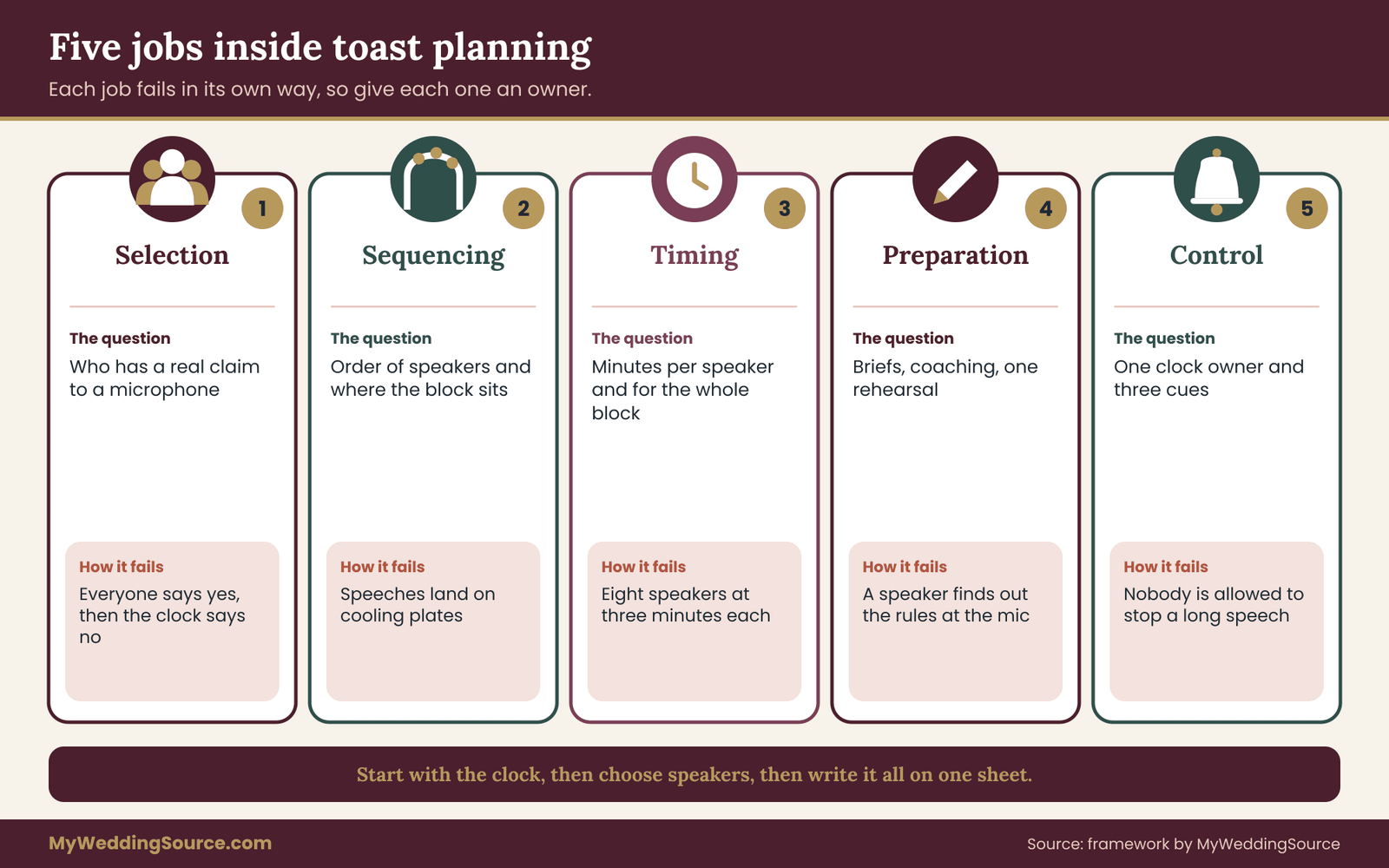
Toast planning has five jobs, and it helps to separate them because each one fails differently.
The first is selection: who speaks at all. The second is sequencing: the order and the position inside the reception timeline. The third is timing: how many minutes each person gets and how the total fits inside the evening. The fourth is preparation: how each speaker is briefed, coached and rehearsed. The fifth is control: who holds the clock, what the cues are and what happens when something goes wrong.
Most couples handle the first job by instinct and skip the other four. They say yes to everyone who asks, put the toasts “somewhere around dinner,” and hope the emcee will manage it. That can work at a forty-person dinner. At a hundred guests with a plated meal, a band, a photographer with a shot list and a venue with a hard end time, it does not.
This toast planning guide stays narrow on purpose. The wider reception sequence, with entrances, first dance, cake and exit, belongs to the reception guest flow guide, and the ceremony side, including readers and officiant cues, sits in the ceremony cue sheet guide. Here the subject is the toast planning block itself and the people in it.
What you will have at the end
By the last section you will have four working documents, all of them short.
A candidate list with a decision beside each name. A one-page toast run-of-show that shows the slot, the speaker, the minutes and the cues. A one-page speaker brief for each person who will hold a microphone. And a failure sheet that says, in advance, who does what when a speech runs long, a microphone fails, or a speaker is not in the room when called.
None of this requires software. A shared document and a printed copy at the DJ table is enough. What matters is that it exists before the day and that more than one person can read it. That habit is the foundation of reliable toast planning.
The idea behind the toast planning matrix
The core tool is the speaking order matrix. Think of it as a grid in your head, or on paper, with one row per slot. Each row answers eight questions: which slot type is this, who is speaking, what is the purpose of the speech, how many minutes, what cue starts it, what cue ends it, what is in the glasses, and what is the backup if the speaker cannot go.
The reason to build it this way is that a toast is a scheduled event with dependencies. It depends on the kitchen, on the sound, on the speaker being nearby, on the glasses being filled, on the guests being seated. The toast planning matrix makes every dependency visible, and a visible dependency is one that somebody can own.
Later sections explain each column. The worked example near the end fills out the whole matrix for an invented couple so you can see how the pieces fit. Keep this point in mind whenever your toast planning gets crowded.
Who this guide is for
It is written for couples who are making the decisions, for the family member or friend who agreed to emcee, and for a planner or coordinator who wants a clean structure to adapt. It also helps speakers, because several sections explain what a good brief looks like from the speaker’s side.
It is less useful if you have decided to have no toasts at all. A later section covers alternatives for that case, including toast-free formats that still give people a way to say something. Small details like this decide whether toast planning feels calm or frantic.
Terms used in this guide
A few terms recur, so here are plain definitions. The toast block is the stretch of the reception where speeches happen, whether it is one block or two. A slot is one position in the sequence. The clock owner is the single person who watches the time and gives cues to speakers. The handoff is the transition between one speaker finishing and the next one starting, including applause, the walk to the microphone and any introduction. A cue is a signal, spoken or visual, that something is about to start or must end.
You will also see the word “toast” used two ways. In the narrow sense, a toast is the moment when guests raise a glass and drink. In the broad sense, people call any wedding speech a toast. This guide uses the broad sense, and it says “the raised glass” when it means the narrow one. Clear toast planning here saves an awkward conversation later.
Who gets a microphone: the four-gate test for toast planning
The most common planning error is treating the speaker list as a list of honors. Treat it as a list of slots instead. Every slot costs the room minutes, and the room has a limited supply.
A fair way to decide is the four-gate test. A candidate has to pass all four gates, or be moved to a different format. The gates are Role, Story, Voice and Clock.
Gate one: Role
Role asks whether the person has a reason to speak that the guests will understand without explanation. Hosts have one, whoever is paying or hosting the event. Parents often have one. The best man and the maid of honor usually have one, because the role itself implies a speech. A grandparent may have one, particularly when they are the family elder.
A role claim does not mean obligation. It means that nobody in the room will wonder why this person is holding the microphone. When a candidate has no role claim, such as a coworker of the groom’s who wants to say a few words, the next gate matters more, because the speech has to earn its place.
Be honest about role claims that are really family politics. A relative who expects a speech because their sibling gets one is asking about fairness, not about role. Fairness is a real concern, and later sections give scripts for handling it, but it is a different question from whether the toast belongs in the room. Write the answer on your sheet, since toast planning depends on what is written down.
Gate two: Story
Story asks whether this person can say something that only they can say. A toast that repeats what the previous speaker said about how wonderful the couple is adds minutes without adding meaning. A toast that offers one specific, kind, short story from a person’s own relationship with the couple adds something nobody else can.
You usually cannot judge story from outside, so ask for it. A short message to each candidate works: “In two or three sentences, what would you want to say about us?” The answer tells you whether they have a story, a list of compliments or a plan to improvise. Do not treat a weak answer as an insult. Treat it as information for the next gate.
Story also covers fit. A story that works at a bachelor party, one that embarrasses a grandparent, one that involves an ex, or one that depends on references nobody else understands does not fit a mixed-age reception. The coaching section covers how to raise this with a speaker without making it personal. Most couples who struggle with toast planning skip this step.
Gate three: Voice
Voice asks about practical delivery. Can this person speak for three minutes to a room of a hundred people, with or without notes, without a high chance of freezing, rambling or being inaudible? Some people are wonderful on a dance floor and miserable at a lectern. Some of the people who say they would love to speak are the ones who will cause the most trouble.
Voice also covers hearing and speech differences. A speaker who is hard of hearing, who stutters, who is more comfortable in another language, or who needs to sit, can all give excellent toasts. They may need a different format, a different microphone or a longer slot. That is a planning matter, not a reason to cut them.
Be careful not to use the voice gate to exclude people for being nervous. Nerves are normal and can be coached. The test is whether the person is realistically able to deliver something good with the support you can give. This is where toast planning stops being abstract and becomes a schedule.
Gate four: Clock
Clock asks whether the schedule can afford this person. It is the least personal gate and the one couples avoid most. If your evening can hold twenty-two minutes of toasts and eight people have asked to speak, the arithmetic decides, not affection.
A useful trick is to run the clock gate first on paper. Set the total toast time you can afford, divide by the default slot length, and see how many speakers fit. If the answer is five and your list has eight names, you already know three people will go to another format. Then apply the other gates to decide which three. That order keeps the conversation about the structure rather than about individuals.

Putting the gates together
Write each candidate’s name down and mark each gate pass, hold or fail. A pass on all four means a slot. A hold means a conversation, such as asking for a draft, a rehearsal video or a shorter slot. A fail on role, story or voice means another format. A fail on clock means a different slot, a pair arrangement or a different event.
The result is not a verdict on anyone’s worth. It is a list of speakers whose toasts you can schedule with confidence, and a list of people you can offer something else. The later sections spell out those alternatives so that the people left off the list still have a meaningful way to take part. Revisit it whenever your toast planning changes.
A short script for the hardest conversation
When you must say no, speak early, in person or by phone, and give the reason in terms of the clock. For example: “We have room for five speakers and about three minutes each, and we are already past that with family. We would love for you to give your toast at the rehearsal dinner instead, or write us a note we can read on our first anniversary. Which would you prefer?”
Notice what that script does. It names the constraint, offers two real alternatives and ends with a question that gives the person a choice. It does not apologize for the decision or invite a debate. Treat it as a standing rule for the rest of your toast planning.
Speaking order for toast planning: seven slot types
Once you know who is speaking, the question is where each person sits in the sequence. Order shapes how the whole block feels. A strong opening settles the room. A weak middle loses it. A closing speech that lands makes the whole block feel complete.
Toast planning works better when you think in slot types rather than in names. Seven types cover almost every reception.
The seven slot types
The welcome. A short opening, usually by a host, a parent or the emcee, that thanks guests for coming and tells them what the next stretch looks like. It is typically two or three minutes, often given before food is served, and it does not need a raised glass.
The blessing or opening words. Optional. A brief spoken or religious opening before the meal. One minute is plenty. Some families treat this as non-negotiable, and it can be combined with the welcome when time is short.
The family toast. A parent, grandparent or another elder speaks for their side of the family. These speeches carry weight and often run slightly longer than friends’ speeches, so they get four minutes in this model.
The wedding party toast. The best man, the maid of honor, a sibling serving as an attendant. These are the speeches guests expect, and they carry the most variance. They are usually the funniest and the riskiest.
The friend or guest toast. A close friend, a mentor, someone outside the wedding party. These need the strictest time limit and the clearest brief, because they have the least guidance from the role itself.
The couple’s response. The couple’s own thank-you, either together or one partner on behalf of both. This is rarely long, and it works best when it is truly a thank-you rather than a third speech about each other.
The closing toast. A final raised glass that signals the block is over. Often the host or the emcee gives it in a sentence. It tells guests the speeches are finished and the evening moves on.
Seven rules for ordering them
These rules are the working part of the speaking order matrix. They are rules of thumb, not laws, and you can break one when you have a reason you can say out loud.
Rule one: hosts before friends. The people who invited the guests speak first, because they set the register and thank the room. Guests expect it, and it keeps a funny speech from preceding a formal welcome.
Rule two: the couple closes. The final speech is the couple’s, unless the family has a tradition that gives a parent the last word. The reason is simple: they have the last claim on the room’s attention, and a thank-you is a natural ending.
Rule three: ramp the energy. Put lighter, shorter speakers earlier and the most sincere, longest ones later. A room that starts with laughter handles an emotional speech better than a room that starts with tears and has to recover.
Rule four: separate similar voices. Two speeches with the same tone and structure back to back feel like one long speech. Put something different between them, such as a parent’s toast between two friends’ toasts.
Rule five: protect the people who cannot wait. If a speaker has a child who needs to go to bed, an elder who tires early, a shift that begins at dawn or a flight at night, they go early. This is a kindness, and it keeps you from the sight of a grandparent waiting forty minutes to say two sentences.
Rule six: put the long-winded before a natural stop. If you know a speaker tends to run over, schedule them just before something that will force a conclusion: the entrée being served, cake cutting, a performer’s set. The next event is a backstop.
Rule seven: pair, do not stack. If two people have a joint history, such as two best men or two siblings, consider a single paired slot of four to five minutes instead of two separate slots. Paired slots save the handoff minute and usually produce better material, because the speakers cannot both tell the same story.
Breaking the rules on purpose
Every rule has a reason, and so does every exception. If the groom’s mother has been recovering from an illness and wants to speak last because she tires early in the evening and needs to leave, the exception makes sense. If a father insists on speaking last because he feels second-place otherwise, the rule probably holds, and a respectful conversation is the better tool.
When you break a rule, write the reason in the margin of the toast planning run-of-show. Your emcee, who will not remember the conversation, will read the toast planning sheet and make decisions based on it. It costs little and protects the whole of your toast planning.
Traditional order versus a modern order
Many couples ask for the traditional order. Traditions differ by family, region and culture, so there is no single version, and no single version is correct. A frequently described pattern runs from host and parents, to the best man, to the maid of honor, and ends with the couple. A modern variant often moves the couple’s thank-you to the start, as a welcome, and lets the friends’ speeches close the block with some humor.
Neither pattern is better in itself. The version that works is the one that fits your service style, your family’s expectations and the energy of your guests. If you have a culturally specific order of speeches, such as a set sequence of family elders, honor it, and adapt the time budget around it rather than the other way around. Good toast planning leaves room for this kind of human detail.
Where to put the toast planning block in the evening
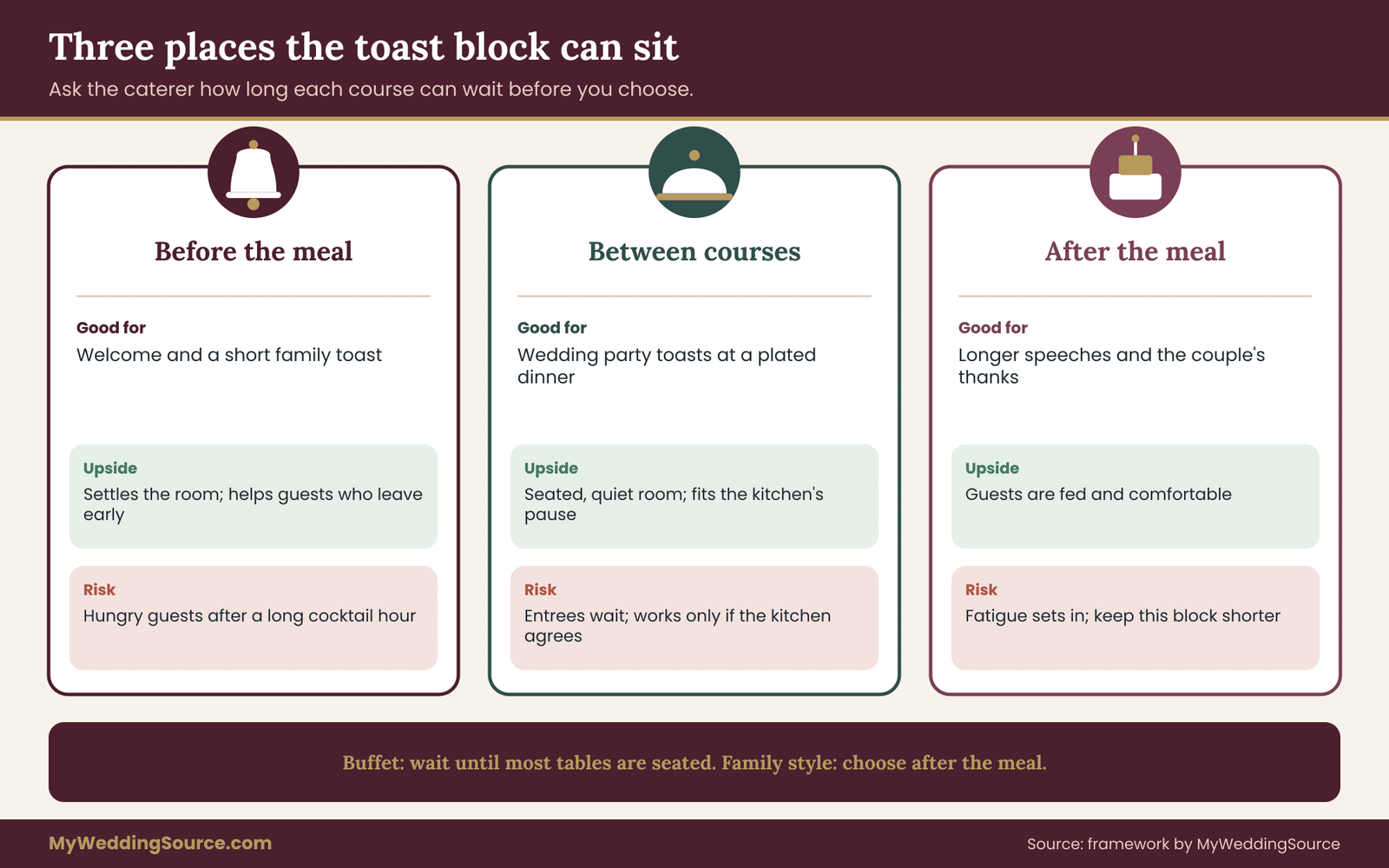
The speaking order sits inside a larger sequence, and the placement of the whole block matters as much as the order inside it. There are three common placements.
The first is the pre-meal block: the welcome and a short toast before the first course. It is good for setting the room and for people who cannot stay late, but it is risky if the guests are hungry after a long cocktail hour.
The second is the between-courses block: speeches in the gap between the first course and the entrée, or between the entrée and dessert. It works well with a plated dinner when the kitchen agrees, because guests are seated and the room is quiet. The wedding menu planning guide explains how service style affects what the kitchen can hold and when.
The third is the post-meal block: speeches after plates are cleared and before cake or dancing. It is the most common and often the best, because the guests are fed and comfortable. The risk is the fatigue that sets in after a long dinner, so the block should be shorter than you think.
Many receptions split the speeches: the welcome and one or two family toasts early, the rest later. Splitting reduces the sit-and-listen burden and lets you place high-energy speeches when energy is highest.
How service style changes the order
The service style of the meal changes where the block can sit, so confirm it with the caterer rather than assuming.
At a plated dinner, the kitchen fires courses in sequence, and a speech between courses can cause plates to sit under a heat lamp. Ask the catering captain how long the entrée can wait, and ask how many minutes of speech fit between salad clearing and entrée service. Do not guess.
At a buffet, guests move at different times, so a speech needs a moment when most people are seated. A common solution is to run the welcome before the first table is released, and to hold the rest until the last table has been through the line.
At a family-style or station meal, there is no clean gap, so the post-meal block is usually easier than a mid-meal one.
At a cocktail-style reception, with no seated meal, guests are standing. Toasts should be shorter, the speaker should be on a visible riser or step, and the microphone matters more. Simple toast planning keeps the focus on the people involved.
Speakers who are not at the head table
A detail that causes real trouble: where speakers sit. If the best man is seated at a table across the room, he needs to be told when to walk, and the walk takes time and passes through other guests. The wedding seating chart guide covers how to seat people, and for toast planning the simple rule is to seat every speaker within a short walk of the microphone and with a clear path.
Seat older speakers on the aisle side of a table, seat anyone who needs a mobility aid with a clear approach, and tell speakers where they will stand before the day. A decision made early makes the rest of toast planning easier.
The part toast planning often forgets: the person introducing
Someone has to say each speaker’s name. The simplest solution is the emcee or a designated friend with a one-line formula: name, relationship, “please welcome.” An introduction should take ten seconds. A long introduction becomes a speech before the speech and eats into the slot.
If you do not have an emcee, the DJ or the band leader can do it, provided they have the correct names and pronunciations on the toast planning sheet. Put pronunciations on the toast planning sheet. A mangled name at the start of an emotional toast is a small wound that is easy to prevent. Share it with the person who owns the clock so your toast planning stays in sync.
A sample order, with reasons
To make the rules concrete, here is one possible order for a plated dinner with a welcome, five speakers and a couple’s thank-you. The reasons beside each position are the part to borrow, not the names.
The host parent opens with the welcome, because they invited the guests and set the register. The best man goes first among the friends, because his speech is the most likely to be funny and gets the room warm. The maid of honor follows, because her tone usually differs and the contrast helps. A parent from the other side speaks next, because an elder’s sincerity lands better after two lighter speeches. A grandparent gives a short toast, because the room will quiet for it. The couple closes with a thank-you, because they own the last word.
That order changes with your people. The structure, a host opening, ramping energy, elders late, couple last, is what to keep. It is a small piece of toast planning that pays off on the day.
The toast run-of-show and speaking order matrix
Here is the central tool of this guide, laid out in words so you can copy it into a document of your own. Each row is a slot. Each slot has eight fields. If you can fill out all eight for every slot, your toast planning is finished. If a field is blank, that blank is the next thing to ask someone.
The eight fields
Slot. The type from the previous section: welcome, blessing, family toast, wedding party toast, friend toast, couple’s response, closing toast. Using the type name keeps the toast planning sheet readable.
Speaker. The name, spelled the way the emcee should say it, with the pronunciation if it is not obvious. Add a mobile number for anyone who might be late, because the clock owner may need to find them.
Purpose. One phrase that says what the speech is for. “Welcome and thanks.” “Funny story, then toast.” “Elder’s blessing.” The purpose lets the emcee judge whether a change is acceptable. If a speaker asks to add a video, the purpose tells you whether it fits.
Minutes. The cap, including the raised glass but excluding the handoff. Three minutes means about three minutes. A later section explains how to choose the numbers.
Cue in. What starts the speech. Usually the emcee’s introduction, but it may be a signal from the kitchen that the room is ready, a DJ’s music cut, or a lighting change. Write it as an action, not an intention.
Cue out. What ends the speech. The speaker’s own closing line, the raised glass, a signal from the clock owner at the soft cue, or applause. Naming it prevents the common failure of speakers who trail off without a clear ending.
In the glasses. What guests will drink for the raised glass. Champagne, sparkling cider, water, a signature drink. This is a service question, because someone has to pour it before the toast begins. Confirm that servers know when to pour and that non-drinkers have something to lift.
Backup. What happens if this speaker cannot go. Someone else steps up, the slot is skipped, or the speech is read by another person. Writing it down makes a surprise manageable.
One sample row, written out
To show the format, here is a single row for an invented best man named Marcus Hale, because a made-up person is safer than a real one.
Slot: wedding party toast. Speaker: Marcus Hale, best man, mobile on file. Purpose: one short story, then a toast to the couple. Minutes: three. Cue in: emcee introduction after the maid of honor sits. Cue out: raised glass and “to Dana and Luis.” In the glasses: sparkling wine already poured by servers during the preceding applause. Backup: the groom’s brother reads the notecards Marcus gave the emcee in advance.
That is eight fields, one paragraph and about seventy words. A full run-of-show for six slots takes a page. It is cheap to make and expensive to omit. Check it again a week before the wedding as part of final toast planning.
The columns the vendors read
Different people use different columns, and it is worth knowing who reads what. The emcee cares most about slot, speaker, purpose and cues. The DJ or AV technician cares about the microphone assigned to each speaker, the music cues and any media to play. The catering captain cares about the cue in and the glasses. The photographer cares about the order and the positions, so they can be in place before each speech.
You do not need to give every vendor the whole document. A one-page version with the columns they need is easier to follow. The wedding vendor timeline guide covers how to hand a schedule to vendors so that it is read, and the same habits apply here: a single source of truth, a version date and a named person who answers questions. Few parts of toast planning matter more than this one.
Adding the sound column
For most receptions, add one more field: Microphone. Handheld, lavalier, headset, podium, or a shared wireless handheld passed around. The type matters because a handheld needs a free hand, which means no notecards and a glass in the other hand is a juggling act. A lectern with a fixed microphone solves that but turns the speaker into a statue. Decide with your AV provider, and test with an actual speaker, not a sound check. Put it in writing so that everyone involved in toast planning sees the same version.
A spare-slot rule
Leave one slot unassigned in the toast planning matrix, marked as the buffer. It is not a speech. It is two minutes of slack that absorbs a late start, a long introduction or a round of applause that goes on longer than expected. A run-of-show with no slack is a run-of-show that is late by the second speaker. The point is to make toast planning predictable, not rigid.
Version control for toast planning
Toast planning changes up to the last day. A speaker drops out, a grandparent arrives late, a toast is added after a family conversation. Use a version date at the top of the toast planning sheet and one place where the latest version lives. When a change happens, tell the emcee, the DJ and the caterer directly rather than assuming they will see the document.
On the day, hand out printed copies. A phone battery dies, a Wi-Fi connection fails, and a laminated sheet on the DJ table does not. This keeps toast planning fair to speakers and kind to guests.
Time limits: building the speaker time budget
Time limits are where toast planning becomes arithmetic. The goal is a budget you can defend, not a number pulled from a blog. The basic structure is simple, and you can adapt it to your room.
Start with the total, not the speaker
Most couples set time limits speaker by speaker, “three minutes each,” and discover too late that eight speakers at three minutes is twenty-four minutes, plus handoffs, plus the welcome, plus the couple’s thanks. Reverse it.
Decide the total toast time your evening can hold. Then subtract slack, then divide by speakers. The total depends on your guest count, the meal service, the age mix, the length of the reception and the venue’s end time. A rough working range for a seated reception with a plated dinner is a toast block of fifteen to twenty-five minutes in total, spread over one or two sittings. Treat that as a starting hypothesis to test, not a rule, and shorten it for children, older guests and long evenings.
The formula
Here is the working formula, in words.
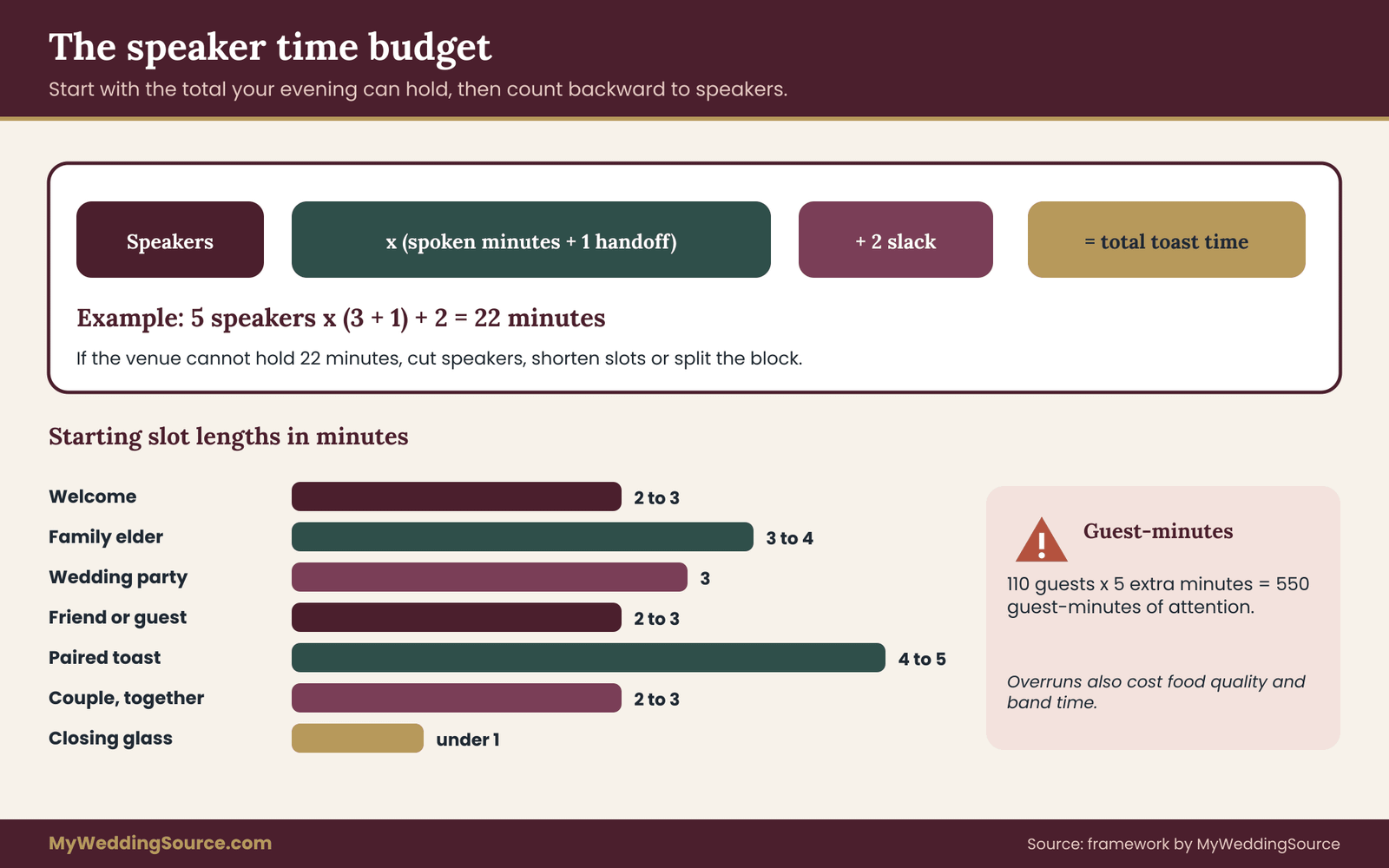
Total toast time equals the sum, across all speakers, of the spoken minutes plus one minute of handoff, plus two minutes of slack for the whole block.
Take five speakers at three spoken minutes each. That is fifteen spoken minutes, plus five handoff minutes, plus two slack minutes, for a total of twenty-two. If your venue will hold twenty-two minutes without harm to the kitchen, the band or the end time, the budget works. If it will not, you have three levers: fewer speakers, shorter slots or a split block. Cheap to do and costly to skip, it belongs in every round of toast planning.
Default slot lengths
These defaults are a starting point you can adjust.
The welcome is two to three minutes. A family elder’s toast is three to four minutes. A wedding party toast is three minutes. A friend or guest toast is two to three minutes. A paired toast is four to five minutes. The couple’s response is two to three minutes in total, not per person. The closing toast is under one minute.
The word counts that sit behind these times depend on how fast a person speaks, and speaking pace varies a lot, especially under stress. A common rule of thumb is that a comfortable speaking pace is somewhere near a hundred and thirty words a minute, which means a three-minute toast is about four hundred words. Treat that as a rough guide, and have each speaker read their draft aloud with a timer, since only the real reading tells you the real length. Your toast planning will be easier to defend if the reason is written down.
Why three minutes
Three minutes is not magic. It is long enough for one story and a toast, and short enough that most audiences remain attentive. A shorter speech can be wonderful, and a longer one can work if the speaker is skilled and the material is strong. The problem is not the number. The problem is a speaker who has no number.
Give the cap as a range with a firm top: “Aim for two to three minutes. Three is the limit.” Speakers tend to run over, so a stated limit that is slightly below your real tolerance gives you a margin. That is the practical heart of toast planning.
The guest-minutes view
A helpful way to think about cost is guest-minutes. If a hundred and ten guests sit through a speech that runs five minutes over, that is five hundred and fifty guest-minutes of attention spent, on one person’s extra material. Whether it is worth it depends on the speech. A moving, funny story is a bargain. A rambling one is a debt.
Guest-minutes also explain why toasts at a large reception need tighter caps than toasts at a dinner for twelve. The audience is larger, the distance from the speaker is greater, and side conversations start sooner. Any vendor reading your toast planning sheet should be able to see this at a glance.
The hidden costs of overrun
An overrun does not only annoy guests. It can touch contracts and costs. A kitchen that must hold plated entrées pays in food quality. A band or DJ booked for a fixed number of hours may charge for overtime, depending on the contract, so read yours rather than assuming. A venue with a hard end time may cut the evening short, usually in the part you care about, such as the last dances or the send-off.
This guide does not quote prices, because they vary by vendor and region. The point is that a slot has a price in some currency, even if the currency is attention or food temperature. Ask each vendor what an extra fifteen minutes would do to their service, so you know the stakes. Returning to this question is a normal part of toast planning.
A split budget
If the total looks too long for one sitting, split it. Put the welcome and one or two family toasts before the meal, the wedding party between courses or after the entrée, and the couple’s response before cake. Each block can be shorter, which keeps guests from sitting through fifteen minutes of speeches in a row.
A split also lets you assign the clock-owner’s attention to smaller chunks, which reduces the chance of a total overrun. The tradeoff is more handoffs, so check that the sound system and the microphone logistics can handle repeated use. Flexible toast planning plans for the exception as well as the rule.
Time limits for special cases
Some situations need a different approach to time limits.
Interpreted toasts. If a speech is translated, the time effectively doubles, because each sentence is spoken twice. Either budget double the minutes or ask the speaker to write a shorter piece. The same applies to toasts with sign language interpretation, where the interpreter benefits from advance notes and a slower pace.
Toasts with media. A slideshow or a video adds technical risk and minutes. Cap media at a fixed length, test the file on the actual equipment, and place it at the start or end of a slot, not in the middle of a speech.
Toasts in a second language. A speech partly in another language may need a short summary in English for guests who do not speak it. A brief handoff to a bilingual friend works better than the speaker translating themselves under pressure.
A speaker who is ill or tires easily. Offer a seated microphone, a shorter slot and the freedom to stop early. Tell the clock owner to avoid any hard cue for this person.
Fitting toasts to the meal, the room and the cues
A speaking order and a time budget are only as good as their fit with the room. This section covers the practical side: the kitchen, the guests’ attention and the cue system that keeps everyone in sync.
Talk to the kitchen before you write the order
The single most useful conversation in toast planning is with the caterer or the catering captain. Ask four questions. How long can each course wait before quality drops? When does the kitchen need to know that a speech is starting or ending? Who gives that signal? And how many minutes of speech between courses does the team consider workable?
Their answers set hard edges. If the entrée can wait ten minutes, a block between courses must fit inside ten minutes, handoffs included. If it cannot wait at all, the block goes before the meal or after it.
Kitchens differ, and so do the answers. Do not assume that what worked at a friend’s wedding works for your menu. A cold first course gives more room than a hot one, a banquet room with a nearby kitchen gives more room than a hall with a long carry, and a caterer with a large staff recovers faster than a small one. Keep your toast planning notes short enough that people actually read them.
The cue chain
A cue chain is the sequence of signals that moves the toast planning block from the kitchen to the microphone. A typical chain runs like this: the catering captain signals that service is paused, the clock owner confirms that glasses are poured, the emcee announces the first speaker, and the DJ lowers the music. Each link has one owner.
Write the chain down, with names. When something fails, the chain shows where. A common failure is that the DJ lowers the music before the glasses are poured, and guests sit in awkward silence while servers hurry. Another is that the emcee starts before the photographer is in position, so the first minute of the first speech goes unphotographed.
The ceremony equivalent of this chain is covered in the ceremony cue sheet guide, which explains how officiants, music and readers hand off to each other. The reception version uses the same habits with different people. This is one more reason toast planning starts weeks before the day.
Who owns the clock
Name one person as the clock owner. Not “the DJ and the planner and the best man.” One person. The clock owner watches the time, holds the toast planning run-of-show, gives cues to speakers and decides when to use a firm cue or hard cue.
Good clock owners are calm, respected by family, comfortable with a microphone and not themselves in the toast block. A hired coordinator, a professional emcee or a trusted friend with no speech to give all fit. The couple should not own the clock, because they are the people in the room least able to attend to it. A parent should not own it either, because telling a relative to stop is hard for family. Done well, toast planning makes this invisible to the guests.
The three-level cue system
An overrun needs a response you can scale. A three-level system is easy to explain to speakers beforehand and easy to carry out on the day.
The soft cue happens at the time a speech should be wrapping up, say at two minutes thirty for a three-minute slot. The clock owner stands near the speaker’s line of sight, holds up a small card or a visible sign, or gives a quiet nod. The speaker sees it and starts moving to a close.
The firm cue happens at the cap. The clock owner steps forward, applauds lightly or says, “Let’s raise our glasses.” Most speakers read the room and finish.
The hard cue is the last resort. It happens at an agreed point beyond the cap, for example ninety seconds over. The DJ fades the music in softly, or the emcee takes the microphone with a warm thank-you. It is rarely needed, and its mere existence tends to keep speeches short.
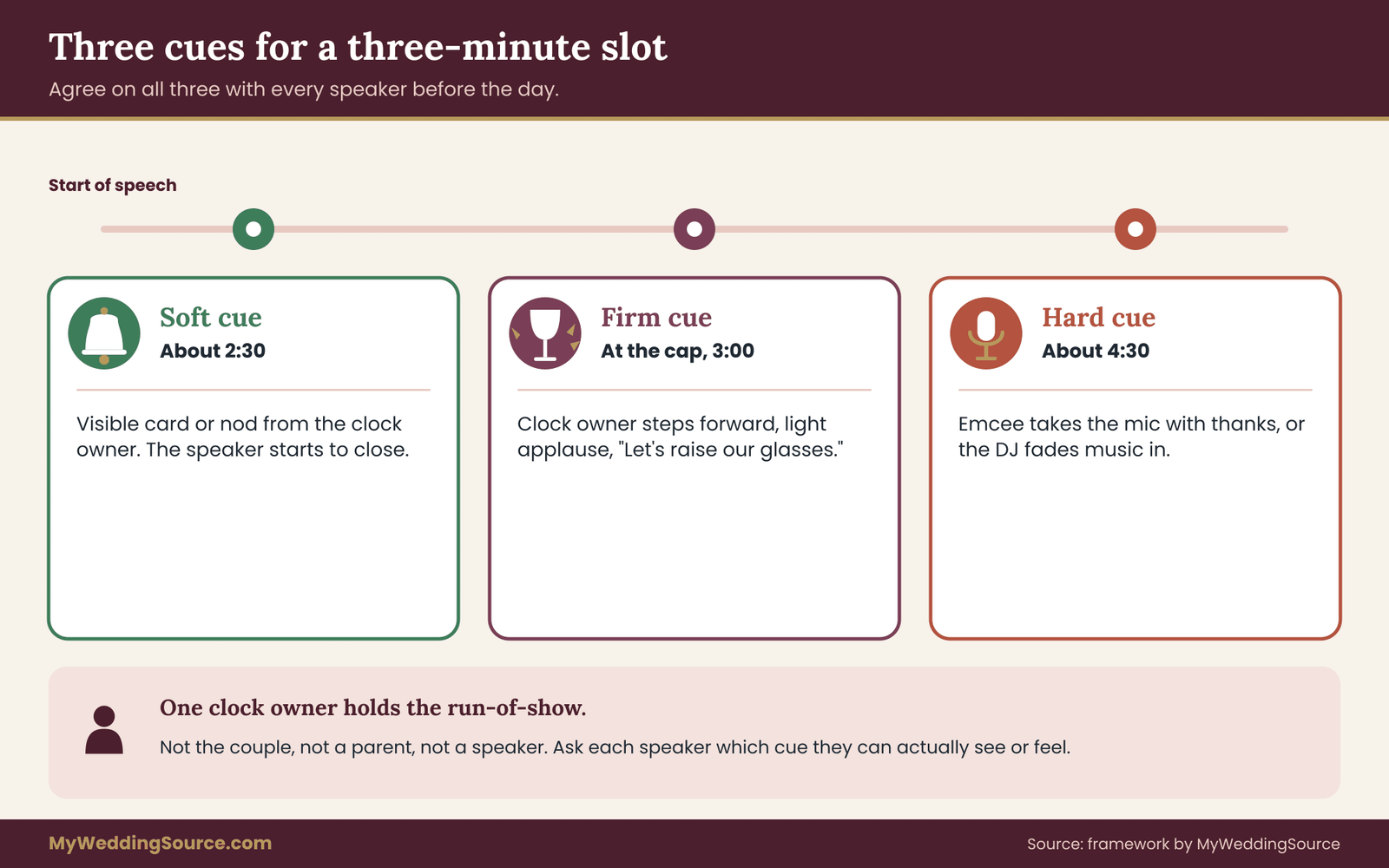
The important part is that every speaker knows the cues in advance. A surprise cue feels like an ambush. A cue the speaker agreed to feels like help. Sound toast planning anticipates this before it becomes a problem.
What the cue looks like
Choose cues that suit your crowd. A small card with a large number can be held where only the speaker sees it. A friend standing at the side with a raised hand works at a smaller event. In a large hall, the clock owner can walk to the front of the room. A visible clock at the back of the room can help a speaker who wants to self-manage.
Avoid cues that guests will notice and enjoy, such as air horns or a game-show buzzer. They can work at a casual wedding when the speaker is in on the joke, but they can humiliate a nervous speaker, and you cannot undo it. Ask for help with this part of toast planning if you need it.
Handling the room’s attention
Guests lose attention in predictable ways. Side conversations begin when a speech passes about four minutes, when the story has too many names, or when the speaker is hard to hear. Phones come out when the speech becomes about the speaker rather than the couple. Servers clatter when clearing continues during a speech.
Ask the catering team to pause clearing during speeches, and ask the bartenders to stop service for the length of each speech. Seat the couple where the speakers can face them, because a speech directed toward the couple tends to be warmer and shorter than a speech directed at the whole room. Remember that toast planning serves the guests as much as the speakers.
Photographers, videographers and the light
If you have a photographer or videographer, tell them the order and the positions. They need to know where each speaker will stand, whether there is a spotlight, and whether the couple should be turned toward the speaker. A speech in the wrong lighting becomes a series of unusable images.
Speaking positions also matter for sound. A speaker who stands next to a loud speaker will cause feedback, and a speaker who stands in front of a window can disappear into backlight. Walk the speaking spot with the AV provider and the photographer before the day.
The wedding photography consent guide addresses how to treat guests’ images and boundaries, which becomes relevant if a toast includes personal stories about people who may not want them recorded or shared. Review it as part of your last round of toast planning.
Cues for people who cannot see or hear them
If a speaker is Deaf or hard of hearing, an auditory cue is useless, and if a speaker has low vision, a card is useless. Ask the speaker what works. A tap on the shoulder from a trusted person, a vibrating timer on a wrist, a written note in large print or a pre-agreed gesture may all be options. The same question belongs in the brief for every speaker: “How should I signal you if you are running long?”
Music and toast planning
The DJ or band is part of the cue chain, so involve them early. Music underscoring a speech, a sound check before the block, and the transition to dancing all affect toast planning. The reception music planning guide covers the music side. For the toast block, the practical points are these: agree on a start cue, confirm that music is silent during speeches, and decide what plays under applause.
A DJ can also protect the clock. If the block runs to the cap and the next item is a dance, the DJ can begin the music at the hard cue, which makes the transition feel natural rather than abrupt. Calm toast planning is mostly a matter of asking this kind of question early.
Speech coaching for toast planning: briefing speakers without writing their speeches
Coaching is the part of toast planning that couples fear most, because it involves telling friends and relatives how to speak. It need not be uncomfortable. The trick is to coach the format and not the person: set clear expectations, give people tools and let them do the writing.
Who coaches
If you have a professional emcee or a speech-coaching friend, ask them to help. Otherwise, the couple, a coordinator or the clock owner can send a short brief and offer one optional rehearsal. Do not appoint a family member as a critic, because feedback from a relative lands differently than feedback from a neutral person.
You are not rewriting speeches. You are making sure each speaker knows the slot, the time, the audience, the tone and the logistics, and has a chance to practice once in the real conditions. Build it into your toast planning from the start.
The one-page speaker brief
Send each speaker a brief at least three weeks before the wedding, and send a reminder a week before. The brief covers eight items.
The slot and the time of day. The minutes allowed and what happens at the cues. The audience: ages, languages, relationships, anyone who may be sensitive about a topic. The tone: warm, funny, short. The topics to avoid. The microphone type and where to stand. What to bring: notes, printed in large type, numbered pages. And what happens at the end: the raised glass and the exact words that end the speech.
Keep it to a page. A brief that is longer than the speech it is meant to guide does not get read.
A structure that works for most speakers
Many people freeze because they do not know how to start. Give them a simple structure, which they can ignore if they have a better one.
Open with who you are and how you know the couple, in one or two sentences. Tell one short story that shows something true about one or both of them. Turn to the couple by saying what the story shows and what you wish for them. Close with a single sentence, then the raised glass.
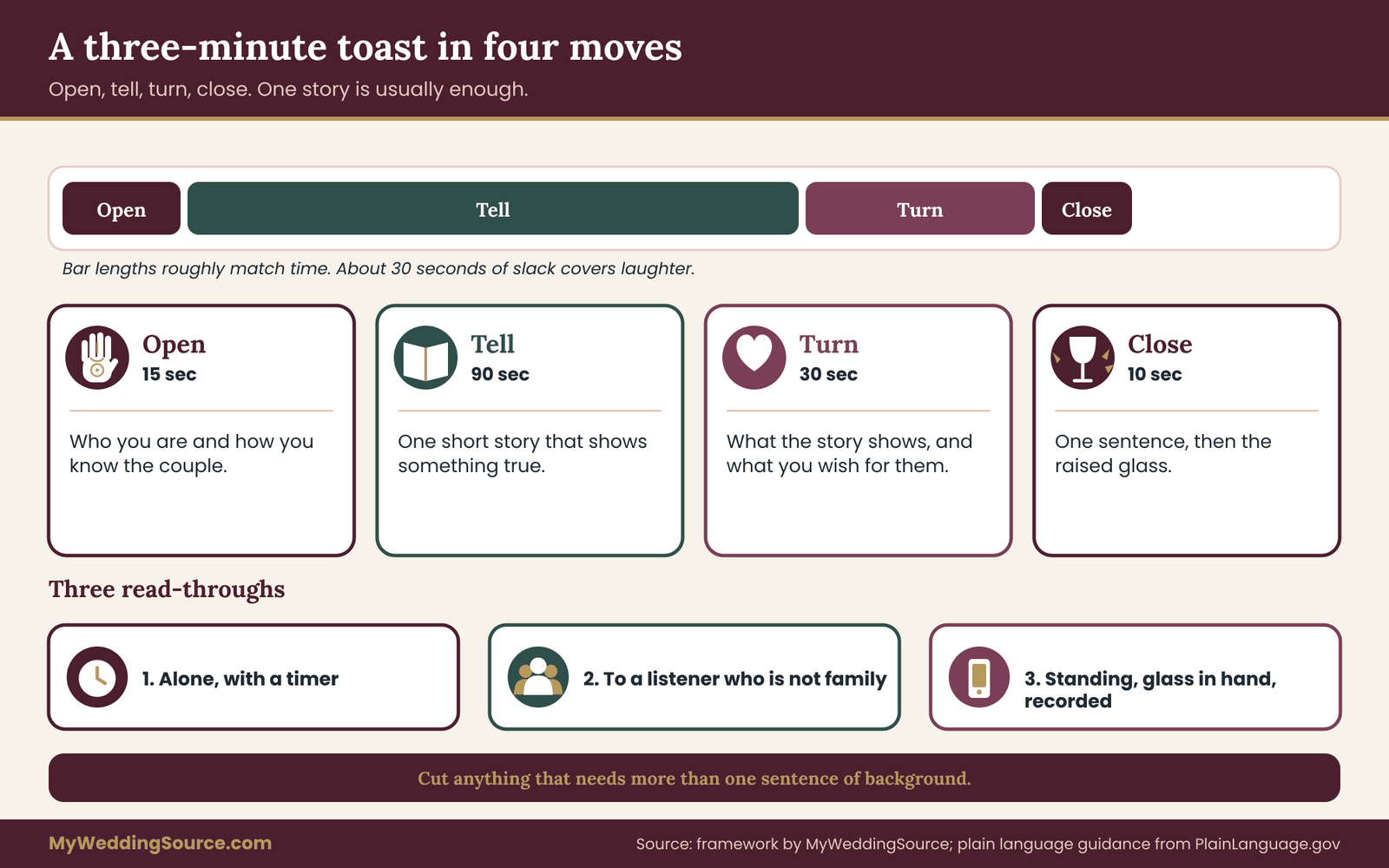
For a three-minute speech, that is roughly fifteen seconds to open, ninety seconds for the story, thirty seconds to turn and ten seconds to close, with a little slack for laughter. One story is the usual limit. Two stories usually mean two weaker stories.
Plain language helps. The U.S. government’s plain language guidance recommends short sentences, familiar words and one idea at a time, and those habits suit a spoken toast better than a written essay. Sentences that read well on paper often sound stiff aloud.
The story filter
A story filter is a short set of questions a speaker can use to check a draft. Would the couple be glad to hear this? Would a grandparent be comfortable? Does it need background that takes more than one sentence? Does it make the speaker the main character? Does it mention an ex, a past drinking story, money, a body, a diagnosis or a family conflict? If the answer to any is yes, change it.
The filter works because it gives speakers a way to cut their own material. People are more willing to delete a joke they have judged themselves than one a bride has vetoed.
Three read-throughs
Recommend three practice rounds. The first is alone, aloud, with a timer, which tells the speaker the real length. The second is to a listener who is not family and who will say what was unclear. The third is standing, with a glass in one hand and the notes in the other, ideally recorded on a phone, which shows how the speech looks and sounds.
A fourth round at the venue, with the actual microphone, is a luxury, but it is worth offering to speakers who are very nervous. Even five minutes of standing at the spot reduces fear.
Scripts for common coaching moments
Coaching is easier with words ready. Here are scripts for situations that come up often.
The speaker who wants to wing it. “We love your instincts, and we would like you to have one anchor. Could you write down your opening line and your closing line, and trust yourself in the middle? We will keep a copy at the DJ table in case you want it.”
The speaker whose draft is too long. “We timed it at six minutes and the slot is three. Which story do you love most? Let’s keep that one and trim the rest. Everything you cut can go in a note to us.”
The speaker who wants slides or a video. “That could be fun. Media adds risk and time, so we need the file by this date, a test on the DJ’s equipment and a cap of ninety seconds. If any of those slips, we will do the speech without it.”
The speaker who wants to sing, rap or perform. “We love the idea. Because performance runs differently from a speech, we will give it a separate slot and a separate time check. Can you send us the song and the length?”
The speaker with a risky story. “That story is funny, and we are not sure every guest will see the humor. Is there a different story where you are the one who looks silly?”
The speaker who is terrified. “You do not have to be good at this. A short, honest speech will land better than a polished one. Would it help if you read from a card, or if a friend stood with you?”
Nerves, voice and the day itself
Nerves are normal and often calm down once a speaker begins. Practical help includes numbered notecards in large type, a glass of water within reach, a slow first sentence and permission to pause. Remind speakers that the audience wants them to do well, because guests are generally on the couple’s side.
The National Institute on Deafness and Other Communication Disorders publishes guidance on caring for the voice, including hydration and avoiding strain. For a three-minute toast the stakes are small, but a speaker who has been shouting over music all evening may hoarsen, so brief the speaker to sip water and avoid straining before their slot.
Alcohol and timing
Alcohol deserves a plain mention. Speakers who drink heavily before a speech tend to run long and lose their filter. Ask them to hold their drinks until after their slot and offer them water at the table. This is a courtesy, not a rule enforced by anyone, and it is worth saying kindly.
The National Institute on Alcohol Abuse and Alcoholism explains what counts as a standard drink and how alcohol affects judgment and coordination. For the raised glass itself, a small pour is enough, and having a non-alcoholic option for every guest avoids singling anyone out.
Feedback that helps
Give feedback as observations, not verdicts. “The story in the middle made us laugh, and the last paragraph felt long” is more useful than “It was good but too long.” Offer one thing to keep and one thing to change. A speaker who leaves a rehearsal feeling capable will deliver a better speech than one who leaves feeling judged.
If a speaker declines coaching altogether, accept it, send the brief anyway, and make sure the clock owner knows that this slot has the highest risk. Put that speaker earlier in the order, or before a natural stop, as the ordering rules suggest.
Sound, access and drinks: the logistics behind every speech
A toast can be perfectly written and still fail because a guest at the back cannot hear it. This section covers the technical and access details that belong in any serious toast planning.
Microphones and the room
Ask your AV provider, DJ or venue three questions. How many microphones will be available during the toast block? What type are they? And who handles a failure? A common arrangement is one handheld wireless microphone passed from speaker to speaker. It is simple, but it means a handoff with a physical object, and a speaker who drops it, covers it or holds it too far from their mouth becomes inaudible.
A lavalier or headset microphone frees the hands and keeps the distance steady, which suits a speaker with notes and a glass. A podium microphone suits formal speeches but fixes the speaker in one place. Ask which option the provider recommends for the room, and test it with a real voice.
Wireless microphones use radio frequencies, and in the United States the Federal Communications Commission regulates their use. A professional provider handles frequency selection and interference as part of the job. If you or a friend plan to bring your own wireless equipment, ask the venue and the AV provider first, because a rogue signal can cause dropouts, and the venue may have rules about outside equipment. The FCC’s site explains the basics of wireless microphone use if you want to read more.
Test with a real speaker, in the real room
A sound check with the DJ saying “check, check” is not enough. Test with someone who speaks softly, because quiet speakers are the ones who fail. Walk the room while they talk. Listen near the back, near the bar and near any loud kitchen door. If you cannot hear them clearly, adjust the speakers or the placement before the guests arrive.
Check for feedback by having the tester walk to the speaking spot and talk at a normal level. A squeal at that stage is cheap to fix. A squeal during the best man’s opening is not.
Where guests can hear and see
Large rooms need a visible speaking position. A speaker who stands at floor level behind a table is invisible to half the room. A low riser, a clear spot on a dance floor with a spotlight or a position at the center of a long wall all help. Guests who can see a speaker tend to listen more closely.
For outdoor receptions, add wind and distance. Wind noise can ruin a microphone, and outdoor sound disperses quickly. A windscreen on the microphone, a speaker positioned to block the wind and extra speakers around the space may be needed. Ask your AV provider about a rain plan as well, because moving a toast block indoors changes the sound problem entirely.
Guests who need access
A reception is a social event, and some guests need additional support to take part in the speeches. Planning for that early costs little, and fixing it on the day costs a lot.
Guests who are Deaf or hard of hearing may need sign language interpretation, captions or a seat near the speakers. The Americans with Disabilities Act sets requirements for effective communication in many public settings, and the ADA website explains what that can mean in practice. A private wedding may differ from a public venue, and the venue itself may have obligations, so ask the venue what it can provide and ask your guests what they need.
If you plan to have an interpreter, place them where the guest can see both the interpreter and the speaker, give them the toast planning run-of-show and, if possible, the speakers’ drafts. Interpreters work better with advance material, and they need a slower speaking pace. Add time to the speaker’s budget as described earlier.
Guests who use wheelchairs or mobility aids need a clear path to their seats and to the speaking area if they are speaking. Guests with low vision may benefit from large print programs or a seat near the front. Guests with sensory sensitivities may need a quiet space, because a loud microphone and a cheering room can be overwhelming. A short note in an invitation or a message to the guest is often enough to start the conversation.
Captions and transcripts
If a guest relies on captions, ask the venue and the AV provider whether live captioning is possible, either through a service or through a phone-based tool that a friend runs. A prepared transcript for speeches that have been written down can also help, but it only works if the speaker sticks to the script. Whatever you use, test it before the evening.
Language and translation
For multilingual guests, decide in advance whether speeches will be translated, summarized or delivered in one language. A short summary by a bilingual friend after each speech is often better than simultaneous translation, which doubles the time and can interrupt the flow. If the speaker wants to speak in a language many guests do not understand, ask for a one-sentence English summary at the start so no one feels excluded.
Drinks and the raised glass
A raised glass needs a drink in it. The service team should know when to pour. The usual approach is to pour for the first toast shortly before the speeches begin, with a refresh for any later toast. Confirm with the bar staff how many pours are planned, since a flute poured too early goes flat and a flute poured too late means guests wait.
Offer a non-alcoholic option that looks festive, such as sparkling cider or a mocktail, so that no guest has to hold up a water glass or abstain visibly. Do not make a point of who is not drinking.
Public health agencies such as the Centers for Disease Control and Prevention publish plain guidance on alcohol and its effects. For toast planning the useful takeaway is modest: speakers and guests are better off when the toast block comes with food and water, not after hours of drinking, and when the raised glass is a small pour.
Seating, sight lines and the head table
Think about who sits where during the toast block. The couple should be able to see each speaker. Speakers should sit close to the microphone. The family of a speaker should be able to see them, because family members tend to react strongly. An elderly speaker should sit near the speaking area, with a short, clear path.
A sweetheart table, a long head table and a round-table setup all change the sight lines. If the couple sits with their back to a wall of windows, the photographer will struggle with light, and if they sit at a long table facing the room, the speakers will have their backs to some of the guests. The guest flow guide covers how seating, entry and service interact.
Weather, delays and shortened evenings
If the evening runs late, the toast block is often the first casualty, because it is the most flexible part of the program. Decide in advance which toasts are essential and which can move. A late ceremony, a delayed entrance or a thunderstorm that sends everyone indoors can compress your timeline by thirty minutes. If you have marked the toasts as must-keep, can-shorten and can-move, the clock owner can adjust without calling a family meeting.
A simple version: mark each slot A, B or C. A slots happen no matter what. B slots shrink to a minute or two. C slots move to a different moment or to the next day’s brunch. The marking costs five minutes and saves a fight.
Rights, quotes and recordings
Speeches seem informal, but they involve a few legal and ethical points that are worth a short, calm look. This is general information, not legal advice, and the agencies named here can answer detailed questions.
Quoting songs, poems and films
Many toasts quote a poem, a song lyric or a line from a film. Spoken in a private room, a brief quote is a common and mostly harmless part of a toast. The picture changes if the toast is recorded and posted publicly, printed in a program or published on a website, because copying and distributing a work can raise copyright questions.
The U.S. Copyright Office explains that copyright protects original creative works, and it explains the fair use doctrine, which allows some uses of copyrighted material under certain conditions that are judged case by case. There is no automatic safe length. If you plan to print or post a quote, the safest course is to prefer public domain works, short quotations that you clearly credit, or your own words. The Copyright Office website is the right place to read the current guidance.
Borrowed speeches and templates
Many speakers search for sample speeches online. Reading examples for inspiration is fine. Copying a published speech word for word is another matter, for two reasons. It is possibly a copyright problem, since the author of a published speech or template generally owns the rights to it, whatever the website says about “free” examples. And it is a poor toast, because it is not about your couple.
A free-to-read page is not the same as a free-to-copy page. If a template is offered under a clear license that allows reuse, follow the license. Otherwise borrow the structure, such as the open, tell, turn, close pattern, and write your own words. A speaker who uses their own story needs no permission and avoids the whole question.
Who owns a speech
A speaker generally holds the copyright in the original words they wrote, even if the couple asks them to give the speech. For ordinary wedding use, that is rarely a practical issue. It becomes relevant if you want to print the speech in a keepsake book, publish it on a website or use it in a video. Ask the speaker first. A short message is enough: “May we include your toast in our wedding keepsake and share it with family?”
Recording speeches
Recording toasts is common, and many couples treasure the audio and video. Tell speakers in advance that their speeches will be recorded, and ask whether they are comfortable with it, particularly for a speech that may include family stories. Tell guests, perhaps in the program or in a short announcement, if a video is being taken, and let anyone who objects know where they can sit or step away.
Private recordings differ from public sharing. Keeping a family copy is one thing, and posting a video that includes guests and their stories is another. Ask the speaker and the people mentioned whether the speech may be shared beyond family. The same habits that protect guests in photographs apply to audio and video.
Storing the recordings
If you record the toasts, save them in more than one place soon after the wedding. The Library of Congress publishes personal digital archiving advice, which recommends keeping copies in several locations and checking them from time to time. Audio and video files are large, and devices fail, so a single copy on a phone is a risk.
Content that crosses a line
A speech can also cause harm without breaking any law. Stories about a guest’s private health, a person’s past relationship, a family member’s conflict, or anyone’s money problems belong nowhere near a microphone. The story filter in the coaching section handles most of this, but the clock owner should also know the couple’s no-go topics, so that they can step in if a speech heads there.
If something goes wrong in the moment, the most graceful rescue is a light interruption by the emcee, a toast to the couple and a move to the next item. Do not debate the content in front of the room. Talk to the speaker privately later if it matters.
A worked example of toast planning for 110 guests
The example below is invented. The couple, Dana Reyes and Luis Okoye, and everyone around them are fictional, and the numbers are assumptions chosen to show the method, not data about any real wedding. Use it as a model for your own sheet.
The setting
Dana and Luis are hosting 110 guests at an evening reception with a plated three-course dinner: a cold salad, an entrée and dessert, with cake cutting after the entrée. Cocktail hour ends at 6:30 and guests are seated for the grand entrance. A DJ runs sound. A professional emcee, hired for the evening, owns the clock. The venue requires the music to end at 10:30.
The catering captain tells them two things. Salads can be cleared by about 7:05, and the entrée can wait roughly fifteen minutes before quality starts to drop. Those two facts shape the whole toast plan.
The candidate list
Eight people have asked to speak, or been expected to. Alan Reyes, Dana’s father, wants to welcome guests. Joseph Reyes, Dana’s grandfather, who is ninety-four, would like to say a blessing. Grace Okoye, Luis’s mother, expects to give a family toast. Marcus Hale, the best man, and Ben Okoye, Luis’s brother, both want to speak. Priya Shah, the maid of honor, has a draft. Theo, a college friend, has asked for five minutes and a slideshow. And Rob Reyes, Dana’s uncle, has said he will “say a few words after dinner.”
That is eight people, and the budget from the clock gate is about twenty-three minutes in total across the evening, so the arithmetic already says that not everyone fits.
Running the four gates
Alan passes all four gates easily: he is a host, he has a clear purpose, he is comfortable speaking and a two-minute welcome costs little. Joseph passes on role and story. His voice is soft, so Dana plans a seated microphone, and because he tires in the evening, the ordering rule about people who cannot wait puts him first, as a one-minute blessing.
Grace passes: role is a parent, story is a short memory of Luis as a child, voice is fine. Marcus and Ben both pass role and voice, but their stories overlap, because both want to tell the camping-trip story. That is a hold, resolved by a pair: Marcus and Ben give one four-minute joint toast with the story divided between them.
Priya passes all four gates. Theo passes role weakly and story well, but the five-minute slideshow fails the clock gate. Rob fails on story: Dana knows from family history that his usual material involves a past relationship. Both are offered other formats.
The decisions
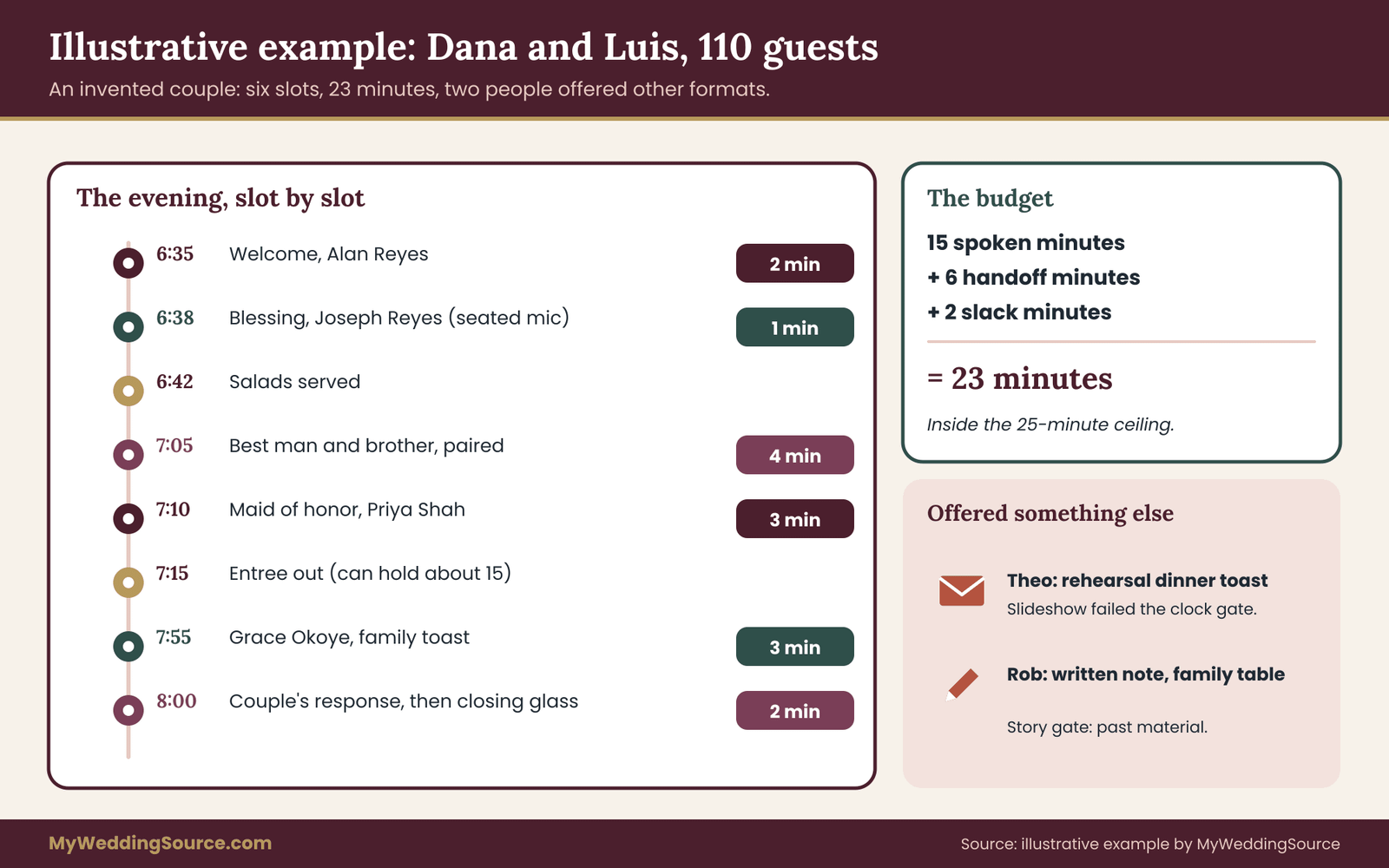
Dana and Luis keep six slots: Alan’s welcome at two minutes, Joseph’s blessing at one, the joint best man toast at four, Priya at three, Grace at three, and the couple’s response at two. That makes fifteen spoken minutes.
For the handoff minutes, each of the six slots gets one: six more minutes. Add two minutes of slack for the whole evening. The total is twenty-three minutes, inside the budget.
Theo is offered a toast at the rehearsal dinner, where there is more room, or a short video message he can send ahead. He chooses to give a toast at the rehearsal dinner. Rob is offered a handwritten note that the couple will read on their first anniversary and a seat of honor at the family table. Dana’s father calls him personally, and Rob accepts.
The toast planning matrix
Here is the toast planning matrix in prose, slot by slot, with the cues.
Slot one, welcome. Alan Reyes. Purpose: welcome and thanks. Two minutes. Cue in: emcee introduction at about 6:35 after guests are seated and glasses of water are poured. Cue out: Alan’s closing line, “Please enjoy dinner.” No raised glass. Microphone: handheld. Backup: the emcee reads the welcome from Alan’s notecard.
Slot two, blessing. Joseph Reyes. Purpose: a short blessing. One minute. Cue in: Alan’s handoff. Cue out: “Amen” and light applause. Microphone: seated, with a table microphone. Backup: Alan reads the blessing.
Salads are served at 6:42 and cleared at about 7:05.
Slot three, wedding party toast. Marcus Hale and Ben Okoye. Purpose: the camping-trip story and a toast. Four minutes. Cue in: emcee introduction at 7:05 after the captain signals that salads are cleared and servers have poured sparkling wine. Cue out: raised glass and “To Dana and Luis.” Microphone: handheld, passed from Marcus to Ben. Backup: Ben reads Marcus’s notes.
Slot four, wedding party toast. Priya Shah. Purpose: one story about Dana, then a toast. Three minutes. Cue in: emcee introduction after applause. Cue out: raised glass. Microphone: handheld. Backup: the emcee reads her printed copy.
The entrée starts at 7:15, ten minutes after salads are cleared, and well inside the fifteen-minute hold the captain described. That is the margin the schedule was built to protect.
Slot five, family toast. Grace Okoye. Purpose: a mother’s toast. Three minutes. Cue in: emcee introduction at about 7:55, once entrée plates are cleared. Cue out: raised glass and a hug. Microphone: handheld. Backup: Luis’s father steps in.
Slot six, couple’s response. Dana and Luis. Purpose: thanks to guests, parents and vendors. Two minutes. Cue in: Grace’s handoff. Cue out: “Thank you, and let’s dance” followed by the closing toast from the emcee. Microphone: handheld, shared.
The cake is cut at about 8:05. Dancing begins at 8:15, and the evening has more than two hours of music left, so no one’s party time is hurt by the toasts.
The A, B, C marks
Dana and Luis mark each slot for the case where the evening runs late. The welcome, the blessing, Grace’s toast and the couple’s response are A: they happen. The best man toast is B: it can shrink to three minutes. Priya’s toast is B: it can shrink to two. There are no C slots, because the plan is already lean.
What happens on the day
Suppose the day goes slightly wrong, as days do. The cocktail hour runs long and guests are seated ten minutes late. The clock owner looks at the sheet and sees that the kitchen has moved everything with it, so the salad-clearing time slides to about 7:15. She keeps the welcome and blessing, notes that the slack is thin and tells the best men before they go up that the cues will be applied strictly.
Marcus and Ben begin well and reach four minutes with half a story left. The emcee gives the soft cue at three minutes fifteen, which both speakers see, and the firm cue at four minutes, a light round of applause and “Let’s raise our glasses.” They finish about forty seconds over. Priya keeps to her three minutes. The block ends at 7:27 instead of 7:24, and the entrée goes out at 7:28, thirteen minutes after clearing. The captain says that is inside the hold. The two minutes of slack were spent as intended, and nothing broke.
What the example shows
Three habits made this work. Dana and Luis started with the total, not the speakers, so the arithmetic made the hard decisions. They offered every person who was cut a real alternative, so nobody went home feeling erased. And they wrote down who owns the clock and what the cues are, so the evening did not depend on anyone’s improvised judgment in a stressful moment.
Notice also what they did not do. They did not write anyone’s speech. They did not promise anyone a slot before checking the kitchen. And they did not leave the cut conversations to the day itself.
Adapting the example
Your numbers will differ. A buffet changes the placement. A shorter evening shrinks the total. A larger family may need a pre-dinner block. A culturally specific order may fix the sequence. The method stays the same: total first, gates second, slots third, cues fourth, alternatives for everyone who does not fit. Run it again whenever a variable changes, and keep your toast planning sheet as the single record of the answer.
Failure conditions and how to recover
A good toast plan names its own failure points. This section lists the ones that come up most often, how to spot them early and what to do when they happen. Keep it in your clock owner’s hands as a one-page sheet.
The speech that runs long
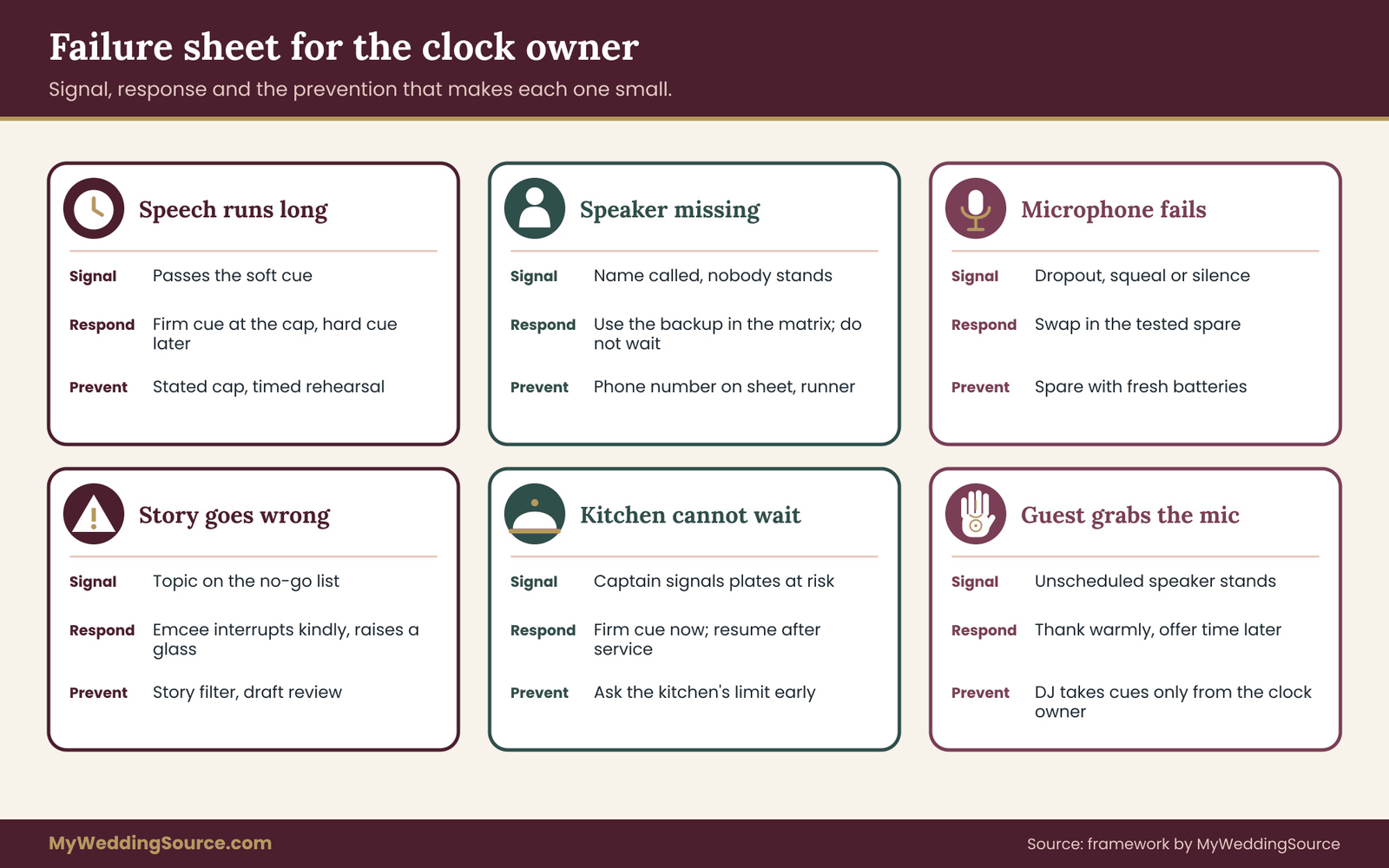
Signal: a speaker passes the soft cue without moving toward a close. Response: give the firm cue at the cap, and the hard cue at the agreed point beyond it. Prevention: a stated cap in the brief, a timed rehearsal and a placement before a natural stop for any known long-winded speaker. If it happens often at your wedding, the cause is usually a slot with no cap, not a bad speaker.
The speaker who is missing
Signal: the emcee calls a name and nobody stands. Response: the backup named in the matrix. Skip the slot, or have the designated reader take over, and do not wait while someone searches the room, because every minute of waiting costs guest attention. Prevention: put a mobile number on the sheet and ask each speaker to sit within a short walk of the microphone. Send a runner to find them before the block begins.
The microphone that fails
Signal: a dropout, a squeal or silence. Response: a second microphone, already tested and in the DJ’s hand, swapped in within seconds. Prevention: a spare microphone with fresh batteries, a test with a real voice and a ten-second plan for who hands it over. If there is no spare, the speaker steps closer and speaks louder while the technician fixes the problem.
The speech that goes somewhere it should not
Signal: the first sentence of a story the couple recognizes as a problem. Response: a graceful interruption by the emcee, a raised glass and a move to the next item. Do not argue in front of the room. Prevention: the story filter, an agreed list of no-go topics and a draft review for any speaker with a history of risky material.
The speaker who has had too much to drink
Signal: slurring, repetition, volume changes. Response: shift them later, shorten their slot or offer a seated reading with a friend. If it is serious, skip the toast, and have the emcee thank them warmly in the next handoff. Prevention: food and water before the slot, and a quiet word in advance, as described in the coaching section.
The kitchen that cannot wait
Signal: the captain signals that plates are at risk. Response: shorten the current speech with a firm cue, or release the entrée and resume the toasts after plates are served. Prevention: ask the kitchen for its limit in advance, and place the block where that limit is not tested.
The schedule that slips
Signal: the ceremony runs long, the photos take longer or guests arrive late. Response: use the A, B and C marks to shrink or move slots. Prevention: build slack into the sheet, and keep the toast block flexible compared with fixed items such as dinner service and cake.
The relative who takes the microphone
Signal: a guest stands and begins speaking with no slot. Response: the emcee thanks them warmly, offers to arrange time later and brings the microphone back. Prevention: tell the table hosts, and tell the DJ that microphones are not handed out without the clock owner’s nod. Open microphone is a deliberate format, covered below, not a default.
The sound that nobody can hear
Signal: guests at the back talking, craning or standing. Response: raise the volume, ask the speaker to come closer to the microphone and look at the sound lead. Prevention: a walk-the-room test, as in the logistics section.
A summary of failure conditions
Almost every failure on this list shares two causes: a missing owner and a missing cue. The first is solved by naming one clock owner. The second is solved by writing down cues. A third cause is a plan that had no slack. If you have slack, an owner and cues, most problems become small.
Alternatives when toasts will not fit
Some weddings cannot hold a long toast block, and some couples or families do not want one. Others have more would-be speakers than slots. There are workable alternatives, and each one fits a different situation.
One group toast
A single toast by one representative, such as a parent or the emcee, on behalf of both families. It is the shortest option. It fits small time budgets, a shy couple or a venue with a strict schedule. The drawback is that fewer people get a voice.
Toasts at a separate event
Move extra speeches to the rehearsal dinner, a brunch or a welcome party. These events often have more time and fewer constraints. The tradeoff is that some guests will not attend them. This is the usual answer for the person cut from the main reception, as the worked example shows.
A cocktail-hour toast
A short toast during the cocktail hour, when guests are standing and moving, takes pressure off the seated block. It works for a quick welcome or a thank-you, and the wedding cocktail hour guide explains how that part of the evening runs. It is less suited to longer stories, since guests are scattered and the sound is harder.
Written toasts and keepsakes
Invite guests to write notes, record audio or video messages, or contribute to a guest book. The couple reads them later, at leisure. This gives every person a voice without any minutes of reception time. It also suits those who dislike public speaking.
A pre-recorded toast
A speaker who cannot attend, or who is too nervous, records a short video that plays during the toast block. Limit it to a minute or two, test the file on the actual equipment and have a backup copy. This works well for family members abroad.
An open microphone, with rules
Some receptions invite any guest to speak. This can be moving and chaotic. If you choose it, set a time window of ten to fifteen minutes, a per-person limit of one minute, a sign-up sheet at the entrance or a list held by the clock owner, and a hard end. Without those, open microphone tends to expand and to attract the people you least want at the microphone.
Toast-free receptions
Some couples skip speeches entirely and let the emcee or the couple give a short welcome and thanks. That is a legitimate choice. The couple can set the tone with a simple opening, a short thank-you and a raised glass, and then move on to dinner and dancing.
Choosing among them
Pick the option that answers your constraint. Short on minutes: a group toast. Too many speakers: a separate event. Nervous speakers: a written or recorded format. Crowded evening: a cocktail-hour toast. An energetic crowd and a strong emcee: an open microphone with rules. Mix and match, because your toast planning can use more than one alternative at once.
Your next steps
This week, write the candidate list and run the four gates. Choose the total toast time your evening can afford, and use the formula to see how many slots that supports. Ask your caterer how long each course can wait and who gives the signal, and ask your venue and DJ about microphones.
Next, name your clock owner and agree on the soft, firm and hard cues. Send each speaker a one-page brief at least three weeks ahead, offer one rehearsal, and have conversations with the people who will be offered another format. Finally, put everything on a single sheet with a version date, give copies to the emcee, the DJ and the caterer, and keep one on paper at the DJ table. Good toast planning is mostly done by the time the day begins, which is the point.
FAQ
How long should the whole toast block be at a wedding?
For a seated reception with a plated dinner, a block of about fifteen to twenty-five minutes in total, including handoffs, is a workable starting range. Spread it across one or two sittings if you can. Adjust for guest count, age mix and venue end time, and confirm what the kitchen can hold between courses before you commit to a number.
Who should speak first at a wedding reception?
Usually a host, a parent or the emcee, who welcomes guests and sets the tone. After that, many couples place the wedding party, then an elder, and finish with the couple’s thank-you. Traditions vary by family and culture, so keep the pattern that fits your people, and write the reason for any change on your sheet.
How many people should give toasts?
There is no fixed number. The arithmetic decides: divide your total toast time by the slot length plus one minute of handoff. Many seated receptions land between four and seven speakers. When more people want to speak than the budget allows, offer a different format, such as a rehearsal dinner toast or a written note.
Should toasts happen before, during or after dinner?
Any can work. Before the meal suits a short welcome. Between courses works with a plated dinner if the kitchen agrees. After the meal is the most common, because guests are fed and settled. Ask your caterer how long each course can wait, and split the block if the total is long.
How do we tell a family member they cannot give a toast?
Speak early, preferably in person, and give the reason in terms of the clock: the schedule holds a set number of speakers. Offer a real alternative, such as a toast at another event or a written note, and end with a question so the person can choose. Avoid debating the decision or apologizing repeatedly.
Do we need an emcee for the toasts?
Not always, but someone must own the clock and introduce speakers. That can be a hired emcee, a coordinator, a DJ or a trusted friend who is not speaking. Give that person the run-of-show, the cues and the pronunciations. Without an owner, overruns and missed handoffs become much more likely.
Can a speaker quote a song or poem?
In a private toast, a brief quote is a common choice. If the speech will be recorded and posted, printed or published, copyright can become relevant, and fair use is decided case by case. Prefer your own words, public domain works or short, credited quotes. The U.S. Copyright Office website explains current guidance.
What if a toast goes badly on the day?
Stay calm and use the cues you agreed. For an overrun, give the soft, then firm cue. For a problem story, have the emcee interrupt kindly, propose a raised glass and move on. For a microphone failure, swap in the spare. Talk to the speaker privately afterward, not in front of the room.
Sources
- U.S. Copyright Office, copyright basics and registration information
- U.S. Copyright Office, fair use overview
- ADA.gov, U.S. Department of Justice, information on the Americans with Disabilities Act
- Federal Communications Commission, wireless microphone and spectrum information
- National Institute on Deafness and Other Communication Disorders, voice and communication health
- National Institute on Alcohol Abuse and Alcoholism, standard drink and alcohol effects
- Centers for Disease Control and Prevention, alcohol and public health
- PlainLanguage.gov, federal plain language guidelines
- Library of Congress, personal digital archiving