
Wedding ushers are the people who greet guests, point them to seats, hand out programs, and keep the ceremony entrance calm, and every couple eventually has to decide whether those jobs go to hired wedding ushers or to friends who volunteer. This guide gives you a role boundary test, a worked case and a set of scripts, so the decision rests on what each job actually demands instead of on budget guilt or family pressure.
Sort every job your wedding ushers might do into three boundary tests: does it carry safety or access responsibility, does it need a fixed time commitment that a guest cannot give, and does it need someone who can say no to a guest without a social cost. Jobs that fail none of the tests suit friends. Jobs that fail one test suit a friend with a written brief and a backup. Jobs that fail two or three tests belong to paid wedding ushers, the venue, or your coordinator. Most weddings end up with a hybrid.
Most couples treat the usher question as a small favor list. A few cousins and groomsmen get asked, they say yes, and nobody writes down what yes means. That works for a thirty-person ceremony in a backyard. It starts to fray when there are two entrances, an older guest who needs a wheelchair route, a late shuttle, a venue that wants a named contact at the door, and a groomsman who also has to be in the photographs.
The opposite mistake is just as common. A couple hears that wedding ushers can be hired, books a small team, and later finds that paid wedding ushers do not know which grandmother sits where, cannot recognize the officiant’s family, and are not the right people to quietly ask Uncle Ray to put his phone away. Paid help and friends are good at different things. The skill is in drawing the line.
This article stays on one question: which jobs go to hired wedding ushers, which go to volunteers, and what to put in writing either way. It does not repeat the full order of events for the ceremony, which is covered in the wedding ceremony step by step guide. If you are still early in planning and want the whole picture, the guide to planning a wedding is the right starting point.
A note on scope. This is general planning information, not legal, tax or labor advice. Rules on paying people, on who counts as an employee, and on insurance differ by state and by situation, so the labor section points you to the agencies that publish the current rules.
What wedding ushers actually do on the day
Before you can divide the work, you need the real list. When people say “ushers” they often picture one image: a man in a suit offering an arm to a grandmother. The real job is wider, and most of it happens before the ceremony and after it.
Here is the working list, grouped by when each task happens. Not every wedding needs every task. A garden ceremony for forty guests may use six of these, and a cathedral ceremony with a long aisle may use fifteen.
Before guests arrive. Check that programs, aisle markers, reserved signs and any accessibility seating are in place. Walk the route from the parking area or drop-off to the seats and look for hazards, such as a loose mat, a cable, an unmarked step or a door that sticks. Confirm who holds the keys to a side entrance. Put out a basket for guest items such as shawls or umbrellas if the venue allows it.
During arrival. Greet guests at the entrance, hand out programs, point to the restrooms and the guest book, and direct people to a side or a family section. Offer an arm or a seat to anyone who wants one. Answer the small questions guests ask in the first ten minutes: where to park, whether the ceremony is on time, whether there is a place for a stroller.
Seating. Seat the honored guests, the grandparents and parents, in the order the couple chose. Keep some rows or end seats free for people with mobility needs. Close the doors, or hold the aisle, for late guests until a natural pause.
During the ceremony. Hold the back of the room. A good usher stands where they can see the aisle and the door at the same time. They handle a crying toddler, a ringing phone or a guest who wanders toward the aisle during the processional, quietly and without drama.
After the ceremony. Release guests row by row or let them follow the wedding party out. Collect leftover programs, forgotten items and the aisle décor that has to move. Point guests to the cocktail hour, a shuttle or the photographer’s family-photo gathering point.
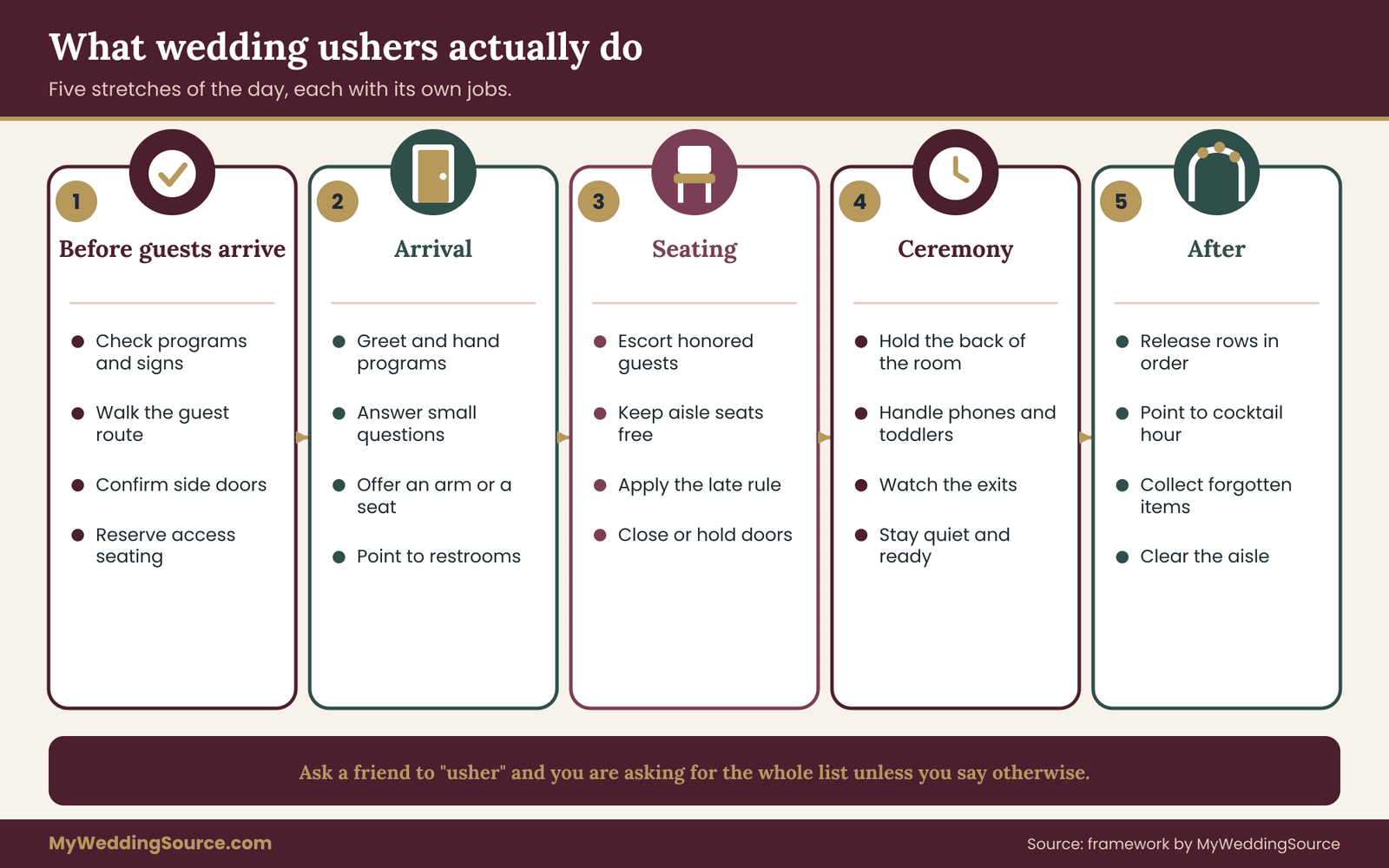
Seeing the list written out changes the conversation. Some of these tasks are pleasant and personal. Some are physical. A few carry real responsibility, such as keeping an exit clear or being the person who notices that a guest looks unwell. When you ask a friend to “usher,” you are asking for all of it unless you say otherwise.
The hidden tasks behind the visible ones
Three tasks rarely get named, and they are where a casual arrangement breaks down.
The first is door control. Someone has to decide when the doors close, who may enter during the processional, and what happens to a guest who arrives with a baby that is already fussing. This is a judgment call that touches a guest’s feelings. A friend who loves the couple may hesitate to hold back their own aunt.
The second is information handoff. Guests ask where the reception is, whether there is a shuttle, and whether children are welcome at dinner. If the people at the door give three different answers, the day starts with confusion. A shared one-page brief fixes this, and later sections show how to write it.
The third is accessibility awareness. Wedding ushers are often the first people to see that a guest cannot manage a step, a long walk or a low folding chair. The couple has usually planned seating for those guests, but someone has to know the plan and carry it out calmly.
Why this is a boundary question, not a budget question
Couples sometimes frame the choice as money versus love: hire people and spend, or ask friends and save. That framing hides the real trade. Friends cost nothing in fees, but they cost their own presence at your wedding. A groomsman who is also an usher is checking a list while the people he came to see are saying hello to each other.
Hired wedding ushers cost money, but they free your friends to be guests. They also carry a different kind of risk, which is that they have no relationship with your family. The right split depends on which risk you would rather carry at each doorway. The next sections build a way to decide that task by task.
Who this decision matters most for
The usher question is not equally important for every couple. It matters most when at least one of these is true: the ceremony has more than one entrance, the venue sets rules about who may stand at doors, several guests need mobility help, a large family expects roles, or the schedule leaves little slack. In those cases wedding ushers carry real weight, and a vague arrangement shows quickly.
It matters least for small, informal ceremonies with a single door and guests who all know each other. There, wedding ushers may be a courtesy more than a function, and the guide’s later sections explain why skipping the role can be a sound choice. If you are unsure which group you are in, read the next section, then return to this question with the task list in hand.
One more point before moving on. Wedding ushers are rarely the first thing couples plan, and the decision is often made late, under time pressure. Making it early, with the task list in front of you, gives hired providers time to quote and gives friends time to say yes or no without feeling cornered.
Three ways to staff wedding ushers: friends, hired help, or a mix
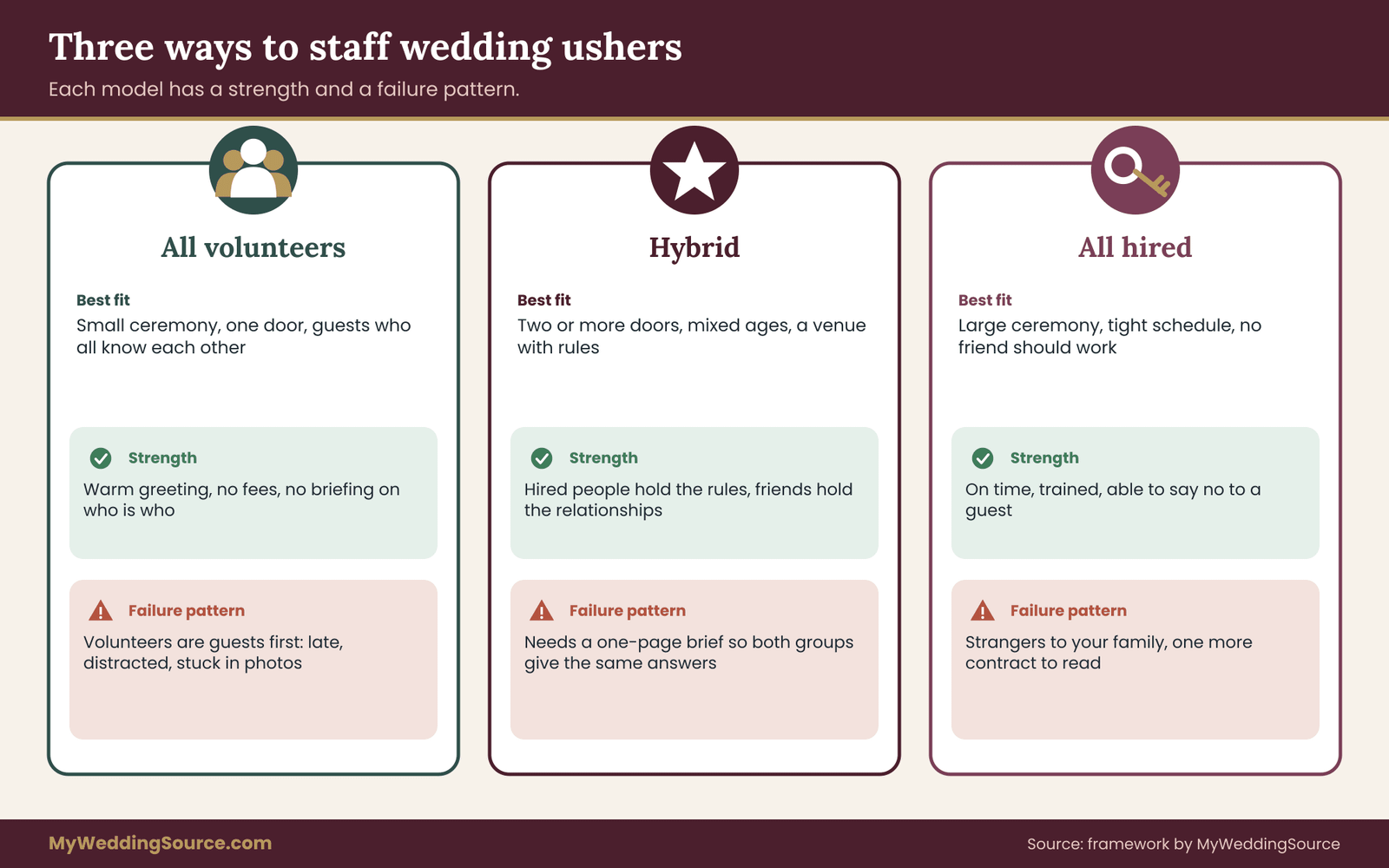
There are three honest models. Each suits a different wedding, and each has a failure pattern worth knowing before you commit.
Model one: all volunteers
Friends and relatives take every job. This is the most common model and works well when the ceremony is small, the venue is simple, and the people you ask are calm and comfortable in a supporting role.
Its strengths are obvious. The door feels warm, because guests are greeted by people they know. Nobody needs to be briefed on who the grandparents are. The cost is close to zero, apart from a thank-you gift.
Its weaknesses show up under stress. Volunteers are guests first, so they may arrive late from the hotel, leave the door to take photographs, or drift into conversation. They also tend to be the same people the photographer needs for the family list and the wedding party. If your volunteer wedding ushers are also in the processional, they cannot be at the door until the music starts and cannot be at the door when it ends.
Model two: all hired staff
A hired team handles every door task. This suits a large ceremony, a venue with several entrances, a ceremony that runs on a tight schedule, or a couple who do not want any friend working during the wedding.
Strengths: staff arrive on time, have done the job before, wear a consistent look and treat the work as work. They can hold a door against a late guest without the social cost a relative would feel.
Weaknesses: they do not know your people. A paid usher cannot tell which man in a gray suit is the groom’s estranged father, and should not be asked to guess. They also cost money in a line of the budget that many couples would rather spend elsewhere, and they add one more vendor whose terms you have to read.
Model three: a hybrid
A small hired team holds the functional jobs, and a few chosen friends hold the personal ones. The hired wedding ushers run the door, the program table, the accessibility route and the late-arrival rule. The friends escort grandparents, greet specific family members by name and carry the emotional moments.
The hybrid is not a compromise that gives everyone half of what they wanted. It is a way of matching each task to the kind of person who does it best. Most of the worked decisions in this guide end here.
A quick way to see which model fits
You do not need a spreadsheet to guess. Answer these in order and stop at the first yes.
Does your venue require a named, responsible person at each entrance, or a staffed accessibility route? If yes, you need at least one paid or venue-provided person. Does your ceremony have more than one public entrance? If yes, treat each entrance as its own post. Do you expect more guests than your volunteers could greet within about twenty minutes? If yes, add hired help. If none of these apply, all volunteers is a reasonable plan, as long as the roles are written down.
How guest count and venue shape the model
Guest count matters less than people expect, and the building matters more. A hundred guests entering through one wide door are easier to greet than sixty guests arriving through three doors on different levels. Before choosing a model, walk or study the venue and count the places where a guest can enter, the places where a guest could get lost, and the places where a guest with limited mobility would struggle.
Time of day also changes the answer. An afternoon ceremony in daylight needs fewer people to guide guests than an evening ceremony where paths are dim. A ceremony that follows a hotel shuttle has bursts of arrivals, so a short crowd of guests needs several greeters at once, then none. A ceremony with open arrivals over an hour needs one steady person instead.
Finally, consider the formality of the ceremony. A formal religious service may have customs about who seats whom, and the officiant or the family’s community may already have people in mind. Ask the officiant early, because some traditions assign these roles and a polite conversation is easier before invitations go out than after.
Terms used in this guide
A few words recur, so it helps to fix their meaning. A post is one place where one person stands for a stated period. A brief is the one-page set of instructions every person at a post receives. A hired team means people supplied by a company or a coordinator, and a volunteer means anyone helping without a fee. Wedding ushers can be either kind, and the same wedding often has both.
When the guide says wedding ushers, it means anyone doing the door, seating and guidance jobs, whatever their title. A bridesmaid escorting a grandparent is doing a job that wedding ushers do. A caterer’s greeter at the door is doing a job that wedding ushers do. Keeping the label tied to the work, not to the person, makes it easier to give each job to the right wedding ushers and to see jobs that nobody holds.
The role boundary test for wedding ushers
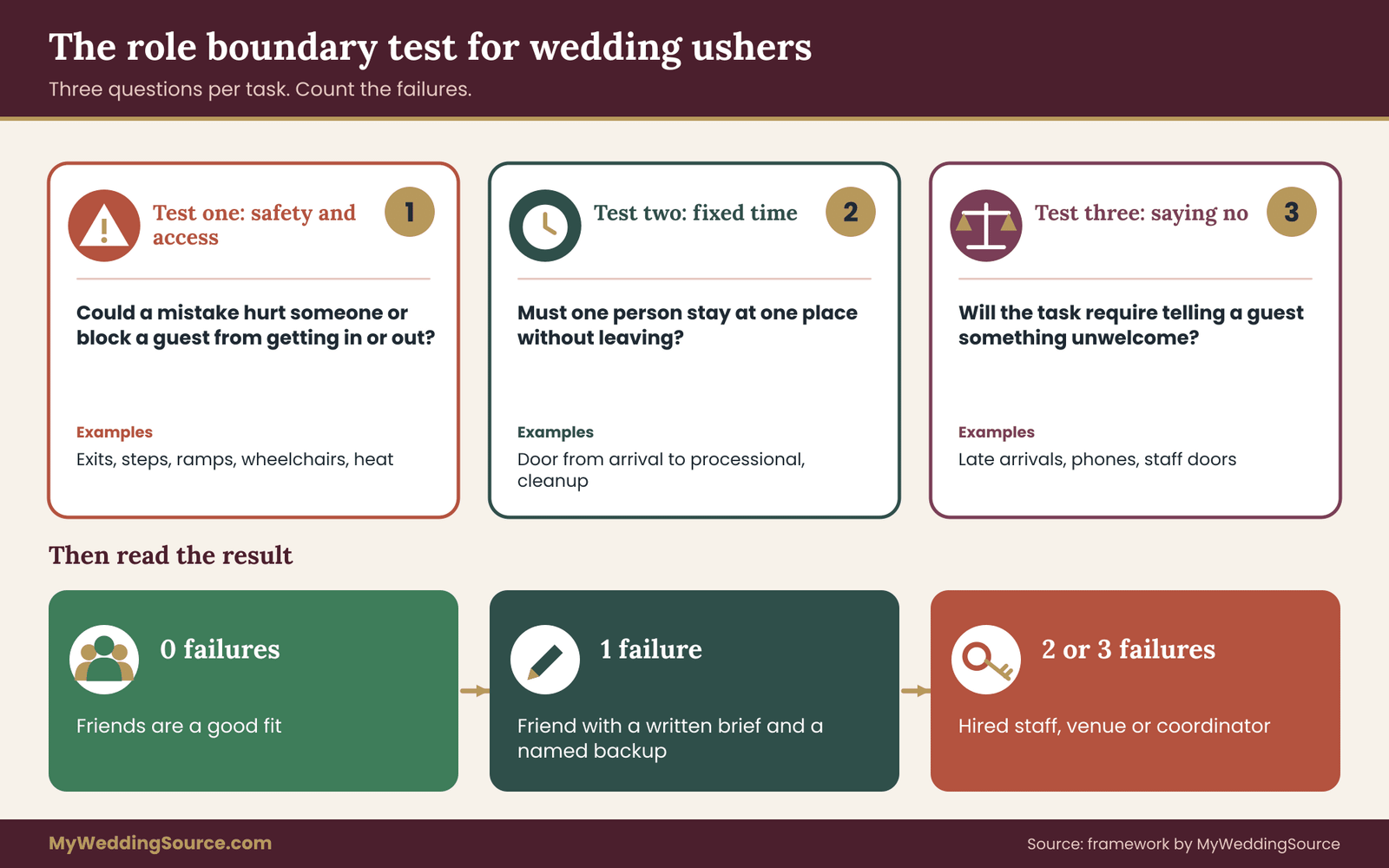
This is the central tool of the article. Instead of asking “do we hire or ask friends,” you ask three small questions about each task. The answers sort the task into a staffing tier.
Test one: safety and access responsibility
Ask whether a mistake at this task could hurt someone or block a guest from getting in or out. Examples: keeping an exit clear, directing guests along a route with a step or a slope, controlling a door that leads to a driveway, noticing that an older guest is overheating, and helping someone in a wheelchair or with a walker.
A task fails test one when a mistake has a physical cost. It does not need professional training, but it needs someone who has been shown the route, knows where the exits are, and has the authority to act. That points toward the venue’s staff, a coordinator or hired wedding ushers with experience, or toward a friend who has been walked through the space and given a clear instruction.
Test two: fixed time commitment
Ask whether the task needs a person to be in a specific place for a specific stretch without leaving. Examples: standing at the entrance from the time guests arrive until the processional starts, holding the back door through the ceremony, and staying behind afterward to clear the room.
A task fails test two when the person doing it has to give up being a guest to do it. This is the test that volunteers most often fail. A friend can hold a post for twenty minutes. Holding it for ninety, including setup before and cleanup after, is a job, and the friend will quietly stop treating it as a favor.
Test three: the ability to say no
Ask whether the task requires telling a guest something they will not like. Examples: asking a guest to wait at the back during the processional, telling someone that the reserved row is taken, asking a guest to put away a phone or a camera, stopping a person who tries to enter through a staff door, and asking an uninvited plus-one to wait for the couple.
A task fails test three when the person doing it is likely to feel social pressure. A hired usher can say no politely and walk away. A cousin who has known the guest for thirty years may find it nearly impossible. Where this test fails, the question is not whether your friends are capable but whether you are fair to put them in that position.
How to read the results
Count the failures for each task. Zero failures: friends are a good fit. One failure: a friend can do it with a written brief and a named backup. Two or three failures: hand the task to hired wedding ushers, the venue or a coordinator.
The test is deliberately simple. Its value is not the arithmetic but that it replaces vague feelings with specific reasons. “I do not want my sister stuck at the door for an hour” becomes “this post fails test two,” and that is easy to explain to your sister.
Some tasks look like they belong to wedding ushers but actually belong to someone else. Parking direction is often the venue’s or a shuttle company’s job. Gift table watch may belong to a family member rather than a door team. Moving a ceremony arch after the vows is usually a rental or décor vendor’s job. The test helps you see these hand-offs, and a rental company’s contract will say which of its own crew moves chairs and arches after the vows.
Jobs that suit friends and family among your wedding ushers
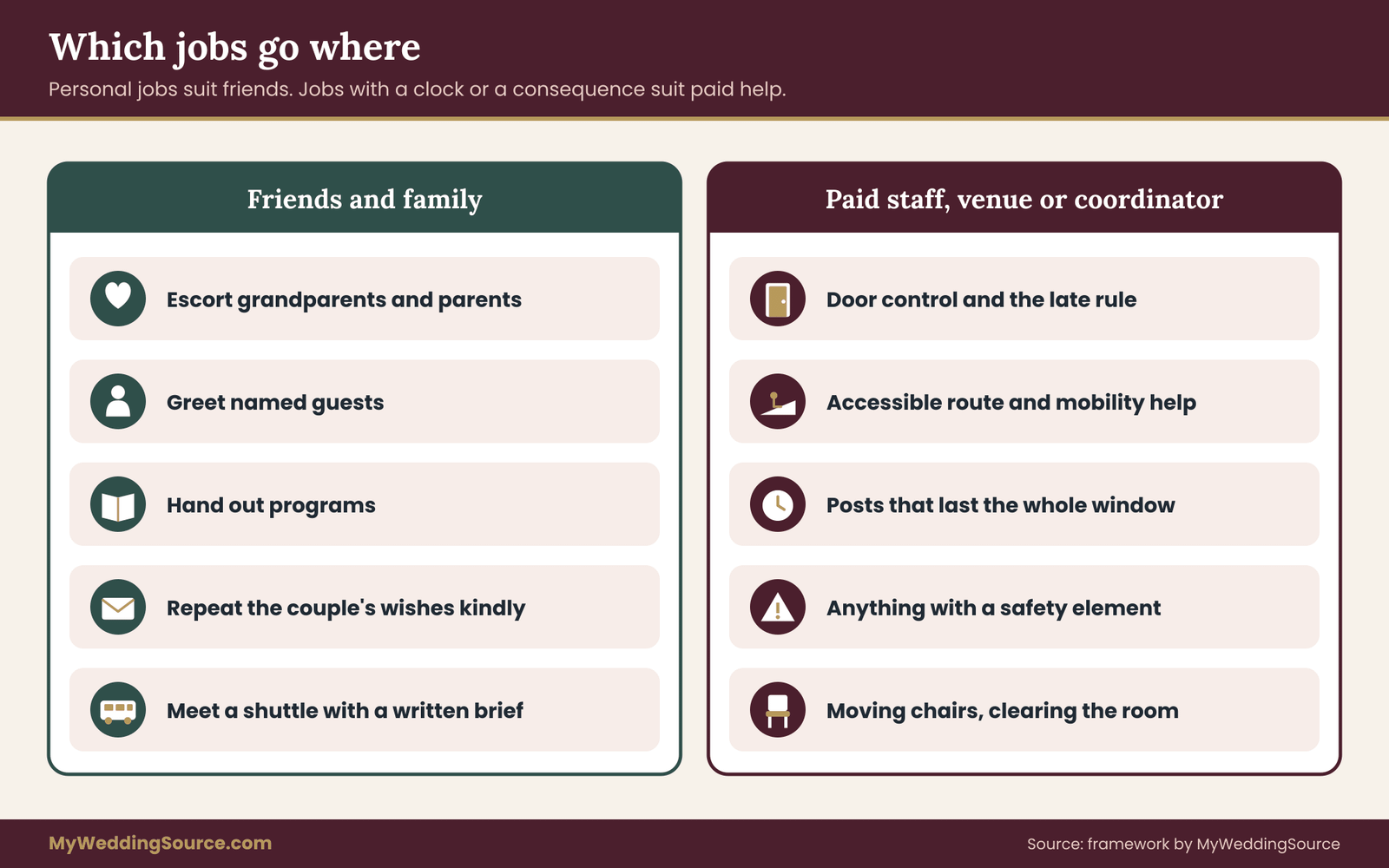
Run the three tests across the task list from the first section and a pattern appears. The tasks that pass every test, or fail only one, are the personal ones. These are the jobs where a known face matters more than polish.
Escorting honored guests
Seating grandparents, parents and other honored guests is the job friends do best. The wedding ushers who do it need to recognize the person, know the seat, and be comfortable offering an arm. A stranger can do the walking, but cannot do the greeting. “Welcome, Grandma Ines, we saved you the aisle seat” lands differently from a polite hello from a hired stranger.
This job fails none of the tests as long as the route is simple and the friend is told which seat to use. It takes a few minutes per escort. If the family is large, spread the escorts among three or four friends so that nobody is stuck.
A practical rule: give each escort a short written list of the guests they are responsible for, with the seat and a one-line reminder about each. “Great-aunt Mei, left side, third row, uses a cane, hard of hearing in the right ear.” It is a courtesy to the guest and a relief to the usher.
Greeting specific people by name
Some guests need a personal welcome. The couple’s elderly relatives, a college friend who flew in alone, a coworker who knows nobody. Assign each of these guests, in advance, to a friend who will find them, say hello and sit near them if there is room.
This is a job for volunteers, not for hired wedding ushers, and it is a quiet kindness the couple cannot do themselves on the day. It does not need a post. It needs a name on a list and a friend who has promised to look.
Handing out programs and keepsakes
Passing a program to each guest is low-risk and short. A friend can do it for the first fifteen minutes of arrival. If the ceremony includes a keepsake such as a fan, a shawl or a bell, the same person can explain it in a sentence. This is a good job for a younger relative or a friend who is shy but wants to help.
Carrying the couple’s wishes into the room
Some requests are personal and benefit from a trusted voice. An unplugged ceremony request, a note that children are welcome to sit near the aisle, or a quiet reminder that the family photos start right after the recessional all sound better from a friend. The sign at the door does the main work, and a friend repeating it kindly fills in the gaps.
What friends should not be asked to do
Friends should not be asked to hold the main door against a late guest, to confront a stranger, to manage an access route without having seen it, or to stay behind after the party starts to clear the room. Each of these fails at least two tests. If you ask a friend to do one anyway, do it knowingly, with a backup and a clear end time.
Jobs that belong to paid wedding ushers, the venue or a coordinator
The other half of the list is functional work with a clock and a consequence. These jobs benefit from someone who treats them as a job.
Door control and the late-arrival rule
Holding the doors for the processional is a classic case of failing test three. Someone has to tell guests to wait, and the couple does not want that person to be a family member who will be thanked with a frown. A hired usher, a venue staff member or a coordinator can say, “We will seat you in just a moment,” and mean it.
Write the late-arrival rule in advance. A common version: guests who arrive after the processional starts wait at the back until the first reading or the first pause, then are seated on the closest side aisle. The couple decides the rule, and the wedding ushers apply it. The wedding ceremony cue sheet guide shows where those pauses fall in a typical ceremony.
Accessibility routes and mobility support
Helping a guest who uses a wheelchair, walker or cane is not a task to leave to whoever happens to be near. The route has to be walked in advance, the seating has to be reserved, and someone has to be assigned to the guest from arrival to seat to exit. This job fails test one and often test two. It is best done by venue staff or experienced hired help, with a friend who knows the guest as a companion.
If your venue has a stated accessibility process, ask who carries it out on the day. If the answer is “your guests will manage,” plan a staffed alternative. The wedding guest care planning guide goes into support for older relatives and young children in more detail.
Staying through the whole event
Posts that last from setup to the end of the ceremony fail test two. A hired team agrees to a start time and an end time in writing. A friend cannot do that without giving up the best part of the day. If a post is long, pay for it.
Crowd movement between spaces
If the ceremony and cocktail hour are in different places, someone has to point the crowd, keep the aisle from clogging and prevent guests from wandering into staff or setup areas. This is the venue’s job in many contracts, so confirm that before hiring anyone.
Anything with a physical or safety element
Clearing a spill, moving chairs after the vows, closing a door that leads to a parking lot, watching for a guest who looks faint, and knowing where the first-aid kit is all benefit from people trained to think about it. Paid staff, the venue’s team or a coordinator are the right choice.
Positions and sightlines for the door team
Where wedding ushers stand matters as much as who they are. A person at the main door should be able to see both the approach and the aisle, so that they notice guests arriving and the moment the music changes. A person at an accessible entrance should stand where a guest can see them from the path, not hidden behind a door. A person at the back of the room should stand to the side of the aisle, never in the center, so that guests are not looking at them instead of the couple.
Walk the posts at the venue with a phone camera or your own eyes. Look at the view from the door, from the back row and from the first row. If a post cannot see what it needs to see, move it.
Ceremonies with their own customs
Some ceremonies carry traditions that shape who may stand at the door or escort guests. A family elder, a member of the congregation or a designated relative may have a fixed role. Ask the officiant and the family early, and write the answer into the plan. Where a custom assigns a role to a person, treat it as a fixed point and design the rest of the door team around it. A hired team can still cover the practical posts while the custom is honored.
Dress, appearance and how guests recognize wedding ushers
Guests should be able to tell who is helping them. Wedding ushers who look like guests are hard to find, and a guest who cannot find help may block the aisle looking for it. A boutonniere, a ribbon, a lanyard or a matching tie is enough. Hired wedding ushers often arrive in standard black and white, and you can add a small flower or ribbon in your colors so they fit the day.
Friends serving as wedding ushers can wear what the wedding party wears, or a simple marker. Avoid anything that makes a volunteer uncomfortable or that requires a purchase they did not plan. If you ask friends to buy an outfit for a role, you have moved from a favor toward a cost, so offer to cover it. Tell hired providers about the dress code before the day, and confirm that comfortable shoes are allowed, because wedding ushers stand and walk for long stretches.
A note on hybrid posts
You do not have to split everything cleanly. A common pattern is to pair one hired person with one friend at each entrance. The hired person holds the rule and the clock. The friend holds the relationships. When a guest needs a firm answer, the hired person gives it. When a guest needs a hug, the friend does. This is also the easiest arrangement to brief, because each person has one kind of job.
What hiring wedding ushers costs, and how to compare quotes
Prices for hired help vary by region, by season and by who is providing it, so this guide does not quote any. What it can do is show the logic of the cost, so you can read a quote and ask the right questions.
The four parts of a quote
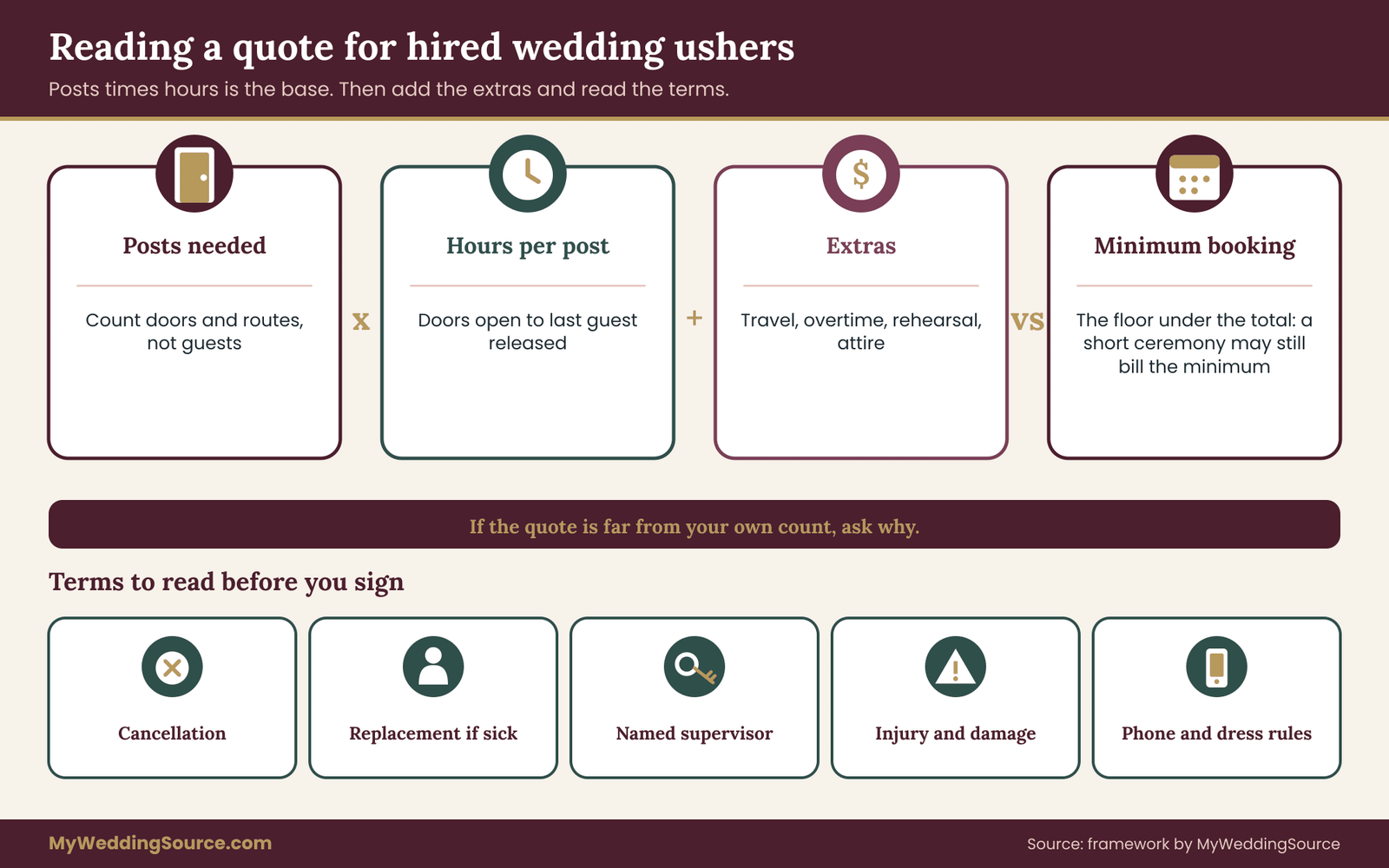
A quote for hired wedding ushers usually combines four things: an hourly or per-person rate, a minimum number of hours, extra charges and terms. Each one deserves a look.
The rate is what a person earns for an hour of work. Ask whether it is for each person or for the team, and whether it includes the provider’s own costs.
The minimum is the shortest booking the provider will accept. Many providers set a minimum of three or four hours even if you only need ninety minutes of ceremony. If your ceremony is short, the minimum is the real price.
Extra charges include travel, parking, overtime when the ceremony starts late, uniform or attire rules, and a fee for rehearsal attendance. Ask for all of them in writing, because the base rate is rarely the final figure.
Terms cover cancellation, replacement if someone is sick, who supervises the staff, and how the provider handles an injury or a damage claim. The guide to reading a wedding vendor contract explains the clauses most worth checking before you sign.
A cost logic that does not depend on numbers
Use a three-step comparison. First, count the posts you actually need, not the people you would like. A single entrance with fifty guests may need one or two hired wedding ushers, and a venue with three entrances may need three or more. Second, count the hours each post must be covered, from the time doors open to the time the last guest has been released. Third, add the extras. Multiply posts by hours, and you have the base of the quote you should receive. If the quote is far from that, ask why.
Compare that figure with the other side of the ledger, which is not zero. Volunteers carry hidden costs: attire or travel you may offer to cover, thank-you gifts, a rehearsal dinner place, and the cost of a bad outcome. A missed door post or a rude moment is hard to price. It is worth naming the risk instead of pretending that unpaid help is free.
Where hired wedding ushers fit in the budget
Staffing rarely appears as its own line in a wedding budget, which is why it gets squeezed. Decide early whether it sits under ceremony costs, under venue costs or under a general “day-of help” line. The wedding budget guide shows how to place lines like this so they do not disappear when other costs rise.
If money is tight, the usual order of savings is: first, trim the number of hired posts to the ones that fail two or three boundary tests; second, shorten the booked hours by lining up the door duties with the actual guest arrival window; third, move the personal tasks to friends. Do not drop hired help from a post that fails test one. A missing safety route is a poor place to save.
Rehearsal, overtime and a late start
Ceremonies run late more often than they start early. Ask how the provider treats a late start, because overtime charges can change the real cost. Ask whether the team attends a rehearsal, how that time is billed, and whether a short walk-through at the venue an hour before guests arrive is included. If the rate changes after a certain hour, ask where that hour falls on your timeline.
A simple protection is to book a window that matches your actual guest arrival and a short buffer after the recessional, instead of booking by the hour at the start of the day and hoping. Match the booking to the posts, not to the whole event.
A hired team compared with a coordinator’s assistant
Some coordinators will assign an assistant to the door instead of a separate team. The assistant knows the schedule and answers to your coordinator, which simplifies communication. The trade-off is that the assistant may also be needed elsewhere, so ask whether the door is the assistant’s only job during the arrival window. A separate team has no other tasks but also has no knowledge of your day beyond the brief. Neither is better in every case. Choose by asking which one would still be at the door if something else went wrong.
Questions to ask before you accept a quote
Ask in writing, and keep the answers.
Who is the person on site who supervises the team, and can you meet or call them before the day? How many ceremonies has the team worked in venues like yours? What happens if a person cancels the morning of the wedding? Can the team arrive early enough to walk the route with your coordinator or venue contact? How do they dress, and can you approve the dress code? What is the policy on phones during the ceremony? Who do they report to if a guest has a complaint?
A good provider answers these without hesitation. A provider who answers in generalities, or who cannot name a supervisor, is telling you something.
Where to find and screen hired wedding ushers
Wedding ushers are not a standard category in every market. They may be offered by a coordinator, a venue, an event staffing company, a hospitality agency, a catering company or a service that supplies hosts for events. Each source has a different level of oversight.
Where to look
Your venue or its preferred staff. Venue teams know the building, the exits and the house rules. Ask whether they provide ceremony hosts, door staff or event captains. This is often the least risky choice for access and safety.
Your coordinator. Many planners and day-of coordinators bring a small crew or can recommend one. They also know the ceremony order and can brief the team. If you already have a coordinator, ask this before looking elsewhere.
An event staffing company. These companies supply hosts, greeters and ushers to corporate and private events. Ask for experience at weddings, not only at conferences, because the tone is different.
A caterer’s or rental company’s team. Some catering companies can add a greeter. This is useful if the same company will serve the reception, but their staff may be committed to setup during your ceremony, so ask.
Individual hires. Hiring people directly, such as local students or hospitality workers, is possible, but it puts more of the responsibility on you. The next section explains why this matters, and why it is worth asking the labor questions first.
How to screen
A short screening conversation is enough. Ask the provider to describe the last ceremony they worked and what went wrong. Everyone has an answer. A provider who says nothing ever goes wrong is not being candid. Ask what they do when a guest refuses to wait at the back. Ask how they handle a guest who is unwell. Listen for calm, plain answers.
Check references if you can, but check them for the right things. You are not looking for a glowing review. You are looking for answers to a few plain questions: were they on time, did they follow the couple’s rules, and did they stay out of the way.
If you are comparing several providers across the whole wedding, the vendor due diligence checklist lays out the checks that apply to any hire.
What to put in writing
Even a short booking should record the date, the venue, the number of people, the start and end times including the rehearsal if any, the rate and the extras, the cancellation terms, the dress code, the supervisor’s name and the phone-use rule. It should also say who covers an absence. One page is enough. The page also becomes the reference for your own volunteers, so that everyone is working from the same expectations.
Checking references for hired wedding ushers
References for hired wedding ushers are worth a short call, but only if the questions are specific. Ask a past client whether the team arrived before the guests, whether they followed the couple’s rules about late arrivals and phones, and whether anyone had to step in to correct a mistake. Ask what the team did when something unexpected happened, such as a guest in the wrong row or a door that would not open.
Be wary of a provider who offers only written testimonials and no contact. Be equally careful with your own expectations. A team that handled a conference well may not suit a family ceremony, and wedding ushers for a formal church service may need different habits from those at a garden party. Ask for experience that matches your venue and your tone, and accept that a smaller provider with the right fit is better than a large one with the wrong one.
Pay, worker status and fair treatment of volunteer wedding ushers
This section raises questions rather than answering them, because the answers depend on your state, on who is hiring whom and on facts a general article cannot see. The aim is to show you which questions exist so that you ask the right office.
Why the labor question comes up at all
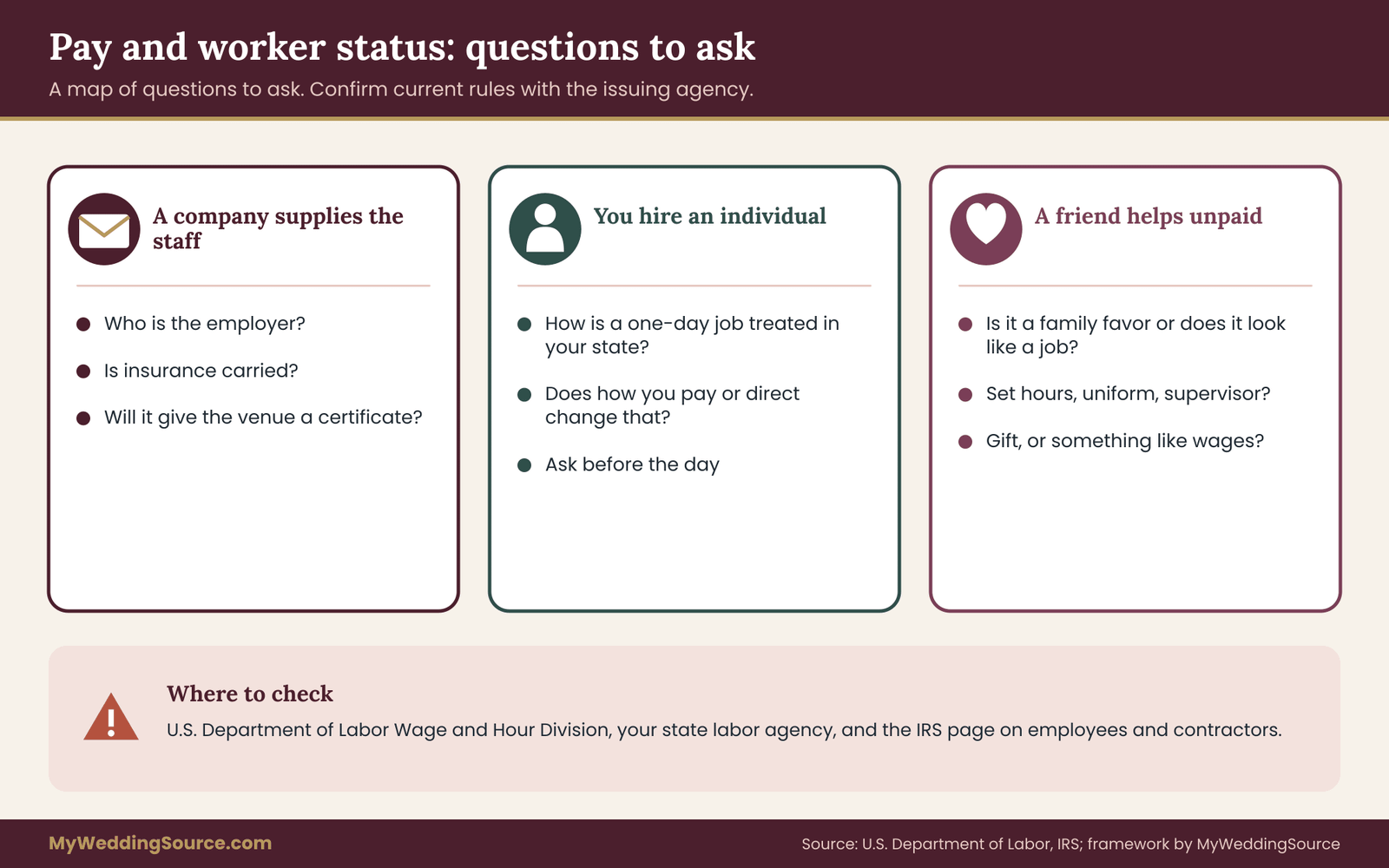
When you book a company to supply wedding ushers, the company is normally the employer of the people who show up, and its own payroll, insurance and wage obligations apply. You are buying a service. When you hire an individual directly, the picture can be different, because the arrangement may raise questions about whether that person is an employee or an independent contractor, and who is responsible for what.
The U.S. Department of Labor’s Wage and Hour Division publishes plain-language material on minimum wage, overtime and worker classification under the federal Fair Labor Standards Act. The Internal Revenue Service publishes its own guidance on how it looks at the employee and contractor question for tax purposes. State labor agencies often add rules of their own, and those can be stricter than the federal ones. The sources section lists the starting pages.
You do not need to master this. You need to notice when a hiring arrangement moves from “I am buying a service from a company” to “I am paying a person directly for hours of work,” and to pause at that point and check the current rules.
Three arrangements and the question each raises
A company supplies the staff. Ask who the employer is, whether the company carries workers’ compensation and liability insurance as the rules in your state require, and whether it will provide a certificate of insurance if the venue asks. These are routine questions for a vendor, and a reputable one answers them quickly.
You hire an individual directly. Ask the labor agency in your state how a short, one-day engagement like this is treated, and whether anything about the way you plan to pay or direct the person changes that. The answer may be simple. The point is to ask before the day instead of afterward.
A friend helps without pay. A friend who helps at a family celebration is in a different position from a person doing unpaid work for a business, and nothing in this guide suggests that asking a friend to hand out programs is a problem. The questions arise when the “friend” role starts to look like a job: set hours, a required uniform, a supervisor, and a thank-you that looks like pay. If you are unsure, the state labor agency is the right office to ask.
Thank-you gifts and covering costs
A small gift, a meal, a boutonniere or a ride is a normal way to thank volunteers. Covering a direct cost, such as parking or a train fare, is also common. The line between a thank-you and payment for work is not one an article can draw for you. If the amount or the pattern starts to resemble wages, or if a volunteer is relying on it as income, stop and ask the labor agency or a qualified adviser.
Insurance and the venue
Venues often ask for proof of insurance from vendors who work on the premises, and sometimes from the couple. Ask the venue whether it has requirements that affect wedding ushers, whether volunteers count as vendors, and whether an event policy you hold covers people who help on the day. If a hired team arrives without insurance and the venue requires it, you may be the one to solve the problem on the morning of the wedding, so ask early.
Treating volunteer wedding ushers fairly
Even when no law is in play, fairness matters. The most common source of friction between couples and friends is not payment but unspoken expectations. A volunteer who feels used becomes a quiet complaint that comes up at the next family dinner.
Ask in a way that allows a real no
Ask privately, not in a group chat, and give the person an easy way out. “We would love your help at the door, and it is fine to say no. We want you to enjoy the day.” Then mean it. A friend who says yes because refusing felt rude will not perform as well as one who chose the role.
Put the ask in terms of the actual task, including the time. “Greeting at the main entrance from three-thirty until the processional starts at four-fifteen, with a ten-minute briefing at three.” This is the information that lets a person decide.
Do not stack roles
The most common mistake with volunteer wedding ushers is the stack. The same friend is a groomsman, an usher, the person who carries the rings, the driver for the grandparents and the one who collects the gift cards after the reception. Every added role raises the chance that something drops.
A simple rule: one main role per person on the wedding day, and one backup role at most. If a friend is in the wedding party and also on the door team, give them a limited post, such as escorting the grandparents, and move the door control to someone else.
Decide who is excused
Some people should not be asked: a pregnant guest in late term, a person recovering from surgery, someone with an anxiety about crowds, a guest traveling a long way who will be tired. Others will volunteer without being asked, and it is kind to let them. If you are unsure, ask in a way that lets them choose what level of help they want.
Offer something real in return
A thank-you that reflects the effort is fair. A boutonniere or a corsage, a seat at the rehearsal dinner, a small gift, a handwritten note after the wedding. Mention it early, so that the ask is not a favor in disguise. A written note after the wedding that names what the person did, such as “you made it easy for Grandma Ines to feel welcome,” carries more than most gifts.
Confirm the role in a few lines
After a friend says yes, send a short confirmation in writing. State the post, the start and end times, who to call, who the backup is, and what the friend does not have to do. A paragraph is enough. It protects the friendship, because both sides remember the same agreement, and it gives a friend something to point to if the role grows. If you find yourself adding duties to the message week after week, that is the signal to move part of the work to hired help.
Plan for the unspoken extras
Volunteers end up doing small things nobody listed: carrying a bag, finding a missing child’s parent, fetching water for an older guest. These are the reason people love friends as wedding ushers, and they are also the reason a post can become heavier than planned. Tell your volunteers that they may skip these extras if they would pull them away from a post, and that a named person will cover. Hired wedding ushers will often decline extras by default, which is a feature, not a flaw, because it keeps the posts staffed.
Tell volunteers what happens when they cannot do it
Include a backup. A volunteer who knows that a named person will step in if they are delayed is more likely to say yes and less likely to panic. It is also kinder, because the friend does not have to wonder whether the whole ceremony hinges on them.
Keep the family dynamics in view
Weddings carry family history. Some family members will expect to be wedding ushers because of tradition or rank. Others will be hurt if they are left out, and some will be relieved. The wedding etiquette guide offers help on handling expectations about roles without starting arguments. As a general rule, speak to a person before the invitation list or the program shows a role, not after.
If a relative insists on a role that does not fit, offer a different one that does. “We have chosen the door team already, but we would love you to escort Grandpa Joe to his seat. He asked for you.” This keeps the relationship intact and the plan intact.
A worked case: a hall with two doors and 140 guests
The following example is invented for illustration. It does not describe a real couple or a real venue, and the numbers are chosen only to make the reasoning visible.
The setup
Priya and Tom are marrying in a restored community hall. About 140 guests are expected. The hall has a main entrance on a street with a few steps and a side entrance from the garden with a gentle ramp. Priya’s grandmother uses a walker, and Tom’s grandfather uses a cane. The ceremony is set for four o’clock, guests are invited to arrive from three-thirty, and a shuttle from the nearest hotel is scheduled to drop its first load at three-forty and its second at three-fifty-five.
They have six friends who offered to help, three of whom are also in the wedding party. They have a day-of coordinator for six hours. The hall provides a caretaker who unlocks and locks the building but does not stay for the ceremony.
Step one: list the posts, not the people
They write the posts the day needs. The main entrance. The garden ramp entrance. The program table. The shuttle drop-off. The honored-guest escorts. The back of the room during the ceremony. The late-arrival rule. The aisle clear-out after the recessional. The coat and bag area. A “welcome by name” list for six guests who will know very few people.
Step two: run the three tests
For each post they ask the three questions and write F for each failure.
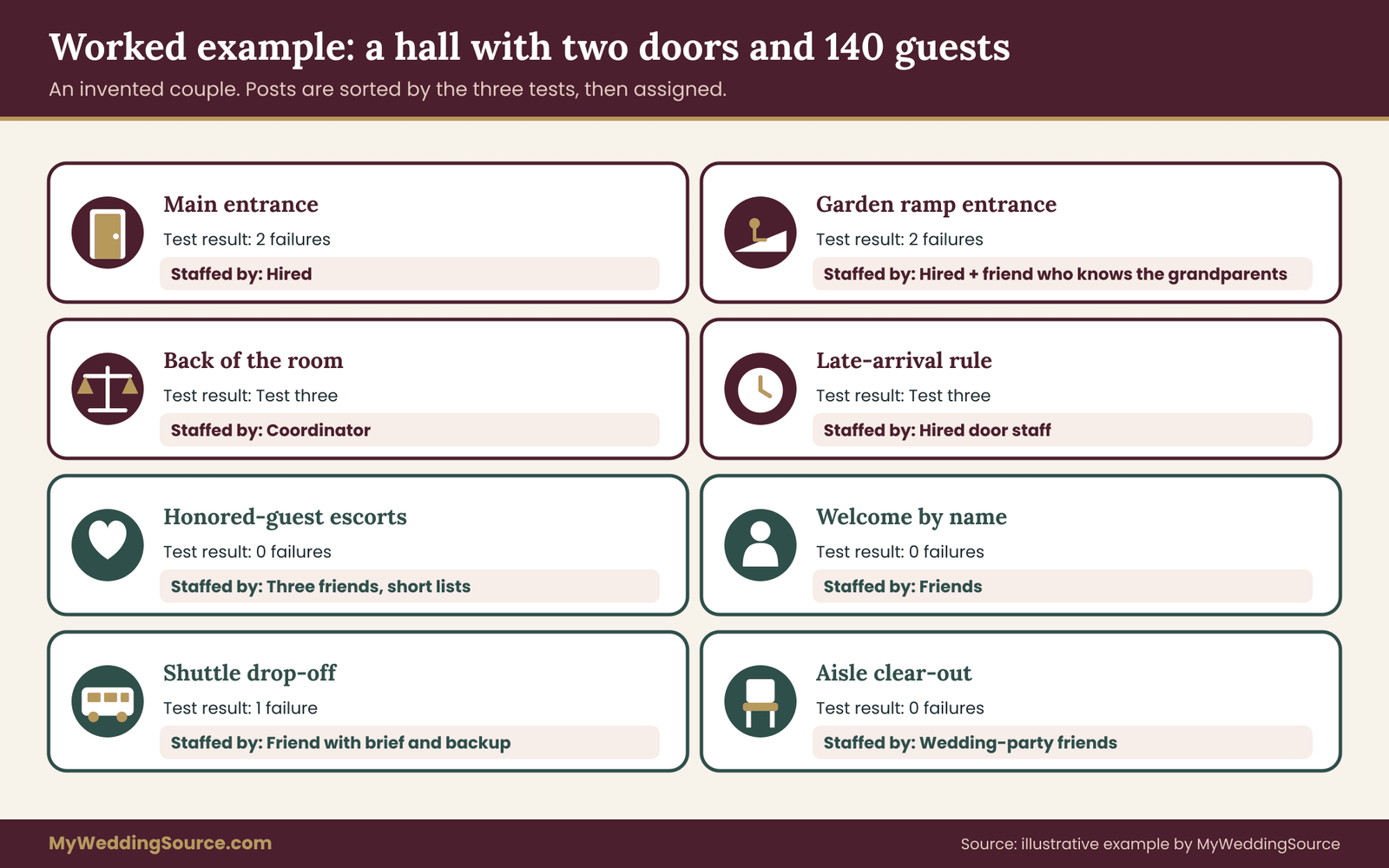
Main entrance. Test one: a few steps and a street, so a mild failure for access. Test two: from three-thirty to four-fifteen, forty-five minutes, a fail. Test three: they need to turn away a guest who is not on the list and hold the door at the processional, a fail. Two or three failures, so staff.
Garden ramp entrance. Test one: yes, this is the accessible route, a fail. Test two: it has to be staffed for the same window, a fail. Test three: not strongly. Two failures, so staff, plus a friend who knows the grandparents.
Shuttle drop-off. The shuttle company’s driver knows the schedule, but someone has to meet each load and point to the doors. Test two fails, and tests one and three do not. One failure, so a friend with a written brief and a named backup.
Honored-guest escorts. No failures. Friends, three of them, each with a short list.
Back of the room during the ceremony. Test three fails, because someone may need to stop a guest from walking toward the aisle. Test two is moderate. This post goes to the coordinator, who is already on site and trusted.
Late-arrival rule. Fails test three. The hired door staff apply it, using the rule the couple wrote.
Aisle clear-out. Light, no failures. Friends from the wedding party, once the photos begin.
Welcome by name. No failures, friends.
Step three: assign and balance
Their result is a hybrid. Two hired wedding ushers cover the main entrance and the garden ramp from three-fifteen until the end of the processional, about an hour and a half. One of those two has done wheelchair and walker seating before. A friend who knows the grandparents stands with the hired person at the ramp, so that the first face the grandparents see is familiar.
Three friends escort honored guests and greet named guests. A fourth meets each shuttle load. The coordinator holds the back of the room. The three friends who are also in the wedding party have limited posts that end before the processional, so none of them is trying to stand in two places at once.
They also write a one-page brief and run a ten-minute walk-through at three o’clock. The brief includes the late-arrival rule, the accessibility route, the phone request and the names of the escorts and their guests.
What the example shows
The number of hired wedding ushers is small. The point was never to hire a full team but to put paid help on the posts that fail two or more tests. The friends have meaningful jobs and are free by the start of the ceremony. The couple did not decide by budget first. They decided by task, and the cost followed.
It also shows the value of naming the posts. Had they simply asked six friends to “usher,” the garden ramp would probably have been unstaffed, because nobody thinks of a side door until a grandmother is standing at it.
A second case: a backyard ceremony for forty guests
The contrast is useful. Imagine a different invented couple, Lena and Marcus, marrying in a relative’s backyard with about forty guests. There is one gate, a flat lawn and two folding chairs for guests who prefer a back seat. The ceremony is short and informal.
Run the same tests. The gate has no access issue, since the path is flat. The commitment is about twenty minutes. Turning a guest away is unlikely, because everyone invited is known to the family. Almost nothing fails. Two cousins can greet guests at the gate, hand out a half-page program and point to seats, while a third person, a friend of the family who knows everyone, seats the two grandmothers.
Hiring wedding ushers here would add cost and a stranger to a small family event for little benefit. Lena and Marcus still write a short brief, because even a small ceremony has a late guest, a shared parking question and a baby who may need to step out. The lesson is that the boundary test is a tool, not a rule that says you should always hire. It often says no.
Briefs and scripts for wedding ushers
Whatever mix you choose, the people at the doors need the same information and the same words. A short brief and a few scripts remove most of the guesswork.
The one-page brief
Keep it to one page, and send it a week before and again the day before. Include the schedule for arrival, the entrances and which is the accessible one, the escorts and their assigned guests, the late-arrival rule, the phone request, the name and number of the coordinator, and a line about what to do in an emergency, such as where the exits are and who calls for help.
Add a short list of guests who need extra attention, using first names and plain notes, such as “walker, aisle seat, row two.” Do not include private information that a guest would not want shared. Seating needs and mobility needs are the only details the wedding ushers needs.
Scripts for common moments
Short scripts help both hired wedding ushers and friends, because they remove the pressure of improvising.
For a late guest at the processional: “The ceremony has started. Let me seat you at the side as soon as there is a pause, and it will only be a minute.”
For a guest who wants to film: “The couple has asked for an unplugged ceremony, and they will share photos afterward. Thank you for keeping your phone away.”
For a guest who is not on the seating list: “Let me find someone who can help. Please wait here, and I will be right back.” Then ask the coordinator, instead of deciding alone.
For a guest who needs help with a step: “Would you like an arm, or would you like me to walk ahead? There is a ramp on the left.”
For a guest who asks where the reception is: Give the same answer every time, written on the brief. “Next door in the main hall, right after the photos. Follow the signs or ask anyone in a blue ribbon.”
Signs help with this, and the wedding signage system guide explains how to place them so that guests do not need to ask.
Rehearse for ten minutes
A ten-minute walk-through the day of the wedding, with everyone at the posts, is worth more than a long email. Walk the route from the drop-off to the seats. Stand at each door and look at what a guest will see. Decide where the backup person stands. Agree on a signal, such as a nod to the coordinator, when a problem needs attention.
Update the brief after the walk-through
The walk-through nearly always changes something. A door sticks, a sign is hidden by a planter, or a post turns out to have a better view from two steps to the left. Fold those changes into the brief and send the corrected version to everyone before guests arrive. Wedding ushers who are working from different versions of the plan will give guests different answers, and that is the problem the brief exists to prevent.
Keep a printed copy at each post. Phones are unreliable in a crowd, and wedding ushers who must scroll for the late-arrival rule will not apply it consistently. A card in a pocket is enough.
Alternatives to hiring wedding ushers or asking friends
The choice is not always between a paid team and a volunteer list. Several other arrangements cover the same jobs, and some of them remove the need for ushers at the door altogether.
Let the venue or coordinator do it
Many venues employ captains or event hosts, and many coordinators bring an assistant. If either does door duty, ask what their staffing covers, how many guests they can greet and whether they will take your list. This is often the simplest answer because the person at the door already knows the building.
Use signs, a host and fewer people
A well-placed sign, a clear entrance and a single greeter can replace a team at a small ceremony. If guests can see where to go and where to sit, they need less direction. A single wedding usher at the main door, with a friend as a backup, can serve a small crowd. Reduce the number of posts by reducing the number of entrances. If the venue allows it, use one entrance for the ceremony and mark the others as staff-only.
Open seating with a few reserved rows
Open seating removes most of the escort task. Reserve the front rows for family and anyone who needs an aisle seat, with clear signs, and let everyone else sit where they like. It does not suit every family, and some cultures and faiths have strong customs about seating, so use it only if it fits. Where it fits, it reduces the number of wedding ushers you need.
Assign by section instead of by guest
For a larger ceremony, divide the room into sections and give each friend a section. One usher takes the left side, another takes the right, and a third handles the rows near the front. Each person knows fewer guests but covers a smaller area, and the load is shared. This works well with a hired person at the door and friends in the sections.
Ask a different kind of volunteer
If friends are reluctant, consider relatives who enjoy being useful, such as an aunt or an older cousin, who may be happier to greet and escort than to stand at a door. If you want to honor someone with a role, such as a grandparent’s friend or a family elder, a seated “welcoming” job at the program table can be more comfortable than standing.
A decision rule when you are still undecided
If you have run the boundary test and the answer still feels unclear, use a tie-breaker. Ask which failure you could recover from on the day. A late volunteer can be replaced by the coordinator. A missing hired person can be replaced by a standby friend. A guest who cannot get through a door, or a family member who feels humiliated by a firm word, is harder to repair. Put the stronger person, whether paid or not, on the post where the failure would be hardest to repair, and give the lighter posts to whoever is left.
Used this way, the test works for any size of wedding. It also helps you explain choices to relatives: wedding ushers are assigned by the task, not by rank or affection, and every person on the list has a role that fits.
Skip ushers for an informal ceremony
For a very small or informal ceremony, no wedding ushers may be needed at all. A handwritten sign and a friend who points the way is enough. It is better to skip the role than to assign it to a person with no clear task.
The step-by-step ceremony guide shows where seating and the processional fit in the order of events, which helps you decide how much help the door will really need.
Failure conditions and fallback plans for wedding ushers
A plan is only as useful as its failure modes. Here are the conditions that most often break a staffing arrangement, along with a fallback for each.
The hired person does not show. Ask the provider for a replacement process and a phone number for the supervisor. Keep a named friend as a standby who knows the plan. If a hired person is missing at the start, the coordinator holds the door while the standby takes the garden route.
A volunteer is late. Build ten minutes of slack into the first post. Ask volunteers to arrive at the venue before the guests, not just before the ceremony, and ask the hotel shuttle to drop them first. Give each volunteer a named backup.
The guest count is higher than expected. If more people arrive than the team can greet, program tables and signs take up the slack. Let the wedding ushers skip the full greeting and just point.
A guest refuses to follow the rule. Door staff should not argue. They should call the coordinator, who has authority to decide. The couple should never be pulled aside during the ceremony to settle a dispute.
A guest is unwell. Every wedding usher should know where the exits are, where the nearest first aid supplies are and who calls emergency services. The brief should say so in one line. If a guest needs help, the team calls for help and does not try to give medical advice.
Weather changes the route. A rain plan moves guests to a different door or a covered walkway. The door team has to know the plan in advance, and the brief should include it.
The wedding party is stuck in photos. If friends who are also wedding ushers are late from photographs, the hired team and coordinator hold the posts. This is a reason to limit friends’ door duty to the time before photos begin.
A volunteer feels used. If you notice someone is stretched, step in. Release them from a post, thank them in public and move on. This costs little and protects the friendship.
After the ceremony
Close the loop. Thank each person in writing, including hired wedding ushers, whose supervisors will appreciate a short note if the team did well. Pay invoices on the terms in the booking. If something went wrong, write down what happened while it is fresh, so your notes help the next couple in your family. If a volunteer went above the plan, say so by name. Wedding ushers who feel seen are the ones who say yes again at the next family wedding.
When to change the plan
Review the plan one week before the wedding. If the guest count has changed, the venue has altered a door, a person has dropped out or a guest’s mobility needs have changed, update the brief and send it again. A late seating change is the most common reason to resend it.
Your next steps
Start with the task list. Write every job your wedding ushers will need to cover, and run the three boundary tests on each one. Mark each task as friends, friend with a backup, or hired. Ask your venue and your coordinator what they already provide before you contact anyone else. If you decide to hire, request written quotes and ask the questions listed above.
If you ask friends, ask privately, say what the job is and how long it lasts, and offer a way to say no. Write the one-page brief and send it a week before the day. Do the ten-minute walk-through at the venue.
Confirm with each of your wedding ushers, hired or not, that they have the brief and know their post. Finally, check with your state labor agency if you plan to pay an individual directly, and use the Department of Labor pages in the sources list as a starting point.
FAQ
Do I really need wedding ushers?
Not always. A small ceremony in a simple space may need only a greeter or a sign. Wedding ushers help most when there are more than one entrance, older or mobility-limited guests, a tight schedule or a venue that requires staffed doors. If guests can find their way and sit without help, you can skip the role, but plan for a few people to escort honored guests.
How many wedding ushers should we have?
Count posts, not guests. One person per entrance is a reasonable starting point, plus one or two escorts for honored guests and someone for any accessible route. Larger ceremonies add people for sections of the room. A venue contact or coordinator can tell you how many doors need coverage, and the right number is the one that lets everyone be seated comfortably before the processional.
Is it rude to ask friends to usher?
No. Many friends are glad to be asked. It becomes unkind when the role is large, unspoken or impossible to refuse. Ask privately, describe the task and the time, and offer an easy way to say no. Give a thank-you after the wedding. If a friend declines, accept it warmly and move to the next person.
What do hired wedding ushers cost?
Prices vary by region, season and provider, so no single figure applies. Ask for a written quote that shows the rate, the minimum hours, extra charges and cancellation terms. Multiply the number of posts you need by the hours each must be covered, and compare that with the quote. If the quote is much higher, ask what is included.
Can wedding ushers also be in the wedding party?
Yes, with limits. A friend who is also a groomsman can escort family before the ceremony, but cannot hold a door during the processional. Give people in the wedding party short, early posts that end before photos begin, and hand door control and late-arrival decisions to hired wedding ushers, the coordinator or another volunteer who is not in the procession.
Do I have to pay friends who help at the door?
This guide cannot answer that for your situation. A friend helping at a family celebration is generally different from a person doing paid work, but the details depend on your state and on how the arrangement works in practice. If you plan to pay anyone, or if the role looks like a job, ask your state labor agency and review the Department of Labor guidance.
What if a hired usher and a family member disagree?
Decide the rule in advance and write it in the brief. The couple’s rule decides, and the coordinator is the person who settles disagreements. Tell the family member before the day who the contact is. On the day, the hired person calls the coordinator and does not argue with a guest, and the couple stays out of it.
Who should brief the wedding ushers, and when?
The coordinator or a trusted friend should send the one-page brief about a week before the wedding and again the day before. Meet at the venue about an hour before guests arrive for a ten-minute walk-through. Include the entrances, the accessible route, the late-arrival rule, the phone request and the contact for any problem.
Sources
- U.S. Department of Labor, Wage and Hour Division: Fair Labor Standards Act
- U.S. Department of Labor: Misclassification of employees as independent contractors
- U.S. Department of Labor: State labor offices
- Internal Revenue Service: Independent contractor or employee
- Occupational Safety and Health Administration
- ADA.gov: Americans with Disabilities Act information
- Ready.gov: Make a plan
- National Fire Protection Association
- U.S. Small Business Administration: Hire and manage employees
- USA.gov: State government and labor agencies