
A camp wedding weekend turns a one-day event into a two-night stay in a place built for summer programs, not for formal guests, so the real planning work is about beds, bathrooms, rules and expectations rather than flowers. This guide gives you an original overnight site workbook, a worked example, a list of alternatives and the conditions under which the whole camp wedding weekend idea should be dropped.
Plan a camp wedding weekend with six worksheets: a bed and cabin ledger, a shared-facilities load check, a guest choice sort (cabin, nearby lodging or commute), a rules and access sheet, a Friday-to-Sunday timeline, and a written expectations note. Count real beds, not advertised capacity. Divide bathrooms, showers and kitchen time by the number of people using them in the same hour. Verify fire, quiet-hour and access rules with the site in writing. If the numbers fail, move guests to alternatives or change the camp wedding weekend format.
Camp sites are appealing for good reasons, and a camp wedding weekend uses all of them. The grounds are large, the setting is private, and everyone sleeps within a short walk of the celebration. A camp wedding weekend can feel like a reunion, with breakfast on a porch, a lake swim before the ceremony and a long evening that does not end with taxis.
It can also go wrong in ordinary ways: eight people share one bathroom, the older relatives are assigned to a top bunk, and nobody told the guests that the dining hall serves breakfast at seven and not a minute later.
This guide is for couples who are seriously considering a camp wedding weekend, or who have already booked one and want to stress-test it. It does not recommend a particular camp or promise any price. It teaches a method. You will leave with a set of numbers you can verify, a way to sort guests into sensible lodging lanes, and a short list of facts that only the site operator, the local fire authority or a land agency can confirm.
A note on scope. This is general information, not legal, safety or financial advice. Capacity limits, fire rules, water systems and accessibility duties depend on the site, the county and the season, so the guide points you to the people who set them. Always get the answers that matter in writing.
What a camp wedding weekend asks of guests and hosts
Start with what makes this camp wedding weekend format different from a hotel weekend. At a hotel, each guest has a private room, a private bathroom and a front desk. At a camp, almost none of that is promised. Cabins may hold six to twelve people, sometimes in bunks.
Bathrooms may be a shared building a short walk from the cabin. The kitchen may belong to the camp’s own staff, who have their own schedule. Cell service may be weak. Roads may be gravel. A camp wedding weekend works when the couple accepts these facts early and designs around them.
Three groups carry the load. The first is the site operator: the camp director or rental manager who knows how many people the property can really sleep, which buildings are open, how the water and septic systems cope with a crowd, and which rules come from insurance, local codes or the camp’s mission.
The second is the host team: you, your families and a small number of trusted helpers who will answer questions at ten at night. The third is the guests, whose comfort ranges from “I love bunks” to “I need a private bathroom and a bed I can get into without climbing.”
The mistake many couples make with a camp wedding weekend is to plan for the average guest. A camp wedding weekend is judged by its least comfortable guest. If the grandmother, the pregnant cousin and the friend with a bad back each have a workable night, almost everyone else will manage too. If one of them does not, the story told afterward is about that night. For more on how this thinking applies across the whole site, see the venue guide, which covers venue selection and the questions that come first.
Why this is a workbook problem, not a mood-board problem
Style choices are easy to change late. Beds are not. A decision about who sleeps where affects the invitation wording, the transportation plan, the catering order, the quiet hours and the budget. That is why this guide treats the camp wedding weekend as an operations problem and gives it a workbook. Each worksheet answers one question, produces a number or a list, and feeds the next.
The workbook is deliberately small. It has six sheets, and each one fits on a single page. You can build it in a notebook, a spreadsheet or a shared document. What matters is that two people can open it, read it and agree on what it says. When a decision changes, you change one line instead of rewriting a long email thread.
What this guide does not cover
This guide is about the overnight and shared-site side of a camp wedding weekend. It does not rank camps, quote prices or tell you how to design a ceremony. For rural and farm-style sites that share some of the same issues, the guide to barn wedding venues is a useful companion. Where a topic needs its own deep treatment, such as bonfire safety, catering at a campground or packing lists, it is mentioned briefly here and kept apart so this article stays focused on the overnight decisions.
The overnight site workbook: six sheets that decide the camp wedding weekend
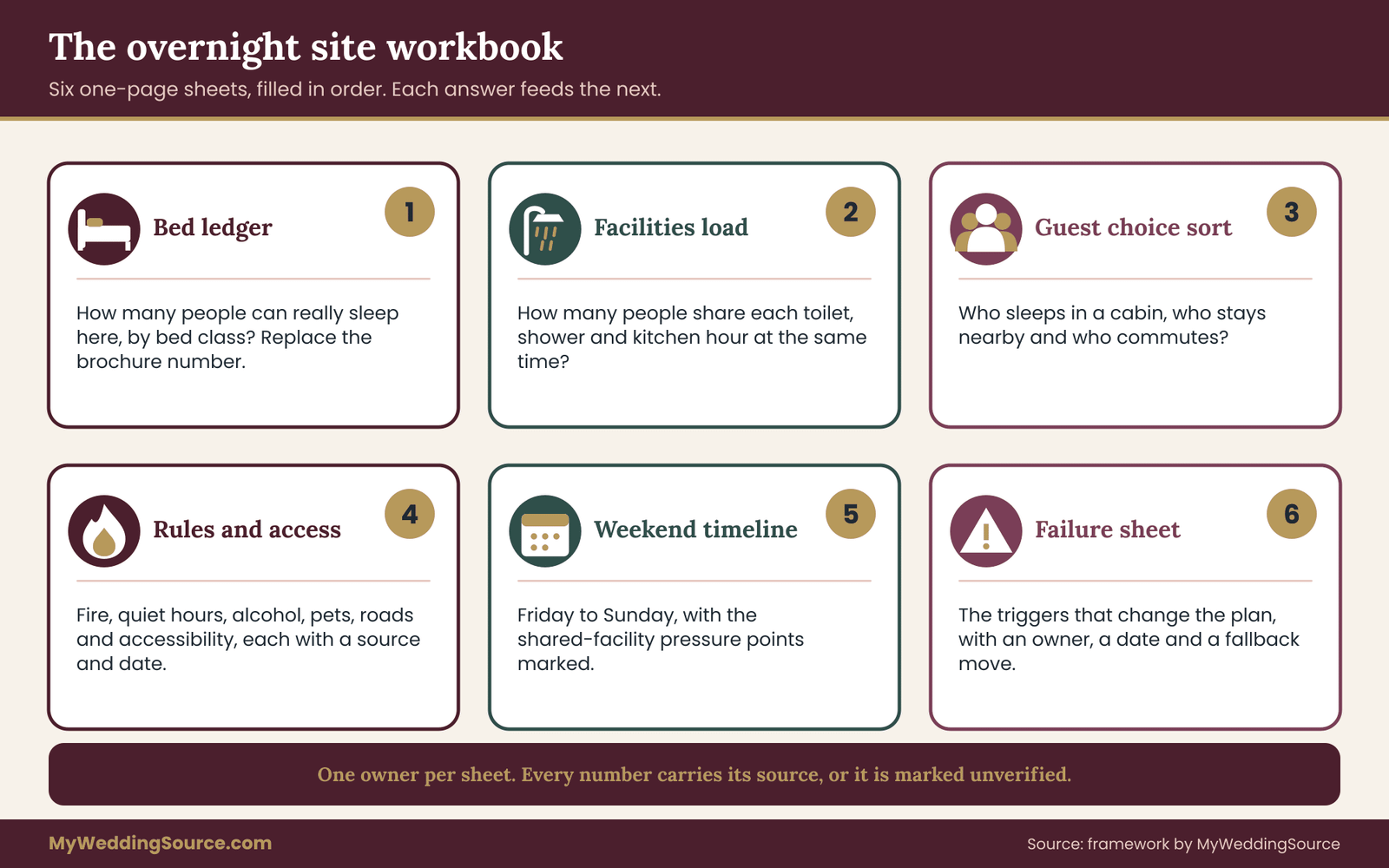
The workbook is the core of this guide, so it is worth seeing as a whole before the individual sheets. Think of it as six questions asked in a fixed order. Each answer constrains the next one, which is why the order matters.
Sheet one: the bed ledger. How many people can actually sleep on the property, by bed type, and how many of those beds are suitable for each kind of guest? This sheet replaces the number printed in the brochure with a number you trust.
Sheet two: the facilities load check. How many people share each toilet, shower, sink, outlet and kitchen hour? This sheet finds the bottleneck. At most camps the bottleneck is not beds. It is the morning shower line or the one working hot water heater.
Sheet three: the guest choice sort. Which guests sleep in a cabin, which choose nearby lodging, and which commute? The sort is built around guest needs and guest choice, not around who is closest to you.
Sheet four: the rules and access sheet. Fire restrictions, quiet hours, alcohol rules, pet rules, vehicle access, check-in and check-out times, and anything the operator or a land agency limits. Every line has a source and a date.
Sheet five: the camp wedding weekend timeline. Friday arrival, Saturday day and ceremony, Sunday departure, with the shared-facility pressure points marked.
Sheet six: the failure sheet. The conditions that would make you change the camp wedding weekend plan, and the move you will make in each case. Most couples never write this sheet, which is why it is the one that saves a weekend.
How to use the sheets in the right order
Fill the sheets in order for your camp wedding weekend and resist the urge to skip to the timeline because it is more fun. If sheet one shows that the cabins sleep fewer people than you hoped, sheet three will tell you how many guests need other lodging, and that changes the transportation plan in sheet five. If sheet four shows that open flames are restricted during your dates, the evening program changes. A completed workbook for a camp wedding weekend is a record of decisions and of the evidence behind them.
Keep a short evidence column on every sheet. For each number or rule, write where it came from: a line in the rental agreement, an email from the camp director with a date, a call to the county fire office. If a statement has no source, mark it as unverified. A workbook with honest “unverified” marks is more useful than a confident one with none.
Who fills in which sheet
Split the work so that one person owns each sheet. A partner who likes spreadsheets can own the facilities load check. A relative with hospitality experience can own the bed ledger and walk the cabins. A friend who is calm on the phone can own the rules sheet and call the site. Shared ownership usually means no ownership. One owner per sheet, a review date, and a short weekly check-in is enough.
Sheet one: the bed and cabin ledger for a camp wedding weekend
The ledger starts with a walk-through, not a brochure. Camps publish a capacity number that usually reflects peak summer programming, when children share bunks and staff fill every corner. A camp wedding weekend asks adults to use the same space, and adults take up more room, keep more luggage and expect more privacy. The number you can safely use is almost always lower than the number on the website.
Build the ledger one building at a time. For each cabin, lodge or house, record the name, the number of beds by type (bottom bunk, top bunk, single, double, cot), the mattress condition, the distance to the nearest bathroom, the number of steps or slope on the path, whether the door sill is level, and whether the building has heat or cooling. Then add a column for the maximum number of people the operator will confirm in writing for adult guests.
Counting beds the honest way
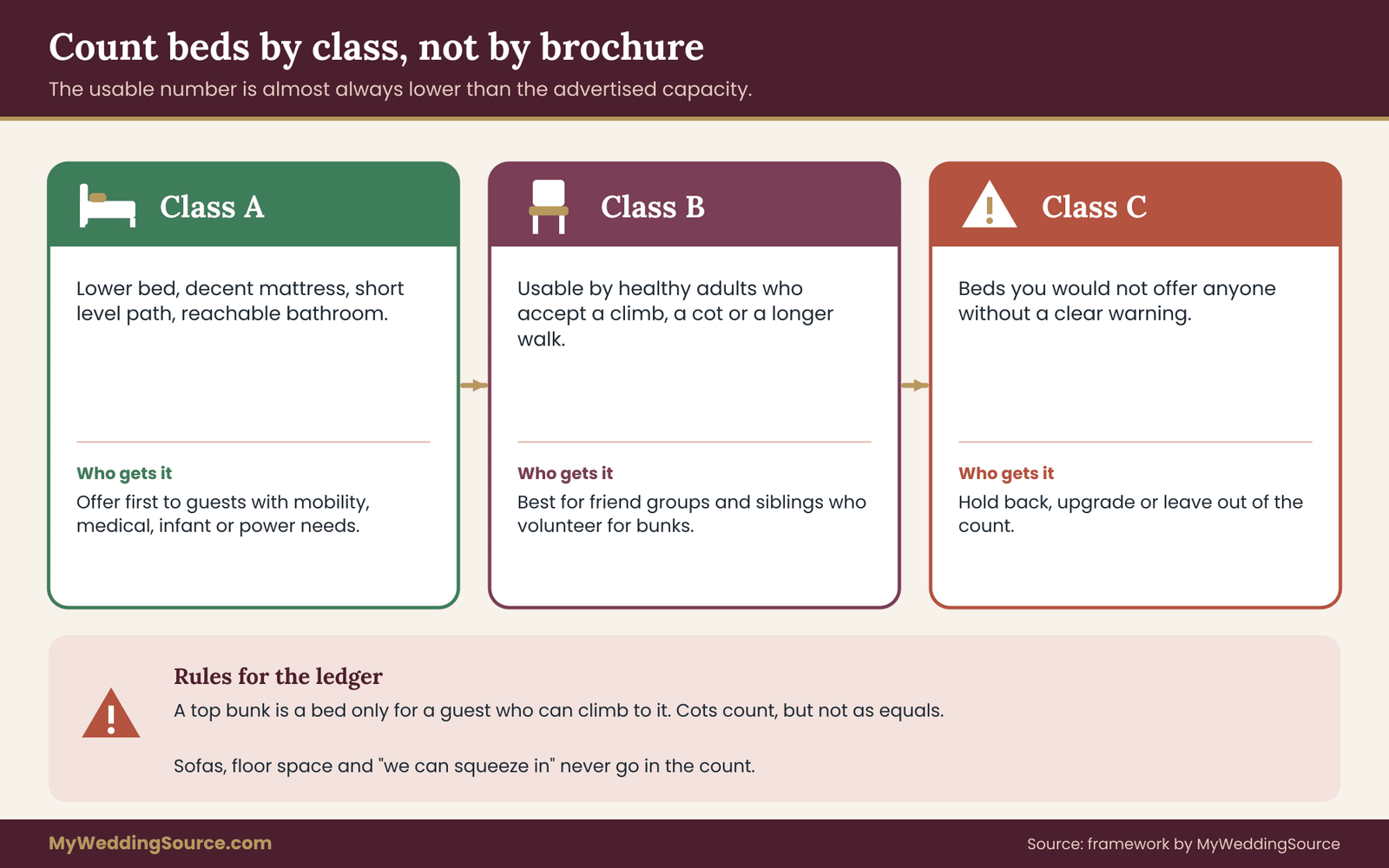
A bunk bed is two beds only if the guest who gets the top one can climb to it. Mark every top bunk as “limited use” and decide in advance who may use them. A cot or a roll-out mattress is a real bed but not an equal bed, and a guest who is offered one should know before arriving. Sofas, floor space and “we can squeeze in” do not belong in the ledger at all. If a bed is not in the ledger, it is not a bed.
Next, group the beds into three classes. Class A beds are the ones almost any guest can use: a lower bed, a decent mattress, a short level path, a reachable bathroom. Class B beds are usable by healthy adults who do not mind a climb, a cot or a longer walk. Class C beds are the ones you would not offer to anyone without a warning. This three-class sort is the backbone of the sheet, because it makes the next question concrete: how many guests need Class A, and do you have that many?
The real cabin math
Imagine a site for a camp wedding weekend that advertises forty-eight beds. After the walk-through, perhaps thirty-two are lower bunks or singles, eleven are top bunks, and five are cots. If three of the lower beds sit in a cabin with a steep path and no handrail, the number of Class A beds drops again. This is an illustration of the method, not a statistic about any camp. The point is that the usable number depends on how you count, and you should count in the way your guests will experience it.
Do the same with groups. Cabins that sleep eight in bunks are best filled with eight people who know each other well: a bridal party, a college friend group, siblings. A couple sharing a cabin with six strangers is an unreasonable ask unless they volunteered. Decide whether you will assign cabins, let guests choose or use a hybrid, and write down the rule. A camp wedding weekend runs more smoothly when the assignment logic is visible and fair.
Privacy and couples
Camp cabins are rarely built for privacy. Walls may not reach the ceiling, partitions may be curtains, and doors may not lock. Your ledger should have a “private option” column that records whether a space has a lockable door, whether it is separated from neighbors, and whether it has its own bathroom or a very short walk to one.
These spaces are scarce. They are the ones you will want for the couple, for parents of infants, for guests with medical equipment and for older relatives. Decide who gets them before the first invitation goes out, because once guests start choosing, the best spaces vanish.
If a camp has a director’s house, a lodge suite or a staff cottage, ask whether it can be rented for the camp wedding weekend. These often have private bathrooms, kitchens and a real bed, and they can solve several problems at once. They also tend to cost more per person than a bunk, so check the budget before building the camp wedding weekend plan around them. The budget guide shows how to set up categories so a lodging line does not quietly swallow the rest of the camp wedding weekend plan.
Linen, bedding and what is included
Many camps provide a mattress and nothing else. Some include pillows; few include sheets or blankets. Write down exactly what is provided, what guests must bring, and whether you will supply a bedding option such as a rental set. Decide this early, because bedding affects luggage, travel by air and guest expectations.
A guest who flies in and finds a bare vinyl mattress will not be pleased, and a guest who drives with a pickup truck and brings a duvet and an air bed will be delighted. The ledger should list bedding next to each cabin so nothing is assumed.
Also record how the site handles laundry and cleaning between your weekend and the next group, because that affects how much you must strip, return or leave tidy. If the camp expects cabins to be swept and bedding stripped on Sunday, someone must own that job, and it should be built into the departure timeline.
Beds are easy to count. Bathrooms are where a camp wedding weekend quietly breaks. The facilities load check turns “enough bathrooms” into a number you can test. It asks how many people use each facility in the same hour, and it focuses on the hours when everyone wants the same thing: the early morning, the hour before the ceremony and the late-night return.
The bathroom ratio
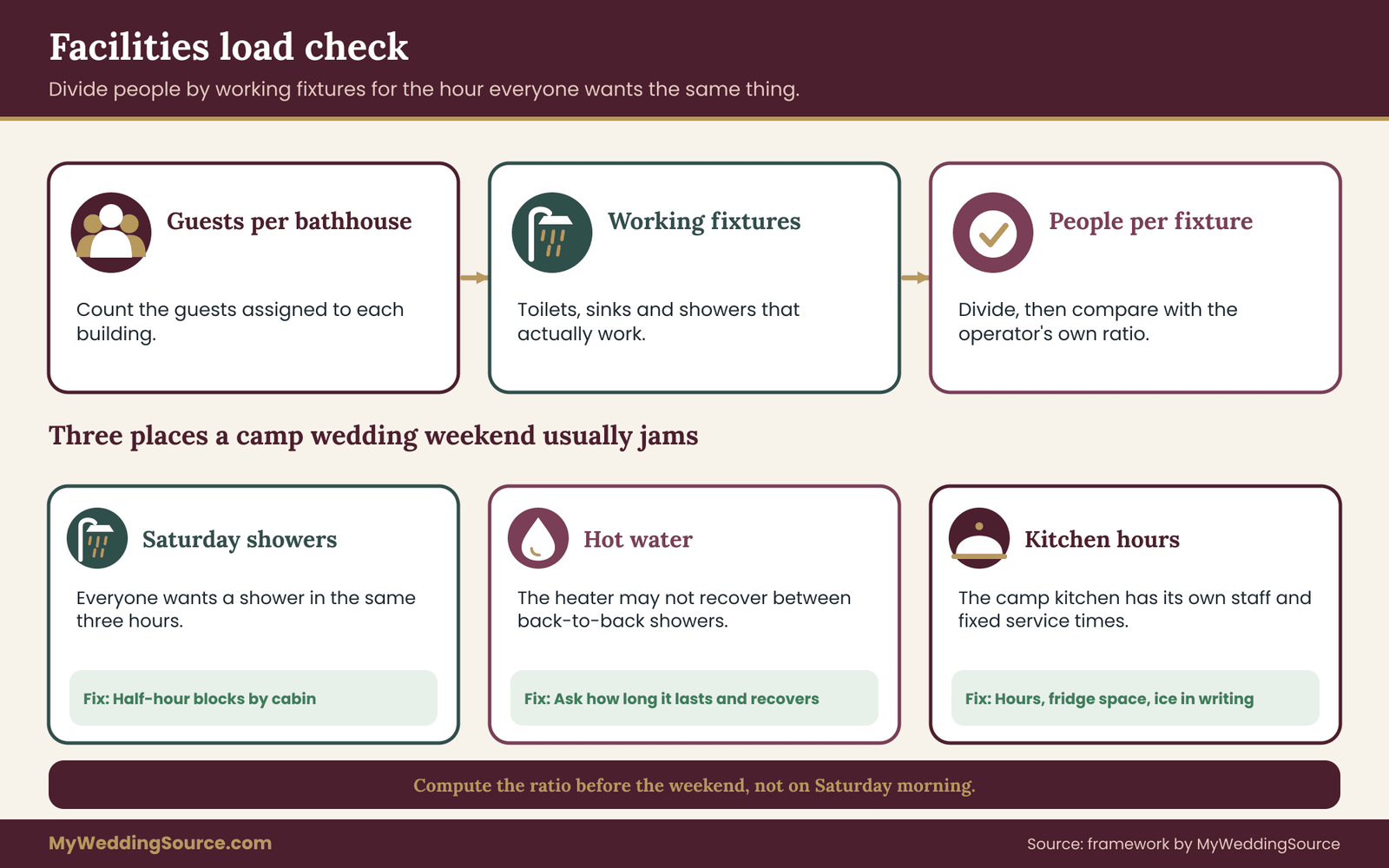
For each bathhouse or bathroom, record the number of toilets, sinks and showers that work, whether they are separated by gender or open to all, whether they have privacy partitions, and the distance from the cabins that rely on them. Then divide the number of guests assigned to that bathroom by the number of working fixtures. A bathroom with two showers serving twenty people, all of whom want to be clean before a four o’clock ceremony, is a bottleneck. The same bathroom serving eight people is a comfortable stay.
You will not find a universal rule that says how many people per shower is correct, and the camp may have a number it uses for regular programs. Ask the operator what ratio they use for adult groups, and compare it to your own load.
What matters is that you compute the number before the camp wedding weekend, not discover it on Saturday morning. If the ratio looks tight, you have options: stagger shower windows by cabin, add portable facilities if the operator allows it, move some guests to alternative lodging, or shift the ceremony later so the shower window widens.
Hot water is a schedule, not a feature
Many camp bathhouses run on a water heater sized for a limited number of showers in a row. When twelve people shower in forty minutes, the water turns cold. Ask the operator how long the hot water lasts under a heavy morning load and how long it takes to recover. If the answer is “it should be fine,” ask what happens if it is not. A posted shower schedule, with half-hour blocks by cabin, is a quiet tool that solves a lot of complaints before they start. It looks fussy and works well.
For the bride, groom or wedding party, who all need hair, makeup and a shower in the same window, consider a separate getting-ready space with its own power and mirrors. Camps often have a lodge, a staff room or a craft building that works for this. Reserve it in the rental agreement, not by verbal agreement. The technical walkthrough guide explains how to measure and document a space so vendors and helpers can plan around it.
Kitchens, ice and refrigeration
If the camp has a commercial kitchen, learn who is allowed to use it. Some sites require their own cooks, some allow outside caterers with proof of insurance and a food license, and some forbid wedding food from entering the building.
Ask about refrigerator and freezer space, ice supply, dishwashing, trash removal and what happens to leftover food. These are details that a regular venue handles without comment and a camp may not. A short email titled “kitchen use for our weekend” with a numbered list of questions gets you answers you can paste into the sheet.
Plan for the quiet needs, too. A guest who takes medication that must stay cold needs a refrigerator they can reach. A family with an infant needs a place to warm a bottle. A guest with a food allergy needs to know where food is prepared and whether labels will be posted. Answers do not have to be complicated, but they have to exist before the camp wedding weekend, not during it.
Power, light and the night walk
Camps are dark, and paths are uneven. Record where lighting exists and where it does not, how far it is from each cabin to the bathhouse at night, and whether the path has steps, roots or loose gravel.
A walk of two hundred feet is nothing in daylight and a real obstacle at two in the morning for someone with a cane or a sleeping child in their arms. Solutions are inexpensive: solar path lights, flashlight baskets at each cabin door, reflective tape on steps, and a clear map. Put the map in the expectations note you will build later.
Outlets are another surprise. A cabin may have one outlet, or none. Phone chargers, CPAP machines, hair tools and medical devices compete for that supply. Write down how many outlets each building has and which ones are on shared circuits. For guests who need continuous power for a medical device, the answer should be known well before they book, and the spot they get should be one with reliable power. This is not a luxury item. It is part of treating guests as adults with real needs.
Sheet three: the guest choice sort
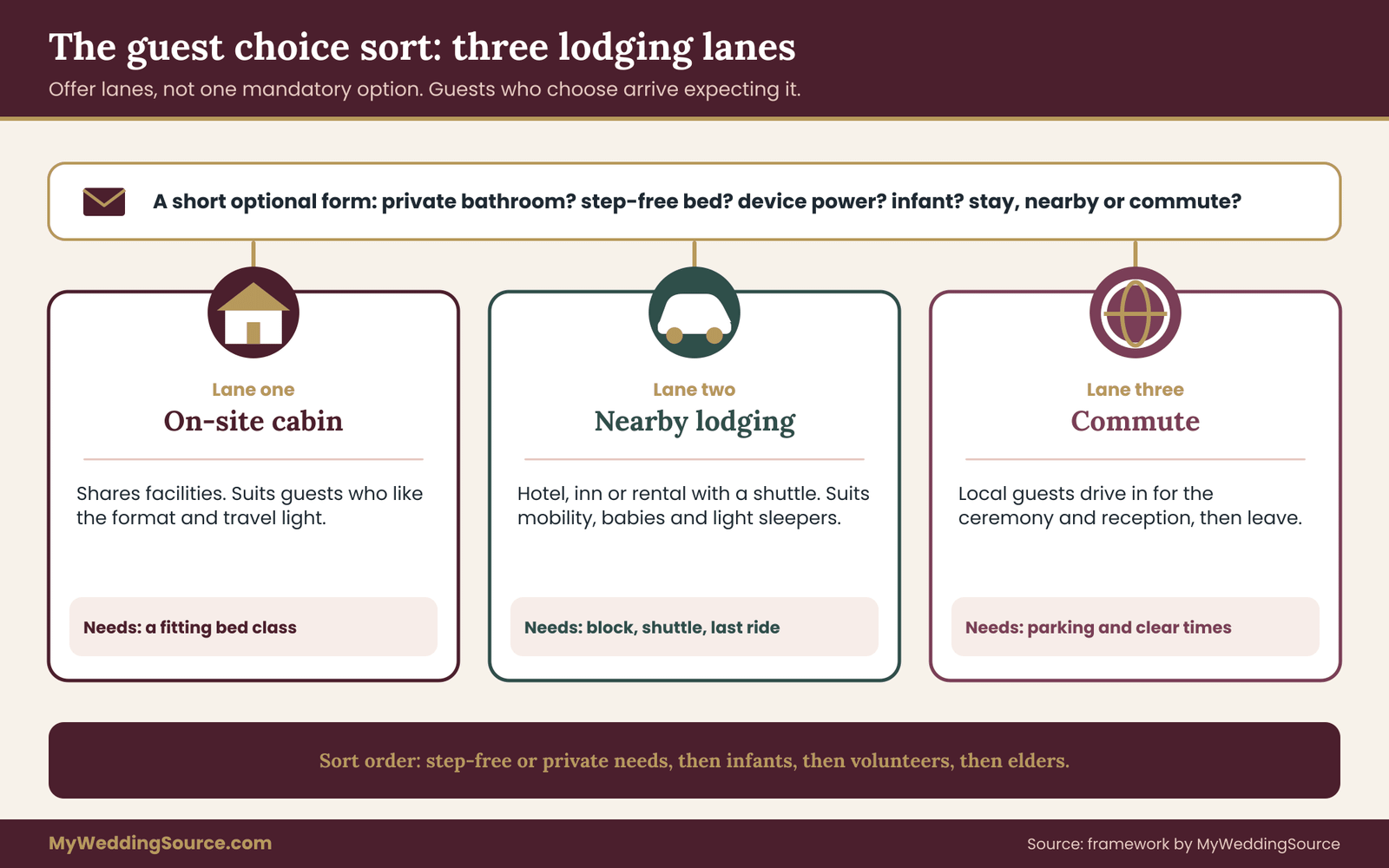
Once you know how many beds and bathrooms you really have, you can ask the question that decides the guest experience: who sleeps where? The guest choice sort is built on a simple idea. Guests are not all the same, and a camp wedding weekend should offer lanes, not one mandatory option. A guest who chooses a lane is a guest who arrives expecting it, which is the whole aim of a well-run camp wedding weekend.
The three lanes
Lane one: on-site cabin. The guest sleeps at the camp, in a cabin or lodge, and shares facilities. This lane suits people who enjoy the camp wedding weekend format, travel light and do not need much privacy. It is the lane that makes the camp wedding weekend feel like a retreat.
Lane two: nearby lodging with a shuttle or a short drive. The guest sleeps in a hotel, inn or rental within a reasonable distance and arrives for events. This lane suits guests with mobility needs, light sleepers, families with babies, and anyone who needs a private bathroom. It also acts as a pressure valve when the camp is full.
Lane three: commute. Local guests, or guests with a nearby home or family, drive in for the day and the evening. They attend the ceremony and the reception, perhaps one meal, and leave. These guests are not second-class. For many couples, a good share of the guest list belongs here.
A camp wedding weekend usually needs all three lanes. A couple who forces everyone into lane one tends to lose guests, create resentment or end up with a rushed workaround. A couple who offers lanes can be generous, because a guest can say yes without feeling trapped.
Questions that sort guests fairly
Rather than guessing, ask. For a camp wedding weekend, a short, friendly form attached to the invitation or the wedding website can collect what you need. Keep it plain and optional. The questions that matter most are these: Do you need a private bathroom? Do you need a ground-level bed or a step-free path? Do you use medical equipment that needs power or refrigeration? Are you bringing children or an infant? Do you want to stay on site, stay nearby or commute? Are you comfortable sharing a cabin, and with whom?
Then sort. Anyone who needs a private bathroom, a step-free route, reliable power for a device or a quiet room goes first to your Class A beds or to lane two. Families with infants go next, because their sleep depends on a quiet, dark, safe room. Friend groups who volunteer for bunks fill the Class B beds. The remaining Class A beds go to older guests, parents and elders. If you reach the end and still have guests without a good bed, they move to lane two, and you move on to the transportation question.
Fairness without drama
Some couples worry that assigning the best beds to certain guests will cause hurt feelings. The way to avoid hurt feelings is to make the rule visible and based on need. “We assigned Class A beds first to guests who told us they needed a ground-floor bed, a private bathroom or reliable power, then to guests traveling with infants, then to the oldest guests” is a rule anyone can understand.
It does not depend on who is closest to the couple. If a close friend asks why they are in a bunk, the answer is calm: the beds were assigned by the stated need, and you can offer a nearby hotel if they prefer.
Also decide whether the wedding party and family get priority. Many couples give them the nicest spaces because they arrive early and carry more tasks. That is a reasonable choice, but state it. Hidden preferences are the ones that cause arguments. For help with the harder conversations that surround lodging, the guide to coordinating guest hotels across budgets and mobility needs shows how to describe options without ranking guests.
Children, infants and sleep
Children change the math. A camp can be a joy for kids and a hazard for parents of toddlers. Ask whether the camp allows children in cabins, whether cribs or portable cribs are allowed, how close the cabins are to water, roads or open fire areas, and whether there are fences.
Many parents of small children will prefer a cabin close to the dining hall and a lodge with a door that closes. Others will prefer a hotel, because a sleeping child is easier to move to a car than to a bunk bed across a field.
Decide whether you want an adult-only or child-friendly weekend and say so clearly. If children are invited, plan for a safe, supervised space during the reception. The sections on guest care in the guest care guide cover the broader question of looking after guests who need extra support.
Guests who cannot or will not stay
Some guests will decline the cabin lane for reasons you never learn. That is fine. Build the camp wedding weekend plan so that declining a cabin does not mean declining the wedding. Provide a short list of nearby lodging options, give a clear arrival time for each event, and tell commuters where to park and how to reach the ceremony.
If the camp is far from public transportation, tell guests early so they can arrange a ride. The goal is to give each guest a way to attend that fits their life, not to prove who is the most adventurous.
Sheet four: rules, fire safety and access for a camp wedding weekend
The rules sheet is where the romantic idea meets the real world. A camp is a working property with an insurer, a local fire authority, perhaps a land agency, and a board that has seen groups cause trouble. Every rule on this sheet should have a source and a date. Rules change by season, and a rule confirmed in March may not hold in August.
Fire restrictions and open flame
Bonfires, fire pits, candles and sparklers are popular at camp weddings and are tightly limited at many sites. Whether open flame is allowed depends on the camp’s own policy, the county or state fire authority, the weather and sometimes the day. Restrictions can be put in place on short notice during dry periods. If a site is on or near public land, a land agency such as the National Park Service or the U.S. Forest Service may issue its own fire restrictions, and local authorities do the same for private land.
Ask the operator in writing: Is open flame allowed during our dates? Who decides, and when? What is the backup plan if a restriction is announced? Is there a designated fire ring, and who supervises it? Is fire extinguisher or water access nearby? A written answer protects you.
It also shapes your evening program: if a fire may be banned, plan an alternative gathering, such as lanterns that are battery powered, a lit gathering area or a music circle that does not depend on flame. Bonfire planning has its own safety questions and is best handled separately from this overnight sheet, but the camp wedding weekend plan must have a fallback that does not depend on one.
Quiet hours, alcohol and noise
Camps often set quiet hours because neighbors, other groups or wildlife are nearby, and because their own staff need to sleep. Find the exact time, whether it applies to music and amplified sound, and whether there are exceptions on wedding nights. Ask about alcohol: whether it is allowed at all, whether a licensed bartender or a special event permit is needed, and where drinking is allowed on the property. Some camps are run by faith or youth organizations with alcohol-free rules that cannot be waived. Learn this before you build a bar plan.
Also record pet rules, smoking rules, drone rules and photography restrictions. A camp may limit drones because of wildlife or neighbor privacy. It may limit pets because of cabin hygiene. These are small lines that can create large problems if discovered late.
Access, parking and emergency routes
Write down how a guest reaches the site: the road type, whether the last stretch is gravel or dirt, the clearance for low cars, the width for a bus or a vendor truck, and the cell coverage along the route. Record where guests park, how far the parking is from the cabins, and whether a shuttle is needed.
Ask how an ambulance or fire truck reaches the main areas, and whether gates are locked at night. These questions are not a sign of pessimism. They are the same questions the site’s own safety plan should answer, and a good operator will respond without defensiveness.
Accessibility deserves its own line. The Americans with Disabilities Act applies in different ways to different kinds of facilities, and a private camp may or may not have fully accessible cabins and paths. Ask the operator which spaces are accessible, what that means in practice, and whether the answer is based on a recent review.
The ADA National Network and the U.S. Access Board publish guidance, and you can read them yourself. The accessible venue red flags guide lists the warning signs to watch for when a site says it is accessible but cannot show how.
Water, septic and waste
Many camps run on a private well and a septic system sized for their normal program. A large adult group using showers and toilets in a short window can strain both. Ask the operator whether the water is tested, whether there is a current boil notice or other advisory, and how the septic system copes with a full house.
Ask whether the camp expects guests to follow rules such as limits on shower length or restrictions on flushing anything but toilet paper. The Centers for Disease Control and Prevention publishes drinking water guidance for campers, and the operator should be able to tell you how they handle it.
Trash is a second, quieter problem. A wedding generates far more waste than a youth program, and the camp may have limited dumpsters, no pickup on Sunday or a rule that all trash leaves with the group. Decide who bags, who hauls and where it goes. Wildlife makes this more than a tidiness question: food scraps left outside draw raccoons, bears or rodents depending on the region, and a camp may require sealed containers and a strict cleanup after each meal.
Wildlife, ticks and food storage
Ask the operator which animals and insects are common on your dates and what the site does about them. In tick country, a note to guests about long pants, repellent and a quick check after walks is a kindness, not a scare. In bear country, the camp may require that no food is stored in cabins. Take such rules seriously, tell guests plainly, and put a short line in the expectations note. Guests who bring snacks, wedding cake leftovers or coolers into cabins can cause trouble for the next group, and for themselves.
Insurance, permits and contracts
Ask whether the camp requires you to carry event insurance, whether vendors must provide certificates of insurance, and whether a permit is needed for amplified sound, tents or alcohol. Read the rental agreement for cancellation terms, force-majeure language, damage deposits and the process for refunding a deposit if a fire ban, a flood or an evacuation affects your dates. A written contract is the tool that holds all of this together. The vendor contract guide explains what to look for in a contract and what to ask before signing.
Sheet five: the camp wedding weekend timeline, Friday to Sunday
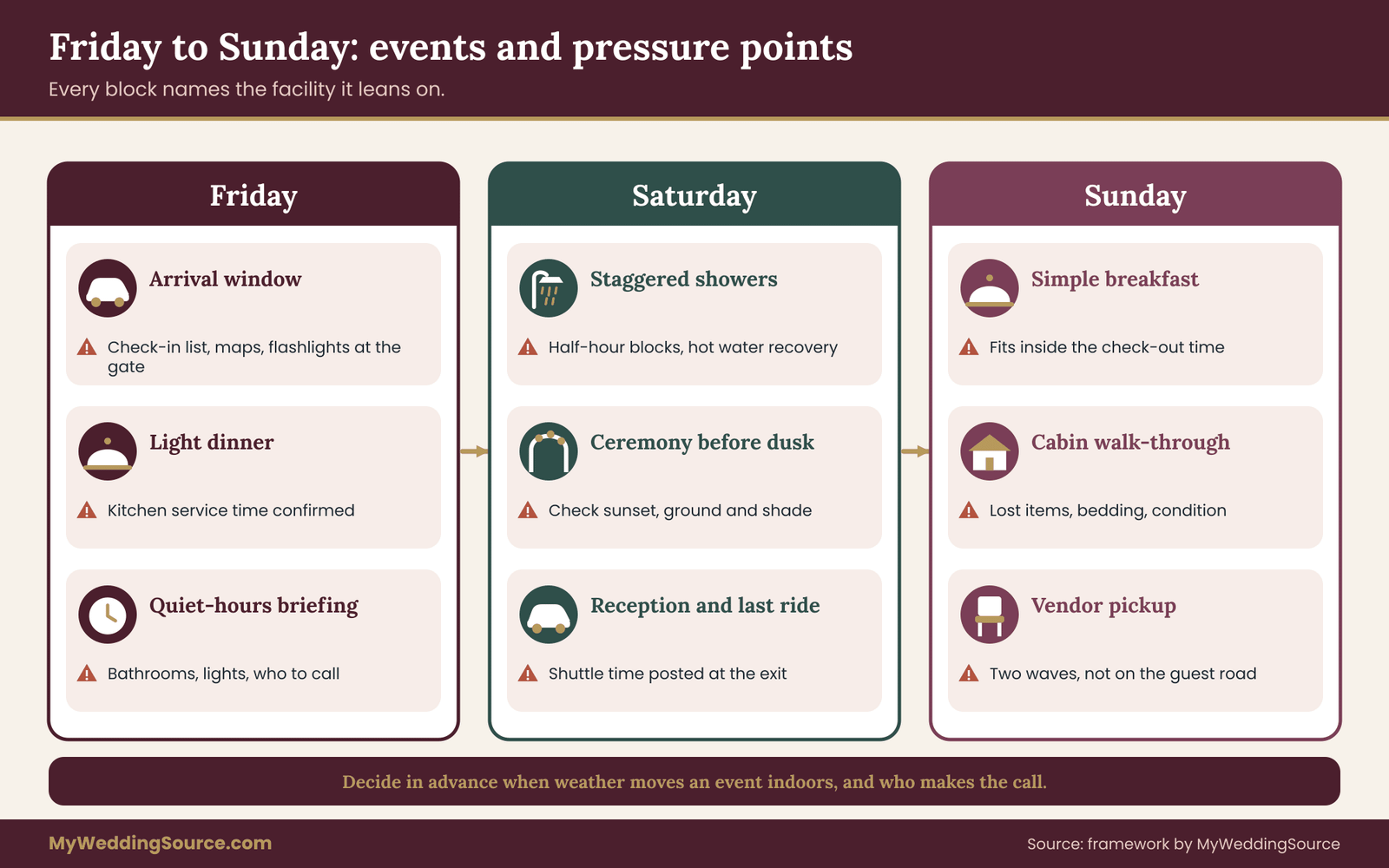
A timeline for a hotel wedding lists events. A timeline for a camp wedding weekend lists events and pressure points. The extra column matters because shared facilities turn small delays into long lines. The sheet below uses three days, but a two-night weekend can be shortened or extended. The method is the same: write each block, then mark the facility it leans on.
Friday: arrival is the first test
Arrival is when the ledger meets reality. Guests come in waves, tired from travel, hungry, and unsure where anything is. Choose a check-in window and tell guests exactly when the gates open and when the cabins are ready. Many camps cannot let you in until a previous group has left, so ask for the earliest time you can count on and add a margin. Put someone at the entrance with a printed cabin list, a map and a bag of flashlights. That one person saves forty questions.
Friday evening should be light. A simple dinner, a short welcome and an early finish are enough. Guests who have driven for hours do not need a program, and the host team needs energy for Saturday. If you plan a rehearsal, keep it short and hold it before dinner, in daylight, when people can see the paths. Tell guests what to expect for the night: where the bathrooms are, when quiet hours begin, and who to call if something goes wrong.
The facilities pressure points on Friday are the check-in desk, the first dinner service and the evening bathroom rush. If the kitchen is shared with the camp, confirm service times. If dinner is catered by an outside vendor, make sure the load-in route does not cross the guest arrival route at the same hour.
Saturday: protect the morning, then the ceremony
Saturday is the day the camp wedding weekend can quietly fail. Everyone wants to shower, eat and get dressed in the same three hours. The timeline should stagger them. Give each cabin a shower window, serve breakfast in a way that does not require a single line, and keep the getting-ready space separate from the guest bathhouse. Mark the hot water recovery time on the sheet as a hard constraint, not a hope.
Place the ceremony late enough that the morning rush finishes before guests need to be ready, and early enough that the evening does not stretch past quiet hours or the available light. Many camp ceremonies happen in the late afternoon, when the light is soft and the heat has eased.
Check the sunset time for your date, plan the photo sessions with that time in mind, and tell your photographer about the light conditions on the site. Get the sunset time for your date from the National Weather Service or a local almanac rather than guessing.
Between breakfast and the ceremony, guests have free time. Camps offer natural options: a walk, a swim if the site allows and supervises it, a game on the lawn, a quiet porch. Provide two or three suggestions on a printed sheet, but do not schedule every hour. Some guests want to nap, and a camp wedding weekend should let them.
Saturday evening: dinner, dancing and the walk home
At a camp wedding weekend, the reception is where the lanes cross. Lane one guests walk back to cabins, lane two guests need a ride, lane three guests need to find their cars. Schedule the last shuttle, tell guests when it leaves, and put the time on a small sign at the exit.
If there is a gap between the end of the reception and quiet hours, plan a lower-key gathering for those who stay, such as hot drinks, a quiet porch or a board game corner. A late-night event that spills into the cabins at midnight will cost you the goodwill of the guests who wanted to sleep.
Lighting for the walk home matters more than the lighting for the party. Put lights on the path, assign two helpers to walk guests to cabins with flashlights, and keep a list of anyone who needs an arm or a ride. Ask the operator for its own emergency plan, and walk the exit routes yourself in daylight.
Sunday: departure is a logistics problem
Check-out time is often earlier than guests expect, because the camp needs to turn the cabins for the next group. Write the time down, repeat it on the Saturday night signs and plan a simple breakfast that fits inside it. A small farewell gathering is lovely, but it should not delay the cleaning crew. Assign someone to walk each cabin, check for lost items, strip beds if required and confirm the cabin is returned in the condition the contract describes.
Plan the departure of vendors and rentals in the same way. Tents, tables, chairs, sound equipment and trash all have to leave on time. If any of these cross paths with guest departures on a narrow road, stagger them. A one-lane gravel road with a rental truck and thirty guest cars is a bad place to learn that two schedules overlap.
Weather as a timeline variable
Weather affects every block of a camp wedding weekend. Heat changes the best time for the ceremony and the need for shade and water. Rain changes the paths, the parking and the dining. Cold changes the sleeping arrangements and the need for blankets.
Check the forecast from the National Weather Service for the days leading up to the camp wedding weekend, and decide in advance at what point you will move an event indoors. Camps often have a dining hall or a lodge that can hold a ceremony, but the capacity is lower than the lawn, so check it on the sheet.
If your dates fall in a season prone to severe weather, wildfire smoke or flooding, build in a decision date. On that date, you and the operator review the forecast and the conditions and decide whether to proceed as planned, shift events or activate a backup. Write the decision date and the decision-makers on the sheet. This is the same discipline used by outdoor event organizers everywhere, and it keeps decisions calm.
Setting guest expectations in writing for a camp wedding weekend
A camp wedding weekend is only as comfortable as the expectations guests bring with them. A guest who arrives expecting a hotel and finds a bunk will be unhappy no matter how nice the bunk is. A guest who knows they will share a bathhouse, walk on gravel and sleep under a quilt will pack accordingly and often enjoy it. The expectations note is a short, honest document that turns surprise into preparation.
What the note must say
Write the note in plain language and put it where guests will see it: on the wedding website, in a printed insert and in a message sent a few weeks before the date.
It should cover the lodging lanes and how guests choose, what each cabin type is like, the bathroom arrangement, the schedule for the camp wedding weekend, the dress code and what to wear on uneven ground, what the camp provides and what to bring, the rules on alcohol, fire, pets and quiet hours, how to reach the site and where to park, and who to contact with questions.
Tone matters. Avoid language that sounds like a warning, and avoid language that oversells. “Cabins are simple and shared; bring a sleeping bag or bedding” is clear and kind. “Rustic charm awaits” tells a guest nothing. Give honest descriptions, and let guests decide. Keep the note short enough to read on a phone.
Dress and footwear
Camp ceremonies often take place on grass, gravel or packed dirt. Guests who wear thin heels will struggle, and guests who wear dress shoes on wet grass may slip. Tell guests what the ground is like and suggest footwear. If you want a formal look, say so, and also say that comfortable shoes are welcome. Offer a basket of flats or a place to change at the ceremony site. A guest who feels comfortable stays longer and has a better time.
Layers are a second need. Evenings in many camp settings are cooler than the day, and cabins may not have heat. Suggest a sweater or wrap. If insects, ticks or poison ivy are common at the site, tell guests and suggest repellent and long sleeves for walks. The Centers for Disease Control and Prevention publish guidance on tick and insect protection that you can point guests to.
What the camp provides and what guests bring
List the supplies by category. Beds and mattresses: provided or not. Bedding and towels: provided or bring your own. Toiletries: bring your own. Flashlights: recommended. Chargers and extension cords: note the limited outlets. Water bottles: some camps do not allow single-use plastic or have limited water points.
Medications: bring your own and tell the host team about any that need refrigeration. A short packing note is more useful than a long one. A dedicated packing list for campground weddings is a topic of its own, so this guide only lists the categories you need to address.
Medical needs and emergencies
Camps are often far from hospitals. Tell guests the distance to the nearest urgent care or hospital, whether there is a nurse or first aid kit on site, and how emergency calls work if cell service is weak. Many camps have a landline or a radio for emergencies. Share the number with the host team and put it on the printed map.
Ask guests with serious medical conditions to tell you in confidence, so you can place them in a suitable cabin and share the information with the camp’s health contact if appropriate. Do not collect more medical detail than you need, and do not share it beyond the people who must know.
How to say no to special requests
Guests will ask for things the camp cannot provide: a private room, a bed in a hotel-quality cabin, a late check-out, a quiet cabin away from the music. Decide ahead of time which requests you can accommodate, which you can partly accommodate and which you must decline.
A calm script helps: “We have a limited number of private spaces and have given them first to guests with mobility or medical needs. We would be glad to help you find a nearby inn and arrange a ride.” It is honest, it respects the guest and it does not apologize for the camp wedding weekend format.
A worked case: the Willow Fork camp wedding weekend
The numbers below are invented to show the method. Willow Fork is not a real camp, the guests are not real people, and none of the figures describe an actual site. Use the structure, not the numbers, and replace every figure with one you have confirmed in writing.
The setting
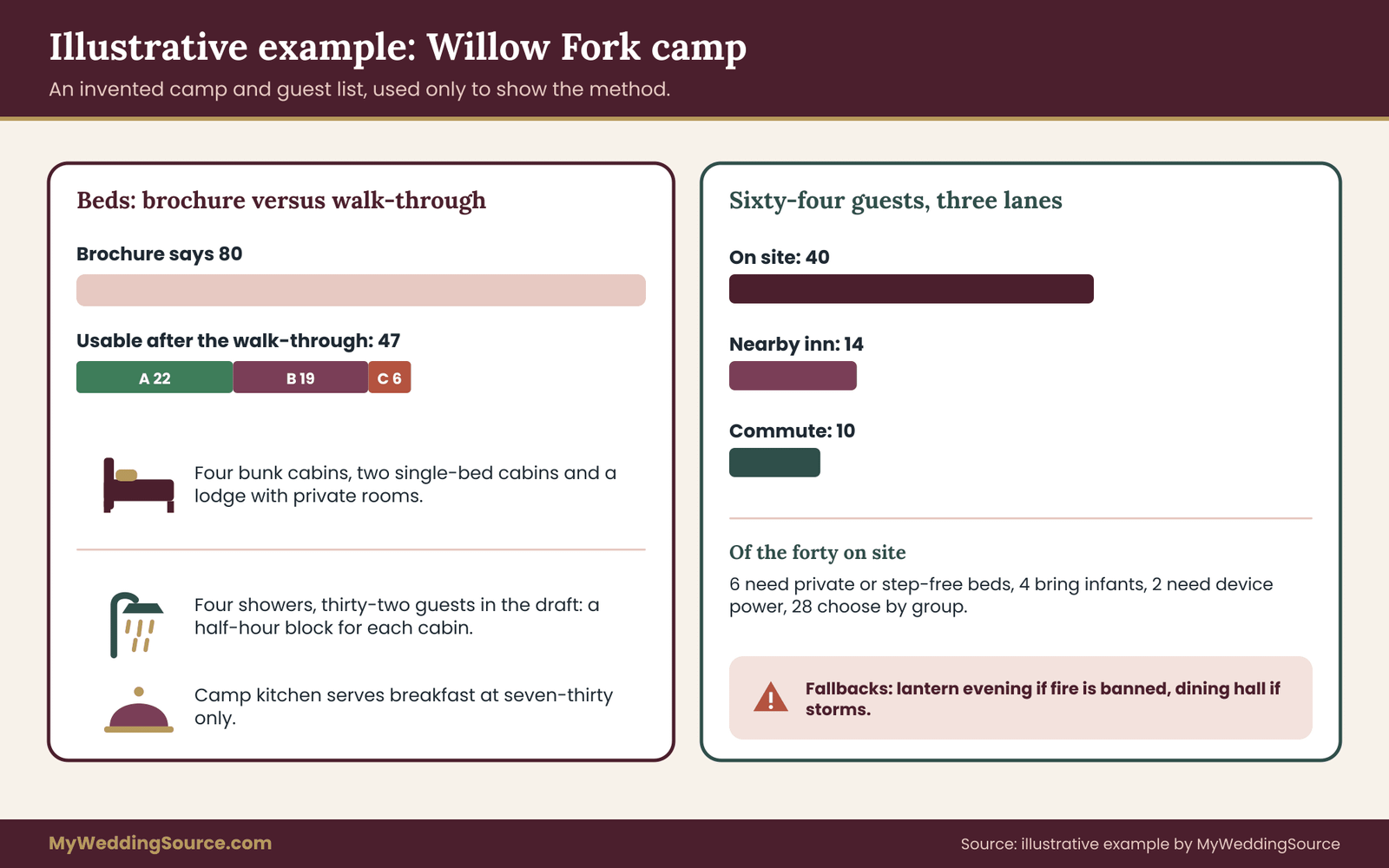
A couple plans a camp wedding weekend for sixty-four invited guests at a fictional lakeside camp. The brochure says the camp sleeps eighty. The couple has booked the camp from Friday afternoon to Sunday at noon, with the dining hall, a lawn, a lake shore and the cabins. The camp’s kitchen is staffed by the camp, and an outside caterer is allowed for the Saturday dinner only. Open flame is allowed in one designated fire ring unless a county restriction is announced.
Sheet one: the bed ledger in practice
The couple and one relative walk the property with the camp director. They record six cabins and one lodge. Four cabins hold eight bunk beds each, with the top bunks marked limited use. Two cabins hold six singles each. The lodge has two private rooms with a shared bathroom. The director agrees in writing that adult guests can use the cabins at a stated maximum, which is lower than the brochure number.
After the count, the couple finds twenty-two Class A beds, nineteen Class B beds and six Class C beds. That is forty-seven usable beds, not eighty. Three of the Class A beds are in the lodge, which also has the only step-free entrance. The couple notes that two cabins are far from the bathhouse, down a gravel path with a slope, and downgrades their beds by one class.
Sheet two: the facilities load check
The bathhouse has four showers, six toilets and six sinks. Four cabins sit on its side of the lawn, so in the first draft it serves thirty-two cabin guests. On Saturday morning, all of them want a shower between eight and eleven. The couple divides thirty-two by four showers and gets eight guests per shower in three hours, about twenty minutes each.
That is workable but tight when hot water runs out. The camp says the heater recovers slowly after a heavy morning. The couple builds a shower schedule with half-hour blocks and keeps the option of moving a few guests to nearby lodging if the guest form shows more demand.
The kitchen is staffed by the camp and can serve breakfast at seven-thirty and not later. The couple tells guests and plans a simple breakfast that finishes in an hour. The outside caterer is allowed on Saturday only and must bring its own refrigerated unit, because the camp’s refrigerators are full of its own food. The couple writes this on the sheet and shares it with the caterer.
Sheet three: the guest choice sort
The couple sends a short form with the invitation. Forty guests say they want to stay on site, fourteen say they prefer a nearby inn, and ten say they will commute. Of the forty, six need a private bathroom or a step-free bed. Four are traveling with infants. Two use medical equipment that needs power.
The couple assigns the three lodge beds and two cabin beds with the best path to the six guests who need private or step-free spaces. They place the four families with infants in the cabins nearest the dining hall, with the camp’s agreement that portable cribs are allowed.
The two guests with devices get cabins with confirmed outlets. The remaining twenty-eight guests choose cabins by group, with the bridal party and friend groups filling the Class B beds. The result: all forty guests have a bed that fits their stated need, with a few beds to spare.
Sheet four: rules in practice
The couple emails the camp director and the county fire office. The camp confirms that quiet hours begin at eleven and that amplified sound must end at ten. The camp does not allow alcohol in the cabins but allows a licensed bartender at the lawn reception. The county fire office says that restrictions are decided each week and are posted publicly, and that a restriction would apply even to the designated ring. The couple writes a backup evening program: lanterns, a music circle and hot cider.
Access is another point. The last half mile is a gravel road with a narrow bridge. The caterer’s truck is too wide for the bridge, so the caterer uses a smaller vehicle and makes two trips. The couple adds the extra time to the vendor timeline. They also confirm with the camp that gates stay open overnight and that the director’s phone number works from the lodge.
Sheet five and six: timeline and failure conditions
The couple builds the Friday-to-Sunday timeline with pressure points marked. Friday arrival begins at three, with the cabin list and flashlights at the gate. Dinner is light and ends at eight. Saturday begins with staggered showers, a simple breakfast, free time and a late-afternoon ceremony. The reception ends at ten, the last shuttle leaves at ten-fifteen, and a quiet gathering continues on the porch until quiet hours. Sunday breakfast ends at ten, check-out is at noon, and vendor pickup is scheduled in two waves.
The failure sheet lists four triggers. If the county announces a fire restriction, the evening program moves to the lantern plan. If the forecast shows severe weather, the ceremony moves to the dining hall and the reception shrinks to the capacity the camp confirms. If more than six guests ask for private bathrooms, the couple adds a nearby inn block. If the camp cannot confirm bed counts in writing by a set date, the couple switches to a smaller guest list or a different site. Each trigger has an owner and a date.
What the worked case teaches
Three things stand out about this camp wedding weekend. First, the usable bed count was far lower than the brochure, and finding that early is what made the camp wedding weekend plan safe. Second, the bottleneck was the morning shower line and the kitchen schedule, not the beds. Third, the guest choice sort gave guests real options, so no one felt pushed into a bunk they did not want. The couple did not need a bigger budget. They needed better information, collected early and recorded plainly.
Alternatives to a full camp wedding weekend
A camp wedding weekend is one format among several, and the best plan may borrow from the others. If the ledger and the facilities check show that the full format will strain your guests, consider these alternatives before you give up on the setting.
The camp as a day venue
Use the camp for the ceremony and reception, and put guests in nearby hotels or inns with a shuttle. You get the setting without the sleeping arrangements. The trade-off is that you lose the reunion feel of Friday and Saturday night, and you add shuttle cost and timing. This is the simplest way to reduce risk, and it keeps the camp as the visual center of the day. The guide to wedding venues helps you compare sites by what each one can and cannot do for a day event.
A hybrid weekend
Offer cabins to a limited group, such as the wedding party, close family and friends who want the experience, and place everyone else in nearby lodging. This keeps the camp wedding weekend feel for those who want it and lowers the facility load. The hybrid is often the best match for couples who like the idea but worry about older relatives or guests with small children. Be open about who is offered cabins and why, so the choice does not feel like a ranking.
A single night instead of two
If Friday night is the problem, drop it. Offer a Saturday afternoon arrival, a Saturday night stay and a Sunday morning brunch. This cuts the number of nights and meals the camp must manage and lowers cost. Guests who want a Friday gathering can meet at a nearby restaurant or a local venue, hosted by friends or family and clearly separate from the main plan.
A barn, farm or retreat property instead
Some properties offer the same sense of space with better facilities: private rooms, en-suite bathrooms, a real kitchen. They cost more per night, but they may cost less in problems. The guide to barn wedding venues explains what to ask about rural properties, and the same questions about beds, water and access apply. A retreat center with its own lodging often sits between a camp and a hotel, and it is worth a look if your ledger shows that your guests need more than a bunk can give.
Tents, glamping and rentals
Some couples bring in tents or rent glamping equipment to expand capacity. This can work, but it adds permits, power, flooring, heating or cooling, weather risk and cleanup. Ask the camp whether it allows outside tents for sleeping, whether it has rules about stakes, power or cooking, and whether the insurance covers them.
Treat tents as another lane in the bed ledger, with their own class, their own facilities load and their own failure triggers. A dedicated guide on campground alternatives for guests covers this more fully; here the point is that each alternative needs the same sheet-by-sheet check.
Failure conditions: when to change your camp wedding weekend plan
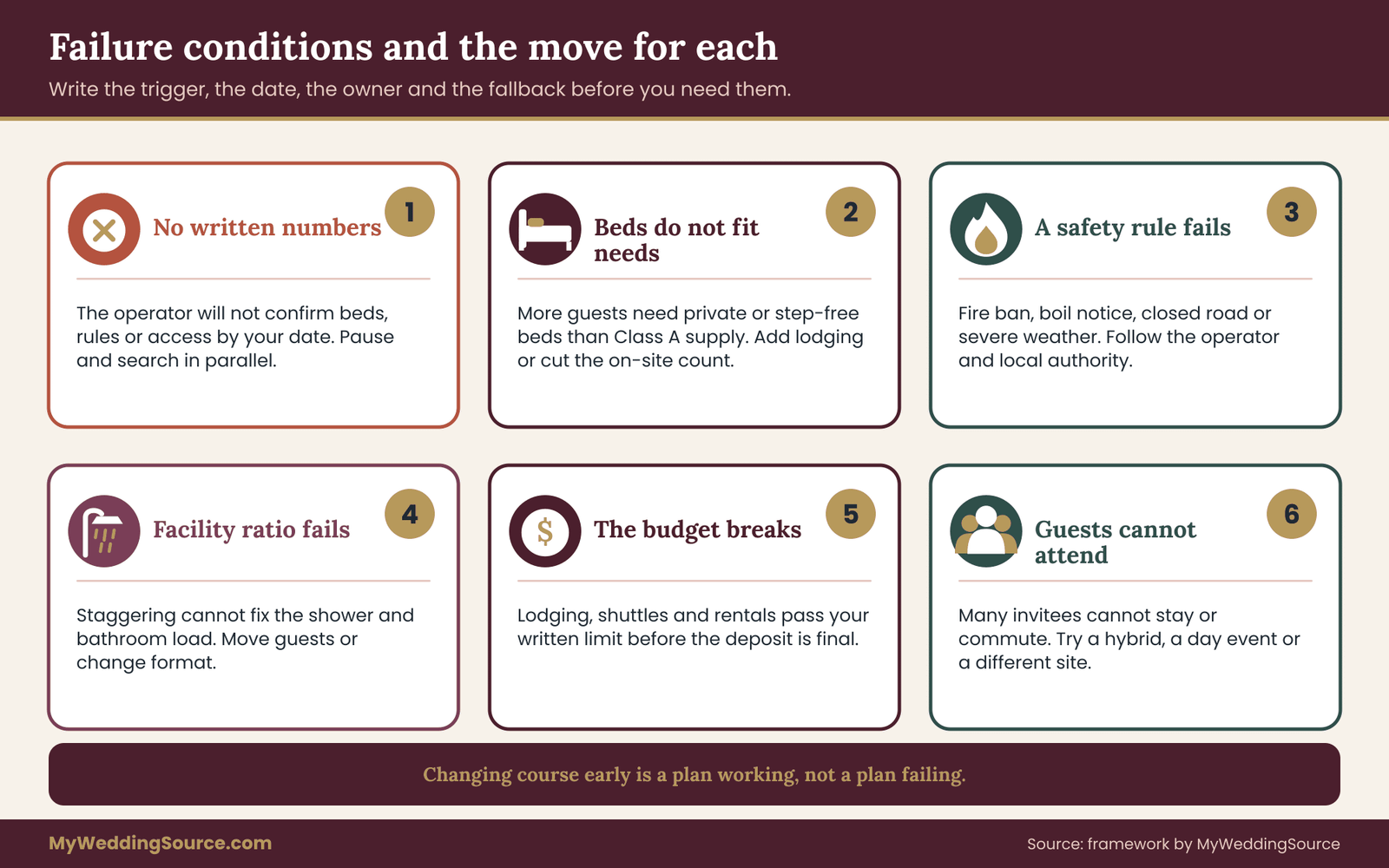
Most planning guides tell you how to make something work. This one also tells you when to stop. The failure sheet is the sixth page of the workbook, and it is the one that lets you change course without panic. A failure condition is a fact that, once true, makes the current plan unsafe, unfair or unaffordable. You write the condition, the date by which you will know, the person who decides and the move you will make.
Condition one: the operator will not put numbers in writing
If the camp will not confirm bed counts, facilities, fire rules or access in writing by your deadline, you are building on promises you cannot check. This is the clearest warning. A camp that has hosted groups before can answer in an email in a day or two.
A camp that cannot or will not answer is telling you something about how the camp wedding weekend will go. Your move is to pause the camp wedding weekend plan, set a firm date, and begin a parallel search for an alternative site. Do not keep adding guests and vendors to a site that has not confirmed the basics.
Condition two: the usable beds do not cover the guests who need them
Suppose your guest form shows more guests who need a private bathroom, a step-free path or reliable power than you have Class A beds. This is a capacity failure that cannot be solved with enthusiasm. Your options are to add a nearby lodging block, rent additional accessible spaces, reduce the number of on-site guests or change the site. Choose one by a stated date. If you do nothing, the guests with the greatest needs end up with the worst beds, and they are the ones least able to fix it on the spot.
Condition three: a safety rule cannot be met
A fire restriction that bans the evening you planned, a water system that has a boil notice, a road that closes, a smoke event or a flood warning are all safety conditions. The right response is not to push through. It is to follow the operator’s and local authorities’ instructions and to have a backup that you already wrote.
The Federal Emergency Management Agency’s Ready campaign and the National Weather Service publish clear guidance for weather and emergency planning, and the U.S. Fire Administration publishes fire safety resources that are useful when you discuss rules with the operator. Use them to frame questions, not to replace the local authority.
Condition four: the facilities ratio fails and cannot be fixed
If the facilities load check shows that the bathhouse cannot serve your guests in a reasonable time, and neither staggering nor added lodging fixes it, the camp wedding weekend format is wrong for your group. A common mistake is to treat this as a minor inconvenience, with the thought that guests will adapt.
Adults adapt to a few small hardships. They do not adapt well to cold showers, long lines and a bathroom a hundred yards away in the dark, especially after a long day. If the numbers are close, add buffers. If they are far, change the camp wedding weekend plan.
Condition five: the budget breaks
A camp wedding weekend can look inexpensive at the start and expensive at the end. Rentals, bedding, extra lodging, shuttles, portable restrooms, outside catering, insurance, permits and staff time add up. If the total passes the limit you set, you must cut or change. Do this before the deposit is non-refundable. A plain budget limit, set in writing before you start, gives you something to measure against. A simple spreadsheet with planned and actual columns is enough to track changes.
Condition six: guests cannot attend in a way that works for them
If your guest form shows that a large share of your invited guests cannot or will not stay on site, and cannot easily commute, you may have chosen a site that does not fit your guest list. This is not a failure of the couple. It is information. A camp may be the right place for a smaller wedding, a hybrid weekend or a day event. A guest list that does not match the site is better discovered in the camp wedding weekend planning stage than on Saturday.
What to say when you change the camp wedding weekend plan
Changes are easier when you have a script.
For guests: “We have changed the lodging plan so that everyone has a bed that fits their needs. Cabins are now offered to the wedding party and a few guests who volunteered, and everyone else will stay at the inn we have arranged, with a shuttle to every event.”
For the camp: “We would like to reduce our on-site headcount for lodging and keep the venue for the ceremony and reception. Please confirm in writing the revised terms and refund of the lodging portion.” For vendors: “Our lodging plan has changed, which affects arrival times and load-in. Here is the updated schedule.” Short, calm and specific messages avoid long email chains.
Recording the decision
Write down each change in the workbook with the date, the reason and the person who agreed. This protects you if a dispute arises with the camp or a vendor, and it helps your helpers stay aligned. It also gives you something to look at after the camp wedding weekend, when you want to remember why you made a choice. A workbook that records changes becomes a short history of the camp wedding weekend, which is often more useful than the original plan.
Host team, transport and budget logic for a camp wedding weekend
A camp wedding weekend asks more of the people around you than a hotel wedding does. The couple cannot be the front desk, the shuttle driver and the cabin monitor. A small host team with defined roles keeps the camp wedding weekend moving and keeps the couple free to be at their own wedding.
Roles that matter
Site lead. One person, not the couple, who is the contact for the camp director. They hold the contract, the keys, the cabin list and the emergency numbers. Arrival lead. Handles Friday check-in, cabin assignments and maps. Facilities lead. Watches the shower schedule, the bathroom supplies, the trash and the quiet-hour sweep. Transport lead. Runs the shuttle times, the parking and the last ride. Care lead. Checks in with older guests, families with infants and anyone with a medical need. Departure lead. Handles Sunday cabin checks, returns and vendor pickups.
The same person can hold two roles if the load is light, but never leave a role unowned. If you do not have enough trusted helpers, hire a day-of coordinator with experience in outdoor or multi-day events, and ask for references from similar weekends. Share the whole workbook with the coordinator, not a summary.
Transportation and the last ride
Camps are often far from town, and a single road may serve every guest. Decide how guests get to the site, how they move between events, and how they leave at night. If some guests are staying in nearby lodging, a shuttle is the best way to make sure no one drives home after a long evening. Choose a licensed transportation provider, ask for proof of insurance and confirm that the vehicle can handle the road, the bridge and the turning space at the camp. Put the shuttle schedule on a printed card.
Parking deserves its own plan. Ask the camp where guests can park, how many spaces are available, whether the ground is firm in wet weather and how cars exit after dark. Assign a parking helper with a flashlight and a vest. If the lot is small, ask guests to carpool and tell them early.
Budget logic without invented numbers
This guide does not give prices because they vary widely by region, season and site. It gives the structure of the cost. Start with the site fee and what it includes. Add the lodging lines: the camp’s per-bed or per-cabin fee, any nearby inn block, bedding or rentals.
Add the shared-facility lines: portable restrooms or showers if needed, extra cleaning, trash removal. Add the transport lines: shuttles, parking help. Add the food lines: breakfast, outside catering, kitchen fees, ice. Add the safety lines: event insurance, permits, a medical or security presence if required. Add the contingency line: a reserve for weather, fire restrictions or last-minute lodging.
Then compare two totals: the full camp wedding weekend, and the day-venue alternative. The difference shows what the overnight format costs and what it buys. Some couples find that the camp wedding weekend costs less overall because it replaces several separate events. Others find that the added lodging and shuttles cost more than a hotel wedding. Neither result is wrong. The point is to decide with real numbers and not with a feeling.
Contracts and what to get in writing
The rental agreement should state the dates and times, the included buildings and spaces, the maximum number of overnight guests, the bed counts, the fire and alcohol rules, the quiet hours, the cancellation and refund terms, the damage deposit, the insurance requirements and what happens if a weather or safety event cancels the camp wedding weekend.
If a point matters to you and the contract is silent, ask for an amendment or a signed email. When you review each contract, check each vendor’s terms against the site’s rules. This is also a good moment to ask the camp about any rules that apply to outside vendors, such as insurance certificates, load-in times and equipment limits.
Your next steps
You do not need to finish the workbook in one sitting. You need to start it in the right order and keep it honest. This week, request the camp’s written answers to five questions: the maximum adult overnight capacity by building, the bathroom and shower count and hot water limits, the rules on open flame, alcohol and quiet hours, the access route and emergency plan, and the cancellation and refund terms.
While you wait, create the six sheets with their headings and one owner each. If the camp is slow to reply, that is itself information for the failure sheet.
A countdown from booking to the camp wedding weekend
In the first month after booking, walk the site with the director and fill in the bed ledger and the facilities load check. Ask for photographs of every cabin and bathhouse, and keep them in the workbook. Draft the guest form and the lodging lanes. In the months that follow, send the form, run the guest choice sort, assign the Class A beds first and place the remaining guests in lanes. Confirm nearby lodging blocks and a shuttle provider. Hold a first review of the failure sheet and set the decision dates.
About eight weeks before the camp wedding weekend, send the expectations note and confirm the rules sheet again, because fire and weather restrictions can change. Confirm vendor load-in routes and kitchen arrangements. Print the cabin list, the maps and the shuttle schedule. Assign the host team roles and walk them through the workbook. About two weeks before, check the forecast, confirm the final headcount by lane and send a short reminder to guests with arrival times, packing categories and emergency contacts.
The week before and the night before
In the final week, check the forecast daily and talk to the camp about any new restrictions. Prepare the flashlight baskets, the cabin signs and the bag for the arrival lead. Confirm that the first aid kit, a phone charger and the emergency numbers are with the site lead. On the night before, pack a small kit for the couple: medication, a change of shoes, snacks, a flashlight and the printed workbook. Tell the host team that the workbook, not the couple, is the source of answers on the camp wedding weekend. Then rest.
After the camp wedding weekend, record what worked and what did not. Which cabins were popular, where did lines form, which rules surprised guests? These notes are valuable if you hold a related event, such as a first anniversary, or if a friend asks you for advice. A camp wedding weekend leaves memories, and it can also leave a useful record.
FAQ
How many guests can a camp wedding weekend safely host overnight?
It depends on the site, and the brochure number is rarely the right one. Ask the operator to confirm in writing the maximum number of adult overnight guests by building, then count usable beds by class. Subtract top bunks and cots that some guests cannot use. The number you can safely offer is the number of beds that fit real guests, not the number of mattresses on the property.
Do all guests have to sleep at the camp?
No, and they should not have to. Offer lanes: an on-site cabin, nearby lodging with a shuttle, or a commute for local guests. Many guests will choose a hotel for privacy, mobility, light sleeping or small children. A camp wedding weekend works better when each guest can attend in a way that fits their needs, and a clear lodging note makes the choice easy.
How do I know if there are enough bathrooms and showers?
Divide the number of guests assigned to each bathhouse by its working toilets and showers, especially for the morning before the ceremony. Ask the operator how long hot water lasts under heavy use. If the ratio looks tight, stagger shower windows by cabin, add portable facilities if allowed, move some guests to nearby lodging or shift the ceremony time.
Can we have a bonfire or use candles and sparklers?
Only if the camp and the local fire authority allow it on your dates. Open flame rules can change quickly during dry or windy periods, and some camps ban it entirely. Ask in writing who decides, when, and what the fallback is. Plan an evening that works without flame, such as battery lanterns or a music circle, so a restriction does not ruin the night.
How should we handle guests with mobility or medical needs?
Ask early and privately through a short form, then assign the most accessible beds and shortest paths to those guests first. Confirm which buildings are step-free, whether paths are lit and level, and where reliable power exists for devices. If the camp cannot meet a need, arrange nearby lodging with a shuttle. Ask the operator for details, since accessibility claims vary.
What should the expectations note include?
Cover the lodging lanes, cabin and bathroom conditions, the schedule, footwear and layers, what the camp provides and what to bring, rules on alcohol, fire, pets and quiet hours, directions and parking, emergency contacts and who to ask for help. Use plain, honest language, and keep it short enough to read on a phone. Send it weeks ahead and repeat key points at check-in.
Is a camp wedding weekend cheaper than a hotel wedding?
Sometimes, but not always, and this guide does not quote prices. Compare the full cost of each format: site fee, lodging, bedding, shared-facility needs, shuttles, catering, insurance, permits and a contingency reserve. Add everything for both options and look at the difference. Some couples save by replacing several events with one site, while others spend more on added lodging and logistics.
When should we give up on the camp and choose another site?
Change course when the operator will not confirm basics in writing, when usable beds do not cover guests who need them, when a safety rule cannot be met, when the bathroom ratio fails and cannot be fixed, or when the budget breaks. Write these triggers on your failure sheet with dates and owners, so the decision is calm and early rather than rushed late.
Sources
- National Park Service, fire safety and campfire guidance for visitors
- U.S. Forest Service, recreation, camping and fire restriction information
- U.S. Fire Administration, fire safety resources
- ADA.gov, U.S. Department of Justice Americans with Disabilities Act information
- U.S. Access Board, accessibility guidelines and standards
- Centers for Disease Control and Prevention, healthy camping, tick and insect protection
- National Weather Service, forecasts, alerts and sunrise and sunset information
- Ready.gov, emergency and severe weather planning
- National Fire Protection Association, fire and life safety resources
- American Camp Association, camp standards and accreditation