

Modular floral installations are large wedding flower pieces, such as a ceremony arch, a welcome cluster or a reception backdrop, that are built from separate sections so they can be taken apart after the event and used again as small arrangements. This guide gives you a split plan, build rules, vendor questions and a teardown transfer plan, so the flowers keep working after the last dance.
Decide before the florist builds anything which installations will be divided, and design each one as named modules that one person can lift, move and set down without tools. Give every module a water plan, a destination and a receiver. Then write a strike sequence with times and names. Modular floral installations cost a little more design and labor up front, and they pay it back by turning one single-use structure into centerpieces, hosting gifts, bedside vases or donations, instead of a pile of cut stems at the dumpster.
Most couples meet their large floral pieces twice: once when they are admired and once when they are cleared. The second meeting is usually rushed. The florist or the venue crew has a strike window, the room is needed for the next booking, and a fully wired arch cannot be divided in ten minutes by anyone, however willing.
The flowers, which are the most perishable and often the most expensive visual element in the room, go where the fastest hands send them. Every minute of preparation for modular floral installations is a minute you do not spend improvising at the strike.
Modular floral installations are a way to design that moment in advance. Instead of one structure whose only future is the trash, you plan a set of modules with a second life already assigned. A garland section becomes a table runner. A cluster from the arch becomes a gift for a grandmother.
A hanging drop is cut down into bud vases for the cake table and the guest book. None of this happens by accident, and most of it cannot be improvised once flowers are glued, wired and foamed into place.
This guide covers the mechanics and the logistics, not the aesthetics. If you are still deciding what your installations should look like, the shape, texture and color relationships belong to a different conversation, and the wedding color palette guide is a good place to settle the colors before you ask anyone to build modules.
Here the question is narrower: given the installation you want, how is it built so it divides cleanly, and who carries each piece where? Modular floral installations are most useful when the receivers are named before the build begins.
A note on scope. This is general information, not legal, tax or financial advice. Plant safety, venue rules and flower pricing vary by location and by supplier, so confirm anything that affects your own wedding with your florist, your venue and the relevant agency.
What modular floral installations are, and when dividing them makes sense
An installation is any floral piece that is structural rather than portable: it hangs, stands, spans or frames. Examples include a ceremony arch or arbor, a hanging cloud over a dance floor, a suspended chandelier, a long garland on a head table, a flower wall, an aisle runner of petals and vessels, and a bar-front panel. A bouquet is not an installation. A centerpiece usually is not either, because it is already a small arrangement.
Installations are expensive per visible square foot for a good reason. They take more stems, more mechanics, more labor and more transport than any other floral item. That cost is exactly why couples ask what happens to them afterward.
The conventional answer is “the florist takes it down”. That is accurate, and it tells you very little. What the florist does with it depends on the contract, the timeline and the venue. Sometimes the florist reclaims reusable structures, such as a metal frame, and discards the flowers. Sometimes the venue crew handles the clearing and the flowers are bagged. Sometimes the couple’s family carries what they can to a car. Modular floral installations replace that vague answer with a specific one.
When dividing is worth the effort
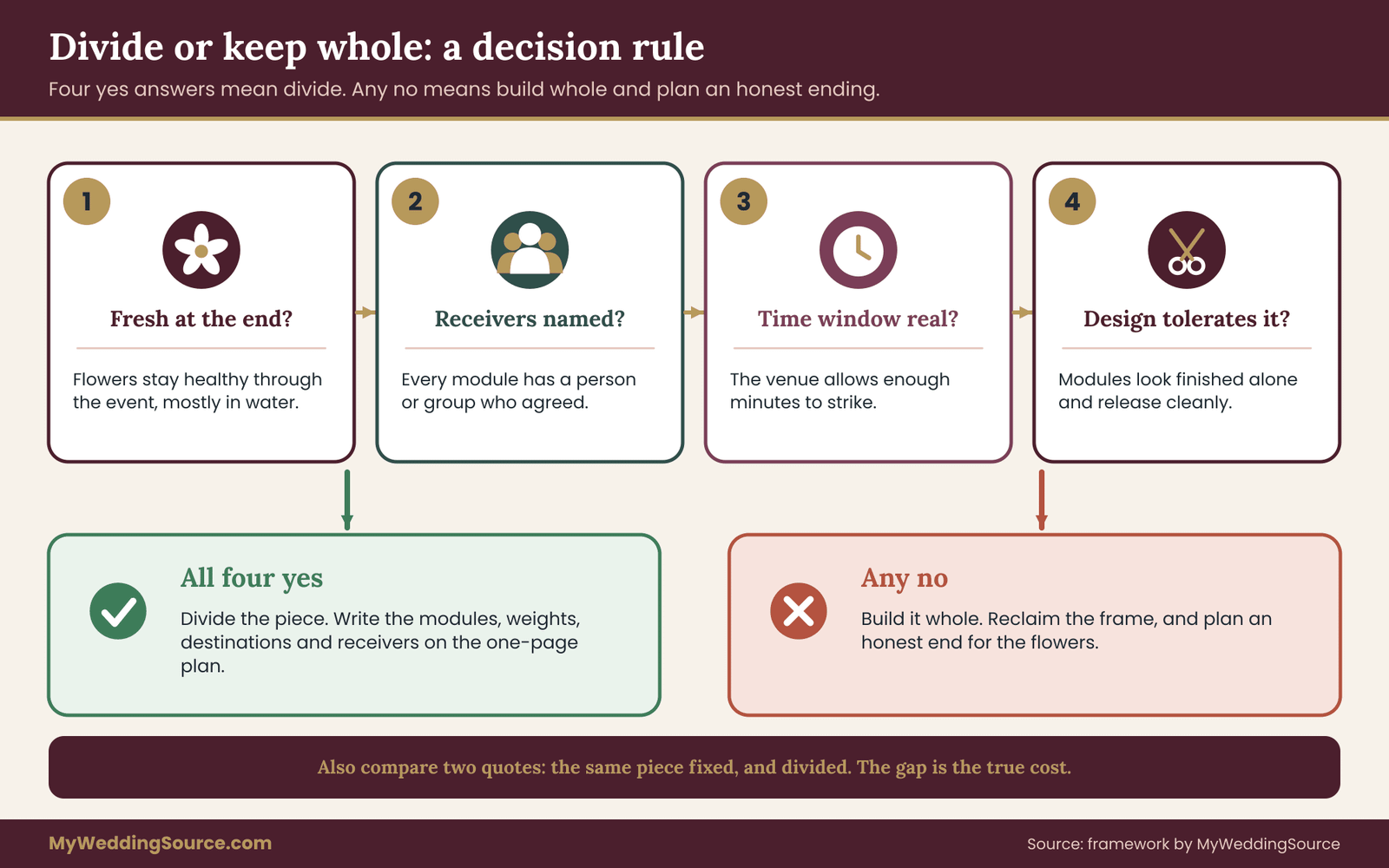
Dividing is not always the right call. Run through four plain tests before committing.
The flowers are alive and healthy at the end of the event. Cut flowers that have been out of water for hours, under hot lights or in a heated tent, may not be worth saving. Flowers that have been in water-fed mechanics throughout are good for another day or two.
There are receivers. A module needs somewhere to go and someone to take it. If nobody is staying behind, nobody has a car, and no charity or care facility has agreed to accept flowers, the transfer plan has no end and should not be built.
The time window exists. You need real minutes at the end of the event, not heroic ones. The venue curfew and strike rules decide how much dividing is realistic, and a venue technical walkthrough is the moment to ask for yours in writing.
The design tolerates it. Some installations lose their character when divided into parts. A dense flower wall of dozens of identical blooms may divide into excellent small panels. A single dramatic asymmetric arch made from one-off branches may not. The next section gives a way to tell the difference before anything is built.
If two or more tests fail, spend your effort elsewhere, perhaps on a different part of the day. If three or four pass, keep reading.
What dividing does not mean
Modular floral installations do not mean cheap flowers or small flowers. They do not mean that the installation looks like a set of separate pots. A good modular build is invisible from the guest side: the joins are hidden by foliage, the water sources are concealed, and the whole piece reads as one continuous form. The modularity lives behind the scenes, in how the parts connect and release.
It also does not mean a promise that every stem will be reused. Some material is always lost: stems cut short for fit, foliage crushed in transit, blooms that open too fast under lights. A realistic goal is that most of the volume has somewhere useful to go, not all of it. Revisit this point a week before the event, when modular floral installations are still easy to adjust.
The split plan: a framework for modular floral installations
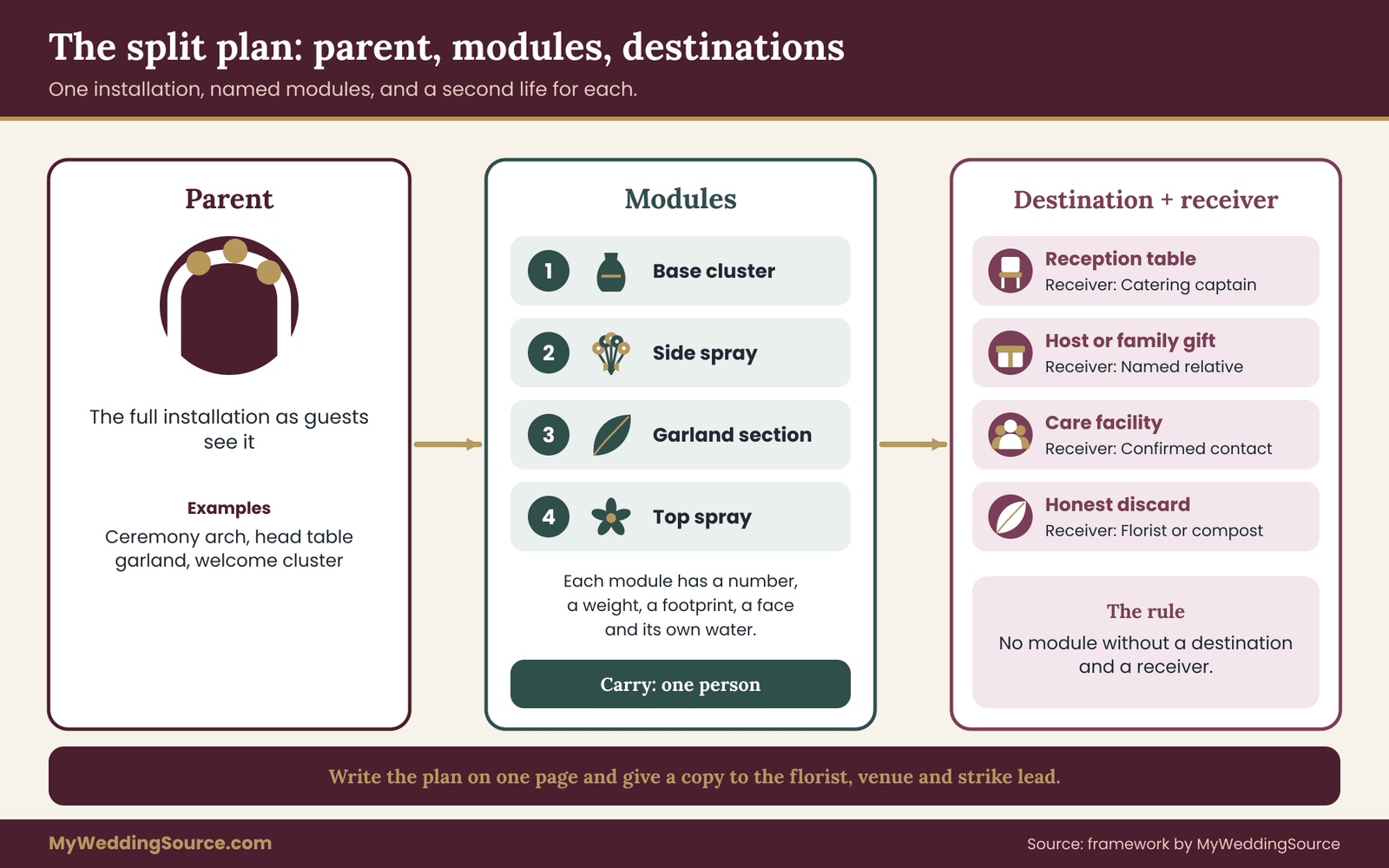
The split plan is a simple way to think about any divisible piece. It has three levels and one rule.
The parent is the full installation as guests see it: the arch, the garland, the backdrop. Every parent gets a name and a position in the room.
The modules are the sections the parent is built from. Each module is a unit that can be lifted off, carried and set down as a working floral piece, with its own water source and its own stability. A module has a number, a weight, a footprint and a face. Two or three modules is a very modest split. Six to ten is common for an arch with side clusters. More than a dozen starts to cost real labor and is worth questioning.
The destinations are the second lives. Each module is assigned one: a reception table, a bar, a host gift, a bedside, a care facility or a compost stream.
The rule is that no module exists without a destination and a receiver. If you cannot name where a module goes and who picks it up, either redesign the module or accept that it is a disposable part of the build and treat it as such honestly. Without it, modular floral installations tend to default to the fastest option, which is the dumpster.
Writing the split plan on one page
The plan fits on a single page, and writing it forces decisions that are easy to avoid. For each parent, list the modules by number. Next to each, write four things: the water plan, the carry weight, the destination and the receiver. A line might read: “Arch left cluster, module 2, reservoir vessel, one-hand carry, goes to the head table, caterer’s captain.” A line for a module with no good destination reads: “Arch top spray, module 5, discard after photos,” which is a perfectly acceptable line.
Honesty about what is disposable is part of the plan.
Share the page with the florist, the venue coordinator and whoever is leading the strike. If you are using a wedding planner or day-of coordinator, they should hold a copy. If you are not, name one person from your own circle to run it; the vendor timeline is the natural place to slot the strike window beside the other end-of-night obligations. Modular floral installations reward a florist who thinks about the strike while sketching the build.
A few terms used in the rest of this guide
To keep the language precise, here are the terms the rest of the guide uses.
A water source is whatever keeps the stems hydrated: a vessel, a tube, a reservoir or a wet wrap. A join is any place where one module attaches to another or to the structure. A carry is one person moving one module. A receiver is the person or organization that takes a module at the end. A strike is the clearing of the room, and the transfer is the movement of modules from the structure to their destinations.
These words are borrowed from event production, and using them with your florist saves a surprising amount of explaining. They also make your contract language shorter, because “strike” and “transfer” mean the same thing to everyone who hears them.
Designing modules: size, weight and measurable checks
The module is the unit of everything that follows, so its design deserves more attention than the arrangement it carries. A module that is too big cannot be lifted by an average guest. A module that is too small multiplies the number of joins and the minutes needed to strike. The sweet spot depends on the people who will actually carry it. Put differently, modular floral installations turn a vague wish to reuse flowers into a set of named jobs.
Set a carry limit before you draw anything
Ask your florist what one person can safely carry and set it as a rule. The best sources for the physical limit are occupational safety bodies rather than florists’ habits. The National Institute for Occupational Safety and Health and the Occupational Safety and Health Administration both publish material on manual lifting and ergonomics, and they are a reasonable reminder that a wet, awkward, top-heavy object is harder to carry than a box of the same weight.
Your family members and venue staff are not trained movers, and some are older. A conservative carry limit protects them and the flowers. Keeping the plan this plain is what lets modular floral installations survive a long, tiring evening.
Translate the limit into plain terms for the build. A good working rule is that a module should be liftable with one hand on the base and one hand steadying the top, should fit through the narrowest door on the route, and should be set down on a flat surface without tipping.
If a module needs two people, label it “two-person” in the plan and make sure two people are assigned. Never leave a module’s weight to chance on the night. Nothing here requires special skill from you, only a decision made early enough for modular floral installations to be built properly.
Five measurable checks for each module
The word “measurable” matters, because modules are easy to describe and hard to verify. The following checks can be done in the florist’s studio or at the final walkthrough without any special equipment.
Weight check. Weigh the finished module on a bathroom or luggage scale, with water in it. Write the number on the plan. If it is above your carry limit, split the module again or lighten the vessel.
Footprint check. Measure the base. A module that goes on a table needs to fit the table. Compare the footprint with your reception table sizes and with the bar and gift table surfaces. This is easy to forget and costly to fix after the fact.
Tip test. Set the module on a flat surface and tilt the surface gently, or push the top lightly. It should resist. A module that tips at modest angles will tip in a car trunk.
Water test. Fill the water source, wait a few minutes and check for seepage. Anything that drips in the studio will leak in a car or on a venue floor, and many venues forbid water damage to carpets or stage surfaces.
Door and route check. Walk the route from the installation to the exit and to the vehicle, carrying a stand-in of the right size. This check belongs in the venue technical walkthrough, where doorways, steps, elevators and loading routes are measured anyway.
The module should work as a small arrangement without help
A common failure is a module that is beautiful in place and useless alone. A garland section cut from a long run has bare, mechanical ends. A cluster that leaned against an arch frame has a flat back. When these are set on a table they look unfinished. Whatever the florist says, record it in writing so the modular floral installations match the promise.
The fix is to design each module with a finished face and a finished base. That means foliage that covers the join, stems that are cut to a tidy fall, and a vessel that looks intentional rather than improvised. Ask the florist to show one module standing alone in the sample or mock-up. If it looks wrong, the split will disappoint on the night. Treat each of these as a question about your own modular floral installations, not as a rule.
Mechanics: water, anchoring and quick-release joins
Mechanics are the hidden systems that make modular floral installations possible. They are also where the real cost and risk sit, because the cleanest-looking installation in the world is useless if it cannot be dismantled without breaking the flowers.
Water is the first decision
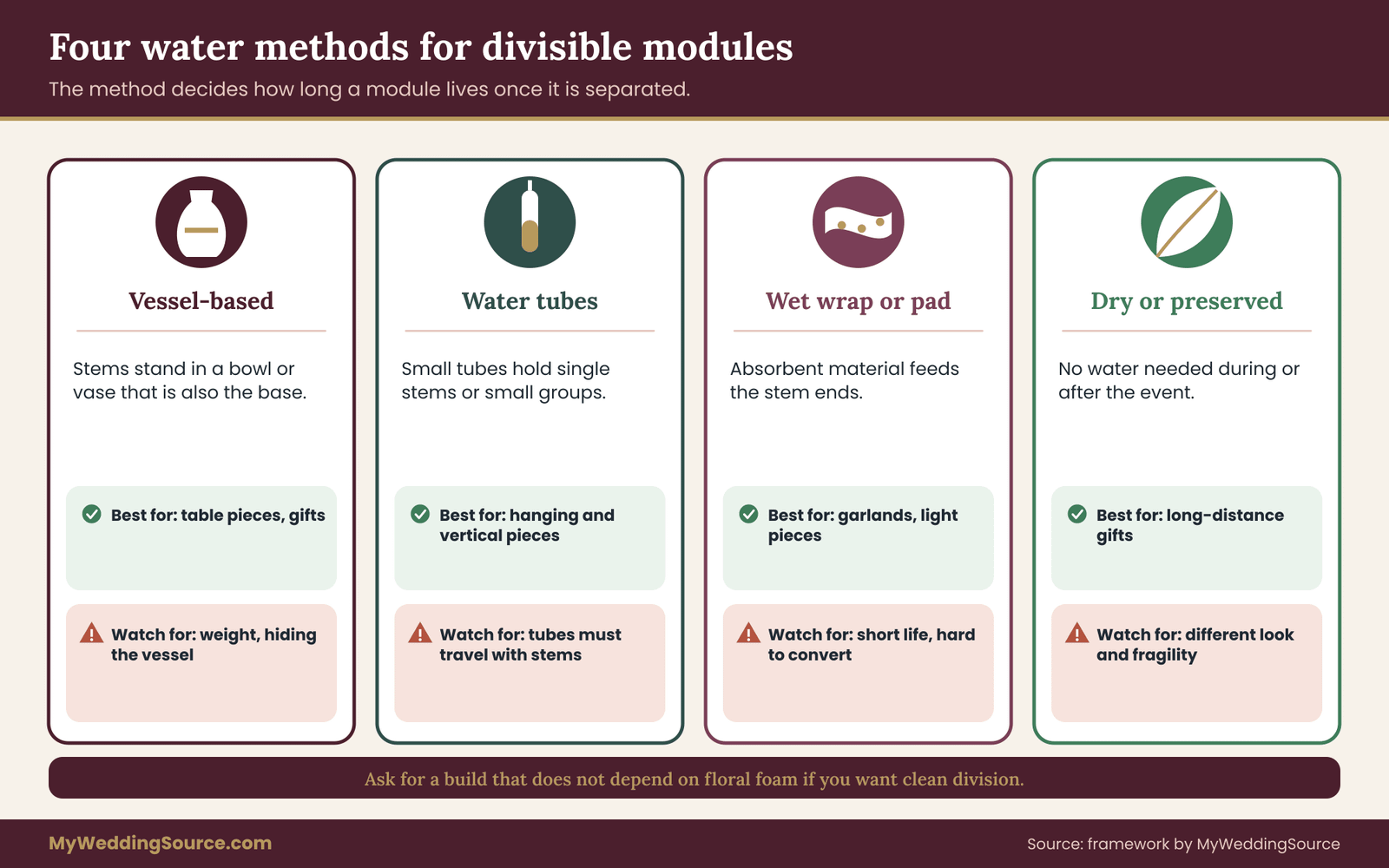
Flowers that are cut live on stored water and whatever they can drink. A divisible module must always have a way to drink, both while it is part of the installation and once it is separated. There are four common approaches, and each suits different pieces.
Vessel-based modules. Stems stand in a shallow container, such as a low bowl, a small vase or a tray, usually with a supportive structure inside. The vessel is the module’s base and its water source. It is the most forgiving approach for division, because the module is already a small arrangement the moment it is lifted. The trade-off is weight and visibility: vessels must be hidden in an elevated installation.
Water tubes and picks. Individual stems or small groups go into small water-filled tubes that are attached to a structure. Tubes are lightweight and easy to conceal, and are common in suspended or vertical pieces. For division, the tubes must come with the flowers, so the group of stems and their tubes become a bundle that can be dropped into a vase. This works well but takes labor.
Reservoir pillows and wraps. A pad of absorbent material or a sealed wet wrap supplies moisture to the stem ends. These are common in garlands and in pieces that must be light. They work for a limited time, and they are the hardest to convert into a vase arrangement, so treat modules built this way as short-term gifts rather than long-lived centerpieces.
Dry or low-water elements. Dried flowers, preserved flowers and foliage that tolerates being out of water form a separate class. They are the easiest to divide and carry and the least perishable. If a few modules can be built from them, the transfer plan becomes much more flexible.
Some florists use floral foam, a water-absorbing block, as the base of many large pieces. It is common in the trade and practical for building, but it complicates division and disposal, because the material is difficult to separate from stems and has a poor reputation for reuse. If you want to divide an installation, ask for a build that does not depend on it, and see the waste reduction planning guide for the broader materials discussion rather than repeating it here.
This is also why modular floral installations belong in the vendor timeline rather than in the decor notes alone.
Anchoring: what holds a module to the parent
Anchoring is how a module attaches to the structure. For division, the best anchors are those that release without cutting. Cable ties and wire are common because they are strong and cheap, and they are exactly what makes a quick strike slow. Ask the florist for alternatives: hooks, clips, magnets where safe, reusable ties, hook-and-loop straps, or modules that sit on a shelf or bracket rather than being fixed to it.
Most of the cost and risk in modular floral installations sits in a handful of decisions like this one.
A useful design principle is that the parent should hold the module, and the module should not hold the parent. In other words, an arch’s frame carries the load, and each cluster rests on or hangs from a point, so a person can lift it away without the structure shifting.
When the structure itself depends on the flowers for stability, as with a lattice of woven branches, division is a poor fit. That is a separate structural decision from the one here, and the florist’s engineer or rigger is the right person to ask.
Joins: label them and keep them few
Every join is a place to lose time. Count them. If an arch has twelve ties per module and eight modules, that is nearly a hundred small cuts at the end of a long night. A better target is one or two releases per module, each identified by a tag or a color, and each usable without scissors if possible. When you review the plan for modular floral installations, read it as if you were the carrier with no background.
Label every join in the plan. A small tag on the back of each module, in the same numbering as the written plan, lets a helper who has never seen the installation work out the order. Tags can be removed at the end, but they are the difference between a calm strike and a puzzle. Planned this way, modular floral installations carry little risk for the florist and the venue.
Test the release before the wedding
The quickest way to find out whether a design divides is to try it. Ask the florist whether a sample module can be built and separated in the studio. If that is not possible, ask for a short explanation of how the release works, and ask who has done it before. A florist who has built divisible pieces will answer in specifics, such as how long it takes and how many people it needs.
A florist who has not may still be able to build it, but you should know that you are asking for something new, and the plan should have more margin. This is the point where many modular floral installations quietly go wrong.
Treat the release test as a gate rather than a courtesy. If the sample fails, change the design before the contract is final. It is much cheaper to alter a mock-up than to alter an installation on site.
Choosing which pieces to build as modular floral installations
Not every large piece should be divisible. Some are better built as a single form and honestly discarded or returned. The skill is knowing which is which, and it helps to go through the day in order, asking of each installation what its modules would become. That is the whole idea behind modular floral installations: decide once, label clearly and hand over calmly.
The ceremony arch or backdrop
A ceremony piece is usually the most photographed and the most structural. It is also the first to be moved, since the ceremony ends and the space is often flipped for the reception. That timing is an advantage: the flowers are fresh, the room is staffed, and a transfer can happen during cocktail hour. Share this detail with the strike lead, since modular floral installations depend on that one person knowing the plan.
A good divisible arch has a frame that stays and flower clusters that move. Typical modules are two base clusters at the feet of the frame, two side sprays at the shoulders, a top spray and a few loose foliage lengths. The base clusters are usually the easiest to turn into table pieces because they are already low and weighted.
The top spray is usually the hardest, because it is built to be seen from below and cut short on the back, so plan it as a disposable or a reuse-after-trim item.
Where the arch is moved from the ceremony to the reception as a backdrop for the head table or the cake, the frame goes with it and the modules stay put. That is the simplest transfer there is, and it asks for no dividing at all. It is worth checking before you design anything fancier. A calm plan beats a clever mechanism when modular floral installations are being cleared at the end of a long day.
The welcome cluster and entry piece
Welcome pieces at the entrance are often larger than they need to be and receive little attention after arrival. They are good candidates for division because they sit on a stand or a table and are seen from the front only. Modules can include a low cluster for each side of the sign and one or two vessels.
At the end of the night these move to the exit as a gift table, or travel with the family who is most likely to take flowers home. The same discipline applies to every one of your modular floral installations, large or small.
Reception backdrops and flower walls
A flower wall is a grid of stems or panels fixed to a board. Division is possible when the wall is built in panels that unhook. Each panel then becomes a small flat piece that can lean against a mirror, sit on a mantel or hang inside a home.
The problem is that the panel is often fed by water tubes or wet foam hidden behind the board, so confirm whether each panel has its own water. If it does not, treat it as a short-life piece, and plan to place it in a vessel the same evening.
Hanging and suspended pieces
Hanging installations are the most difficult to divide, for reasons that are practical rather than aesthetic. They are heavy, the stems are set in tubes or wet wraps, and they are removed by someone on a ladder. Many venues have rules about rigging and ceiling loads, which your venue contract will cover. If you want a hanging piece divided, ask for it to be built as a number of independent drops, each hung from its own point.
Each drop is then a module, and the ladder person simply lowers one at a time. A florist’s time is limited, so bring this up while modular floral installations are still being sketched.
Garlands and runners
Garlands on a head table or a long banquet table are classic modules in disguise, because they are already built from segments. If the florist makes the run in sections of the same length and the same internal structure, each section can become a table runner on a guest table. The key is the joins, which should be covered by foliage so that the ends look intentional. The same reasoning holds for any of the modular floral installations on your list.
Aisle arrangements and petals
Vessel-based aisle pieces, such as a row of bud vases or small bouquets on stands, are the easiest to divide, because every unit is already independent. Their weak point is quantity: forty small arrangements are forty carries. Cap the number of aisle modules by the number of receivers you can honestly assign. Loose petals are another matter, and they are a different problem from the vessel-based pieces discussed here. If you remember one habit for modular floral installations, make it the one-page plan with names on it.
Bar fronts and cake table pieces
Small installations around the bar and cake table tend to be divided naturally by the caterer, who clears these areas first. Tell the catering captain what you want saved and where it should go, because these pieces are in the way of service and are at risk of being removed in a hurry. Revisit the plan if the guest count or venue changes, because modular floral installations were sized for the original numbers.
Vendor questions and contract language for modular floral installations
Once you have decided which pieces to divide, the florist needs to agree. The agreement should be specific enough that two people could follow it without asking you for clarification. This section gives questions and wording, and the rest of the paperwork is covered elsewhere on the site. Take it one piece at a time, since modular floral installations are really a set of small decisions.
Questions to ask the florist
Start with a plain description: “We would like these pieces built so they can be separated into small arrangements after the event.” Then ask questions that cannot be answered with a yes.
How many modules would each piece have, and what is the weight of the heaviest? A florist who has thought about it can answer in numbers.
How does each module keep water, and for how long? The answer should name a method such as vessel, tubes or wrap, and give a rough time. If the florist says “hours”, ask which hours, since the clock that matters is time from the start of the event.
What is the release method? Ask what is cut, unhooked or lifted, and how long a strike takes with a given number of people.
Do you do the division yourself, or do you hand over modules? This question determines who carries the cost and risk. Some florists will divide on site for a fee, some will hand over modules at a set time, and some will not do it at all.
Which components are reclaimed by you? Frames, stands, vessels and other rental or reusable items usually belong to the florist. Know which ones, and know the return window, because a vessel left at the venue may be billed.
What is the extra charge, if any? The labor of building divisible pieces and the time of strike are usually priced. Ask for a line item rather than a general uplift, so that you can compare options.
For a broader method of comparing several florists on the same terms, the vendor due diligence checklist gives a general framework, and the florist questions above slot into it.
Words to put in the contract or the written scope
Contracts differ, and a lawyer can advise on yours; the wedding vendor contract guide shows what a typical agreement covers. As a general matter, the scope document or the order form should state what will be built, how many modules, the strike window and who is responsible for each step. Plain statements such as the following, adapted to your case, are clearer than a long clause.
“The ceremony arch will be built as six detachable modules, numbered one to six, each with its own water source and a carry weight not above the agreed limit.”
“The florist will divide the arch and deliver modules one to four to the reception head table between the end of the ceremony and the start of cocktail hour.”
“Frame, stands and glass vessels remain the property of the florist and will be collected the same night by an agreed time.”
If your florist declines to commit in writing, take that as information. A verbal promise at a booking meeting is easy to forget at a crowded strike.
Who pays for what, and when
The extra labor is typically paid as a line on the florist’s invoice. If a family member or friend does the strike, there may be no extra charge, but there is a cost in their evening. Note the timing: confirm any extra fees before the deposit, not after the build. Good modular floral installations are designed backward from the end of the night.
Ask also about damage. If a module is dropped, broken or taken by a guest before the strike, what is the florist’s position? This is rarely addressed in standard contracts, and it is a legitimate question for a vendor who is building something intentionally divisible. This alone separates workable modular floral installations from decorative intentions.
Written confirmation of the venue’s rules
The venue’s rules are as important as the florist’s. Ask in writing whether flowers can be moved during the event, whether staff or vendors are allowed to carry modules through guest areas, and what time the room must be cleared. Venues with strict curfews or union labor may have rules about who can touch what. Without the venue’s written answer, the split plan is a hope rather than a plan.
The teardown transfer plan: a strike sequence for modular floral installations
The split plan says what each module becomes. The teardown transfer plan says when, by whom and in what order. This is the part of modular floral installations that most often gets skipped, because it feels like logistics rather than design. In practice it decides whether anything is saved.
Four windows in the life of an installation
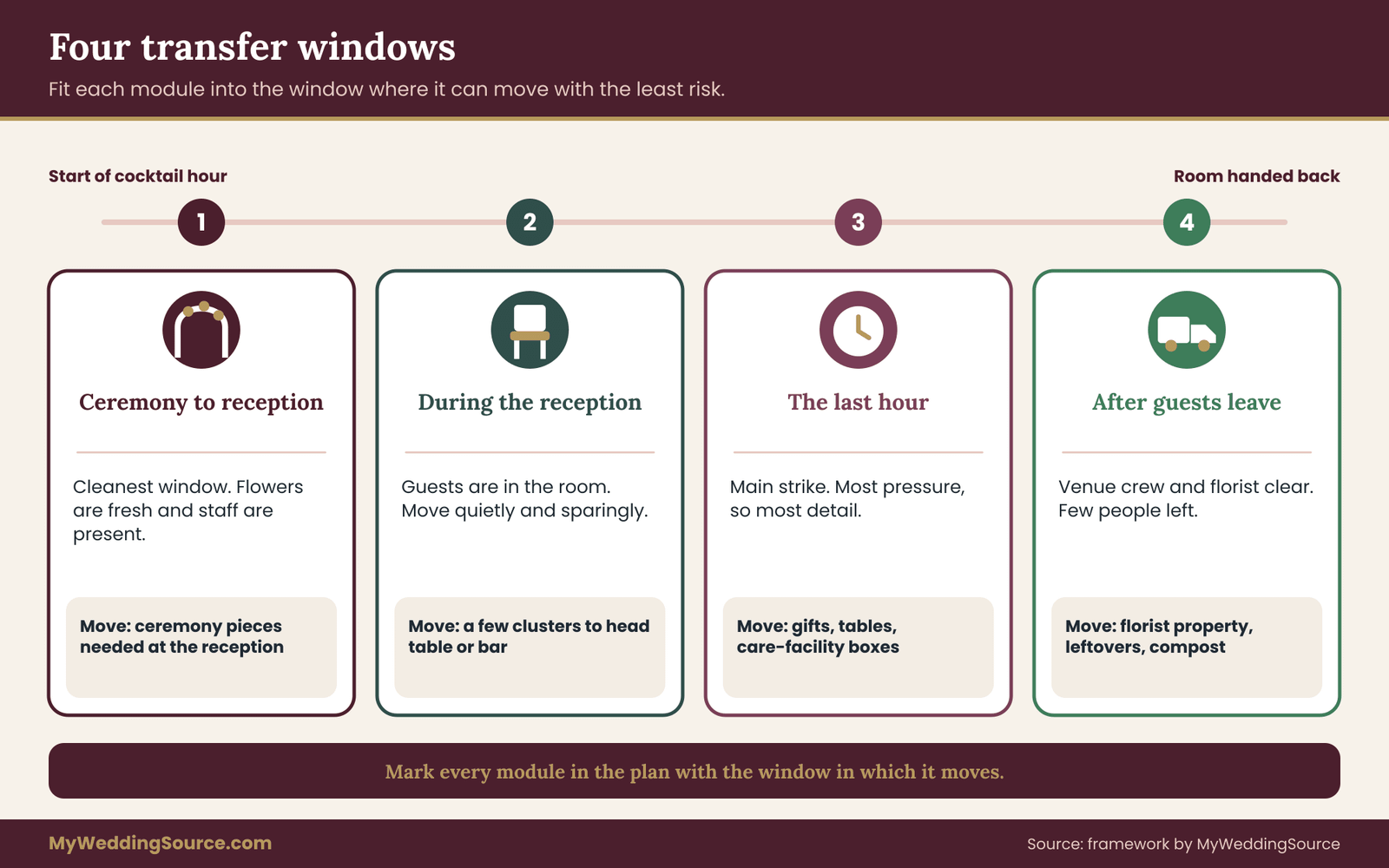
An installation passes through four windows, and each can host a transfer.
Window one: between ceremony and reception. The room is being turned and the flowers are fresh. Anything that must move from the ceremony to the reception should move now. This is the cleanest window, because people are present, the schedule is predictable and the flowers have had the least time in the heat.
Window two: during the reception. Modules can be moved for a purpose, such as bringing arch clusters to the head table, but guests are in the room and every movement is visible. Use this window sparingly, and only for pieces that a staff member can move quietly.
Window three: the last hour. The cake has been cut, the dancing is winding down and the vendors start to pack. This is the usual time for the main strike, and it is the window with the most pressure. The plan for window three should be the most detailed.
Window four: after guests leave. The venue crew and florist clear the remaining pieces. Transfers here are mostly to a vehicle, and the receivers are people who are still around, such as the couple’s family and the vendors.
Fit the plan into these windows rather than inventing new ones, and mark each module with the window in which it moves.
A strike sequence that holds up when people are tired
A sequence is a list of steps in a fixed order that anyone can follow. Here is one pattern that fits most pieces. Adapt the times and roles to your event, and treat the numbers as an illustration rather than a norm.
First, confirm the people. Name a strike lead, who holds the plan and the module tags, and name the carriers. Tell the lead a day earlier, not on the night, and give them a printed copy.
Second, clear the receivers’ space. Before any module moves, the destination must be ready. If centerpieces are going to guest tables, the tables must be cleared of old centerpieces first. If a gift table is waiting, it must be set up with cards.
Third, move the heaviest and the most fragile first. Large vessel-based modules should move before small ones, because they take longer and are more likely to suffer if left.
Fourth, release and carry one module at a time, check the tag and place it directly with its receiver. Avoid creating a pile in the middle of the room, because the pile is where modules get lost or confused.
Fifth, sweep the room. When the last module has moved, check for stray stems, vessels, tags and tools. The room belongs to the venue again, and its rules about debris, water and chemicals apply.
Sixth, record what happened. A short list of modules, destinations and receivers is useful for thank-you notes and for any dispute about returned items.

Who does the work
Role clarity matters more than the number of people. A strike lead with three carriers is better than ten volunteers without direction. Guests are not unpaid staff, and the people who hold the plan should be people who agreed to hold it.
If you have a planner or day-of coordinator, the strike sequence is part of their job, though it may need to be added to their scope. If you do not, ask a calm, organized friend or relative who will not be dancing at the time. A person who is also a member of the wedding party is a poor choice, since they are likely to be photographed and thanked and swept up in other tasks.
There is no need to over-engineer it; modular floral installations only have to work once, on one night.
The florist and the venue should be told who the lead is, and the lead should know the florist’s contact. Place the strike beside the other vendor obligations, such as the caterer’s clear and the rental pickup. The test of modular floral installations is whether a stranger could take them apart from the plan alone.
Handling time pressure
Time is the limiting factor. If the venue requires the room cleared within a short period, divide only what can be divided in that period, and let the rest go. A realistic approach is to rank modules by value, which is a mix of beauty and the receiver’s enthusiasm, and to do the highest-value ones first. If the last ones do not get done, the plan has still delivered most of its benefit. For modular floral installations, boring and specific beats ambitious and vague.
Leave a margin. A plan that works on paper with no slack will fail the first time a carrier is delayed, a vase is missing or a guest asks for a photograph. Build in a buffer, and treat it as part of the strike rather than as waste. Ask about this early, because modular floral installations are much easier to adjust on paper than in a studio.
Destinations: where each module goes and who receives it
A module without a destination ends in the trash. A module with a good destination and a willing receiver is a gift, a decoration or a service. This section covers the common destinations, with their strengths and limits.
Within the event
The simplest destination is the same event. Arch clusters can become centerpieces on reception tables, flower pieces at the bar, accents on the cake table or decoration at the sweetheart or head table. Little or no travel is needed, the flowers are fresh and the guests see the result.
The only requirement is that the table plan can accept them, so check the reception layout and table sizes, and the reception guest flow guide explains how furniture and service lanes interact. Seen this way, modular floral installations are mostly a scheduling and labeling exercise with flowers attached.
Moving flowers within the event also saves a purchase. If you were planning to buy small arrangements for the cocktail hour or the dessert table, a divisible installation can supply them. Discuss with the florist whether the small arrangements should be removed from the budget when the modules replace them, since otherwise you may pay for both.
For the people in your life
Many modules become gifts, and these work best when each has a named person and a message. A grandmother who could not stay late, a host who lent a house, a friend who drove a long distance and a parent who paid for part of the wedding are natural recipients. Write the names on the plan.
Ask the florist to include a simple card, or write a short one yourself, and think about whether the gift is practical: a small vase that fits a car seat is better than a large one. The lesson for modular floral installations is to make every step small, labeled and owned.
Care instructions help. A short note stating “trim the stems and add fresh water” is enough, and it is the kind of detail that makes a gift something that lasts. Mention the pet question described in the safety section below if the recipient has a cat or dog. Questions like this are quick to ask and cheap to answer, and they shape how modular floral installations behave on the night.
Care facilities, hospitals and community groups
Flowers can go to nursing homes, hospices, community centers and similar places. These destinations need a call in advance, since many places have rules about fresh flowers, scents, allergens and infection control. A facility may accept flowers only in the morning, may want arrangements in certain containers or may decline them entirely. Treat the facility’s reply as the only answer that counts, and write it down.
Some communities have volunteer groups that collect wedding flowers and redistribute them. If one exists in your area, it may have its own pickup times and containers. Ask early, because such groups often plan their routes in advance and can refuse same-day requests.
Home and later use
A module can also go home with the couple or a family member. A cluster in a vase can brighten a room the next day, a dried bundle can last for months and a few stems can be pressed. The couple is usually tired after a wedding, and the plan should not rely on them to do work on the night.
A designated family member can take modules home on their behalf, and the couple can collect them the next day. Written down, the answer turns modular floral installations from an idea into a task someone owns.
Compost and disposal
Some modules will not be saved. They are the ones that are damaged, wilted or built with materials that cannot be reused. A responsible end of life is to compost the plant material where a facility accepts it, which requires a separate plan. Sorting materials and verifying a facility is a separate task from dividing, so settle it with the facility before the wedding rather than on the night. A florist who has built modular floral installations before will usually answer this quickly and specifically.
A simple rule for matching modules to receivers
Match the module’s life to the receiver’s effort. A module with a long vase life, such as a vessel-based cluster of hardy flowers, suits a person who will look after it for days. A module with a short life, such as a wet-wrapped garland, suits an event use or a same-day gift.
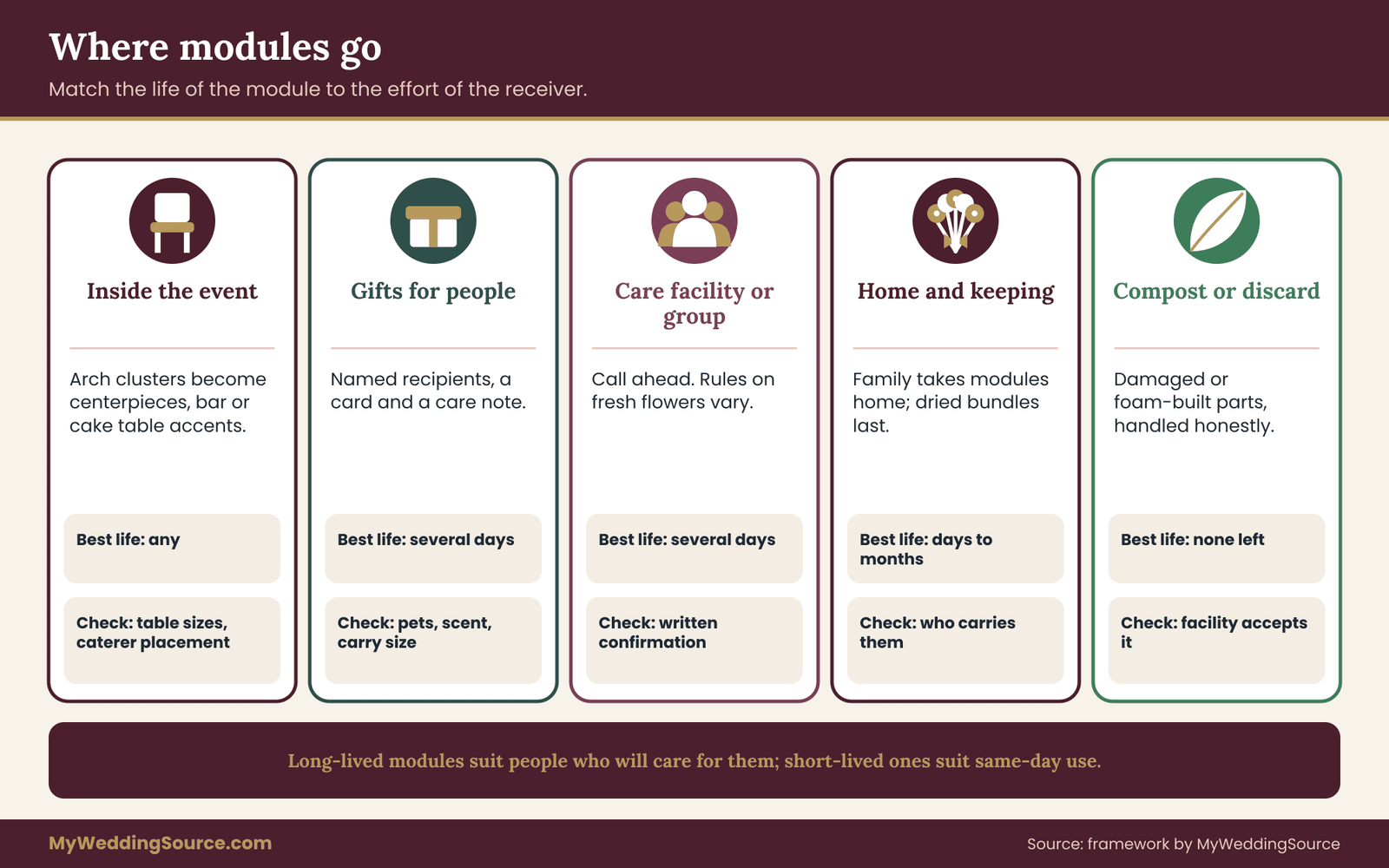
A dried or preserved module suits a long-distance recipient. When you match these well, nothing is wasted, and nobody is handed a chore. Be specific, because modular floral installations are judged on the night by what is written down.
Safety checks for modular floral installations after the event
A module that leaves the venue becomes part of someone’s home, car or hospital room, so it carries a duty of care that a fixed installation does not. This section lists the checks worth making. None needs special equipment, but each needs a decision before the night. With this in place, modular floral installations stop depending on one person’s memory.
Plants and pets
Some flowers and foliage are toxic to cats, dogs or children. The American Society for the Prevention of Cruelty to Animals keeps a searchable list of plants that are toxic and non-toxic to dogs, cats and horses, and the Poison Control service publishes information on plants that are harmful to people.
Lilies are a well-known example of a plant that the ASPCA lists as dangerous to cats. They are also a very common wedding flower. A short check at this stage saves a long scramble later with modular floral installations.
The practical rule is to know the plant list of each module before it is handed out. Ask the florist for the species in each module, then check each species against the ASPCA list. A module that contains a risky species can still be used within the event, but it should not be given to a household with a pet that may chew it, unless that is the recipient’s informed choice.
The short version is simple: do not guess, and do not assume that “wedding flowers” are safe.
Flowers and food
Flowers from a florist are not food. They may have been treated with preservatives, sprays or other products during growing and transport, and they are rarely grown for eating. Do not use a module’s blooms as garnish or in drinks unless the florist and the caterer have confirmed in advance that they are food-grade and have been handled as such.
Keep modules away from open food on a buffet, and ask the caterer where they prefer them to stand when the service is in progress. One honest line in the plan is worth more than a long list of hopes about modular floral installations.
This also matters in the transfer. A module placed on a dessert or bar table to save it may sit near food that guests will eat, so give the caterer a say in where it goes.
Lifting, water and slipping
Water is heavy and slippery. A module that has been filled with water is heavier than it looks, and a small spill on a polished floor is a hazard for guests in formal shoes. Carry modules with a hand under the base, keep the route clear, and ask carriers to take small steps and avoid walking backward.
Keep a towel and a bag of absorbent material near the strike, because water tends to end up on the floor. The point is not perfection but a plan that modular floral installations can actually follow.
If a carrier is expected to move a module through a crowd, such as a reception in progress, they should be told to wait for a gap. A dropped vase is more than an inconvenience, since broken glass in a ballroom stops the evening.
Candles, heat and open flame
Candles and flowers are a common pairing, and a divisible module sometimes includes both. Paper, dry foliage and some flowers burn easily. The National Fire Protection Association publishes guidance on candle safety, and many venues have their own rules about open flame. If a module with candles is to be moved, extinguish the candles first and let wax and glass cool. Never carry a lit candle among guests.
Exits and accessible routes
Modules placed along walls, near doors or in corridors can block movement. Fire codes and accessibility rules require clear routes, and the Americans with Disabilities Act sets standards for accessible routes in public places. Your venue manager is the authority on what is allowed in the space, and a good practice is to keep every transferred module out of exits, aisles and ramps.
If a module is placed on the floor for a time, make sure it does not narrow a path that a wheelchair, a walker or a stroller needs. It helps to remember that modular floral installations are a service to the people receiving the flowers as much as to the couple.
Allergies and scent
Some guests have allergies to pollen or fragrance. If a module is going to a table, consider who sits there. Strongly scented flowers, such as lilies and some roses, can bother a guest with a sensitivity. When you plan the table placement, ask if anyone at that table has mentioned it, and swap a module if necessary. Even a rough version of this helps modular floral installations get through the strike without drama.
Cross-border and agricultural rules
If your flowers or plant material travel across borders or between regions, there may be agricultural rules. The U.S. Department of Agriculture’s Animal and Plant Health Inspection Service publishes information on importing plants and plant products, and some states restrict the movement of certain plants. This matters mostly for destination weddings, where a module might be carried home in a suitcase or a car.
If you plan to take plant material across a border, check with the issuing agency first. Modular floral installations make sense only when the work they create is work someone has agreed to do.
Costs and trade-offs of modular floral installations
A divisible build is not free, and it is not always a saving. This section explains where the cost comes from, how to compare it and what it replaces. It does not give prices, because prices vary widely and are specific to the florist, the region and the date, and the sources section lists no price survey for that reason. The result is that modular floral installations feel routine on the night instead of improvised.
Where the extra cost comes from
There are four places where costs appear.
Design and mechanics. A divisible piece needs more planning than a fixed one. The florist spends more time on sketches, on joins and on testing. That time is billed in some form.
Materials. Vessels, tubes, hooks and reusable ties cost money. Some are rented, some are purchased and some are returned. A build with many vessels will carry a different cost from a build with one frame.
Labor on site. Dividing is slower than clearing. Someone must be paid or thanked for the time, and a florist’s hourly rate is likely to be higher than a volunteer’s evening.
Transport. Modules that travel need space in vehicles, containers and sometimes a second trip. A van that carried one arch in must carry eight modules out, with water.
Where the savings may come from
The savings are real but conditional. A module that becomes a centerpiece replaces a purchase of that centerpiece. A module that becomes a gift replaces a bought thank-you. A set of divisible pieces may let you reduce the number of separate small arrangements ordered for the reception. None of these savings appears automatically, and each needs a line in the budget. Remember that modular floral installations are a means to an end, which is flowers that stay useful.
To check, write two columns in a simple note on your phone or paper. In the first, list the small arrangements you would otherwise buy. In the second, list the modules that would replace them. If the second list covers at least some of the first, subtract the matching items from the florist’s order. If it covers none, the divisible build is a values choice rather than a financial one, and that is fine as long as you know it.
A fair way to compare two quotes
Ask each florist for two quotes: the installation built as a single piece, and the installation built as modules, with the same flowers and the same size. The difference is the real cost of dividing. Keep the scope identical so that you compare like with like, and ask the florist to separate the labor, materials and transport lines.
The wedding budget page has a general method for tracking such lines, and it keeps the comparison from getting lost among other costs. It costs little to confirm this, and modular floral installations lose a lot when it is skipped.
If the difference is small, dividing is probably worth it for the added flexibility alone. If it is large, ask what drives it, and consider dividing only the pieces that bring the largest return, such as the arch clusters, and leaving the hanging pieces as they are. It is a small step, and it is one that modular floral installations depend on.
A decision rule for the whole question
Here is a rule that fits on a card. Divide a piece if it passes the four tests in the first section, if its modules each have a named receiver, if the extra cost is smaller than the value of the replaced purchases and gifts, and if the strike window supports it.
Otherwise build it as a single piece and plan an honest end for it. This rule is deliberately plain, and it will not satisfy a couple who want a sustainability claim, but it keeps the decision tied to what can actually happen on the night.
What not to claim
Be careful with words. A module that is moved to a table is reused, not recycled. A bundle that goes to compost is composted, which is different from saved. If a florist or a venue offers a sustainability claim, ask what it means and what would prove it, as you would for any other claim. The Federal Trade Commission publishes guidance on environmental marketing claims, and its general principle is that a claim should be specific and supportable.
The same standard is a good one for you to apply in your own announcements and thank-you notes, so that the story you tell matches what happened. If the answer is vague, treat it as a warning about how the modular floral installations will actually be handled.
A worked example: one wedding, three modular floral installations
The following couple is invented for illustration. The numbers are examples of how the split plan reads on paper, not averages or benchmarks, and your own figures will differ with your florist, your venue and your guest count.
Hale and Moreno are planning a Saturday wedding with a ceremony in a garden and a reception in a hall about ten minutes away. They have a hundred guests, a florist who agrees to build divisible pieces for an extra labor line, a venue that allows vendors to clear until a set time, and a sister of one partner who has agreed to lead the strike.
They want three large pieces: a ceremony arch, a head table garland and a welcome cluster. Do this once for each of your modular floral installations and the rest of the plan gets easier.
The three parents and their modules
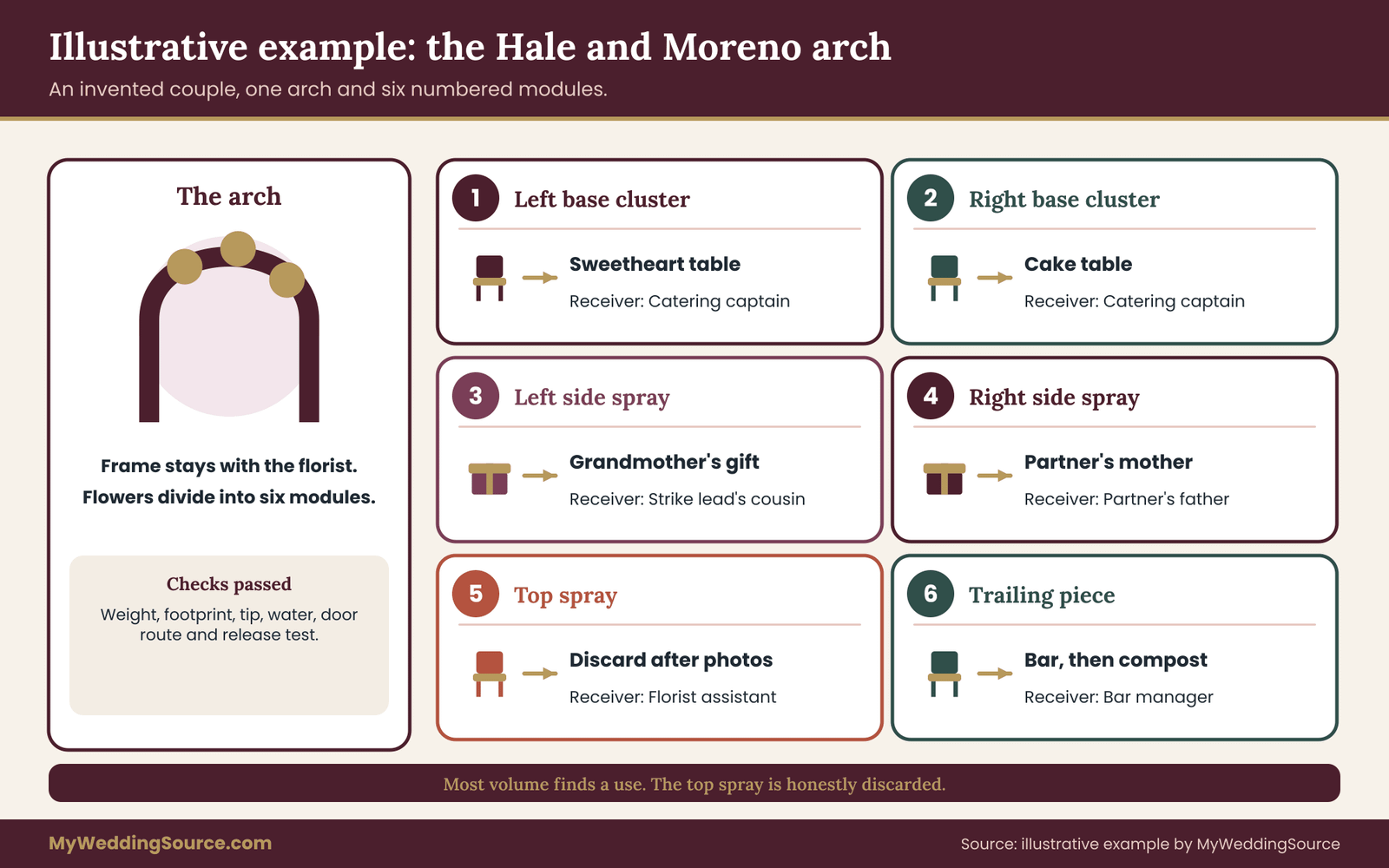
The arch is a freestanding wooden frame that the florist owns. Flowers are built as six modules. Two base clusters sit on shallow vessels at the foot of each post. Two side sprays hang from hooks at shoulder height and use water tubes. One top spray is attached with reusable ties, and one trailing piece runs down a post on a wet wrap. The base clusters weigh the most, because they carry water, so the florist weighs them at the studio and records the numbers.
The head table garland is built as four sections of equal length, each with foliage-covered ends. Each section has its own wet wrap and a short, flat base made of a strip of waterproof material. Sections join at the middle of the table with a hidden clip.
The welcome cluster is two vessel-based pieces on either side of the entry sign, each with its own water, built to be carried by one hand under the base.
The one-page split plan
Here is how the plan might read, in prose rather than a grid, for the arch.
Module one, left base cluster, vessel-based, two-hand carry, goes to the sweetheart table at the reception, receiver is the catering captain. Module two, right base cluster, vessel-based, two-hand carry, goes to the cake table, receiver is the catering captain. Module three, left side spray, tube-fed, one-hand carry, goes to a grandmother who left before dinner, receiver is the strike lead’s cousin. Module four, right side spray, tube-fed, one-hand carry, goes to the partner’s mother as a gift, receiver is the partner’s father.
Module five, top spray, built for the arch only, discard after photographs and send plant material to a community compost drop-off, receiver is the florist’s assistant. Module six, trailing piece on a wet wrap, short life, goes to a table at the bar for the evening and is composted at the end, receiver is the bar manager.
The garland sections become runners for four guest tables, and the welcome pieces go home with the partners’ parents. The plan notes which items are the florist’s property, such as the frame and the glass vessels, and what time the florist’s van will arrive to collect them. Keep this in mind whenever you review quotes for modular floral installations.
Checking the example against the measurable checks
The couple’s strike lead and the florist run through the checks. All modules pass the weight check, with the two heaviest base clusters labeled two-hand carry. The side sprays fit the narrow door between the garden and the hall, which the lead confirmed by carrying a stand-in. The garland sections fit the guest tables, which are rounds of a known diameter.
The water test finds that one base vessel seeps slightly, and the florist swaps it for a heavier one. None of these fixes would have been cheap on the night. Simple labels and a printed page do more for modular floral installations than any extra hardware.
The release test is the most useful. In the studio the florist finds that the top spray is tied with permanent wire and takes too long to remove, so it is changed to reusable ties. The extra cost is small, and the time saved on the night is considerable. Apply this to each piece you are considering before you commit to modular floral installations in the contract.
What the couple did, week by week
Several months before the wedding, they decided which pieces to divide, using the four tests from the first section. Two months before, they asked the florist for the module counts, weights and water plans, and checked species against the ASPCA list. Six weeks before, they asked the venue in writing about moving flowers during the event and the clearing time. One month before, they wrote the split plan on a page and agreed it with the florist and the caterer.
Two weeks before, they briefed the strike lead and listed receivers. The week of the wedding, they confirmed the plan by message with everyone involved, printed three copies and packed a small kit with ties, towels and a few water bottles. On the night, the lead followed the plan. In the days after, the couple sent notes with photographs of the flowers in their new homes.
What went right, and what stayed imperfect
In this example, most of the volume finds a use, and several modules are enjoyed in new places. A few things stay imperfect. The top spray is not saved. The wet-wrapped trailing piece is short-lived. One module is delayed because a carrier is stuck in a conversation. These are normal outcomes, and the plan survived them because it had margin and named people. Nothing about the plan depended on perfection. Couples often underestimate this when they first plan modular floral installations.
Edge cases and common mistakes with modular floral installations
Even a good plan meets awkward cases. Here are the ones that come up most often, with a response for each. Where a case is beyond the scope of a florist’s advice, check with the venue manager or the relevant authority.
Outdoor weddings and heat
Heat shortens vase life and makes water evaporate faster. Outdoor modules should have larger water sources and be shaded when possible. If it is very hot, move modules into a cooled space as soon as the ceremony ends, and delay the gifts until the cooler part of the day. If rain is forecast, ask whether modules can be covered, and plan an indoor fallback for the transfer. Planning modular floral installations well also makes the day itself quieter for everyone involved.
Venues with strict rules
Some venues forbid vendors from moving items during events, restrict the clearing window, or require use of house staff. In these places, a modular plan may depend on the venue’s staff. Ask the venue to confirm in writing what they will do and what they will not, and adapt the plan so that anything that needs your own people is moved during the permitted window.
If the venue will not allow transfers at all, consider building modular pieces for the benefit of the florist’s own reuse, and skip the guest-facing transfers.
Guests who take flowers unasked
At many weddings, guests take centerpieces and arrangements at the end of the evening. This is usually welcome, and it can serve your plan, provided you tell guests clearly what is free to take and what is reserved. A small sign on a table stating “Please take these home” does the job.
For reserved items, put a card on them. If you want a module to go to a specific person, ask a staff member to hold it. If you only act on one thing here, make it this, and your modular floral installations will be in better shape.
Rented or borrowed components
Vessels, stands and frames are often rented or borrowed. If a module is given away in a rented vessel, someone has to get the vessel back. Plan either to use disposable or owned vessels for modules that will be given away, or to ask recipients to return rented ones, which is unreliable. A clear approach is to swap rented vessels for plain, inexpensive ones at the strike and keep the rented items for the florist. That habit keeps modular floral installations realistic rather than aspirational.
A florist who cannot or will not divide
Some florists work with fixed mechanics and cannot easily divide. That is a legitimate position. You can ask them for a smaller version of the plan, such as dividing only the garland or the aisle vessels, or you can find another florist for the parts that matter to you.
A florist who tells you honestly what they cannot do is more useful than one who promises everything and delivers little. Be wary of any promise about modular floral installations that has no weight, no time and no name attached.
Allergies, mobility and care for older relatives
If a relative with limited mobility will receive a module, make sure it is light and stable. If a relative has allergies, check the plant list and the scent. If the recipient is in a care facility, check the facility’s rules, because the person who agreed to accept flowers may not be the person on duty when they arrive. Few couples need every idea here, and modular floral installations still work when only some are used.
The most common mistakes
A few errors recur. The first is deciding too late, after the florist has already ordered and built the mechanics. The second is a module with no receiver, which is a gift to nobody. The third is assuming that guests, relatives or the venue will do the strike without being asked. The fourth is cutting joins with scissors in a hurry, which damages stems and wastes time.
The fifth is leaving the florist’s property behind, which can cost a replacement fee. The sixth is ignoring the plant list, which can lead to a harmful gift. The seventh is promising more than the plan can deliver, in a way that disappoints the very people you wanted to please. This is where modular floral installations differ most from a standard fixed build.
What to say when you ask for help
Plain wording makes requests easier to accept. To a relative: “Would you lead the flower strike after the cake? I will give you a one-page plan, and you only need to follow it.” To the florist: “We would like to divide the arch into modules for after the event. Can you tell us how many, how heavy and how long it takes to release?” To a recipient: “We saved some flowers from the ceremony and would love to give them to you.
Is that welcome?” Short, specific and optional wording lets people say yes without pressure and no without guilt.
Small weddings and very large ones
Guest count changes the plan more than people expect. At a small wedding of thirty or forty guests, one installation may hold as many flowers as the whole room needs, and dividing it can supply every table. The risk is the opposite: more receivers than modules, so decide in advance who goes without rather than splitting a module into pieces too small to use.
At a large wedding, the number of modules rises and so does the number of carries, and it becomes more important to cap the count and to hire or assign extra hands.
In both cases, the number of modules should follow the number of receivers and carriers, not the other way around. This keeps modular floral installations honest about what they can and cannot save.
Photographs and records of the split
Take a photograph of each module in its original place before it moves, and another in its new place afterward. The first helps the florist or a future vendor see how a piece was built. The second is a keepsake and a record for thank-you notes. If the florist or venue asks to photograph the installation for their own use, that is a separate permission question, and agree on image use with them before the day.
Keep the written split plan with your other vendor papers, since it is a record of what was promised and what was done. Few of these steps take long, but together they are what makes modular floral installations workable.
A final-week checklist in prose
In the last week, confirm four things by message. First, the strike lead has the plan and knows the florist’s contact. Second, the venue has confirmed the clearing window and the route. Third, the receivers know whether and when they will receive a module, and the facility or group has confirmed any donation. Fourth, the florist has confirmed what they are bringing for the strike, such as vessels, towels, bags and replacement ties.
Put the answers in one thread so that anyone can find them, and print the plan, because phones go flat and signal in some venues is poor. A short paper copy is the cheapest insurance you will buy for the whole project.
Judging whether it worked
A week or two later, look at the plan and mark what happened. How many modules reached their intended receiver? How many were used in the event? How many were discarded and why? Did the strike finish within the window? Which release or water method worked, and which did not? Share the answers with the florist, since they are useful to anyone building the next modular piece.
Measure the result against your own plan, not against someone else’s ideal. A plan that put most modules in the right hands, and taught you something about your own limits, was a good plan. The aim is calm: modular floral installations should make the end of the night easier, not busier.
Your next steps
Start with the installations you already want. List them, and for each one apply the four tests: fresh flowers at the end, willing receivers, a real time window and a design that tolerates division. Mark the ones that pass. Then write the split plan on a single page, with a water plan, a carry weight, a destination and a receiver for every module, and be honest about the modules that are disposable.
In practice, modular floral installations succeed or fail on small details such as a tag, a towel or a named carrier.
Next, take the page to the florist and ask for the module count, the release method and the extra cost as a separate line, then put the answers in the written scope, as the vendor contract guide describes. Ask the venue for its rules on moving flowers and its clearing time in writing. Name a strike lead and brief them a week ahead, and check every plant on the list against the ASPCA database before you promise a module to anyone with a pet.
Print the plan, pack a small kit, and let the plan do the work on the night. If one installation passes and the rest do not, begin there, since a single well-run split teaches more than an ambitious plan nobody can carry out. For modular floral installations, a short written answer is worth more than a confident conversation.
FAQ
What are modular floral installations?
They are large wedding flower pieces, such as an arch, a garland or a backdrop, built from separate sections so they can be taken apart after the event. Each section is a working small arrangement with its own water and a planned destination, such as a reception table, a gift or a donation. The structure stays together for the event and comes apart on purpose, rather than being cut apart in a hurry at the end.
Does dividing an installation cost more than a single piece?
Often yes, a little. The extra cost comes from design time, vessels and tubes, labor to release modules and transport. It may be offset if modules replace small arrangements you would otherwise order. Ask the florist for two quotes with the same flowers, one fixed and one divided, and with labor, materials and transport on separate lines, so you can see the real difference.
Which installations are easiest to divide?
Vessel-based pieces are easiest, such as aisle vases, low clusters at an arch base, table garlands built in equal sections and welcome pieces on stands. Hanging pieces and dense woven structures are hardest, because they are heavy, hung high and often depend on the flowers for stability. Hanging pieces can still work if built as independent drops, each on its own hanging point.
How long do flowers last after an installation is divided?
It depends on the flower, the water method and how long they were out of water or under heat. Vessel-fed modules of hardy flowers can last for days with fresh water and trimmed stems. Wet-wrapped or tube-fed modules are shorter-lived. Ask your florist for an honest estimate for each module and give the receiver a short care note.
Who should handle the teardown?
A named strike lead with a printed plan and a few carriers is the best arrangement. A planner or day-of coordinator can do it if it is in their scope. Avoid relying on guests or wedding party members who are busy. The florist should also confirm what they will do themselves, such as collecting their frame, stands and vessels at an agreed time.
Are my wedding flowers safe for pets and children?
Not always. Some common flowers and foliage are toxic to cats, dogs or people, and lilies are a well-known example for cats. Ask the florist for the species in each module, check them against the ASPCA plant list and the Poison Control information, and avoid gifting risky modules to households with pets or small children, unless the recipient understands the risk.
What if the venue will not allow flowers to be moved?
Ask for the rules in writing and adapt. You may be able to move modules during an allowed window, such as between ceremony and reception, or have house staff do it. If nothing is allowed, build for the florist’s own reuse of frames and vessels, plan a clean end for the flowers and skip the guest-facing transfers. Do not rely on a verbal exception.
Can the flowers be donated to a hospital or care home?
Sometimes. Many facilities have rules about fresh flowers because of infection control, allergies and scent, and some do not accept them. Call ahead, ask what containers and delivery times they accept, and write the answer down. A local volunteer group that redistributes wedding flowers may be an option, but it needs advance notice and may have set pickup times.
Sources
- Toxic and non-toxic plants, ASPCA
- Poison Control, plant and poison information
- Ergonomics and manual handling, Occupational Safety and Health Administration
- Lifting and material handling, National Institute for Occupational Safety and Health
- Candle and fire safety, National Fire Protection Association
- Accessible routes and public spaces, ADA.gov
- Plant imports and plant health, USDA Animal and Plant Health Inspection Service
- Green Guides on environmental marketing claims, Federal Trade Commission
- Composting at home, U.S. Environmental Protection Agency