
What to do with wedding decorations after the event comes down to one honest inventory and four doors: keep it, sell it, donate it, or return it. This guide gives you an item-by-item disposition ledger, a deadline calendar that starts the night of the reception, one worked case, and a list of the conditions under which each plan fails.
Before you decide anything, find out who owns each item, because rented and borrowed wedding decorations have to go back and have deadlines. Write every remaining item on a ledger with its owner, condition, destination and a date. Keep only what has a named place at home. Sell what is worth the effort at a price floor you set in advance. Donate only what a receiver has agreed to take. Recycle or discard the rest properly, and put every pickup and return date on a shared calendar.
The reception ends, the venue lights come up, and a room full of things you spent months choosing becomes a pile. Candles half burned, centerpieces in mismatched vessels, a welcome sign taller than your car, forty yards of ribbon, a box of table numbers, a hundred votive holders that belong to a rental company. Everyone is tired. Someone says “just throw it in the van,” and that single sentence is where most problems with wedding decorations begin.
The pile of wedding decorations is not one problem. Some of it is not yours to decide about at all. Some of it is worth real money for a few weeks and nothing after that. Some of it is a charity’s headache dressed up as a gift. Some of it carries a return deadline that is measured in days and a late fee that is measured in dollars. Treating wedding decorations as one thing is what produces both the guilt of throwing out something good and the quiet misery of a garage full of boxes nobody wants.
This article is about the decisions after the event. It is not a design guide and it is not a general waste plan. If you want the broader picture of cutting waste from catering through cleanup, the wedding waste reduction planning guide covers that audit. Here the question is narrower and more practical: the wedding is over, the decorations are in front of you, and you need to decide what happens to each one.
A note on scope. This is general information, not legal, tax or financial advice. Contracts, venue rules, charity policies and local disposal rules differ, so confirm the details that affect you with the vendor, the receiver or the local authority named in the relevant step.
What counts as wedding decorations after the event
It helps to define the pile before you sort it. For this guide, wedding decorations means any physical item that was bought, rented, borrowed, made or received to change how a space looked or felt during the wedding weekend. That is a wider net than the centerpieces on the tables. Wedding decorations include the ceremony and the reception, and it includes anything you used at the rehearsal dinner, the welcome gathering or the morning-after brunch.
In practice the pile contains six groups, and it is worth naming them because each group behaves differently.
Structures and large pieces. Arches, arbors, backdrops, hanging installations, lounge furniture, dance floor pieces, and anything on a stand. Large wedding decorations are usually rented or vendor-owned, and they are heavy, so they have the strictest pickup logistics.
Table pieces. Centerpieces, vases, candleholders, chargers, table runners, linens, menu cards, table numbers and place card holders. This group has the most mixed ownership, which is the usual source of confusion.
Lighting. String lights, lanterns, pinspots, candles and battery tea lights. Lighting combines fire risk, electronics and fragile parts, so it needs its own handling.
Signs and paper goods. Welcome signs, seating charts, bar signs, programs, and framed photographs. Paper has the lowest resale value and the highest sentimental value, a combination that tempts people to keep everything.
Florals and greenery. Bouquets, boutonnieres, arch flowers, petals, and potted plants. These are perishable, so their window is hours or days, not weeks.
Consumables and favors. Candles, confetti, ribbon, favor boxes, leftover favors, guest book supplies, and anything meant to be used up. These are the easiest to forget and the easiest to donate or reuse.
The four doors, and the fifth one nobody wants to name
Every one of your wedding decorations leaves through one of four doors. It is kept, sold, donated or returned. A fifth door exists, which is recycling or disposal, and it is not a failure. It is the correct destination for a surprising share of the pile, such as ribbon that is frayed, candles burned to the bottom, foam that crumbled, and flowers that are three days past their best.
With wedding decorations, the useful move is to treat the fifth door honestly instead of pretending every item has a noble second life. A donation center that receives a box of stained linens has not been helped. A buyer who receives a centerpiece with a cracked vase has not been served. An item that goes to the wrong door costs someone else time, and often costs you more than doing the right thing at the start.

The figure above shows the order in which the doors are tested. The first question is ownership, which decides whether the item is even yours to place. Only then do condition, value and a receiver come into play. The sequence matters more than any single rule, and the next sections follow it in order.
Why the order beats going by feel
Most people sort wedding decorations by feeling. They hold up a lantern, think about the day, and decide. That works for a few keepsakes and fails for a hundred items for three reasons.
First, feeling does not know about contracts. The lantern might be a rental with a per-item replacement charge, and the feeling that it is “ours now” has no legal weight.
Second, feeling does not know about time. Flowers lose their value the same evening, a rental has a drop-off hour, and a venue may require its space cleared by a set time the next morning. A sequence that starts with deadlines protects you from the sentimental items that crowd out the urgent ones.
Third, feeling is tired at midnight, and tired people sort wedding decorations badly. The decisions about what is kept, sold, donated or returned are better made from a written ledger than from a pile at the end of a long day, and a ledger can be filled in by a friend who was not emotionally invested in the centerpieces.
What this guide will not do
It will not tell you what any of your wedding decorations is worth. Resale values, rental rates and donation acceptance change by city and season, and any figure printed here would age quickly. It will not rank vendors, charities or marketplaces. It will not promise a tax deduction or a refund. What it gives you is a method that works whatever the prices are, plus the questions to ask the people who set the rules.
It also does not assume you have a month. Many couples with wedding decorations still to place leave on a trip the next day or go back to work within a week. The method is built so that the first decisions can be made in about an hour at the venue, the next ones in an evening during the first week, and the long tail of sales and donations can be handled over several weeks by someone else if you hand over the ledger.
Ownership comes first: who actually owns your wedding decorations
Ask any couple what they own after the wedding and the honest answer is “I think most of it.” That guess is the weak point of every plan for wedding decorations. For wedding decorations, ownership is a fact that sits in a contract, an invoice or a text message, and it should be established before anyone starts packing.
There are six ownership situations, and most weddings contain at least four of them.
Rented from a rental company. The company owns it, you pay for a rental period, and the item must come back in a stated condition by a stated time. Nothing about it is yours to keep, sell or donate, even if it was left in your name and even if you added your own ribbon to it.
Supplied by a vendor as part of a package. A florist’s vases, a planner’s lanterns, a caterer’s chargers, an arch from a decorator. These often look like part of the design you paid for, so couples assume they are theirs. Sometimes the vendor sells them with the package and sometimes they are loaned for the day with a deposit. The contract language decides, and it can be surprisingly specific.
Provided by the venue. Chairs, tables, house linens, candle holders in a ballroom, a ceremony arch that stays on site. These never leave the building, but they can still be damaged, and you can still be charged for them.
Borrowed from family and friends. The grandmother’s lace runner, the cousin’s wooden crates, the neighbor’s long farm table. These have the strongest return obligation of all, because the relationship matters more than any fee.
Bought by you. Wedding decorations you purchased new or used, ordered online, picked up at a craft store, or won at an auction. These are yours to place, and they are the only items for which keep, sell and donate are all open.
Gifted or made by guests. A handmade sign from an aunt, a centerpiece from a friend who did the flowers as a gift, framed art someone brought. Legally these are yours, but there is a social rule that you do not sell or give away a heartfelt handmade gift without a word first.

How to establish ownership in one sitting
Do this check on your wedding decorations before the wedding if you can, and certainly in the first two days after it. Open the signed contracts and invoices for the florist, the decorator, the rental company, the caterer, the planner and the venue, and look for three things in each: an inventory or itemized list, a section on returns or breakage, and a section on what happens to items after the event.
The wedding vendor contract guide explains how to read those sections. For this purpose you only need to find language such as “rental items remain the property of,” “to be returned by,” “damage or loss will be charged at,” or “client may keep.” Highlight it and copy the line into the ledger you will build in the next section. If a contract is silent, ask in writing. A short message is enough.
“Quick question about the centerpiece vessels and candleholders from our order. Are these ours to keep after the event, or do they come back to you? If they come back, when and where, and is there a charge for anything missing?”
Keep the reply. If a vendor says “keep them” in a text, that is useful evidence that the item is yours, and it belongs in the same folder as the contract.
The three cases couples get wrong
The package that blurs the line. A florist’s package for ceremony flowers often includes the arch structure, and the structure is a rental while the flowers are yours. Couples take the whole arch home because it looks finished, then receive a call about a missing structure. Ask which parts of any bundle are consumable and which are returned.
The deposit that depends on return. Many rentals and some vendor-owned pieces carry a refundable deposit, and the refund depends on counting and condition. If an item is not returned as agreed, you may lose the deposit on top of paying a replacement charge. Treat any deposit as a debt you are owed, and put the return date on the calendar first.
The item moved from one category to another. A rented vase that is later “bought” by the couple because it was cheaper than returning it has changed ownership by agreement, and the agreement should be written and paid for. A friend’s vase that gets broken is no longer a loan, it is a replacement conversation. Neither should be left to memory.
A fast test for any of your wedding decorations you are unsure about
Pick the item up and ask five questions in order. Did we pay for it, and can I show where? Is there anything written about returning it? Does it carry a rental tag, a barcode or an engraved name? Did the vendor ask us to leave it in a particular place? Did anyone say it was a loan? If you cannot answer the first question with a receipt or an invoice line, treat the item as not yours until proven otherwise.
That rule sounds strict, and it is meant to be. When sorting wedding decorations, the cost of holding something that turns out to be yours for another day is nothing. The cost of keeping something that turns out to be a rental is a charge, a damaged relationship with a vendor, and sometimes an unpleasant message from a stranger.
Build the disposition inventory for your wedding decorations
An inventory is a list of what you have. A disposition inventory is a list of what will happen to each item, with a date. The difference is small on paper and large in practice, because a list of what you have is a record of the past while a list of what will happen is a plan.
The ledger of wedding decorations works because it makes four decisions visible at the same time: who owns the item, what shape it is in, where it is going, and by when. Everything else in this guide supports filling those four fields honestly.
Create it before the wedding, if you can
The best time to start the ledger of wedding decorations is during planning. Each time you order, rent or make something for the wedding, add a line. By the wedding day, most of the ledger already exists and the only task left is to record the condition. If you are reading this after the event, you can rebuild it from invoices and photographs. Walk the venue photographs and the vendor delivery lists and write one line for every distinct item or set of identical items.
Do not list every individual candle among your wedding decorations. List “candles, unlit, pillar, one box” and “candles, partly burned, forty.” Group identical items and count them. A ledger with a hundred and fifty lines will be abandoned, while a ledger with forty lines will be finished.
The eight fields
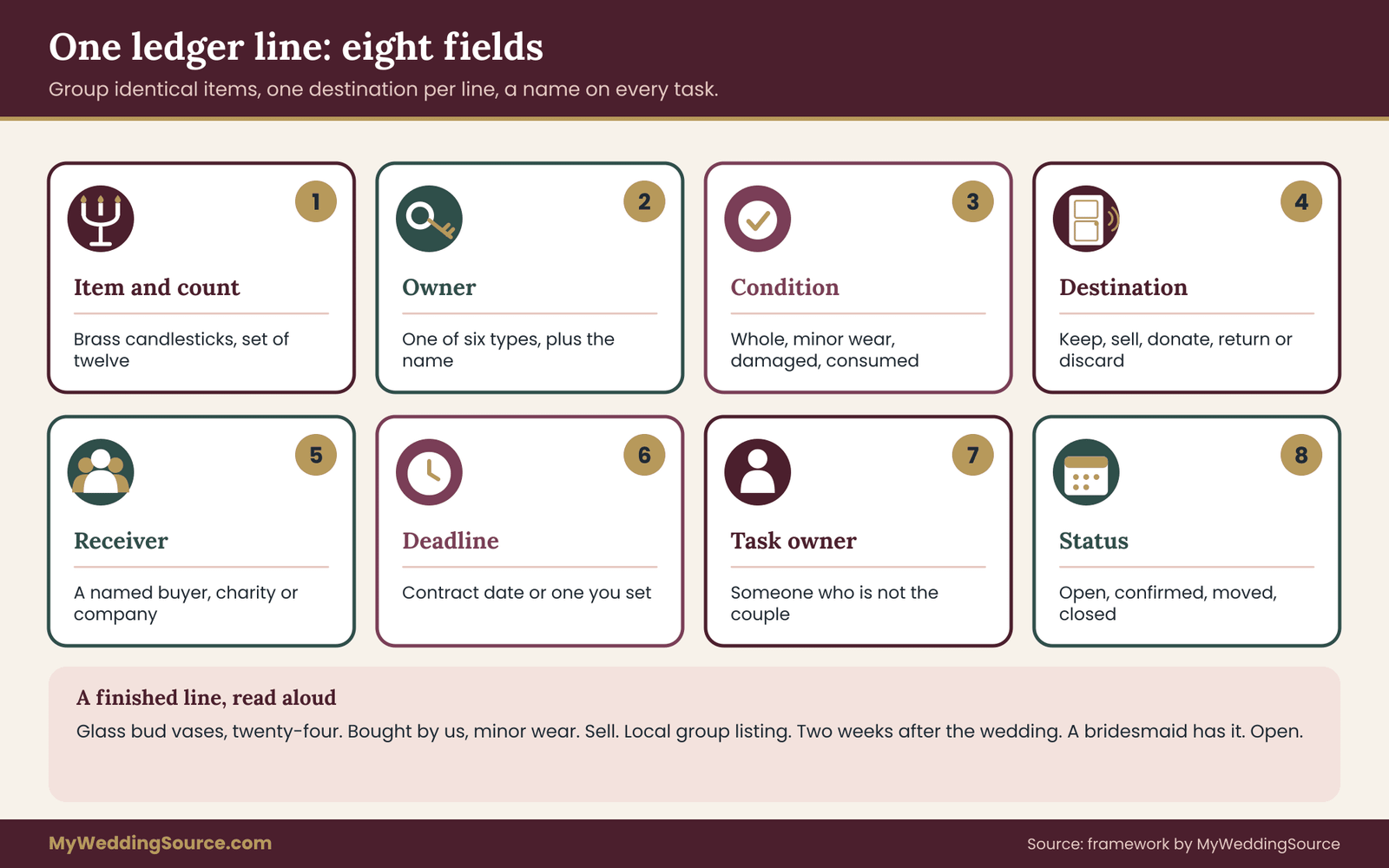
Each line carries eight pieces of information. The fields are short on purpose.
Item and count. What it is and how many. “Brass candlesticks, set of twelve.”
Owner. One of the six ownership situations named above, plus the name of the party. “Rental company, order confirmation on file.”
Condition. Whole, minor wear, damaged or consumed. Photograph anything in doubt before it is moved.
Destination. Keep, sell, donate, return or recycle and discard. Only one per line. If a set is going to two places, split it into two lines.
Receiver or buyer. The actual name of the company, person, charity or listing. “Maybe someone” is not a receiver.
Deadline. The date or hour by which the item has to be moved. For returns this comes from the contract. For sales and donations you set it.
Owner of the task. The person who will carry out the move, who is almost never one of the couple. This is the field that rescues the plan.
Status. Open, confirmed, moved or closed, with the date you changed it.
A worked line, so you can see how little it takes
A completed line for table pieces reads in a single breath: “Glass bud vases, twenty-four, owner is the couple, bought used, minor wear, destination sell, buyer a listing in a local group, deadline two weeks after the wedding, task owner is the bridesmaid who offered, status open.” That is every decision made, and it is something a person who was not at the wedding can carry out.
Compare it with the usual note on a phone: “sell the vases.” The note carries none of the facts that would let someone act, and it will still be there in the spring.
Where the ledger lives
Use the format you are most likely to keep open for your wedding decorations. A shared spreadsheet is the usual choice because several people can edit it from their phones, and because the status column can be sorted. A shared note works if the list is short. A paper list on a clipboard works at the venue during teardown and should be photographed and transferred the same night.
Share it with the people who will do the work, in view-and-edit mode, and keep a plain copy in the folder you will set up for the rest of the paperwork. The guide to wedding records after the event shows how to organize that folder, and the disposition ledger fits naturally into its vendor and money sections.
Returning rented and borrowed wedding decorations
Returns of wedding decorations are the first door because they are the only one with someone else’s deadline. Rented wedding decorations often have a pickup window, a drop-off window or a return-by hour, and the rules for counting and condition are usually written down. Handle returns of wedding decorations first and the rest of the ledger gets calmer.
Read the return terms before the wedding week
The return terms are in the rental agreement or the vendor contract, and they tend to cover the same five things. When and where the items go back. Whether the company collects or you deliver. How items must be packed, cleaned or sorted. How the count is verified and who signs. And what is charged for loss, damage or lateness.
Write the answers into the ledger beside each rented line. Many couples discover the clean-and-pack requirement only on the night, when a vendor mentions that candle wax must be removed from holders or that linens must be shaken out and bagged by type. If any of that is unclear, ask a week before the wedding, when the answer is cheap. The wedding rental planning checklist lists the questions worth asking at booking time and is a good companion to this section.
The five checks on return day
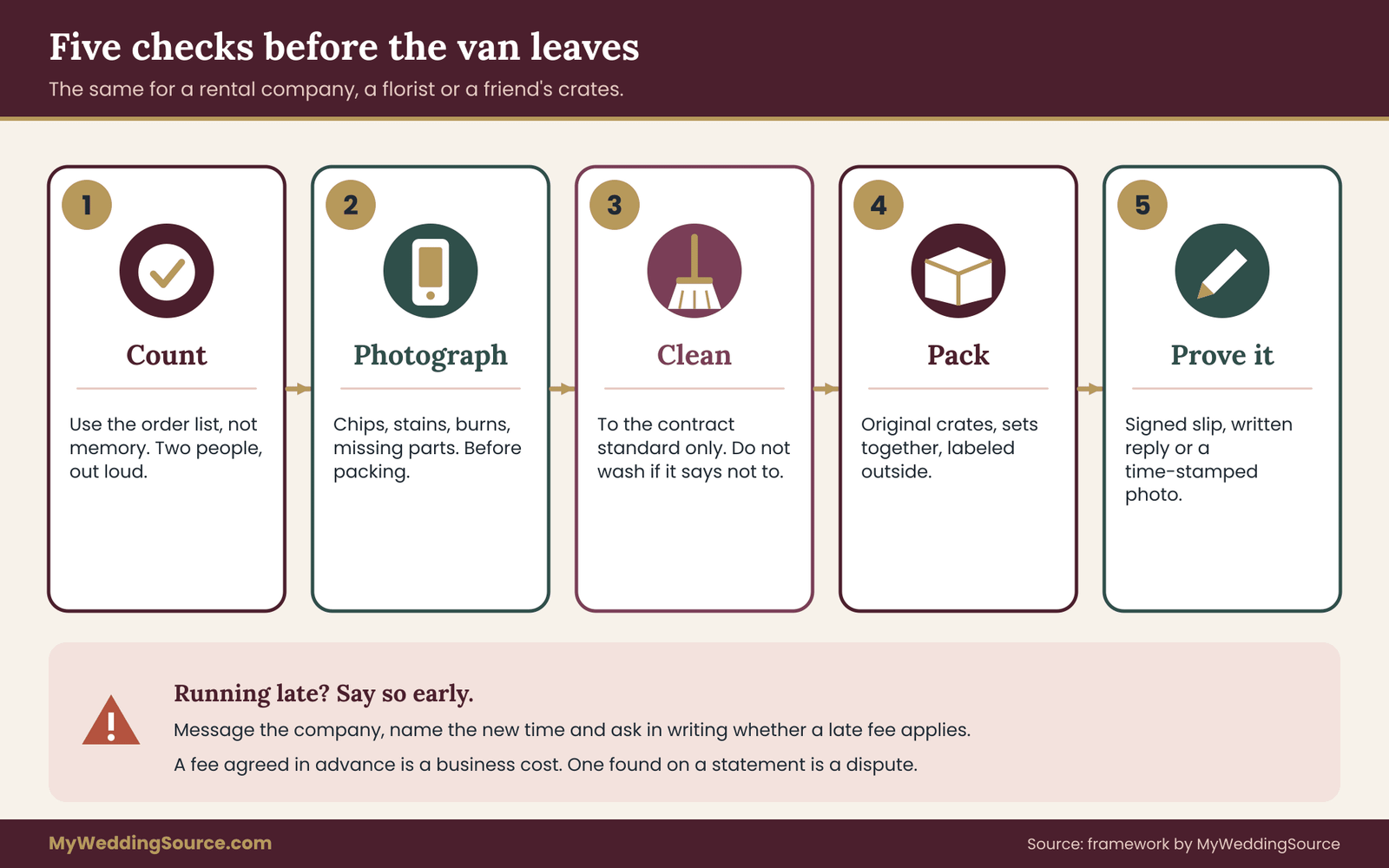
A return goes smoothly when five things are true before the van leaves. These are the same whether the items are going to a rental company, a florist or a friend.
Count against the list. Use the delivery or order list, not your memory. Count each set out loud with a second person, and record the number in the ledger. Items go missing in the last hour of a wedding, and the count tells you early enough to look for them.
Check condition and photograph problems. Look for chips, cracks, stains, burn marks and missing parts. Photograph anything damaged before it is packed, with a note of when and where. Photographs protect you in both directions, because they show damage that existed already and damage that did not exist when you returned the item.
Clean to the stated standard. Not to your own standard. If the agreement asks for wax-free candleholders, scrape them. If it says “do not wash,” do not wash. Overcleaning can damage finishes and undercleaning can trigger a fee, so go by the contract.
Pack as agreed. Use the original crates or boxes if they were supplied, keep sets together and label the outside. Fragile glass wrapped in the paper that came with it travels better than glass in a trash bag.
Get something in writing. A signed return slip, a reply that says “received in full,” or a time-stamped photograph of the handover. The point is evidence that the items arrived, so that a later charge can be disputed with something better than a recollection.
Who returns what, and when
Do not plan to make the returns of wedding decorations yourself. Name a person for each return in the ledger’s task owner field and confirm that they have the delivery list, the vehicle space and the time. A friend with a car and a clear Sunday morning is worth more than three willing people with plans.
Group returns by destination to reduce trips. If a single florist supplied vases, stands and the arch, it is one return with one count. If six items are going back to the venue, they are a separate stop that can be done at the end of the teardown. Order the stops by deadline, not by convenience, and put the earliest one first.
Late returns and what to do about them
Sometimes the time simply runs out. The reception goes long, the venue’s curfew arrives, or a vehicle is full. Do not stay silent and hope. Call or message the company as early as possible, say plainly what is late and why, and propose a specific new time. Companies deal with late returns constantly and tend to respond better to a clear request than to a late arrival with no notice.
Ask in the same message whether a late fee applies, and get the answer in writing. A fee agreed in advance is a business cost. A fee discovered on a statement three weeks later is a dispute.
Loss, breakage and the replacement charge
Expect that some of the wedding decorations will be lost or broken, and decide in advance how you will handle it. Most agreements charge a replacement amount per item, and the amount can be larger than the rental cost. Do not argue about the principle at the venue. Record the loss, ask for the written replacement charge, and compare it to the contract.
If the charge looks inconsistent with the agreement, take it up in writing within days, not weeks, and attach the photographs and the count. If you paid by credit card, remember that disputing a charge has its own time limits, which the consumer financial protection agency explains on its website. Check that guidance, and keep the dispute in the financial section of your records.
Borrowed items from people you love
Return borrowed wedding decorations first and personally, if you can. Clean them, replace anything that was used up, and add a short note. A grandmother’s runner returned within a week with a handwritten thank-you is a better outcome than a perfect return a month later.
If something borrowed was damaged, say so at the time you return it, not later. Offer to repair it, replace it or pay for it, and let the owner decide. These conversations are far easier when they are brief and honest, and much harder when the person discovers the problem themselves.
Keeping wedding decorations without filling a closet
Keeping is the door people over-use with wedding decorations. Wedding decorations feel connected to a day you want to remember, so almost everything seems worth keeping at first. A year later most wedding decorations are in a bin whose contents you have forgotten.
The goal is to keep fewer wedding decorations on purpose. Keep what you will use, display or hand down, and let the rest go through another door while it still has value.
The three tests for anything you plan to keep
The place test. Can you name the exact spot where this will live? “In the garage” is a location, not a place. “On the third shelf of the hall closet, in the box labeled keepsakes” is a place. If you cannot name one, you are not keeping the item, you are postponing a decision.
The use test. Will it be used again in a way you can describe? Candle holders that match your dining room are a use. Forty identical jars you might use for something are not. Items for a future anniversary party, a baby shower or a vow renewal count only if you can picture the event.
The meaning test. Does it carry a memory you would miss? A hand-lettered sign, the guest book, the cake topper from your grandparents’ wedding. These items are kept because of what they hold, and they deserve good storage.
A piece of wedding decorations that passes none of the three goes to another door. One that passes the meaning test but is large, such as a welcome sign, can be photographed from several angles, with the photographs kept and the item itself placed elsewhere.
A storage cap
Set a limit on kept wedding decorations before you start. A single banker’s box or one storage bin per partner is a workable cap for most couples. When the box is full, something comes out before something goes in. The cap forces the choice that sentiment postpones, and it keeps keepsakes from turning into a storage unit.
Pack the box for opening in ten years. Use acid-free tissue for paper and fabric, avoid sealing damp items, and put a short list taped inside the lid. Cardboard that has absorbed candle wax or fruit juice will stain whatever it touches, so wipe and dry everything first.
What is usually worth keeping, and what usually is not
Worth keeping in many cases: the guest book and anything people wrote in, a few pieces of signage with real meaning, framed photographs, handmade items from family, a small selection of table numbers or place settings, and the items you will use in your home.
Not usually worth keeping: more than a handful of identical glass items, centerpieces made of materials that decay, anything with a smell or residue that will not clean, damaged items you do not plan to repair, and generic supplies that cost little to rebuy. A roll of ribbon you will never use again is not a memory. It is a roll of ribbon.
Reusing wedding decorations at home
Many wedding decorations are better lived with than boxed. Vases become kitchen vases. Lanterns go on a porch. A table runner becomes a runner on a dining table. Signs that have a clean design can hang in a hallway. This kind of reuse keeps the wedding in daily life and costs nothing, and it makes the keep door the most satisfying of the four.
Reuse is also where signage deserves a thought. Printed boards and framed prints sometimes work as home decor, and the guide to wedding signage as a system describes how to design them in ways that survive past the day. If a sign was made for the event with a name and date on it, decide whether it is a keepsake or clutter before it enters the house.
Selling wedding decorations without regret
Selling wedding decorations is the door that rewards the most planning and punishes the most delay. Used wedding decorations are in demand for a short window, because other couples are planning for dates that are coming up and want to save money. That window closes within weeks. After it, the same items compete with everything else on a resale site and fall in value.
Selling wedding decorations also costs your time, and your time is the scarcest thing you have in the first month of marriage. The honest question is whether the sale is worth the effort at the price you can realistically expect.
Set a price floor before you list anything
A price floor is the lowest amount for which you would complete the sale, set in advance and written in the ledger. It stops two common mistakes. One is accepting an offer that does not cover the time of packing and meeting the buyer. The other is holding out for a figure that no buyer will pay, and ending up with the item and no sale.
To find a floor, search for sold or completed listings of similar items in your area, not asking prices. Then subtract what you spent on materials or fees to sell, and add a value for the hour or two the sale will take. If the result is close to zero, the item belongs behind another door.
This guide does not state any price, because values vary by place, season and condition. Use your own searches and keep a screenshot of what you found.
Sell in lots, not one piece at a time
Individual wedding decorations rarely justify the effort. Grouped lots do. Twenty-four matching vases sold as a set to a single buyer are one meeting. Twenty-four listings are twenty-four conversations.
Think about what a future bride or groom wants to buy: a complete set for a table style, a collection of ceremony pieces, a bundle of signs and stands. Describe each lot as a coherent kit and say what it was used for. Photograph the set together on a plain surface in daylight, and add one photograph of any flaw.
Write the listing so nobody is surprised
An honest listing saves the most time. State the number of pieces, the dimensions, the material, the condition including any chips or stains, whether the item has been used outdoors, and what is not included. Say if the items were rented or bought, and say whether the buyer will receive them washed or as they came out of the event.
Avoid claims you cannot support, such as “like new” for items that were used for a day, or “authentic antique” for something you bought in a craft shop. If a seller misstates condition, the buyer will return the lot or leave a complaint, and either costs more than the sale was worth. The details about how to avoid misleading buyers belong to your listing text, so write them down plainly.
Choose the channel by the size of the lot
Local pickup suits large, fragile and heavy items. Shipping suits small, light and well-packed items, but shipping glass carries a risk of breakage and a cost that often exceeds the value. Wedding resale groups, local classifieds and neighborhood groups work for bulk lots. A consignment shop or a wedding resale store may take a set and pay a percentage after the sale, which saves effort but takes a share and some time.
Read each platform’s rules before listing. Fees, seller protections and prohibited items vary, and they change. Check the current terms directly on the platform instead of relying on an article, including this one.
Pickup safety and payment
Meeting a stranger to hand over a van load of vases is ordinary and mostly harmless, and it is still worth some caution. Arrange pickups in daylight, at a public location or the front of your building, with a second person present. Keep communication inside the platform where possible, and do not share more personal information than you need.
Be skeptical of any buyer who overpays and asks for a refund of the difference, who wants to pay with a check that “will clear,” or who asks you to ship before payment arrives. The Federal Trade Commission publishes consumer guidance on fake check and overpayment scams, and reading it once is a good use of five minutes. Accept payment that you can verify before the item leaves your hands.
Taxes and records for sales
Sales of used personal items at a loss are generally not taxable events, but the rules depend on the situation, and platforms may have reporting obligations of their own. A tax professional can answer questions about your case, and the Internal Revenue Service website explains general rules for personal property. For your own records, note each sale in the ledger with the date, amount and buyer name or handle, and keep it with the money section of your files.
If the proceeds are meant to offset wedding costs, you can reflect them in the final numbers of your wedding budget. Recording the amount keeps the budget honest about what the wedding actually cost.
Selling to people you know first
Before you post any wedding decorations publicly, offer the lots to friends, relatives and recently engaged acquaintances. A cousin planning a wedding next spring may take the whole table set at a fair price and collect it herself, which saves listing, messages and pickups. Say plainly what is for sale, what you want, and by when. A direct offer often closes in a day, while a public listing takes weeks.
If you give an item away instead of selling it, say so clearly, so nobody wonders whether they owe you something. Gifts between friends are fine. Confusion about whether something was a gift or a loan is not.
When to stop trying to sell
Give each lot a time limit. Two weeks is a reasonable starting point, and you can lengthen it for something that has a real market. If a lot has not sold by the deadline, drop the price once, by a set amount recorded in the ledger. If it still does not sell, move it to another door. That might be donation, a swap with a friend, or recycling. The aim is a closed ledger line, not a perfect price.
Donating wedding decorations: what receivers can actually accept
Donating wedding decorations sounds simple and often is not. A donation is a request, and the receiver decides whether to say yes. Some organizations love wedding decorations, and others do not. Others are overwhelmed by them. The difference is whether the donation fits what the receiver can use, store and resell or distribute.
Start with a call, not a drop-off
Never leave donated wedding decorations outside a closed building or arrive with a loaded van without asking. Unannounced donations of items the organization cannot use become disposal costs for the receiver. Call or email first, describe what you have in plain words, and ask whether they would like it, when they can receive it, and whether they can send someone.
“We have about thirty glass vases, clean and without chips, and a few boxes of fabric table runners from a wedding last week. Would any of this be useful to you, and if so, what are your donation hours and how would you like it packed?”
If the answer is no, thank them and ask whether they know who might say yes. Receivers often know their neighbors in the sector, and that single question can produce better matches than a search.
Who tends to take what
The match depends on the item. Thrift stores generally accept clean, whole household items such as vases, frames, candle holders and linens. Community theaters and school drama programs sometimes take fabric, props and lighting. Schools and art programs sometimes use jars, ribbon, paper and craft supplies. Senior centers, hospitals and care homes sometimes welcome flowers, subject to their own rules on live plants. Community gardens and compost programs may accept untreated plant material, and a local reuse center may take wedding supplies for resale or for a creative reuse program.
Each of these is a possibility, not a promise. Rules about what is accepted are the receiver’s, and they differ between organizations in the same town.
What receivers usually refuse
Expect refusals for items that are stained, broken or missing parts, anything with a strong smell, partly burned candles in quantity, items covered in glitter or adhesive, and large structures that need a truck. Food, including favors that are edible, belongs to a separate set of rules and receivers, and a caterer or a local food rescue organization can tell you what is allowed.
Do not use donation as a way to avoid paying for disposal. Pushing unusable items onto a charity moves the cost to people with a smaller budget and less staff than you. If an item is not good enough to give to a friend, it is not good enough to donate.
Condition standards that make a donation welcome
Clean the wedding decorations and sort them before you deliver. Pack fragile pieces in boxes with the pieces separated. Group identical items so that staff can count and price them quickly. Write a short list on the outside of each box and include a count. Remove personal names and dates where practical, because names on signs are not useful to an organization that cannot reuse them.
If you are donating a large number of items, ask whether the organization prefers delivery on a specific day. A week-night delivery that suits you may not suit a volunteer-run shop that is open on Saturdays.
Tax receipts and valuation
Some couples hope to claim a deduction for donated wedding decorations. Whether that is possible depends on your tax situation, on the receiver’s status and on the value of what you give. The Internal Revenue Service explains charitable contributions, required records and how to value donated property, and its publications are the place to start. Do not assume the receiver will provide a valuation, because most will not.
For your own protection, ask for a written acknowledgment that lists the date, the receiver’s name and a description of the items, and put it with your records. Whether a deduction is available is a question for a tax professional, not for this guide.
Donation that works, and donation that does not
A good donation of wedding decorations has four features. The receiver said yes in advance. The items are clean and whole. The delivery is on the receiver’s schedule. And the receiver has a way to use or resell the items. When those four are present, the donation helps. When any one is missing, you are mostly moving the pile somewhere else.
Special handling: flowers, candles, lights and other tricky wedding decorations
Some wedding decorations do not fit the four doors cleanly because they are perishable, hazardous or regulated in some way. Plan for these separately, ideally before the wedding, because they are the items most likely to be left in a trunk and forgotten.
Flowers and greenery
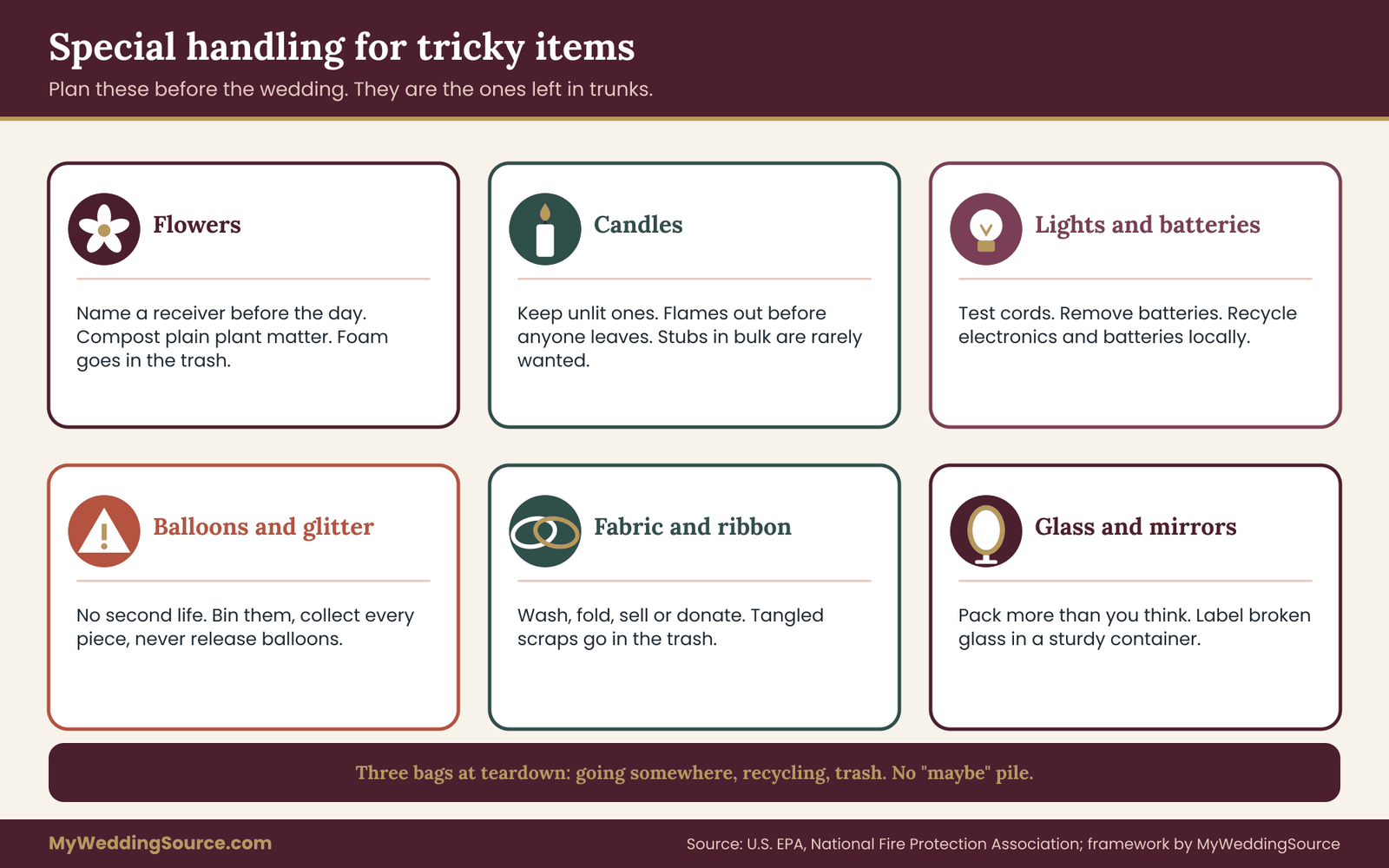
Of all wedding decorations, fresh flowers lose value in hours, which makes them the most time-critical items on the ledger. Decide before the reception who will take them and where. Options include a friend who wants a bouquet for home, a hospital or care home that accepts fresh flowers, a community garden or compost program, and the florist’s own collection arrangement if one exists.
Call early. Many organizations will take flowers only on certain days or only in clean containers, and some do not accept live plants at all. Do not assume a yes. If nobody can take them, composting is a sound last step for untreated plant material, and the Environmental Protection Agency explains home composting and what belongs in it.
Remove wire, floral foam, plastic, ribbon, tape and any stickers before composting. Floral foam in particular does not break down and should not go into a compost pile. Preserved or dyed flowers and anything sprayed with glitter or paint belong in the trash, not the compost.
If you want a keepsake, press one bouquet or dry a few stems within a day or two. Preservation methods vary, and the keepsake can be small without losing its meaning.
Candles
Candles among your wedding decorations pose two separate questions: what to do with the leftover wax, and how to handle open flames afterward. Partly burned candles are usually not welcome in donations in large quantity, but a bag of unlit pillar candles in a box may be. Keep unburned candles for home use or give them to a friend. Melt down a handful of stubs for a single new candle only if you actually enjoy that, not because it feels virtuous.
Store candles away from heat so they do not warp, and do not leave burning candles unattended during teardown. The National Fire Protection Association publishes candle safety guidance, and a quick read before the wedding is worth it. Make sure every flame is out before anyone leaves a room.
String lights, lanterns and anything with a plug or a battery
Of all wedding decorations, lighting is the group with the most hidden parts. String lights, fairy lights, battery tea lights and lanterns contain wire, bulbs, batteries and electronics, and each of those has its own end-of-life path.
Test working lights before you decide. A string that lights up is worth keeping, selling or donating. One that flickers or has a damaged cord is a fire risk, and it should not be passed on. The Environmental Protection Agency explains how to donate or recycle electronics, and many local programs accept string lights as small electronics.
Batteries need separate handling. Remove them from tea lights and lanterns before storing, to prevent leaks, and recycle them according to your local program. The Environmental Protection Agency has a page on used household batteries that points to local rules. Never throw lithium batteries into ordinary trash.
Balloons, confetti, glitter and small plastics
These are the least recoverable wedding decorations of all. Latex and foil balloons, plastic confetti, glitter, plastic sequins and single-use plastic decor are generally not reusable and rarely recyclable. They also have a way of reaching waterways and wildlife if released.
Do not release balloons, and put confetti and glitter in the trash instead of leaving them on the lawn. If you are still planning, the better answer is not to buy them, and the broader wedding waste reduction planning guide explains how to choose materials that have somewhere to go afterward. After the event, put them in the trash, pick up the pieces thoroughly, and move on.
Fabric, linens and ribbon
Fabric items such as runners, napkins and drapes are among the most reusable wedding decorations, because textiles are in demand and last a long time. Rented linens go back to the company in the condition it specifies. Your own linens can be washed, folded and sold or donated, and a clean set of napkins is welcome in more places than a pile of stained ones.
Ribbon is easy to keep and hard to rehome. A neat roll sold in a bundle with other craft supplies may find a buyer, and a school art program may take it. Tangled scraps are better thrown away than donated.
Paper goods and signs
Among wedding decorations, paper has the lowest resale value and the strongest pull to be kept. Programs, menus, place cards and seating charts rarely have a second use. Keep one of each in the keepsake box and recycle the rest where your local program accepts them. Laminated or foil-stamped items are not always accepted in curbside recycling, so check local rules.
Large foam board or mounted signs are bulky and awkward. If they are in good condition and generic, such as a plain welcome stand, a local reuse group or a school may take them. If they carry your names, photograph them and let them go.
Glass, mirrors and fragile items
Glass and mirrors are valuable on the resale and donation side because they are reusable. They are also the items most likely to break in transit, so pack them better than you think necessary. The wedding mirror decor safety guidance on this site describes how to handle heavy mirrors, and the same care applies after the wedding. Broken glass goes in a sturdy, labeled container so that nobody is cut when handling the trash.
Foam, plastic and items with no second life
Some wedding decorations have no good destination at all. Floral foam, polystyrene blocks, adhesive-backed vinyl, treated or painted items, and cracked plastic belong in the trash unless your local program says otherwise. Do not feel guilty. A short search of your local waste authority’s website tells you what is accepted, and that is more useful than guessing.
Sorting these items early prevents a larger problem. When they sit in a pile with reusable items, they contaminate it. A box of good vases with a handful of broken foam pieces is harder to give away than a clean box.
Edge cases that change the plan
Destination weddings. Carrying wedding decorations home by air is rarely sensible. Decide before you leave which wedding decorations stay at the destination, which go to a local receiver, and which small keepsakes fit in a carry-on. Ask the venue or planner whether a local charity or reuse group takes event items, and arrange it before the trip. Rented items stay with the local supplier, so the return list is short and the contract is simple.
Backyard and home weddings. The pile is already at your house, which tempts you to leave it. Do not. Time limits matter more here because nobody else enforces them. Use the same ledger, ask a friend to hold the clipboard, and set a firm date for the garage to be empty.
Venues with a leave-nothing rule. Some venues require every item to be gone by a set hour, and some charge a fee for anything left behind. In that case the order of the day changes: items for a named receiver or a return go first, and everything undecided goes into one labeled box in your own vehicle, so the venue is cleared on time.
Two events, two sets. If you held a rehearsal dinner and a reception, keep two ledgers or one ledger with an event column, because ownership and return times are often different. Items moved between events should be noted, since a rental can be counted twice or not at all.
Multiple payers. When parents or relatives paid for part of the wedding decorations, ask early whether they expect to receive the items or any sale proceeds. A short conversation before the wedding avoids a long silence after it.
A small habit that helps: three bags at teardown
Have three containers at the venue during teardown: a box for items going home or to a named receiver, a bag for recycling, and a bag for trash. Ask the people helping to decide quickly and not to put items in the “maybe” pile. The “maybe” pile is how ledgers fail, because it is the one place where nobody has made a decision.
The deadline calendar and who does the work
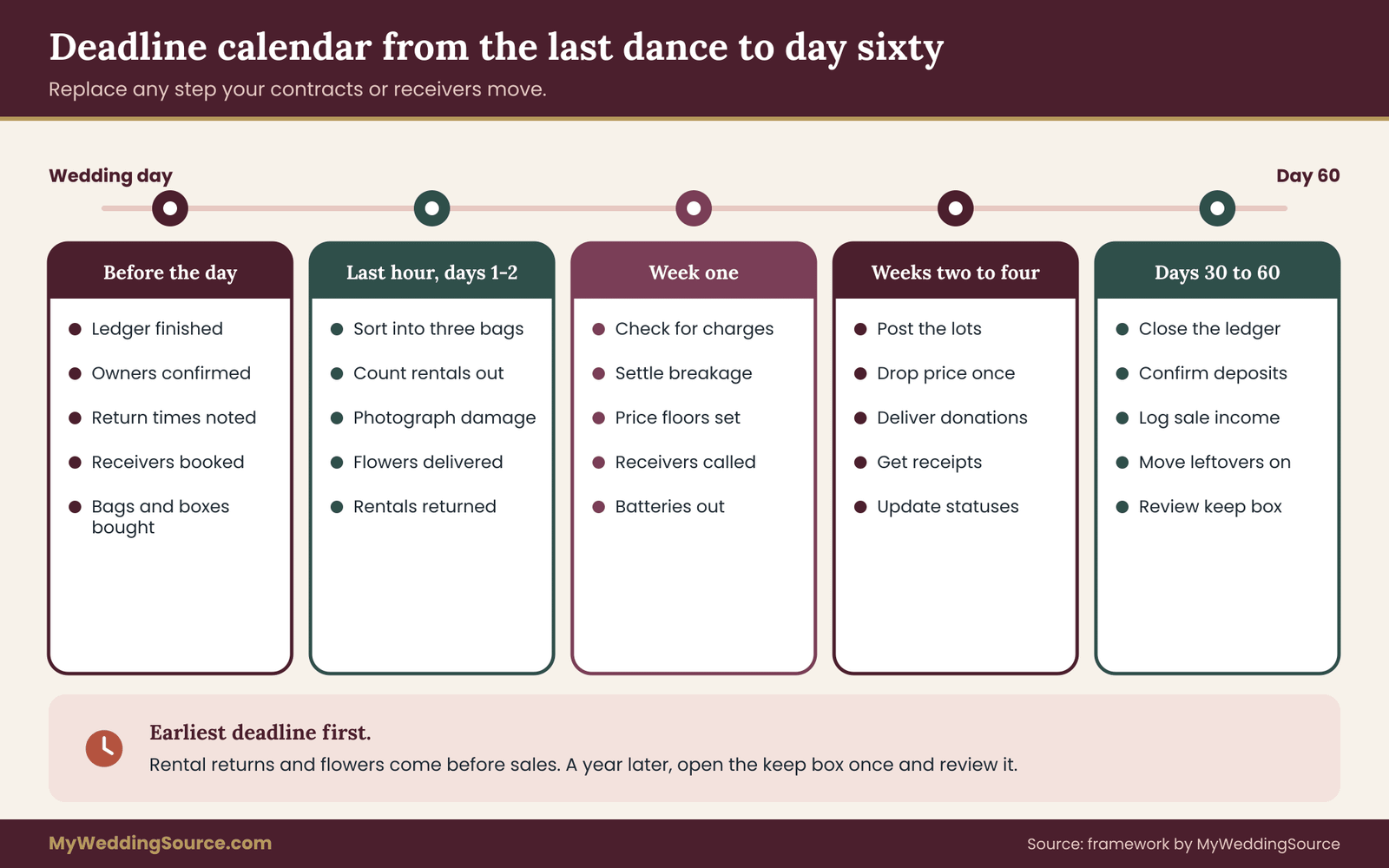
A ledger of wedding decorations without dates is a wish list. The calendar turns each line into something that happens, and it works best when it is built backward from the earliest deadline, which is usually the end of the reception. Most of the difficult choices about wedding decorations are really scheduling choices in disguise.
The calendar below is a template. Your contracts and receivers will move some of the dates, so treat it as a starting point and replace any step that your paperwork overrides. The wedding vendor timeline shows how to fit these steps around vendor load-out times on the day itself.
Before the wedding: set the system up
In the final two weeks, finish the ledger, confirm ownership for every rental and package line, and write the return time beside each rental. Name a person for each destination and give them the ledger. Print a copy for the teardown crew and put one set of the contracts in a folder at the venue. Confirm any receiver that has agreed to take flowers or candles, with a day and a time.
Buy the three bags and a few boxes for your wedding decorations ahead of time, with marker pens and a roll of tape. These cost very little and remove the most common reason for a messy teardown, which is that nobody has anything to put things in.
The last hour of the event
Teardown is not the time for decisions. It is the time for sorting into the three containers and moving rentals to the return stack. Ask one person, not a committee, to run the clipboard. Count rentals against the list as they are packed, and photograph any damage as it is found.
Keep anything fragile or valuable with you or with a trusted person, not in a vendor’s van unless the contract says so. Hand off the keys, the signed forms and the ledger to the person in charge of the next day.
Day one and day two
Take rented wedding decorations back at the earliest time allowed. Deliver flowers to their receiver or to the people who asked for them, and move anything perishable out of vehicles. Put keep-box items in a single room at home, not scattered across several. Upload the ledger changes the same evening, even if only a few lines moved.
If you are away on a honeymoon, the task owners carry this stage without you. The ledger and a short message are enough. Tell each person what they are collecting, where it goes, when, and whom to call if something goes wrong. Give them permission to make small decisions without asking.
Week one
Confirm that all returns are recorded and that no rental charge has appeared. Settle any breakage conversations while the memory is fresh. Photograph and list the items you plan to sell, and set the price floor and the time limit. Contact receivers for donation items and agree on drop-off days. Remove batteries from lights and sort the electronics.
Weeks two to four
This is the sales window. Post the lots, answer messages on a schedule and complete pickups. Drop the price once on lots that have not moved. Deliver donations on the agreed days and collect the acknowledgments. Check the ledger every few days and update statuses, because stale lines are how things get forgotten.
Days thirty to sixty
Close the ledger of wedding decorations. Anything still open is moved to another door or discarded. Confirm that any refundable deposits have come back and match them to the amounts in the contracts. If one is missing, follow up in writing, with the return receipt attached. Reconcile the sale proceeds and enter them in the money records.
The first anniversary
Look inside the box of kept wedding decorations once a year. Decide whether each item still deserves its place, and let go of anything that no longer passes the three tests. It is a small ritual, and it prevents the slow growth of a collection that nobody chose.
The questions you ask at booking time shape how easy this stage is, and the rental planning checklist is worth rereading when you set return times.
Who does the work, and how to ask
A task owner is a named person, a specific time and a clear job. “Can you take the vases back on Sunday” is a good request. “Could someone help with decorations afterward” is a request that yields no help.
Ask people who have offered, and give them the smallest complete task. Provide the list, the address, the time, and the phone number of the person at the other end. Say thank you in writing, and offer to return the favor. Avoid assigning cleanup to anyone who also gave a speech, wore the dress or has traveled a long way.
If a family member insists on being in charge of everything, let them, but keep the ledger as the shared source of truth. It is easier to defer to someone who is following a list than to someone working from memory.
Three short messages worth having ready
Most of the friction around wedding decorations comes from messages that are vague or late. These three, adapted to your situation, cover most of what you will need.
To a rental company, a week before: “We are returning the rental order on Sunday. Could you confirm the pickup or drop-off time, how you would like items packed and cleaned, and who will sign the count?”
To a possible receiver: “We have clean, whole wedding decorations to offer, listed with counts below. Would you like any of them, and when could you receive them?”
To a task owner: “Thank you for helping. Here is the ledger. Your job is lines twelve to nineteen. Everything goes to the address in the notes by Sunday at noon. If anything is damaged or missing, photograph it and text me, and do not worry about small decisions.”
Short messages with a clear request get answered. Long messages with several questions wait.
A worked case: one invented wedding, item by item
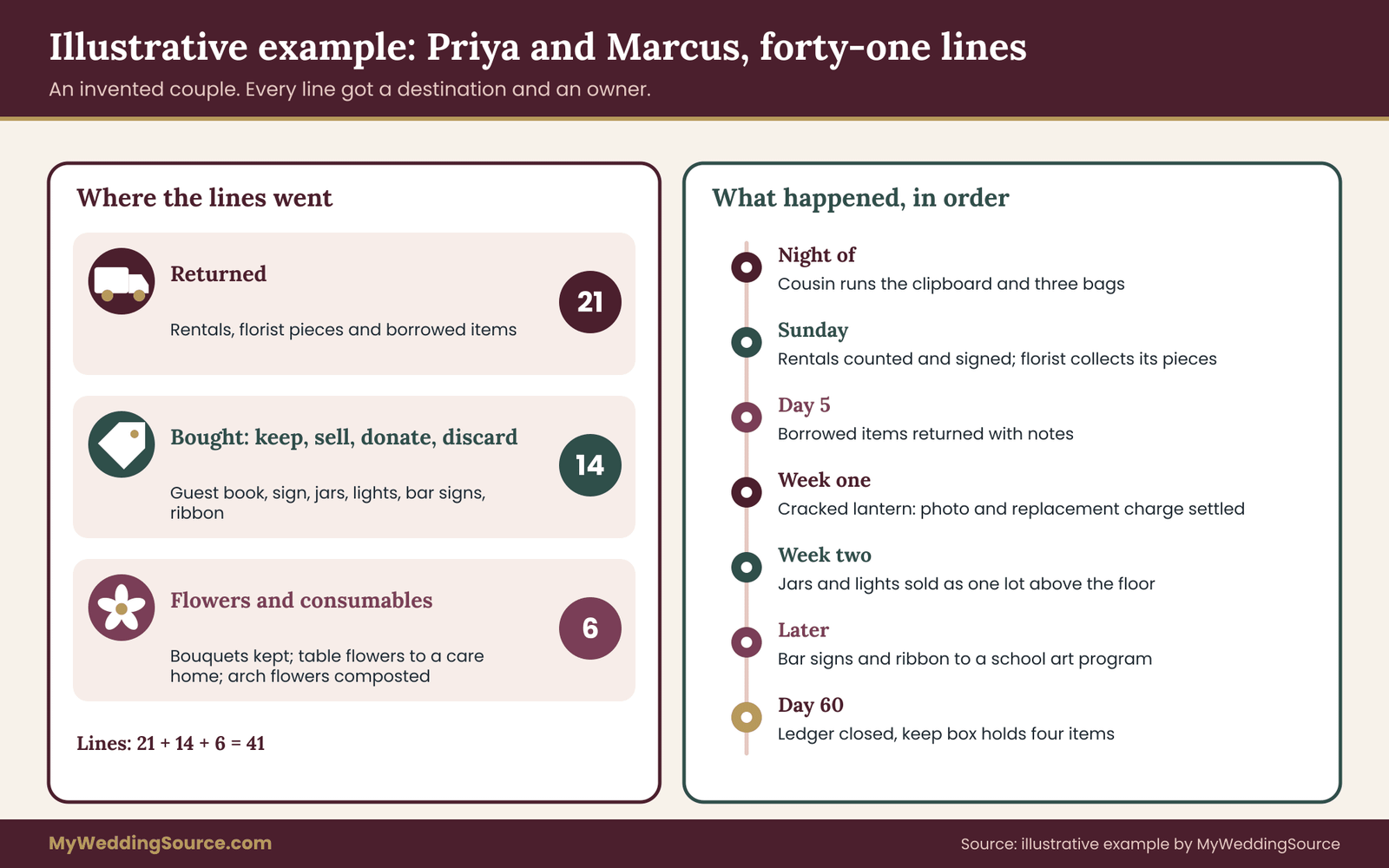
The following example is invented for illustration and does not describe a real couple or real prices. It shows how the ledger and calendar behave when they meet an actual Saturday night. The couple, Priya and Marcus, married at a rented hall with a dinner for a hundred and ten guests, and they planned to fly out the next afternoon.
What they had
Their ledger had forty-one lines. Eleven lines were rentals from a rental company: chairs, linens, candlesticks, lanterns and a ceremony arch. Six were vendor items from the florist: vases, stands and the structure for the flower arch. Four were items borrowed from family, including a lace table runner and a set of wooden crates. Fourteen were items they had bought, such as table numbers, a welcome sign, signs for the bar, glass jars and string lights. Six were consumables and florals.
Priya’s cousin, who had offered to run teardown, was named the ledger keeper and given a printed list.
How the decisions came out
The eleven rentals went back on Sunday morning to the rental company, on the cousin’s schedule, with a count signed on the company’s own slip. One item, a lantern, had a cracked panel, and a photograph was taken at the hall before it was packed. The company’s replacement charge was lower than the couple had feared and was paid within the week.
The florist’s vases and stands were collected by the florist on Sunday afternoon according to the contract. The flowers themselves were divided: the bridal bouquets were kept, the table arrangements went to a nearby care home that had said yes on the phone the week before, and the arch flowers were composted by the cousin at a community garden that accepts plant material.
The family items were washed and returned within five days with notes.
Of the fourteen bought items, they kept four: the guest book, the welcome sign, a framed seating plan and a set of table numbers that Priya liked. They sold the glass jars and the string lights as one lot, set a floor in advance and found a buyer in the second week. They donated the bar signs and the unused ribbon to a school art program after a phone call. They threw away the confetti and a worn banner.
What the example shows
Almost every good outcome for these wedding decorations came from a decision made before the wedding. The ownership check meant the rentals went back without confusion. The phone calls to receivers happened while the couple still had energy for them. The cracked lantern was photographed because the return checks were on the cousin’s list. The sale happened because a price floor was set, and the rest went to receivers who had said yes.
Nothing in the case required money or special equipment. It required a list, a handful of dates and a small number of people who knew exactly what they were doing. That is the whole method, and it holds up whether the wedding has forty lines or four hundred.
When the plan fails: failure conditions and fixes for wedding decorations
Any method for wedding decorations fails in predictable ways. Knowing the failure conditions in advance is more useful than a promise that the method always works. Each one below describes the situation, the early sign, and what to do about it.
Failure one: the ledger is made but nobody owns it
The early sign in a plan for wedding decorations is a ledger with no names in the task owner column, or a single name against forty lines. The cause is usually that the couple wanted to avoid asking for help. The fix is to cut each line down to a task one person can complete in an hour, and to ask for a specific favor. If nobody is available, reduce the ledger. Fewer, bigger decisions are better than many small ones that never happen.
Failure two: ownership was assumed
The early sign is a vendor message a week after the event asking about items you thought were yours. The fix is to read the contract at once, check the invoice, and respond in writing with the facts. If the item really was a rental, return it as soon as possible and ask about any late fee. If the contract allowed you to keep it, send the clause. In both cases, stay calm and specific.
Failure three: the sale takes over the month
The early sign is that you are still answering messages about a single set of vases three weeks after the wedding. The cause is a missing price floor or time limit. The fix is to apply the rule you should have set at the start: one price drop, then a handoff to another door. A sale is worth the effort only while it is cheap in time.
Failure four: the receiver cannot take the wedding decorations
The early sign is a donation center that says “we did not expect this” at the door. The cause is an unannounced drop-off, or a description that did not match the load. The fix is to call ahead, send photographs, and have a second receiver in mind. If the first receiver says no, do not argue. Thank them, and go to the second one.
Failure five: the keep box of wedding decorations grows
The early sign is a second box, then a third. The cause is the absence of a cap. The fix is to apply the place test again, remove duplicates, and photograph the large items before letting them go. A keepsake that has a place is a keepsake. A pile that has a label is a pile.
Failure six: the perishable is left behind
The early sign is flowers still sitting in buckets on the morning after. The cause is that nobody was assigned to them. The fix is to prevent it by naming a person for the florals before the wedding, with a receiver and a time. If it still happens, compost what you can, and do not leave plant material in sealed bags where it will rot.
Failure seven: damage and disputes
The early sign is a charge on a statement that does not match the count. The cause is missing evidence. The fix is to gather the photographs, the signed return slip and the contract clause, and send a short, factual message asking for an itemized explanation. If the issue is not resolved, your card issuer or payment provider has a dispute process with its own deadlines, and the consumer financial protection agency explains how it works. File the thread with your vendor records.
Failure eight: the couple is unreachable
The early sign is a plan that depends on the couple answering questions during a honeymoon. The fix is to give task owners authority. Write a one-line rule that says what they can decide without asking: anything below a stated value can be sold, donated or discarded. Leave contact details for emergencies only.
Failure nine: sentiment overrules the list
The early sign is a pile of items that have been “kept” without a place. The cause is ordinary: the wedding was meaningful. The fix is not to ignore sentiment but to give it a limited space. A single box and a few photographs hold most of what matters, and the items that go elsewhere can be photographed first.
Failure ten: the rules changed
The early sign is that an organization has changed its donation policy or a rental company has changed its terms since you last checked. The fix is to confirm each rule directly with the party that sets it, and not to rely on a website snapshot, an article or a friend’s earlier experience. That includes this one. Rules, fees and acceptance policies change, so confirm what applies to you.
A short decision rule to carry in your head
If an item is not yours, return it. If it is yours and has a place at home, keep it. If it is yours, whole and in demand, sell it in a lot with a time limit. If it is yours, clean and a receiver has said yes, donate it. If it is none of these, recycle or discard it responsibly and close the line. Those five sentences cover nearly every item that will ever be in your pile of wedding decorations.
Your next steps
Pick one evening before the wedding, or the first evening after it, and do three things. First, open your contracts and mark which items are rented, vendor-owned or borrowed, and write the return time beside each. Second, start the ledger with the eight fields and fill in the lines you already know, grouped by item. Third, name one person for teardown, one for returns, and one for flowers, and send them the list.
Then work through the calendar a week at a time. Return the rentals, place the flowers, sell what is worth selling, and donate what a receiver has agreed to take. Close the ledger by the second month. When it is closed, the wedding decorations are no longer a pile in a garage. They are a small box of things you chose to keep and a set of records showing that everything else went somewhere on purpose.
FAQ
What should we do with wedding decorations right after the reception?
Sort them into three containers at teardown: items going home or to a named receiver, recycling, and trash. Take rentals to the return stack and count them against the order list. Move flowers to whoever agreed to take them. Do not make final decisions about keepsakes that night. Record what happened on a ledger, and make the rest of the decisions in the following days.
Can we keep decorations that came with the florist or decorator package?
Only if your contract says so. Many packages include rented or loaned pieces such as stands, arches and vases, with flowers and consumables being the part you keep. Read the sections on returns, ownership and deposits, and ask in writing if it is unclear. A reply that says “keep them” is worth saving with the contract.
Is it worth selling used wedding decorations?
Sometimes. Selling pays when items are in demand, can be sold as a lot and can be handed over close to home. It does not pay when the sale takes more time than the money is worth. Set a price floor and a two-week limit in advance, and move unsold lots to donation or recycling.
Will a charity take our leftover wedding decorations?
It depends on the charity and the items. Thrift stores, school art programs, theaters and reuse centers often take clean, whole items, but they decide. Call first, describe the items honestly and ask when they can receive them. Expect refusals for stained, broken, smelly or bulky items, and do not use donation as a substitute for disposal.
Can we claim a tax deduction for donated wedding decorations?
That depends on your tax situation, the receiver’s status and the value of the items, so ask a qualified tax professional. The Internal Revenue Service publishes guidance on charitable contributions, records and valuing donated property. Ask the receiver for a written acknowledgment with the date and a description, and keep it with your records.
What do we do with leftover flowers?
Decide before the wedding. Options include a friend, a care home or hospital that accepts fresh flowers, a community garden or compost program, or the florist’s own collection service. Call ahead, because many places accept flowers only at set times and in clean containers. Remove wire, foam, plastic and ribbon before composting. Floral foam should go in the trash.
How do we handle string lights, candles and batteries?
Test lights before passing them on and discard any with damaged cords. Take out batteries and recycle them according to local rules. Keep unburned candles for home or give them to a friend, and make sure flames are out before leaving a room. Small electronics can often be recycled through local programs, which you can find through the Environmental Protection Agency.
What if a rented item was damaged or lost?
Photograph the damage, count the set against the order list and tell the company promptly. Ask for the replacement charge in writing and compare it with the contract. If the charge looks wrong, dispute it in writing within days and attach photographs and the signed return slip. If you paid by card, your issuer has its own dispute process and deadlines.
Sources
- Reducing and reusing basics, U.S. Environmental Protection Agency
- Sustainable management of materials, U.S. Environmental Protection Agency
- Composting at home, U.S. Environmental Protection Agency
- Electronics donation and recycling, U.S. Environmental Protection Agency
- Used household batteries, U.S. Environmental Protection Agency
- Publication 526, Charitable contributions, Internal Revenue Service
- Publication 561, Determining the value of donated property, Internal Revenue Service
- Fake check scams, Federal Trade Commission
- Candle safety, National Fire Protection Association
- How do I dispute a charge on my credit card bill?, Consumer Financial Protection Bureau