
Gown preservation vs resale is the choice a couple faces in the weeks after the wedding, when the dress comes home creased, stained at the hem and still full of feeling. This guide gives you a five-gate decision tree for the gown: keep it sealed, sell it, rework it, pass it on, or wear it again, with a worked case and the conditions under which the tree fails.
Do not decide in the first week. Photograph the dress, check it for stains and damage, and book a cleaning consultation within a few weeks, because sugar and body-oil stains darken over time. Then run the five gates: wishes, condition, money, deadline, and reversibility. If nobody will want the gown in twenty years and a buyer would pay a fair price, sell it. If a person already wants it as an heirloom, choose gown preservation by a qualified cleaner or conservator. If neither is clear, clean it, store it simply, and set a review date.
Most advice about a used wedding dress starts with a conclusion. Preserve it, because it is an heirloom. Or sell it, because it is a thousand-dollar garment you will never wear again. Both pieces of advice ignore the reader. A gown that cost a modest amount, with a beaded train that was dragged through a field, is a different object from a vintage silk gown that already carries a family story, even if both are “a wedding dress.”
This article does not tell you which path to choose. It gives you a way to find out, using questions you can answer from your own closet floor. The approach borrows from how museum staff think about objects: record the condition first, ask what the object is for, and prefer steps that can be undone over steps that cannot. Gown preservation is one of five outcomes, and it is only the right one for some dresses.
A note on scope. This is general information, not legal, tax or financial advice, and it is not a conservator’s assessment of your particular gown. Fabric damage, cleaning prices and resale outcomes vary widely, so the article avoids price promises and points you to professionals and agencies for current figures.
Gown preservation vs resale: what you are really deciding
The label “preserve or sell” hides five different outcomes. Naming them separately makes the choice clearer, because each one needs different work in the first month.
Preserve. You keep the gown for the long term, usually cleaned, packed and stored so it stays in decent condition for decades. Gown preservation can mean a commercial box service, a conservator, or a careful do-it-yourself job.
Sell. You find a new wearer. The gown is cleaned or disclosed as is, photographed, priced and shipped or handed over locally.
Rework. You have the dress altered into something else, such as a shorter dress, a christening gown, or a new silhouette. This changes the object permanently.
Pass on. You give the dress to a relative, a friend, a charity, or a program that serves people who cannot afford a gown. The gown leaves your hands but stays in use.
Wear again. You keep it simply, in a garment bag or a breathable box, for an anniversary dinner, a vow renewal, or portraits. There is no sealing and no sale.
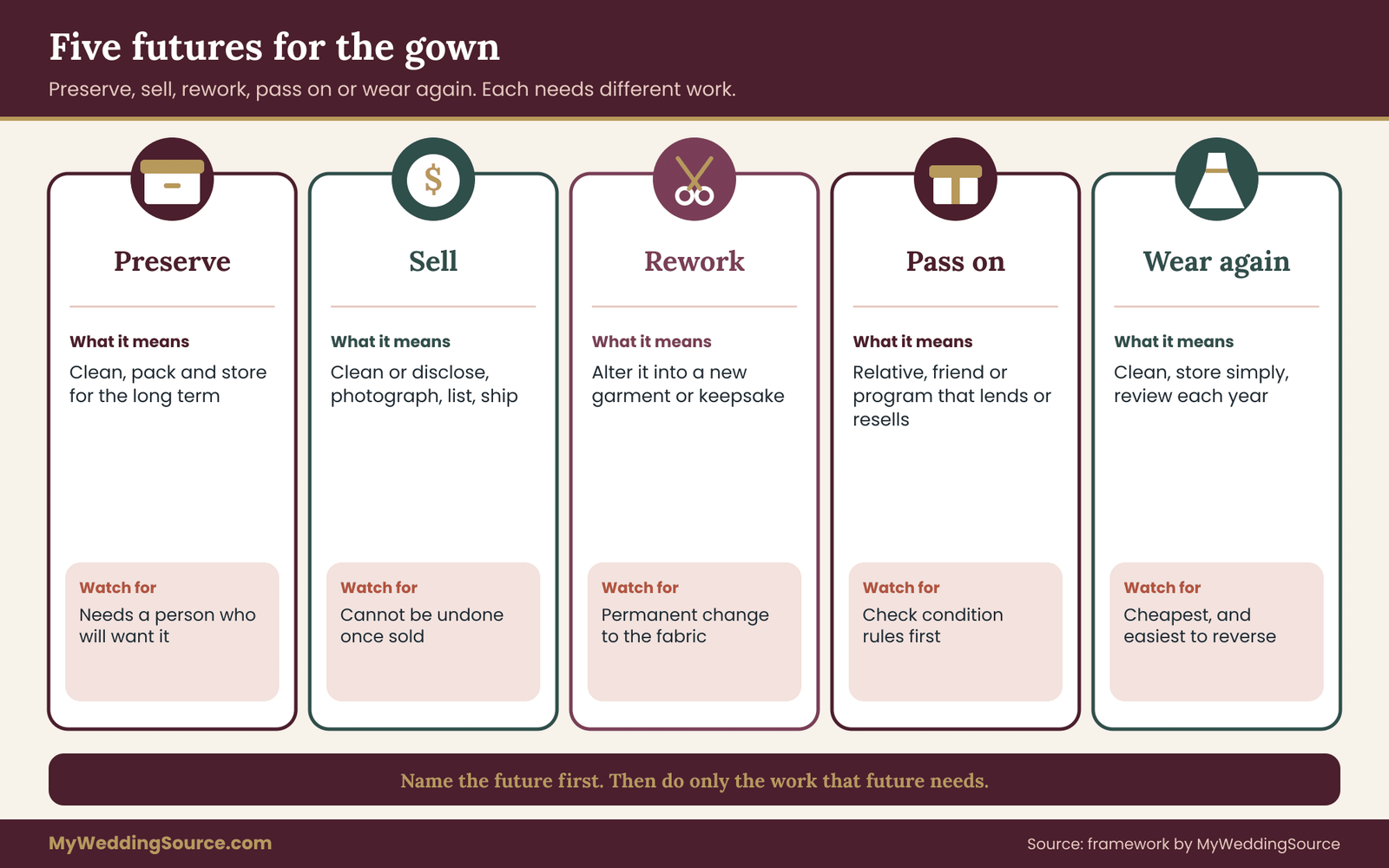
Seen this way, the gown preservation vs resale question is not a fight between love and money. It is a question about which of five futures the dress should have, and what each future costs in cash, time and regret.
Why the decision is harder than it looks
Three pressures push couples to decide badly. The first is timing: sellers are told that a gown loses value the longer it sits, and gown preservation companies often arrive in the inbox with limited-time offers. The second is emotion: a wedding dress is one of the few garments people feel guilty about selling. The third is partial information. Few people know what their gown is made of, what stains are on it, or what a cleaner can and cannot remove.
None of those pressures is a reason to rush. The first thing that actually runs against the clock, whether you choose gown preservation or a sale, is staining, and that deadline is measured in weeks or months, not days. Almost everything else can wait for a clear head.
What this article leaves to other guides
Fitting, taking in and letting out a gown before the wedding is covered in the wedding dress fit and alterations guide. The mechanics of writing a sales listing, photographing a gown and pricing it are a separate subject, and this article touches them only where they change the preservation decision. What belongs here is the choice between paths, the evidence you need to make it, and the failure points.
The five gates of the gown decision tree
The tree has five gates, and it works for gown preservation, sale and every path between. You pass through them in order, and each gate either settles the question or narrows it. Write the answers on one sheet of paper. If you are deciding with a partner, answer separately first and compare afterward.
Gate 1: Wishes. Is there a named person, now, who wants the gown in the future? A daughter, a niece, a sibling, or a partner who says they will want to see it in thirty years counts. A vague feeling that “someone might” does not. If there is a named person, gown preservation moves to the front of the line. If there is none, move on.
Gate 2: Condition. What is the gown’s actual state? Look at the hem, underarms, bodice lining, closures, beading and any stains. If the damage is severe, such as torn lace, broken seams or large set-in stains, sale prices fall and preservation gets harder. Condition does not choose the path, but it limits the paths that are realistic.
Gate 3: Money. What would each realistic path cost, and what would it return? Compare the cleaning quote, the gown preservation quote and the likely net from a sale, after fees, shipping and any cleaning you would do to sell. This is where a short worksheet beats a feeling.
Gate 4: Deadline. Does something force the timing? A seller’s market for a recent style, a stain that needs treatment soon, a storage space you must clear, or a relative who is only in town this summer can each set a date.
Gate 5: Reversibility. Which choice can you undo? Selling cannot be undone. Cutting a dress cannot be undone. Cleaning is mostly one-way. Putting a clean gown in a breathable box for a year undoes easily. When two paths look equal, pick the one you can reverse.
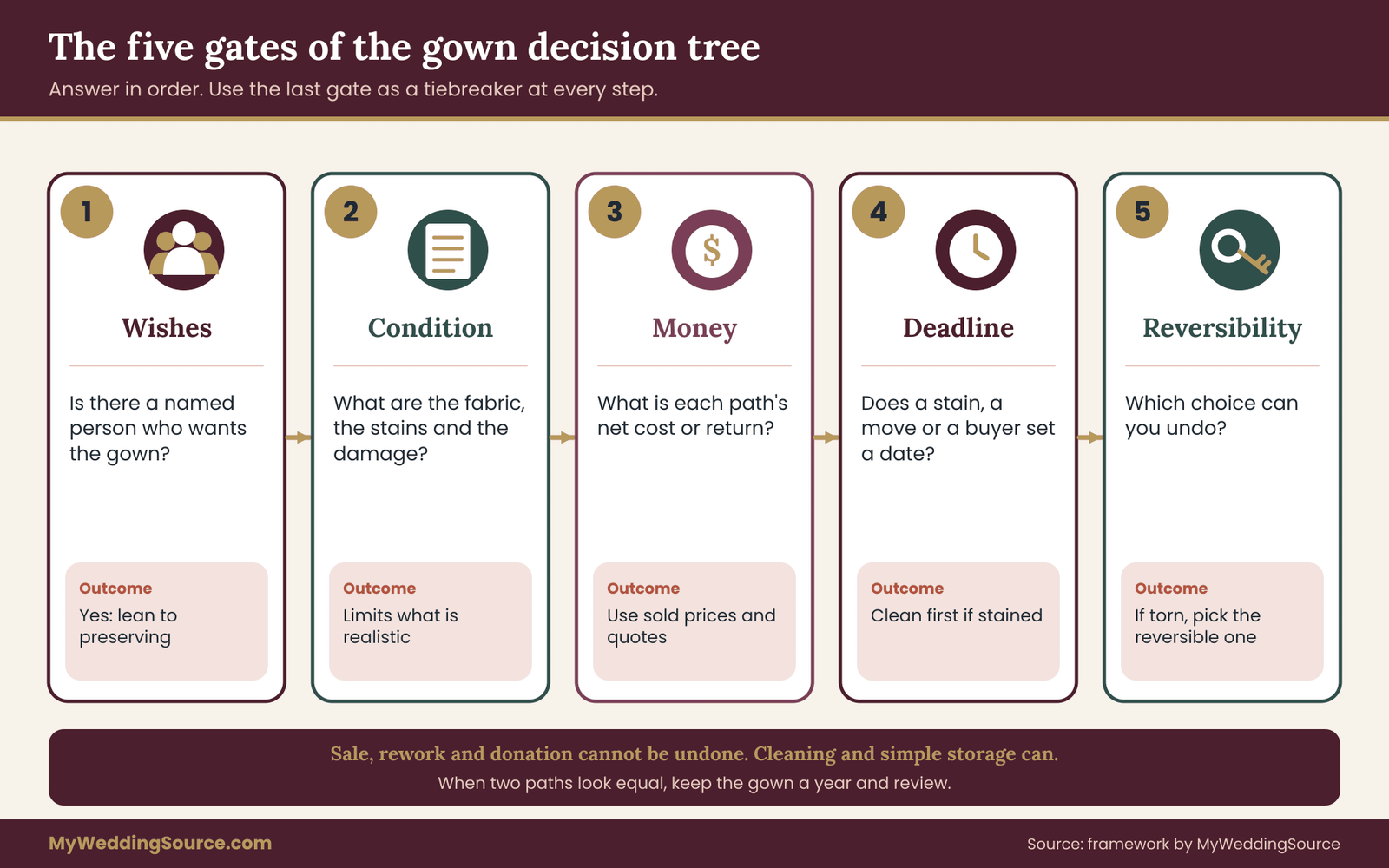
The sections below take each gate in more depth. Before that, a short rule about order. Gate 5 sounds like the last question, but it works as a tiebreaker for all of them. If you are torn at any gate, choose the reversible option and set a review date, rather than forcing a verdict.
How to use the tree with a partner or a parent
Gown decisions often involve three or four opinions. The bride may want to sell, her mother may want the gown kept, and a sibling may want to wear it. The tree lets you separate the question of whose gown it is from the question of what is practical. Run Gate 1 in the open, with names. If the person who wants the gown is willing to pay for part of gown preservation, say so at that point, not after the quote arrives.
When opinions conflict and nobody is wrong, the reversible choice usually wins: clean it, store it simply, and agree to meet again in a year. A calendar entry with a date is more useful than a promise to talk about it later. The wedding decision-making guide offers language for sharing input without losing control, and the same habits apply here.
The first 72 hours: record the gown before anyone touches it
The most useful work in the first three days takes no money. It is a record. Before the dress is cleaned, repaired, sent to a seller or sealed in anything, it should be photographed and described as it came home. That record helps with every later path. A gown preservation company, a conservator, a buyer, an insurer and a family member all ask the same question: what condition was it in?
Start with the garment itself. Hang it on a padded hanger only if the weight is light and the bodice is sturdy, because a heavy beaded gown on a thin hanger stretches the shoulder seams. If the dress is heavy, lay it flat on a clean white sheet over a bed, with the skirt arranged without sharp folds.
Take wide photos of the front, back and sides in daylight. Then take close photos of each area where something looks wrong: the hem, the underarms, the zipper or buttons, the waistline, any beads that have loosened, and any stain. Add a coin or a ruler for scale in close shots. Photos taken in the first days are the best evidence of what happened on the day, if you later need to talk to a cleaner, a seller, or a vendor.
What to write beside the photos
Note the fabric content from the label or the original receipt, the designer and style name, the date of the wedding, and the dates and places you wore it. Add a plain list of what happened: champagne on the skirt at the cocktail hour, a muddy hem during the photos, perfume on the bodice. The more specific the list, the more accurately a cleaner can choose a treatment.
Write down anything that was done to the dress before the wedding, such as hemming, bustling, or added straps. The bustle points matter to a future wearer and are easy to forget. Your alterations tailor may have notes too, and the same fit guide on this site explains what a good alteration record contains.
Keep the dress out of the usual hiding places
Many gowns spend their first month in the worst place in the house. A car trunk, an attic, a basement, a plastic dry-cleaning bag in a warm closet and a corner by a sunny window all expose the fabric to heat, humidity, light or off-gassing. A cool, dim, dry closet in the main living area is ordinary and enough for a few weeks.
Remove the dry cleaner’s plastic bag if the gown came back in one. The National Park Service museum guidance on textiles advises against long storage in plastic bags, and the reasoning is that plastic traps moisture and can give off vapors.
Put a note on the garment bag with the wedding date and the words “not yet cleaned,” so a helpful relative does not hang it in a hot garage. ## Condition triage: what the gown can and cannot become
Gate 2 asks what the dress is made of and what happened to it. Condition does not decide what you want, but it decides what is possible, and it changes both the cost of gown preservation and the price a buyer would offer. Spend an hour on this and you avoid most surprises later, whatever you decide about gown preservation.
Read the fabric before you read the stains
Look at the care label and the original paperwork. The fiber matters for every path. Silk and wool are protein fibers, and they react differently from cotton, linen, polyester and nylon. A gown labeled as polyester satin tolerates more handling and more cleaning methods than a silk dupioni with hand-sewn beading. Many modern gowns mix fibers: a polyester skirt over a silk-blend bodice, lace appliqued on tulle, or a nylon net underlayer.
If the label is missing, say so to the cleaner instead of guessing. A good cleaner will test a hidden seam allowance before choosing a solvent. A cleaner who confidently names a fiber without looking at the label or testing is a reason to ask more questions.
Embellishments need their own look. Glass beads, plastic beads, sequins, pearls, crystals and metallic thread respond differently to heat, solvents and friction. Some plastic sequins can melt or cloud in certain solvents. Hand-attached beads can fall off during cleaning, so ask whether the cleaner counts and secures loose ones first.
The stains that run on a clock
Stains come in two kinds from a gown preservation point of view. Some sit on the surface and come out. Others age in the fabric and turn dark yellow or brown even when they were invisible on the wedding day.
Sugar stains are the usual culprit. Champagne, wine, cake, punch and many mixed drinks leave sugar that looks like nothing when dry, then oxidizes and darkens over weeks or months. Body oil and deodorant at the underarms and bodice behave similarly. Grease, makeup and foundation at the neckline can also set. Grass and dirt on the hem are usually visible and often removable, but a damp hem left in a closed bag can grow mildew.
Do not try to blot or scrub these at home with household cleaners. Home treatment can set a stain, leave a ring, or strip a dye. If the stain is fresh, dab gently with a clean white cloth and plain water only if the label allows it, and otherwise leave it for a professional.

A simple triage in three bins
After you photograph the gown, sort what you see into three bins. This is not a diagnosis, and a conservator or a skilled cleaner will see more than you do. It is a way to tell the professional what you want to know.
Bin one: wear and soil. Gray hem, light dirt, a few small marks, wrinkles, faint perfume. These are normal. A standard professional cleaning is likely to address them, and both selling and gown preservation remain open.
Bin two: stains and stress. Visible sugar or oil stains, a pulled thread, loose beads, a stretched strap, a seam under strain, mildew spots. Treatment is possible but less certain, and the cleaner may offer a range of results instead of a promise. These problems often influence the money gate more than the wishes gate.
Bin three: structural damage. A torn skirt, a ripped lace panel, dry-rotted fabric, a broken zipper, large dye transfer, or heavy smoke or water exposure. Some of this can be repaired, but the cost may be higher than the dress’s value, and a rework or a keepsake display might be more honest than a sealed box or a sale.
What condition does to each path
For gown preservation, condition sets the quality of the starting point. A professional gown preservation service cleans before sealing, and the sealing process does not repair damage. Boxing a gown with an uncleaned sugar stain is a known way to turn a small problem into a yellow patch decades later. If the stain cannot be removed, the question becomes whether you want a gown that has a visible mark for the long term.
For sale, condition sets the price band and the honesty burden. A buyer who sees a stained hem in a clear photo can make an informed offer. A buyer who is surprised after delivery will ask for a refund. A used-dress listing needs a plain description of every flaw, and the photo record from the first 72 hours becomes the base for that description.
For rework, condition determines which parts can be reused. A damaged skirt may leave a clean bodice, a good length of lace, or enough fabric for a smaller garment.
For passing on, condition matters to the recipient. Many charities and programs have standards for cleanliness and completeness and will tell you what they accept. Ask before you drop off a bag.
When to bring in an expert before deciding
A textile conservator is a trained specialist who works on fragile fabrics and historic garments. Most wedding gowns do not need one. A conservator becomes relevant when the dress is antique, handmade, unusually fragile, or carries a documented family history. The American Institute for Conservation maintains a public directory to find qualified conservators, and the Smithsonian publishes guidance on caring for textiles for institutions and individuals.
If your gown falls into that category, delay everything else until you have asked for an assessment. Cleaning an old silk gown with the wrong method can cause damage that nobody can reverse. For further reading on inspecting older garments, see the separate guide on this site about vintage gowns, which covers what to check in fabric and seams.
A short condition sheet to keep
Write the following on one page and keep it with the dress: fabric and fiber content, embellishments and how attached, known stains with their cause and date, repairs and alterations done, and any smells. Add the cleaner’s notes after cleaning. This one-page file makes every later conversation shorter, whether you are speaking with a gown preservation company, a buyer, or a granddaughter.
It also protects you. If a vendor damages the gown during cleaning, a record from before cleaning is the best way to show what changed. The wedding vendor contract guide explains why you want liability and handling terms in writing before any service starts, and the same logic applies to a cleaner or a gown preservation company.
The money gate: gown preservation vs resale in net terms
Gate 3 asks what each path costs and returns. People compare the wrong numbers here. They compare the original price of the dress with a resale offer, or the headline price of a gown preservation kit with a nothing-at-all alternative. The right comparison is net cash and time for each path, after every cost on the way.
The two-line worksheet
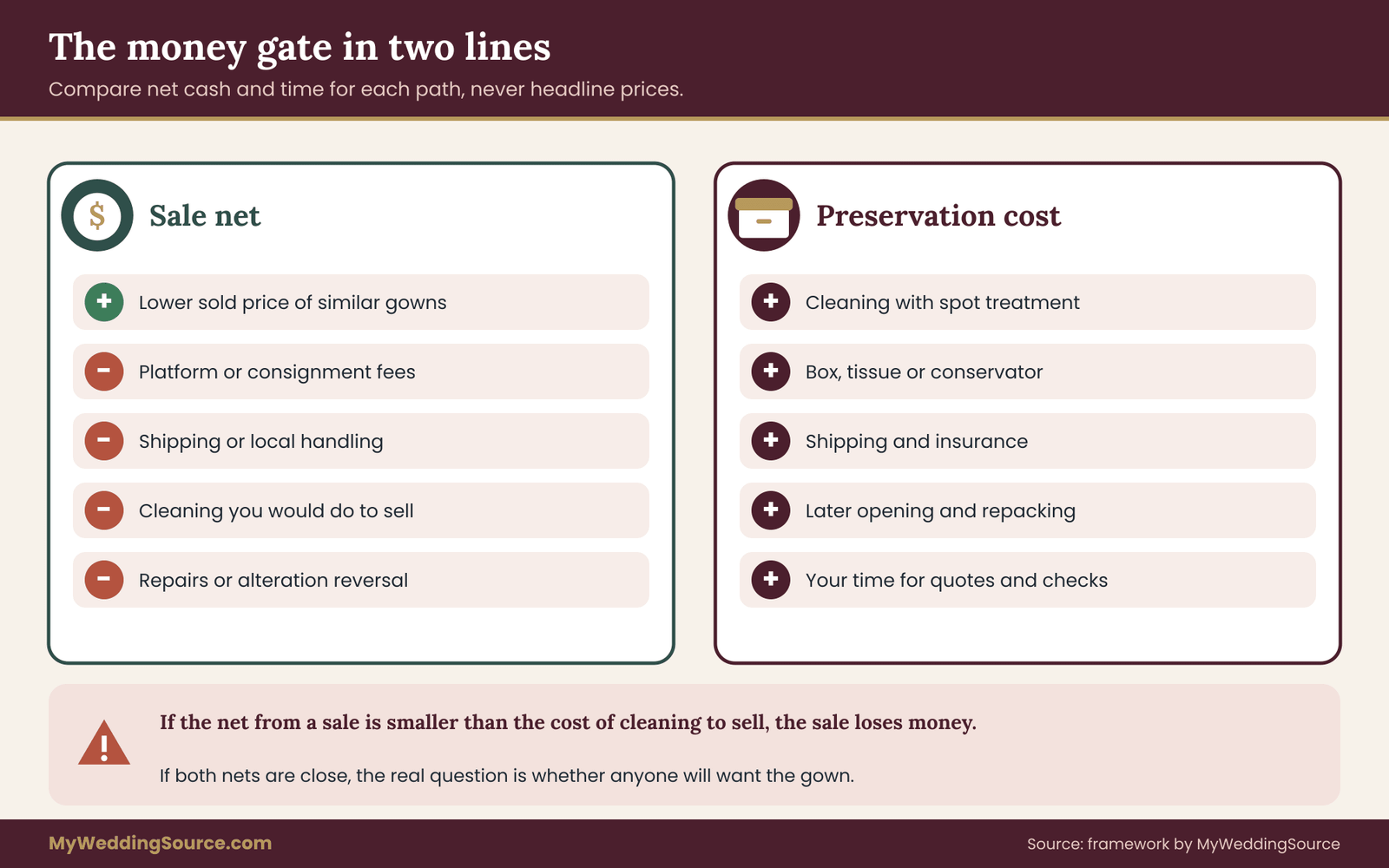
For the sale path, write: expected sale price, minus platform or consignment fees, minus shipping or local handling, minus cleaning you would do to sell, minus any alteration reversal or repair. The result is the net. Do not use the highest asking price you saw. Use the lower end of what similar gowns actually sold for, and if you cannot find sold prices, treat the figure as unknown and say so.
For the gown preservation path, write: cleaning cost, plus the gown preservation service or box cost, plus shipping or insurance, plus any later cost to open, inspect and repack. Many couples forget that a sealed box is not a one-time purchase if you plan to check the gown every few years.
The difference between the sale net and the cost of gown preservation is not the whole story. It is the starting number for the question: what is a clean, stored gown worth to us, and what is it worth to a buyer?
Cost logic without invented prices
This article does not list prices, because they differ by region, by fabric and by year, and a number quoted in November 2026 could mislead you in spring. Instead, use ratios. If the net from a sale is less than the cost of cleaning for sale, the sale path loses money before it starts, and an honest as-is listing, a donation or a keepsake may fit better. If a gown preservation quote is close to the likely net from a sale, the real question is not money but whether anyone will want the gown.
If your gown cost very little and the gown preservation quote is larger than what you paid, the decision turns on sentiment and on the second gate: condition. A clean, simple storage at home may give most of the benefit for a fraction of the cost.
For help with how a wedding-day expense fits the rest of your finances, the wedding budget guide explains how to track what you spent and what was refundable, and the same worksheet habit applies to this after-wedding cost.
Tax and insurance questions
Some paths touch tax rules. Donations to a qualifying charity may be deductible in some cases, and the Internal Revenue Service explains what substantiation is required for donated clothing and household items in its publication on charitable contributions. Whether any deduction helps you depends on your return, so ask a tax professional. Selling a personal item at a loss is generally not treated like a gain, but the rules differ and you should confirm them for your situation.
If the gown is covered under a wedding insurance policy, or a homeowners or renters policy, check what is covered after the day, whether the cleaning or storage period is included, and whether a stored gown has a stated value. Insurance wording varies, and you should read the policy or ask the insurer, not assume.
The hidden cost of waiting on gown preservation or sale
Time has a cost on both paths. Waiting too long to clean a stained gown can make the stain harder to treat. Waiting too long to sell a trend-driven gown can narrow the buyer pool, although a timeless silhouette may hold interest for years.
Do not accept the claim that a gown loses all value after a fixed number of months. That is a sales line, not a rule. The better question is whether the style you wore depends on a current trend, and a buyer search will tell you more than a headline. ## When gown preservation makes sense
Gown preservation is the right path when a specific person will value the dress and the gown is in a condition that can be cleaned and stored well. It is the wrong path when it is bought out of guilt, when the quote exceeds what the family can comfortably spend, or when nobody has asked to inherit the dress. This section helps you tell which case you are in, and what gown preservation actually buys.
Three honest reasons to choose gown preservation
The first is a named heir or a family tradition. A gown that three generations of women have worn, or that a sibling plans to alter for a future wedding, is an object with a future. In that case the question is not whether to preserve it but how to do it well.
The second is rarity. A gown made by hand, made from antique lace, or made by a designer whose work is hard to find has a value that a sale may not capture. The buyer pool for such a gown is small, and a sealed sale to a stranger can cost more in lost meaning than it returns in cash.
The third is the wish to wear it again, within a few years, for an anniversary, a renewal or a portrait session. This calls for careful cleaning and breathable storage, but it may not need a long-term sealed box. Reach for the simplest option that protects the fabric until the date you named.
Two weak reasons to be careful about
One weak reason is fear of regret. People say, “If I sell it, I will wish I had kept it.” That may be true, and the reversibility gate answers it: keep the gown stored simply for a year, then decide. The other is a limited-time offer. A gown preservation service that pressures you to order within days, or that warns the gown will be ruined if you wait a week, is applying a sales tactic. The Federal Trade Commission publishes guidance for consumers on high-pressure sales and on checking a company before you pay.
What gown preservation usually involves, step by step
Services differ, but a typical job has four steps. The gown is inspected and the cleaner notes stains and damage. It is cleaned, often with spot treatment for known stains. It is dried, checked, and packed with acid-free tissue, either in a box or a bag. And it is returned to you, often with a certificate or a promise about the packaging.
Ask what each step means in practice. “Cleaned” could mean a standard dry-cleaning cycle or a hand cleaning with spot treatment. “Acid-free” tissue should be described, because the right tissue depends on the fiber. Conservation guidance, including National Park Service material on storing textiles, notes that buffered tissue is often recommended for cellulose fibers such as cotton and linen, and unbuffered tissue for protein fibers such as silk and wool. If the company does not know which it uses, that is a signal.
The sealed box and the questions it raises
Many gown preservation kits promise an airtight seal and a window so you can view the dress. Some conservators prefer breathable storage, because a sealed box can trap moisture or residual vapors, and an undetected stain can develop inside it. Others accept a well-made box when the gown is clean and dry at packing. Neither view is a scandal. The honest approach is to ask the provider why they choose their box, and what happens if you open it.
Ask about warranty terms in plain language. What does the company promise, for how long, and what do you have to do to keep the promise? Some warranties are void if you open the box, which defeats the purpose of checking the gown every few years. If the warranty depends on a condition you cannot meet, you are not buying protection.
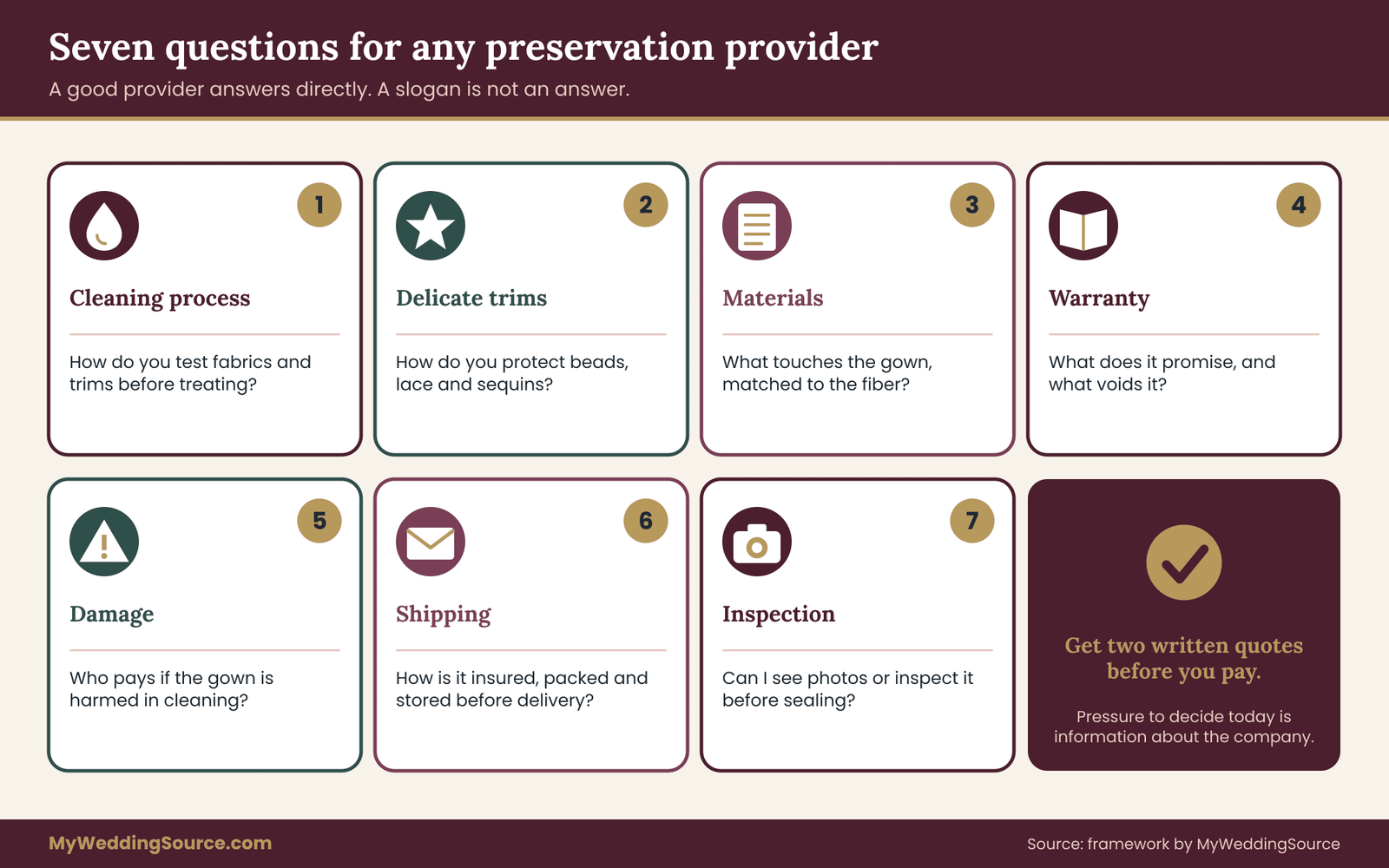
Questions to ask any gown preservation provider
- What is your cleaning process, and do you test fabrics and trims before treating?
- How do you handle beading, lace and sequins that may be damaged by solvents?
- What materials touch the gown, and how are they matched to the fiber?
- What does the warranty promise, and what voids it?
- What happens if my gown is damaged during cleaning, and who pays?
- How is the box shipped, insured and stored before it reaches me?
- Can I inspect the gown and see photos before it is sealed?
A gown preservation provider who answers these questions directly, without flattery or evasion, is probably worth a conversation. One who answers with a slogan is not.
Cleaning decisions: what to do before any path
Cleaning is the one step that gown preservation, sale and rework share, and it is the step with the most risk. Preservation needs a clean gown. A sale usually benefits from one. A rework may start with one. Only a pass-on to a close friend or a simple display may skip it.
Dry cleaning, wet cleaning and hand cleaning
Most wedding gown cleaning is done in one of three ways. Dry cleaning uses a solvent instead of water and is common for structured gowns with boning, heavy lace or fabrics that bleed. Wet cleaning uses water and detergent, sometimes by hand, and can be appropriate for fabrics that tolerate it. Hand cleaning with spot treatment handles specific stains before or instead of a full cycle.
The right method depends on the fiber, the trims and the stains, and not on a general rule. A silk gown with hand-sewn beading, a polyester satin gown with plastic sequins and a cotton lace dress each want a different approach. A cleaner who takes time to look at the gown, ask what happened to it and explain the plan is doing the job properly.
Solvents are an environmental and health question too. The Environmental Protection Agency regulates certain dry-cleaning solvents and publishes information about alternatives. If this matters to you, ask what the cleaner uses and how they handle waste.
Timing: when to clean
For most gowns, cleaning within a few weeks of the wedding is a reasonable target, particularly when there are sugar or oil stains. That is a practical window, not a hard deadline. If you must wait longer, store the dress in the cool, dark, dry place described earlier and tell the cleaner about the delay and the stain history.
Do not clean at home unless the label and a professional confirm it is safe. A bathtub wash of a gown with boning, lining and beads is a common way to ruin a sound dress.
Cleaning for sale vs cleaning for gown preservation
The two goals differ. Cleaning for gown preservation aims to remove everything that could harm the fabric later, including invisible sugars. Cleaning for sale aims to make the gown look good and smell fresh at a cost that does not eat the sale price. A buyer may accept a faint shadow on a hem if the price reflects it and the listing says so. A long-term box cannot afford that shadow, because the shadow may spread.
For this reason, do not decide the path after you have cleaned the dress for one purpose. Decide the path, or at least the rough path, and then clean for it. If you are still undecided, ask the cleaner for the gown preservation standard of service, because it leaves every option open, then compare the additional cost to the sale benefit.
Reading a cleaning quote
A quote should state the service, the stains it will treat, the trims it will protect, the turnaround time and what happens if a stain does not come out. Ask whether a stain that remains after treatment will be noted in writing. Ask whether the price changes if the cleaner finds more work than expected. Ask who is liable if a bead falls off or a dye shifts, and compare the answer with the terms in the written agreement.
Get at least two quotes if the gown is valuable or fragile, and compare the services, not just the prices. A cheaper quote that skips spot treatment is not a bargain if it leaves the stain. Keep the paperwork in your records folder with the contract and receipt, as the guide to organizing wedding records explains.
What to do when the cleaner says a stain will not come out
This happens. Ask for a plain description of what remains, what it is likely to do over time, and whether another method might help. If the stain is on a hem or an underarm, it may be acceptable for a gown you plan to sell with disclosure or to wear once more. If it sits on the bodice front and you intend gown preservation, you may prefer to save the dress as a record with its mark, or to ask a conservator about options.
Whatever you choose, record the result. A written note about the remaining stain protects both your later self and any future owner. ## Storage that protects the gown: boxes, bags and the room itself
Whatever path you choose, including gown preservation, the gown spends time in storage, sometimes a few months while you decide and sometimes decades. Storage is where gown preservation succeeds or quietly fails. A professional box in a hot attic does worse than a plain breathable bag in a stable closet.
For gown preservation, the environment matters more than the container
Textile conservators generally agree on the same basics. Fabric prefers a stable, cool, moderately dry, dark place. Big swings in temperature and humidity are harder on fabric than a steady, ordinary room. Light fades dyes and weakens fibers. Pests such as moths and silverfish feed on soiled natural fibers, and soiled garments attract them more than clean ones.
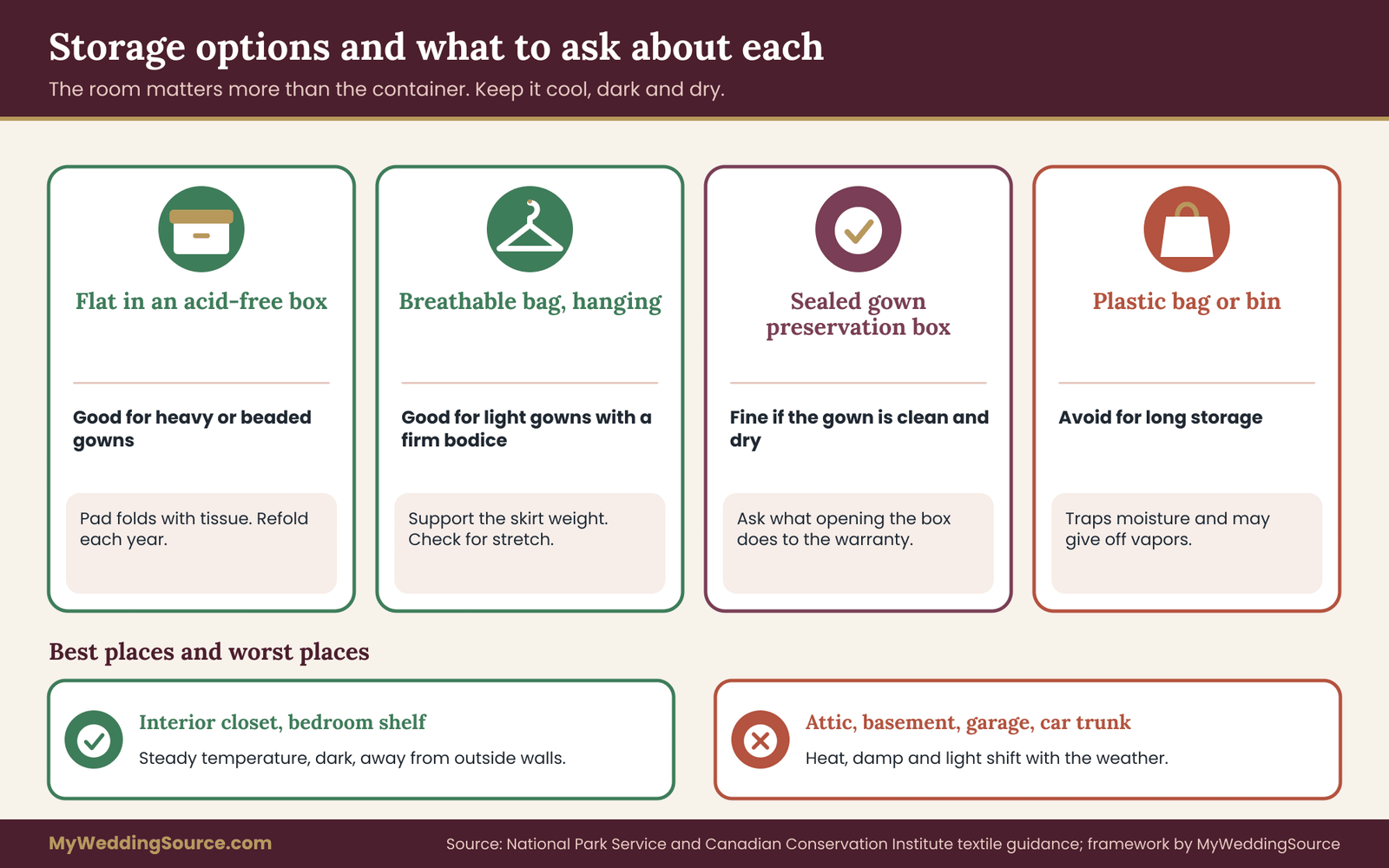
So the best storage spaces are inside the living area of the home: a closet on an interior wall, the space under a bed in a regularly heated room, or a shelf in a bedroom. The worst are attics, garages, basements, outbuildings and storage units without climate control. If you live in a hot, humid or flood-prone area, put that in front of the container question. A flood-prone basement defeats any box.
The National Park Service Conserve O Gram series on storing and handling textiles, and the Canadian Conservation Institute’s notes on caring for textiles, repeat these points, and both are free to read.
Boxes, bags and hanging
Each way of holding a gown has trade-offs. Think of them as choices you can match to the gown, not as right and wrong.
Flat in a box. For heavy, beaded or delicate gowns, lying flat is gentler than hanging because it avoids stress on shoulder seams. A large, clean, acid-free box with tissue folded into the creases reduces sharp folds. The weight of layers can still crush trims, so stuffing and tissue placement matter.
Hanging in a breathable bag. For light gowns with a sturdy bodice, a padded hanger and a cotton or muslin bag works well and lets you check the dress easily. Heavy skirts should be supported so the weight does not pull on the bodice. Long storage on a hanger can stretch fabric.
Sealed gown preservation box. This is the commercial option many people think of first. It is a reasonable choice when the gown has been cleaned thoroughly and is dry, and when you accept that opening the box may change its warranty. Ask the questions given in the previous section before buying.
Plastic. Avoid ordinary plastic bags, plastic bins and PVC-based covers for long storage. Some plastics trap moisture and some release chemicals that can discolor fabric. A short trip home from the cleaner in plastic is fine, but take it off when you arrive.
Tissue, wrapping and padding
If you pack the gown yourself, use clean, white, acid-free tissue and unbleached muslin, and match the tissue to the fiber as described earlier. Fold as little as possible. Where folds are unavoidable, pad each fold with a roll of tissue so there is no sharp crease. Stuff the bodice and sleeves lightly with tissue to hold their shape. Do not use colored tissue, newspaper, or ordinary cardboard that touches the fabric, because dyes and acids can transfer.
Wear clean, dry hands, and remove rings and watches that could snag lace or beading. If you wear cotton gloves, make sure they do not catch on beads.
Scheduling a check-in for gown preservation
Gown preservation does not end when the lid closes. Open the box or bag at a regular interval, such as once a year on the anniversary, to look for yellowing, odors, moisture or pests. Refold along different lines so the same creases do not wear through. Note the date and what you saw in your condition sheet. If the warranty forbids opening the box, you cannot check, and that is a cost to weigh.
If you find a problem, take photos before you change anything and contact the cleaner or conservator. Early warning is the main benefit of a check-in, and it takes about twenty minutes.
Moving, travel and shared homes
Couples move often in their first years of marriage. A stored gown should be among the items you carry yourself or ship with insurance, not packed in the moving truck’s unconditioned space, where heat can build. Label the box so movers know which way is up and that it is fragile.
If you store the gown at a parent’s home, discuss it first. Ask where it will go, who will have access, and what happens if the parent downsizes. A gown in a stranger’s closet after a house sale is not preserved, only misplaced. Put the location in your records, and tell a second person.
Storage for a gown you plan to sell
If you plan to sell within a few months, you do not need a sealed box. A breathable garment bag in a cool closet and a ready set of photos is enough. The bigger risk is leaving the gown uncleaned and stained for the sale period, or letting it become a shelf item for a year. Decide whether you will sell, set a date, and clean when you list, not months before.
Storage for the undecided
Most readers fall here. The simple holding pattern is: clean to a gown preservation standard if the budget allows, then store it in a breathable bag or box in a stable closet, and schedule a review twelve months out. This keeps every path open, and it prevents rushed choices in either direction.
A gown that has been cleaned and stored well can still be sold, preserved, reworked or passed on a year later. A gown that has been sealed in an airtight box can usually still be sold too, though the seal may need to be broken and the price of a new seal paid again.
The resale path: what changes the outcome
Selling is the path that returns cash and puts the dress back in use. A separate guide on this site covers listing, photography and pricing step by step. Here the focus is on how the resale decision interacts with the rest of the tree, and which facts move the outcome.
What drives what a buyer will pay
Nobody can promise a resale price, and anyone who does is guessing. The drivers are well known, though. Brand and style recognition matter, and so does how recent the design is. Condition and completeness, including the original tags, a matching veil or slip, and any extra pieces, matter too. Size and the amount of alteration limit the buyer pool. Seasonal timing affects demand, and so does the sales channel and its fees.
A heavily altered gown, such as a gown taken in for a petite frame, is harder to sell because few buyers share the measurements. The alteration may be reversible if the seams were left generous, and your tailor can tell you. If you intend to sell, ask the tailor early. The wedding dress alterations guide explains what leaves room for later changes.
Channels in plain terms
A consignment shop takes a share of the sale and handles the work, often with a slow timeline and tight standards. An online resale marketplace gives you control and a wide audience, and costs you time, fees and the job of dealing with buyers. A local sale, through a community group or a bridal shop’s buy-back program if one exists, reduces shipping risk and lets the buyer see the gown. Each channel has a different trade-off between time, money and risk, and none is always best.
Protecting yourself as a seller
Describe every flaw you know about. Keep your photos. Decide your return policy before listing, and state it. Avoid payment methods that you cannot verify, and be cautious with any buyer who asks to pay by sending a check for more than the price or to move the conversation off the platform. The Federal Trade Commission publishes consumer warnings about overpayment and fake-check scams, and these target online sellers regularly.
Ship insured, with tracking, and in a box that keeps the gown clean and dry. The United States Postal Service explains insurance, tracking and packaging options on its website, and the terms change, so read the current version before you ship.
When resale loses to gown preservation or the other paths
Resale loses when net proceeds are close to zero after costs, when the gown is in poor condition, when it is too altered to fit most buyers, or when the process would cost more time and stress than it is worth. It also loses when a family member wants the gown. If you can answer Gate 1 with a name, do not list the dress until that person has said yes or no.
A short note on the second-hand market and the planet
Choosing sale or donation over disposal keeps a garment in use. A used gown has a lower footprint than a new one, and the wedding waste reduction guide looks at how couples can account for that kind of reuse in a realistic audit. Do not overstate the effect; a gown is one garment among the wedding’s many materials. But it is one of the easier items to keep out of a landfill. ## Alterations, rework and the other three paths
Gown preservation and sale get most of the attention, but the other paths often fit better, especially for couples who do not want to spend much and do not want the gown to sit in a box. This section covers alterations as they affect each path, and then the rework, pass-on and wear-again options.
Alterations on the way in and out
Alterations done before the wedding shape every later choice. A hem shortened for walking, a bustle added, a bodice taken in and straps added change the gown’s fit for the next person. Whether these can be undone depends on how much seam allowance remains and whether fabric was cut.
Ask your tailor, now, three questions. What was changed? Can it be reversed, and at what cost? Was any fabric trimmed that cannot be put back? Write down the answers. They matter to a buyer, to an heir who is a different size, and to a conservator.
Alterations after the wedding fall into two groups. Some prepare the gown for a path, such as restoring the original hem for a sale or letting out a bodice. Others change the gown permanently, such as shortening it or removing the train. If you are not sure you want the permanent kind, do the reversible kind only, or none, and leave the gown intact for the time being.
For gown preservation, the safe rule is to preserve the dress as it is, with the alterations you made, and keep a note of what they were. Reversing alterations and then sealing the gown can add cost and risk without a clear benefit. For sale, the opposite is often true: if reversing a simple hem or removing a bustle loop widens the buyer pool, it may pay for itself.
Rework: turning the gown into something else
Rework is for people who want the fabric and the story to continue in a different shape. A gown might become a shorter dress for a vow renewal, a christening gown, a pillow or a framed piece, a ring-bearer’s cushion, or a bridesmaid’s accessory. Rework is permanent, and that is its main risk.
Use a careful process. Choose a seamstress or designer who has done this before, ask to see similar work, and agree on the outcome in writing. The separate guide on this site about reworking a wedding gown covers what such an agreement should include. Decide early whether you want to keep any original pieces uncut. Some couples keep a swatch or the bodice, a small act of gown preservation, and rework only the skirt.
If the gown has a strong family history, talk to the people whose story it is. A gown that three people have worn is not only yours to cut.
Pass on: family, friends and programs
Passing on keeps the gown in use and can be done in ways that cost you nothing. A relative or friend who is planning a wedding may want to wear it, borrow it, or alter it. A gown lent in a family may need written terms: who pays for cleaning, what happens if it is damaged, and who gets it afterward. It sounds formal, but a one-paragraph note removes the awkward moment later.
Charities and programs that accept wedding gowns have their own rules about condition, size and style. Some resell gowns to raise funds; others lend them to people with limited means, or repurpose them into items for babies. Contact the program first, ask what they need, and learn what they do with gowns they cannot use. Ask for a donation receipt if you may want to claim a deduction, and read the IRS guidance on charitable contributions to learn what records are required.
Wear again
A gown that you will wear again within a few years, for an anniversary, vow renewal or portraits, calls for gentle care and not sealed storage. Have it cleaned, store it in a breathable bag, and try it on once a year to see whether it still fits and whether you still like it. If the answer is no for two reviews in a row, treat that as new information for the tree.
This path costs the least and keeps the most options open. It is also the one most often skipped, because it feels less formal than a gown preservation box. It deserves a place in the comparison.
Renting out or lending commercially
Some couples consider renting their gown to others, through a local shop or an online service. This is a business arrangement with its own risks: wear, cleaning between rentals, damage disputes, and contract terms. Read the agreement closely, ask who is liable for damage, and check what the platform’s rules say about cleaning and insurance. For most couples, a single sale or a loan to a friend is simpler.
A gown that does not fit any path
Occasionally the gown is simply a dead end: heavily damaged, soiled beyond repair, or of a fabric that has deteriorated. In that case, consider whether parts can be saved, such as lace, buttons, a sash, or beads. A small keepsake from a damaged gown can hold the memory better than a sealed box of ruined fabric. Textile recycling programs may take what cannot be reused, though availability varies.
Choosing the path: how gown preservation compares with the others
The five paths are different tools, and it helps to compare them on the same few questions. This comparison is in prose, so you can see the reasoning and not just the verdicts.
Cost, effort and what you keep with gown preservation
Gown preservation costs the most in the short term and keeps the physical gown intact. It asks for effort at the start, which is the quote and the packing, and a small yearly effort if you check the dress. Resale returns cash and asks the most effort in the middle, with photographs, listings and buyers, and leaves you with nothing physical. Rework costs money and creativity, and leaves a transformed object. Passing on costs little and leaves you with the satisfaction of knowing where the gown went. Wearing again costs little and leaves you with the gown.
Reversibility, again
Rank the five paths by how easily you can change your mind. Wear again and simple storage are the most reversible. Gown preservation is partly reversible, since you can open the box and sell the clean gown later, though the seal and the warranty may be lost. Resale, pass-on and rework are not reversible. The reversibility ranking is a quiet reason to hold the gown for a year when you are unsure, and to pick the irreversible paths last.
Matching gown preservation and the other paths to the person
A few patterns repeat. Couples with a daughter, niece or sibling who has asked for the gown tend to fit gown preservation. Couples with limited space and a gown in good, current style tend to fit resale. Couples who feel attached to the fabric but not to the shape tend to fit rework. Couples whose gown is a plain, modest garment tend to fit pass-on or wearing it again. These patterns are not rules. They are starting guesses that Gates 1 through 4 should confirm or overturn.
When the answer is a split
You do not have to choose one outcome for the whole gown. A couple might sell the dress and keep the veil, preserve the bodice’s lace as a framed piece, or donate the skirt fabric. A split is often the most honest solution when feelings and finances point different ways, and the tree allows it. Ask whether the keepsake piece can be removed without lowering the sale price much, and have the work done by someone who has done it before.
Accessories are part of this. Veils, slips, headpieces and shoes have their own resale and keepsake value, and the wedding day accessories guide covers how to keep them organized. Keep them with the dress record, so the gown and its parts do not get separated. ## A worked case: one gown run through the five gates
The following example is invented to show how the tree works. The people are fictional, the numbers are round figures chosen to make the arithmetic easy to follow, and they are not market prices or a prediction of what any gown would cost or sell for. Use your own quotes.
The situation
Marisol married in October. Her gown is a polyester-blend satin A-line with machine lace on the bodice and a short train. It was purchased new. She wore it for about nine hours. At the cocktail hour someone spilled a sugary drink on the skirt, and the hem went through damp grass during photos. Back home, the gown hung in the dry cleaner’s plastic bag in a bedroom closet for two weeks.
Her wishes are mixed. She likes the idea of keeping it for a future daughter but has no children yet. Her sister, Ines, is engaged and has said, half joking, that she would not wear Marisol’s dress. Her husband, Dev, says he does not mind either way. They are saving for a down payment and do not want to spend much.
Gate 1: Wishes
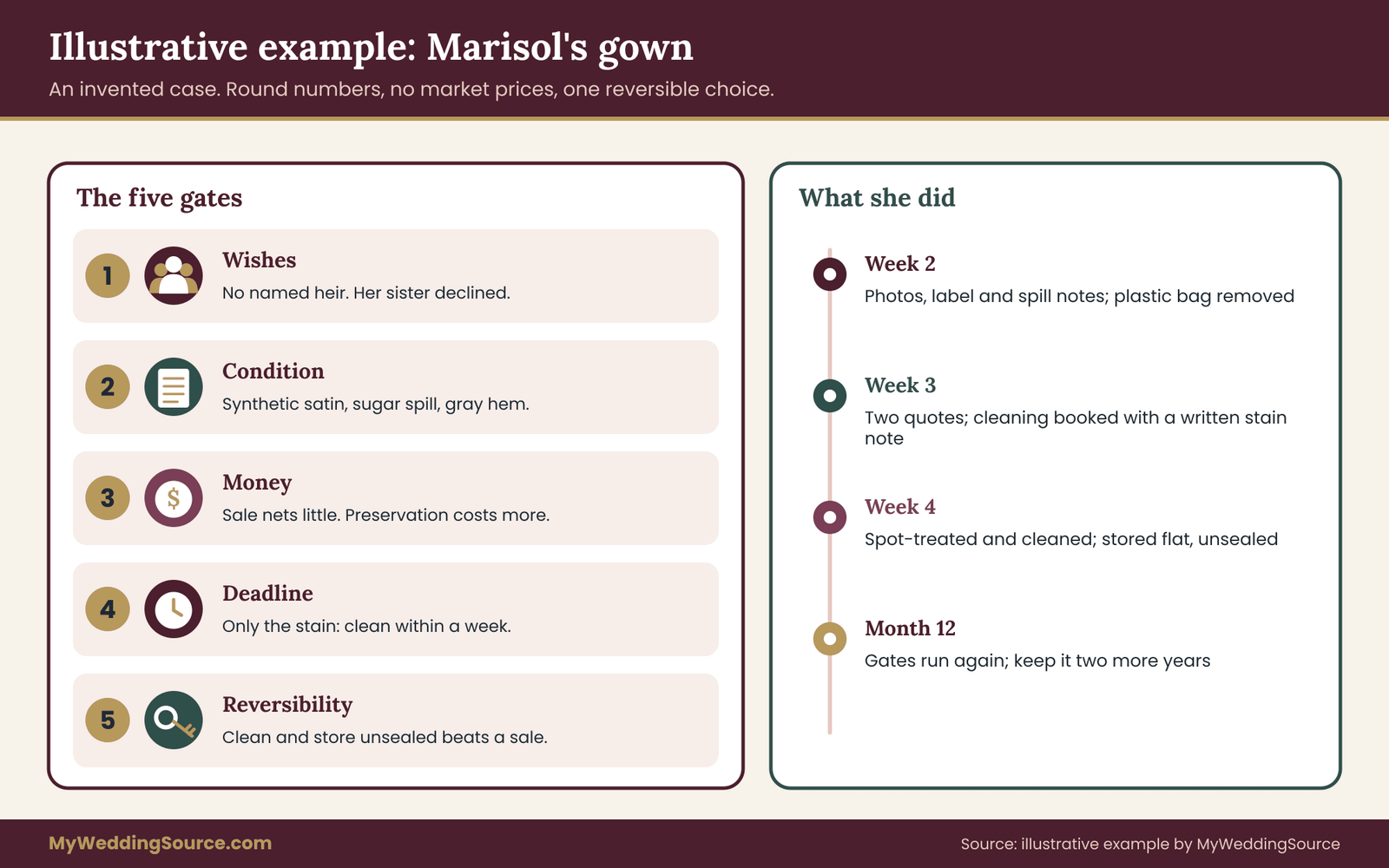
Marisol writes the answer plainly: no named person wants the gown. Ines has said no, and a hypothetical daughter is not a name. That does not mean gown preservation is out, but it does remove the strongest reason for it. The gown does not move to the front of the line.
Gate 2: Condition
She photographs the gown in daylight, front, back and sides, and adds close photos of the hem, the spill area and the underarms. She notes the label, which gives the fiber content, and the date of the spill. The spill area shows a faint shadow, and the hem is gray. The lace is intact. The beading is minimal.
Triage puts the gown in bin one with a touch of bin two: normal wear plus a sugar stain with a clock on it. The fiber is synthetic, which tolerates more cleaning methods than silk. She decides to ask a cleaner about the stain without delay.
Gate 3: Money
Marisol gets two cleaning quotes and one gown preservation quote. She writes each in her notes. Using round numbers for this example, say standard cleaning with spot treatment is quoted at A, a preservation-grade service with box is quoted at A plus B, and the lowest sold price she can find for similar gowns in similar condition is C.
Her sale net is C minus platform fees, minus shipping, minus A, since she would clean before selling. She finds that in her example, this leaves a modest sum. Her gown preservation cost is A plus B plus a little for insurance. The gap between the two is large relative to what the couple wants to spend now.
She does not conclude that sale wins. She concludes that sale pays a small return and gown preservation costs a real amount, and that neither is urgent except the cleaning.
Gate 4: Deadline
The one clock is the stain. The cleaner says sugar stains can darken, and the gown is already two weeks out. Marisol books cleaning for the following week. No other deadline exists: the style is classic, the buyer market for A-line gowns is steady in her searches, and nobody is waiting for the dress.
She also learns that the cleaner can describe what remains after treatment in writing. She asks for that.
Gate 5: Reversibility
Marisol compares the options by how easily she can change her mind. Sealing the gown in a box is hard to reverse cheaply. Selling now cannot be undone. Cleaning and storing it in a breathable bag costs little and keeps every path open.
The result of the gown preservation vs resale check
Marisol chooses the reversible path. She has the gown cleaned with spot treatment, asks for a written note on the stain, and stores it flat in an acid-free box without a seal in a bedroom closet. She sets a calendar review for the first anniversary and writes the answer to each gate on one sheet that goes in her records folder.
On the anniversary, she runs the gates again. Ines’s wedding has passed, Marisol is expecting a child, and the stain note shows no change. She decides to keep the gown another two years, until the child is old enough to ask.
If she had been told to preserve it in the first month, she would have paid for a sealed box on the strength of a feeling. If she had been told to sell, she would have sold a dress she later wanted. The tree cost her an evening of paperwork and a reviewable decision about gown preservation.
What the example shows
The case shows three things. The tree does not always produce a final answer, and that is acceptable, because the reversible choice is itself an answer. The deadline gate, which was the stain, was narrow and specific, and not a general fear of losing value. And the money gate gave a comparison, not a verdict. A different Marisol, with a named heir and a silk gown, would have run the same gates and chosen gown preservation in week three.
Talking it through: scripts for hard conversations
Gown decisions touch relatives, and a few of the conversations are awkward. Having words ready helps. These are suggestions in plain language, not requirements. Change them to match your voice.
To a relative who wants the gown
“We have not decided what to do with the dress yet. We will clean it and store it carefully for a year, and then we will decide. If you would like to be considered, please tell us what you have in mind and whether you would help with costs.” This keeps the relationship warm, asks about money early, and avoids a promise you cannot keep.
To a relative who assumes you will preserve it
“I know it matters to you. Preserving it professionally costs real money, and I want to be sure someone will want it. Can we talk about who that might be?” It names the cost without scolding and brings Gate 1 into the open.
To a cleaner or gown preservation company
“Before I decide, I would like a written quote that lists the process, the materials, what happens to stains that do not come out, and what the warranty requires. I am also getting a second quote.” A professional should be comfortable with this. If the response is pressure to decide today, treat it as information about the company.
To a buyer
“The dress has a light shadow on the skirt where a drink was spilled. Cleaning reduced it but did not remove it. Here are close-up photos in daylight.” Disclosing a flaw in plain words, with photos, reduces disputes more than any return policy.
To a charity or program
“I have a wedding gown in good condition, cleaned this month. Can you tell me what sizes and styles you need and what condition you accept? Do you provide a donation receipt?” Asking first saves you a trip and a possible rejection.
To yourself
“If I do not decide in a year, the default is to keep it in simple storage and review again.” Defaults help. Without one, undecided gowns drift into attics and years pass.
Sharing costs between people
If a parent or a sibling wants gown preservation and you do not, offer an arrangement. They pay for the gown preservation quote and take the gown, or you hold it and they cover half. Write it down, even if it is one line in a message. Money and family are an easy combination to misremember, and the wedding cash-flow guide explains why a written schedule helps both sides.
Handling guilt
Many people feel guilty about selling or donating a wedding dress. It may help to remember what the dress is: a garment that did its job. The marriage is not stored in the fabric. Photographs, vows and a few small keepsakes carry the memory, and a gown in use by another person is not a loss. If the guilt does not ease, the reversibility gate has an answer: keep it a year. ## Where the tree fails: edge cases and failure conditions
A decision tree is a tool, and every tool has conditions under which it gives a poor answer. Knowing them is part of using it honestly. Here are the situations in which this tree should be set aside or adjusted, and what to do instead.
When the information is wrong
The tree depends on honest answers. If Gate 1 is answered with a hope and not a name, it points to gown preservation for the wrong reason. If Gate 2 skips the close photos, the condition may be worse than you think. If Gate 3 uses an asking price instead of a sold price, the money looks better than it is. Whenever you notice that an answer is a guess, write “guess” next to it, and treat the result as provisional.
When the gown is antique, handmade or historic
For a gown that is decades old, hand-sewn, or part of a documented family history, the tree is too coarse. Cleaning an old silk gown can do irreversible harm. Go to a textile conservator first, as the earlier section describes, and let that person’s assessment replace Gates 2 and 3. The American Institute for Conservation’s directory and the Smithsonian’s textile care pages are starting points.
When there is smoke, flood or mildew
A gown exposed to smoke, floodwater or active mildew is not a normal case. Mold can spread to other items, and the odor and residue may need specialist treatment. Isolate the gown, avoid handling it more than necessary, and consult a cleaner who has experience with this kind of damage. In some cases, an insurer may be involved. Gown preservation boxes do not fix this, and sale may not be honest without full disclosure.
When the budget limits gown preservation
Sometimes the tree’s answer is not affordable. A family wants gown preservation, but the quote is out of reach. In that case, look for a lower-cost version of the same protection: careful cleaning, breathable storage and a yearly check can do most of the work. Do not borrow for a box. A clean gown in a good closet is better than an expensive box in a hot garage.
When time is short
Deadlines sometimes squeeze the process, such as a move, a house sale or a relative who is leaving the country. If you must act fast, protect what cannot be recovered. Photograph the gown, record the condition, clean if there are sugar stains, and store the dress in the simplest safe way. Postpone the irreversible choices until the pressure passes. A hurried sale or a hurried rework is a common source of regret.
When two people disagree and neither will move
If a partner or a parent wants one path and you want another, the tree will not settle it, because it is about the gown, not the relationship. Use the reversibility gate to buy time, or use a split: one piece kept, the rest sold. If the disagreement carries older conflict, a third party such as a trusted relative may help. The decision-making guide linked earlier describes ways to share input without leaving one person with all the cost.
When the gown is not the only dress
Some couples have a second outfit, a reception dress, or multiple items from a multi-day wedding. Treat each as a separate run through the gates, since the answers may differ. A reception dress is often easier to wear again, and a plain slip dress may suit a pass-on better than the main gown.
When a vendor is involved in the problem
If the gown was damaged by a bridal shop, a tailor or a cleaner, the question is no longer only about disposition. Keep every document, photograph and message, and read the contract. The wedding vendor due diligence checklist explains what to check before and after hiring someone who handles your property. Contact the business in writing, describe the problem, state what you want, and keep copies. A consumer protection agency can explain your options if the business does not respond.
Signs the whole approach needs a rethink
If you have been through the gates twice and still cannot decide, if every path feels wrong, or if the gown has become a source of conflict or distress, step back. The garment is not the issue. Put it in simple storage, write a date to revisit, and come back to it when the wedding is further behind you. Time is on your side once the stain question is handled.
Your next steps
This week, photograph the gown front, back and sides, and take close-ups of any stain or damage. Write down the fiber, the label details and what happened to the dress on the day. Take it out of any plastic bag and hang or lay it in a cool, dark, dry place.
This month, book a cleaning consultation and ask for a written quote and a written note on any stain that remains. Answer the five gates on one page, with a name at Gate 1. If you are unsure, choose the reversible path, store the gown simply, and put a review date on your calendar for the first anniversary.
Then keep the paperwork together with your other post-wedding papers, and let the decision settle. Gown preservation, sale, rework, pass-on and wearing it again are all legitimate outcomes. What matters is that the one you choose is based on your own facts, not on pressure or guilt.
FAQ
Is gown preservation worth it?
It depends on whether a specific person will want the gown and whether it can be cleaned and stored well. If a daughter, sibling or friend has asked for it, gown preservation can be sensible. If nobody has, simple clean storage for a year keeps your options open at a lower cost. Compare quotes and ask what the warranty requires before you pay for gown preservation.
Should I clean my wedding dress before selling it or choosing gown preservation?
Often yes, if there are stains or odors that a buyer would object to and the cleaning cost is small compared with the price difference. If cleaning would cost more than it adds, disclose the flaws plainly and list the gown as is. Photograph the dress before cleaning so your description matches what it looked like when it came home.
How soon should I clean the gown before gown preservation or a sale?
A few weeks is a practical target, especially if there are drink, cake or body-oil stains, because sugar can darken over time. It is not a hard deadline. If you have to wait, store the gown in a cool, dark, dry place, take it out of plastic, and tell the cleaner how long it has been and what spilled.
Does a sealed gown preservation box protect a dress better than a breathable bag?
Not always. A sealed box can work when the gown is thoroughly clean and dry, but some conservators prefer breathable storage because trapped moisture or hidden stains can cause trouble. Ask the provider why they use their method and what happens to the warranty if you open the box. The room matters more than the container.
Can I sell a gown that has been altered?
Yes, but altered gowns fit fewer buyers. Ask your tailor whether the changes can be reversed and what they would cost. Describe every alteration in the listing, including hem length, bustle and any taken-in seams. Some buyers like a ready-to-wear fit, and others will need to pay for more work, so price accordingly.
What if I cannot afford professional gown preservation?
You can still protect the dress. Have it cleaned by a reputable cleaner, store it in a breathable bag or an acid-free box in a stable closet, and check it once a year. Avoid attics, basements and plastic. This approach costs far less and keeps every option open, including a later professional service if your budget changes.
Are there tax rules for selling or donating a wedding dress?
Possibly. Donations to a qualifying charity may be deductible in some cases, and the IRS explains the records needed in its charitable contribution guidance. Selling used personal items usually brings no taxable gain, but rules vary with your situation. Ask a tax professional about your own return, and keep receipts and sale records in your files.
What if my family disagrees about what to do with the gown?
Separate whose gown it is from what is practical, and ask each person to name what they want and what they would pay. If nobody moves, choose the reversible path: clean it, store it simply, and set a review date a year out. A split, such as selling the dress and keeping the veil, can also help.
Sources
- Smithsonian Institution
- American Institute for Conservation, Find a Conservator
- National Park Service, Museum Management Program
- Canadian Conservation Institute, Government of Canada
- Library of Congress, Preservation
- Federal Trade Commission, Consumer Advice
- Internal Revenue Service, Publication 526, Charitable Contributions
- U.S. Environmental Protection Agency, Dry Cleaning
- United States Postal Service, Insurance and Tracking