
Wedding guest care is the quiet work of making sure the youngest and oldest people at your wedding can eat, rest, move and stay safe without anyone having to ask twice. This guide shows you how to build a wedding guest care plan for babies, children and older relatives: a triage chart, outreach wording that does not assume anything, vendor tasks, day-of roles and a worked example.
Sort every guest who may need support into four care levels, from self-managed to dedicated caregiver. Ask each household a short, open question instead of guessing what they need. Give one person the job of care lead for the day, brief your venue, caterer and transport provider on the specific needs, and write down who handles naps, meals, rest breaks, medication timing and early departures. Put the wedding guest care plan on one page and share it with the people who will carry it out.
Most couples think about their youngest and oldest guests at the last minute, usually in the form of a worried text from a parent: “Is there somewhere the baby can sleep?” or “Grandpa can’t stand for long, will there be chairs?” Each question is reasonable. Each one also arrives when the venue is booked, the floor plan is drawn and the timeline is printed. A wedding guest care plan moves those questions to the front, when answering them is cheap.
This article is long on purpose. Care needs differ a lot between a six-week-old, a seven-year-old and a ninety-year-old, and a short list would flatten those differences. You do not have to use every section. If you are short on time, read the first three sections, run the worksheet near the end, and come back to the age-specific parts when you know who is actually coming.
A note on scope. Nothing here is medical, legal or childcare-licensing advice. Where the guide touches safety, it points to public health and safety agencies and tells you what to ask a qualified provider. Rules about childcare, accessibility and licensing differ by state and venue, so verify the local ones before you rely on any of this.
What wedding guest care covers (and what it does not)
Wedding guest care is everything you do for guests who cannot fully look after themselves for a long, tiring, food-and-music-heavy day. That group is wider than most couples expect. It includes babies and toddlers who need sleep and feeding on a schedule, school-age children who need things to do and an adult watching, teenagers who are too old for a kids’ table and too young for the bar, and older relatives whose energy, mobility, hearing or memory shape how they experience the day.
It also includes the people who look after them: a parent with an infant, an adult son who drives his mother, a professional caregiver who comes along. Their needs are part of the plan, because a guest who cannot step away from a child or a parent is not really attending.
It helps to separate wedding guest care from two things it is often confused with.
Accessibility planning is about the physical and communication barriers in a venue: steps, door widths, restrooms, captions, interpreters. It matters a great deal, and it is the venue side of the picture. Wedding guest care sits on top of that. It asks what a person needs once they are inside: a place to sit down, a quiet room, food at a regular time, someone who knows they are there.
Hospitality is the general sense of being welcomed, fed and kept comfortable. Every guest benefits from it. Wedding guest care is the more targeted version, aimed at people for whom a missed nap, a long wait for food or a loud room can turn into a real problem rather than a small annoyance.
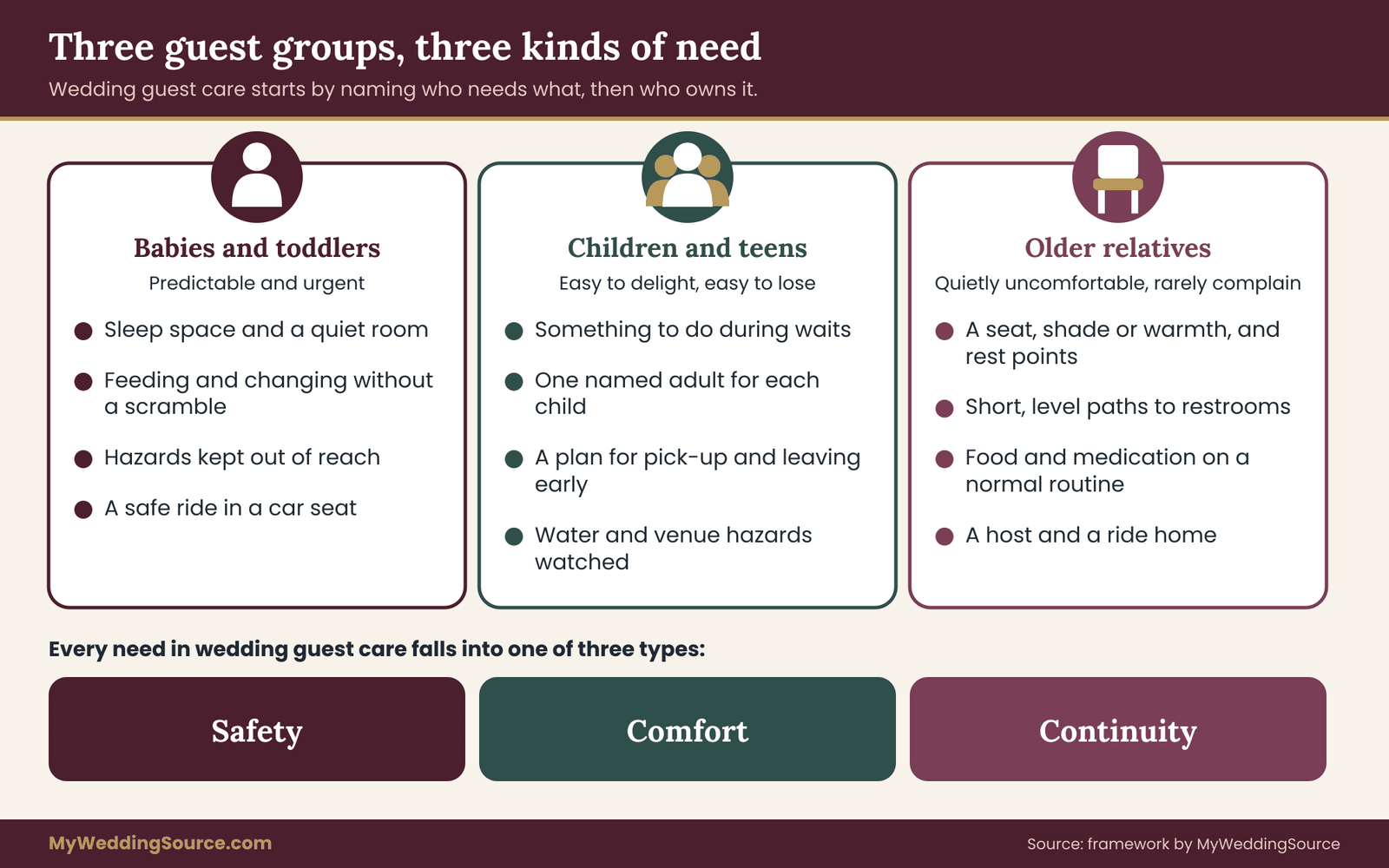
Three kinds of need in wedding guest care
Nearly every care need falls into one of three groups, and naming them keeps the plan balanced.
Safety. Things that can cause harm if no one is watching: a toddler near water or a decorative candle, a small child eating hard or round food, an older guest on an uneven path, a person with dementia who wanders, an allergen on a buffet.
Comfort. Things that decide whether the day is bearable: somewhere to sit, shade, a quiet space, a toilet that is close and accessible, volume that does not hurt, food that suits the person.
Continuity. Routines that keep a person well: a baby’s sleep and feeds, a child’s snack and bedtime, an older guest’s meal and medication times, rest breaks, a ride home at the right hour.
When couples plan only for safety, guests are protected and miserable. When they plan only for comfort, they miss the hazards. Continuity is the one that gets forgotten, and it is the one that decides whether a family stays for the first dance or leaves after the toasts.
Who wedding guest care is for
Plan for people, not categories. A five-year-old who is calm in crowds and sleeps anywhere needs far less than a five-year-old who is sensitive to noise and has a food allergy. An eighty-eight-year-old who walks a mile a day needs less support than a sixty-eight-year-old recovering from surgery. Age is a rough signal and nothing more, which is why the triage in this guide is built on what each person needs, not on how old they are.
Why wedding guest care goes wrong
A wedding guest care plan rarely fails because a couple did not care. They fail for a handful of ordinary reasons, and knowing them helps you design around them.
Everyone assumes someone else has it. The bride’s mother assumes the venue has a quiet room. The venue assumes the family will bring what they need. The planner assumes the parents will supervise. When nothing is written down, three people each believe the question is closed and nobody has actually answered it.
The needs are invisible until the day. A guest does not mention that her husband tires quickly, because she does not want to make a fuss. A parent does not say the baby will not sleep without a particular routine, because it seems like a small thing to raise with a couple busy planning a wedding. The information exists, but nobody asked in a way that made it easy to share.
The schedule ignores the people it affects. A ceremony that starts at four, followed by two hours of photos, cocktails and a seated dinner at eight, is a long run for a toddler and a long sit for an eighty-year-old. The schedule was built around the couple’s photos and the caterer’s kitchen, not around nap windows or energy.
The plan lives in one head. A couple knows who needs what, but they will be unavailable for most of the day. If the knowledge is not shared with someone who can act on it, the plan disappears at the moment the couple walks down the aisle.
Care is treated as a favor, not a task. “Could you keep an eye on Grandma?” is a request that gets forgotten at the second drink. “You are Grandma’s host from the ceremony until dinner is served” is a task with a start and an end.
The rest of this guide is built to fix those five problems: ask early, write it down, build the schedule around real needs, share the plan and give each job a name.
Build a care-needs triage for your wedding guest care plan
The triage is a simple chart that sorts guests by how much support they are likely to need. You fill it in after your first round of outreach, and it tells you how big your wedding guest care operation needs to be. It also stops you from over-planning for guests who will manage fine on their own.
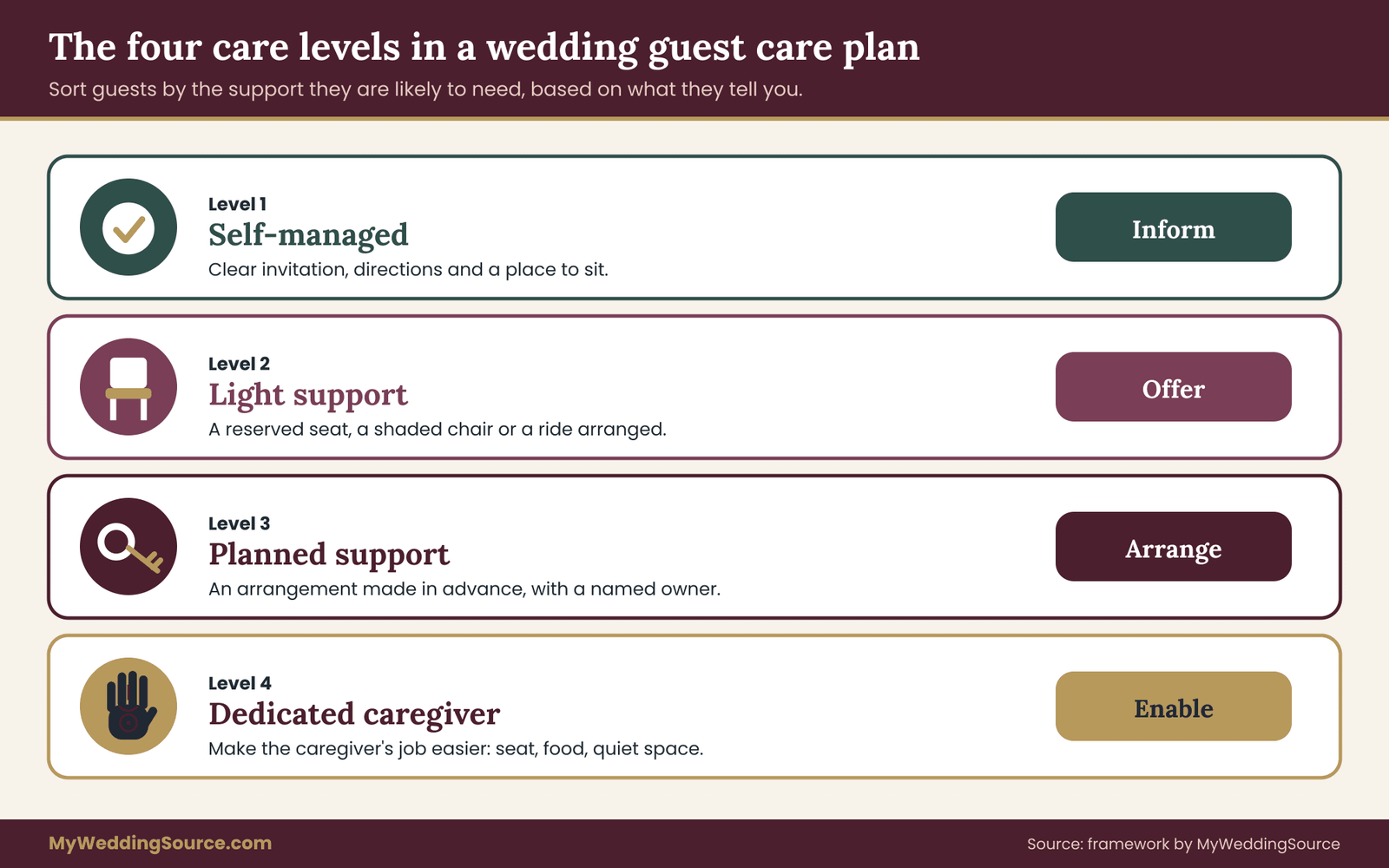
The four care levels
Level one: self-managed. The guest or their family can handle everything. Most guests, including many children with their parents and many older guests who are independent. You still welcome them, but there is nothing extra to arrange.
Level two: light support. One or two small accommodations make the day work. A reserved seat near an exit, an aisle seat, a highchair, an early dinner, a warning about when the music gets loud. These are usually free or cheap and mostly depend on telling the right person in advance.
Level three: planned support. The day needs real arrangements. A portable crib in a quiet room, a hired sitter for the evening, a rest area with a recliner, a wheelchair-accessible route and a seat at the front, a companion assigned to the guest. This level needs a named person and a time.
Level four: dedicated caregiver. The guest needs continuous help from someone trained or closely familiar: a professional caregiver, a family member who is not available to enjoy the wedding, a person with advanced dementia, a child with significant medical or behavioral needs. The plan here is mostly about making it possible for the caregiver to attend, rest and eat, and about backup if something changes.
Most weddings have a large level-one group, a medium level-two group, a small level-three group and perhaps one or two level-four guests. The point of the chart is to make that shape visible so that your effort goes where it is needed.
How to fill in the wedding guest care chart
Create a simple list, in a spreadsheet or on paper, with one row per household or person who might need support. Use these columns:
- Guest or household. Names as they appear on the guest list.
- Who they are. Baby, child, teen, older guest, caregiver. Keep it neutral.
- What they told you. Their own words, copied from the reply. Do not paraphrase into a diagnosis.
- Care level. One to four, based on what they said, not on your guess.
- What you will do. The specific arrangement, in a sentence.
- Owner. The person responsible. A name, not “the venue.”
- Confirmed. A date and how you confirmed it.
The “what they told you” column is the important one. It keeps the chart honest, because it makes you write down what you actually know rather than what you assume. If the cell is empty, the right level is one until you hear otherwise, and the right next step is to ask.
Keep the chart private. It will contain information about health, age and family circumstances. Share only the arrangements and owners with the people who need them, not the reasons. A caterer needs to know that table six requires a softer menu, not why. Our section on protecting guests’ information explains this further.
Putting guests on the chart without labeling them
There is a real risk here: a chart that sorts people can feel clinical, and it can lead you to treat a person as a category. Two habits help.
First, write the arrangement, not the label. “Early seat near the restroom, dinner served first” is more useful and more respectful than “Level three, mobility.” Second, remember that levels change. A guest can start at level one and move to level three the week before because of a fall, a cold or a travel delay. Revisit the chart at each check-in, and treat a change as a normal update, not a problem. ## Ask without assuming: outreach for wedding guest care
The hardest part of wedding guest care is learning what people need without making anyone feel examined. Guests are often reluctant to volunteer limits. Older relatives in particular may play down a problem to avoid being a burden, and parents of young children are used to being told their kids are “no trouble.” Good outreach makes an honest answer easy.
Principles that keep the question kind
Ask everyone the same open question. Put a line in your invitation details or RSVP follow-up that goes to all guests, not just the ones you worry about. A general invitation to share needs does not single anyone out.
Ask about needs, not conditions. You do not need a diagnosis to plan a seat near the aisle. Ask what would make the day easier: “Is there anything that would help you feel comfortable?” A guest can answer with exactly as much detail as they choose.
Offer concrete examples. People respond to specifics. “A seat near an exit, a quiet place to sit, a high chair, an early meal” gives a guest a menu they can pick from without having to invent a request.
Give a person, not an inbox. Name a contact who will read the reply, ideally someone other than the couple. A cousin or a planner is easier to message honestly than the bride.
Say what you will do with the answer. A single sentence about privacy goes a long way: “We will only share what is needed with the people arranging it.”
Make replying easy. A short form, a reply-to-this-text option and a phone number cover different habits. Older guests often prefer a call, and the adult child who handles their correspondence often prefers email.
A short outreach message for all guests
You can adapt this wording for a wedding website, an RSVP follow-up or a printed insert. It is original text, written to be copied and changed.
We want everyone to enjoy the day. If you or someone traveling with you would find anything easier, such as a place to rest, a seat near an exit, a high chair, a quiet room for a baby, a meal at a particular time or help getting around, please tell us. Write to [name] at [contact] by [date]. We will share only what is needed with the people arranging it.
That is all most guests will see, and it works for everyone.
Messages for specific households
When you know a household includes a baby or an older relative, a short personal note makes it easier to answer plainly. Keep each message to a few lines, name the day, and end with a clear request.
To a family with a baby or toddler.
We are so glad you are coming. We want the day to work for a little one. Would a quiet room for naps help, and should we arrange a portable crib or a high chair? If there are meal or sleep times we should plan around, tell us and we will keep them in mind when we set the schedule.
To an adult child who looks after an older parent.
We would love to have your mother with us. We would like to plan comfortably for her, so we would be glad to hear what would help most. For example, seating, timing, a rest area, transport or someone to stay near her during the evening. If it is easier to talk by phone, call [name] at [number].
To a guest with a professional caregiver.
Please bring [name]’s caregiver as our guest. We will set a place at the table, and we would like to know if there are meal times or breaks to plan around so the caregiver can eat and rest too.
Notice what these messages avoid. None asks about age, illness or ability. None assumes the answer is yes. All of them treat the guest as the expert on their own needs.
What to do when you hear nothing
Silence is not “no needs.” It usually means the message was missed, the reader did not want to make a fuss, or someone else is handling things. Follow up once, in a different way, and keep the tone light. If the guest is level one by default and still does not reply, plan for the basics anyway: a reachable seat, a quiet corner and an accessible restroom are good for everyone.
Do not push for details. If a guest says “we will be fine,” believe them and move on. Your job is to open the door, not to walk through it for them.
Collecting information without collecting too much
Every extra field on an RSVP form is a piece of data you are responsible for. A good rule is to ask only what you will use. For wedding guest care, that usually means:
- A yes or no on whether anyone traveling with the guest has a need you should plan for.
- An age range for children, enough to plan activities, meals and seating, not a date of birth.
- Food allergies and dietary needs, for the caterer.
- A phone number for the person who will answer questions on the day.
Skip medical history, diagnoses and medication lists. If a guest chooses to share them, treat them as private, share only the arrangement that results and delete the details when the wedding is over.
Wedding guest care for babies and toddlers
Babies and toddlers are the guests whose needs are most predictable and most urgent. They need to sleep, eat, be changed and be kept away from hazards, all on a rhythm that your timeline does not control. The good news is that the needs are concrete, and a handful of arrangements solve most of them.
Sleep: the biggest question in wedding guest care for babies
Parents’ first worry is usually sleep. A baby who misses a nap can become unmanageable, and a baby who falls asleep in a loud room needs somewhere safe to be.
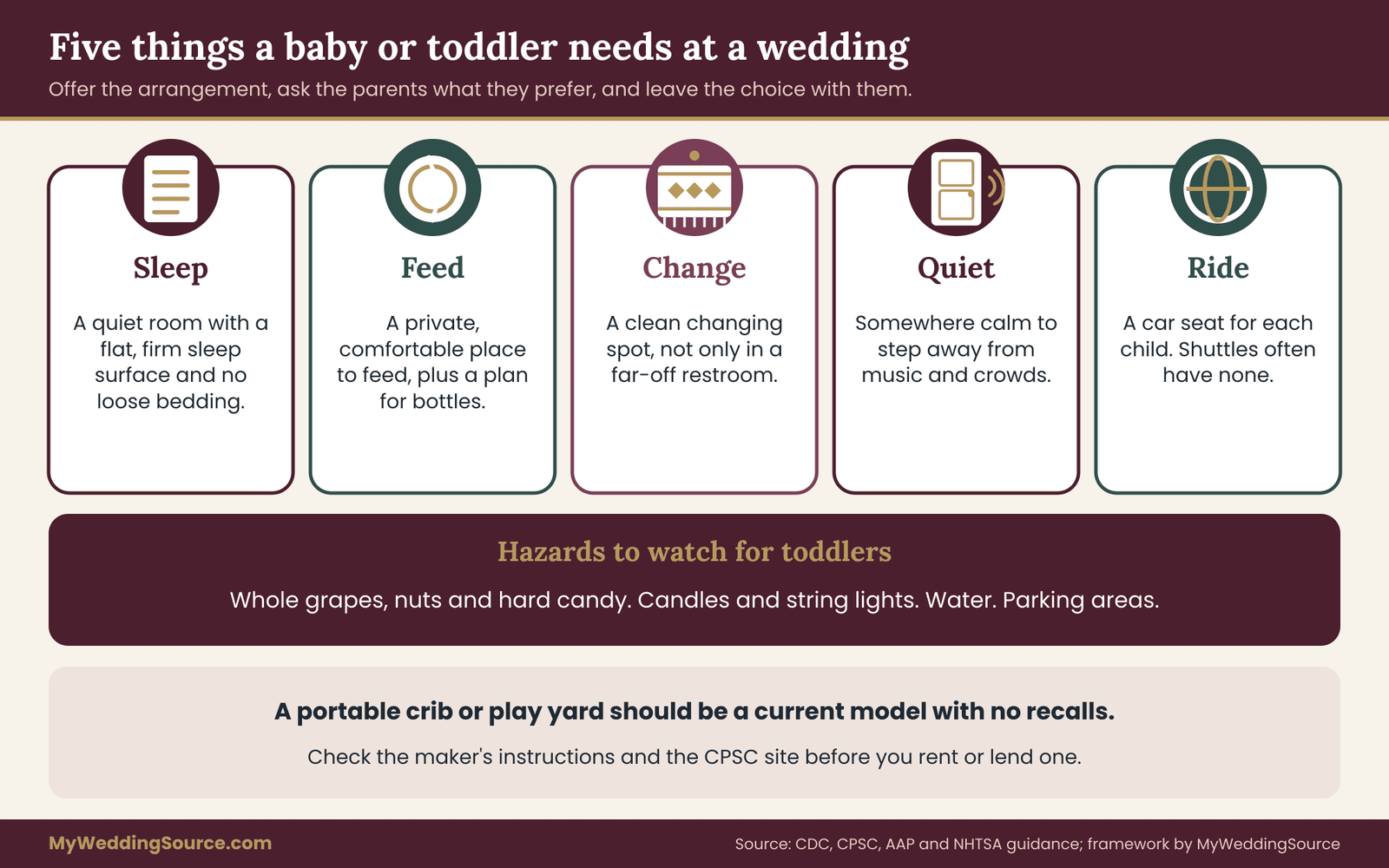
Public health guidance on infant sleep is consistent. The Centers for Disease Control and Prevention advises that babies sleep on their backs, on a firm, flat surface, in a space free of soft items such as blankets, pillows and bumpers. A crib, bassinet or play yard that meets safety standards is the usual setting. A sofa, an armchair or a pile of coats is not a safe sleep surface for an infant, however convenient it looks at a wedding.
What that means for your wedding guest care plan:
- Offer a dedicated sleep space. A quiet room with a portable crib or play yard is the best answer. Ask your venue whether it has a spare room, a bridal suite or an office you can use.
- Let parents bring their own. Many families travel with a portable crib they trust. Ask whether they would prefer to bring theirs or have one arranged. Rental companies provide play yards, but you should confirm with the rental company that the model is current and not subject to a recall.
- Follow the manufacturer’s instructions. The Consumer Product Safety Commission’s guidance on play yards stresses using the product as the manufacturer directs, with only the mattress pad that came with it and no added padding. If you arrange one, make sure it is set up correctly and, ideally, that the parents are the ones to set it up.
- Keep it supervised. A baby asleep in another room should be checked by a person, whether a parent or a trusted adult the parents have chosen. A monitor helps, but it does not replace a person.
- Keep it dark and quiet enough. A room away from the dance floor, with a “sleeping baby” note on the door, is more useful than any gadget.
If the venue cannot provide a room, a hotel room nearby can serve the same purpose. Ask the hotel for a crib, a room close to the elevator and flexible check-in, which matter more to a family with an infant than almost any other perk.
Feeding, changing and noise
Feeding. Parents may need a private, comfortable place to nurse or bottle-feed, with a chair, a table and an outlet for a bottle warmer or breast pump. A corner of the sleep room often works. For babies who eat solids, ask the caterer about simple, soft food and whether a parent can warm something. Make sure parents know they are welcome to feed their baby wherever they are comfortable, including at the table.
Changing. A changing surface in a restroom that is not cramped helps a lot. If the venue’s restrooms have no changing table, a clean, padded surface in a private room works. Stock a small basket with wipes, a few diapers in common sizes, disposable bags and hand sanitizer. It costs very little and parents notice it.
Noise. Babies are sensitive to loud sound. Warn families when the music will be at its loudest, and offer a seat or a quiet area away from the speakers. Ask your DJ or band about volume during dinner.
Temperature. Babies cannot regulate heat as well as adults. A shaded spot at an outdoor ceremony, a cool room and an easy way to adjust clothing are small things that matter.
Food and choking hazards for toddlers
Toddlers are curious and put things in their mouths, and weddings are full of small items: candies, nuts, chunks of meat and cheese, grapes, confetti, floral decorations. The American Academy of Pediatrics identifies foods that carry a higher choking risk for young children, including hot dogs, whole grapes, nuts, popcorn, hard candy and chunks of raw vegetables or meat, and recommends cutting food into small pieces appropriate for the child’s age.
For your wedding guest care plan:
- Ask the caterer for a toddler-friendly option that is soft and cut small, or confirm that parents may bring food.
- Keep small, hard candies and favors off toddler-level surfaces.
- Do not assume that a child’s table is a safe table. Someone needs to be sitting with the youngest children.
- Keep balloons, which are a known hazard for small children when they pop, out of reach or off the menu for toddlers.
Rides: car seats and the trip to the venue
Getting to and from the wedding is a safety question as well as a convenience question. The National Highway Traffic Safety Administration recommends that children ride in the right car seat for their age and size, rear-facing as long as the seat allows, then forward-facing with a harness, then in a booster until a seat belt fits properly. The Centers for Disease Control and Prevention stresses that proper child restraint use is one of the most effective ways to prevent injury in a crash.
That matters to you if you are arranging transport. A shuttle or party bus is rarely equipped with car seats, and the rules for taxis and ride-share vehicles vary by state. If your wedding includes a shuttle between a hotel and a venue, tell families in advance that car seats are not provided and ask whether they would rather drive. Our guest transportation planning guide walks through how to plan shuttles and rides, including how to handle families who need to bring their own seats.
A short checklist for the baby and toddler group
- A quiet room with a safe sleep space and a person to check on it.
- A private place to feed, a comfortable chair and an outlet.
- A clean, accessible changing surface and a small supply basket.
- Soft, small-cut food available, and small hazards kept off low surfaces.
- A warning about loud moments, and a seat away from the speakers.
- A plan for the ride to and from the venue.
- A named person parents can ask for help.
Wedding guest care for children and teens
School-age children are the easiest guests to delight and the easiest to lose track of. They are old enough to want to join in and too young to judge risk, and a wedding offers them long stretches of waiting. A good wedding guest care plan for this age group has three parts: something to do, an adult responsible for them and a clear route for leaving early.
What children need from the day
Something to do. Children can sit through a ceremony of twenty or thirty minutes if they have a small job or a quiet activity. After that, they need movement. A few simple things go a long way: an activity bag with paper, pencils and a small puzzle, a kids’ table with a few things to make, a lawn game outdoors, a short scavenger hunt written in simple words. Keep the activities quiet during the ceremony and speeches.
Food they will eat. Children often refuse unfamiliar food. Ask the caterer about a child’s plate and about timing, and ask how children are priced in the quote. If dinner is served late, a snack earlier in the afternoon prevents meltdowns. Our wedding budget guide shows where child pricing usually sits in a catering quote, which is worth reading before you sign.
A way to rest. After a few hours of excitement, children get tired and overstimulated. A quiet corner with a blanket and a book, or a room with a movie, can save a bad evening.
Their own place in the story. Children who have a job, even a small one, feel included. A flower girl, a ring bearer or a program handout can be a real role. If you are including children in the ceremony, our guide to flower girl and ring bearer rehearsal explains how to practice with age-appropriate expectations.
Who is responsible for each child
This is the question that matters most and is answered least. At many weddings, children are “everyone’s responsibility,” which means no one’s.
The clearest rule is that each child has a named adult who is responsible for them at all times unless they have been formally handed to someone else. For most children that adult is a parent. If a parent will be busy, for example as a member of the wedding party or giving a toast, name a substitute in advance and make sure the child knows who it is.
Where a larger group of children attends, many couples hire childcare for part of the event. That choice has legal and safety implications, which the next section covers.
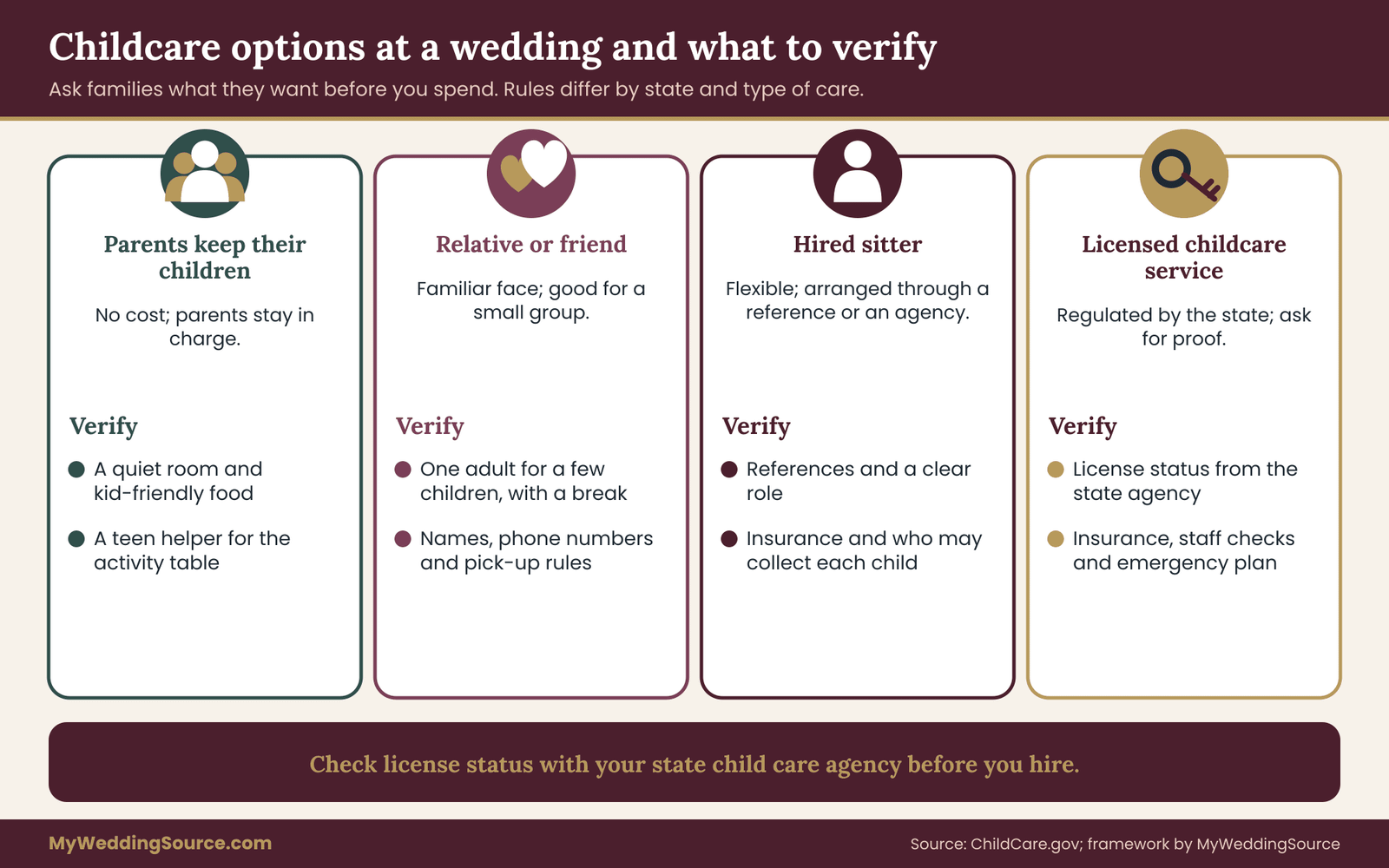
Childcare options and what to verify
There are four common ways couples arrange care for children during a wedding. None is right for every wedding, and each has different things to check.
Parents stay responsible. The simplest option and the default for most weddings. Nothing to hire, no new risks, but parents miss parts of the day. This works best when you support parents with a kids’ activity table, a quiet space and an early-meal option.
A trusted relative or friend. A teenager cousin or an aunt who volunteers to run a kids’ table is common. This is cost-free and personal, but it asks a lot of a guest, who may end up missing the wedding. Treat it as a real job with a start, an end and a break, and thank the person.
A hired sitter or nanny. A familiar sitter brought by one family, or a sitter you or a family hire for a small group. The quality depends entirely on the person, so you or the parents need to check references and agree on what the sitter will do.
A licensed childcare service on site. Some companies specialize in event childcare, bringing staff and activities to a venue or hotel. Because child care for groups is regulated in most states, the licensing and legal requirements depend on where the wedding is held and how the service is structured.
The U.S. Department of Health and Human Services’ childcare.gov site explains that child care providers are generally regulated by state licensing agencies, and that requirements vary by state and type of care. That is the first thing to understand: there is no single national rule, and you should not assume that your provider is covered by the rules you imagine. Ask the provider which rules apply to them in your state, and where the family can verify it.
Questions worth asking any childcare provider
Ask each provider to answer these in writing, and compare the answers with your state’s licensing office rather than relying on the provider’s word alone.
- Are you licensed or registered in this state, and where can I verify it?
- What background checks do your staff go through, and who runs them?
- What is your staff-to-child ratio, how does it compare with local rules, and what happens when more children arrive than expected?
- Do your staff hold current first aid and CPR training, and for which ages?
- Are you insured, and does the policy cover events at this venue?
- How do you handle allergies, medications and emergencies, and who calls the parents?
- How do parents drop off and pick up, and how do you confirm who is authorized to take a child?
- What happens if a child is upset, ill or injured, and where will the children be located relative to the party?
This list does not set a ratio or a standard for you. Ratios and training requirements are set by state and local law and, for private arrangements, by the provider’s own policy. Your task is to find out what the provider does, check that it matches the law that applies and decide whether you are comfortable.
Pick-up, drop-off and authorization
A common gap is the end of the night. A child is handed to the wrong adult, or a parent leaves without telling the sitter. Set a simple procedure:
- Parents sign children in with a name, a phone number and the name of anyone authorized to collect the child.
- A child is released only to a person on that list, who shows identification if the provider is not personally familiar with them.
- If the parent will be late or someone else will collect, the parent tells the provider in advance.
- At the end, the provider reads the list back and confirms every child has left with an authorized adult.
If you are hiring a service, ask whether they have their own authorization form and use it. If a relative is running the kids’ table, a simple card with the same information works.
Venue safety and wedding guest care for children
Children notice hazards adults overlook. Walk the venue with a child’s eye level in mind before the day:
- Water. Ponds, fountains, pools and hot tubs are the most serious risk for young children. The Centers for Disease Control and Prevention recommends constant, undivided attention from a designated adult around water, along with barriers. If your venue has water, assign a “water watcher” for the times children are outdoors, and keep gates closed.
- Candles, heaters and string lights. Open flames, hot lamps and loose cords are tempting. Raise them out of reach, or place them in areas children cannot get to.
- Cake knives, glassware and bar areas. Keep sharp and breakable items away from children, and make sure children do not reach the bar.
- Parking lots and roads. Children running outdoors should not be able to reach a road or a lot. Choose an area with a clear boundary.
- Stairs and balconies. Rails and gates, or a person nearby.
- Décor. Confetti, small favors, balloons and fresh flowers that may be toxic if eaten. Ask the florist which blooms are in reach.
A plan for a missing child
You will probably never need it, and you should have it anyway. Agree in advance on a short procedure: whoever notices a child is missing tells the care lead immediately, the lead alerts the venue and key staff, a few adults check the obvious places and the exits, and the venue’s security or management helps. Keep a recent photo or description of each child with the family, and make sure parents’ phone numbers are on the wedding guest care sheet. If a child is not found quickly, call emergency services.
You do not need to alarm anyone. A care lead who knows the steps and a venue manager who knows who to call is enough.
Teenagers
Teenagers sit awkwardly between groups. They are bored at the kids’ table and not supposed to be at the bar. A few ideas make the day better for them: seat them with people their age, give them a small job such as helping with the guest book or running a playlist, and tell parents what the alcohol rules are. Teenagers are also often the best caretakers for younger children, but they should be treated as guests, not unpaid staff.
Leaving early: wedding guest care at the end of the night
Plenty of families with children will leave before the end. Make that easy. Plan the schedule so the cake cutting, first dance and toasts happen before the youngest children are exhausted. Tell families when these moments will occur so they can decide whether to stay. And arrange a way for families to leave without going back through the whole party. A short exit, a coat check or a quiet path to the parking lot helps. Our timeline guide on planning the wedding timeline shows how to place the moments that matter most to early leavers in the first half of the evening. ## Wedding guest care for older relatives
Older relatives are often the guests the couple most wants to see and the guests most likely to be quietly uncomfortable. Grandparents, great-aunts and long-time family friends may have travelled a long way, they may tire sooner than everyone expects, and they are the least likely to complain. Good wedding guest care for older guests is mostly about energy, access and being known by someone on the day.
The word “older” covers an enormous range. A healthy seventy-year-old who dances all night and a ninety-year-old who uses a walker and has trouble hearing have almost nothing in common as guests. This is why the triage works from what a person says they need. Treat any guidance below as a menu of things to consider, not a profile.
Energy: plan wedding guest care around it
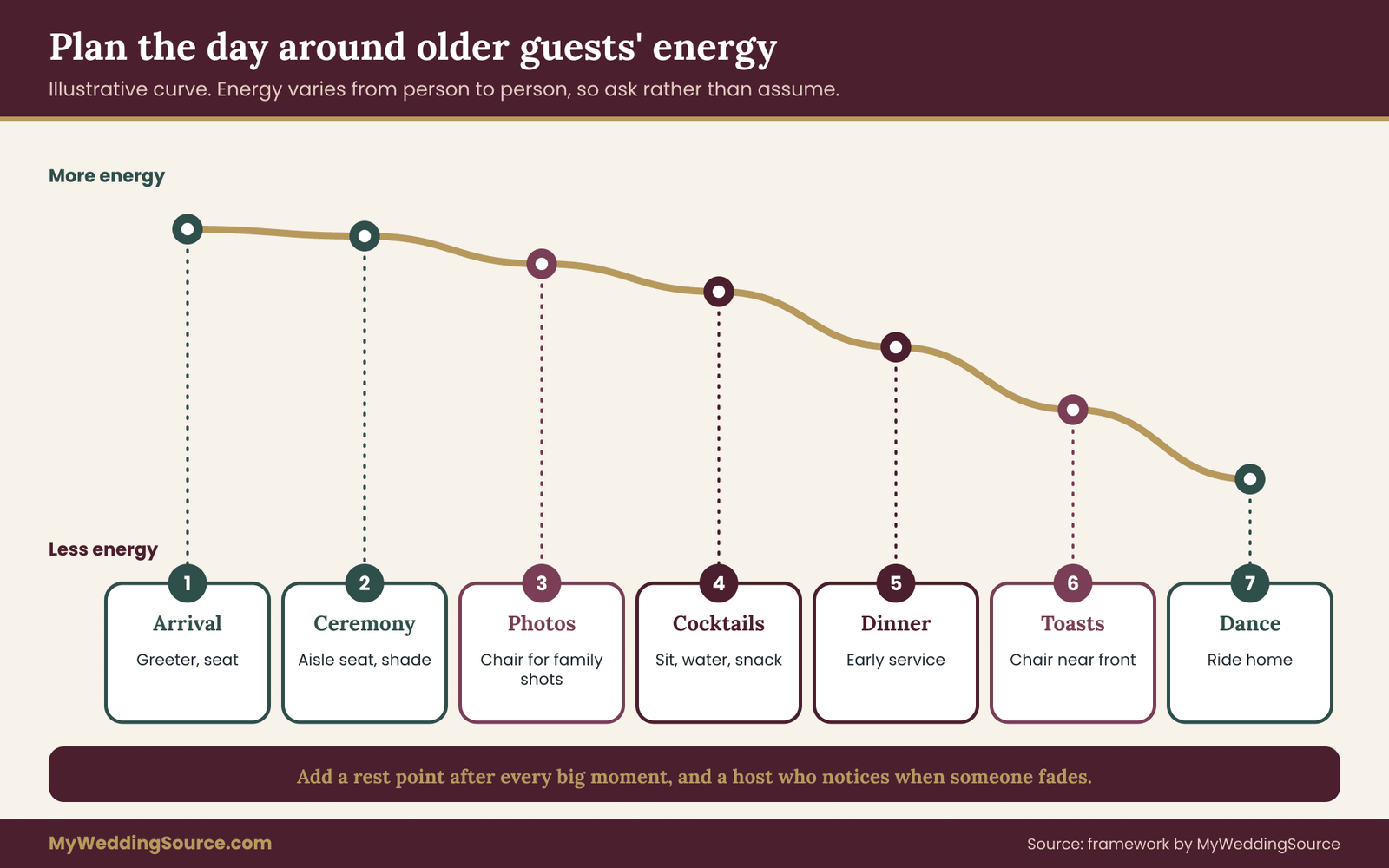
The most useful single idea is that energy is a budget. A long day of travel, a formal ceremony, a loud reception and a late finish draws the budget down fast. The aim of the plan is to spend it on the moments that matter most to the guest, such as the ceremony and the family photographs, and to give them places to recover.
Practical moves:
- Seat guests early and close. For the ceremony, a reserved aisle seat near the front or near an exit avoids standing and lets a guest leave quietly if needed. Mark it with a card, not a ribbon that looks like a warning.
- Serve dinner on time. Older guests who eat or take medication on a schedule are affected by long gaps. If dinner will run late, plan a snack or drinks earlier.
- Place older guests near, not at, the center of the action. A table close to the dance floor is lively, but a table next to the speakers makes conversation hard. A spot with a view of the floor and a lower sound level suits many guests.
- Schedule photographs with energy in mind. Family photos that need an older relative to stand for a long time are better done before the ceremony or immediately after, not at the end of a long evening. Offer a chair.
- Make the exit easy. A guest who is tired should be able to leave without crossing the whole room or waiting for a ride in the cold.
Mobility, falls and surfaces
Falls are a serious risk for older adults. The Centers for Disease Control and Prevention reports that roughly one in four adults aged sixty-five and older falls each year, and its STEADI program offers guidance on reducing the risk. You are not responsible for anyone’s health, but you can control the surfaces and routes at your wedding, and that matters.
Walk the route an older guest would take, from the car park or drop-off to the ceremony seat, the restroom, the dining table and the exit. Look for:
- Surfaces. Grass, gravel, cobblestones, thick carpet edges, uneven flagstones and wet decking. A sturdy path or mat over grass makes a large difference. Our guide on the outdoor wedding rain plan explains how to prepare surfaces and routes for wet weather, when risks rise.
- Steps and thresholds. A single step is an obstacle for some guests. Ask where ramps, handrails and level entrances are.
- Lighting. Dim lighting at a reception is atmospheric and tricky for anyone with vision problems. Make sure paths, steps and restroom routes are well lit.
- Distances. A long walk from parking to the ceremony site can be too much. A golf cart, a short shuttle or a drop-off point close to the entrance helps. Provide chairs along longer routes.
- Restrooms. Close, accessible and clearly signed. If they are far, say so and offer help.
- Seating. Chairs with arms are easier to stand from than low sofas or backless benches. Ask the rental company for sturdier chairs for older guests, or mix a few in.
The 2010 ADA Standards for Accessible Design set technical requirements for accessible routes, doors and ramps in places of public accommodation. Among the reference figures, accessible routes are generally at least thirty-six inches wide, door openings at least thirty-two inches clear, and ramps no steeper than a one-to-twelve slope. Use these numbers only as conversation starters, because requirements depend on the building, its age and the type of event. If a guest uses a wheelchair or other mobility device, ask the venue to confirm the route in person or through photographs.
Heat, cold and weather
Older adults are more sensitive to heat, and some medications make this worse. The Centers for Disease Control and Prevention lists adults aged sixty-five and older among those at higher risk of heat-related illness. If your wedding is outdoors or in warm weather, plan shade, cool water, seating and an indoor place to retreat. Do not ask older guests to sit in direct sun for a long ceremony, and consider starting a bit later in the day.
Cold matters as well. Old buildings, drafty tents and winter evenings can be uncomfortable, and cold surfaces and ice are fall hazards. Our winter wedding weather plan explains heating, coats and routes in cold weather.
Hearing, vision and communication in wedding guest care
Many older guests have some hearing or vision loss. At a loud reception this can make the evening isolating. A few things help:
- Seat people in a spot where they can see faces and hear conversation.
- Turn the music down during dinner, and give older guests a warning before speeches or a dance.
- Provide programs in large type for the ceremony, and make sure the person reading is audible.
- If a guest uses a hearing aid or other device, do not make a point of it. Ask whether a quiet space or a seat near the speaker would help.
- For a guest who uses sign language, ask the guest or their family how they want interpretation arranged. Interpreters book up, so start well ahead of the date.
Food, medication and routine
Older guests may follow dietary restrictions or eat at set times. Ask the caterer about low-salt, soft, diabetic-friendly and other options, and ask the guest or their family what suits them. Do not guess. You do not need to know the reason for a diet, only the practical request.
Some guests take medication at certain hours. You are not managing it, and you should not ask for details, but you can make it easy by keeping the schedule predictable, offering water and giving the guest a quiet place to take a pill or a break. A guest’s family member or caregiver is usually the right person to manage the details.
Memory loss, dementia and wedding guest care
Weddings can be disorienting for a guest with memory loss. Crowds, noise and unfamiliar places can cause confusion and distress, and wandering is a real concern. The Alzheimer’s Association offers practical guidance on travel and events, including keeping routines, limiting stimulation and making sure the person is accompanied.
For your wedding guest care plan:
- Ask the family what would help, and follow their lead.
- Name a companion, a family member or a trusted friend who stays with the guest, so they are never alone.
- Offer a quiet room or seat away from the noise, where the guest can rest and the companion can take a break.
- Brief the venue staff and the care lead so they know a guest may become disoriented, and where the exits are.
- Make sure the guest carries identification and contact information, discreetly, and that the companion has a phone.
- Plan an early, gentle departure, and avoid making a fuss when it happens.
Treat the guest with the same respect as any other. A person with dementia can still enjoy a wedding, and being treated as a guest matters.
Caregivers and wedding guest care
A professional caregiver or a family member who provides care is a guest too, and their experience matters. If the guest cannot be left alone, the caregiver will be working through the whole event.
Invite the caregiver as a guest with a seat and a meal. Ask about breaks, and arrange a place where they can rest. If the caregiver is a paid professional, discuss expectations with the family in advance, including whether they are included or provided by the family. The principle is simple: make it possible for the person who cares to eat, rest and use the restroom.
Travel for older guests
Many older guests travel a long way, and the trip can be harder than the wedding. A few resources help them plan:
- The Transportation Security Administration’s TSA Cares program helps travelers with disabilities or medical conditions through airport screening, and travelers can contact it before they fly.
- The U.S. Department of Transportation explains the rights of air travelers with disabilities, including requesting assistance from the airline.
- The American Geriatrics Society’s Health in Aging Foundation has a tip sheet on safe travel for older adults.
You are not planning the trip, but pointing a guest to these resources and offering to book accessible lodging nearby is a welcome gesture. Ask the hotel about room types, elevators and the distance to the venue.
Service animals
Some guests are accompanied by a service dog. Under the Americans with Disabilities Act, a service animal is a dog individually trained to perform tasks for a person with a disability, and businesses open to the public generally must allow service animals to accompany their handlers. Staff may ask only two questions: whether the animal is required because of a disability and what work or task it has been trained to perform. They may not ask for documentation. Emotional support animals are not service animals under the ADA, though other rules and venue policies may apply.
If a guest tells you they will bring a service animal, let the venue and caterer know, and plan a spot where the animal can lie comfortably and where food is not dropped. Do not ask questions beyond the two permitted ones. ## Vendor tasks that make wedding guest care work
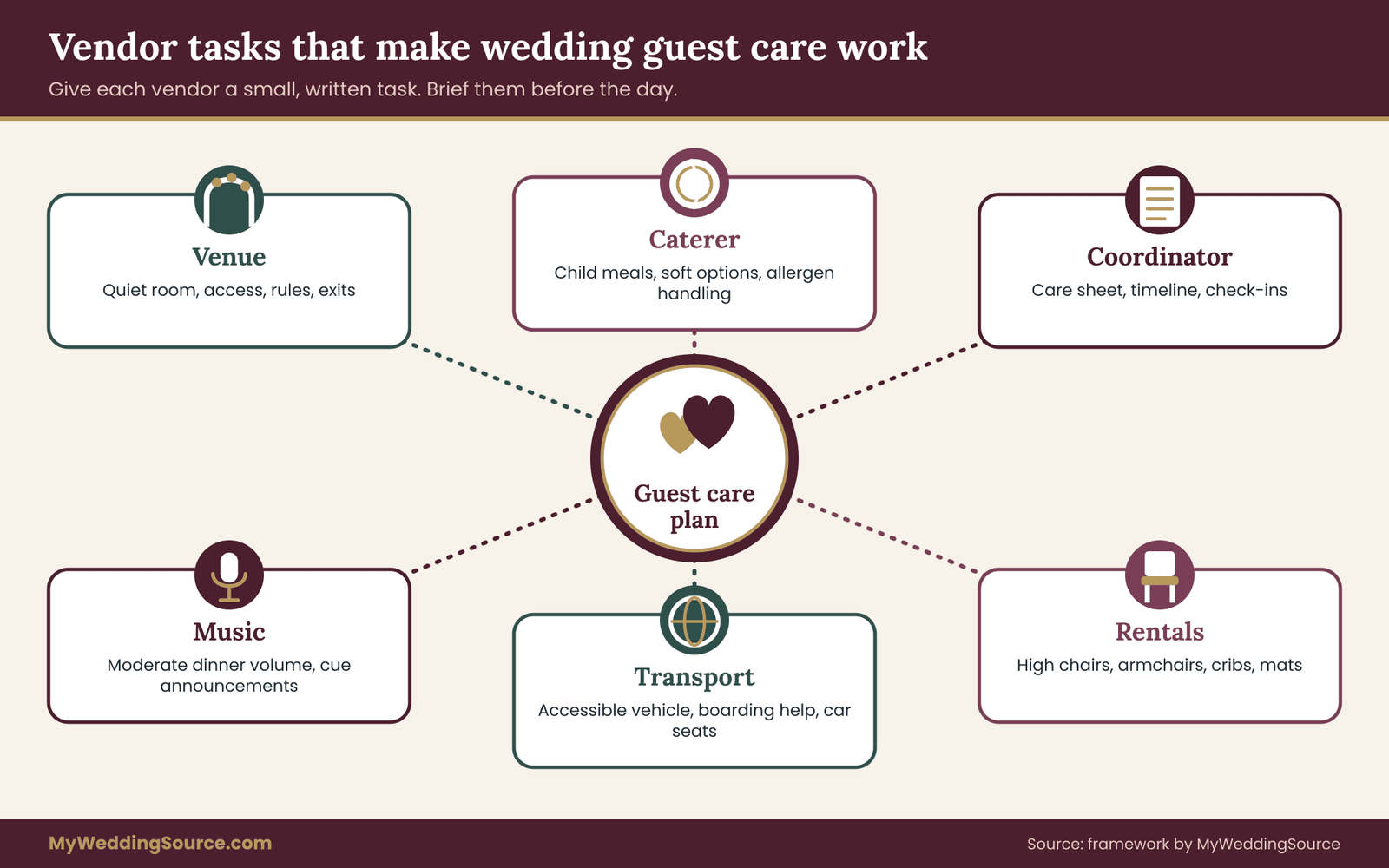
A wedding guest care plan that depends on the couple fails the moment the ceremony starts. The way to make it hold is to give specific tasks to the vendors who already have staff, access and authority on the day. Each vendor can do a small piece of wedding guest care in the course of their normal work, provided they know about it in advance and agree in writing.
Think of the vendors as a relay team. The venue controls the space, the caterer controls food, the coordinator controls the schedule, the music provider controls volume, the photographer controls how long people stand, and the transport provider controls how people arrive and leave. Brief each one on the parts of the plan that touch them.
The venue’s part in wedding guest care
The venue is the most important partner because it controls rooms, access and rules. Ask:
- Are there rules about children, strollers or infants? Some venues have age policies, insurance requirements or restrictions on certain rooms.
- Is there a room that can be used for sleeping, feeding or quiet time, and can it be reserved for the whole event?
- Where are the accessible entrances, restrooms, ramps, elevators and seating areas, and who can walk through them with you?
- What are the policies for service animals, and is there somewhere a service animal can wait comfortably?
- Where are the exits, the first aid supplies and the nearest emergency services?
- Who is the manager on duty, and how can the care lead reach them?
- Are there hazards for children, such as water, stairs, balconies, hot surfaces or parking lots?
If the venue has a coordinator, ask them to join the walkthrough and tell them about your wedding guest care plan so they can flag problems early. A venue that knows you plan for babies and older guests will often volunteer solutions you did not think to ask for.
The caterer’s part in wedding guest care
The caterer controls what guests eat and when. Ask for:
- A child’s meal that is simple, familiar and cut into small pieces, and a clear policy on whether parents can bring food for infants.
- A soft or lower-salt option for older guests, and a way to flag special diets at the table.
- Allergen handling. The U.S. Food and Drug Administration lists nine major food allergens: milk, eggs, fish, crustacean shellfish, tree nuts, peanuts, wheat, soybeans and sesame. Ask how the kitchen prevents cross-contact and how servers will identify plates for guests with allergies. Food Allergy Research and Education offers guidance for hosting parties with allergic guests.
- Timing. Serve children and older guests early if possible, and ask the caterer how late they will keep the kitchen open for a family leaving early.
- Water. Make sure water is available at every table and in the cocktail area, not only at the bar.
The coordinator or planner
If you have a planner or day-of coordinator, they are the natural home for the wedding guest care sheet. Ask them to:
- Hold a copy of the wedding guest care chart, with the arrangements and owners, not the private reasons.
- Build the timeline with nap windows, meal times and energy in mind.
- Check in with the care lead at set times.
- Know who to call if a guest becomes ill, a child is missing or a plan changes.
If you do not have a coordinator, the care lead takes this role. Our wedding planning checklist can help you place these tasks in your overall timeline, and the briefing described below gives the people around you their parts.
Music and wedding guest care
Music is the biggest variable for comfort. Ask your DJ or band to:
- Keep volume moderate during dinner and conversation, and give notice before it rises.
- Announce key moments, such as the cake cutting and first dance, a few minutes ahead so families can gather.
- Take a quiet break, or switch to softer music, when the youngest children are winding down.
- Use a microphone and speaker setup that older guests can hear during toasts, without turning everything up.
The photographer and videographer
A photographer who understands the plan can be a gentle ally. Ask them to:
- Take formal family photos early, with a seat for older relatives.
- Be flexible with schedules for babies and young children, who may need photos at a specific time.
- Follow your wishes about photographing children, and check any consent arrangements with parents.
Transport
If you provide shuttles or rides, ask the provider about wheelchair-accessible vehicles, assistance boarding, time at the stops and whether child seats are allowed. Tell families whether they can bring their own car seats, and note that shuttle and ride-share rules vary by state.
The rental company
Rentals matter for care. Ask for:
- Sturdy chairs with arms for older guests, and a few extra chairs along long paths.
- High chairs and booster seats in the number your children’s table will require.
- Portable cribs or play yards, if you are providing them, with confirmation that the models are current and not subject to recalls.
- Fans or heaters, depending on the weather.
- Mats or pathways over grass or gravel.
The florist and décor team
Flowers and decorations can be hazards or comforts. Ask the florist which plants are toxic if chewed, keep low arrangements out of reach of small children, and make sure aisle installations are anchored. Candles and string lights should be placed so that a toddler cannot reach them or tip them.
Putting wedding guest care tasks in writing
An email thread is enough. After each conversation, write a short summary of what the vendor agreed to do, and ask them to confirm. Keep the messages in one folder so your care lead can find them on the day. If a vendor’s task affects cost, make sure it appears in the contract or a signed addendum. Our wedding vendor due diligence checklist explains how to verify vendors before you book, which is a good moment to ask about the care tasks too.
Day-of roles: who runs wedding guest care
A wedding guest care plan needs people. On the day, wedding guest care works best when a few roles are named and each person knows what they are responsible for. These are roles, not job titles. One person can hold two of them in a small wedding, and a large wedding may need several people in each.
The wedding guest care lead
The care lead is the single point of contact for everything in your wedding guest care plan. They hold the wedding guest care sheet, know who needs what and have the authority to ask the venue and vendors for help. Ideally they are not the couple, the parents of the couple or anyone in the wedding party, because those people will be busy and in the photographs. A close friend, a cousin, a planner or a coordinator is a good choice.
The care lead’s job:
- Check in with each level-three and level-four guest or caregiver at the start of the event.
- Hold the list of authorized pick-ups for children, if applicable.
- Keep a phone on, charged, with the venue manager’s and vendors’ numbers.
- Make quick decisions about swaps, such as moving a seat or calling a ride.
- Close the loop at the end of the night, confirming that every child and every guest who needed help has left safely.
Guest hosts
A guest host is a family member or friend assigned to look after one older guest or one small group during the day. This is the most effective single tool in wedding guest care, because it gives an older relative a familiar person whose job is to notice if something is wrong. The host walks them in, sits nearby, brings water and food, and makes sure they get a ride home.
Make the assignment clear and bounded: “You are Aunt Ruth’s host from the ceremony until the cake.” Give them a break at the end of that time, and thank them.
The kids’ captain
If you have a group of children, a kids’ captain runs the activity table or play area. This might be a teenage cousin, a hired sitter or a friend who is good with children. They should know each child’s name, the adult responsible and any allergies or needs. They should not be asked to supervise alone for the whole evening.
The venue contact
Name one person at the venue who is the care lead’s contact for the day. Often this is the on-site manager or event coordinator. Make sure the care lead and the venue contact meet at the start.
Briefing the team on wedding guest care
A brief meeting before the event, even ten minutes, lets everyone know their role. Cover:
- Who needs what and who owns each arrangement.
- Where the quiet room, the first aid supplies and the exits are.
- How to reach the care lead.
- What to do in an emergency, with the venue’s address and the nearest hospital or urgent care if you know it.
- When the key moments happen.
Put all of this on a single page and give a copy to the care lead, the coordinator and each guest host.
Emergencies and first aid
You cannot plan for every emergency, but you can plan for the response. Know where the first aid kit is and who has first aid or CPR training among your guests and vendors. If a medical emergency happens, call emergency services first and then the care lead. Ask the venue about its emergency procedures, and make sure someone knows the street address, so they can direct responders. Do not ask guests to disclose conditions in advance for this purpose. The point is readiness, not records.
A day-of timeline for wedding guest care
The timeline below shows where wedding guest care touchpoints fit in a typical wedding day. It is a pattern, not a schedule, so adjust it for your wedding. The point is to place care actions at moments when they are needed and to avoid clustering everything at the start or end.
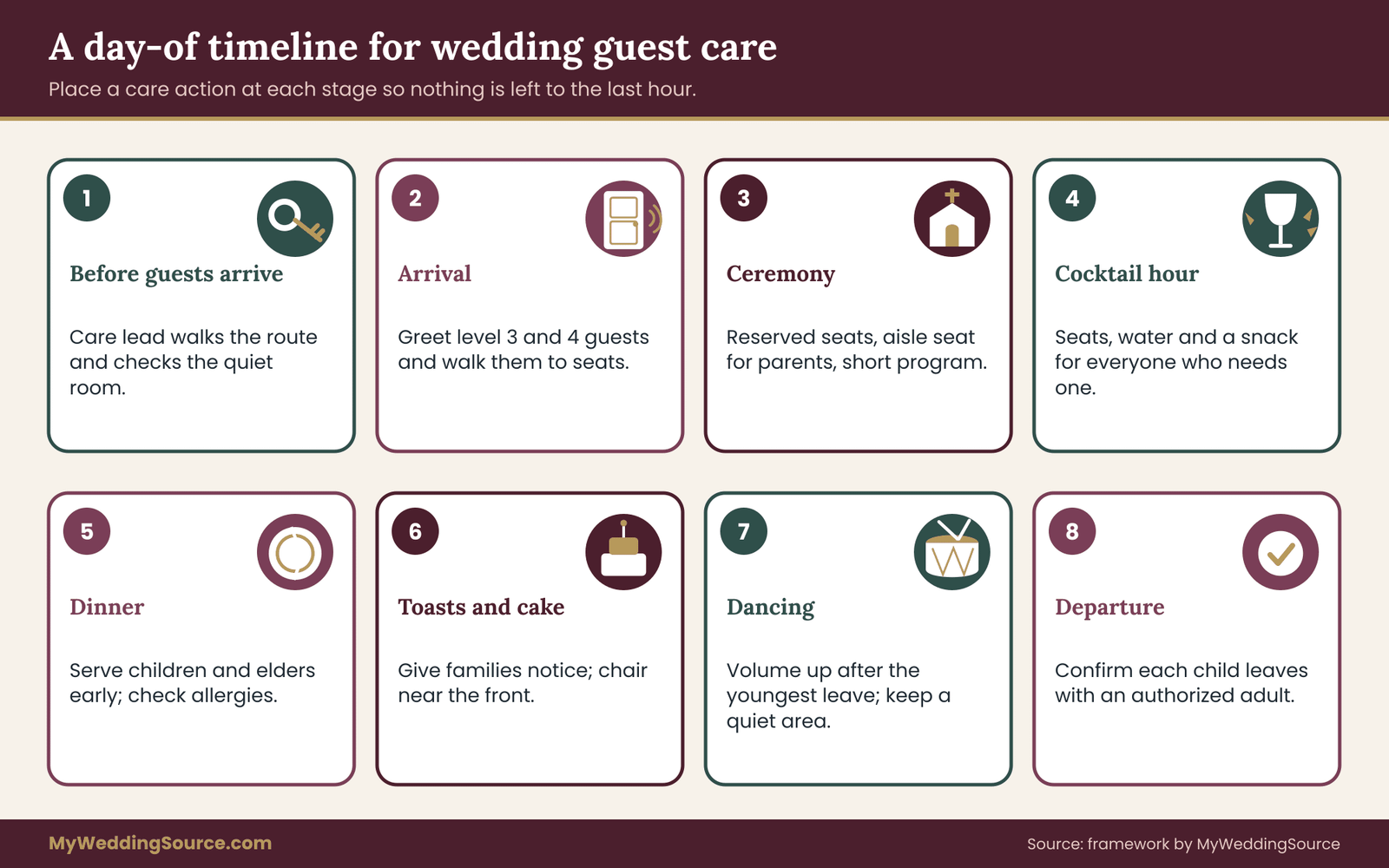
Before guests arrive. The care lead walks the route with the venue contact, checks the quiet room, restrooms, seating and signage, and makes sure the wedding guest care sheet is in their hands. The kids’ captain sets out activities. Guest hosts confirm who they are looking after and where they will meet them.
Arrival. The first moments set the tone. Greet level-three and level-four guests personally and walk them to their seats. Offer water. Point parents to the quiet room, and families with strollers to a place to leave them. A greeter who knows the plan is worth more than a sign.
Ceremony. Keep it short for the sake of children and older guests, or schedule a seat break if it is long. Place reserved seats and mark them discreetly. Give parents an aisle seat so they can step out with a fussy child. Remind guests that parents may leave and return, so no one feels judged.
Cocktail hour. This is the time for food and rest. Make sure older guests can sit, children have a snack and families can find the quiet room. The care lead checks in with each host.
Dinner. Serve children and older guests early when you can. Check allergies and special meals at the table. Keep the volume moderate. This is also when a hired sitter or kids’ captain can take children to an activity if they are done eating.
Toasts and cake. Give families a few minutes’ notice so they can gather, and tell early leavers when the cake will be cut. If an older guest is tiring, offer a chair near the front.
Dancing. Turn the volume up after the youngest children leave, and tell older guests where the quieter areas are. This is when many families go home, so make the exit easy.
Departure. The care lead checks that each child leaves with an authorized adult and each older guest has a ride or a host to go with. A short thank-you and a small take-home snack make the leaving warm.
After. The care lead sends a brief note to hosts and vendors thanking them, collects the wedding guest care sheet and deletes any private information that is no longer needed. ## A worked example of wedding guest care
Abstract advice is easier to trust when you see it applied. The scenario below is invented for illustration. The couple, the guests and the decisions are made up, and nothing in it is a rule. It shows how the triage and the ownership steps of wedding guest care turn into actual choices.
Imagine a couple planning a Saturday afternoon wedding for about 110 guests, with a ceremony on a lawn and a reception in a rented hall twenty minutes away. They have gone through the guest list and found the following groups:
- Nine children under twelve, including two babies and one toddler.
- Four teenagers.
- Six guests over seventy-five, one of whom uses a walker and one of whom has memory loss and travels with her daughter.
- A guest who uses a wheelchair and is not elderly.
- One guest with a service dog.
Using the four wedding guest care levels, the couple sorts them like this.
Level one, self-managed. Most guests, including the teenagers and the guests in their sixties and seventy-somethings who travel easily. They get a clear invitation, clear directions and a place to sit.
Level two, light support. Three of the older guests who are fine on their own but tire in the afternoon. The plan is a reserved seat near the exit and a chair in the shade at cocktail hour, plus a ride arrangement so no one drives home after dark if they would rather not.
Level three, planned support. The guest with the walker, the guest with the wheelchair, the two babies and the toddler. Each of these needs an arrangement made in advance: a short, level path from the parking area to the lawn, a spot in the hall near an accessible restroom, a quiet room for the babies, and a place for strollers.
Level four, a dedicated caregiver. The guest with memory loss attends with her daughter. The couple’s job is not to supervise her, but to make her daughter’s job easier: a seat near the exit, a table near the restrooms, food served early, and an agreed quiet space if the room gets overwhelming.
The decisions that followed
Once the groups were clear, the couple made a handful of decisions.
- They asked, rather than guessed. Each level-three and level-four guest got a short, private message asking what would make the day comfortable. Most replied with one or two practical points. The guest with the walker mentioned that stairs were the main issue. The guest with the service dog asked where the dog could wait during the reception.
- They changed one thing about the venue. The ceremony lawn was across a gravel path. The couple asked the venue to lay a temporary mat, and the venue agreed at a modest cost. The alternative was moving the ceremony, which would have been far more disruptive.
- They set up a quiet room. The hall had a small side room. The venue agreed to keep it unlocked, and the couple asked a rental company for a portable crib and two comfortable chairs. They made the room known in the program and through the care lead.
- They arranged childcare for the reception. For the nine children, they hired a sitter through a licensed service for the dinner hour, and their cousin, a teenager, volunteered as kids’ captain. Parents were told where the activity table would be and how pick-ups worked.
- They named a care lead. A close friend who was not in the wedding party agreed to be the single point of contact, and attended the venue walkthrough.
- They gave guests hosts. Each level-three and level-four guest had a friend or relative assigned for a specific window of the day. The couple thanked each host in advance.
- They briefed vendors. The caterer was told which guests needed softer food or allergy handling, the DJ agreed to a lower volume at dinner, and the transportation provider confirmed that the shuttle would have a lift.
- They wrote it all on one page. The wedding guest care sheet listed arrangements and owners, not private details. The care lead held it, and the coordinator had a copy.
What this example does not show
It does not show an ideal wedding. It shows a plan that is proportionate. The couple did not try to remove every possible difficulty. They looked at who was coming, picked the arrangements that mattered most and assigned each to a person. They spent time on the six or seven guests who truly needed planning and left the rest alone.
It also shows something that is easy to miss: most of the decisions were small and cheap. A mat on a path, a room that stays unlocked, a reserved chair, a thoughtful message. The costly decisions, such as hiring childcare, were optional and were made after the couple looked at what the families wanted.
Budget, contracts and insurance for wedding guest care
Wedding guest care does not need a large budget, but it does need a line in the budget, because small items add up and are forgotten when the totals are tight. Our wedding budget guide explains how to structure a budget, and the care items below fit under guest experience, rentals and staffing.
Where the money for wedding guest care usually goes
- Childcare. A sitter or a licensed childcare service is the largest optional item. Pricing varies widely by region and provider, so get quotes from the specific providers you are considering instead of relying on a general number.
- Rentals. High chairs, boosters, portable cribs, chairs with arms, mats, fans or heaters.
- Transport. An accessible vehicle or an additional shuttle run for guests who cannot manage the main route.
- Food. Child meals, softer options and allergy-safe plates may cost the same as a standard plate or slightly more, depending on the caterer.
- Staff time. The venue or planner may charge extra for additional coordination or for staff to be present in a quiet room.
- Small supplies. Activity packs, water, snacks, a first aid kit, labels and signage.
What to put in writing
Any arrangement that costs money or depends on a vendor’s agreement should be written into the contract or an addendum. Include:
- What the vendor will provide, how many and at what time.
- Who is responsible for setting up and removing it.
- The cancellation and change terms.
- Any limits, such as a maximum number of children in the quiet room.
If a vendor makes a verbal promise, ask them to send it in an email. A message the vendor has acknowledged is stronger than a memory of a phone call.
Insurance and wedding guest care
Wedding insurance policies vary, and most are not built around guest care. Event liability coverage may protect against some claims connected to injuries at the event, but the details differ by policy and by venue. Many venues require the couple to carry liability coverage, and some require proof of insurance from vendors. Our wedding insurance guide covers what policies typically address and what to ask. Ask your insurer or the venue directly about the following:
- Whether children’s activities, such as a bounce house or a pool, are covered or excluded.
- Whether a hired sitter or childcare service has its own coverage.
- Whether the venue’s coverage applies to guests who are injured on the property.
If a family wants to bring their own childcare arrangements, ask the venue whether that raises any insurance or access questions.
Protecting children’s information
A good wedding guest care plan collects a few details about children and older guests. Treat those details with the same care as the guests themselves, because wedding guest care depends on trust.
Collect only what you need
Ask for what the plan needs and nothing more. For a child, that might be a name, the parent’s contact number and any allergy that affects food. For an older guest, it might be the kind of seating or mobility support that would help. You do not need medical histories, diagnoses or documents. If a parent or a guest offers more, thank them and note only what is relevant to the day.
Keep it in one place
Store the wedding guest care sheet in a single place with limited access: the care lead, the coordinator and perhaps the couple. Avoid pasting private information into group chats, shared documents with a wide audience or vendor emails that go to many people. When a vendor needs a piece of information, share only that piece.
Be careful with online forms and photos
If you collect information through an online form or a wedding website, remember that children’s data is treated differently from adults’ data in the United States. The Federal Trade Commission explains how the Children’s Online Privacy Protection Rule applies to websites and services directed at children under 13. A private wedding website is not the same as a children’s service, but the principle is a good one: do not ask for more than you need, and do not collect children’s information in a public or loosely controlled place. If you are unsure whether a tool you plan to use falls under these rules, check the provider’s privacy terms.
Photos raise a related question. Some parents do not want their children’s pictures shared online. Ask families about photo preferences early, and the care lead can pass any parent’s request on to the photographer.
Delete it afterwards
When the event is over and every guest is home, delete or destroy the wedding guest care sheet and any messages that contain private details. The point of the sheet was the day. Keeping it serves no purpose, and deleting it respects the people who trusted you with their information.
Hard conversations in wedding guest care
Most wedding guest care conversations are easy. A few are not, and they are worth thinking about before they happen.
When a guest says no to help
Some older guests do not want to be helped, and some parents do not want to be told where to sit. Respect that. Offer the arrangement once, clearly and warmly, and then leave it. You can say, “The seat is there if you want it.” An offer that remains open and is not pressed is a form of respect.
When a request is larger than you can meet
A guest may ask for something you cannot provide: a private room, a dedicated driver, a change to the whole schedule. Be honest and kind. Explain what you can do and offer alternatives. Say, “We cannot move the ceremony, but we can arrange a seat at the end of the row and a ride home right after the toasts.” Guests tend to accept limits when they hear what the couple can do and see the effort behind it.
When parents disagree about children
If one family wants children at the reception and another does not, or one wants a sitter and another does not, avoid taking sides. State the policy clearly, apply it to everyone and explain the reasons, such as space or budget. Our wedding guest list guide covers how to set a children policy and communicate it fairly. If the policy is firm, put it on the invitation and the website so no one is surprised.
When a guest’s condition worries you
Sometimes you notice that a guest seems unwell, confused or unsteady. Do not diagnose or announce it. Quietly tell the care lead, who checks in with the guest or the guest’s companion. If the situation looks urgent, call emergency services. Otherwise offer water, a seat and a quiet place, and let the guest decide what comes next.
When someone cannot come
Some guests decide that attending is too much, and that is a legitimate choice. Thank them for letting you know, and if it suits them, offer another way to share the day, such as a call after the ceremony, a message or a visit. Do not press them to reconsider. The aim of wedding guest care is to widen access, not to insist that everyone attend. ## Limits of wedding guest care and what to verify locally
A planning article cannot know your venue, your state or your guests. Keep these limits in mind as you put wedding guest care into practice.
This is planning guidance, not medical, legal or childcare advice. The safety points in this guide are general and drawn from public agencies and professional organizations. They are meant to help you ask better questions, not to replace a pediatrician, a physician, a licensed childcare provider or an attorney. If a guest has a specific medical need, that guest and their clinician are the experts.
Rules differ by place. Childcare licensing, car seat laws, venue policies, alcohol rules and service animal access all depend on where you are and what kind of space you use. The Americans with Disabilities Act sets a national baseline for public accommodations, but local codes, a building’s age and the type of event all matter. Ask the venue and the relevant local office directly.
Reference numbers are conversation starters. The accessibility measurements in this guide describe what the 2010 standards use as reference points. Your venue’s actual route, door or ramp may be different, and the person using it is the best judge of whether it works.
You cannot remove all risk. A good wedding guest care plan reduces avoidable problems and gives people a way to handle the unavoidable ones. It does not guarantee that no child will wander, that no guest will tire or that nothing will go wrong.
Check these items locally before the wedding:
- The venue’s rules on children, strollers, service animals, outside childcare providers and quiet rooms.
- Your state’s licensing rules, if you hire a childcare service, and whether the provider is licensed, insured and checked.
- Car seat requirements in your state, if you provide transport.
- The venue’s emergency procedures, the nearest urgent care or hospital and who has first aid training on site.
- Any alcohol or liability rules that affect children and unattended minors at the venue.
Common mistakes in wedding guest care
Most failures in wedding guest care come from a small number of patterns. Seeing them in advance makes them easier to avoid.
Planning for the average guest only. A seating chart, a timeline and a menu built for the typical adult will quietly fail the infant, the eighty-year-old and the guest who uses a wheelchair. Spend a short time on the unusual cases and the rest of the plan improves.
Making assumptions instead of asking. Guessing that a grandmother cannot manage stairs, or that a parent wants a sitter, is often wrong and sometimes insulting. A private, warm question beats a guess.
Collecting information without using it. A form that asks about needs and then goes nowhere is worse than no form, because it creates an expectation. If you ask, act on what you hear and tell the guest what you did.
Relying on the couple. The couple will be in photographs, in conversation and in motion. A wedding guest care plan that depends on them will fail. Name a care lead and guest hosts.
Giving one person too much. A single relative asked to watch ten children, look after a grandmother and carry the diaper bag will burn out. Split tasks and set time limits.
Leaving vendors out. A venue, a caterer or a DJ who learns about a need on the day cannot respond well. Brief vendors in advance and put changes in writing.
Over-sharing private details. Passing a guest’s health or family situation to everyone who might help is unkind and unnecessary. Share the arrangement, not the reason.
Forgetting the end of the night. Many plans cover arrival and dinner and then stop. The departure, with sleepy children, tired relatives and rides, is where care matters most.
Treating wedding guest care as a favor, not a plan. “We’ll see who needs help” is not a plan. A few lines on one page, an owner for each arrangement and a quick briefing are what make care happen.
A one-page worksheet for wedding guest care
Use this worksheet to turn the ideas in this guide into a single wedding guest care page. Copy it into a document or a notes app, fill it in as you plan and give a copy to your care lead.
1. Guests who need planning. For each guest or family, write the care level (one to four), the arrangement and the owner. Do not write private reasons.
| Guest or family | Level | Arrangement | Owner |
|---|---|---|---|
2. Quiet room. Location, who has the key, what is in it and who knows.
3. Childcare. Provider or volunteer, hours, location, pick-up rules and who is the kids’ captain.
4. Older guests. Seating, shade or warmth, rest points, hosts and rides.
5. Vendors. For each vendor, the care task they agreed to and the date you confirmed it.
6. Roles on the day. Care lead, guest hosts, kids’ captain and venue contact, each with a phone number.
7. Emergency information. Venue address, nearest urgent care or hospital, who has first aid or CPR training and where the first aid kit is.
8. End of the night. Who confirms that each child has left with an authorized adult and each older guest has a ride.
9. After the event. Who deletes the sheet and the messages.
FAQ
What is wedding guest care?
Wedding guest care is the planning you do so that every guest, including babies, children and older relatives, can be comfortable and safe at your wedding. It covers things like seating, quiet spaces, childcare, food, rest, rides and who is responsible for each arrangement. It is separate from accessibility compliance, which deals with the physical features of a venue.
How early should we start wedding guest care planning?
Begin when you finalize your guest list, because that is when you can see who is coming and what groups you have. Ask guests about their needs once invitations are out, and brief vendors well before the event. Interpreters, accessible transport and licensed childcare book up, so those items should be started earlier than the rest.
How do we find out what older guests need without being awkward?
Ask privately and warmly, and keep the question practical. A message like “We want you to be comfortable, so is there anything that would make the day easier?” gives a guest the choice to answer or not. Offer a few concrete options, such as a seat near the exit or a ride home, and accept a “no” gracefully.
Should we hire a sitter or childcare service for the reception?
It depends on how many children are coming, how long the event runs and what parents prefer. A sitter or licensed service can give parents a stretch of adult time, but it costs money and needs planning. Ask the families whether they would use it before you commit. If you hire one, check licensing with your state’s child care agency and confirm insurance and pick-up procedures.
What should we do about babies and naps?
Provide a quiet room or a hotel room nearby, and let parents know where it is. If you supply a portable crib or play yard, confirm it is a current model without recalls and that the sleep space is flat and firm, with no loose bedding. Ask parents whether they prefer to bring their own equipment.
Who should run wedding guest care on the day?
Name a wedding guest care lead who is not the couple and not in the wedding party. Give them a single page with the arrangements and owners, the vendor contacts and the emergency information. Add guest hosts for older guests and a kids’ captain for children, and give each a defined window of time.
How do we protect the privacy of guests who share health or family details?
Collect only what the plan needs, keep the information on one sheet held by the care lead and share only the arrangement with vendors. Avoid group chats and shared documents with wide access. Delete the sheet and related messages after the event.
What if a guest refuses help or a request is too big for us?
Offer the arrangement once and leave it open. If a request is beyond what you can provide, say so kindly, explain what you can do and offer an alternative. Guests usually respond well to honest limits that come with a real effort to help.
Your next steps
A realistic way to begin wedding guest care is to do three small things this week.
- Sort your guest list into wedding guest care levels. Go through your list with the four levels in mind and note who falls into level three or four.
- Send the short outreach messages. Ask each of those guests, or the family member who knows them best, what would make the day easier.
- Name your care lead. Choose someone you trust who is not in the wedding party, and give them the worksheet.
From there, build the rest of your wedding guest care plan alongside the other parts of your planning. The wedding planning checklist is a good place to slot the tasks, and the wedding guest list guide helps with the numbers and the children policy that shape everything else.
Sources
- CDC: Providing Care for Babies to Sleep Safely
- CPSC: Play Yards business guidance
- American Academy of Pediatrics, HealthyChildren.org: Choking Prevention
- CDC: Choking hazards for infants and toddlers
- NHTSA: Car Seats and Booster Seats
- CDC: Summer Swim Safety and drowning prevention
- ChildCare.gov: Child care licensing
- CDC: STEADI older adult fall prevention
- CDC: Heat and older adults
- ADA.gov: 2010 ADA Standards for Accessible Design
- ADA.gov: Service Animals FAQs
- Alzheimer’s Association: Traveling safely with dementia
- TSA Cares
- U.S. DOT: Air travelers with disabilities
- Health in Aging Foundation: Safe Travel Tips for Older Adults
- FDA: Food Allergies
- FARE: Hosting parties with food allergies
- FTC: Children’s Online Privacy Protection Rule six-step compliance plan