
A wedding staffing plan is the written answer to a simple question: for every task that has to happen on the wedding day, which named person does it, who covers if that person is stuck, and how will anyone know it is done? This guide gives you a coverage and accountability matrix you can fill in by hand, one worked case, the alternatives for each job, and the conditions under which the whole plan quietly fails.
Divide the day into four jobs (guests, setup, service, breakdown). List every task inside each job, then give each task one owner, one backup and one signal that proves it is finished. Count the people who will actually be present, including venue staff, caterer staff, vendors, a coordinator and volunteers, and match tasks to people before anyone is hired. If a task has no name, two names, or a name that is double-booked at the same hour, the wedding staffing plan is not finished.
Most couples never write a wedding staffing plan. They hire a venue, a caterer, a photographer and a florist, and each contract describes what that company will do. What none of those contracts describes is the space between companies: the person who greets the elderly aunt at the curb, the person who knows where the cake knife went, the person who stays after the last song to count rented chairs. Those gaps do not belong to any vendor, so they fall to whoever happens to be standing nearby, and that is usually the couple’s closest relatives.
A good wedding staffing plan closes those gaps before the day. It does not require a large budget or a professional coordinator, although it works better with one. It requires a list, honest headcounts and a willingness to write one name beside each task instead of “family” or “the venue.”
This article is written for couples planning a wedding of any size who want to know who handles guests, setup, service and breakdown. It stays focused on assigning people and proving coverage. For the order of events across the day, use the wedding vendor timeline, and for what goes into the agreements themselves, the guide to the wedding vendor contract.
A note on scope. This is general planning information, not legal, tax or financial advice, and rules about pay, worker status and insurance differ by state and situation, so confirm the current rules with the agency that issues them.
What a wedding staffing plan covers and what it leaves out
The phrase “wedding staffing” gets used for several different things, and mixing them is how plans go wrong. Sometimes it means hiring hourly helpers. Sometimes it means the catering company’s service ratio. Sometimes it means which relatives have jobs. A useful wedding staffing plan covers all of the people who do work on the day, whoever pays them, and it treats the work as one system.
Here is what falls inside the wedding staffing plan. Every task that has to be done by a person between the first delivery and the last departure is in scope. That includes tasks nobody calls work: carrying the guest book to the table, noticing that the restroom has run out of paper, finding a missing child’s shoe, walking an older guest to a seat that is close to a restroom, or telling the band that the toast is starting.
Here is what stays outside. The wedding staffing plan does not decide the menu, the seating chart or the order of the evening. Those decisions come first, and the wedding staffing plan assigns people to carry them out. It also does not replace the individual vendor contracts. It sits on top of them and shows where one contract ends and another begins. If you are comparing how different vendors define their scope, the guide on vendor due diligence covers the questions to ask before you sign.
This guide also does not go deep into single-topic roles that have their own pages on this site. Bar staffing, ceremony cue sheets, room flips, welcome desks and coat check each have enough nuance to fill a full article. Here they appear as one line in a larger ledger, because the point of the exercise is the whole picture.
Why most wedding staffing problems are gaps, not shortages
When something goes wrong on a wedding day, people tend to say there were not enough staff. Sometimes that is true. More often the count was fine and the assignment was missing.
Consider a common case. The caterer has eight servers. The venue has a manager and two porters. The planner has an assistant. The couple has ten attendants and a dozen relatives willing to help. That is plenty of people. Yet at 9:40 p.m. the dessert is melting on a side table, the sparkler exit has no one with a bucket of water, and the bride’s grandmother has been waiting for a ride for twenty minutes. None of these tasks was anyone’s job, so every person in sight assumed it belonged to someone else.
Researchers who study teams in other fields describe this as diffusion of responsibility, and it is easy to see why it applies at weddings. A task shared by “the wedding party” is a task owned by nobody. The fix is not more people. The fix is one name per task, and a rule that when two people share a task, the wedding staffing plan says which one leads.
There is a second kind of gap, which is timing. A person can be a perfect owner of one task and unavailable for it. The photographer who is assigned to “tell the families when to gather” is, by definition, busy photographing. The bride’s brother who owns “start the music for the processional” is, by definition, in the processional. A wedding staffing plan has to test each assignment against where the person will actually be at that hour.
The third kind is authority. A volunteer asked to “make sure the doors are clear” cannot ask the DJ to move a speaker. A porter asked to “help with cleanup” cannot decide whether the leftover flowers go home or to a donation site. Part of a good wedding staffing plan is writing down what each person is allowed to decide, and who holds the decision when it exceeds that.
The four jobs: guests, setup, service and breakdown
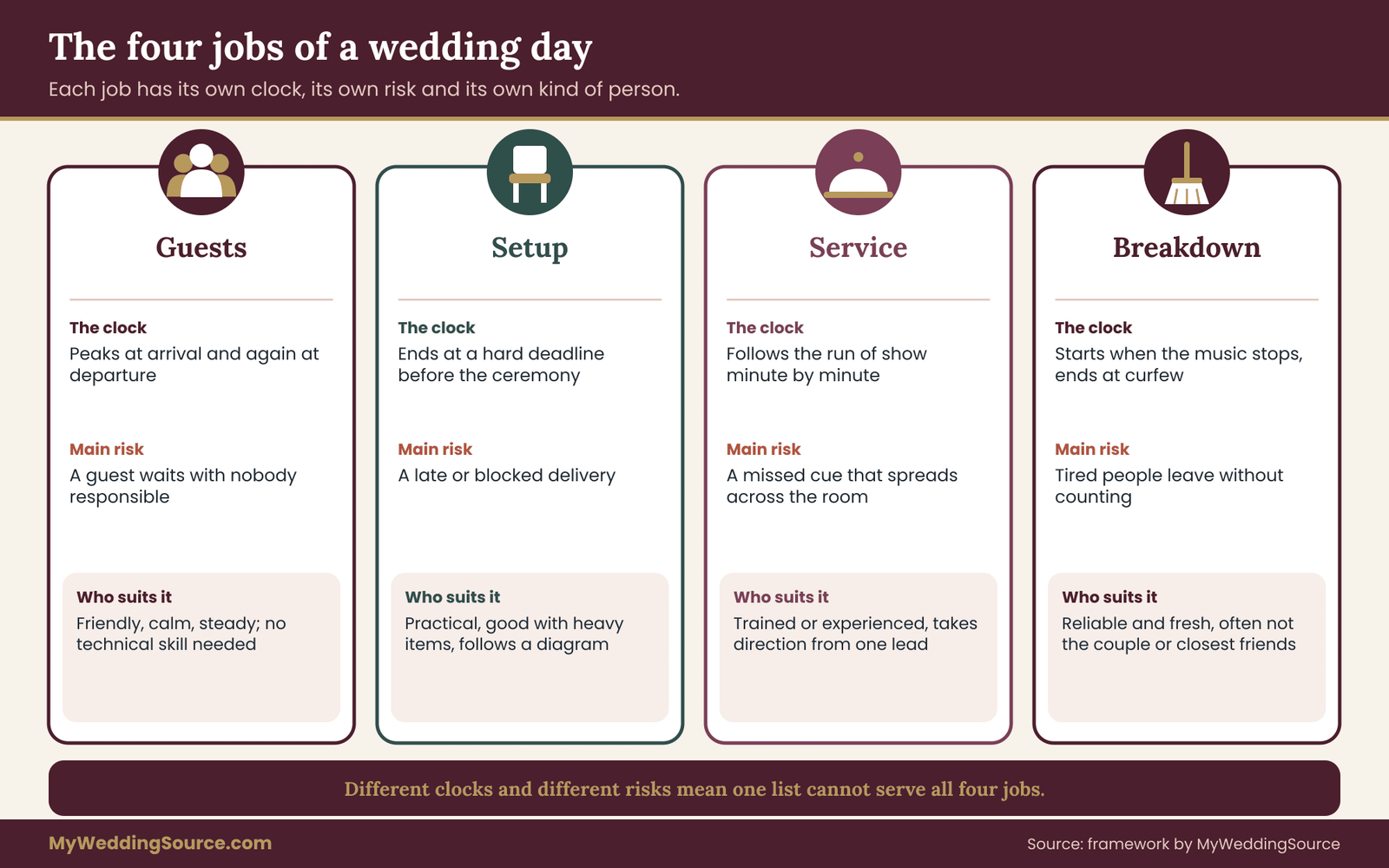
The title question divides the day into four jobs, and the division is useful because each job has a different clock, a different kind of risk and a different set of people who are naturally suited to it.
Guests. This job covers everything where a human being is helped, informed or kept safe: arrival, parking, directions, greeting, seating, accessibility, children, older relatives, questions, lost items, and the quiet handling of anything awkward. Its clock follows the guests, which means it peaks twice, at arrival and at departure. Its main risk is that a guest is left waiting with nobody responsible. People who suit this job are friendly, calm and steady, and they do not need technical knowledge.
Setup. This job covers load-in, installing décor and rentals, checking the room against the wedding staffing plan, positioning signs and finishing details. Its clock is set by the venue’s access window and by vendor delivery times, and it ends at a hard deadline, usually doors or the start of the ceremony. Its main risk is a late or blocked delivery. People who suit this job are practical, comfortable with ladders and heavy items, and willing to follow a diagram.
Service. This job covers food, drink, cake, music cues, transitions between spaces, vendor coordination during the event, and the handoffs that keep the evening moving. Its clock is the run of show. Its main risk is a missed cue or a service stall that spreads across the room. People who suit this job are trained or at least experienced, and they take instruction from a single lead.
Breakdown. This job covers clearing, packing, returning rentals, securing gifts and valuables, leftovers, trash, and the final walk with the venue. Its clock starts when the music stops and ends at a curfew or a contract deadline. Its main risk is that tired people leave things behind or leave without counting. People who suit this job are reliable and not too tired to count, which often rules out the couple and their closest friends.
Each of the next sections takes one of these jobs apart. Before that, the wedding staffing plan needs a count of who is actually available, because a ledger of tasks with no people attached is only a wish list.
Count the people who will really be there
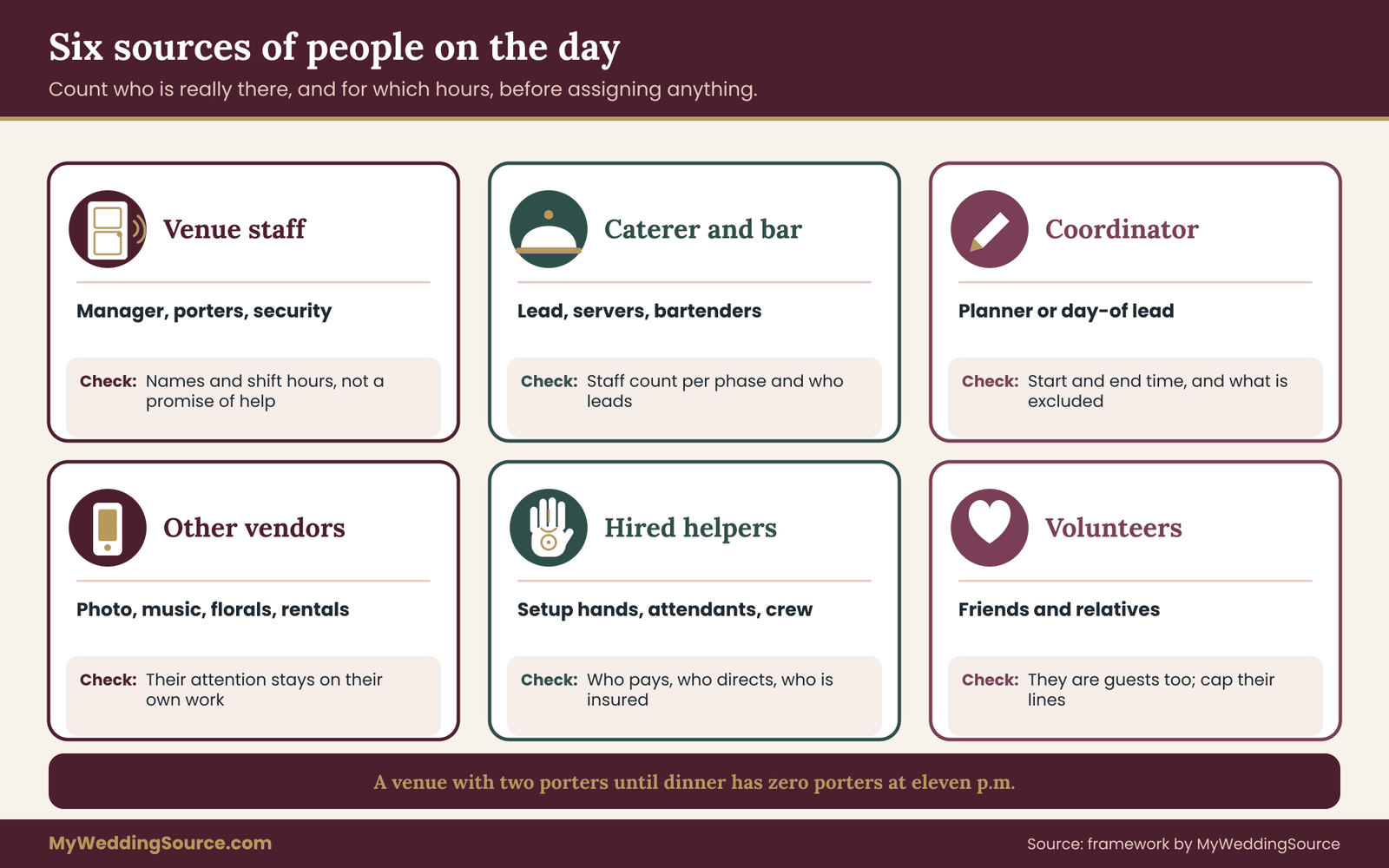
A wedding staffing plan starts with an inventory, not a wish list. Write down every person who will be on site and doing work at any point, grouped by who controls their time. The grouping matters because the couple can only direct some of them.
Venue staff. These are the people who work for the site: a manager, porters, security or a maintenance contact. They know the building, the loading route and the house rules. They answer to the venue, not to you, so what they do is set by the venue agreement and by their own supervisor. Ask for names and shift hours, not just a promise that “our team will help.”
Caterer or bar staff. Servers, a captain, bartenders, kitchen staff and sometimes a rentals driver. They answer to the caterer’s lead. Their scope is usually written as a ratio of staff to guests plus a service style. It rarely includes tasks outside food and beverage, so asking a server to move a centerpiece may be a favor, not a duty.
Planner or day-of coordinator. If you have one, this person is the natural owner of the matrix on the day. Their scope varies widely. Some run the whole event from setup to breakdown, and some only manage the ceremony and the first hour. Read what the agreement actually says.
Other vendors. The photographer, videographer, DJ or band, florist, rental delivery crew and transportation company each bring people. Their attention is on their own deliverable. A florist can be asked to remove ceremony flowers at a set time because it is their product. A florist cannot also be the person who greets late guests.
Hired helpers. Hourly workers or temporary staff you or a vendor engage directly, such as extra setup hands, a parking attendant or a guest-services person. They fill gaps, and they come with employment questions covered later in this article.
Volunteers. Friends and relatives who offered. They are generous, flexible and often emotionally invested. They are also guests who want to enjoy the wedding, and the wedding staffing plan has to protect that.
Once the groups are listed, write a number beside each one for each phase: how many people, from what time to what time. A venue that provides two porters from 8:00 a.m. to 2:00 p.m. provides zero porters at 11:00 p.m. A caterer with eight servers during dinner may have three during cleanup. This hour-by-hour headcount is the real supply. The tasks come next, and the wedding staffing matrix connects the two.
A short example of why the hour matters. A couple assumed the venue’s two porters would break down the ceremony chairs after the cocktail hour so the ballroom could open for dancing. The venue agreement said porters were on site until the end of dinner service, not through the evening. The chairs stayed where they were until a groomsman and two cousins stacked them in dress shoes. Nobody was careless. The supply of people was assumed instead of counted.
The coverage and accountability matrix, explained
Here is the framework this guide uses. It is a ledger with one line per task, and each line answers six questions. You can keep it in a notebook, a shared document or a printed set of sheets. The original name for the tool is the coverage and accountability matrix, and the rules for it are short enough to memorize.
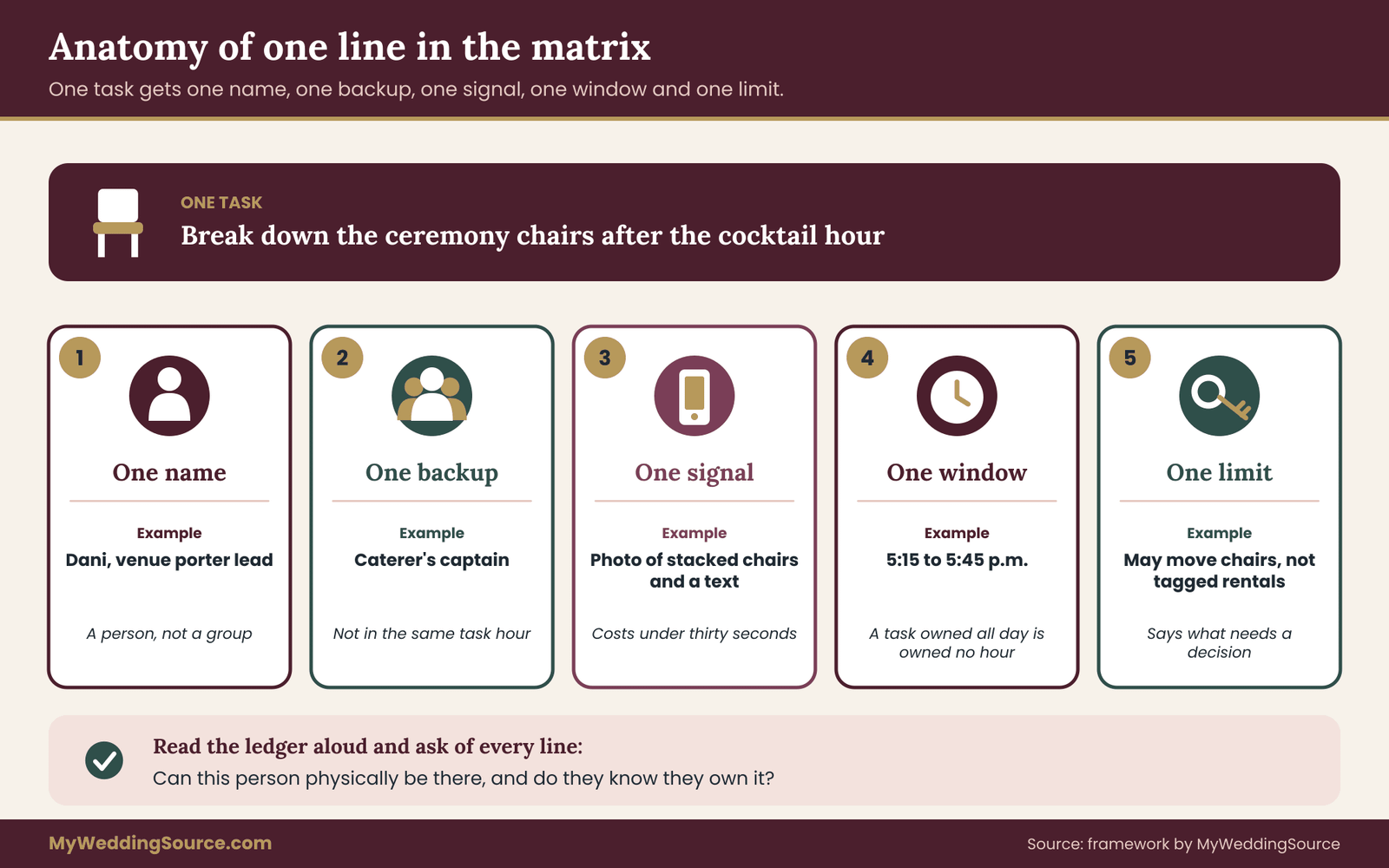
One task, one line. A line is a single action that can be finished. “Guest experience” is not a line. “Greet arriving guests at the curb and point them to the check-in table” is a line.
One name. Every line has exactly one owner. The owner is a person, not a role, and not a group. If a friend owns it, the friend’s name goes down. If the owner is whoever is on shift for the caterer, the caterer’s lead is the name and the lead assigns it.
One backup. Every line has one person who steps in if the owner is stuck, late or ill. The backup must be able to reach the owner and must not own another task at the same hour. If the owner and backup are both in the processional, the backup is not a backup.
One signal. Every line has one way the owner shows the task is complete: a text with a single word, a photo, a check mark on a shared sheet, or a spoken report to the coordinator. The signal is chosen in advance and costs less than thirty seconds. The signal turns “I think it’s handled” into “it’s handled.”
One window. Every line has a start and a finish. A task owned for the whole day is owned for no hour.
One authority limit. Every line states what the owner may decide alone and what must go to a named person. For example, the owner of “fix guest seating mix-ups” may swap two seats at the same table, and anything that changes table counts goes to the coordinator.
Together these are the one-name, one-backup, one-signal rule with a window and an authority limit. Take the example above and write it as a line: task is “break down ceremony chairs”; owner is the venue porter lead, named Dani; backup is the caterer’s captain; signal is a photo of the stacked chairs and an all-clear text; window is 5:15 to 5:45 p.m.; authority is that Dani may move chairs to the storage area but may not touch rentals tagged for return. Every piece of information that a stranger would need is on that one line.
The matrix is built in three passes. First list tasks by phase. Second, assign names using the people inventory, and mark overlaps where one person holds two lines in the same hour. Third, read the whole ledger aloud with the coordinator and ask of every line: can this person physically be there, and do they know they own it?
Setting up the ledger without making it a second job
A ledger that takes forty hours to write will not be written. The aim is a matrix short enough that people read it and detailed enough that nobody has to guess. These rules keep it short.
Write at the level of a delegation, not a script. If an experienced person would know how to do the task, the line only needs the task name, owner, backup, window and signal. Detail goes in only for tasks that depend on local knowledge, such as which door the catering truck must use.
Group routine lines. “Restock restrooms” can be one line with a window of every thirty minutes, as long as one person owns it. Do not write twelve lines for twelve restock checks.
Put the wedding staffing ledger where people will see it. A person reads a one-page printed sheet in their pocket more than a link they must find. For a small wedding, one printed page per owner, listing only their own lines, is better than a master sheet. For a large wedding, the coordinator holds the full ledger and each owner has a personal page.
Keep a short “decisions needed” list. Any line that cannot be assigned yet goes onto this list with a date. Unassigned lines are the most useful information in the wedding staffing matrix, because they show where a hire or a favor is still needed.
Review it three times. Once when the main vendors are booked, once at the final headcount, and once in the last week. The third review is the one that catches a changed arrival time or a vendor swap.
A note on who should write it.
If there is a planner or coordinator, they should draft the ledger, and the couple should review and sign off on the lines that involve their own families, because that is where sensitivities are. If there is no planner, a trusted, organized friend who is not in the wedding party writes the draft, and the couple reads it. The couple should not own more than two or three lines on the day. If the matrix shows them as the owner of ten tasks, the wedding staffing matrix has failed before the wedding starts.
The wedding staffing ledger also becomes the basis for vendor conversations. When you see that no one owns “guide the catering truck to the service entrance,” you can ask the venue manager who does it, and put the answer in the vendor agreement. The wedding vendor contract guide describes how to add scope notes like this one to an agreement so that the expectation is written down in a place both sides will see.
How to decide how much staffing coverage is enough
“How many people do we need” has no single answer, but it has a method. Instead of starting from a headcount ratio, start from the busiest ten minutes of each phase and ask what must happen at the same time.
For guests, the busiest period is arrival. Count how many separate things have to happen in the first fifteen minutes: parking directions, greeting, handing out programs, escorting people with mobility needs, answering the question “where is the restroom.” If three of those happen at once, you need three people, not one.
For setup, the busiest period is the last hour before doors. Count how many areas still need work: ceremony space, reception tables, bar, cake, signs, sound check. Each area needs one owner, and the owners cannot be in two rooms.
For service, the busiest moment is usually the first course or the cake cutting, when food, drink, photography and music all converge. Ask the caterer to describe what each server is doing in that window, and compare it with their written ratio.
For breakdown, the busiest period is the first thirty minutes after the last guests leave, when décor, rentals, gifts and trash all need attention.
Peak-based wedding staffing prevents the usual error of averaging. A wedding with an average of one helper per twenty guests can still be badly staffed at the single moment when sixty guests arrive within ten minutes. The ledger exposes this, because it puts several lines in the same window and shows that one name appears on all of them.
Not every gap needs a hire. Some can be closed by moving a task to a different hour, merging two tasks into one, or removing a task. If the matrix shows that three people are needed to hand out programs at the same moment guests also need directions, one answer is to place the programs on the seats ahead of time. The best staffing decision is sometimes a design change.
Guests: who greets, guides and looks after people
The guest job is the one most often left to “the family,” and it is the one where a good wedding staffing plan makes the biggest visible difference. Guests do not see the setup or the kitchen. They see whether someone met them at the door.
Start with the guest journey and mark every point where a person might need help. Parking or drop-off. The walk to the entrance. Check-in or finding a seat. Restrooms. Coat or bag storage, if offered. The move from ceremony to cocktail hour. Finding a table. Getting food when there are dietary needs. Leaving. Each of those points is a candidate line in the wedding staffing matrix. The guide to reception guest flow covers how to design the movement itself, and the wedding staffing plan then puts a name on each point where movement can stall.
Arrival and greeting. Assign one greeter at the main entrance who is not a family member with a tight emotional schedule. A greeter should know the program start time, the location of restrooms, where accessible entrances are, and who to call about a problem. Give the greeter a one-line script, such as: “Welcome, the ceremony starts in the garden at four, restrooms are through the lobby on your left, and I can walk you there.” A script keeps tired volunteers from improvising wrong information.
Accessibility support. Name one person, with a backup, who owns support for guests with mobility needs, including wheelchair routes, seating near aisles, and rides between areas. This person should walk the routes beforehand with the venue manager, so that they know which door is level and which elevator is reserved. The U.S. Department of Justice publishes accessibility guidance through ADA.gov, and the venue agreement should state which entrances and restrooms are accessible. If you are unsure, the venue technical walkthrough shows how to measure and confirm routes before the day.
Children and older relatives. Each child under a certain age should have a named adult on duty, and the wedding staffing plan should say whether that adult is a parent, a hired sitter or a relative. Older relatives who need a seat close to a restroom or an early ride home should be matched to a named helper in advance. Do not leave either group to a general promise that “someone will keep an eye out.”
Questions and small emergencies. Pick one “question person” who has a phone, the run of show and the coordinator’s number, and who is not in any photo or procession. Guests will find that person if they are visible and wearing something recognizable, such as a colored ribbon. Their authority is to answer, to solve small problems like finding a phone charger or a bandage, and to escalate anything larger.
Quiet handling of awkward moments. An intoxicated guest, a family disagreement, an uninvited visitor. These need a named person who does not draw attention. The owner is usually the coordinator, with the venue manager as the backup for matters that involve safety or removal. The couple should not be told in the middle of the event unless it is truly their decision.
Departure. The end of the night is another peak. Rides, lost items, farewells, leftover favors and the last drink. Assign one person to stand at the exit with the ride plan, and one to collect forgotten belongings into a labeled container.
For a small wedding of thirty or fewer guests, one person can own several of these lines as long as the wedding staffing matrix confirms they never fall in the same window. For a large wedding, the guest job may need its own lead who briefs a small team.
Setup: load-in, installation and inspection
Setup is the job with the most hard deadlines and the fewest spectators, which makes it the one where a wedding staffing plan prevents quiet disasters. The goal is that the room matches the wedding staffing plan by the time guests walk in, and that someone other than the person who built it has looked at it.
Break setup into three stages. Load-in is getting items into the building. Installation is putting them in place. Inspection is checking that they are right and safe.
Load-in. Every vendor with a delivery needs a time window and an entrance, and the wedding staffing matrix needs one person who owns the loading door. At many venues that is the venue manager or a porter. At a site without staff, it may be a hired helper or a friend who is not otherwise involved. The load-in owner confirms the route, keeps the door open, and handles two questions: where does this go, and is the path clear. Ask the venue about freight elevators, dock hours and floor protection, since these decide how many hands load-in actually needs.
Installation. Most professionals install their own work: the florist places arrangements, the rental company sets chairs and tables, the lighting vendor rigs fixtures, the DJ builds the sound system. The couple’s own items are different. Signs, programs, favors, a guest book, family photos and handmade decorations belong to nobody unless the wedding staffing matrix names an owner. Write one line per group of items, such as “place table numbers and menus by 3:30,” and give it to one person with a diagram.
The diagram. A single floor plan that shows tables, signs, the cake, the gift table, the bar and the exits is the most useful setup tool. Give a printed copy to each installer. A volunteer with a diagram can place thirty centerpieces correctly. A volunteer with only a verbal description will make thirty small guesses.
Inspection. The person who builds something should not be the only one who inspects it. Assign an inspector who walks the finished room with the diagram, checks that nothing blocks an exit, that candles and cords are safe, that table counts match the seating plan, and that every sign is spelled correctly. A planner or the venue manager usually serves best. A trusted friend with a keen eye also works.
Final check and handover. Fifteen minutes before doors, the inspector reports to the coordinator, who confirms with a one-word signal that the room is ready. The couple should not be asked to inspect the room. They are the audience for it.
What to do when setup runs late. The matrix should include a rule for the tight case. For example: if setup is not complete by thirty minutes before the ceremony, the coordinator notifies the couple’s point person, and the owners of lowest-priority lines, such as the favor table, are told to stop. A decision made in advance spares anyone from choosing under stress.
Setup staffing often depends on contract terms about access time. If the venue allows only a two-hour window and you need three, the issue is not staff, it is a missing hour, and the fix is a conversation with the venue before signing. The wedding vendor timeline shows how to work backward from the ceremony to find the real deadline for each delivery.
Who should not be on the setup list
A staffing plan also needs a short list of people who should be kept off setup. The aim is not to exclude anyone, but to protect them.
The couple and their parents should not be setting up on the morning of the wedding if it can be avoided. Hair, makeup, photographs and a calm breakfast need that time, and fatigue before the ceremony is a real cost. The same goes for attendants who must be dressed and photographed early.
Guests who have traveled from out of town should not be asked to work, even if they volunteer. A wedding is a long day for them as well, and asking a guest to carry boxes turns an invitation into a favor.
People with a physical limitation should not be assigned heavy lifting, even if they offer. Instead, give them a seated or supervisory line, such as checking place cards against a list.
Children should not be assigned any task that involves ladders, candles, cords or vendors’ equipment. A child can hand out programs. A child should not be near a lighting rig.
When someone offers to help and the wedding staffing matrix has no suitable line, thank them and offer a different role, such as taking photos of the setup, or tell them honestly that the day is already covered. Having a clear reason in the wedding staffing matrix makes this conversation easy: “The ledger is full, but we would love you to enjoy the day.”
The result is a setup crew made of professionals for heavy and technical work, a few reliable helpers with clear instructions for the couple’s own items, and an inspector who confirms the room. That crew is smaller than most couples expect, and it fits on a single page.
Service: food, drink, cues and transitions
Service is where the wedding staffing plan meets the run of show. It covers the work that happens in real time while guests are present: serving, pouring, cueing music, moving people from one space to another, handling vendors who need to be in the right place at the right moment, and keeping the evening on schedule.
The catering team holds most of this job, and the first step is to understand what they have actually agreed to do. Ask the caterer for four things in writing: how many staff will be present at each phase, what service style they are using, what tasks are included beyond food and beverage, and who the on-site lead is. The lead’s name goes in the wedding staffing matrix as owner of the lines that concern kitchen timing, course pacing and service staff. If the caterer cannot name the lead, that is a finding.
Food service. The wedding staffing matrix needs a line for each of the moments where timing matters: when the kitchen fires the first course, when dietary meals go out, when the toast happens and servers pause, when dessert is served, and when late-night food arrives. The owner is the caterer’s lead, but the signal goes to the coordinator, so that the DJ and photographer hear that dinner is starting. Dietary meals deserve a separate line with a named server for each special meal, since an allergy mix-up is one of the few service errors that can hurt a guest.
Bar service. Bar staff have their own rules about identification, service limits and closing times. The matrix should show who the lead bartender is, who may stop service for a guest, and who makes the final call to close the bar. The wedding bar service planning guide covers lines, ice, stock and nonalcoholic options in more depth. The wedding staffing plan only needs to ensure that one name owns each decision.
Cues. Cues are small signals that pass between people: the DJ is told the couple is ready for the first dance, the photographer is told the cake is about to be cut, the band is told the toast is next.
Each cue needs one sender and one receiver. A frequent failure is that nobody sends, because every person assumes someone else already did. The coordinator usually owns cues, with a backup who has the same copy of the run of show. For the ceremony itself, the ceremony cue sheet describes how to lay out officiant, music and processional timing.
Transitions. Moving from ceremony to cocktail hour to reception involves more people than any other part of the evening: guests who need guidance, rental crews who flip a room, servers who set up the bar, and musicians who change position. Each transition needs one lead who stands at the point where the traffic splits and tells people what is next. If a space is being reset while guests are nearby, assign someone to keep guests out of the reset area.
Vendor care. People who work long shifts need water, food and a place to sit. Vendor meals are usually a line in the contract. The wedding staffing matrix should state who tells vendors when and where they eat, so that the photographer is not eating at the moment of the toast and the DJ is not leaving the booth during the first dance.
Photographer and videographer coordination. These vendors need access to certain moments and certain places. The matrix should name one person who escorts the couple and family to the photo area and who knows the family photo list, so that the photographer does not have to chase relatives. This role is frequently handed to a relative, and it is a good fit as long as the relative is not also the mother of the bride and has someone to replace them for a few minutes.
Music and sound. The DJ or band typically owns the audio equipment, but someone else must own the decisions about volume complaints, the end of the night and last-song timing. If the venue has a sound limit, the wedding staffing matrix should say who monitors it and what happens when it is exceeded.
Staff breaks, long shifts and the service gap
A service team that works through a long evening needs a break schedule, and the wedding staffing plan should not ignore it. If every server takes a break during the same quarter hour, the room is under-covered. If nobody takes a break, the team slows down by the end of the night.
Ask the caterer how they handle meals and rest periods for their staff. A responsible company will have a schedule. What you need to know is when the thinnest coverage occurs and who is in charge during it. If the lead steps out for a meal, the wedding staffing matrix should name who acts as lead.
The same applies to volunteers. A friend who owns three lines for six hours is not a volunteer, that friend is an unpaid employee with no break. Cap volunteer lines at a number that leaves time for dinner, a dance and a conversation. A useful rule is that no volunteer owns more than two lines in the same ninety-minute period, and no volunteer owns a line during the meal or the first dance unless they have chosen to.
For wage and break rules that apply to paid staff, the U.S. Department of Labor Wage and Hour Division publishes the federal baseline, and many states add stricter rules. The article does not interpret these rules, and the vendor or employer who pays staff is responsible for following them. What the couple controls is the schedule they ask for. A plan that demands a nine-hour shift with no break from a small caterer creates a wedding staffing problem and possibly a legal one for that vendor.
Breakdown: clearing, returning and closing out
Breakdown is the job that nobody wants, and it is when a wedding staffing plan most often fails because the people who care about the wedding are already gone or too tired to count. A plan that treats breakdown as an afterthought will leave items behind, create disputes about missing rentals, and push a stressful chore onto relatives at midnight.
Divide breakdown into five lines of work.
Personal items and valuables. Gifts, cards, the guest book, the cake topper, family heirlooms, the couple’s clothes and anything sentimental. One person, who is trusted and sober, owns collecting these into a single labeled container or vehicle. The wedding staffing matrix should say who that person is, where the items go, and who has the key. Cards with cash or checks need particular care. Plan for them to leave with someone responsible and not stay on a table.
Vendor property. Each vendor is responsible for taking their own items: the florist’s vases, the rental company’s linens, the band’s gear. The matrix should assign one person, usually the venue manager or coordinator, to confirm that each vendor has signed off or left. Do not assume that a vendor who left early took everything. A count against the rental order is the only proof.
Rentals and returns. Items from the rental company are typically counted and returned by the vendor, but some arrangements make the couple responsible for stacking, sorting or returning. The rental planning checklist covers what to ask. The wedding staffing matrix should give one owner for the count at the end of the night and one for the return on the following day if the couple is involved.
Venue handoff. The venue manager typically does a walk-through at the end. The matrix should name the person who attends it and who has the authority to sign. That person should not be the bride or groom. The walk-through checks for damage, trash, items left behind and any deposit deductions, and it is easier to settle an issue on the spot than weeks later.
Trash, food and leftovers. Decide beforehand what happens to leftover food, flowers and décor. A food donation requires planning and a named driver. Flowers might go home with guests or to a nursing home. Décor might go to a family member. Without a decision, the default is the dumpster.
The curfew. Many venues have a hard stop. The wedding staffing matrix should state the time the music ends, the time guests must leave, and the time the last staff must be out. Working back from that time gives the actual start of breakdown, which may be thirty minutes earlier than the couple thinks. The wedding staffing plan only needs the times, and the venue agreement is where they are fixed.
Breakdown wedding staffing is where hired help makes the largest difference for the least money, because the work is physical, predictable and short. Even two paid helpers for ninety minutes can replace a dozen relatives who are exhausted and would prefer to be at the after-party.
Hire, volunteer or rely on vendors: choosing the source for each wedding staffing line
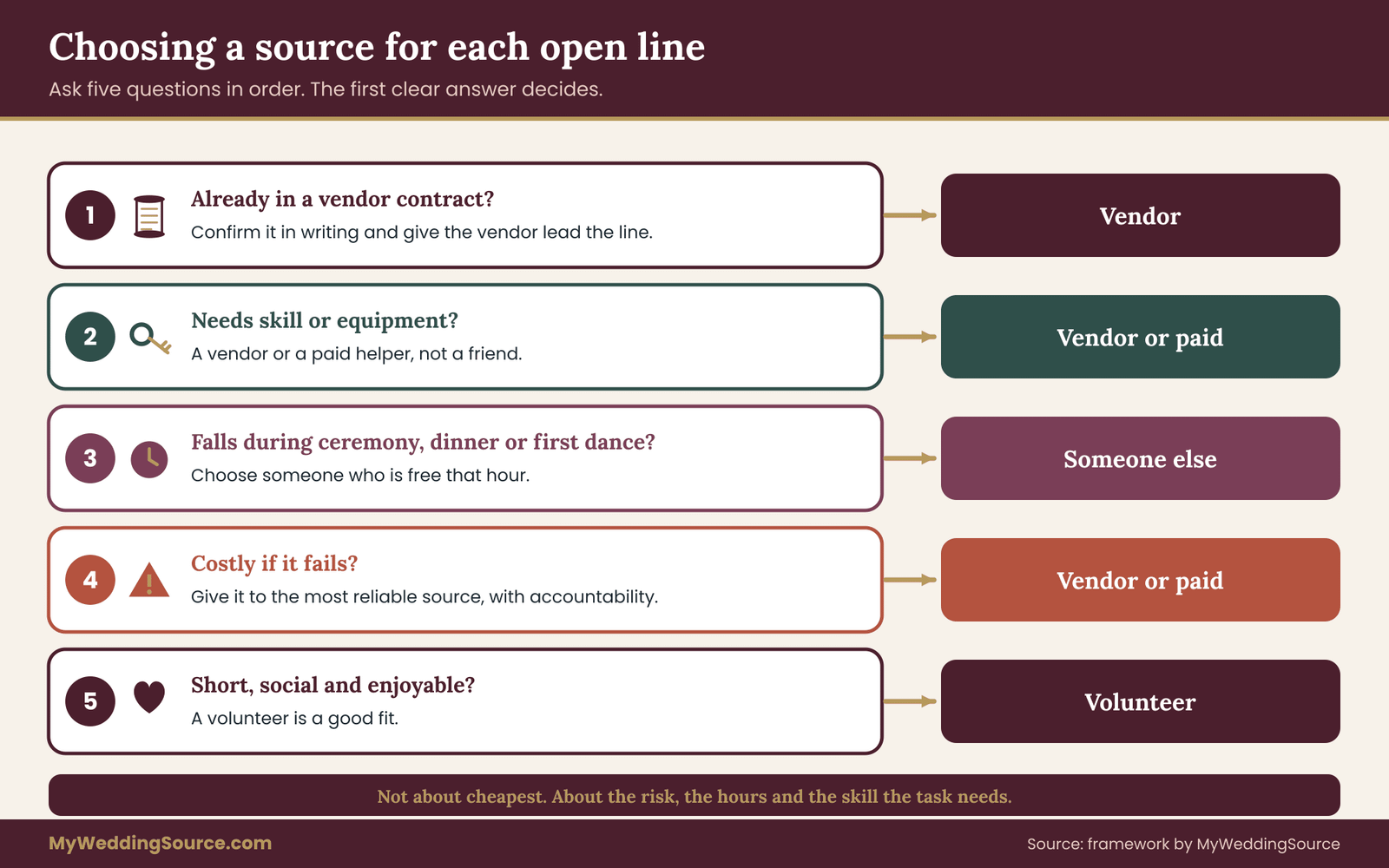
Once the tasks exist and the people are counted, the wedding staffing matrix will show lines with no good owner. Each of those has three possible sources: a vendor already on contract, a volunteer, or a paid helper hired for the purpose. The choice is not about which is cheapest. It is about which source fits the task’s risk, hours and skill.
Vendor-provided coverage is best when the task is part of the vendor’s own deliverable or when they already have staff on site. The rental company’s crew can handle the count and return of rentals. The caterer’s lead can manage service staff. Their scope should be written in the agreement, since a verbal promise from a sales call is not a wedding staffing assignment. If a task is outside their scope, adding it may cost extra or be refused, and it is better to learn that at booking than on the wedding day.
Volunteer coverage is best for tasks that need familiarity with the people more than skill: greeting relatives, escorting an older guest, carrying a gift box, holding a baby for a minute. It works when the task is short, when the volunteer wants it, and when they can still enjoy the event. It works poorly for tasks that are physical, long, technical or tied to a hard deadline. It also works poorly for tasks that put a friend in conflict with a vendor or a guest, such as asking someone to leave.
Paid helpers are best for predictable, physical or time-bound work that nobody in the wedding should be doing: extra setup hands, a parking attendant, a breakdown crew, a guest-services person at the entrance. You pay for reliability and for the helper’s willingness to follow instructions from a stranger.
Use these questions in order, line by line.
- Is this task part of a vendor’s contract already? If yes, confirm it in writing and give the vendor’s lead the line.
- Does it require skill, training or equipment that a volunteer would not have? If yes, a vendor or a paid helper, not a friend.
- Does it fall in a time when the volunteer would otherwise be in the ceremony, photographs, dinner or the first dance? If yes, choose someone else.
- Is the cost of failure high? A missed cue costs a minute. A missed rental count costs a deposit. An unattended child costs far more. High-cost lines go to the most reliable source, and volunteers with no accountability should not hold them.
- Is the line short, social and enjoyable? If so, a volunteer is a good fit.
The questions are not exact, but they move decisions from instinct to reasoning, and they give you a sentence to explain a choice to a relative who was hoping for a role.
Paying people for wedding work: what to check without guessing at law
When a wedding staffing plan includes paid helpers, the couple becomes a client, an employer or something in between, depending on how the person is engaged. The rules about this are set by federal and state agencies, and this article does not give a legal conclusion. It describes the questions to ask and where to read the rules.
Who pays and who directs. The simplest arrangement is that a vendor, such as the caterer, the planner or a wedding staffing agency, supplies the helper and takes responsibility for pay, insurance and scheduling. You pay the vendor’s invoice. In that case the vendor’s contract should state that their staff are covered by their own policies and that they handle supervision. If you engage an individual yourself, you are in a different position, and the questions below matter more.
Worker status. The U.S. Department of Labor explains how it distinguishes employees from independent contractors, and that status affects who owes wages, taxes and insurance. The IRS publishes its own guidance on the same subject. The rules are not decided by what you call the person, and they differ by state. If you plan to hire individuals directly, read the agency pages and, if the situation is unclear, ask a qualified professional in your state.
Wage and hour rules. Paid workers are generally covered by wage rules, which include minimum pay, overtime and, in some states, meal and rest breaks. For short, informal help, the details can still apply. Check the Department of Labor and your state labor agency for current rules and thresholds, and do not rely on a friend’s recollection or an old forum post.
Insurance and injuries. Ask what happens if a helper is hurt carrying a table. A vendor’s policy may cover their own employees. A volunteer relative or an individual you hire directly may fall outside any policy. Some venues require every person who works on site to be covered by a policy and to appear on a certificate. The due diligence questions earlier in this guide include coverage, and you can ask the venue directly what it requires of anyone who works on its grounds.
Safety. The Occupational Safety and Health Administration publishes general guidance on lifting, heat exposure, ladders and electrical hazards. These apply to wedding work as they do to any physical work. For outdoor weddings in summer, heat is a particular concern for setup and breakdown crews, and the wedding staffing matrix should include water and shade for them.
Volunteers and gratuities. A thank-you gift for a friend who helps is ordinary. Paying cash to a friend who works a long shift may raise the same questions as paying anyone else. Gratuities for paid staff are a separate subject; the contract and the caterer’s policy usually say whether a service charge is already included.
Written confirmation. For any hired helper, write a short confirmation that lists the date, start and end time, the tasks, the rate, who supervises, how and when they are paid, and who to call if they cannot come. Share it with them. A written note also shows the helper that the job is real, which improves reliability.
None of this requires fear. It requires reading a few agency pages once, choosing arrangements that put responsibility with a business that is set up to carry it, and avoiding verbal side deals that leave nobody sure of their obligations.
A worked case: one wedding staffing plan, start to finish
The example below is invented for illustration. It does not describe a real couple, and the numbers are chosen to show the method, not to suggest what any wedding needs. Call the couple Maya and Tomas. They are marrying at a historic hall with a garden for the ceremony and a hall for the reception, with about a hundred and twenty guests.
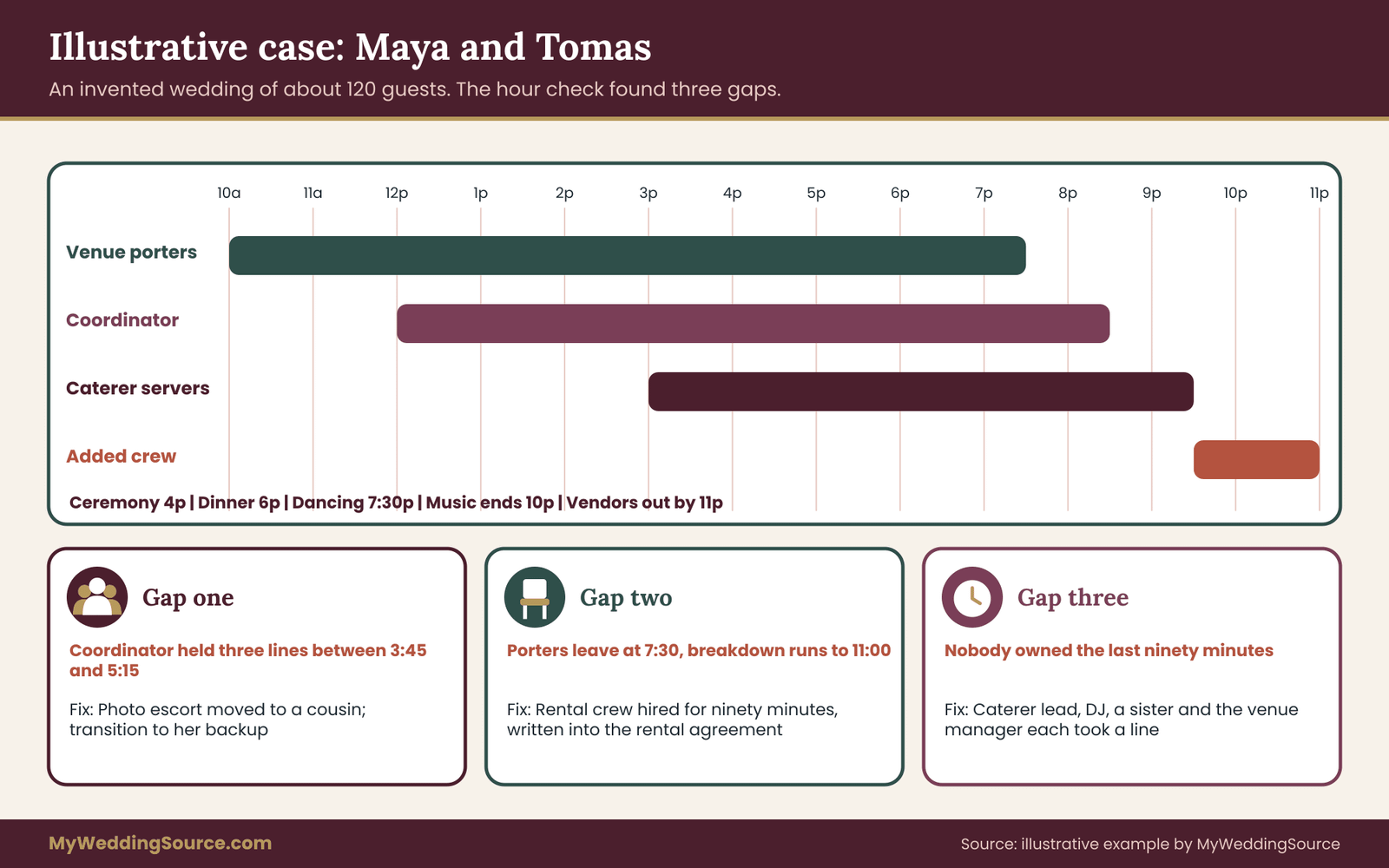
The day as booked. Ceremony at 4:00 p.m. in the garden. Cocktail hour at 4:30 on the terrace. Dinner at 6:00 in the hall. Dancing from 7:30. Music ends at 10:00, and guests leave by 10:15. The venue requires all vendors out by 11:00.
The supply. The venue provides a manager for the whole day and two porters from 10:00 a.m. to 7:30 p.m. The caterer provides a lead, seven servers and two bartenders, with servers on site from 3:00 until about 9:30. The couple hired a day-of coordinator who works from noon to 8:30 p.m. A photographer, a DJ, a florist and a rental company are booked. Six friends volunteered.
First pass: the ledger. Maya and Tomas, with the coordinator, listed forty-one tasks across the four jobs. They wrote one name, one backup, one signal and one window on each line. Then they read the wedding staffing ledger by the hour and marked every place where a name appeared twice at the same time.
What the hour check showed. Three problems appeared.
First, the coordinator owned the ceremony cues, the family photo escort and the transition to the reception, all between 3:45 and 5:15. She cannot be in three places. The fix was to move the family photo escort to Tomas’s cousin, who is not in the ceremony party and has the photo list, and to give the coordinator’s backup the transition line.
Second, the porters left at 7:30. Every breakdown line from 10:00 to 11:00 depended on them. The venue manager confirmed that porters could stay until 11:00 for an additional hourly fee, which the couple declined. Instead they hired two helpers from the rental company’s own crew, who were already scheduled to return for pickup, for ninety minutes of breakdown. Their line was written in the rental agreement.
Third, the coordinator leaves at 8:30, and nobody owned the last ninety minutes. The caterer’s lead took the bar-close decision, the DJ took the last-song timing, and Tomas’s sister, who does not drink and volunteered, took “gift and card collection” with a backup. The venue manager took the final walk-through. The couple were told that they owned none of these lines.
The greeters and guests. One volunteer owned the curb greeting from 3:15 to 4:00 with a one-line script and a ribbon. A second volunteer, a retired nurse who is Maya’s aunt, owned accessibility support for two guests with mobility needs, after she and the manager walked the route together. She asked for a seat near the garden path, and her backup was a cousin.
The signals. Each owner had a one-word text signal to the coordinator’s phone, and from 8:30 to the venue manager’s phone. A group message was avoided, because a group message becomes noise.
The outcome was not a perfect day, because no wedding is. What changed was that when the cake knife was missing at 7:20, the wedding staffing matrix showed that the cake line belonged to the caterer’s lead, the backup was a server, and the knife was in the rental box that the signal had not confirmed. It was found in four minutes. The couple heard about it the next day.
What to take from the worked case
Three lessons from the example apply to almost any wedding. The first is that the hour check finds more problems than the task list does. The second is that most fixes were changes of timing or ownership, not additional people. The third is that the couple ended the exercise owning fewer lines than they began with.
A second case, shorter, shows the same method at the other end of the scale.
A couple marries in a backyard with thirty guests and no caterer staff, only a food truck. Their ledger has fifteen lines. Setup is done the day before by two friends who are given a diagram. On the day, one friend owns greeting and parking, one owns the music and cues, and the food truck operator owns food service. Breakdown is handled by the next morning’s clean-up crew, who are two hired helpers for two hours, engaged through a written note. The wedding staffing plan fits on one page, and nobody is asked to do something they would not normally do at a family party.
The method works at both sizes because it does not depend on the number of people. It depends on the questions: who, backup, signal, window, authority.
Failure conditions: how a wedding staffing plan breaks
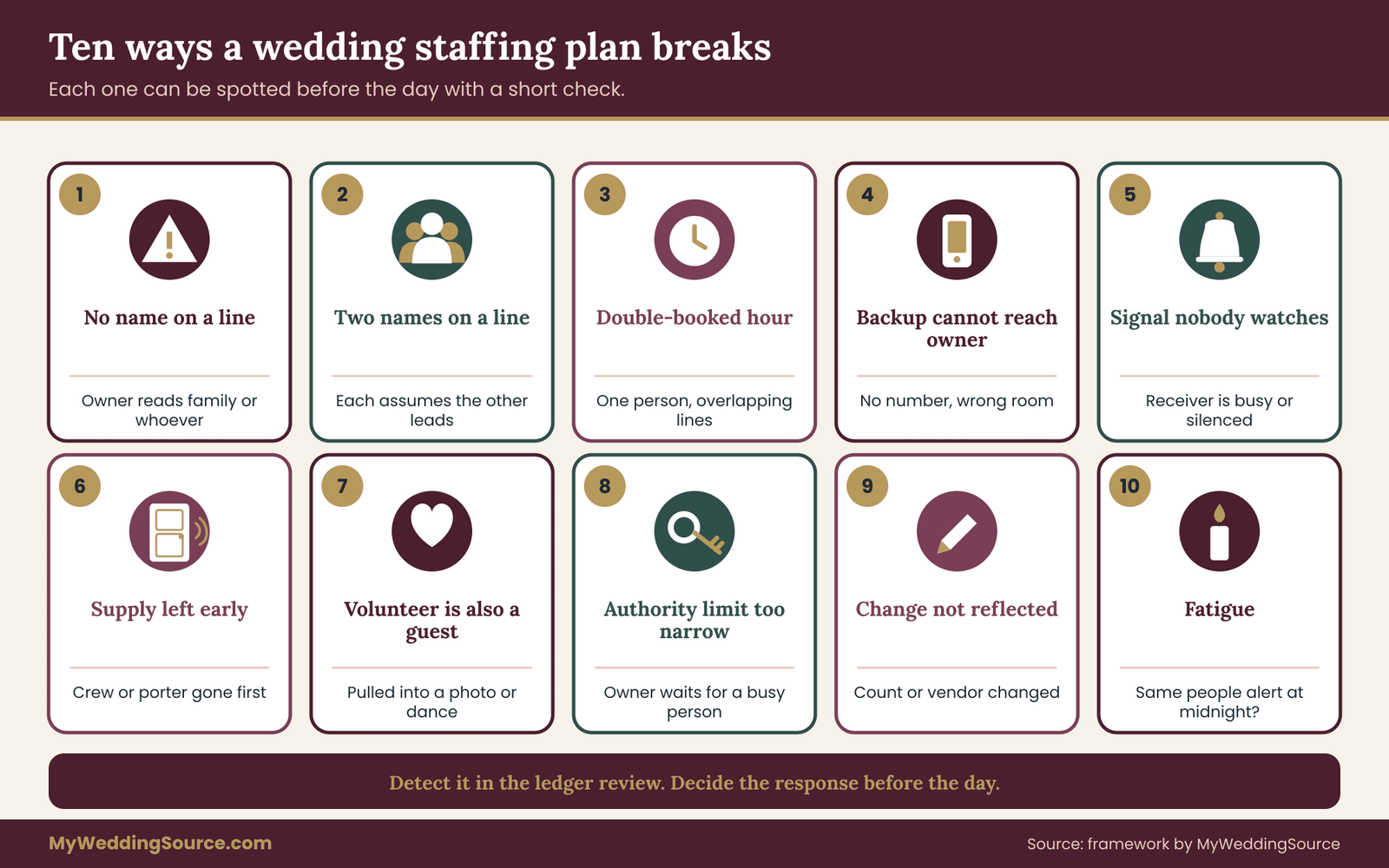
Every plan has conditions under which it stops working. Writing them down in advance turns surprises into decisions. The following are the most common failure conditions for a wedding staffing plan, each with a way to detect it before the day and a response if it happens anyway.
1. A line with no name. The task says “family” or “the venue” or “whoever is free.” Detection: read the ledger and highlight any line where the owner is not a specific person. Response: assign a name, or move the line to the decisions-needed list with a date. If the day arrives with the line still open, the coordinator takes it, and the line is marked as at risk.
2. A line with two names. Two people share a task and each assumes the other will lead. Detection: look for lines with “and” in the owner column. Response: pick one lead and make the other the backup. A shared task is a decision that has not been made.
3. A double-booked hour. The same person owns lines that overlap. Detection: sort the wedding staffing ledger by time and scan each person’s lines. Response: move one line to another person or to a different time. This is the failure condition that the worked case found three times.
4. A backup who cannot reach the owner. The backup does not have a phone number, is in a different part of the venue or does not know they are the backup. Detection: ask each backup to repeat their lines aloud at the briefing. Response: swap the backup or change the signal to something the backup can see.
5. A signal nobody watches. The owner sends a text, but the coordinator is in the ceremony or has a silenced phone. Detection: test the signal chain during the rehearsal or the final walk. Response: name a second receiver, such as the coordinator’s assistant, or a spoken signal at a specific place.
6. A supply that left early. A vendor’s crew, a porter or a coordinator ends their shift before the tasks that depend on them. Detection: compare the people inventory with the late lines. Response: move the lines, extend the shift, or hire a replacement, as the worked case did with the breakdown crew.
7. A volunteer who is also a guest. A friend with a line is pulled into a conversation, a photograph or the dance floor. Detection: ask the volunteer honestly whether the line fits their evening. Response: build in a swap, so that anyone can hand a line to the backup without guilt, and treat that swap as normal.
8. An authority limit that is too narrow. The owner cannot decide anything and so waits for someone who is busy. Detection: ask each owner what they would do if a small problem arose. If the answer is “ask someone,” the limit may be too tight. Response: widen the limit for low-risk decisions, and name who decides the rest.
9. A last-minute change that is not reflected. A guest count changes, a vendor swaps a staff member, or rain moves the ceremony indoors, and the ledger is not updated. Detection: schedule the third review in the last week and a short review after any major change. Response: edit the wedding staffing ledger first, then tell the people it affects.
10. Fatigue. The wedding staffing plan assumes the same people are alert at midnight as at noon. Detection: look at who owns the last lines of the evening and how long they have been on duty. Response: hand the final lines to people who arrive fresh, such as a paid breakdown crew, or to a volunteer who was told to pace themselves.
What to do when the wedding staffing plan fails on the day
Even a careful matrix will meet a moment it did not predict. The ledger helps then, because it tells you where the gap is and who has the authority to fix it.
When something goes wrong, the person who notices tells the owner of the line. If the owner is not there, they tell the backup. If neither responds within a few minutes, they tell the coordinator. If there is no coordinator, the couple’s point person is the final stop, and that person is not the couple. This sequence is written on each owner’s page.
The coordinator or point person decides in three steps.
First, is anyone’s safety at risk? If so, call the venue manager and, if needed, emergency services, and do nothing else until that is settled. Second, can the line be handled by moving a person or a time? Third, if not, can the task be dropped without harm? Many tasks can. A favor table that is not set up is a small disappointment. A wheelchair route that is blocked is a real problem. The ranking of lines by consequence, which the couple can agree on in advance, gives the coordinator permission to drop low-priority lines without asking.
After the event, keep the wedding staffing ledger. A short note beside each line, saying whether it worked, helps you adjust for the next event in the family, and provides a record if there is a dispute with a vendor about who was meant to do what. The same ledger can feed into the records the couple keeps after the wedding.
Briefing, signals and contract wording for your wedding staffing plan
Briefing, signals and escalation on the day
A matrix does nothing if the people on it do not know it exists. The briefing is where the wedding staffing plan becomes real, and it takes less time than most couples fear.
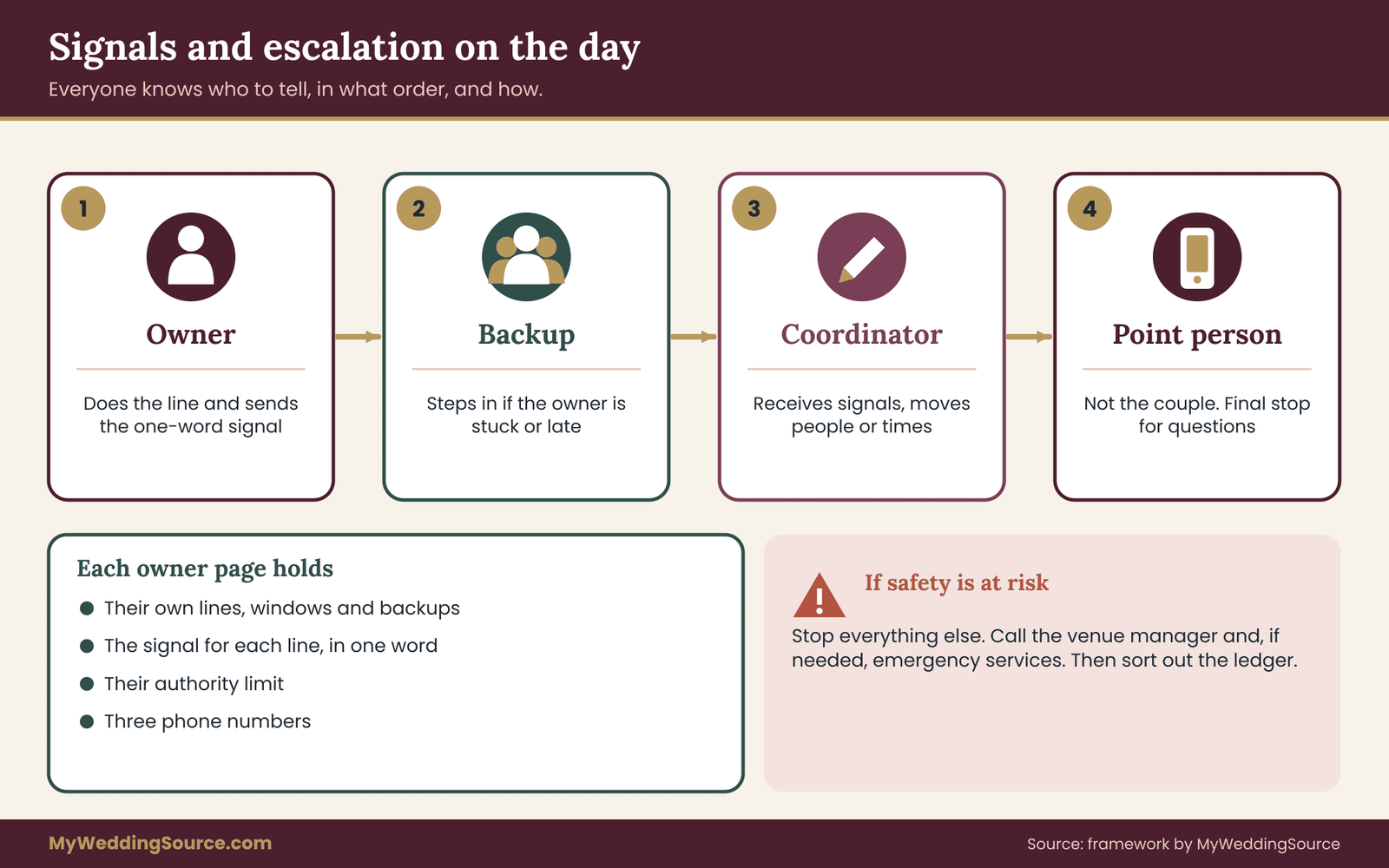
The owner page. Each person gets a single page with their own lines, windows, backups, signals and authority limits, plus three phone numbers: the coordinator, the venue manager and the couple’s point person. Print it in large type. People look at it between tasks and in poor light.
The briefing. Hold one short meeting, ideally the day before or the morning of. For a small wedding, ten minutes with the volunteers is enough. For a larger one, the coordinator holds one session for volunteers and a separate check-in with each vendor lead. At the briefing, each person reads their own lines aloud and names their backup. Reading aloud finds misunderstandings faster than any written review.
The signal channel. Choose one channel for signals, such as a single text thread with the coordinator or a set of individual texts, and say so at the briefing. Avoid a large group message that fills with congratulations and photos. If the venue has weak cell service, plan for it. A radio or a spoken signal at a set place may be needed and the signal rule should be tested on site before the day.
Escalation. Write the order of who to tell on the owner page: owner, backup, coordinator, point person. Also write a single sentence that gives each person permission to ask for help: “If you are not sure, ask the coordinator. You will not be bothering anyone.”
The couple’s point person. The couple should name a person who is not in the wedding party and who fields any questions that would otherwise reach them. This person holds a copy of the ledger and the vendor contact list. They are the reason the couple can stay out of the operation.
Vendor-facing language. Vendors are more cooperative when asked clearly. A short message works: “Your lead on the day is [name]. Please send your arrival text to [coordinator] on arrival, and tell her when dinner service starts. Our contact for anything unexpected is [point person].” A message like that sets the signal and the escalation without a long conversation.
Adding the wedding staffing plan to your contracts
Staffing assumptions that stay in a spreadsheet are only assumptions. The ones that matter should be written into the agreements, so that both sides understand them. The following items are specific to staffing.
Named lead and contact. Ask each vendor to name the person who will be on site and in charge, and a phone number for the day. If the person changes, the vendor tells you in advance.
Staff count and hours. State how many people the vendor will bring and when they will be present. A phrase such as “approximately” invites disagreement. If the number depends on the final guest count, say how.
Scope boundaries. State which tasks are included and excluded. For the caterer, say whether staff will set tables, handle rentals or clear décor. For the florist, say who removes ceremony flowers and when. For the rental company, say who counts, stacks and returns.
Access and timing. Add the load-in window, the entrance and the end time. If the venue provides staff, add the hours, so that the question “who is there at eleven” has a written answer.
Substitution. State what happens if the named person cannot attend. For example: the vendor will inform you, and will send a person of equal experience.
Extra hours. State the rate or the process for extending a shift. A coordinator who knows the cost of an extra hour can choose in the moment.
Insurance. Ask for certificates where the venue requires them, and confirm that the vendor’s insurance covers their own staff.
Do not expect every vendor to agree to every item. Many will, since the items cost them nothing. Where a vendor refuses, the matrix needs to be updated, because a line that depended on that vendor no longer has a source.
Your next steps
A wedding staffing plan is built in short sittings, not in one marathon. Here is a sequence that fits around a normal life, with the work spread across the final stretch before the wedding.
Step one: list the tasks by job. Take one sheet for each of the four jobs and write every task you can think of, in plain words, one per line. Do not assign anyone yet. Ask the planner, the venue manager and your caterer’s contact for the tasks they know happen at weddings like yours, since they will remember ones you will not.
Step two: count the supply. Make the people inventory from the earlier section. For each group, write the number of people and the hours they will be on site. Where a contract does not say, ask in writing and save the reply.
Step three: draft the ledger. Give every task one name, one backup, one signal, one window and one authority limit. Put question marks where you do not know. Those question marks become your decisions-needed list.
Step four: run the hour check. Sort the wedding staffing ledger by time and look for any person who appears twice in the same window. Move lines until nobody is double-booked. Then look at the earliest and latest hours and see who is really present.
Step five: choose sources for the open lines. For each line with no good owner, use the five questions to choose a vendor, a volunteer or a paid helper. Write the contract changes that follow, and send them while the vendors are still in the booking stage.
Step six: draft the owner pages. One page per person, with their lines, backups, signals and three phone numbers. Keep each page short enough to read in a minute.
Step seven: brief and rehearse the signals. Hold the short briefing. Ask each person to read their lines aloud. Test the signal channel once at the venue, or at the rehearsal.
Step eight: review three times. At vendor booking, at final headcount and in the final week. After any large change, review the ledger before you tell anyone else.
Step nine: keep the wedding staffing ledger afterward. Add a short note beside each line saying how it went and file the document with your other wedding records.
If you do only three things, do these. Give every task one name. Check that nobody owns two things at the same hour. Make sure the last hour of the night has an owner who is not the couple.
If the wedding staffing plan feels large, begin with the job you worry about most. For many couples that is breakdown, and for others it is guests with mobility needs. A short, honest ledger for one job is better than a perfect ledger for none, and the other three jobs can be added over the following weeks as the vendors and the final headcount settle.
Keep the finished ledger with your other planning papers so it is easy to find in the final week.
FAQ
How many staff or helpers does a wedding need?
There is no fixed number. Start from the busiest ten minutes of each phase, such as arrival, the last hour of setup, the first course and the first half hour of breakdown, and count the separate tasks that must happen at once. That count is your minimum for the phase. Then check what the venue, caterer and vendors already provide before adding paid help or volunteers.
Who is responsible for setup and breakdown at a wedding?
It depends on your contracts. Venue staff, rental crews, the caterer and the florist often handle their own items, but the couple’s personal items, signs and gifts belong to nobody unless a person is named. Write one owner and one backup for each group of items, and confirm vendor responsibilities in writing so that setup and breakdown do not default to relatives.
Do I need a day-of coordinator to have a wedding staffing plan?
No, but a coordinator makes the wedding staffing plan easier to run. Without one, a trusted organized friend who is not in the wedding party can hold the ledger and receive signals. The important part is that one person is the receiver of updates and has the authority to decide small problems, and that the couple is not that person.
Can friends and family work the wedding as volunteers?
Yes, for short, social and low-risk tasks such as greeting, escorting an older guest or collecting cards. Avoid giving volunteers physical, technical or long-hour tasks, or lines that fall during the ceremony, dinner or first dance. Tell each volunteer which lines they own, who covers for them, and that handing off a line is acceptable.
Do I have to pay hired helpers as employees?
That depends on how the person is engaged and on your state. The U.S. Department of Labor and the IRS publish guidance on employee and independent contractor status, and state labor agencies add their own rules. A simple route is to use a vendor or agency that supplies and pays its own staff. Check current rules with the agency, and ask a qualified professional if the situation is unclear.
What should I put in a vendor contract about staffing?
Ask for a named on-site lead and phone number, the number of staff and their hours, the tasks included and excluded, load-in and end times, what happens if the lead changes, the cost of extending a shift, and the insurance that covers their staff. Putting these in writing turns assumptions from a sales call into terms both sides can check.
What if someone on the wedding staffing plan does not show up?
Use the backup named on that line. If the backup is also missing, the coordinator or point person decides whether to move another person, shift the time or drop the task. Rank lines by consequence beforehand, so that low-priority tasks can be dropped without discussion and safety-related lines always get an owner first.
When should I finish the wedding staffing plan?
Draft the wedding staffing ledger once your main vendors are booked, review it at the final headcount, and finish it in the last week with owner pages and a briefing. Late changes are normal, so schedule a short review after any major change. A plan that is eighty percent complete and shared is more useful than a perfect one that nobody has seen.
Sources
- Worker Misclassification, U.S. Department of Labor, Wage and Hour Division
- Wage and Hour Division, U.S. Department of Labor
- Independent contractor (self-employed) or employee?, Internal Revenue Service
- Occupational Safety and Health Administration, U.S. Department of Labor
- Heat exposure, Occupational Safety and Health Administration
- ADA.gov, U.S. Department of Justice Civil Rights Division
- FDA Food Code, U.S. Food and Drug Administration
- Food safety, Centers for Disease Control and Prevention
- Take a class, American Red Cross