
Yacht wedding planning comes down to one question that most couples ask too late: can this vessel legally and safely carry this group, through this program, in this weather, on terms you can survive if it goes wrong? This guide gives you a six-gate decision workbook that answers it before you pay a deposit, plus one worked case and the conditions that should end the idea.
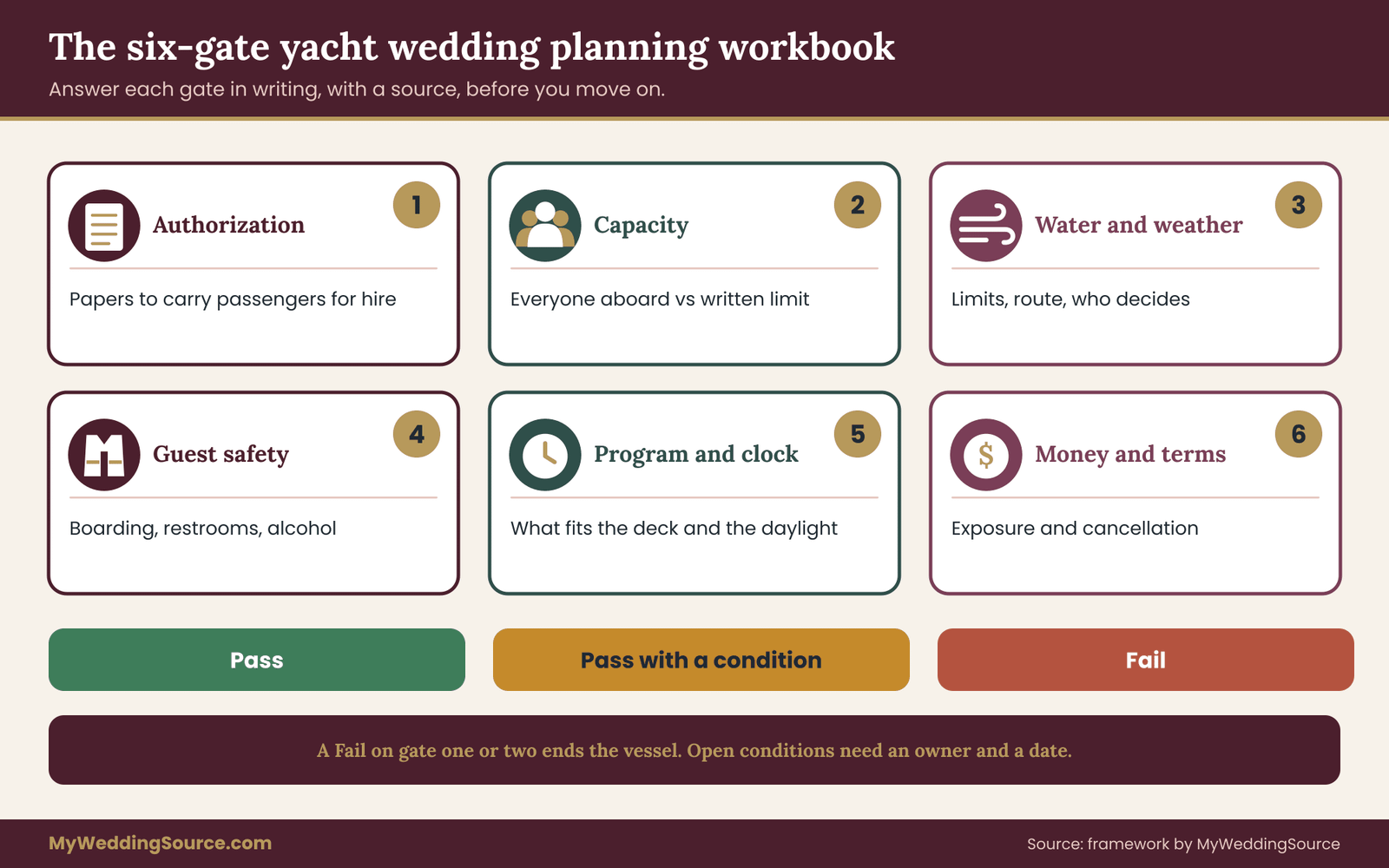
For yacht wedding planning, work through six gates in order: authorization (can the vessel carry paying passengers), capacity (how many people, counting everyone aboard), water and weather, guest safety and mobility, the program and the clock, and the money and terms. Score each gate Pass, Pass with a condition, or Fail. A Fail on the first two gates ends the vessel. Two or more open conditions on the middle gates mean you shrink the program, not hope for good weather.
A wedding on a yacht looks simple in photographs. Water, light, a deck, a few dozen people. The planning behind it is not simple, because a vessel is not a venue. A venue has a fire marshal’s occupancy number and a parking lot. A vessel has a passenger limit set by a regulator, a captain with the final word on every decision, a hull that moves, a schedule tied to tides and daylight, and a refund policy written for a charter business rather than a wedding business.
None of that makes a yacht wedding a bad idea. It makes it an idea that deserves a different kind of homework. Standard venue shopping asks whether you like the room and whether the price fits. Yacht wedding planning has to ask a stricter set of questions first, and only then the pleasant ones about flowers and playlists.
A note on scope. This is general planning information, not legal, insurance or maritime advice, and the rules for vessels, alcohol service and marriage ceremonies differ by state, waterway and vessel. Where a rule matters, the guide names the agency that issues it so you can confirm the current version yourself.
What yacht wedding planning actually involves
The word “yacht” covers a wide range of vessels, and the range matters more than the marketing. Before you compare prices, sort the options by how the vessel is operated, because that decides what you can ask of it and what protections you have.
A crewed charter. A vessel with a captain and crew, hired for a block of hours, carrying passengers for pay. This is the typical wedding yacht. The operator is responsible for the vessel, the crew, the safety equipment and the route. You are responsible for your guests and your program.
A dinner cruise or event vessel. A larger boat that runs scheduled and private events, often with a built-in galley, a dance floor and indoor and outdoor decks. These tend to have the highest passenger limits and the most standardized terms. They also tend to have fixed packages.
A small captained boat. A vessel carrying a handful of passengers. Fine for an elopement or a ceremony for a few people. It is a poor fit for a full wedding, and the limit on passengers is the reason.
A bareboat charter. You rent the vessel without a captain and sail or drive it yourself. This is a vacation product. It is not a sensible choice for a wedding, because the person who should be getting married would also be responsible for the vessel and everyone on it.
A yacht hired but kept at the dock. A stationary event on a vessel tied up at a marina. This changes the weather and boarding picture a great deal, and it is covered in its own section later. Many couples are happiest here, and it deserves honest consideration rather than being treated as a lesser version.
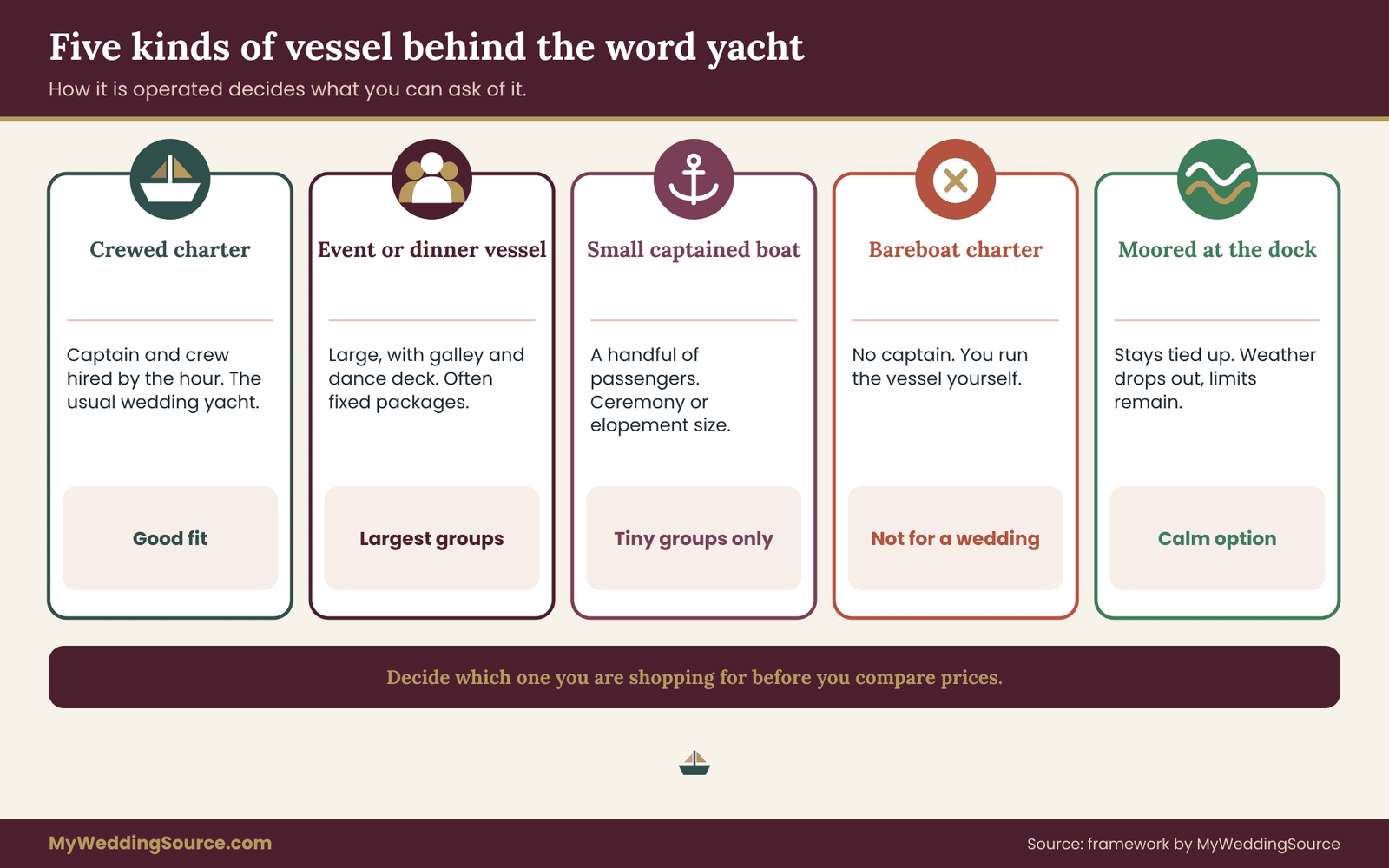
The first job in yacht wedding planning is to decide which of these you are really shopping for. Couples often start with a picture of a sleek private yacht and end up on an event vessel that carries sixty people and has a set menu. That can be a good outcome. The point is to decide on purpose, with the passenger number and the program in front of you, rather than discovering it in the contract.
Why the vessel is not the venue
A reception hall holds a wedding. A vessel transports one. That single difference explains most of what makes this kind of event harder to plan. Keeping that difference in view is the quickest way to make yacht wedding planning realistic.
Guests are carried, so there is a regulated limit on how many may be aboard. The structure moves, so shoes, glassware, heels and wheelchairs behave differently from the way they do in a ballroom. The venue leaves, so late guests cannot join and early guests cannot easily leave. The weather is not scenery, because a captain can shorten, reroute or cancel the trip for reasons that have nothing to do with your preferences.
And the service is not under one roof, because the galley, the sound system and the crew belong to the operator and may need a guest caterer or a DJ to be approved in advance.
Each of those differences shows up later in the yacht wedding planning workbook as a gate. The aim is to make them visible while you still hold your deposit, not after you have sent invitations.
What this guide covers and what it leaves to other guides
This guide is the decision layer. It helps you decide whether a yacht wedding is feasible for your group and how to structure it so the pieces fit. It does not try to replace a full contract review, a seasickness plan, a photography guide or a catering guide, each of which deserves its own space. Where those topics arise, you will get the decision rule and a pointer, not a second guide inside this one. Think of this as the front door to yacht wedding planning, with the specialist topics behind it.
If you are still at the stage of comparing waterfront and non-waterfront venues in general, the wedding venues guide covers how to compare spaces, and you may want to read it first. If your guests include people who use mobility devices or have trouble with steps, keep the accessible wedding venue red flags guide open alongside this one, because a vessel adds steps, thresholds and narrow passages that a building rarely has.
The workbook: six gates for yacht wedding planning
The structure of this workbook is deliberately simple. A gate is a question you must answer in writing, with a source, before you move to the next one. Each gate has three possible results.
Pass. The answer is documented and it supports your plan as it stands.
Pass with a condition. The answer supports the plan only if something specific happens, such as a smaller headcount, a changed start time or a ramp that the operator must confirm. A condition always has an owner and a deadline. A condition with no owner is a hope.
Fail. The answer does not support the plan. A Fail does not mean the idea is dead. It means this vessel, this date or this program is dead, and you change one of them.
The six gates run in a deliberate order, from the questions that can end everything to the ones that only shape the details.
Gate one: Authorization. Is the vessel and its operator permitted to carry passengers for pay, and can you see the paper that says so?
Gate two: Capacity. How many people may be aboard on your route, who counts toward that number, and does your program fit inside it?
Gate three: Water and weather. What conditions are normal for your place and date, what conditions stop the trip, and who decides?
Gate four: Guest safety. Can every guest on your list board, stay aboard, use a restroom and leave safely, including children, older relatives and guests who have been drinking?
Gate five: Program and clock. Does the ceremony, cocktail, dinner and dancing you want really fit the vessel, the daylight and the hours you booked?
Gate six: Money and terms. How much of your payment is at risk if conditions stop the trip, and does the contract say what happens next?
Why the order matters
The order is not arbitrary. Gate one and gate two are binary and cost almost nothing to check. If a vessel cannot legally carry your headcount, nothing you plan about napkins matters. Gates three through five are where most real-world adjustment happens, so they come in the middle. Gate six comes last because the contract only makes sense once you know the shape of the event, but it must come before the deposit, not after. Good yacht wedding planning protects you from your own enthusiasm by putting the cheap, decisive questions first.
Many couples run these in a different order. They find a beautiful vessel, fall for it, pick a date, and only then ask about capacity. By that point the emotional cost of a Fail is high, and people argue themselves into conditions that should have been refusals. Running the gates in order, on paper, protects you from your own enthusiasm.
How to keep the yacht wedding planning workbook
You do not need software. A single shared document with six headings is enough. Under each heading, write four lines: the question, the answer, the source of the answer (an email, a document, a link to an agency page), and the result. If the source is “the salesperson said so on the phone,” the gate is not finished. Ask for the answer in an email and paste it in.
Keep a seventh heading for open conditions, listing each condition, who owns it and the date it must be closed. Review that list every week once you book. It will usually be short, and it is the single most useful page you will have in the final month.
One more rule keeps the yacht wedding planning workbook honest. Score a gate on what is in writing today, not on what the operator is “sure will be fine.” Operators are rarely lying. They are simply used to flexible, informal arrangements that work most of the time. A wedding is the occasion when the exception happens, and writing is what turns a reassurance into a commitment.
A first pass in thirty minutes
Before you request any quotes, do a rough first pass on your own using only what you already know. Write your likely headcount, including your wedding party, vendors and children. Write the season and the time of day you want. Write the three parts of the event you care about most, and the one you could live without. Write the amount you could lose without real damage to your finances. This quick page is the honest starting line for yacht wedding planning, before any operator has a chance to charm you.
That page is the frame the rest of the yacht wedding planning workbook sits in. It tells you which gates are likely to cost you something. A couple with ninety guests and a hard no on a reduced guest list is going to hit gate two early. A couple planning a December event in a cold northern harbor will hit gate three. A couple with a grandmother who uses a walker will spend a lot of time on gate four.
Knowing in advance where the pressure will land makes the questions to ask sharper. ## Gate one: can the vessel legally carry your guests
Everything in yacht wedding planning rests on this gate, and it is the one couples most often skip because it feels like paperwork. It is not paperwork. It is the difference between a vessel that is allowed to carry your guests for money and one that merely looks like it is.
In the United States, the U.S. Coast Guard regulates vessels that carry passengers for hire. The details are technical and they change, so treat the following as the shape of the rule and not its text. A small captained vessel may carry only a small number of paying passengers under a captain’s license for that kind of operation.
A vessel that carries more passengers generally falls into an inspected category, and an inspected passenger vessel carries a document, usually called a certificate of inspection, that states how many persons it may carry and on which waters or routes. The thresholds and terms are published by the Coast Guard, and an established operator should be able to point to them without hesitation.
The three documents to ask for
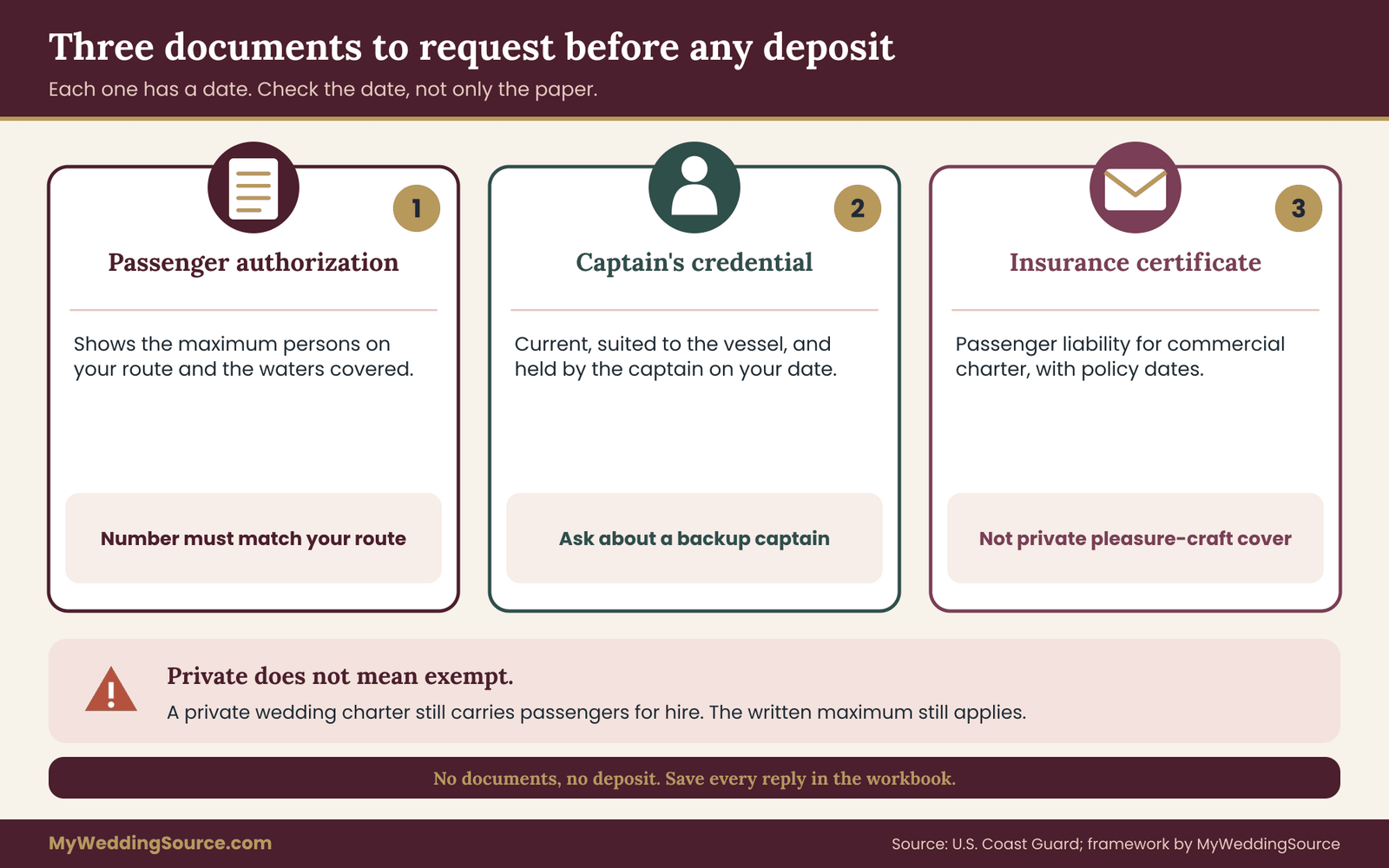
You do not need to read the regulations. You need to ask for the paper that shows the operator already satisfies them. Ask for three things, in an email, before you pay anything. These requests are the backbone of safe yacht wedding planning, and they take one email.
The vessel’s authorization to carry passengers for hire. For an inspected vessel, this is the current certificate of inspection, which lists the maximum number of persons allowed and the route or waters covered. Ask for a copy, not a verbal summary. If the vessel is a smaller one operating under a captain’s license, ask for the captain’s credential and the number of passengers it permits.
The captain’s credential. The person at the helm of a passenger vessel should hold a current credential suited to that vessel. Ask the operator to confirm that the captain assigned to your date holds it, and ask whether a backup captain exists if the first one becomes unavailable.
Proof of insurance. Ask for a certificate showing passenger liability cover for the vessel’s commercial operation, with the policy dates and the named insured. A vessel insured as a private pleasure craft is not the same as one insured for carrying paying guests. If the marina or a dock owner requires you or your event company to be named on the policy for your date, the operator should tell you now, not in the last week.
Notice what these three requests have in common. Each one can be answered with a document, and each document has a date. A permit that expired last spring tells you something. A credential that belongs to a captain who is not working your date tells you something else. In yacht wedding planning, dates on documents are as important as the documents themselves.
A script for the first email
Short and neutral works best. Operators who run weddings regularly will answer it in a few minutes. Operators who do not will often show it by how they reply.
“We are considering your vessel for a wedding on [date], for about [number] guests including vendors. Could you send a copy of the current passenger authorization showing the maximum persons on our route, the captain’s credential, and your insurance certificate with dates? We would also like your written weather and cancellation policy.”
That one message covers gates one, three and six at the same time. Save the reply in your yacht wedding planning workbook under gate one and note the date it arrived.
Reading the answer
A clean answer includes the documents, the maximum persons for your route, and no argument. Acceptable answers sometimes include a short delay while the operator finds the files. A worrying answer is one that avoids the passenger limit, says the paperwork is “all in order” without sending it, or suggests that the rule does not apply because the event is private. How an operator answers is part of your yacht wedding planning evidence, so keep the reply.
Private does not remove the rule. A private wedding charter is still passengers carried for hire, and the number of passengers is still limited by the vessel’s authorization. If an operator suggests that a private event allows more people aboard than the document lists, treat that as a Fail on gate one and walk away. The person who pays for that shortcut is the guest standing on the deck.
There is a second pattern worth noticing. Some operators advertise a very high “capacity” that refers to a space inside the vessel, such as a dining salon, or to a count at the dock, not to the number permitted underway on your route. The number that counts for gate one is the number authorized for the route you will actually run, written down by the operator.
Vessel types and what they usually mean for you
A neat list of vessel types and their capacities does not exist, because the numbers depend on each individual vessel’s document. What does help is knowing the pattern. Matching your guest list to the right class of vessel early saves weeks of yacht wedding planning.
Very small captained boats usually carry only a few passengers. If you are planning a ceremony with a small group, one may be enough, and the paperwork is simple. Mid-sized yachts and charter boats often carry a few dozen passengers. Larger event vessels and dinner-cruise boats may carry a hundred or more. The bigger the number, the more likely it is that the vessel is inspected, that the operator has a dedicated events team, and that the terms are standardized, with less room for negotiation.
None of that is good or bad. It is simply what to expect. A couple who wants a ceremony on a particular classic yacht should know that the classic yacht may carry fewer passengers than their guest list, and that the answer is a smaller guest list or a different vessel, not a conversation about whether the limit really applies.
When the vessel is moored, not moving
A vessel tied up at a dock for the whole event may be treated differently from one that leaves, and the rules for a moored vessel can vary by operator, marina and local authority. Do not assume the lower risk means fewer limits. A moored vessel still has a structure that can only hold so many people, a gangway with limits of its own, and a marina that may have its own rules about events and alcohol.
Ask both the operator and the marina what the limits are for a stationary event, and write down both answers. A stationary option is a legitimate branch of yacht wedding planning, not a lesser one.
The marina and the dock
Boarding does not begin on the vessel. It begins at the dock, and the dock has an owner. Marinas, municipal piers and private docks sometimes require an event permit, proof of insurance, a limit on guests in the dock area, or a fee for use. Ask the operator who controls the dock where your guests will wait and board, and whether any permit is needed.
If the answer is “we handle that,” ask them to confirm in writing that they hold the permit or that none is required. Dock rules are an easily forgotten corner of yacht wedding planning, so ask about them directly.
The marriage itself
One question belongs in gate one even though it is not about the vessel. If you intend the legal ceremony to happen aboard, confirm with the county or other local office that issues your marriage license that a ceremony on the water, at the place where the vessel will be at that moment, is valid under your license. Licenses are generally tied to a jurisdiction.
Moving water can cross boundaries, and a ceremony conducted at sea or in a different county from where the license was issued can create a question you do not want to answer after the fact. Many couples sidestep this entirely by signing the legal paperwork on land and holding a symbolic ceremony on board. Ask the issuing office what it recommends, and ask your officiant too. The wedding officiant requirements guide explains how officiant authority works in general.
Settle the legal question early, because it can reshape the rest of your yacht wedding planning.
Scoring gate one
Pass means you hold the authorization, the credential and the insurance certificate, with dates that cover your event, and the maximum persons figure for your route is in writing.
Pass with a condition is rare for this gate, and should be a clear item with a date: for example, an insurance certificate that will be reissued after the renewal date, which falls before your event.
Fail means missing documents, an unwillingness to share them, a passenger limit below what you need, or any suggestion that the limit can be exceeded. End the conversation with that vessel and ask the next operator on your list. A Fail at gate one is the cheapest failure you will ever have, because you have paid nothing yet.
What an established operator looks like
You can learn a lot from how an operator behaves before the contract. Operators who carry wedding groups regularly tend to have a standard packet, a named events contact, a clear answer to the passenger limit, a written weather policy, and a willingness to let you visit the vessel before you commit. They also tend to ask you questions: how many children, whether anyone uses a wheelchair, whether alcohol will be served and by whom.
Those questions are a good sign. They mean the operator is thinking about the guests as well as the booking. Choosing a steady operator is the single most useful shortcut in yacht wedding planning.
Operators who dodge the documents, push you toward a fast deposit, or compete on “limited availability” are worth setting aside. A good yacht is rarely so scarce that you cannot take three business days to verify it.
The wedding vendor due diligence checklist covers the general habit of checking a vendor before you pay. For a vessel, the checks above are the specific version. ## Gate two: capacity, headcount and program load
Once a vessel passes gate one, you hold a number: the maximum persons allowed on your route. Gate two asks whether your wedding fits inside that number and, separately, whether it fits comfortably inside the program you want. These are two different questions, and mixing them up is the most common arithmetic error in yacht wedding planning.
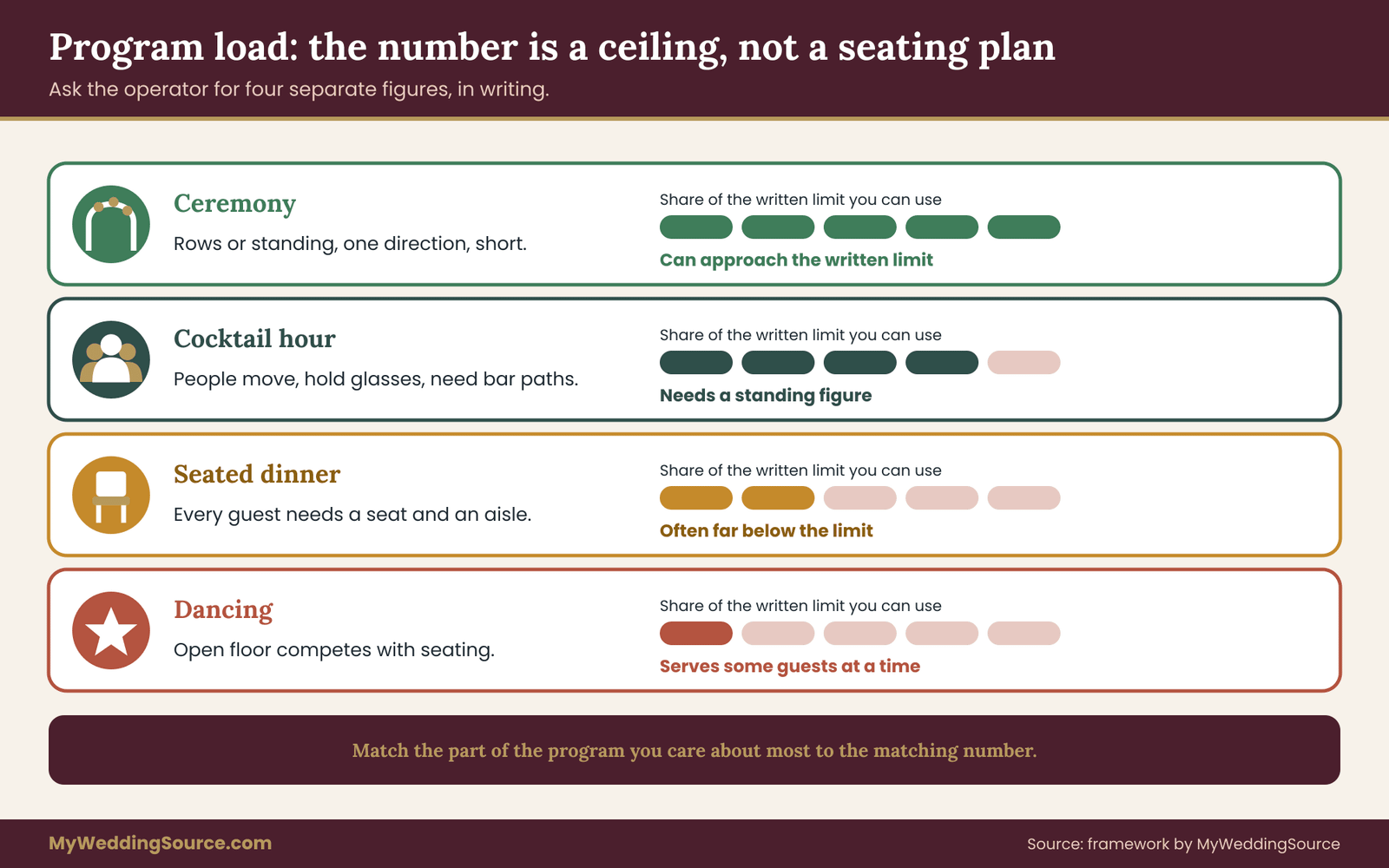
The first question is legal. The second is practical. A vessel authorized for one hundred persons is legally full at one hundred, and that figure does not tell you how many people can sit down to dinner, dance without bumping into each other, or reach a restroom without a queue. The authorized number is a ceiling, not a seating plan.
Who counts toward the number
Start by writing down every person who will be aboard at the same time. Operators and regulators count persons, not invitations, and not only the people on your guest list. The count usually has to include several groups that couples forget. Honest counting is where yacht wedding planning either starts well or starts to drift.
Guests who said yes. Your confirmed RSVPs, plus plus-ones and children. Infants and small children are generally counted as persons aboard unless the operator’s written terms say otherwise, and you should ask for that rule in writing.
The two of you and your wedding party. Obvious, but they are sometimes left off a first draft of the count.
Your own vendors. A photographer, a videographer, a DJ, a band, an officiant, a planner or coordinator, a florist who comes to set up and stays, and caterers or bartenders you bring. Each person is aboard. A five-piece band is five people.
The operator’s crew. Whether crew count toward the passenger limit depends on the vessel’s authorization, and the answer is on the document or in the operator’s confirmation. Do not guess. Ask: “Does the maximum persons figure include the crew, or is it passengers only?” The answer changes your usable number by several people.
Add them up and compare the total with the written figure for your route. If your count is within a couple of people of the limit, treat that as a Fail for gate two, not a Pass. A group of that size will almost certainly change by the wedding day, and you want room for a cousin who was not expected, not an argument on the dock about who stays behind.
Attrition and the buffer
RSVPs change late. People who said yes get sick, and a few who said no turn up with a good reason. For a vessel with a hard limit, this volatility has a cost that a ballroom does not have: you cannot simply add a chair. A deliberate buffer is a small cost that makes yacht wedding planning far less stressful in the final month.
Set a buffer on purpose. A working rule in this guide, not a standard, is to book a vessel whose written limit for your route is comfortably above your expected headcount, so that the likely range of final numbers sits well inside it. How much margin you need depends on how many guests are children, how many are traveling and how reliable your RSVPs have been. If you are unsure, write down your best case and your worst case and require both to pass.
Then set a decision date. The date by which you must tell the operator the final headcount should be written into the contract. After that date, no new names. Guests who miss the deadline get a warm explanation, not a space.
The program load
Next comes the practical question. Look at what you want to do aboard, because different parts of a wedding need different amounts of room per person. Matching program to room is the practical heart of yacht wedding planning at this gate.
A ceremony is the lightest load. Guests sit or stand in rows, facing one direction, for a short time. Many vessels can host a ceremony at or near their written limit, provided the deck allows rows and a clear path for the couple, and provided the deck’s fixed furniture does not block the sightlines.
A cocktail hour asks for more room than a ceremony because people move, hold glasses and talk in clusters, and bars and trays need paths of their own.
A seated dinner is the heaviest load per person on most vessels. Every guest needs a seat at a table, tables need aisles, and servers need to pass. Vessels often have a seating layout for dinner that is well below their passenger limit. The number of dinner seats is a separate figure and you should ask for it.
Dancing needs open floor, and open floor competes with the seating you just counted. A small dance floor on a vessel is common, and it serves only some of the guests at a time.
Speeches and toasts need a spot where people can hear. On a vessel with several decks, a toast that carries on the main deck may not carry upstairs.
The working rule from this guide is to match the program to the vessel, not the other way around. Ask the operator for four numbers, each in writing: the maximum persons on your route, the seated-dinner capacity, the capacity for a standing reception and the number of people the dance area can hold. Your headcount must pass the one that matches the part of the program you most want.
The load ladder
Use this ladder when the numbers disagree. Start with your headcount and the program you want. Compare it with the vessel’s four numbers. The ladder keeps yacht wedding planning honest when the numbers disagree with the dream.
If the headcount fits everything, including the seated dinner, you have a Pass for gate two.
If it fits the ceremony and cocktail but not the seated dinner, the plan has a choice: have a standing or buffet-style reception aboard, hold the dinner on shore, or reduce the headcount. This is a Pass with a condition. The condition has to name the choice.
If it fits the ceremony only, the vessel works as a ceremony location and not as a full wedding. That may be perfect for a short sunset ceremony followed by a land-based reception, and it should be described that way in the contract.
If it does not fit the ceremony, it is a Fail.
The split and the second sailing
A larger guest list sometimes pushes couples toward splitting the group across two vessels or two sailings. The idea is attractive on paper and complicated in practice. Two vessels mean two manifests, two captains who each make their own safety decisions, two sets of conditions, and two separate sets of terms. Two sailings mean that half the group waits on shore while the other half is aboard. Neither is impossible.
Both need clear planning and are better treated as a separate format with their own workbook rather than a patch added when the number does not fit. Read the logic of gate two again before choosing a split. It is usually simpler to change the headcount or to change the program than to double the logistics. Splitting the group is possible, but it multiplies the workload of yacht wedding planning rather than solving it.
Children, infants and non-sailors
Children change the count and the plan in ways that are easy to underestimate. They count as persons aboard. They need life jackets that fit, which is a gate four matter. They tire early, and a vessel at sea cannot return for a nap. A realistic plan for families with young children either keeps the cruise short, adds a parent-supervised quiet corner, or gives families the option to attend the ceremony only and leave before the long evening part.
Planning for these guests early makes yacht wedding planning kinder as well as safer.
Guests who simply do not want to be on a boat for hours are another group. A few will say so honestly. Others will say yes out of politeness and regret it halfway. Giving people an easy, guilt-free way to take part in part of the event, a land-based reception or a shoreside welcome, is kinder than hoping everyone is comfortable. The same logic applies to guests who are unsure about motion.
Ask your guests early, in the invitation or on the wedding website, whether the plan works for them. A short question gets honest answers; an assumption gets a few silent absences.
Counting at the dock
On the day, someone must count. The operator’s crew will usually keep a manifest, and a good one will insist on checking names against it. Give them a list that matches what you wrote in the yacht wedding planning workbook, and ask one trusted person to stand at the gangway with it. If the count reaches the written limit and more guests are waiting, the crew has to stop boarding.
That is their job, and it is the reason the limit exists. Discuss in advance what happens to guests who are left behind, so the answer is not improvised at the dock. Often the answer is a quiet word from the planner to a family member, a car to the reception venue, and a welcome drink on land. The count at the gangway is where yacht wedding planning meets the real world.
The same difference between a legal number and a usable layout applies to any land venue, and it is worth asking about whichever room you eventually choose.
Scoring gate two
Pass: your best-case and worst-case headcounts both fit inside the written maximum for your route, with a buffer, and the seated, standing and dance numbers match your program.
Pass with a condition: the program must change to fit, for example the dinner moves ashore or the guest list is capped at a set number by a set date.
Fail: your headcount exceeds the written maximum, or the operator will not state the figure for your route. ## Gate three: water, weather and the schedule
Gates one and two are about paper and arithmetic. Gate three is about the thing you cannot negotiate with. A venue on land has weather you plan around. A vessel has weather that decides whether the event happens at all, and the decision belongs to the captain.
This gate is not a forecast. Nobody can forecast your wedding day months ahead, and this guide will not pretend otherwise. What you can do is judge how exposed your date, place and format are, decide what you will accept, and agree in writing who decides when it is close.
Safety limits and comfort limits
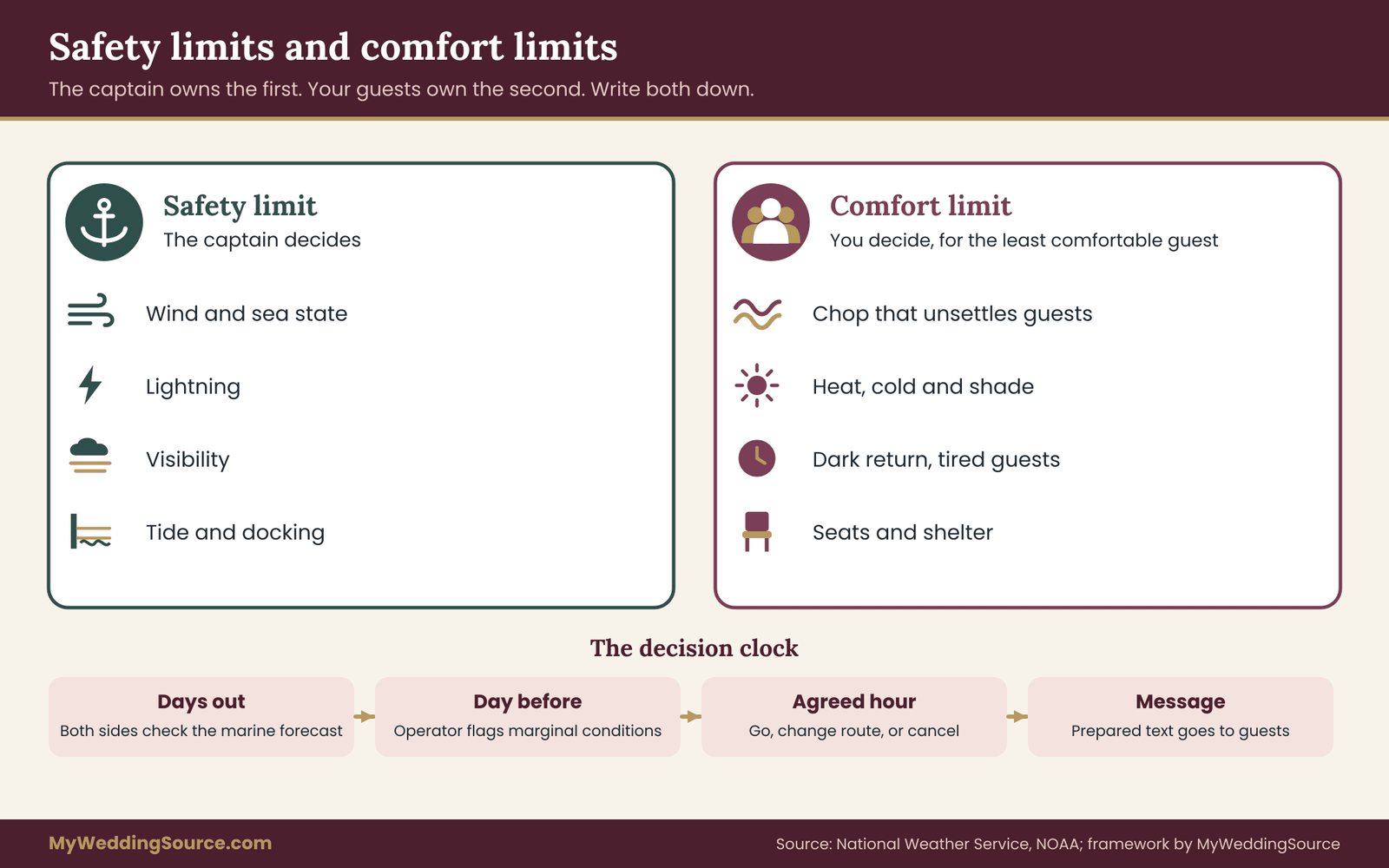
The most useful distinction in this gate is between two kinds of limit. Writing both limits down is a quiet but powerful habit in yacht wedding planning.
A safety limit belongs to the captain. It covers wind strength, wave height, visibility, lightning, strong currents and anything else that affects whether the vessel can sail and dock safely. You do not argue with a safety limit, and a good captain should not be pressured to ignore one. In yacht wedding planning, the single worst plan is the one that treats the captain’s decision as a negotiation.
A comfort limit belongs to your guests. It covers chop that is within the captain’s limits but will make half the deck unwell, cold wind that is safe but unpleasant in formal clothes, or heat that is fine for the crew and hard on an older relative. The captain may sail happily in conditions that a guest in a long dress and heels finds miserable.
Only you can decide what is acceptable to your group, and you should do so in advance, in writing, and with the guests who are least comfortable in mind.
Gate three asks you to write both limits down.
What to ask the operator
Ask about the conditions that most often change a trip, in plain terms, and ask for the answers by email. These questions turn vague reassurance into usable yacht wedding planning evidence.
Ask what wind speed or sea state makes the operator shorten, change or cancel a trip on your route, and what source they use to decide, such as the marine forecast from the National Weather Service. Ask who makes that decision, at what hour on the day, and whether you will be told directly. Ask whether the route has a sheltered alternative, such as staying inside a harbor, and whether that alternative is included in the price.
Ask what happens if the weather is fine at the dock but worsens during the trip. Ask how the vessel handles lightning, since a deck is not a shelter from it.
Ask also about tides and currents if your route passes shallow areas or narrow channels, because the slope of a gangway and the available water under the keel change with the tide. The National Ocean Service publishes tide predictions for the coast, and an operator who runs your route should already know the relevant hours.
Use the official marine sources
You can check conditions yourself, and you should, from a few weeks before the date. The National Weather Service publishes marine forecasts and advisories for coastal and inland waters in zones that do not always match the forecast for the nearest town. Water conditions can differ from land conditions by a wide margin, and a calm afternoon in town can be a choppy one on the open water.
Learn the name of the marine zone for your route and read its forecast the way you would read the town forecast. The operator may use the same zone, and if they do, you will be reading the same page they are. Reading the marine forecast yourself is a free upgrade to your yacht wedding planning.
None of this requires technical skill. Read the wind, the wave height and the advisory type, and note whether the forecast describes steady conditions or a change during your hours. Then compare it with the written limits you got from the operator. Gate three is a comparison between two documents, not a prediction.
Season, daylight and the shape of the day
Season controls much of your weather risk, and it also controls daylight, which controls your schedule. A sunset ceremony on a yacht is a popular idea, and its timing depends on a date you picked months ago. Sunset arrives at different hours across the year, and a late afternoon departure in one season is a dark return in another. Daylight is a hard constraint in yacht wedding planning, even when it feels like a mood.
Work backward from the return. Decide the latest time you are willing to be docking and disembarking, taking into account that guests will be tired, some will have been drinking and the dock may be hard to see in the dark. Add the time for the cocktail hour, the ceremony and the dinner you hope to have aboard. If the total pushes the return past your limit, shorten the program or change the date.
The guide to choosing a wedding date covers the general trade-offs of season and timing; for a vessel, daylight and weather add two more weights to the same scale.
Cold and heat deserve a plain mention. A deck that feels pleasant at five in the afternoon can feel cold at seven, with wind that makes it colder still. Guests in light formal clothes need a plan, whether that is blankets, an interior space or a simple note in the invitation. In hot months, shade, drinking water and a place to sit are not luxuries. They are the difference between a good evening and an uncomfortable one.
The route and the exposure
Not all routes carry the same weather risk. A route inside a harbor, behind a breakwater or on a protected bay is usually calmer than one along an open coast or across a wide expanse of water. Narrow passages and busy shipping lanes add their own considerations, and the captain will have opinions about each. A calmer written route is the most valuable single item in yacht wedding planning for weather.
Ask the operator to describe two routes: the one you want, and a calmer one that they would use if conditions are marginal. Ask them to put both in writing, with the times for each. A written alternate route is the most useful single item in this gate, because it turns a cancellation into an adjustment. When conditions are borderline, an operator who can offer the sheltered route will often run the trip, which keeps your wedding on schedule.
The decision clock
A plain schedule of checks makes conditions less stressful. Keep it brief, and agree it with the operator in advance. Agreeing a clock before booking is a calm habit that experienced yacht wedding planning relies on.
A few days before, both sides look at the forecast and confirm the backup route and the backup plan. The day before, the operator tells you if the conditions look marginal. On the day, a decision is made at an agreed hour with enough lead time for guests to travel. If the answer is no, the operator tells you directly, and you have a prepared message to send to guests.
The point of the clock is not to remove uncertainty. It is to make sure nobody hears about a cancellation for the first time from the dock.
Who tells the guests
Agree before the day who sends the message if the trip changes, how it goes out, and what it says. Write two drafts in advance, one for a changed plan and one for a cancelled one, and keep them in the yacht wedding planning workbook. A short text message with the new time, the new place and one line of reassurance is enough.
The people who suffer most in a weather change are guests already traveling, so the message must reach them quickly and say plainly where to go. Keep it simple: one sender, one channel, one message. Communication is part of yacht wedding planning too, and it is easy to prepare in advance.
What “good enough” looks like
A Pass at gate three does not mean the weather will be good. It means four things are true. You have the operator’s written limits for wind, sea state and lightning. You know who decides and when. You have a written sheltered or alternate route. And you have a fallback for the event itself, such as a land-based space on a soft hold, that you are willing to use. A realistic pass is a modest goal, and it is the right one for yacht wedding planning.
A Pass with a condition is common here. The typical conditions are a date change away from the stormiest part of the year, a later start to leave daylight for the return, or an agreement on a covered area for guests on the deck.
A Fail looks like a vessel that will not say what weather stops the trip, a route with no calmer alternative in an exposed place during a risky season, a schedule that forces a dark return for older or intoxicated guests, or a plan with no fallback and a non-refundable payment.
Edge cases worth a line
Some situations come up repeatedly and deserve a sentence each. Raising these edge cases early is routine yacht wedding planning, not pessimism.
If the captain cancels while you are at sea, the vessel returns to the dock. Ask what the return plan is, including whether there is a shuttle or alternative transport for guests who cannot wait.
If a guest becomes unwell on board, the crew handles the first response, and the operator should be able to tell you how they contact emergency services from the water. Ask for that procedure.
If conditions are marginal but allowed, some guests will want to disembark. Ask whether the vessel can return early and how that would affect the rest of the group.
If the forecast is clearly bad days ahead, many operators will move a date. Ask in advance what notice they need and what it costs.
These are the sort of questions that feel awkward on a friendly call and read clearly in a contract. Put them in writing, and be unembarrassed about it. ## Gate four: guest safety, mobility and alcohol
Gate four turns from the vessel to the people. It asks whether every guest on your list, not the average guest, can board, stay aboard, use a restroom and leave without harm. It is the gate where yacht wedding planning is most likely to reveal something awkward about your own list, and it is far better to find that out now.
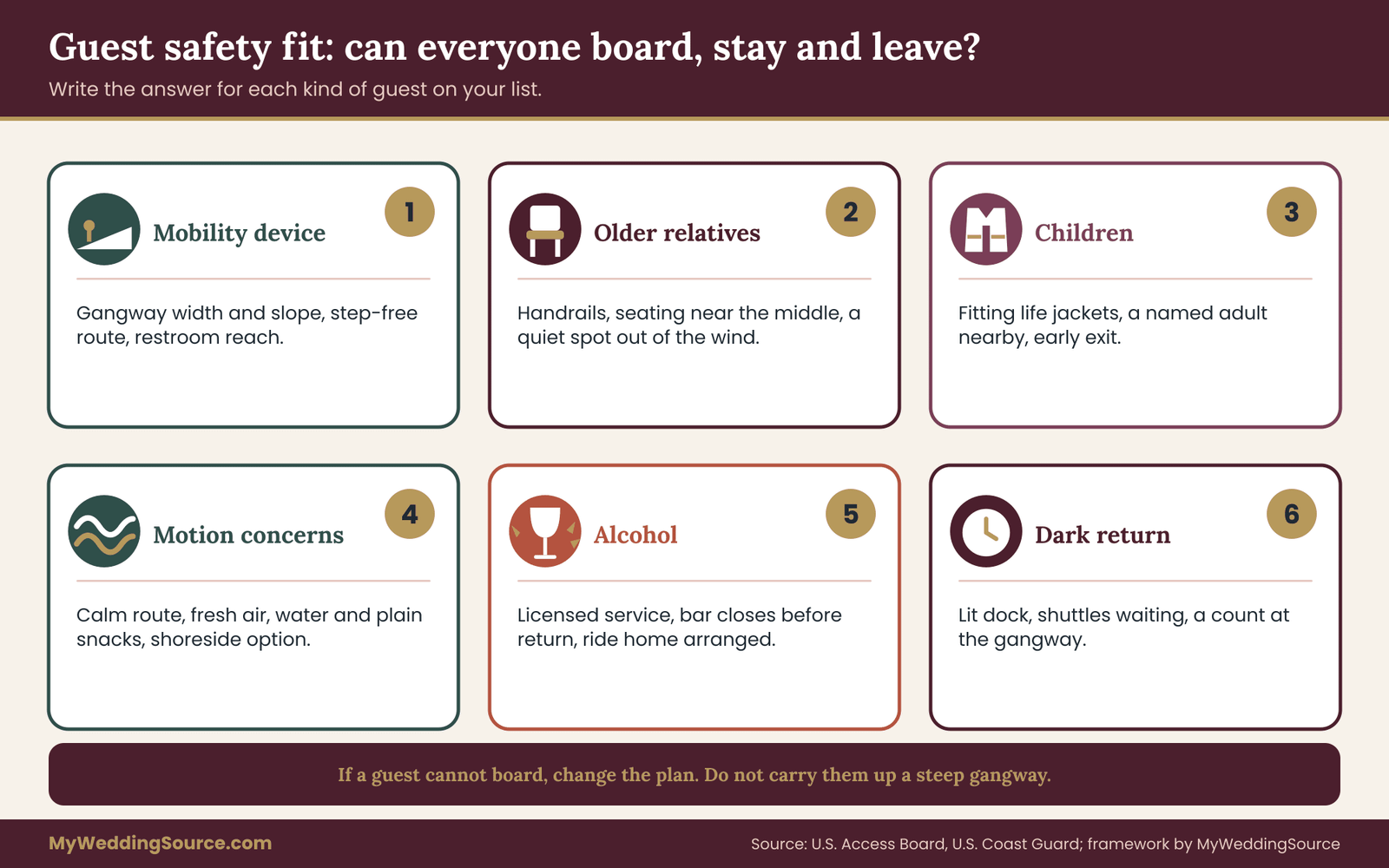
Start by writing a short, private list of guests who need something specific. You are not collecting medical records and you do not need details. You need categories: guests who use a wheelchair, scooter or walker; guests who cannot manage steep steps or narrow passages; guests who are pregnant, elderly, or very young; guests who have said they get motion sick; guests who are sober or avoiding alcohol; and guests who are likely to drink heavily. Many guests fall into none of these. Some fall into two.
Boarding and moving around
Boarding is the moment of greatest physical risk for most guests. A gangway can be steep at low tide, narrow, wet or unsteady. A vessel’s deck may have raised thresholds, steps between levels, narrow passages and stairs that are steeper than a building’s. Restrooms, often called heads, may be small and below deck. Boarding detail is where yacht wedding planning most often exposes a problem on a guest list.
Ask the operator for a description of the boarding path and the interior routes, not just a yes or no on accessibility. Ask how wide the gangway is, whether it has handrails on both sides, and what the slope is at your boarding time. Ask whether any part of the vessel is reachable without steps, and whether a wheelchair can pass through the doors. Ask where the restrooms are and whether any is usable by a person with limited mobility.
Ask whether the crew can assist boarding and which guests, if any, would be unable to board at all.
Federal accessibility rules apply to some commercial passenger vessels, and the U.S. Access Board publishes guidelines for them, but the application to a private charter depends on the operator, the vessel and the facts. Do not assume that a vessel is accessible because it is commercial, and do not assume it is not. Ask for specifics, and the accessible wedding venue red flags guide lists the patterns that tend to hide problems.
If one guest cannot board, the honest answer is not to ask them to be carried up a steep gangway. It is to change the plan so that they can take part, for example with a shoreside ceremony or a dockside reception where they are included.
A guest who cannot board should not learn that on the dock. Ask early, in a private and kind way, and offer a clear alternative.
Lodging and transport around the vessel
The dock is often at a marina some distance from guest hotels, and the return after dark may require transport for guests who have been drinking. If your group includes people with different budgets and mobility needs, the guest hotel guide for different budgets and mobility needs shows how to pick lodging that works for everyone, and it helps to apply the same logic to the pickup point for the vessel.
A shuttle that runs from hotels to the dock, with a drop-off close to the gangway, removes a surprising number of problems.
Life jackets and equipment
A passenger vessel carries life jackets and other safety equipment according to the rules that apply to it. What matters for your planning is that the right sizes are available for your guests, including children and any guests who need larger sizes, and that you know when and how the crew will brief guests. Equipment questions are short, and they belong in every set of yacht wedding planning notes.
Ask the operator how many life jackets are carried, in which sizes, and whether there is a range for children. Ask when guests will be told where they are. Ask whether guests will be required to wear them at any point. Rules vary by vessel, by state and by guest age, and the U.S. Coast Guard publishes boating safety information that explains the general approach for recreational vessels and passengers.
Tell your guests what to expect so no one is surprised. A line in the invitation or on the wedding website saying that the vessel carries life jackets and the crew will give a safety briefing before departure is enough.
Alcohol
Alcohol changes the risk on a vessel more than almost anything else, and it deserves its own plain paragraph. A guest who has been drinking is less steady on a deck, more likely to lean on a railing, and less able to judge risk near water. The person operating the vessel must remain sober, and the operator will have rules about who serves alcohol, what may be brought aboard, and sometimes about when service must stop. Pacing the bar is one of the highest-value decisions in yacht wedding planning.
Ask the operator whether alcohol is provided by the vessel, whether you may bring your own, whether a licensed bartender is required, and whether the vessel’s license or insurance sets limits on service. Ask what happens if a guest becomes too intoxicated. Rules differ by state and by vessel, so take the operator’s written policy as your starting point and ask the state or local alcohol authority if you are unsure.
Two practical choices make a big difference. One is to end bar service well before the return and to switch to water, coffee and food for the final stretch. The other is to plan how guests get home, so no one who has been drinking has to drive from the marina. The wedding bar service planning guide covers bar staffing and pacing in more detail, and the same pacing logic applies here, with the added reason that the venue is surrounded by water.
Motion and comfort
Some guests will feel unwell on a moving vessel, and this guide does not give medical advice about it. The planning response is simple and not medical. Choose a route and a time that keep the water as calm as practical. Make the interior and the open air both available, with a place to sit near the middle of the vessel, where motion is usually least noticeable.
Tell guests ahead of time that the vessel moves, and encourage anyone with concerns to speak to their own health professional before the event. Have water and plain snacks available, and brief the crew about who to turn to if a guest needs to sit out. If a guest knows motion is a problem for them, give them an easy alternative, like joining the shoreside part of the day.
Comfort is part of yacht wedding planning even though the medical side belongs to each guest and their own professional.
Children and supervision
Children are happy on a vessel for the first hour and anxious about it for the next three. Decide who is responsible for each child. A parent or an adult named in advance should be near each child at all times, particularly near rails, stairs and the gangway. A vessel is not a place for children to run, and the crew cannot be both hosts and babysitters. Naming a responsible adult for each child is a small step with large value in yacht wedding planning.
Scoring gate four
Pass: you can describe, in writing, how each category of guest on your list boards, stays aboard, uses a restroom and leaves, and the operator has confirmed the key details.
Pass with a condition: one or two guests need a specific alternative, such as a shoreside role, or a boarding aid that must be confirmed by a date.
Fail: the vessel cannot be boarded by a guest you are not willing to exclude, the operator will not describe the boarding path, or the plan has no way for intoxicated guests to be safely returned home.
Gate five: program, clock and what actually fits aboard
Gate five asks a simple question with many parts. Does the wedding you picture fit the vessel, the daylight and the hours you booked? It is where preferences meet physics, and it is where good yacht wedding planning looks most like ordinary event planning, only tighter.
Build the timeline backward
Start with the end. Decide the time you want to be back at the dock and the time guests should be leaving. Subtract the length of each part of the program in turn. Add boarding time at the beginning, which tends to be longer than you expect, and disembarking time at the end, which is also longer than you expect. Add a small buffer for the unexpected, such as a late arrival or a delay at the gangway.
Working backward from the return is the most dependable method in yacht wedding planning for a schedule.
A rough sketch, not a rule, might allow time for boarding, a short ceremony, a cocktail hour while the vessel is moving, a seated meal, a few toasts, a limited amount of dancing and a return. Each of those parts takes up room and time, and each of them competes for the same deck.
What to cut first
Most plans need a trim. The parts that tend to be least successful on a vessel are the long ones. A multi-course dinner with many speeches is hard to run on a moving deck. A long receiving line is hard to run at a gangway. A dance set that needs a full floor is hard in a small space.
Cut the long parts first and keep the ones that suit the setting: a short ceremony, a toast, a view, a simple meal. Trimming early is a normal part of yacht wedding planning, not a sign of a weak idea.
The things that must be approved
Several items need the operator’s approval and should be checked in this gate. Music and sound equipment, because noise rules and electrical capacity vary. Candles and open flames, which many operators ban. Confetti, petals and biodegradable-looking items that still end up in the water, which are often prohibited. Decor attached to railings, which can be a safety issue. Outside caterers and bartenders, who may need approval.
Bringing a cake aboard, which has to be carried, stored and cut on a moving surface. And any request to adjust the layout of the deck. A written approval list is a quiet time-saver in yacht wedding planning.
Ask for the vessel’s rules on each in writing, and bring a short list of what you intend to bring. A photo of the deck with your layout marked, sent to the operator, prevents a lot of surprises.
Vendors aboard
Each vendor needs to know that the space is limited and moves. They need to know the load-in time, where they can set up, how much power is available, and what happens to equipment in rough conditions. The photographer needs to know where they can stand. The musicians need to know where they will not be in the way. A good operator will have worked with wedding vendors before, and a good vendor will ask the right questions.
If a vendor has never worked on a vessel, say so, and ask them to talk to the operator directly before the date. Briefing vendors properly is a standard step in yacht wedding planning that many couples leave to chance.
The honest program
The most useful thing you can do at gate five is to write one sentence that describes the event as it will actually happen. For example: “A forty-five-minute ceremony and cocktail cruise in the harbor, a short dinner ashore, and dancing at the restaurant.” If that sentence does not match the plan on the vessel’s booking form, change one of them. One true sentence about the event is the best check in all of yacht wedding planning.
Scoring gate five
Pass: the program, as written, fits the vessel’s layout, the booked hours and the daylight, and the operator has approved the items that need approval.
Pass with a condition: part of the program, usually the dinner or the dancing, moves ashore, or the schedule changes by a set amount.
Fail: the program cannot fit within the booked hours, the vessel will not allow something central to the event, or the return falls outside your safe limit for guests. ## Gate six: money, terms and the cost of a no
The last gate asks what happens to your money. It comes last because you cannot judge a contract until you know the shape of the event, and it comes before the deposit because a contract signed first leaves you with no workbook to bargain from. For general contract habits, the wedding vendor contract guide explains the clauses to look for in any agreement. This section covers the parts that are unusual for a vessel.
This guide does not quote prices, because charter pricing depends on vessel, season, hours, region and operator, and any figure here would be invented. It gives you the logic for comparing quotes instead.
What the quote should say
A charter quote for a wedding should make clear what the fee covers and what it does not. Read it for the following items, and ask the operator to add anything that is missing. Reading the quote line by line is routine yacht wedding planning, and it is worth the hour.
The hours. Does the charter time start when guests board or when the vessel leaves the dock? Does it end at the dock or at the last guest off? Weddings run late at both ends, and the difference can be an hour you did not know you were paying for.
Overtime. What is the rate per additional hour, and who approves it? Is overtime possible at all, given the crew’s working hours and the dock’s rules?
Crew and captain. How many crew are included, and what do they do? Do you need additional staff for food, bar or cleanup, and who provides them?
Fuel and fees. Is fuel included? What about dock fees, port charges, cleaning fees and any security or damage deposit?
Gratuity. Is it included, expected or optional, and how is it handled? Ask whether a service charge or tip is already built in, so you do not pay twice.
Taxes. Is the quote before or after tax? Sales and other taxes vary by place, and the operator can tell you what applies to a charter.
Catering and bar. Is food provided by the vessel, a partner caterer or your own? What are the minimums? Are alcohol and mixers included?
Insurance requirements. Does the operator require anything of you, such as a certificate for your own vendors?
The payment schedule and your exposure
Most charters ask for a deposit to hold the date and a balance before the event. Look at the schedule and add one number to your yacht wedding planning workbook: your worst-case exposure. That is the amount you would lose if the trip were cancelled for a reason that is no one’s fault, such as a storm on the day. Exposure is the number that turns yacht wedding planning from a dream into a decision.
Think of it as three layers. The first is the deposit, which is often non-refundable. The second is the balance, which may become non-refundable inside a certain window before the date. The third is any money spent on things that cannot be recovered, such as flowers, travel or a non-refundable caterer. Add all three, and ask yourself whether you could absorb that loss. If not, the plan is too expensive for its risk, however beautiful the vessel.
A payment made by credit card may carry dispute rights if the service is not delivered, and the Consumer Financial Protection Bureau explains how billing disputes work for credit cards. The protection has conditions and time limits, so treat it as a back-up and not a substitute for a clear contract. Keep your exposure number visible in the yacht wedding planning workbook where you will see it each time a payment comes due.
Weather and cancellation terms
This is the part of the contract that matters most to a yacht wedding, and it is the part that varies most. Look for the answers to these questions in the text itself. These terms decide whether yacht wedding planning protects you or leaves you exposed.
Who decides whether the trip runs, and on what grounds? If the captain cancels for safety, do you receive a refund, a credit, a reschedule or nothing? If you choose to cancel because the forecast looks poor but the captain would sail, what happens? If the trip is shortened, is the fee reduced? If the operator cancels for any other reason, such as a mechanical fault or a double booking, what do they owe you, including a substitute vessel?
A credit toward a future date has limited value for a wedding. The event does not happen again. If the contract offers only a credit, ask whether the credit can be used for a different event, transferred or converted to a refund. If it cannot, count it as lost money in your exposure figure.
Weather insurance and event cancellation insurance exist, and they have exclusions that matter a great deal. Read what a policy covers before you buy one, and ask the insurer in writing about the specific scenario of a captain’s cancellation for weather. Do not assume that a policy that covers “weather” covers a decision made by a captain at the dock.
Liability, damage and the rules for your guests
Charter terms often assign responsibility for damage, injury and behavior in ways that surprise couples. You may be asked to sign a waiver or a release, to accept responsibility for guests’ conduct, or to pay for damage to the vessel. Read these clauses closely. You are not asked to become a lawyer. You are asked to notice what you are agreeing to, and to ask a qualified professional if something looks heavy. Reading these clauses is the unglamorous side of yacht wedding planning, and it matters.
Ask whether guests will sign individual waivers at boarding. If so, tell guests before the day, because a form handed over at a gangway with a line behind it is a poor moment for a careful read.
What to do if the contract and the yacht wedding planning workbook disagree
Sometimes the standard contract contradicts what the salesperson said, or what you wrote in the yacht wedding planning workbook. Do not accept a verbal assurance. Ask for a written amendment that states the agreed term, signed or confirmed by email by someone with authority. An amendment that fixes a headcount, a route, a weather clause or an included hour is worth more than any number of friendly conversations. Resolving the mismatch in writing keeps yacht wedding planning on solid ground.
Scoring gate six
Pass: you can state your worst-case exposure, you can absorb it, and the contract answers who decides, what is refunded and what happens if the vessel cannot sail.
Pass with a condition: one or two terms need an amendment, with a date by which it must be signed and before which no deposit is paid.
Fail: the contract is silent on weather and cancellation, you cannot absorb the exposure, the operator will not amend clearly unfair terms, or the payment is due before the documents in gates one and two have been provided.
Worked case: yacht wedding planning for seventy-four guests
An example makes the six gates concrete. The couple below is invented for illustration. Every number is made up to show how the yacht wedding planning workbook runs, and none of it describes a real vessel, operator or price.
Marta and Devon want a late-afternoon wedding on the water in a coastal city, in a month when evenings stay warm but afternoon wind is common. They have invited eighty-six people. Based on their history of RSVPs and travel, they expect between sixty-eight and seventy-six to attend. Their guests include two grandparents, one of whom uses a walker, a handful of children, and a group of college friends who like a late party.
They find two vessels they like and begin the yacht wedding planning workbook with the same headcount, a worst case of seventy-six guests.
The headcount
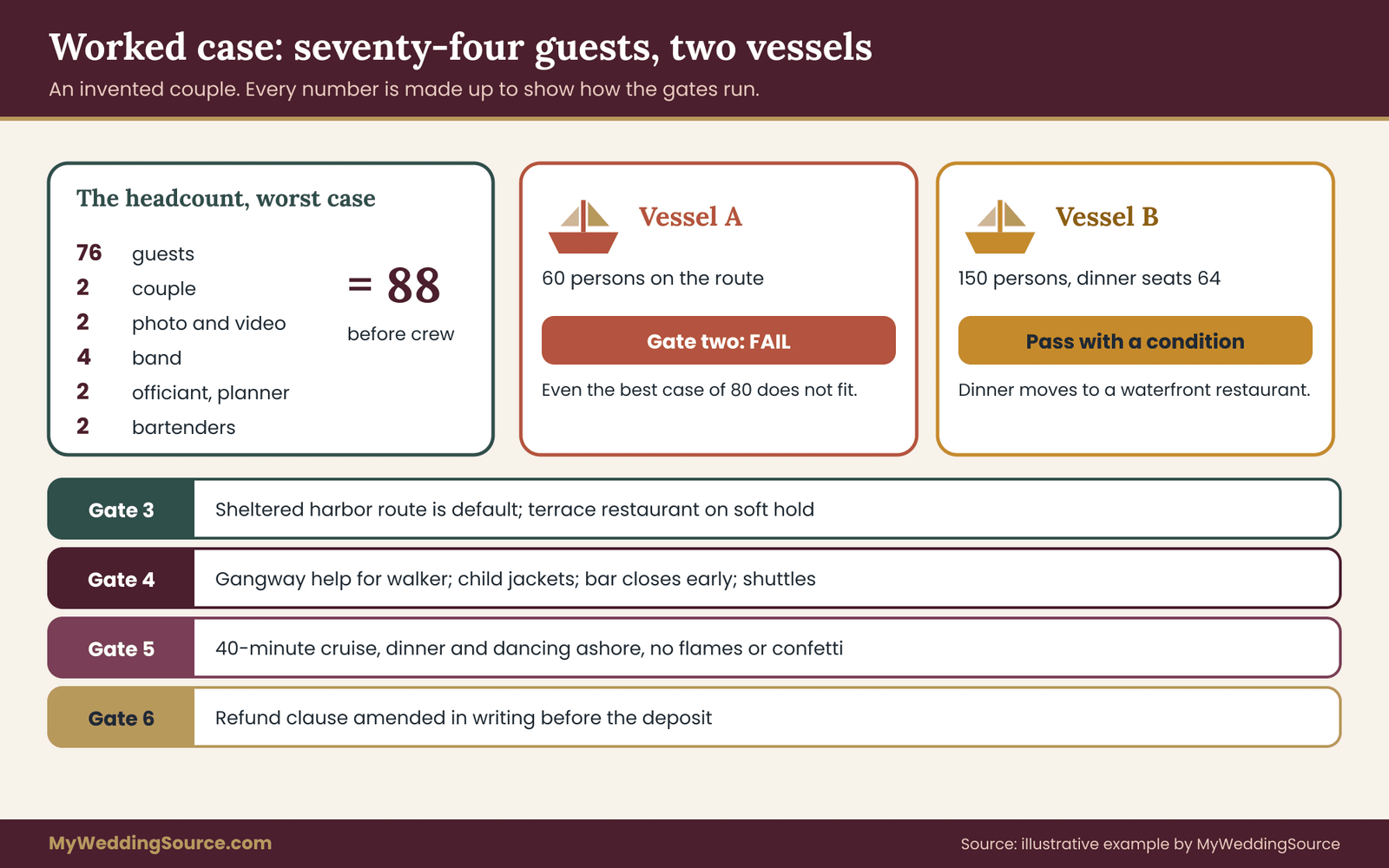
Before touching the vessels, Marta writes the headcount in full. Seventy-six guests at the worst case, plus the two of them, a photographer and a videographer, a four-person band, an officiant, a coordinator and two bartenders from their caterer. That is eighty-nine people before the vessel’s crew. Her best case, sixty-eight guests, brings the total to eighty-one. The two numbers become the range that every vessel must contain. Starting from the full count, not the invitation count, is how this yacht wedding planning example begins.
Vessel A
Vessel A is a graceful classic yacht the couple loves. The operator sends a document showing a maximum of sixty persons on the route, and confirms that the number includes the crew. Gate one passes. At gate two, the worst-case total of eighty-nine and even the best-case total of eighty-one exceed sixty. The result is a Fail. Marta considers cutting the guest list to fit, then realizes it would mean removing about a third of her guests.
She treats the vessel as unsuitable for the full wedding and notes that it might work for a ceremony for a small group. She moves on. This early Fail shows how yacht wedding planning saves effort rather than wasting it.
Vessel B
Vessel B is a larger event vessel. The operator provides the authorization, the captain’s credential and an insurance certificate, all current. The maximum on the route is one hundred and fifty persons, and the written note says crew are counted separately. Gate one passes. This vessel shows how a Pass with a condition shapes yacht wedding planning instead of blocking it.
At gate two, the numbers are clear. The worst-case total of eighty-nine sits comfortably inside the ceiling, a margin of more than a third. The operator then supplies the program numbers: a seated dinner for sixty-four, a standing reception for the full ceiling, and a dance area that comfortably holds a few dozen. The seated dinner is below the worst-case guest count.
The program does not fit the whole event, so gate two is a Pass with a condition: the dinner cannot happen aboard for everyone, and the couple must either move it ashore or limit guests to sixty-four.
Weather and the schedule
At gate three, the operator shares written limits. The captain decides on wind and sea state using the marine forecast zone for the harbor. There is a sheltered route inside the breakwater, included in the price, and the captain will run it on marginal days.
The couple checks the forecast for the zone closer to the date and sets their own comfort limit: they will go on the sheltered route but not on the open water if the forecast shows steady afternoon wind. Sunset on their date is a little before eight, so they ask for a seven-thirty return, well before dark, to protect older and tired guests. They agree to the decision clock with a three-hour call on the day and a prepared message.
Gate three is a Pass with a condition: the sheltered route is the default, and the couple name a restaurant with a covered terrace as the fallback.
Guest safety
At gate four, Marta writes the list. One grandparent uses a walker, two guests are pregnant, there are six children, and the group of college friends will want the bar open. The operator describes the gangway, which is wide with rails on both sides but steep at low tide, and explains that the main deck has no steps from the boarding point to the ceremony area, while the dining level is reached by stairs.
The restroom on the main deck is small but reachable. The grandparent can board with the crew’s help at the time they will arrive, which is near high water. The operator can provide child-sized life jackets for every child on the list.
For the bar, the couple chooses a licensed bartender provided by the operator, closes service before the return and arranges shuttles to the hotels. Gate four is a Pass with conditions: one boarding-aid confirmation with a date, and the shuttle booking.
Program and money
At gate five, the couple writes their one-sentence program: a forty-minute ceremony and cocktail cruise inside the harbor, then a seated dinner at a restaurant on the waterfront and dancing there. The restaurant sits two minutes from the dock. Because the vessel’s dinner seating is below their headcount, this arrangement turns a gate two condition into a plan. The operator approves the band for the main deck, bans open flames and confetti, and agrees to a layout drawing. Gate five passes.
At gate six, the quote has the charter hours starting at boarding and ending at the last guest off. The couple asks for overtime terms, the cancellation clause and the weather clause in writing. The operator offers a credit for weather cancellations, which the couple does not want because they cannot hold the wedding again.
After a conversation, the operator amends the contract to state that if the captain cancels for safety, the couple may choose a refund of the unused balance, with the deposit treated as a credit. Marta writes down the worst-case exposure: the deposit plus the cost of the restaurant minimum, which she judges she can absorb. Gate six passes with a condition: the amendment must be signed before the deposit.
What the yacht wedding planning workbook changed
The first vessel the couple loved was out within an hour, before any money moved. The second vessel was a better fit, and the plan changed in three ways: the dinner moved ashore, the trip stayed in the harbor, and the contract gained a refund clause. None of those changes happened because anyone was difficult. They happened because the questions came in the right order. ## When yacht wedding planning should stop
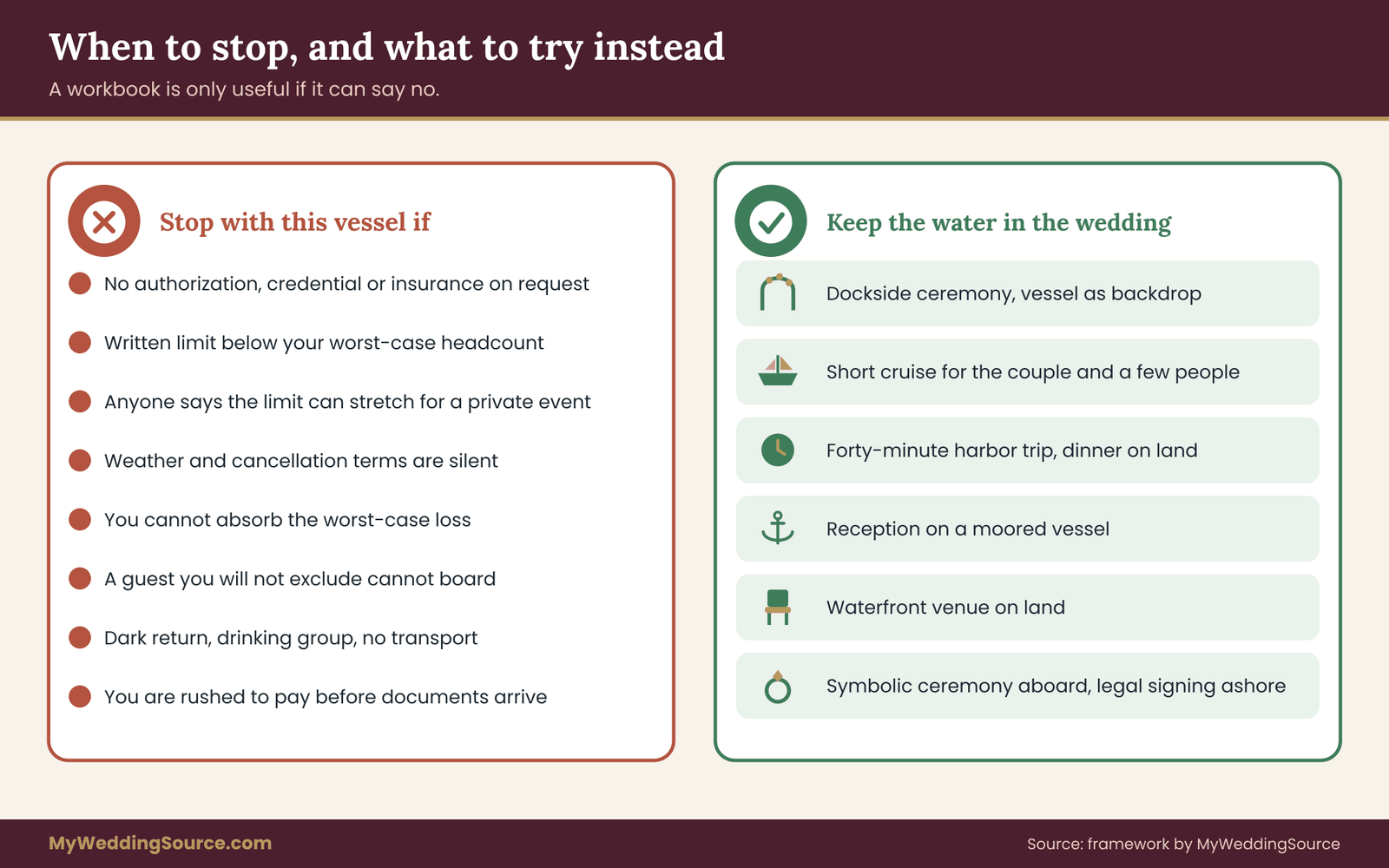
A workbook is only useful if it can say no. This section lists the failure conditions plainly, so you can recognize them while you are still emotionally flexible. Any one of the following is a reason to stop with the current vessel, date or plan, and to change at least one of them.
The vessel cannot show its authorization. If an operator will not send the passenger authorization, the captain’s credential and the insurance certificate, end the conversation. Reputable operators have these documents at hand.
The passenger limit is below your worst-case headcount. Do not plan on the assumption that some guests will not come. Plan on the number that might. If the limit and the number do not meet, change the vessel or the guest list.
Someone suggests the limit is flexible. Any suggestion that a private event can carry more than the vessel’s written maximum is a Fail, whoever makes it and however friendly they are.
You cannot absorb the worst-case loss. If a storm on the day would put you in financial difficulty, the plan is too expensive for its risk. Reduce the exposure by shortening the charter, choosing a dockside format, moving the date, or choosing a vessel with a clearer refund clause.
The weather and cancellation terms are silent. A contract that does not say who decides, and what you receive when the answer is no, leaves you with no protection exactly when you need it.
A guest you will not exclude cannot board. Gate four is not a place for compromise at the expense of a person. If a grandparent cannot safely reach the deck and you will not hold the wedding without them, the solution is a different format, not a hope that the crew will manage.
The return would be in the dark, with a drinking group, and no transport. That combination is the most common cause of regret in vessel events. Change one of the three.
You are being rushed. A deposit deadline that falls before you can check the documents is a reason to slow down. A good vessel is rarely so scarce that you must decide in a day.
Soft failures
Some problems are not reasons to stop but reasons to adjust. A vessel with a narrow deck can still host a ceremony. A vessel without a good dance floor can still host a cruise and a land-based party. A vessel with strict rules on decor can still look beautiful in plain lines. A soft failure is the moment to change the program, not the vessel. Write down the change, and rescore the gate. Knowing the difference between a stop and an adjustment keeps yacht wedding planning moving.
How to rescore
When something changes, whether a headcount, a date, a vessel or a program, go back to the gate it touches and rescore everything after it. A changed date reopens gate three and gate five. A changed headcount reopens gates two, four and six. Many couples change one item and assume the rest still holds. The yacht wedding planning workbook exists to catch that. Rescoring is what keeps yacht wedding planning accurate after every change.
Alternatives that keep the water in your wedding
If the yacht wedding planning workbook returns a Fail, or if the cost of a pass is higher than you want, there are several ways to keep the feeling you were after without carrying a whole wedding across water. None of these is a consolation prize. For many couples, they turn out to be the better wedding.
A dockside ceremony with a vessel as backdrop. The ceremony happens on a dock, a lawn or a pier next to the water, and the vessel sits behind you. Guests do not board, so the passenger limit and the weather decision largely drop away. You still need a permit for the dock or lawn and a plan for wind and rain, which is why this format pairs well with the usual approach to outdoor ceremonies.
A short cruise for the couple and a few people. A small group, such as the couple, their parents and the photographer, takes a short trip before or after the ceremony. This keeps the images and removes the guest-safety load. It is a good fit when the number of people who can be aboard is small.
A cruise as one part of a longer day. A forty-minute harbor trip after the ceremony, followed by a dinner on land, treats the vessel as an experience rather than the venue. It also reduces the exposure, because a cancelled trip leaves the rest of the day intact.
A stationary event on a moored vessel. Hosting a cocktail hour or a small dinner aboard a vessel tied at the dock removes the weather decision and the return-after-dark problem. It still has a capacity, a gangway and a marina to deal with, so the earlier gates still apply, in a lighter form.
A waterfront venue on land. A restaurant, a club or a hall with a view of the water gives you the setting without a hull. For help comparing these, the wedding venues guide goes through the basics of choosing between spaces, and the questions there carry over well.
A symbolic ceremony on the water and a legal ceremony on land. The legal signing happens ashore, at a time and place that suit the paperwork, and the water ceremony becomes a meaningful ritual for guests. This sidesteps jurisdiction questions at once.
Choosing between them
Ask which part of the idea you are attached to. If it is the photograph, a dockside format or a short cruise gives you most of it. If it is the sense of departure, a cruise as one part of the day gives you the moment. If it is the full evening on the water, you need the strictest version of the yacht wedding planning workbook, a vessel with a large capacity and a generous contract, and a fallback.
Whichever you pick, the same discipline from yacht wedding planning applies in a lighter form.
Be honest with yourself about what the vessel adds and what it costs. A vessel adds a memorable setting and a sense of occasion. It also adds regulated capacity, weather risk, motion, boarding difficulty and a contract that favors the operator. None of that is a reason to avoid a yacht wedding. It is a reason to choose one deliberately.
Your next steps
Start with the quickest tasks and work toward the larger ones. Each takes less time than you might expect.
- Write your worst-case and best-case headcounts, counting vendors, children and crew questions.
- Send the first-email script to two or three operators and ask for the authorization, the credential, the insurance certificate, the weather policy and the cancellation terms.
- Record every answer in the six-gate workbook, with its source and date.
- Score gates one and two as soon as the documents arrive, and drop any vessel that fails.
- Visit the vessel at the hour and the tide you will use, with the guest who will find boarding hardest in mind, if possible.
- Write your safety limits and your comfort limits for weather and agree the decision clock in writing.
- Compute your worst-case financial exposure before you sign anything.
- Request written amendments for any term that contradicts the yacht wedding planning workbook, and pay the deposit only after they are signed.
- Choose your fallback and put it on a soft hold.
- Check current rules with the issuing agencies listed in the sources, since requirements, fees and vessel terms change.
FAQ
How far ahead should I begin yacht wedding planning?
Start as soon as you have a rough date and headcount, because the first two gates cost nothing and can rule out a vessel in days. Popular vessels and dates fill, but the paperwork checks are quick. Aim to finish gates one through three before you pay any deposit, and keep your final headcount decision date written into the contract so the operator and the caterer can plan around it.
What is the first document to request from a yacht operator?
Ask for the vessel’s current authorization to carry passengers for hire, which shows the maximum persons allowed on your route and the waters it covers. Request it by email together with the captain’s credential and an insurance certificate with dates. These three documents answer the most important questions at once and show how organized the operator is. A refusal or long delay is itself useful information.
Do crew and vendors count toward the passenger limit?
It depends on the vessel’s authorization, so ask the operator to confirm in writing whether the stated maximum includes crew. Your own vendors, such as the photographer, band, officiant and bartenders, are people aboard and should be counted in your plan. Add everyone who will be on the vessel at the same time, then compare that total with the written figure for your route.
Can I add more guests than the vessel’s written limit for a private event?
No. A private event is still a charter carrying passengers for hire, and the vessel’s written maximum applies. If anyone suggests the limit can be stretched for a private party, treat that as a failed gate and choose another vessel or a smaller guest list. The people at risk from an overloaded vessel are your guests, and the crew is right to stop boarding at the limit.
What happens to my money if the captain cancels for weather?
That depends entirely on the contract, which is why the weather and cancellation terms are part of the yacht wedding planning workbook. Look for who decides, whether you receive a refund, a credit or a reschedule, and what applies if the trip is shortened. A credit has little value for a one-time wedding. Ask for any refund terms to be written into an amendment before you pay a deposit.
Is a moored yacht easier to plan than one that sails?
In many ways, yes. A vessel tied to the dock removes most of the weather decision and the return-after-dark problem, and it can suit older or less mobile guests. It still has a passenger limit, a gangway, a marina and an operator’s rules, so the earlier gates still apply in a lighter form. Ask the operator and the marina about the limits for a stationary event.
How do I handle guests who cannot or would rather not board?
Ask early, privately and kindly, and offer a real alternative so nobody feels excluded. Options include a dockside ceremony they can attend, a shoreside welcome, or a land-based reception where the whole group meets afterward. Do not ask a guest to manage a steep gangway or stairs they cannot safely use. Planning the alternative from the start makes the event kinder for everyone.
Can I hold the legal marriage ceremony on the boat?
Possibly, but confirm it with the office that issues your marriage license before you decide. Licenses are generally tied to a jurisdiction, and a vessel can move across boundaries. Many couples sign the legal paperwork on land and hold a symbolic ceremony aboard, which avoids the question. Ask the issuing office and your officiant what they recommend for your location, and get the answer in writing.
Sources
- U.S. Coast Guard: passenger vessel regulation, inspection and safety information.
- Coast Guard Office of Auxiliary and Boating Safety: recreational boating safety, life jackets and passenger guidance.
- Coast Guard Marine Safety, Security and Stewardship: inspection, credentialing and commercial vessel policy.
- National Weather Service marine forecasts: marine zone forecasts, advisories and wind and wave guidance.
- NOAA Tides and Currents: tide predictions and water level information for coastal routes.
- ADA.gov: U.S. Department of Justice information on the Americans with Disabilities Act.
- U.S. Access Board: accessibility guidelines, including those for passenger vessels.
- Consumer Financial Protection Bureau: credit card billing disputes and consumer payment rights.
- Federal Trade Commission consumer advice: guidance on deposits, refunds and checking businesses before paying.