
Campground wedding catering is ordinary catering with three extra problems: a long road between the kitchen and the table, no controlled kitchen at the other end, and wildlife that treats a dinner buffet as an invitation. This guide gives you a one-page route, hold and guard sheet, a worked case and the conditions under which you should change the plan.
Plan campground wedding catering as three lines on one sheet. The route line covers how food physically gets from the kitchen to the serving area, including road limits, vehicle size and a written arrival window. The hold line covers how every dish stays out of the temperature danger zone until it is eaten. The guard line covers how food, trash and scented items are secured from wildlife before, during and after dinner. Get the managing agency’s food and wildlife rules in writing first, because they override everything else.
Most advice about wedding food assumes a venue with a kitchen, a loading dock and a dumpster behind a fence. A campground has none of those things. The nearest paved road may be a gravel track with a weight limit. The serving area may be a pavilion with one outlet. Overnight, the same pavilion may be visited by raccoons, rodents, birds, deer or, in some regions, bears. Those facts change what you order, how it travels and how it is cleared away.
This guide is about the gap that campground wedding catering has to close, and nothing else. It does not explain how to choose a menu in general, how to read a catering proposal or how to run a camp weekend.
The broader menu questions are covered in the wedding menu planning guide, and the sleeping, cabin and guest-expectation side of a camp weekend is its own subject. Here the question is narrower for campground wedding catering: once the menu exists, how do you move it, protect it and guard it in a place where the usual safeguards are missing?
A note on scope. This is general information, not legal, tax or safety advice. Food permits, fire restrictions, wildlife orders and access rules differ by agency, county and season, and they change, so the guide points you to the office that issues each rule rather than stating a current figure.
What campground wedding catering actually involves
Campground wedding catering sits where three kinds of work meet: food production, transportation and site management. A conventional caterer is strong at the first. A camp manager is strong at the third. Almost nobody on the planning team is responsible for the second, which is why the route between them is where plans most often break.
It helps to separate the people who are involved in campground wedding catering, because each one controls something different.
The caterer controls the menu, the production kitchen, the packing method and the serving equipment. They know how long a dish holds. They may not know the camp’s road.
The campground or retreat operator controls the site: the road, the gate hours, where vehicles may park, what electricity and water exist, what is allowed to be left outdoors and what the wildlife rules are.
The managing agency, when the site is on public land such as a national or state park, controls permits for commercial activity and food storage orders. A privately owned retreat has its own rules, but a public campground has rules written by an agency that you cannot negotiate with.
The local health authority typically decides whether a caterer can serve food at an outdoor event and what temporary permits apply. The name and process differ by county.
You and your planner control the schedule, the guest count and the decision to approve or reject the plan.
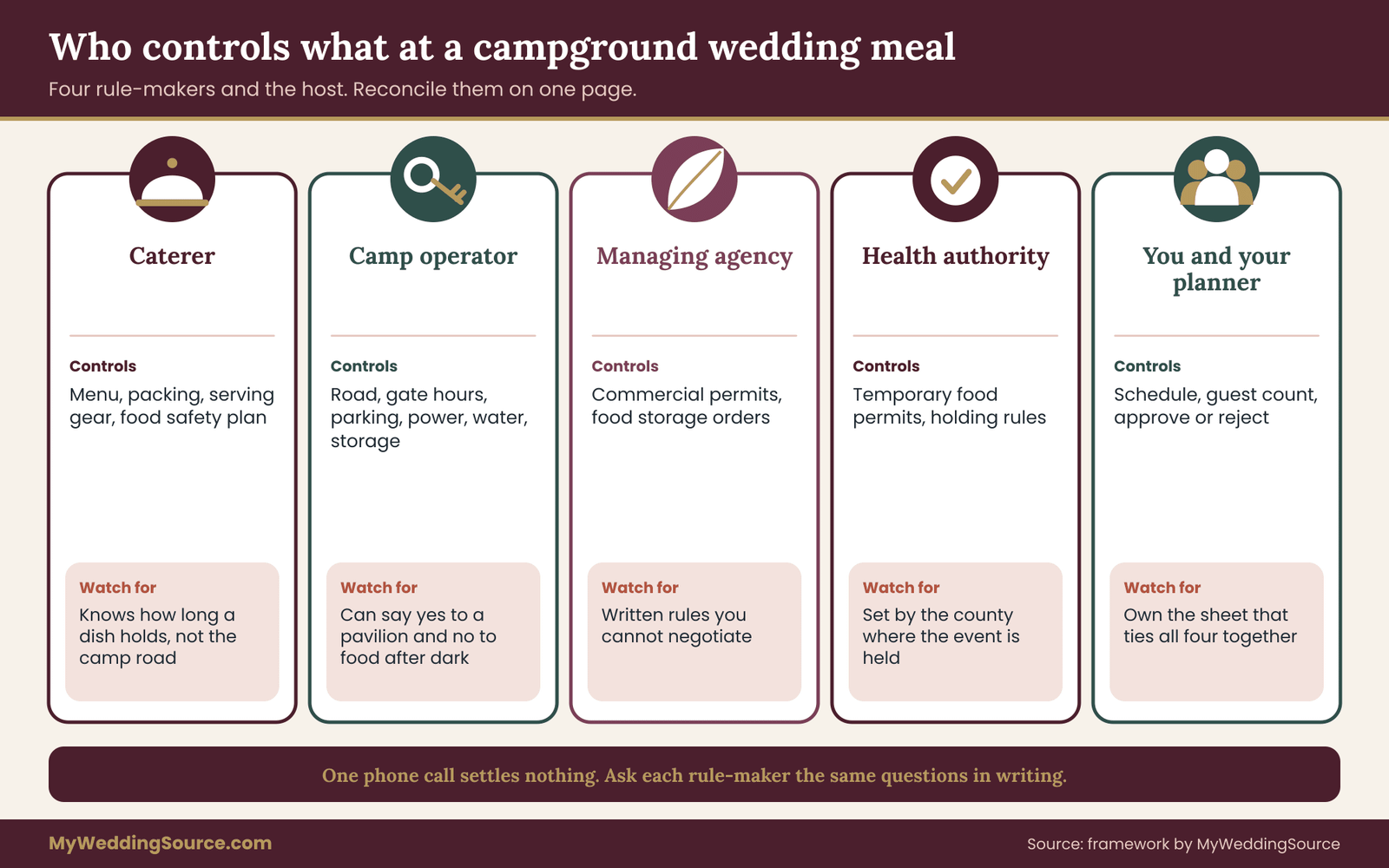
Looking at the four rule-makers side by side shows why a single phone call rarely settles campground wedding catering. The caterer can promise a dish will hold for two hours, but the road can eat forty minutes of that. The camp can promise a pavilion, but the agency can forbid leaving food out after dark. Campground wedding catering works when someone reads all four sets of rules and reconciles them on one page.
Why a camp changes the food plan for campground wedding catering
Four site facts do most of the damage.
First, distance and surface. A caterer used to ten minutes of paved road may face thirty or forty minutes on a narrow gravel route, with a vehicle that cannot carry a full-size hot box safely over washboard ruts.
Second, power and water. Many campgrounds offer a single outlet near a pavilion, a hand pump or a spigot, and no sink suitable for food service. That limits what can be reheated, rinsed or kept cold on site.
Third, hours and gates. A camp may lock its gate at a set time, or the agency may restrict vehicle movement during quiet hours. A delivery that arrives late may have nowhere to go.
Fourth, wildlife. Food and trash that would be harmless in a hotel ballroom become attractants outdoors. A small animal in a serving tent is annoying. A larger animal near a crowd of guests is a safety problem for people and for the animal.
What this guide leaves out
This guide does not cover fire safety for a bonfire, though cooking on open flame brings its own permission chain. It does not cover how to price a catering package, which is a contract question better handled in the wedding vendor contract guide. It does not cover accessibility of the buildings themselves beyond the narrow question of whether food service can reach the guests who need it. Keeping the scope of campground wedding catering tight lets the sheet in the next section stay usable on a single page.
The route, hold and guard sheet
The method for campground wedding catering in this guide is a single worksheet with three lines. Fill in one line at a time, in order, because each line depends on the one before it. The route sets the time food spends in transit. The hold line has to survive that time. The guard line has to cover everything the first two lines leave outside.
Line one, the route. Write down the start point, the end point, the road surface, the total travel time with a loaded vehicle, any gate or hour restrictions, the vehicle type and the parking and unloading spot. Then write the planned departure, planned arrival and the latest acceptable arrival, each as a clock time.
Line two, the hold. For every dish, write how it is held while traveling, how it is held while waiting, how it is reheated or kept cold at the site, and the clock time by which it must be served or discarded. Next to each dish write the lowest and highest temperature it should stay within, as given by your caterer’s food safety plan and the health authority.
Line three, the guard. For every moment food, trash or scented items are outside a vehicle or building, write who is responsible, what container or enclosure they sit in and when they are removed. Add the wildlife policy that guests and vendors have agreed to.
How to use the three lines together
The campground wedding catering sheet is not a form to be filed. It is a pressure test. Read it from the bottom up. If the guard line says every scrap leaves the site by ten at night, then the route has to include a departure after dinner and a driver who is not drinking.
If the hold line says a dish must be served within two hours of leaving the kitchen, then the route line must show an arrival that leaves room for that. If the route line shows a one-hour drive on gravel, the hold line must justify a dish that survives it.
A useful habit is to write a one-sentence verdict beside each line: pass, pass with a change, or does not pass. A line that does not pass is not a failure of the plan. It is the reason the sheet exists. It tells you which dish to swap, which vehicle to change or which part of the evening to move indoors.
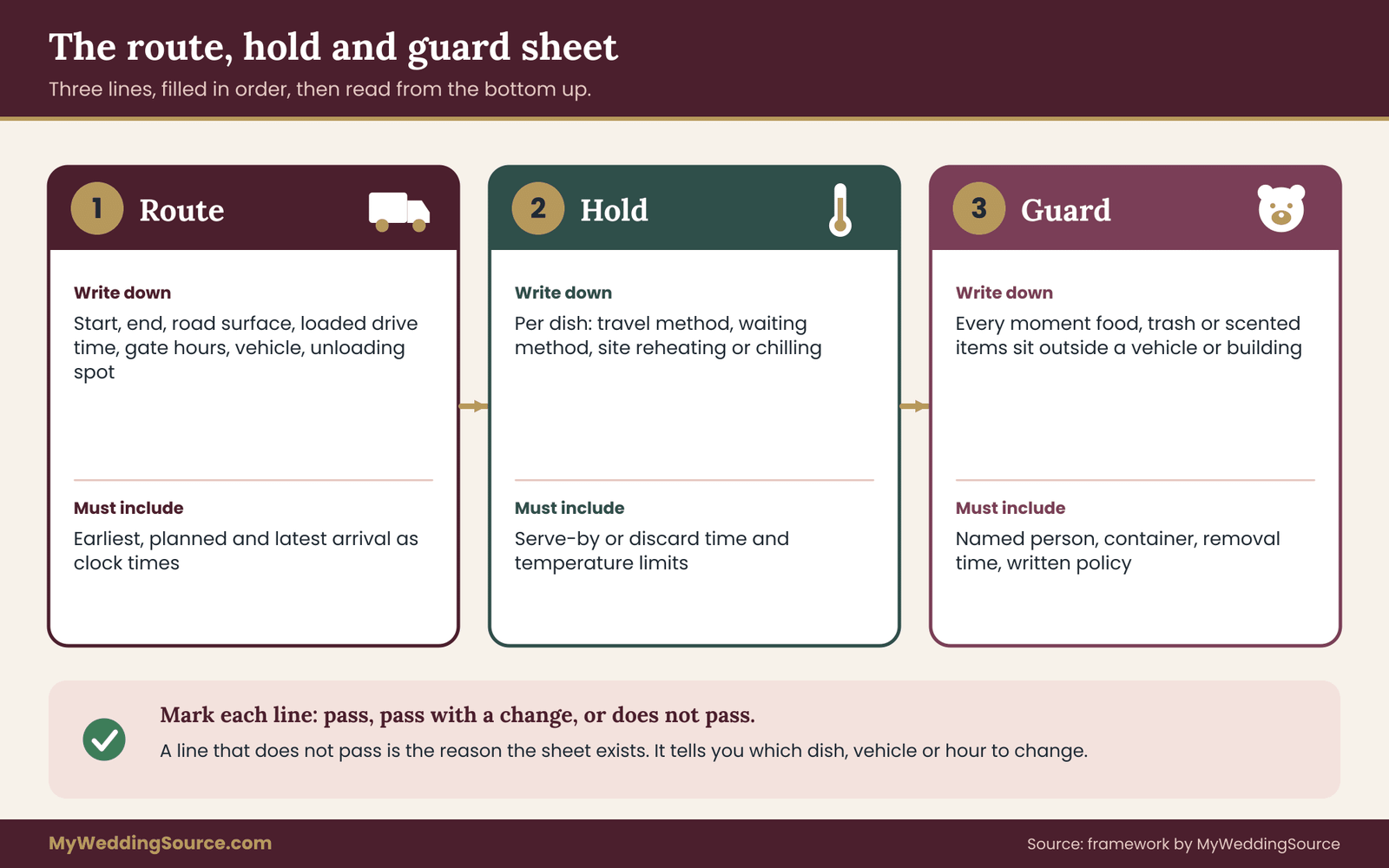
The infographic above shows the three lines and the question each one answers. The sheet can fit on one page, and it should be copied to the caterer, the camp contact, the planner and whoever drives the vehicle, so that no one is working from a different version.
Keeping the sheet honest
Fill the campground wedding catering sheet in with facts, not hopes. If you do not know the road time, drive it, in a loaded vehicle of the same size, at the same time of day. If you do not know the agency’s food storage rule, find the written order or ask the agency to state it.
If the caterer says a dish holds for three hours, ask where that comes from and how it is measured. A claim with no written source belongs in the margin as an open question, not on the sheet as a fact.
Sheet entries for campground wedding catering should also name the person who checked them. A line that reads “road verified” tells you nothing; a line that reads “road driven by the planner on a Tuesday afternoon, thirty-five minutes loaded” tells you what was checked and how to repeat it.
Finally, date the campground wedding catering sheet. Campgrounds change gate hours with the season, agencies update orders and caterers change vehicles. A sheet written in spring is a draft by the time autumn arrives. Re-read it at three points: when you book, one month out and one week out.
Mapping the route for campground wedding catering
Route planning is the least glamorous part of campground wedding catering, and the part that most often decides whether dinner is hot, cold and safe or merely late. The goal is a route you have actually measured, with a margin, and a fallback if any link fails.
Measure the last mile, not the whole trip
Caterers usually quote a drive time from their kitchen to the venue address, and for campground wedding catering that number is only the start. That number is built from a map application and assumes ordinary roads. The part that matters for a campground is the last stretch: the gravel or dirt access road, the gate, the loop road inside the grounds and the walk or short drive from the parking area to the serving spot.
Ask the camp for four facts and write them on the route line. What is the road surface for the final segment? Is there a posted or practical limit on vehicle length, weight or height, including low branches and bridges? Is the gate staffed, locked on a schedule or opened by code? And where, exactly, may a delivery vehicle stop to unload, and for how long?
Then verify the answers yourself. Drive the final segment, slowly, at the hour the delivery will happen. Note anything that would slow a loaded vehicle: a washboard section, a steep grade, a tight turn, a creek crossing, a narrow bridge. These details feel minor until a rental box truck meets them with a stack of hot boxes.
Choosing the vehicle for campground wedding catering
Vehicle choice follows from the road, not from the amount of food. A large box truck carries more but may not fit the final segment. A pickup or van fits more roads but carries less and exposes food to dust and vibration. A trailer can add capacity but complicates turns on a narrow loop.
When the road is rough, three questions help decide.
Can the vehicle drive the final segment without scraping, stalling or needing a spotter? If the answer is uncertain, test it empty first.
Can the food be secured so it does not shift? Rough roads tip pans, slosh liquids and crush delicate items. A dish that survives a smooth highway may arrive as a mess after a mile of ruts.
Is there a shuttle option? Some camps run a utility vehicle or a farm truck between the parking lot and the pavilion. Using it means two handoffs but may protect the food and the vehicle. Handoffs, however, add time and a place where a container can be set down on dirt.
Write the vehicle, its size and the reason you chose it on the route line. If the caterer wants to use a different vehicle on the day, that is a change to the sheet, not a surprise at the gate.
The arrival window as a written promise in campground wedding catering
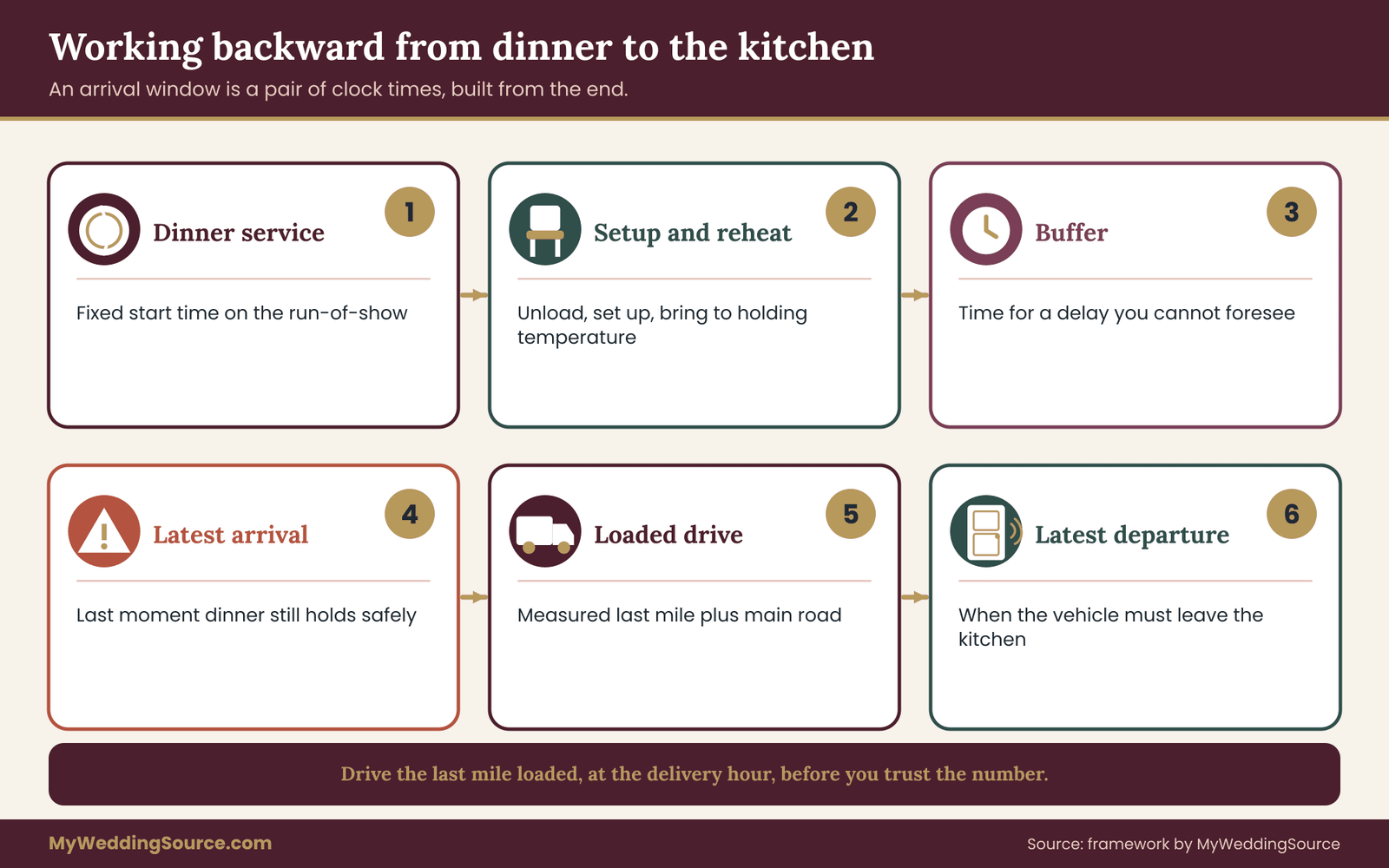
An arrival window is a pair of clock times, not a vague hour. The earliest time is when the camp will let the vehicle in and when staff can meet it. The latest time is the last moment at which dinner can still be served on schedule and every dish remains within its hold limit.
Work backward from dinner. Suppose dinner service begins at a certain time. Subtract the time needed to unload, set up and reheat. Subtract the buffer for a delay you cannot foresee. That is the latest acceptable arrival. Subtract the loaded drive time and you have the latest departure from the kitchen. If the caterer’s plan leaves less than thirty minutes of buffer for an unpaved road, ask why.
A written window also protects the caterer. If the camp’s gate opens an hour later than assumed, or a ceremony runs over and the pavilion is not yet free, the caterer has a document that shows the delay was not theirs. Both sides then have a shared reason to solve it rather than a dispute afterward.
Handoffs, spotters and the person at the gate
Every handoff in campground wedding catering is a place for time and temperature to slip. Count them. Kitchen to vehicle is one. Vehicle to unloading spot is two. Unloading spot to serving area is three. If a shuttle is involved, add two more. Each should have a named person, not a role.
Name one person on the camp side who meets the vehicle and one person on the caterer’s side who leads the unloading. Give both a mobile number, and check before the event that there is signal at the gate. Coverage at a campground can drop out entirely in a valley or under tree cover, and a driver who cannot reach anyone may wait at a locked gate with a full load. If signal is poor, agree on a landline, a radio channel or a physical check-in point.
For events with several vendors arriving the same afternoon, build a short arrival schedule so rental trucks, florists and the caterer do not meet at the same bend in the road. The venue technical walkthrough guide explains how to measure access routes in detail, and the same habits apply here: measure twice, write the numbers down and give the written version to everyone who will drive.
When there is no vehicle access
Some sites have no road to the serving area, which changes campground wedding catering more than any other single fact. Food must then be carried, rolled or shuttled in stages. This is workable for smaller menus but changes the choice of dishes. Heavy trays, large stockpots and liquids are hard to carry over uneven ground. Containers with secure lids, insulated carriers with handles and food that can be portioned at the site are easier.
If carrying is part of the plan, the route line needs a carry distance, a surface description and the number of people available to carry. A thirty-yard path across flat grass is different from a quarter mile of roots and steps. Test it with a loaded container of similar weight, preferably in daylight and again in the dark, because setup often runs late.
Contingency for the route in campground wedding catering
Write one backup for each link that could fail. If the main road is closed by weather, is there a second road, and does the vehicle fit it? If the gate is locked, who has the code or key? If the primary vehicle breaks down, what is the substitute and how long does it take to arrive? A simple contingency table is not needed. One sentence per link is enough, and it is the kind of sentence that turns a crisis into a delay.
Vehicles, loading and the transport clock
Once the route is measured, the next job is to load the vehicle so the route does not undo the food. This is where the caterer’s expertise matters most in campground wedding catering, and where your role is to ask the right questions rather than direct the packing.
What to ask the caterer about packing
You do not need to design the packing, but you should hear the answers to a few plain questions. How is hot food held while it travels, and for how long can that method hold it above the safe limit? How is cold food kept cold, with ice, gel packs or a refrigerated vehicle? Is raw food, such as raw meat or unwashed produce, kept apart from ready-to-eat food? How are containers secured against sliding and tipping? And what does the caterer carry to measure temperature at arrival?
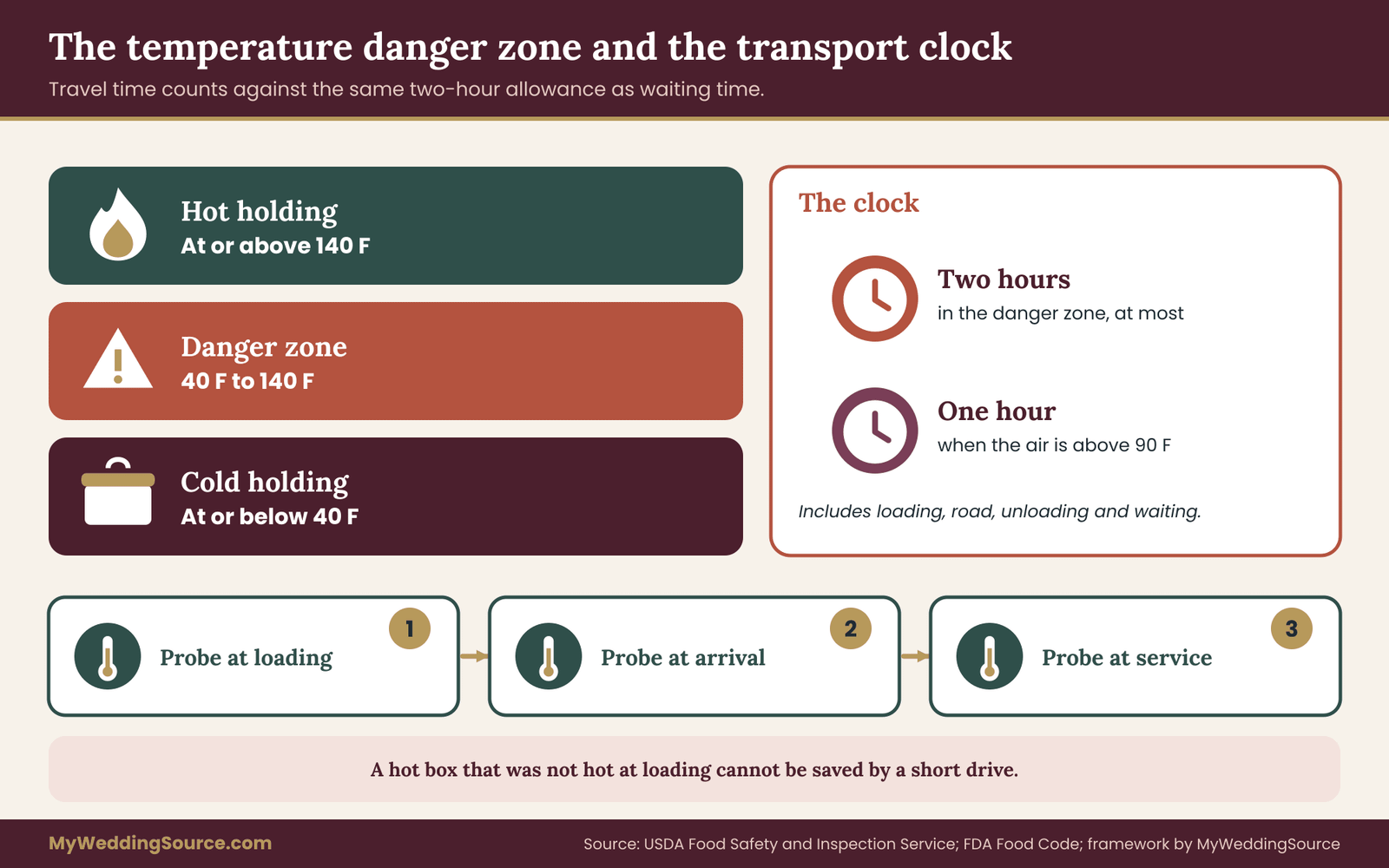
The U.S. Department of Agriculture’s Food Safety and Inspection Service explains the temperature danger zone as the range between forty and one hundred forty degrees Fahrenheit, where bacteria can multiply rapidly, and advises that perishable food should not sit in that range for more than two hours, or one hour when the air is above ninety degrees.
Those figures are a general guideline, and a licensed caterer works from a food safety plan approved by the local authority. Treat the guideline as a way to test claims, not as a substitute for that plan.
Starting the transport clock
A transport clock is a simple record of when each dish leaves a controlled temperature and when it returns to one. It starts when a container leaves the cooler, oven or hot box, and it stops when the food is placed in a heated or chilled holding device at the site, or served.
The clock matters because the time on the road is part of the two-hour allowance, not separate from it. A dish that starts hot and holds well in an insulated carrier may be safe for the whole trip. A dish that was warm to begin with, or one that spent twenty minutes on a loading dock, may have used most of its time before it reaches the gate.
Ask the caterer to note, for each dish, the temperature at loading and the temperature at arrival. A probe thermometer takes seconds to use. If the caterer does not measure at arrival, that is a gap in the hold line, and it is reasonable to ask for it to be added.
Loading order and unloading order
Loading order should be the reverse of unloading order. The items needed first at the site, such as cold appetizers, should be reachable first. Items that are heavy or hot should be placed where they will not shift. Ice and raw items should be low and separate.
At the site, unloading should flow to the correct holding area without piling containers on the ground. A clean table or the tailgate of a vehicle is better than a patch of grass, and a covered surface is better than an open one. This ties straight into the guard line: anything set down outdoors is now exposed to animals and weather, even for a short time.
What the vehicle should carry besides food
A short kit often decides whether a problem in campground wedding catering stays small. It includes a probe thermometer and a way to clean it, a supply of ice or gel packs beyond the minimum, covered bins for trash, sealable containers for leftovers, paper towels, hand sanitizer and a first aid kit.
If the camp has no running water suitable for food service, the vehicle may also need to carry potable water for handwashing and cleaning. Ask the caterer what is in their campground wedding catering kit, and ask the camp what is available on site, then fill any gap before the day, not on it.
Checking the route with a trial run
If the budget allows, a trial run is the most reliable way to test the route and the hold line together. The caterer drives a loaded vehicle with the same type of container, perhaps with water or a simple dish, from the kitchen to the serving spot at the same time of day. Someone records departure time, arrival time and the temperature of a probe in a container at both ends.
A trial for campground wedding catering costs a few hours and some fuel. Compared with a failed dinner for guests who have traveled to a remote site, that is a modest price. If a full trial is not possible, drive the route yourself in a similar vehicle and let the caterer review your notes. Either way, the point is to replace assumptions with measurements before the day.
For help with the paperwork side of this, such as writing delivery times and responsibilities into the agreement, the wedding vendor purchase order checklist shows how to turn a scope into a written acceptance standard, which is useful for a delivery that has to arrive by a certain hour.
Food protection in campground wedding catering
The hold line of the sheet is where food safety lives. The principle is simple and unforgiving: keep hot food hot, keep cold food cold, keep raw and cooked food apart, keep hands and surfaces clean, and keep a clock running. At a conventional venue the kitchen does much of this for you. In campground wedding catering you rebuild each of those safeguards by hand, outdoors, and the paragraphs below take them one at a time.
Hold temperatures and the two-hour rule
The USDA guideline mentioned earlier gives the outer limits. Cold food should stay at or below forty degrees Fahrenheit, and hot food should stay at or above one hundred forty degrees. Anything that spends more than two hours in between, or more than one hour when the outdoor temperature is above ninety degrees, is a candidate for discarding. The Food and Drug Administration’s Food Code, which many state and local authorities base their own rules on, takes a similar approach with specific holding and cooling requirements.
Two things follow for campground wedding catering. First, outdoor summer events can hit the one-hour limit easily, so the plan should assume the shorter clock on hot days. Second, the clock does not pause for photographs, speeches or a slow ceremony. If dinner is delayed, the food must wait in a proper holding device rather than on a table.
Your job is not to enforce temperatures. It is to confirm that the caterer has a way to hold each category at the right temperature on site, and that the way fits the camp’s power and space. Ask directly: what will keep hot dishes hot for the length of service, and what will keep cold dishes cold?
Power, fuel and holding equipment
On site, holding comes from electric warmers, chafing dishes with fuel, insulated carriers, coolers with ice or a combination. Each has a limit.
Electric equipment needs reliable power. A single campground outlet may trip a breaker if a warmer, a coffee urn and a sound system share it. Ask the camp what the circuit can handle and whether a generator is allowed. Generators bring noise, fuel storage and in some campgrounds a prohibition. Ask the caterer for the wattage of every device and add them up against what the camp says it can supply.
Fuel-based chafing dishes need fire permission. Many campgrounds and agencies restrict open flame and some restrict fuel types during dry periods. Treat a canned-fuel chafer as an open flame until the camp or agency says otherwise in writing, and check the current fire restrictions with the managing agency close to the date.
Insulated carriers hold temperature for a limited time and lose heat each time they are opened. They suit transport and short holds better than a three-hour buffet. Ice-filled coolers keep cold food safe only while ice remains and the lid stays mostly closed.
Choose the holding method for each dish in your campground wedding catering plan and write it on the hold line next to the clock time it must be served or discarded.
Cross-contamination in a camp setting
Cross-contamination happens when raw food, or the juices from it, touch food that will not be cooked again. Outdoors, the risk rises because surfaces are improvised and washing options are limited.
Practical controls are inexpensive. Keep raw meat, poultry and seafood in separate, sealed containers below ready-to-eat items. Use separate utensils and cutting boards, labeled by food type. Keep a clean surface for ready-to-eat items, away from dust and insects. Wash hands before handling food, using potable water and soap, and sanitize between tasks. If the site has no suitable handwashing, the caterer should bring a portable station with potable water, soap and a way to catch wastewater.
Ask the caterer to describe the handwashing arrangement and the surface plan. A caterer who has worked outdoors will answer quickly. One who has not may need to adjust the menu so that less raw handling happens on site, for example by cooking everything off site and finishing it with minimal preparation.
Allergens and special diets in a remote setting
A remote site shrinks your margin for error in campground wedding catering. There may be no nearby store for a replacement ingredient, and no easy route to medical help. Allergen control therefore moves earlier in the plan.
Collect dietary needs with the RSVP, and pass the list to the caterer with enough lead time to adjust the menu. The FDA publishes the major food allergens recognized in the United States, which is a useful checklist for asking guests what they need. Label dishes at the table so a guest can identify them without asking, and keep a short list of ingredients for each dish on site.
For serious allergies, ask the caterer how they prevent cross-contact during packing, transport and service, not only during cooking. Separate containers, dedicated utensils and a plated serving method for the affected guest can reduce risk. Make sure someone on site knows where the nearest medical help is and how long it takes to reach, and that guests with serious allergies know their own plan. The broader question of menu structure for different needs is covered in the guide to building a menu for different ages and diets.
Water, ice and cleanup supplies
Water used for food preparation, handwashing and cleaning must be safe to use. Some campgrounds have treated water; others have springs, wells or hand pumps whose quality varies. Ask the camp whether the water is treated and tested, and where the nearest tap suitable for food use is. If there is any doubt, bring potable water in clean, food-grade containers.
Ice is a food, and it should come from a safe source and be handled with clean scoops. Ice used to chill cans or bottles should not also be used in drinks unless it is kept separate. Cleanup supplies, including sanitizer, clean cloths and bins, should be in the kit and counted.
Choosing a service model for campground wedding catering
The way food is served shapes everything else on the campground wedding catering sheet. Each model changes the hold line, the guard line and the number of hands needed.
Plated, buffet, family style and boxed service
Plated service needs a finishing kitchen or an area where servers can plate under control. It requires hot plates, a short plating window and many hands. On a campground with limited space and power it is demanding, though it keeps food covered and limits time on open tables.
Buffet service is easy to run and forgiving on timing, but it keeps food exposed for the length of service. That is a food safety concern and a wildlife concern, because open food on a table is both a hold challenge and an attractant. Buffets need sneeze guards or covers, a clear end time and a plan to close the line.
Family style puts shared platters on tables. It feels warm and suits a pavilion, but platters sit out until someone clears them, and refills require runners.
Boxed or individually packed meals are hardest to love and easiest to protect. Each portion is sealed, labeled and held in a cooler until handed out. They fit remote sites, hiking-in weddings and sites with no kitchen, and they reduce exposure to wildlife and cross-contact. They are best treated as a deliberate design, with good food and good packaging, not a downgrade.
Choosing by constraint, not by taste, in campground wedding catering
Start with the constraint that bites hardest. If power is the limit, choose a service model that depends less on electric holding. If space is the limit, avoid a model that needs a long buffet line. If wildlife is the limit, choose a model that keeps food covered or contained until the moment it is eaten. If the route is the limit, choose dishes and a model that tolerate a long trip.
A common pattern for campground wedding catering is a hybrid. A cold or room-temperature first course held in coolers, a main course finished in a controlled way close to service, and a dessert that does not need refrigeration. The mix reduces the number of items that need hot holding and shortens the time any single dish is exposed.
Menus that survive the route and the site
Dishes differ in how well they travel and how safely they hold. Braised or slow-cooked items hold heat well and reheat gently. Delicate items such as fried food, seared fish or soufflés lose quality quickly and are poor candidates. Dishes with dairy, eggs or mayonnaise-based sauces need strict cold control. Items that can be cooked to order on site need fuel, space and a plan for the smoke and the smell, which brings the guard line into play.
Ask the caterer to propose a short campground wedding catering menu built for transport, not an adaptation of the standard menu. Then check it against the three lines. A dish that passes all three is a keeper. A dish that fails any line should be changed, not defended.
Who serves, and how many hands
Service staff determine how long food is exposed and how quickly it is cleared, so staffing is a core part of campground wedding catering. For a campground, add staff to the usual ratio for the first and last thirty minutes, when unloading and breaking down take extra hands. Ask the caterer how many staff they plan to bring, how they will get to the site and where they will sleep or rest if the day is long.
Make sure each staff member knows the wildlife policy, covered in the next section. A server who leaves a tray of food on a bench while helping a guest has just broken the guard line.
Beverages and the cooler problem
Beverages deserve their own note in campground wedding catering. Coolers of drinks left in open areas draw animals as readily as food does, because sugar, alcohol and the smell of cans attract them. They also add a lot of ice and wet waste. Plan a covered, ideally lockable, beverage station and a schedule for refilling and collecting empty containers. If alcohol is served, check the camp’s alcohol rules and any permit the venue or agency requires; the wedding bar service planning guide covers the bar side separately.
Wildlife controls for campground wedding catering
The guard line is the part of campground wedding catering that most couples have never written before. It rests on one idea, shared by park agencies and by outdoor education groups such as Leave No Trace: wildlife becomes a problem when animals learn that people mean food. Every unsecured meal teaches that lesson, and animals that learn it are often relocated or destroyed. A wedding is a large, aromatic, short-lived feeding opportunity, and your job is to make sure the animals learn nothing from it.
What counts as an attractant in campground wedding catering
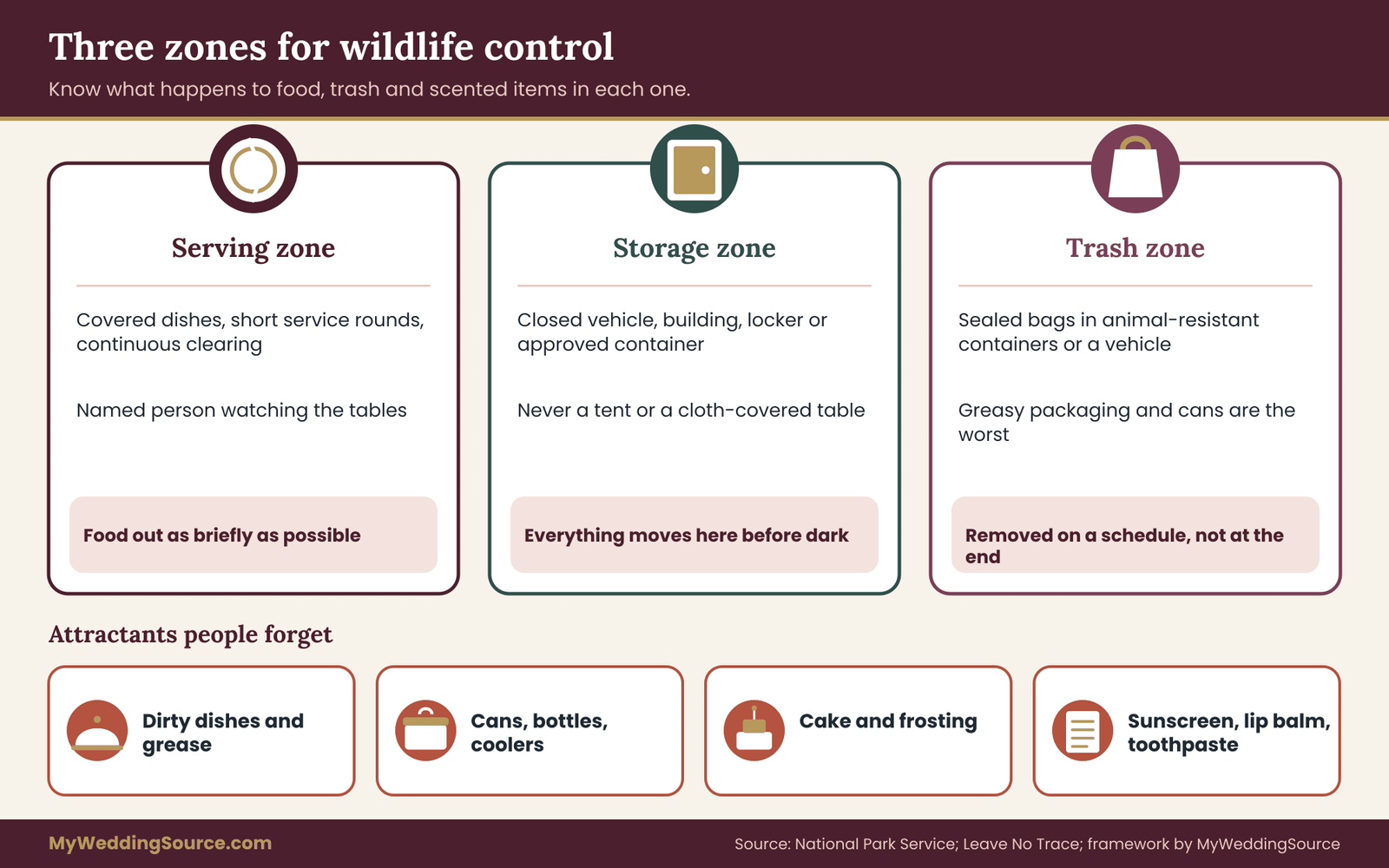
An attractant is anything with a smell or a taste that an animal may investigate. Food is the obvious one. The list is longer than most people expect: dirty dishes, grease and drips, cooking oil, empty beverage cans and bottles, cake and frosting, compost, pet food, trash bags with food residue, sunscreen, lip balm, toothpaste, scented candles and some cosmetics. Coolers hold smell even when empty.
The National Park Service and other agencies treat food, trash and scented items together for this reason, and many parks require them to be stored in approved containers, bear-resistant lockers or closed vehicles when not in use. The exact rule varies by park and by region, so the sheet should record the specific rule for your site, from the agency’s own page or a written reply, not a general impression.
Who the animals actually are
The risk depends on location. In much of the country the usual visitors are raccoons, opossums, skunks, rodents, crows and gulls. They raid open food, tear into trash and spread mess, and some can carry disease. In other regions deer, foxes or coyotes may come close to gatherings, and in parts of North America black bears and, in a smaller area, grizzly bears are present and are the reason for strict storage orders.
Do not guess when planning campground wedding catering. Ask the camp which animals are active at the site in the month of your wedding, what incidents have occurred and what the standard policy is. Ask the agency or local wildlife office for guidance if the site is on public land. If bears are present, the rules are typically stricter, enforced and non-negotiable, and campground wedding catering must be designed around them.
The three zones: serving, storage and trash
Divide the site into three zones and write what happens in each.
The serving zone is where guests eat. Food is exposed here for the shortest time possible. Use covers, serve in rounds rather than leaving everything out, and clear plates continuously. Assign a person to watch the tables and to respond to an animal approaching, so that the response is calm and agreed, not improvised by guests.
The storage zone is where food waits before and after service. It must be inside a vehicle, a building or an approved container, depending on the rule. A tent or a table with a cloth is not storage. If the camp has a locked kitchen or a food locker, ask whether you may use it and who holds the key.
The trash zone is where waste goes. Trash must be sealed, held in animal-resistant containers or inside a vehicle and removed on a schedule. Greasy packaging and food scraps are the worst offenders. Plan for more trash than you think in campground wedding catering, because a catered dinner generates paper, bottles and leftovers in volume. Ask the caterer to remove waste or to coordinate with the camp. The wedding waste reduction planning guide explains how to estimate waste from catering to cleanup, which helps you size the trash zone realistically.
Timing is a wildlife control in campground wedding catering
Animals are more active at dawn and dusk, and many are nocturnal. Dinner often falls at dusk. That is not a reason to avoid dinner, but it is a reason to plan the sequence: bring food out as late as safe, serve efficiently, clear promptly and move everything into secure storage before it gets fully dark.
A common mistake is to leave dessert, cake or drinks out through an evening of dancing. These items sit unattended while guests are distracted, and they are the easiest targets. Set a clear clear-down time, assign it to a named person and make it part of the run-of-show. If a late-night snack is planned, serve it from a staffed, covered station and clear it in the same way.
Overnight is its own question. Even if the wedding is over, the site must be left with no food, trash or scented items outside secure storage. If the event includes camping or cabins, guests need to know the rule too, which is covered in the next section.
Cooking on site and the smell problem
Cooking draws animals from a long way off, which matters for campground wedding catering. Grilling, frying and open-fire cooking produce strong smells and grease that settles on surfaces. If the menu includes on-site cooking, the guard line needs more: a cooking area away from sleeping areas, a way to contain and remove grease and a plan for cleaning surfaces and equipment before dark. Check whether the camp or agency allows cooking at all, and under what fire rules. Where it is permitted, a simple cook-off-site, finish-on-site approach reduces both smell and permissions.
Animal-proof containers: what to ask for
Containers used in campground wedding catering are only as good as their closures. A cooler with a loose lid is not animal-resistant. Some regions use certified bear-resistant containers tested by an interagency body; others rely on lockers, hard-sided vehicles or buildings. Ask the camp what it provides and what you may bring. If you plan to use your own containers, confirm that they meet the site’s standard, and confirm who is responsible for storing them.
For small animals, tight-fitting lids, latches and heavy lids are often enough. For larger animals, the standard is higher, and the agency decides what qualifies. When in doubt, a closed vehicle or a locked building is the simplest approved option, and it is worth planning vehicle space for that purpose.
The wildlife policy for guests and vendors
A guard line in campground wedding catering works only if everyone follows it, and most breaches come from people who did not know the rule or did not think it applied to them. A short written policy, shared before the event and repeated at the event, closes that gap.
What the policy should say
Keep the campground wedding catering policy short, plain and specific. A useful policy covers five things.
Food and drinks stay at the dining area or in vehicles, not in tents, cabins or pockets, unless the camp says otherwise. Scented items such as toiletries and snacks go to the designated storage, with a note on where it is. Trash goes in the marked containers immediately, and glass, cans and greasy packaging are handled in a specific way. Animals are never fed, approached or photographed up close, and guests keep their distance. And there is one named person to tell if an animal approaches or a rule is broken.
Write the policy in everyday language, and put the reason in one line: this protects guests and the animals. Policies that sound like threats are ignored. Policies that explain themselves are followed.
Telling guests before they arrive
Include the campground wedding catering policy in the wedding website and in the travel or logistics message that goes out before the weekend. A guest who packs a snack bag and a scented lotion cannot follow a rule they did not hear about. For overnight guests, the policy belongs in the arrival packet too, and in a sign at the cabins or campsites.
A short script works for the host or a camp contact at the welcome moment: “We are sharing the grounds with wildlife, so food and drinks stay in the dining area or your vehicle, and trash goes in the marked bins. Please do not feed or approach any animals. If you see one, tell this person.” Keep it calm and keep it brief. Guests tend to accept a clear instruction from a friendly person with a reason.
Briefing vendors and staff
Vendors outnumber guests in the busiest hours of campground wedding catering and handle more food than anyone. Brief every vendor on the policy in writing. Include the florist who brings a snack, the photographer who leaves a bag on a chair and the rental crew who eat lunch behind the pavilion. A written briefing at booking and a short verbal one at arrival is enough.
Put a clause in vendor agreements that vendors follow the site’s food and wildlife rules and remove their own trash and food. The wedding vendor due diligence checklist can help you decide which questions to ask an unfamiliar caterer about outdoor experience before you sign.
What to do if an animal approaches
Decide the response in advance, so it is not invented under pressure. The general principle is to stay calm, keep a distance, do not run, do not feed and do not try to chase or corner the animal. Move people away from the food and secure it if that can be done safely. Alert the named person, who contacts the camp or the agency as appropriate. Larger animals need specific guidance from the agency, and a site with bears will have a protocol you should learn and rehearse.
For campground wedding catering, record any incident, including time, place and what drew the animal, and share it with the camp. This helps the site manage its own risk and shows you took the rule seriously.
The clear-down walk
Close campground wedding catering with a walk. Two people, one from your team and one from the caterer or camp, check the serving zone, the storage zone, the trash zone, the parking area and the paths. They look for dropped food, cups, wrappers, packaging, bottles and anything with a smell. The walk takes ten minutes and prevents the situation where a forgotten tray becomes a problem at midnight. Write the walk on the run-of-show with a time, a name and a checklist.
Permissions and written answers before you book
Campground wedding catering depends on a chain of permissions, and a weak link usually surfaces late. The principle is to ask each rule-maker the same short set of questions, in writing, early enough to change the plan. Do not rely on a verbal “that should be fine” from a front desk.
What to ask the campground or retreat operator
Send a short written list about campground wedding catering and ask for written answers. Is outside catering allowed, and are there approved or required caterers? Is there a commercial or vendor fee, and a certificate of insurance requirement? What are the gate hours, the vehicle limits and the unloading spot?
What power, water and refrigeration exist, and what may a caterer use? Where may food be stored, held and served, and what is the food and wildlife policy? What are the rules on open flame, fuel and generators? What are the quiet hours and when must vendors be gone?
The answers become the first draft of the route and guard lines. If an answer is “I’m not sure,” record it as an open item and ask who would know. A camp that has hosted weddings before will have answers ready. A camp that has not may be willing, but you will need to supply more of the structure.
Public land and commercial use
If the campground is in a national or state park, a national forest or another public site, there is usually a separate layer. Agencies commonly require a permit or authorization for commercial activity on public land, which can include a caterer operating on site, and for events above a certain size. The National Park Service, the Forest Service and state agencies each have their own offices and processes for this, and timelines can be long.
Start with the agency’s own website and ask the permit office whether a wedding with outside catering needs a special use or commercial authorization, who applies, what it costs and how far ahead. Do not assume the caterer’s general business license covers it. A caterer who has not worked on that land before may be unfamiliar with the process, and it is better to learn this at booking than at the gate.
Health authority and food permits
Local health departments typically regulate food service at events. Many require a licensed caterer and a permit for temporary food service, and some regulate where food may be prepared and how it is transported. The requirements vary by county and state, so ask the health authority for the jurisdiction where the event will take place, not where the caterer’s kitchen is.
A reasonable request for campground wedding catering is to ask the caterer for their current license and permit details and whether any extra permit is needed for the campground. If the caterer says they handle this routinely, ask them to show you how. The U.S. Food and Drug Administration’s Food Code and the Centers for Disease Control and Prevention’s food safety pages are good background, but the permit you need comes from the local authority.
Insurance and liability for campground wedding catering
Camps and agencies often require vendors to carry liability insurance and to name the property owner as an additional insured. Ask the caterer for a certificate of insurance and send it to the camp. If an agency permit applies, it may have its own insurance requirement. Check this early, because a certificate can take days to issue.
Ask also who is responsible if a guest becomes ill, if food is damaged in transit or if a wildlife incident occurs. These questions can feel awkward, but they are normal. The answers belong in the written agreement, and the wedding vendor contract guide shows how to read the clauses that cover delivery, cancellation and responsibility.
Fire and fuel rules
Fire restrictions can change quickly with weather and are set by the agency or local fire authority. Check the current restrictions on the agency’s or fire authority’s site close to the date, and again a few days before. If chafing fuel, a grill or a fire pit is part of the plan, get written permission that names what is allowed and under what conditions, and have an alternative that uses no flame if a restriction is announced.
Putting it in writing
Ask for the camp’s answers, the agency’s permit or reply, the caterer’s license and the insurance certificate in one folder. Label each item with the source and date. Attach the sheet. When all parties have the same documents, disagreements about what was agreed become easy to resolve.
A short agreement for campground wedding catering should state the arrival window, the hold standards, the wildlife and trash responsibilities, who supplies power, water and containers, and what happens if the site rules change. This may be a few paragraphs added to the caterer’s contract. Keep the language plain.
Documentation to keep from the day
Keep a record of campground wedding catering temperatures at arrival and at service, the time of departure and arrival, any delays and what was done, any incident with wildlife and the clear-down walk results. These notes are useful if a guest reports illness, if the camp asks questions or if you want to improve the plan for another event. A single page with times and numbers is enough.
A worked case: seventy guests at an invented creek campground
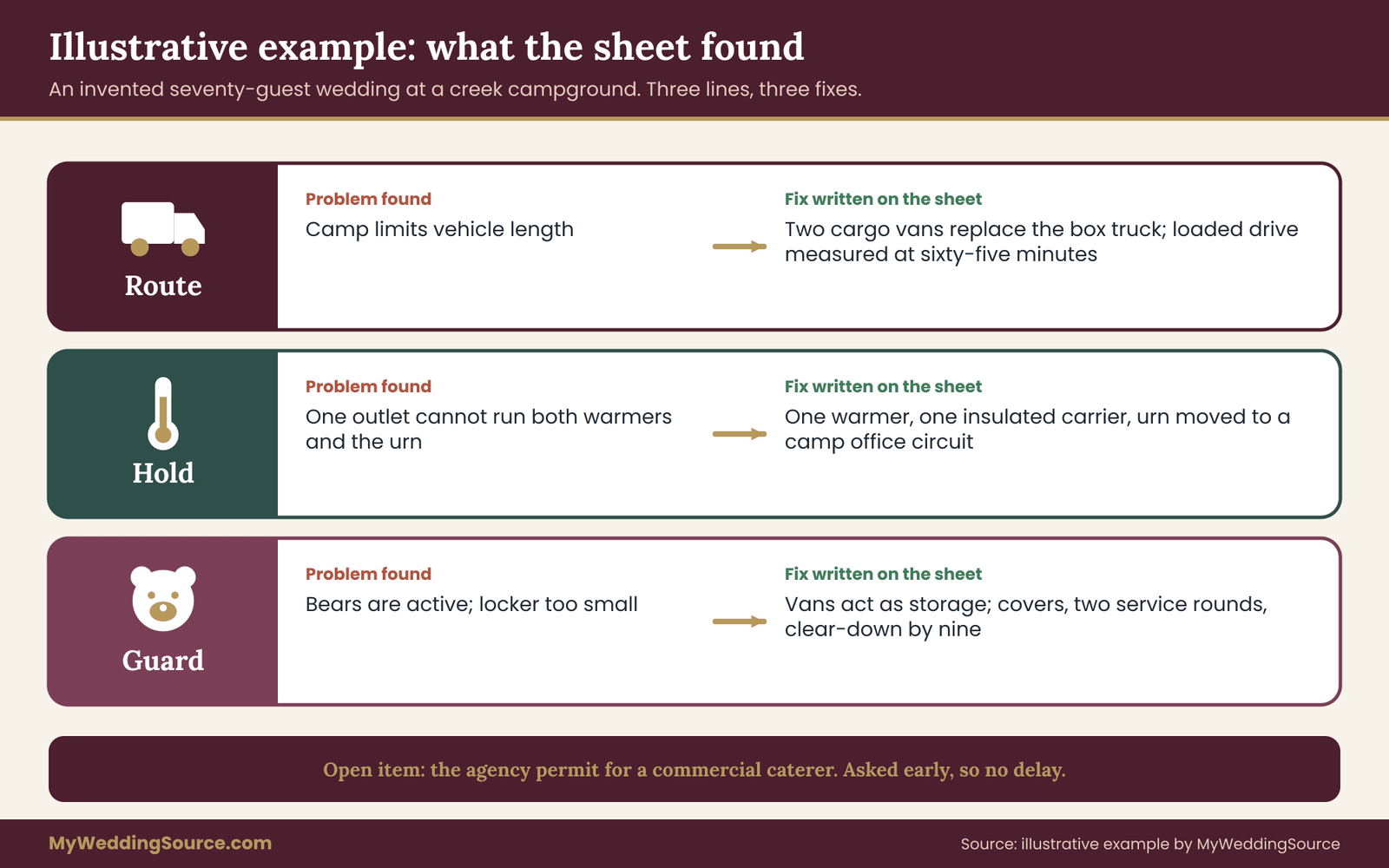
This example is invented for illustration. The names, places and numbers are not from a real event, and the point is to show how the three lines of the sheet find problems early.
Maya and Daniel plan a Saturday wedding at a public campground with a pavilion by a creek. The guest count is seventy, and the couple has hired a caterer for campground wedding catering. Dinner is set for six-thirty, an hour before sunset.
The caterer’s kitchen is in a town forty minutes away, and the camp’s final access road is gravel with a posted limit on vehicle length. The camp has one outlet at the pavilion, a spigot with water that the camp says is treated and a bear-resistant food locker near the parking area. Black bears are active in the area.
Filling in the route line
The camp’s written answer states a maximum vehicle length that rules out the caterer’s usual twenty-six-foot box truck. The caterer proposes two cargo vans. The planner drives the final segment in a similar van at four in the afternoon and records twenty-five minutes from the gate to the pavilion on washboard gravel, with one narrow bridge. Total loaded drive from the kitchen is therefore sixty-five minutes.
The camp unlocks the gate at two in the afternoon. The caterer sets an arrival window of three to four in the afternoon, which leaves a margin before the six-thirty dinner for unloading, reheating and setup. The camp contact will meet the vans at the gate, and a utility cart will carry containers from the parking area to the pavilion, one hundred yards on a packed path.
Filling in the hold line
The caterer plans a braised main course, roasted vegetables, a cold salad and bread, with a dessert that does not need refrigeration. The main and vegetables leave the kitchen above the hot limit in insulated carriers and reach the pavilion after sixty-five minutes. The caterer measures temperature at arrival with a probe.
Because the dishes arrive more than two hours before service, they are moved to electric warmers at the pavilion. The caterer adds up the wattage of two warmers and a coffee urn and finds it exceeds what the single outlet can safely supply. The sheet flags a problem.
The fix is to use one warmer for the main, hold the vegetables in an insulated carrier and move the coffee urn to a separate circuit at the camp office, which the camp approves. The cold salad travels in a cooler with ice packs and moves into a second cooler at the pavilion with a thermometer. The dessert is a sealed, shelf-stable item.
Filling in the guard line
Because bears are present, the camp’s policy requires food, trash and scented items to be locked in the bear-resistant locker or a closed vehicle whenever they are not being served or eaten. The locker is too small for seventy guests’ worth of leftovers, so the caterer plans to take all leftovers and trash away in the vans at the end of service. The vans are therefore the storage zone, and the drivers will not leave early.
Dinner is served buffet style but in two short rounds, with covers on every dish and a staff member at the line. The caterer clears plates continuously. A named volunteer is responsible for the wildlife policy, and the hosts brief guests at the welcome. Drinks are in a covered station that is emptied into the vans at nine, and the late-night snack is replaced by a sealed pastry box handed out at the exit.
What the sheet changed in this campground wedding catering case
Three changes came from the sheet. The vehicle changed because of the length limit. The power plan changed because of the outlet. The clear-down and storage plan changed because of the bears. None of these surfaced in the original proposal, and each would have been far more expensive to fix on the day.
The sheet also exposed one open question: the agency’s permit for a commercial caterer. Maya checked with the permit office, which confirmed that a commercial authorization was required and gave a processing time that meant applying immediately. The campground wedding catering plan went ahead on schedule because the question was asked in time.
What this example does not prove
It does not prove that this plan would suit another site. A private retreat with a commercial kitchen would have a different sheet. A site without bears would have a lighter guard line. The campground wedding catering example is a demonstration of method, not a template to copy, and every number in it should be replaced with measured facts from your own site.
Alternatives when the plan does not pass
Sometimes a line of the campground wedding catering sheet comes back as “does not pass” and no tweak fixes it. The road is too rough, the agency forbids outside catering, the wildlife rules are stricter than the menu can meet or the budget cannot cover the extra staff. That is useful information, and there are several honest alternatives. Each trades one problem for another.
Move the cooking off site and serve simple food
Shift as much work as possible to the caterer’s kitchen and serve food that needs little on-site work. Fully cooked dishes that hold well, cold or room-temperature plates and sealed packaged items all reduce the hold line and the smell. The trade-off is less drama at the table and a menu that leans on what travels well. Many guests will not mind, particularly if the food is good and the setting is beautiful.
Use boxed or individually packed meals for campground wedding catering
In campground wedding catering, individually packed meals are the strongest answer when the guard line is the main problem or when the route is rough. Each portion is sealed, labeled for allergens and held in a cooler until it is handed out. Guests eat at tables or on blankets, and the packaging is collected in sealed bags. This reduces exposure time and cross-contact and simplifies clearing. The trade-offs are more packaging waste, which you must plan for, and a less formal feel.
Split the day between the campground and a controlled venue
Hold the ceremony at the campground and the dinner at a nearby restaurant, lodge or hall with a proper kitchen. This can solve the route, hold and guard lines in one move. It adds a short transfer for guests, which needs transport and timing, and it moves part of the experience away from the camp. If guests are staying at the camp, the transfer adds a ride home. The wedding venues guide can help you weigh a second venue against the cost and complexity of fixing the first.
Bring the camp’s own kitchen or an approved caterer
Some camps have a commercial kitchen, a preferred caterer list or an in-house food service. Using them can simplify permits, power, water and wildlife rules, because they already work within the site’s limits. Ask what menus are offered, how much flexibility exists and what they charge. The trade-off is less choice and, sometimes, less control over the menu.
Food stations with staffed clear-down
For sites where a buffet is the only workable format but wildlife is a concern, staffed stations with covers and short service windows can be enough. A staff member at each station keeps food covered between guests, and a hard end time moves food into secure storage. This needs more people and a firm schedule, and it fails if the schedule slips.
Shorten or shift the meal
A shorter dinner reduces exposure. Moving dinner earlier, into daylight, reduces the time food is out at dusk. Serving a lighter late-night item from a staffed station, rather than leaving a spread out, lowers risk. These changes cost little and can be combined with any other option.
Choosing among alternatives
Use the same logic as before. Name the line that failed and pick the alternative that fixes it with the least damage to everything else. If the route failed, think about vehicle, shuttle or location. If the hold line failed, think about service model and menu. If the guard line failed, think about packing, timing and storage. Then run the revised plan through all three lines again. A fix to one line can break another, and the sheet is how you find out.
Failure conditions: when to change or stop
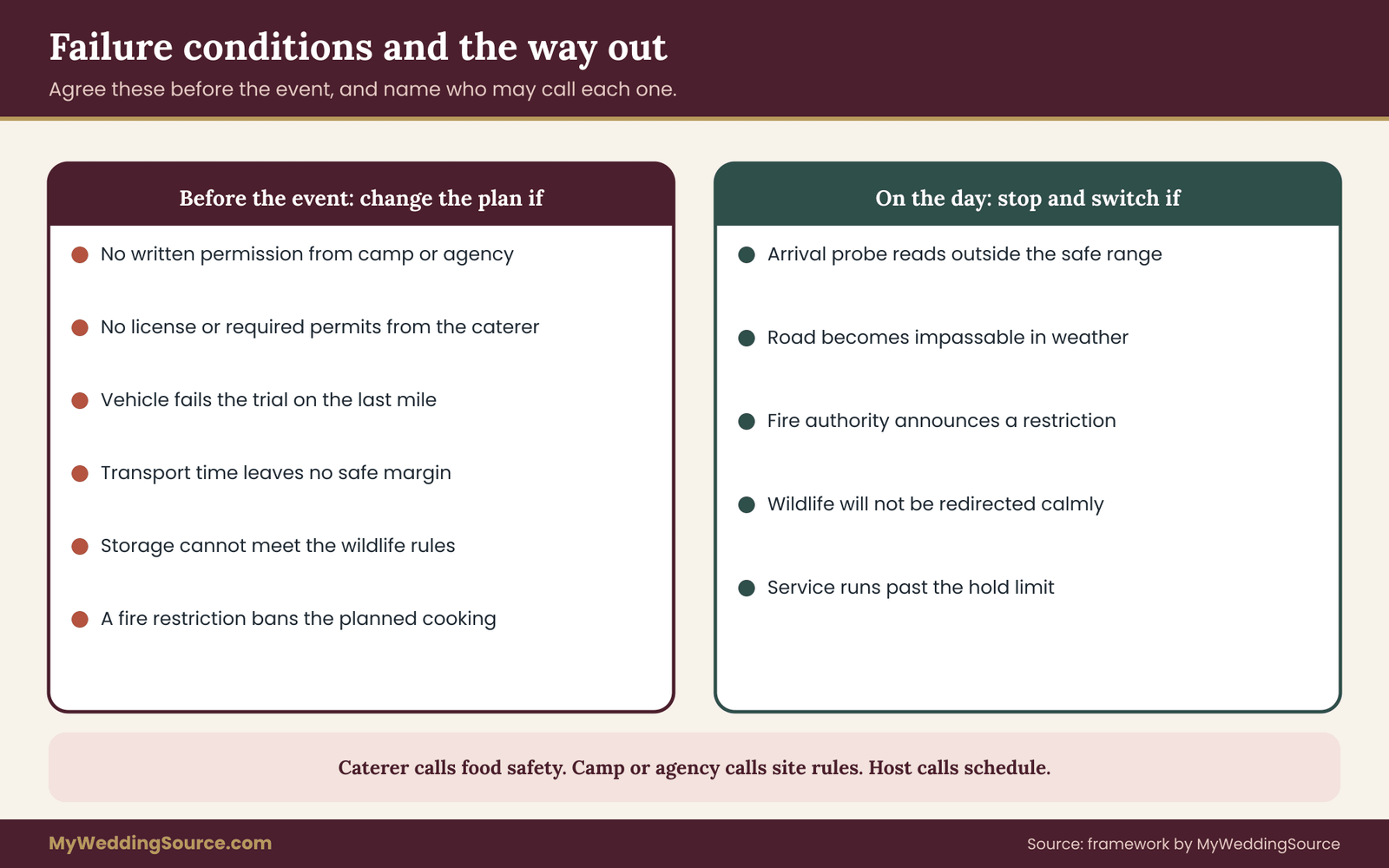
A campground wedding catering plan needs a stated point at which you stop defending it. Failure conditions are the pre-agreed signs that the plan should change, be paused or be abandoned. Writing them down before the event removes the pressure to hope.
Conditions before the event
Change the plan if any of these is true. The managing agency or camp will not give written permission for outside catering or for the way you intend to serve. The caterer cannot show a current license and the permits the health authority requires. The vehicle cannot complete a trial run on the final segment safely.
The measured transport time leaves too little margin for the hold limits and no fix is found. The wildlife rules cannot be met, for example because there is no approved storage for the amount of food. A fire restriction bans the cooking or fuel the menu depends on. Or the caterer will not accept the written wildlife and trash responsibilities.
Each of these is a reason to use an alternative from the previous section, not a reason to push on. A late change is possible when the sheet has already named the fallback.
Conditions on the day of campground wedding catering
On the day, set thresholds in advance and name the person who may call them. A short list is enough.
If the temperature reading at arrival shows a dish outside the safe range, the caterer discards or does not serve it, and the substitute plan comes into effect. If the access road becomes impassable because of weather, the vehicle does not attempt it, and the backup road or the alternative service model is used.
If the fire authority announces a restriction, flame-based cooking and heating stops and the no-flame option begins. If wildlife shows interest in the serving area and cannot be calmly redirected, food is secured and service pauses or moves to the vehicles. If service is delayed beyond the hold limit, affected dishes are not served.
The person who calls these thresholds should be the caterer for food safety, the camp or agency contact for site rules and the host or planner for schedule changes. Agree this before the event, so no one argues about authority while food is cooling.
When a guest may be at risk
Some conditions in campground wedding catering protect people, not just food. If a guest has a serious allergy and the caterer cannot ensure safe handling, arrange a separate, sealed meal that the guest can trust. If medical help is far away, tell guests with higher risk, and make sure a plan is in place. If wildlife that is dangerous to people is nearby, follow the agency’s guidance and do not attempt to manage it yourselves.
After a failure
If something goes wrong in campground wedding catering, record what happened, tell the camp or agency as appropriate and follow up with any guest who was affected. Do not hide an incident from the site. Agencies and camps respond better to honest reports, and the record helps you improve the next plan. A short written note to the caterer about what you observed supports any discussion of refunds or responsibility under the agreement.
Your next steps
Start with the three questions that unlock the rest. Ask the camp or agency for its written food, wildlife and vendor rules. Ask the caterer for their license, insurance and experience with outdoor sites. Then drive the final stretch of road in a vehicle similar to the one the caterer will use, at the hour of delivery, and write down what you find.
With those answers, fill in the route, hold and guard sheet and read it from the bottom up. Mark each line pass, pass with a change or does not pass. Fix the lines that do not pass, choose an alternative if you must and set the failure conditions in writing. Share the campground wedding catering sheet with everyone who will touch the food, and date it. Revisit it one month and one week before the wedding. Good campground wedding catering is mostly a matter of asking these questions in time.
FAQ
Can a caterer legally serve food at a campground wedding?
For campground wedding catering the answer is usually yes, but the permission comes from more than one place. The camp or agency decides whether outside caterers are allowed on its grounds, and the local health authority decides what permits food service needs. Public land often adds a commercial authorization. Ask each in writing, and ask the caterer to show a current license and any event permit.
How long can food sit out at an outdoor wedding?
The USDA’s general guideline is that perishable food should not stay between forty and one hundred forty degrees Fahrenheit for more than two hours, or one hour when the air is above ninety degrees. Your caterer’s food safety plan and the local authority set the actual rules, so ask how each dish will be held and measured at the site.
Is a buffet a bad idea at a campground?
For campground wedding catering a buffet is not always a bad idea, but it keeps open food exposed for longer, which raises both food safety and wildlife concerns. It works with covers, short service rounds, staff at the line and a firm end time. If the site has bears or heavy raccoon activity, boxed meals or staffed rounds are safer choices.
Who is responsible for wildlife at a camp wedding?
Responsibility in campground wedding catering is shared. The camp or agency sets the rules, the caterer controls food and waste while working, and the hosts are responsible for guests. Name one person on your team to watch the policy, and write vendor responsibilities for food and trash into agreements, so that nothing is left to assumption.
Do we need bear-resistant containers?
Only if the site’s rules or the local wildlife situation call for them. Many parks in bear country require food, trash and scented items to be kept in approved containers, lockers or closed vehicles. Ask the camp or managing agency what standard applies and what they provide, and do not rely on a regular cooler to meet it.
What if the road to the campground is rough?
Test it. Drive the final segment in a similar loaded vehicle at the delivery hour, and note time and hazards. Choose a vehicle that fits, secure containers against tipping and build a larger arrival buffer. If the road cannot be done safely, consider a shuttle, a smaller menu, boxed meals or a second location for dinner.
Can we cook on site at a campground wedding?
Sometimes, depending on fire restrictions, camp rules and the menu. Open flame, fuel and grease all bring permission and wildlife questions. Get written permission that names what is allowed, check current restrictions close to the date and prepare a no-flame alternative. Cooking food off site and finishing it simply on site is often easier.
How do we handle guests with food allergies at a remote site?
For campground wedding catering, collect needs with the RSVP, share them with the caterer early and ask how cross-contact is prevented during packing, transport and service. Label dishes, consider a separate sealed meal for serious allergies and make sure someone knows where medical help is and how long it takes to reach. A remote site gives less room for last-minute fixes.
Sources
- National Park Service
- Bears, National Park Service
- Danger zone, 40 F to 140 F, USDA Food Safety and Inspection Service
- FDA Food Code, U.S. Food and Drug Administration
- Food allergies, U.S. Food and Drug Administration
- Food safety, Centers for Disease Control and Prevention
- U.S. Forest Service
- Leave No Trace Center for Outdoor Ethics
- Interagency Grizzly Bear Committee
- U.S. Fish and Wildlife Service