

Wedding venues are priced in layers, so compare the total cost, the rules, and the contract terms before you compare photos.
You have three venues open in three browser tabs, and each one seems to be telling a different story. One lists a rental fee of $4,500, one quotes $145 per person, and one says “pricing available upon inquiry” next to a gorgeous gallery of string lights. Choosing among wedding venues feels like choosing a look, but the decision is closer to choosing a bundle of costs, rules, and risks that will shape your catering, your vendors, your timeline, and your weather plan for the next year. This guide is the research-stage companion to our wedding venues hub: it walks through venue types, true-cost layers, tour questions, capacity, pricing by date, vendor restrictions, contract terms, red flags, and accessibility, then ends with a method for comparing three finalists on equal footing.
Pricing in this corner of the industry is genuinely complicated, and that is not the same as venues being shady. A barn that rents the property and lets you hire everyone else, and a hotel that sells a per-person package, are both selling something legitimate, but they are not selling the same thing. The goal here is to help you notice which costs are inside the quote, which are outside it, and which ones appear only after you sign. Contract and legal points below are general education, not legal advice, and terms and state laws vary, so treat them as questions to bring to the venue and, for anything high stakes, to a licensed attorney in your state.
Start here: what to decide before you tour
Touring first and deciding later is how couples fall for a room they cannot afford or a lawn that cannot hold their grandparents. A few decisions made in advance turn every tour into a test instead of a sales pitch. This section covers what the national numbers can and cannot tell you, and the handful of filters worth setting before you book a single appointment.
What does the venue choice actually decide for the rest of your plan?
The venue is usually the first large contract, and it quietly sets the terms for several others. It fixes your date and your maximum guest count, it often determines who can cater and pour drinks, and it decides whether you need a rain plan, a tent, or a shuttle. That is why The Knot’s 2026 Real Weddings Study, a survey of U.S. couples married in 2025, lists the venue among the elements couples say matter most to them, alongside attire and the photographer.
Why does the venue usually come first?
Most other vendors book around a date and a location, so the venue is the domino that tips the rest. A florist cannot quote without knowing the space, a caterer cannot confirm without knowing the kitchen, and a photographer cannot plan portraits without knowing where the light falls at your ceremony time. Booking the venue first also tells you your real guest ceiling and your real budget shape, because the venue typically becomes one of the largest single line items. Zola’s venue cost article, updated in March 2026, puts the venue at about 17% of a typical total budget, and our own wedding budget guide shows how to build the rest of the plan around that share. The practical consequence is that a rushed venue decision is rarely a small mistake, because it ripples into every contract that follows.
What can national averages tell you, and what can’t they?
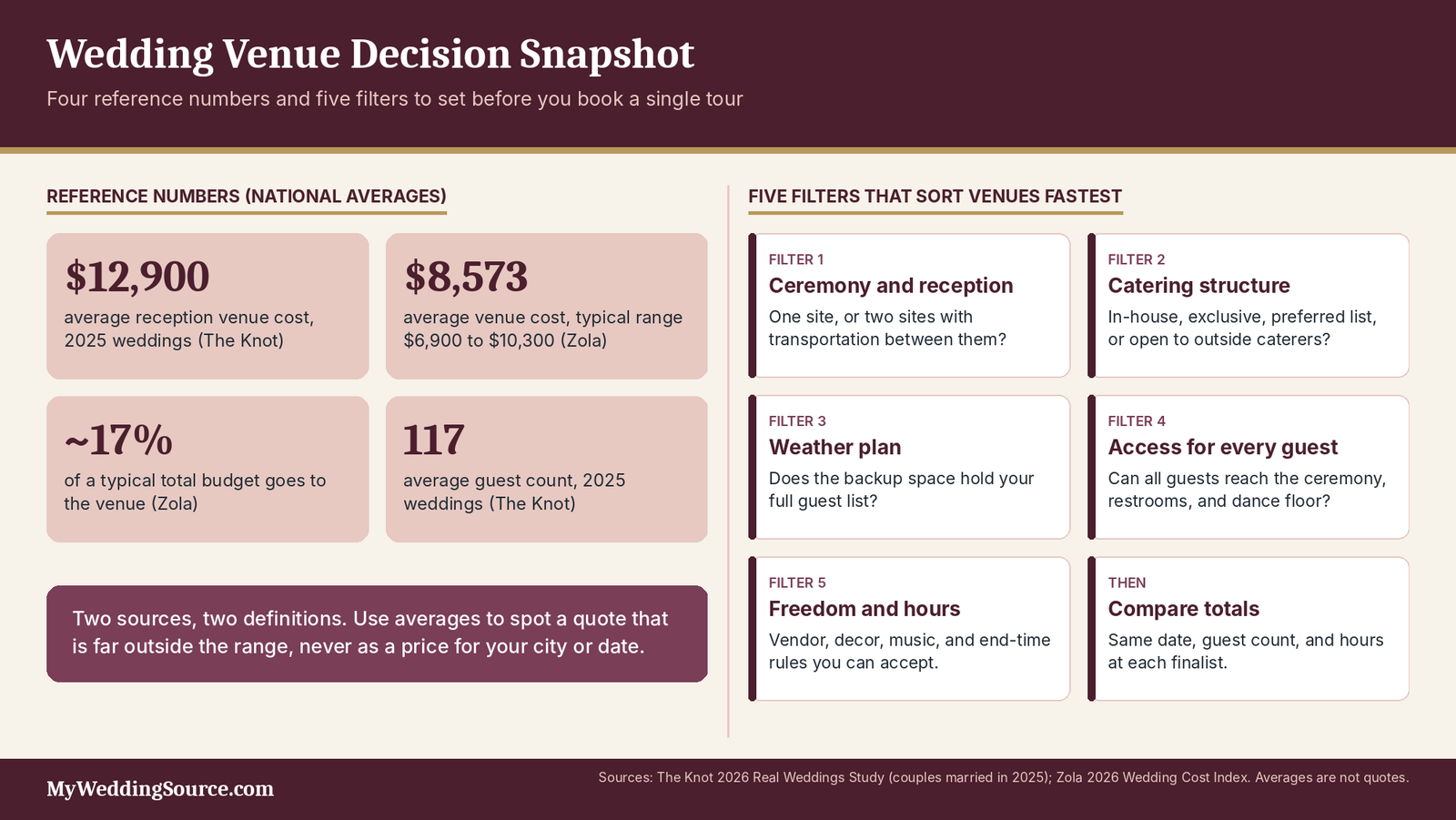
National figures are useful for sanity checks and unreliable as quotes. The Knot’s study reports an average total wedding cost of roughly $34,000 for 2025 weddings, an average of 117 guests, and an average reception venue cost of $12,900 on its average wedding cost page; that page does not say whether the venue figure includes food and drink, so do not read it as a rental fee. Zola’s 2026 cost data lists a lower average venue cost of $8,573, with a typical range of $6,900 to $10,300. The gap between the two numbers most likely reflects different samples and definitions, which is an editorial reading rather than something either source states. Your own city, date, and guest count matter far more than either average, so use these figures only to tell whether a quote is wildly outside the ordinary range.
Which filters should you set before you book a single tour?
Filters keep you from spending a Saturday at a venue that fails on a point you already knew mattered. The goal is not a long checklist but five or six decisions that eliminate options quickly. Write them down and share them with your partner before the first email goes out, because tour-day charm is persuasive and a written filter is not.
How do you set a guest-count range and a date window?
Give yourself three numbers: the guest count you expect, the count you would be comfortable stretching to, and the count at which you would rethink the whole plan. A venue that fits 80 guests beautifully but strains at 110 is a poor match if your list is genuinely uncertain, and a candid look at who is really on the list can help you pressure-test the headcount. Then define a date window rather than a single date: two or three acceptable months, plus whether Fridays and Sundays are on the table. A flexible window is the single most useful tool when you start comparing prices, a point the date and season section covers in more detail. Venues that are fully booked on your ideal Saturday may have an excellent offer on the Friday before it.
What are the five filters that eliminate venues fastest?
Five questions sort most venues into “keep touring” and “stop here.” First, does the venue host both ceremony and reception, or will you need transportation between two sites? Second, is catering in-house, exclusive, or open to outside caterers? Third, what is the weather plan if the setting is outdoors, and is the backup space big enough for your full guest list? Fourth, can every guest and vendor reach the ceremony, restrooms, and dance floor without barriers? Fifth, how much freedom do you have over vendors, decor, music, and hours? If a venue fails one of these in a way you cannot accept, you have saved yourself a tour and a stack of follow-up emails, and if it passes all five, the remaining sections will help you test the details.
Which type of wedding venue fits your plan?
Venue type is shorthand for who handles what. At one end, an all-inclusive property provides the room, the food, the staff, and often the tables and linens. At the other, a farm or garden provides land and a date, and you assemble everything else. Neither end is better in a general sense, and the right fit depends on how much coordination you want to own, how much flexibility you need, and how comfortable you are with variable costs. The categories below overlap, so treat them as patterns to test with questions rather than guarantees about any one property.
Which venues bundle the most of the event?
Bundled venues trade flexibility for predictability. You usually get one point of contact, a kitchen that knows the room, and a staff accustomed to wedding timelines. The trade-off is that the menu, bar, and vendor choices may be limited to what the property offers, and the per-person price carries a lot of the cost.
All-inclusive venues and resorts
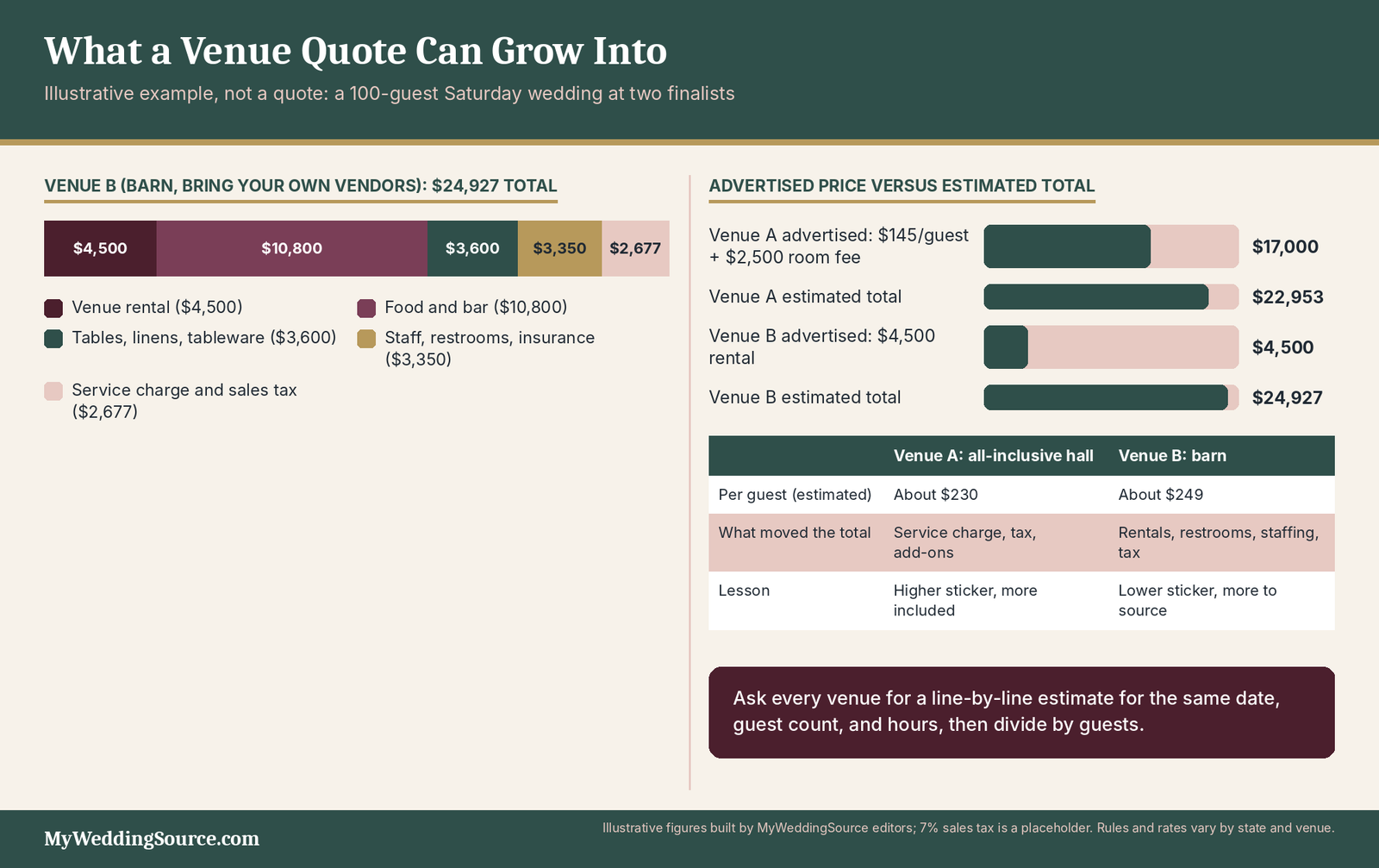
An all-inclusive wedding venue typically sells a package that combines the space, food, beverages, staff, and basic furnishings, sometimes with a coordinator and a ceremony setup. The appeal is a short vendor list and a clearer per-guest number, which makes early budgeting easier. The cautions are the package’s boundaries: ask exactly which bar tier is included, how many hours the package covers, what the service charge applies to, and which items, such as upgraded linens, a late-night snack, or a cake-cutting service, sit outside it. A package that reads $145 per guest can land closer to $230 per guest once service charges, tax, and add-ons are applied, as the illustrative example in the cost section shows. Treat the package as a starting line, not the finish.
Hotels and banquet halls
Hotels and banquet halls are built for events, which means reliable restrooms, climate control, loading access, staff, and often guest rooms for a room block. Many hotels require that you use their catering and bar service, and some charge a food-and-beverage minimum that applies on top of the room fee. A hotel can be a strong choice for a mid-winter date, a large guest list, or a plan where many guests travel in, but the ballroom’s neutrality means you may spend more on decor to make it feel like yours. Ask whether the ceremony and reception rooms are separate, how long the room flip takes, and whether other events share the building on your date, because noise from an adjacent party can intrude on your toasts.
Which venues give you a blank canvas?
Blank-canvas venues give you the most control and ask the most of you. The rental fee is often modest compared to a package, which is why they photograph well in a budget spreadsheet. The catch is that everything the property does not supply, from restrooms to power to tableware, becomes a separate vendor, a separate quote, and a separate day-of responsibility.
Barns and farms
Barn and farm venues pair a rustic setting with typically open vendor policies, but “barn” can describe anything from a restored timber frame with heating and restrooms to an open-sided shed on a working farm. Because barns are often converted agricultural buildings, regulators sometimes treat them as a change of use. A Maryland State Fire Marshal guideline for wedding barns, written around the 2015 Life Safety Code, notes that they are considered a change of use from agricultural storage to an assembly occupancy, with requirements such as sprinklers above certain occupant loads and bans on hay bales and straw as decor (Maryland State Fire Marshal). That document is state-specific and dated, so use it as a reason to ask any barn about its permits, occupancy, and decor rules, not as a rule for your location.
Estates and historic homes
Estates and historic properties often rent the grounds and house for a full day, sometimes with overnight stays for the wedding party, and they usually require outside caterers and rental companies. That can create more design freedom and a more private feel, but also more line items, since a historic home may lack a commercial kitchen, adequate restrooms, or modern climate control. Preservation rules may limit what can be nailed, taped, hung, or lit, and insurance requirements for historic structures can be stricter. Ask who maintains the property, whether a venue manager is on site all day, and what the policy is for damage, because the security deposit and the liability clauses matter more when the building itself is the attraction.
Gardens, parks, and outdoor sites
Gardens, arboretums, and public parks offer scenery that needs little decoration, and many are priced as rentals rather than packages. They also introduce permits, noise limits, restroom availability, and the weather. Public land may require a special-event permit, may limit alcohol or amplified sound, and may not let you reserve the space exclusively, so other visitors can wander through your ceremony. Tents, generators, lighting, and portable restrooms can become a significant cost block, which is why an outdoor site that looks inexpensive on paper deserves a full estimate before it earns the label. The weather side of outdoor planning gets its own section below.
Which venues turn an existing space into a wedding?
Urban and unexpected venues convert spaces designed for something else, which can create memorable character and unusual constraints. These spaces often come with strict windows for load-in and load-out, defined capacity, and house rules built around a business that keeps operating, so details matter more than the aesthetic. Ask early who else uses the space on your date and what the building needs to be ready for its regular business the next morning.
Restaurants, lofts, and private dining rooms
A restaurant buyout or loft rental usually means a built-in kitchen and bar, an experienced team, and a more intimate scale. Restaurants often price by a food-and-beverage minimum rather than a rental fee, so the minimum becomes the budget floor, and you may owe the difference if guests eat and drink less than the number. Loft and warehouse spaces often supply only the shell, which sends you back to rentals, caterers, and restrooms. Ask whether the space is exclusive to you, what time guests can arrive, and how sound is handled, since neighbors and shared walls can influence the music, the ceremony, and the end time.
Museums, galleries, and public spaces
Museums, galleries, libraries, and civic buildings can deliver dramatic architecture, often with strict rules. Expect a preferred caterer list, limits on candles, confetti, and decor attachments, security or staffing requirements, and a firm end time. Because these venues sometimes serve as fundraising sources for nonprofits, the rental may support a mission, but the same institutions may close the space with little flexibility if a public event is scheduled. Ask about insurance requirements, exhibit protection rules, and where vendors can stage equipment, since a tight load-in route through a public lobby can add labor charges.
| Venue type | What is typically bundled | Where extra costs tend to appear | Ask before you book |
|---|---|---|---|
| All-inclusive or resort | Space, food, bar, staff, basic furnishings | Service charge, tax, add-ons, upgrades | Which bar tier and how many hours are in the package? |
| Hotel or banquet hall | Room, catering, bar, staff | F&B minimum, room fee, decor, parking | Are ceremony and reception rooms separate, and what is the flip time? |
| Barn or farm | Property and date, sometimes tables and chairs | Rentals, restrooms, power, staffing, tents | What are the permit, occupancy, and decor rules? |
| Estate or historic home | Grounds and house for a set period | Caterer kitchen setup, rentals, insurance, damage deposit | What can be attached, lit, or moved on the property? |
| Garden or outdoor site | Land and setting | Permits, tent, generator, restrooms, backup space | Who owns the weather decision, and where is the indoor option? |
| Restaurant or loft | Kitchen and bar, or a shell | F&B minimum, rentals, sound limits | Is the space exclusive, and what is the minimum on my date? |
| Museum or public space | Space and sometimes security | Preferred vendor fees, staffing, insurance, strict end time | Which vendors are allowed, and what decor rules apply? |
What does a wedding venue really cost?
The rental fee is the number on the website, and it is rarely the number on the final invoice. A venue’s true cost is the sum of what you must pay to use the space, what you must buy because of its rules, and what you will realistically add to make the day work. Understanding those layers is the difference between a quote that feels like a bargain until the second invoice and one that holds steady. The framing below is general; actual fees, taxes, and policies vary by venue, state, and date.
What is in the sticker price, and what usually is not?
A sticker price tells you what the venue sells, not what your wedding will cost to run there. Two numbers that look identical can cover different hours, different spaces, and different services. The first task in any comparison is to translate each quote into the same terms.
Rental fee versus package price
A rental fee buys access to a space for a defined window, and it may or may not include tables, chairs, a ceremony site, a getting-ready room, or a day-of manager. A package price bundles the space with food, beverages, staff, and basic furnishings, which is why it looks larger at first glance. The right way to compare them is to build the missing pieces onto the rental until the two quotes describe the same event. If a barn rental of $4,500 requires you to add catering, bar service, tableware, restrooms, and staffing, then it must be priced against the package plus its own add-ons, not against the package alone. Ask each venue for a one-page description of exactly what is included, including the number of hours, because “all day” and “six hours” are different products.
Food-and-beverage minimums
A food-and-beverage minimum, often written as an F&B minimum, is the amount you commit to spend on food and drink at the venue, and it is common at hotels, restaurants, and clubs. Some venues apply the minimum to food, beverages, and service charges, while others exclude tax or fees from the count, and the difference can shift your required spend by thousands of dollars. If your final bill falls below the minimum, many contracts charge the difference anyway, so the minimum functions as a floor rather than a target. Ask whether the minimum changes by day or season, whether it includes the service charge and tax, and whether rental fees count toward it. A venue with a lower room fee and a higher minimum is not necessarily cheaper, because the minimum tends to be the larger number.
Which extra charges stack on top?
Most surprises come from a small group of recurring charges. They are not hidden in a sinister sense, since many are disclosed, but they are easy to miss when you are comparing a headline price. Our deeper guide to wedding venue contract hidden costs covers the long list of fee names, so this section focuses on the categories and how they combine.
Service charges, gratuity, and taxes
A service charge is a percentage the venue or caterer adds to food and beverage totals, often to cover staffing and administrative costs, and it is a different thing from a tip. Zola’s venue cost article describes service charges and gratuities as often running 18 to 22 percent of vendor costs and says 57 percent of couples face a mandatory venue service fee, though the page does not clearly specify the sample behind that second figure, so treat it as directional. Taxes add another layer and vary by state. As one example, New York’s tax department explains in its catering guidance that a service charge is always subject to sales tax, that a mandatory gratuity escapes tax only if it is separately stated, labeled a gratuity, and paid fully to employees, and that room rental is taxable when the facility also caters the event. Those rules are New York’s, not national ones, so ask your venue to state which lines are taxed and at what rate.
Rentals, staffing, and security
Venues that do not supply furnishings send you to a rental company for tables, chairs, linens, tableware, glassware, and often a dance floor. Zola notes that some venues include tables, chairs, and linens while others charge for them, which makes this one of the easiest places for two quotes to differ by a large amount without anyone noticing. Staffing is similar: bartenders, servers, a venue attendant, coat check, valet, and security guards may be required by the venue or the caterer, and each may be billed hourly with a minimum. Alcohol service is often a factor, because many venues require licensed or insured bartenders. Ask who provides each item, who is responsible for setup and breakdown, and whether the staffing count is fixed or scaled to your guest count.
Time-based fees: load-in, overtime, and cleanup
Time is a hidden price driver because venues price the window, not just the event. Vendors need hours to load in and set up, and the clock may start when the first vendor arrives, not when the ceremony begins. Overtime is typically billed hourly after the contracted end time, and cleanup or breakdown may be built into the fee or charged separately. Zola’s article lists delivery and setup fees of roughly $200 to $500 per vendor as a possible charge, which can add up across a florist, a rental company, a band, and a cake delivery. Confirm the earliest access time, the hard end time, whether the venue charges for extra setup hours, and whether any required cleaning service is included.
Insurance, permits, and damage deposits
Many venues require couples to carry event liability insurance and to name the venue as an additional insured, and they may require vendors to provide certificates as well. This is separate from cancellation coverage: Consumer Reports describes wedding insurance as having two parts, cancellation or postponement coverage and liability coverage that responds if someone is injured or property is damaged. That article dates to 2018, so we do not repeat its price examples. Tents, fireworks, amplified sound, and street closures may require permits that fall to you or to a vendor. A refundable security deposit protects the venue against damage, so ask when it is returned and what the venue can deduct.
| Cost layer | What it covers | Who usually sets it | What to ask |
|---|---|---|---|
| Rental or room fee | Access to the space for a set window | Venue | How many hours, and which spaces are included? |
| F&B minimum or package | Food and drink spend, or a per-guest bundle | Venue or caterer | Does the minimum include tax, service charge, and rental fee? |
| Service charge and gratuity | Percentage added to food and beverage | Venue or caterer | What percent, on which lines, and does staff receive it? |
| Sales tax | State and local tax on taxable lines | State and local government | Which lines are taxed, and at what rate? |
| Rentals and furnishings | Tables, chairs, linens, tableware, dance floor | Venue or rental company | What is included, and what must I source? |
| Staffing and security | Bartenders, servers, attendants, guards | Venue or caterer | Is the count fixed, and are there hourly minimums? |
| Time-based charges | Early access, overtime, cleanup, vendor delivery | Venue | When does the clock start, and what is the overtime rate? |
| Insurance and permits | Liability certificate, tent or sound permits | Venue, couple, or vendor | Who must supply what, and by when? |
How do the layers add up in a real comparison?
Numbers make the point faster than adjectives. The example below uses invented but plausible figures to show how a venue with a lower advertised price can end up costing more once the missing pieces are added. It is a method, not a market report.
An illustrative two-venue example
Imagine a 100-guest Saturday evening wedding and two finalists. Venue A is an all-inclusive banquet hall that advertises $145 per guest plus a $2,500 room fee. Venue B is a barn that advertises a $4,500 rental fee and lets you bring your own caterer, bartender, and rentals. After building out each quote with the same assumptions, including a 22 percent service charge at Venue A, a 20 percent caterer service charge at Venue B, and an illustrative 7 percent sales tax on taxable lines, the totals look quite different from the headlines. The barn’s lower advertised price becomes the more expensive plan, while the hall’s higher per-guest price turns out to include more of the work.
| Line | Venue A: all-inclusive hall | Venue B: barn, bring your own vendors |
|---|---|---|
| Venue rental or room fee | $2,500 | $4,500 |
| Food and beverage | $14,500 (100 guests at $145) | $10,800 ($7,800 food, $3,000 bar) |
| Tables, chairs, linens, tableware | Included | $3,600 |
| Staffing, cleanup, security | Included | $1,200 |
| Restrooms, lighting, shuttle | Not needed | $1,900 |
| Required insurance policy | $0 | $250 |
| Add-ons (ceremony setup, AV, cake cutting) | $1,350 | $0 |
| Service charge | $3,190 (22%) | $1,560 (20% on food) |
| Sales tax (7%, illustrative) | $1,413 | $1,117 |
| Estimated total | $22,953 | $24,927 |
| Per guest | About $230 | About $249 |
What the example does and does not prove
The example does not prove that all-inclusive venues are cheaper or that barns are expensive. A barn with included tables, a nearby caterer with a modest per-person rate, and a shorter bar program can easily beat a hotel package. What the example shows is that the order of two quotes can flip once you account for everything the cheaper-looking one leaves out. It also shows why a per-guest figure is more useful than a headline fee: dividing the total by the guest count lets you compare venues of different sizes and structures. Redo the exercise with each finalist’s real quote, your own guest count, and your state’s tax rules, and treat the result as your working budget number.
What should you ask on a wedding venue tour?
A tour is part showroom and part inspection, and it moves quickly because someone is guiding you through a beautiful space while you are also trying to evaluate it. Good questions do two things: they surface facts the website leaves out, and they give you a record you can compare later. The structure below separates what to settle before you visit, what to notice while you walk, and what to do after you leave. If you work with a planner, our wedding planner questions guide covers how to involve one in this stage.
What should you ask before you book a tour?
The cheapest tour is the one you skip because an email answered the deal-breaker. Spending a few minutes on screening protects your weekends and keeps you from falling for a place that fails on basics. Treat the first email as the first round of your comparison, because the replies are data.
Which screening questions belong in the first email?
Send the same short message to every venue: your date window, your guest-count range, the type of event, and a request for the full fee schedule, the vendor policy, and the cancellation terms. Ask directly whether your dates are available, what the minimum or package price is for those dates, and what is excluded from the quote. A venue that replies with a clear document in a day or two is giving you a preview of how it communicates once you are a client. A venue that will only discuss price on a call or in person is not necessarily a problem, but write down what you learned and ask for a follow-up in writing. The point is to receive comparable information from each place before you spend time driving to it.
When should you tour, and what should you see?
Visit at the time of day your wedding would happen, because a courtyard that looks gorgeous at noon can be glaring or dark at your ceremony hour. If possible, see the space set up for an event, ask for photos of weddings at your guest count, and look at the backstage areas, such as the kitchen, restrooms, storage, and getting-ready rooms. Bring your partner and anyone whose opinion will shape the decision, and take a measuring app or a notebook for ceiling height, door widths, and distances. If your guest list includes older relatives or guests who use mobility devices, walk the route from parking to the ceremony site yourself. Photograph everything you plan to compare, since a week later the three barns will blur together.
What should you ask and notice during the tour?
Once you are inside, split your attention between the space and the operation. The space tells you how the day will look, and the operation tells you how the day will run. Bring a short list of questions so the guide’s story does not set the agenda for the whole visit.
How does the space flow from ceremony to dinner to dancing?
Walk the path your guests will take, from arrival to ceremony seating to cocktail hour to dinner to the dance floor and out again. Ask where guests wait if the ceremony starts late, where the wedding party gets ready, and where the couple can be alone for a few minutes before the reception. Check sightlines to the head table or sweetheart table, the location of speakers, and whether a pillar will block half the room. Listen for noise from the kitchen, the road, or a neighboring event, and look for restrooms that can handle your guest count. These are the small things that make the day feel good or feel cramped, and they are far easier to catch on a tour than at 6:30 p.m. on the wedding date.
What are the logistics: parking, load-in, power, and storage?
Ask where vendors park, how far they carry equipment, whether there is an elevator or a loading dock, and how much time they have to set up. Ask about power: how many outlets, whether a band or DJ can plug in without tripping a breaker, and whether a generator is needed outdoors. Find out where caterers can stage food, where trash goes, and where you can store gifts, cards, and décor before and after the event. Ask about guest parking capacity and whether a valet or shuttle is recommended. A venue with a charming ceremony site but a single narrow path for vendors can add labor charges, as can limited elevator access.
Which house rules shape your decor, drinks, and music?
Ask what is restricted: open flames, sparklers, confetti, fog machines, adhesive on walls, outside alcohol, drones, amplified outdoor music, and children’s activities. Ask when music must end, whether there is a noise ordinance, and who monitors it. Ask whether the venue holds the alcohol license or whether you must hire licensed bartenders, and whether outside alcohol is allowed with a corkage fee, a topic we explain in our corkage and cake-cutting fees guide. Rules that look minor on paper, like an early hard curfew or a ban on candles, can reshape your timeline and decor plan, so write them down and bring them back to your partner.
What should happen after you leave?
The hour after a tour is when your impressions are sharpest and your judgment is least influenced by the host. Use that window to capture details before they fade. A shared note or spreadsheet works well, since both partners can add observations from their phones on the drive home.
How do you debrief while the details are fresh?
Sit down with your partner within a day and score the venue on the same few criteria for every tour: total estimated cost, fit for your guest count, flexibility on vendors, weather backup, access, and how the staff handled your questions. Note one thing you loved and one thing that worried you. Write down any verbal promises, such as “we can usually extend the end time” or “the owner will let you bring in your own cake,” because verbal statements can be hard to rely on unless they appear in the contract. Doing this immediately keeps the venue that charmed you most from outranking the one that fits you better.
How do you request a proposal and hold a date?
Ask for a written proposal with a line-by-line estimate for your date, guest count, and hours, and ask what exactly secures the date: a deposit, a signed contract, or a short courtesy hold. If a venue offers a hold, ask how long it lasts and whether another couple can displace you. Be cautious about any “this price expires today” pressure, and ask whether the offer can be held in writing for 48 or 72 hours so you can read the contract. A reasonable venue understands that a wedding venue decision is a large commitment. Use the proposal, not your memory of the tour, to compare.
| Topic | Question to ask | A clear answer looks like | If the answer is vague |
|---|---|---|---|
| Total cost | Can you give a line-by-line estimate for my date and guest count? | A written proposal listing every fee | Ask for the fee schedule in an email |
| Capacity | How many guests fit for seated dinner with a dance floor? | A specific number tied to a floor plan | Request the diagram and layout options |
| Hours | When can vendors arrive, and when must we be out? | Exact times and overtime rate | Ask what is billed before and after the event |
| Vendors | Are there required or preferred vendors, and any outside-vendor fees? | A written policy | Ask for the policy and a list |
| Weather | Where do we go if it rains, and who decides when? | A named space, capacity, and decision time | Ask what the backup holds and costs |
| Access | What is the route from parking to ceremony, restrooms, and dance floor? | A described path with surface and width | Walk the route on the tour |
| Contract | What is refundable, and what happens if you cancel? | Plain terms in the contract | Ask for the contract before the tour ends |
How do capacity, layout, and the room flip work?
A venue’s listed capacity is the number most couples quote and the least likely to match their actual layout. “Fits 150” can mean 150 people standing at a cocktail reception, 150 in rows of chairs for a ceremony, or 150 at round tables with a dance floor, and those are very different rooms. Understanding capacity before you sign protects you from a crowded dance floor, a cramped buffet line, and a headcount you cannot legally exceed. It also affects the room flip, the quiet scramble in which staff turn a ceremony space into a dinner space while you take photos.
What does “capacity” really mean?
Capacity is a family of numbers, not a single figure. Each one answers a different question, and each can be limited by a different rule. The one that governs your event is the one that matches your layout.
Why one venue can have several capacity numbers
Venues commonly publish separate capacities for a theater-style ceremony, a seated dinner, a cocktail-style reception, and a seated dinner with a dance floor. The seated dinner with dance floor is usually the smallest number and the one that matters for most weddings. Some of these figures are comfort limits set by the venue, and others reflect an occupant load set under fire and building codes by the local authority. New Hampshire’s State Fire Marshal explains, for example, that the general NFPA definition of an assembly occupancy is a space used for a gathering of 50 or more people, and that local municipalities may have their own requirements that must also be followed (NH State Fire Marshal). That is one state’s page, so use it as a reminder to ask who sets the venue’s limit rather than as a rule for your location. Ask for the posted occupant load and for the layout used to calculate your event capacity.
What takes up space that guests do not count
A guest count describes people, but a floor plan also has to fit a dance floor, a DJ or band, a buffet or stations, one or more bars, a cake table, a head table or sweetheart table, a guest book, a gift table, and a photo area. Aisles matter too, since people need clear paths to restrooms and exits, and some layouts need wider routes for guests who use mobility devices. A room that technically seats 120 may feel tight at 110 with a six-piece band and a late-night snack station. Rather than relying on a square-foot rule of thumb, ask the venue or your caterer for a scaled diagram at your actual guest count with every element placed. If the venue cannot provide one, that tells you something about how closely the space has been tested for weddings your size.
How does a room flip work?
A room flip is a transformation of a single space from one configuration to another, usually from ceremony seating to dinner and dancing. It lets you hold the ceremony and reception in one place without moving guests, and it is common in hotels, ballrooms, and rental halls. The flip is easy to underestimate because it happens off stage and the cost shows up as time and labor.
What happens during the flip
During cocktail hour, staff or rental crews remove ceremony chairs, set tables and place settings, position the dance floor, move the bar, and sometimes bring in decor from the ceremony. Guests wait in another area, so the venue needs a second space or an outdoor patio for them. Ask who is doing the flip, how many people, how long it takes, and whether the cost is included or billed as labor. Also ask where florals and ceremony decor go after the ceremony and whether anything left behind can be moved to the reception. If your ceremony space and reception space are already separate rooms, you can often skip the flip and the labor charge that goes with it.
How the flip affects your timeline and your photos
A flip usually dictates a cocktail hour of a certain length, which has ripple effects on your photographer’s schedule and your portrait time. If the flip takes 60 minutes and your cocktail hour is 45, guests will be waiting outside a closed door, hungry and perhaps irritated. If your couple portraits or family photos happen during the same window, make sure they are not planned in the same room that is being reset. Weather adds a wrinkle for outdoor ceremonies with indoor receptions, because the cocktail space must work in rain too. Build the flip into your timeline with your venue and photographer, and give it a buffer; our guide to building a wedding timeline shows how these pieces fit into the larger schedule.
How do you fit the guest list to the room?
Matching a guest list to a space is an exercise in margins. A room too large can feel empty, and a room too small makes every movement a negotiation. The contract also introduces a guarantee that locks in your headcount before the event.
Final headcount, guarantees, and attrition
Most venues and caterers ask for a final guest count a set number of days before the wedding, and you are typically billed for at least that number even if fewer guests attend. Some contracts also set a minimum guest count at signing, with a clause that lets you reduce by only a percentage, which is known as an attrition clause. Ask what the deadline is, whether you can add guests after it, whether you can reduce, and by how much, and whether the minimum applies to food, to the room, or to both. A venue that lets you reduce by 10 percent before the deadline without penalty is quite different from one that holds you to your signed number, and the difference can be a four- or five-figure swing on a hundred-guest wedding.
Right-sizing the room for the wedding you actually have
If your guest list is likely to shrink, choose a venue that does not penalize a lower headcount and that still feels full at the smaller number. If it may grow, ask where the upper limit sits and whether the layout can stretch without removing the dance floor. Consider whether a room with moveable walls or a patio can scale up and down. Think about the ceremony too: a 70-person ceremony in a 200-seat hall echoes, while a 120-guest ceremony in a small chapel may mean standing guests. Your ideal is a venue whose comfortable seated capacity sits a bit above your expected headcount, giving you room to adjust without the space feeling oversized.
How do date, season, and weather change the price and the plan?
The same room can carry very different prices depending on the day, the month, and the forecast you plan around. The date shapes what you pay, who is available, and how many guests can travel. Weather shapes what the day looks like and what it costs to protect it, especially at outdoor venues. The two topics belong together because the cheapest date and the riskiest weather often overlap, and trading one for the other is a decision you should make deliberately.
How much do date and season really move the price?
Date-based pricing is real, but the size of the effect is easy to overstate. The available evidence points to modest differences in total wedding cost across seasons and larger differences when you change the day of the week at a venue that publishes tiered pricing. Check the specific venue’s rate card rather than relying on a headline percentage.
What the popular-month data show
The Knot’s 2026 read-out reports that 76 percent of couples marry between May and October, and its analysis of popular dates says fall has been the most popular season since 2015 and that higher demand for a date yields higher prices. The projected most popular 2026 dates included June 6, June 20, September 19, September 26, and October 10. The Knot’s average total wedding cost by quarter was $33,200 for January through March, $34,300 for April through June, $35,400 for July through September, and $33,200 for October through December, a spread of about $2,200 on whole-wedding totals. These are overall costs across all vendors, not venue fees, so they show that season is not the only driver of price. For venues in particular, demand for a specific Saturday can matter more than the month.
Fridays, Sundays, and weekdays
Many venues set different prices or minimums for Friday, Saturday, and Sunday, and some offer weekday rates. Zola’s wedding cost data says Saturday evenings command the highest prices and that weekend dates in winter or weekday celebrations can save 20 to 30 percent on most vendor costs; treat that as a platform-wide estimate, not a promise from any venue. The venue is the most likely place to see a meaningful difference, since a food-and-beverage minimum or room fee may drop for a Friday or Sunday. The trade-offs are guest availability, travel, and work schedules, plus fewer available vendors on weekdays. Ask each venue to quote the same event on three different days and see how much the price moves before you give up your preferred Saturday.
| Date option | Possible upside | Trade-off to weigh | Ask the venue |
|---|---|---|---|
| Peak Saturday (May to October) | Most guests and vendors available, familiar weather window | Highest demand, highest minimums, earliest sellout | What is the minimum, and how far ahead is it booked? |
| Shoulder Saturday (April, early November) | Lower demand, often more availability | Weather and daylight less predictable | Is there a seasonal rate or reduced minimum? |
| Friday or Sunday | Lower room fee or minimum, easier availability | Guest travel and work schedules | What is the price difference from Saturday? |
| Weekday | Largest potential savings, flexible hours | Fewer guests can attend, fewer vendors available | Are weekday rates published or negotiable? |
| Winter or holiday weekend | Lower demand and pricing at some venues | Travel conflicts, weather, higher guest costs | Are there blackout dates or holiday surcharges? |
What weather plan should a venue have?
Weather planning is a venue question as much as a vendor question, because the venue owns the space where the backup happens. A weather plan is more than “we have a tent.” It includes capacity, cost, permits, timing, and who makes the call. Our outdoor wedding rain plan guide goes deeper on the planning side, and this section focuses on what to ask the venue.
The backup space or tent, and what it holds
Ask whether the indoor backup holds your entire guest list for both ceremony and reception, because “we have a covered porch” is not a rain plan for 120 people. If the backup is a tent, ask who provides it, who pays, whether it requires a permit, and whether it has sidewalls, flooring, lighting, heating, or cooling. Tent rules are local and can be strict: New Hampshire’s fire marshal page, for example, notes that its threshold for tents and canvas-covered areas drops to a gathering of 50 or more people, a reminder that tents can trigger their own inspection rules. If the backup is a room that is also booked for another event, find out what happens when it rains on both of you.
Who decides, and by when?
A weather plan fails most often at the decision point, not the equipment. Agree in writing on who has the authority to call the switch, what time the decision is made, and what information it is based on, because caterers, florists, rental companies, and photographers need advance notice to reroute. Ask whether the venue can charge extra for a late switch, whether it will hold the backup space free, and whether it has a standard decision time for outdoor events. Write the trigger down, such as a forecast chance of rain at a particular hour, so the decision is not made under pressure by the people with the most at stake.
Heat, cold, wind, and lightning
Rain is the weather problem people plan for, and it is not the only one. Heat can affect guest comfort, wax, food safety, and hair and makeup, while cold may call for heaters, blankets, and a shorter outdoor ceremony. Wind can topple arches, signs, and tent walls. Lightning is a safety question rather than a comfort one: the National Weather Service states that there is no safe place outside when thunderstorms are in the area and urges people to go indoors when thunder roars. A tent keeps rain off but is still outside, so ask where guests would go during a lightning delay, how many people that shelter holds, and who tells the guests to move.
How do preferred vendor lists and venue restrictions work?
Vendor policies are where a venue’s rules become your budget. Some venues let you hire anyone with proper insurance, some recommend a short list, and some require that you choose from a list or use their in-house team for catering and bar service. None of these approaches is wrong, but each shifts your costs and your control in a different direction. Understanding the vocabulary lets you compare policies fairly and ask about the terms that matter most.
What is the difference between preferred, approved, and exclusive vendors?
The labels are used loosely, so ask each venue to define its own. The same word can mean a suggestion at one property and a requirement at another. A written policy is worth more than a verbal summary.
What a preferred vendor list usually means
A preferred list is generally a set of vendors the venue has worked with and trusts, offered as a convenience. You may be free to hire others, and the list can save time because those vendors know the space, the kitchen, and the load-in path. The questions to ask are whether using a preferred vendor changes your price, whether going outside the list triggers a fee, and whether the venue receives a referral fee or commission from the vendors it recommends. A referral arrangement is not inherently a problem, but you are entitled to know about it. Treat the list as a starting point for your own research, and compare at least one outside option on price and quality.
Approved lists and exclusive in-house services
An approved or required list means you must choose from named vendors, and an exclusive arrangement means the venue or its designated partner is the only option for a service such as catering, bar, or rentals. Exclusive catering is common at hotels and event halls, and it makes the venue’s per-person price central to your budget. The benefit is that the vendors know the property, which tends to smooth load-in and setup. The cost is less price competition and fewer menu choices, so ask for sample menus, dietary-accommodation policies, tasting options, and the full per-person price including service charge and tax before you decide.
Outside vendor fees and requirements
Venues that welcome outside vendors often set conditions. These may include a certificate of insurance naming the venue as an additional insured, proof of a business license, a vendor meal count, a delivery window, and in some cases a flat fee per outside vendor or a percentage surcharge. The fee may cover coordination, extra supervision, or lost revenue from in-house services. Ask what the fee buys, whether it applies to every vendor or only certain categories, and whether a vendor who cannot supply the insurance certificate can be replaced without a penalty. A low rental fee paired with several outside-vendor fees may not be low at all.
Which restrictions affect your budget the most?
Not every rule has a dollar sign, but some of them move the total significantly. The ones that tend to matter most involve food, drinks, music, and the people who run the day. Listing them next to your quote shows which ones you can live with and which ones change the math.
Catering and alcohol policies
Catering and bar policies are the most expensive restrictions to misunderstand. Ask whether you must use in-house catering, whether outside caterers are allowed with a fee, and whether the kitchen is equipped for a full service or only for warming. For alcohol, find out whether the venue holds the license, whether you can bring your own with a corkage fee, whether the bar must be staffed by licensed or insured bartenders, and what the venue’s liability requirements are. Alcohol laws differ by state and locality, so confirm the specific rules with the venue and your state or local alcohol authority. If your plans include an open bar, check what the venue counts as the bar minimum and what happens if guests drink less than predicted.
Photography, music, and decor rules
Some venues restrict where photographers can go, require that DJs and bands use specific equipment or volume limits, or limit when music can play outdoors. Others have decor rules that prohibit candles, nails, tape, confetti, fog machines, or anything left overnight. These rules often come from insurance, neighbor relations, or the damage they have seen, so it helps to ask about the reason rather than just the rule. Share the rules with your photographer, music vendor, and florist before you sign, because they may price differently or decline if a rule conflicts with how they work. A venue’s constraints shape the design from the start, so share them early.
Required coordinators and day-of staff
A number of venues require that you hire a day-of coordinator or use the venue’s coordinator, and some charge a mandatory event-manager fee. This can be valuable, since someone who knows the building directs vendors, manages the flip, and handles problems, but you should know what the person does and does not do. Ask whether the venue coordinator handles only the venue’s logistics or the whole wedding day, whether a personal planner can work alongside them, and how many events they manage at once. If the fee is mandatory, include it in your cost comparison rather than treating it as optional.
Which wedding venue contract terms should you read before paying a deposit?
A venue contract turns a tour and a proposal into obligations. Most of what you will want to understand sits in a handful of clauses that control your money and a handful that control your day. This section is general education about common provisions, not legal advice, and contract terms and state laws vary, so consider asking a licensed attorney in your state to review a contract before you sign it. For the long list of fee names, see our guide to wedding venue contract hidden costs (linked earlier), which this section complements rather than repeats.
Which clauses control your money?
The money clauses decide how much you pay, when you pay it, and what you can recover if plans change. They deserve the first read, and they deserve a second read after you have the full contract in hand. Highlight each date and dollar amount as you read, then copy them onto your calendar so no deadline arrives as a surprise.
Deposit, payment schedule, and refundability
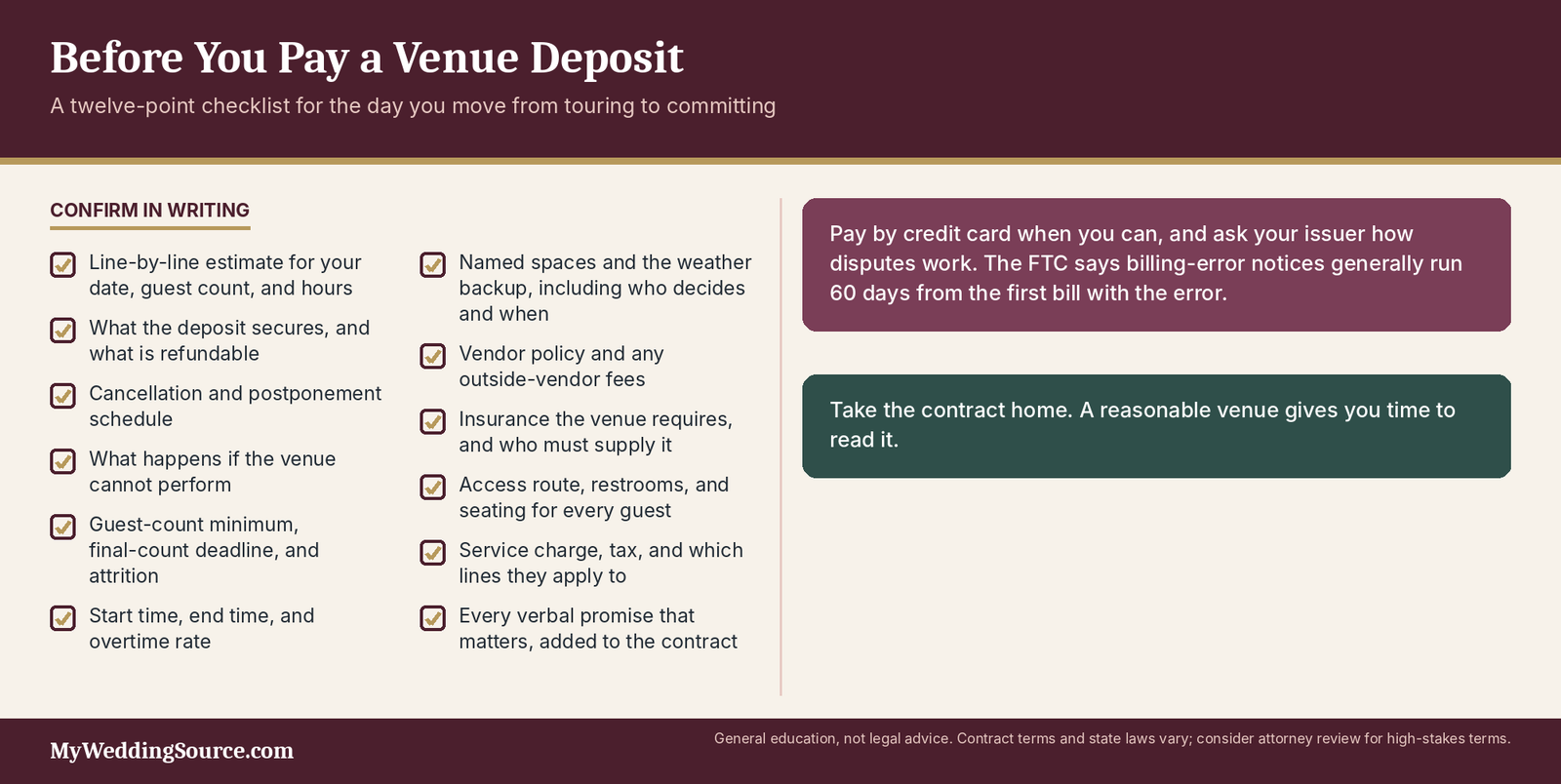
Look at the amount of the deposit, what it secures, whether it is refundable in any scenario, and when the remaining balance is due. A Better Business Bureau spokesperson quoted in a September 2026 InvestigateTV report advised against paying an “all-in deposit” for a wedding venue and urged couples to get the payment schedule, cancellation policy, and consequences of a vendor failing to deliver in writing. If you pay by credit card, the Federal Trade Commission explains that the Fair Credit Billing Act lets you dispute certain billing errors, including services not delivered as agreed, but that you generally must notify the issuer within 60 days after the first bill with the error was sent. Because that clock runs from the bill, a deposit paid long before the wedding may fall outside it, so ask your card issuer how its own policies handle a venue that cannot perform.
Cancellation, postponement, and venue-side failure
Most contracts spell out what you owe if you cancel, often on a sliding scale that increases as the date approaches. Read what happens if you postpone, whether your deposit transfers to a new date, and whether the venue charges for date changes. Equally important, read what happens if the venue cannot perform because of a closure, a sale of the property, a double booking, or damage to the building. The contract should say whether you receive a full refund, how quickly, and whether the venue must help you find an alternative. Our guide to wedding cancellation and postponement covers the planning side of those scenarios in more detail.
Which clauses control your day?
These clauses govern what actually happens on the wedding date, and they are where vague wording can later become a dispute. Specific words beat general promises. If a promise made on the tour matters to you, ask for it to be added to the contract in plain words.
Guest-count terms, hours, and the right to change spaces
Check the minimum guest count, the final count deadline, any attrition percentage, and whether the numbers apply to food, bar, or room charges. Look at the contracted hours, including setup, event, and breakdown, and the overtime rate. Some contracts reserve the right to substitute a comparable space, change the layout, or move the event within the property, so ask what “comparable” means and whether it applies to an outdoor ceremony site. Confirm the specific rooms or areas you are renting by name, and make sure the contract describes the weather backup rather than leaving it to a conversation.
Liability, insurance, and indemnification
Contracts often require you to carry liability insurance, name the venue as an additional insured, and indemnify the venue, which means you agree to cover certain claims. Read who is responsible for damage by guests and vendors, who is responsible for injuries, and whether the venue’s own insurance covers its premises. Keep the types of coverage separate: event liability protects against injuries and property damage, cancellation coverage reimburses specified losses if the event is disrupted, and vendors carry their own policies. If the contract language on indemnification is unclear, that is a good clause to ask an attorney about, because it can allocate risk in ways a layperson might not expect.
Force majeure, disputes, and governing law
A force majeure clause says what happens when events outside either party’s control, such as severe weather, government orders, or disasters, prevent the event. Read whether it allows a refund, a credit, or a reschedule, and whether the venue can keep deposits. Also look for dispute provisions such as mandatory arbitration, attorney-fee clauses, and the state whose law governs the agreement. These terms shape what remedies you have if something goes wrong, and they vary widely. Ask for plain-language explanations of anything you do not understand, and do not feel rushed into signing the same day.
| Clause | What it controls | Plain-language question | Why it matters |
|---|---|---|---|
| Deposit and schedule | What you pay and when | What does the deposit secure, and is any of it refundable? | Sets your money at risk early |
| Cancellation and postponement | What you owe if plans change | What do I owe at 12 months, 6 months, and 30 days out? | Defines your failure cost |
| Venue-side failure | What happens if the venue cannot perform | Do I get a full, fast refund, and any help finding a replacement? | Protects against closure or double booking |
| Guest-count terms | Minimums, final count, attrition | How low can I go, and by when? | Locks in your largest costs |
| Hours and overtime | Access, end time, extra fees | When does the clock start and stop? | Affects vendor schedule and bills |
| Space and weather | Named areas and backup plan | Is the backup space written into the contract? | Avoids a verbal-only promise |
| Liability and insurance | Who covers injuries and damage | What coverage must I carry, and who is named? | Allocates risk |
| Disputes and governing law | Arbitration, fees, state law | How would a disagreement be resolved? | Shapes your remedies |
Which red flags and access issues should make you pause?
Red flags are information, not accusations. Most venues are run by people who work hard and want your event to go well, and most of the friction couples encounter comes from unclear communication or unusual structures rather than bad intent. Still, a few signals deserve a calm second look before you pay, and accessibility deserves its own check because it affects whether every guest can take part. For fraud-specific warning signs, see our guide to wedding venue scam warning signs, and for access detail, our guide to accessible wedding venue red flags.
Which red flags deserve a calm second look?
A red flag is a reason to ask another question, not necessarily a reason to leave. The goal is to gather enough information to either relax or move on. Most of the signals below can be tested with one written question and a day of patience.
Pricing and communication flags
Pay attention if a venue will not provide a fee schedule, gives a different price each time you ask, or says details will be sorted out after you sign. Pressure tactics, such as a price that expires within hours or a claim that another couple is about to take the date, are worth slowing down for. Verbal promises that never appear in the contract are another signal, because a written contract can take precedence over what was said on a tour. Ask for the answer in writing, and note how the venue responds. A venue that is comfortable putting its terms in writing is usually a venue that expects to honor them.
Paperwork and safety flags
Ask to see documents that matter: proof of liability insurance, the alcohol license if the venue serves drinks, any permits needed for events at the property, and occupancy information for the space you are renting. Hesitation to provide basic documents is worth noting, as is a property that appears unfinished, with exits that are blocked or unclear, or with restrooms and power that cannot support your guest count. The BBB spokesperson in the InvestigateTV report suggested checking vendors through more than one source, asking for references, and having a conversation with a real person before committing a large sum. Reading reviews, speaking to recent couples, and verifying the business registration where available are all reasonable steps.
What sounds alarming but is often normal
Several features that make couples nervous are routine. Non-refundable deposits are common, since the venue is taking a date off the market. Food-and-beverage minimums, required insurance, hard end times, preferred vendor lists, and a requirement to use the venue’s coordinator are all normal in many parts of the industry. The question is not whether they exist but whether they are disclosed clearly, priced fairly relative to your alternatives, and consistent with the rest of the contract. If a feature you dislike is standard, weigh it in your scorecard instead of treating it as a verdict on the venue.
How do you check accessibility before booking?
Accessibility is a practical question about whether guests can arrive, move around, use restrooms, hear the ceremony, and join the dance floor. It deserves attention before you book because retrofits are expensive and sometimes impossible. This section gives general education from official and standards sources; it is not legal advice, and coverage depends on the facility.
What the ADA covers, in plain terms
The U.S. Department of Justice’s Title III primer explains that businesses open to the public, such as restaurants, bars, hotels, and private museums, are public accommodations, and that existing barriers must be removed where doing so is readily achievable. It also states that new facilities must be accessible and that alterations must be made accessible to the maximum extent feasible, and the Department’s page on the 2010 ADA Standards says projects with permit dates on or after March 15, 2012 must meet those standards. For older buildings, the primer notes that some barriers may not be readily achievable to remove, in which case the business should offer its services another way. Whether a particular wedding space counts as a covered facility can depend on how it is owned and used, so ask the venue how it approaches access rather than assuming either way.
What to check on the walk-through
The ADA National Network’s planning guide for temporary events offers useful reference points: accessible routes at least 36 inches wide, door openings of at least 32 inches, ramps no steeper than 1:12, and van-accessible parking spaces at least 132 inches wide. Treat those as guideposts for your walk-through, not a legal test, since the enforceable requirements come from the ADA Standards. Check the path from parking to the ceremony, the route to restrooms and the dance floor, the number of steps at entrances and along the way, the location of accessible seating, and whether the restroom can be reached without crossing grass or gravel. Ask what the venue has done for guests with mobility devices at past weddings.
Outdoor surfaces and communication access
Outdoor venues add terrain. The same guide notes that compact, stable crushed stone or soil can work while loose gravel, sand, and tall slippery grass are hard to roll across, and that temporary mats can create a stable route. Ask whether the ceremony lawn is level, whether a hard-surface path exists, and what happens in wet weather. Communication matters as well: the Justice Department’s primer says businesses must take steps to communicate effectively with people who have vision, hearing, and speech disabilities, and the ADA National Network guide suggests having assistive listening available. Ask about a microphone and speaker for the ceremony, a quiet space for guests who need a break, and how guests can request accommodations ahead of time.
How do you compare three wedding venues apples-to-apples?
By the time you have toured a few places, you will have three kinds of information: numbers, rules, and feelings. The risk is that the feelings are vivid and the numbers are not comparable, so the venue with the prettiest light or the friendliest host quietly wins. A structured comparison does not remove emotion from the decision, but it makes sure emotion is working with the same facts for each finalist. The method below takes about an evening and can save a great deal of money and regret.
How do you build comparable quotes?
Comparable means the same event described the same way. You are not comparing venues, you are comparing what each venue would cost and require for an identical wedding. That shift in framing is what turns a pile of brochures into a decision.
Standardize the inputs
Choose one reference event and send it to every finalist: the same date type (for example, a Saturday in your target month), the same guest count, the same start and end times, the same services, and the same list of requirements such as a ceremony site, a getting-ready room, and a bar. Ask each venue to respond with a written, line-by-line estimate that includes service charges, taxes, minimums, required staffing, and any fees for outside vendors. Where a venue does not provide an item, build the missing cost yourself using real quotes for rentals, catering, and logistics, as in the barn example earlier. Divide each total by the guest count to get a per-guest figure that makes different-sized venues comparable.
Add a failure-cost column
The total cost is only half the picture, because a cheaper venue with an unforgiving contract may carry more risk. For each finalist, note the deposit amount, whether any of it is refundable, the cancellation schedule, what happens if the venue cannot perform, and what the weather plan costs. A simple way to express this is a “money at risk” figure: the amount you would lose if you had to cancel six months before the date. Two venues with the same total can have very different risk profiles, and the one that lets you recover more if plans change may be worth a slightly higher price.
How do you weigh cost against fit and risk?
Once the quotes are comparable, you need a way to weigh the non-financial factors without letting any single one dominate. A weighted scorecard is an editorial tool, not a formula, and the weights should reflect your priorities, not ours. Think of it as a way to see your own priorities written down, which is often the part couples find most clarifying.
Build a weighted scorecard
List the criteria that matter, assign weights that add up to 100, score each venue from 1 to 5, multiply, and add. The weights in the table below are a starting point; adjust them to fit your situation, and set accessibility to whatever your guest list requires, since a venue that fails a necessary access criterion should not win on points. Have your partner score independently first, then compare notes, because disagreements reveal which criteria you value differently. Keep the scorecard honest by scoring from the written proposal and the contract rather than from memory.
| Criterion | What to measure | Starting weight (editorial) |
|---|---|---|
| Total estimated cost | Per-guest total from a written, line-by-line estimate | 25 |
| Capacity and layout fit | Seated dinner with dance floor at your guest count | 15 |
| Weather and backup plan | Backup space capacity, cost, and decision rule | 15 |
| Accessibility | Route, restrooms, seating, and communication access | 15 |
| Contract terms | Refundability, cancellation, guest-count flexibility | 15 |
| Vendor freedom | Catering, bar, music, and decor restrictions and fees | 10 |
| Responsiveness | Speed and clarity of answers in writing | 5 |
Tie-breakers and when to walk away
If two venues finish within a few points of each other, choose the one with the lower failure cost and the clearer contract, because certainty is worth more than a small price difference. If the scores are close and your gut still prefers one, that is allowed; the scorecard exists to prevent surprises, not to override your sense of place. Walk away if a venue will not put key terms in writing, if the total cost cannot be established before you are asked to pay, or if a necessary accessibility feature is missing and cannot be added. Walking away from a place you love is hard, but it is much cheaper than walking away from a signed contract.
FAQ: Wedding venue questions
These are the questions couples ask most often once the tours begin. The answers are general education, and your venue’s contract controls the details. Where a question depends on your state or your contract, the answer says so and points to the next step.
Costs and booking
Cost and timing questions tend to arrive together, because the price you pay depends on the date you choose and how early you commit. The answers below keep the two connected, with the caveat that your own quotes outrank any average.
How much should I expect to spend on a wedding venue?
National averages give a rough frame: The Knot reports an average reception venue cost of $12,900 for 2025 weddings, and Zola reports an average of $8,573 with a typical range of $6,900 to $10,300, with the venue accounting for about 17 percent of a typical budget. The two sources use different samples and definitions, and neither is a quote for your city. What you spend depends on your region, date, guest count, and whether food and drink are inside the venue fee. The most reliable way to answer the question for your wedding is to request line-by-line estimates for your reference event from three or more venues.
How far ahead should I book a wedding venue?
There is no single universal timeline, and we could not verify a national lead-time figure from the sources we reviewed. Popular dates, especially in the May-to-October peak that The Knot data highlights, tend to fill earlier, so check availability for your top dates before you commit to the rest of the plan. Flexible dates, such as a Friday or Sunday, may remain open longer. Our wedding timeline guide places venue booking in the larger schedule, and the venue itself can tell you how far ahead it usually books your preferred dates.
Is a non-refundable deposit normal?
A non-refundable deposit is common because the venue is removing a date from its calendar, but the details vary a great deal. What matters is what the deposit secures, whether it applies toward your balance, and what happens if the venue cannot perform. A Better Business Bureau representative quoted in a recent news report advised against paying an all-in deposit for a venue, so consider asking for a smaller deposit with a payment schedule. Read the cancellation clause as carefully as the deposit clause, since the two work together.
Rules and risks
The second group of questions concerns what you may and may not do, and what protects you if something goes wrong. These answers are general education, and a licensed attorney in your state is the right person for advice on your specific contract.
Can I bring my own vendors to a wedding venue?
It depends on the venue’s policy, which may be open, preferred-list, approved-list, or exclusive for certain services. Some venues allow outside vendors with a certificate of insurance and a fee, while others require you to use their catering or bar. Ask for the policy in writing, ask what any outside-vendor fee covers, and compare the total cost of each approach rather than the sticker price alone. If you have a vendor you care about, check that the venue permits them before you sign.
What insurance do I need for a wedding venue?
Venues commonly ask for event liability coverage and a certificate naming the venue as an additional insured, and they may require vendors to carry their own policies. Cancellation coverage is a separate product that reimburses certain losses if the event is disrupted, and Consumer Reports describes both parts in its wedding insurance explainer. Whether you need either depends on the venue’s requirements, your contract, and your tolerance for risk. Ask the venue exactly what it requires, and read any policy’s exclusions before you buy.
What should I do if my venue closes or cannot honor the contract?
Start by documenting everything: your contract, payments, and communications. Contact the venue in writing, reference the contract’s refund and venue-failure provisions, and ask for a response date. If you paid by credit card, contact the issuer promptly, since the Fair Credit Billing Act’s dispute window generally runs from the first bill showing the problem, and consider contacting your state attorney general’s consumer protection office. For significant sums or complex disputes, a licensed attorney in your state can advise you on your options, and this guide cannot.
Your next steps
The sections above contain a lot of detail, and the way to use it is in sequence: narrow, gather, compare, then commit. The steps below turn the guide into a short list of actions, starting this week and ending at the moment you would pay a deposit. Each step is small enough to finish in an evening, and none of them requires you to sign anything.
This week
The first week is about setting up your search so every tour produces comparable information instead of impressions. A little structure now means you will not be reconstructing details from memory in a month.
Set your filters and send the screening email
Write down your guest-count range, your date window, your required features, and your deal-breakers, and agree on them with your partner. Then send the same screening email to every venue on your list, asking for availability, the fee schedule, the vendor policy, the cancellation terms, and the backup weather plan. Note which venues respond clearly and quickly. Remove any venue that fails a filter you cannot compromise on, so you only tour places that could actually work.
Build your scorecard and schedule the tours
Copy the scorecard criteria into a shared note or spreadsheet, adjust the weights, and decide who scores first. Schedule tours at the time of day your ceremony would take place, and group them over one or two days so your memories stay fresh. Print or save the tour checklist and bring a notebook, a phone for photos, and any measurements you need. Ask each venue to send its written proposal within a day or two after your visit.
Before you pay a deposit
The moment you pay a deposit is when your options narrow, so this is the checkpoint worth slowing down for. Take the contract home, read it away from the sales conversation, and give yourself a day before you commit.
Get the full proposal and contract in writing
Request the contract and the full fee schedule before you decide, and read them against your scorecard. Confirm that the contract names the specific spaces, hours, backup plan, and guest-count terms you were promised, and that verbal assurances appear on paper. Check the cancellation schedule, the venue-failure provisions, and the insurance requirements, and note every deadline on your calendar. If anything is unclear, ask for the explanation in writing.
Run the final checks
Before you sign, compare the final per-guest total and money-at-risk figure for your finalists, and consider whether a licensed attorney in your state should review the contract. Decide how you will pay, keeping in mind that a credit card may offer dispute rights that other methods do not, and ask the venue what deposit amount is standard. Keep a copy of everything, including the proposal and the emails that preceded it. Then book the venue that earns its place on the scorecard and in the contract, and tell the other finalists thanks.
Sources & methodology
- The Knot Real Weddings Study 2026 data page — sample description (U.S. couples married in 2025) and venue importance
- The Knot average wedding cost — average total cost, guest count, reception venue cost, cost by quarter
- The Knot most popular wedding season and dates — popular seasons and dates, demand and pricing
- Zola: what weddings really cost — Saturday evening pricing, weekday and winter savings estimate
- Zola: how much wedding venues cost — average venue cost, share of budget, service fees, setup fees
- New York State Department of Taxation and Finance: caterers and catering services — example of how service charges, gratuities, and room rental can be taxed
- Consumer Reports: should you buy wedding insurance — cancellation versus liability coverage (2018 article)
- Federal Trade Commission: using credit cards and disputing charges — billing error disputes and the 60-day notice window
- InvestigateTV and WAFB: protecting your budget from wedding vendor problems — Better Business Bureau advice on deposits and written terms
- ADA.gov Title III primer — public accommodations, readily achievable barrier removal, communication
- ADA.gov 2010 ADA Standards — which standards apply to new construction and alterations
- ADA National Network: planning guide for accessible temporary events — route, door, ramp, parking, surface, and communication reference points
- New Hampshire State Fire Marshal: places of assembly — example of assembly occupancy and local requirements
- Maryland State Fire Marshal: inspection guidelines for wedding barns — example of change-of-use treatment of barns (older, state-specific)
- National Weather Service: lightning safety — no safe place outside during thunderstorms
Methodology: Verified facts here come from the agency and organization pages linked above, read in October 2026. Cost averages and percentages are survey or platform findings, and the two wedding platforms use different samples and definitions, so we show them side by side rather than blending them. The two-venue cost table is an illustrative example built by our editors with invented figures and a placeholder tax rate, and the scorecard weights, red-flag framing, and ordering of steps are editorial judgment. Contract, insurance, and tax discussions are general education, and terms and state laws vary.
Freshness note: Recheck The Knot and Zola figures when each publishes its next annual study, expected in early 2027, and recheck the Fair Credit Billing Act and ADA pages if any agency announces a change. The New York tax guidance, the New Hampshire and Maryland fire marshal pages, and the Consumer Reports article are examples that may be updated, and local rules for your venue always take precedence. Review this guide at least once a year, and again before peak booking season.