
A conservatory wedding takes place inside a glass house full of living plants, which means the heat, the humidity and the rules about what may touch a leaf matter more than the flowers you bring. This guide gives you a microclimate comfort check and a prohibited-decor screen, so you can judge a conservatory venue before you sign and plan around what the building will not allow.
Treat a conservatory wedding as two separate questions. First, comfort: visit at the hour you plan to marry, read the temperature, the humidity and the sun on the exact spot where guests will sit, and sort each spot into green, amber or red. Second, decor: run every item you want to bring through six tests (touch, water, soil, flame or haze, scatter, and anything introduced). Ask the conservatory for its restrictions in writing, and agree on the conditions that would move the ceremony before you pay a deposit.
Botanical conservatories are among the most photographed wedding settings there are. Palms, ferns, orchids, a curved glass roof, filtered light. The pictures make a conservatory wedding look like a party in a room that happens to be full of plants. It is closer to the opposite. A conservatory is a plant collection that happens to have a room-sized space inside it, and the collection comes first.
That ordering explains almost everything you will be told about a conservatory wedding. The staff will limit the guest count, the ceremony length and the decor of any conservatory wedding, and the reasons will rarely be about taste. The air inside is kept warm and wet for the plants, not for people in formal clothes. The paths are narrow because the beds are valuable. The rules on confetti, candles and cut stems exist because a single mistake can damage something that took decades to grow.
A note on scope. This is general planning information, not legal, safety or insurance advice, and every conservatory, city and insurer sets its own rules, so confirm anything that matters with the venue’s events office.
If you are still comparing kinds of places, the wedding venues guide sets out the broader choices. This article assumes a conservatory wedding is already on your list, and it stays on three things that other venue types do not raise in the same way: the climate inside the glass, the decor that the building will refuse, and the plan for the day when conditions are worse than expected.
What a conservatory wedding actually asks of you
Three features set a conservatory wedding apart from a wedding in a hall, a barn or a garden outdoors, and each one changes how a conservatory wedding is planned.
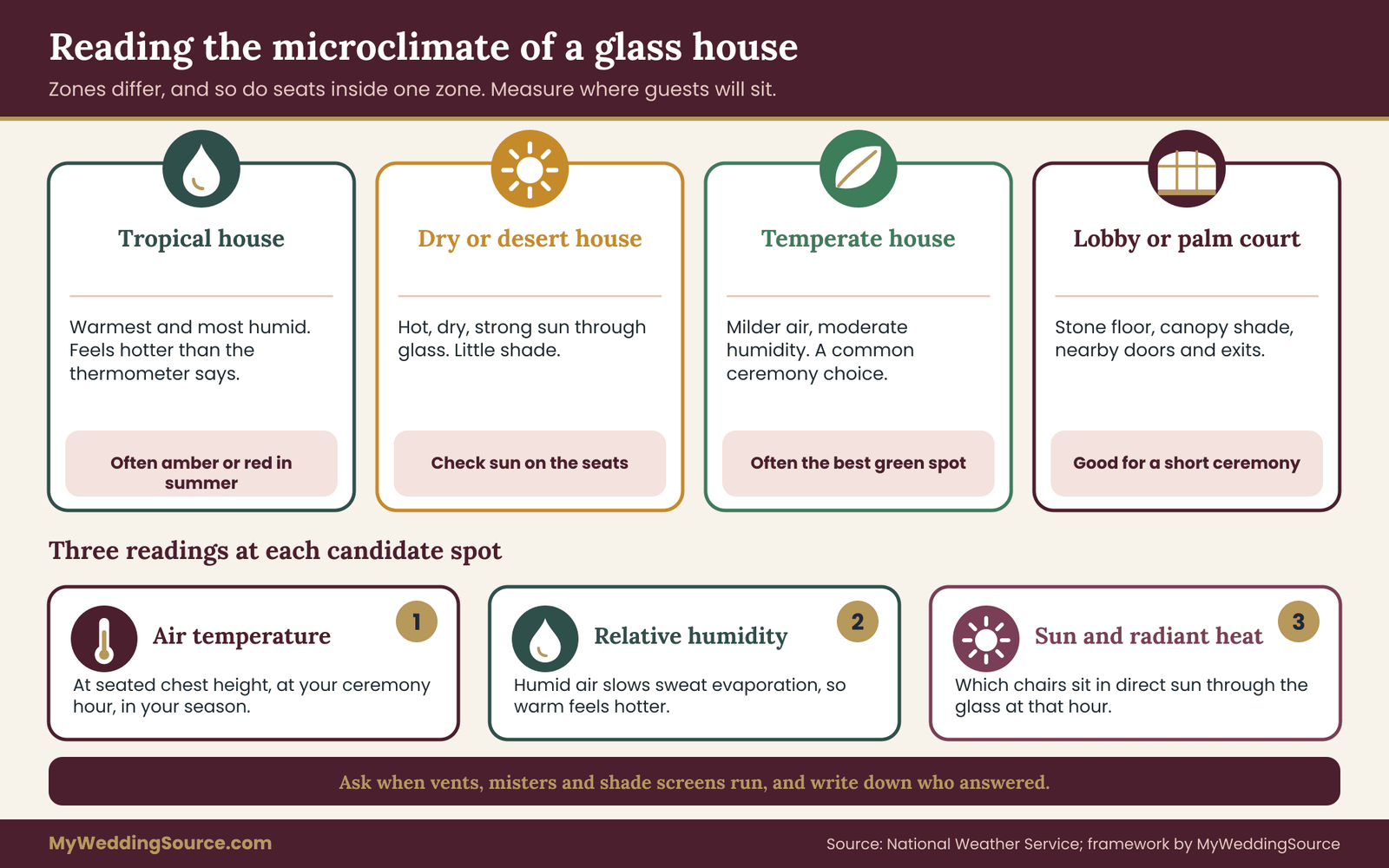
The air is engineered for plants. Many conservatories keep separate zones: a tropical house that stays warm and very humid, a dry house for desert plants, a temperate or Mediterranean house that is milder, and sometimes a cool house for ferns or alpine species. Each zone has a target range set by the horticulture staff. Guests experience those ranges as heat, damp air or both, and the range cannot be adjusted for your comfort without affecting the plants.
The surfaces are part of the collection. Floors, paths, beds, hanging baskets, pots, the glass and the metal frame all belong to a building that is cleaned and maintained on a schedule. Moisture lives everywhere, and persistent dampness can support mold, which is why the Environmental Protection Agency’s guidance on mold and moisture shapes how these buildings are cleaned. Many floors are slick when damp, and many paths are old, uneven or narrow.
The visitors keep coming, or the plants keep growing. Some conservatories close entirely for a private conservatory wedding. Others stay open to the public and cordon off a zone. Either way, the plants keep respiring, the irrigation keeps running and the staff keep working around you. A conservatory wedding rents you time and space inside an operation that does not stop for you.
Why the rules feel strict, and why they usually make sense
It helps to picture what the horticulture team is protecting. A rare orchid may have taken years to reach flowering size. A mature tree fern or palm may be older than the building’s current roof. A collection may be tied to research or to a regulatory agreement about where certain plants are held. When a coordinator says “no confetti,” the meaning is rarely “we dislike confetti.” The meaning is closer to “loose material gets into soil, irrigation and drains, and we cannot pick it all out.”
The same logic explains the quiet limits that surprise couples. No outside plants may be brought in, because plants carry insects and disease. No open flame, because heat and combustion byproducts harm leaves and because the building is full of organic material. No glitter, no foam, no spray adhesives. No aisle runner pinned to a path. Each rule has a mechanical reason, and learning the reason is the fastest way to predict the rule a conservatory wedding will meet that you were not told.
What this guide does not cover
It does not rank venues, quote prices or promise that any given conservatory wedding will be allowed to include a given item. Conservatory policies vary widely: some allow ceremonies only, some allow dinners, some allow almost nothing beyond a small group and a small floral piece. A few are managed by cities, some by universities, some by nonprofit garden organizations, and each sets its own terms for a conservatory wedding. The checklists below are tools for asking better questions and noticing problems early, not a substitute for the venue’s own document.
Reading the microclimate before you commit
A microclimate is the local climate of a small area. In a conservatory it can vary a great deal across a few steps. A bench near the roof vents may feel entirely different from a bench beside a fountain under a dense canopy, and both differ from the doorway. Guests at a conservatory wedding sit in one specific place for the length of the ceremony, so the reading you need is for that spot, at that hour, in that season.
The common mistake is to tour on a convenient afternoon, enjoy the pleasant warmth and sign the contract. A mild Tuesday in the cool season tells you almost nothing about a Saturday in July at four in the afternoon, when the sun is high on a glass roof. The glass magnifies the season. Winter visits can feel comfortable and a summer conservatory wedding can feel like a greenhouse, because it is one.
The three readings that matter
Take three readings at each candidate spot. You do not need special tools beyond a phone and, ideally, a small handheld thermometer and humidity gauge that cost little. Ask the venue first whether it posts its own readings or whether its staff can share the typical range for the zone.
Air temperature at seated height. Measure about chest height for a seated person, not up near the roof where warm air collects and not at floor level. Note whether the reading changes during the visit as the sun moves or as the vents cycle.
Relative humidity. High humidity makes warm air feel hotter because sweat evaporates more slowly. The National Weather Service heat index exists for exactly this reason: it combines air temperature and humidity to describe how hot it feels to the body. A tropical house at a temperature that sounds modest can feel much hotter than the number suggests.
Direct sun and radiant heat. A seat that sits in a patch of sun through glass feels warmer than the thermometer says, because the sun heats skin and fabric directly. Note which chairs would sit in sun at your ceremony hour and which would be in shade. Shade cloth, retractable screens and plant canopy change this, and the staff know how.
Why the hour and the date change everything
Glass buildings track the sun. Many conservatories use roof vents, misting or shade systems to hold the plants steady through the day, and these systems have schedules. Ask when vents open, when misting runs and when shade screens deploy. A mister that fires at the start of your processional is a problem you can solve by asking for a different schedule, but only if you know about it in advance.
Dates matter in two ways. Seasonal sun angle changes how much light and heat enter the roof. And outside weather changes how hard the building works. On a very hot day the vents may be fully open and the interior still climbs, and on a cold day the heating may be running and the air may be dry near the vents and damp elsewhere. Ask to see the building at the same time of day, in the same season, as your date, or ask the staff what the range typically looks like then.
Ask for the plant side of the story
The horticulture staff will often tell you something the events office does not. Which zone is warmest? Which paths flood when watering runs? Which beds are in flower at your date and which are dormant? Is any part of the house closed for repairs, repainting or plant replacement in the weeks before your date? A conservatory wedding in the middle of a glass repair project is a different event from the one in the photographs.
Write the answers down, with the date and the name of the person who gave them. When a venue’s answer is “it varies,” follow up with the question “what is the usual range at that hour on that date?” A specific answer is worth more than any general reassurance.
The comfort checklist for a conservatory wedding
Once you have readings, you need a way to turn them into decisions about your conservatory wedding. The method here has three steps: sort each spot into a band, adjust the band for who is sitting there and what they are wearing, and then set a length limit for the event in that spot.
Step one: sort each spot into green, amber or red
Use the heat index chart published by the National Weather Service as your reference. It lets you look up a “feels like” value from a temperature and a humidity reading, and it groups results into caution levels. You do not need to memorize the values. You need only to read the chart for your numbers and note which level they fall in.
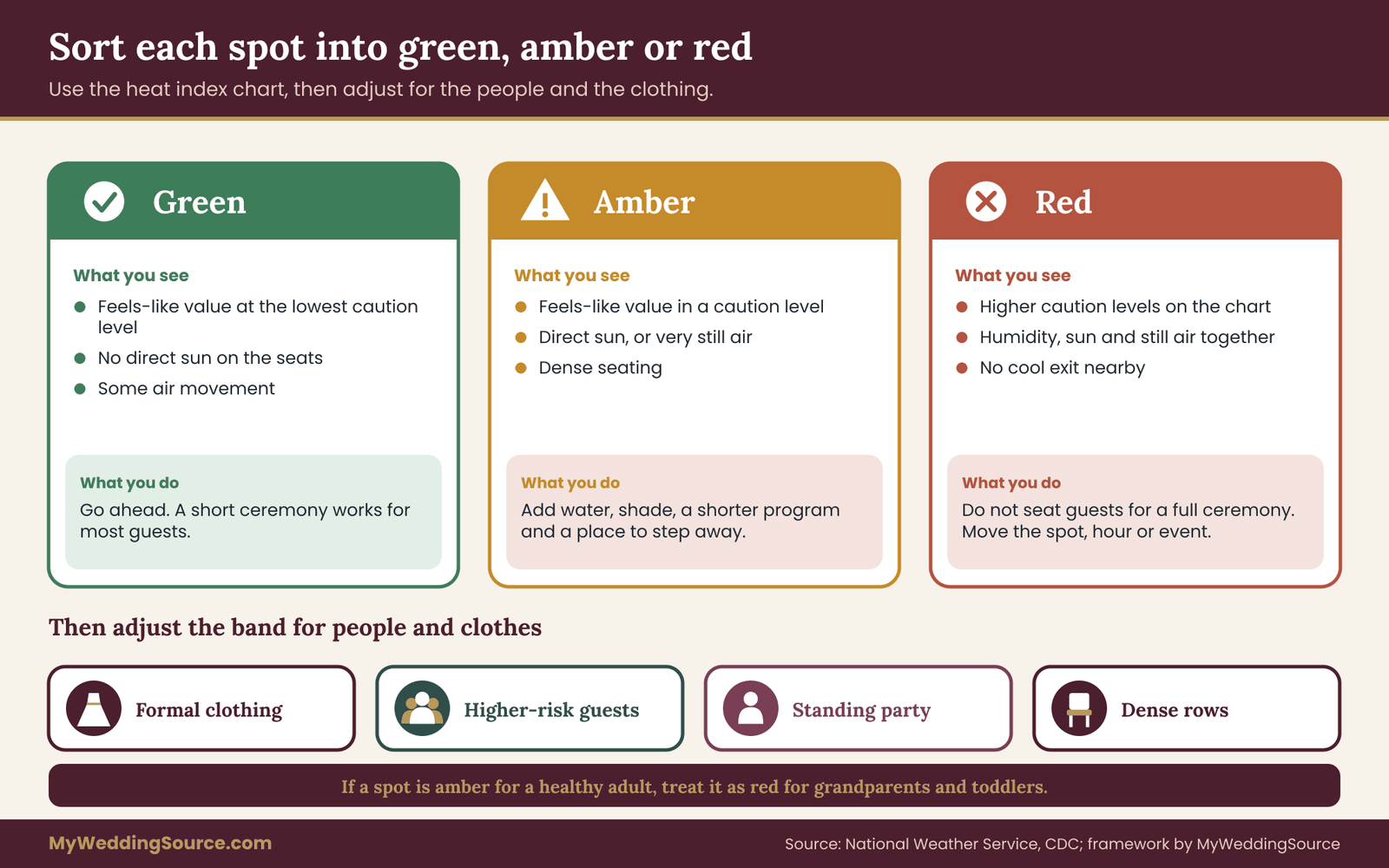
Green means the feels-like value sits at or below the lowest caution level on the chart, no sun reaches the seats, and the air moves a little. People in formal clothes can sit through a short ceremony without trouble.
Amber means the value sits in a caution level, or the seats get direct sun, or the air is very still. Most people at a conservatory wedding will manage, but some will not, and you need specific measures: water, shade, a shorter program and a place to step away.
Red means the value sits in the higher caution levels, or the combination of humidity, sun and still air is clearly oppressive. Do not seat guests there for a full ceremony. Either change the spot, change the hour, or change the event.
The point of the three bands is not scientific precision. It is a shared language for you, your planner and the venue, so that a conversation about a spot ends in a decision rather than in “it should be fine.”
Step two: adjust for people and clothing
The chart describes a healthy adult in shade with light clothing. Your guests are none of those things. Several common features of a conservatory wedding make the real experience hotter than the chart:
- Formal clothing: suit jackets, long dresses, layered fabrics, tights, ties, and heavy veils or trains.
- Age and health: older relatives, pregnant guests, babies, young children and people with heart conditions or on certain medications are more affected by heat. The Centers for Disease Control and Prevention lists groups at higher risk of heat illness, and your guest list probably includes several.
- Dense seating: bodies add heat and block air. A crowded row feels warmer than the same row half empty.
- Standing: a wedding party standing at the front for the whole service is more exposed than seated guests.
- Alcohol and a late lunch: both change how people handle heat.
A practical rule for a conservatory wedding: if a spot is amber for a healthy adult, treat it as red for the front-row grandparents, the flower girl and the wedding party in full dress. You do not have to treat the whole room as red; you can seat vulnerable guests in the best spot, which is cheaper and kinder than redesigning the day.
For more on caring for older relatives, babies and children during a long day, the wedding guest care planning guide goes through the roles and supplies you will want.
Step three: set a length limit for each spot
Comfort is a function of time. A green spot is comfortable for an hour. An amber spot may be fine for twenty minutes and unpleasant for sixty. So after you decide the band, decide how long guests will be in that spot and let the answer drive the program of the conservatory wedding.
A simple way to do this is to write the spots and their time limits in a short list:
- Arrival and greeting zone: how long will guests wait here, and where do they wait if the doors are not yet open?
- Ceremony seats: how long from the first processional note to the recessional?
- Photo zone: how long will the wedding party stand while photos are taken, and in which band?
- Reception or dinner zone, if the conservatory allows one: how long will people sit, eat and dance in that band?
When a spot is amber, plan the length limit explicitly. A fifteen-minute ceremony with a short reading and no extended rituals fits an amber spot far better than a forty-minute service with three readings and a unity ritual. If the program cannot be shortened, move the spot to green or move the ceremony somewhere cooler and bring only the photographs to the conservatory.
The comfort checklist in one page
Before you commit to a conservatory wedding, you should be able to answer each of the following in writing, with a name and a date next to the answer.
- Which zone will hold the ceremony, and what are its typical temperature and humidity at our hour and season?
- Which seats receive direct sun at our hour, and what shade options does the venue allow?
- When do vents, misters and shade screens run, and can the schedule be changed for our window?
- Is there a cooler area, outdoors or in a separate room, where guests may wait or recover?
- Where is drinking water available, and may we bring our own bottles, coolers or a water station?
- Which guests are at higher risk, and where will they sit?
- How long will each group stand or sit in the house, and does the program fit the time limit for that band?
- What happens if a guest feels unwell: who calls whom, where is the nearest exit, and how does emergency help reach the building?
What “good enough” looks like
Some couples worry that the checklist will rule out every conservatory wedding. It usually does not. Many conservatories have a milder zone, such as a temperate house, a palm court or a lobby area, where the air is comfortable for a short ceremony in most seasons. For a conservatory wedding the checklist often points to a specific corner, at a specific hour, with specific adjustments.
It also sometimes points the other way, and tells you that the tropical house you loved in photographs is a poor ceremony site in July. That is a useful answer to receive before a deposit rather than after.
A few signs that a spot is good enough for a conservatory wedding: the readings are in the green or low amber band at your hour, the seats are in shade, a path or door is close for anyone who needs to leave, and the staff have given you the vent and mister schedule in writing. A few signs that it is not: the venue will not tell you the typical range, the seats are in full sun, or the only exit passes through the whole crowd.
Heat plans for guests, the wedding party and vendors
The comfort checklist describes the room. A heat plan describes what people do about it. The plan for a conservatory wedding has to cover three groups with different needs: guests, the wedding party and the people working the event.
Guests: water, shade, information and an exit
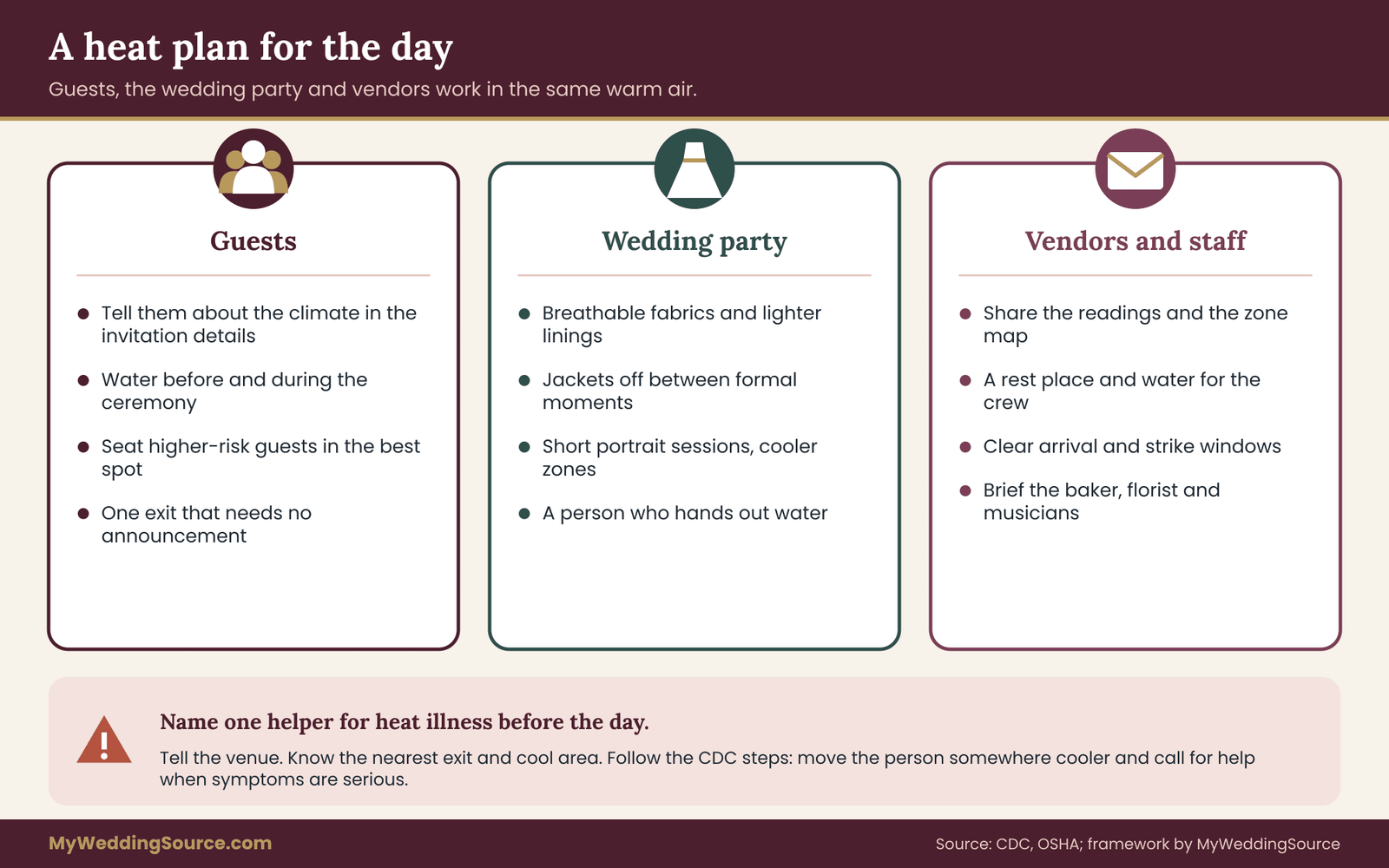
The simplest measures are the most effective. Provide drinking water before and during the ceremony, where the venue allows it, and ask in advance whether bottles or a water station are permitted, since some conservatories restrict liquids near plants and floors. Tell guests about the climate before the day, in the invitation details or on the wedding website, so they know what a conservatory wedding feels like: “The conservatory is warm and humid. Light fabrics are recommended. Water will be provided.” The sentence costs nothing and changes what people wear.
Programs printed on stiff card can double as fans, but in a humid house paper softens and curls, so ask your printer about the stock if you plan to hand programs out inside. A quieter option is to skip printed programs for the ceremony and put the order of events on a sign at the entrance.
Plan an exit that does not need an announcement. A guest who feels faint should be able to step out through a nearby door, sit in a cooler spot and be reached by a designated helper without crossing a ceremony in progress. Put the helper’s name in your emergency plan and tell the venue.
If a guest shows signs of heat illness, such as heavy sweating with weakness, dizziness, nausea, or confusion, the CDC advises moving the person to a cooler place and seeking medical help when symptoms are serious. Learn those steps from the agency’s guidance rather than from this article, and assign one person on your team the task of calling for help.
The wedding party: dress, standing time and relief
The wedding party carries the heaviest load at a conservatory wedding. They are in formal clothes, often in layers, and they are on their feet in the sun for portraits. Practical steps include:
- Choose breathable fabrics for the party’s clothing and consider lighter linings.
- Let people remove jackets between formal moments, and plan a place to hang them where they will not touch plants.
- Keep the portrait sessions short in the house and use the cooler zones for group portraits.
- Provide water to the party, with a person responsible for handing it out.
- Seat the party during the ceremony where the venue allows, or shorten the standing time with a brief program.
Ask the couple’s hair and makeup artist how their products handle humidity. High humidity changes how hair holds a style and how makeup sets, and a plan for touch-ups beats a hope that nothing will move. The bridal hair and makeup planning guide covers trials and timing in general.
Vendors and staff: they work in the same air
Photographers, musicians, caterers, florists and rental crews work through the conservatory wedding for hours, often longer than guests. In the United States, the Occupational Safety and Health Administration publishes guidance on heat exposure for workers, including water, rest and shade, and your vendors’ employers are responsible for their own workers. You can still make the work safer and your day smoother by giving vendors a clear arrival window, a place to rest and water, and the heat readings you took.
Be specific in the vendor brief: tell the caterer how warm the service area gets, tell the musicians about humidity and their instruments, and tell the photographer about lens fogging. The sections on food, sound and photography later in this guide go through each of these.
The prohibited-decor screen for a conservatory wedding
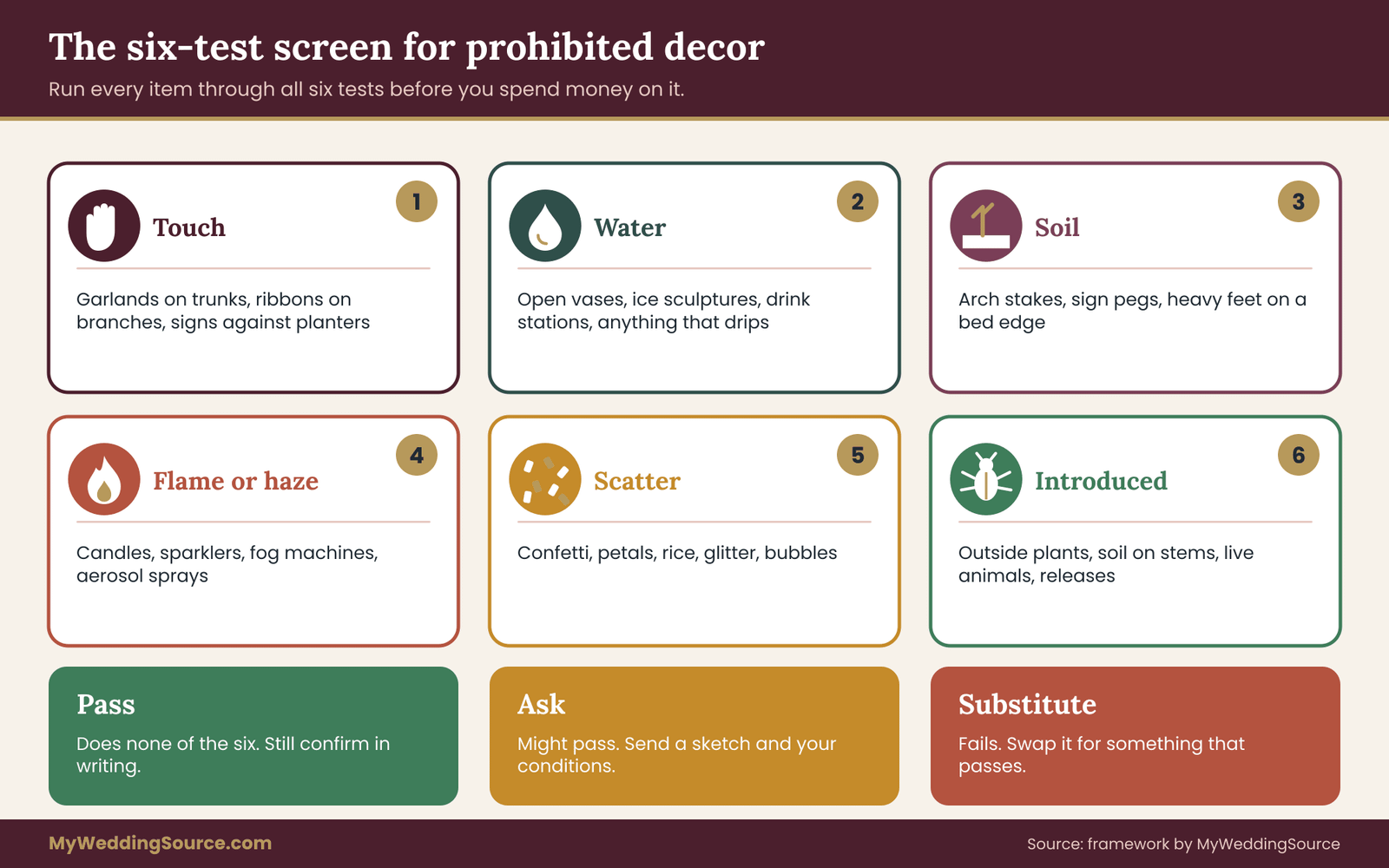
Most wedding decor is designed for places where nothing important lives, and a conservatory wedding is not one of them. A conservatory is the opposite. The screen below is a set of six tests that predicts whether a piece of decor will be refused, and tells you what to ask when the answer is unclear. Run every item on your conservatory wedding inspiration list through all six before you spend money on it.
The six tests
Test one: touch. Will the item contact a plant, a bed or a plant label? Garlands wrapped around trunks, ribbons tied to branches, signs leaned against a planter and lights draped through foliage all fail. Plant tissue is easily damaged, oils from hands and residues from adhesives harm leaves, and a snapped stem cannot be reattached. Items that stand free on a hard path, with space around them, usually pass.
Test two: water. Will the item drip, spill, leak or hold water? Fountains of wine, ice sculptures, cut-flower arrangements in open vases and drink stations all add water to a floor or a bed. Water on old tile or stone makes a slip hazard for guests and staff. Ice melt carries salt or dye into soil and drains. If the item contains water, the venue will ask where it drains.
Test three: soil. Will the item enter or disturb soil, mulch or planting beds? Stakes for arches, pegs for signs, heavy base plates for lanterns and feet on a bed edge all fail. So does anyone stepping into a bed for a photograph, which is why venues rope or mark them. Free-standing structures on weighted bases, set on protected flooring, usually pass.
Test four: flame, heat or haze. Will the item burn, heat or produce smoke, fog or spray? Candles, sparklers, lanterns, cold-spark machines, fog and haze machines, and hairspray used on site all fail at most conservatories. Fire is the obvious concern, since the building contains dry plant material, but haze and aerosol residues also coat leaves and trigger fire alarms. Ask about battery-powered flameless candles instead, and ask whether they may be used.
Test five: scatter. Will the item shed pieces? Confetti, rice, birdseed, loose petals, glitter, bubbles, ribbon wands and metallic table scatter all fall into this group. Loose material drops into beds, irrigation and drains, and it can attract pests or foul equipment. Bubbles leave a residue on floors and leaves. Many couples assume natural petals are fine; ask first, because some conservatories refuse them too.
Test six: introduced. Will the item bring in something living or something that could carry living material? Potted plants from a florist, cut stems with soil or insects, live animals, released butterflies or doves, and even wet moss all fall into this group. Plants and plant material can carry insects, eggs and disease, and conservatories protect collections that may include species held under plant-health rules. The United States Department of Agriculture’s Animal and Plant Health Inspection Service publishes background on plant pests and protections.
Three verdicts and what to do with each
After you run an item through the screen, it ends in one of three verdicts.
Pass. The item does none of the six, such as a free-standing sign on a weighted easel on a hard floor, away from plants. Still confirm in writing, since the venue may have its own view about placement.
Ask. The item might pass under certain conditions. Battery candles on a hard floor, a freestanding arch with a weighted base, or a florist’s cut arrangement in a sealed container are common examples. Write down the condition you would meet and ask for approval of that specific plan with a photograph or a sketch. Venues respond better to a concrete proposal than a general question.
Substitute. The item fails for a conservatory wedding. Replace it with something that serves the same purpose and passes. Many couples find that the substitute suits a conservatory wedding better anyway. Many couples find that the substitute is better suited to a conservatory anyway.
Common requests, run through the screen
Aisle runner. It touches the floor and the edges of paths, and it can be a trip hazard on a damp surface. Many conservatories refuse it or require that it be secured without tape or adhesive. Substitute: skip the runner and let the path be the aisle, or ask whether a thin non-slip runner on a hard path is allowed.
Petal toss at the recessional. Fails scatter, and perhaps touch. Substitute: guests may hold a small flower to wave or hand to the couple, or the exit may take place outdoors, where petals are the venue’s decision.
Candles and lanterns. Fail flame. Substitute: battery-powered candles, if permitted, or lighting that the conservatory already provides. Ask about their own uplighting, since many have it.
Hanging installations. Fail touch if they connect to plants, and often fail structural limits if they connect to the frame. Glass houses are not designed to carry loads on their roof structure. Ask the venue whether any rigging points are permitted. Most will say no.
Floral arch. A freestanding arch on a weighted base, set clear of the beds, may pass. An arch staked into soil fails. Some conservatories prefer that you use the plants already in the house as your backdrop and bring only a small arrangement.
Cut flowers in vases. May pass if the vases are sealed or low-risk, but they fail introduced if the stems carry soil or pests. Ask what the conservatory requires about outside flowers. Some require that they are clean and free of soil, and some refuse them.
Bubbles, sparklers, confetti cannons. Fail at nearly every conservatory wedding. These are among the most commonly named prohibited items in venue policies generally.
Fog or haze for an entrance. Fails flame or haze, and may set off the smoke detectors. Do not plan it.
Balloons. Often refused because they can burst, drop latex pieces into beds or snag on roof structure. Ask.
String lights and uplights. Depend on power, placement and heat. Use of the venue’s own power may be required. Hot lights near leaves can scorch them, and cords on a damp floor are a hazard. Ask the venue which lighting you may bring and where outlets are located.
The most useful decor is the building itself
The simplest conclusion from the screen is also the most useful: a conservatory wedding needs far less than you planned to bring. A conservatory is already an extraordinary setting, and many of the best conservatory weddings use almost no added decor. A few ideas for conservatory wedding decor that tend to pass the screen:
- Choose the ceremony spot for its backdrop and let a single plant, a window or a path do the work of an arch.
- Use paper or fabric signs on stable freestanding frames, positioned away from beds.
- Rely on the venue’s lighting at the right hour and on daylight through the glass, rather than adding lights.
- Select a small number of pieces in a color that complements the planting, and place them where the venue approves.
- Use the guests’ clothing, and the couple’s, as the color in the picture.
The wedding color palette guide can help you choose a restrained palette against a green background, since green is an unusually dominant color in these pictures. And if you want a longer list of items that venues commonly restrict, the wedding rental planning checklist covers questions to ask about rentals and what the rental company needs to know about your venue.
When the decor list and the rules disagree
At some point in planning your conservatory wedding you will want something that the screen says is refused, and a vendor will say “we can make it work.” Treat that sentence with care. A vendor can make something work in the vendor’s sense, which means physically fit in a space. Only the conservatory can make it permitted. If the conservatory has not approved the specific item in writing, do not assume it is allowed, and do not let a vendor bring it to the load-in as a test.
Ask the florist and the planner to send their conservatory wedding decor list to the venue before the walkthrough, so any no-go item is discovered while there is time to substitute. A refusal at load-in leaves a team with a truck of unwanted decor and no time. A refusal in a spreadsheet three weeks earlier is simply an edit.
Event restrictions conservatories commonly write
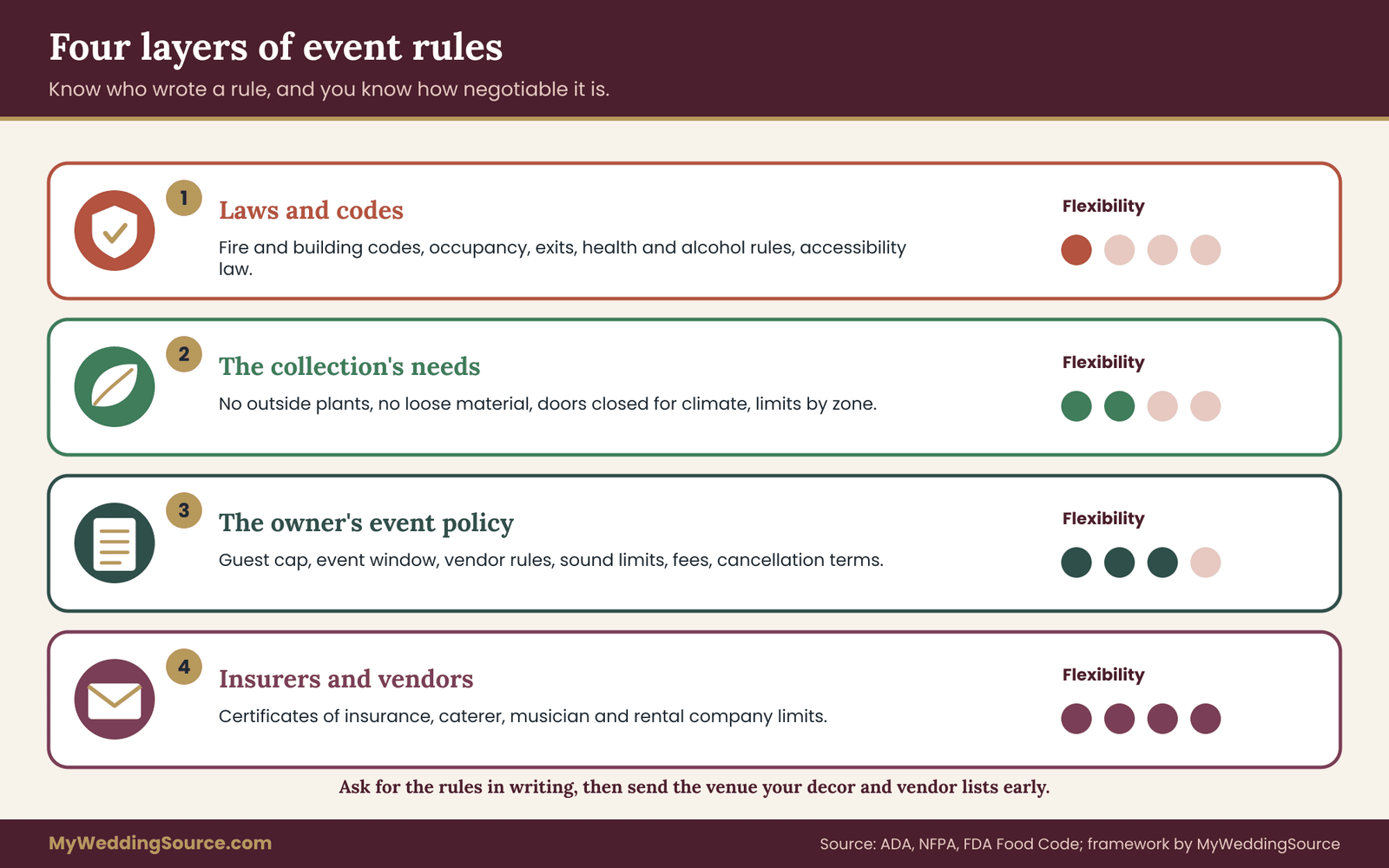
The rules for a conservatory wedding come from more than one source, and knowing which source wrote a rule tells you how negotiable it is. Think of four layers of conservatory wedding rules, from the least flexible to the most.
Layer one: laws and codes
The first layer is set by public rules that neither you nor the venue can waive. Building and fire codes, which draw on safety standards such as those the National Fire Protection Association publishes, set the maximum number of people who may occupy a space and require clear exits and aisles. Local fire officials may need to approve any event that changes the seating layout, and many venues require you to follow their approved plan. Health departments regulate food service, and alcohol is governed by state and local licensing.
Accessibility law applies to a conservatory wedding too. In the United States, the Americans with Disabilities Act sets requirements for public accommodations and state and local government facilities, and the ADA website explains the basics. A conservatory open to the public is expected to keep accessible routes, and it will protect those routes during your event. That means your seating plan may need to leave clear paths wider than you would choose, and that a narrow historic path may simply not be available for a processional with guests walking alongside.
If you want a broader approach to checking whether a venue is workable for guests with mobility needs, the accessible wedding venue red flags guide lists the questions worth asking before you commit.
Layer two: the collection’s needs
The second layer protects the plants. These are the rules that the horticulture staff write: no outside plants, no loose materials, no contact with beds, limits on hours or on guest numbers in sensitive zones, and a requirement that certain doors stay closed so that temperature and humidity do not leak. A door held open for guests during a hot afternoon changes the climate for the plants in that zone, and some zones cannot tolerate it.
The American Public Gardens Association is a useful starting point for how public gardens and conservatories think about their collections and their visitors. Collection rules are often the most rigid after the law, because the venue cannot undo a loss. Expect to hear “we do not make exceptions” about a conservatory wedding, and expect it to be true. If a rule seems arbitrary, ask what it protects. Often the answer suggests a workable alternative.
Layer three: the owner’s event policy
The third layer is the document you sign for the conservatory wedding. It is written by whoever owns or manages the conservatory: a city parks department, a university, a nonprofit garden or a private operator. The event policy usually covers:
- The number of guests allowed in the whole building and in each zone.
- The event window, including setup and teardown, and the end time for amplified sound.
- Whether the event is exclusive or runs during public hours.
- Which activities are permitted: ceremony only, reception, dinner, dancing.
- Vendor rules: approved or insured vendors, a requirement for a certificate of insurance, and restrictions on load-in routes and equipment.
- Alcohol rules: whether alcohol is allowed, who may serve it and whether it is limited to certain areas.
- Photography and filming: whether professional photographers need permission, whether tripods or lighting are limited, and whether drones are allowed at all.
- Fees: rental, staff, cleanup and damage deposit, and what triggers a charge.
- Cancellation and weather terms.
Read the conservatory wedding document with a pen. For each rule, note whether it is about safety, the plants, the neighbors or convenience. Rules in the last category are the most open to discussion.
Layer four: your insurer and vendors
The fourth layer comes from the parties who share the risk. Many venues require event liability insurance and a certificate of insurance for vendors. Your own policies and your vendors’ policies may restrict what they will cover in a public building with living collections. Ask your venue what documents it expects, and give the list to each vendor early, since a certificate can take days to obtain.
Vendors apply their own limits to a conservatory wedding too. A caterer may decline to serve in a space without a prep area. A musician may decline to play an expensive instrument in humid air. A rental company may not deliver to a site without a loading route. These limits can combine in surprising ways at a conservatory wedding, so write each vendor’s constraint on the same page.
Questions that surface the real limits
Couples tend to ask “Can we have a conservatory wedding here?” and receive “Yes.” The question that produces useful answers is more specific. Here are questions that tend to open the real constraints, in the order that works best.
- What is the maximum guest count for the ceremony zone and for the whole building at one time?
- What is the earliest setup time and the firm end time, including teardown and vendor exit?
- Which zones may we use, and which are closed to us, even if they look available?
- Is the event exclusive, or will public visitors be in the building?
- Can you send your full list of prohibited items and your list of approved or required vendors?
- What are the rules on alcohol, food and drinks inside the house, and where may they be served?
- What are the rules for photography, video, drones and lighting equipment?
- Which staff will be present during the event, and what are their responsibilities?
- What is your cancellation policy, and what happens if the building closes or conditions are unsafe on our day?
- What do you require from us in writing before the date: a decor list, a layout, insurance certificates, a vendor list?
When answers arrive, put them in one document with dates and names. If an important answer was given by phone, send a short follow-up email: “Thank you for the call today. To confirm, the ceremony zone holds a maximum of the number we discussed, and open flame is not permitted. Please tell us if anything here is not correct.” That message turns a conversation into a record without any tension.
How rules show up in cost
You do not need to invent price estimates to reason about cost. Restrictions change the cost of a conservatory wedding in three ways. They change what you buy, since a conservatory usually reduces decor spending and adds spending on cooling, water and photography time. They change how many people you can host, since a small capacity means a smaller list or a second event elsewhere. And they change what you must pay for, such as venue staff presence, insurance certificates or required rental items.
Ask for a written fee schedule that lists every charge, including any for extra hours, staff, cleaning and damage. If the document lists “additional fees as determined by the conservatory,” ask for examples. The wedding vendor contract guide explains how to read the clauses that decide who pays when something changes.
A note on public access and noise
Some conservatories stay open to the public through your event, with a zone roped off for you. In that case, the plan has to address the visitors’ route, their experience and their view of you.
Other guides on this site take up public-garden visitor access in depth, and the same ideas apply to a public conservatory wedding with one added difficulty: sound and heat carry through a single connected space. Even a closed ceremony zone may be audible from the next room, and a loud DJ set can reach the whole building through the glass.
Food, drink and flowers under glass
Food, drink and cut flowers are the three categories where a conservatory wedding most often runs into a vendor who has never worked in a humid glass house. Each behaves differently here than in a ballroom.
Food and the crumb problem
Start with a basic question: does the conservatory allow food in the house at all? Some allow only a ceremony and send guests to an adjoining hall, terrace or tent for dining. Others allow a plated dinner in a lobby or palm court but not in the plant zones. A few allow light bites and drinks in a defined area. Whatever the answer for your conservatory wedding, food does two things that the building dislikes: it drops crumbs and it draws pests.
Crumbs and spills attract insects and rodents, and a collection of plants is a poor place to manage a pest problem. Venues therefore tend to limit food to hard-floored areas that are easy to clean, require covered containers during transport and require that trash leaves the building promptly. If the venue permits a cocktail hour in the house, expect rules on sticky items, red wine near pale surfaces and anything messy to eat standing up.
Temperature is the second issue. Warm, humid air is hard on perishable food. The United States Food and Drug Administration’s Food Code is the model that most state and local health departments use for retail food safety, and it keeps the same basic rule that has applied for a long time: keep cold foods cold and hot foods hot, and limit the time food spends in between.
You do not need to memorize the Food Code. You need to ask your caterer how they will hold cold items in a warm room, where the service station will be, and whether the venue has a prep space with refrigeration.
If the setting makes a full meal difficult, a menu built for a conservatory wedding works better than a standard menu pushed into a bad fit. Chilled and room-temperature dishes hold well in warmth. Items that depend on being crisp, like fried foods, suffer in humid air. Chocolate and whipped toppings soften quickly. For a general approach to menus that suit different guests, see the wedding menu planning guide, which covers dietary needs and service styles.
The cake in a warm, damp house
A wedding cake is the item most likely to fail visibly. Buttercream and whipped icings soften in heat and humidity, and a tall tiered cake can lean or slump. Fondant can sweat in humid air. You do not need a number to reason about this: the warmer and more humid the room, the shorter the time the cake can stand out.
Practical options include a cake that has a firmer, more heat-tolerant finish, a smaller display cake with sheet cake served from the kitchen, a cake displayed only briefly for the cutting and then removed to a cool area, or a dessert table placed in the coolest spot the venue allows. Ask the baker directly how the cake will behave at your conservatory wedding readings, and give them the numbers you took.
A baker who knows the readings can choose the filling, the finish and the support structure, and can tell you honestly how long the display may last.
Drinks, ice and water on the floor
A water station is useful and also a risk, because spills on damp tile are slippery. Place it on a hard floor away from plant beds, with a drip tray, towels and a person assigned to wipe up. Ask whether the venue permits drink stations in the house, and whether ice must be kept in a sealed container so meltwater does not reach a drain or a bed.
Alcohol adds another layer. Alcohol and heat together affect how people feel, and hydration matters. Many couples planning a conservatory wedding offer water at every drink station and place a few non-alcoholic options in the first round. The wedding bar service planning guide covers how to set service and pacing, and you can apply it with a heat-aware twist: longer gaps between pours, water always at the bar, and a shorter service period in the house.
Flowers: fewer, simpler and clean
At a conservatory wedding, cut flowers have a different role. Instead of filling an empty room, they sit in a room that is already abundant. Many florists who work in conservatories take the opposite approach from a ballroom: a small number of deliberate pieces, in a restrained palette that picks up one color from the planting.
Heat is hard on cut flowers. Warm, humid air speeds wilting for many types, and some blooms hold up far better than others. Ask your florist which varieties they recommend for a warm house and how they will keep arrangements fresh between delivery and the ceremony. Ask where flowers can be stored, since a cool back room or a refrigerated van changes what is possible.
The conservatory’s policy on outside flowers matters more than anything the florist tells you. Some venues ask that all stems arrive clean, with no soil, no moss and no visible insects. Some refuse certain cut stems or require that arrangements arrive in sealed containers. Some prohibit outside plant material outright and recommend that you use the house’s own plants. Get the policy in writing and send it to the florist before they design anything.
One more consideration is the bouquet. A bridal bouquet carried through a humid house will wilt faster than one carried in air conditioning, and bouquet water or gel packs may leak. Ask your florist about a holder that keeps stems hydrated without dripping, and plan to set the bouquet down in a cool place between photographs.
Vendor by vendor: what each one should know
Vendors who have not worked a conservatory wedding tend to arrive with ballroom assumptions. A short, specific brief avoids the unpleasant surprises. Here is what each should hear.
Caterer. The climate readings, the zone for service, the rule on food in the house, the prep and storage space, and the path from the loading area to the service area. Ask them how they will hold hot and cold items and who removes trash.
Florist and decor team. The six-test screen, the written policy on outside plant material, the floor surfaces, the rigging limits, and the load-in time and route.
Photographer and videographer. The light, the glass, the lens-fogging problem, the humidity, the restricted beds, and the zones allowed for portraits. They should know about the noise rules, the tripod rules and the drone ban if there is one.
Musicians and DJ. The humidity, the acoustics of glass, the sound limits and the end time. A string quartet in a humid house will need to retune, and an electronic keyboard may need protection from moisture.
Hair and makeup. The readings, the plan for touch-ups and the location of the cool area for the getting-ready period.
Rental company. The floor surfaces, the load-in path, the weighted-base requirement for any free-standing item, and the venue’s rules about rental delivery times.
Planner or day-of coordinator. All of the above, plus the venue’s emergency procedures and the contact for the horticulture staff on the day.
Give every vendor the same one-page summary of the conservatory wedding constraints. When vendors receive the same page, they notice conflicts between their plans before the day. The wedding vendor timeline guide explains how to coordinate arrival windows, and the venue technical walkthrough guide shows how to measure access routes and vendor needs on a site visit.
Deliveries, storage and the strike
Plan the load-in and the strike of a conservatory wedding with the same care as the ceremony. Conservatories often have limited loading access, narrow doors and no elevator. They may require that carts have soft wheels, that deliveries use a specific entrance and that vendors cover floors. Storage space is scarce, and any item that is delivered early needs a place that does not obstruct plant care.
At the end of the night, the strike may be the most restricted part of the day. Venue staff often need the house cleared and secured quickly so that watering and climate systems can return to normal. Agree on an end time that includes teardown, and make sure each vendor knows exactly when they must be out of the building. A vendor who lingers affects the collection’s schedule and, usually, your deposit.
Sound, light and photographs in a glass house
Glass changes sound and light at a conservatory wedding in ways that surprise couples and vendors alike. None of the effects are mysterious, and each has a manageable answer once you know to ask.
Sound: hard surfaces and a single big room
Glass, stone, tile and metal reflect sound. A conservatory with few soft surfaces can be echoey, and speech that sounds clear at the front may blur toward the back. Foliage helps, since leaves scatter and absorb some sound, but the effect depends on the planting. A palm house with dense canopy behaves differently from an open atrium.
For a conservatory wedding ceremony, the safest approach is to keep the room small and the voices clear. Guests seated close to the officiant hear well without amplification. If the venue allows a microphone, a small, low-volume system aimed at the seats usually works better than a larger one that fills the glass. Test the sound at the hour of the ceremony, with chairs and people in place, because an empty room echoes more than a full one. Ask your officiant to speak slowly, and to face the guests.
Many conservatories restrict amplified sound for two reasons. Sound travels across a connected glass space and bothers neighbors and other visitors. And some collections include animals or sensitive species, or sit inside shared buildings with museum or research areas. Ask about the maximum level, the end time and whether a DJ or band is allowed at all. The wedding ceremony cue sheet guide shows how to coordinate music and speaking cues, which becomes more important when sound is limited.
Humidity affects instruments. Wooden instruments such as violins, guitars and pianos respond to changes in moisture, and a humid room can shift tuning and strain strings. A string quartet may retune several times, and a piano may not be available at all. Electronic equipment can suffer from condensation when moved between air conditioning and a humid room. Ask musicians about their experience in humid venues and give them time to acclimate before playing.
If a conservatory wedding cannot have live amplified music, quiet options include recorded music played softly through a small speaker, a solo instrument with a low natural volume or a short a cappella piece. A silent processional followed by a single song can feel more intimate than a long set.
Light: beautiful, uneven and hard on cameras
A conservatory wedding offers a lot of light, but it is not always the kind you want. Overhead glass produces strong top light, and direct sun creates harsh shadows on faces. Shade cloth, foliage and the time of day soften it. Early morning and late afternoon often give the gentlest light, but those hours may also fall outside the venue’s event window, or clash with your comfort needs.
A professional photographer who has worked in glass houses will ask to visit at your hour. Ask them to describe where they would place the couple and the guests. Their answer can change your ceremony layout, since a seat that is comfortable and shaded may also be the best seat for photographs. Where the light is poor, they may suggest a different spot, and you should listen.
Lens fogging. When a camera moves from a cool, dry car or air-conditioned room into warm, humid air, moisture condenses on the lens and filters. This is ordinary physics and affects phones too. Photographers handle it by letting their equipment acclimate in a bag before use. Build that time into the schedule, and ask the photographer how long they need. A conservatory wedding that begins with a ten-minute wait for lenses to clear is a wedding that planned for it.
Flash and lighting. Many conservatories restrict flash, strobes and stands, and a few restrict tripods on certain paths. Hot continuous lights near leaves can scorch them. Ask before the day which equipment is allowed, and share the answer with the photographer and videographer.
Restricted beds and paths. The best photographic spots are often the most protected. Venues rope or mark off beds, and they will remove a photographer who steps into one, even for a moment. Ask the staff to show you which spots are allowed for portraits and, if possible, which hours they are quiet.
Drones. Most indoor venues forbid drones, and a glass roof makes them a poor idea anyway. Do not plan on drone footage inside a conservatory.
Privacy and photographs of the collection
If your conservatory wedding takes place while the building is open to the public, other visitors may photograph the event, and you may appear in their pictures. If the conservatory restricts photography of its collection, that may include certain plants or exhibits. Ask the venue how it handles both at a conservatory wedding. The wedding photography consent guide explains how to set boundaries for guests and image use, and the same questions apply when strangers are in the room.
A worked example: a conservatory wedding in July
The example below, an invented conservatory wedding, shows the method. It is not a real couple, a real venue or a report of real readings. Nothing in it is a statistic. It shows how the checklist and the screen change a plan.
The starting plan. Maya and Dev want a conservatory wedding, with the ceremony in the tropical house of a botanical conservatory, on a Saturday in July at four in the afternoon, followed by dinner in the same house. They expect eighty guests, they want a flower arch, an aisle runner, candles along the path and a petal toss. They have three older relatives and a toddler on the guest list.
The site visit. Their planner visits on a mild spring weekday and, afterward, asks the venue for its typical summer range. The events office says the tropical house is the warmest and most humid zone in the building and that the glass roof adds heat on sunny afternoons. The planner returns on a warm day around midday, takes readings at chest height in the proposed seating area, notes that the seats sit under open glass and looks up the heat index chart.
On that day the feels-like value lands in a higher caution band, and the planner concludes that four in the afternoon in July would be worse. That spot is red.
The comfort decision. The planner looks for a milder spot and finds the temperate house, a lobby with a stone floor and a palm court. The palm court has canopy shade and readings in the lower caution band at midday, which makes it amber with good shade. The couple moves the ceremony to the palm court, shortens it to fifteen minutes, seats the older relatives and the toddler’s family in the shaded rows nearest the door, and places water at the entrance.
The timing decision. The venue’s event window allows an earlier slot. The couple moves the ceremony to late morning, when the roof is less hot than in the afternoon, and plans an early lunch rather than a dinner. They ask the venue to run the shade screens and vents on the schedule the staff recommends for that hour.
The decor screen. Their list goes through the six tests:
- The flower arch is staked into soil, so it fails the soil test. They substitute a single arrangement on a weighted stand, set on a hard floor, and ask for approval with a sketch.
- The aisle runner touches the floor and may be slippery. They skip it.
- The candles fail the flame test. They ask about battery candles on the hard floor and decide not to use them in the end, since the palm court’s own lighting is enough.
- The petal toss fails the scatter test. Guests will instead hold small paper-wrapped favors and wave them as the couple exits to an outdoor terrace.
The vendor briefs. The caterer is told that the house does not allow dining in the plant zones. Lunch will be served on the terrace in a tent, and the cake will be displayed briefly and cut in the shaded court. The photographer is told to plan time for lenses to clear and to use the palm court and a defined set of paths for portraits. The string trio is told about humidity and given time to tune.
The failure conditions. The couple writes down, in advance, conditions that would trigger a change. If a heat advisory is in effect for the day, the ceremony runs in a twelve-minute version with water offered at arrival. If the venue closes a zone for a plant or glass issue, the ceremony moves to the terrace under a tent. If a guest needs care, the helper they named walks the guest to the cool lobby and calls for help.
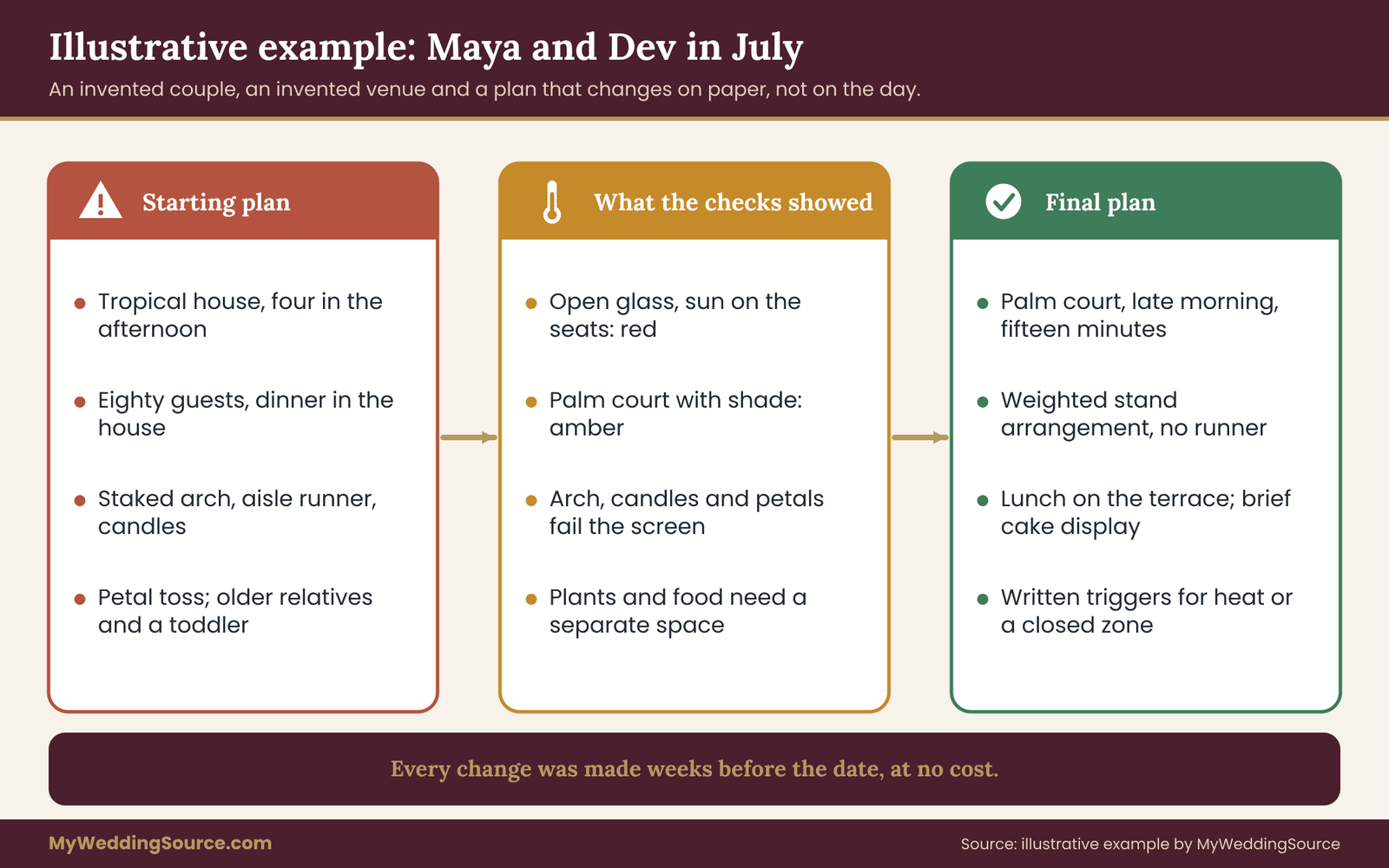
What this example teaches. The final plan for this conservatory wedding keeps what the couple wanted most: green planting behind them, a short ceremony in the conservatory and photographs in the glass house. It drops the pieces that did not fit the building. The result is not a smaller wedding. It is a wedding fitted to the place it takes place in, and every change was made weeks before the date, on paper, at no cost.
Failure conditions and alternatives to a conservatory wedding
Every venue has conditions under which it stops being the right place. A conservatory wedding has more of them than most, and most are predictable. The mark of a good plan is that the conditions are written down before the day and that everyone involved has agreed what happens when one occurs.
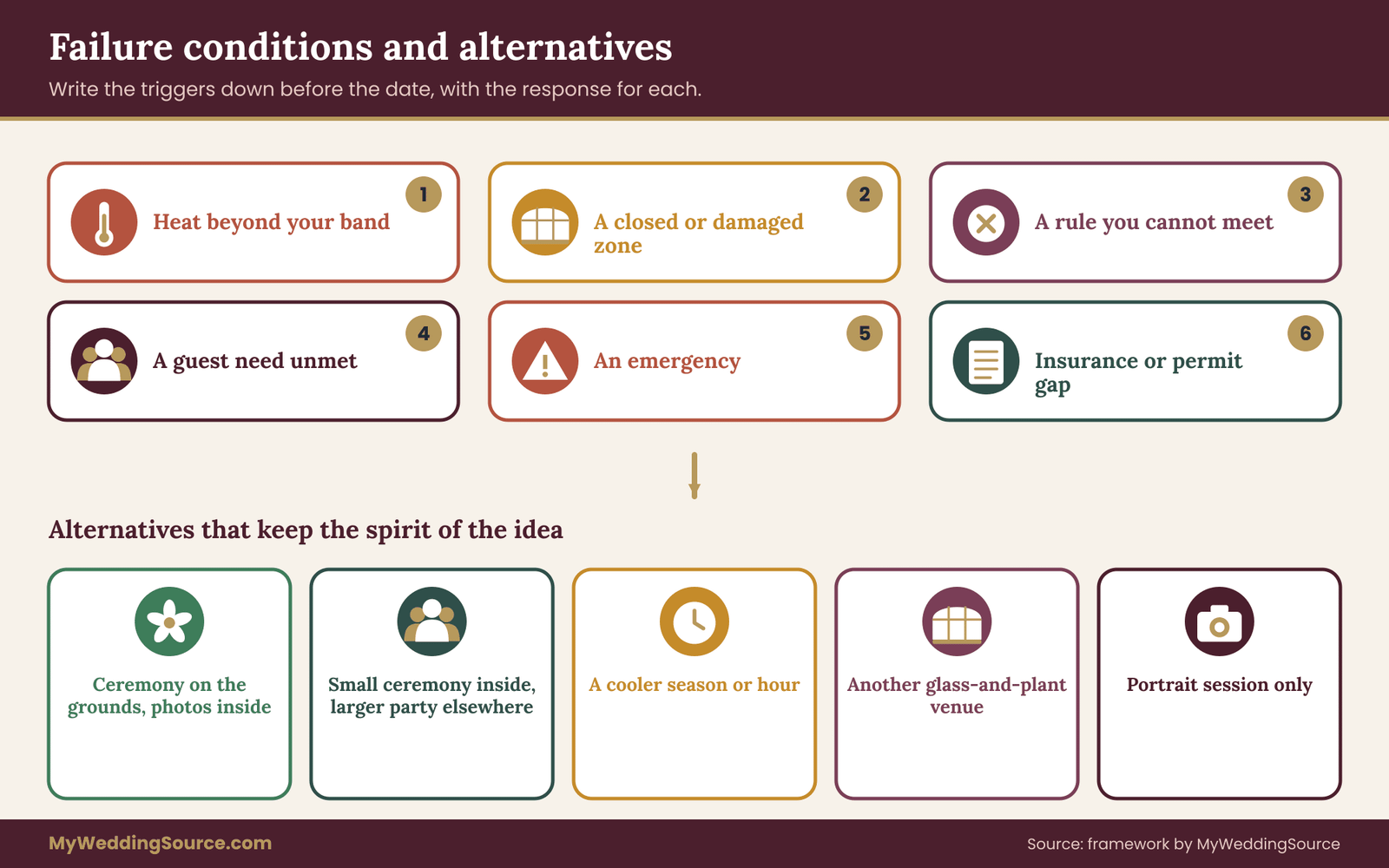
Six failure conditions worth writing down
Heat or humidity beyond your band. If readings on the morning of the event, or a forecast for the day, put the ceremony spot in red, the plan changes. Options include shortening the program, moving the seats, moving to a cooler zone, moving outdoors or postponing the photographs. Decide who makes the call and by what time, since a vendor team needs notice.
A closed or damaged zone. Glass repairs, a plant replacement, a pest treatment or a systems failure can close part of a conservatory with little notice. Ask what the venue offers if the zone you booked is unavailable: a different zone, a refund, a credit or a reschedule. Get the answer in the contract.
A rule you cannot meet. Sometimes the venue’s rules and your plans cannot be reconciled. A band that needs amplification, a dinner for the full list and a late end time may all be refused. If the rules cannot be met, it is better to find out before the deposit, and to say so honestly to the venue and to yourselves.
A guest need the building cannot meet. If a key guest cannot reach the ceremony spot because of steps, narrow paths or surfaces, the venue is not accessible for your event, whatever its charm. Accessibility is not a detail to fix later. Ask for a route description and, if possible, walk it with a wheelchair or walker in mind.
An emergency. At a conservatory wedding, heat illness, a fall on a wet floor or a fire alarm can all happen. Confirm the venue’s emergency procedures, the exits and the assembly point, and name a person on your team who knows them. Write a short emergency page with contacts and roles, and check it against the venue’s own procedures before the day.
Insurance or permit problems. If a required certificate of insurance or permit is not in place by the deadline, the venue may refuse the event. Put the deadlines on your calendar and track them.
Alternatives that keep the spirit of a conservatory wedding
When a conservatory wedding does not fit, you do not have to give up the idea of green and glass. Several alternatives preserve most of it.
Ceremony outdoors in the conservatory’s grounds, photographs inside. Many conservatories sit in gardens. A ceremony on a lawn or terrace, with a short photograph session in the house at the cool hour, delivers the glass-house pictures without seating eighty people in a warm room. Check the garden’s rules, which are different from the building’s.
A small ceremony in the house and a larger reception elsewhere. If capacity is the limit, hold an intimate ceremony with immediate family in the conservatory and host a larger celebration at another venue. This also helps with heat, since a small group in a green zone is a different experience from a large group in an amber one.
A different season or hour. Many problems shrink in cool months or in the morning. A winter or early spring conservatory can be lovely, since the glass house is a warm refuge in the cold. Check that your guests can travel, and that the venue’s schedule works.
A different glass-and-plant venue. An orangery, a greenhouse at a nursery, a garden pavilion or a botanical hall without a living collection may offer a similar look with fewer constraints. Their rules will differ, so apply the same checklist and screen.
A ceremony elsewhere with a greenhouse portrait session. Some conservatories allow a short, scheduled portrait session for a fee, separate from an event. Ask whether it is possible and what the rules are.
How to decide: a short rule
If the building passes the comfort check at your hour in at least one zone, the decor screen leaves you with an acceptable list, the restrictions in writing fit your guest list and your vendors, and the failure conditions have agreed responses, a conservatory wedding is workable. If any of the four fails and cannot be fixed with a change you are happy to make, choose one of the alternatives above.
The point is not to reject the venue. It is to decide with the same information the venue’s staff already have.
Contracts, insurance and the questions to put in writing
The last step is to convert what you have learned about your conservatory wedding into a contract that matches. Many disputes with venues arise because a verbal promise never made it into the document.
What the contract should say
Check that the conservatory wedding agreement names the exact zones you may use, the event window including setup and teardown, the maximum guest count, the list of prohibited items or a reference to the policy that lists them, the vendor requirements and the fees. Look for language on weather and conditions: what happens if the building is closed, if a zone becomes unavailable or if conditions are unsafe. If the contract says nothing, ask the venue to add a sentence.
Look carefully at damage terms. Because plants are valuable and slow to replace, damage charges can be significant, and the contract may describe them in general terms. Ask what is counted as damage, how it is assessed and whether you have a chance to respond. The wedding vendor contract guide walks through clause by clause what to ask about cancellation, changes and responsibility, and it applies to venue agreements as well as to other vendors.
Insurance
Many venues require event liability insurance for the date. The Insurance Information Institute explains the basics of insurance types in plain language. Ask the venue what coverage it requires, which parties must be named and how far in advance it needs the certificate. Also ask your own insurer or agent whether a policy you already hold, such as homeowners or renters coverage, applies to an event at a third-party venue, and what an event policy would cover. Policies vary, and only the insurer can tell you what yours covers.
Putting it together
Create a single document with the venue’s answers, the contract clauses, the readings, the decor screen results and the failure conditions. Share it with your planner, your vendors and the person who will run the day. A shared conservatory wedding document replaces dozens of separate conversations, and it makes the day-of decisions easier because nobody has to guess what was agreed. If you are still comparing options, return to the wedding venues guide, which helps you set the larger venue decision in context.
Your next steps
Start with three actions this week for your conservatory wedding. First, request the venue’s full event policy, its prohibited items list and the typical temperature and humidity range for your zone, date and hour. Second, schedule a visit at the hour of your ceremony, take the three readings at the exact seats and sort each spot into green, amber or red. Third, run your decor list through the six tests and send the venue a short proposal for every item that falls into the “ask” group.
Then write down the failure conditions for your conservatory wedding and share them with your planner and your vendors. A conservatory wedding rewards couples who plan around the building rather than against it. Once the comfort, the decor and the conditions of your conservatory wedding are settled on paper, the day itself is mostly a matter of enjoying a remarkable room.
FAQ
Is a conservatory wedding too hot in summer?
It can be, depending on the zone, the hour and the building. Glass roofs trap heat, and humid zones feel hotter than the thermometer says. Visit at your planned hour, take readings at the guest seats, and compare them with the National Weather Service heat index chart. Many couples planning a conservatory wedding choose a milder zone, a morning ceremony or a cooler season to keep guests comfortable.
Can we bring our own flowers to a conservatory wedding?
Sometimes, but many conservatories restrict outside plant material. Some require clean stems with no soil, moss or insects, some require sealed containers, and some refuse outside plants completely. Because plants can carry pests and disease, the rules are strict. Ask for the policy in writing, and share it with your florist before they begin designing.
Are candles or sparklers allowed in a conservatory wedding?
Usually not. Open flame is a fire risk in a building full of plant material, and smoke and residue can harm leaves. Many venues also forbid fog, haze and aerosol sprays. Ask whether battery-powered candles are acceptable and whether the venue’s own lighting can do the job. Never assume that a vendor’s approval replaces the venue’s.
Can we have confetti, petals or bubbles?
Most conservatories refuse them. Loose material falls into beds, irrigation and drains, and bubbles leave a film on floors and leaves. Ask the venue whether any exit-moment item is allowed, or plan the toss outdoors where the grounds team permits it. Wavable items that do not shed, such as small flags or paper wands, are sometimes accepted.
How many guests can a conservatory wedding include?
It varies widely. Capacity depends on the building’s fire code occupancy, the zone, the path widths, the accessibility needs and the collection’s limits. A building may hold a large crowd in a lobby and only a small group in a plant zone. Ask for the maximum in the specific zone you plan to use, not the building total.
Can a conservatory wedding be accessible for guests who use wheelchairs?
Often yes in part, but historic paths, steps and damp floors can be barriers. Public conservatories are generally expected to maintain accessible routes, and the ADA website explains the basics. Ask for a route description from the entrance to the ceremony seats and to restrooms, and walk it yourself with a wheelchair user’s needs in mind.
What should we do if a guest feels faint from the heat?
Move the person to a cooler place, offer water and get help quickly if symptoms are serious, following the Centers for Disease Control and Prevention’s heat illness guidance. Assign one helper before the day, tell the venue the plan and know where the nearest exit and cool area are. Treat confusion, fainting or a very high temperature as an emergency and call for medical help.
What happens to a conservatory wedding if a zone closes before our date?
That depends on your contract, so read it before you pay a deposit. Ask what the venue offers if the zone you booked is unavailable: an alternative zone, a refund, a credit or a new date. Ask for the answer in writing, and keep a backup plan, such as an outdoor ceremony location, ready.
Sources
- Heat index chart and explanation, National Weather Service
- Heat and your health, Centers for Disease Control and Prevention
- Heat exposure, Occupational Safety and Health Administration
- Americans with Disabilities Act, U.S. Department of Justice
- FDA Food Code, U.S. Food and Drug Administration
- Plant health, Animal and Plant Health Inspection Service, U.S. Department of Agriculture
- Mold and moisture, U.S. Environmental Protection Agency
- Fire and life safety information, National Fire Protection Association
- Insurance basics, Insurance Information Institute
- Public gardens and their collections, American Public Gardens Association