
Leftover wedding food is the leftover wedding food that remains after a couple, their guests and the catering team have all been served, and moving it safely to people who need it takes more coordination than a few foil pans at the end of the night. This guide explains why that work belongs to the caterer and a vetted receiving organization, and gives you a policy checklist, a worked case and clear stop conditions.
Treat leftover wedding food as three different things: food that was never served, food that sat on a buffet or service line, and food that left the kitchen on a guest plate. Only the first group is a realistic candidate for donation, and only if the caterer kept it at safe temperatures and a receiving organization has agreed in advance, in writing, to the foods, containers, pickup window and handling rules. Decide who owns the leftover wedding food, who signs and who says no before the wedding day. If a link is missing, use a lower option such as guest take-home or composting.
Every wedding with a full meal ends with the same quiet question. There are trays of chicken under foil, a half-eaten display of roasted vegetables, a cake with most of its tiers uncut, and a room full of tired people who are not thinking about food at all.
Somebody, usually a parent or the best friend who stayed late, says that it would be a shame to throw it all away. They are right. They are also about to make a decision that involves food safety rules, liability questions and a pickup that nobody has arranged.
This article is about making that decision well, ahead of time, with the right people. It does not argue that every wedding should donate. It argues that donation is a professional handoff, and that couples who treat it as a wedding-day favor tend to end up with one of two results: a trunk full of food nobody can safely use, or nothing at all because the evening ran out of energy. A short written arrangement with your caterer avoids both.
A note on scope. This is general information, not legal, tax, medical or food-safety advice. Food codes, donor protection rules and receiving-organization policies differ by state, county and organization, and they change. Where a rule decides the outcome, the article points to the agency or organization that issues it so you can confirm the current version yourself.
The site already covers the wider subject of cutting event waste in its guide to wedding waste reduction from catering to cleanup. This piece stays narrower. It looks only at the leftover wedding food that exists after service, and at the policy decisions that decide whether any of it can responsibly be moved to someone else’s table.
Why leftover wedding food needs professional coordination
Think about what a wedding kitchen actually does. A catering team plans quantities against a headcount, cooks in stages, holds food hot or cold, serves it through a defined window, and then clears. Along the way they make dozens of small judgment calls about temperature, time and handling that a guest or a family member never sees. Those same judgment calls decide whether surplus is safe to eat the next day.
A couple cannot make those calls about leftover wedding food from the dance floor. They were not watching the thermometer on the chafing dishes, they do not know when a pan came out of the oven, and they cannot tell by looking whether a tray of pasta has spent ninety minutes or four hours in the warm zone.
The person who knows is the caterer or the kitchen lead. That is the first reason leftover wedding food has to run through the caterer: the information about the food’s history lives in the kitchen, not in the ballroom.
The second reason is ownership. In most catering contracts, the leftover wedding food you pay for is prepared for service at your event. What happens to it afterward is often addressed in a short clause, or in none at all. Some companies have a firm policy that nothing leaves the building because of their insurance and their health department permit.
Others will pack surplus for donation as a routine practice. Others will do it only if you ask in advance. Until you read the contract and ask, you do not know which kind of caterer you hired. The guide to what to look for in a wedding vendor contract covers the general habit of reading these clauses early.
The third reason is the receiving end. A food bank, shelter, pantry or community kitchen is not a dumpster with a kinder name. Each one has a written policy about which foods it accepts, in what packaging, at what temperature, with what labels and during which hours.
Many cannot accept food that has been served to the public, many have no way to take hot prepared food at ten at night, and some will only take donations from a donor who has registered with them first. Those are reasonable rules. They exist because the people being fed are often more vulnerable to foodborne illness than the average wedding guest.
The fourth reason is timing. Food safety works on a clock, and the clock starts when food leaves temperature control, not when the reception ends. A wedding runs long. A donation that would have been fine at nine can be unusable at midnight, and the only way to protect it is to have the packing and pickup scheduled in advance, with a person who has the authority to start the process and the knowledge to stop it.
Put those four reasons together and a clear division of labor appears. The couple decides that they want surplus food to go somewhere useful and puts that goal in writing. The caterer decides what is safe and handles the leftover wedding food. A receiving organization decides what it can accept. A named person on the day makes the final call. Nobody improvises, and nobody is stuck with a decision they are not equipped to make.
This does not make leftover wedding food a heavy project. For a plated dinner with a small number of extra portions, the whole arrangement can be a two-paragraph email exchange and a phone number. The point of the coordination is to keep it light on the day by doing the thinking beforehand.
Three classes of leftover wedding food
The phrase “leftovers” hides three very different situations. Sorting leftover wedding food into classes before the wedding is the single most useful step in this guide, because every later decision depends on which class a given tray belongs to.
Class A: held-back food. This is food the kitchen prepared but never put out. Extra trays of a buffet entrée that stayed in the kitchen. Surplus portions of a plated course that were cooked but not plated. Unopened cases of packaged items such as bread, fruit or bottled water. Class A is the only class that most receiving organizations and most caterers will consider for donation, because the kitchen can document how it was held.
Class B: service-line food. This is food that went out to the buffet, the carving station, the dessert table or the grazing display. Even if it was kept at proper temperature, it has been exposed to guests, to serving utensils, to the air in a busy room and to the chance of a hand reaching into the wrong tray.
Many food codes and many receiving organizations treat this food as unsuitable for donation. Some caterers will return untouched sealed items from the service line, such as individually wrapped desserts, and handle the rest as waste or compost.
Class C: guest-contact food. Plates, bowls, bread baskets and anything that reached a table or a guest. This food is not a donation candidate under any sensible policy. It belongs in the compost bin if a composting route exists, and otherwise in the trash. Calling it leftover wedding food is accurate, and treating it as donatable is a mistake that has to be named out loud, because it is the one that people in good faith make most often.
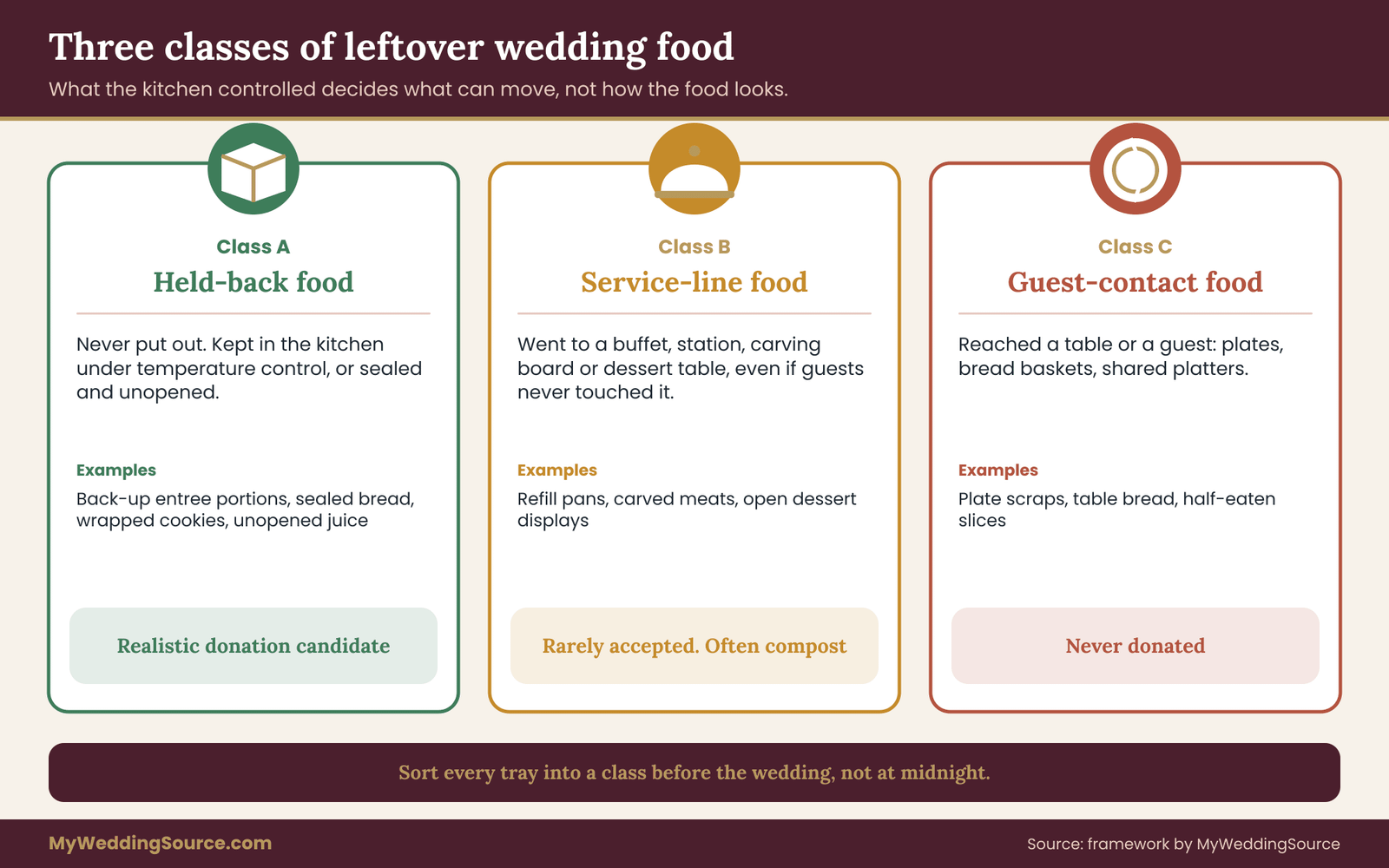
Two details make the classes easier to apply. First, the line between A and B is about what the kitchen controlled, not about what the leftover wedding food looked like. A full tray that sat uncovered on a service line is Class B even if nobody touched it. A half-empty pan that never left the warming cabinet is Class A.
Second, packaged and sealed items sit slightly outside the scheme. A sealed box of crackers, a closed bottle of juice or a wrapped cake box that stayed sealed can be held to a simpler standard, though a receiving organization may still want to see the label and the date.
It helps to say the classes aloud with the caterer, because the vocabulary often differs. Some kitchens call Class A food “back-of-house surplus” or “overproduction.” Some say “extras.” The word does not matter. What matters is that both of you mean the same thing by it, and that the written arrangement says what is covered and what is not.
Most surplus will, honestly, be Class B and Class C. A buffet generates a lot of service-line food by design, and a plated dinner generates plate waste. The share of Class A food depends on how the caterer produced the meal, how tightly the headcount was managed and whether the kitchen cooks to order or in batches.
This is why the quantity conversation, covered in a later section, matters so much. The most reliable way to give away more good food is to cook less surplus of the wrong kind in the first place.
There is a useful side effect of the classes: they remove guilt. Couples sometimes feel that throwing away a tray of service-line food is a moral failure. It is not. It is the outcome of a rule that protects the people who would have received it.
What would be a failure is handing over food whose history nobody can vouch for, or promising a charity a delivery that falls apart at midnight. Knowing which class a tray belongs to lets you stop feeling bad about the correct decision and focus on the choices that actually help.
With the three classes set, the next question is who is allowed to decide which tray is which. That is the role of the caterer-led model.
The caterer-led model for leftover wedding food: who decides, who owns, who signs
A caterer-led approach means the catering company is the party that classifies, handles, packs and releases surplus, under rules the couple has asked for in writing. The couple sets the goal. The caterer owns the leftover wedding food and the risk until the handoff. The receiving organization owns the leftover wedding food and the risk after it. Each handoff has a name attached.
That sounds formal for what is, at heart, a kindness. But informal arrangements fail at exactly the moments that matter. If a cousin loads trays into a minivan, nobody has recorded when the leftover wedding food left temperature control, nobody has told the receiving organization what is in the pans, and nobody can be reached the next morning if a question comes up. A modest layer of structure turns the same kind gesture into something the receiving organization can actually use.
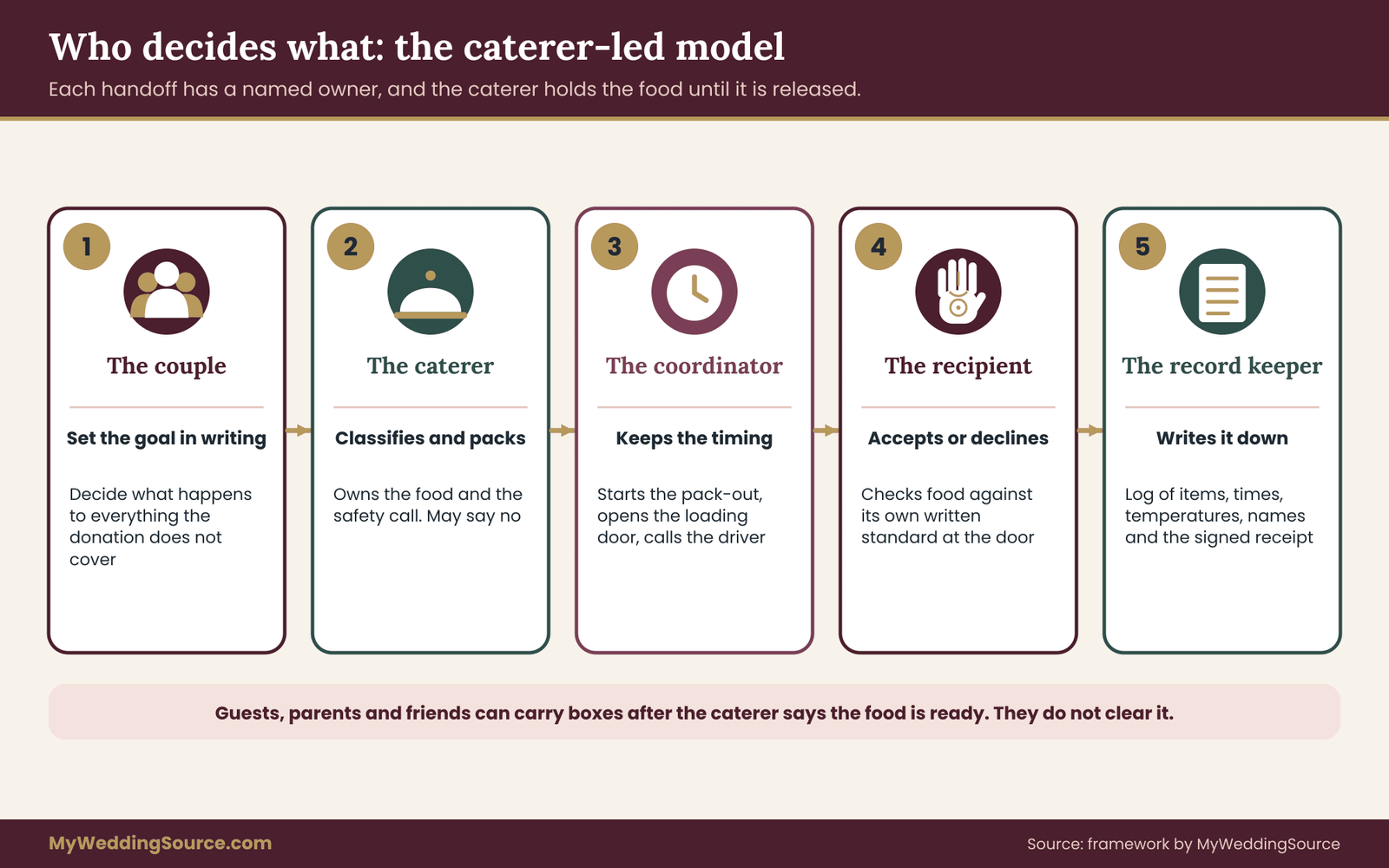
Here are the five roles in the model, with the decision each one owns.
The couple decide whether surplus donation is a goal at all, and how much effort and money they are willing to attach to it. They put the request in the contract or in a signed email. They do not handle the leftover wedding food on the day. They also decide what happens to anything the donation does not cover, such as whether guests may take cake home.
The caterer or kitchen lead decides which food is eligible, which class it belongs to, how it was held and whether it can be packed. This person also has the power to say no. A good caterer will say no to a donation request that cannot be done safely, and will say it kindly and early, which is a feature, not a flaw.
The coordinator or venue contact keeps the timing on track. If the pickup window is nine thirty to ten, someone has to make sure the kitchen is ready at nine and the receiving driver can reach the loading door. A planner, venue manager or banquet captain can do this. If you have none, a named friend or relative with no other wedding-day duties can hold the role, though it needs to be someone who will not be on the dance floor at the critical hour.
The receiving organization decides what it accepts and how. It tells you in advance which foods it takes, how they must be packed, which hours it can receive, whether it sends a driver or expects delivery, and what paperwork, if any, it needs. It also decides at the door whether the leftover wedding food in front of it meets its standard. A receiving organization that turns food away at the door is doing its job.
The record keeper writes down what happened. It can be the same person as the coordinator. The record is short: what was packed, when it left temperature control, at what temperature it was held, who took it and when. It protects everybody and it makes next year’s arrangement easier.
You will notice that nobody in the list is a guest. That is deliberate. Guests, parents and friends are generous and often eager to help, but none of them is in a position to certify the food’s history. They can help carry boxes after the caterer says the leftover wedding food is ready, and that is plenty.
The first conversation with the caterer
The best time to raise surplus food is when you are comparing proposals, or at the latest when you are finalizing the contract. Asking early shows you what a caterer does as a matter of course. Asking late limits your options. Here are questions in plain language, along with what each answer tells you.
Ask: “Do you have a written policy on surplus food from events?” A company with a policy has probably thought about it. A company with no policy is not disqualified, but you will need to help it build a small one.
Ask: “Have you donated surplus from weddings or similar events before, and to whom?” Specific answers, such as naming a local food rescue group or a pantry, are a good sign. Vague answers are a signal to ask for details.
Ask: “Which of the leftover wedding food classes can you donate, and which can you not?” Use the three classes from the previous section. If the caterer says that nothing can leave the building, believe them and move to the alternatives later in this guide. If the caterer says that held-back food only can go, that matches what most food codes and receiving organizations expect.
Ask: “Who on your team makes the final call on the night, and how do I reach them?” You want a name, not a company.
Ask: “Is there any fee, such as extra labor, packaging or delivery?” Some companies absorb this. Some charge for staff time past the contracted end. Ask before the invoice, not after.
Ask: “Does your insurance or your health permit restrict what you can hand to a third party?” You do not need a legal opinion. You need to know if the answer is a flat no.
A fair way to close the conversation is to say what you would like, not what you demand. For example: “We would like any untouched held-back food to go to a local organization if it can be done safely. We will help you find one, and we understand you may say no on the day.” That wording gives the caterer room to refuse without making the request awkward. It is also a clear instruction a kitchen manager can follow.
If your caterer is a home-based or very small operation, the questions still apply, but the answers may be different. Keep a closer eye on licensing and local rules in that case, and ask the caterer directly which health authority oversees them.
What to put in writing about leftover wedding food
A short written statement beats a verbal promise. It can be a paragraph in the contract, an addendum or a signed email that both of you can find later. It should say who is responsible for surplus, what classes are in scope, which receiving organization is named, what the pickup window is, who has authority to cancel the donation for safety reasons and what the couple will pay if anything. File that email with the rest of the vendor paperwork so it is easy to find a year from now.
You are not writing a legal instrument. You are making sure that two parties who both want the same outcome have the same understanding of how to get there. If either party wants legal language, ask a professional in your state.
Building a surplus ledger before the wedding for leftover wedding food
A surplus ledger is a short worksheet that estimates how much of each food is likely to be held back, so that the donation conversation is based on realistic quantities. It is the original working tool of this guide, and it takes about twenty minutes with your caterer.
Start with the menu. List each food item in a row: appetizers, entrées, sides, bread, salad, dessert. For each row, write three things. First, how the item is served: plated, buffet, station, passed or boxed. Second, how the kitchen produces it: cooked in batches, cooked to order, assembled from components or bought in finished. Third, the caterer’s honest estimate of how much extra will be cooked beyond the headcount.
Why these three? Because they predict the class of the leftover wedding food. A plated entrée cooked in batches will usually produce some Class A food, since the kitchen keeps a few extra portions for last-minute headcount changes and allergy swaps.
A buffet entrée served out of chafing dishes will produce mostly Class B food, because whatever is left on the line is already exposed. Passed appetizers often come out of the kitchen on trays and return as Class B. Packaged bread and individually wrapped dessert may be the simplest Class A items of the whole night.
The next column is the packaging fit. Ask what each item would be packed in if it were donated. Hot pasta in a shallow pan with a tight lid is a very different object from a tray of sliced beef in juices. The receiving organization will have a view. Foods that are hard to pack safely, or that do not hold well, should be marked as low priority.
The last column is the decision rule. For each item, write one of three words: donate, offer or discard. “Donate” means the item is Class A, the packaging works and the receiving organization has said yes. “Offer” means the item goes to guests or staff, such as boxed cake slices for take-home. “Discard” means the item is not recoverable under the rules, and the plan is compost or trash. Doing this on paper before the wedding means no one has to invent a rule at eleven at night.
Here is how the ledger changes the conversation. A couple might discover that the caterer’s usual overproduction is small, only a few portions per entrée, and that nearly everything else will be service-line food. The honest conclusion is that donation will be a modest handoff, probably a couple of pans and some wrapped items, and that the greater leverage is on the order side. That is a good finding, because it points to a lower guest-count buffer or a more precise menu rather than to a heroic handoff.
On the other hand, the ledger can show that a large amount of Class A food will exist. A caterer cooking for a three-day event, or one preparing a tasting menu for a large crowd, may have meaningful amounts of unplated food. In that case the arrangement with the receiving organization deserves more care: a confirmed pickup, enough refrigerated space on its end and a back-up recipient in case the first one cannot take everything.
The ledger also helps with budgeting. Food held back and not served is food you paid for. If the numbers show a substantial amount of Class A food, you may want to discuss reducing the buffer with your caterer for the final count. Menu structure affects quantities, and the wedding budget guide explains where catering sits among the larger costs. Neither is a substitute for asking your own caterer what overproduction they plan.
Keep the ledger of leftover wedding food to one page. It should name the date of the event, the caterer’s contact, the receiving organization’s contact, the three or four items most likely to be donated, the pickup window and the person who may cancel. When the wedding approaches, send a copy to the caterer and the coordinator, and keep one in the wedding-day folder.
One practical warning. The ledger is an estimate, not a promise. The caterer cannot know how many guests will skip the entrée or how many second helpings will go through the line. The ledger gives structure to the conversation, and a good caterer will adjust it as the headcount firms up in the final week. Treat any number in it as a range, and expect the real figure on the night to differ.
The recipient policy checklist for leftover wedding food
Once a caterer has said that some food is eligible, the next question is who can take it. This is where the second half of the original tool in this guide comes in: a recipient policy checklist. It is a set of eight questions you ask a receiving organization before you name it in your arrangement. The answers tell you whether the organization can use leftover wedding food at all, and what the caterer will need to prepare.
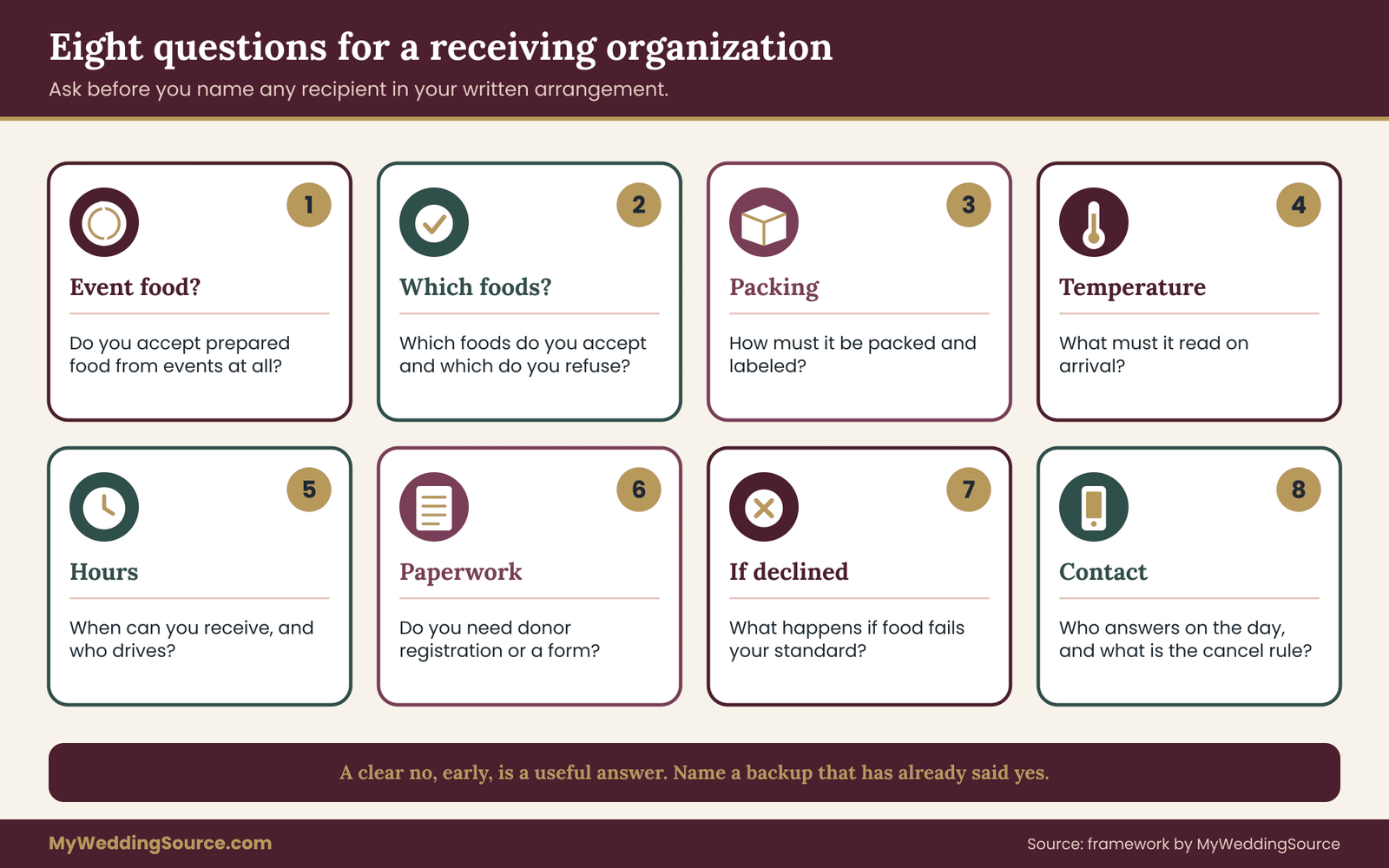
One: Do you accept prepared food from events? Many food banks focus on shelf-stable and fresh produce donations and do not take prepared meals. Others run community kitchens or meal programs that welcome cooked food from licensed caterers. Start by confirming that the organization takes leftover wedding food of any kind.
Two: Which foods do you accept, and which do you refuse? Common refusals include food that has been served to the public, items with raw egg or raw seafood, anything homemade without a license, open containers and food with unclear ingredient information. Write the list down and give it to the caterer.
Three: How must the leftover wedding food be packed and labeled? Receiving groups often ask for shallow pans, tight lids or sealed bags, a label with the dish name, the date and time it was packed and a list of major allergens. Some ask for an ingredient list. A caterer can usually meet these requests if told in advance.
Four: What temperature standard do you require on arrival? Cold food typically has to arrive cold and hot food hot, or hot food chilled quickly and delivered cold. The organization will say which method it can accept. If it has no way to check temperature on arrival, that is a sign to be cautious.
Five: What are your hours, and how do pickups work? A pantry that closes at four in the afternoon cannot receive food at ten at night. Some groups run a rescue driver who collects from event venues and can come late. Others expect the donor to deliver. Find out the exact window and how long the organization can hold the leftover wedding food before distribution.
Six: Do you require anything from the donor, such as registration, a signed form or a license number? Some organizations keep a roster of approved donors. You may need to register the caterer, not yourself. Allow time for that.
Seven: What happens if the leftover wedding food does not meet your standard on arrival? The right answer is that the organization will decline it, and that you and the caterer need a plan for what happens next, such as returning it or disposing of it. Know this before the night.
Eight: Who is the contact on the day, and what is the cancellation rule? You need a phone number that will be answered during the pickup window, and a rule for cancelling by a stated time. A vague “just show up” is not good enough.
A caution on tone. Receiving organizations are busy and often short on volunteers. Approach them as a partner, not a drop-off point. A short, specific message works better than a long story about your wedding. State the date, the approximate amount, the type of food, who the caterer is, and ask whether the organization can accept it. Be ready to hear no. A no is a useful answer. It means you can try the next option long before the wedding day.
Here is a plain script for a first email or call. “We are hosting a wedding on a Saturday in late spring. Our caterer expects a small amount of unserved prepared food, packed by the kitchen. Could your organization accept something like that? If so, what would you need from us and from the caterer, and what are your pickup hours?” Four sentences, no pressure, and every question the organization needs to answer is in there.
Keep the replies. A short email that says what the organization accepts is the best protection against a misunderstanding. Forward it to the caterer so the kitchen packs to that standard.
What the checklist does not cover
The checklist is about policy fit. It does not replace the caterer’s food-safety judgment, and it does not guarantee that food will be accepted on the day. It also does not answer questions of law, such as the protections available to donors in your state.
Federal law, through the Bill Emerson Good Samaritan Food Donation Act, offers some liability protection for good-faith donations of apparently wholesome food to nonprofit organizations, but it has conditions and it does not make every donation risk-free. If your caterer or the receiving group raises liability, ask them what they rely on and ask a professional in your state if it matters to you.
Matching leftover wedding food to the right kind of recipient
Receiving organizations are not interchangeable, and sending the wrong kind of food to the wrong kind of group is a common cause of failed donations. A short tour of the usual types helps you pair the leftover wedding food with the right door.
Food banks and large food rescue networks. These organizations often operate at warehouse scale. They are strong on shelf-stable goods, produce and bulk donations, and many follow strict protocols from national networks. For leftover wedding food they are most likely to be useful for sealed, packaged and unserved items. Some have local partners that take prepared food. Feeding America’s network is a place to look for a local member, and your state or county may list food banks too.
Food rescue organizations. These groups specialize in moving prepared and perishable food from event venues, restaurants and caterers to agencies that can use it the same day. They often run volunteer drivers and have training in safe handling. If one operates in your area, it is usually the best match for Class A prepared food, because it already has a process for the exact situation.
Community kitchens, shelters and meal programs. These organizations cook and serve meals on site. Some will accept prepared food from licensed caterers if it arrives within a defined time and temperature range, since they can reheat or serve promptly. Their needs vary widely. Some take only raw ingredients, some only cooked food with full documentation.
Pantries and neighborhood programs. Small pantries may have limited refrigeration and limited volunteers. They are well suited to packaged bread, wrapped desserts and unopened items, and not well suited to a late-night load of hot entrées.
Community fridges and informal sharing programs. These are open, public refrigerators or shelves where anyone can leave and take food. They are valuable in many places, but because they are not staffed or monitored, they often have strict posted rules about what can go in. They are usually not the right place for a large load of prepared catering food, and they should only be used within the rules posted on site.
Staff and family. The kitchen staff, the venue crew and your own families are also recipients. This is not donation in the formal sense, but it is a legitimate use, covered in the alternatives section below.
Pairing works best when you look at the leftover wedding food, the quantity, the time and the geography together. A small amount of cooked chicken after a late reception may fit a meal program that runs a morning service. A pallet of unopened water and sealed snacks fits a food bank. A tray of wrapped desserts fits a pantry that opens mid-morning. Matching is a short exercise, and the surplus ledger from the previous section gives you the inputs.
Distance matters as well. A recipient across the county may sound ideal on paper and fail in practice because nobody can drive there before the clock runs out. The clock is what limits the choice. The next section explains the clock.
Finally, plan for a second recipient. If the first organization declines on the day, or the pickup falls through, a backup that has already said yes saves the arrangement. The backup can be a smaller organization or a different type, such as a pantry for packaged items. Name both in the written arrangement so the caterer knows what to do if the first plan stops working.
One more consideration is how you describe the leftover wedding food to a recipient. Accuracy matters more than enthusiasm. Name the dishes, list the main ingredients, say whether anything contains common allergens, and state when it was prepared. Do not describe the leftover wedding food as fresh unless the caterer can say when it was cooked.
A recipient that receives an honest description can decide quickly and serve its clients with confidence. A recipient that receives a vague or glowing one has to guess, and may decide not to risk it. The same honesty protects you: if the description matches what was packed, you have done your part regardless of what happens after the handoff.
Food safety clocks that decide what leftover wedding food can move
Every decision about leftover wedding food comes back to time and temperature. Bacteria that cause foodborne illness grow fastest in the range between cold and hot. The U.S.
Department of Agriculture describes that range as roughly 40 to 140 degrees Fahrenheit, and its general guidance is that perishable food should not sit in that range for more than two hours, or one hour when the surrounding air is above 90 degrees. Confirm the current wording with the USDA, because agencies update their language. For a summer afternoon wedding, the one-hour version is the one that matters.
The point for a couple is not to memorize numbers. It is to understand that the clock belongs to the leftover wedding food, not to the event. A tray that came out of a warming cabinet at eight and sat on a buffet until ten has used its allowance whether or not the party is still going. A tray that stayed in the kitchen at safe temperature has not. That difference is exactly why the first class of leftover wedding food is the only one that most organizations accept.
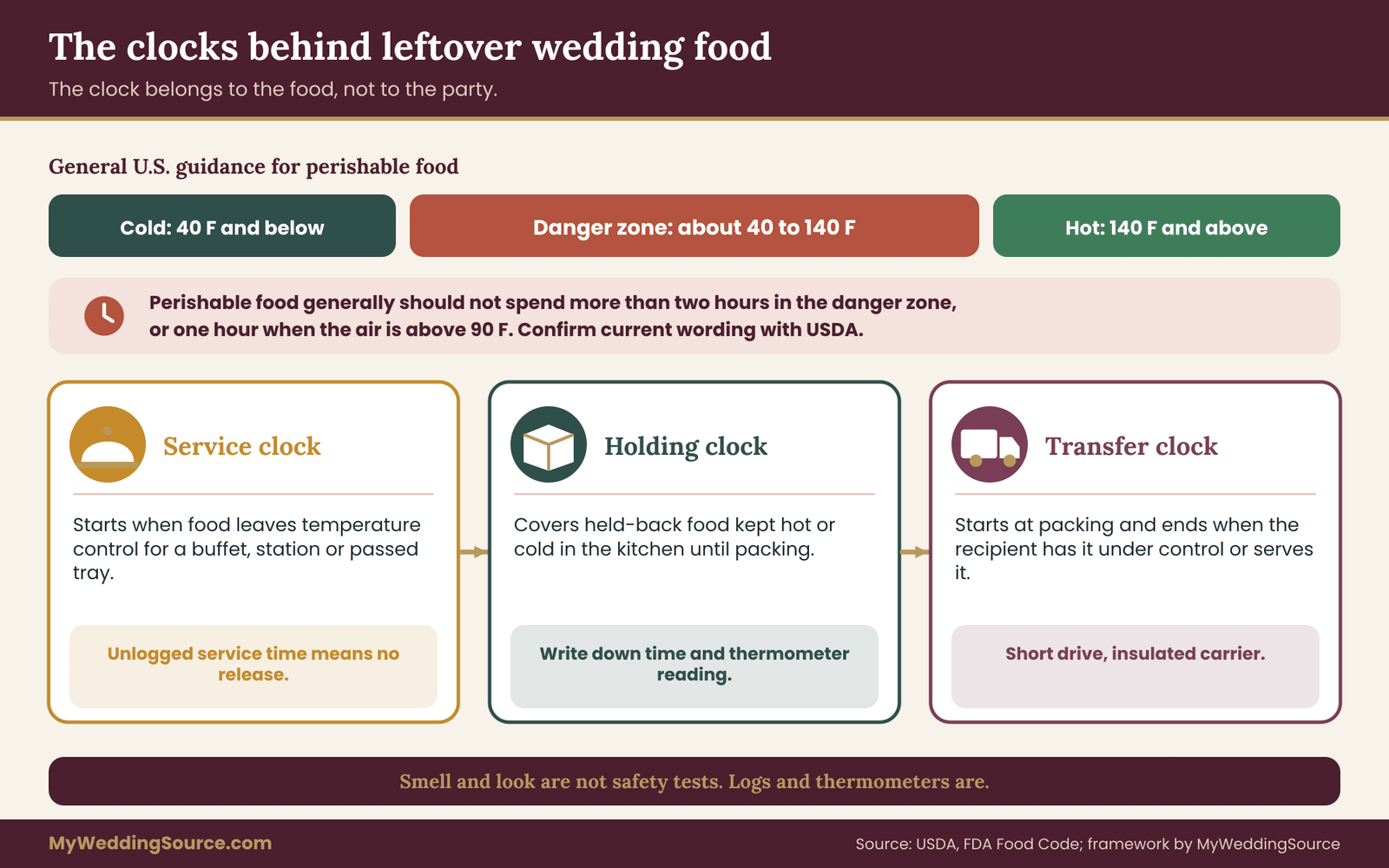
There are three clocks to think about.
The service clock starts when food leaves temperature control for the buffet, the carving station or the passed tray. Caterers track this closely for food they intend to hold, and it is the reason service-line food is treated differently from held-back food. If the kitchen did not log when a pan went out, it cannot prove how long it was out, and a careful caterer will not release it.
The holding clock covers food kept back in the kitchen. Hot food held hot, usually in warming cabinets or insulated carriers, and cold food held cold, usually in refrigeration or on ice, can stay in good condition for a defined period, but the holding itself is not unlimited. The kitchen lead knows how long each item has been held and what the thermometer read. Ask them to write both down at the time of packing.
The transfer clock starts when the leftover wedding food is packed for donation and runs until the receiving organization puts it back under temperature control or serves it. A fifteen minute drive in an insulated carrier is a different risk from a ninety minute drive in an open trunk. The transfer clock is the one couples most often forget, because it happens after the party.
Cooling also matters. Food that was hot and will be donated cold has to be cooled quickly, not left on a counter. Food safety agencies generally advise dividing large amounts of hot food into shallow containers so they chill faster. That is a kitchen task, and a trained kitchen will already know how. If a receiving organization wants food chilled before pickup, tell the caterer early so they can plan the container size and the refrigeration space.
Reheating is the receiving organization’s job, not yours. If you hear that donated food will be reheated to a safe temperature, that is a good sign of a competent recipient, but do not take on that responsibility yourself or promise it on their behalf.
Why “it smells fine” is not a test for leftover wedding food
In a late-night kitchen, someone will say that the food looks fine, smells fine and has only been out a little while. It is a human instinct and it is not a safety test. Many of the organisms that cause illness do not change the look or smell of food.
This is why caterers who donate rely on logs and thermometers rather than judgment, and why couples should not override a caterer who says no on the evening. A rule that is simple enough to apply at midnight is better than a judgment call made by tired people.
That also makes the case for a written cutoff. A common approach is to set a latest packing time, for example thirty minutes after the last course is cleared. If the leftover wedding food is not packed and moving by then, it is not donated. The exact time depends on the menu and the recipient. The point is that it is chosen before the wedding, written down and applied without argument.
Sorting out who verifies
There are several people who could verify food safety, and it helps to be clear which of them does. The caterer verifies the history and condition of the leftover wedding food at packing. The receiving organization verifies the leftover wedding food on arrival, against its own standard. A health department, if involved, sets the rules both parties work under. A couple does not verify food safety. A couple verifies that the arrangement exists, that the people named in it are the right ones and that the cancellation rule is clear.
Local rules differ, and it is worth knowing where to find yours. The FDA publishes the model Food Code, which many state and local health departments adopt in some form, and your county health department can tell you how it applies to caterers and food donations in your area. The guide to vetting wedding vendors before you sign is a good place to remind yourself to ask a caterer for their license and their health inspection history, which also tells you something about how seriously they take the clock.
Packing, labeling and the handoff for leftover wedding food
Packing is where an arrangement for leftover wedding food either works or does not. A good packing routine takes a trained kitchen team about as long as it takes to clear the line, and it should not be improvised.
The caterer packs the leftover wedding food, ideally from the held-back stock, into clean, food-grade containers that are suited to the recipient. Shallow, covered pans for cooked dishes. Sealed bags or boxes for bread and wrapped desserts. Separate containers for items with different allergens. No mixing of foods that were held at different temperatures. No reuse of serving utensils that touched guest-contact food.
Each container is labeled. The label usually carries the name of the dish, the date and time it was prepared, the date and time it was packed, the main allergens and the storage instruction, such as “keep refrigerated.” If the receiving organization asked for an ingredient list, it is attached. The labels are small, plain and legible. They are the main way a volunteer who never met you knows what is in the pan.
The caterer takes temperatures at packing and records them. A simple log sheet with columns for item, time packed, temperature and initials is enough. The log goes to the record keeper, who keeps it with the arrangement.
Transport comes next. If the receiving organization sends a driver, the driver arrives at the agreed time at a defined door, with insulated carriers or a cooler for cold items. If the caterer delivers, the kitchen has a carrier and a route. If a friend or family member is asked to drive, which should be rare, the caterer needs to confirm that the containers and the carrier are suitable and that the drive is short.
At the handoff, the receiving person checks the leftover wedding food against the label and the log, accepts or declines, and signs or initials. Declined food comes back to the caterer, who disposes of it. This moment is brief, and it is the one that should never be skipped, because it is the point where responsibility passes.
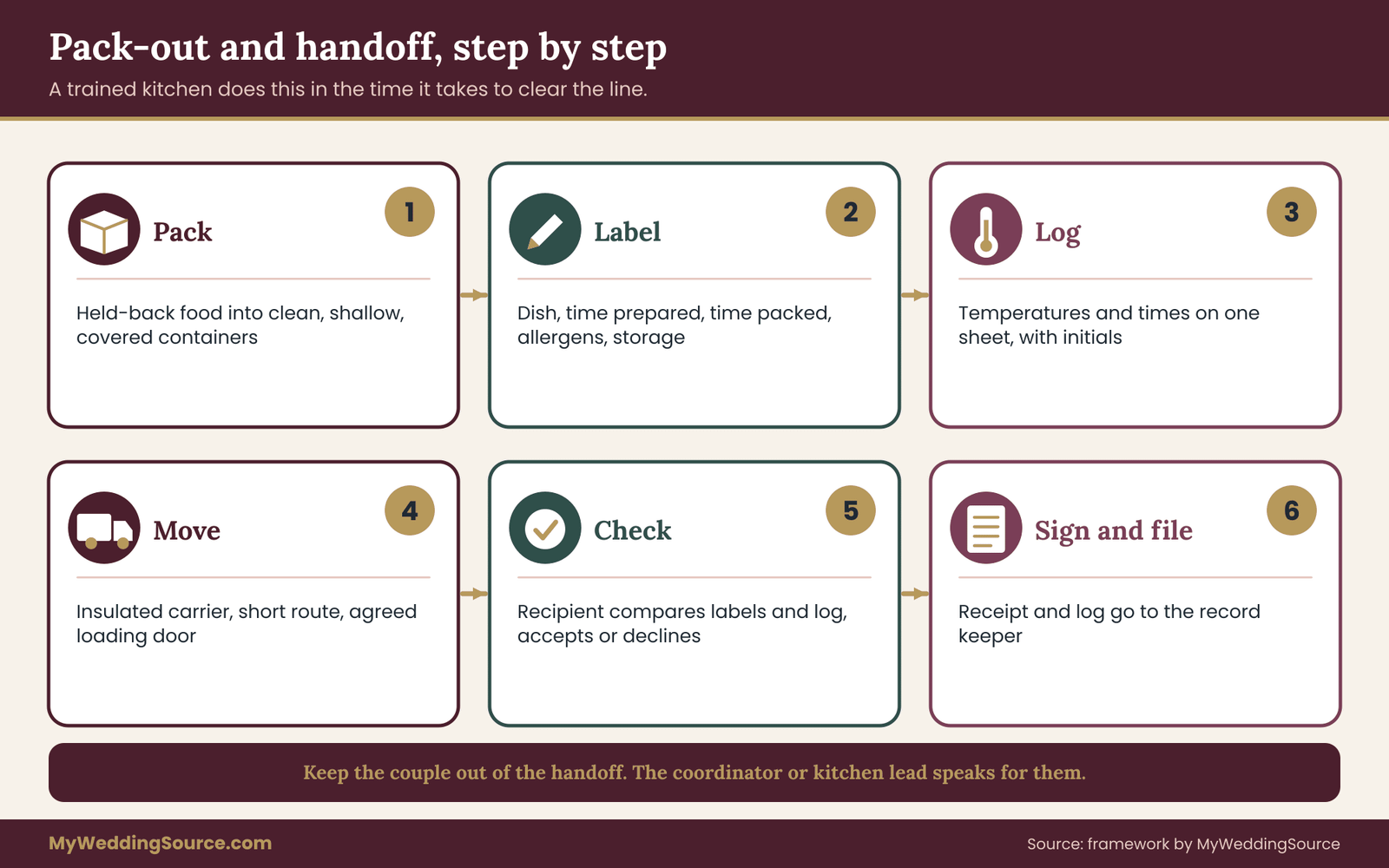
A few practical details help.
Agree on a loading point that is not the dance floor. The service entrance or loading dock is a better place for a handoff than the lobby. Ask the venue manager where drivers may park and enter, and whether they need to be told in advance.
Tell the venue that a donation pickup is happening. Some venues have rules about food leaving the premises or about who may enter a kitchen. Others will gladly help. Either way, a short note avoids a confused security guard at ten at night.
Leave the couple out of the handoff. The couple should not be carrying pans in a gown or suit, and they should not be answering a driver’s questions while guests are saying goodbye. The coordinator or the kitchen lead can speak for them. If the couple wants to meet the volunteers, they can do it another day with a thank-you note.
Keep a record. A photo of the labeled containers before they leave, the log sheet and the signed receipt, if any, are a small file. It is the evidence that the plan worked, and the first thing you will want if a question arises.
Lastly, accept that some nights will not go to plan. A reception that runs late, a headcount that changes, a driver who is delayed. If the handoff cannot happen within the safe window, the right choice is to stop. Stopping is not a failure. It is the system working. The stop conditions later in this guide spell out what stopping looks like in practice.
A worked case of leftover wedding food: one invented Saturday dinner
The following example is invented to show the checklist working end to end. The couple, the caterer and the organizations are fictional, and no real figures are implied. Real events differ, and your caterer and recipient will set their own rules.
Maya and Dev are marrying on a Saturday evening in late spring, with a plated three-course dinner for about one hundred and twenty guests, a dessert table and a late-night snack of wrapped pastries. Their caterer is a mid-sized company that works in the region and has donated surplus before, though not with every client. The reception venue has a service door at the back and a kitchen the caterer uses.
Eight weeks before. Maya raises the subject with the caterer’s event manager while finalizing the contract. The manager explains the company’s policy: held-back food and sealed items may be donated through a local food rescue group they have worked with, but service-line food and anything that reached a table is discarded. Maya asks that the policy be added to the contract as a short paragraph, and the manager agrees.
Six weeks before. They build the surplus ledger together. The plated entrée is cooked in batches and the kitchen typically cooks a small number of extra portions to cover headcount changes and dietary swaps. The salad and the side dish are plated from bulk and will leave little surplus.
Bread is baked and served in baskets, so it is Class B once on the table, though sealed backup loaves are Class A. The dessert table is mostly Class B, but a box of individually wrapped almond cookies for the late-night snack is sealed and unopened until served. The ledger lists four candidate items: extra entrée portions, backup bread, sealed cookies and a case of unopened juice bottles.
Five weeks before. Dev contacts the food rescue group using the short script from the policy checklist. The group answers in a day. It accepts prepared food from licensed caterers if packed in shallow covered pans, labeled with the dish and the time, delivered cold or held hot, and picked up between ten and ten forty-five at night by a volunteer driver.
It does not accept food served to guests, and it requires the caterer to register as a donor, which takes a form and a few days. It names a contact and a cancellation rule: a call by seven in the evening if anything changes.
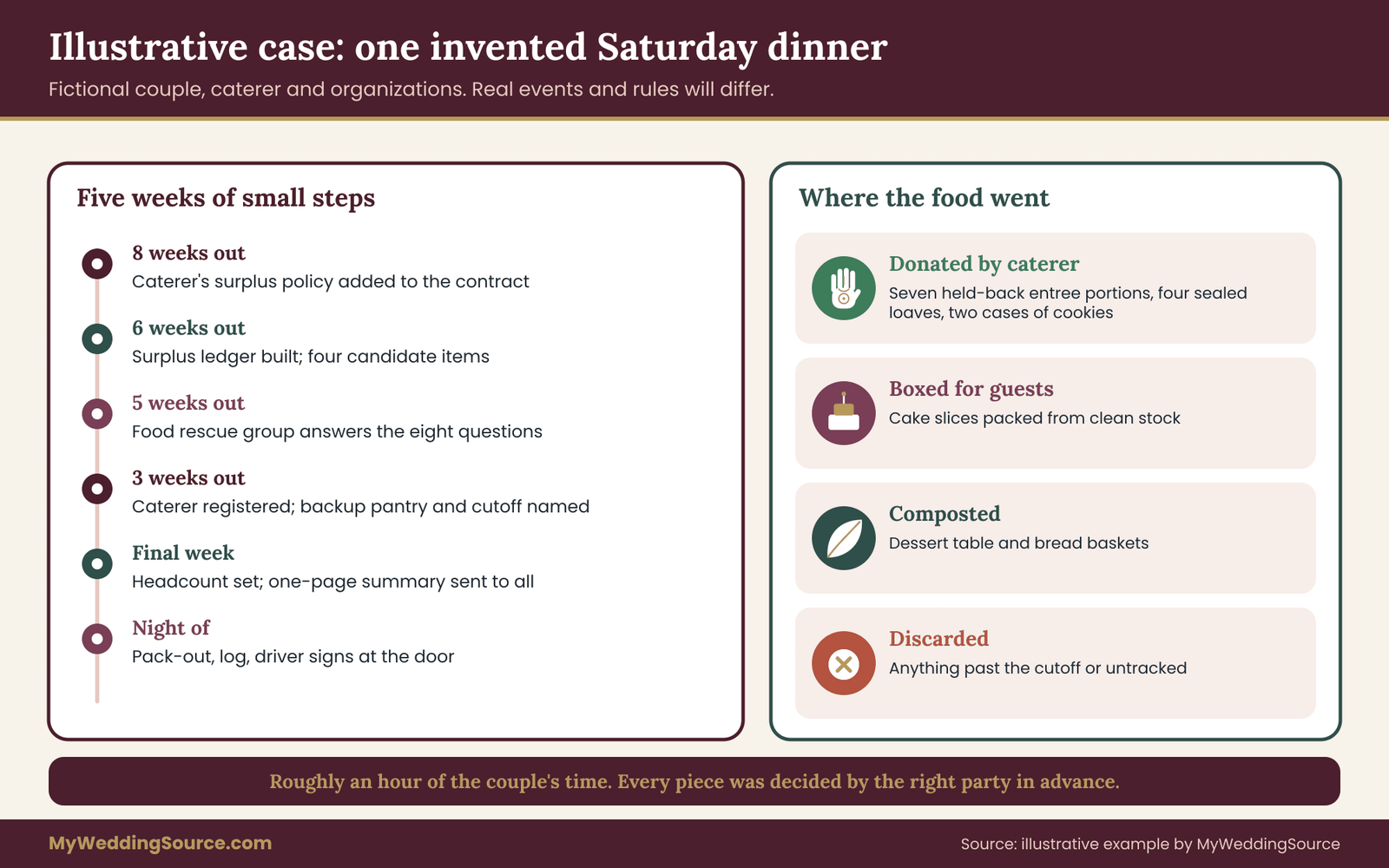
Three weeks before. The caterer registers. Dev and the event manager agree on a backup: a small neighborhood pantry that opens at nine the next morning and can take sealed and packaged items only. They add both organizations, the pickup window and the latest packing time to the written arrangement. The record keeper is named: the venue’s banquet captain, who is on site the entire evening and agreed to help.
Final week. The headcount firms up at one hundred and eighteen. The caterer adjusts the ledger: seven extra entrée portions held back, four backup loaves and two cases of cookies. Maya sends a one-page summary to the caterer, the banquet captain and the food rescue contact.
On the night. Dinner service ends at half past nine. The banquet captain checks in with the kitchen lead. The kitchen lead has logged that the seven extra entrée portions stayed in the warming cabinet and were never put on a line. Temperatures were taken at packing and recorded.
The portions are packed into two shallow covered pans, labeled with the dish, the time prepared and the time packed, and moved to a cooler to chill for transport. The four backup loaves and the sealed cookies are boxed. The juice goes on a cart. The volunteer driver arrives at ten fifteen, checks the labels against the log and the pans against the list, accepts everything and signs the sheet. Total time at the door: about six minutes.
What did not happen matters too. The buffet-style dessert table, partly eaten, went to the compost bin because the caterer has a compost arrangement. The bread baskets on the tables were cleared as guest-contact food. Two guests asked whether they could take home a cake slice, and the caterer boxed several slices for them, which is a guest take-home, not a donation. A relative suggested loading the leftover salad into his car for a friend, and the banquet captain declined politely, explaining the rule. Nobody was upset.
The next morning. The pantry did not need the backup because the first handoff worked. Maya sent a short thank-you note to the food rescue group and the caterer, and filed the log and receipt with her other vendor documents, as described in the guide to organizing wedding records after the event.
What does this case show about leftover wedding food? Not that donation is always smooth. The point is that the pieces worked because each one was decided in advance by the right party. The couple spent about an hour in total across five weeks. The caterer did what they already do for other clients.
The receiving organization got food it could use, in the form it asked for. The leftover wedding food was modest, a few trays and some packaged goods, and that is a realistic outcome. A large amount of Class A food would be unusual and would call for a bigger conversation.
Here is the simple decision rule for leftover wedding food that the case illustrates, written so you can reuse it. If the leftover wedding food was never served, was held within the caterer’s controls, is packed the way the recipient requires and can be delivered within the agreed window, it goes. If any of those four conditions fails, it does not go, and it follows the lower options instead.
Stop conditions: when leftover wedding food should not be donated
A policy is only as good as its stop conditions. These are the situations in which the right decision is to stop the donation and use a lower option. Writing them down in advance makes it much easier to apply them at the end of a long night.
The food’s history is unknown. If the caterer cannot say when a pan left temperature control, where it was held and at what temperature, it is not released. No log, no donation.
The food reached a service line or a guest. Class B and Class C food stays out of the donation, as described above, unless the receiving organization has stated in writing that it accepts a specific category of service-line food. That is rare, and the caterer must agree.
The packing cutoff has passed. The latest packing time was agreed in advance. After that time, nothing is packed for donation, however good the leftover wedding food looks.
The receiving organization cannot receive. If the driver is delayed beyond the window, the organization’s phone is unanswered, or the organization says it can no longer accept, the donation goes to the named backup, and if there is no workable backup, it stops.
The food does not meet the recipient’s standard. Wrong packaging, missing labels, missing allergen information or a temperature that is out of range. The recipient says no, and the caterer disposes of the leftover wedding food.
The caterer says no. The caterer’s food-safety judgment overrides the couple’s wishes and anyone else’s. A caterer who stops a donation is applying the arrangement, not breaking it.
A guest or family member is improvising. If someone starts packing food on their own, the coordinator steps in. Informal packing outside the caterer’s control undermines the arrangement and puts the leftover wedding food outside the record.
Someone feels unwell. If any guest or staff member reports a possible foodborne illness during or after the event, stop all donation activity, tell the caterer and the receiving organization and follow the guidance of the local health department. This is rare and serious, and it belongs in the plan.
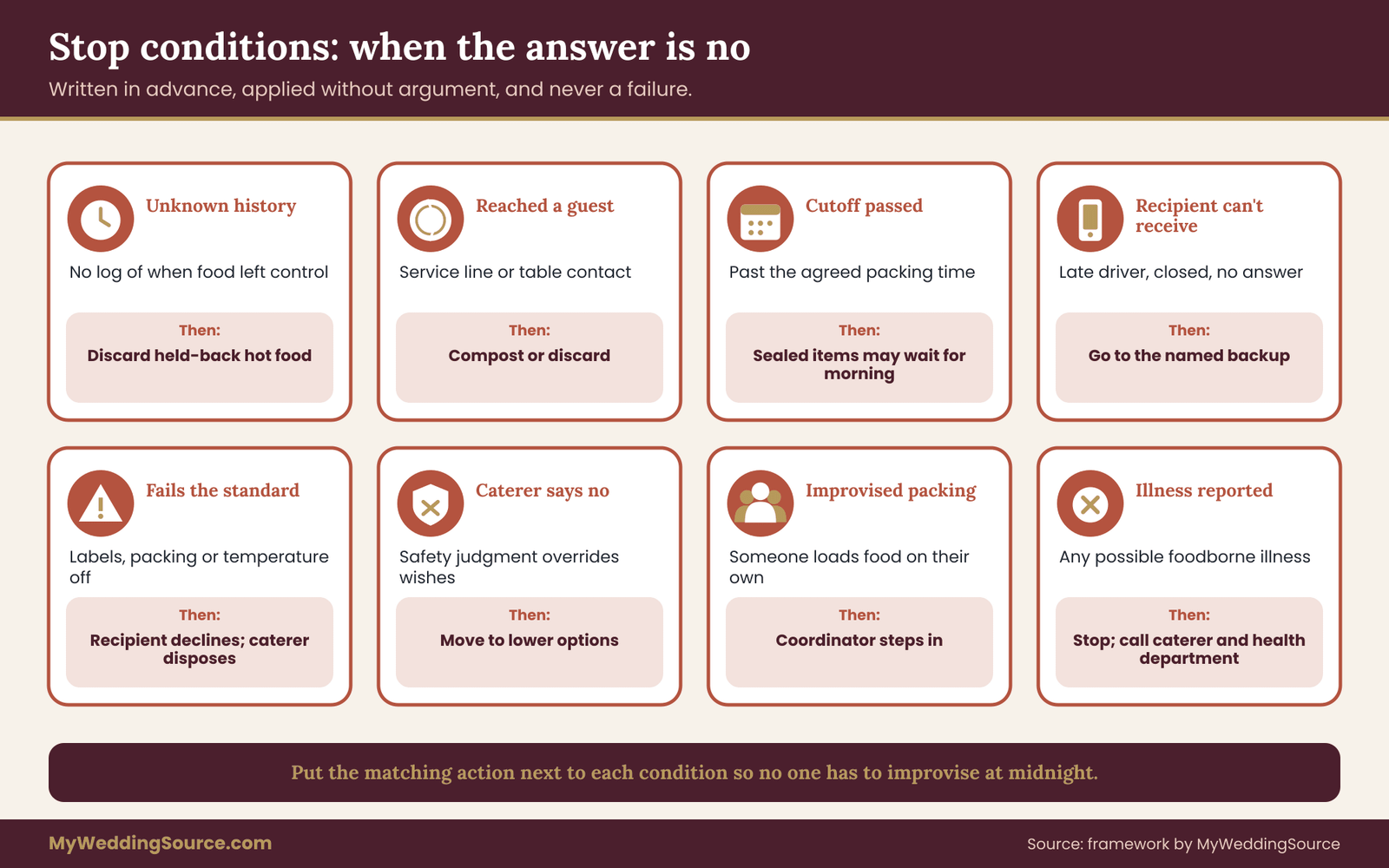
Each stop condition has a matching action: dispose, compost or offer to guests or staff under the lower options. It is worth writing the action next to the condition so the person making the call does not have to improvise. For example, “Cutoff passed: discard held-back hot food; sealed items may still go to the pantry in the morning.” A short list of that kind, kept by the coordinator, is the real deliverable of this section.
One more point about stop conditions: they are not a statement that the couple failed. They are the reason a donation arrangement can be trusted. Receiving organizations want caterers and couples who have clear stop rules because those partners will not send them something unsafe. If a stop condition triggers, a brief note to the receiving organization the next day, thanking them and explaining what happened, builds the relationship for next time.
Alternatives when leftover wedding food cannot be donated
Sometimes donation will not work. The caterer may have a firm no-release policy, no receiving organization may serve your area, or the event may run too late. That does not mean everything goes in the trash.
There is an order of better and worse options, and the environmental agency that publishes the Food Recovery Hierarchy ranks them roughly in this order: prevent surplus, feed people, feed animals, use industrially, compost, and only then send to landfill or incineration. The U.S. Environmental Protection Agency has also published an updated scale that keeps prevention and feeding people at the top. Check the agency’s current pages for the exact wording.
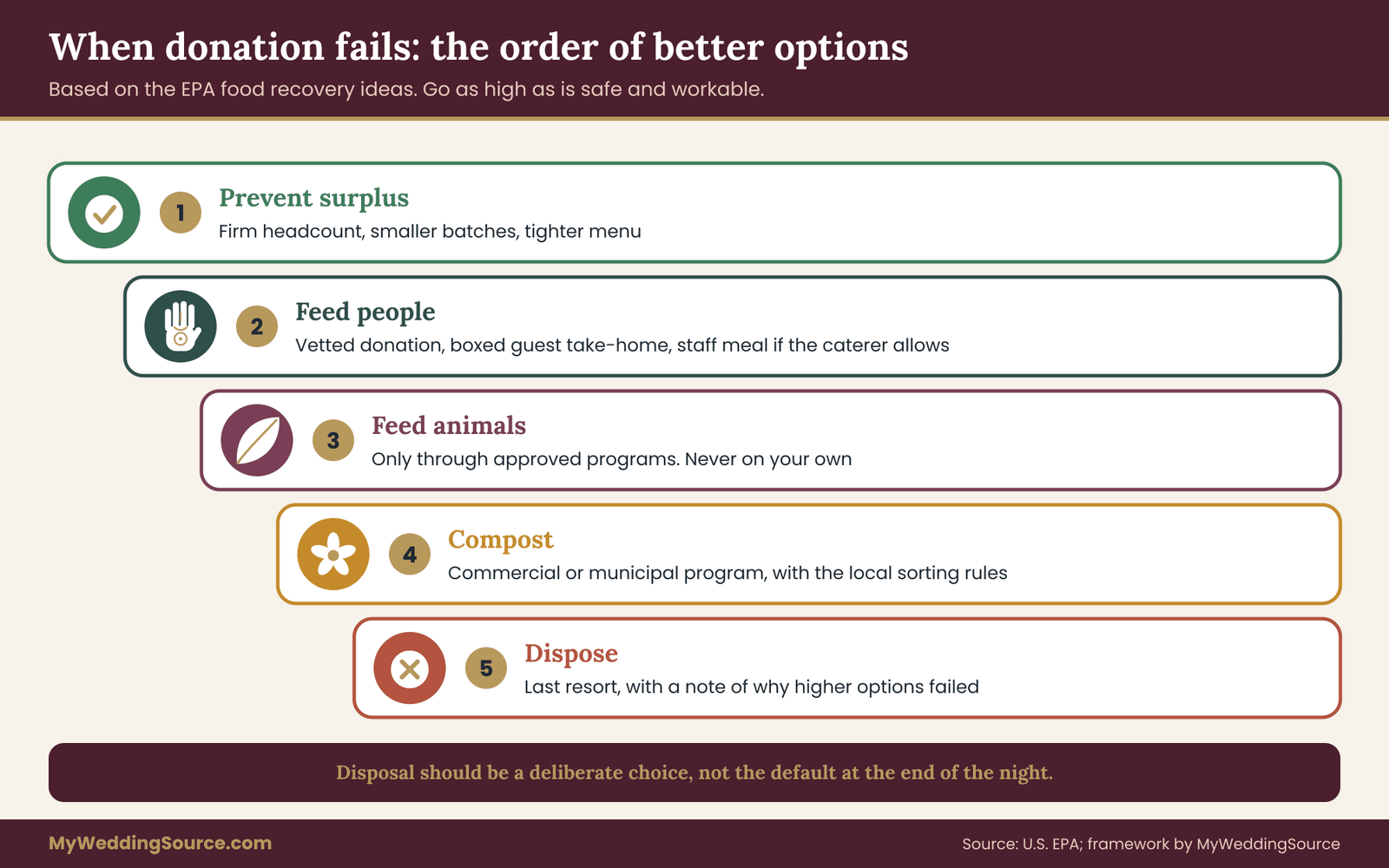
The practical version for a wedding looks like this.
Prevent the leftover wedding food. The best way to deal with leftover wedding food is to produce less of it. That means a firm final headcount, a caterer who cooks in smaller batches closer to service, and a menu whose structure matches how your guests will actually eat. Ask the caterer what overproduction they plan and whether they can reduce it once the count is final. The guide to wedding menu planning covers how course structure and service style influence quantities.
Feed people through a vetted channel. This is the donation route covered in this guide. It sits high on the list for a reason, and it is worth the effort when the conditions are right.
Guest take-home. Guests often love to take home a slice of cake or a wrapped dessert, and a caterer can pack these safely. Use it for items that are designed to travel: boxed cake slices, wrapped cookies, candy, sealed snacks. Put a plain label on the box and a short note about when to eat it.
Do not offer take-home on food that needs refrigeration unless the guest will get it home quickly, and do not encourage guests to take food from the buffet itself. The caterer packs take-home items from clean stock, not from the line. The guide to reception guest flow covers how to build an unhurried departure so a take-home station does not create a bottleneck at the door.
Staff and vendor meals. Many caterers and venues have rules about whether staff may eat leftover event food. Some allow it from held-back stock; others forbid it. If your contract includes staff meals, ask whether they come from the same production or are ordered separately. Check what your catering contract says about staff meals and ask the kitchen lead directly. A hungry team that has worked a long evening is a legitimate recipient, as long as the caterer sets the rules.
Animal feed. Some programs divert food scraps to animal feed, but rules on what may be fed to animals are strict, often regulated by agricultural authorities, and food waste that contains meat or has touched plates is usually restricted. Do not take this route on your own. If a farm or program is in your area, it will have its own process, and the caterer will know whether they work with one.
Composting. Composting is the best use for food that cannot feed people. Many municipalities and private haulers offer curbside, drop-off or commercial composting for food scraps. Some venues and caterers already participate. If you want compost, ask the venue and the caterer what exists, what must be sorted and what is accepted. Bones, dairy and cooked food are sometimes excluded from home composting but accepted by commercial programs, so confirm the local rule.
Disposal. Where nothing else works, food goes to the trash. Do this deliberately, with the caterer’s agreement, not by default. It is the lowest option, and a clear record of why the higher options were not available is part of an honest account of the wedding.
Choosing among the options on the night
At the end of a wedding there is not time to weigh every choice about leftover wedding food. This is why the earlier work matters. If the ledger and the arrangement exist, the decision at the end is mostly mechanical.
For each item, the coordinator and the kitchen lead look at its class, the clock and the options available, and they pick the highest option that is still safe and workable. A tray of held-back pasta might go to the food rescue driver. A sealed box of cookies might go to the pantry. Cake slices go to guests. The rest goes to compost.
It can help to keep a one-page decision card in the coordinator’s folder. It has a short list of items, their classes and the planned destination. A second line for each item says what to do if the first plan fails. The card turns a stressful moment into a simple checklist.
Contract language, cost and timing for leftover wedding food
The arrangement around leftover wedding food works best when it lives in the paperwork. Three questions decide how heavy the paperwork has to be: who pays, what the contract says and when each step happens.
Who pays
Donation is not always free. Packing materials, extra kitchen labor beyond the contracted end time, refrigerated transport and delivery can all carry a cost. Some caterers absorb it as part of their service and treat it as a matter of principle. Others itemize it. Receiving organizations rarely charge donors, but they may not have the capacity to send a driver at night.
A couple can decide to cover reasonable costs, for instance extra labor for a kitchen assistant to pack and log, or a modest gift to the receiving organization to help with its own costs. Whatever you decide, put it in writing so there is no surprise on the final invoice. Do not assume a price. Ask your caterer for a quote, since it will depend on region, staffing and contract terms, and record the answer in your budget.
It is also fair to ask whether any tax treatment applies to a donation. Rules about charitable deductions are set by the Internal Revenue Service and by state authorities, and they depend on who owns the leftover wedding food and who makes the donation. Since the caterer, not the couple, usually owns and donates the leftover wedding food, a couple should not assume a deduction. A tax professional can answer it for your situation.
What the contract should say
You do not need a long clause. A few lines usually cover it. State that the couple requests that held-back, unserved food be offered to a named receiving organization under the caterer’s food-safety procedures. State that the caterer decides what is eligible and may decline for safety reasons. State the packing cutoff and the pickup window. State who bears any additional cost. State that a log of food, times and temperatures will be kept and shared on request. If the caterer already has a template for this, use it.
If your caterer refuses to put anything in writing, treat that as information. It does not necessarily mean the caterer is unsafe. It may mean that company policy forbids releasing food. In that case, ask for confirmation of the policy and move to the alternatives. The guide to wedding vendor timelines helps you place each question at the point in the schedule when it is most useful.
A timeline that works backward from the wedding
A workable schedule has about six checkpoints.
At the time of choosing a caterer, ask about surplus policy and compare answers. At contract signing, add the arrangement or confirm the no-release policy. About two months out, build the ledger and contact the receiving organization. About a month out, confirm that the organization has accepted, that the caterer is registered if needed and that a backup exists.
In the final week, update the quantities based on the final headcount and send the one-page summary to everyone. On the day, confirm in the morning that the pickup is still on, then let the caterer and coordinator run it.
After the wedding, the last checkpoint is the follow-up. Send thanks, file the log and the receipt, and note anything to do differently next time, whether you are the couple, a planner or a family member planning a later event. A short note takes five minutes and keeps a good relationship going.
Keeping the effort proportional for leftover wedding food
It is easy to over-engineer this. For a small wedding with a modest amount of surplus, the whole thing may amount to an email to the caterer asking what they do with extras, a second to a local food rescue group, and a quick decision card.
For a large wedding with multiple events across a weekend, a more detailed arrangement is warranted. Match the effort to the quantity of Class A food in the ledger. If the ledger shows almost none, spend your energy on reducing overproduction and on composting. If it shows a lot, spend it on a solid handoff with a backup.
Special situations that change the plan for leftover wedding food
The framework holds across most weddings, but certain settings bend it. Here are the ones that come up most often.
Venue-run or hotel catering. When the venue’s own banquet department does the cooking, the venue’s policy governs, and many hotels forbid food leaving the property for liability reasons. Ask the banquet manager directly. If the answer is no, the surplus ledger still helps you reduce overproduction, and composting or staff use may be allowed.
Buffets and stations. Buffets produce the most service-line food and the least Class A food, unless the kitchen holds back a reserve of each tray. A caterer can keep refill pans in the kitchen and bring them out one at a time, which reduces exposed food and leaves more held-back food at the end. Ask whether that is how they work.
Family-style service. Platters that reach the table are guest-contact food, even if untouched. If the kitchen holds extra platters, those are Class A. The distinction is the same: what the kitchen controlled.
Outdoor summer weddings. Heat tightens the clock. The one-hour guidance for warm air applies, and cold food on a hot lawn can pass its limit quickly. If the reception is outdoors in hot weather, set an earlier packing cutoff and agree that cold items stay in refrigeration until the last moment.
Late-night snacks and food trucks. Food truck operators have their own permits and rules. Treat them like a separate caterer. Ask whether they release surplus, and note that wrapped or sealed items are the simplest to pass along.
Cake. Cutting cake creates Class B food, but a top tier that was never cut and a sealed box of backup slices are Class A. Most couples keep a tier for later, which is a personal use, not a donation. Note allergens: cake often contains eggs, dairy, wheat, tree nuts or soy, and a recipient needs to know. Ask the baker how the cake was held and boxed.
Dietary, cultural and religious requirements. If food was prepared to a specific standard, such as halal, kosher, vegetarian or vegan, tell the recipient accurately and do not mix it with food prepared another way. A recipient serving people with particular requirements will want clear labels. Do not claim a standard the caterer cannot certify.
Alcohol. Opened alcohol is not part of food donation, and rules on unopened alcohol vary by state and by license. Do not assume it can be given away. Ask the bar vendor and check local law. The same goes for unopened mixers: sealed soft drinks and juice are usually simple, but still confirm with the recipient.
Home catering and potluck-style weddings. Food prepared in a home kitchen is often outside what receiving organizations will take, because there is no inspected kitchen, no log and no way to verify the history. Plan on guest take-home among the people who prepared it and composting for the rest.
Multi-day events. Rehearsal dinners, welcome receptions and farewell brunches each produce their own surplus. Treat the leftover wedding food from each event as separate, with its own ledger and its own handoff, even if the same caterer and recipient are involved.
Tight or small weddings. With little leftover wedding food at stake, If the guest count is small and the caterer produces to order, there may be almost no surplus. That is a good result. The effort is better spent on a compost arrangement or on keeping the headcount accurate.
When something goes wrong. A late driver, a lost label, a recipient that closes early. Use the backup, then the lower options, then stop. Write down what happened, and send a note to everyone involved. These are the moments when the stop conditions and the decision card earn their keep.
If you are early in the process and still weighing broader ways to cut waste, the guide to reducing waste across a wedding is a good companion. It covers the larger audit, while this guide handles the narrower question of the leftover wedding food after service.
Your next steps
Work through these in order, and stop wherever the answer is no.
- Read your catering contract for any clause on surplus food, leftovers or removal from the premises.
- Ask your caterer the six questions from the first conversation, and write down the answers.
- Build the one-page surplus ledger with the caterer, and sort items into the three classes.
- Contact one receiving organization with the short script, and ask the eight policy questions.
- Name a backup recipient and a record keeper.
- Put the arrangement in writing: who decides, the packing cutoff, the pickup window, the cancellation rule and who pays.
- Send the one-page summary to the caterer, the coordinator and the recipient in the final week.
- After the wedding, send thanks and file the log with your other records.
FAQ
Can we donate the leftover wedding food left on the buffet after the reception?
Usually not. Food that sat on a service line has been exposed to guests, utensils and room air, and most caterers and receiving organizations treat it as unsuitable. Food that stayed in the kitchen under temperature control and was never put out is the realistic candidate. Ask your caterer how they classify each, and confirm the recipient’s rules before the wedding.
Who is responsible for leftover wedding food after the event?
In most arrangements the caterer is responsible until the handoff, because the kitchen knows the food’s history, and the receiving organization is responsible after accepting it. The couple sets the goal and puts it in writing but does not handle the leftover wedding food. Your contract may say otherwise, so read it and ask the caterer to confirm.
How long can wedding food sit out before it is unsafe?
General U.S. Department of Agriculture guidance is two hours in the range between 40 and 140 degrees Fahrenheit, and one hour when the air is above 90 degrees. The clock starts when food leaves temperature control. Because rules and local standards vary, ask your caterer and your health department for the standard that applies to your event.
Do food banks accept prepared catering food?
Some do and many do not. Food banks often prefer shelf-stable and fresh items, while food rescue groups, community kitchens and some meal programs accept prepared food from licensed caterers under defined conditions. Call before the wedding and ask the eight policy questions. A clear no early on is useful, because you can move to another recipient.
Are we legally protected if we donate?
There is a federal law, the Bill Emerson Good Samaritan Food Donation Act, that offers donors some protection for good-faith donations of apparently wholesome food to nonprofits, and states have their own laws. The protections have limits and conditions. Ask your caterer and the recipient what they rely on, and consult a professional in your state if it matters to you.
What if our caterer refuses to release any food?
Accept it and move on. Many caterers have policies tied to their insurance and health permits, and a refusal is not a sign of a bad company. Use the lower options: reduce overproduction in advance, offer guests boxed take-home items, ask about staff meals and arrange composting. Ask for the policy in writing so you have a record.
Can guests take food home from the buffet?
It is better to avoid it. Food taken from the buffet has the same exposure problems as other service-line food, and nobody can track the time and temperature once it leaves. A better approach is for the caterer to pack take-home items from clean stock, such as wrapped desserts or boxed cake slices, and to label them with simple instructions.
Can we deduct the value of donated wedding food on our taxes?
Do not assume so. In most cases the caterer owns the leftover wedding food and makes the donation, not the couple, and tax treatment depends on who donates, the recipient’s status and the records kept. The Internal Revenue Service publishes the rules, and a tax professional can tell you whether anything applies to your situation.
Sources
- U.S. Environmental Protection Agency: Sustainable Management of Food
- U.S. Environmental Protection Agency: Food Recovery Hierarchy
- U.S. Department of Agriculture: Food Loss and Waste
- USDA Food Safety and Inspection Service
- FoodSafety.gov
- U.S. Food and Drug Administration: Food Code
- Centers for Disease Control and Prevention: Food Safety
- Feeding America
- Congress.gov: Bill Emerson Good Samaritan Food Donation Act
- Internal Revenue Service