An emergency contact plan for a wedding day is usually written for guests, and the couple is treated as the people who make the calls. This guide covers the other case: two partners who each live with their own health needs, who may each need help on the day, and who want a short, voluntary, written plan that says who is called, who acts, and who is told what.
Build one card per partner, not one card for the couple. Each card names a response person who can reach that partner within a minute, an information person who holds the partner’s own clinician-written plan and can be phoned, and a backup for each. Every person on a card agrees in advance and can say no. Venue staff and vendors get a role and a location, never a diagnosis. Anything that looks like a true emergency goes to 911 first, and the card never replaces that call.
Most emergency contact plan advice for weddings assumes the bride and groom are the stable center of the event. Somebody collapses at the cocktail hour, the couple stay calm, and the day-of lead handles the rest. That assumption is reasonable for most couples. It stops working when one or both partners have a health condition that can produce symptoms during a long, emotional, hot or noisy day, because then the person who would normally be called is also the person at the center of the situation.
An emergency contact plan for that kind of couple has to answer questions a standard contact sheet skips. If your partner is the one who needs help, who is called in your place? If you are in the ceremony and cannot be interrupted, who knows what your partner needs? If both of you have needs, who covers the first minutes for each of you without one person being pulled in two directions? And who decides how much of your private health history anyone else hears?
This article builds an answer in the form of a voluntary response contact and role card. It explains the structure, shows how to choose the people, gives scripts for asking them, walks through one invented case, and describes the ways the whole thing can fail so you can build in alternatives. The emergency contact plan is a planning tool for the people around you. It is not medical care, and it does not tell anyone what to do for a medical condition.
A note on scope. This is general planning information, not medical, legal or financial advice. Each partner’s treating professionals decide what a response plan for that person should say, and the Americans with Disabilities Act, privacy rules and venue contracts differ by situation. Where a rule matters, the guide points you to the agency or the professional who can confirm it.
What an emergency contact plan is for a couple with individual health needs
Start with what the document does. An emergency contact plan on a wedding day is a short, written agreement about three things: who is contacted, who responds in person, and what each of them is told. It is built before the day, shared with a small number of people, and used in a few minutes when something goes wrong. It is not a medical record, a care plan or a legal directive.
For a couple with individual health needs, the emergency contact plan has a fourth job. It has to keep each partner in charge of their own information. One partner might be comfortable with a bridesmaid knowing about a daily medication. The other might want only a spouse and a parent to know anything at all. A single shared document forces both of you toward the level of the less private person, or leaves the more private person exposed. Two cards avoid that.
The second thing to separate is the layer of response that belongs to professionals. Calling 911 is the right first step for any situation that looks like a true emergency, and the dispatcher takes over the decisions from there. The 911.gov site, run by the National 911 Program, explains how the system works in plain terms. Your emergency contact plan does not compete with that call. It makes sure the call gets made quickly, the location is stated correctly, and someone who knows the person is on hand when the paramedics arrive.
The third thing is what a plan cannot do. It cannot diagnose. It cannot tell a friend how to treat anyone. It cannot guarantee that a person will be reachable. What it can do is cut the confusion that normally eats the first few minutes: who has the phone, who goes to the person, who finds the venue manager, who meets the ambulance at the correct door.
Who this guide is for
This guide is written for a couple in which at least one partner has a condition that could, with some chance, need attention during the wedding. The condition could be a chronic illness, a condition that causes sudden symptoms, a mobility or energy limit that can turn into a safety issue, a mental health condition that can be affected by stress or sleep loss, or a condition managed with medication on a schedule.
The guide does not need to know which. In fact the card works better when it does not name conditions at all, for reasons covered later.
It also applies when the health needs belong to the couple only in part. If one partner has a need and the other is simply the usual contact, the other partner still gets a card, because the day puts them in a role that cannot be filled at the same time as spouse and caregiver.
If your situation is broader, such as a guest-focused medical plan, you do not need to rebuild it here. Venue access is a separate subject, covered on the site in a guide to accessible wedding venue red flags, and backup communication is covered later in this article. This guide stays narrow: the two partners, their people, and the card.
What an emergency contact plan is not
It is not an obligation placed on anyone. Everyone named on a card volunteers, and a person who declines has done you a favor by saying so now rather than on the day. It is not a disclosure to your guests. Nothing on a card is announced, printed in a program or shared in a group chat. It is not a replacement for a conversation with each partner’s own clinician, who can tell you what a written plan for that person should include and whether the wedding schedule needs any adjustment.
It is also not a reason to be afraid of your own wedding. The point of the card is the same as the point of a spare tire. You make it so the rare bad moment is a small problem, and then you stop thinking about it and enjoy the day.
Why a standard emergency contact plan breaks when the couple is the one who needs help
A standard emergency contact plan is a list of names and phone numbers with a hierarchy: venue manager, day-of coordinator, a relative. It works because the person in trouble is a guest, and the people on the sheet are all separate from that guest. Three features of a wedding day make the same sheet fail when the person in trouble is one of the two people the day is built around.
The usual contact is not free to act
In most households each partner lists the other as their emergency contact. That is sensible on an ordinary Tuesday. On the wedding day, the spouse is the other half of the same event. They may be standing at the altar, in a photograph, in a receiving line, on a dance floor with a microphone nearby, or in a different room being dressed. They may also be the person with the most anxiety about the situation, which makes them less able to give a calm, clear account to a dispatcher.
The fix is not to remove the spouse from the card. A spouse should usually know. The fix is to name a response person who is not the spouse, so the first minute does not depend on someone who is, at that moment, part of the ceremony or the one in distress.
The people who know the most are often not in the room
The best information about a person’s health plan sits with that person’s clinician, the person themselves, and sometimes a parent or close friend who has handled it before. On the wedding day, the clinician is not there. The parent may be in the second row, and may be the person most affected by seeing the partner unwell. The friend who understands the routine may be a groomsman currently in a photograph forty feet from where the problem is.
This is why the card separates two roles. The response person is physically close, calm and trained or willing to be guided. The information person holds the person’s own written plan and can be reached by phone, so that if a paramedic or a first aider needs the clinician’s instructions, someone can read them aloud. They do not need to be in the same room. They need to answer their phone.
Privacy pressures arrive all at once
When something goes wrong at a wedding, everyone wants to help. A well-meaning aunt asks the bridesmaids what is wrong. A vendor wants to know whether to stop the music. The venue manager asks for information they would like to have on file. In the noise, a person’s private medical history can travel much further than they wanted, through people who are not covered by any privacy rule.
That last point is worth stating plainly. The U.S. Department of Health and Human Services explains that the HIPAA Privacy Rule applies to health care providers, health plans and certain related organizations. A caterer, a photographer or a friend is not among them. Anything you tell them is held only by their discretion and your agreement with them. The sensible response is to tell them as little as the task needs, and to decide the wording before the day, not under pressure.
The two-partner problem in an emergency contact plan
When both partners have needs, a third difficulty appears. If both cards name the same best friend as response person, the friend is split in half the moment both partners are unwell, or the moment one is unwell and the other is also upset. A single maid of honor cannot be in two places. Overlapping on one name for convenience is the most common weak point in a two-person plan, and it is the easiest to fix on paper.
The emergency contact plan in the rest of this guide is meant to fix all four problems at once. Each partner gets a card. Each card has different people, or at least different primary people. Information is sorted into rings so that the number of people who know anything is small, and the number who know everything is smaller still. The card sits alongside the venue’s own emergency procedures and the day-of lead’s cue sheet, not in place of them.
If you are still setting the overall shape of your planning, the general planning checklist is a sensible place to confirm where this item sits in the schedule. Come back here when you are ready to name people. A good time to begin the card is when you finalize your vendor list, because the people you hire often become the day-of contacts you rely on.
A short test for whether you need an emergency contact plan
Ask each partner the same three questions, separately. First, is there any situation on a long wedding day in which you would want someone other than your spouse to step in? Second, is there information about your health that would help a first aider or paramedic and that you would not want broadcast? Third, is there anything that would change how a venue or a vendor should treat you in the first ten minutes of a problem?
If either partner answers yes to any one of the three, build the card. If both partners answer no to all three, you may still want a lighter, one-page version. Many couples who start with a light version find that writing the names down, even once, is the only step that matters. ## The voluntary response card: the core of this emergency contact plan
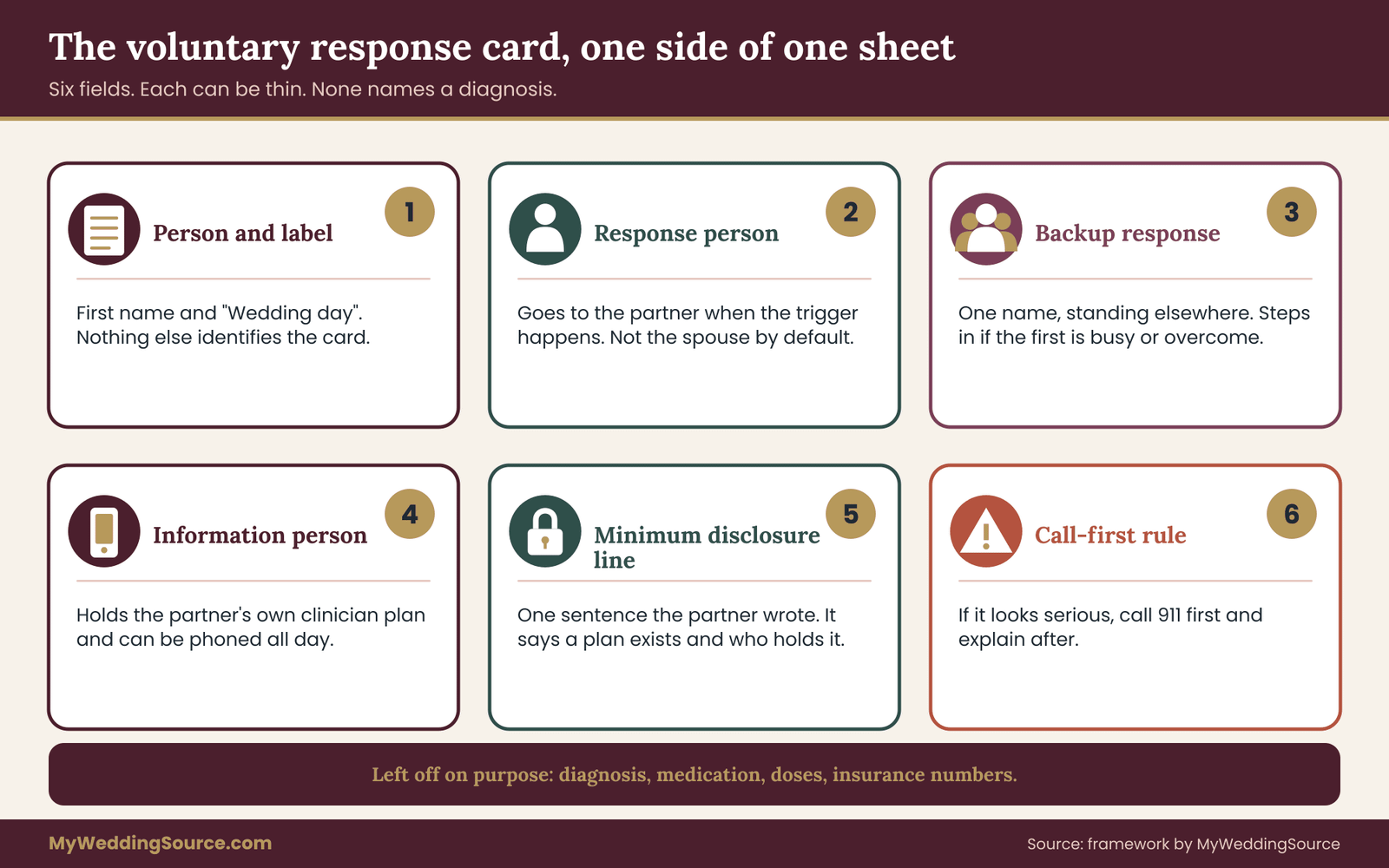
In this emergency contact plan, the card is one page per partner. It is written by the partner it belongs to, shared only with the people named on it, and kept in two forms: a paper copy in a known place and a photo or note on the phone. It has six fields. Each field exists because a specific thing goes wrong without it, and each can be left deliberately thin.
Field one: the person and the label
The top of the card has the partner’s first name and a plain label for the day, such as “Wedding day, Saturday”. Nothing else identifies the person. There is no date of birth, no condition and no address. If the card is lost, a stranger who finds it learns only that a person has a plan and a list of phone numbers.
Field two: the response person
This is the single person who goes to the partner when a trigger happens. The trigger is defined on the card in plain words, such as “I look unwell, I ask for you, or someone tells you I need help.” The response person is within about a minute of the partner during the key parts of the day. They are not the spouse, unless the couple chose otherwise on purpose and wrote a backup beside the name.
Choose someone who stays calm, who will not hesitate to call 911 and who is willing to be asked to stop a conversation or leave a photograph. Avoid someone whose own role in the wedding is fixed, such as a person giving a reading or delivering a toast at the moment you are most likely to need them.
Field three: the backup response person
One name only. This person steps in if the first person is unavailable, is also at the center of the situation, or has been pulled away by a second incident. The backup should not share a seat at the same table or the same spot in the processional with the first person. If both stand in the same row of the same photograph, they are not independent.
Field four: the information person
The information person holds the partner’s own written plan, if one exists, and can be phoned at any time during the day. It might be the partner’s parent, sibling or close friend. It might be the partner’s own clinician’s office, if the clinician has agreed to be listed and has an after-hours line. It does not have to be the same person as the response person. In fact it is often better if it is not, because the response person is busy and the information person is calm.
The information person has one job: to be available to answer, through a phone call, whatever a paramedic or first aider asks. They do not decide medical treatment. They read from the partner’s plan, and the partner’s plan comes from the partner’s treating professionals.
Field five: the minimum disclosure line
This field decides what the response person may say to others. It is a single sentence, written by the partner, such as “Tell them I have a health condition with a written plan, and that my information person can be phoned.” It does not name a diagnosis. It tells venue staff and paramedics only that a plan exists and who holds it.
A partner who is comfortable sharing more can write more, and a partner who is not can write almost nothing. The line is the partner’s decision. It is not up for negotiation with the spouse, the parents or the planner.
Field six: the call-first rule
The card states, in the same words on both partners’ cards, that any situation that looks like a true emergency is handled by calling 911 first. The response person does not wait for the information person, the spouse or the venue manager. After the call is made, the card tells them whom to notify next, and in what order.
The rule is written in because stress produces delay. People who are unsure whether a situation counts often hesitate and ask each other. A written rule removes the question. If it looks serious, call first and explain after.
What the emergency contact plan deliberately leaves off the card
The card does not include a diagnosis, a medication list, a dose, an insurance number or a doctor’s name. Those belong in the partner’s own written plan, which the information person holds, and which the paramedics will get from the partner’s own medical identification features or from the information person on the phone. The card is the routing layer of the emergency contact plan. The partner’s own plan is the content layer. Keeping them apart means the routing layer can be handed to a venue manager without any private detail attached.
It also leaves out instructions for treatment. If a partner’s clinician has written steps for a first aider, those belong in the clinician’s document, where they are accurate, dated and professionally owned. A planning article, a friend or a group chat is the wrong source for them.
How long an emergency contact plan card should be
One side of one sheet. If the card runs longer, it is no longer a card, and the person who needs it in thirty seconds will not find the line they need. The rest of the material, such as the contact details for the venue and a map of the property, goes on the day-of lead’s sheet or the venue’s own emergency procedures, not here.
Paper and phone forms of the emergency contact plan
Print the card on plain paper and keep it in two spots that the response person knows: inside the partner’s bag or the bridal suite, and with the day-of lead. Put a photo of the card in the response person’s phone as a favorite or pinned note. A card that lives only in a text thread will be unreachable if the phone is locked, and a card that lives only on paper will be left in a different room.
The four rings of an emergency contact plan: who gets which information
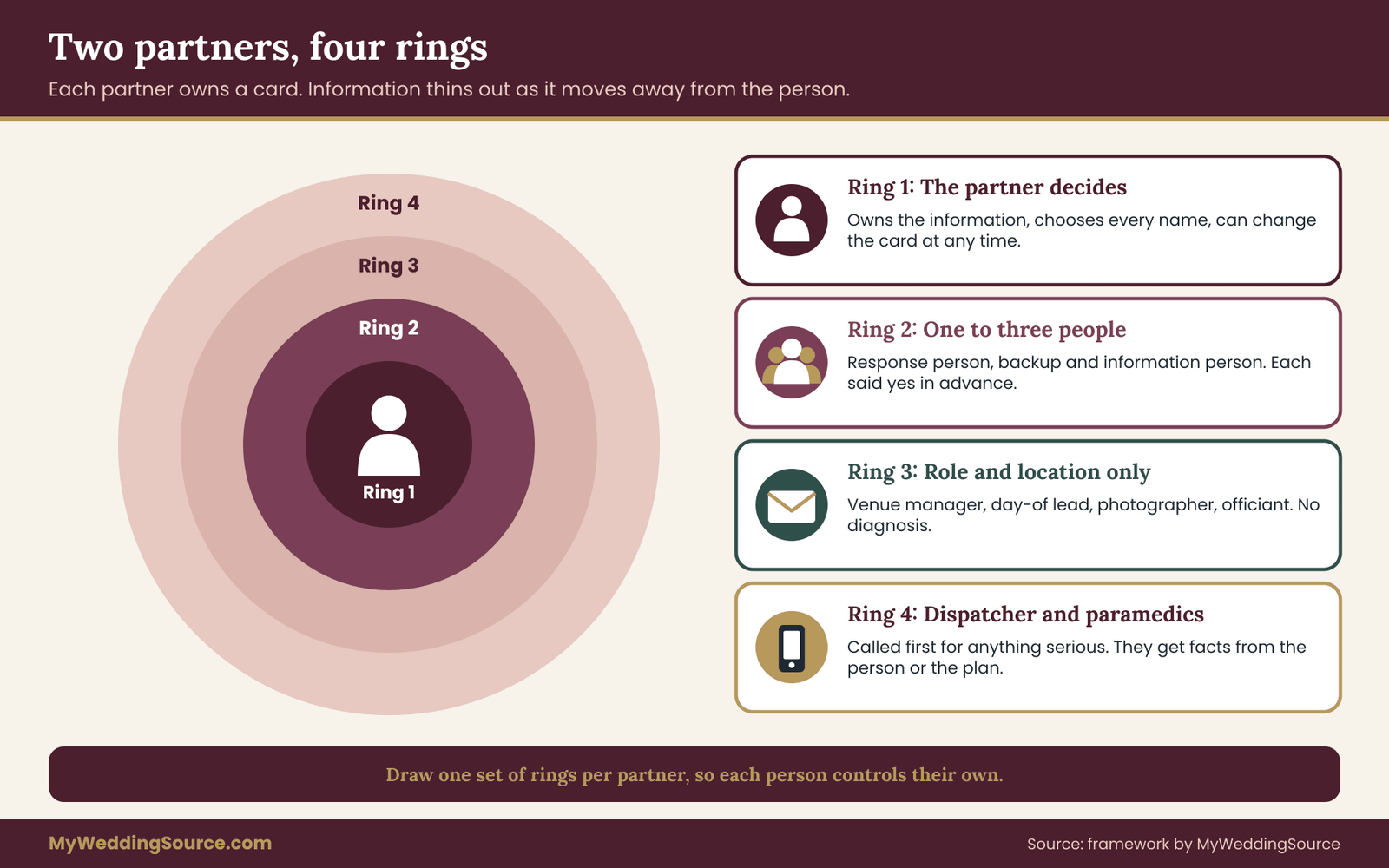
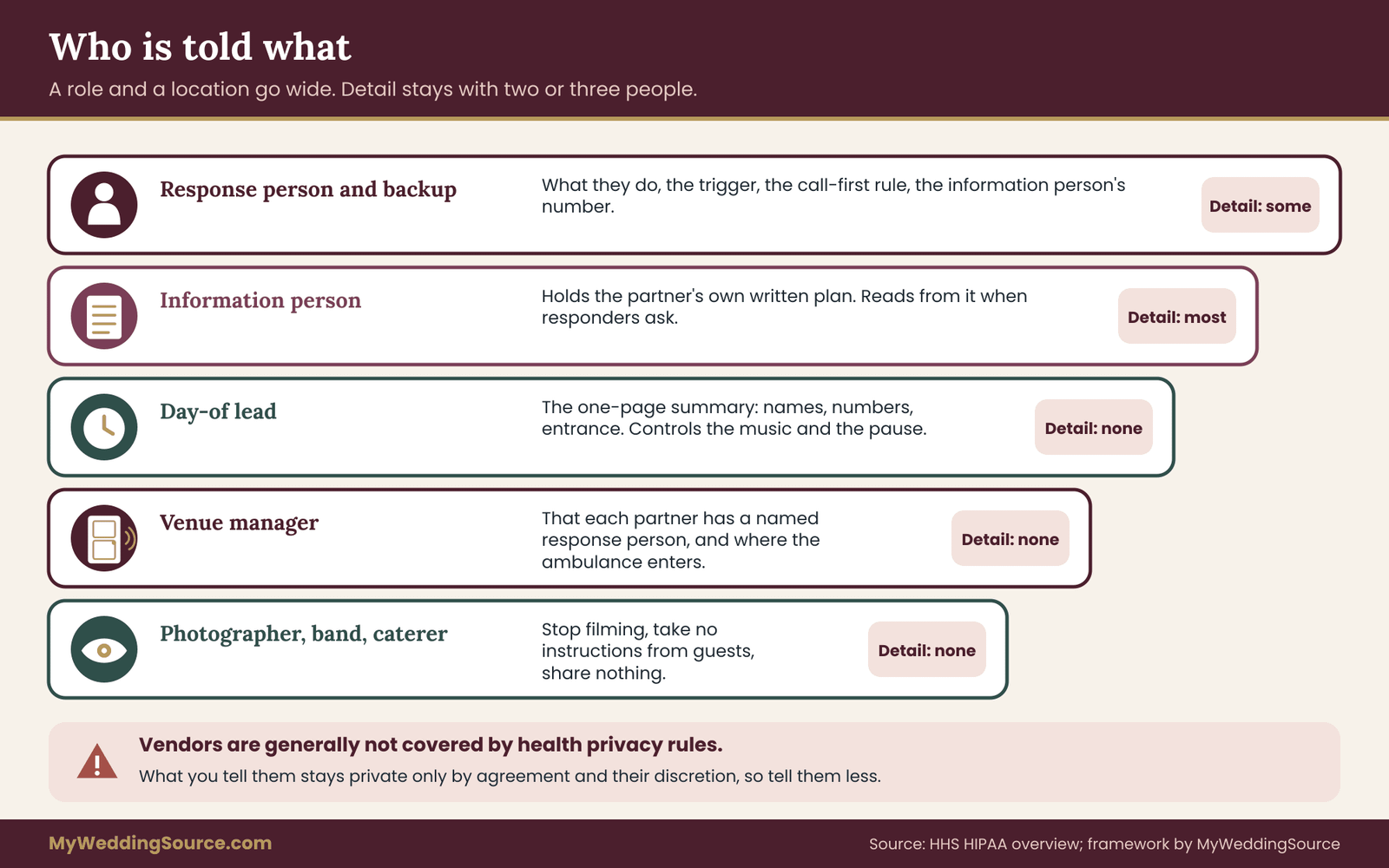
The card names people. The rings of the emergency contact plan sort what each of them is told. Think of four concentric rings around the partner. The closer the ring, the more detail, and the smaller the number of people.
Ring one: the partner themselves
The partner owns the information. They decide what is on the card, they decide who is named, and they can change either at any time up to and during the day. No one is added to a ring without the partner’s agreement, including a well-meaning parent or the planner.
Ring two: the people who need the detail
These are the information person, the response person and the backup. They know what is in the partner’s plan, to the extent the partner chooses. In practice that means one to three people. They are told in advance, in a private conversation, and they have the same card.
Ring two does not include the spouse automatically, though in most cases the partner will want the spouse in it. When the spouse is in ring two, the partner and spouse should still agree on what the spouse does if both are affected, or if the spouse is the one who needs help.
Ring three: the people who need a role and a location
These are the venue manager, the day-of coordinator, the photographer who follows you around, the officiant and perhaps the catering lead. They need to know three things: that a response person exists for each partner, what that person looks like or where they will be, and the phone number to use. They do not need a diagnosis. Giving them one does not help them act faster, and it widens the circle of people who know.
A script that works for this ring is short and neutral. Say that each of you has a personal plan managed by a named person, that if you ask for help or look unwell they should find that person first, and that if the situation looks serious they should call 911 and then the response person.
“If either of us seems unwell, find Ana for me or Luis for my partner, and call 911 if it looks serious.”
Ring four: emergency services
This is the 911 dispatcher, the paramedics and, later, the hospital. They need the facts about the person, and they get them from the person if able, from the response person, from the information person on the phone, or from the person’s own medical identification. The ring is outside the card. Your job in this emergency contact plan is to make sure the passage from ring two to ring four is short: the response person calls, states the address and entrance, and has the information person’s number ready.
Why rings beat a single list in an emergency contact plan
A flat emergency contact plan of ten names invites two failures. People on it assume someone else is handling things, and details that should have stayed with two people end up with ten. Rings make both problems visible. If you cannot say why a person is in a ring, they are probably in the wrong one.
The check is simple. For each name on either card, write what that person does in the first five minutes and what they need to know to do it. If the answer is “nothing” or “everything”, move them. Someone who needs everything is information person. Someone who needs nothing but a role and a phone number is ring three. Someone in neither group does not belong on a card.
Keeping the emergency contact plan stable on the day
The rings are decided in the weeks before, and the card is closed a few days out. A late change on the morning of the wedding, such as adding a new person because a cousin offered, is a sign of stress, and stress is when mistakes enter. If someone new volunteers, thank them and offer them a harmless job instead, such as keeping a water station stocked or guiding guests to the right entrance. They can be added after the wedding if the plan is reused for a later event.
If you want to see how the card fits with the other tasks of the day, the wedding ceremony cue sheet guide shows where the response people can stand during the processional without blocking a reader or the officiant. ## Choosing and asking the people for your emergency contact plan
An emergency contact plan is only as good as the people on it, and the people are only useful if they said yes freely. This section covers how to choose them, how to ask, how to handle a no, and what to give each person after they agree.
Qualities that matter more than closeness in an emergency contact plan
Closeness is the first instinct, and it is often the wrong filter. The people closest to you are often the people most upset by seeing you unwell. A sibling who has been through it before might be an excellent information person and a poor response person. A cousin you see twice a year, who works as a nurse or a lifeguard and keeps a level head, might be a much better response person than your maid of honor.
Look for five qualities. The person is calm when others are not. They are willing to act on a written rule rather than debate it. They respect privacy without being told twice. They are physically present for the stretches of the day when you are most likely to need them. And they will tell you honestly if they cannot do it.
Training helps but is not required. The American Red Cross and the American Heart Association both list first aid and CPR courses on their sites, and a volunteer who has taken one recently will be more at ease. If a person offers to take a course before the wedding, welcome that. If they have not, the card and a short conversation are enough, because the emergency contact plan is built around calling 911 and following the dispatcher, not around treatment.
Who tends to be the wrong choice for an emergency contact plan
Be wary of three types. The first is the person who needs to be in control, who will take over the room, reassure everyone loudly and slow down the call. The second is the person with a fixed job at the key moments, such as a best man giving the toast at the exact time you are most fatigued. The third is the person with their own difficult day, such as someone traveling with a newborn or a relative who is grieving. They may be willing in principle and unable in practice.
None of these is a character flaw. They are simply scheduling and temperament mismatches, and noticing them in advance is the whole value of a deliberate choice.
Matching people to the two cards of an emergency contact plan
Two partners need at least four different people for the response and backup slots, and two for the information slots, though one person can hold the information role for both partners if both partners agree and the person can handle it. The more your partner’s plan and yours overlap in time, the more distinct the people should be.
A useful rule: no person holds the primary response slot for both partners. If the first person is pulled to one partner, the other partner still has someone. The same person can be backup for the other partner, because backup is only used if the primary is unavailable.
A second rule: if one of the partners’ parents is a candidate, think about the effect of the role on the parent. Being the person who must call 911 for their own child is a heavy assignment on a day they are also celebrating. A parent can be the information person, since that role is phone-based and calmer. The response role can go to a person with a little more distance.
How to ask: scripts, consent and the right to say no
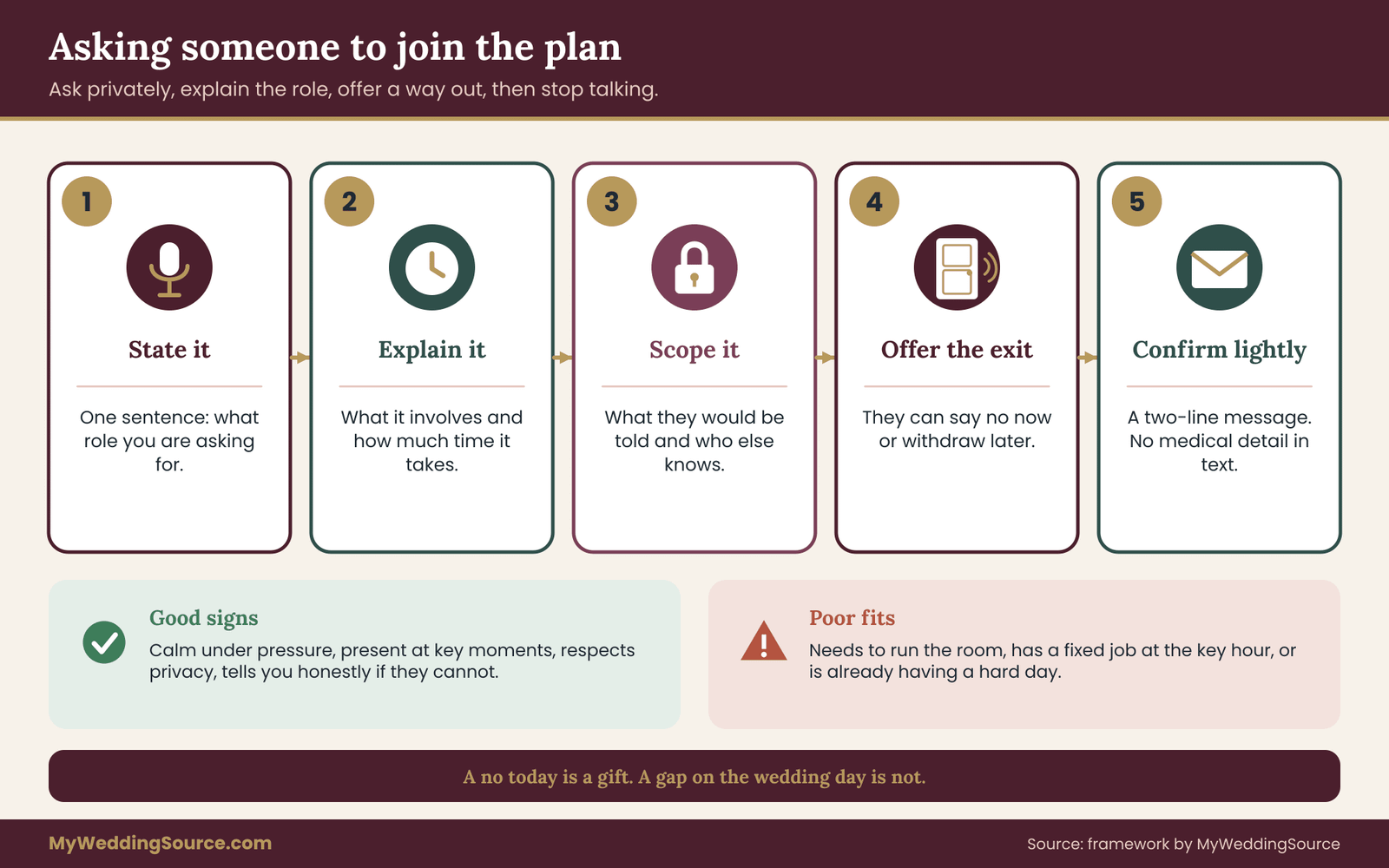
The ask matters as much as the choice in an emergency contact plan. A badly made ask can turn a generous friend into a worried one, or leave a person agreeing out of politeness rather than willingness. Ask each person privately, in person or on a call, never in a group message.
The structure of a good ask
Follow five steps. State what you are asking in one sentence. Explain what the role involves in plain language and how much time it takes. Say what information they would receive and who else would know. Offer a clear way out. Then stop talking and let them answer.
A script for a response person:
“I’d like to put your name on my wedding day plan as the person who goes to me if I need help. It means staying close during certain parts of the day and calling 911 first if it looks serious. You would get a one-page card. You can say no, and I will not be upset.”
A script for an information person:
“I’d like you to be the person who can be phoned if a paramedic needs my written plan from my doctor. You would not need to be at the wedding the whole time, only reachable. You can say no.”
Notice what the scripts leave out. They do not describe the condition. The detail comes after the person agrees, and only to the extent the partner wants. A person who has not yet agreed has no reason to hold private information about you.
Make the no easy
People often say yes because refusing feels unkind. To prevent that, offer two ways out. Tell them they can decline now. Tell them they can also withdraw later, even the week of the wedding, if their circumstances change. Then add that a no is useful information. A person who says no now has protected your plan from a hole on the day.
If a person hesitates, ask what the concern is. Sometimes it is a fear of getting it wrong, which a short walk through the card can settle. Sometimes it is a conflict with another role. Sometimes the answer is simply no, and the right reply is thanks.
Confirm your emergency contact plan in writing, lightly
After a verbal yes, send a short message that restates the role in two or three lines and asks them to reply “agreed” or similar. This is not a contract. It is a record that protects both of you from a misremembered conversation. Do not put medical details in that message. Text threads are easy to forward and hard to delete.
What each volunteer receives
Give each person a role card of their own, separate from the partner’s card. It is a half page. It contains the partner’s first name, the person’s role, the trigger words, a numbered list of first actions, the phone numbers for the backup and for the information person, and a short list of things they should not do.
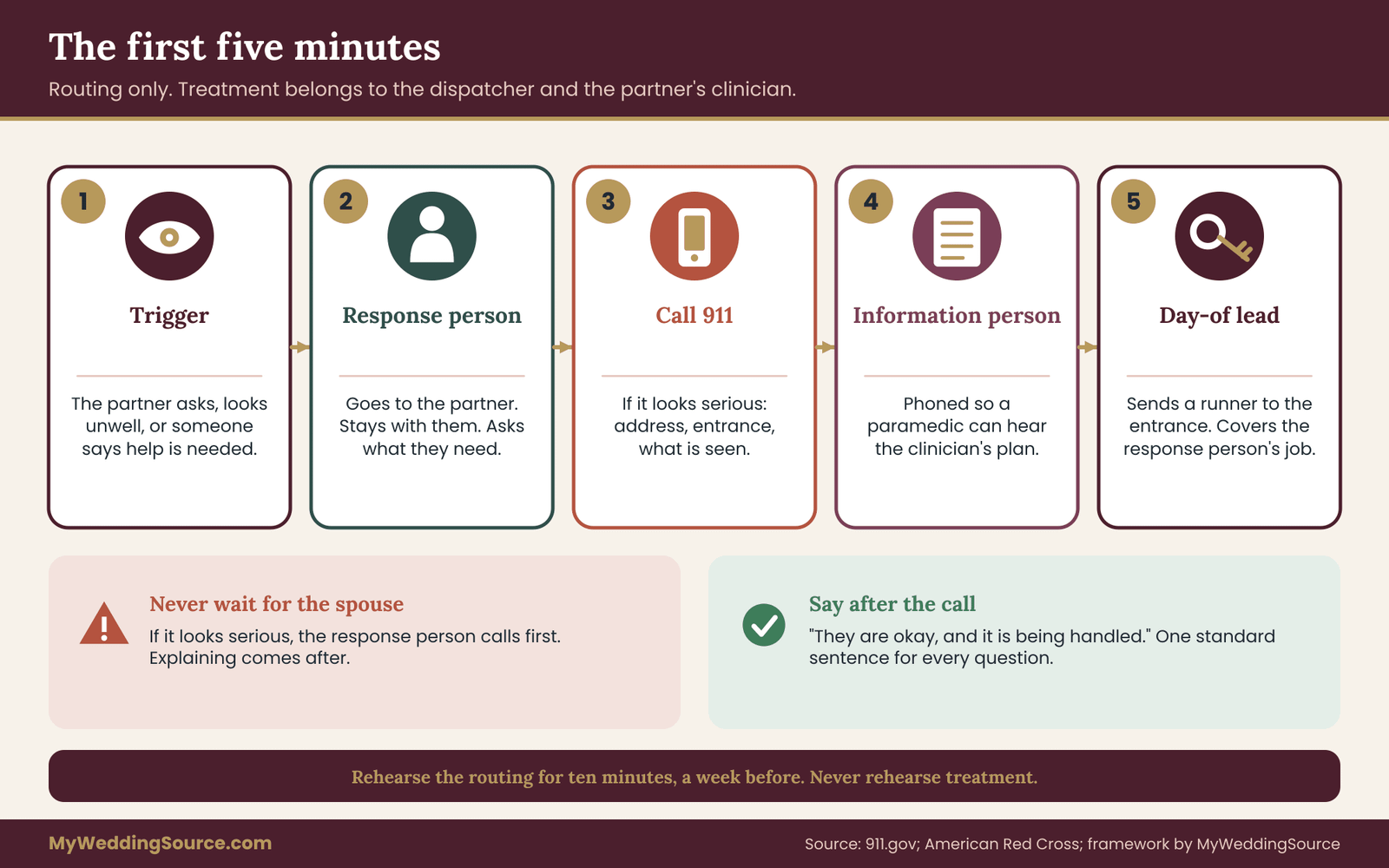
The first actions in the emergency contact plan are the same for every response person: stay with the partner, ask what they need if the partner can answer, call 911 if it looks serious, state the venue address and the entrance for the ambulance, then notify the day-of lead and the information person.
The don’t list is just as short: do not give any medication unless the partner’s own written plan says so and the partner or the plan’s author has told you how, do not move the person unless there is immediate danger, do not discuss the cause with guests, do not post anything.
When the spouse is also on the card
Some couples will want each other as the first response person, because that is who they trust. That choice is valid. If so, write it into the card on purpose, and add two protections. First, name a second response person who is also physically close and who has the authority to take over if the spouse is overcome or must be elsewhere.
Second, agree in advance on the specific moments when the spouse is not the first response person, such as the ceremony itself, a dance in front of a crowd, or the photo session with the extended family. A spouse who is standing in front of a hundred guests is not in a position to leave quickly.
Handling parents and family who want a bigger role
Family members often want to be on the card because they love you. Their offers deserve a respectful reply and not necessarily a yes. A good reply is: “Thank you. We have chosen people for the emergency contact plan based on where they will be standing, and we would love your help in another way.” Then give them a role that is real and visible, such as hosting the bridal party breakfast or greeting the older guests at the door.
If a parent insists on being told everything, treat it as a boundary conversation, not a planning one. The partner whose information it is makes the decision. If you want help handling that conversation, the site’s guide to decision rights in wedding planning lays out how couples can take input without handing over control.
Writing each partner’s emergency contact plan card separately, field by field
With the people chosen, each partner fills in their own card without the other’s input. This step protects privacy and also reveals differences that need to be reconciled. Sit apart. Use paper first if that helps. Then compare the cards only on the points where they have to interlock.
Step one: draft the trigger sentence
The trigger is the sentence that starts the plan. It should be simple enough that a stressed person could act on it without interpretation. Examples include “I ask for you,” “I sit down and cannot get up,” or “I look pale or confused to you.” Do not use medical language. The point is behavior or appearance that a layperson can notice, and the partner knows their own patterns best.
If you are not sure which signs would help, ask the partner’s clinician. A short question, such as “What would a friend notice first, and what should they do?”, often yields a clear, professional answer that can be turned into the card.
Step two: write the minimum disclosure line
Draft the line in the first person, then read it aloud. Would you be comfortable if the catering manager heard it? If not, trim it. If it makes the response person’s task impossible, add a word. A typical balance is a sentence that says a plan exists and who holds it, and no more.
Step three: set the locations
Decide where the response person will be during each block of the day: getting ready, the ceremony, photographs, cocktail hour, dinner, dancing and departure. This is the step that most couples skip, and it is the step that turns the card into something usable. A response person who is on a different floor during photographs is not a response person for that hour.
A simple device is a four-line schedule on the back of the role card. For each block, it gives a place, such as “front left of the aisle” or “near the head table.” Update it after the final run-of-show is set.
Step four: set the quiet exit
Each partner should have a quiet way to leave the room without explanation. It might be a code word with the response person, a hand signal, or a text. The exit lets a partner step out before something becomes an emergency. It is a prevention step, and it fits the card because the response person is the one who walks with them.
A quiet exit also matters to the information in the plan. If a partner uses it early and the problem passes, no one has been alarmed, and no one needs an explanation. That outcome is the best result an emergency contact plan can produce, and it will usually go unnoticed by everyone else at the wedding.
Step five: compare and reconcile the emergency contact plan
Now bring the two cards together. Check four things. Do the response people overlap in time and place? Do the information people have conflicting loyalties? Does either card depend on the spouse in a way that fails if the other partner is also affected? And are the rings consistent, with no person holding more information than the partner intended?
Fix what you find. If the same cousin appears on both cards as the primary response person, change one. If a parent is the information person for both partners and will be in the ceremony processional, pick a second information person who can answer the phone during that stretch. ## What the venue, vendors and day-of lead need from your emergency contact plan
The emergency contact plan belongs to the two partners and their volunteers. Everyone else on the day is a ring three contact, and they need a different, shorter handoff. This section covers what to tell each group, what to ask of them, and how to avoid giving away more than the job requires.
The day-of lead and the emergency contact plan
If you have a coordinator or a designated friend, they hold the one-page summary of the emergency contact plan. It lists the response person and backup for each partner, the information person for each, the phone numbers, and the call-first rule. It does not contain any health details. The lead’s role is to keep the response people free to act. If the response person leaves to be with a partner, the lead covers whatever the response person was doing, whether that is greeting guests, cueing a reading or holding a bouquet.
The lead also manages the venue relationship. When 911 is called, the lead sends someone to the entrance the ambulance will use, confirms the gate or elevator is open, and tells the venue manager what is happening in the minimal wording the partner chose. The lead keeps the music, the schedule and the guests moving in whatever way suits the situation, including pausing when needed.
The site’s guide to the wedding vendor timeline is a good reference for where the lead and the key vendors need to be at each stage of the day, which helps when you are checking that response people are not scheduled into the same corner as a vendor who needs the space.
The venue manager and your emergency contact plan
Venues have their own emergency procedures. Ask for them in writing, early. The questions that matter for your emergency contact plan are practical. Where is the best entrance for an ambulance? Who on staff is trained in first aid, and is there an automated external defibrillator on the property? Where is the nearest quiet room a partner can use to rest? Is cell coverage reliable throughout the property, or are there dead zones? Who is the on-site contact during the event, and does that person have a radio?
If either partner has a need that affects the physical setup, such as step-free routes, a place to sit during the ceremony or a cool room, raise it as an access request. Under the Americans with Disabilities Act, public accommodations are generally expected to consider reasonable modifications for people with disabilities, and the Department of Justice’s ADA site at ada.gov explains the general rules in plain terms.
A venue’s obligations depend on its type and circumstances, and your contract matters too, so ask the venue what it can offer and put the answer in writing. The site’s guide to accessible venue red flags lists what to look for before you sign.
What you do not owe the venue is a diagnosis. A line such as “one of us may need a quiet space and a seat during the evening” gives the manager what they need to prepare. It does not give them a reason to hold a record about your health.
The photographer and videographer
Photographers follow you everywhere and see everything. That makes them useful as an early warning and a risk to privacy. Ask them, as part of a short pre-wedding call, to do two things. First, if a partner steps away or the response person arrives, they should stop shooting and not film or photograph the situation. Second, they should not share, post or comment on any image that shows a partner receiving help.
Put this in the contract if you can. The site’s vendor contract guide explains where such clauses fit. If the contract is already signed, send a short written request and ask for a reply.
Caterer, band and DJ
These vendors usually only need to know that a pause may be requested and who will request it. A one-line instruction works. The day-of lead is the only person who can ask for music to stop or the room lights to come up. The band does not take instructions from a guest, a relative or the response person. This keeps a medical situation from being turned into a show by someone who wants to help.
The caterer should know where the first aid supplies are and who is authorized to open the kitchen for water or ice. If either partner has dietary needs that connect to their health, that is a separate and ordinary conversation covered elsewhere on the site.
The officiant
The officiant controls the ceremony, and a ceremony is a hard place to leave. Tell them how a pause works. A partner who needs to sit or step out raises a hand, or the officiant notices and offers a moment. Ask whether they are comfortable stopping the ceremony and resuming. Most are. A good officiant is likely to have seen a fainting guest or a nervous partner before.
If the plan includes a signal, such as a nod to the response person, share that with the officiant so a quiet pause does not turn into an awkward stare.
Where the emergency contact plan lives: phones, paper, wristbands and locked screens
An emergency contact plan that cannot be found in the first minute is not a plan. This section covers how to store the card so that a calm person with an ordinary phone can open it, and a paramedic can find what they need without anyone fumbling.
The paper copy of the emergency contact plan
Print two copies of each partner’s card and keep one in each partner’s day bag. Put a third in a sealed envelope with the day-of lead. Mark the envelope with the partner’s first name and “wedding day plan,” nothing more. A sealed envelope keeps the card from being read casually, and a response person who needs it can open it in seconds.
If either partner is in a dress or suit with no pockets, check where the bag is at each part of the day. During the ceremony it may be with a bridesmaid or a groomsman. During photographs it may be in a car. Ask who is holding it and write that on the role card.
The phone copy of the emergency contact plan
Each volunteer saves a photo of the card in a locked folder, or in a notes app with a passcode, and sets the partner’s name as a favorite contact. Two things matter here. The response person’s phone needs enough battery to last the day, and they should carry a small charger. And their phone’s silent or focus modes must allow calls from the partner’s number and from the information person.
Phones have built-in medical identification features that let a first responder see emergency contacts and certain health information from the lock screen, if the owner turns it on. Apple and Google both document how these work on their support sites, and the options differ by device and version. If a partner chooses to use the feature, they decide what appears there, and the content comes from the partner and not from this card. It is the partner’s call whether to use it at all.
Wristbands and jewelry
Some people with certain conditions wear medical alert jewelry as part of their ordinary life. If a partner already does, discuss with the photographer and the stylist how it will be handled, not whether it will be removed. Many people choose to keep it on, and a good stylist will work around it. If a partner does not usually wear one, the wedding is not the moment to start unless the clinician advises it.
The backup for dead phones and no signal
An emergency contact plan that relies on mobile service fails in a dead zone. Walk the venue with a phone in each ring two person’s hands and check bars in the ceremony space, the reception room, the restrooms and the car park. Where coverage is weak, agree on a runner system. A volunteer, who is not in ring two, stands near the weak spot and relays the message to the lead.
The site’s article on wedding day digital contingency planning covers backups for communication and file access more broadly, including how to keep a card available when a phone dies or a cloud account is locked.
Who can open the card and when
Decide on a policy and share it with the lead. The card is opened only by the response person, the backup, the lead and the partner. If a venue manager asks to see it, the response person gives them only the role and location summary. If a paramedic asks for health information, the response person puts the paramedic on the phone with the information person, or hands over the partner’s own medical identification. It is not handed to a guest or a vendor, and it is not photographed for a chat group.
After the emergency contact plan is used
If the card has been used, even for a minor episode, the partner who owns it reviews what happened within a few days. Which step worked? Which one was slow? Did the response person have what they needed? Was the disclosure line the right length? Update the card, and thank the people who acted. The value of an emergency contact plan is partly in the revision.
A short run-through of the emergency contact plan before the day
The week before the wedding, hold a ten-minute run-through with each partner’s ring two people. Walk through one imagined trigger. The response person goes to the partner. They call 911 in rehearsal, saying the address aloud and naming the entrance. They call the information person and confirm the number works. They notify the lead. Time it. Most groups find one weak step, such as a wrong phone number, an entrance nobody can name or a card left in a car, and each is cheap to fix in daylight.
Do not rehearse any medical treatment. The run-through is a rehearsal of routing: who goes where, who calls whom, and what is said. Treatment is the dispatcher’s and the clinician’s territory, and a run-through that strays there confuses the roles. ## A worked case: an invented couple builds an emergency contact plan
The following example is invented to show how an emergency contact plan comes together. The names, the venue and the details are made up, and nothing here describes a real person’s care. The health needs are left deliberately general, because the card does not depend on them.
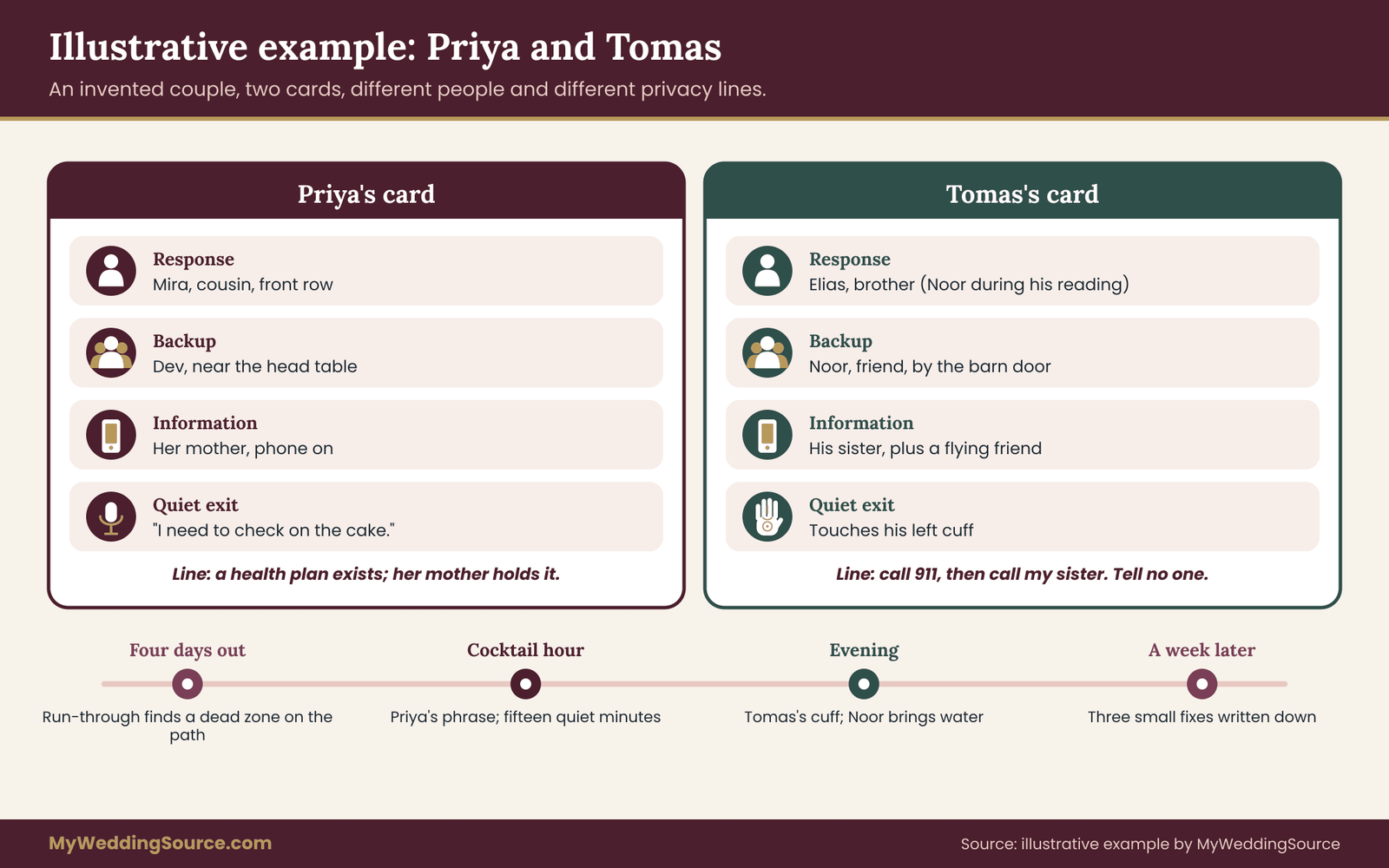
Priya and Tomas are planning a Saturday afternoon wedding for about eighty guests at a small vineyard venue with a ceremony lawn, a barn for the reception and a gravel path between them. Priya has a condition that is managed with medication at set times and that her clinician says can bring on sudden, severe tiredness.
She has a written plan from her clinician. Tomas has a different condition that can cause a sudden episode with little warning. He also has a written plan. He is private about it and wants as few people as possible to know the details.
Decision one: whether to use a shared card or two
They first tried to write one emergency contact plan card for the pair, listing each other as the first contact. When they read it aloud, they saw the problem. If Priya had a bad moment during the ceremony, Tomas would be standing next to her and expected to handle it. If Tomas had an episode during their first dance, Priya would be in his arms in front of eighty people. They agreed on two cards with different people.
Decision two: choosing response people
Priya chose her cousin Mira as her response person. Mira is a pediatric nurse, lives forty minutes away and would be in the front row of the ceremony. For backup she named her friend Dev, a college roommate who is calm and who would be near the head table. Tomas chose his brother Elias, a firefighter, as his response person, and his friend Noor as backup.
They noticed that Mira and Noor were both assigned to hold bouquets and arrange the guest book at the same time before the ceremony, and moved the guest book to a different volunteer. They also noticed that Elias was giving a reading during the ceremony, and arranged for Noor to be the person closest to Tomas during that block, with Elias moving in for the rest of the day.
Decision three: choosing information people
Priya’s mother, who is calm on the phone and keeps a copy of Priya’s clinician-written plan, became her information person. She will be at the ceremony and then at a table in the barn, and she has agreed to keep her phone on and to step out if called. Tomas picked a close friend from his hometown who knows his plan well and will be on a flight on the wedding day but on the ground before the ceremony begins.
That created a gap. After a short conversation they found a second information person, his sister, who lives nearby and has a copy of the plan.
The lesson in this decision is that the information role is the one most likely to fail on logistics. A person who will be in the air, in a dead zone or behind a locked phone is not an information person for those hours.
Decision four: the disclosure lines
Priya wrote: “Tell them I have a health plan, my mother holds it, and she can be phoned.” She was comfortable with that sentence going to the venue manager and the lead.
Tomas wrote: “Call 911, then call my sister. Do not discuss it with anyone.” He did not want the word “plan” said aloud in front of others. The couple agreed that this was his decision and that Priya would not ask for more detail on the day.
Decision five: the quiet exit
Priya’s quiet exit is a phrase she says to Mira: “I need to check on the cake.” Mira knows it means a rest in the shaded room off the barn. Tomas’s quiet exit is touching his left cuff, which Noor will see and answer by going to him with a glass of water. Neither signal means an emergency. Both mean a pause before one.
Decision six: what the venue gets
The venue manager receives a half page that says there are two response people per partner, gives the names and phone numbers of the response people only, names the entrance for an ambulance, and asks to confirm that the gate on the gravel path will be unlocked at the start of the event. It says nothing about conditions. The manager adds that the barn has an AED and that two staff are certified in first aid, and writes it in the reply. That answer goes on the day-of lead’s sheet.
The run-through of the emergency contact plan
Four days before the wedding, the six volunteers who are ring two for either partner meet for ten minutes at the venue. They walk from the ceremony lawn to the barn. They find that the gravel path has a spot with no signal, and the response runners agree to stand near it during the cocktail hour. They test the call to the information people. Tomas’s sister does not pick up because her phone is in a do-not-disturb mode. She fixes it on the spot.
They also find that the card for Priya was saved in Mira’s phone under a name that reveals nothing, which is correct, but that Mira could not remember the name of the folder. They agree to put a shortcut on the phone’s front screen.
What the emergency contact plan did in this invented case
On the day, nothing serious occurs. At the cocktail hour, Priya says her phrase about the cake. Mira goes with her to the shaded room, a nurse’s habit of checking in without making it look like a check. Priya rests for fifteen minutes and returns. No one at the wedding notices. Later in the evening Tomas touches his cuff, and Noor goes to him. After a few minutes he joins the dance floor again.
The card was used twice. Neither use needed 911. Both used the quiet exit, and the response people did their job by not making it a scene. That is the most common good outcome. If a true emergency had occurred, the next steps on the cards would have started: call 911, give the venue address and the entrance, call the information person, notify the lead.
What the couple would change in their emergency contact plan
In a review a week later, Priya and Tomas wrote down three changes for any future event. They would put the information person’s phone number on the back of the role card as well as the front. They would ask the venue for a radio for the lead, because the cell dead zone was larger than expected. And they would give the cousin who stepped in for the guest book a gift, since her quick change of plans was part of why the system worked.
Why this emergency contact plan case is useful, and where it stops
It shows the method working when both partners need cards, when privacy preferences differ, and when logistics try to overlap. It does not show every possible problem. A different couple might have a venue with no cell coverage at all, a partner who needs an interpreter, a destination wedding with no local clinicians, or a family that refuses to respect a privacy line. The next section covers failure conditions, and the sections after it show how to adapt.
When an emergency contact plan fails: failure conditions and alternatives
Any emergency contact plan can fail. Naming the ways it fails ahead of time is cheaper than discovering them on the day. For each failure below, there is an alternative that can be put in place for little or no cost.
Failure one: the response person in the emergency contact plan is unavailable
A person is in the restroom, on the phone, away from the room, or has had a drink too many. The backup is meant to cover this, but the backup may be far away too. The alternative is a short list of “nearby adults,” two or three people not on the card who have been briefed only on the call-first rule and the lead’s number. If neither response person is close, any of these can start the call, and the lead takes it from there.
Failure two: both response people are with the other partner
If both partners need help at once, which can happen when a shared trigger, such as heat or a long delay between meals, affects both, the emergency contact plan has a capacity problem. The alternative is a third pair of response people for the specific blocks of the day when both partners are most exposed. The lead can be one of them, with the understanding that the lead’s other duties wait.
Failure three: the information person cannot be reached
The phone is dead, in a dead zone or silenced. The alternative is two layers. First, a second information person, as Tomas had. Second, the partner’s own medical identification, which responders can find without anyone’s phone. The card should say which of these the partner has chosen.
Failure four: the card is lost or not at hand
The bag is in a car, the envelope is in a different building, or the phone is locked. The alternative is a redundancy rule: the response person memorizes the first three lines of the card, and the lead has a copy. Those lines are the trigger, the call-first rule and the information person’s number.
Failure five: a person talks
A helper, relative or vendor repeats what they know. This is the failure that damages relationships, not safety. The alternative is to reduce the damage in advance by sharing less, by choosing people who understand privacy, and by agreeing on a standard sentence for any question: “They are okay. It is being handled.” Practice the sentence.
Failure six: the emergency contact plan makes a partner feel watched
A card is meant to reduce anxiety, not add to it. If a partner feels hovered over, the card has become a burden. The alternative is to let the partner say how visible the response people are. Some prefer a person nearby but out of sight. Some want a quiet check at set times. Some want nothing until they ask. The partner owns the setting and can change it during the day.
Failure seven: the venue or a vendor will not cooperate
A venue refuses a modification, a vendor will not agree to stop filming, or a manager insists on a medical form. The alternative is to treat it as a contract and compliance issue, not an emergency contact plan issue. Ask for the policy in writing, check whether it matches the contract, and consider whether another venue or vendor is a better fit. The ADA site at ada.gov and the guides on this site give general information, and a lawyer can advise on a specific dispute.
Failure eight: the day itself changes
A schedule runs late, a ceremony moves indoors because of weather, a reception hall is changed. The response people’s locations on the role cards no longer match. The alternative is a five-minute check at each major change, led by the lead. It asks: where is each partner, where is each response person, and is the entrance still right?
{{INFOGRAPHIC:7}} ## A calendar for building your emergency contact plan, from months out to the day after
The emergency contact plan takes a few hours of real work, spread over several weeks. The work is easier when each step has a time. The calendar below assumes you start about three months out. If you have less, compress the middle steps, and do not skip the first and last.
Three months before: decide the shape
Each partner has a private conversation with their own clinician if they have one, to ask whether a written plan exists, whether it needs updating before the wedding and what a first aider should know. Ask also whether the wedding schedule itself raises any concern, such as a long gap between meals, a heat exposure, a time-zone change or a late night. Adjust the schedule if the clinician suggests it. This step belongs to the partner and the clinician, not to the planner.
At the same time, ask the venue for its emergency procedures and confirm the entrance, the AED and the staff first aid training. Add the venue’s answers to the day-of lead’s sheet.
Two months before: choose and ask for the emergency contact plan
Each partner lists candidates for the four slots: response, backup, information and backup information. Choose with the criteria from earlier. Ask each person privately, using the scripts. Allow a week for answers. If someone declines, thank them and move on, and do not take it personally. A decline at two months is far better than a gap at two hours.
Six weeks before: draft and reconcile the emergency contact plan
Each partner writes their own card separately. Then compare for overlaps in time, place and people. Adjust. Draft the role cards for the volunteers. Draft the half page for the venue and the one-page summary for the day-of lead. None of these documents names a condition.
Four weeks before: brief the people
Meet each volunteer, one on one or in a small group, and walk through the card and the role card. Share the phone numbers. Tell them the trigger, the call-first rule and the quiet exit. Do not go into medical detail beyond what the partner has chosen. Ask whether they have any concerns or conflicts on the wedding day. If they do, adjust now.
Two weeks before: the vendor handoff
Send the vendor requests: the pause request, the privacy request for the photographer, and the instruction that only the lead can ask for music to stop. Confirm the replies. Check the contract wording and, where needed, ask for a short written addendum. The same terms can go in a short written addendum that each vendor signs or confirms.
One week before: the emergency contact plan run-through
Hold the ten-minute rehearsal at the venue if possible, or by phone if not. Check phone numbers, signal, battery, the card’s location and the entrance. Print the final cards. Seal the envelopes. Deliver one to the lead. Make a short list of last-minute changes and decide who may authorize them.
The day before
Each partner checks their own plan’s practical points: medications and supplies packed, according to their clinician’s directions, meals and water on schedule, sleep, and a quiet hour. This is not part of the card, but it is the most effective preventive step in the whole plan. Confirm with each volunteer by text, and note anyone whose circumstances have changed.
The day itself
Keep it small. The lead has the envelope. The response people have the card and a charged phone. Each partner knows their quiet exit. Do not review the emergency contact plan again on the morning. If a partner feels worse than expected, tell the response person early and adjust the schedule, rather than waiting for a trigger.
The day after: closing the emergency contact plan
Thank everyone who had a role, in person if possible, and mention nothing about any episode in public. Shred the paper copies or return them to the partners. Delete the phone copies from the volunteers’ phones and ask them to confirm. A short review follows within the week. The card should not stay in other people’s possession longer than it needs to.
Special situations that change an emergency contact plan
The method above fits most couples. A few circumstances change it, and each is worth thinking about before you assume the basic version will do.
An emergency contact plan when only one partner has a need
The healthy partner still gets a card, because on the day they are the spouse, the host and sometimes the person expected to give a clear account to a dispatcher. Their card can be one line: the response person for them is whoever is near. The main change is on the other partner’s card. The spouse is a valid ring two person but not the sole response person, for the reasons covered earlier.
A mental health condition, stress or sleep loss
Some conditions respond to stress, lack of sleep or alcohol, all of which a wedding provides. The emergency contact plan works the same way, with attention to the quiet exit and the response person’s tone. A person who steps out because of rising anxiety needs a calm companion and a quiet room, not a scene. The response person should know that 911 is for true emergencies and that the partner’s own plan covers the rest.
If a partner’s plan includes a crisis line or a clinician contact, it lives in the information layer and not on the card. The 988 Suicide and Crisis Lifeline is a US service anyone can call or text for emotional distress, and a partner’s own clinician can say whether and how it belongs in their plan.
An emergency contact plan for a destination or multi-day wedding
Travel adds three problems. Local emergency numbers may differ outside the United States, hospitals may be far away, and the information person may be in a different time zone. For a US-based wedding with guests traveling in, nothing changes about 911. For a wedding abroad, find the local emergency number and the nearest hospital before the trip, and ask the partner’s clinician what to bring.
Add a local contact, such as the venue’s coordinator, as a ring three role. Plan for a pharmacy visit that may be harder than at home. Write the local address in the language of the country and in English.
For multi-day weddings, make one card per day or one card with a block schedule. Fatigue builds, and response people tire as well. Rotate roles if possible so that one person does not cover three days.
An emergency contact plan for a venue with poor coverage or access
Rural venues, boats, gardens and mountains often have gaps. The alternative is a landline or a radio, a named runner and a fixed rule about who goes to the one spot with coverage. Ask the venue where the landline is and whether staff carry radios. Plan for a longer arrival time for responders and say so in the card: the address, the gate code and the person who opens the gate.
A partner who uses a mobility device or has an energy limit
Here the emergency contact plan overlaps with the day’s physical layout. Routes, seating, rest spots and transportation between spaces matter. The venue questions from earlier apply here, and the wedding guest care planning guide covers the support arrangements for older relatives and children that sometimes share the same spaces. Make sure the response person knows the quickest step-free route to the nearest exit, not the shortest route on a map.
A partner who needs communication support
If a partner uses sign language, a device for speech, a support person or an interpreter, the card names the person who will be with them and explains how to reach them. A dispatcher can be reached by text in many areas, and the FCC and 911.gov describe where text to 911 is available. Where it is not, a voice call is the standard route. Add that detail to the card if relevant, and ask the response person to practice both.
Guests who know too much
Sometimes a guest, such as a relative or a doctor friend, knows a partner’s condition and offers to help. Accept the kindness, and give them a role that does not depend on knowledge, such as keeping a seat free near the aisle. If they step in during an episode with advice, the response person thanks them and states, “We have it handled.” A short, kind sentence ends the interference and protects the partner’s choice.
A wedding that is not a single event
Rehearsal dinners, welcome parties and next-day brunches are all part of the same stretch of fatigue. A partner who is steady on Saturday may be in a different place on Friday night. Treat each event as a block with a response person, and consider simplifying the schedule if the clinician recommends it. A lighter schedule is often the most effective protection of all. ## Your next steps
Work through these in order. Each takes less than an hour, and the first three can happen this week.
- Each partner, separately, writes down the three situations on a long wedding day in which they would want someone other than their spouse to step in. If the list is empty, make a one-page version and stop there.
- Each partner asks their own clinician whether a written plan exists and what a first aider should know. Take notes, and keep the clinician’s document with the person it belongs to.
- Ask the venue for its written emergency procedures, the ambulance entrance, the AED location and the staff first aid training. Put the answers on the day-of lead’s sheet.
- List candidates for response, backup, information and backup information on each card. Check that no one holds the primary response slot for both partners. Ask each person privately, with the scripts, and accept a no.
- Draft each partner’s emergency contact plan card on one side of one sheet. Write the trigger, the minimum disclosure line, the call-first rule and the quiet exit. Reconcile the two cards for overlap.
- Send the vendor requests: the pause rule, the privacy request for the photographer and the single point of authority for stopping music.
- Hold the ten-minute run-through, fix the weak step, print, seal and hand the envelope to the lead. After the wedding, thank the people and return or delete every copy.
If you are still shaping the wider schedule that this card sits inside, the wedding planning checklist helps you place each step among the rest of the work. And if you take away only one idea, take this one: the emergency contact plan is a routing tool, so that a very small number of calm people know where to go and whom to call. The rest of the day belongs to the two of you.
FAQ
Do we need an emergency contact plan if only one of us has a health condition?
Yes, a light version. The partner without a condition still takes on roles on the day that make them hard to reach, so a one-line card naming whoever is nearest is enough. The partner with the condition gets the full card, with a response person who is not the spouse. Writing the emergency contact plan down once, even briefly, costs an evening and removes guesswork.
Who should be the emergency contact in our wedding day emergency contact plan if my spouse is also getting married?
Name a response person who is physically close and not part of the ceremony at the key moments, and a backup who stands elsewhere. Your spouse can still be on the card as someone to be told. The point is that the first minute should not depend on someone standing at the altar or dancing in front of guests.
How much health information should our emergency contact plan give the venue and vendors?
As little as the task requires. A role and a location is usually enough: who is the response person, how to reach them and which entrance an ambulance should use. A diagnosis does not help staff act faster, and vendors are generally not covered by health privacy rules such as HIPAA, so anything you share stays with them by agreement only.
Should the response person in our emergency contact plan give any medication or treatment?
The card does not tell anyone to treat anything. If a partner’s clinician has written steps for a first aider, those belong in the clinician’s own plan, held by the information person, and should be followed only as the clinician wrote them. Otherwise the response person stays with the partner, calls 911 for anything that looks serious and follows the dispatcher.
What if someone we ask to join our emergency contact plan says no?
Thank them and move on. A no now is a gift, because it keeps a hole out of the plan on the day. Offer them a small, ordinary role instead. Make it easy to decline by saying so in the ask, and by saying that they can also withdraw later if their circumstances change.
Is a wedding emergency contact plan a legal document?
No. It is a planning agreement among volunteers, not a medical directive, a power of attorney or a contract. It does not give anyone authority over medical decisions. Questions about those documents belong with each partner’s own advisers. The card only routes people and phone calls, and it defers to emergency services and to the partner’s clinician.
In our emergency contact plan, when do we call 911 and when is the quiet exit enough?
The card sets the rule: if a situation looks like a true emergency, call 911 first and explain afterward. The quiet exit is for early signs, when a partner steps out to rest before anything escalates. If you are unsure which it is, treat it as the former. Dispatchers are trained to guide callers and prefer an early call to a late one.
How do we keep the emergency contact plan private after the wedding?
Ask each volunteer to delete the phone copy and return or shred the paper one within a few days. Keep each partner’s own plan with the partner. Share nothing in group chats or photos, and agree on one standard sentence for any question: “They are okay, and it is being handled.” Review the plan privately and update it for next time.
Sources
- Americans with Disabilities Act, U.S. Department of Justice
- HIPAA Privacy Rule overview, U.S. Department of Health and Human Services
- National 911 Program, 911.gov
- Make a plan, Ready.gov from the U.S. government
- First aid, CPR and AED training, American Red Cross
- CPR and emergency cardiovascular care, American Heart Association
- Federal Communications Commission, 911 and text to 911 information
- 988 Suicide and Crisis Lifeline
- Apple Support, Medical ID and emergency features
- Google Support, emergency information on Android