
Service service problems on a wedding day are the late arrivals, missing items, short staffing and broken promises that show up while the event is still running. This guide explains how to record those service problems calmly and accurately, with an impartial timeline, a photo checklist and a contract evidence list, so you can fix what can be fixed that day and still have clear proof afterward.
Fix first, record second, sort third. Name one trusted person as the Recorder so the couple never holds the phone. Use a five-line entry for each of the service problems: clock time, place, what was seen, what was said, and what happened next. Take three photos (wide, medium, close) only when it is safe and quiet to do so. Match each entry to a contract clause or a written message later. Stop recording the moment a guest could be hurt, and call the right emergency service instead.
Most couples picture a service failure as one dramatic scene. In practice a service problem is usually small and slow. A bartender arrives seventy minutes late. A rental order is missing four chairs. The sound technician says the cue was never in the run sheet. Nobody is shouting, and everyone is busy, so nobody writes anything down. Three weeks later the vendor remembers the day one way, you remember it another, and the only evidence is a blurry photo with no time on it.
The opposite mistake is just as costly. Some people respond to service problems by filming everything, confronting vendors with a phone in their hand, and turning a rough hour into a scene guests will remember. Careful service problem documentation should be nearly invisible. It should take less time than a bathroom break, cost the couple no attention, and read afterward like a neutral log written by someone with no reason to exaggerate.
This article is about that narrow skill, service problem documentation: recording wedding vendor service problems while the event is still happening, in a way that does not disrupt the party and holds up later. It does not tell you how to win a refund, how to write a review, or how to dispute a card charge. Those steps come afterward and are covered elsewhere on the site. Here the goal is simpler: leave the wedding with a record you trust.
A note on scope. This is general information, not legal, tax or financial advice. Rules about recording, contracts, refunds and consumer complaints differ by state and by situation, so where a rule matters, the article points you to the agency that publishes it.
What documenting service problems on the day actually means
For a service problem, to document means to create a record that someone who was not there could read and understand. That sounds obvious, but it rules out most of what people actually do. A text that says “worst DJ ever” is not documentation. A forty-minute video of a dance floor is not documentation either, because nobody will watch it and it shows nothing about what was promised.
A good record has four properties: it is dated, it is specific, it separates what happened from what someone thinks about it, and it can be matched to something in the contract or in writing.
Think of three layers that work together. The first is the timeline, a short list of entries with clock times. The second is the photo set, a handful of images that show the service problem in its setting. The third is the paper layer: the clause in the contract, the line in the run sheet, or the message from the vendor that shows what was supposed to happen.
Any one layer alone is weak. A timeline without paper reads like an opinion. Paper without a timeline shows a promise but not a failure. Photos without either are just pictures.
The word “impartial” matters here. Your record will probably be read by someone with no loyalty to you: a vendor’s manager, a card issuer’s reviewer, a venue’s insurer, a small claims clerk, or a mediator. If your entries read like a complaint letter, the reader discounts them. If they read like a log kept by a careful stage manager, the reader trusts them. That trust is the whole point of writing things in a flat, factual voice.
Not every disappointment is a service problem that deserves a record. A centerpiece that is slightly shorter than the mock-up, a song that ran a minute over, or a server who forgot a napkin does not need a log entry. The tools in this guide are for service problems that could matter later: something promised in writing that did not happen, something that cost the guests time or comfort, something that changed the schedule, or anything that could connect to money, safety or a damaged item.
A later section gives a simple severity ladder so you do not have to decide from scratch while a toast is happening.
For the broader job of running a vendor team on the day, the wedding planning checklist is the place to start, and this article assumes you already have vendors, contracts and a rough schedule. If you do not, build those first. Documentation cannot repair a plan that was never written down.
The order that keeps the party safe: solve, record, sort
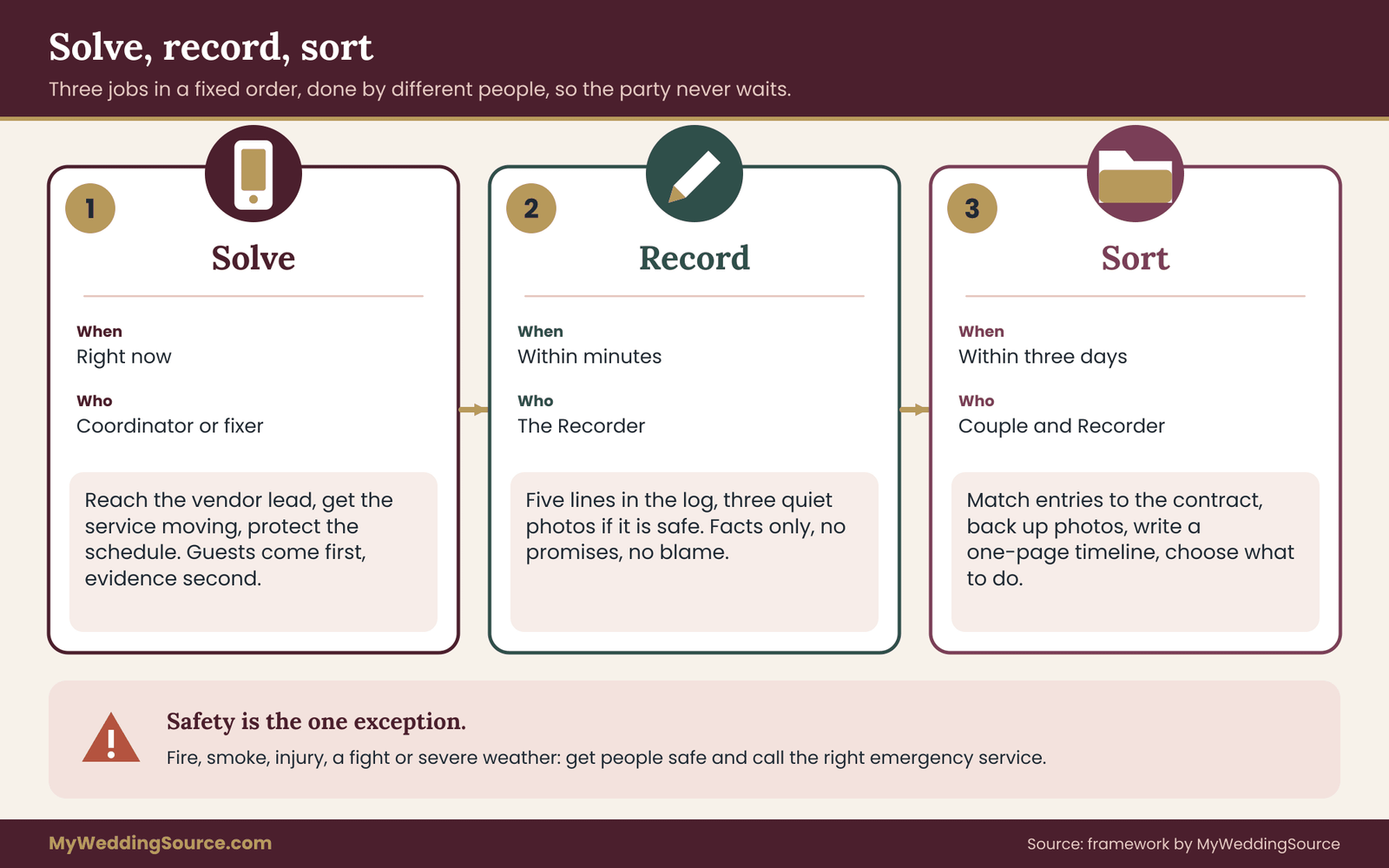
The most useful rule in this whole subject is a sequence. When something goes wrong, solve the immediate service problem first, record it second, and sort the evidence third. People reverse the first two all the time, and the party pays for it.
Solving comes first because guests and vendors are in the room now, and every minute of an unsolved service problem makes it bigger. If the bar has one bartender instead of two, the first task is a line for guests, not a photograph of the empty station. If the cake has not arrived, the first task is a call to the baker and a plan for the schedule, not a screenshot of the baker’s contract.
A good record never competes with a live fix. If you ever feel that taking a photo is slowing down a solution, put the phone away. You can reconstruct a photo’s worth of information later from the timeline, but you cannot undo a delay.
Recording comes second, and it should happen close to the event, because memory decays faster than most people expect. The goal is not a perfect record. It is a short one made within minutes, while the details are fresh: what time it was, where it happened, what you saw, what was said, what was done. A five-line note made at 6:15 beats a beautifully written account at midnight, and both beat a recollection three weeks later.
Sorting comes third and happens after the party. That means matching entries to the contract, collecting messages, backing up photos and deciding whether the matter needs a conversation, a request in writing or nothing at all. Sorting is where you decide what the record is for. Trying to decide that during the reception is a mistake, because on the day you do not yet know the full cost of the service problem.
A late caterer might look like a small delay at dinner and become a large issue once the venue sends an overtime charge.
Here is a worked illustration of why the order matters. A couple notices that the sound system is cutting out during the ceremony processional. The wrong response is to start recording audio and filming the technician while the music stutters. The right response is to have the coordinator or the Recorder quietly reach the technician, confirm the cable or the battery, and get the music running.
Only after the processional does the Recorder write the entry: time, place, what was heard, what the technician said, what fixed it. The entire documentation took ninety seconds and nobody in the room noticed.
There is one important exception to this order, and it is safety. If a service problem involves fire, smoke, a medical emergency, an unstable structure, severe weather, a fight or any threat to a person, you do not solve it and you do not record it. You call the appropriate emergency service and follow the venue’s emergency plan. Ready.gov publishes general emergency preparedness guidance, and the venue’s own safety procedures come first.
Photographing a hazard is only appropriate after people are safe, and only if it can be done without going near it. The wedding day digital contingency plan covers how phones, chargers and messaging should be set up so the rest of the team stays reachable when something fails.
One more point on sequence. Sorting does not mean you must act. Many service problems end with the vendor making it right on the spot, or with the couple deciding it is not worth a dispute. A record you never use costs almost nothing. A record you needed and did not make cannot be recreated. That asymmetry is why a brief, quiet note is worth the effort even when the service problem seems minor.
Which service problems deserve a record: a four-step severity ladder
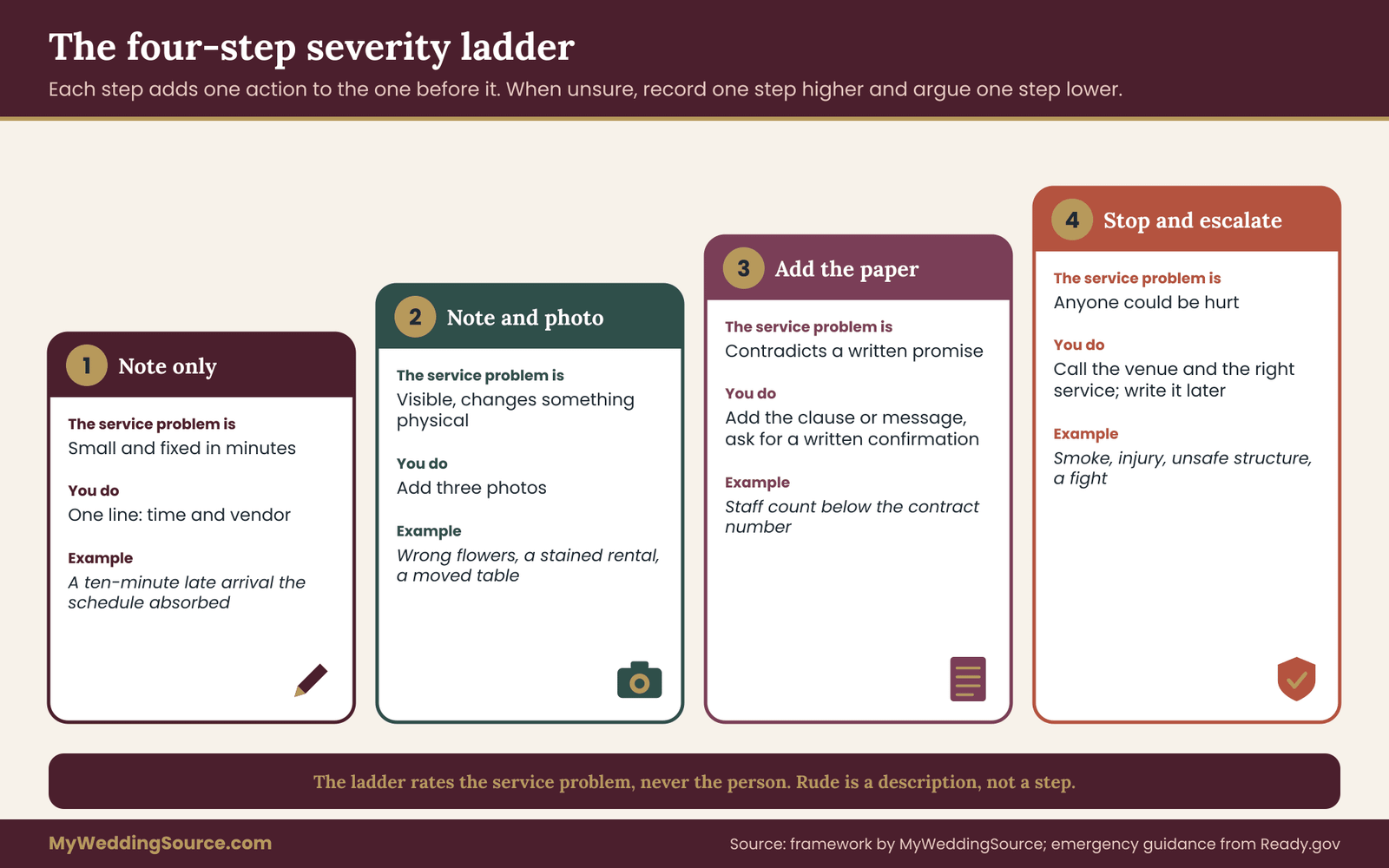
Because you will be deciding in a hurry, it helps to have a ladder you can run in your head. It has four steps, and each step adds one action to the one before it.
Step one: note only. The service problem is small, it was fixed within a few minutes, and no guest was affected in a way they would remember. Examples: a vendor was ten minutes late but the schedule absorbed it, a chair count was off by two and was corrected, a server spilled water and replaced the glass. Write a one-line entry with the time and the vendor name. This takes fifteen seconds and costs nothing.
Step two: note and photo. The service problem is visible, it changed something physical or the schedule, and it might be questioned later. Examples: the wrong flowers were delivered, a rental item was stained or broken on arrival, the dessert table was set up in a different place than the diagram. Write the entry and take the three photos described later in this guide. Keep the photos discreet and do not include guest faces if you can avoid it.
Step three: note, photo and a witness to the paper. The service problem contradicts something specific in writing, such as a staffing level, a start time, an item count or a service duration, and it affects a meaningful part of the event. Write the entry, take the photos, and also capture the proof of the promise: the clause number, the message thread or the run sheet line.
Ask the vendor’s lead on site for a short written confirmation of the facts, in whatever channel they use. If a replacement or a discount is offered verbally, ask them to put it in a message.
Step four: stop and escalate. The service problem threatens safety, involves an injury, involves police or an inspector, or could expose the couple or a guest to legal liability. Do not build a case in the moment. Get people safe, call the right service, and let the venue or the vendor’s insurer handle their own paperwork. You can write your entry afterward, in private.
The ladder keeps you from over-recording small service problems and under-recording large ones. It also gives the Recorder a rule to follow without asking the couple, which matters because the whole design is that the couple stays out of it. If the Recorder is unsure between two steps, the rule is to go one step higher on documentation and one step lower on confrontation. Write more, say less.
A final point about the ladder: it is about the service problem, not the person. A vendor who is rude is not automatically a step-three event. Rudeness that causes a missed cue or a guest complaint becomes a service problem with a description. “The server said he could not help” is a fact. “The server was terrible” is a judgment, and it does not belong in the log.
Choosing a Recorder so the couple never holds the phone
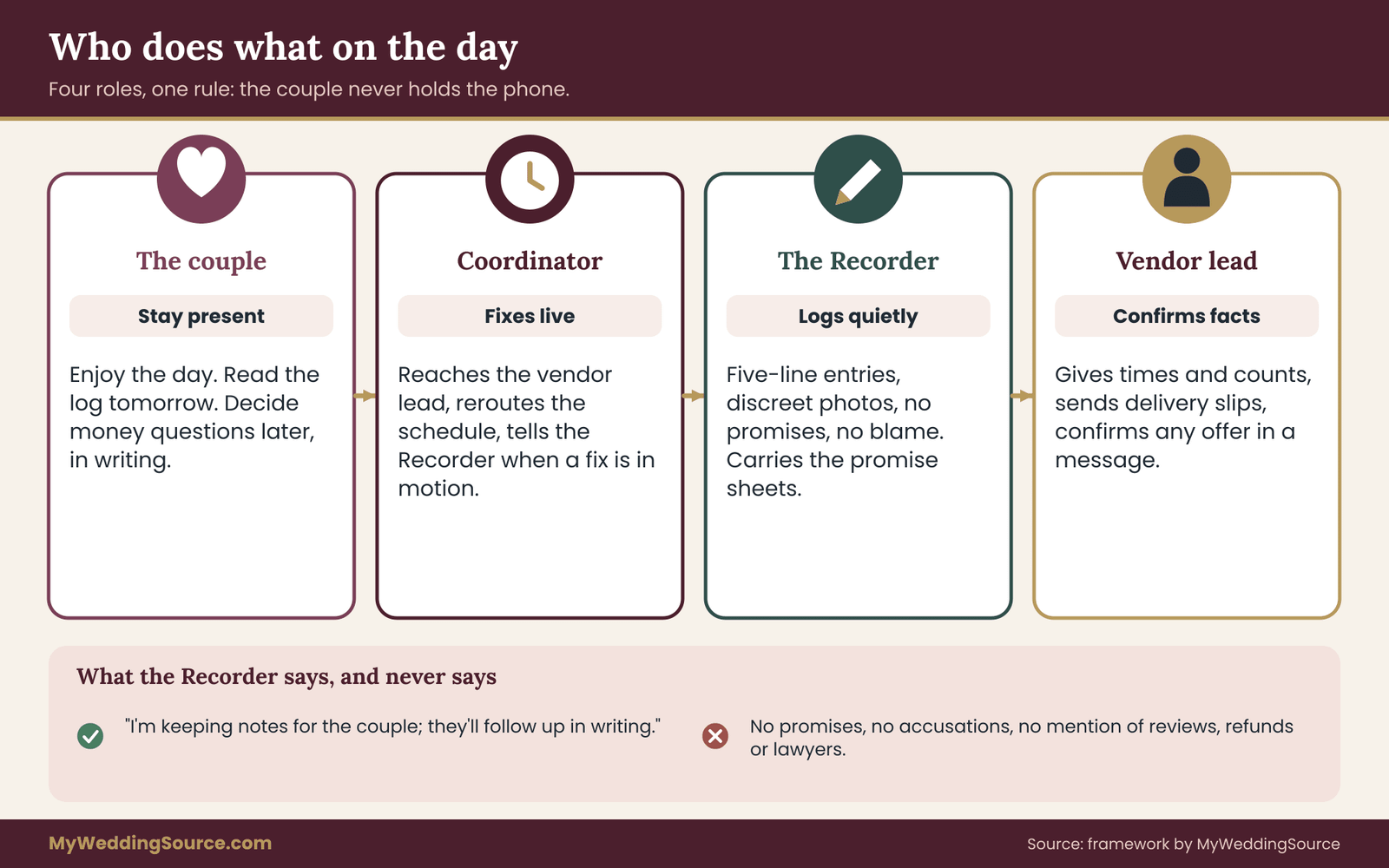
The single design decision that keeps documentation from disrupting the event is who does it. The couple should not. They are the guests of honor, they are being photographed, and a phone in the hand of someone about to walk down an aisle sends the wrong signal to every vendor in the room. Give the job of logging service problems to one named person, call that person the Recorder, and tell every other helper that this is the only person who logs service problems.
A good Recorder has five traits. They are present for most of the event but not tied to a task that cannot be interrupted, so a bridesmaid giving a toast or a parent hosting the head table is a poor choice. They are calm in a mild crisis. They can write briefly and plainly.
They are trusted by both partners. And they are not the person most likely to quarrel with a vendor. A cousin who loves the couple and is furious at the caterer will write an angry log. A friend who likes lists and does not take sides will write a useful one.
If you have a day-of coordinator or planner, the role often fits them, but check two things. First, ask whether their contract allows them to keep notes that you can later use. Some coordinators keep their own logs private, or they work for a venue and have a different loyalty. Second, ask whether they are already stretched.
A coordinator running the ceremony cue sheet may not have a free minute. In that case the coordinator handles live fixes and the Recorder handles notes, and the two should agree on a signal, such as a nod or a text, for “I need the time and the facts.”
What the Recorder carries is minimal. A phone with the camera and a notes app is enough. Some people prefer paper because it never runs out of battery and is visibly neutral: a small notebook with a pen, with each page headed by the date, can be handed over later without exposing the rest of the phone. Whichever you use, set the phone clock to automatic time and keep the notes in one place. Do not use six apps.
Give the Recorder a one-page hand-off card, printed or in a message. It should contain the vendor list with the name and mobile number of each on-site lead, the contract’s key times (arrival, start, end, breakdown), the key quantities (staff counts, item counts, durations), the names of the venue manager and the couple’s decision-maker for money questions, and the severity ladder in two lines.
The card means the Recorder does not have to ask the couple what was promised, which would pull the couple back into the service problem. The wedding vendor timeline page explains how to build the arrival and breakdown times that go on this card.
Decide in advance who the Recorder reports to, and keep that line short. The simplest rule: the Recorder tells the coordinator or the designated fixer about a service problem that needs a live solution, and writes about it in the log only after that handoff is made. The Recorder does not negotiate, promise a refund, accept an offer or argue about blame.
If a vendor starts discussing money, the Recorder says, “I’m only keeping notes today; the couple will follow up in writing,” and writes down what the vendor said. That sentence is worth practicing. It is truthful, it is polite, and it keeps the Recorder from creating a commitment by accident.
There is one more reason to name a Recorder in advance. Without one, everybody records a few service problems and nobody records enough. Three guests each take a photo of the late cake. The mother of the bride sends the coordinator a text. A groomsman posts a complaint in the group chat.
None of it is organized, some of it is public, and some of it contradicts the rest. A single service problem log written by one person in one voice is far easier to defend than six fragments.
Tell vendors that someone will be taking notes? Usually this is unnecessary and can create tension. But there are two situations where a quiet word helps. If you plan to take photos of a vendor’s equipment or work area, such as a catering prep space or a DJ booth, ask the venue or vendor lead when you can, since some areas have rules.
And if the Recorder will speak with the vendor’s lead on site, say a short, neutral introduction: “I’m keeping the day’s schedule notes for the couple.” Most professionals recognize this and accept it. Many keep their own logs for the same reason.
Last, write down who the Recorder is on the hand-off card, with a backup. If the Recorder is pulled into a family photo or gets sick, the backup picks up the same notebook. Pass the notebook physically if you use paper, or share the same notes document if you use a phone, so that the log is continuous instead of split.
The five-line entry: one minute per problem
Every entry should be short enough to write in about a minute and structured enough that anybody can read it. The format for each service problem has five lines. Use the same five every time, in the same order, so that your own memory and a stranger’s reading both work without effort.
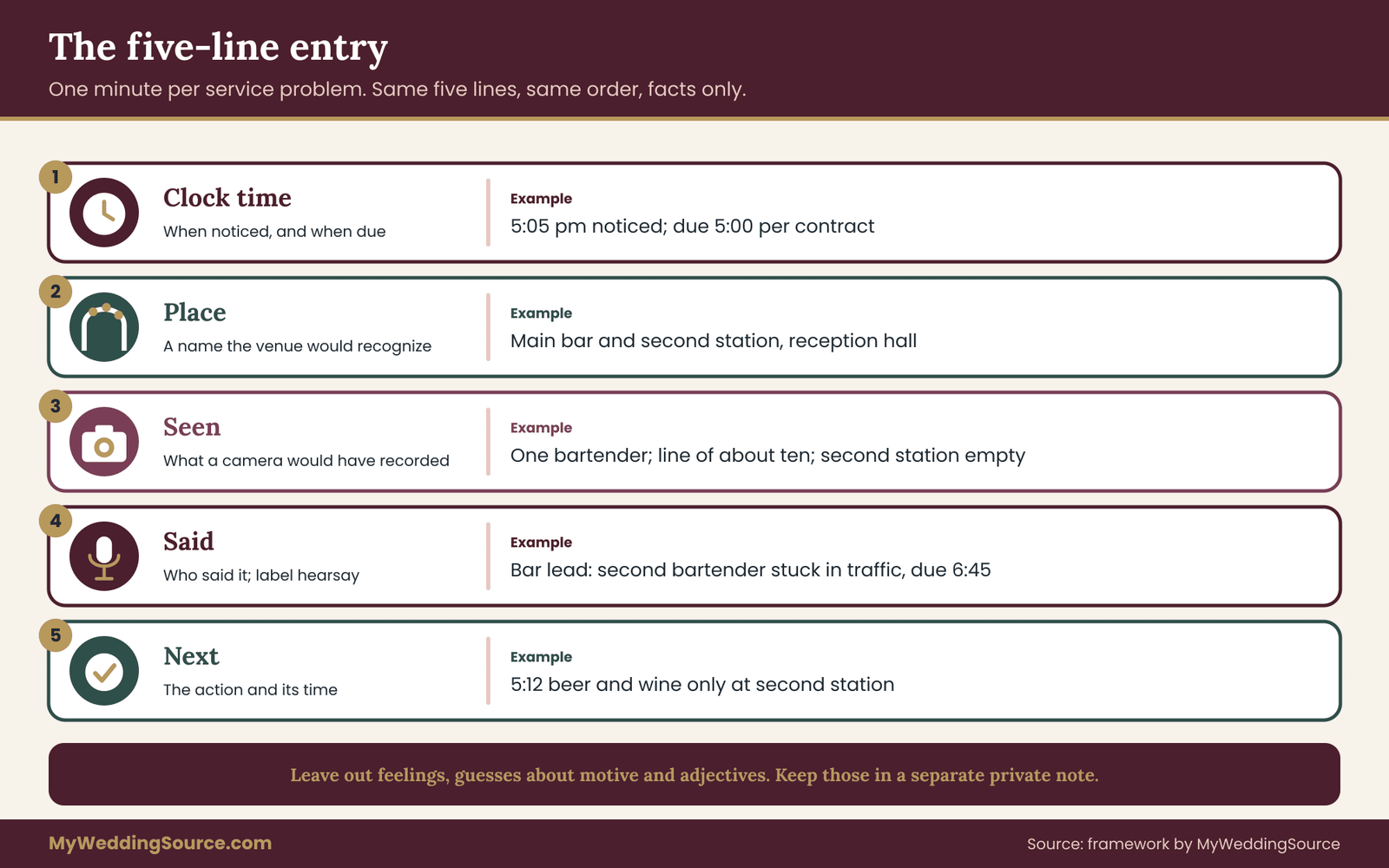
Line one: clock time. Write the actual time the service problem was noticed, in hours and minutes, and, if different, the time it began. “6:12 pm noticed; bartender due at 5:00 per contract” is better than “late.” If you do not know when it began, say so. “Unknown start; first seen 6:12.” Never guess at a time and present it as fact. A wrong time damages every other entry around it.
Line two: place. Write where it happened with a name that the venue would recognize: “main bar, east side of reception room” or “loading dock, door B.” This matters because venue staff, security footage and other vendors may be able to confirm what happened at that spot at that time. Avoid vague places like “over there.”
Line three: what was seen. Describe only what a camera would have recorded. “One bartender at the main bar; line of about fifteen guests; second bar unstaffed.” Numbers are welcome but only if you counted. If you estimated, write “about.” Do not write “the staff were slacking” or “the line was ridiculous.” Those are conclusions. The record should contain the observations they were based on.
Line four: what was said. Write who said what, in your own words, with the person’s name or role. “Bar lead said second bartender stuck in traffic, expected 6:45.” If the exact words matter, keep the quote short, under about fifteen words, and mark it as a quote. If you did not hear it yourself, write “reported by” and name the source. Hearsay is fine in a log as long as it is labeled.
Line five: what happened next. Write the action taken and the time. “6:20 coordinator moved cocktail service to one bar and added a drink ticket line; 6:50 second bartender arrived.” If nothing was done, write “no action yet.” This line makes the entry a story with an end instead of a complaint with no resolution, and it is the line that most often shows the vendor or the venue fixed the service problem quickly. That is good evidence too.
Some Recorders like to add a sixth line for the contract reference: “Contract section on staffing; message thread with the bar manager, dated in May.” This is optional on the day, since you may not have the contract open, and it can be added during sorting. What matters on the day is the first five lines.
Notice what is missing from the format. There is no line for feelings, for guesses about motive, or for what the vendor should have done. Those do not belong in the entry. If you want to vent, do it in a separate private note, and keep it away from the log. A log with commentary mixed into the facts loses credibility everywhere it is read.
Use short sentences. Use the vendor’s name or role, not “they.” Use numbers where you counted. Use the same words you would use to explain the service problem to a person who is not upset. If you are writing in the notes app, put the five lines under a single heading with the vendor’s name, so each vendor’s entries can be found later, and keep entries in time order within the log.
A few examples of tone, described rather than scripted. A good entry might report that the florist’s delivery arrived at the venue and the arch piece was not included, that the florist’s driver said it was in the second van and would arrive within the hour, that the coordinator held the ceremony setup of that area until the piece arrived, and that it arrived and was installed.
A poor entry says the florist messed up and the couple was upset. The first can be forwarded to the florist’s manager as it stands. The second cannot be forwarded to anyone.
Two habits make the five-line entry easier. First, write the entry as soon as the live fix is in motion, even if it is incomplete; you can add line five later in the same note. Second, keep a running “open items” line at the top of the log with service problems that are still unresolved, so that you remember to come back to them and the coordinator knows what is pending.
When an item is resolved, strike it and add the closing time. By midnight the open list should be empty or deliberately carried over to the next day.
Finally, back the log up before you sleep. A shared notes document that the couple’s trusted contact can read is fine, as is a photo of each notebook page. The wedding records guide explains how to keep the rest of the paperwork organized once the event is over, and the log should join that archive in the folder for vendor files.
Building an impartial timeline from your service problems entries
Single entries about service problems are useful, but a timeline is what a reader actually wants. It lays the day out in order and shows how one failure led to another, or how a quick fix prevented a bigger one. An impartial timeline is one that a vendor, a venue manager and a couple could all read and agree on the facts, even if they disagree about who is responsible.
Build it the day after the event, or within two days, while memories still match the notes. Start with the baseline: the scheduled times from the contract, the run sheet and the final timeline you sent to vendors. List each scheduled item with its planned time on the left. Then place your log entries beside them with the actual times. The gaps are the story. A planned five o’clock bar opening beside an actual six-fifty opening is a clear, neutral statement that needs no adjective.
Use only these building blocks: planned time, actual time, difference, source of each fact, and action taken. The source column is what makes a timeline impartial. For every fact, note whether it came from the Recorder’s direct observation, from a vendor’s statement, from a photo with a timestamp, from a venue record, or from a written message.
A fact with a named source is far harder to dispute than an unattributed one. If two sources disagree, record both and do not choose. “Bar lead said 6:45 arrival; photo timestamp shows arrival at 6:52” is more credible than “bartender arrived at 6:50,” because it shows you did not smooth the numbers.
Language matters as much as structure. Here are the substitutions that keep the timeline neutral. Replace “late” with the planned and actual times. Replace “refused” with what the person said. Replace “rude” with the exact thing that was said or done, or leave it out. Replace “ruined” with the specific consequence, such as “the cake was not cut until after the first dance.” Replace “obviously” and “clearly” with nothing; if it was obvious, the facts will show it.
Replace “always” and “never” with the number of times you actually observed. And replace “they” with the vendor’s name or role, because “they” can mean three companies at once.
There is one more rule for impartiality: include the things that went right. If the venue’s staff stepped in and fixed a service problem the vendor caused, put that in the timeline. If the vendor apologized and brought extra help, put that in too. Leaving these out makes a record look one-sided, and a one-sided record is easy to dismiss.
It also gives you a fairer picture of what you can reasonably ask for later. A vendor who failed to arrive on time but fully compensated in the room has a different story than one who ignored the service problem.
Keep the service problem timeline to one or two pages. If it runs longer, you are including things that do not matter, or you have not separated the key service problems from the minor notes. A useful split is a two-level structure: a short “summary timeline” with five to ten major items, and a longer “detail log” that holds every five-line entry. The summary is what you send to anyone who wants the story. The detail log is what you keep in case a question arises.
Add a brief header at the top with the date of the event, the venue, the names of the people who wrote the log, the sources used and the date the timeline was prepared. At the bottom, state what the timeline does not cover, such as periods when the Recorder was not present. That one sentence strengthens the whole document, because it shows that gaps are acknowledged and not hidden.
It helps to have another person read the timeline before it goes anywhere. Ask a friend who was not at the wedding to read it and tell you what happened. If they come away with a different account than you intended, the timeline is unclear or loaded. Fix the wording. This test works well because it mimics how a stranger will read it.
Finally, mark each entry with its place in the contract. If the bar was due at five, note the section of the agreement that says so. If you cannot find it, mark the entry “no matching clause found” and keep it anyway. A log entry without a contract match can still support a request for goodwill, and it may match a message thread you have not located yet.
The wedding vendor contract guide explains the clauses that most often define start times, staffing and substitutions, and it is a helpful reference when you are matching the timeline to paper.
The photo checklist: wide, medium, close and the page that explains it
Photos are the most persuasive evidence of a service problem and also the easiest to misuse. A good photo set shows the service problem, the place and the time. A bad one shows a guest’s face, an awkward moment or a vendor’s embarrassed expression, and it tells the viewer nothing about what went wrong. The goal is a small set of photos made quickly, with the phone held low and the screen dimmed, that nobody in the room notices.
Use the three-shot ladder for any step-two service problem or higher. The first shot is wide: it shows the whole area so that the viewer knows where this is. A wide photo of the reception room with the bar visible at the edge establishes place. The second shot is medium: it shows the specific thing in context, such as the bar with a single bartender and a line, taken from a few steps closer.
The third shot is close: it shows the detail that proves the point, such as the label on the wrong flowers, the dent in the rented table, the missing item on the order sheet, or the printed time on a delivery slip.
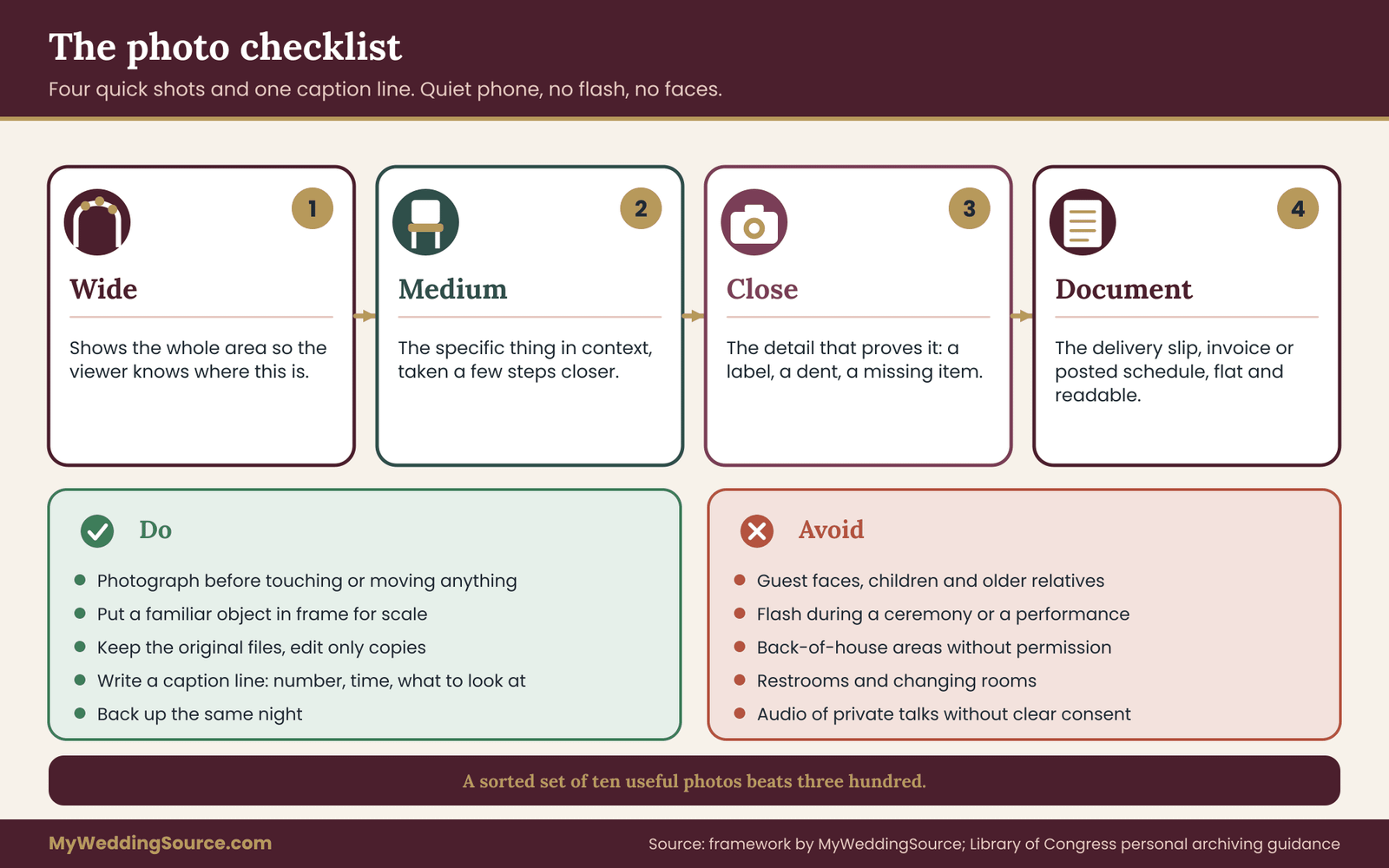
Add a fourth shot, the document shot, when paper is involved. A photo of the delivery slip, the vendor’s invoice, the posted schedule or the venue’s checklist links the service problem to a record that already exists. Take it flat and well lit so the text is readable. A document photo is often more valuable than any scene photo, because it comes from the vendor or venue and was not created by you.
Rules for taking the shots. Include a scale reference when size matters; a standard item like a chair or a plate, placed in frame, makes a damage photo meaningful. Photograph before touching or moving anything when the item might be damaged, because moving it can change the evidence and the damage claim. Take each shot more than once if the first is blurry, but do not take dozens; a sorted set of ten useful photos is better than three hundred.
Turn off filters and effects. Do not edit, crop heavily or annotate the originals. If you need to mark up a picture, make a copy and keep the original untouched.
Leave faces out where possible. Guests did not agree to appear in a complaint file, and a photo with a recognizable child, older relative or someone mid-drink will cause trouble if it is ever shared. Shoot at the table, the tray, the equipment, the setup. If a guest unavoidably appears, keep the photo private, and do not post it anywhere. The wedding photography consent guide covers guest boundaries and image use, and the same respect applies to evidence photos.
Be careful around vendors’ work areas and equipment. A catering kitchen, a DJ booth or a florist’s van may have restrictions, and a photograph of a person at work can feel like surveillance. Ask the venue manager or the vendor lead before photographing anywhere that is not a public part of the event, and if the answer is no, write a detailed note instead.
Never photograph inside restrooms, changing rooms or any private space. Never use a flash in a performance or ceremony. And do not hold a phone up to a vendor’s face while asking them a question.
On timestamps: phones usually save the date and time with each photo, which is useful, but the information can be altered or lost when the photo is shared by some messaging apps or edited by others. Keep the original files on the phone, and when you back them up, copy the full-resolution originals instead of sending them through a chat.
The Library of Congress publishes guidance on archiving personal digital files, and the same habits apply: keep the original, make copies, and label the folder with the date and vendor.
A short caption file completes the set. For each photo, write one line in the log: the file name or number, the clock time, what it shows and who took it. For example, “photo 4, 6:14 pm, main bar, one bartender, line of guests, taken by the Recorder.” You do not need to describe what is obvious from the image. You do need to say what the viewer should look at, because someone reviewing twenty photos months later will not remember the context.
Video deserves a word. A short clip of ten to twenty seconds can capture something that a still cannot, such as a speaker failing intermittently or a door that will not close. But video often captures sound, and recording audio of people without their knowledge is regulated in some places, with rules that differ by state.
The Reporters Committee for Freedom of the Press publishes a guide to state recording laws, and it is worth reading before you rely on any audio. When in doubt, take photos and write notes. They carry nearly the same weight with far less legal risk.
Finally, back up the photos the same night. Copy them to a second location, such as a laptop or a cloud folder, and do not delete anything from the phone until you have checked the copies open correctly. A photo that exists in only one place is one dropped phone away from disappearing.
The contract evidence checklist: tying service problems to the paper
A log of service problems shows what happened. The contract shows what was supposed to happen. Service service problems become actionable when the two line up, and the match is what the contract evidence checklist is for. You will use it during sorting, after the event, but you can prepare it before the wedding so the Recorder knows what to look for on the day.
Start with a one-page “promise sheet” for each vendor. Copy from the signed contract only the items that can be observed on the day: arrival time, setup start, service start and end, breakdown time, staffing numbers, equipment named, items and quantities, substitutions allowed, and any sentence about what the vendor will do if a service problem occurs. Put the section number or page next to each item.
A promise sheet is one page, not the whole contract, and it is what the Recorder carries. If the contract has no such detail, that is itself useful to know before the wedding. The wedding vendor due diligence checklist explains what to ask a vendor to put in writing before you sign.
Next, collect the changes. Contracts are often amended by email or text: a later start time, a swapped menu item, a different contact person, a reduced staff count. Each change that was accepted in writing counts as part of the agreement, or at least as evidence of what both sides understood. Gather those messages into one folder per vendor and note their dates.
The most common source of confusion in a service problem is a promise made in a message that nobody put into the contract. If the vendor’s own message says two bartenders, that message is strong evidence, sometimes stronger than the contract’s general language.
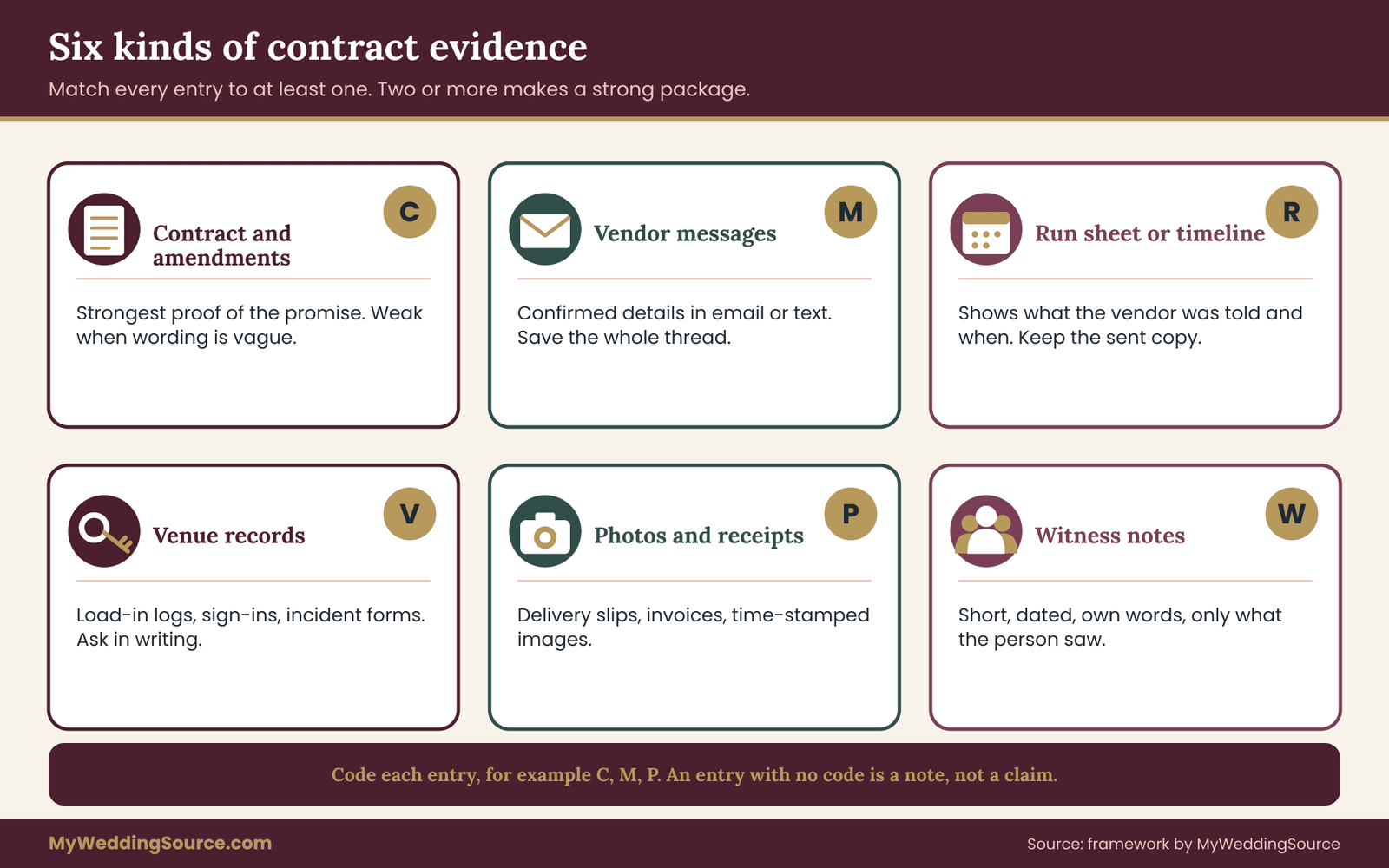
The checklist has six evidence types, and each has a typical weakness.
Signed contract and amendments. The strongest proof of what was promised. The weakness: general wording, such as “adequate staff” or “reasonable efforts,” gives little to measure. Look for numbers, times and named items.
Vendor messages. Emails, texts and portal messages in which the vendor confirmed details. The weakness: informal wording, and the chance that the vendor’s staff who sent them are not the staff on site. Save the whole thread, not a screenshot of one message, so the context is visible.
The run sheet or timeline you sent. Proof of what the vendor was told to do and when. The weakness: it proves you communicated, not that the vendor agreed. Keep the sent message with its date and the list of recipients.
Venue records. Load-in logs, security sign-ins, loading dock schedules and incident forms. The weakness: venues may not share them quickly. Ask the venue manager during the event whether you can have a copy of any record related to the issue, and request it in writing afterward.
Photos and receipts. Delivery slips, vendor invoices, signed receipts, photos with time stamps. The weakness: they show a moment, not a pattern. They work best paired with the log.
Witness notes. Short statements from a coordinator, venue staff member or guest who saw the issue. The weakness: memory and bias. Take them within a day or two, in the witness’s own words, with a date and a sentence about what the person saw directly.
Match each log entry to at least one of these. An entry matched to two or more is strong. An entry with no match can still be kept, but treat it as a note and not as a claim. Use a simple code in the log: C for contract, M for message, R for run sheet, V for venue record, P for photo or receipt, W for witness.
An entry coded “C, M, P” is a solid package. An entry coded with nothing needs more work before it is used.
Some clauses deserve special attention because they often decide what remedy is reasonable. A cancellation or termination clause, a substitution clause, a force majeure clause that excuses performance for events outside the vendor’s control, a limitation of liability, a requirement to report issues within a set number of days, and a clause on how disputes are handled. Read each one before you decide how to describe a service problem, because the contract may require notice in a particular form or within a particular window.
A report window of a few days is common in some service contracts, and missing it can weaken a claim. Check yours the first week after the event, not the third.
If a clause is unclear, do not interpret it in the log. Quote the short passage in the sorting notes, mark it “unclear,” and ask a qualified professional if the stakes warrant it. The wedding vendor purchase order checklist shows how to write the details of a purchase so that fewer clauses are unclear to begin with, and it is a good reference if you are still choosing vendors.
One caution about using the checklist as a weapon. The purpose is accuracy, not leverage. If the record shows that the vendor did what the contract required, say so in your own notes and accept it. If the record shows a service problem the contract does not cover, the right next step might be a polite request and not a claim. A calm, accurate record gets better responses from vendors than a stack of citations, and it is a better foundation if a formal dispute ever does follow.
What to say while you record: scripts for the room
Service problem documentation often fails at the human level, not the technical one. The Recorder can have a perfect notebook and still cause a scene by saying the wrong thing at the wrong moment. A few short, rehearsed sentences solve most of the awkwardness. Use them in a low voice, at the vendor’s level, away from guests, and keep the tone the same as you would use to ask where the restroom is.
When you first notice a service problem and want facts: “Can you tell me what’s happening with the second bartender? I’m tracking the schedule for the couple.” This is a question, it is neutral, and it states your role. Do not open with “why isn’t this done.” A question that starts with why often gets a defensive answer, which then becomes the first thing in your log.
When you need a time or a number: “What time do you expect the rest of your team?” and “How many are on site right now?” Write the answer, and if it is a time, check it later. If the vendor is vague, say “I’ll note that as ‘unknown’ for now.” Never pressure for a specific time to be sure you have a clean entry; pressure produces guesses, and a guess logged as a promise is worse than an honest blank.
When the vendor offers a fix: “Thank you. I’ll note that, and the coordinator will confirm the plan.” Do not accept or decline compensation. If a vendor says, “We’ll take something off the bill,” write the exact words, the speaker and the time, and reply, “The couple will follow up with you in writing.” This is not a rejection. It routes the money conversation to a calmer time and to the people who are authorized to decide it.
When a vendor asks you to stop taking notes or photos: comply in the moment, and write down the request. “Of course. I’ll leave it there.” Then record that the vendor asked you to stop, with the time. Do not argue about your right to document. A fight costs more than the photo is worth, and the written entry that you stopped when asked actually reads well later.
When a vendor becomes angry: lower your voice, step back, and end the conversation politely. “I’ll let you work. Thanks for your time.” Then leave, and write what happened. If the anger crosses into threats or physical intimidation, move to step four on the ladder: get to a safe place, tell the venue manager or security, and call the proper service if needed. A record is never worth a risk.
When a guest asks what’s wrong: “A small schedule change; we’re handling it.” This is truthful and brief. Do not name the vendor, do not discuss money, and do not describe the service problem. Guests will not remember a vague answer, but they will remember a detailed one that sounded like gossip.
When the couple asks what’s happening: tell them only what they need. The point of a Recorder is that the couple is spared the detail. A good update is one sentence about the status, one about whether anything is needed from them, and nothing else. “The bar is short one person; the coordinator has it covered; nothing needed from you.” If the couple wants to know more, the log will be there tomorrow.
Practice these lines out loud once with the person who will be the Recorder, the way a speech is practiced, so that the words are available under pressure. Also decide in advance what the Recorder will not say. The list is short: no promises, no accusations, no threats about reviews or refunds, no mention of lawyers, and no comparisons between vendors.
A single sentence that mentions a bad review can turn a cooperative vendor into a defensive one, and it can also create problems of its own, and a threat made in a heated moment may be remembered quite differently from how it was meant.
Finally, give the vendor a way to be helpful. People tend to cooperate when they are given something specific to do. “Could you send me the delivery slip when it’s ready?” or “Could you text the coordinator when your team arrives?” are small requests that generate paper evidence, and the vendor will often be glad to do them because they help the vendor too.
Many professional vendors keep their own incident notes for the same reasons. A matching record on their side makes a later conversation faster and calmer for everyone.
A worked case of wedding service problems, from first sign to sorted file
The following service problem example is invented, and it is here only to show how the method behaves under pressure. The couple, Imani and Theo, are hosting a hundred guests at a rented hall. Their contract with the bar company lists two bartenders from 5:00 pm to 10:30 pm, and a signed amendment changes the bar setup time to 4:00 pm. Their cousin Rosa is the Recorder. The coordinator, Ben, handles live fixes. Rosa carries a promise sheet that lists the bar details and the section numbers.
At 5:05 pm, cocktail hour opens. Rosa sees one bartender at the main bar and none at the second station. She does not walk over with her phone out. She finds Ben and says, “The bar contract says two bartenders from five, and I see one. Can you check?” That is the first rule at work: a live fix goes to the fixer, and the record waits for a quiet moment.
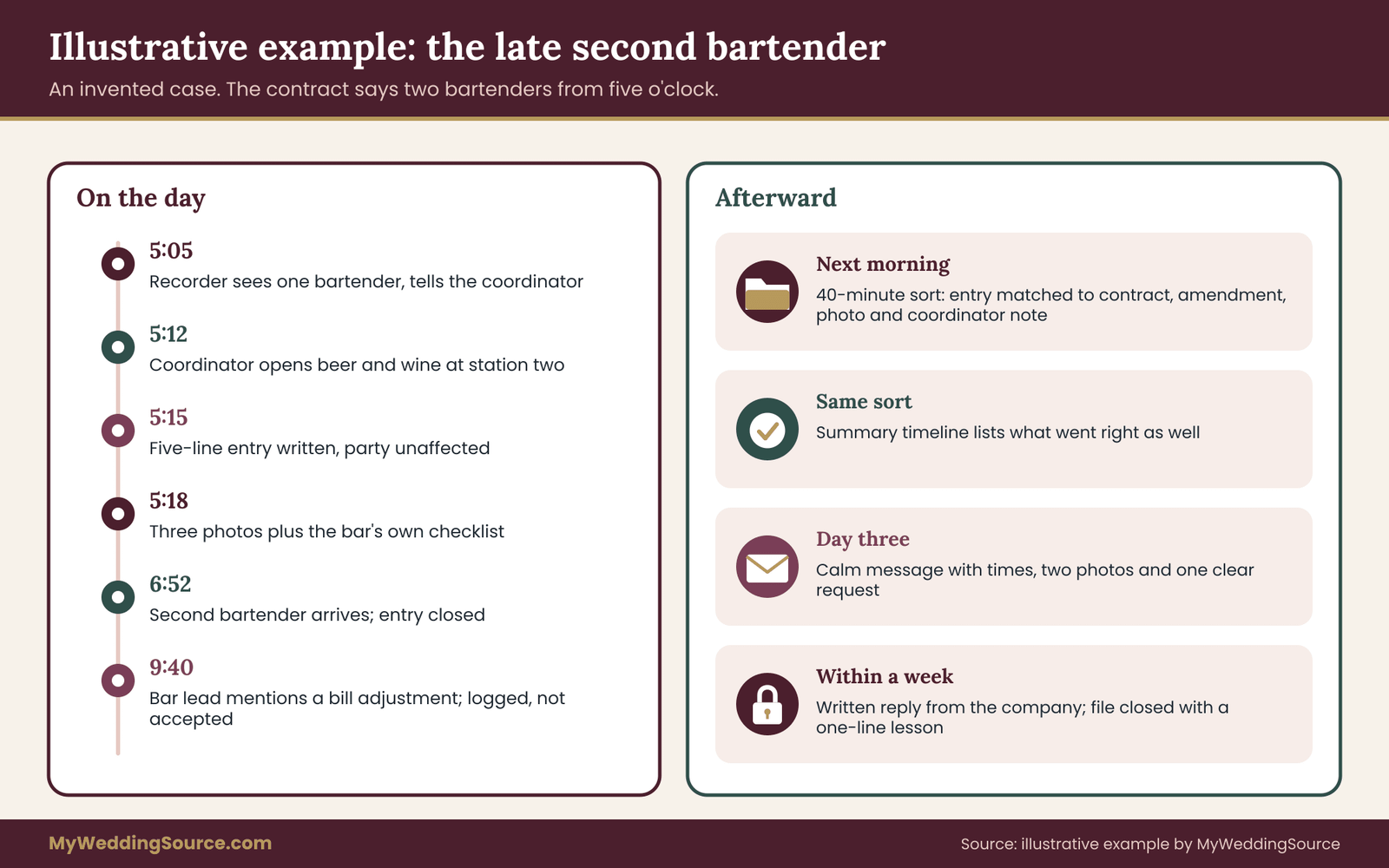
Ben speaks with the bar lead, who says the second bartender is delayed by traffic and expected around 6:45. Ben asks the lead to open the second station for beer and wine only, using the one bartender’s help, and to have a single signature cocktail menu for now. He also moves a few servers to pass drinks during the first part of the hour. Guests barely notice. Rosa, at 5:15, steps to the side of the room and writes the first entry.
Clock time: 5:05 noticed; bartender due at 5:00 per bar contract and amendment. Place: main bar and second bar station, reception hall. Seen: one bartender at main bar; line of about ten guests; second station unstaffed. Said: bar lead told Ben the second bartender was stuck in traffic, expected 6:45. Next: 5:12 Ben moved to a beer and wine option at second station and added passed drinks; no change to the schedule.
Rosa takes three photos at 5:18: a wide shot of the room with the bar in the corner, a medium shot of the main bar from the side showing the line without faces, and a close shot of the unstaffed station with its sign. She also photographs the bar contractor’s delivery checklist, posted on the bar, which lists the staff count. The checklist photo links the vendor’s own paperwork to the service problem.
At 6:52, the second bartender arrives. Rosa notes it, adds the arrival time to the first entry, and marks the item closed. She also writes what went right: the bar lead stayed in contact, the coordinator’s plan kept lines short, and the first guest complaints came after 6:00. At 7:30, the bar runs out of lime juice for the signature drink. This is a second, smaller entry, step one on the ladder, with a time and a line about the replacement.
At 9:40, the bar lead tells Rosa that the company will “make it right on the final bill.” Rosa writes the words, the speaker and the time, and answers with the sentence from the script: “The couple will follow up in writing.”
The next morning, Rosa and Theo spend about forty minutes on sorting. They match entry one to the contract section on staffing (C), to the amendment email (M), to the delivery checklist photo (P) and to Ben’s brief written note (W). They create a summary timeline with the planned five o’clock bar, the actual six-fifty full staffing and the actions taken.
They add a line that says the venue manager was not asked for records. They note that the verbal offer on the final bill is unconfirmed, and they decide to ask for it in writing.
Within three days, Theo sends a message to the bar company, copying the sales contact named in the contract. It states the planned and actual times, attaches two photos and the amendment, mentions the verbal offer by name and time, and asks what adjustment the company proposes. It does not mention reviews, does not claim a specific sum, and does not call the vendor anything.
The company responds in writing within a week. Whatever the outcome, the record is clean, and it would hold up if a card issuer or a mediator were ever to read it.
What does the example teach? First, the live fix and the record were done by different people, so neither slowed the other. Second, the entries separate observation from statement. Third, the photos included the vendor’s own paperwork. Fourth, the Recorder accepted no offers and made no promises. Fifth, the notes included what went right. Sixth, the sorting took under an hour because the entries were already structured.
Now change one condition to see where the method strains. Suppose the bar lead had said he did not know when the second bartender would arrive, and the first bartender began to look overwhelmed. The ladder moves up when the service problem lasts: after about thirty minutes with no known arrival time, the Recorder should ask the coordinator to treat it as a step-three event, take the additional steps of asking the lead for a written confirmation of what he said, and note the guest wait times.
Documentation intensity follows duration and impact, not just the first impression.
Change another condition. Suppose the Recorder had been Theo’s mother and she had written, “The bartenders were useless and ruined cocktail hour.” The facts in that sentence are a single late arrival and a long line. The judgments add nothing but risk. A reader would discount the whole entry. That is why the five-line format has no place for adjectives, and why the Recorder is chosen for temperament as much as for availability.
A third change: suppose the contract had said only “adequate bar staff.” Then the promise sheet would have no number to match, and the amendment would be the only hard evidence. The couple would rely more on the vendor’s own checklist, on the delivery message and on the facts about guest wait times. The lesson for next time is to ask for numbers in writing before the wedding. Contract review belongs early in the schedule, when numbers are still easy to add.
One more point about this example of service problem documentation. The couple did not know on the day whether they would ask for anything. They simply kept the option open. That is the point of the method. The record cost a few minutes during the party and about an hour afterward, and it gave them a choice that they would not have had otherwise.
Alternatives when your own record is thin
Sometimes the Recorder was not available to log the service problem, the phone died, or the service problem happened in a place you could not see. The absence of your own notes does not end the matter. It means you gather the record from other sources, and you do it quickly. The alternatives are listed from strongest to weakest, and each has its own conditions.
Venue and coordinator logs. Many venues keep a timeline, an incident form or a load-in record. Many professional coordinators keep a timeline of the day. Ask for a copy in writing the day after the event. Be specific: “the load-in record for the vendors on this date,” not “any documents.” Venues are not required to share internal records in many cases, but many will share a summary. If the coordinator’s contract allows, ask for their notes on the specific time window.
The vendor’s own records. Delivery confirmations, dispatch logs, driver check-in times, staff scheduling, point-of-sale reports and equipment checklists often exist. You can ask for them politely, by naming the specific item: “Could you share the arrival time your driver logged?” Vendors who are confident in their service often share them. Vendors who decline are telling you something, but write the response, not the guess.
Third-party records. Text messages with timestamps, phone call logs, rideshare or traffic data for a late vendor, photos that other people took with metadata that happens to show the time. Your own call log can show when you phoned a vendor and for how long, which establishes a timeline even when no notes exist.
Wedding photographer and videographer files. Their images carry time stamps and often catch the scene by accident: an empty bar, a missing item, a late setup. Ask the photographer in writing whether you may have specific images, and be clear that you are not asking for a change in the contract. Photographers often have rules on sharing out-of-gallery images, so ask politely. The photographer is also a vendor, and if the photography itself is the service problem, the evidence must come from somewhere else.
Guest statements. A short written account from a guest who saw the service problem can support your account, but it is the weakest in most cases. Ask only if the guest volunteers, ask them to write only what they saw, and do not feed them details. Guest accounts that read like your own notes are discounted.
Reconstructed notes. If you have nothing else, write a reconstruction now, label it as such, and include the date you wrote it. A reconstructed note is honest evidence of your recollection, and many readers accept it for what it is. Do not backdate, and do not present it as written on the day. Many disputes have been weakened by one false date.
A final alternative is to accept that the record is thin and handle the matter as a request instead of a claim. A polite message that states what you recall, asks what the vendor’s records show, and invites a fair adjustment can work even with no photographs. Thin records and short, honest requests go together well. Overclaiming with a thin record does not.
Privacy, recording laws and guest boundaries around service problems
Service problem documentation involves other people, and it can run into law and good manners. This section covers the areas that most often cause trouble, in the order you are likely to meet them. None of it is legal advice, and the rules vary by place, so use it to know what to ask and where to look.
Audio recording. In the United States, laws about recording conversations differ by state. Some states allow recording if one participant consents, and others require consent from everyone in the conversation. Some also treat a conversation differently depending on whether the people have a reasonable expectation of privacy. Because of that variation, a recording of a private talk with a vendor can be unusable or even unlawful in some places.
The Reporters Committee for Freedom of the Press publishes a state-by-state guide, and it is a reasonable first stop. For wedding service problems, the practical rule is simple: write notes, take photographs, and do not record private conversations without clear permission.
Video of guests. Wedding guests are in a semi-private setting, and they have not agreed to appear in a complaint. Filming the dance floor to prove that the music was too quiet will capture dozens of faces. Avoid it. If a video is truly needed, such as a short clip of a broken speaker, frame the equipment and not the people, keep it brief, and store it privately.
Vendor staff. Employees are working, and many are anxious about being blamed. Avoid photographing people at work in ways that identify them. Photograph the item, the station, the label, the paperwork. If a name tag appears in a photo, that is acceptable, but do not zoom on it. In your notes, use the role or the first name that the person gave you, not a description of the person.
Children and vulnerable guests. Do not include them in any evidence photo. If a service problem affected a child or an older relative, such as a missing meal for a dietary restriction, write the facts without names, and keep the details inside the family.
Venue rules. Some venues restrict photography in kitchens, back-of-house corridors, storage rooms or security areas. Others require permission to photograph their equipment. Follow the rules. A photograph taken in violation of a venue rule can create a separate problem for you, and it can make the venue less cooperative about releasing its own records.
Where the record goes. Keep the log and photographs in private storage, shared only with the people who need them: the couple, the Recorder, a trusted adviser, and later the vendor or the issuer when you decide to send something. Do not post excerpts on social media, group chats or review sites while a matter is open. Public comments can turn a private disagreement into a public one, and anything you post can be read by the other side.
If you plan to write a review, wait until the matter is resolved and write from the facts. The Federal Trade Commission explains the Consumer Review Fairness Act, which limits certain contract clauses that try to stop honest reviews, and it is worth reading before you sign any contract that mentions reviews.
Data security. The log and photos may contain names, phone numbers, contract amounts and venue details. Treat them as you would any personal paperwork. Use a passcode on the phone, a strong password on the cloud account, and do not email the whole archive when a single page will do. The Cybersecurity and Infrastructure Security Agency publishes plain guidance on backups and account protection.
There is one more boundary to keep in mind: the couple’s own conduct. If a service problem tempts you to share a vendor’s private details or insult them in public, pause. A calm, documented complaint is more effective than an online outburst, and a measured tone is a good habit when the record may be read by someone neutral. The best use of documentation is to prevent a conflict from growing, not to prepare for one.
When documenting service problems backfires: failure conditions
Any method has conditions under which it stops working, and service problem records are no exception, and an honest guide should list them. Documentation of service problems can fail, or even cause harm, in several recurring ways. Knowing them in advance lets the Recorder stop before it is too late.
It slows the fix. If the Recorder is the only person who can reach the vendor and is busy writing, the service problem lasts longer. The cure is the rule that live fixes come first, and the role split that gives the coordinator the fixing and the Recorder the notes. If there is no coordinator and one person must do both, fix first, record in two minutes afterward.
It is seen. A Recorder who films a vendor, argues about evidence or hovers with a notebook can sour a team in the middle of service. The cure is discretion: short notes, three discreet photos, no running commentary. If a vendor objects, stop and write that down.
It is partial or slanted. A log that records every vendor error and none of the vendor’s recoveries will be discounted. The cure is the impartial timeline rule: include what went right, label sources and write only observations.
It is inaccurate. A wrong time, a guessed number or a misattributed quote harms every other entry. The cure is the habit of writing “about,” “unknown” and “reported by” when you are not sure. A log with honest gaps beats one with confident errors.
It is late. Contracts sometimes require notice of a service problem in a short window, and a record that lies unused for three weeks may miss the window. The cure is to read the notice clause during sorting and send any needed message promptly, even if it is brief.
It is public. Evidence shared in public channels can expose guests, break a venue rule or provoke the vendor. The cure is to keep the file private until a decision is made about who should receive it.
It substitutes for a real conversation. A thick folder is not a remedy. Some service problems are better solved with a phone call and a handshake, and a vendor who is treated like a defendant may stop cooperating. The cure is to decide, after sorting, whether a documented request or a simple conversation is the right next step.
It hides a safety problem. If the Recorder is photographing a blocked exit or a faulty extension cord while guests are nearby, the priority has been inverted. The cure is the step-four rule: stop recording, tell the venue and call the appropriate service. Ready.gov provides general guidance on emergency preparedness, and the venue’s emergency plan takes precedence.
It becomes a grievance project. Some couples find that keeping a log shifts their attention to everything that went wrong, even after the party has ended. If the record starts to feel like an obsession, give it a boundary: one sorting session, one decision, one message if needed, then close the file. The wedding is the thing to remember, not the log.
Use these conditions as a pre-mortem for your own service problem plan. Before the wedding, read the list aloud with the Recorder and the coordinator and ask, for each, “How would we notice, and what would we do?” That ten-minute conversation is itself a form of documentation, because the answers can be written on the hand-off card.
The full planning checklist is a good place to add the Recorder, the hand-off card and the sorting appointment to your master list so they are not forgotten in the last week.
Finally, remember that documentation is one tool among several. Good contracts, clear run sheets, a reliable coordinator and a well-chosen vendor team prevent most service problems and soften the rest. The record is the safety net, and nobody plans a wedding around the net. Keep it light, keep it accurate, and let the day be a wedding.
The first seventy-two hours: sorting your service problems file
The day after the wedding, with every service problem still fresh in the log, most couples are tired, happy and not ready to think about vendors. That is fine. The sorting session does not need to happen that morning. But it should happen within about three days, because memories are still sharp, notice windows may be short and vendors are still reachable. Block one hour, with the Recorder if possible, and follow the same steps each time.
Step one: collect. Gather the log, the photos, the promise sheets, the contract, the message threads and any notes from the coordinator. Put copies in one folder named with the date and the word “vendors.” Do not rename or edit the originals. Check that every photo opens and every page of the notebook is legible.
Step two: sort entries by vendor. Group the five-line entries under each vendor and read them in time order. Mark each with its evidence code: contract, message, run sheet, venue record, photo or witness. Draw a line under any entry that has no match and decide whether it is a note or a possible claim.
Step three: write the summary timeline of each service problem. One page per vendor, or one page in total if there were only two or three entries. Planned time, actual time, source, action. Include what went right. Have a person who was not at the wedding read it and tell you what they understood.
Step four: check the notice clause. Read the contract for any requirement to report service problems, the form of notice, the time window and the person to contact. If a window is short, send a brief message now and add detail later. A notice that says “we are reviewing the day and will send details by a stated date” is acceptable in many situations and keeps your options open.
Step five: decide what each matter is. There are four possible outcomes. Close it: the service problem was fixed, no claim. Thank and note: the vendor handled it well, and your notes say so. Request: ask politely for a specific adjustment or an explanation. Dispute: the matter involves a payment, a damaged item or a serious breach, and requires a more formal process, possibly including your card issuer or a consumer agency.
Most matters are the first three. Choose on the facts and the cost, and do not let the size of your folder choose for you.
Step six: back up and file. Copy the finished folder to a second place and add it to your wedding archive. A good wedding records archive has retention and access rules, and this folder belongs in the vendor files family. Keep it at least until the vendor file is closed, all payments are settled and any deadlines have passed. Many people keep the final summary much longer.
If the matter involves money, a few general pointers apply, and the details belong with the agencies that publish them. If you paid by credit card, the Fair Credit Billing Act sets a process for disputing billing errors, and the usual rule is that written notice must reach the issuer within sixty days after the statement with the charge was sent. The Federal Trade Commission and the Consumer Financial Protection Bureau explain how the process works.
If you need to complain about a business, USAGov lists ways to file a consumer complaint, and the Better Business Bureau accepts complaints and passes them to businesses. A state or local consumer protection office may also help. None of these is a guarantee of an outcome, and none replaces advice from a qualified professional when the amount at stake is large.
Keep your tone about a service problem in writing the same as your tone in the log. State the planned and actual facts, attach two or three of the best photos and the key contract page, mention any verbal offer by speaker and time, and make one clear request with a reasonable date for reply.
Do not threaten. Do not list every grievance. A short message that a stranger could understand in a minute tends to get further than a long one. For the structure of a contract that makes this easier in the future, this guide to the vendor contract terms is a helpful companion.
Last, close the file on purpose. When the matter is resolved, or when you decide to let it go, write one line in the log: the date, the outcome and anything you learned. Then store it. The lesson is often the most valuable part: ask for numbers in writing, name an on-site lead, add a call time, and write a Recorder into the plan. Those changes help the next event, whether it is your own anniversary party or a friend’s wedding that you help to plan.
Your next steps
Do three things this week, long before the wedding if it is still ahead. First, choose a Recorder and a backup, and give them a one-page hand-off card with vendor leads, key times, staffing numbers and the severity ladder. Second, build a promise sheet for each vendor from the signed contract, listing only what can be observed on the day. Third, rehearse the scripts once and agree on the rule: fix first, record second, sort third.
If your wedding has already happened, gather what you have today. Write the first timeline from your memory and any messages, label it as reconstructed, and check the notice clause in each contract. Then decide, vendor by vendor, whether the matter is closed, a thank-you, a request or a dispute. A calm record of your service problems will not change what happened, but it will let you decide what to do next from facts and not from frustration.
FAQ
Should the couple document service problems themselves on the wedding day?
Usually not. The couple should be present for the day, and a phone in their hands can strain relationships with vendors and distract from the event. Name a trusted Recorder who takes short notes and a few discreet photos, and pass urgent issues to the coordinator. The couple can read the log the next day and decide what, if anything, to do.
How much detail does one entry need?
Five short lines are enough: clock time, place, what was seen, what was said and what happened next. Use only facts you observed or heard, and label anything reported by someone else. Add the contract reference later, during sorting. If an entry takes more than a minute, you are probably adding opinions or details that do not matter.
Is it legal to record a vendor’s phone call or conversation?
It depends on where you are. In the United States, state laws differ: some allow recording when one person consents, and others require everyone to consent. Because of that, the safest approach is written notes and photos, with audio only when everyone clearly agrees. For a plain overview of state rules, check the Reporters Committee for Freedom of the Press.
What if the vendor asks me to stop taking photos?
Stop, politely, and write down that the request was made, with the time. Arguing costs more than the photo is worth, and the note that you complied helps show a fair, calm record. You can document through written notes and through the vendor’s own paperwork, such as delivery slips, instead.
Should I post photos or comments about a service problem online?
Not while the matter is open. Public posts can expose guests, provoke the vendor, break a venue rule and weaken a later request. Keep the file private, resolve the matter first, and write any review afterward from the facts. The Federal Trade Commission explains how the Consumer Review Fairness Act treats honest reviews.
How soon should I send a complaint after the wedding?
As soon as you have sorted the facts, ideally within a few days. Read the contract for any notice window, because some require a report within a short time. If you paid by credit card, billing disputes generally need written notice within sixty days of the statement. A brief message that promises details later can preserve your options.
What if I have no notes at all?
Write a reconstruction now and label it with today’s date. Then gather other sources: venue or coordinator records, vendor delivery logs, message threads, call logs and the photographers’ time-stamped images. Ask politely and in writing. A thin record is best used for a calm request, not a claim, and it should never be backdated.
When should I stop documenting and call for help?
When any guest could be hurt: fire, smoke, a medical emergency, a fight, unsafe structures or severe weather. Get people safe, alert the venue and call the right emergency service first. Ready.gov offers general preparedness guidance, and the venue’s emergency plan comes first. Photographs and notes can wait until everyone is safe.
Sources
- Ready.gov, emergency preparedness and planning, Federal Emergency Management Agency
- File a consumer complaint, USAGov
- Fair Credit Billing Act, Federal Trade Commission
- Consumer Review Fairness Act and consumer protection guidance, Federal Trade Commission
- Consumer Financial Protection Bureau, credit card and billing dispute resources
- Reporters Committee for Freedom of the Press, state recording law guidance
- Personal archiving: preserving your digital memories, Library of Congress
- Cybersecurity and Infrastructure Security Agency, backup and account protection guidance
- Occupational Safety and Health Administration, workplace safety information
- Better Business Bureau, complaint process for consumers