
A wedding teardown inventory is a written, room-by-room list of everything that was brought into your venue, who owns each item, who is holding it, and where it goes next. This guide gives you an original custody log, a three-count method, a worked case and the failure conditions, so that Monday morning contains no mysteries.
Build the wedding teardown inventory before the wedding, not after it. Divide the venue into zones. For every item, write four things: the owner, the current holder, the destination and the proof of handoff. Count the items three times: before guests arrive, after the last vendor leaves, and on Monday morning. Any item that is missing on the third count gets a name, a last-known holder and a claim deadline, so nothing is simply “lost.”
Most couples picture teardown as sweeping, stacking and loading a van. The harder part is bookkeeping. During a wedding weekend, dozens of objects change hands: rented chairs, borrowed lanterns, a grandmother’s cake knife, a florist’s vases, the DJ’s cables, three boxes of programs, the guest book, a gift table’s worth of envelopes. By Sunday afternoon nobody can say with confidence where half of them are. A wedding teardown inventory is the document that makes that question answerable.
This article treats the teardown inventory as a custody log, not a to-do list. A to-do list says what to do. A teardown inventory says who had what, when, and who accepted it next. That small difference is what turns “I think the florist took it” into “the florist signed for four glass cylinders at 11:40 p.m.” If you have ever searched your car trunk for a borrowed item at midnight, you already understand the problem.
A note on scope. This is general planning information, not legal, tax or financial advice. Contract terms, donation rules, insurance coverage and waste regulations differ by vendor, venue and place. Where a rule matters, the article points to the agency or document that sets it, so you can confirm the current version yourself.
What a wedding teardown inventory covers
A wedding teardown inventory covers physical objects that enter the venue and have to leave it, or be deliberately left behind with someone’s agreement. That includes rentals, vendor equipment, items you own, items borrowed from friends or family, consumables with leftovers, and personal belongings that guests and the wedding party leave in the room.
It does not replace the contract, the vendor timeline or the budget. Those documents say what was promised and what it costs. This one records what physically happened to each object after the party stopped. The three documents check each other: the contract lists what a vendor owns, the timeline lists when it should leave, and the teardown inventory shows that it did.
The scope matters because couples tend to track only what is expensive. A rented sofa gets a line; a basket of forty cocktail napkins does not. That seems reasonable until you notice that the cheap items are the ones that disappear without anyone being responsible. A good wedding teardown inventory is built around risk of confusion, not price. A sentimental ring box, a borrowed extension cord and a bag of ceremony programs all deserve a line, and a tray of loose votive holders can share one line with a count.
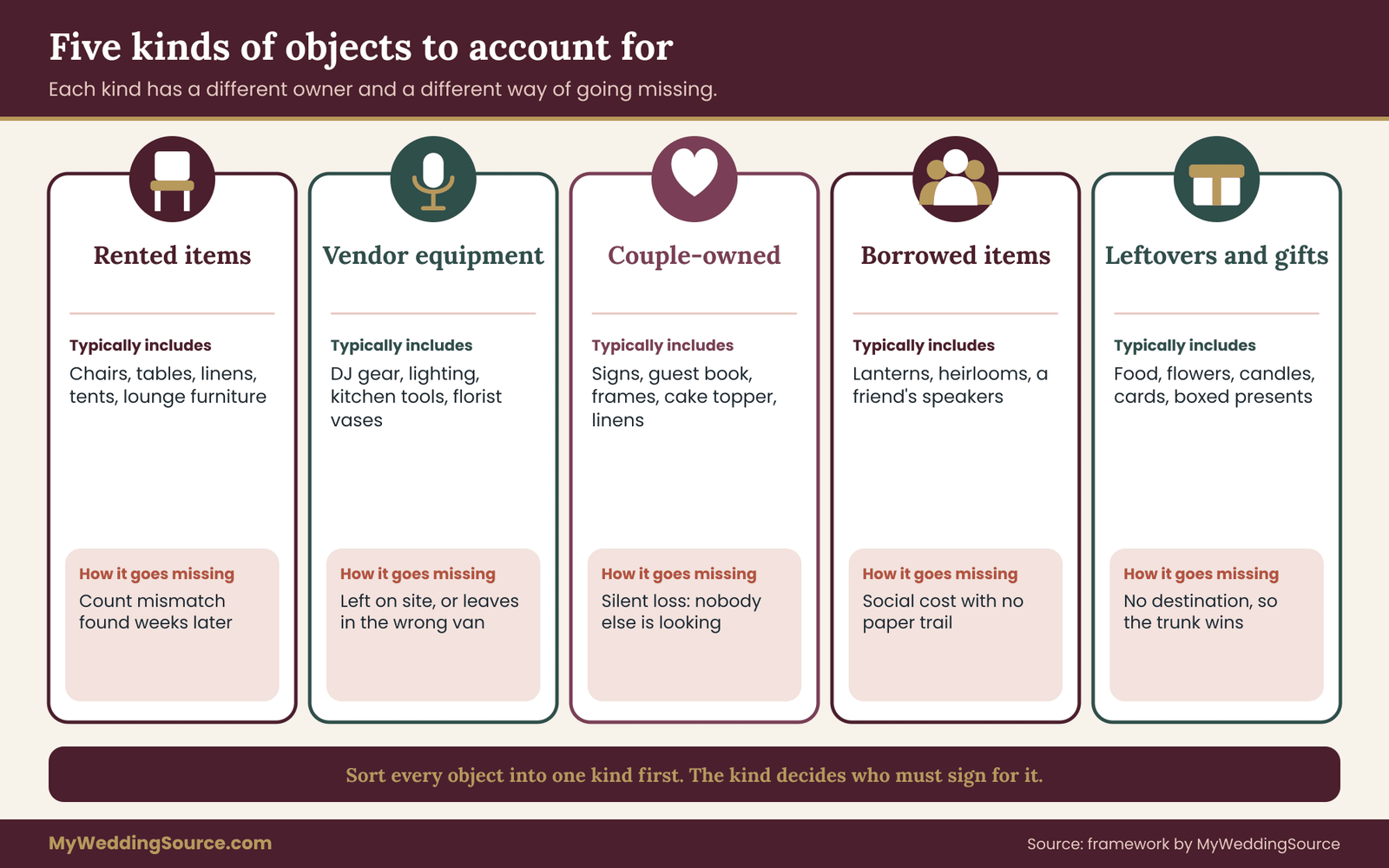
There are five kinds of objects to separate from the start. Rented items, which someone else owns and expects back. Vendor equipment, which stays under the vendor’s control even while it sits in your room. Couple-owned items, which you decided to buy or make. Borrowed items, which belong to a friend or relative and carry the most social risk. Consumables and leftovers, such as food, candles and flowers, where the question is use or disposal, not return. The ownership section later in this article gives each class its own rules.
What the teardown inventory is not
It is not a photo album of the setup, although photos help. It is not a packing list for your honeymoon, and it is not an insurance claim, although it can support one. It is also not something you must complete by yourself. The couple owns the decision about what the teardown inventory contains. A day-of coordinator, a trusted relative or a planner usually keeps it, because you will be busy being married.
If you want the broader view of how to reduce what you generate in the first place, the wedding waste reduction guide on this site covers the audit side. This article starts later, at the moment the objects already exist and have to be accounted for.
Why Monday morning is where things go missing
Saturday night feels like the finish line, but from a logistics view the wedding is not over until every object has been counted out of the venue. Three characteristics of a wedding weekend create what this article calls the custody gap: the stretch of time in which an object exists but nobody is clearly responsible for it.
First, the hours are tired and compressed. Teardown happens after a long day, often in low light, often with people who have been awake since dawn. Mistakes are ordinary at that hour. Someone carries a box to the wrong car. Someone assumes the venue will keep the leftover signs. Someone takes a vase because it looked like theirs.
Second, authority is split. At 11 p.m. the venue controls the building, the caterer controls the kitchen, the rental company controls its own equipment, the DJ controls the booth, and you control almost nothing, because you are in a car or a hotel room. Each party tracks its own gear and nobody tracks the whole. A missing item sits between two parties, and each assumes the other has it.
Third, Sunday and Monday add delay. Rental pickups, vendor return trips and venue walkthroughs often happen the day after, when memory has faded and the room has been reset by staff. By the time a couple notices that a borrowed candelabra is gone, the cleaners have been through twice.
The three places things actually vanish
Objects rarely vanish dramatically. They slip out at predictable points. The first is the handoff between guests and vendors during the last hour, when centerpieces are being taken home or stacked. The second is the loading dock or parking lot, where items sit in transit with no one watching. The third is the day after, when items travel between your home, a friend’s car and a storage area, and nobody can say which stop they reached.
A wedding teardown inventory attacks each point differently. At the guest handoff it uses a designated table and a count. At the dock it uses a named person with a checklist. On Monday it uses a short reconciliation walk. The later sections build each of these.
What this costs you if you skip it
There is no invented statistic to offer here, and none is needed. The cost is plain from the common cases. A vendor can bill for equipment that you believe was returned. A borrowed item can strain a friendship. A rental company can charge a replacement fee, and a deposit can be withheld for a count that nobody can dispute. Each of these is a small problem that becomes expensive only because there is no record.
What this guide adds to the contract and the timeline
Two guides on this site already cover neighboring ground, and it helps to be clear about the line between them. The wedding rental planning checklist covers what to order and how to confirm it, and the wedding vendor material covers what each vendor owes you. Both are about the plan. This article is about the record of what actually happened.
Think of the plan as a promise and the teardown inventory as a receipt. If the plan said the rental company would collect forty-eight chairs by 10 a.m. Sunday, the teardown inventory shows that forty-eight chairs were counted, staged and picked up, and by whom. If the numbers differ, you notice on Monday instead of three weeks later when the invoice arrives.
The next sections build the pieces in order: the four fields on every line, the zone list, the ownership classes, the three counts, the handoff scripts and the Monday walk. By the end you will have a custody log you can build in a spreadsheet, a notes app or on paper.
The four fields every wedding teardown inventory line needs
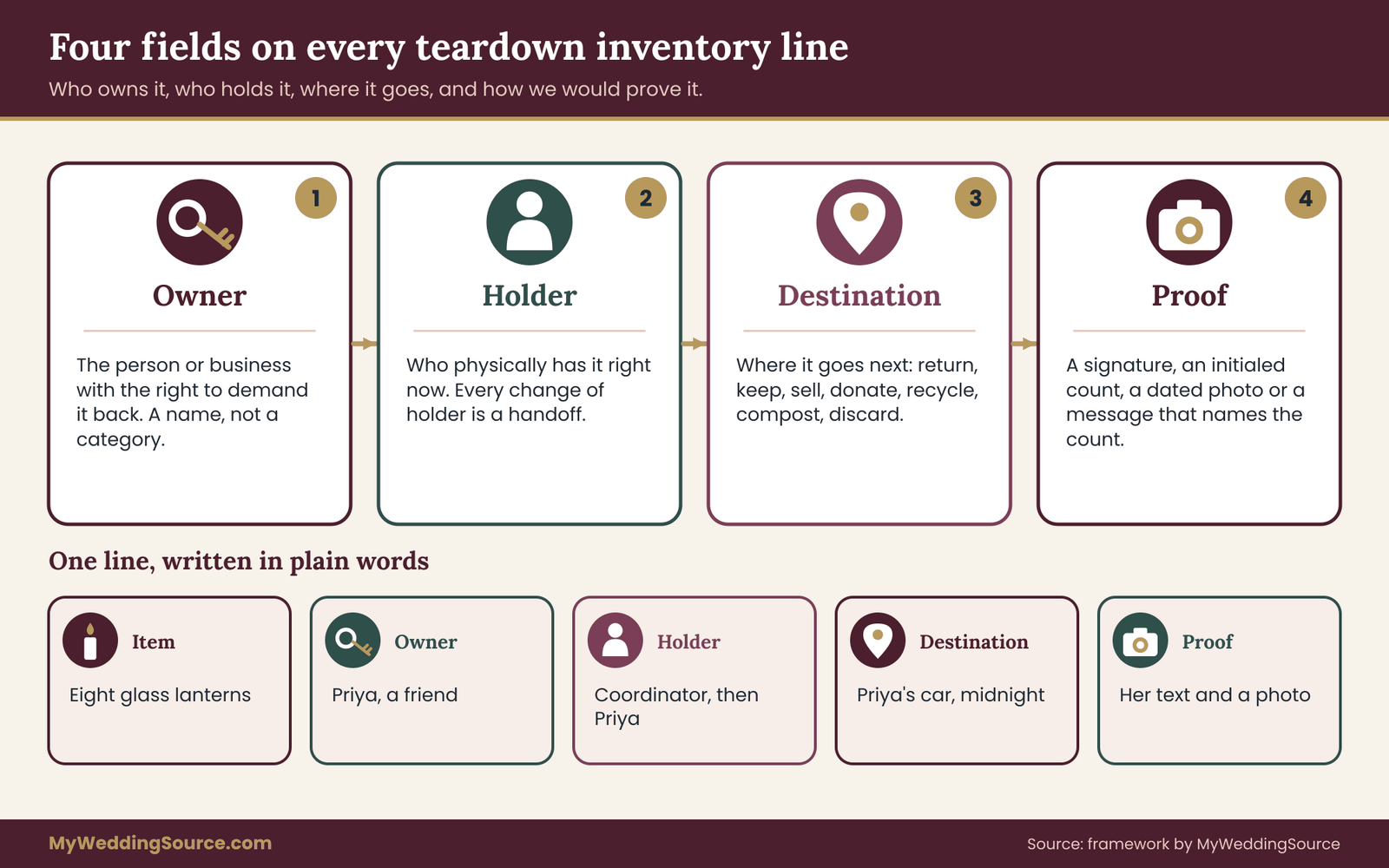
Spreadsheet templates for wedding planning usually offer a column for item, quantity and cost. That is a shopping list, not a custody record. A wedding teardown inventory line needs four fields that answer four questions at any moment: who owns this, who has it now, where is it going, and how would we prove it got there.
Owner. The person or business that holds legal title or the right to demand it back. For a rented chair it is the rental company. For a lantern borrowed from your aunt it is your aunt. For decor you bought, it is you. Write a name, not a category, because “vendor” is not someone you can call on Monday.
Holder. The person who physically has the item right now. This field changes, and the changes are the entire point. At 4 p.m. the holder of a box of programs might be the coordinator. At 11 p.m. it might be your cousin. On Monday it might be you. Each change is a transfer of custody and gets its own entry.
Destination. Where the item goes next and what happens to it there: returned to a named owner, kept by you, sold, donated, recycled, composted, thrown away or left with the venue by agreement. An item with no destination is the one that ends up in a trunk.
Proof. The simplest evidence that the handoff happened. A signature, an initialed count, a photo of the stack at the dock with the vendor’s van visible, a text message that says “received four vases, thank you.” Proof does not have to be formal. It has to exist, carry a time, and be findable.
An example line, written in plain words
Here is how one line reads without a grid. The item is eight glass hurricane lanterns. The owner is a friend named Priya. The holder at the ceremony is the day-of coordinator. The destination is Priya’s car on Saturday at midnight. The proof is a text from Priya confirming eight lanterns received, with a photo of the box. That sentence contains everything someone would need if a lantern turned up broken.
Notice what this line of the teardown inventory leaves out. It does not include the price, the color, the supplier or the reason you chose them. Those belong in your budget and design documents. Keeping the custody log narrow makes it fast to fill in, and a log that is fast to fill in actually gets filled in.
Three optional fields that earn their place
Beyond the four core fields, three extras help in particular cases. A quantity field matters for sets, since “chairs” means nothing but “forty-eight chairs” can be checked. A condition note matters for anything fragile or rented, because a rental company may ask whether an item left in good shape. A deadline field matters when someone expects the item back on a certain day, such as a Sunday noon pickup or a Monday venue walk.
Resist adding more. Every added column makes the person at the dock less likely to fill in anything. If you find yourself wanting a column for supplier phone number, keep it in the vendor contact sheet and refer to it.
Item identifiers for sets and singles
Give each line a short identifier that matches the zone, such as the first letters of the room and a number. For identical items in a set, use one line with a quantity and agree on how the set is counted: stacks of ten, crates of twelve, trays of twenty-four. Counting by container is faster and has fewer errors than counting loose items in dim light.
For singles that matter, such as the cake knife or a family candelabra, give each its own line and a photo. A photo taken during setup is the cheapest form of condition record you can make, and it helps if someone later says an item was chipped when it left.
Setting up the file: spreadsheet, paper or both
Decide where the teardown inventory lives before you fill it. A shared spreadsheet has one real advantage: several people can open it at once, and the edit history shows who changed what. Its weakness is the dark back hallway with no signal. Paper has the opposite profile. It works anywhere and nobody has to unlock a phone, but it cannot be searched and a single sheet can get wet or lost.
The sturdy answer is both. Keep a master version in a spreadsheet or notes app, print one sheet per zone for the night, and photograph the completed sheets before anyone leaves. Then someone types the entries into the master on Sunday. This costs an hour and gives you a searchable teardown inventory plus a paper backup.
Keep the column order the same on every sheet: item, quantity, owner, holder, destination, proof. When every zone sheet looks alike, a substitute zone lead can pick one up and understand it in seconds. Put the zone name, the date and the page number at the top of each sheet, and leave a few blank lines at the bottom for items that appear unexpectedly. An item with no line is a sign the setup count missed something, and it should be added the moment someone notices.
Name the file clearly and share it with the keeper, the coordinator and one of you. Do not share the teardown inventory with every vendor. Vendors need their own lines and counts, not your full record of personal items and borrowed pieces.
Building the room-by-room zone list
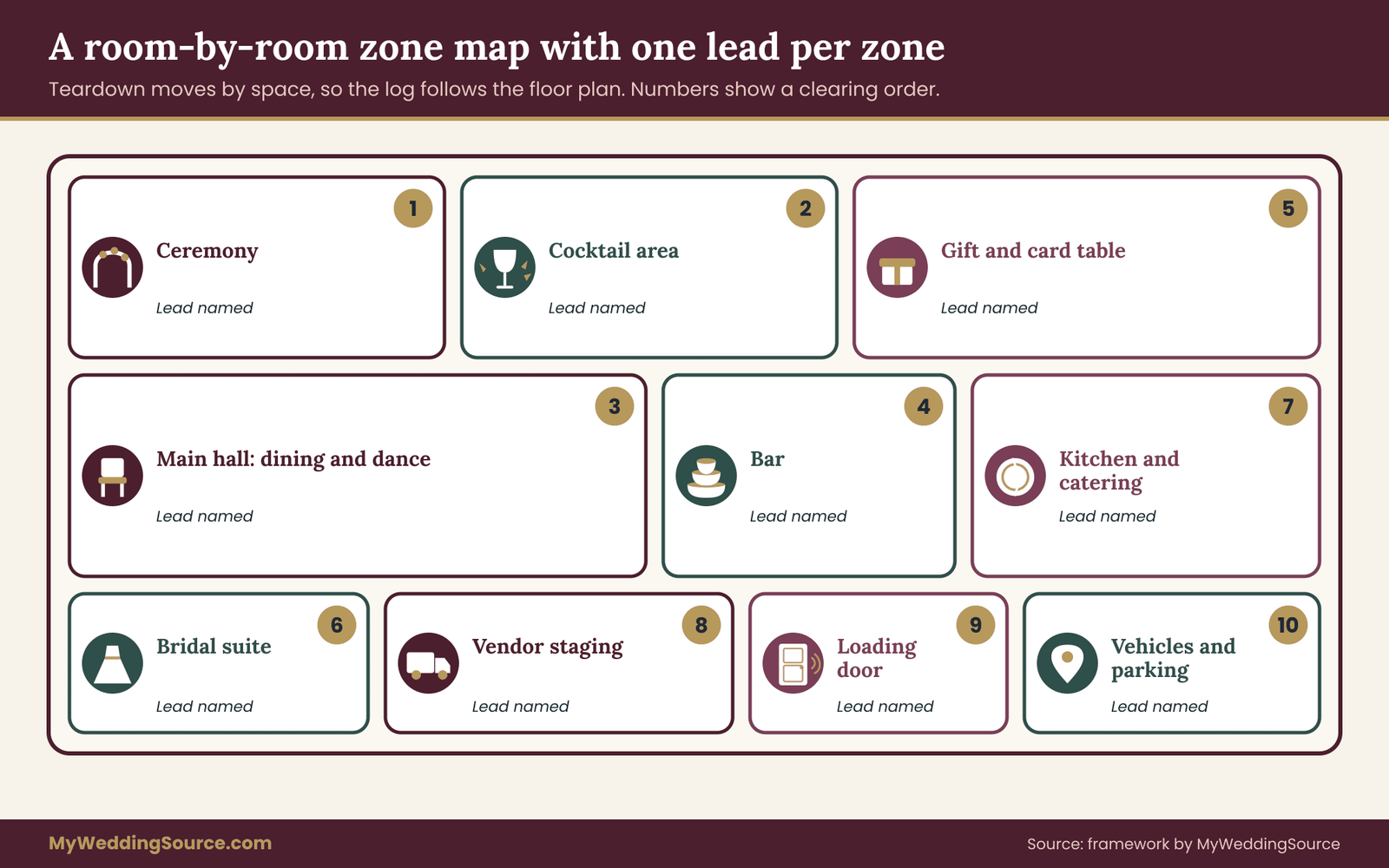
A wedding teardown inventory organized by item type is hard to use, because teardown does not move by item type. It moves by space. People clear the ceremony site, then the cocktail area, then the dining room, and the teardown inventory should follow the same path. That is why the log is organized room by room.
Start with a walkthrough of the venue floor plan, either at your site visit or from the venue’s own diagram. The venue technical walkthrough guide explains how to gather measurements and access routes, and the same visit gives you most of what you need for the zone list. Mark each distinct space where objects will be placed, then give each a name that everyone will use in conversation.
Typical zones, adjusted for your site
A venue rarely has the same spaces as another venue, so treat this as a starting set rather than a rule. Most weddings have a ceremony area, a cocktail or arrival area, a dining or dance room, a bar, a kitchen or catering staging space, a getting-ready room, a gift and card area, a vendor staging area, a loading dock or load-out door, and a parking or curbside zone. A weekend wedding adds a lodging zone for guest hotel rooms, a welcome-event space and a morning-after location.
Some of these zones belong to the venue and others are temporary. A coat check, a photo booth corner or a dessert table is a zone for exactly one evening. List those, too, because temporary zones are where unclaimed items collect.
One owner per zone
Assign each zone a zone lead: one named person who answers for everything in that space until it is signed out. The zone lead does not carry the items. They confirm the count, watch the handoffs and write the entries. Without a lead, a zone is like a room where everyone assumes someone else locked up.
Zone leads can be the coordinator, a planner’s assistant, a trusted friend or a vendor lead, depending on the zone. Be careful about giving this to close family on the wedding day. A parent or sibling is likely to be emotionally busy, and a job that depends on attention at 11 p.m. is a heavy one. If a relative insists, give them the lowest-risk zone, such as the gift table.
Order of clearing
Decide the clearing order in advance, because it determines the order of counts. A common order is to clear the ceremony site first if it was held in a separate space, the cocktail area while dinner is served, the guest tables after the last dance, and the kitchen and vendor areas last. Moving items from a cleared zone to the staging area is itself a transfer, and it belongs in the teardown inventory with a holder change.
Draft the zone list now and send it to the venue manager and coordinator for corrections. Venues often know a zone that you will not see on a floor plan, such as a storage closet that vendors use or a back hallway where deliveries wait. Add them.
Zones that are easy to forget
Three zones cause trouble because nobody plans them. The first is the vehicle zone: the trunk of a friend’s car holding your centerpieces overnight is a storage location and should be written down. The second is the lodging zone, where items such as welcome bags, the bridal party’s clothes and gift cards end up in hotel rooms. The third is the gift area, where cards, envelopes and boxed presents accumulate, covered in more detail in the ownership section.
If you built your own tracking before, as with the wedding records archive you will want to keep afterward, the zone list can become the first page of that record once the weekend is over.
Ownership classes and what each one demands
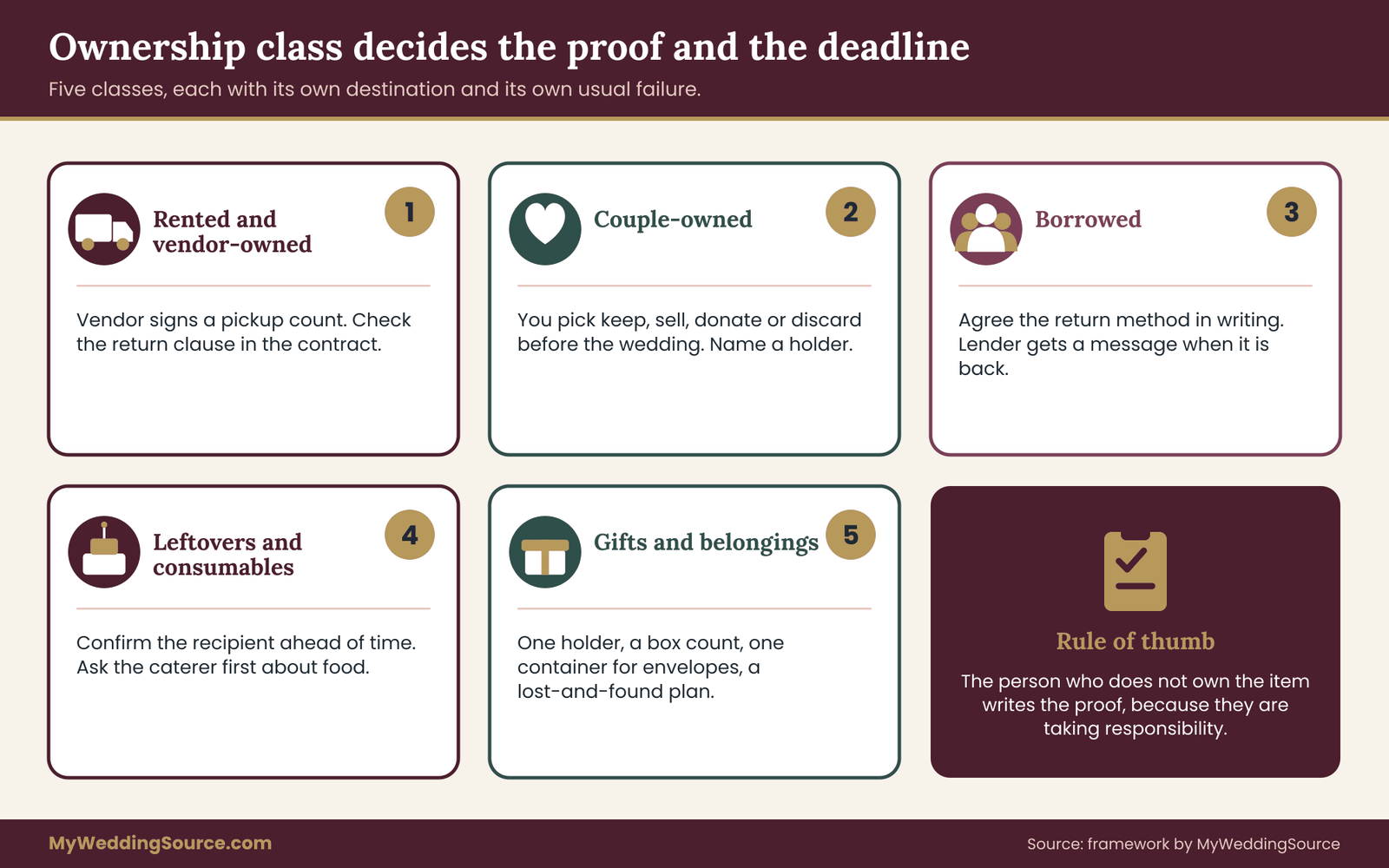
Not every object on a wedding teardown inventory needs the same treatment. A rented tent and a bag of leftover rose petals are both on the list, but only one of them can result in an invoice. Sorting items by ownership class decides the questions to ask, the proof to collect and the deadline that applies. There are five classes, and each has a typical failure.
Rented and vendor-owned items
These belong to a business. The rental company, the caterer, the lighting vendor and the band all expect their property back, and most contracts say how and when. The wedding vendor contract guide explains the clauses that usually matter, and the one to find here is the return or load-out clause: who removes the items, by what time, and what happens if they are not removed.
The line for a rented item should show the contract quantity, the staged quantity, the returned quantity and the proof. If the vendor collects the items themselves, a signed pickup count or a dated message is the proof. If you are responsible for returning them, you are the holder until the vendor accepts them, and the teardown inventory should say so.
The typical failure is a count mismatch discovered by the vendor after the fact. A rental company counts forty-eight chairs out and forty-six back, and the contract assigns replacement cost to the renter. Your counts on Saturday and Monday are your side of that conversation. They do not settle it by themselves, but they replace a flat denial with a record.
Couple-owned items
These are things you bought, made or commissioned: signs, a guest book, frames, linens, a custom cake topper. Their destination is your decision, and the teardown inventory forces you to make it. The reasonable options are keep, sell, donate, give to a family member or discard. A sign with your names on it has a different destination than a plain easel.
For couple-owned items, the main risk is silent loss. Nobody else is looking for them, since no vendor will chase a lost frame. Put a holder on every line, and make that holder someone who will be at the venue when the items are packed. If you plan to sell or donate decor afterward, record that in the destination field now, so the item goes into the right box instead of the car trunk pile.
Borrowed items
Anything lent by a friend, relative, coworker or neighbor belongs here. These carry the highest social cost and often the lowest paper trail. Borrowed items rarely appear in any contract, and the lender may not be at the wedding.
Write the lender’s full name, how you will return the item, and by when.
Agree on the return method before the wedding. A short message works: “I’ll have your lanterns back to you by Wednesday; do you want them delivered or picked up?” That message is also your proof of the arrangement. If the item is irreplaceable, such as a family heirloom, ask whether the lender would rather carry it themselves at the ceremony and take it home afterward. Removing it from the teardown stream altogether is often the safest handling.
Consumables and leftovers
Food, drinks, candles, flowers and paper goods have no return. Their question is what happens to what remains. The line records the remaining quantity and the chosen destination: take home, donate, compost, recycle, trash.
Food needs the most care, because safety matters as much as logistics. The U.S. Environmental Protection Agency’s food recovery hierarchy ranks feeding people above feeding animals, industrial uses, composting and disposal, which gives you an order of questions to ask about leftovers. Food that has been sitting in the temperature danger zone is a separate matter, and the U.S. Department of Agriculture’s food safety pages explain the limits. Your caterer’s own policy comes first, since many caterers will not release food that has been served or held out.
Donation has its own rules. The federal Bill Emerson Good Samaritan Food Donation Act gives general liability protection to people who donate food in good faith to nonprofit organizations, but receiving organizations set their own acceptance rules, and state law may add conditions. Call the recipient ahead of time and write their name and pickup time in the destination field. For flowers and decor, the same logic applies: confirm who will accept them before the evening, as the wedding waste reduction planning guide describes for the audit stage.
Gifts, cards and personal belongings
This class is the one couples most often forget to plan, and it contains the objects with the most emotional and financial weight. Envelopes of cash, gift cards, boxed presents, the card box and guests’ forgotten coats and phones all end the night in one area.
Name one holder for the gift area, and make the transfer explicit: at a set time, the gift lead hands everything to a named person with a count of boxes and one container for envelopes. A short written log of boxes and envelope counts is enough. It is not a thank-you ledger, which is a separate task covered by records guidance after the wedding. It is a custody record of the pile.
Guest belongings are a custody problem too. Decide in advance who holds lost items, where they go on Sunday, and how guests can ask about them. A shoebox with a name on it and a note taped to it is a lost-and-found system.
Edge cases that change the owner field
A few situations come up often enough to plan for. The first is the vendor who leaves equipment overnight by agreement. A tent crew might return Sunday, or a lighting company might strike at dawn. During that gap the venue or the couple may be listed as the holder, which can create a liability question. Write the agreement into the teardown inventory line, with the pickup time and the name of who confirmed it, and ask the vendor whether their coverage applies while the gear sits on site.
The second is the item that changes owner during the event. A friend gives you the lanterns as a gift, or a vendor offers to leave a leftover sign. The log should show the change with a date and a message, so the lanterns stop being a loan on Saturday and become a gift. Without that note, the lender may expect them back while you believe they were given.
The third is an item bought for the wedding and returned to a store afterward. If you plan to return unopened supplies, treat them as a separate class in the teardown inventory, with the receipt and the return deadline in the proof field. Store policies on returns vary, so check the receipt rather than trusting memory.
The fourth is the item that belongs to the venue but was moved by your team. A venue’s chairs, tables or planters are often shifted to fit your layout. Record where each moved item stood originally, and ask the venue manager whether staff will reset them or whether you are expected to. A venue that expected to find its furniture in place on Monday and finds it scattered may bill for the labor.
When an item belongs to two classes
A few objects straddle classes. A framed photo that you own might hang on a rented easel. A centerpiece might use your own candles in the florist’s vases. When this happens, split the line. Record the vases under the florist’s ownership and the candles under yours. Splitting prevents the common error where a whole arrangement leaves with one party and half of it belongs to someone else.
Another gray case is the item you thought you were buying but are actually renting, such as certain linens, signs and rented decor sold in packages. Check the paperwork. The wedding vendor purchase order checklist describes how to confirm scope and acceptance, which includes confirming whether an item is sold or loaned. If the paperwork is unclear, ask the vendor in writing and put the answer in the teardown inventory.
Ownership decides who writes the proof
A useful rule: the person who does not own the item should produce the proof, because they are the one taking responsibility. If a friend returns a lantern to you, you write the receipt. If a florist leaves with vases, the florist signs. If you take the leftover signs home, you write the destination yourself. The rule is not mandatory, but it keeps the burden where it belongs and keeps the day-of team from becoming an unpaid clerk.
The three-count method: before, during and after
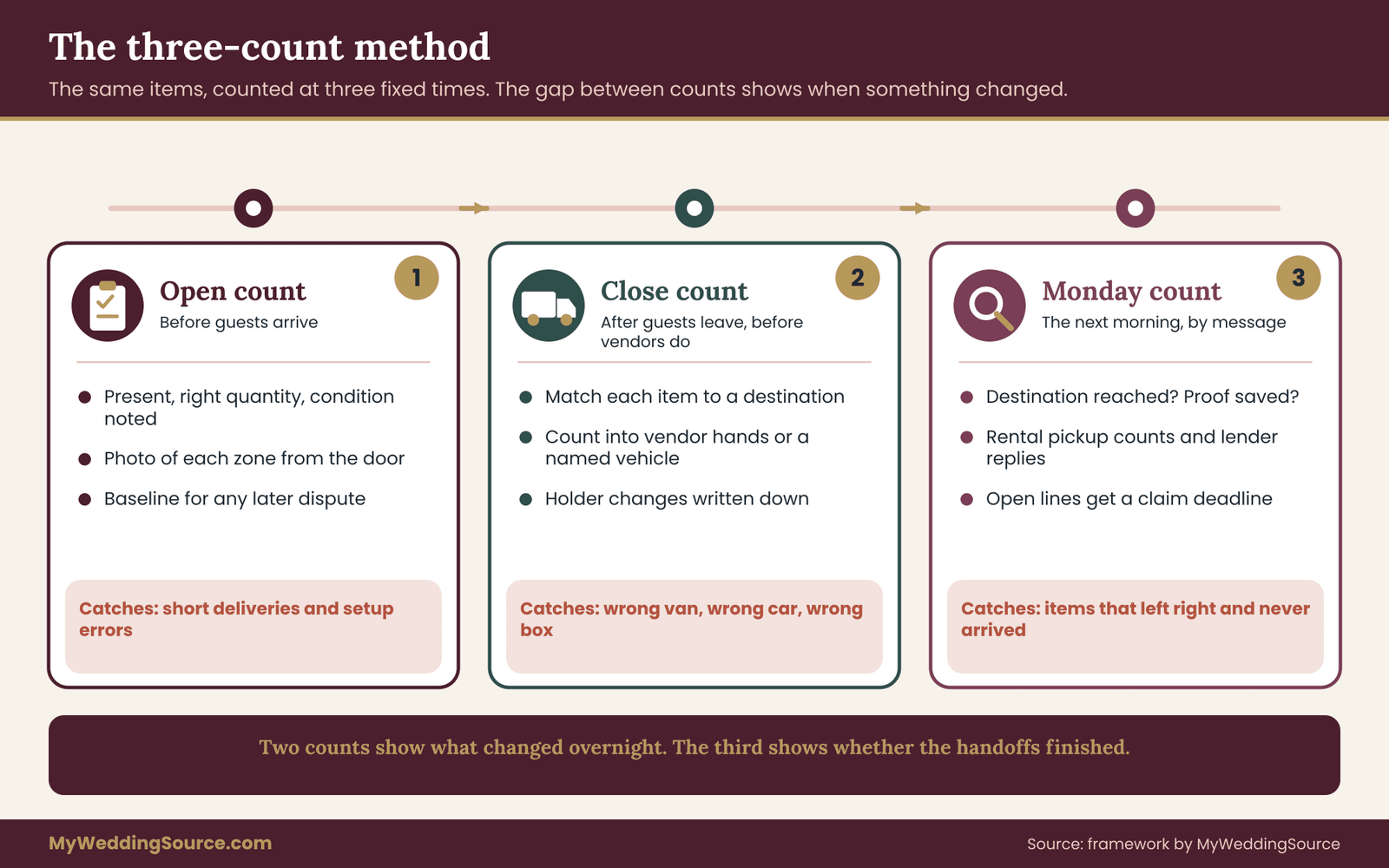
Most advice about checking inventory says “do a final walkthrough.” One walkthrough only tells you what is missing at that moment, with no way of knowing when it went missing or who last held it. The three-count method gives the wedding teardown inventory a time dimension. You count the same items at three fixed points, and the difference between any two counts points you to the window in which something changed.
Count one: the open count
The open count happens before guests arrive, once setup is finished. Each zone lead walks their zone with the teardown inventory and confirms every line: item present, quantity right, condition noted. A photo of each zone from the entrance is enough for the condition record.
This count has a second job. It is the moment to catch setup errors, such as a delivery that was short or an item that arrived and nobody wrote down. If the florist delivered nine arrangements and the log says ten, you want to know at 3 p.m., not on Monday. Anything wrong gets fixed or noted, and the zone lead initials the zone as “open count complete” with the time.
The open count also defines the baseline for disputes. A rental company can say an item arrived damaged, and your photo from this walk answers it. Keep it brief: five to fifteen minutes per zone for most weddings, longer for a large reception hall.
Count two: the close count
The close count happens after the last guest has left and before the last vendor leaves. It answers a different question: what is leaving, and with whom? Each zone lead walks the zone again, but this time they are matching items to destinations. Items that go back to rental vendors get staged together and counted into the vendor’s hands. Items that go home with you are loaded and counted into a named vehicle. Items destined for donation or disposal are bagged and labeled.
This is the count where the holder field changes most. Every line should end the night with a new holder, written down, or with a note saying the item stays in the venue by agreement. A line with the same holder as the open count and no explanation is a red flag, because things rarely stay exactly where they began.
Run the close count in the order from the zone list, and do not let anyone leave a zone before its count is signed. This takes discipline at midnight. It helps to have a short sentence ready: “Before you go, can we count this together?” Most vendors are used to being asked and will do it quickly.
Count three: the Monday count
The third count is the one that makes the teardown inventory a custody record instead of a night-of checklist. On Monday morning, or whichever day follows the wedding by the time everything should have settled, the teardown inventory keeper reviews every line and asks one question: has the destination been reached, and do we have the proof?
For rented items, the proof is the vendor’s pickup count or return receipt. For borrowed items, it is the lender’s confirmation. For items that went home with you, it is a confirmation that they are in your home or in storage. For donations, it is a receipt or message from the recipient. For consumables, it is a note that they were used, shared or disposed of.
The Monday count is mostly messages. It takes thirty to ninety minutes for an average wedding, and most of it is a few short texts and emails. The point is to close lines. A line without proof after Monday gets flagged, with a claim deadline, and moves to the unaccounted list described later.
Why three counts and not two
Two counts, open and close, tell you what changed overnight. The third tells you whether the handoffs completed. Many items are “lost” in the day after the wedding, when something leaves the venue in the right vehicle and then never reaches its destination. A close count signed at midnight does not catch that, and it is the reason a Monday count exists.
A lighter version is possible for a small wedding: the open count and the Monday count with the close count folded into a photo. The alternatives section explains when the shortcut is reasonable and when it is not.
Matching the counts to the vendor timeline
The three counts only work if the times are real. Put each one on the vendor timeline next to the load-in and load-out windows, and tell vendors where they fall. The wedding vendor timeline gives a way to lay out the day, and the counts become three additional rows on it.
The open count belongs after the last vendor finishes setup and before the first guest arrives. Many vendors finish late, so build in a small gap. The close count belongs after the guests leave, but before vendors disperse. If the DJ leaves at the final song and the florist at the last dance, the close count for their zones has to happen as they pack, not after. The teardown inventory then follows the vendor schedule instead of fighting it.
Reading the gaps between counts
When two counts differ, ask three questions in order. Did the item leave the zone, or was it never counted correctly? If it left, who held it between the two counts? And what does the proof field say about that handoff? These three questions turn a vague “it is missing” into a specific “it left the ceremony zone with the florist’s crew between 6 p.m. and midnight.”
Be careful about the first question. Many apparent losses are counting errors, such as a stack miscounted in dim light or an item counted twice from two angles. Recount before you raise an alarm. A teardown inventory that reports a loss that did not happen costs trust, and trust is what the vendors and friends are giving you.
Transfer of custody: handoffs, scripts and signatures
Every change of holder is a transfer of custody, and each one is a moment of risk. You do not need a legal document for each one. You need a habit that makes each handoff visible. A good handoff has four parts: both people name the item and the count, the receiver confirms the condition, the receiver says where it goes next, and someone writes it down.
A script that takes fifteen seconds
Awkwardness is the main enemy of a handoff, so it helps to have words. A zone lead can use something like this: “I’m handing you the six lanterns from the ceremony area. They’re Priya’s, and they go to her car. Can you confirm six, no damage?” The receiver says “six, no damage” and the zone lead records the time and initials. That is the entire process.
For a vendor, a polite version works: “Can we count together before you load? I’ll note the count and your name.” Most professional teams have done this before. If a vendor resists, treat that as information, and write what happened in the teardown inventory without argument.
Who can sign
Decide in advance who can sign for what on the teardown inventory. Zone leads can accept and release items within their zone. The coordinator can sign for the couple on routine handoffs. Only you, or one named delegate, can approve unusual changes: leaving an item with the venue, giving something away, or accepting a vendor’s claim of damage. Write this authority list on the first page of the log so no one has to find you at midnight.
What counts as proof
Proof does not have to be a signature. A time-stamped photo showing items beside the vendor’s vehicle counts. So does a text message from the receiver, or a vendor’s printed pickup sheet with a count. The test is whether a stranger reading the proof a month later could tell what was handed over, to whom and when. Photos with the items spread out and countable beat photos of a closed box.
Keeping the log usable in the room
A teardown happens standing up, in low light, with one hand free. Plan the format around that. A shared spreadsheet on a phone works if the cells are few and large. A printed sheet per zone on a clipboard works for people who do not want to type. A voice memo works as a backup, as long as someone transcribes it into the teardown inventory afterward. Choose the format that the zone leads will actually use, and test it at the rehearsal.
Do not rely on mobile signal. Many venues have weak coverage in back rooms and loading areas, and an app that needs a connection will fail exactly when needed. Paper plus a later photo of the sheet is a legitimate method.
After the handoff: one correction rule
If a count turns out to be wrong after the handoff, do not erase the line. Add a correction entry with the new count, the time and the reason. Erasing makes the teardown inventory less useful in a dispute and makes the next person less willing to be honest. A log with visible corrections looks more trustworthy than one that is suspiciously clean.
Running Monday morning: the reconciliation walk
Monday morning is when the wedding teardown inventory earns its keep. By now the music has stopped, the dress is in a box and everyone is exhausted. The reconciliation is intentionally small. It is a sit-down with a coffee, the log and a phone, not another event.
Who runs it and when
The teardown inventory keeper runs it, with the couple present only for decisions. If you hired a planner or day-of coordinator, ask in your contract whether Monday follow-up is included, since many packages end at the last vendor’s departure. If it is not, appoint a friend who owes you nothing but is good at lists and ask them directly, in advance, with a clear scope: one to two hours on Monday, messages only.
Pick the time for when the answers will arrive. Rental companies and venue offices often open at nine, and weekend staff may not be reachable until then. A good rhythm is to review the teardown inventory at eight, send the confirmation messages by nine thirty, and recheck at noon and again at the end of the day.
The reconciliation in five passes
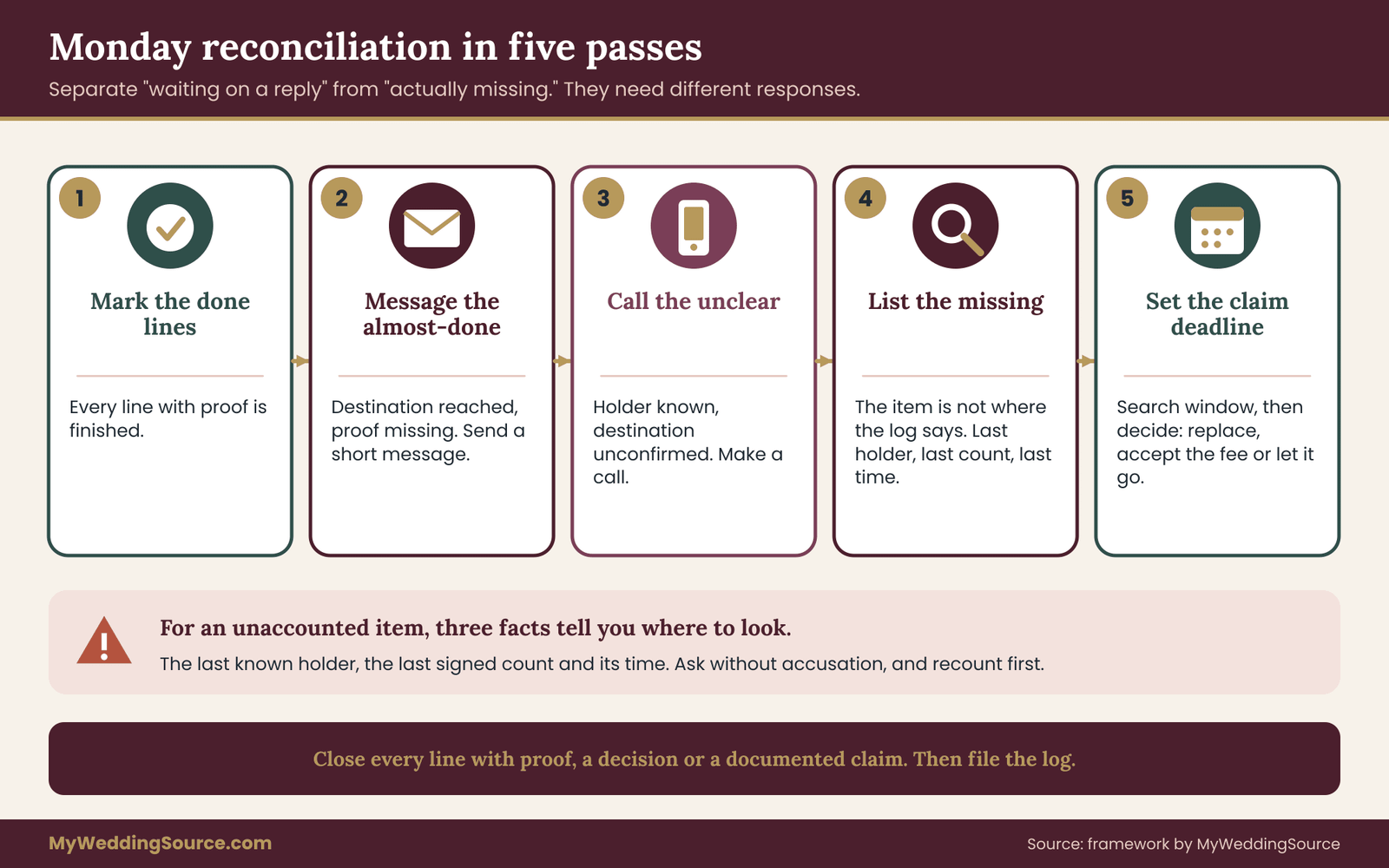
Pass one is to read the teardown inventory from top to bottom and mark every line that has proof. These are done. Pass two is to mark every line where the destination is reached but proof is missing, such as a vendor who picked up the chairs but did not sign. These need a message. Pass three is to mark every line where the holder is unclear, meaning the close count shows a holder but the destination was not confirmed. These need a call.
Pass four is to list every line where the item is not where the log says. These are the problem lines. Pass five is to write the claim deadline for each problem line.
The passes sound formal, but each one takes minutes. The structure matters because it separates “waiting on a reply” from “actually missing,” and those two need very different responses.
Messages that close lines
Short, specific messages work better than long ones. To a rental company: “Confirming that forty-eight chairs and six round tables were collected Sunday at ten. Can you send the pickup count?” To a lender: “Your lanterns are in my hall closet. Want me to drop them off Wednesday or will you pick them up?” To a venue manager: “Did the cleaning staff find anything left in the ballroom or the bridal suite? We are missing a cake knife.”
Each message names the item, the count and the question. Keep a copy in the teardown inventory under the line. Replies become the proof.
Deposits and the Monday count
If a deposit is tied to a condition or a count, such as a rental or venue security deposit, the Monday count is where you prepare for the return. Gather the open-count photos, the signed close counts and any damage notes before the vendor completes their own inspection. Do not make accusations. Present your record as a reference: “Here is the staged count and condition photo from setup, in case it helps.”
For the money side of the aftermath, the wedding records guide explains how to match vendor files to payments and how long to keep them.
When an item is unaccounted for
An unaccounted item is one with no proof after Monday. Treat it as a short investigation with a clock, not a blame session. The teardown inventory gives you the last known holder, the last signed count and the time of that count. Those three facts tell you where to look.
Start with the last known holder. Ask without accusation: “The log shows you had the guest book at midnight. Do you remember where it went?” Then check the logical places: the vehicle zone, the venue lost-and-found, the vendor’s truck, the hotel room. If the item is a rental, tell the vendor right away, because a promptly reported discrepancy is easier to resolve than a late one.
The claim deadline
Give every unaccounted item a deadline for the search and a decision at the end of it. A reasonable pattern is to search for a few days, then decide whether to replace, accept the fee, ask the lender to name a fair outcome or let it go. For rented items the contract may set its own dispute period, so read it first. For borrowed items, talk to the lender before you decide, and offer a fair outcome before they have to ask.
Write the decision in the teardown inventory with the date. A closed line, even one closed with “lost, replaced at our cost,” is better than an open line nobody revisits. Open lines are how a petty problem becomes a long grudge.
What to do about donations and disposal that happened Saturday
Items sent to donation or disposal on Saturday still belong on the Monday count. A donation needs a name, such as the receiving organization or person, and a message that confirms receipt. If the item was disposed of, the teardown inventory should say who put it where. This matters less for napkins than for an expensive item that a vendor later says was theirs.
If you donated flowers, decor or food, the U.S. Internal Revenue Service publishes guidance on charitable contributions, including recordkeeping for noncash gifts. Whether you can claim any deduction is a tax question for a qualified professional. For the teardown inventory’s purpose, a receipt or a written acknowledgment from the recipient simply closes the line.
Multi-day and destination weddings
When a wedding spreads across several days or places, a single Monday count is not enough. Treat each event as its own cycle with its own open, close and follow-up counts: the welcome party, the ceremony day and a farewell brunch can each have a short teardown inventory, tied together by one master list of items that travel between them. Items such as signs, speakers and welcome bags move from one event to the next, and the master list shows which event currently holds them.
For a destination wedding, add a travel line for each item that has to go home with you: how it travels, who carries it, what the airline or carrier allows and who pays. Airline and carrier rules change, so check the current rules directly with the carrier instead of trusting a forum post. Items that cannot travel need a local destination, such as a donation drop-off or a shipping quote. The teardown inventory should give you a decision before the packing starts, not a surprise at the check-in counter.
Storage after Monday
Items you keep need a home. A box of decor in a closet is also a custody problem, only a slow one. Label each container with its contents and the date, and add a final line to the teardown inventory with the storage location. If you plan to sell or donate later, give yourself a date and write it on the line. Otherwise a closet full of decor slowly becomes one more thing you have to decide about during a busy month.
Photograph what you keep, in the containers, before they are sealed. A single photo of an open box is the fastest inventory you will ever make, and it helps if you later need to list items for sale or confirm that something was donated and not lost.
Closing the log
When every line has proof, a decision or a documented claim, mark the teardown inventory closed and date it. Save a copy. Then move the teardown inventory into your permanent records, where it sits alongside the vendor files and the receipts. If anything surfaces later, such as a late invoice or a rental charge, you will know exactly where to look.
A worked example: the Delgado and Whitfield wedding
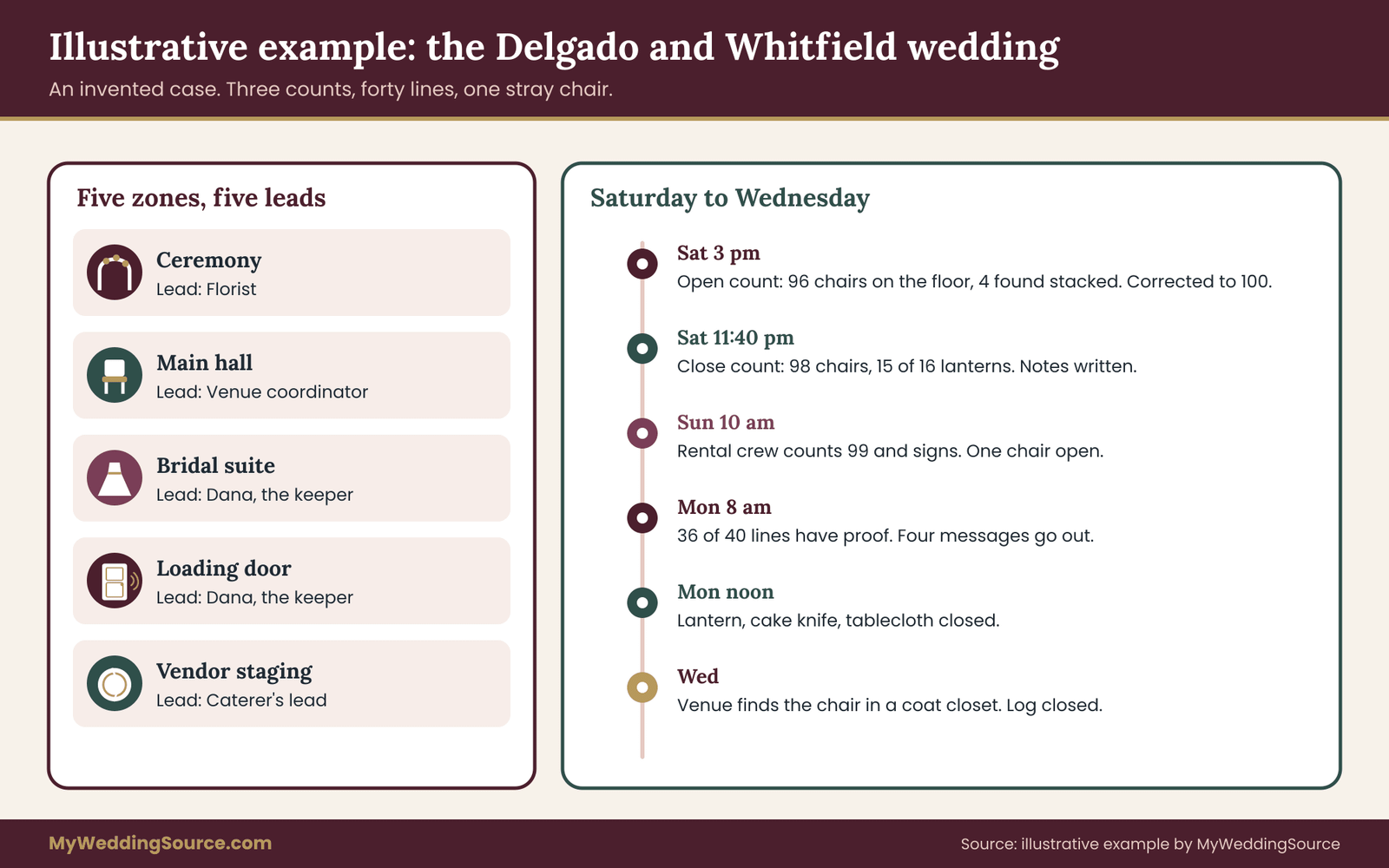
The following case is invented to show the method in motion. The couple, the vendors and the numbers are made up for illustration, and nothing here describes a real wedding. It shows how one wedding teardown inventory behaves when something goes slightly wrong, which is the situation the teardown inventory exists for.
The setup
Camila Delgado and Owen Whitfield are marrying on a Saturday at a converted warehouse venue with a ceremony space, a main hall, a small bridal suite and a back loading door. They have a rental company for chairs and tables, a florist, a caterer with their own kitchen team, a DJ, a friend lending sixteen lanterns, and a lot of homemade decor: signs, a guest book, frames and linens.
They name five zones: ceremony, main hall, bridal suite, vendor staging and loading door. Their friend Dana, a project manager who offered to help, becomes the teardown inventory keeper. The venue’s coordinator leads the main hall. The florist leads the ceremony zone, since most of it is florals. Dana covers the bridal suite and the loading door. The caterer leads vendor staging.
This teardown inventory has about forty lines. Chairs and tables are single lines with quantities. The lanterns, the cake knife, the guest book and the box of cards each have their own line. Dana adds a photo to each of the personal items.
Saturday afternoon: the open count
At 3 p.m., the zone leads walk their zones. In the ceremony zone, the florist confirms two arches and ten aisle arrangements. In the main hall, the coordinator counts one hundred rented chairs against the contract and finds ninety-six on the floor. Four chairs are stacked at the back, delivered separately. The count is corrected to one hundred. A short note records where the four extra chairs were found.
Dana photographs the lanterns on the aisle and records sixteen, no chips. She texts the lender: “Sixteen lanterns staged and counted. I’ll confirm again at the end of the night.”
Saturday night: the close count
At 11:40 p.m., the DJ finishes. The rental company has said its crew will arrive Sunday at ten. Dana and the coordinator count the chairs into stacks of ten and photograph them against the wall. The close count shows ninety-eight chairs, not one hundred. The teardown inventory shows the holder as the venue, with the rental company due to collect.
Two chairs are missing. Dana checks the loading door, the bridal suite and the ceremony room. She finds one in the bridal suite, used as a prop for photos. The second is not found. She writes: “One chair unaccounted for at 11:55, last seen in ceremony zone at 6 p.m. Searching on Sunday.” That note is the beginning of the claim record.
The lanterns are packed into two crates by the lender’s friend. Dana counts fifteen. She counts again; fifteen. She notes the last known location of the sixteenth, the cocktail hour table, and asks the caterer’s lead whether any staff moved it. The lead says it might have gone with the cocktail linens.
Sunday and Monday: the third count
On Sunday at ten, the rental crew arrives, counts ninety-nine chairs and signs the pickup sheet, noting that one chair is missing from the contract count of one hundred. Dana photographs the sheet. That is proof for ninety-nine chairs and the beginning of a conversation about one.
On Monday at eight, Dana opens the teardown inventory. Thirty-six of forty lines have proof. Four need work: the missing chair, the missing lantern, a rented tablecloth the caterer says it took but did not sign for, and the cake knife, which Camila’s mother took home and has not confirmed.
Dana sends four messages. The caterer replies by ten that the lantern was in a linen bin and has been returned to the venue. The cake knife arrives at Camila’s apartment by noon, confirmed by a photo. The tablecloth is confirmed by a signed note the caterer’s lead found in his truck. The chair is still missing.
The chair
The rental contract says the renter is responsible for lost items at replacement cost. Dana does not argue. She sends the rental company the open-count photo, the close-count photo and the pickup sheet, and asks whether the venue’s cleaners reported a stray chair. The venue manager replies on Tuesday that a chair was found in a coat closet and has been set aside. The rental company arranges a pickup on Wednesday.
On Wednesday the line is closed with proof. Dana marks the log closed and saves it to the couple’s archive.
What the example shows
Three things stand out. First, every discrepancy was found on the same day it occurred, because the counts ran at fixed times and matched. Second, the teardown inventory pointed to where to look: the last known zone, the last known holder and the last signed count. Third, the one issue that took days, the chair, was resolved with a record of when and where it was last seen, not an accusation.
Nothing in this example required special tools or a large team. It required forty lines, five zones, a time for each count and one person who cared about the loose ends.
Alternatives to a full wedding teardown inventory
A complete teardown inventory is the most reliable option, but it is not the only one, and for some weddings it is more than needed. The honest question is how much confusion your wedding can produce and how much it would cost you. Here are the reasonable alternatives, with their trade-offs.
The photo-only inventory
Take a clear photo of each zone after setup and another at the close of the night. The photos serve as the record. This takes almost no effort and works for a small wedding with few rentals. Its weakness is that photos show presence, not ownership, so it cannot tell you who should have an item or where it went. It suits a backyard wedding with a few borrowed items and one vendor, and it fails for a venue wedding with six vendors.
The vendor-supplied list
Ask each vendor for its own equipment list and rely on them to account for it. This is sensible for big rental packages, since a good rental company already counts what it delivers. The gap is everything that is not on a vendor list: your own decor, borrowed items, leftovers and gifts. Use vendor lists for vendor equipment, and keep your own log for the rest, which is a hybrid that many couples find sufficient.
The planner-run inventory
A full-service planner or day-of coordinator may already keep a load-out list. Ask what theirs covers and whether you can see it before the wedding. If it covers vendor gear and venue setup but not your personal items, add those to the same document. Do not assume that a planner’s list includes the gift table or the lanterns your friend lent you.
The single-owner shortcut
For a very small wedding, one person can hold a single list for the whole event, with open and Monday counts only. This works when there are fewer than fifteen non-trivial items, one location and no vendor load-out beyond a caterer and a florist. If the list grows, add zones.
Keeping a teardown inventory when the venue handles everything
Some venues, particularly all-inclusive ones, provide tables, chairs, linens, setup and cleanup. That reduces the number of owners, but it does not remove the need for a teardown inventory. What changes is the content. The venue’s gear can be a single line, such as “venue-owned tables, chairs and linens, venue crew resets,” with the venue manager as the owner and holder. Your own items still need lines, because venue staff are not tracking your guest book, your signs or your cousin’s lanterns.
Ask the venue three questions before the wedding. Who removes decor and personal items at the end of the night, and by what time? What happens to items left behind, and for how long are they held? Is there a lost-and-found, and who handles inquiries after the weekend? Put the answers at the top of the teardown inventory so that the next person to read it knows the rules of the building.
Also decide whether the venue’s staff will sign for a count. Many will, because they handle the same question for every event. If they will not, photograph what you leave in their hands and send the photo with a short message the same night.
Deciding which version to use
A practical test: count the number of parties who bring objects into the venue. If it is two or fewer, a photo-only version is probably enough. If it is three to five, use a single list with three counts. If it is six or more, or if any of them are rental companies with deposit terms, use the full zone log. The numbers are rules of thumb, not guarantees, so adjust them if you have fragile or sentimental items.
When a wedding teardown inventory fails: conditions and fixes
Any system fails under certain conditions, and a teardown inventory is no exception. Knowing the failure conditions in advance lets you design around them, or decide that the method is not worth the effort in your case. These are the ones that matter most.
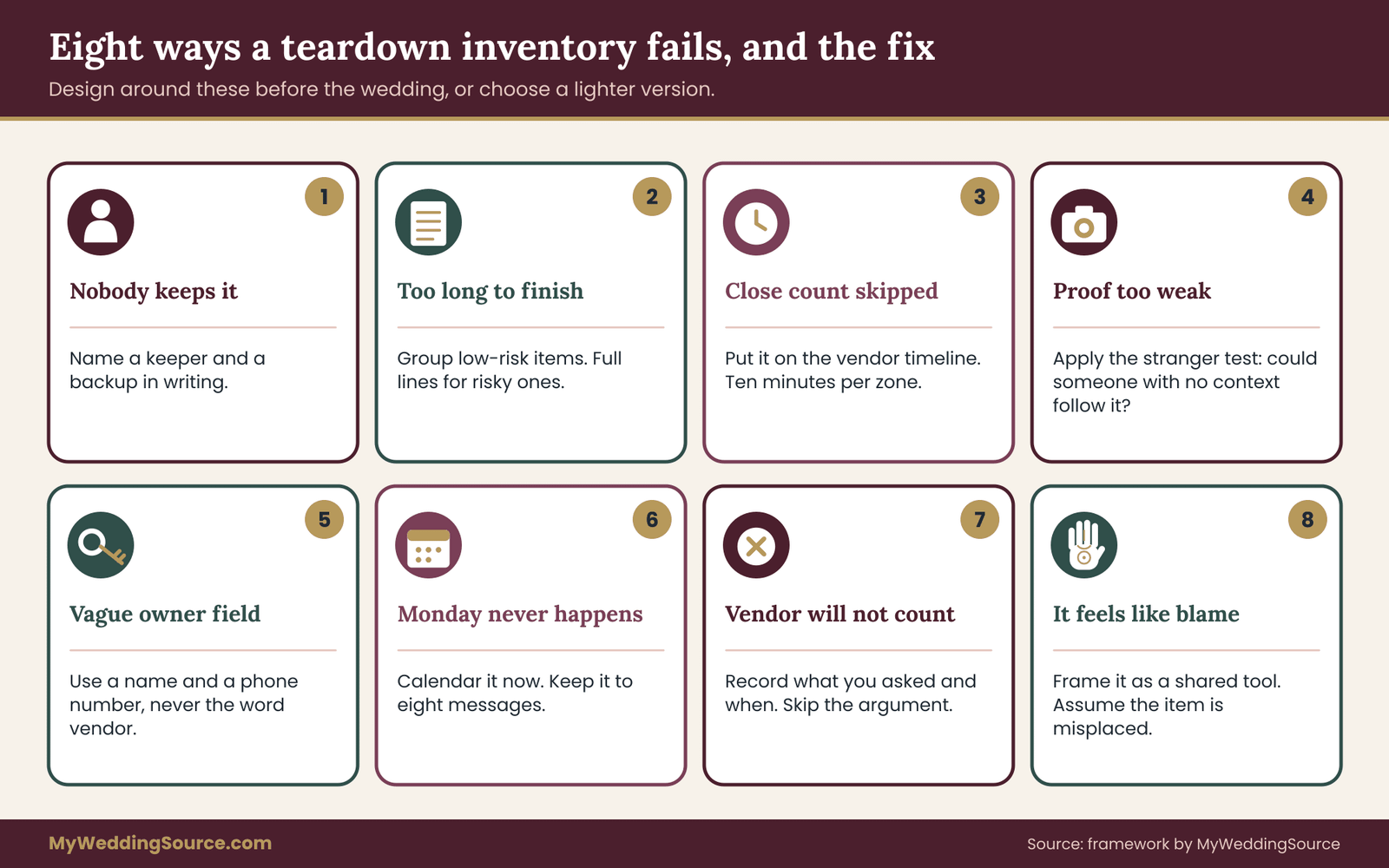
Failure one: nobody owns the log
A teardown inventory with no keeper becomes a document everyone assumes someone else is updating. The sign of this failure is a log with the open count complete and everything after it blank. The fix is naming the teardown inventory keeper in writing, with a backup, before the wedding. If you cannot name one person, reduce the teardown inventory to the photo-only version, because a smaller system that is actually run beats a larger one that is not.
Failure two: the log is too long
Couples who record every napkin and every cable produce a teardown inventory that no one can finish at midnight. The sign is a long list with most lines blank. The fix is to group low-risk items into single lines with a count and to give full lines only to items that are rented, borrowed, sentimental or expensive. A wedding teardown inventory should fit the people who will use it, not an ideal of completeness.
Failure three: the close count is skipped
The open count is easy because everyone is rested and the room is calm. The close count is hard because everyone wants to leave. When it is skipped, the Monday count has nothing to compare against, and you cannot tell when anything went missing. The fix is to schedule the close count into the vendor timeline, tell each vendor about it in advance, and build ten minutes per zone into the load-out schedule.
Failure four: the proof is too weak
A mumbled “yeah, I got it” is not proof, and a photo of a closed box is hardly better. The sign of weak proof is that a month later no one can say what was handed over. The fix is the stranger test described earlier: could someone with no context read this entry and understand it? If not, add a count, a name or a clearer photo.
Failure five: the owner field is vague
“Vendor” or “family” in the owner field defeats the purpose. When an item goes missing, you need a person to call. Replace categories with names and phone numbers kept in the contact sheet. This is especially important for borrowed items, where the lender may be a friend of a friend and the only link is your own memory.
Failure six: Monday never happens
Many logs die on Sunday evening, when exhaustion wins and the third count is postponed. The sign is a log that is mostly complete and then abandoned. The fix is to put the Monday count on the calendar before the wedding, with a specific time and a specific person, and to keep it small. If the whole task is eight messages and a closing note, it is much more likely to happen.
Failure seven: the venue or vendor will not cooperate
Occasionally a venue or vendor refuses to count with you or to share its records. A teardown inventory cannot force that. What it can do is record what you asked, when, and what was said. That record is useful later, and it may be useful in a conversation about whether a deposit should be returned. If a vendor’s refusal is a pattern, bring it up in review and consider it when you choose vendors in the future. Do not make accusations in the moment. Write down what happened and continue.
Failure eight: the log invites blame
A teardown inventory can feel like an accusation, particularly when it names a friend as the last holder of a lost item. The fix is tone. Present the teardown inventory as a shared tool, not as a surveillance system. When something is missing, ask the last holder for help locating it, and use language that assumes the item is simply misplaced. Most things are.
What the log cannot do
A wedding teardown inventory is not a legal contract, an insurance policy or a guarantee. It does not stop theft or damage, and it does not make a vendor liable for something their contract excludes. If an item is very valuable, such as a family heirloom or expensive jewelry, the right protection may be to keep it out of the venue entirely, to have its owner carry it, or to talk to an insurance professional about coverage. The teardown inventory supports those decisions, but it does not replace them.
It also does not settle questions about taxes, donation deductions or waste disposal rules. For those, the issuing agency or a qualified professional is the right source, and your log simply provides the facts they will ask for.
A short test before the wedding
One week before the wedding, ask five questions. Does every zone have a named lead? Does every line have an owner, a holder and a destination? Is the Monday count on someone’s calendar? Have the vendors been told that a close count is coming? Can the log be filled in on a phone with no signal? If any answer is no, fix that one thing first.
Your next steps
Start with the zone list. Walk through your venue floor plan, name each space, and give each one a lead. Then build the teardown inventory with the four fields for the items that carry real risk: rentals, borrowed pieces, sentimental objects and anything with a deposit attached.
Two weeks before the wedding, send the zone leads their sheets and tell vendors you will count with them at load-out. The day before, add the Monday count to a calendar. After the wedding, run the reconciliation walk, close the lines and store the finished log with your other records. For rental details, the rental planning checklist is a useful companion to keep open while you build the first version.
FAQ
What is a wedding teardown inventory?
It is a written list of every object brought into the venue, organized room by room, that records who owns each item, who holds it, where it goes next and the proof that the handoff happened. It is used during and after teardown to make sure nothing is lost, billed in error or left unclaimed.
Who should keep the teardown inventory on the wedding day?
Not the couple. A day-of coordinator, planner, or a reliable friend who is not in the wedding party is the best choice. Whoever it is should know the venue, have authority to count with vendors, and be available on Monday. Name a backup in case the first person is pulled into another task.
How long does it take to build a teardown inventory?
Most couples can build a first version in a few evenings once they have the venue layout and vendor lists. The zone list takes the least time. Adding lines for rentals, borrowed items and sentimental objects takes the most. Small weddings need much less. Do not try to finish every line at once; start with the high-risk items.
Do we need a spreadsheet, or will paper work?
Either works. A shared spreadsheet is easy to copy and search, but paper sheets on a clipboard are more reliable in a dim room with weak signal. Many teams use paper on the night and photograph the sheets afterward. Choose the format your zone leads will actually use, and try it once at the rehearsal.
What if a rental company says items are missing and we disagree?
Share your records: the open-count photo, the close-count photo and any signed pickup sheet. Ask for their count sheet and the contract clause on lost items. Stay factual and polite. Whether you owe anything depends on your contract, so read it carefully, and ask a legal professional if the amount is large.
Can we donate leftover food or flowers?
Often yes, but the caterer’s policy and the recipient’s rules decide. Many caterers do not release food that has been served. Call the receiving organization before the wedding, write the pickup details in the destination field, and check food safety guidance from the U.S. Department of Agriculture. Donation tax questions belong with a qualified tax professional.
What should we do with borrowed items we cannot find?
Tell the lender promptly and without excuses, share what the teardown inventory shows about the last holder and last count, and search the likely places. Then offer a fair outcome, such as replacement or payment, before they have to ask. Agree on the outcome in writing and close the line, so the matter does not linger.
Is a teardown inventory worth it for a small wedding?
Often a lighter version is enough. If only one or two parties bring items, a photo of each area at setup and at close, plus a short Monday message to anyone who lent you something, covers most of the risk. Grow the system only as the number of owners, rentals and deposits grows.
Sources
- Recycling basics and what to do with materials, U.S. Environmental Protection Agency
- Sustainable management of food, U.S. Environmental Protection Agency
- Food recovery hierarchy, U.S. Environmental Protection Agency
- Sustainable materials management, U.S. Environmental Protection Agency
- Bill Emerson Good Samaritan Food Donation Act, 42 U.S.C. 1791, Legal Information Institute
- Charitable contributions, Publication 526, Internal Revenue Service
- About Form 8283, noncash charitable contributions, Internal Revenue Service
- Danger zone, 40 F to 140 F, USDA Food Safety and Inspection Service
- Chain of custody, NIST Computer Security Resource Center glossary
- Federal Trade Commission, consumer advice