
A low demand reception is a wedding party where every ask on a guest is announced in advance, kept small, and easy to decline without explanation. This guide gives you an original opt-out and facilitator system: a way to audit what the evening asks of people, a card guests can use, a brief for the people running the room, a worked example, and the conditions under which the whole idea fails.
To plan a low demand reception, list every moment of the evening and name what it asks of a guest (attention, conversation, noise tolerance, movement, waiting, or an on-the-spot decision). Give each moment one of three doors: stay as you are, step aside, or leave quietly. Tell guests in writing before the day, put a short opt-out card on every table, and assign one named facilitator to run each moment. Make a no cost nothing, never ask twice, and never ask anyone to perform without their earlier yes.
Most receptions are built from a script that nobody wrote down. The couple enters to an announcement, everyone is told to clap, the first dance happens under a light, a relative taps a glass until the couple kisses, the DJ calls all the single people to the floor, and a microphone travels around the tables. Each piece looks harmless. Together they make a long evening of small, unannounced requests, and for many people (including many couples) that is the tiring part of the day.
A low demand reception keeps the parts you actually want and changes how they are asked. Dancing can still happen. Toasts can still happen. The difference is that nobody has to guess whether they are expected to take part, nobody is called out by name without agreeing first, and the people running the room know exactly what to say when someone says no.
This article is about that single design problem: making participation at a low demand reception optional and clear. It does not try to cover the whole reception, only what makes a low demand reception different. If you want the full flow of entry, seating, food and exit, the guide to wedding reception guest flow covers that, and this article assumes you have it open next to you. Here the focus is narrower. What does each moment ask, how does a guest say no, and who handles it?
A note on scope. This is general planning information, not legal, medical or accessibility advice, and it does not diagnose anyone or assume that any group of people needs the same things. Needs differ from person to person and from day to day. Where a rule applies to a venue or a vendor, the article points you to the issuing agency so you can check the current version yourself.
What a low demand reception means in practice
The word “demand” here is used in a plain, practical way. A demand is anything the reception asks a person to do beyond arriving, eating and being kind. Being watched is a demand. Making small talk with a stranger at a table of eight is a demand. Standing in a loud, bright room is a demand on the senses. Waiting forty minutes for a plated dinner without knowing when it will arrive is a demand on patience and planning. Being handed a microphone is a large demand.
Nothing about this is a flaw in the guest, and a low demand reception never treats it as one. Every person has a different budget for these things, and the budget changes with sleep, travel, a long ceremony, a hard week, a crowd of relatives, or an old family tension that has nothing to do with the wedding. A low demand reception respects that people spend their budget differently, and it asks very little of the budget by default.
What it is not
A low demand reception is not a silent party, a boring party, or a reception where nothing happens. Some people hear “low demand” and picture guests sitting in a dim room with no music. That is one possible version, and it is not the one this guide is about.
It is also not a sensory-friendly event in the narrow sense of controlling light and sound, although it overlaps with that. Sensory comfort is one of six kinds of demand, covered below. A reception can have loud music and still be a low demand reception if the loud part is optional, located away from the dining tables, and announced.
And it is not a label for any particular kind of person. Couples who plan this way include people who are neurodivergent, people with chronic illness, people who dislike being the center of attention, people planning around a partner’s anxiety, and people who have simply been to too many weddings with forced games. The design works for all of them because it does not require anyone to explain why.
Who sets the level
You do. The couple decides how low the demand goes in a low demand reception, and the answer can be different for different parts of the evening. You might be comfortable with a lively dance floor and a loud toast, yet want no receiving line and no spotlight dance.
You might want an almost entirely quiet evening with one planned moment of music. Both are valid. The aim is not to reach a target score. The aim is that every ask is a decision you made on purpose and that every guest can see it.
This is where a short conversation with your partner pays off before any vendor is hired. Each of you writes down the three moments of a typical reception you would most like to skip and the three you would most like to keep. Compare the lists. The overlap tells you what to design around, and the differences tell you where one of you may be quietly carrying the other’s discomfort.
Six kinds of demand a reception makes
To plan a low demand reception you need a vocabulary for what is being asked. Without one, “make it a chill reception” becomes a vague instruction that vendors interpret in the usual way. These six categories are a working list, not a clinical one. They are meant to be used with a pen, against your actual run of show.

Attention demand. Being looked at, being introduced, being asked to stand, being in a photograph that everyone will see, being asked to speak or sing. The spotlight dance, the garter and bouquet moments, the “everyone raise a glass and look at the couple” moments, and the emcee asking for a volunteer all sit here. This is the demand most guests mention when they say they dread a wedding.
Social demand. Talking to people you do not know, answering the same question about how you met, networking at a table, being matched with a seat partner, or being steered into a conversation by a well-meaning relative. Assigned seating with strangers is a social demand even if the food is excellent.
Sensory demand. Volume, bass, flashing lights, strong perfume, fog or haze machines, crowded aisles, hot rooms, camera flashes, and the sudden bang of a champagne cork or a sparkler send-off. Sensory demand is real for plenty of people and is often invisible to the couple, because it was built into the venue package.
Physical demand. Standing for a long ceremony line, walking across grass, dancing, queueing at a buffet, climbing stairs to the bar, or sitting on a hard chair for three hours. This overlaps with accessibility planning, so it is worth reading the guide to accessible wedding venue red flags before you sign a contract.
Time and uncertainty demand. Not knowing what comes next, how long a gap will last, when dinner will be served, or whether a surprise is coming. A schedule that slips by an hour is a heavy demand for people who rely on knowing what happens next. Surprises, however well meant, belong in this category too.
Decision demand. Being asked on the spot to choose, to respond, to say yes or no in front of others. “Will you dance with me?” is a decision demand. So is “Who wants to come up for the game?” when the person asking is looking at you.
Why six and not one
Treating all of this as “stress” hides the useful part. A person might handle a loud room easily and hate being introduced. Another might love a stage and find an unstructured two-hour gap unbearable. If you only ask “is this stressful?”, you will end up cutting the wrong things. Asking which of the six an item is lets you keep the parts you value and change how they are delivered.
A first pass with your run of show
Take whatever draft schedule you have, even a rough one, and write the six categories across the top of a page. Under each, list the moments that fit. Most moments will appear in more than one column. Cake cutting is mainly attention, a little sensory, and a little time. A group photo is attention and social. The dance floor is physical and sensory, and for some guests it is also a decision.
You do not need to fix anything yet. Just notice where the columns are crowded. In many receptions, and in most plans for a low demand reception that start from a template, attention and decision demands cluster in the middle of the evening, right after dinner, in a block of announcements that nobody scheduled deliberately. That cluster is usually the first thing to redesign.
If you also have the guide to wedding reception music planning open, mark which music blocks are loud enough to count as sensory demand and which are background. The point is to have honest data about your own evening before anyone suggests changes.
The opt-out ladder for a low demand reception
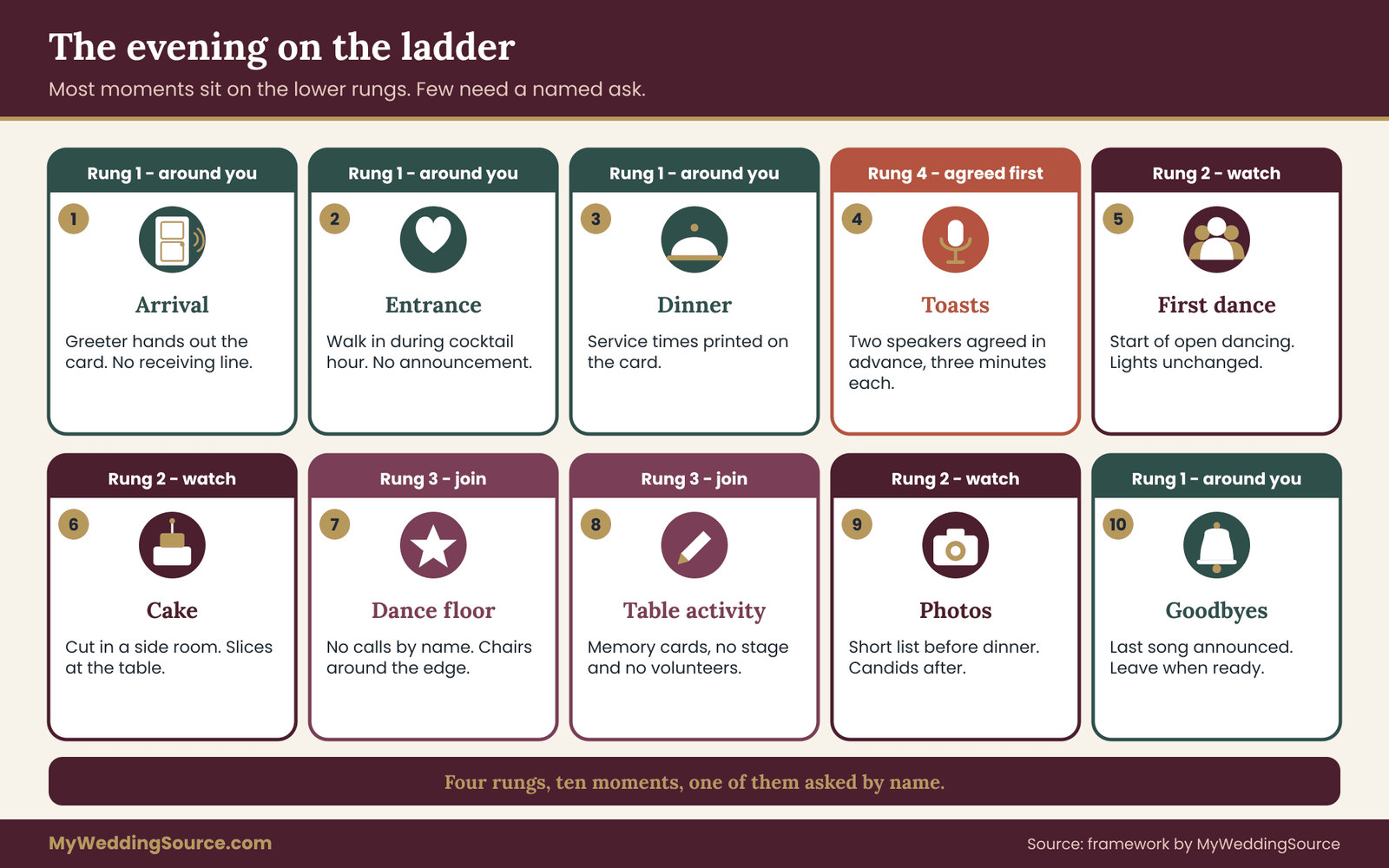
Once you can name what each moment asks, you need a way to decide how much of it to keep. The opt-out ladder is a four-rung scale. Every moment in your evening sits on exactly one rung, and the rung tells you how it is announced, who runs it and what a guest does to decline.
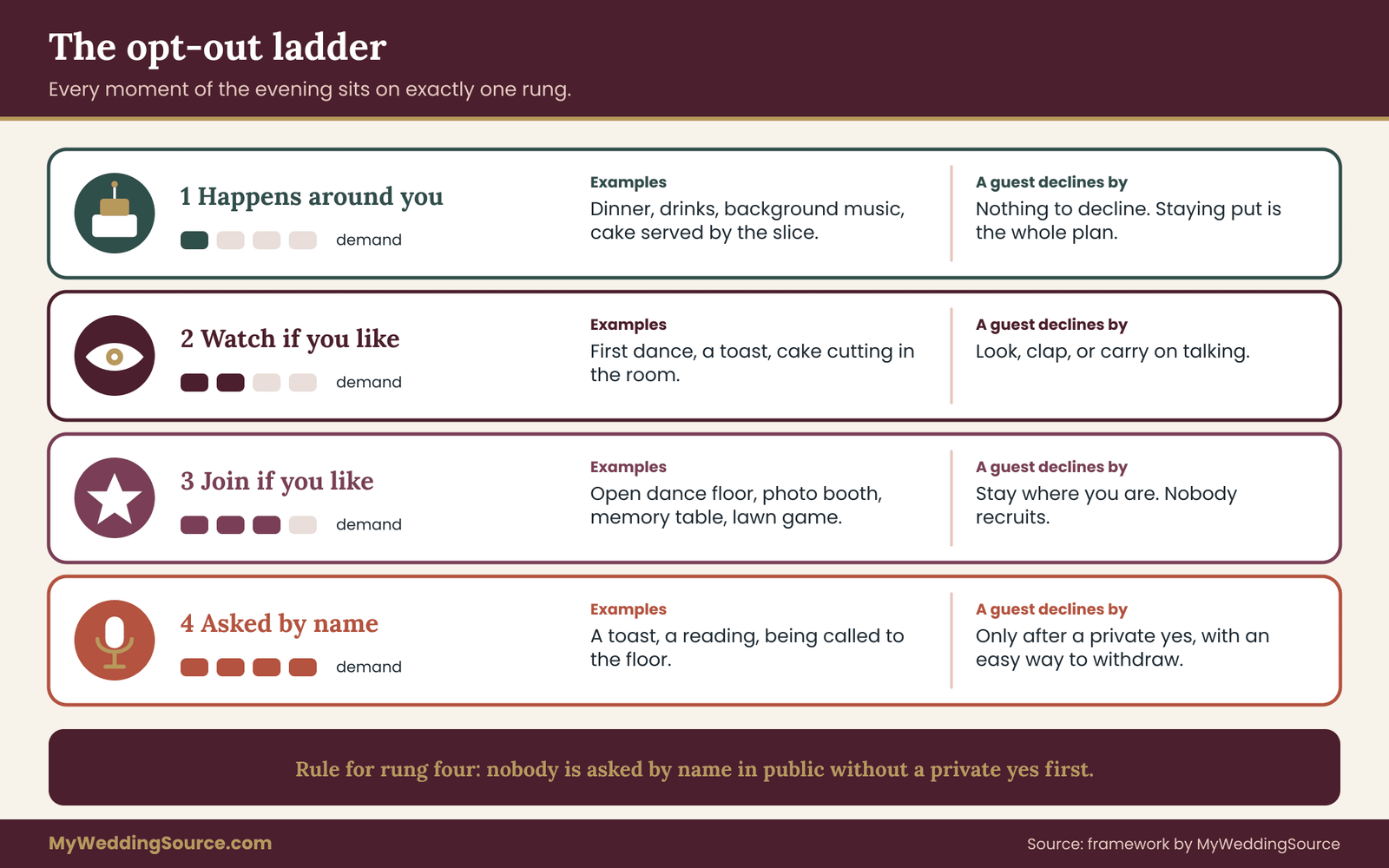
Rung one: it happens around you. Dinner service, background music at conversation volume, drinks, the cake being cut in a side room and brought out in slices. A guest does not have to do anything, and not taking part is not a visible act. There is nothing to decline because nothing is asked. A low demand reception is mostly rung one.
Rung two: watch if you like. The first dance, the cake cutting in the room, a toast from a parent, a short ceremony reading at the reception. The activity is public, but it does not require anything of the audience beyond what they choose to give. The ask is soft: you may look, clap, or carry on with your conversation. Guests need to know that looking away is fine.
Rung three: join if you like. The open dance floor, a lawn game, a photo booth, a song request, a memory table where guests can write a note. A guest joins by walking over. Not joining looks like staying where they are. The key rule on this rung is that nobody recruits. An announcement says the thing exists and where; it does not point.
Rung four: asked by name. Reading a poem, giving a toast, being pulled onto the floor, being called on to answer a question, being asked to hold a prop. This is the rung that carries the most attention and decision demand, and it is the rung the low demand approach treats with the most care.
The rung-four rule
In a low demand reception, nobody is asked by name in public unless they have already said yes in private. That one rule removes most of what makes a reception stressful.
In practice it means a toast giver has agreed weeks ahead, knows the time limit and the order, and has the option to withdraw until the day. It means the MC never invents a volunteer. It means the bouquet toss, the garter moment and any “single people to the floor” call do not appear unless you choose them, and if you do choose them, the people involved have opted in ahead of time and the call is phrased to include anyone who wants to join rather than a category of people.
In practice it means a toast giver has agreed weeks ahead, knows the time limit and the order, and has the option to withdraw until the day. It means the MC never invents a volunteer. It means the bouquet toss, the garter moment and any “single people to the floor” call do not appear unless you choose them, and if you do choose them, the people involved have opted in ahead of time and the call is phrased to include anyone who wants to join rather than a category of people.
Moving a moment down the ladder
Most moments can be moved one or two rungs down without losing what you love about them. Some examples, kept deliberately small:
A grand entrance announced to the whole room is a rung-four moment for the couple, because they are asked to perform. Moving it down to rung one might mean walking in during cocktail hour while guests are already mingling, with no announcement at all. You still arrive. You skip the spotlight.
A first dance performed alone under a light is rung two for guests and a large attention demand for you. You could dance it in a moment when the floor is already half full, at the start of the open dancing, with the lights unchanged. Some couples move it to a private room before the reception and play the clip later. Others skip it and have the first song be one everyone dances to.
A cake cutting in front of the whole room is rung two. Cutting the cake in a quiet corner, with a photographer and two relatives, and then serving slices, is rung one for guests. The photograph is still taken.
A “story from each table” game is rung four for everyone. Replace it with a written memory card on each table that guests may fill in or ignore, and the same warmth moves to rung three.
What not to move down
Be honest about the things you want to keep at a higher rung. If your grandmother has waited fifty years to give a blessing at the microphone, that is a rung-four moment and it is worth keeping, provided she has agreed and the logistics are calm. A low demand reception is not about removing meaning. It is about making sure each high-demand moment is chosen on purpose rather than inherited.
Writing the ladder into the plan
Create a single page for your low demand reception with the evening in order and the rung number next to each moment. The page is only for you and the people running the room. If more than a third of the moments are on rung four, you have either a performance-heavy reception, which is a valid choice but not a low demand reception, or a plan that needs another pass.
Making a low demand reception clear before the day
A low demand reception only works if people know participation is optional. A guest who has to work out the rules in the moment, while the room is watching, will usually take the path that draws the least attention, which is often to join in against their own preference. Clarity ahead of time removes that pressure.
Where the information goes
Put the news of your low demand reception where guests already look, in three layers, each shorter than the last.
The first layer is your wedding website. A short page titled something plain, such as “How the reception will work”, is enough. It lists the evening in order, says in one sentence what each moment involves, and notes whether guests are expected to do anything. The guide to the RSVP etiquette covers how to collect information through the response card, and the same card can carry one optional line about needs.
The second layer is the printed or digital program. A half page, with times, in plain language. If the room has a quiet area, it appears here with a location.
The third layer is the table card or opt-out card, covered in the next part. It is the version a guest reads at the moment of need.
Words that make a no easy
The tone of your messaging matters more than its length. Consider two ways of announcing the dance floor.
“Everyone is welcome to join us on the dance floor!” sounds warm, but it contains a mild instruction: everyone, join us. A guest who stays seated is making a visible choice against the invitation.
“The dance floor will be open from eight. Dance, watch, or stay at your table. All three are part of the evening.” tells the guest that staying seated is part of the plan, which removes the sense of refusing something.
A few other phrasing patterns that work:
“There will be a toast from two family members around eight forty. You are welcome to listen from your seat or step out for a few minutes.” This names a time, a type of moment and two ways of taking part.
“There is a quiet room by the lobby with soft light and no music. You do not need to tell anyone you are going.” This answers the question guests would be too shy to ask.
“We have not planned any games or group activities that require guests to perform.” For some people, this single sentence will decide whether they enjoy the evening.
Phrases to avoid: “no pressure!” repeated in every line (it signals that pressure exists), “just have fun!” (an instruction), “everyone will be dancing” (a prediction that becomes a fear), and “come if you can” attached to specific moments (it sounds like a test).
What to say about why
You do not owe anyone an explanation of your choices. Many couples describing a low demand reception add a single line such as “We have planned the evening so that guests can take part as much or as little as they like.” That is enough. It does not mention any person’s needs, so it does not label your guests or your family, and it does not invite debate.
If you want to be more specific, speak about yourselves and keep it factual: “We are keeping the evening calm and predictable because that is how we enjoy parties.” That tells people the design is a preference, not a rule of etiquette they might have broken.
Timing the message
Send the full description of the low demand reception with the invitation or shortly after the response deadline. Send a one-paragraph reminder a week before, with the order of the evening and the location of the quiet area. A guest who is anxious about the day will tend to reread the message several times, so the facts should be the same every time and easy to find. Changes made after the reminder should be rare and announced with the new time first, reasons second.
Reaching guests who will not read the website
Some guests, usually older relatives or those without regular internet, will not open the page. Print the summary of the low demand reception on the invitation insert or a card, and ask one family member to call the guests who might need it. The guide on wedding signage systems is a useful companion here, because signs at the venue carry the same message to anyone who missed the earlier ones.
One honest limit
Writing the message does not change the room. If guests read “optional” and then see the DJ pulling people onto the floor, they will believe the room, not the website. The facilitator guide later in this article exists to close that gap. A low demand reception depends on the behavior of the people running it as much as on the wording of the invitations.
The guest opt-out card
The opt-out card is the small, physical piece of a low demand reception. It sits on each table, or in each program, and tells a guest in a few lines how to take part and how not to. It is not a form and it does not need to be returned. Its job is to make the choice visible and ordinary.
What goes on the card
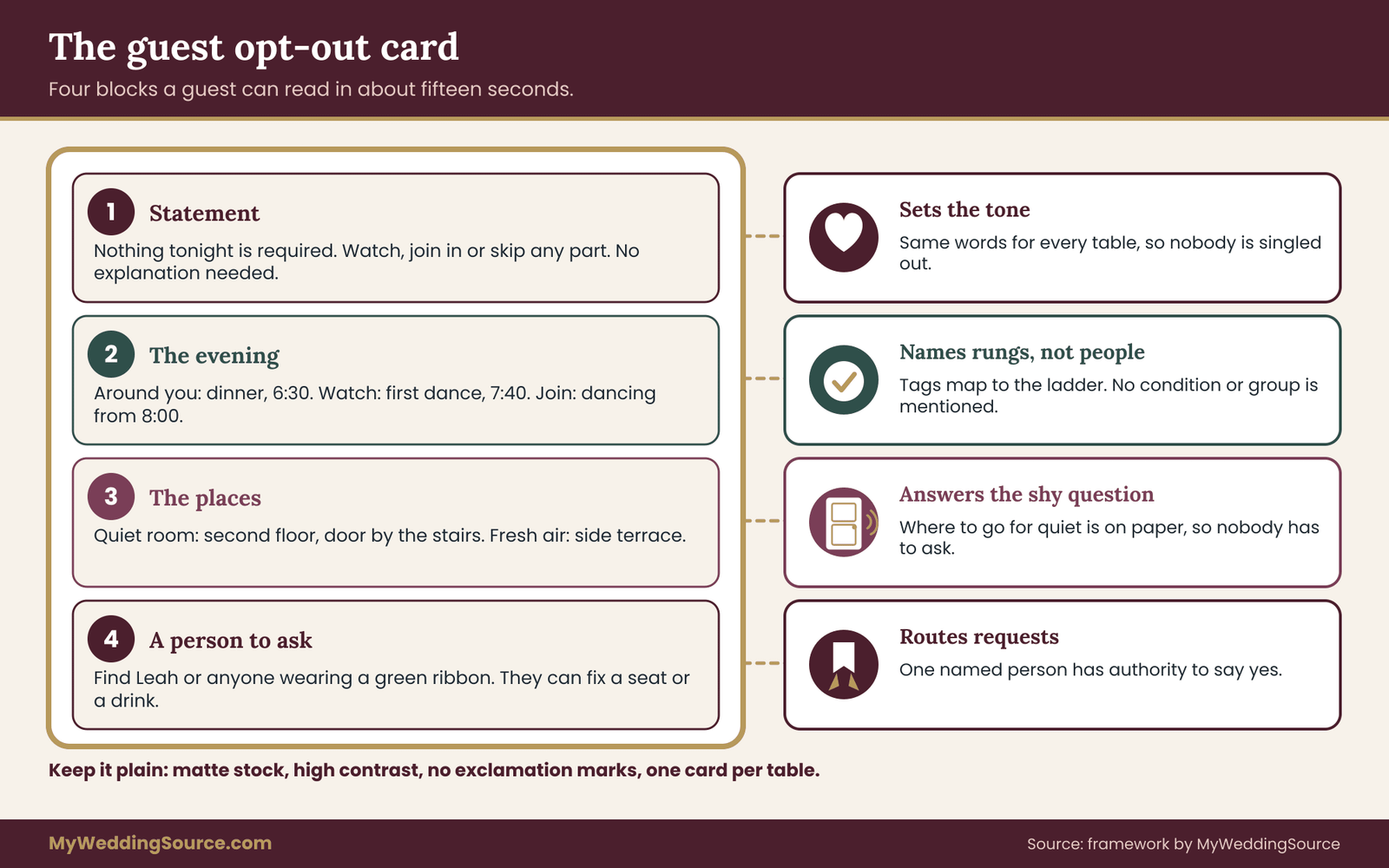
Keep it to what a guest can read in about fifteen seconds. Four blocks are enough.
The first block is a plain statement: “Nothing tonight is required.” Follow it with a short line that says what that means: “You can watch, join in, or skip any part of the evening. You do not need to explain.”
The second block is the evening in order, with times. Five to eight lines, one for each moment, each with a short tag in one of three words: around you, watch, or join. Those tags map to the first three rungs of the ladder. Rung four moments are listed only by the people who agreed to them, such as “Toast by Dana, about eight forty”.
The third block names the places. Where the quiet space is, where the outdoor air is, where the restrooms are, where food is available outside the main dinner, and where to find a facilitator. If the venue has a step-free route, say so in one phrase.
The fourth block names a person and a way to ask. “Ask Priya, in the green scarf, or any member of the wedding party wearing a ribbon.” This is the facilitator, and the card makes them easy to find.
What does not go on the card
On a low demand reception card, do not put any reference to a diagnosis, a condition, or a group. A card that says “for guests who need sensory breaks” separates people into those who need the card and those who do not. A card that goes to every table treats everyone the same, which is the point.
Do not put rules on it. “Please do not take photos during the first dance” belongs on a different sign, and it is a request about behavior toward the couple, not about the guest’s own participation. Mixing the two makes the card feel like a list of restrictions.
Do not use exclamation marks or cheerful pressure. The card should sound like a calm station announcement.
Wording that has worked as a pattern
These are patterns, not exact text to copy. Adapt them to your voice.
“Tonight is open. Take part in as much or as little as you like. You do not need to tell anyone why.”
“Around you: dinner, drinks, music while we eat. Watch: first dance, about seven forty. Join: dancing from eight. Quiet room: second floor, door by the stairs.”
“If anything is unclear, or you want a different seat or a quieter spot, find Priya or any person wearing a ribbon. They can arrange it without a fuss.”
The last line is crucial because it routes requests through someone with the authority to say yes. Without it the card promises flexibility and leaves the guest to negotiate with a server, a DJ or a relative.
Table placement and design
Put one card at each table, standing, near the center. If your table design is crowded, fold it into the menu card as a bottom third. Print on plain, matte stock in a legible type size: high contrast, no glare, nothing smaller than a menu.
For digital delivery, put the same text on the wedding website, and make a printable PDF so guests can keep it on a phone. A QR code is acceptable as a backup but should not be the only route. A guest in a crowded room with poor reception will not scan it.
The facilitator guide for a low demand reception
A card makes the choice visible. A facilitator makes it real. This section is the brief for the people who run the room. It is written so that you can copy the structure and hand it to two or three friends or relatives.
Why name facilitators
Without named roles, the people who feel responsible for the room default to old habits. The DJ calls people onto the floor because that is what the DJ does. An enthusiastic aunt drags a reluctant cousin to the photo booth because she is being kind. A groomsman keeps pouring after someone says no. These are not bad people. They are following the usual script because nobody gave them a different one.
A facilitator is simply a person who has been given the new script for a low demand reception and the authority to apply it.
Four roles
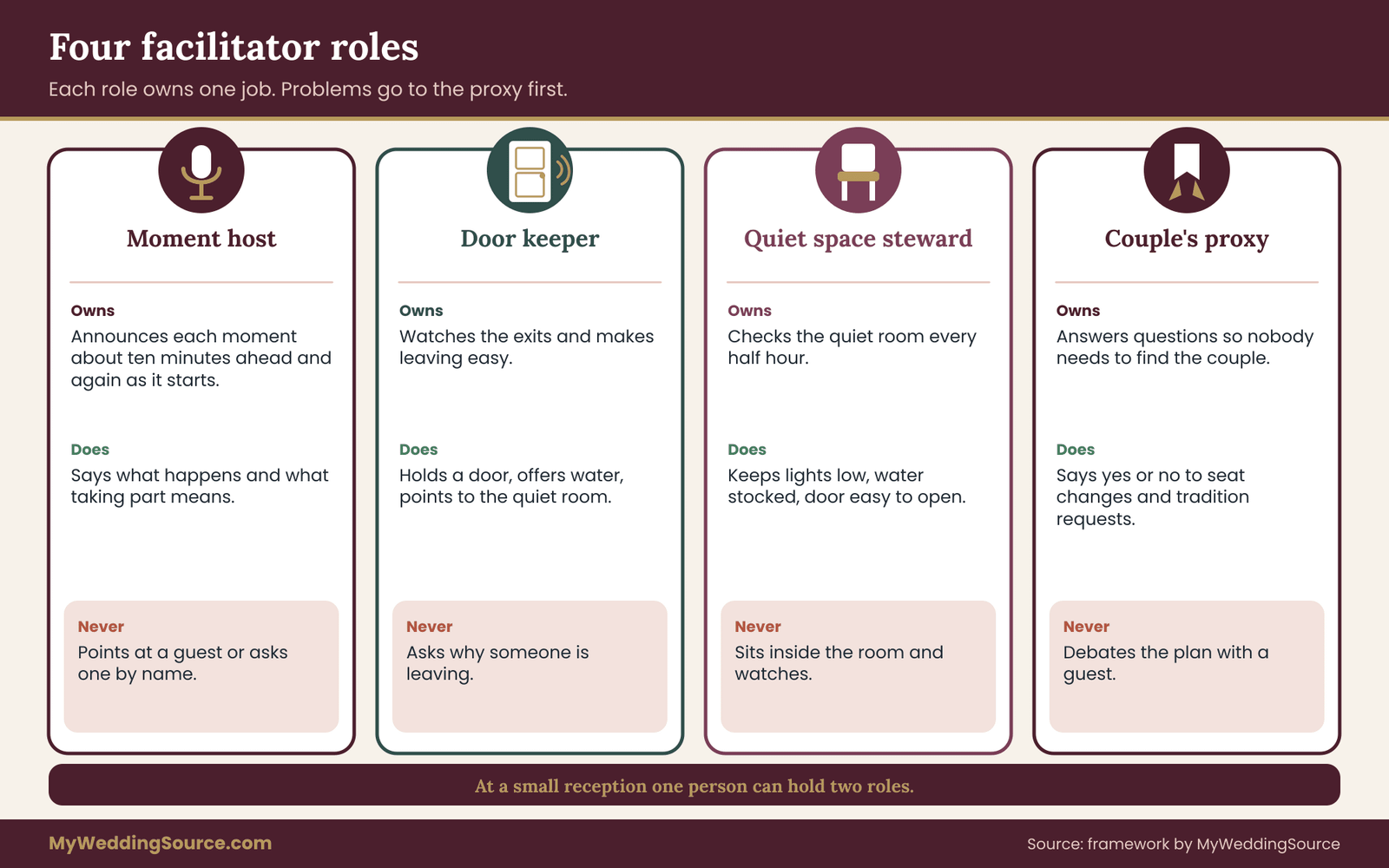
You may not need four people to run a low demand reception. At a small reception one person can do two roles. The roles are separate on paper because they ask for different skills.
The moment host. This person announces each moment in the neutral wording on your page, about ten minutes before it begins and again as it starts. They say what is about to happen, what taking part involves, and what not taking part involves. They never ask a guest by name to join. If the DJ or emcee has been hired, the moment host works with them and gives them the exact words.
The door keeper. This person quietly watches the exits of the main room and the quiet space. Their job is to make leaving easy: hold a door, offer water, point to the quiet room, or just nod. They do not ask a guest why they are leaving, and they do not follow. They report to the couple’s proxy only if a guest looks unwell or asks for help.
The quiet space steward. If you have a quiet room, someone should check on it briefly every half hour. Lights stay low, the door stays easy to open, and the room remains free of tasks. The steward does not sit inside it and watch. They check supplies, such as water and chairs, and leave.
The couple’s proxy. This person answers questions on your behalf so that nobody needs to find you. A relative asks why there is no bouquet toss. A guest wants to change a seat. The proxy knows your preferences and has authority to say yes or no. They also take over any issue that would otherwise reach you in the middle of your own dinner.
The one-page brief
Give each facilitator of the low demand reception the same page, no longer than a single side. It should contain the evening in order with rung numbers, the exact announcement wording for each moment, the three rules of the evening, the names of the other facilitators, and a short list of phrases to use. A few of the rules that tend to work:
Announce, do not summon. Say what is happening and where. Do not point at anyone.
A no is complete. If a guest declines something, the answer is accepted, with a smile, and the guest is not asked again later in the evening.
Do not explain a guest to another guest. If someone asks, “Why isn’t he dancing?”, the answer is “Not tonight,” and nothing more.
Do not fix a guest. If a guest looks uncomfortable, ask once whether they would like anything, then let them answer. If they say no, leave them be.
Keep the couple out of it. Problems go to the proxy first.
Scripts for common moments
The words below are suggestions, kept short because a facilitator is often speaking to a guest who is already uneasy.
When a guest declines to join a group photo: “No problem. We will get the photographer to take a few of the people who are here, and you can stay put.” Nothing more.
When a guest is pulled by a relative: “Let her pick. She will join if she wants to.” Said lightly, to the relative, not to the guest.
When a guest asks to leave early: “Of course. Thank you for coming. Do you want me to pass anything on to the couple?” That leaves the guest in control of what is communicated.
When a guest asks where to go for quiet: “The second floor, door by the stairs. You can stay as long as you like.”
When an older relative objects to the absence of a tradition: “They decided to keep the evening simple this time. They hope you enjoy it. Can I get you a drink?” Redirecting to hospitality is more effective than defending the choice.
When the DJ or a vendor drifts back to the old script: “Quick reminder from the couple. No calls to the floor, no named volunteers. Open dancing with the lights as planned.” Say it privately and kindly, and thank them.
Training takes fifteen minutes
Meet with the facilitators of your low demand reception the week before, ideally at the venue or by video. Walk through the evening line by line. Role-play two of the scripts above. Ask each person what they would do if they saw something that was not on the page, and agree that the answer is to ask the proxy. Then stop. A longer meeting will not improve the day, and it risks making the facilitators feel they are managing a crisis.
Choose people who can say no
The best facilitators for a low demand reception are not always the closest relatives. They are people who stay calm, can say no to a pushy aunt, and do not take the room’s mood personally. A friend who loves attention and loves to organize can still do the job, provided they accept that their role is to protect choices, not to produce enthusiasm. Your cousin who excels at getting a crowd going is wonderful on the dance floor and wrong for the role of moment host.
Compensating and thanking
Facilitators at a low demand reception are working. Give them a seat, a meal at a good time, and a break. If a role will take them away from the party for much of the evening, consider a paid helper or the venue’s coordinator. The guide to wedding vendor timelines helps you place the facilitator tasks next to your other vendor cues so they are not forgotten.
Walking through a low demand reception, moment by moment
This section applies the six demands, the ladder and the card to the usual sequence of a reception, so you can see a low demand reception take shape. Treat it as a menu, not a prescription. For each moment you will find what it tends to ask of guests, the version that fits a low demand reception, and the line a facilitator can use.
Arrival and the receiving line
A receiving line is a long sequence of small social demands for guests and a long sequence of repeated attention for you. Guests must wait, greet, speak briefly and move on; you must do the same forty or sixty times in a row.
Alternatives that keep the warmth: greet guests at their tables during dinner, a few tables at a time, with a clear window of ten minutes; or stand near the cocktail area for twenty minutes without a line, so guests can approach if they wish. If you want a receiving line for family reasons, limit it to parents and the couple, and put a chair beside it for anyone who needs to sit.
Make the arrival at a low demand reception calm. A greeter hands each guest a program and the card, and says where the drinks and seating are. Nobody should be asked to find their own table in a crowd without a visible chart. A clear seating chart with large print keeps people from clustering at the board.
The grand entrance
Most couples at a typical party are introduced by name, and the room stands to applaud. That is a rung-four moment for you and a rung-two one for guests who are suddenly expected to clap and stand.
For a low demand reception, you can walk in unannounced during cocktail hour, or enter quietly at the start of dinner with a single sentence from the host: “Dinner is served. The couple will join you at their table.” The sentence is a plain statement, not a cue to stand. If you like the sound of an announcement, say your names without asking anyone to do anything.
Seating and conversation
Assigned seating is kind in many ways. People know where to go and do not have to search for a place. It also creates the social demand of sitting with strangers for ninety minutes. A few small choices reduce the load: seat people with at least one person they know; avoid seating anyone at a table of all strangers; and put conversation starters on the table only if they are plainly optional.
A card that says “Ask each other anything you like” is a demand in disguise. A card that says “Here are three small questions if you ever run out of things to say” is closer to an offer.
Leave a few seats unassigned in a quiet corner for guests who want to move. The facilitator can mention these when asked, and nobody has to explain why they are choosing the corner.
Dinner timing
For many guests the most difficult part of the evening is the gap before food arrives. Time and uncertainty demand is highest when people do not know how long a wait will last. Print the service plan on the card: “Salads at six thirty, mains at seven, dessert at eight fifteen.” Tell your caterer that you want the timing written down and the changes announced early. If a delay is likely, have the moment host tell tables as soon as the delay is known, with a revised time.
If you have a plated dinner, ask the caterer whether a short bread basket or small first course can arrive within fifteen minutes of seating. Where the meal is a buffet, release tables in small groups so that lines stay short. Use the cocktail hour as a soft landing before dinner, with seats, water and a quiet corner within easy reach.
Toasts and speeches
Toasts are the clearest rung-four moment. To keep them inside a low demand reception, follow four habits.
Pick speakers who have said yes in private, weeks before. Give each a time limit and an approximate slot. Tell the audience what to expect: “Two toasts, about three minutes each, around eight.” Let guests step out during toasts without ceremony; the card has already said so.
Remove “open mic” toasts. A free microphone invites people to feel obliged and gives a stage to a speaker nobody has vetted. If you want to give people a way to share, put a memory book at a table where guests can write, or collect short audio or written messages beforehand.
Ask speakers to avoid questions to the audience, calls for volunteers and requests for people to stand. A toast should ask for one thing only: a raised glass at the end, and a raised glass is optional.
The first dance and other dances
A first dance alone under a light is the textbook attention demand, and a common first edit to a low demand reception. You can lower it in several ways without losing the music. Dance when the floor is already open, with the lights unchanged, and let others join after a minute.
Dance a shorter version, such as one verse and one chorus. Dance in the quiet room or an empty ballroom before guests arrive, and record it. Or skip it, and start the open dancing with a song you both like.
Parent dances follow the same logic. They are rung-four moments for the people involved, so they need advance agreement. If a parent would rather not dance in front of the room, offer a private alternative, such as a short walk, a photograph or a meal. Ask the DJ or band to agree to volume zones in writing, which matters because the loudest part of a reception is often the music right after dinner.
Cake cutting
The cutting itself takes under two minutes and rarely needs an audience. Choose a version where guests may drift over to watch, or cut quietly in a side space with the photographer. A facilitator announces, “Cake is now being cut. Slices will be at the table by the window in ten minutes.” That is all. People who want to see it can come; others will not notice that they missed anything.
The dance floor
For many guests the dance floor is the main event, and for others the main stressor. At a low demand reception the two are separated. Place the floor away from the dining tables if the room allows. Keep the volume at a level where people at the tables can still talk without raising their voices. Offer a clear off-ramp: chairs around the edge, a doorway to a quieter hall, and a facilitator nearby who can fetch water.
Rules for the DJ or band at a low demand reception: no calls to the floor by name; no single-people calls; no “everyone up” commands; no forced dances such as the wedding line; no unannounced fog, strobe, or confetti cannon. The announcer may say, “Dancing is open. The next hour is music we think you will enjoy,” and then step back.
Games and activities
Wedding games are demand magnets in any low demand reception that is not careful: the shoe game, group trivia, guess the couple, the dollar dance. If you want an activity, choose one that guests may do alone, at a table, at their own pace, and in no particular order. A table card of crossword clues, a postcard to the couple to be mailed in six months, a corner for building a small paper craft, or a photo wall where guests can add a snapshot are all examples.
Anything that requires a person to stand up and perform in front of others should either be removed or placed on rung four with prior consent.
The bouquet toss, garter and other category calls
These moments sort guests into groups, usually by relationship status, and ask the group to step forward. They combine attention demand, decision demand and a sense of exclusion for those who do not fit the category. If you love the symbolism, offer a version that anyone may join: leave the bouquet on a table with a card inviting someone to take it home, or hand it to a person who means something to you without a game.
Photography
A group photo schedule at a reception is a series of requests to stand, smile and wait. A shot list, shared with the photographer in advance, keeps it short and predictable. Ask the photographer to avoid flash in dark moments where possible, to take candid photos of tables rather than calling people together, and to ask permission before photographing guests who step away. The guide to wedding photography consent lists the questions worth asking your photographer about guests who do not want to be photographed.
The send-off and goodbyes
Sparkler exits, bubble tunnels and long goodbye lines are all attention-heavy and noisy. A low demand reception can end quietly. A facilitator announces a last song fifteen minutes before it plays, and guests leave when they are ready. Couples who want a ceremonial exit can slip out with a small group. If you want a send-off, use a quiet one such as a bell or a simple wave at the door.
A worked case: one invented couple, one evening
The example below is invented. The couple, the venue and the numbers are made up to show the method, and they are not a report of a real wedding or a claim about results. Use it to see the steps of a low demand reception in order and then replace every detail with your own.
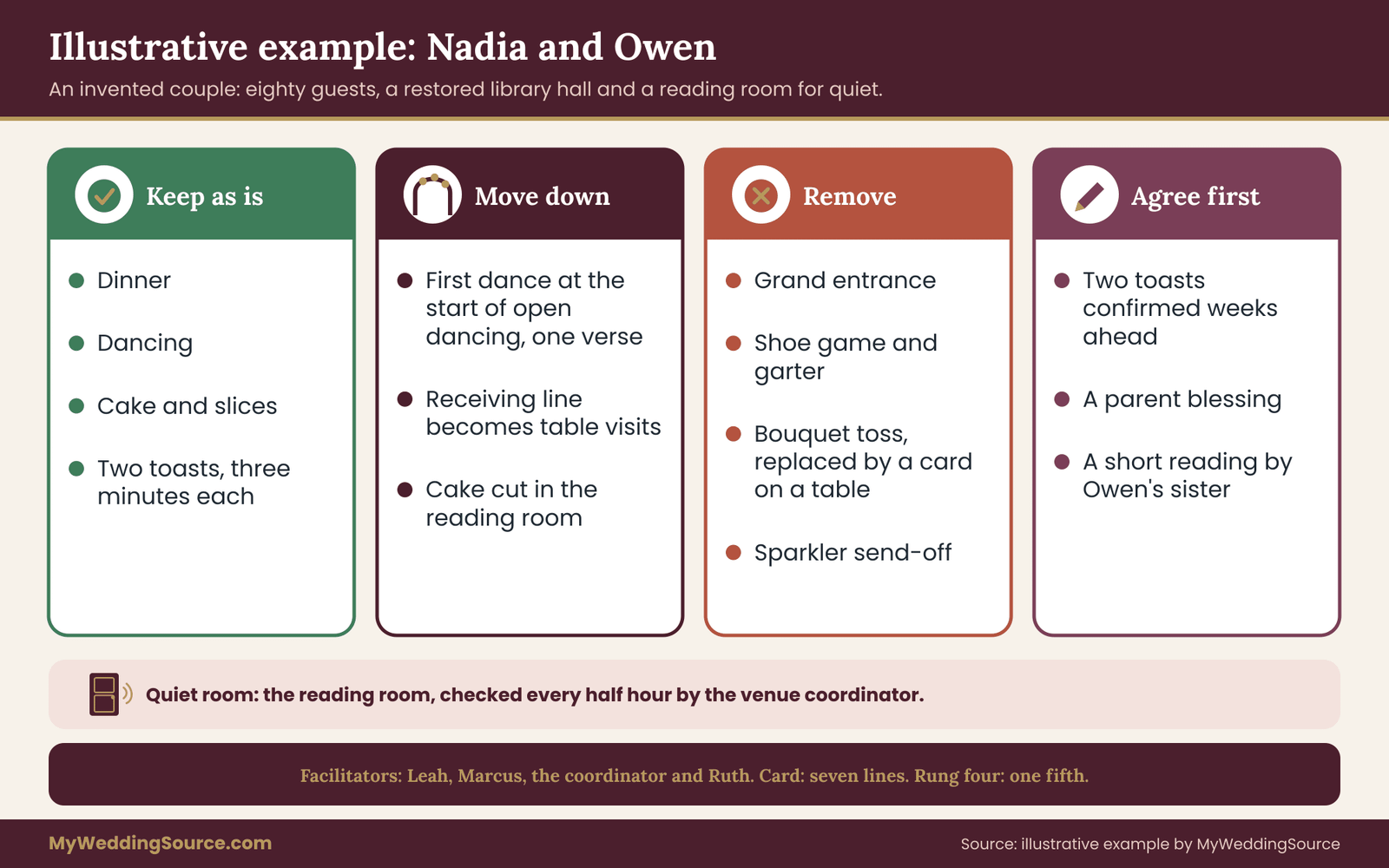
Nadia and Owen are planning a Saturday evening reception for eighty guests in a restored library hall with a smaller reading room off the main space. Nadia gets worn out by long noisy evenings and by being introduced. Owen is comfortable on a microphone but dislikes forced games. Both of them have family members who love a loud party. They want a low demand reception with music and dancing and a calm room, in that order.
Step one: the audit
They write the evening in order and mark the six kinds of demand against each moment. The block right after dinner is crowded: toasts, the cake, the first dance and a bouquet toss all fall within twenty-five minutes, so attention and decision demand stack up. The cocktail hour is mostly social demand. The dance floor is sensory and physical.
They also each list their top three skips and keeps. Nadia’s skips are the grand entrance, the receiving line and anything with her name called aloud. Owen’s skips are the shoe game, the garter and any request for guests to sing. Their keeps overlap: dinner, two toasts, dancing, and cake.
Step two: the decisions
For every moment they choose one of four actions: keep as is, move down the ladder, remove, or pre-agree. The test they use is a single question: “Does this moment carry something we love, or is it here because weddings usually have it?”
The grand entrance is removed. They arrive during cocktail hour and sit down at their table at dinner. The receiving line is replaced by a table visit during dinner, with a ten-minute window and a note on the program. The shoe game and the garter are removed. The bouquet toss is replaced by a bouquet left on a side table with a card.
The toasts are kept and pre-agreed. Nadia’s brother and Owen’s best friend have both said yes, know the order and have a three-minute limit. The first dance is moved down: it takes place at the start of open dancing, with the lights as they are, for one verse and a chorus, and anyone may join after that.
The cake is cut in the reading room with the photographer and four family members, and slices are served at the main room. An announcement says cake is being cut and tells guests where slices will appear.
Step three: the card and the ladder page
They write a card of seven lines. The top says, “Nothing tonight is required. You can watch, join in or skip any part of the evening.” The evening follows with times and the three tags. The reading room is described as the quiet room, with the instruction “Door by the staircase; no music; stay as long as you like”. The bottom names the facilitators, and says that any person with a green ribbon can help with a seat, a drink or a quiet space.
They print a single ladder page for the facilitators with the rung number next to each moment. Four moments sit on rung four, all of them agreed in advance: two toasts, a parent blessing, and a short reading by Owen’s sister. The ratio is about one fifth of the evening, which they judge acceptable.
Step four: the facilitators
Nadia’s cousin Leah is the moment host, because she is organized and can speak calmly. Owen’s friend Marcus is the door keeper. The venue coordinator agrees to check the reading room every half hour, which makes her the quiet space steward. Owen’s sister Ruth is the couple’s proxy; she knows both families and has authority to say no to a pushy relative.
They hold a fifteen-minute call the week before and rehearse two of the scripts: a guest declines a group photo, and an aunt asks why there is no bouquet toss. Leah says afterward that the second script, redirecting to a drink, felt easy because it did not require her to argue.
Step five: the vendor brief
They send the DJ a one-page brief. Dancing opens at eight, with a sound level agreed in writing, no calls to the floor, no named volunteers, no fog or strobe, and a quiet announcement before each toast. They send the photographer a shot list with five group photos, scheduled before dinner, and a request not to ask guests to pose during the evening. They send the caterer a written service plan with times, and ask for a short first course within fifteen minutes of seating.
Step six: the message to guests
The website has a short page, “How the evening will work,” with the order of events and one line about optional participation. A paper insert in the invitations says the same. A reminder email goes out a week before with the order and the location of the reading room. Nothing in the messages mentions any person’s needs. They say only that the couple is keeping the evening calm and that guests may take part as little or as much as they like.
What the example shows
The couple planning this low demand reception did not remove everything. They kept a loud dance floor, two toasts, cake and a first dance. What changed was who was asked, how they were asked, and what happened when someone said no. The plan has a clear structure: audit, decision, card, facilitators, vendor brief, messaging. If you do those six steps in order and revisit each after a venue walk-through, you will have a workable low demand reception plan even if your own moments are different.
A rough timeline for your own plan
Work backwards from the date of your low demand reception. Ten weeks out, do the audit and make decisions. Eight weeks out, brief the DJ, caterer and photographer, and confirm the quiet room with the venue. Six weeks out, publish the website page and mail the insert. Four weeks out, ask the facilitators and the people giving toasts to confirm. One week out, hold the facilitator call and send the reminder. The day before, walk the room with the venue coordinator and test the quiet space.
If you have less time, keep the order and shorten each step. The audit and the vendor brief matter most. A beautiful card does little at a low demand reception if the DJ has not been told what not to do.
Checking the plan with a second pair of eyes
Before you finalize, give the ladder page and the card to one person who is not part of the planning and ask a single question: “Where would you feel put on the spot?” Choose someone who is honest and who will be a guest, not a family member who is helping to run the day. Their answer often reveals a moment you thought was rung two that is actually rung four, such as a cheerful “come on up” from a relative that appears in the schedule as a harmless photograph.
For one more layer of review, the guide to accessible wedding venue red flags is a useful checklist for the physical side of the plan, including routes, seating and restrooms. A low demand reception that is hard to get around is not low demand for anyone who has to find an alternate route.
Briefing vendors and the venue for a low demand reception
A low demand reception only holds if the people you pay follow the plan. Vendors are trained on the standard wedding script, and their packages are built around it. You will usually get what you ask for, but you have to ask in writing and early.
What to write down for each vendor
Keep each brief to one page, in plain language, with what to do and what not to do. Send it before the contract is signed where possible, so a vendor who is not comfortable can say so while you can still choose someone else.
The DJ or band. The CDC’s NIOSH and the NIDCD both publish plain guidance on loud noise and hearing, which is useful when you pick a number.
Ask for the sound level in writing, either as a maximum decibel reading at the dining tables or as a simple rule such as “speech at the tables must be possible without raising your voice.” Ask for no calls to the floor by name, no single-people or relationship-category calls, no pulling guests from tables, no fog, haze, strobes or confetti launchers unless you add them yourself, and no live microphone requests to the audience.
Ask the DJ to read announcements exactly as supplied on your page. A professional who objects to these requests is telling you something useful before the deposit.
The photographer. Ask for a candid style with little direction, a short formal list scheduled before dinner, and no flash during quiet moments unless the room is too dark for the camera. Ask that guests be asked, not told, to pose, and that anyone who steps away is not followed with the camera.
The caterer. Ask for allergen information on every dish, in line with the food-labeling guidance the FDA publishes, a written service timeline, delivery of a first course or bread within a stated time of seating, and clear labels on food. A caterer’s staff also have a script, which sometimes includes encouraging guests to line up or to “come and get it”. Ask staff to announce service quietly and to let tables release at their own pace.
The planner or venue coordinator. If you have one, give them the ladder page and the facilitator list and ask them to align with the moment host. If you do not, the couple’s proxy fills that role. Either way, one person should hold the single copy of the schedule that everyone else follows.
The officiant or emcee. If anyone speaks to the room, give them exact wording and a short list of what not to say. Ask them to avoid jokes that single out a guest, requests to stand, and open-ended questions to the crowd.
What to ask the venue
Start with the quiet space your low demand reception will use. Ask whether there is a room, nook or outdoor area that can be set aside for the entire reception, whether it carries a rental fee or is part of the contract, and whether it can be lit softly, kept free of music and reached without crossing the dance floor. A coat room, a library, a bridal suite or a covered porch can work. Photograph the space during your walk-through and note how sound travels into it.
Next, ask about sound. Some venues impose a maximum level, a time limit or a required sound limiter, and these can help you. Others have a house sound system that cannot be set quietly. Ask to hear it at the level you want before you sign.
Then ask about lighting controls. Ask whether the dimmers can be set in advance and left alone, and whether a staff member will change them on a cue. A venue that dims the lights for dancing without being asked can undo your plan.
Ask about the route. Where are the restrooms in relation to the main room and the quiet room? Can a person leave the room without crossing the floor? Is the route step-free? The U.S. Access Board and the Department of Justice both publish accessibility guidance for places of public accommodation, and the ADA site is the right place for questions about what a venue must provide.
The couple’s private choices are not regulated by the ADA, but a venue open to the public has duties of its own, and it is reasonable to ask how it meets them. Treat the ADA site as a starting point and confirm specifics with the venue, as this article is not legal advice.
Cost logic without invented prices
Most of a low demand reception costs little money and a good deal of planning time. A few items might add cost, and none of them can be priced here without knowing your market, so ask each vendor for a written quote.
The quiet room may add a rental fee or may be free. Extra staff for facilitation may be unnecessary if friends do the work, but a venue coordinator’s time may be billed. Printed cards cost about what any printed program costs. A longer service timeline may require an extra server or a different format of meal, which a caterer can price. Sound limiting may reduce the options for bands, which can narrow your list.
What a low demand reception often saves is the cost of items you remove: a sparkler exit, a staged entrance, a fog machine, props for games, and elaborate group photo sessions. Compare your total before and after, and keep a note of what you gave up and why, so the decision does not get reopened at the last minute.
Contract language
You do not need legal language to protect the plan. A single clause in each contract, in your own words, is enough: “The vendor will follow the attached day-of brief, including no calls to guests by name and no unannounced effects.” Ask each vendor to sign or initial the brief. If a vendor will not, ask what they would change. If the answer is a reasonable adjustment, the brief can reflect it. If the answer is that they cannot work any other way, you have your answer about fit.
Place these cues beside the rest of your vendor schedule so that nothing is sent to one vendor and missed by another.
Other paths when a full low demand reception is not the right fit
A full low demand reception is one point on a range. Some couples want less change, some want more, and some find that a different event format meets their needs better. These alternatives are compared in prose so you can see the trade-offs.
A traditional reception with a few exceptions
You keep the usual structure and change only the moments that matter most to you, such as no entrance announcement and no bouquet toss. It is the lowest-effort path and works well when your family is attached to traditions and your own list of skips is short. Its weakness is that guests do not get a clear signal, so a card and one facilitator are still worth having. If your list of skips is longer than three or four items, you are already doing most of what this guide describes.
A daytime or brunch reception
A shorter event in daylight, with a single meal and few planned moments, can lower demand just by being shorter and earlier. Guests are less tired and often more relaxed. The limits are that venues and caterers sometimes price weekends and mornings differently, that some guests may travel on the same day, and that a shorter event leaves less room for a dance floor if that matters to you.
A two-part day
You hold a small ceremony and meal with family and close friends, then host a separate open party for a wider group at a later time or on another day. The first event can be a very small low demand reception because the group is small and familiar. The second event can be as casual as you like, with no obligations.
This costs more in logistics and sometimes more in money, and it requires you to decide who goes to which part, which is a social task of its own. The guide to how to handle a guest list can help with that conversation.
A micro wedding or elopement with a later celebration
You marry privately or with a few people and mark it later with a dinner or a gathering. This path removes nearly all public performance from the legal day. It may disappoint relatives who expected to attend, so plan one sentence for them, and plan for the later gathering to be its own low demand reception.
Choosing between them
Ask four questions. How many people must be present for the event to feel right to you? How long can you comfortably host? Which two moments do you most want to protect? And which expectation from family, if you ignored it, would cost you the most peace? The answers usually point to one of the paths above.
If they point to the full low demand reception, the rest of this guide applies directly. If they point to a shorter format, you can still use the audit, the ladder and the card, because they work at any size.
A caution about swapping one script for another
Be wary of replacing the old script with a new rigid one. A couple who bans every activity and enforces silence can create a different kind of demand, where guests feel they must behave perfectly. The aim is flexibility. Keep a little room for guests to do something spontaneous that you did not plan, as long as it asks nothing of anyone else.
When a low demand reception fails, and what to do about it
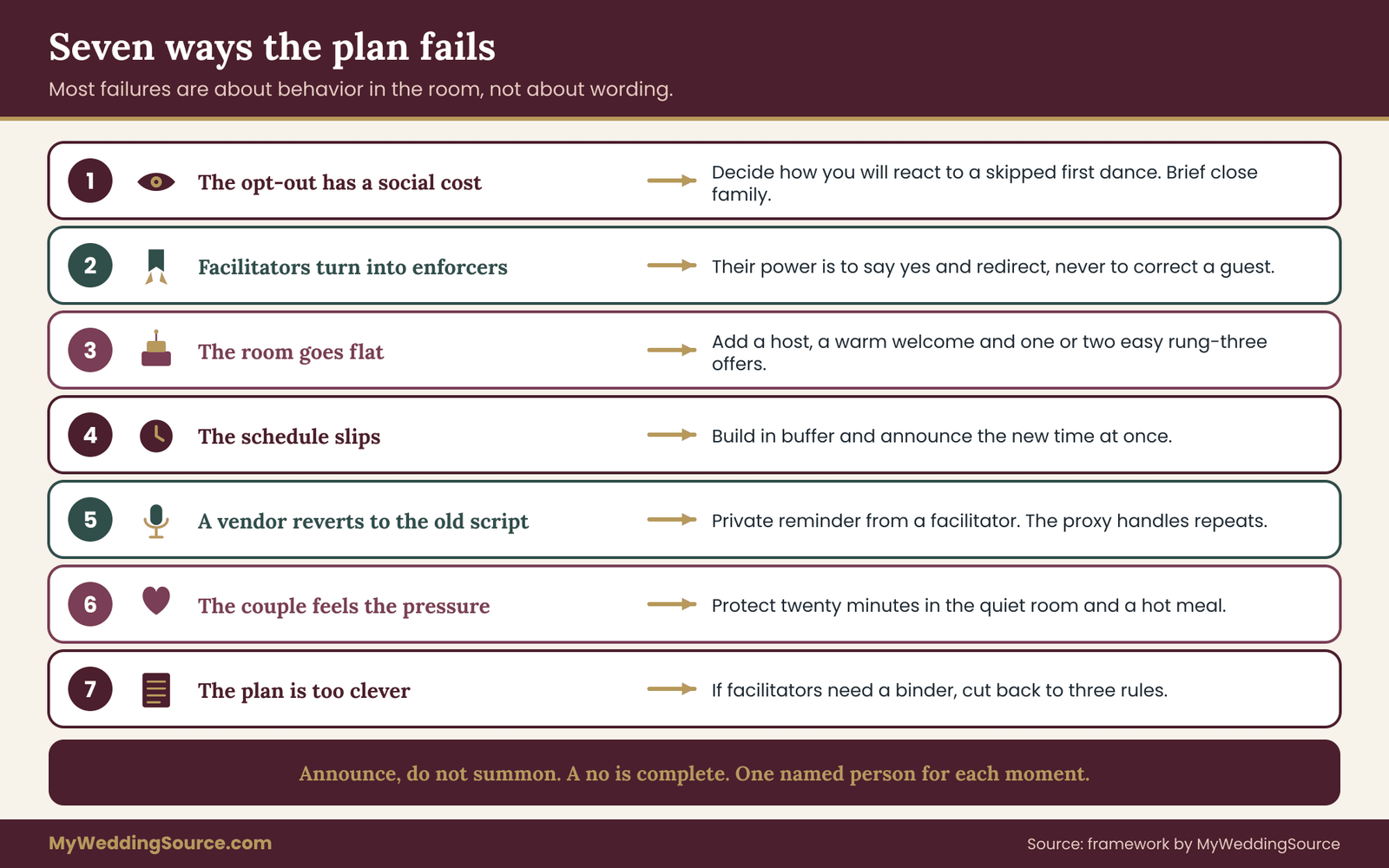
Any plan can break. The conditions below are the ones most likely to undo a low demand reception, together with a fix for each. Read them before the day, because several of them can be prevented in an hour of preparation.
Condition one: the opt-out has a social cost
At a low demand reception guests will say they can skip anything, then watch how the room reacts to the first person who does. If the couple, a parent or a facilitator shows disappointment, the rest of the room learns that the invitation was not sincere. The fix is behavior, not wording. Decide in advance what you will do when someone skips your first dance: keep dancing, smile, do not look for them afterward. Tell close family the same thing before the day so nobody comments.
Condition two: the facilitators become enforcers
A person with a ribbon and a mission can slide from protecting choice to policing it. A facilitator who tells a guest, “You really should sit down, the couple asked for quiet,” is no better than the aunt who insisted on dancing. Remind facilitators that the card gives guests options, not rules. Their authority is to say yes to a request and to redirect pressure, never to correct a guest’s behavior. If a facilitator is uncomfortable with a situation, they pass it to the proxy.
Condition three: the room goes flat
Some guests will mistake a low demand reception for a cold one. If there are no announcements, no games and no guidance, a mixed crowd may sit stiffly and wait for something to happen. A low demand reception still needs warmth: a host who greets tables, music that people can feel at the right moments, food that arrives on time, and one or two details that give guests something to talk about.
Plan a few rung-one and rung-three offerings that make the room feel active without asking anyone to step forward.
Condition four: the schedule slips
Because predictability is part of the design, a late schedule is a larger failure at a low demand reception than in a standard reception. A forty-minute delay in dinner, when the card promised seven, carries more weight than it would at a party that advertises nothing. Build buffer into the plan and tell guests the new time the moment you know it. The facilitator who owns the moment announces the change quietly at each table, without drama.
Condition five: the vendor reverts
A DJ may carry on with their usual patter after a few hours, especially if the room is quiet and the DJ feels they are failing. A caterer’s staff may start herding guests when a line forms. The fix is a facilitator nearby and a short private reminder, offered kindly and without blame. If a vendor repeatedly ignores the brief, use the proxy to speak to them, not you.
Condition six: you are the one who feels the pressure
Couples planning a low demand reception sometimes plan for guests and forget themselves. If you feel obliged to circulate, perform thanks, or monitor every table, you have created a new set of demands on yourselves. Build in time off the floor: a protected twenty minutes in the quiet room after dinner, a meal you can eat while it is hot, and permission to leave when you are done. The couple who can say no inside their own low demand reception sets the tone for everyone.
Condition seven: the plan is too clever
A system with six roles, three cards and a color-coded timeline can create its own load. If your facilitators need a binder, the plan is too complicated. The core of this guide is small: announce, do not summon; a no is complete; one named person for each moment. If a detail does not support those three, drop it.
When to change the plan on the day
Sometimes the right move is to adapt in the moment. If the room is flat and several guests ask for more activity, the proxy can suggest an extra song or open a table activity without calling anyone up. If a guest has a rough time, the door keeper and the proxy can arrange a seat, a ride or a quiet word.
If you personally need a break, take it, and tell the proxy so they can handle questions. A written plan is a tool, and the point of a low demand reception is a room where people can choose.
Talking with family who expect the usual traditions
Some of the strongest pushback will come from relatives who see the usual moments as part of the meaning of a wedding. A calm, short conversation before the invitations go out often prevents a larger argument later.
When you describe the low demand reception, lead with what you are keeping: “We will have dinner, toasts, cake and dancing.” Then say what you are changing and why, in a sentence about yourselves: “We are skipping the entrance and the garter because we enjoy a quieter evening.” Offer a place for their tradition if it is important: “If you would like to give a blessing at dinner, we would love that.”
If a relative continues to push, restate once and stop: “We have decided. We would love your help with the toast.” The point is to avoid debate, because debate treats your choices as a proposal. For more on declining advice without a long argument, the same approach applies as with any other wedding decision, and the guide to wedding reception guest flow shows where a tradition can fit without changing the rest of the plan.
Your next steps
Do these in order. Each takes less than an hour.
- Write your low demand reception as a list of moments and mark the six kinds of demand beside each.
- Place every moment on the ladder, and move or remove any that sit on rung four without a clear yes from the person involved.
- Write the opt-out card for the low demand reception in four blocks: a statement, the evening in order, the places, and the person to ask.
- Choose a moment host, a door keeper, a quiet space steward and a couple’s proxy, and give each the one-page brief.
- Send each vendor a one-page brief and ask them to confirm it in writing.
- Publish a short page on your website and print the card, then send a reminder a week before.
- Walk the room with the venue coordinator the day before and test the quiet space.
FAQ
Is a low demand reception the same as a sensory-friendly reception?
No, although they overlap. A sensory-friendly event focuses on light, sound and crowding. A low demand reception also covers social and attention demands such as speeches, spotlight dances and forced games. You can have a loud, bright party that is low demand because every loud moment is optional, announced and located away from the tables, or a quiet room that is not low demand if guests are called on by name.
Do I have to tell guests why we are doing this?
No. A single sentence is enough: “We have planned the evening so guests can take part as much or as little as they like.” You do not need to describe anyone’s needs or your own. Explaining your low demand reception can invite debate or label people. If you choose to share a reason, speak about your own preferences and keep it short, since that reads as a plan and not as a request for permission.
Can we still have dancing and toasts?
Yes. Those are among the moments most worth keeping. The change is in how they are asked. Toast givers agree beforehand and know their time and order. The dance floor opens with an announcement, and nobody is called to it by name. Guests may watch, join or stay at their tables. Keeping the parts you love is the point of a low demand reception.
What if a guest feels left out because nothing is required of them?
Some guests may read optional as unwelcome. Offset that with warmth: a host who greets tables, a card that names a person to ask, and a few low-pressure options such as a memory book or a table activity. The aim is to make participation easy and visible, not to remove it. At a low demand reception most guests relax once they see that they can choose, and that their choice is accepted.
Who should be a facilitator?
Pick people who are calm, can say no to a persistent relative, and will accept the role of protecting choices rather than creating enthusiasm. Friends, cousins or the venue coordinator are good candidates. Avoid giving the job to the most excitable person in the family. Give each facilitator a seat, a meal and a one-page brief, and ask them to pass any problem to the couple’s proxy.
How do we handle a DJ who insists on calling people to the floor?
Raise it before signing, in writing, and ask for a signed brief. If the DJ objects, treat that as useful information about fit. On the day, a facilitator can remind the DJ privately and kindly. If the habit continues, the proxy, not you, steps in. Having a second choice vendor in mind before you commit is a calm way to keep the decision flexible.
Is this legal advice about accessibility?
No. This guide is a planning framework, not legal or medical advice. A venue open to the public has its own duties under federal accessibility law, and the ADA website is the place to read the current rules. If a particular guest or you need specific accommodations, ask the venue in writing and confirm what it will provide before you sign.
How early should we start?
Ten weeks before the day is comfortable for a low demand reception: the audit and decisions come first, then vendor briefs, the website page, facilitators and a final walk-through. If you have less time, protect the audit and the vendor brief, because those two steps decide most of what guests experience. Even a short version of a low demand reception plan, done in a week, is better than relying on the room to work it out.
Sources
- ADA.gov, U.S. Department of Justice Americans with Disabilities Act information
- U.S. Access Board, accessibility guidelines and standards
- ADA National Network, technical assistance on the ADA
- Centers for Disease Control and Prevention, autism spectrum disorder information
- National Institute on Deafness and Other Communication Disorders, noise-induced hearing loss
- CDC NIOSH, occupational noise exposure
- Job Accommodation Network, workplace accommodation guidance
- National Institute of Mental Health, anxiety disorders information
- U.S. Food and Drug Administration, food allergies