
A boat grand exit is the moment the couple walks down a pier, steps aboard a vessel and leaves the reception by water while guests watch from the shore. This guide covers the two things that decide whether it works: where the guests stand to see it, and how the couple and everyone else move safely before, during and after cast-off.
Treat a boat grand exit as a short, timed operation with its own run sheet. Get written approval from the vessel operator and the marina or pier owner before you design anything. Divide the shoreline into viewing zones with a stated head count each, put a named person at the edge of the pier, and work backward from cast-off on a single clock. Add go and no-go gates for wind, water level, light and crowd size, and decide in advance what happens to the exit if any gate fails.
Most advice about a boat grand exit is about the picture: the lit vessel, the waving couple, the wake in the dusk. The picture is the easy part. The hard part is that a few minutes of departure compress a lot of risk into one place. A hundred guests, many holding drinks, crowd toward a narrow pier.
A person in a long dress or a rented suit steps across a gap onto a moving deck. A captain is trying to leave on time while the photographer asks for one more minute. Nobody planned these minutes, so everybody improvises them.
This article plans them. It is deliberately narrow. It does not cover chartering a vessel for the whole evening, boat catering, seasickness or marina noise, which have their own guides. It covers the boat grand exit itself and the logistics around it: where guests watch, how a crowd is held back from the water’s edge, how the couple boards, how the sequence runs on a clock, what the weather is allowed to do before you cancel, and how guests get home afterward.
A note on scope. This is general planning information, not legal, insurance or maritime advice, and the rules for vessels, piers, alcohol and crowds differ by operator, waterway and jurisdiction. Where a rule matters, the article names the kind of office that issues it, so you can confirm the current version yourself. If you are still choosing where to hold the reception, the wedding venues guide compares sites, and the reception guest flow guide covers the rest of the evening.
What a boat grand exit actually involves
People use the phrase “boat grand exit” for three quite different events, and the planning changes with each. Before anything else, decide which one you are picturing.
The loop. The couple boards, the vessel pulls away, travels a short distance in view of the guests, turns and comes back to the same pier. The couple disembarks privately a little later, often after the crowd has gone. This is the most common version because the guests get a clear departure, the vessel never leaves the site, and no second landing has to be arranged.
The one-way trip. The vessel leaves the reception site and ends at a different landing, a hotel dock or a restaurant pier, where a car or a quiet room waits. Guests see the boat grand exit but not the arrival. This version needs a second site, a second set of permissions and a person who is certain the landing is open and lit.
The staged send-off. The couple steps aboard, the lines are cast off and the vessel moves only a few boat lengths before it stops or comes straight back. It is a photograph and a wave, not a voyage. It is the safest version and the right one when the water is busy, the light is poor or the guest group is large.
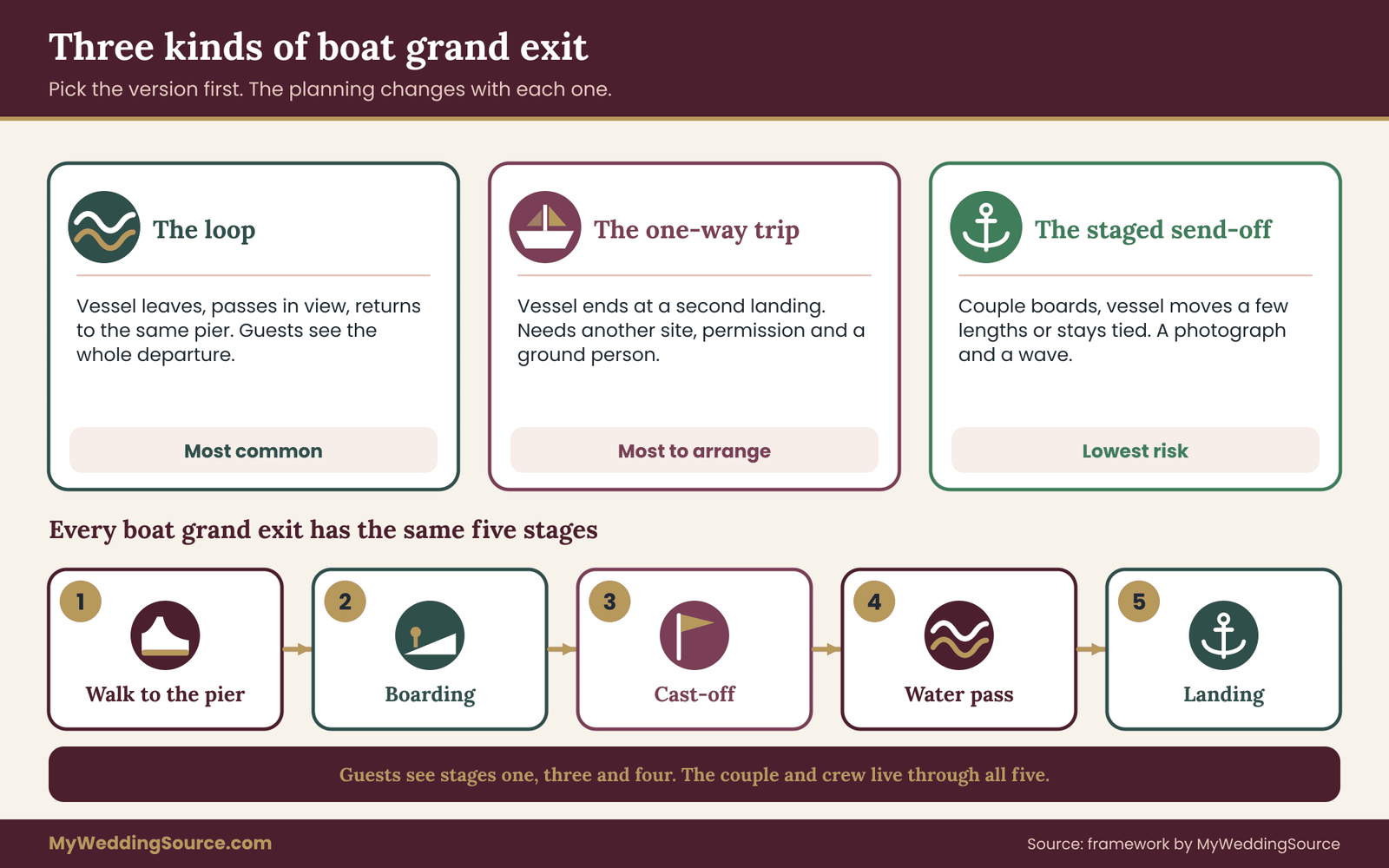
Each version of the boat grand exit has the same five stages: the walk to the pier, boarding, cast-off, the water pass, and the landing. Guests mostly see stages one, three and four. The couple and crew live through all five. A good plan gives each stage an owner, a time and a stop condition.
Why the exit deserves its own run sheet
The reception schedule usually ends with a vague line that says “grand exit, 10:00.” That line hides at least fifteen separate actions. Someone has to clear the pier, someone has to tell the DJ to stop the music or change it, someone has to move the couple’s belongings to the vessel, and someone has to confirm that the captain has the number of people he will carry. If those actions live in six different heads, the boat grand exit starts late and runs rushed.
A separate run sheet also protects the relationship with the operator. A captain is responsible for the vessel and the people on it, and a captain will make a call that disappoints a wedding party without hesitation. The more clearly you have described the sequence beforehand, the fewer surprises he or she has to react to at the dock.
What guest viewing areas really mean
A viewing area is not simply a place with a view. For a boat grand exit it has to satisfy four conditions at once. It has to be legal for that many people to stand there. It has to be physically safe, which means a surface that holds a crowd, a rail or a clear setback from the edge, and a way to leave.
It has to give a line of sight to the point where the couple boards and to the water beyond. And it has to be reachable by every guest who wants to be there, including those who cannot stand for long or cannot manage a step.
For a boat grand exit, many couples assume the pier is the viewing area, because that is where the couple walks. In practice the pier is usually the worst place for a crowd. It is narrow, it is the couple’s route, it sits over water, and it is often rated for a limited number of people.
The best viewing areas for a boat grand exit are frequently on land beside or behind the pier, with the pier itself reserved for the couple, a small family group and the crew.
Who has to say yes before you plan the exit
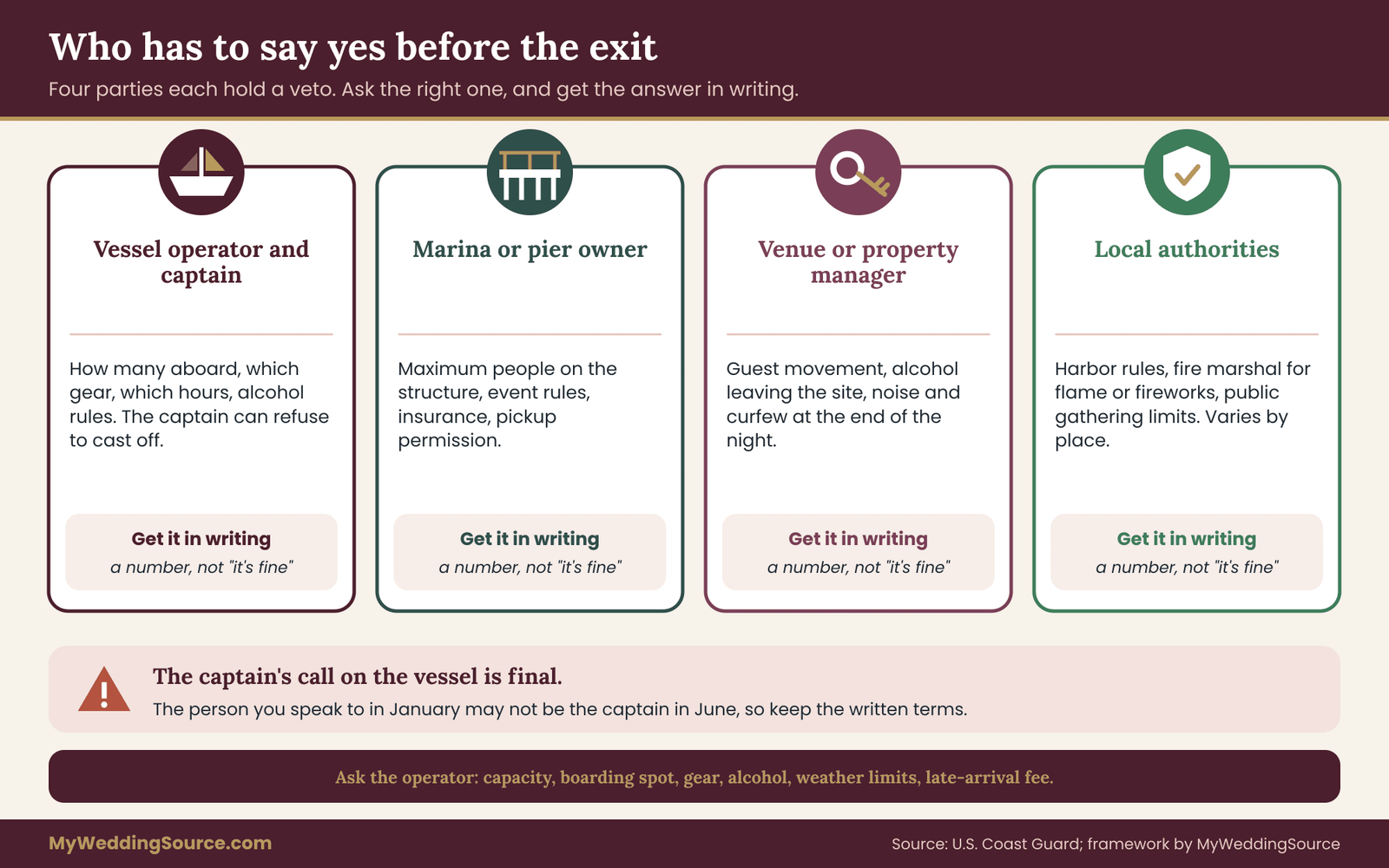
A boat grand exit involves at least four parties who each hold a veto, and you should know which one you are asking at each step. Asking the wrong person gets you a cheerful yes that means nothing.
The vessel operator and captain. The operator controls whether the vessel is available for a departure at that hour, how many passengers it may carry, what safety gear is aboard and whether alcohol is allowed. A captain has authority over the vessel at all times and can refuse to cast off. Ask for the operator’s written terms and ask specifically about a boat grand exit at dusk with a dressed couple, because many charter terms assume a longer trip.
The marina, pier or dock owner. The owner decides who may stand on the structure, how many people at once, whether a vessel may pick up passengers there, and what insurance the event needs. A public pier can have different rules from a private marina. A hotel dock can have different rules from a municipal one. Get the maximum number of people allowed on the structure in writing, not as a verbal estimate.
The venue or property manager. If the boat grand exit starts from a reception venue and ends at a pier it does not control, the venue still has a say about guest movement, alcohol leaving the premises, and noise at the end of the night. A venue contract may also limit where guests can stand after a certain hour.
Local authorities. Depending on the location, you may need to consider a harbor or waterway authority, a fire marshal if you want any flame or fireworks, and the local rules for public gatherings. These vary widely. Ask the venue and the operator first, since they have usually handled a similar event, and then confirm with the issuing office yourself.
Questions to put to the operator in writing
Written answers matter because the person you speak to in January may not be the captain on the day. Put these questions in an email and keep the reply.
- How many passengers is the vessel authorized to carry, and how many will you allow for this boat grand exit? The couple, the captain and any crew count toward the number.
- Will you board the couple at the pier, and where exactly does the vessel tie up for boarding?
- What do you require guests and the couple to wear or do aboard, including life jackets?
- What is your policy on alcohol, glassware and open flame aboard, even for a ten-minute trip?
- At what wind speed, wave height or visibility do you cancel or shorten a departure, and who decides?
- If the couple boards late, how long will you wait, and what happens to the fee?
The answers do two jobs. They tell you what the vessel can actually do, and they give you the language for your own run sheet. If the operator will not answer in writing, treat that as information about how the day will go.
The U.S. Coast Guard’s role, in plain terms
In the United States, the Coast Guard sets the framework for passenger vessels. A vessel that carries passengers for hire generally has to meet requirements tied to how many people it carries and how it is operated. Smaller vessels may be operated by a licensed captain under one set of rules, and larger vessels are inspected under another.
You do not need to learn the regulations. You need to ask the operator how the vessel is authorized and then ask to see the capacity information, which should be posted or documented. The Coast Guard’s website explains the categories, and your operator can tell you which one applies.
A useful way to hold this: the number on the vessel’s capacity documentation is a ceiling, not a target. A boat grand exit rarely needs more than a handful of people aboard, so the capacity limit seldom binds. It matters mainly because it tells you the vessel is legitimately set up to carry passengers at all.
Mapping guest viewing areas for a boat grand exit
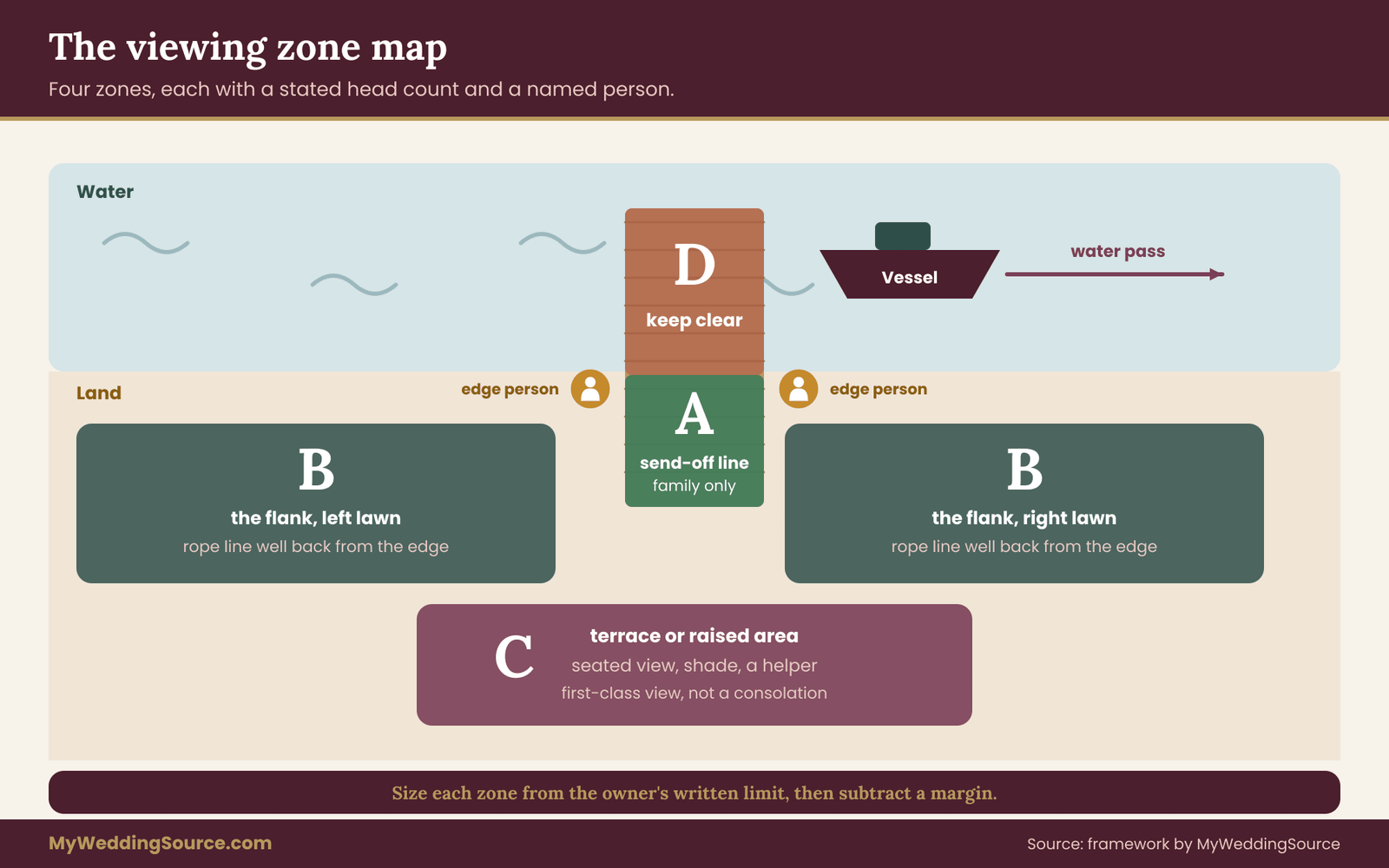
The central design tool for any boat grand exit is the viewing zone map. Instead of letting guests drift toward the pier, you decide in advance where each group stands, how many people that spot holds, and who is responsible for it. Four zones cover almost every site that hosts a boat grand exit.
Zone A, the send-off line. This is the short stretch of land or deck beside the start of the pier where the couple walks through. It holds the people you most want close: parents, grandparents, the wedding party, perhaps the officiant. It is small by design. Keep it to the number the site can hold without anyone being pushed toward the edge, and give each person room to raise an arm.
Zone B, the flank. This is the shoreline or lawn alongside the water where the vessel will pass. It is where most guests should stand. People here see the boarding at a distance and watch the vessel move away, which is the part of a boat grand exit that makes the memory. For a boat grand exit, Zone B should be wide, with a clear path behind it so nobody feels trapped against the water.
Zone C, the overflow. This is an elevated or set-back area, such as a terrace, a bank, a second-floor deck or a parking-lot edge, from which guests can see over the crowd. It is for people who cannot stand on uneven ground, who do not want to be in the crush, or who arrive after A and B are full. Treat it as a first-class viewing area, not a consolation prize.
Zone D, the keep-clear area. This is everything the guests do not enter: the pier itself beyond the send-off line, the boarding platform, the gangway landing, the loading area for the couple’s belongings, and the vehicle access. Mark it clearly. Zone D protects the crew, the couple and the people who would otherwise stray into harm.
How to size each zone without guessing
You do not need an engineer’s tools to size a zone sensibly. You need three things: the maximum figure the owner or authority gives you, an honest look at the ground, and a margin.
First, ask the pier or dock owner for the maximum number of people allowed on the structure at one time. Ask the venue for any limit on the shoreline or lawn. If the answer is a number, write it down. If the answer is “it’s fine,” ask again, because “fine” is not a number and no one has verified it.
Second, walk the ground in the shoes guests will wear. Look for a slope toward the water, loose boards, wet planks, uneven pavers, gaps, ropes, cleats, hoses and electrical cords. A zone that looks roomy on a plan can be half unusable once the tripping hazards and the sightline blockers are removed.
Third, subtract a margin. If you are given a limit of sixty on the pier, plan for no more than thirty to forty there, because the number assumes people standing still with nothing in their hands. A crowd that moves toward a departure, holds phones overhead and leans for a view behaves differently from a counted load.
A zone’s head count is the number you can defend to a captain, not the number that fits.
Who stands where, and why
Zone assignments should follow the guests’ needs and your own priorities, not simply who arrives first.
Put grandparents and older relatives in Zone A or C, depending on whether they can handle the walk and the standing. Put small children with an adult in Zone B at the back, away from the edge, or in Zone C. Put photographers and the videographer in a defined spot in Zone A or B where they do not block sightlines.
Put the DJ or band output toward Zone B so the music carries to the crowd. Put the people who will manage the crowd, described below, at the boundaries between zones.
You do not have to announce the zones as zones. A short note in the program or a few words from the emcee does the job: “Please gather along the lawn on the left of the pier, and family will be on the pier.” People follow simple directions when they hear them from a person with a microphone and a reason.
Sightlines you can test in daylight
The test for a boat grand exit viewing area is a sightline test, and you can run it before the wedding. Stand at the back of each zone and look at three points: the spot where the couple steps onto the vessel, the vessel’s line of travel, and the point where it turns or fades from view. Check what blocks each view. Tents, tall hedges, a parked truck, a boat on a trailer, a light pole and a rail can all remove the shot you are counting on.
Then test again at the expected light. A viewing area that is perfect at four in the afternoon can be dark at nine. If the boat grand exit takes place after sunset, find out what light will exist at each zone: the pier lights, the vessel’s navigation lights, the venue’s string lights. A guest who can see only silhouettes still enjoys the moment, but a guest who cannot see where to step is a risk.
Crowd management at the pier and the shoreline
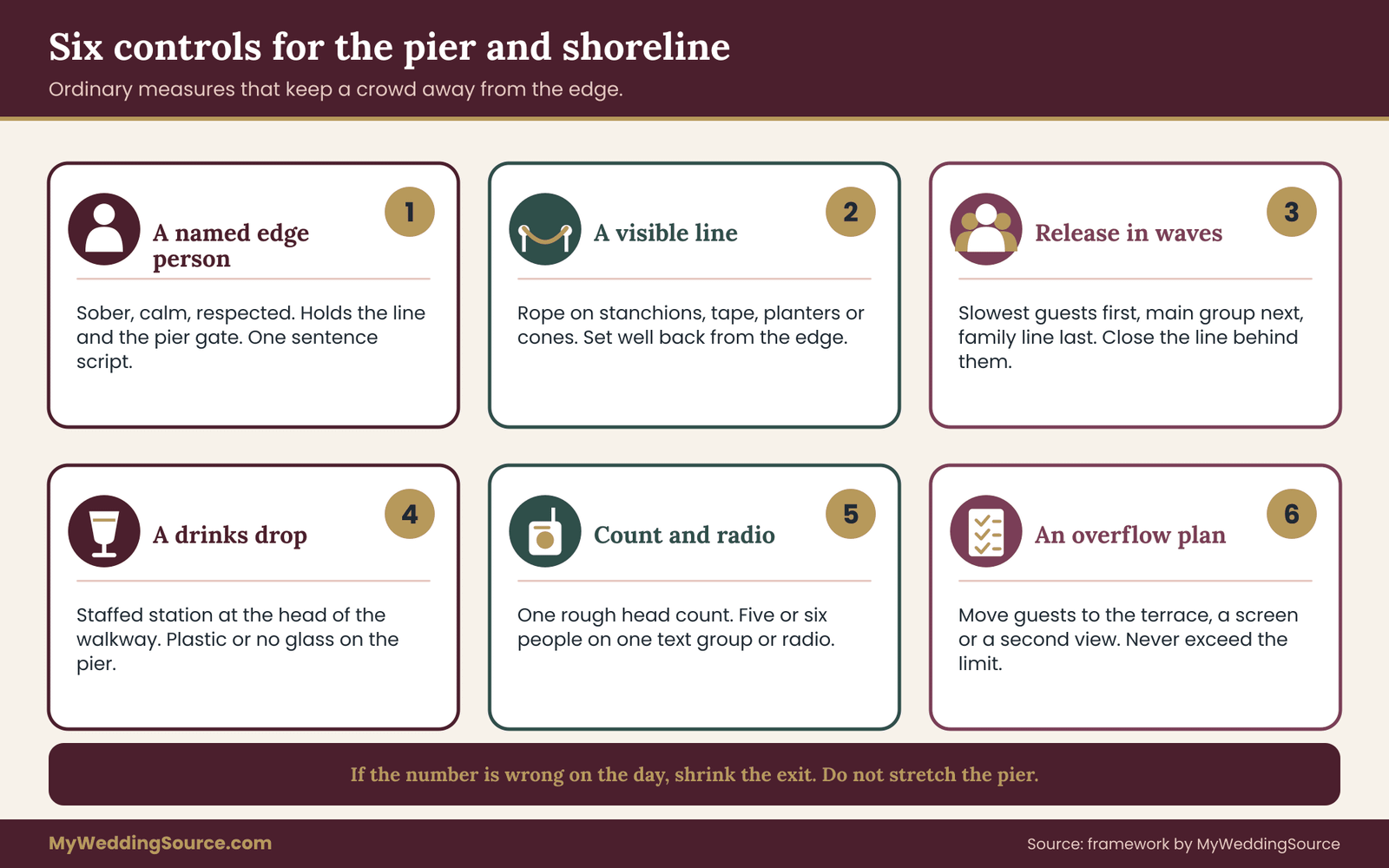
A boat grand exit draws a crowd toward the water at the same moment, usually after a long evening with alcohol served. The risks are familiar: people leaning over a rail, a child slipping away, a glass dropped on the boards, a guest stepping back from a camera into the water. None is dramatic. All are preventable with ordinary controls.
Put a named person at the edge
At a boat grand exit, the most effective single control is a named person responsible for the edge of the pier and the shoreline. This should be someone sober, calm and respected, not the best man, who is already busy, and not the couple’s parents, who will be watching the vessel. A venue coordinator, a day-of coordinator, a trusted cousin or a hired marshal can do the job.
The edge person has three tasks. Keep guests from stepping past the marked line. Notice anyone in difficulty, such as a person who has had too much to drink, a person who is unsteady, or a child who has wandered. And hold the gate at the pier entrance until the couple and family are ready to walk. Give this person a one-sentence script: “Family and the couple on the pier, everyone else on the lawn, please.” They should not be shy about using it.
For larger groups, add a second person at the boundary between Zone B and Zone C, and a third who stays with the vehicles or the loading area. Keep the number of people with authority small, so guests are not receiving instructions from five voices.
Use a visible line, not a verbal one
People respond to a physical line much better than to a request. A rope on stanchions, a strip of bright tape on the ground, a row of planters, a runner of fabric, or a line of cones tells a guest where to stop without a conversation. Check with the pier owner before attaching anything to a structure, since a rope tied to a rail can be a hazard in its own right.
The line should sit well back from the edge. If a vessel will pass close, the line should also keep guests out of its wake and its mooring lines. A good rule is to place it where a guest leaning forward still cannot touch the rail, which usually means farther back than couples expect.
Staging the release of guests
A common mistake is to let everyone surge to the water when the music cues the boat grand exit. Instead, release guests in waves.
First, have the DJ or emcee announce the boat grand exit about fifteen minutes before cast-off, and invite guests to collect their drinks, visit the restroom and move to the viewing area. Second, guide the oldest and least mobile guests first, with a helper walking beside them. Third, direct the main group to Zone B along a clear route, not through the couple’s path.
Fourth, hold a small group, such as the wedding party, to line up at the send-off. Fifth, close the line behind the last group so nobody wanders in late through the keep-clear area.
Each step buys safety and keeps the boat grand exit from starting in a crush. It also produces better photographs, because the guests are placed and not scattered.
Drinks, glass and cigarettes near the edge
Glassware on a pier is a hazard on its own. Broken glass in the boards is dangerous to barefoot guests and to the crew, and a glass that goes overboard becomes debris in the water. Ask the caterer to switch to plastic or to collect glasses before guests walk out. Set a drinks drop station at the head of the walkway, staffed, so people can leave a glass without feeling they are losing their drink.
If smoking is permitted anywhere on the site, designate a place well away from the pier, the fuel dock and the vessel. Marinas often contain fuel and flammable materials. Do not assume that a lit cigarette at the edge of the crowd is harmless.
Counting and communicating
Someone should know the number of guests who go out to the viewing area and the number who come back. A rough count is enough. The point is that the edge person, the coordinator and the captain share one picture of who is where. Radios or a simple text group among the five or six people who run the boat grand exit prevent the confusion that comes from shouting across a lawn.
When everything is calm, this looks like overkill. When a guest steps into a gap or a child heads for the water, it looks like good sense.
What to do if the crowd is bigger than the zones
Sometimes more people arrive than a zone can hold. The solution is not to squeeze but to redistribute. Move guests to Zone C. Ask a venue manager whether the parking-lot edge, a second dock or an upper deck is open. Offer guests an alternative: a livestream on a screen inside, a second viewing from the reception terrace or a “second look” when the couple lands.
Do not let the crowd’s size push the couple’s family onto the structure beyond its limit. If the number is wrong on the day, the boat grand exit shrinks to a staged send-off and a photograph, which is better than an accident.
Guests who cannot stand at the rail: a different view
A guest list is rarely uniform. Some guests use wheelchairs or walkers. Some tire quickly, some cannot manage a slope or a plank walkway, and some are sensitive to crowds or noise. Others are carrying a toddler, a sleeping baby or a stroller. A boat grand exit can include all of them if you decide on purpose where they will be.
The principle is simple: the best view should not require the hardest route. The accessible route should be the main route, or at least a good one, and the guests who use it should see the same moment as everyone else.
Check the route before you promise the view
Walk the path from the reception to each zone with a rolling suitcase or a borrowed wheelchair, if you can. Notice transitions, such as a lip at a door, a gap between a ramp and a pier, a gravel path, grass that sinks, a steep gangway or a slope that changes with the tide. Public piers and marinas in the United States are covered by accessibility rules in various ways, and the ADA National Network and the U.S.
Access Board publish guidance on boating facilities and accessible routes. You do not have to read it all. Use it as a reason to ask the owner direct questions about ramps, gangway slope and surface.
Ask the pier owner or marina manager: Is there a route to the viewing area that does not involve steps? Does the surface stay firm when wet? Is there a place where a wheelchair user can be near the front without blocking others? If the answer is no for the pier itself, put the accessible viewing area on land and make it as good as the pier.
Build one seated viewing place with a real view
Create a seated section in Zone A or Zone C with chairs, a flat surface and a clear line to the couple’s boarding point. Provide shade if the boat grand exit is in daylight and a blanket or a space heater-free warm spot if the evening is cool. Assign a helper to the section. The helper’s job is practical: bring a drink of water, assist with the walk back, and move chairs to keep the view clear when the crowd stands.
If a guest uses a mobility device and wants to be on the pier for the family line, ask the owner and the operator before the day, not at the gate. In a boat grand exit the gangway is the hard part, and it is usually the vessel’s gangway rather than the pier’s. A captain can say honestly whether a person can be assisted at the point of boarding, and the answer for the couple’s own boarding matters too, if either of them has a mobility need.
If it is not possible, the person can still wave from Zone A, with the couple pausing to share a moment beforehand.
For more on this kind of question, see the guide on accessible wedding venue red flags, which covers what to ask about paths, ramps and restrooms before you commit to a site.
Sound, light and sensory comfort
A boat grand exit often adds noise at the end of a long evening: music cues, cheering, engine sound, a horn. For guests who are sensitive to noise, create a quiet edge in Zone C, away from speakers. For guests with low vision, make sure the walking route has lighting that does not glare. For guests who are hard of hearing, place the emcee’s microphone where a person in Zone C can hear it, or use a printed card to describe the sequence.
Children can find a boat grand exit thrilling or frightening, especially if a horn sounds. Tell parents what to expect. The wedding guest care planning guide discusses how to support babies, children and older relatives across the day, and its ideas about quiet spaces and handoffs translate well to a pier crowd.
Offer a second view to anyone who cannot be outside
Some guests cannot or do not want to go outside at night. Provide a second view, such as a window with a good line of sight, a screen in the reception room showing a livestream from a person with a phone, or a plan to greet the couple at the landing. A second view is not a weakness in the plan. It turns the boat grand exit from a moment that excludes some guests into one that includes everyone, and it costs almost nothing.
The safe transfer: moving the couple from the reception to the vessel
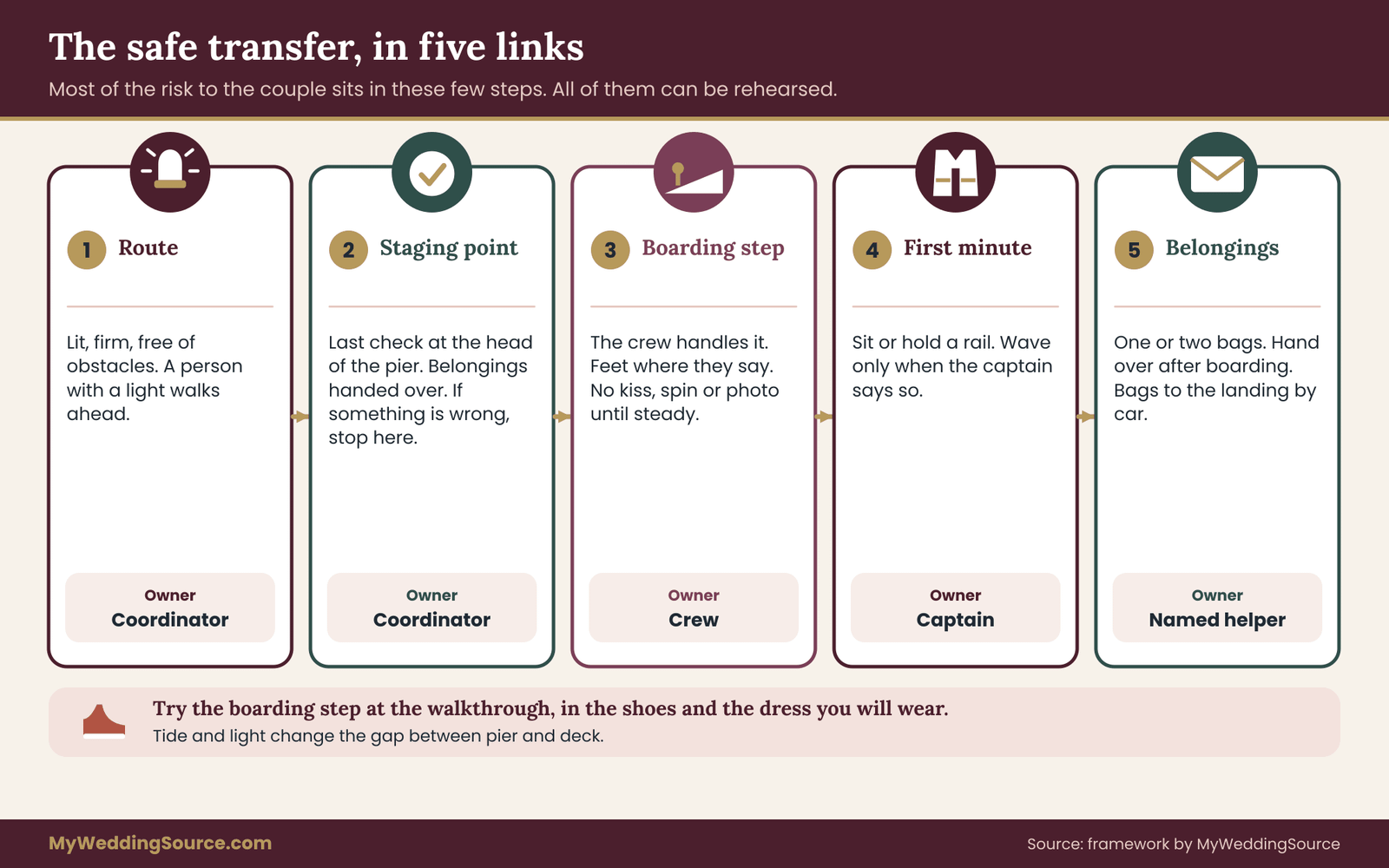
The transfer is the part of a boat grand exit that exposes the couple, and not the guests, to the most risk. It is also the part that is easiest to rehearse. A good transfer in a boat grand exit has five links: the route to the pier, the staging point, the boarding step, the first minute aboard and the loading of belongings.
The route to the pier
The couple’s walk from the reception to the pier for the boat grand exit should be on a route that is lit, firm and free of obstacles. If the site has a shortcut that is dark or slick, do not use it, even if it is shorter. Place a person ahead of the couple to carry a light and to check the route in the minutes beforehand. This person’s job is also to hold back anyone who steps into the aisle.
Shoes matter. A guest in a long dress and heels on a wooden pier risks catching a heel in a plank gap. Ask the couple whether they want to change into flats for the walk, carry the heels and change aboard or at the landing, or accept the risk with a careful pace. A pair of slip-resistant shoes in a bag beside the pier is a common-sense backup, whatever the style.
Dresses and long jackets need attention. A train that drags can catch on a cleat, a rail or a gangway. Plan who will lift or bustle a train for the walk and the boarding step, and rehearse that handoff once.
The staging point
Before the couple steps onto the pier, stop at a staging point at the head of the walkway. The staging point is where the coordinator confirms the vessel is ready, the edge person confirms the zones are set, and the couple has a last moment with family. It is also where any items the couple is carrying, such as a bouquet, a bag, a small cake box or a bottle, are handed over or secured.
The staging point gives the boat grand exit a clean beginning and a clear hold line. If something is wrong, the couple stays here. They do not stand at the end of the pier waiting while a question is answered.
The boarding step
Boarding is the point at which a person’s weight moves from a fixed surface to a floating one. Even a calm boat moves slightly, and the gap and height between pier and deck can change with the tide, the wake of another vessel and the load aboard.
Ask the captain or a crew member to handle boarding, not the wedding party. A crew member will tell the couple where to place their feet, what to hold, and when to step. A couple should follow that direction as strictly as they would follow an airline crew. Boarding is not the moment for a joke, a kiss, a spin or a photograph. Those come after the couple is seated or standing steadily.
If there is a gangway, a lower step or a boarding platform, ask to see it in daylight at the walkthrough and to try it, with the shoes and the dress that will be used. If the couple finds it awkward at three in the afternoon, it will be harder at nine at night.
The couple boards when the crew says so. The photograph waits.
The first minute aboard
Once aboard, the couple should sit or hold a rail and wait for the crew’s instruction before waving. The captain may ask for a moment to check lines and clear the pier. Do not stand at the bow, the rail or the stern for the wave until the vessel is moving steadily and the captain agrees. Many operators will invite the couple to stand in a protected spot for the wave, and will keep the speed very low.
Belongings and who else is aboard
Decide who is aboard besides the couple and the crew. Each additional person is another body to board, another life jacket to find and another person to be counted against the vessel’s limit. For most departures, the right number of people aboard is the couple, the captain and perhaps one photographer or a family member. Resist the urge to add a wedding party, which turns a short exit into a loaded passenger trip.
Pack the couple’s belongings in one or two bags, not in six. A clean list of what goes aboard lowers the chance that a bag is left on the pier. If the couple is traveling after the boat grand exit, the bags should go by car to the landing, not aboard the vessel, unless the captain has approved the weight and the stowage. Do not hand a bouquet, a train or a bag across the gap. Hand it once the person is aboard, steady and holding a rail.
The departure clock: a timeline for the boat grand exit
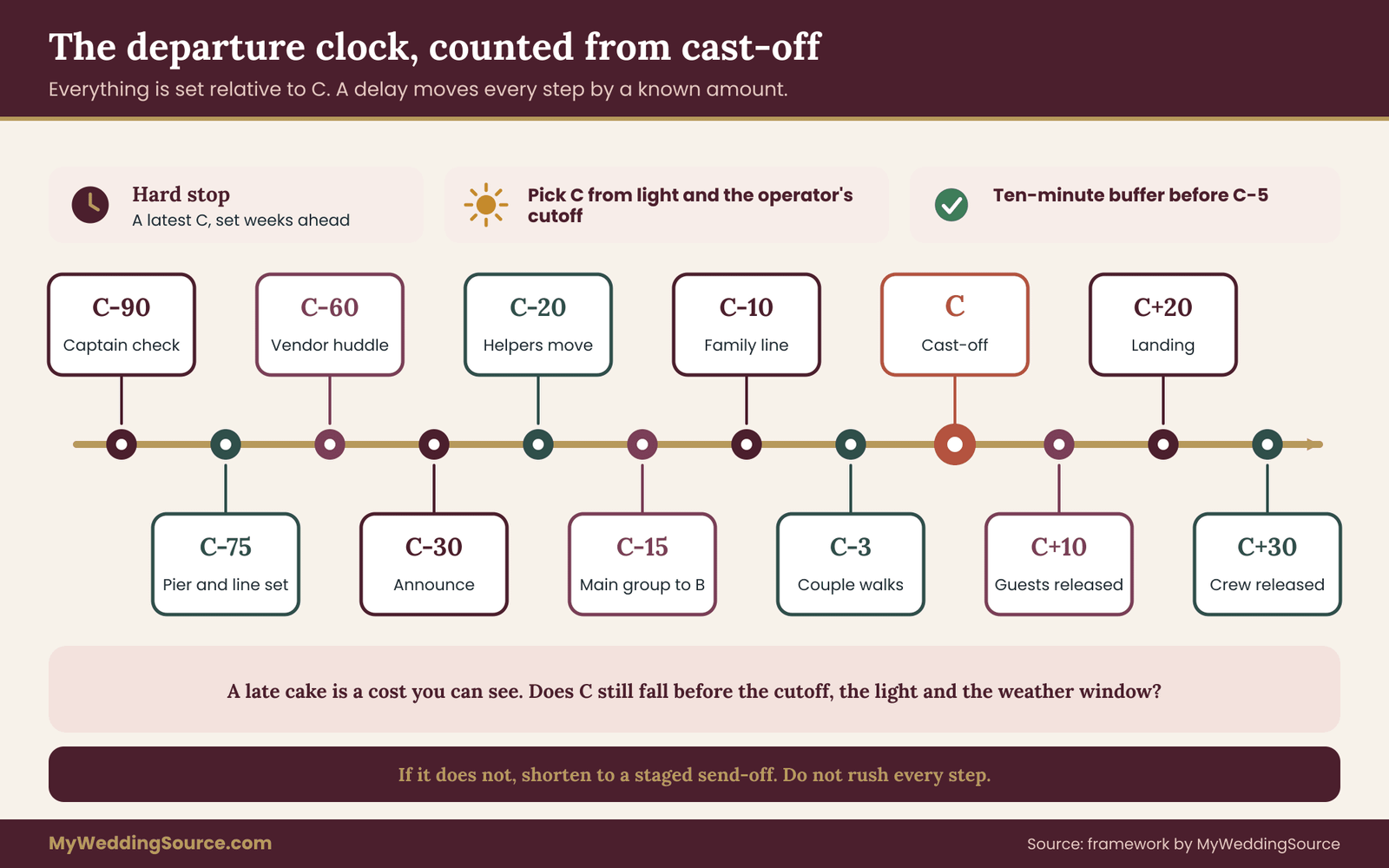
The original tool in this guide is the boat grand exit clock. It is a single timeline, counted backward and forward from one moment: cast-off, written as C. Everything in the exit is set relative to C, so a delay at one step shifts the rest in a known way instead of causing a scramble. Print the clock on one page, give a copy to the coordinator, the captain, the DJ and the edge person, and keep the numbers in minutes.
You choose C by working from light and from the operator’s schedule. Most couples pick a time shortly before or around sunset for the light, or a set late-evening time that suits the reception. The National Weather Service publishes sunset times for any date and place, and the operator will tell you the hour after which the vessel stops running. Pick C only after you know both.
C minus 90 to C minus 45: confirm and prepare
C minus 90. The coordinator and the captain speak, by phone or in person. They confirm the vessel is at the pier, the crew is present, the weather and water conditions are acceptable, and the number of people aboard matches the plan. This is the first go-or-no-go check, described in the next section.
C minus 75. The edge person walks the pier and the shoreline, clears hazards, places the line or the stanchions and sets the drinks drop station. The couple’s belongings are packed and moved to the staging point or the vehicle.
C minus 60. The photographer, the videographer and the DJ are briefed in a short huddle. Everyone hears the order of events, the signals and the place each person will stand. Keep the briefing to five minutes.
C minus 45. The reception continues. The coordinator checks that the guests who will need help moving, such as older relatives, know the plan and have a helper. If the couple wants a last dance, a toast or a cake moment before the boat grand exit, this is the window.
C minus 30 to C minus 10: release the guests
C minus 30. The emcee or DJ announces that the boat grand exit will happen in half an hour and invites guests to stretch, refill, visit the restroom and collect wraps. This message is not the cue to move yet. It tells people to prepare.
C minus 20. Guests who need extra time begin moving to Zone A and Zone C with helpers. The drinks drop station opens. Glassware is collected.
C minus 15. The main group moves to Zone B along the planned route. The edge person is at the boundary. The coordinator starts counting.
C minus 10. The wedding party and family line up at the send-off. The couple is at the staging point with a final moment. The captain confirms the vessel is ready and the lines are set.
C minus 5 to C: the send-off
C minus 5. The emcee asks guests for quiet or for the cheer, depending on the style. If a music cue is planned, it begins. The lead person walks the couple’s route with a light, confirming the path is clear.
C minus 3. The couple walks the pier. Family waits at the send-off line. The walk is slow and short.
C minus 1. The crew handles the boarding. The couple steps aboard, sits or takes a rail, and waits for the captain’s go.
C. The captain casts off. This is the moment the guests see and the clock’s anchor.
C plus 1 to C plus 30: the water pass and the aftermath
C plus 1 to C plus 5. The vessel moves along its planned line, slowly, in view of Zone B. The couple waves from a protected spot only when the captain says it is safe to do so.
C plus 5 to C plus 10. In a loop, the vessel turns and returns. In a one-way trip, it passes out of sight. In a staged send-off, it stops a short distance away and returns. The coordinator watches the clock and the captain’s signal.
C plus 10 to C plus 20. Guests are released from the viewing area, with a clear message about what happens next: shuttles, the after-party, the end of the evening. The edge person keeps the line in place until the pier is empty.
C plus 20 to C plus 30. The couple lands and disembarks, either at the same pier or at the second landing. A person is waiting with a light, a hand and the couple’s belongings. Someone confirms to the coordinator that the couple is ashore. Only then does the coordinator release the crew, the marshals and the vendors.
How to adjust the clock
The boat grand exit clock is not a promise. It is a way to see the cost of a delay. If the cake cutting runs ten minutes over, every step moves ten minutes, and the question becomes whether C still falls before the operator’s cutoff, before the light is gone and before the weather window closes. If it does not, you shorten the exit to a staged send-off rather than rushing every step.
Two adjustments are useful. First, build a ten-minute buffer between C minus 10 and C minus 5, because the last few steps are where the delays collect. Second, decide in advance a latest acceptable C, called the hard stop. After the hard stop, the vessel does not leave, whatever has happened, and the couple does a land exit instead. The hard stop is easier to hold when it was written down weeks earlier by the people who now have to enforce it.
Light, sound and photography at the exit
A boat grand exit is a visual event. That is why couples want one, and also why they tend to underestimate how much light, noise and photography shape the plan.
Light and the vessel
A vessel moving at night carries navigation lights as required by the rules for the waterway. The Coast Guard Navigation Center publishes the Navigation Rules, and your operator will follow them. Do not ask a captain to turn off or cover these lights for a boat grand exit photograph. Do not decorate a vessel in a way that hides, changes or imitates them, and do not attach strings of colored lights that might be mistaken for navigation or distress signals by other boats.
If you want the vessel to look festive, ask the operator what decorations are allowed and where they can be attached. Simple options include greenery, fabric or a small sign, but only with approval and secured so nothing can blow into the water or onto a person. Anything that can come loose on a moving deck is a hazard for the couple and for other boats.
Flares, sparklers and fireworks
The most common request at a boat grand exit is a lit send-off: sparklers, flares, lanterns or fireworks. Treat each as a separate question with a separate authority.
Handheld flame and sparklers on a pier are a risk to guests’ clothing, to the wooden boards and to a marina full of fuel and plastic. Many marinas and venues ban them outright. Fireworks and aerial effects usually require licensed operators and a permit from the local fire authority, and a pier crowd has no good place to stand under them.
Never use marine flares or anything that resembles a distress signal. A red or orange flare over the water can trigger a rescue response, and the Coast Guard treats a false alarm as a serious matter. If you want light, use something that cannot be mistaken for a distress call and cannot ignite anything: battery-powered lanterns, LED wands, a line of warm lights on the shore, or a phone-flashlight wave led by the emcee.
The National Fire Protection Association publishes general guidance on fire safety, and the local fire marshal is the one who can say what is allowed at your site.
Sound
A boat grand exit works best when the sound is planned. The DJ or band can fade the last song into a cue, with a short announcement, and then play a chosen piece as the couple walks. Ask the captain about the vessel’s horn. Some captains will give a short blast on cast-off, while others avoid it for noise or safety reasons. Do not assume.
Keep the volume at the shore moderate, and aim speakers away from nearby homes or other vessels. Marina neighbors and live-aboard boaters notice evening noise. The rule is simple: end amplified sound at the time your venue allows, and move to a quieter cue for the final minutes.
Photography and video
A photographer who understands the plan can capture the boat grand exit without getting in its way. Brief the photographer on the zones, the clock and the keep-clear area. Agree on one or two positions: a spot in Zone A for the boarding and a spot in Zone B for the vessel’s pass. If the photographer needs to be aboard, tell the operator in advance and count the person toward the passenger limit and the weight.
Drones add questions about airspace, privacy and the safety of a crowd under a flying machine. If anyone wants one, ask the operator, the venue and the local authorities, and consider whether the shot is worth the added risk. A steady wide shot from the shore costs less and carries no hazard.
Phones are the other camera. Guests will hold them up, and the crowd will tilt forward. A friendly line from the emcee, such as “Phones up, feet back, please,” shortens the lean toward the water and keeps the line intact. A family photo list helps you decide which group photos to take before the boat grand exit, so the pier is not used for portraits at the last minute.
Short scripts for the people who run the exit
People under mild stress follow a script better than a principle. Give each role one or two sentences to say, printed on the run sheet, and rehearse them aloud once. They do not have to sound polished. They have to be clear, calm and the same every time.
The emcee, thirty minutes out. “In about half an hour the couple will leave by boat from the pier. Please finish your drinks, visit the restroom, and look for a helper in a green ribbon if you would like a seat with a view.”
The emcee, at the viewing area. “Family will stand on the pier and everyone else will stand on the lawn behind the rope. Please keep your feet behind the line and your drinks at the station. Thank you.”
The edge person, to a guest who has crossed the line. “Could you step back behind the rope for me? The crew needs the pier clear. You will still have a great view from there.”
The coordinator, to the captain, at cast-off minus ten. “Pier is clear, family is in place, couple is at the staging point. Are you ready for them, and is the boarding spot where we agreed?”
The couple, to each other, at the staging point. “Are you both happy to go? If either of us wants the land exit, we say so now and nobody minds.”
The captain, to the couple, at boarding. The captain will say what to do, and the couple’s only script is to do exactly that. If the captain says wait, they wait.
None of these lines needs to be memorized word for word. The point of writing them down is that each person knows when they speak, who hears them and what the next step is. A short script also stops a well-meaning guest from filling a silence with a new instruction at the wrong moment, which is how crowds end up pointed in two directions at once.
Weather, tide and water: the go and no-go gates for a boat grand exit
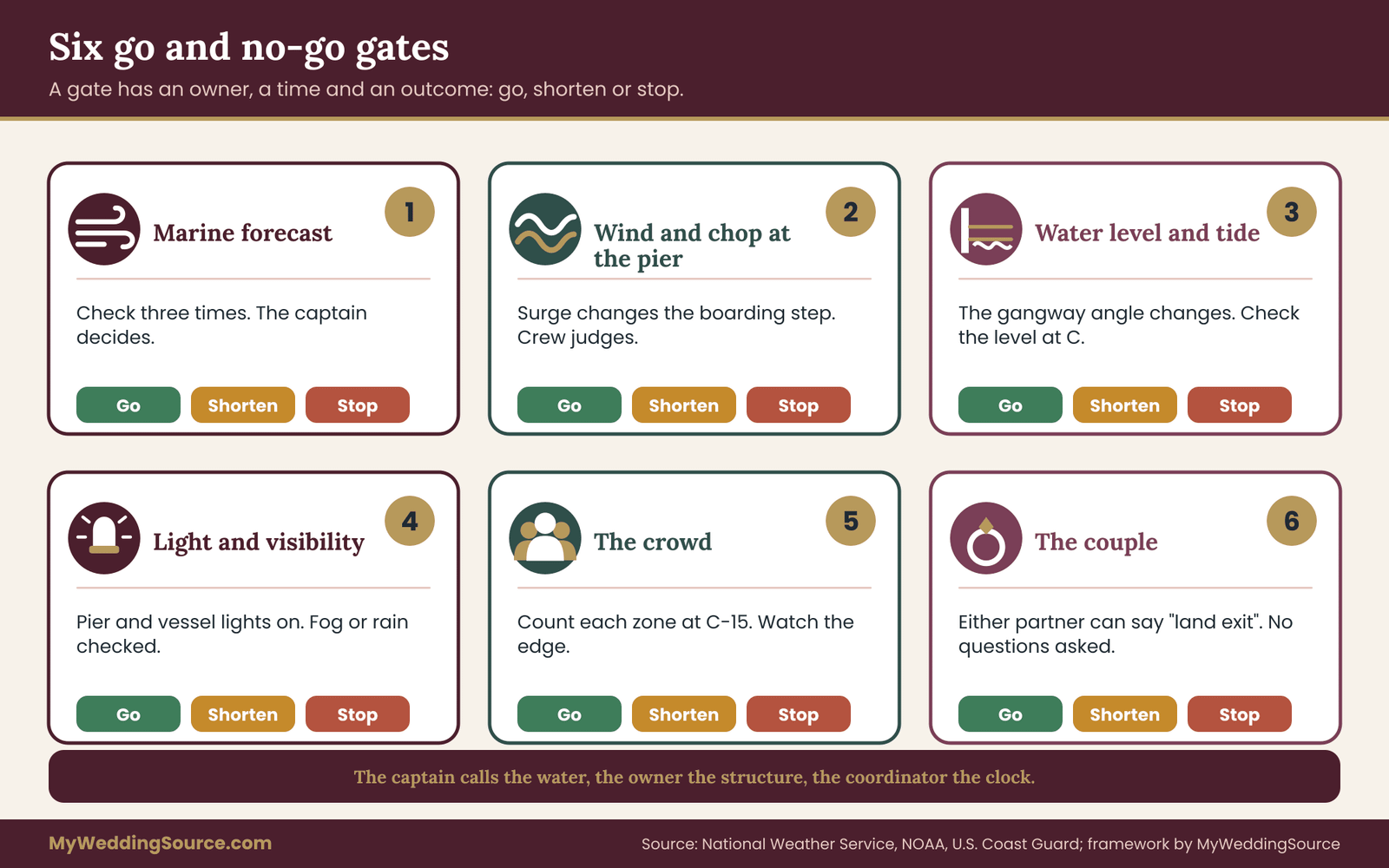
A boat grand exit depends on conditions you do not control, so the plan needs gates. A gate is a check made at a stated time by a named person, with a clear outcome: go, shorten or stop. Six gates cover the usual risks. Each one has an owner, a time and a fallback, and the captain has the final word on anything that touches the vessel.
Gate one: the marine forecast
Start with the official marine forecast for the area. The National Weather Service issues marine forecasts, small craft advisories and warnings for coastal waters, large lakes and some inland waters, and the captain will already read them. Look at the forecast the day before, again in the morning and again two hours before C.
You are not expected to interpret the forecast as a mariner. Ask the captain to tell you plainly whether the boat grand exit is on, and what the limit is. A small craft advisory, for instance, is a signal that conditions are hazardous for smaller vessels, and a captain will use it with other information to decide. The important thing is to agree beforehand that the captain’s decision is final and that nobody argues with it at the dock.
Gate two: wind and chop at the pier
For a boat grand exit, wind matters twice. It moves the vessel against the pier, which makes boarding harder, and it moves the water, which changes the gap between pier and deck. A wind that feels mild to a guest on the lawn can create a surge at the pier head. The captain or crew will judge this from the deck. Ask what would make them shorten the exit to a staged send-off, and what would make them cancel the boarding altogether.
Gate three: water level and tide
In tidal waters, the height of the water changes the gangway angle, the boarding step and the clearance under a pier. The National Oceanic and Atmospheric Administration publishes tide predictions, and a captain will check them. Look up the predicted level at C and ask the captain or marina how the boarding changes at that level. At a very low tide, a gangway can be steep.
At a very high one, a floating dock can ride close to the pier surface or even require stepping over something. Where there is a tide, the boarding step you tested at three in the afternoon may be different at nine at night. Ask to see it, or ask the marina for a photograph of the gangway at a similar level.
Gate four: light and visibility
Check that the pier and the route are lit, that the vessel’s lights work and that the captain is comfortable with the visibility. Fog, haze or heavy rain can shorten a departure or end it. If the boat grand exit takes place after dark, add a person with a handheld light and confirm that the pier lights, which the owner controls, will be on at C.
Gate five: the crowd
At a boat grand exit the crowd is a condition too. At C minus 15, the coordinator checks how many guests are in each zone and how many are heading toward the pier. If Zone B is over its number, or if a guest is clearly unsteady near the edge, the coordinator may shorten the exit, hold at the staging point or move guests. The question is whether the structure and the people on it are in a safe state. If they are not, the exit waits.
Gate six: the couple
The last gate is the couple’s own readiness. A person who is exhausted, dizzy, nervous about the water or in shoes that no longer work should not board. Agree beforehand that either partner can say “land exit” without explanation, and that nobody will push back. This is not a failure of nerve. It is the cheapest safety device in the plan, and it costs nothing at all.
Who calls it, and how
Decide on the decision chain before the day. Usually the captain calls conditions on the water, the pier owner or venue calls conditions on the structure and in the crowd, and the coordinator calls the clock and the timing. The couple decides only on whether they want to go, not on whether it is safe. Write these roles on the run sheet.
If a boat grand exit gate fails, the coordinator tells the DJ or emcee, and the emcee announces a change to guests in a calm way. A good line is: “The captain has asked us to keep the boat at the dock tonight, so we will send the couple off from here.” Guests respond well to a short, matter-of-fact message that gives a reason.
When to cancel the exit, and what replaces it
A written failure plan is the difference between a disappointment and a crisis. A boat grand exit fails in three ways: it does not start, it starts and has to be stopped, or it ends badly. The plan should say what you do in each case, and it should do so in terms of conditions, not feelings.
Conditions that stop the exit before it starts
Stop the boat grand exit before the couple walks if any of the following is true: the captain says no; the pier owner or venue says the structure or the crowd is not safe; the forecast or the water crosses the limit the operator set; the vessel is not at the dock or not ready by the hard stop; the light is inadequate and cannot be fixed; or the number of people aboard would exceed what the captain agreed to carry.
None of these needs a debate. The coordinator announces the fallback, and everyone moves to it.
Conditions that stop it in progress
During the boat grand exit, stop if a guest or crew member is hurt, someone falls or goes into the water, a guest crosses the line and will not step back, the vessel loses power or another vessel enters the path. In each case the captain controls the vessel, and the coordinator controls the shore. If someone goes in the water, call for emergency help immediately and let the crew follow their procedures. Do not send a guest in after them.
Everyone who has a role should know the location of the nearest life-saving equipment, the street address or position to give an emergency dispatcher, and who makes that call. Write three facts on your run sheet: the address or position to give a dispatcher, the phone numbers of the captain and the venue, and the name of the person who makes the call.
Fallback exits, from nearest to farthest
When the boat grand exit cannot happen as planned, a fallback should keep the moment intact. Rank the fallbacks from nearest to the original to farthest.
The staged send-off. The couple boards at the dock and waves from the vessel, which stays tied up. It keeps the photograph and the walk.
The dockside send-off. The couple walks the pier to the vessel, stands beside it for the photographs, then walks back to a car. Guests still see the same walk.
The shore send-off. The couple leaves from the reception site, with a decorated car, a golf cart, a bicycle or on foot through a guest-lined path. It borrows the staging of the pier without the water.
The private water moment. The couple takes a short ride with the captain later, when conditions improve or the crowd has gone, with a photographer if the operator allows. Some couples find this more relaxed than the public version.
Pick the fallback with the operator and the venue beforehand. If the operator expects a no-show fee, ask whether it applies to a weather cancellation, and make sure you know what the contract says about that. The wedding vendor contract guide explains the clauses worth checking, such as cancellation terms, force majeure and refund timing.
Failure conditions for the plan itself
The boat grand exit plan can fail in quieter ways. It fails if the viewing area is smaller than the guest list can use, if the route to Zone C has an obstacle you did not test, if the run sheet has no owner for a task, if the operator’s terms change in a way nobody noticed, or if the clock has no hard stop. Review the plan a week before and again the day before. Walk through each failure and write the response.
If you find that the exit only works if everything goes right, it is not ready. A good boat grand exit plan works with a late cake, an early captain, a half-full pier and an unexpected shower.
A worked case: one boat grand exit from first call to last guest
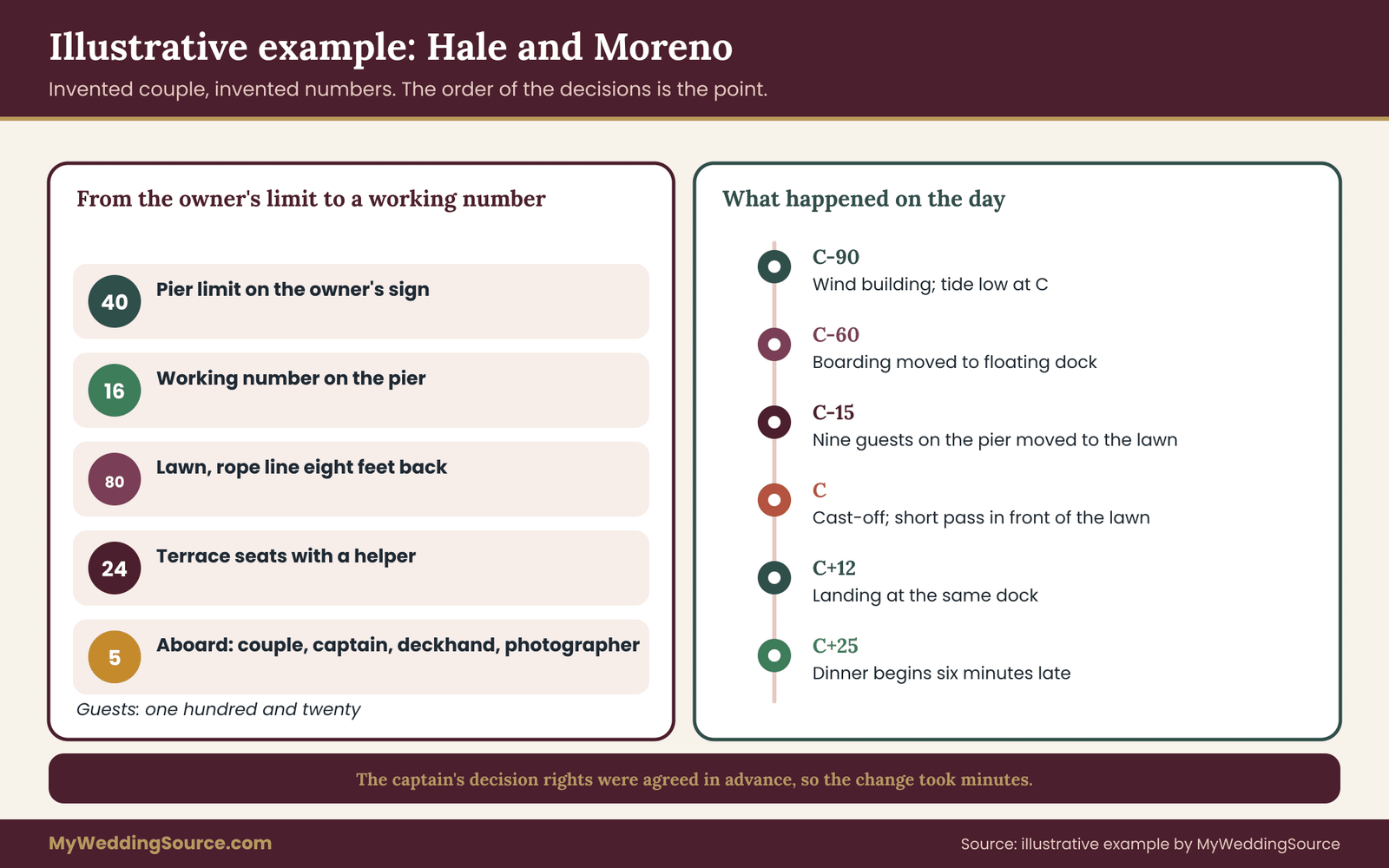
The example below is invented to show the method. The couple, the marina and the numbers are made up, and your site will have its own limits. What matters is the order of the decisions.
Imagine a couple, Dana Hale and Marcus Moreno, planning a boat grand exit for one hundred and twenty guests at a reception on a lawn beside a small tidal marina. They want to leave by boat at the end of cocktail hour, take a short sunset loop and come back to the dinner tent. They have a charter operator with a small vessel, a captain, one deckhand and a day-of coordinator.
Step one: collect the written limits
Before any design, the coordinator gets four answers in writing. The operator says the vessel is authorized for a small passenger count and will carry the couple, the captain, the deckhand and one photographer, five people in all. The marina says the pier may hold forty people at once.
The venue says guests may stand on the lawn and the terrace until the end of the evening, but not on the fuel dock or the boat ramp. The operator adds that the captain may shorten or cancel the boat grand exit at any time.
Notice what the couple does not yet have: a fixed number of guests who may stand where. The pier’s forty is the owner’s maximum, not the couple’s target.
Step two: draw the zones and set the numbers
The coordinator walks the site in daylight. The lawn along the water is wide and slopes gently. The terrace is a raised patio with a clear view over the lawn. The pier is narrow, with a gap at the gangway.
The zones come out like this. Zone A is the head of the pier and the first stretch, with a firm cap of sixteen people, well below the forty on the owner’s sign: the couple’s parents, grandparents, the wedding party and the officiant, plus the coordinator. Zone B is the lawn beside the pier with a roped line eight feet back from the edge, holding the bulk of the guests.
Zone C is the terrace, set aside for guests who prefer a seated view, with twenty-four chairs, shade cloth and a helper. Zone D is the rest of the pier, the fuel dock and the boat ramp, marked with cones and ropes.
Two people are named: an edge person for the pier line and a second at the terrace stairs. The coordinator keeps the radio.
Step three: set the clock
The couple chooses a cast-off for the boat grand exit just before sunset so the light is good and the vessel returns before dark. The sunset time comes from the National Weather Service, and the captain sets the hard stop twenty minutes after sunset, after which the vessel does not leave the dock.
Working back from C, the coordinator writes the boat grand exit clock: a captain check at C minus 90, pier set at C minus 75, announcement at C minus 30, helpers moving at C minus 20, main group at C minus 15, family line at C minus 10, walk at C minus 3, boarding at C minus 1, cast-off at C.
The loop is ten minutes. The landing is at C plus 12 at the same pier. A second hard stop is set for the ending: the couple must be ashore by twenty-five minutes after C so dinner can begin.
Step four: the gates on the day
At C minus 90 the captain reports the forecast is acceptable, with a breeze building from the open water. At C minus 60 the wind is a little stronger. The captain checks the tide table and notes that the water will be low at C, which steepens the gangway.
The captain decides on two changes. The vessel will load from the end of a floating dock, not the main pier, which avoids the steep gangway. And the loop will shrink to a short pass in front of the lawn, rather than out around the point, so the vessel stays near the shore and the guests keep sight of it.
The coordinator updates the clock, tells the DJ, and adjusts the walk, which is now thirty feet longer. The couple, who had hoped for the longer loop, is told by the coordinator and the captain together, with the reasons. They agree. The gate worked because the decision rights were set in advance and the reasons were stated.
Step five: the crowd at C minus 15
At C minus 15, about eighty guests are on the lawn, thirty on the terrace and ten near the bar. The edge person counts nine people on the pier ahead of the family and asks them, politely, to move to the lawn. Two do not hear, and the second person steps in. A guest in Zone B steps over the rope to take a photo, and the edge person asks her to step back with a smile and a gesture.
The count is on target. The coordinator notes that the terrace guests cannot hear the emcee, and sends a helper to give them a short update.
Step six: boarding, pass and landing
The couple walks to the floating dock with Marcus carrying Dana’s shoes. A crew member takes each of them by the forearm, tells them where to step and then seats them in a protected spot behind the cabin. The photographer boards after them. The captain casts off. The vessel passes in front of the lawn at idle speed, the couple stands for a short wave when the captain says so, and the guests cheer.
The vessel returns, the couple lands at the floating dock, and the coordinator radios that they are ashore. The pier crew removes the ropes. Dinner begins six minutes late, which is inside the buffer.
What the example shows
The boat grand exit planning did three things that the couple could not have done alone. It converted the owner’s limit into a smaller working number. It made the captain’s authority explicit before the pressure began. And it kept every decision on one clock, so that a change in the loop did not break the dinner.
Transport logistics: getting guests, the couple and the crew home
A boat grand exit ends at a pier, but the evening does not. The logistics after cast-off are as important as the viewing areas. They are also where couples most often rely on hope.
Guests leaving after the exit
If the boat grand exit is the end of the evening, a crowd leaves at once, many of them after drinking. A marina or waterfront site often has one road in, limited parking and no easy place for a vehicle to turn. For the exit, plan the pickup area, the shuttle or rideshare zone and the parking exit before the day.
The wedding reception guest flow guide covers how to design entry, seating, food and exit across a whole reception, and the same thinking applies to the last fifteen minutes: one clear route out, a staffed pickup spot and a lit path.
If you provide shuttles, count seats and trips. A simple way to estimate is to divide the number of guests who will leave right after the boat grand exit by the seats per vehicle, and then decide how many minutes you can accept for the last guest to leave.
If the shuttle loop takes twenty minutes and a vehicle seats twenty, a hundred and twenty guests need six full loads. With one vehicle that is two hours of waiting. With three, it is forty minutes. The arithmetic tells you what to hire, and an operator can confirm it.
Rideshare vehicles pile up at a single waterfront entrance, and the signal can be poor at some marinas. Choose a pickup spot a short walk from the viewing area, mark it with a sign and a person, and put its name in the program. Send a text message to guests beforehand with the address and the spot. The wedding day digital contingency plan discusses how to set up backup communication when cell service or a single system fails.
Guests who should not drive
Be honest about alcohol. A pier crowd leaving after a long evening includes people who should not drive. Arrange rides, a hotel room block within walking or shuttle distance, or a designated pickup system. The wedding guest hotels guide explains how to coordinate lodging across different budgets and mobility needs, and a nearby block of rooms is one of the best safety tools for a waterfront wedding.
The couple’s landing and departure
Decide where the couple’s night continues. In a loop, they land at the same pier, often after the crowd has gone, and walk to a car or return to the reception. In a one-way trip, a car or a quiet landing is waiting, and the person responsible should confirm the landing is open, lit and ready one hour before. Have a driver, not a guest, who is sober, knows the route and has the bags.
Ask the operator how long the crew will stay after landing. If the couple lingers on the dock for photographs, a crew on overtime becomes a cost. Write the end time into the clock.
Vendors, crew and load-out
The pier and the marina road are shared with the vendors who are leaving. The caterer’s truck, the band’s van, the rental company’s trailer and the photographer’s car all try to use the same exit. Assign a load-out order and a time, and keep vendors off the pier while the boat grand exit is under way. A single person at the vehicle gate prevents the traffic knot that grows when the crowd and the equipment leave together.
If the vessel does not return where it started
In a one-way trip, a mistake costs more. The vessel can arrive at a landing that is closed, unlit or occupied. The captain should confirm the landing with the owner and a person on the ground should be present. If the landing fails, the fallback is to return to the starting pier. Put this in writing with the operator, along with the fuel and time it uses, so no one is surprised by an extra charge.
Costs and contract terms for the departure
A short boat grand exit can cost more than its length suggests, because the operator is selling the vessel, the crew and the schedule, not the minutes. This section does not quote prices, which vary by region and season and would be out of date quickly. It lists what to ask and what to compare.
What drives the cost
Vessel and crew time. Operators often price by the hour with a minimum, so a ten-minute loop may be billed as a longer block. Ask whether there is a shorter option for a departure, and whether the time starts at arrival or at cast-off.
Standby and overtime. If the boat grand exit runs late, the captain and crew may bill extra. Ask how overtime is counted and whether a delay caused by weather or the pier owner is treated differently.
Positioning and fuel. A vessel that must travel to your site, wait and return can add charges. A one-way trip can add a second landing, and sometimes a return of the vessel without passengers.
Pier and marina fees. The owner may charge for event use, extra insurance or staff. Ask for these in writing.
Insurance. The operator carries its own coverage, and the pier owner or venue may require a certificate for the event. Ask what each party requires of you. Insurance, cancellation and liability clauses are worth reading closely.
Decor, lighting and marshals. Stanchions, cones, a lighting rental, a hired marshal and a second coordinator are real line items. They are small next to the vessel but easy to forget.
Terms to settle before you sign
Settle the following in the contract or in an attached run sheet, not only in conversation.
- The exact timing: arrival time, boarding time, cast-off time, the planned route and the hard stop.
- The number of people allowed aboard and who they are.
- The captain’s authority to shorten or cancel, and what happens to the fee if the captain does.
- Weather and conditions, including who decides and how much notice you will get.
- Alcohol and glassware aboard, and any ban on flame or decorations.
- Photographer and videographer access, including drone rules.
- The landing point, any second site, and the plan if it is unavailable.
- Payment schedule, deposit, refund and rescheduling terms.
If any boat grand exit item stays vague, the vagueness is a risk you are accepting. It is better to hear a clear “no” from the operator than a vague “we’ll see.”
A comparison of three ways to spend the budget
If the budget is limited, compare three honest options. The first is a full loop, with the most time on the water and the highest cost. The second is a staged send-off, with the vessel tied or moving only a short way, which costs less and carries less risk. The third is a land exit with a decorated vessel as a backdrop, which costs the least and keeps the water in the photographs.
None of them is the wrong choice. What matters is that you know which one you are buying and that the guests, the family and the operator share the same picture. For the wider question of the venue itself, the wedding venues guide helps you compare waterfront sites on access, capacity and rules, and the wedding vendor timeline shows when to book and confirm each vendor.
Keep proof of everything
Keep copies of the operator’s written terms, the pier owner’s limits, the venue’s rules and any approvals. Save the forecast screenshots and the captain’s final confirmation. If a dispute arises over a fee or a cancellation, these records settle it, and they cost nothing to keep.
Your next steps
Work through these steps in order for your boat grand exit. Each takes an hour or less.
- Decide which version of the boat grand exit you want: the loop, the one-way trip or the staged send-off. Write one sentence for each guest group about what they will see.
- Email the operator the six questions in the first section and wait for written answers.
- Ask the pier or marina owner for the maximum number of people on the structure and any rules about events, insurance and crowds.
- Walk the site in daylight, then again at the hour of the exit. Draw the four zones and test the sightlines and the accessible route.
- Name the edge person, the coordinator and a backup for each, and give them the zone map.
- Write the departure clock with a hard stop and share it with the captain, the DJ and the photographer.
- Write the six gates and the fallback exits, and agree on who decides.
- Plan guest transport and the couple’s landing, including the pickup spot and a text message to guests.
- Rehearse the boarding once, in the shoes and the clothing you will wear, if the operator allows.
- Review the whole plan a week before and the day before, and fix whatever has changed.
Keep the run sheet, the zone map and the clock together in one shared file so every helper sees the same version.
FAQ
How many guests can safely stand on a pier for a boat grand exit?
There is no general number. The pier owner or marina sets a maximum for the structure, and it should be given to you in writing. Plan to use well under that figure, because a crowd that moves and leans behaves differently from a counted load. Often the better choice is to keep guests on land beside the pier and reserve the structure for the couple, a small family group and the crew.
Do we need permission for a boat grand exit?
Almost always. The vessel operator must agree to the boat grand exit, the pier or marina owner must allow the event on its structure, and the venue may have its own rules. Some locations also involve a harbor authority or a fire marshal, especially if you want flame or fireworks. Ask the operator and venue first, then confirm with the issuing office yourself, since rules vary by place.
Can we use sparklers or flares at a boat grand exit?
Sparklers and flame are banned at many piers and marinas because of fuel, wooden boards and crowded edges. Marine flares must never be used for effect, because they signal distress and can trigger a rescue response. Battery lanterns, LED wands and warm shore lighting give the same feeling without the risk. Ask the venue and the local fire authority about anything else.
What happens to the boat grand exit if the weather turns?
The captain decides whether the vessel leaves, and the decision is final. Agree beforehand on a fallback: a staged send-off with the boat tied up, a dockside send-off, a shore exit or a private ride later. Ask the operator in writing whether a weather cancellation affects the fee, and tell guests the change plainly and calmly when it happens.
How long should a boat grand exit last?
Most last between five and fifteen minutes on the water, plus the walk and the landing. A longer trip adds cost, weather exposure and boarding risk without improving the guests’ view, because they see only the first few minutes anyway. A short loop in front of the viewing area usually gives the best result. The captain may shorten it for conditions.
Where should older or less mobile guests watch the exit?
Put them in a seated area with a firm, step-free route, good light and a clear view of the boarding point, often on a terrace or a raised patio rather than the pier. Assign a helper to the section. Offer a second view, such as a window or a screen, for anyone who prefers to stay inside.
Who should be on the boat with the couple?
Usually only the captain, any required crew and perhaps one photographer. Each person adds weight, boarding steps and a count against the vessel’s limit. A wedding party on board turns a short exit into a passenger trip with different rules. Ask the operator exactly who may come aboard, and put the list in writing before the day.
How do guests get home after a boat grand exit?
Plan the transport before the evening. Mark a pickup spot near the viewing area, arrange shuttles or a rideshare zone, and tell guests by text message where to go. A hotel block within a short ride is the safest option for guests who have been drinking. Estimate shuttle needs by dividing guests leaving at once by seats per vehicle and counting the loop time.
Sources
- U.S. Coast Guard for passenger vessel categories, inspection and recreational boating guidance.
- U.S. Coast Guard Boating Safety Division for life jacket, alcohol and boating safety information.
- U.S. Coast Guard Navigation Center for the Navigation Rules and aids to navigation.
- National Weather Service for marine forecasts, small craft advisories and sunset times.
- NOAA Tides and Currents for tide predictions and water level information.
- ADA.gov for the Americans with Disabilities Act and accessible routes.
- U.S. Access Board for accessibility guidelines for recreational boating facilities.
- National Fire Protection Association for general fire safety guidance on flame, sparklers and crowds.