
Boat wedding catering is food service in a kitchen the size of a closet, on a floor that moves, with nowhere to put the trash. This guide gives you a one-page galley and waste brief to hand your caterer and your charter operator, a way to rate the boat on four limits, and a clear rule for when the menu should change or the kitchen should stay on shore.
Rate the vessel on four limits before you pick a boat wedding catering menu: power and refrigeration, space for food and people, the path a plate travels, and what happens to waste. Put the answers in a one-page brief that both the caterer and the charter operator sign off. If any limit rates as a stop, change the service style or cook ashore. Never plan on dumping food scraps, packaging or wash water over the side. Ask the operator and the local authority for the current rules.
A wedding dinner on a boat sounds simple until someone asks where the soup will be reheated. Land venues come with a kitchen, a loading dock, a dumpster and a health inspector’s checklist. A charter boat comes with a galley built for a crew’s lunch, a hold that doubles as storage for life jackets, a deck that tilts, and a captain who is legally and personally responsible for everyone on board. Boat wedding catering lives inside those limits whether or not anyone writes them down.
Couples planning boat wedding catering usually discover the limits late. The caterer’s proposal assumes ovens, ice machines and a place to stage plates. The operator’s contract assumes a snack tray and a cooler. Neither side is wrong, but neither side has seen the other’s assumptions. The gap shows up on the dock at four in the afternoon, when forty pounds of crushed ice, six hot boxes and a cake arrive at a gangway built for people.
This article is about closing that gap with paper, early, so that boat wedding catering starts from facts and not assumptions. It does not repeat the full charter review, which belongs in your contract work with the operator. It also does not choose a place for the wedding, which the wedding venues guide covers, and it does not teach general menu design, which the wedding menu planning guide already covers.
It focuses on one question: what can this particular boat actually feed, serve and clean up after, and what has to be true for that to stay safe?
A note on scope. This is general planning information, not legal, safety or regulatory advice, and the rules for vessels, food service and waste vary by vessel, state, harbor and day. Where a rule matters, the article points you to the agency or operator that sets it so you can confirm the current version.
Why boat wedding catering is not land catering with a view
On land, a caterer can solve a problem by adding something: another oven, another table, another person, a second truck. On a boat, almost every addition runs into a fixed limit. The galley is already built. The deck is already measured. The number of people aboard is capped, and that cap usually includes crew and vendor staff, not only guests. Boat wedding catering is therefore mostly a subtraction exercise. You start from what the vessel can handle and work backward to a menu.
Four differences set boat wedding catering apart from the land version.
The kitchen is fixed and small. A charter galley may have a small refrigerator, a sink, a modest cooktop or none, and counters that serve as the crew’s only work surface. Many operators allow no open flame at all. Some have no galley, only a bar and a cooler. You cannot assume the equipment list you would expect from a venue.
Everything moves. Plates slide, sauces slosh, tall stacks tip and hot liquids become a burn risk. Wake from a passing vessel can arrive without warning. Serving methods that are routine on land, such as a carving station or a slow-moving buffet line, become hazards when the floor shifts.
People and food share the same few feet. Passengers walk the same narrow routes servers use. Stairs and companionways may be the only way between galley and deck. A server carrying a tray down a ladder-steep stair is a different job from one crossing a ballroom.
Waste has no easy exit. On land the dumpster is thirty feet from the kitchen door. On a boat, everything that comes aboard must go home with the boat, usually in bags stored where the guests are not. Rules about what may be discharged overboard are strict, and for a wedding group the practical answer is simple: nothing goes over the side.
What this means for the couple
You do not need to become a marine kitchen expert to manage boat wedding catering. You need to ask the right questions in the right order, and you need to make sure the caterer and the operator are answering the same questions. The brief in this guide exists for that reason. Its job is to turn two sets of assumptions into one set of facts before deposits are paid for food the boat cannot serve.
It also protects relationships. A caterer who learns the day before that the galley has one outlet is understandably upset, and a captain who learns that the caterer is bringing propane burners is understandably firm. Neither conversation goes well at the dock.
The four limits: a galley brief for boat wedding catering
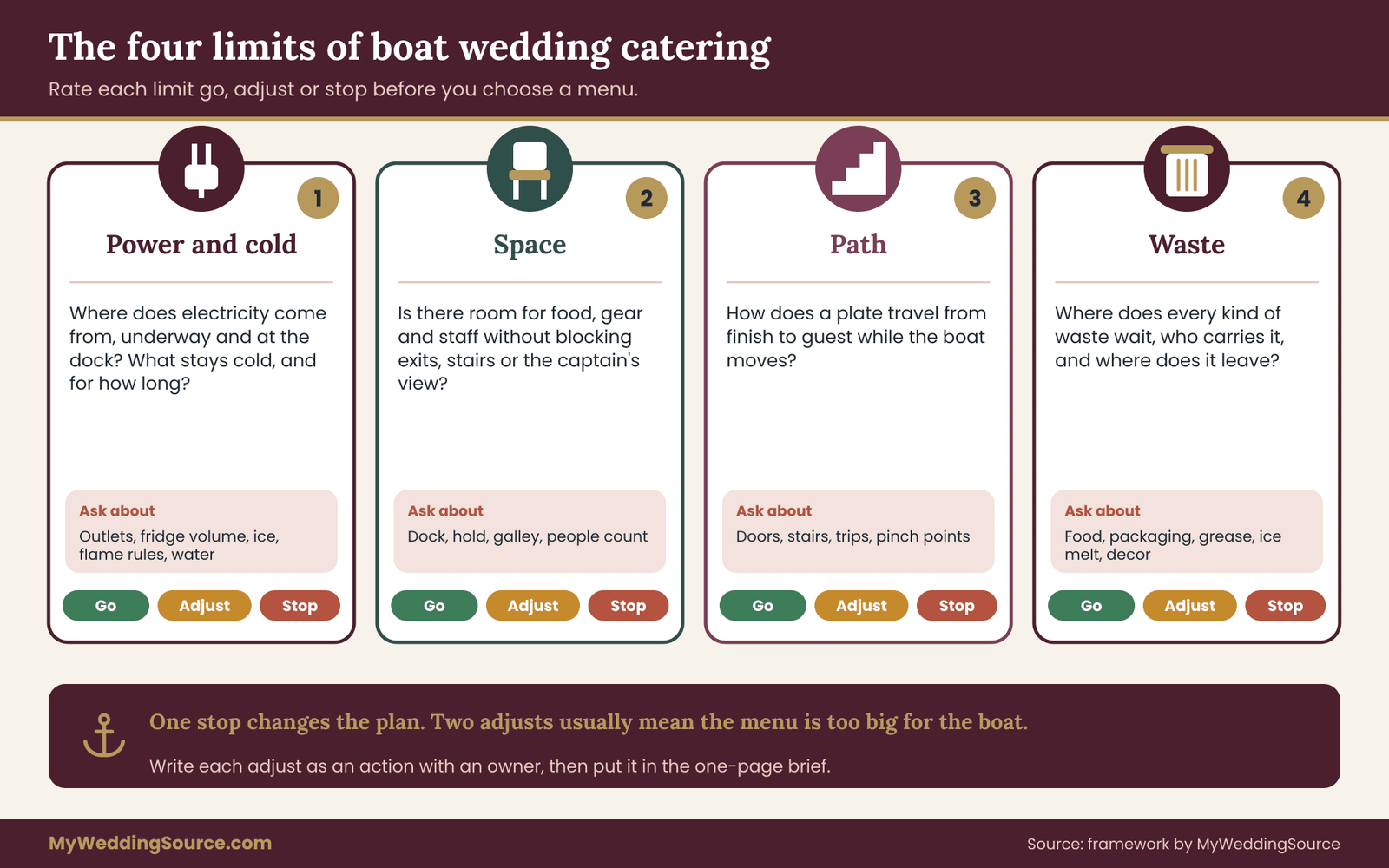
The brief for boat wedding catering rests on four limits. Rate each one as go, adjust or stop for the menu you have in mind. The ratings are your own judgment, informed by what the operator tells you in writing. They are not an official classification.
Limit one, power and cold. Can the vessel supply the electricity, refrigeration and heat that the menu needs, for the whole time the food is aboard? This includes whether power is shore power at the dock, a generator underway, or batteries. It also covers ice, since ice is heavy, melts into water and needs somewhere to drain.
Limit two, space. Is there room for the food, the equipment and the people who handle it, without blocking exits, stairs or passenger areas? Include the hold, the dock staging area and the walk between them. Include the space needed afterward for dirty dishes and bags of waste.
Limit three, the path. How does a plate or a glass travel from where it is finished to where a guest receives it, and does that route stay clear and safe when the boat moves? Count steps, stairs, doors and turns. A route that works at the dock may not work at speed.
Limit four, waste. Where does every kind of waste go from the moment it exists until it is ashore: food scraps, packaging, grease, ice melt, wash water, broken glass, flowers and decor? Who carries it, who pays for disposal, and what does the operator forbid?
Rating each limit
A go means the menu fits within the limit with the equipment and space the operator has confirmed in writing. An adjust means it fits only if something changes, such as moving a hot course to the shore, reducing the number of servers, or staging waste on the lower deck. A stop means it does not fit, and no adjustment you can reasonably afford will make it fit.
One stop is enough to change the plan. Two or more adjusts usually mean the menu is too ambitious for the vessel. Section by section, the rest of this guide helps you rate the limits and write the adjustments into the brief.
Who answers which limit
In boat wedding catering, different people hold different answers, and asking the wrong person wastes a week. The operator or captain answers power, cold, space and the rules about flame, alcohol and waste. The caterer answers what equipment the food truly needs, how many staff are required and how food is held safely. The local health authority decides whether the caterer needs a specific permit for the water or the harbor. The marina or port decides where waste may be unloaded.
The couple’s job is to carry questions between these parties until each answer is in writing. A phone call that settles a point should be followed by a short email that restates it. When the day comes, that email thread is the evidence of what everyone agreed.
“Before we finalize the menu, could you send the galley equipment list, the power source for each outlet, and your rules on open flame and waste? We will share it with our caterer.”
Galley constraints that shape boat wedding catering: power, heat, cold and water
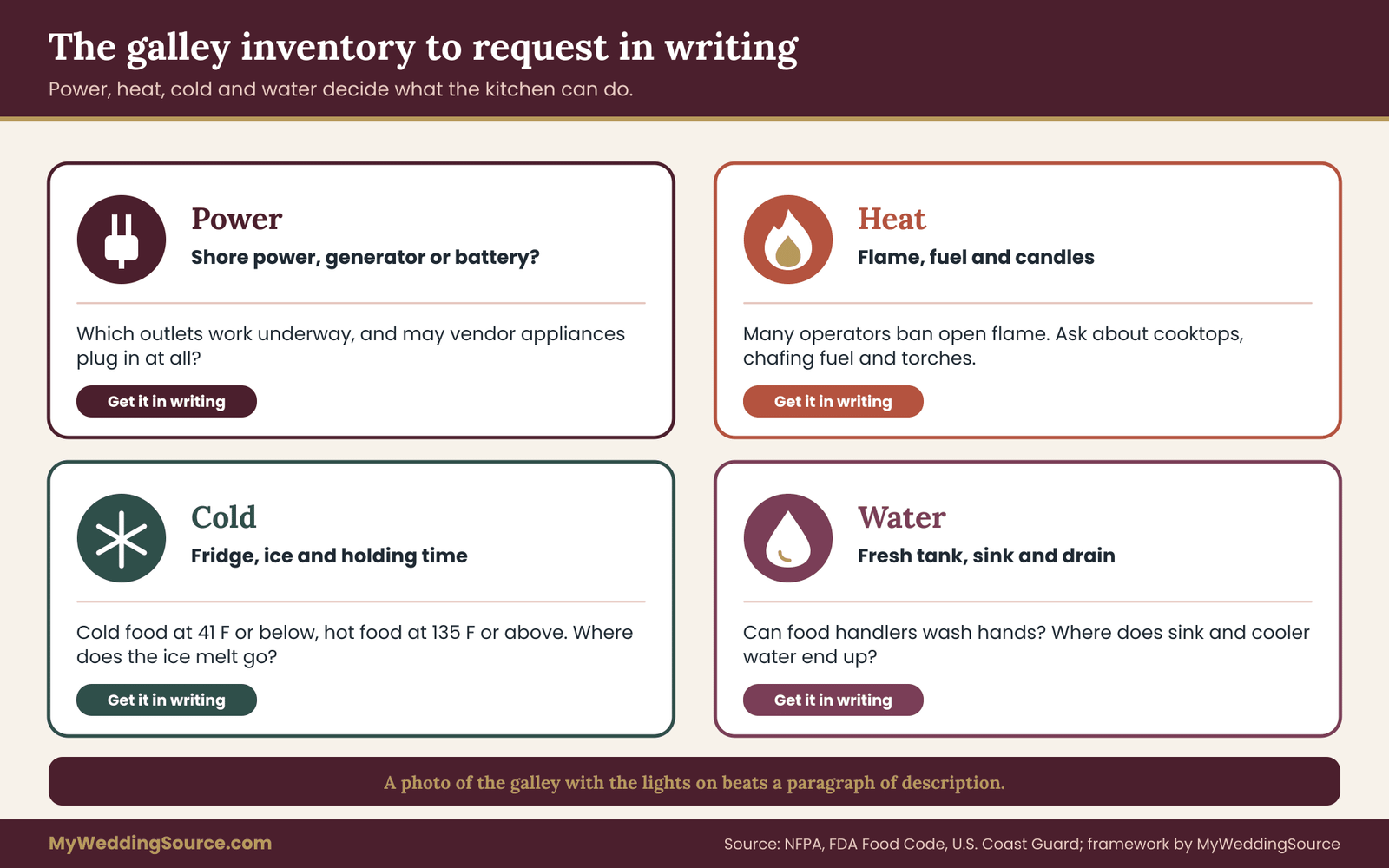
Start with the galley inventory, because everything else in boat wedding catering depends on it. Ask the operator for a written list that says what is installed, what works, what is allowed and what is not. A photo of the galley with the lights on is worth more than a paragraph of description. If the operator offers no list, you are about to plan boat wedding catering around guesses, and a stop rating on the first limit is a fair place to begin.
Power: where it comes from and how much there is
Electricity aboard comes from one or more of three sources: shore power while the boat is tied to the dock, a generator while underway, or the vessel’s batteries and inverter. Each has limits that land venues rarely have. A circuit that is fine at the dock may be unavailable once the boat leaves, and an inverter that runs a coffee maker may not run a convection oven.
For boat wedding catering, ask which outlets exist, which source feeds each one, and whether any can run appliances the caterer brings. Do not accept a general “yes, we have power.” Ask what happens when the boat leaves the dock, and what happens if two appliances run at once. A captain may well say that guest and vendor equipment may not be plugged into the vessel at all, and that answer should simply be written into the brief.
Appliances that look small can draw a lot. Warming cabinets, induction burners, coffee urns and blenders all pull more power than their size suggests. The caterer should supply the electrical needs of any equipment in watts or amps from the label, and the operator should say yes or no to each item by name.
Heat: flame, fuel and the fire plan
Many operators ban open flame on board, which shapes boat wedding catering more than any other rule. That includes propane cooktops, butane burners, torch lighters for crème brûlée, and the small fuel cans under chafing dishes. The reasoning is straightforward: fire on a boat is dangerous because escape routes are limited and water is all around you. The National Fire Protection Association publishes standards on fire protection for boats, and operators follow their own insurer’s and regulator’s requirements on top of those.
If the operator allows a cooktop, ask what type it is, who may use it, and whether a crew member must supervise. If it allows no cooking at all, the caterer’s plan changes completely: the food must arrive cooked and travel in insulated or electrically heated containers, and anything that needs finishing must be finished with the equipment the vessel permits.
Candles are a related question. Real candles on a table are open flame, and many operators prohibit them. Battery candles solve the look without the rule. Include decor in the heat conversation so it does not surprise the captain on the day.
Cold: refrigeration, ice and holding time
A galley refrigerator may hold lunch for the crew, not dinner for forty people. Ask for the interior volume in plain terms: how many full-size hotel pans or how many standard coolers’ worth of food will fit with the door closed. Then compare it to what the menu actually needs to keep cold from loading until service.
The U.S. Food and Drug Administration’s Food Code, a model that many state and local health departments adopt, treats 41 degrees Fahrenheit or below as the standard for keeping cold food, and 135 degrees or above for holding hot food. The numbers matter because a boat can make them harder to meet: a warm cabin, afternoon sun on the dock and long gaps between loading and service all work against cold food.
Ice solves part of the problem and creates another. It is heavy, it takes space, and as it melts it makes water that has to drain somewhere that is not the guest area or the bilge. Ask where ice may be stored, how it will be drained, and whether the operator permits loose ice on board at all. Sealed ice packs and dry-ice policies need explicit permission as well, since dry ice raises ventilation concerns in enclosed spaces.
Water: fresh, gray and what the sink does
The sink on a charter boat may be small, may draw from a limited fresh water tank, and may drain to a tank or directly overboard through a system built for light use. Ask how much fresh water the vessel carries, whether it is potable, and whether it is meant for drinking, handwashing or both. A caterer who needs to wash hands, rinse produce and run dish water will use more than a crew making sandwiches.
Handwashing deserves its own question. If the galley sink cannot support proper handwashing for food handlers, the caterer needs a plan, such as a portable handwashing station if the operator permits one. Do not leave this to the day. A food worker with no way to wash hands is a food safety problem no matter how nice the boat is.
How to rate limit one
Put the answers side by side with the menu. A go rating means the power, heat, cold and water the menu needs are confirmed in writing and fit within what the operator permits. An adjust means one item must change: a hot dish moves ashore, ice is replaced with a smaller number of insulated carriers, or handwashing is arranged outside the galley. A stop means the menu needs something the vessel cannot or will not provide, such as cooking on board when no cooking is allowed.
Be willing to read a stop as information, not failure. A boat that cannot hold a hot buffet may do a lovely cocktail-style dinner with cold and room-temperature foods and a single warm course carried in sealed insulated boxes. In boat wedding catering, the menu follows the boat, not the other way round.
Space, storage and the load-in for boat wedding catering
The second limit in boat wedding catering is room. Space on a boat is not only about square feet. It is about where each item may sit without blocking exits, stairs, life jackets or the captain’s view. The operator knows these rules, and you do not, so let them draw the boundaries.
Three zones of space
Think of the space question in three zones: the dock, the hold and the working galley.
The dock zone is where the food arrives and waits. Ask where vendors may park, how far the walk to the gangway is, whether a cart or hand truck is allowed and how wide the gangway is. A gangway, ramp or boarding step has a weight limit and a width, and a cart that is fine on a loading dock may not be fine on a floating pier that tilts at low tide.
For tidal ramps, the slope changes with the water level, so ask for the likely slope at your loading time.
The hold zone is where food and equipment live during the trip. Ask which compartments are available, whether they are enclosed and temperature-controlled, and what else shares them. Items that need to stay cold must not be parked next to an engine space or a hot deck. Items that tip, such as stacked trays, need a place where they will not move.
The working galley zone is the actual prep and plating area. Ask how many people can work there at once without blocking the others. A galley that fits two people shoulder to shoulder cannot host a team of six servers collecting plates. The number of people the galley can hold decides how many plated courses you can run at once.
The people count that surprises couples
Vessels carry a maximum number of people, set by their inspection or certificate, and that number is a limit on everyone aboard. Ask the operator whether caterer staff, servers, bartenders, a photographer, a musician and the crew count toward it. In many cases they do. If the vessel is certified for a set number of people and your guest count already uses most of it, there may be no room for the staff the caterer needs.
This changes boat wedding catering in a direct way. If the caterer needs five staff and the vessel can only add three, the style of service must need fewer hands. A plated multi-course dinner needs many hands. A family-style meal assembled on shore needs fewer. Boat wedding catering is partly a headcount problem, and the sooner the count is written down the easier the decision.
Load-in as a timed operation
A boat does not wait for a slow load-in. The charter has a start time, a tide or schedule, and sometimes a hard deadline set by a bridge opening, a harbor rule or daylight. In boat wedding catering, treat the load-in as a timed task with its own schedule rather than a few minutes before guests arrive.
Work backward from the departure time. Guests may board at a set time, the captain may need a safety briefing before departure, and the vessel may need the galley clear of loose items before that briefing. The caterer needs the time to carry items aboard, store them and begin any finishing. Put those times in the brief with a margin, and agree who may stop the load-in if the boat’s timing demands it.
If the load-in has to happen while other passengers or vendors are boarding, plan the sequence so food and guests do not cross in the same narrow place. A separate service entrance, a different gangway or an earlier dock slot solves most of this.
How to rate limit two
For boat wedding catering, a go rating means there is confirmed room in each zone, the people count works with the caterer’s staffing, and the load-in fits the schedule with margin. An adjust might mean reducing the number of staff, using fewer, smaller containers, or arriving earlier than usual. A stop means the vessel cannot hold the food, equipment and staff the menu needs without blocking something that must stay clear.
Write each adjust as an action with an owner. “Caterer will bring no more than four insulated carriers, each small enough for one person to carry up the gangway” is an adjust in a form someone can check. “Keep things compact” is not.
Choosing a service style for boat wedding catering
With the first two limits rated, you can choose how food reaches the guests, which is the central style decision in boat wedding catering. The service style is the biggest lever you control, because it decides how many staff, how much galley time and how much movement the plan requires. There is no best style of boat wedding catering for every boat. There is a style that fits this vessel, this crew and this route.
Plated, seated service
A plated dinner means each guest receives a finished plate at a table. It looks formal and photographs well, and it is also the hardest to run aboard. Plates must be finished in the galley, carried along the path, and delivered while the boat moves, often in waves so that every guest is served at about the same time. That takes a lot of staff and a roomy galley.
Plated service can work on a larger vessel with a real galley, a wide interior and a calm route. On a small boat it usually becomes an adjust or a stop. A common compromise is plating in a simple way: a cold first course set at the tables before guests sit, and a main course that arrives already composed and only needs warming.
Family-style platters
Family-style service puts shared platters at each table, and guests serve themselves. It needs fewer hands because there is no individual plating, and it handles dietary needs well if labeled clearly. The catch is weight and spill risk. A full platter is heavy and slippery, and passing it around a table while the boat tilts is a small balancing act.
Use shallow, secured serving dishes, non-slip mats and smaller portions per platter with refills, not a single huge dish. Ask the caterer to bring platters that suit the table size on the boat, which is often smaller than banquet tables. Keep soup out of this style unless the bowls are covered or served from sealed pitchers.
Stations and buffets
A buffet or station setup lets guests move to the food. On a boat, that means guests walking while the vessel moves, queuing in a deck space shared with exits, and holding a hot plate in one hand while steadying themselves with the other. Stations with live cooking or carving are usually ruled out by heat and flame limits.
A buffet can work for a docked or moored event, where the boat is a venue and not a moving vehicle. Underway, it needs a large calm space and a short line. A simple test helps: if a guest with a plate and a drink cannot reach a handrail or seat without crossing someone else’s path, the buffet fails the path limit. The wedding reception guest flow planning approach for ballrooms is a good starting point, but the boat version must be tighter.
Passed appetizers and cocktail-style service
Cocktail-style service uses small, handheld food passed by servers or set out in one place, with guests standing or sitting in clusters. It fits boats well because the food needs no plates and little cutlery, and it adapts easily to a moving deck. Choose items that hold their shape, tolerate a few minutes at room temperature and do not drip.
The downside is hunger and expectation. If guests expect a seated dinner, a long cocktail-style event may not feel like enough. A good caterer will estimate how much to serve per person across the length of the trip, and the number should match the time aboard, not an abstract average.
Boxed or pre-portioned meals
Individually boxed meals, in compostable or reusable containers, are the lowest-demand style on staff and galley. Each guest receives a sealed portion. Sealed boxes mean fewer spills, easy labeling for allergens and simple counting. The tradeoff is presentation and the packaging waste, which becomes a limit-four problem.
Boxed service can be dressed up well with a tablescape, cloth napkins and real cutlery, and it is a sensible choice for a short cruise where the main meal happens ashore. Pair it with a reusable serving plan if the operator permits real dishware, and read the wedding waste reduction guide before choosing single-use containers.

A simple way to choose
Use the ratings from the first two limits to choose your boat wedding catering style. If the galley has no cooking and little cold storage, move toward boxed meals, cocktail-style service or family-style cold platters. If the galley is generous and the vessel is large, plated or family-style service becomes possible. If the boat will stay at a dock, a buffet becomes workable. Then check the choice against limit three, the path, in the next section.
Do not choose a boat wedding catering style because a photograph on a caterer’s website looked good. Those photos nearly always come from land venues. Ask the caterer for examples of boat wedding catering they have actually served, and ask what they changed. A caterer who has worked on boats will answer in specifics: what they cut, what they moved ashore, how they handled stairs.
Staffing, the service path and the plate-flow test
The third limit, the path, is where good boat wedding catering plans quietly fail. A path is the route food, drinks, dishes and people take through the boat. Draw it on paper, because describing it in words hides the problem spots.
Draw the path on a deck plan
Ask the operator for a deck plan or a simple sketch showing the galley, the dining or deck area, stairs, doors, exits and the bar. Mark where food is finished, where it is served, where used dishes return, and where waste is stored. Draw lines between them. Wherever two lines cross, or where a line passes through a narrow space, you have found a pinch point.
Typical pinch points include a single door between galley and deck, an interior stair, a passage next to the bar and a bottleneck where guests queue for the restroom. Each can be managed, but each needs a rule: one-way traffic, a time window when servers have priority or a second route.
The plate-flow test
The plate-flow test is a simple way to rate the path. Pick the most demanding moment of boat wedding catering service, such as the main course for all guests, and count the trips needed. Take the number of plates or platters, divide by what one server can safely carry, and multiply by the time each trip takes along the real path. Then compare the total to the time you can allow before food goes cold or guests grow restless.
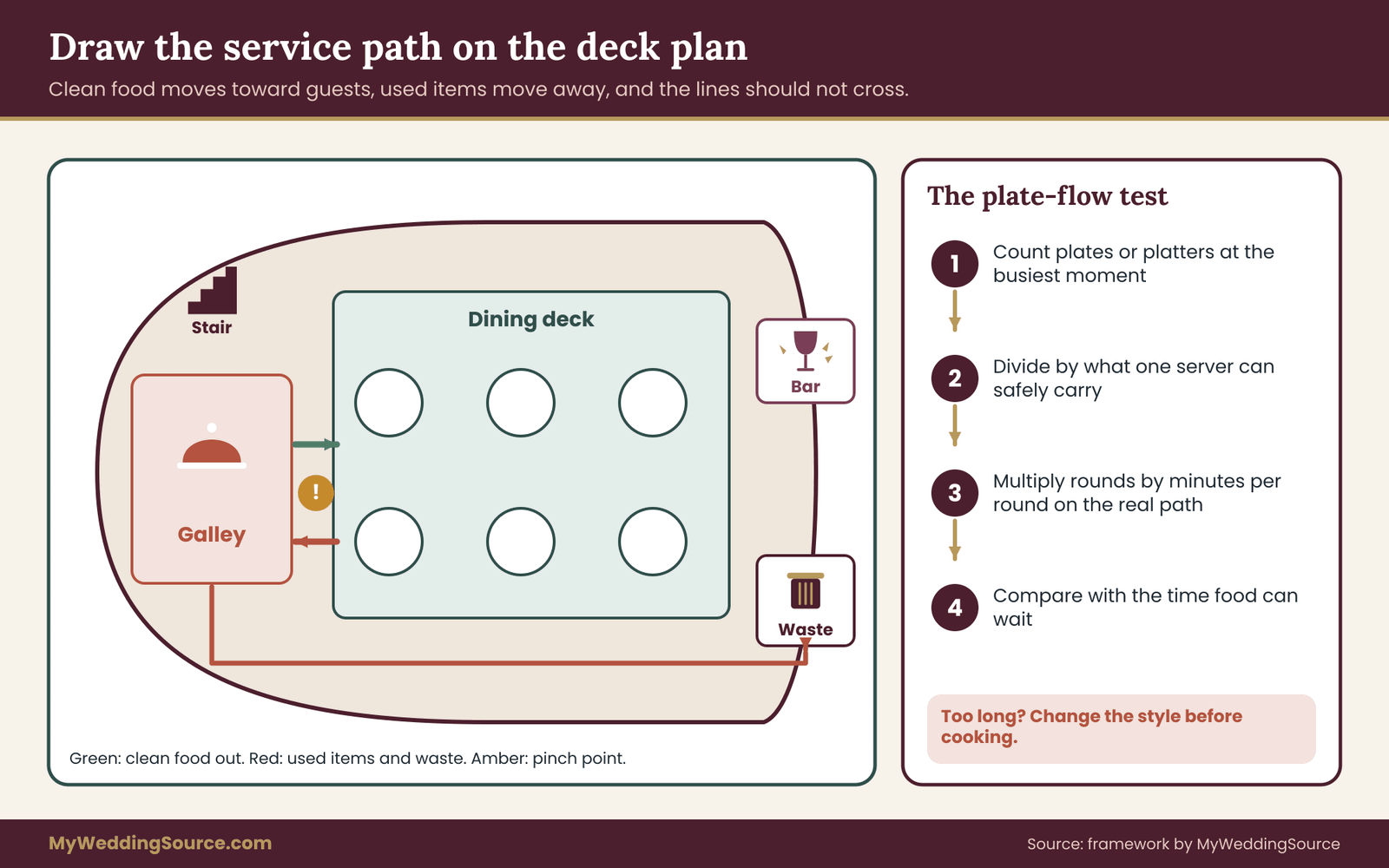
If the answer is far more than you can allow, you have found a stop or an adjust before any food was cooked. This is an arithmetic check, not a precise forecast. Its value is that it forces both sides to put numbers on a problem that is otherwise argued in feelings. The worked case later in this guide runs the test with invented numbers.
Staff: how many and who they are
The staffing question in boat wedding catering has two parts: how many staff the service needs, and who is allowed to work aboard. Count servers, a lead who manages the galley, a bartender if there is one, and a runner who handles dirty dishes. Then count the crew the operator already provides. Some operators supply a deckhand who can help with plates, but crew duties are safety duties first, and a crew member who is serving is not watching the guests.
Ask the operator what the crew will and will not do. Crew members are not catering staff unless the contract says so, and the captain may have to refuse a request that distracts from safe operation. Ask also whether the operator requires any briefing or orientation for vendor staff, and who delivers it. The briefing is short and important: where the exits are, where the life jackets are, what to do if the weather changes and who gives orders in an emergency.
Movement rules for servers
For boat wedding catering, agree movement rules in advance and write them into the brief. Typical rules include carrying one hand free for the boat, no running, no stacking beyond a set height, no hot liquids on stairs while the boat is underway, and pausing service for the captain’s announcements. Also agree what happens if the captain asks for a halt: service stops without argument and resumes when told.
Make sure servers are comfortable on a boat. A server who gets seasick or fears water is a risk for everyone, and a good caterer will ask staff in advance. For the guests’ side of this, the wedding guest care planning approach to older relatives and children applies on a boat, with the added need to keep walkways clear of strollers and walkers.
How to rate limit three
For boat wedding catering, a go means the path is drawn, the plate-flow test fits the available time with margin, and the staffing is confirmed against the people count. An adjust might mean serving in waves, adding a runner, or moving the dirty-dish return to a different route. A stop means the path cannot be made safe at the speed the menu requires, such as plated service for a crowd across a single narrow stair.
Food safety aboard: how boat wedding catering stays safe from kitchen to guest
Food safety rules do not relax because the venue floats, and boat wedding catering makes them harder to follow. They get harder to follow, and the person responsible may not be obvious. In boat wedding catering there are usually three parties: the caterer, who prepares and serves the food, the operator, who owns the vessel and its galley, and a health authority, which may be a state or local department. Your first job in boat wedding catering is to find out which authority actually covers this event.
Who is in charge of inspection
The U.S. Centers for Disease Control and Prevention runs a Vessel Sanitation Program for large cruise ships, and that program does not cover a small charter boat. A small boat or a harbor cruise is more likely to fall under state or local food rules, or under the caterer’s own permit, and the answer can differ from one county to the next. Do not guess. Ask the caterer which permit covers the event, and ask the local health department whether a temporary or off-site permit is needed.
Also ask whether the operator holds any food-handling approval for the galley, and whether the galley may be used by an outside caterer at all. Some operators allow only their own approved crew to touch the galley, and some allow no food preparation. Ask for the answers in writing, because a verbal “we do this all the time” does not help if a guest becomes ill.
Temperature control from loading to service
For boat wedding catering, the Food Code’s standard of 41 degrees Fahrenheit or below for cold food and 135 degrees or above for hot food is a good frame for the plan. The question is how each item stays inside that range from the caterer’s kitchen to the guest’s table, given the time on the dock, the walk aboard and the service period.
Write a short temperature plan for each food in your boat wedding catering menu that needs it. Name the container, the starting temperature, the time it will spend outside refrigeration or heat, and the person who will check it. Ask the caterer to bring a calibrated thermometer and to record readings. That small habit, a few numbers on a card, turns a vague promise into something checkable and costs nothing.
Reheating has its own rule. Food reheated for hot holding generally needs to reach a higher internal temperature than the hot-holding minimum; the Food Code uses 165 degrees Fahrenheit for many reheated foods. If the galley cannot reheat to that temperature, the menu should not depend on reheating there.
Moving food: transport and holding
Insulated carriers, electrically heated cabinets and well-packed coolers all work for transport. The point is to match the container to the food and the time. A hot box that holds heat for two hours is a poor match for a three-hour trip with no way to reheat. The caterer should be able to say, in plain terms, how long each item can safely wait.
Plan for delays in boat wedding catering. Boats run late, cast off late or wait for a bridge. Ask what the caterer does if service starts an hour behind plan. The answer should be concrete: which dishes are removed from the menu, which are replaced with something shelf-stable, and who decides. A delay on a boat cannot be solved by a quick trip back to the kitchen.
Handwashing, gloves and cross-contact
Handwashing is the core of food safety, and in boat wedding catering it depends on water. Confirm that handwashing is possible near where food is handled. If the galley sink cannot be used, a portable handwashing station with a fresh water supply and a way to catch the used water may be an option. Ask the operator whether it is allowed and where it can be placed.
Gloves and utensils are the second layer. Serving tongs, separate utensils for each dish and clean serving spoons prevent cross-contact, which is when an allergen or germ moves from one food to another. Ask the caterer how they will keep utensils clean during service, where used ones go and how many spares they carry. Spares are cheap, and a dropped tong on a moving boat is common.
Dietary needs and allergens on a boat
Dietary needs are a safety issue as well as a courtesy in boat wedding catering. Guests with serious allergies need accurate information, and a boat is a poor place to make a last-minute swap. Collect dietary information through the RSVP, pass it to the caterer in a single list and ask the caterer to confirm what they can do in a shared galley. A small galley raises the chance of cross-contact because surfaces, sinks and utensils are shared.
Labeling matters more when service is passed or stationed, because a server who walks by cannot explain every ingredient to every guest. Ask for printed labels, and have the lead server know the ingredients of each item. For guests with severe allergies, the best practice is a sealed, labeled meal made and carried separately, with the guest told which meal is theirs before boarding. The wedding menu planning guide explains how to gather and organize those needs.
The U.S. government’s food safety resources, including foodsafety.gov and the FDA’s pages on food allergens, explain the main allergens and the basics of safe handling. Point the caterer to them if there is any doubt, and ask the caterer to describe their own allergen procedure.
Alcohol, glassware and who serves
Bar service has rules of its own, and the vessel’s license, the caterer’s license and the state’s law may all apply. Some operators provide the bar, some allow a caterer’s bar and some allow neither. Glass is also a safety question on a moving boat: broken glass on a deck is a hazard for bare feet and a pain to clean in a small space.
Ask whether the operator requires plastic, tempered or reusable acrylic glassware and whether glass bottles may be brought aboard at all. The wedding bar service planning guide covers pours, counts and licensing, and the boat-specific points belong in the same brief.
The food safety card
Boil the boat wedding catering safety plan down to a one-page card that travels with the lead server and the captain. It lists the permit that covers the event, the temperature plan for each hot and cold item, the handwashing arrangement, the allergen list with which meal belongs to whom, and the name of the person who makes the call if food is out of temperature. If something goes wrong, the card shows that the plan existed and who owned each part.
What to do if food is out of range
In boat wedding catering, decide in advance what happens if a food item sits outside its safe range for longer than planned. The answer should be to discard it, not to hope. A caterer who keeps a small reserve, such as extra portions of shelf-stable items or a simple backup course, can replace a discarded dish without a crisis. Without a reserve, the decision to discard feels expensive, and that is when people are tempted to serve what they should not.
Put the discard rule in the brief and say who has authority to enforce it. On a boat, that is usually the lead caterer with the captain’s support. Agree on it before the day, with everyone in the room, rather than in a hurry at the dock.
How safety connects to the four limits
Notice that every boat wedding catering safety point above ties back to a limit. Temperature control depends on power and cold. Handwashing depends on water and space. Moving food safely depends on the path. Discarding food depends on waste. If a safety step cannot be supported by a limit that rates as a go, you either change the step or change the menu. Safety is not a fifth limit. It is what the four limits are protecting.
Waste rules for boat wedding catering: what never goes overboard
The fourth limit of boat wedding catering is the one couples forget until the dock. Every wedding produces waste, and dinner produces the most: scraps, packaging, napkins, bottles, cooking oil, wash water, melted ice and the decor that was not meant to last. On land, waste is the caterer’s quiet problem. On a boat, waste is a regulated item that must be tracked from the moment it exists until it reaches shore.
The rule that keeps things simple
For boat wedding catering, the working rule is nothing goes over the side. That includes food scraps, which many people assume are harmless to feed to fish and birds. It includes plastic of any kind, straws, wrappers, balloons, confetti, rice, petals, glitter, candles, flowers and the bag you put it all in. It includes cooking oil and grease, and it includes anything you thought would biodegrade quickly.
The rule is simple because the legal picture is not. U.S. rules for garbage from vessels come from the international MARPOL treaty, Annex V, which the U.S. Coast Guard implements in federal regulations. In general terms, throwing plastic into the water is prohibited everywhere, and rules about other garbage, including food waste, depend on how far the vessel is from land and what kind of water it is in.
Some waters, including many harbors, rivers and lakes, add stricter state or local rules. A charter operating on a calm bay near a marina is almost certainly in a place where discharging anything is unwelcome and often unlawful.
Do not try to work out which rule applies to your route. Ask the operator to state, in writing, the waste policy for your trip, and treat it as binding on every vendor. The operator carries the legal responsibility as the vessel’s owner, and operators generally prefer a strict policy for exactly that reason.
Placards and waste plans
Larger vessels are required to display a placard that tells passengers and crew what may not be thrown overboard, and some must keep a written waste plan. Whether your vessel needs them depends on its size and what it carries. You do not need to read the regulation, but you can ask a simple question: does the vessel have a waste management plan, and can we see the part that affects catering? An operator who runs commercial charters will usually know the answer immediately.
The U.S. Coast Guard, the Environmental Protection Agency and, for some waters, NOAA all publish material on vessel discharge and marine debris. Their websites are the right place to confirm the current rules, and the Sources section lists them.
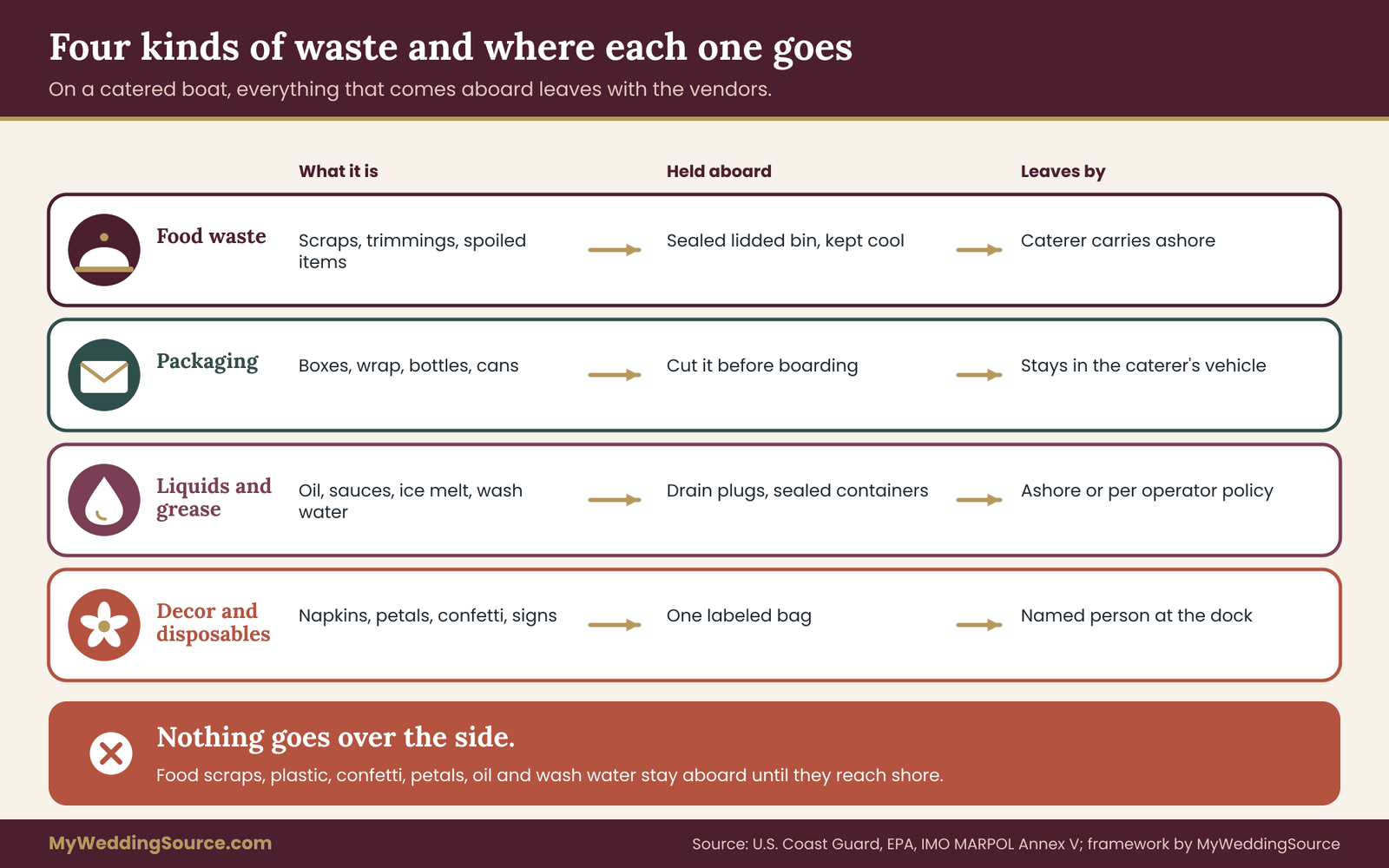
Four kinds of waste on a catered boat
Sort boat wedding catering waste into four kinds, because each has a different holding method and a different exit.
Food waste includes plate scraps, trimmings, spoiled items and leftover food that cannot be served again. It attracts pests and smells, so it needs a sealed container and, ideally, cold storage if the trip is long.
Packaging covers boxes, wrap, bottles, cans, cups and anything that arrived with the food. Reduce it before boarding, since packaging is the easiest waste to avoid.
Liquids and grease includes cooking oil, sauces, melted ice, wash water and drink dregs. These cannot go down a galley sink if the sink drains straight overboard or to a limited holding tank, so check what the sink is connected to.
Decor and disposables means napkins, cups, floral waste, confetti, signs and balloons. They tend to be forgotten in the catering plan, but they are part of the same bag.
Where the rule meets the menu
Waste decisions in boat wedding catering begin with the menu. A menu with many small plastic cups creates a waste problem. A menu served on reusable plates creates a washing problem. Each choice moves the challenge from one limit to another, and the brief is where you decide which challenge the boat can handle better.
A boat with a roomy galley and a working sink might handle reusable dishware well, provided water and space allow washing. A boat with no galley may do better with sealed, compostable or recyclable single-use items that leave with the caterer. Neither is automatically better. Compostable packaging only helps if someone actually composts it, and many compostable items end up in a landfill if the local system does not accept them.
Waste logistics: bags, ice melt, grease and the dock handoff
Knowing what may not go overboard is half the job of boat wedding catering. The other half is where waste sits for the three hours before it can leave. This section turns the rule into a plan, using the four kinds of waste and the path you drew earlier.
Where bags live during the trip
In boat wedding catering, waste bags need a place that is out of sight, out of the walkway, closed and cool if possible. On a small boat that place may be a locker, a lower deck or a lidded bin tied to a rail. Ask the operator where the bins may go, how many they allow and whether they must be secured. Loose bags on a moving deck become a hazard and an odor problem.
Plan the route for waste the same way you planned the route for food. Waste should not travel the same path as clean plates, at least not at the same time. A simple rule is that clean food moves toward the guests, and used items move away from them, along a separate line where possible. When a single route serves both, set a time rule, such as clearing plates only after the captain’s all-clear.
Count the bags for your boat wedding catering plan. A caterer can estimate how many bags a given menu produces, and the operator can say how many the boat can hold. If the numbers do not meet, the menu changes, or a second pickup is arranged, or the caterer takes more packaging back to the kitchen. Do the counting before the contract is signed.
Ice and melt water
Ice melt is the quiet waste stream in boat wedding catering. A large amount of ice becomes a large amount of water, and water on a boat moves toward the lowest point. Ask the caterer to use coolers with drain plugs and to drain them into a container, not into the bilge or onto the deck. Ask the operator where that water may go: some will allow it into the galley sink, and some will insist it go ashore.
Think about reducing the problem at its source. Pre-chilled food in insulated carriers needs less ice than warm food chilled aboard. Reusable cold packs produce no melt water. A smaller ice plan reduces weight, space and waste together, which is a rare triple benefit.
Grease, oil and wash water
Cooking oil and grease must not go overboard and should not go down a galley drain. If the menu involves frying, which it should rarely do on a boat, plan for the used oil to leave in a sealed container with the caterer. For most boat wedding catering menus the simpler answer is to avoid fried items or to prepare them ashore.
Wash water raises a similar question. If the vessel has a holding tank for galley water, ask for its capacity. A dinner for dozens of guests may fill it more quickly than a crew’s lunch. Many harbors are also designated areas where discharge of treated or untreated waste is restricted, and the operator should know whether yours is one. If the operator cannot tell you where wash water goes, treat washing aboard as a stop and bring clean items and remove dirty ones.
Glass, sharps and unusual waste
Broken glass and cutlery sharps need a rigid container, not a bag. A cardboard box or a sealed bin protects crew and caterers, and the operator may already carry one. Ask for it by name. Include a small cleanup kit near the bar: a brush, a dustpan, gloves and a container. A broken glass reported in a minute is a minor event, and one found barefoot later is not.
Flowers and decor also leave. Petals underfoot are slippery, and loose confetti or petals can blow overboard in a second. If a ceremony includes a toss, move it to the dock or choose a captured alternative such as bubbles in a controlled area, subject to the operator’s permission. The general approach to cutting waste on land applies here with tighter boundaries.
The dock handoff
The last step of boat wedding catering is where waste leaves the boat. Ask the operator or marina where waste may be unloaded, who carries it and whether a fee applies. Some marinas accept waste from charter customers, and some do not. A bag carried off the boat and into a public bin on the dock may break local rules or the marina’s agreement.
Name the person who carries the waste, the time it leaves and the place it goes, and add that to the brief. The caterer typically takes their own packaging and food waste away. The operator typically handles the vessel’s trash. Decor waste is often the gap, since neither party thinks it belongs to them. Assign it to someone before the day, and give that person the right to say no to guests who want to take a centerpiece with them across a gangway at midnight.
How to rate limit four
For boat wedding catering, a go means every kind of waste has a holding place, a carrier and an exit, confirmed by the operator and the caterer. An adjust means one kind needs a change, such as swapping single-use cups for reusable ones or reducing ice. A stop means the vessel has no acceptable place for the waste the menu creates, or the operator will not allow it aboard, and the menu or service style must change.
The galley and waste brief for boat wedding catering, line by line
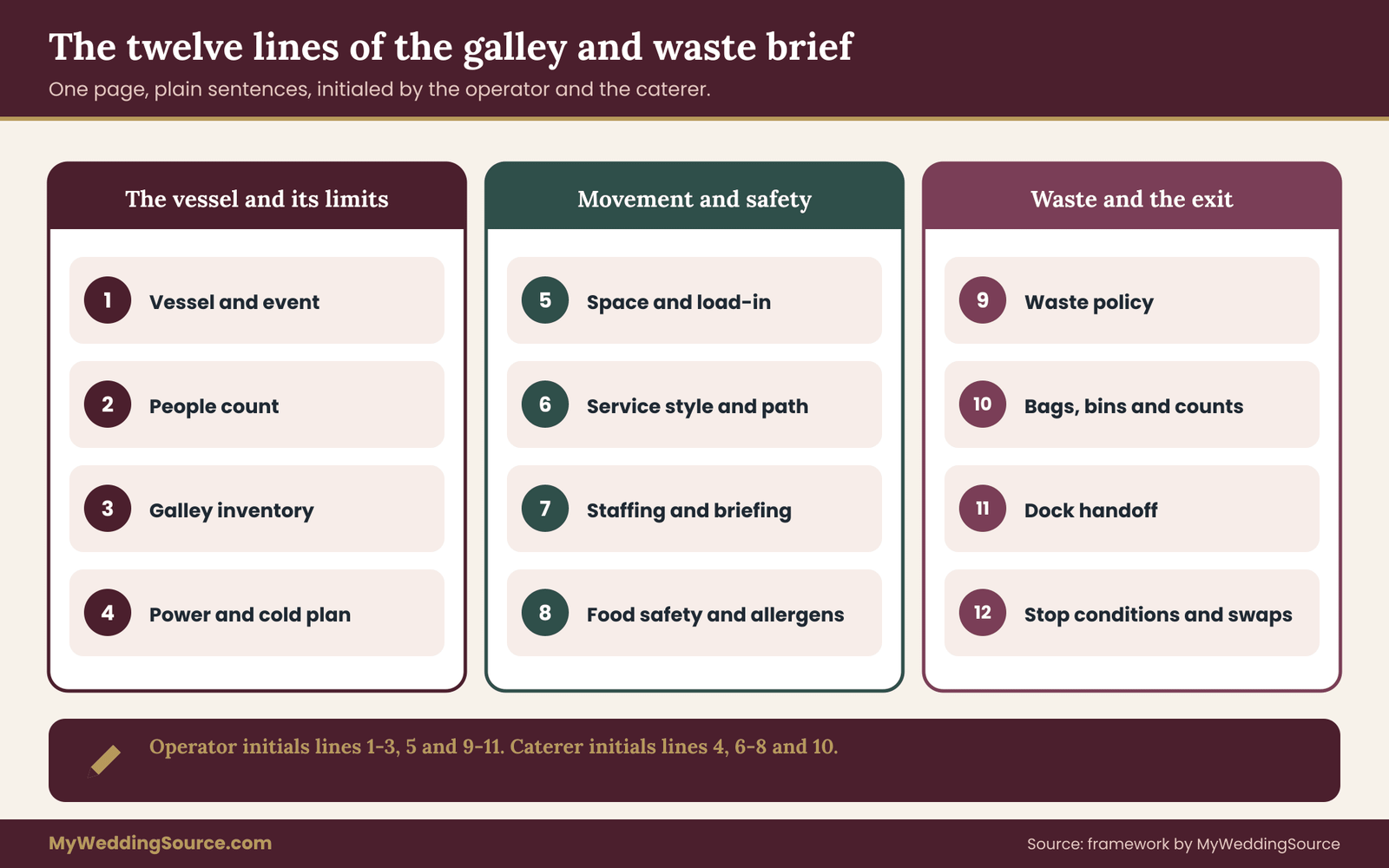
The brief is a single page, written by you, reviewed by the caterer and confirmed by the operator. Its purpose in boat wedding catering is to replace assumptions with statements that two other people have read. It does not need legal language. It needs plain sentences, numbers and names. Below are the twelve lines, in the order that tends to work, with notes on what each should say.
Lines one to four: the vessel and its limits
Line one, the vessel and the event. For boat wedding catering, name the vessel, the date, the route, the boarding time, the departure time, the return time and whether the boat stays docked, moves or both. A caterer cannot plan without knowing whether the food will ever be served while moving.
Line two, the people count. Write the guest count, the vessel’s maximum number of people, and the number of crew and vendors who count toward it. Do the subtraction on the page. If the room left for caterer staff is smaller than the staff the menu needs, the problem is visible on line two, long before the menu is final.
Line three, the galley inventory. List what is installed and permitted: refrigeration, cooking equipment, sink and water supply, counter space and outlets with their power source. State what is not allowed, such as open flame or outside appliances. Attach the operator’s photos or list.
Line four, power and cold plan. Say which equipment runs on which power source and when. Say how cold food is held from loading to service, with the container, the ice or pack plan and the person who checks temperatures. This is where the 41 and 135 degree figures from the Food Code appear as targets.
Lines five to eight: movement and safety
Line five, space and load-in. Give the dock staging area, the gangway or ramp details, the hold areas available, the load-in start time and the time the galley must be clear. Name who may stop the load-in.
Line six, service style and path. Name the style chosen, attach the deck sketch with the path marked, and state the result of the plate-flow test: how many trips, how many servers, how long. Include the movement rules for staff.
Line seven, staffing and briefing. List caterer staff by role and the crew duties that the operator confirms. State who gives vendor staff the safety briefing and when. State who is in charge of the galley during service.
Line eight, food safety and allergens. Name the permit or authority that covers the event, the handwashing arrangement, the allergen list with meal assignments and the discard rule if a food item goes out of range.
Lines nine to twelve: waste and the exit
Line nine, the waste policy. Quote the operator’s written waste policy in one or two sentences. State that nothing goes overboard, and list the four kinds of waste with a holding place for each.
Line ten, bags, bins and counts. Give the estimated number of bags, the number of bins the boat allows, and where they sit. If counts do not match, say how the gap is closed.
Line eleven, the dock handoff. Name who carries each kind of waste, where it goes ashore, when and whether any fee applies. Include decor, flowers and glass.
Line twelve, stop conditions and swaps. List the conditions that change the plan, who decides and what replaces what. This line is covered in more detail in the last part of this guide.
Who signs and when
The boat wedding catering brief is not a contract. It is a working document, and it works best when each party initials the lines that belong to them. Ask the operator to confirm lines one through three, five and nine through eleven. Ask the caterer to confirm lines four, six through eight and ten. Share the signed copy with your coordinator or whoever runs the day.
Send the boat wedding catering brief early enough to change the plan. A good time is after you have a draft menu and before you pay the final food deposit. If you have already signed with a caterer, share the brief anyway; a change order costs less than a failed dinner. The wedding vendor contract guide explains how to turn a brief like this into a contract addendum.
A short script for the conversation
When you send the boat wedding catering brief, a few plain sentences work better than a long message.
“We are planning a wedding dinner on a charter boat, and we would like our caterer and your crew to work from one page. Could you review the attached brief and correct anything that is wrong? We would rather change the menu now than at the dock.”
Most operators and caterers welcome a request like that because it saves them an unpleasant surprise. If either side resists putting things in writing, treat the resistance as information, and see the vendor due diligence advice in the wedding vendor due diligence checklist for what to do when a vendor will not commit to specifics.
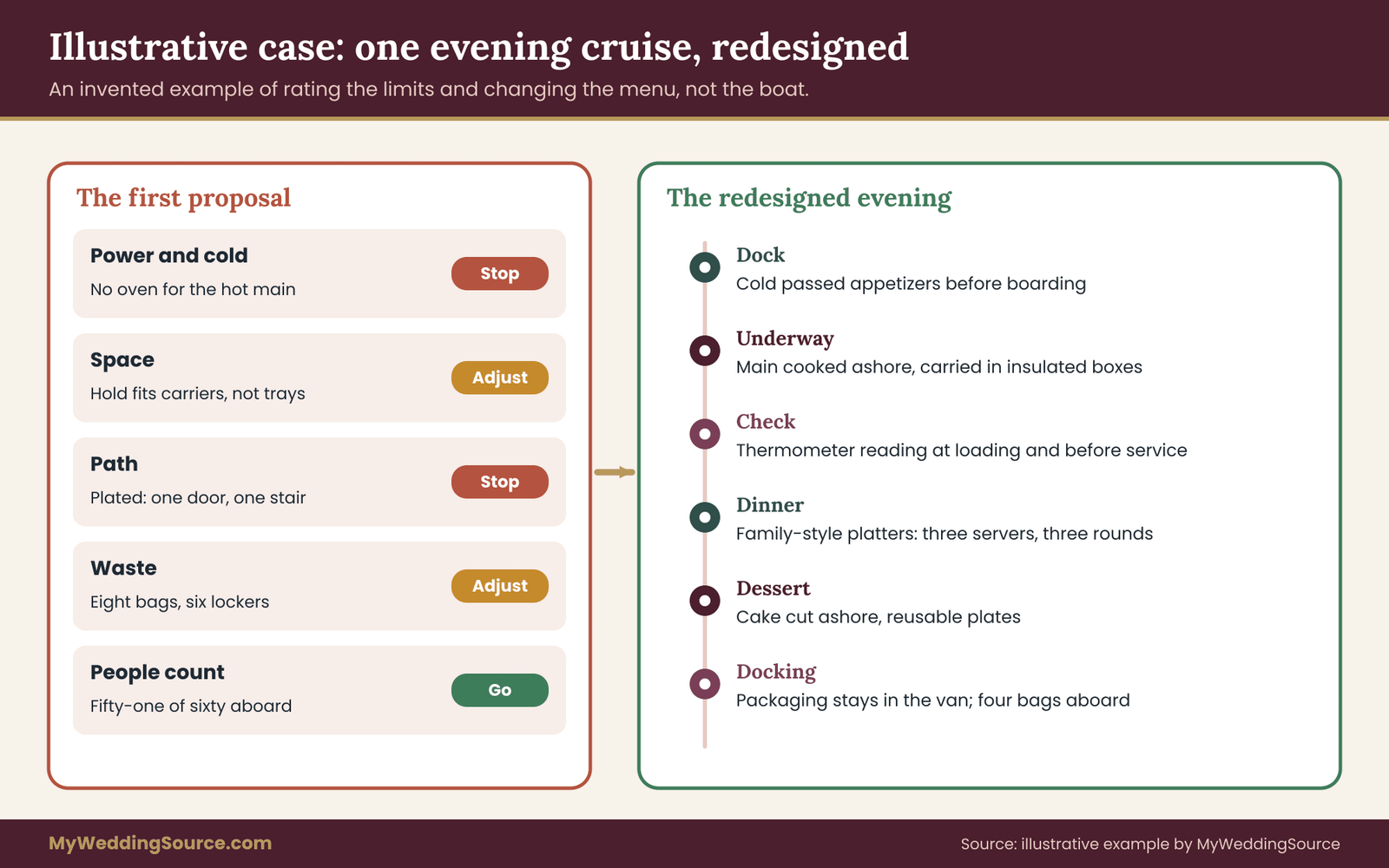
The following example of boat wedding catering is invented to show the method. The vessel, the numbers and the people are illustrative, not data from a real event, and your own boat will differ.
The starting point
A couple plans an evening cruise for forty-two guests and sends the caterer’s draft boat wedding catering proposal to the operator. The vessel is certified for sixty people in total. The couple’s caterer proposes a plated three-course dinner with a hot main course, served while the boat is underway for two hours. The operator’s galley, once photographed and described, has a small refrigerator, an electric two-burner cooktop that may be used only while the boat is docked, a sink with a limited fresh water tank and no oven.
The operator forbids open flame and any outside appliances. It also asks that all waste leave with the vendors.
Rating the four limits
The people count is the first surprise. Forty-two guests, three crew, four caterer staff, a photographer and a musician make fifty-one people aboard, within the sixty-person limit, so staffing is a go with room to spare.
Power and cold rate as a stop for the proposed menu: the hot main needs an oven the boat does not have, and the refrigerator holds only a few hotel pans. Space rates as an adjust, because the hold can store insulated carriers but not stacked chilled trays. The path rates as a stop for plated service: one door and one interior stair separate galley from dining deck.
The plate-flow test confirms it. Plating forty-two dinners with two plates per trip and three servers means seven rounds. If each round takes four minutes on the real path, the last guest is served about twenty-eight minutes after the first, and the first plates have gone cold.
Family-style service for six tables of seven, with three platters per table, means eighteen platters. Three servers carrying two platters each need three rounds. At three minutes a round, service takes about nine minutes. The numbers are rough, and they point clearly in one direction.
Waste rates as an adjust. The caterer estimates eight bags of trash for the proposed menu and individual plastic-wrapped desserts. The operator’s lockers hold six bags. Nothing may go overboard.
The redesigned plan
In this boat wedding catering example, the couple and the caterer change the menu, not the boat. Guests gather on the dock for a short reception with passed cold appetizers. The cruise begins at sunset. The main course is cooked ashore and carried aboard in insulated carriers, then served family-style on shallow, secured platters, with one reserve cold plate per table in case a hot item is below temperature at the check.
A thermometer reading is taken at loading and again before service. Dessert is a sheet cake cut ashore and served on reusable plates that go back to the caterer’s van after docking.
Waste in the boat wedding catering plan changes too. Packaging stays in the caterer’s vehicle on the dock, individual wraps are dropped, and the caterer commits to removing food waste in sealed containers at the end. Four bags remain aboard, which fits the lockers. Ice is replaced by reusable cold packs, which removes melt water entirely.
What the brief records
The final one-page boat wedding catering brief states the people count, the galley inventory, the style, the plate-flow result, the temperature plan, the allergen list with a labeled sealed meal for one guest, the waste policy, the bag count and the dock handoff. The operator initials its lines, the caterer initials theirs, and a coordinator holds the copy. The couple spent a few evenings on paper and avoided a dock-side argument. They also kept most of the menu they loved, adapted to what the boat can do.
What the example does not claim
This boat wedding catering case is illustrative. It does not say that these numbers are typical, that this boat is representative or that the redesign is right for every vessel. It shows a method: rate the limits, test the path with arithmetic, change the menu to fit, and write down the result so that everyone shares the same facts.
When boat wedding catering should fail your review, and the alternatives
A boat wedding catering brief is only useful if it can say no. Line twelve of the brief lists the conditions under which the plan must change, who decides and what replaces what. Write them before the day, while everyone is calm and no one is tired.
Stop conditions that should change the plan
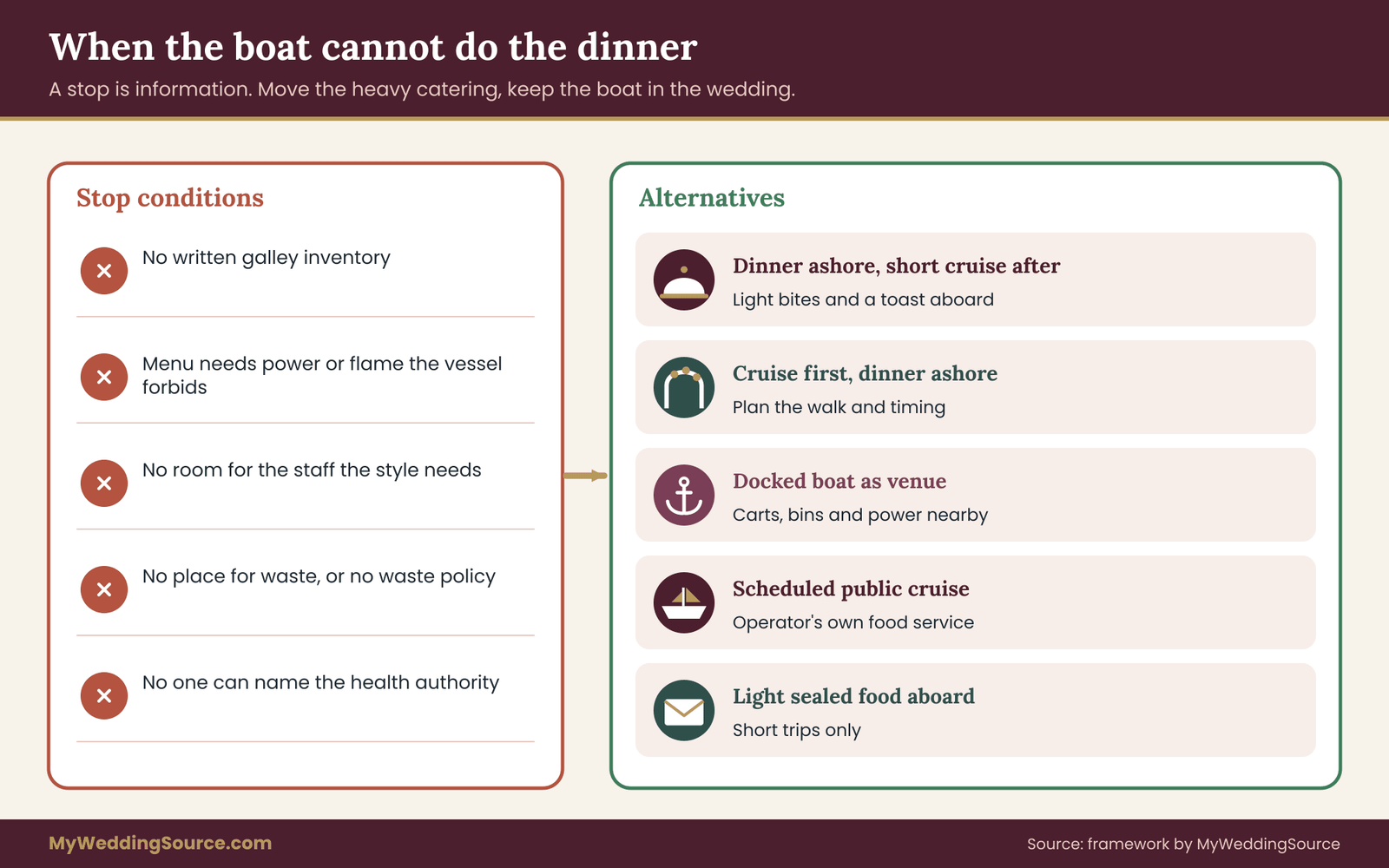
Some conditions should always force a change in boat wedding catering. If the operator will not confirm the galley inventory in writing, you cannot plan around it. If the caterer’s equipment needs power or heat the vessel forbids, the menu does not work as written.
If the people count leaves no room for the staff the style requires, the style must change. If there is no acceptable place for waste, or the operator will not state its waste policy, the menu cannot involve anything that creates waste you cannot carry.
Two more conditions deserve attention. If no one can tell you which health authority covers the event, the caterer should confirm it before you sign. And if a vendor refuses to put a safety or waste commitment on paper, consider that reluctance a reason to look for another vendor, using the approach in the due diligence guide mentioned earlier.
Day-of triggers
Some boat wedding catering stop conditions appear only on the day. Weather is the obvious one: wind, rain, a fog bank or a harbor advisory can change the route, the length of the trip or whether the boat leaves at all. The captain decides, and the caterer’s plan should already include a version that works if the trip is shortened, moved to the dock or delayed.
Your charter contract covers the money side of weather, and the catering brief covers the food side: which items hold, which are replaced and what happens to the food already prepared.
Food out of temperature range is the second trigger. The brief states the discard rule, the reserve and the person who decides. A third trigger is a changed people count. If a late guest or an extra vendor pushes the headcount toward the limit, someone must have the authority to say that service style or staffing has to change, and that someone should be named.
Alternatives when the boat cannot do the dinner
A stop is not the end of the idea of boat wedding catering. It means the boat is the wrong place for this part of the event. Several alternatives keep the boat in the wedding while moving the heavy catering elsewhere.
Dinner ashore, cruise afterward. The meal happens at a restaurant, a venue or a dockside space with a real kitchen, and the boat provides a short cruise with light bites and a toast. This is the simplest fix when the galley rates as a stop on several limits. It keeps the boat photos and the sunset and removes the dinner problem entirely.
Cruise first, dinner ashore. Guests ride, then walk to a land venue for a seated meal. Plan transport and timing so that the cruise end and the dinner start fit together, and check the reception space’s rules and your guests’ mobility before assuming the walk is easy.
A docked boat as the venue. If the vessel stays at the dock, the movement and several waste problems fall away, since the dock offers carts, bins and power. Heat and flame rules still apply, and the people count still applies, but a buffet or stations may become workable. Ask the operator whether a docked event changes its rules and its price.
A scheduled public cruise. Some operators run public dinner or brunch cruises with their own food service. Booking part of one trades control for simplicity, and the operator’s catering, waste and safety arrangements are already in place. The trade is that you accept their menu and their schedule.
Light, shelf-stable food on board. If the cruise is short, serve a few cold, sealed items, a toast and dessert, and plan dinner elsewhere. Short is under a couple of hours for most groups, but the right number depends on your guests, so ask the caterer to estimate hunger by time aboard.
Choosing between them
Use the ratings to choose among boat wedding catering alternatives. If the galley is a stop on power, cold or heat, move the cooking ashore and keep the food light aboard. If it is a stop on the path, change the style to something that needs fewer trips. If it is a stop on waste, cut packaging and reuse or return what you can.
If it is a stop on space or people count, consider a docked event, a smaller guest list on the boat or a split event. Alternatives are not a sign the couple failed. They are the point of rating the limits early.
Keeping the decision fair
Boat wedding catering often involves compromise between the couple’s picture and the boat’s reality. Tell guests plainly what the evening will include so that no one expects a seated multi-course dinner and gets a toast and canapés. A short note in the invitation or on the wedding website, with the schedule and what will be served, protects the mood. Do not hide a reduced menu behind vague wording.
Check how it feels to the caterer and operator too. A plan that leaves one of them carrying all the risk will not hold. If the brief puts every stop condition on one party, rewrite it until the load is fair, and until each party’s role matches what they actually control.
Review the brief once more
Before you sign off, reread the twelve lines with fresh eyes, or ask a friend who has never seen it to read it. If the friend cannot say what the plan is for the food, the waste and the weather, rewrite it. A good brief is one that a stranger could use to run the day.
It is also the document you will want if a guest becomes ill or a vendor disputes a charge. Your broader paperwork approach from the wedding venues guide applies here as well: keep the signed copy where the people who run the day can find it.
Your next steps
- Ask the operator for a written galley inventory with photos, the power source for each outlet, and the rules on open flame, glass, alcohol and waste.
- Send the inventory to your caterer and ask them to mark every item of equipment, power and space their menu needs.
- Rate each of the four limits of boat wedding catering as go, adjust or stop, and choose a service style that fits the worst-rated limit.
- Draw the service path on a deck plan and run the plate-flow test with real numbers.
- Write the twelve-line brief, including the waste policy, the bag count and the dock handoff, and ask both parties to initial their lines.
- Confirm which health authority covers the event, and what permit the caterer needs.
- Decide the day-of triggers and the swaps before the final food deposit.
FAQ
Can a caterer cook on a charter boat?
For boat wedding catering, it depends on the vessel and the operator. Many charter galleys have limited or no cooking equipment, and many operators ban open flame and outside appliances. Ask for a written list of what is installed and permitted. If cooking is not allowed, the caterer prepares food ashore, carries it aboard in insulated containers and uses only the heating the operator approves.
Who is responsible for food safety on the boat?
Responsibility in boat wedding catering is usually shared. The caterer is responsible for handling and temperature control of the food, the operator is responsible for the vessel and its galley, and a state or local health authority may set the rules. Ask the caterer which permit covers the event and ask the operator whether outside caterers may use the galley.
Do the caterer’s staff count toward the passenger limit?
Often yes, but it depends on the vessel’s certificate and the operator’s rules. Ask in writing whether crew, servers, bartenders and other vendors count toward the maximum number of people aboard. Then do the subtraction on paper. If there is not enough room for the staff your service style needs, change the style or the guest count.
Can we throw food scraps or leftovers overboard?
Plan on no. Federal rules restrict what vessels may discharge, plastic is barred, and harbors, rivers and lakes often add stricter local rules. Operators usually require that nothing leave the boat except as approved. Hold food waste in sealed containers and take it ashore. Ask the operator for its written waste policy and confirm current rules with the Coast Guard or EPA.
What kind of service works best on a moving boat?
For boat wedding catering, styles that need fewer trips, less galley space and less handling work best: passed or cocktail-style food, boxed meals and family-style platters. Plated multi-course service and buffet lines are the hardest while underway. A buffet can work if the boat stays docked. Test any style with the plate-flow check before you commit to it.
How do we keep food at a safe temperature without a kitchen?
Use insulated carriers, heated cabinets the operator permits and well-packed coolers or cold packs, and plan the timing so food spends little time outside range. The Food Code treats 41 degrees Fahrenheit or colder and 135 degrees or hotter as the targets. Ask the caterer for a temperature plan and a thermometer log.
What if the weather changes the trip?
The captain decides whether and how the boat goes out. Your catering brief should list a version of service for a shortened trip, a docked event or a delay, with the items that hold, the items replaced and who decides. Your charter contract covers the refund and cancellation side separately, so ask both vendors about food already prepared.
Is it cheaper to bring in an outside caterer or use the operator’s food?
There is no safe general answer for boat wedding catering, and prices differ by vendor and place. The operator’s own food may fit the galley and the rules better, and an outside caterer may offer more choice but add equipment, staff and waste to plan. Ask both for written quotes against the same brief, and compare what each includes.
Sources
- U.S. Coast Guard for vessel safety, passenger vessel requirements and garbage regulations for vessels.
- U.S. Environmental Protection Agency for vessel discharge, marine debris and water protection guidance.
- FDA Food Code for the model rules on food temperatures and handling.
- FoodSafety.gov for safe handling, temperature and allergen basics.
- Centers for Disease Control and Prevention for its vessel sanitation program and foodborne illness information.
- National Fire Protection Association for fire protection standards that apply to boats and cooking equipment.
- Electronic Code of Federal Regulations for the current text of federal vessel and garbage rules.
- International Maritime Organization for the MARPOL convention that sets garbage discharge rules for ships.
- National Oceanic and Atmospheric Administration for marine weather and marine debris information.
- Occupational Safety and Health Administration for workplace safety guidance for vendor staff.