
A wedding staffing contingency is the short, written set of decisions that tells everyone what happens when a person who was supposed to work your wedding does not arrive, leaves early or cannot finish. This guide gives you a no-show triage, a five-rung role escalation chart, safety gates for who may cover which duty, and a worked case you can adapt.
When a staff member is absent, run your wedding staffing contingency in four steps, in order. Confirm the absence and the exact hole it leaves. Sort the missing duty by what breaks if it stays empty: safety, timing, guests or comfort. Climb the escalation chart one rung at a time (absorb, shift, borrow, call in reserve, reduce scope) and stop at the first rung that works. Never give a safety-critical duty to someone who is not cleared for it. Write down what you decided and why.
Most couples picture a staffing problem as a dramatic moment: a bartender who never shows, a server who walks out. In practice it is usually quieter. A catering captain texts that her car will not start. A setup assistant is sick and the lead hears about it at noon. A venue porter was scheduled by a manager who has since left. The hole is small at first, and the first decision made about it often decides whether it stays small.
This article is about that first decision in a wedding staffing contingency, and the ones that follow. It does not try to teach you how to build a full wedding crew from scratch, because the broader question of who handles guests, setup, service and breakdown is a separate subject. Here the assumption is that a crew exists on paper, one person is missing, and you or your coordinator must decide, quickly and calmly, who does the work now.
A note on scope. This is general planning information, not legal, tax or financial advice, and rules about pay, hours, worker classification and minors differ by state and by situation, so confirm anything that matters with the agency that issues the rule.
What a wedding staffing contingency plan covers, and what it does not
A wedding staffing contingency plan answers one question in advance: if this specific person is gone, who does their work, in what order, and with what limits? It is narrower than a staffing plan. A staffing plan says who is hired for which job. A wedding staffing contingency says what happens to that job when the hired person disappears.
That difference matters because the two documents are used at different moments and by different people. The staffing plan is read weeks ahead by the couple and the planner. The wedding staffing contingency is read at 3:40 on the wedding afternoon by whoever is standing nearest to the problem, often someone who is stressed and who was not part of the planning. It has to be short, specific and permission-giving. If a reader must interpret it, it has failed.
A workable wedding staffing contingency has five parts. The first is a triage, a fixed list of questions that turns “someone did not show” into a defined problem. The second is a classification of roles by consequence. The third is an escalation chart, which orders the available fixes from cheapest to most disruptive. The fourth is a set of qualification gates, the duties nobody may cover without clearance. The fifth is a record, so that afterward you can settle questions about pay, contracts and refunds with facts instead of memory.
What a contingency does not cover is equally important. It does not replace vendor contracts, and it does not decide who is liable when a vendor fails to staff an event they were paid to staff. That question is answered by the contract and by the vendor’s own policies, and the wedding vendor contract guide on this site explains which clauses to look for.
It also does not cover the loss of a main vendor such as the photographer or the band, which have their own backup logic. This guide is about the people who run the room: coordinators, servers, bartenders, setup crew, greeters, parking help and similar roles.
Who actually makes the call
Before a single person is missing, decide who is allowed to reassign duties. In many weddings the answer is unclear. The couple assumes the planner will handle it. The planner assumes the caterer manages its own team. The caterer assumes the venue will supply a porter. When something goes wrong, three people each wait for another to act, and ten minutes disappear. The first line of any wedding staffing contingency should name the person who decides.
A simple rule removes the confusion. Each employer or vendor runs its own people. The coordinator runs the day and decides priorities between teams. The couple decides only what changes the experience for guests, such as a shorter cocktail hour or a cut menu course, and they should not be asked until the coordinator has options to offer. Write this rule on the first page of the wedding staffing contingency and share it with each lead before the day.
Notice what the rule implies. If the caterer’s server is absent, the caterer’s captain decides how to cover. The coordinator does not move that server’s tasks onto the venue’s staff without asking, because the venue’s staff answer to the venue, and doing so can create pay, supervision and insurance questions nobody intended. The coordinator can ask, offer and coordinate. The coordinator should not quietly command people who do not work for them.
Why most absences are small, and why that helps
One useful fact shapes everything that follows: most absences affect only part of a role. A server missing from a team of eight leaves seven servers and an uneven station map. A setup assistant missing from a crew of four leaves a slower load-in, not a failed one. Seeing the hole as a fraction instead of a catastrophe changes your first move from panic to arithmetic. Most of what a wedding staffing contingency has to handle is arithmetic, not drama.
Arrival windows and call times, which the vendor timeline guide explains how to collect, give you the clock. The arithmetic has three numbers. How many people were scheduled for this function? How many are present? And how long do you have before the function is needed? A bartender missing at ten in the morning, with service starting at five, is a different problem from a bartender missing at 4:45. The same missing person can mean a calm phone call or a service stop, and only the clock tells you which.

That is why the first figure in this guide is a triage flow and not a role list. Before you decide who covers whom, you need to know what exactly is missing and how much time remains. The next section walks through the triage in the order you would use it on the day.
The first twenty minutes: a no-show triage for a wedding staffing contingency
Treat the first twenty minutes after you learn of an absence as a separate phase with its own job: gather facts and stabilize. You are not trying to solve the whole problem in that window. You are trying to avoid making it worse, and to reach the point where you can choose a rung on the escalation chart with real information.
The triage in a wedding staffing contingency has six questions. Ask them in this order, and write the answers on one line each, even if the page is a sticky note.
One: Is the person truly absent, or only late? Many reported no-shows are traffic, a wrong address or a phone on silent. Call the person directly, then their employer or team lead, before you declare an absence. Give a late arrival a defined window, such as fifteen minutes past the call time, and treat the person as absent when the window closes. Declaring too early burns goodwill and can leave you with two people doing one job. Declaring too late costs setup time you cannot get back.
Two: Which exact duties does this person own? Do not accept “the bartender is out” as the whole statement. Does that person pour, set up the bar, run the cash or tip system, check identification, carry ice, restock and break down? Each duty may have a different cover. Pull the written assignment sheet and list the real tasks and their times.
Three: What is the deadline for each duty? Some tasks are needed at a clock time, such as pouring the first toast. Others are needed by a state, such as chairs set and linens pressed before the guests arrive. Mark each task with the latest moment it can start and still finish.
Four: What does the empty duty break? This is the consequence question, and it feeds the role classes in the next section. Ask whether leaving the task undone creates a safety problem, a timing problem, a guest-facing problem or only a comfort problem.
Five: Who is already on site with relevant skill? Make a short list: staff of the same employer, staff of other vendors on a break or between tasks, venue employees, and willing friends or relatives. Do not assign anyone yet. You are collecting names.
Six: Who else needs to know right now? At minimum, the absent person’s employer must hear that the person has not appeared, because they may know of an accident, an illness or a transport problem you do not. The lead of the affected team must be told so they can adjust. The couple does not need to be told yet unless the gap will visibly change the day.
Keep the call tree short and written
The triage depends on being able to reach people. If the only way to contact the caterer’s manager is a personal number saved in one person’s phone, a dead battery can turn a small absence into a long one. The wedding day digital contingency plan guide on this site covers backup communication in more detail.
For a wedding staffing contingency, the minimum is a printed call sheet with the employer’s emergency number for every vendor, the venue manager’s number, and the name of the person who can approve a change of duties for each team.
Keep the call tree short. Three layers is usually enough: the person who found the absence, the lead of the affected team, and the coordinator. Anyone beyond that is probably a decision-maker who should receive a summary after the first move, not a question before it.
The two mistakes to avoid in the first twenty minutes
The first mistake is solving too fast. Someone sees an empty station, grabs the nearest willing person and hands them the work. It feels decisive. It also bypasses every check that matters: Is that person cleared for the duty? Do they work for a company that allows it? Are they leaving a hole of their own? Fast fixes made before the six questions are answered have a way of producing a second absence.
The second mistake is waiting for perfect information. The opposite error is to keep calling people for twenty-five minutes while the clock runs. Set a limit. When the twenty minutes end, choose the best available rung of the escalation chart with what you know, record the choice, and revisit it when new information arrives. A decision that can be reversed is better than no decision.
A one-line triage record
Write the result as a single line that anyone can read later: the time you learned of the absence, the person and employer, the duties affected, the deadline, the consequence class and the rung you chose. For example: “4:10 p.m., one server from the caterer, station three, needed by 5:30, guest-facing, rung two.” That line, the smallest unit of a wedding staffing contingency, takes fifteen seconds to write and becomes the spine of the record you will want if there is a question about pay or a refund afterward.
Notice how little of a wedding staffing contingency triage is about the absent person. It is about the work. That is deliberate. Your first job is to protect the guests and the schedule. Your second job, later and separately, is to understand why the person did not come and to be fair to them. Mixing the two jobs leads to anger directed at the wrong target while the real problem grows.
Sorting roles by what breaks when they disappear
A wedding staffing contingency works best when it ranks duties by consequence instead of by job title. Titles mislead. A “greeter” sounds minor, but a greeter at a venue with a single narrow entrance who also checks for a wristband may hold a safety and capacity task. A “setup assistant” sounds interchangeable, but the person who knows where the sparkler buckets go is not. Ranking by consequence lets you decide quickly without arguing about whose job matters more.
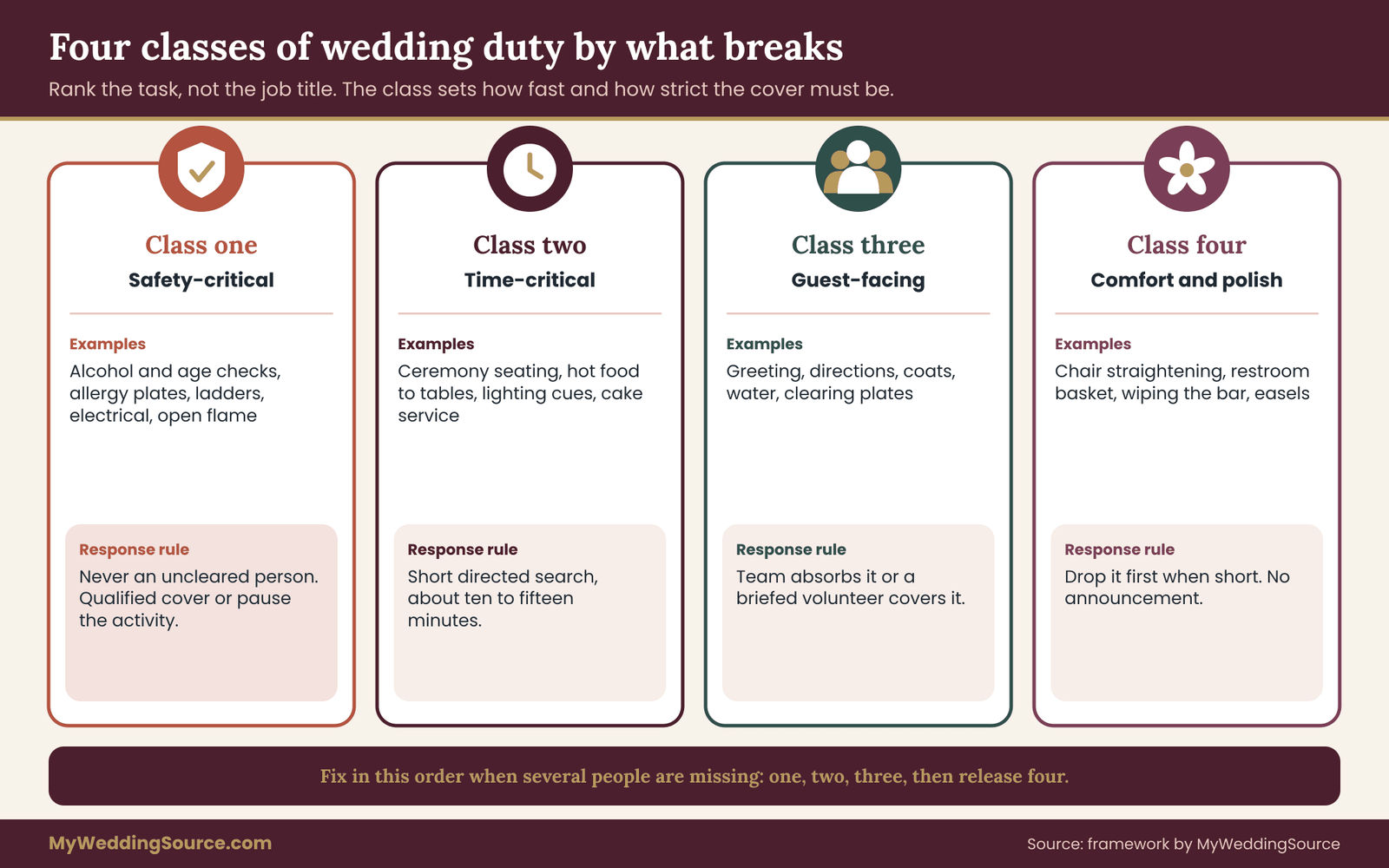
Use four classes in your wedding staffing contingency. Each one has a different standard for cover and a different tolerance for delay.
Class one: safety-critical duties. These are tasks where leaving the work undone, or doing it without training, can hurt someone. Examples include alcohol service and age checks, handling food for guests with allergies or restricted diets, anything on a ladder or above head height, electrical connections and generators, open flame and candle supervision, crowd flow at an exit, and watching a body of water, a dance floor in wet weather or a fire pit.
A class one duty is never reassigned to an uncleared person. If it cannot be covered by a qualified one, the activity is paused or changed.
Class two: time-critical duties. These are tasks with a hard clock where lateness cascades. Examples are ceremony seating before the processional, hot food reaching tables while it is hot, the first-dance lighting cue, and the cake being cut and plated before the band’s set. A missing person here is serious, but the risk is mostly to the schedule and to the guests’ experience, not their safety.
Class three: guest-facing duties. These are tasks that guests see and interact with: greeting, directing, taking coats, answering questions, refilling water, clearing plates. A gap shows up as waiting, confusion or an untidy room. It is real, and it affects how people feel, but it can be covered by a willing and briefed non-professional and can be tolerated for a short while.
Class four: comfort and polish duties. These are tasks that improve the day but whose absence goes largely unnoticed: straightening chairs between courses, restocking the restroom basket, wiping the bar top, refreshing a signage easel. Leave these undone first when you are short.
Why the class decides the response speed
In a wedding staffing contingency, the class tells you how long you may spend searching for the perfect cover. Class one tolerates no improvisation: you either find a qualified person or you change the activity. Class two allows a short, directed search: you may have ten or fifteen minutes before it becomes an emergency. Class three can be absorbed by the existing team for a period. Class four can be dropped without announcement.
This also gives you a defensible order when more than one person is missing. If two servers and the greeter are gone, you do not agonize over which to fix first. The servers’ tasks are class two and class three, the greeter’s is class three, and any bar task among them may be class one. Fix class one, then class two, then class three. Release class four.
Marking duties in advance
The classification in a wedding staffing contingency is cheap to do before the day and expensive to improvise during it. Go through the staffing plan, task by task, and mark each with a class. A one-page assignment sheet with a small letter beside each task is enough. When something goes wrong, whoever holds the sheet can see in seconds which tasks are untouchable.
Two cautions help. First, mark the task, not the person. If the head bartender is also the person who checks the age of every guest, those are two tasks with the same class, and each needs a cover. Second, mark conditionally where the setting changes the risk. Candle supervision is class one in a barn with hay and class three in a restaurant with sealed lamps.
Standing on a chair to adjust a garland is class one if the chair is on gravel and class four if you are using a stable step stool on a flat floor. Write the condition beside the mark.
A quick test for the class of an unfamiliar task
When a task is not on the sheet of your wedding staffing contingency, ask three questions. Could someone be injured, sickened or arrested if this is done badly? If yes, class one. Does something need to happen at a fixed time that others depend on? If yes, class two. Do guests directly notice if it is missing?
If yes, class three. Anything left is class four. The test takes ten seconds and works on tasks you did not foresee, such as a flower girl’s sudden need for an adult escort to the restroom or a vendor who needs a person to hold a door while carts move through.
The role escalation chart: five rungs from absorb to reduce
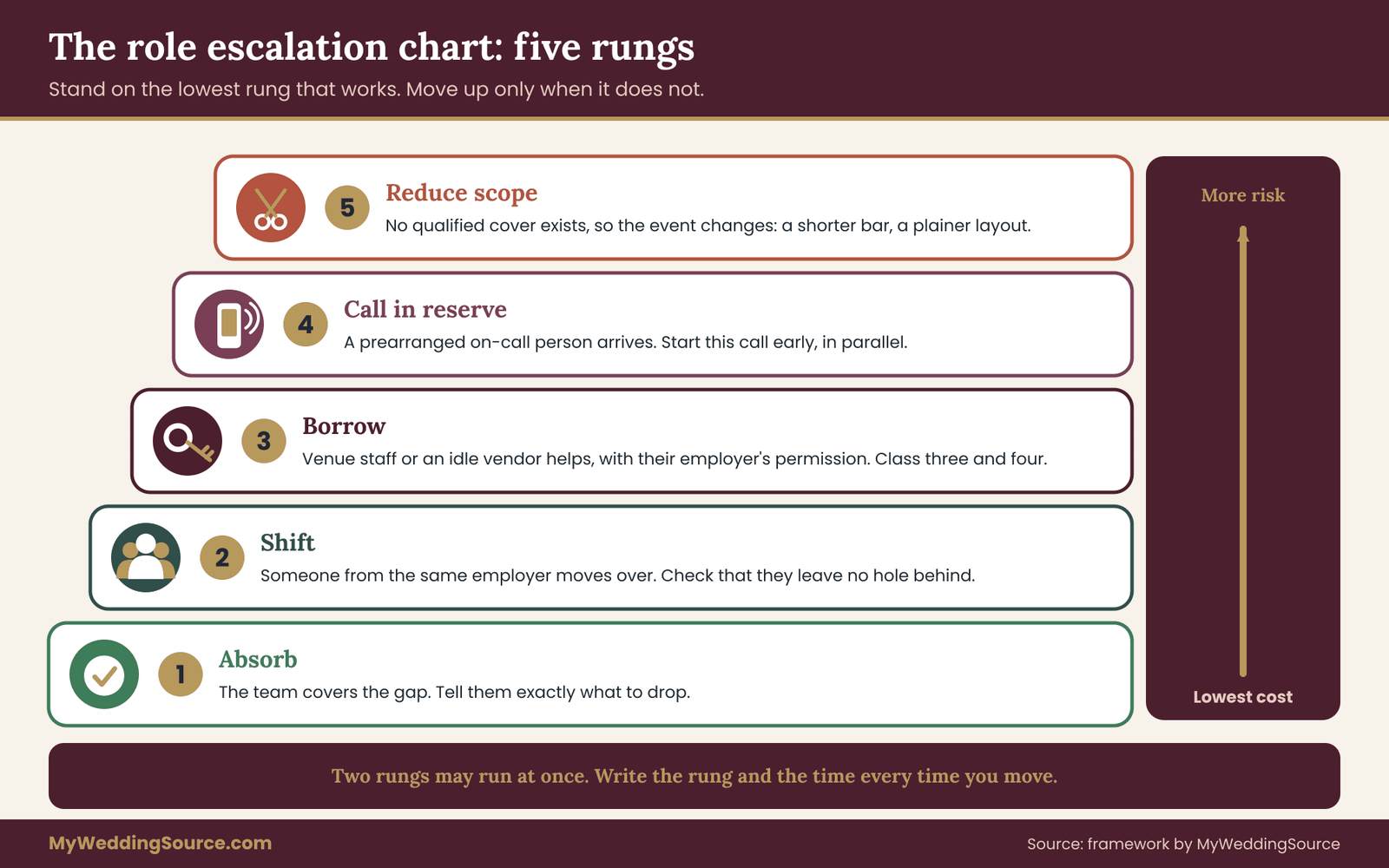
The escalation chart is the center of the wedding staffing contingency. It lists, in order, the five ways to deal with an absence, starting with the least disruptive and ending with the most. The rule is to stand on the lowest rung that works and move up only when it does not.
Think of it as a ladder with a clear label on each step. The reason a wedding staffing contingency uses fixed rungs is that people under pressure reach for the most dramatic fix, such as calling in a favor from a cousin or hiring a stranger through an app. Those are higher rungs, they cost more in risk and coordination, and they are often unnecessary because a lower rung would have been enough.
Rung one: absorb. The existing team covers the gap without moving anyone. This works when the absent person’s tasks are class three or four, when the remaining team is large enough, and when the gap is brief. The key discipline is to tell the team what to drop.
If you tell seven servers to “pick up the slack,” they will try to do everything and the service will degrade evenly. Tell them, for example, that water refills can wait until after the main course and that the bread service moves to a single pass.
Rung two: shift. One or more people from the same employer move to the missing person’s task, and their own task is either dropped, shared or delayed. A captain steps onto a station. A banquet manager carries trays. This is the most common fix at a professional event, and it is the preferred one because the people moved are already trained, insured and under the same supervision. The check here is whether the shifted person leaves a class one or class two hole behind. If so, shifting only moves the problem.
Rung three: borrow. Someone from outside the affected team does the task for a defined time. Possible sources are the venue’s own staff, another vendor’s idle hands, such as a florist’s assistant who has finished setup, or a coordinator’s assistant. Borrowing needs permission from that person’s employer and an honest brief about the task. It is limited to class three and four tasks and to class two tasks that need no certification. Do not borrow for class one unless the lender is certified for it.
Rung four: call in reserve. A prearranged backup is activated: an on-call staffer from the agency, a standby bartender with a current alcohol-service certificate where the law requires one, or a trusted friend who has been briefed and told in advance that they might be asked. A reserve takes time to arrive, so this rung should start in parallel with rung one or two, not after they have failed. The cost, usually a fee or a day rate, should be agreed before the wedding, not negotiated while the clock runs.
Rung five: reduce scope. Nobody can cover the task, so the event changes. A cocktail hour becomes wine and beer only. The dessert display becomes cake-only. The ceremony seating moves from assigned to open. The signature drink is dropped. Reducing scope is not failure. It is the only honest answer when the alternative is putting an unqualified person in a class one job, and a calm, announced reduction almost always bothers the guests less than a chaotic attempt to keep everything.
How to use the chart
Three rules govern the climb through a wedding staffing contingency. First, start at the lowest rung that plausibly works for the class of the missing duty. A class four gap starts and ends at rung one. A class two gap starts at rung two. A class one gap skips to the rung that provides a qualified person, which is rung two with a certified same-employer person, or rung four with a certified reserve, and otherwise rung five.
Second, you may run two rungs at once. While the captain covers the station at rung two, you can place the call to the reserve at rung four, so that if the gap lasts longer than an hour you already have someone coming. Parallel action is not indecision. It is the main reason a wedding staffing contingency works under a clock.
Third, record each rung used and the time. If you moved to rung four at 4:35 and the reserve arrived at 5:20, the record shows both the delay and the cost of the delay. That matters later when you decide whether the original vendor owes you anything.
What the chart is not
The chart is not an instruction to spend more money at each rung, and a wedding staffing contingency should not be a spending plan. Rungs one through three usually cost little or nothing. Rung four has a defined fee. Rung five can save money. A wedding staffing contingency succeeds when most absences are resolved at rungs one and two, and the higher rungs exist for the occasional serious gap.
If you find that you are routinely reaching rung four, the underlying staffing level is too thin, and you should add people to the roster before the day, not rely on the reserve.
Notice also that a wedding staffing contingency is not about blame. It deliberately has no rung that says “find out who is responsible.” That conversation matters, but it belongs after the event, with the contract in hand. During the event, the only question is which rung gets the work done safely, and the discussion of responsibility is handled in the follow-up section near the end of this guide.
Wedding staffing contingency rules for duties nobody may cover without clearance
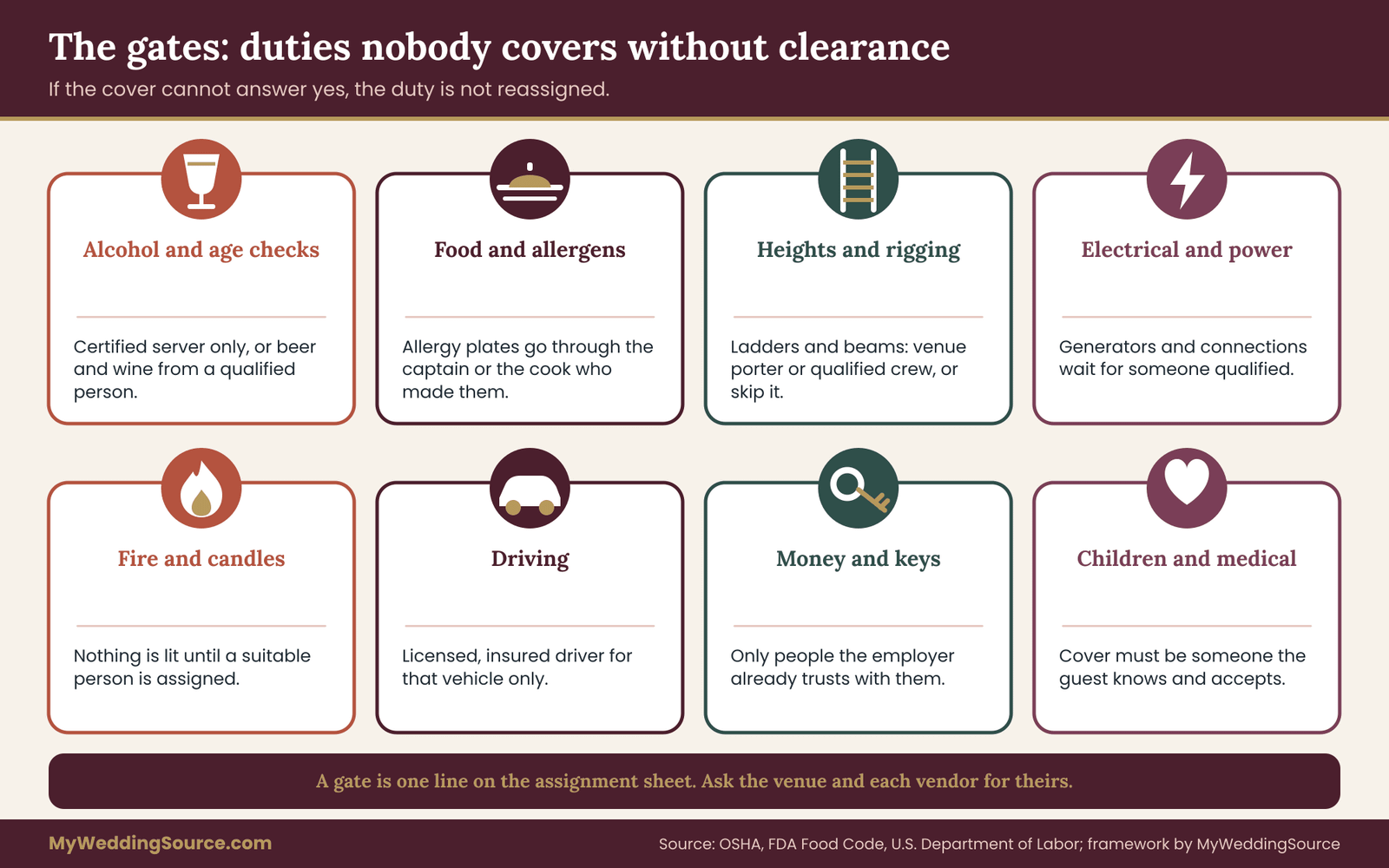
Every wedding staffing contingency needs a short list of gates: duties that stay empty rather than go to someone who is not qualified. Gates exist because the people most likely to volunteer in a crisis are the ones with the best intentions and the least training. A helpful uncle who has poured drinks at home is not the same as a bartender who knows the venue’s service rules. A kind bridesmaid who offers to carry the hot trays is not the same as a server who has been shown how.
Think of each gate in a wedding staffing contingency as a question with a yes or no answer. If the cover cannot answer yes, the duty is not reassigned.
Alcohol service and age checks. Rules about who may serve alcohol, whether training or a certificate is required, and who is responsible when a guest is over-served differ by state and sometimes by county. The venue’s liquor license and the bar vendor’s insurance usually assume trained servers. Do not let a friend take over a bar because the bartender is out.
Options are another certified bartender from the same company, a reduced bar menu handled by an existing qualified person, or a bar closed to anything other than beer, wine and soft drinks until relief arrives.
Food handling and allergens. Handling ready-to-eat food, and especially managing dishes for guests with allergies, is a task with real consequences. The Food and Drug Administration publishes the model Food Code that many state and local health departments base their rules on, and the Centers for Disease Control and Prevention publishes guidance on food safety. A volunteer should never plate a dish for a guest with a declared allergy. Allergy-labeled plates should go through the person who prepared them or the captain who checked them.
Heights, rigging and electrical work. Hanging a garland from a beam, adjusting lights on a stand, connecting a generator or moving a heavy arch are tasks with a fall, shock or crush risk. The Occupational Safety and Health Administration has public guidance on fall protection and electrical safety. If the person who normally does this is absent, the task waits for a qualified person or is changed to something that can be done safely from the ground.
Fire, candles and heat. Open flame supervision, fire pits, sparkler exits and food warmers each have local rules and venue rules. If the person assigned to supervise is absent, the item is not lit until someone suitable is assigned. Heat itself is a staffing issue: OSHA publishes guidance on heat exposure, and a crew that has lost a member in hot weather has fewer people to rotate through shade and water.
Driving and vehicle handling. A shuttle driver, a valet or a person moving a delivery truck usually needs a valid license and insurance coverage. A guest or friend should not be asked to drive someone else’s vehicle because the driver is absent unless the vehicle owner explicitly allows it and the insurer is satisfied.
Money, tips and keys. Handling a cash tip jar, a payment device or the keys to a locked room puts both the person and the event at risk. Assign these only to people the employer already trusts with them.
Children, medical needs and mobility support. If the absent person was responsible for a ring bearer, a guest who uses a wheelchair or a relative who needs medication reminders, the cover must be someone known to that guest and willing to take the job, not whoever is free.
What a gate looks like in practice
A gate in a wedding staffing contingency is not a long rule. It is a line on the assignment sheet: “Bar: certified only. If bartender absent, beer and wine only until relief.” Another: “Allergy plates: captain only.” Another: “Ladder: venue porter or none.” Each line tells whoever is standing at the problem what they are permitted to do without asking.
Gates also protect the person who steps in. A willing friend who is asked to do something outside their competence has no cover if it goes wrong. By stating the gate in advance, you spare the volunteer an awkward decision and spare the couple a bad outcome. A polite refusal such as “That one needs a licensed person, but I can set the water stations” helps everyone.
When the gate and the clock collide
The hardest moments are those where a gate blocks the only fix and the clock is running. The bar is empty at 5:00, the toast is at 5:30, and the only person free is not certified. This is where rung five of the escalation chart matters. Reduce the scope. Open with a pre-poured sparkling toast, set out bottled water and soft drinks, and delay cocktails until the reserve arrives. Guests almost never mind a late bar. They mind unsafe service or a bar that runs out of control.
Resist the temptation to rationalize. Statements such as “It’s only for twenty minutes” or “Everyone here is a grown-up” are how gates get crossed. If the duty is class one, the answer is no cover or qualified cover, and the wedding staffing contingency should say so in plain words that the person who reads it at 4:50 can point to.
Check with the people who set the rules
Not every gate in a wedding staffing contingency is yours to write. The venue may impose its own, such as requiring that only its staff operate a particular elevator, the sound limiter or the kitchen. The caterer may have its own policy on who may work its stations. The insurer of a vendor may limit what a stand-in can do. When you build your wedding staffing contingency, ask each party for its gates in writing, and add them to yours. The certificate of insurance and vendor agreements often reveal these limits.
The wedding vendor purchase order checklist guide explains how to put scope and responsibilities into a written agreement. For a wedding staffing contingency, the relevant question to add is plain: “If one of your staff is absent, who covers and what are the limits on who may do your tasks?”
Once you know which duties may be covered, the next question is who has the authority to reassign a paid person, and what happens to their pay, hours and responsibilities. This is where well-meaning improvisation can create problems that last longer than the wedding.
Start with a principle. A person who works for an employer is directed by that employer. If a coordinator hired by the couple tells a caterer’s server to leave the station and carry boxes for the florist, the coordinator has given an instruction to someone they do not employ. Many caterers welcome flexibility, but the instruction should go through the person who does employ that server. A short call to the captain solves it: “Can you spare someone for ten minutes to help with the flowers at the ceremony?”
Employees, contractors and the label problem
Event staff are engaged in different ways. Some are employees of a catering company or venue. Some are independent contractors hired for a day. Some are volunteers. Some come through a staffing agency, which is a third arrangement. How a person is classified affects who directs them, who pays them, who carries insurance for them and what rules apply to their hours and pay.
The U.S. Department of Labor’s Wage and Hour Division publishes information on how the Fair Labor Standards Act treats employees and independent contractors, and the Internal Revenue Service publishes its own guidance on the same distinction. These agencies are the place to check current rules. This guide does not tell you how any specific person should be classified, and a label on a contract does not by itself settle the question.
What it does tell you is that the way a stand-in is brought in can have consequences, and that a quick call to the employer is better than an improvised arrangement.
Pay, hours and who owes what
When someone is moved to a different task, ask four things. Does the new task change their pay rate or the terms of their agreement? Does covering extend their hours, and if so, who is responsible for the additional time? Do they have breaks coming that must be protected? And is the person comfortable doing the new task?
Hours deserve particular attention. When a team is short, the remaining people often work longer and skip breaks. The Department of Labor publishes information on hours worked and, for minors, on limits on hours and on hazardous tasks. If your crew includes workers under eighteen, such as a part-time server who is sixteen, do not assume the same duties apply to them as to adults. Ask the employer, and keep young workers away from tasks such as operating certain equipment or serving alcohol unless the employer confirms it is permitted.
The honest rule is simple. Do not decide pay or hours for another person’s employee. Pass the information to their employer and let them decide. Your job is to keep a record of what was asked and for how long so the employer can handle the pay correctly afterward.
What to do with your own paid helpers
If the couple hired a coordinator and an assistant directly, and one is absent, the remaining person can reassign tasks within that small team. Here too the usual care applies: the assistant may not be insured for everything the lead is, and a stand-in friend is not automatically covered. Check the coordinator’s terms. A coordinator who runs a company will have a policy for absences, such as a second coordinator on call, and the couple should ask about it when hiring, because it is part of any wedding staffing contingency.
Contracts: what to look for before the day
Your signed vendor agreements are where this starts. The contract, not the day-of conversation, is the main tool for a wedding staffing contingency. Look for clauses on four points. First, the minimum staff level the vendor commits to, stated as a number or a ratio. Second, the vendor’s obligation to replace an absent worker at its own cost and within a time frame.
Third, any minimum notice for changes to the staffing level. Fourth, any remedy if the vendor is short, such as a partial refund, a credit or a reduced scope. If none of these appear, ask for them to be added in writing before signing.
The wedding vendor timeline guide on this site shows when in the planning calendar to collect each vendor’s staffing details and confirm call times. A good moment to ask the staffing question is at the final confirmation, about two weeks out, when the vendor has actual names, not just a headcount.
Keeping the paper trail light
You do not need a legal file for a wedding staffing contingency. You need a few facts in one place: who was absent, who covered, what time, which employer approved, and what, if anything, was promised about pay or a refund. A note in the coordinator’s log, with a timestamp, is enough. Later sections show how to turn it into a follow-up message that is fair to the vendor and protective of the couple.
Using friends and family as cover without creating new problems
Friends and relatives are the most common substitute at a small wedding and the most misused one. They are willing, free and already on site. They are also guests, often dressed for photographs, possibly emotional, and not trained for the task. A good wedding staffing contingency does not forbid their help. It defines where their help is useful and where it is not.
The test for any volunteer in a wedding staffing contingency is a simple pairing: is the task low in consequence, short in duration and easy to explain in two minutes? If all three are true, a volunteer is a reasonable cover. If any one is false, climb to a different rung.
Tasks that suit a volunteer
In a wedding staffing contingency, volunteers work well at class three and four tasks with a clear start and finish. Examples: standing at the entrance with a stack of programs, carrying signs to the right easel, guiding guests to the coat rack, setting out favors, topping up water pitchers, collecting gift cards in a box at the gift table, watching the guest book, helping an older relative to the table.
They also work well as an extra pair of hands when a professional leads, such as holding the end of a banner while a vendor fastens it.
A good volunteer task has a visible end. “Set out the thirty favors on the table by the door, then you are done” is easy to accept and easy to finish. “Help out wherever needed” is a slow drain on a friend’s afternoon and invites confusion about what they are responsible for.
Tasks that do not suit a volunteer
Avoid volunteers for any class one duty, as the previous section explains. Avoid them for tasks that keep them away from the event for a long stretch, because the person you are borrowing is probably someone the couple wants to see in the photos or at the dinner.
Avoid them for tasks that require firm authority over strangers, such as turning away a gatecrasher or a guest who has had too much to drink. And avoid assigning them to anything involving a vendor’s equipment, since the vendor’s insurance and warranty usually assume their own staff.
One more category deserves a mention: tasks involving family members who have complicated relationships. If a parent is already stretched, adding “cover the greeter” to their load is not kind. Choose volunteers who are in a good place to be useful and who can say no without friction.
How to ask well
The way a volunteer is asked decides whether they feel used or valued. Three habits help.
State the task, the start, the end and who to report to. “Could you stand at the lobby door from 4:30 to 5:15, hand each guest a program and point them to the garden? Maya, our coordinator, will check in with you.” That is specific, bounded and tells them who to turn to.
Offer an exit. “If anything feels like too much, tell Maya and she will take over.” A volunteer who knows they can step back is more willing to start.
Make it concrete that you are grateful. A volunteer who covers a gap deserves a real thank-you, a note or a favor, and a seat at the dinner they helped to run smoothly. Do not treat their help as an entitlement.
Brief them like staff
A volunteer named in a wedding staffing contingency who receives the same one-page brief a staffer would receive does a better job. The brief should have four lines: what you are doing, where to stand, what to say if a guest asks X, and what to do if something unusual happens.
The last line matters most. For a greeter it might say: “If a guest uses a wheelchair or has trouble with the path, call Maya on this number and walk them to the accessible entrance.” For a favors helper: “If a guest asks about allergens, direct them to the caterer’s captain.”
Protect the volunteer too
Volunteers are not trained, and not necessarily covered by any insurance beyond their own. Keep them away from hazards, give them water and a break, and do not leave them alone in a task that could turn confrontational. If a friend is helping at a time when they would otherwise be drinking, ask them to hold off until the task is done. A person who has been drinking should not take over any duty that carries consequences for others.
The wedding vendor due diligence checklist guide on this site covers how to check out a professional before hiring. When a volunteer cover becomes a regular part of your wedding staffing contingency, a lighter version of that checking applies: confirm that the person is available, willing and comfortable with the task well before the day.
Role by role: who covers whom when a position is empty
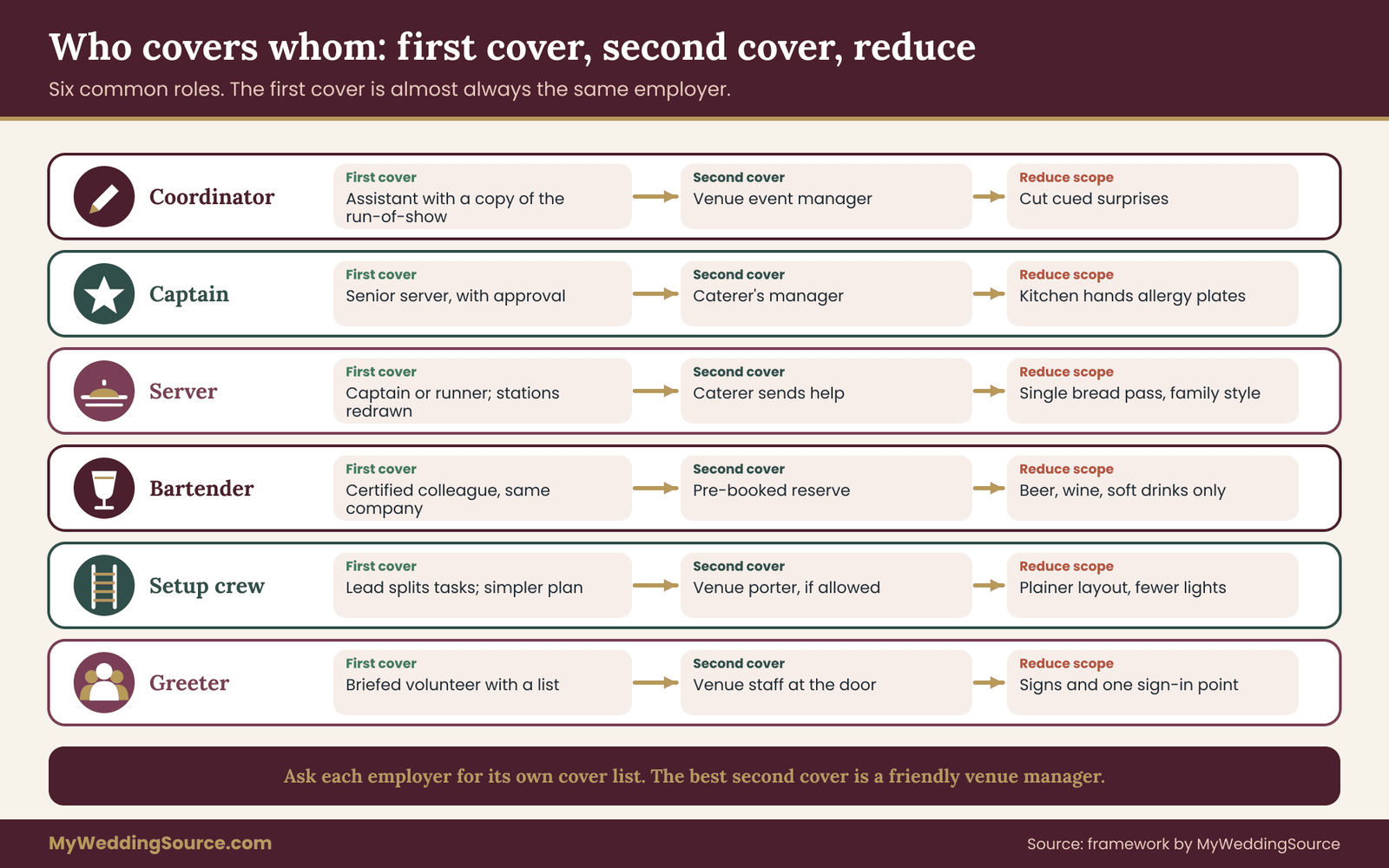
A general ladder is useful, but a wedding staffing contingency has to deal with real gaps, and real gaps have faces. This section walks through the roles most often missing at a wedding and suggests, for each one, a first cover, a second cover and a point at which scope should be reduced. Treat the suggestions as starting points to adapt to your crew size and venue.
Lead coordinator or day-of manager. This is the hardest absence because the person holds the schedule in their head. The first cover is the coordinator’s assistant, if there is one, who should already carry a copy of the run-of-show. The second is the venue’s event manager, who knows the building and can keep vendors moving, though not necessarily the couple’s preferences. A third option is a trusted, organized friend holding the printed schedule, acting as a messenger and not a decision-maker.
Reduce scope by cutting optional moments, such as a reveal or a surprise, that rely on the coordinator’s cueing. Prepare for this absence before the day: a wedding staffing contingency should make sure the schedule exists in at least three copies in at least three hands.
Catering captain or lead server. The captain directs the team and is the point of contact for the kitchen. If the captain is absent, the first cover is the most senior server, who steps up with the caterer’s approval. Then the caterer’s manager, who may need to travel. Because the captain also checks allergy plates, the allergy gate must be reassigned explicitly. If it cannot be, plated allergy dishes should be delivered by the kitchen lead only.
Server. A single missing server is usually a rung one or rung two problem. The remaining servers redraw stations, and a captain or runner covers the gap. The service pattern can change: moving from plated service to a family-style or buffet finish shortens the work per table, though that is a decision for the caterer, not for the coordinator.
If two or more servers are missing, call the caterer immediately, because the problem is probably larger than the wedding. For a view of how service interacts with guest movement, the wedding reception guest flow guide explains the entry, seating, food and exit sequence.
Bartender. Class one in most settings. The first cover is another certified bartender from the same company. The second is a reserve bartender who has been identified in advance. If neither is available, reduce scope: beer, wine and soft drinks poured by an existing qualified person, with the cocktail menu paused. Do not let a friend step behind the bar.
Setup crew member. Usually class two for time and class one when heights or equipment are involved. The first cover is the same team: the lead takes a lighter task and a second member takes the heavy one. The second cover is the venue’s porter or banquet staff, if the venue allows. Reduce scope by simplifying the layout: fewer lanterns, a smaller aisle display, a plainer entry. A simpler setup done well beats a complicated one done in a rush.
Greeter, usher or welcome-desk person. Class three. The first cover is a willing volunteer with a printed list. The second is a member of the venue’s staff positioned at the door. Reduce scope by using signs and a single, clear sign-in point, with a note directing guests to seating.
Parking, shuttle or valet attendant. Class one if the person drives or controls traffic on a public road, class three if they only direct on a private lot. The first cover is another trained attendant from the same company. Where none is available, post clear signs and ask the venue what it permits. Never ask a guest to drive a shuttle.
Coat check or bag-check attendant. Class three with a property-loss risk. The first cover is a volunteer with a numbered ticket system. If nobody can do it, set up a self-service rack with a sign saying the venue is not responsible for items, after checking the venue’s policy.
Kitchen or prep staff. Class one for safety and class two for time. Cover from within the kitchen team first. If the kitchen is short, the caterer may simplify the menu, and the couple should accept that earlier rather than later.
Cleanup and breakdown crew. Class four during the event, class two at the end, because the venue contract often fixes an out-time. The first cover is the remaining crew with a shorter list. The second is a deliberate choice to leave heavy items for a morning pickup, if the venue allows. The venue technical walkthrough guide covers how to find out in advance what access and timing the venue allows.
What the list shows
Three patterns appear across these roles in any wedding staffing contingency. First, the preferred cover is nearly always someone from the same employer, which is why the staffing level written into the contract matters so much. Second, the second cover is nearly always the venue, which is why a good relationship with the venue manager is worth cultivating before the day. Third, a reduction in scope is a realistic choice for almost every role, and it works best when the couple has already agreed in principle what they would give up.
A short conversation with the couple a few weeks ahead can settle this: “If we are ever short of people, which three things would you cut first?” Their answers become the content of rung five in your wedding staffing contingency. A couple who has chosen what to drop ahead of time will not feel their wedding was damaged when it happens.
A worked case: three people missing on one afternoon
The following is an invented example, written to show a wedding staffing contingency in use. It is not a record of a real event, and the numbers are illustrative. Use it as a pattern, not a prediction.
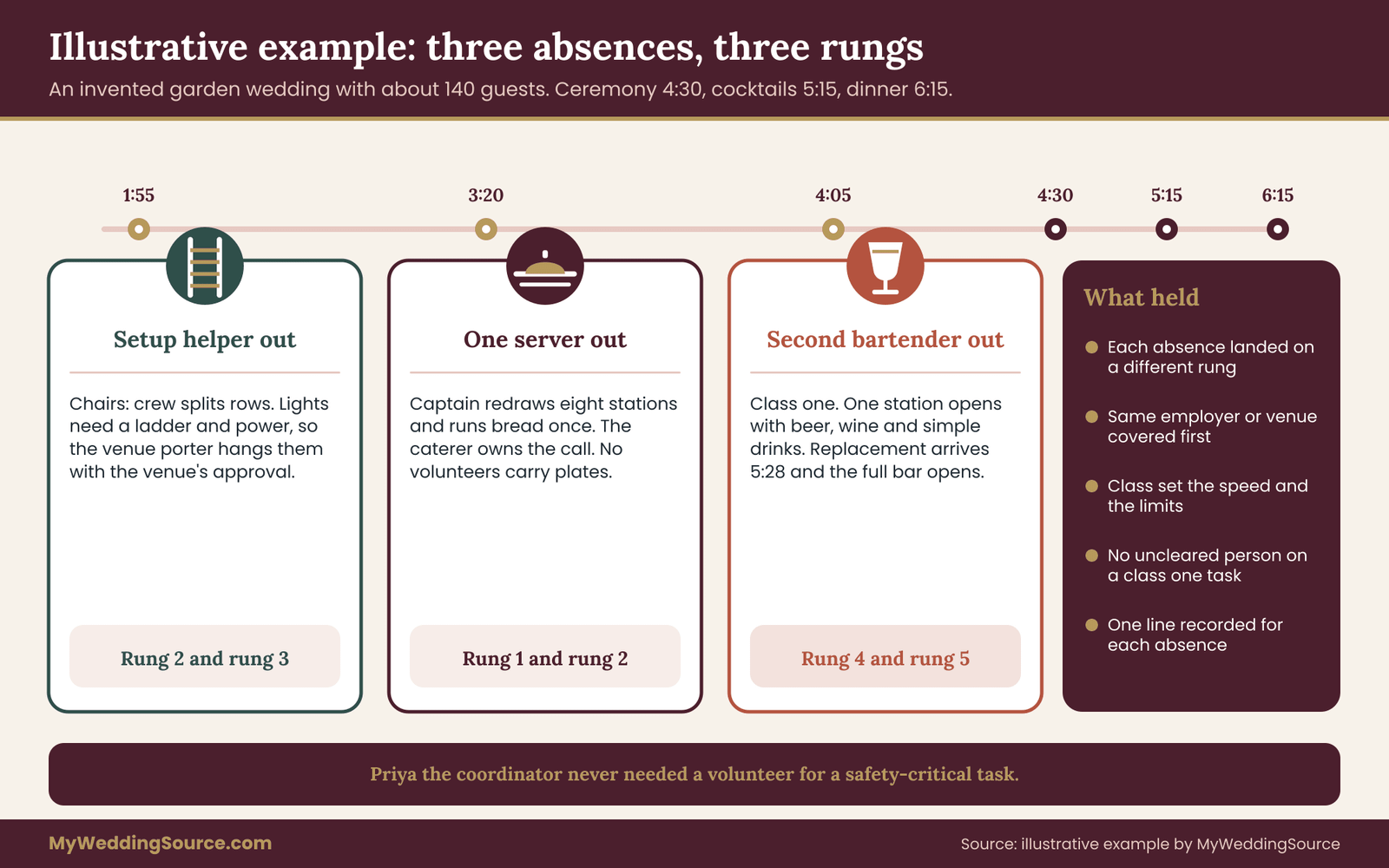
The setting is a garden venue with a tent, a ceremony at 4:30 p.m., cocktails at 5:15 and dinner at 6:15. There are about 140 guests. The couple has a day-of coordinator named Priya with one assistant, a caterer with a captain and nine servers, a bar company with two bartenders, a three-person setup crew from a rental company and the venue’s own porter.
Absence one: the setup helper at 1:55 p.m.
Priya learns that one of the three setup crew has not arrived. She runs the triage. The crew lead confirms by phone that the person is not on the way, and the rental company’s dispatcher says the worker called in sick that morning but the message did not reach the lead.
The absent person owned two tasks: arranging the ceremony chairs and hanging the string lights over the dinner tables. Chairs are class two with a clock at 4:00. The lights involve a ladder and an electrical connection, so they are class one.
Priya works through her wedding staffing contingency. For the chairs she chooses rung two: the lead and the remaining crew member split the rows and finish sooner than expected because the plan is simple. For the lights she cannot use a volunteer. She asks the venue manager whether the porter, who has done this work before, can hang them.
The venue agrees, which is rung three, and Priya notes that she asked the porter’s employer, not the porter. She writes the line: “1:55, one crew member, rental company, chairs and lights, deadlines 4:00 and 5:45, rung two for chairs, rung three for lights.”
The cost of this absence is mostly the porter’s time and a conversation with the rental company afterward. The rental company later offers a credit. Priya does not decide the amount. She records the facts and passes them to the couple.
Absence two: the server at 3:20 p.m.
The caterer’s captain texts that one of nine servers is ill and will not come. The remaining eight can cover a 140-guest plated dinner, but the stations are uneven. The triage shows the missing server owned a table block and the bread service. Table service is class two, bread service class three.
The captain applies rung one and rung two together. She redraws the stations so each of the eight takes a slightly larger block and moves herself to a runner position, so a banquet person is a flexible hand. Bread moves from a second pass to a single pass at the table. The captain tells the team what is dropping: no second water refill before the first course. Priya does nothing except confirm and note the change, because the caterer owns the decision. She does not ask a volunteer to carry plates.
At 5:30 the captain reports the station map is steady. The guests are unaware. This is what a good low-rung fix in a wedding staffing contingency looks like: the work is spread, the dropped items are chosen in advance, and nobody is moved into a task for which they are not trained.
Absence three: the second bartender at 4:05 p.m.
This one is class one, and the clock is tight. The bar company’s lead bartender arrives and reports that the second bartender, who was supposed to arrive at 3:30, is unreachable. The bar is planned as two stations with a cocktail menu. One certified bartender cannot run two stations for 140 guests during a short cocktail hour.
Priya applies the wedding staffing contingency chart. Rung one fails because a single person cannot absorb a second station. Rung two could work if the bar company has another certified bartender at another event, so she asks the lead to phone the company. Rung three is closed: no outside vendor is certified. Rung four is the company’s on-call arrangement, if one exists. She asks the lead to start that call while she considers rung five.
The company answers that a replacement can reach the venue by 5:30. That is fifteen minutes into cocktail hour. Priya and the lead agree on a reduction in scope: at 5:15, the single bartender opens one station serving beer, wine, sparkling wine and two simple pre-batched drinks that need no custom mixing, plus bottled water and soft drinks.
The couple is told in one sentence by Priya, who frames it as a decision already made and asks only whether they would like the signature drink moved to dinner. The replacement bartender arrives at 5:28, opens the second station and the signature drink joins the menu.
What the case shows
Three lessons about a wedding staffing contingency stand out. The first is that each absence landed on a different rung, and none needed the most expensive one. The second is that the person in the best position to cover was almost always the same employer, or the venue, and not a volunteer. The third is that the class of the duty set the speed and the limits. Priya never hesitated over the setup crew, because the class two chairs and the class one lights each had a clear route.
It also shows where things could have gone wrong. If Priya had skipped the triage and told a groomsman to hang the lights, the venue’s electrical and ladder rules and the rental company’s insurance could have been affected. If she had told the captain to use a volunteer as a server, the allergy gate could have been bypassed. If she had told the second bartender’s replacement to start work without a check, the bar might have run beyond its license. A wedding staffing contingency exists to prevent those quick, well-intended mistakes.
Variations on the case
Change one detail and the wedding staffing contingency leads somewhere else. If the venue had no porter, the lights would have moved to rung five: dining under a simpler lighting plan with lanterns on the tables and the ceiling lights left off. If the second bartender had been one of three and not two, the single missing person would have been a rung one problem.
If the missing server had been the captain, the allergy gate would have forced an explicit handover, and the kitchen lead would have walked allergy plates out. If all three absences had occurred at the same time, the order would still follow the class: bar and lights first, chairs second, bread last.
What to say: scripts for the people you must call
A good wedding staffing contingency includes the words, not just the steps. People under stress either say too much or too little, and a prepared script keeps the call short and the facts clear. The scripts below are samples for a wedding staffing contingency. Use plain language, own wording and your own names.
To the absent person
Reach out once and keep it free of blame. “Hi, this is Priya, the coordinator for the Harper wedding. We expected you at 3:30 and have not heard from you. Are you on the way, and is everything all right? Please call me at this number as soon as you see this.” You do not yet know whether there has been an accident, an illness or a mix-up.
The person’s safety matters more than the schedule, and the tone should reflect it. Do not send a second, angrier message in the next ten minutes. If you hear nothing, call the employer.
To the employer or team lead
“This is Priya, coordinator at the garden venue. One of your people, the second bartender, has not arrived, and we have service starting at 5:15. Can you tell me whether they have been in touch with you, and whether you can send a certified replacement? If you can, when would they arrive? If not, what do you advise we do about the second station?” Notice that the script asks for information first, a solution second and the vendor’s own advice third. The employer often knows something you do not.
To the venue manager
“One of the caterer’s servers is out. The caterer is handling it. I am telling you so you know that service may be a little slower in the first half hour. Separately, our rental company’s crew is short one person. Would it be possible for your porter to hang the dinner lights, with the rental company’s agreement? I will ask them now.” The message gives context, asks one thing and names the next step. Do not ask the venue to take over a task until the affected employer has agreed.
To the team, in a short briefing
Stand where the whole team can hear. “Quick update. We are one server short. Captain Lee has redrawn the stations and each of you has a few more tables. Drop the second water pass until after the first course, and bread goes out once. If something is not clear, ask Lee. If a guest raises an allergy, Lee handles it. Thank you, this is going well.” A briefing of thirty seconds with three clear instructions is better than a long message that people forget.
To the couple
Under a wedding staffing contingency, the couple should hear about a gap only when it changes what they or their guests experience, and then in a form that offers a choice, not a problem. “A bartender is delayed. The first fifteen minutes of cocktail hour will have a smaller drink menu.
The full bar opens at 5:30. We have already arranged it. Would you like the signature drink served at dinner instead?” This respects their time, reports facts and invites a small decision. If nothing changes for them, tell them afterward or not at all.
To the guests
Most staffing changes need no announcement. If service is slower, a captain or a coordinator who happens to be nearby can say, “Thank you for your patience, we’re bringing the next course now.” Avoid explaining the cause. Guests do not need to know that someone did not show up, and an explanation sounds like an excuse.
If a service is genuinely paused for safety, such as a closed bar, a short, calm sign or spoken line is enough: “The bar will be open for cocktails at 5:30. Wine, beer and soft drinks are available now.”
To the absent person, later
After the event, a second message is appropriate. “We missed you on Saturday and we were worried. Please let us know what happened so we can tell your employer accurately.” If the person was ill or had an accident, the tone is simple concern. If the reason is unclear, state the facts without accusation and let the employer handle any discipline. A calm, factual tone keeps the relationship intact and helps with any later conversation about pay or a refund.
Failure conditions: when a wedding staffing contingency stops working
Any process has points where it stops helping. A wedding staffing contingency is no exception, and knowing those points in advance keeps you from forcing a fix that is no longer safe or fair. The conditions below are written as signs you can recognize in the moment, with the step to take when you see each one.
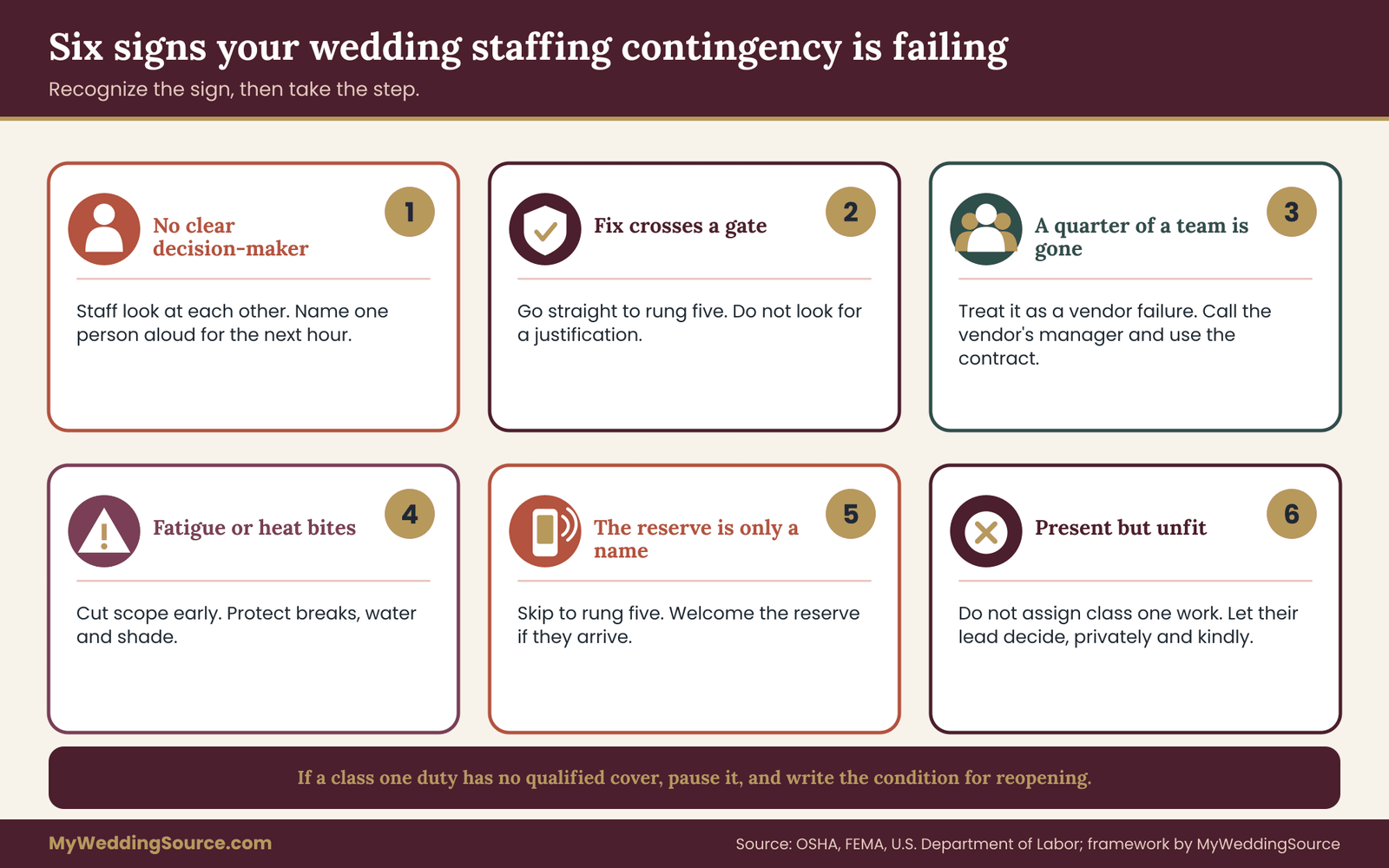
The decision-maker is unclear. If two people give opposite instructions to the same team, the wedding staffing contingency has failed before it began. Sign: staff look to each other before acting. Step: name one person aloud, in front of the team, as the decision-maker for the next hour. The coordinator is the usual choice, and the venue manager is the usual second.
The only available fix crosses a gate. Sign: every rung that would work puts an uncleared person on a class one duty. Step: move to rung five at once. Do not search for a justification. Reduction of scope is the right answer, and it is easier to explain than an injury or a violation.
The absence is bigger than one person. A single missing worker is an individual event. When a large share of a team fails to appear, the pattern points to a vendor problem such as a scheduling error, a transport failure or a company in trouble. As a rule of thumb, which is this guide’s own framework and not a legal or industry standard, treat the loss of about a quarter or more of a team as a vendor-level failure.
Sign: two or three people missing from the same employer. Step: skip the ladder for that team and call the vendor’s manager, not the captain. The contract’s remedy and the vendor’s own escalation path now matter more than a clever reassignment.
The shifted person leaves a hole behind. Sign: you covered one gap by creating another of the same class. Step: stop and re-run the triage on the new gap. A shift that moves a class two hole from one place to another is not progress.
Fatigue or heat starts to bite. Sign: remaining staff are working through breaks, a hot day, long hours without water, or a visible drop in care. Step: cut scope earlier than planned and protect breaks. A tired team makes errors in exactly the class one tasks where errors count. If you need a plan for staff rest, the idea of scheduled breaks belongs in your wedding staffing contingency as a fixed item, not a favor.
The reserve is a name on paper. Sign: you call the on-call person and learn they never confirmed or are out of range. Step: go straight to rung five and keep the reserve as a late bonus if they arrive. This is why reserves need a confirmation message on the day before and on the morning of the event.
A person is present but unfit to work. An absence is not always a no-show. Someone may arrive injured, unwell, or clearly impaired. Sign: a staffer who is unsteady, ill or visibly unable to do the task. Step: do not assign them to a class one duty. Ask their lead to decide whether they should stay, rest or leave, and treat the work as absent. Handle it calmly and privately. This is a person who may need help, not an enemy.
Someone leaves in the middle of the event. A staff member may walk out after an argument, a family emergency or an injury. Sign: a task that was covered at 6:00 is empty at 7:30. Step: re-run the triage from question one. A late absence has the same structure as an early one, only with less time and fewer free people.
The venue’s rules block every fix. Sign: the venue refuses to lend staff or allow outside help, and the contract limits who may work in the space. Step: ask once for an exception, in writing if possible, and if refused, accept rung five. Do not circumvent a venue rule. A conflict with the venue costs more than a smaller menu.
When to pause the event
On rare occasions a wedding staffing contingency should tell you to pause part of the event. If a class one duty has no qualified cover, the activity waits. A fire pit remains unlit, a bar stays closed, a ladder task is skipped. A pause is not a collapse, and the guests can have a drink of water and a seat. What causes harm is carrying on as if the gap did not exist.
Pausing works best when it has an end condition: “Bar reopens when the replacement arrives or at 6:00, whichever comes first.” Without an end condition, a pause drifts into the evening and no one remembers why. Write the condition on the assignment sheet.
What if everything fails
If a staffing problem grows beyond what the wedding staffing contingency can handle, the coordinator’s job is to make sure guests are safe and fed, in that order. Safe means exits are clear, the room is not overcrowded and nobody is in a hazardous task without cover. Fed means food and water are reaching tables in some form, even if simplified.
After that, comfort and polish. A wedding with a plain menu, a short bar and a few forgotten details is still a wedding, and the guests will remember the people more than the service.
If a vendor has failed to staff an event it was paid to staff, record the facts and address the remedy afterward, using the contract. The wedding cash flow planning guide on this site explains deposits, final balances and how to hold back payment decisions until deliverables are confirmed. Do not argue about a refund while the event is running.
Building a wedding staffing contingency before the day
Everything in the earlier sections is easier if you prepare it ahead. This section lists what to put in place in the weeks before the wedding, in an order that matches a normal planning calendar. It is meant to take a few focused hours in total, not weeks of effort.
Four to six weeks out: ask the right questions
For your wedding staffing contingency, collect each vendor’s staffing numbers: how many people, which roles, what call times, what the minimum number of people is, and what happens if a person is absent. Ask in writing, and keep the answers. Ask whether the vendor keeps an on-call person and how fast they can arrive. Ask the venue what it allows: staff loans, extra helpers, access times, and its own rules on who may operate which equipment.
Also look at the contract for the points from the earlier section: staff level, replacement duty, notice and remedy. If anything is missing, request a short written addendum. A vendor who responds with a clear policy is one who has handled this before.
Two weeks out: classify duties and set the gates
With final names in hand, build the core of your wedding staffing contingency: mark each task with its class on the assignment sheet. List the gates: bar, allergy plates, heights, electrical, fire, driving. Check them with each vendor and the venue. Choose the decision-maker and write the rule that each employer runs its own team.
Agree with the couple on their three cuts. Ask which three things they would drop first if the team were short, in order. Put the answers on the sheet as the first moves for rung five.
One week out: confirm the reserve and the call tree
Identify your reserves: an on-call person at each key vendor, a standby volunteer for class three tasks and a backup for the coordinator’s role. Ask each to confirm in writing that they are available, know where the event is and know that they might be called. Reserves who are not confirmed are not reserves.
Print the call sheet with names, roles, numbers and the employer’s emergency contact for each vendor. Put copies in three hands. Check that the venue’s contact will answer on the day. If the day involves a long schedule of different teams, a vendor timeline helps you see when each vendor arrives and leaves, which shows where gaps would be hardest to cover.
Budget for the reserve
A reserve in a wedding staffing contingency has a cost: a day rate, a minimum call-out fee or simply a thank-you gift. Set aside a small amount for this and treat it as insurance that you hope not to use. Do not invent figures. Ask your vendors for their actual call-out terms and add the result to your budget notes. Most couples are surprised that the answer is usually modest compared with the cost of a service failure.
The day before: confirm
The day before, a wedding staffing contingency needs one message. Send a short message to each vendor lead: “We are looking forward to tomorrow. Please confirm your arrival time and the number of staff you are sending, and tell us if anyone has dropped out.” The question about dropouts is the key. It gives vendors a chance to report an absence a day early, when many more options are open than at 4:00 on the day.
On the day: the brief
A five-minute briefing for each team lead at arrival is the most useful part of the wedding staffing contingency. Hand them the call sheet and the assignment sheet. Tell them the decision-maker, the gates and the three words: “tell me early.” Leads who feel able to report a problem at the first sign are worth more than a thick binder.
After the day: record, review and follow up
Within a few days, collect the records: the triage lines, the rungs used, the times, who approved what. Send the vendor a short, factual summary of any absence and its effects, and ask what they propose. Keep the tone constructive. Many vendors will offer a credit or a partial refund for a verified shortfall, and many will not need to, because they solved it.
Decide, together with the couple, what matters to you: a credit, a corrected policy, or a note for future clients. The goal of the follow-up is to learn and to be fair, not to punish.
Finally, update the wedding staffing contingency itself. If rung four was used twice, the roster was thin. If a gate was crossed, the sheet was unclear. If a script helped, keep it. A good wedding staffing contingency improves with each event, and a copy you refine is worth more than one you never review. For the wider question of who is assigned to guests, setup, service and breakdown in the first place, see the staffing plan guide on this site.
Your next steps
Pick one evening this week and do three things. First, open your assignment sheet, or create one, and mark every task with its class: safety-critical, time-critical, guest-facing or comfort. Second, write the gate list, the handful of duties nobody may cover without clearance, and send it to each vendor and the venue so they can correct it. Third, write the decision-maker rule in one sentence and tell each team lead.
Then work forward on your wedding staffing contingency in small steps. Ask each vendor for staffing numbers and a replacement policy. Ask your couple which three things they would drop first. Confirm one reserve for each important role. Print the call sheet and the escalation chart on a single page and give copies to three people. A short, rehearsed wedding staffing contingency beats a long one that sits in a folder.
On the day, keep the wedding staffing contingency triage questions where you can see them, climb the chart one rung at a time, and write a one-line record of every absence. The aim is not a perfect day. The aim is a day where a missing person is a small, handled event, and where everyone who was on site left safe, treated fairly and clear about what happened.
FAQ
What is the first step in a wedding staffing contingency when a staff member does not show up?
In any wedding staffing contingency, the first step is to confirm the absence, then define the gap. Call the person and their employer, give a short window for lateness, and list the exact duties and deadlines the person owned. Only then choose a fix. Acting before you know which tasks are empty often creates a second problem, because the nearest volunteer may not be cleared for the work.
Who has the authority to reassign a vendor’s staff on the wedding day?
Each employer directs its own people. The coordinator runs the day and sets priorities between teams, but should ask a vendor’s lead before moving that vendor’s staff, and should ask the venue before using venue staff. The couple decides only matters that change the guest experience. Put this rule at the top of your wedding staffing contingency and tell every team lead.
Can a friend or relative cover a missing bartender or server?
For serving food or alcohol, usually not. Alcohol service is governed by state and local rules and by the venue’s license and insurance, and handling allergy dishes needs training. A friend suits low-consequence tasks such as greeting, handing out programs or setting favors. If a bartender is absent, use another certified bartender, a reserve, or reduce the bar menu.
How many staff can be missing before a wedding staffing contingency becomes a vendor problem?
There is no official number. As a working rule in this guide, losing about a quarter or more of one team points to a vendor-level failure, such as a scheduling or transport error. At that point call the vendor’s manager and follow the contract’s remedy, instead of trying to patch the gaps one by one with volunteers.
Does moving someone to a different job affect their pay or classification?
It can. Pay, hours, breaks and worker classification depend on the employer, the arrangement and the rules where you live. The U.S. Department of Labor and the Internal Revenue Service publish current guidance. Do not decide pay for another person’s employee. Pass the details to their employer, and keep a simple record of who did what and for how long.
Should we tell the couple and guests when a staff member is absent?
Tell the couple only when the gap changes what they or their guests will notice, and offer a choice, such as moving a signature drink to dinner. Guests rarely need an explanation. A brief thank-you for patience is enough. If a service is paused for safety, post a short, calm line about when it will resume.
What if the only fix would put an uncleared person on a safety-critical task?
Do not use it. Reduce scope instead. Pause the activity, serve a simpler menu, skip the ladder task or keep the fire item unlit until a qualified person is available. A reduced, calmly explained plan is almost always better for the guests than an improvised one that risks injury or breaks a venue or license rule.
Can we get a refund if a vendor’s staff did not show up?
That depends on your contract and the vendor’s policies. Look at the staffing level, the replacement duty and any stated remedy. Record the facts on the day, ask the vendor in writing afterward what they propose, and keep the tone factual. For legal questions about a dispute, consult a qualified professional or the relevant consumer agency.
Sources
- Wage and Hour Division, U.S. Department of Labor
- Misclassification of employees as independent contractors under the FLSA, U.S. Department of Labor
- Independent contractor (self-employed) or employee?, Internal Revenue Service
- Occupational Safety and Health Administration, U.S. Department of Labor
- Heat exposure, Occupational Safety and Health Administration
- FDA Food Code, U.S. Food and Drug Administration
- Food safety, Centers for Disease Control and Prevention
- Business continuity planning, Ready.gov, Federal Emergency Management Agency
- National Incident Management System, Federal Emergency Management Agency
- U.S. Equal Employment Opportunity Commission