
Wedding staff breaks are the planned pauses that keep servers, bartenders, kitchen crew and coordinators functional across a day that can stretch past ten hours. This guide shows how to build a relief coverage timeline around your run of show, how to pair it with five review checkpoints for pay and break rules, and what to do when the people simply are not there.
Do not schedule wedding staff breaks by the clock. Schedule them by the run of show. List every post, mark which ones must never be empty, find the quiet windows in your evening (ceremony, toasts, the dinner plateau, cake cutting), and assign a named reliever to every break. Then confirm with each staff member’s actual employer what break and pay rules apply, because those rules vary by state and by employer. A written rota with a signal and one person who can approve changes is the whole system.
A wedding looks like a five-hour event on the invitation. For the people working it, the day is much longer. A server may arrive at two in the afternoon, set tables for hours, serve through dinner, stay for the dance floor and clear glassware until the venue empties at midnight. A bartender may be on a feet-down, never-sit schedule for the same stretch. The couple sees a celebration. The crew sees a long shift with three or four moments when everything gets busy at once.
That gap is where wedding staff breaks go wrong. Nobody plans to skip them. They get skipped because the break was never attached to a moment in the evening, nobody was named to cover the post, and the only time it felt possible to step away was also the time the room needed everyone. By nine o’clock the crew is tired, the service slows, and a small mistake with a tray or a drink order becomes a larger one.
This article is about the planning side. It treats wedding staff breaks as a coverage problem first and a compliance question second, and it keeps the two in a clear order. You will build the coverage plan yourself, because you know your timeline. You will send the legal and pay questions to the people who answer them, because those answers depend on the employer, the state and the worker.
A note on scope. This is general information, not legal, tax or financial advice, and it does not tell you which break or wage rules apply to any worker. Where a rule matters, the article points to the agency that publishes it.
What wedding staff breaks cover, and who owes them
The phrase covers more than a lunch period. In practice, wedding staff breaks come in three kinds, and keeping them apart makes the planning much easier.
A meal break is a longer pause, usually around thirty minutes, in which a worker can sit down and eat. A rest break is short, often ten or fifteen minutes, for water, a restroom visit, a sit and a stretch. A relief gap is the informal version, when a coworker covers a post for a few minutes so someone can step out. Many weddings run almost entirely on relief gaps, which is exactly why they need to be planned instead of improvised.
The next question is who owes the break. In most weddings, the couple is not the employer of the people working the room. The venue employs its banquet staff. The caterer employs or contracts its servers, bartenders and kitchen crew. A band leader pays the musicians. A planning firm pays its assistants.
Each of those organizations is responsible for how its own people are scheduled, including wedding staff breaks and pay. The couple’s job is to hire vendors who plan for this, and to avoid building a schedule that makes wedding staff breaks impossible.
There are exceptions, and they matter. If you hire a person directly, such as a student to run errands or a friend paid to manage the guest book, you may be an employer in a legal sense. Volunteers raise their own questions. Whether a given person counts as an employee, a contractor or a volunteer is a classification question that the U.S.
Department of Labor and the Internal Revenue Service both publish guidance on, and it is outside what a planning article can settle. The vendor contract guide on this site covers how to confirm who you are actually hiring and what the agreement says.
Why wedding staff breaks are a planning problem, not only a rules problem
Even in a state with no specific break requirement, a tired crew is a practical risk. Hot trays, wet floors, glassware, stairs and alcohol all reward attention. A worker who has been on their feet for seven hours without a sit-down is more likely to drop a plate, mishear an allergy note or snap at a guest. This is not a claim about statistics. It is ordinary reasoning about people, and most event supervisors will tell you the same in their own words.
Federal wage law adds a second, narrower reason. Under the Fair Labor Standards Act, federal law does not generally require employers to give meal or rest breaks, though many states do. What federal law does address is how break time is counted. Short rest breaks, roughly five to twenty minutes, are generally counted as hours worked.
A meal period is generally unpaid only if it lasts at least thirty minutes and the worker is completely relieved of duty. If a bartender has to eat a sandwich while watching the bar, that time is generally counted as work.
None of that is a legal conclusion about your wedding. It explains why the shape of a break matters: what happens inside the break decides how it is treated, and a break that is not really a break can cause both a practical and a payroll problem for the employer.
What this guide will and will not do
You will leave with a method, not a ruling, and the method treats wedding staff breaks as something you can schedule, name and check. The method has two tracks that run side by side. The first is the relief coverage timeline, a six-step process that turns your run of show into a named rota.
The second is a set of five review checkpoints, placed at the stages of planning where the right question can still be answered cheaply. The checkpoints do not make you the legal reviewer. They make sure the right person reviews the right thing at the right time.
The guide does not cover who staffs the wedding in the first place, how many servers you need, or how meals are served. Those are separate planning questions, and where they intersect, this article states the dependency and moves on. For the overall shape of the evening, the vendor timeline guide is the best companion, since your relief plan is only as accurate as the schedule underneath it.
The long-shift arithmetic behind wedding staff breaks
Most couples think about their event in terms of the guest schedule: ceremony at four, dinner at six, last dance at eleven. That is the guest clock. Staff live on a different clock, and the difference is the first thing to see on paper. Every plan for wedding staff breaks should begin there.
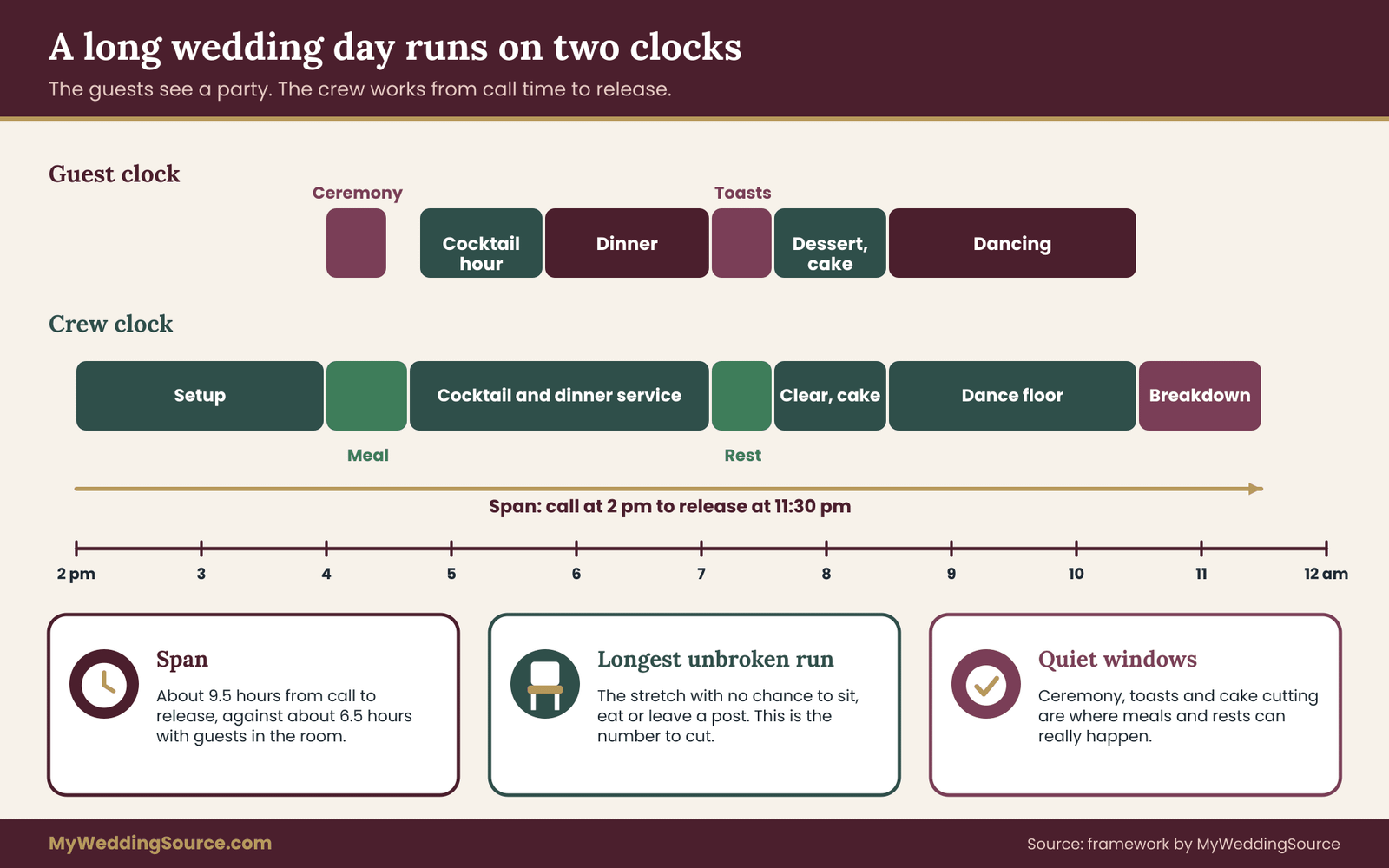
The staff clock starts when a person is told to arrive, which is usually before any guest and often before the florist has finished. It includes setup, any pre-event meeting, the event itself and the breakdown. It ends when the person is released, which for many roles is well after the last guest leaves. The span from call time to release is the length of the shift, and it is almost always much longer than the party.
A simple way to measure a shift
Take any role and write four times: call time, first guest contact, last guest contact and release. Then subtract. A server called at two in the afternoon, first serving guests at four forty-five, finishing the dance-floor service at ten forty and released at eleven thirty has a span of nine and a half hours. Only about six of those hours involve guests. The rest is setup, resets and clearing, which is still physical work and still counts as time on the job.
Two numbers come out of that exercise. The span is the whole stretch from call to release. The longest unbroken run is the longest stretch in which that person has no chance to sit, eat or leave their post. Span tells you about total fatigue. The longest unbroken run tells you where the plan is weakest, and that number is the one you can fix. In practice, wedding staff breaks exist to shorten it.
Where the long runs hide
Long unbroken runs, the stretches that wedding staff breaks are meant to cut, tend to hide in four places.
The first is setup into service. When setup runs late, the crew rolls straight from hauling chairs into greeting guests, and nobody has eaten. The second is dinner service, where the kitchen, the servers and the bar are all at peak at once, so there is no spare hand to cover anyone. The third is the late dance floor, where service is lighter but continuous, and the bar and the floor attendants stay on duty with no natural pause.
The fourth is breakdown, which feels like the end of the day but is often the hardest physical stretch, after a long shift and with the least patience left.
A useful habit is to mark each of those on a one-page strip of the day, hour by hour, and note the staff members who are on duty in each stretch. Gaps jump out. A bartender who works from four forty-five until eleven with no named relief is a gap, regardless of how pleasant the bartender is about it.
Overtime and the week behind the day
Long wedding days also interact with weekly hours. Federal overtime rules, in general terms, apply to covered employees who work more than forty hours in a workweek. A caterer whose staff worked a full week before a Saturday wedding may find the Saturday hours carry overtime pay.
That is the employer’s calculation, not yours. It matters to you only because overtime changes the vendor’s cost of a longer day, and a vendor that is quietly worried about overtime may resist a later start time or a longer service window.
Some states count overtime by the day as well. The Department of Labor’s overtime page explains the federal rule and points to state labor agencies for stricter ones. If a vendor tells you a change to your timeline will add cost for hours, treat it as a real conversation and ask for it in writing. Your payment calendar is where an extra labor line will land, so keep that in mind when the vendor quotes a change.
The three sizes of shift
It helps to sort roles into three rough sizes, because the planning response is different for each.
A short shift, up to about five hours, usually needs only a rest pause or two. A standard shift, from five to nine hours, needs a meal break and at least one rest break, and it is the size most banquet staff work at a wedding. A long shift, beyond nine hours, needs a careful rota with a meal, multiple rests and a plan for the final stretch.
Setup crews, coordinators and kitchen leads often fall into this last group without anyone noticing, since their hours are spread across the day and never appear on the invitation.
Match the planning effort for wedding staff breaks to the size of the shift. None of those cutoffs is a legal line. They are planning categories of this guide, chosen so that you can decide how much attention each role deserves. Your vendor’s employer and your state labor agency set the real rules, and they may set different thresholds.
Why “we’ll find time” does not work
The most common plan for wedding staff breaks is a spoken promise: the staff will find time. It sounds relaxed, and it fails predictably. The moments that feel quiet to a guest, such as the toasts, are the moments the kitchen is plating the next course.
The moments that feel quiet to the kitchen, such as the dance floor, are the moments the bar is busiest. A promise that does not name a window and a reliever is not a plan. It is a hope that the evening will be kind.
The fix is not complicated. It is to attach each break to a specific moment in the run of show, name the person who covers, and write it down in a form that one person can follow at a glance. The next section shows how to find those moments.
Posts, peaks and quiet windows: reading the run of show
Planning wedding staff breaks starts with posts, not people. A post is a job that has to be done at a place for a period of time: the bar, the door, the kitchen pass, the cake table, the guest book, the coat check, the head table service. People fill posts. When a person steps away, the post is either covered, paused or empty, and those three outcomes are the whole decision.
Hard posts, soft posts and floating posts
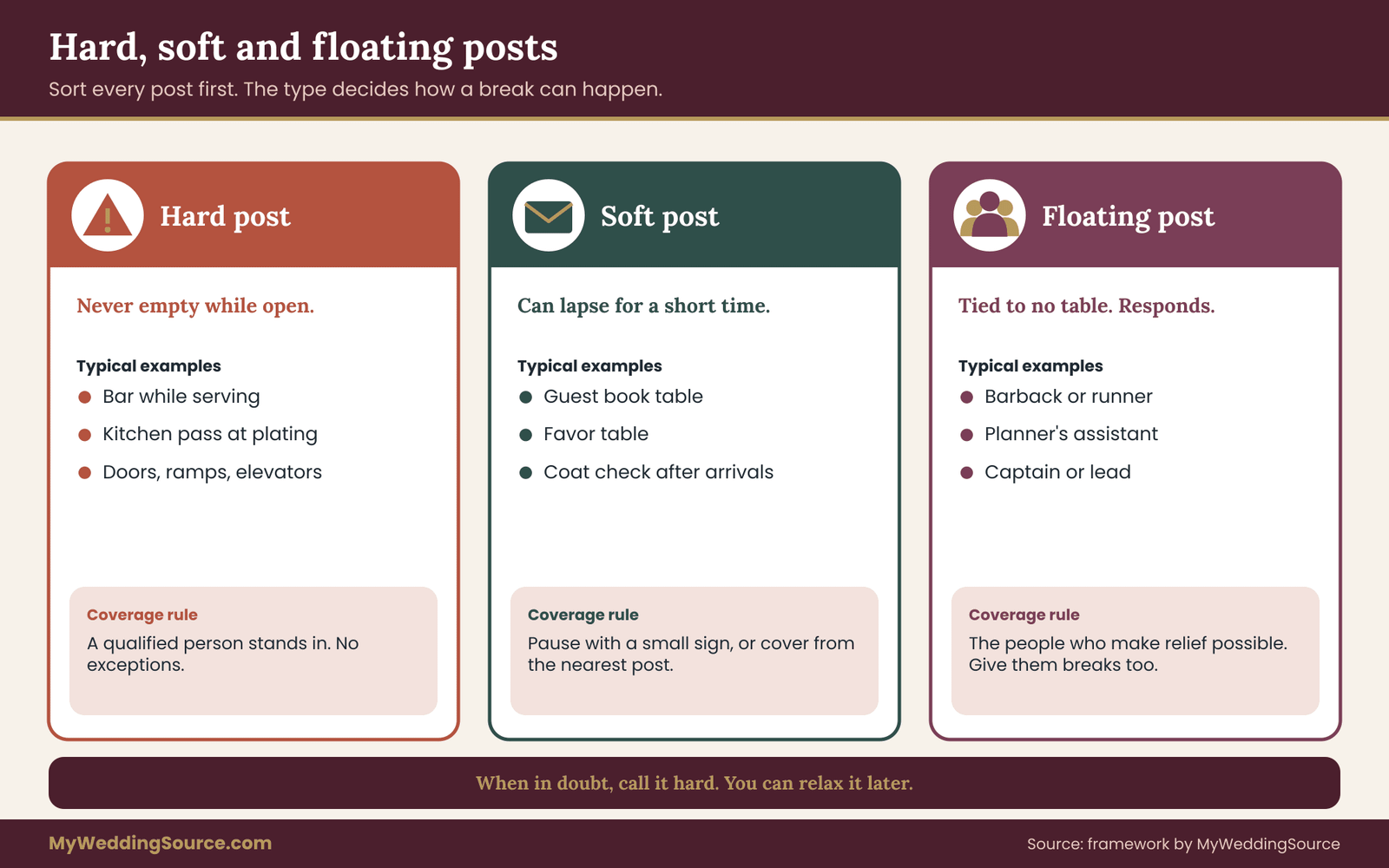
Sort every post into one of three types.
A hard post must never be empty while it is open. The bar when alcohol is being served is the clearest example, since an unattended bar is both a service failure and a safety question. The kitchen pass during plating is another. So is any post that controls a door, a ramp, a freight elevator or a guest with a medical or mobility need. If a hard post is open, someone qualified stands in it.
A soft post can lapse briefly without harm. A guest book table, a favor table, a coat check after the main arrival wave and a gift card box are usually soft. These posts can be paused with a small sign, such as “back in ten minutes,” or covered by whoever is nearest. They are where a lot of quick wedding staff breaks naturally happen.
A floating post belongs to no table or station. It is a person whose job is to respond: reset a table, run ice, relieve a bartender, find a missing chair. Floaters are what make relief possible, because they are the people who can cover a hard post without leaving another one empty. A wedding with no floaters needs every break to be paid for by a coverage gap somewhere else.
Writing the posts down takes ten minutes and changes the conversation. Instead of asking “will staff get breaks?” you can ask “who covers the bar from seven oh-five to seven fifteen?” The second question has an answer, and the first does not. Wedding staff breaks stop being a vague goal and become a list of assignments.
Finding the quiet windows
A quiet window is a stretch of the evening when demand on a certain post falls without anyone doing anything special. They are not the same for every post. The ceremony is a quiet window for the whole reception crew, since there are no guests in the room.
The toasts are a quiet window for the bar and the floor, since guests are listening, but not for the kitchen, which is often finishing the next course. The plateau after dessert is a quiet window for servers but a busy one for the bar.
Here is the typical set of quiet windows, from the reception side of a plated-dinner wedding.
The ceremony. If the reception room is separate and fully set, the crew can eat a staff meal and reset. This is the longest quiet window and often the only one that fits a full meal break.
The cocktail hour. Bar and passed-appetizer posts are at their peak. Servers who are not passing food are at a quiet window if the dining room is fully set. This is a window for the dining room crew and not the bar.
The dinner plateau. After entrees are served and before plates are cleared, the floor staff has a short stretch with little to do. This often lasts ten to twenty minutes and suits rest breaks and water.
The toasts. Guests are seated and attentive. Floor service stops, bar traffic falls, and the room asks the crew to be invisible. This window is the best one for short rest breaks, provided the kitchen and the bar are covered.
Cake cutting and the first dance. The room is watching, the floor is quiet for a few minutes, and servers can step back. This suits very short pauses.
The mid-dance stretch. Service is light but continuous. The bar needs coverage, the floor needs occasional clearing, and a rotating rest pattern works well.
Last call to release. The most tiring window, since breakdown starts while guests are still leaving. Plan the end carefully rather than leaving it to chance.
The wedding ceremony cue sheet guide shows how the ceremony clock is built, and that detail tells you how long the ceremony window really is. A ceremony cue sheet that adds a twenty-minute delay before the processional is a twenty-minute extension of your first quiet window, if you plan for it. If you do not, it is just twenty minutes of staff standing around hungry.
Reading demand honestly
Quiet windows depend on how the evening is run, so be honest about the format. In a plated dinner, the dinner plateau exists but is short. In family-style service, the servers’ peak shifts later, since platters are refilled throughout the meal. At a buffet, the busiest period is the opening of the line, followed by a long, manageable stretch. A food-truck or station evening has a different shape again, with staff spread across posts for the whole evening and few shared pauses.
The wedding reception guest flow guide describes how guests move through entry, seating, food and exit, and each of those flows implies where staff are tied down and where they are free. Use it to mark your own peaks on the strip of the day. A plan for wedding staff breaks built on someone else’s evening shape will not fit yours.
A one-page strip for the evening
Draw the day as a horizontal line from the earliest call time to the latest release. Mark the guest events above the line. Under the line, add one row per post and shade the hours it is open. Shade peaks darker. Then look for light stretches across multiple rows at once, which are your best shared windows, and for places where a hard post is open while the floaters are also needed elsewhere, which are your danger spots.
You do not need software. A piece of paper with hours across the top is enough. The result should fit on one page that a lead can read in a minute, since the lead will be the one who uses it at eight in the evening with a phone in one hand.
The relief coverage timeline, step by step
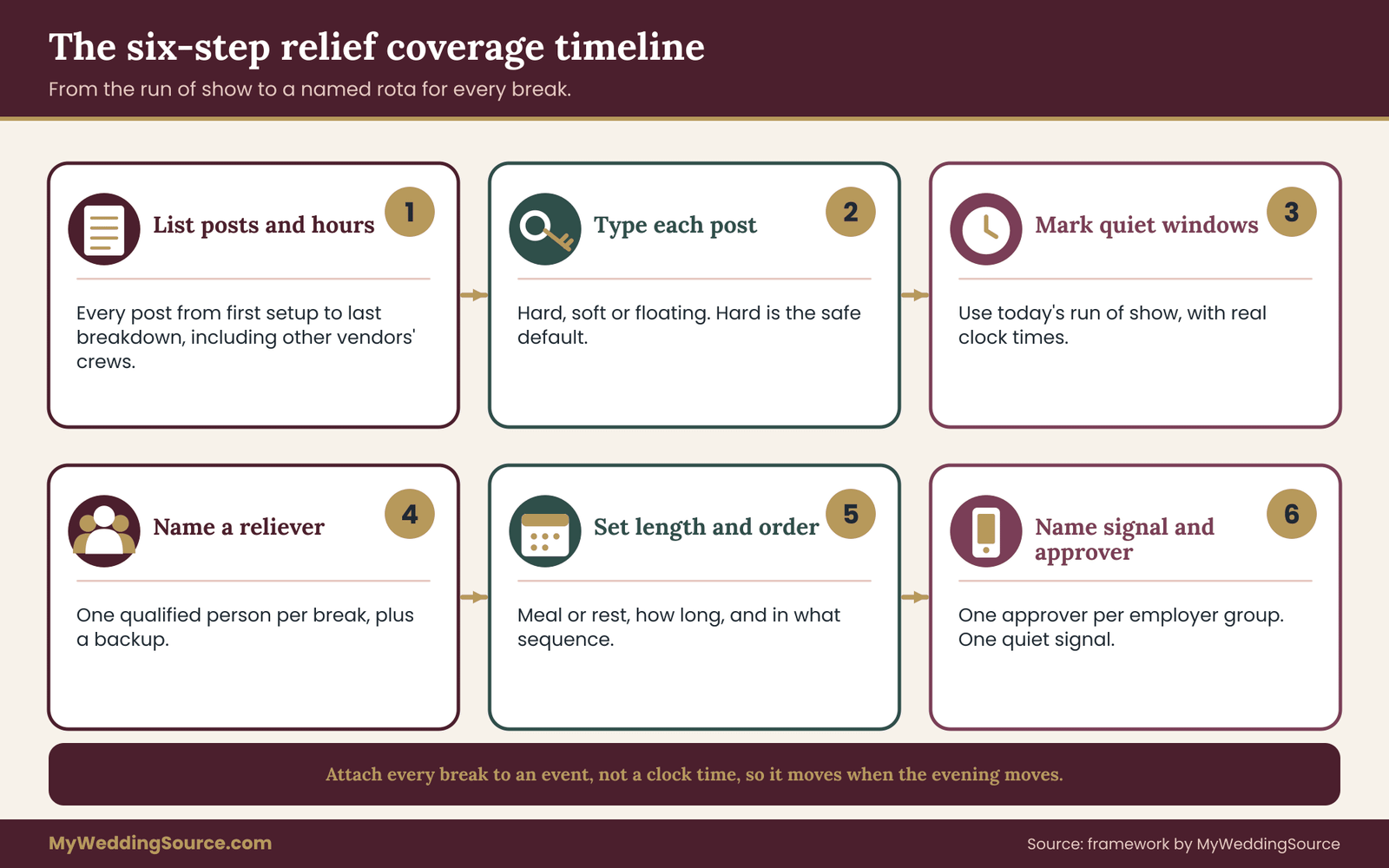
This is the central method for wedding staff breaks in this article. It has six steps, and it is meant to be run by the couple or the planner a few weeks before the event, then reviewed with the vendors. It turns the strip of the day into a rota that names who covers whom.
Step one: list the posts and the hours
Write every post that exists between first setup and last breakdown, with its open hours. Include posts that belong to vendors you do not control, such as the band’s sound check or the photographer’s coverage, since those people have wedding staff breaks too and will compete for the same quiet windows and the same staff meal.
Step two: type each post
Mark each post hard, soft or floating. When in doubt, call it hard. You can relax it later, but you should not discover on the day that a post you treated as soft was holding a door shut.
Step three: mark the quiet windows on the strip
Use the list in the previous section. Write the actual clock time next to each window, taken from the current run of show, not the earlier draft. A shift in the dinner time moves every window, and it is common for plans for wedding staff breaks to go stale because someone moved the toasts.
Step four: assign a reliever to every break
For each person who works longer than a short shift, choose the window for their meal and for each rest, and write the name of the person who covers their post. Where a hard post is involved, the reliever should be qualified for that post. A server cannot cover a bar if serving alcohol requires a license or certificate in your state, so check who is eligible.
Step five: set the break lengths and the order
Write the planned length of each break, for example “meal, thirty minutes” and “rest, ten minutes.” Then order the wedding staff breaks so that no two relievers are needed at once. If two bartenders both need a ten-minute rest in the same toast window, they go in sequence, not together.
Step six: name the signal and the approver
Choose how a person asks for a break and who says yes. At most weddings that is a lead or captain, a planner or the venue’s banquet manager. Pick one approver for each employer group and state the signal, such as a hand on the shoulder or a text to a single number. Without one named approver, the plan collapses into a negotiation in front of guests.
What the six steps produce
At the end, your wedding staff breaks sit on a single page with names, windows, lengths and relievers, and a second page, which is the checkpoint list covered later. The first page is operational. The second is administrative. Both are short, and both can be handed to a vendor as part of a request for confirmation.
The vendor timeline is where this fits in the planning calendar, and the six steps are simply one more thread to attach to it; wedding staff breaks belong in the same calendar as every other vendor confirmation. When you send the final timeline to vendors, attach the rota and ask each vendor to confirm that it fits their staffing and their own break rules. That single request often surfaces problems that would otherwise appear at nine o’clock on the night.
Sizing relief for wedding staff breaks: floaters, minutes and order
Once the posts and windows are on paper, the next question is arithmetic: do you have enough hands to cover the wedding staff breaks? You can answer it without a formula by counting minutes. Sizing wedding staff breaks is a counting exercise, not a guess.
The relief minute budget
Add up the break minutes owed. If six servers each take a thirty-minute meal and two ten-minute rests, that is fifty minutes each, or three hundred minutes in total. Now add up the minutes of hard-post coverage those wedding staff breaks would uncover. Servers on the floor are not all hard posts, so the uncovered amount may be small. Bartenders are different: two bartenders on a hard post with a ten-minute rest each and a thirty-minute meal each need ninety minutes of relief from someone qualified.
That relief has to come from somewhere. The usual sources are a barback or floater, a lead who steps in, a second bartender scheduled for the middle hours only, or a planned bar pause during a quiet window. Each source costs something. A floater costs wages. A lead who steps in cannot lead. A middle-hours bartender costs a short shift. A bar pause costs a few minutes of guest service. The budget makes the trade visible, so you pick one on purpose.
A rule of thumb that is only a planning aid
Use any ratio for wedding staff breaks as a starting question, not an answer. A common starting point is one floater for every four to six hard or semi-hard posts, with extra support during dinner. Treat this as a conversation starter and nothing more. The right ratio depends on the room, the service style and how long the day runs.
A small garden wedding with one bar and two servers may need no floater at all if a lead covers. A ballroom with three bars, a coat check and a late dance floor may need two.
What matters is the shape of the question you ask the vendor. Instead of “how many staff do you bring?”, ask “which person covers each bartender’s rest and meal, and in which windows?” A vendor who has run many weddings can usually answer this at once. One who has not may need to think, and that is useful information.
Break lengths and what they buy
Short breaks and long breaks do different jobs.
A ten-minute rest buys water, a restroom visit and a few minutes off the feet. It is enough only if the person does not have to travel far. At a large venue with a staff restroom across a parking lot, ten minutes is a walk and nothing else. In that case, plan fifteen, or relocate the rest area.
A fifteen-minute rest buys a short sit, a snack and time to check a phone for emergencies. It is a more realistic length for outdoor venues, tents and buildings with long corridors.
A thirty-minute meal is the usual length of a real meal period. Whether it is paid or unpaid, and whether it counts as time worked, depends on the employer and on whether the worker is completely relieved of duty. A meal where the worker has to keep one eye on the floor is not a clean meal period.
A long break of an hour or more is a split-shift pattern, where staff are free for a stretch and return. It works for long events with a natural gap, such as a daytime ceremony and an evening reception, and it raises its own questions about pay and travel that the employer must answer.
Order matters more than length
Relief fails mostly through ordering. If the strongest server and the most senior bartender both break during the toasts, the room is left with the least experienced people at the moment a guest might need something. Spread experience across the windows, the same way you spread it across posts when you plan wedding staff breaks. Put the lead’s break in a window when the planner or venue manager is also on the floor. Put the kitchen lead’s meal before service starts, not during it.
Also avoid chains. If person A covers person B and person C covers person A, any delay in B’s return ripples through the rota. Where possible, have one reliever cover two or three short wedding staff breaks in sequence, and have a second person ready as a backup for that reliever.
Who relieves the relievers
The weakest point in most plans is the floater or the lead, because there is no one assigned to cover them. Give each of them a break in a window when the room is quiet and the need for them is small, and name an alternate. Often the coordinator or the planner’s assistant is that alternate.
Wedding staff breaks for the floater and the lead are the ones most often forgotten. If you are your own coordinator, which some couples are not by choice, the plan above needs an honest accounting of who will actually be present in the room.
The wedding bar service planning guide goes into the bar side, including how many bartenders a guest count typically needs and what a bar pause looks like. The cocktail hour guide covers the first peak of the evening, which is when break plans most often collapse, since the bar, the passed food and the guest arrival all compete for the same hands.
Break length and the long tail of the night
Late in the evening, relief needs change. Fewer guests means fewer servers are needed, which opens a different option: release some staff early instead of giving them wedding staff breaks. A server who works until nine thirty, given a final-rest and an early release, may be better off than one who works until eleven with the same total break time.
Late-evening wedding staff breaks are often replaced by an early release, and that trade must be agreed in advance. It affects pay, it affects the vendor’s contract and it affects the guest experience, so it is a decision to make with the vendor and not to improvise.
The five review checkpoints beside the wedding staff break schedule
The relief timeline is a coverage plan for wedding staff breaks. The checkpoints are a parallel track of questions that go to the people who can answer them. The idea is simple. Instead of one legal worry that hangs over the whole project, you break it into five small questions and put each at a stage when the answer is cheap to get and cheap to act on.
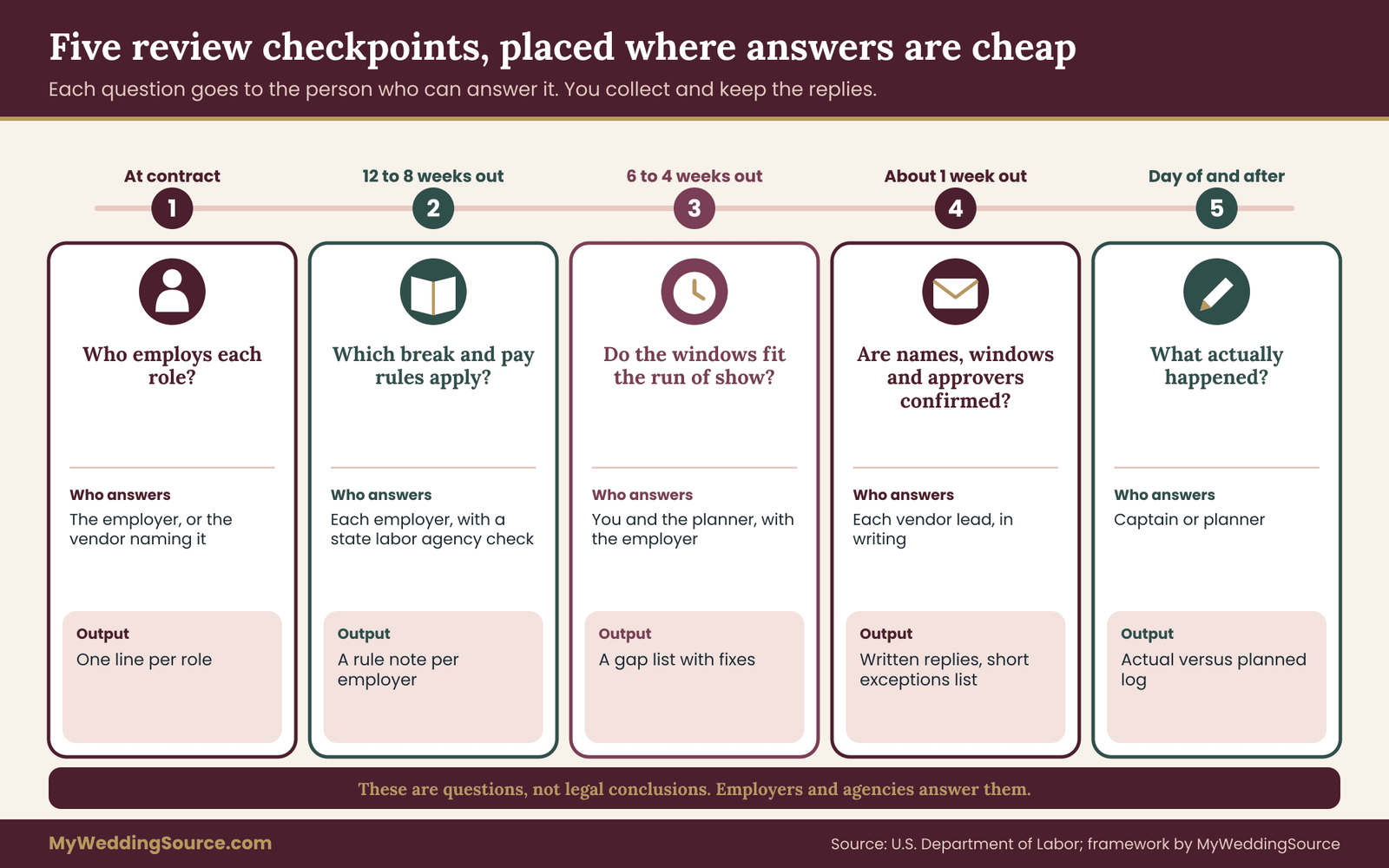
Checkpoint one: who is the employer? (at contract)
Before you sign, list every role that will work at your event and write down who employs each person: the venue, the caterer, an agency, a planning firm, a band leader, you, or no one because the person is a volunteer. Ask each vendor to state it in the contract or a short email.
The goal is not to audit the vendor. It is to know whom to ask each later question, since break rules attach to the employer and the person you spoke to at the booking may not be that employer.
The output is a one-line entry per role: “Servers: employed by the caterer.” “Barback: placed by a staffing agency.” “Guest book attendant: friend, unpaid.”
Checkpoint two: which rules apply? (draft staffing, about twelve to eight weeks out)
When the headcount is drafted, ask each employer in writing what break and pay rules their staff follow for a shift of the planned length, and whether any state rule is triggered. The Department of Labor publishes a state-by-state summary of meal and rest period requirements, and your state’s labor agency has the authoritative answer.
You are not looking for a legal opinion. You are looking for one sentence from each employer that tells you what wedding staff breaks their staff must receive, so that the rota you build respects it.
The output is a rule note per employer, written by the employer: “Our staff receive a thirty-minute meal after no more than five hours, and a ten-minute rest per four hours,” or whatever is true for them.
Checkpoint three: do the windows fit the day? (run of show, about six to four weeks out)
Overlay the rota on the locked run of show. Check each person’s longest unbroken run against the employer’s rule note. Mark any stretch that exceeds it. This is the checkpoint where the timeline and the rules meet, and it is usually where a problem appears: a thirty-minute meal that cannot happen before the seventh hour, a rest that lands during dinner plating, a break window shortened by a late ceremony.
The output is a gap list with proposed fixes: move the meal earlier, add a floater for ninety minutes, or shorten the service window.
Checkpoint four: confirm in writing (about one week out)
Send the final rota to each vendor lead and ask them to confirm three things: the names, the windows and the approver. Ask also whether any worker is under eighteen, since young workers often face limits on hours and late shifts under federal and state child labor rules, and whether any person is on call or expected to travel between sites. Keep the replies.
The output is a set of written confirmations, and a short list of exceptions.
Checkpoint five: record what happened (day of and within a week)
On the day, someone notes the actual times: when the crew arrived, when wedding staff breaks started and ended, when the last person was released. It can be a single line in the planner’s notes. The employer is the one with recordkeeping duties, and the Department of Labor publishes a fact sheet on them. For you, the record is a quick way to settle a later question, such as an overtime bill that seems high or a vendor who says a break was given when it was not.
The output is a one-page actual-versus-planned log, kept with your other wedding records.
Why the checkpoints sit where they do
Each checkpoint is placed to prevent a specific, expensive failure. The employer question belongs at contract, because after signing you have less leverage to ask. The rules question belongs at draft staffing, because the answer changes the headcount. The windows question belongs after the run of show is locked, because before that, the windows are guesses.
The confirmation belongs a week out, because that is the last moment a replacement can be found. The record belongs on the day, because memory fades within days.
What the checkpoints are not
They do not settle legal questions, and they are not a claim that you can verify compliance. If an employer gives an answer that seems off, or if a worker raises a concern, the right move is to ask the employer to confirm with their own adviser or the state labor agency. Your role in wedding staff breaks is to ask clearly, keep the answers and build a schedule that does not work against them.
Putting wedding staff breaks into quotes, contracts and run sheets
A plan for wedding staff breaks that lives only in your head cannot survive a vendor change, a sick day or a planner who leaves early. Writing it into the paperwork turns it into a shared expectation. You do not need a long legal clause. You need a handful of plain lines in the places vendors already look.
What to ask for in the quote
When you request a quote from a caterer, banquet venue or staffing company, ask the vendor to state the following in writing.
The call-to-release hours for each role, not only the event hours. A quote that says “five hours of service” tells you nothing about the nine-hour day behind it. The guide to reading a vendor agreement explains how to compare hours, scope and add-ons across proposals so that two quotes mean the same thing.
The planned wedding staff breaks for the shift length, stated by the vendor in its own words. A single sentence is enough: “Staff receive a thirty-minute meal and ten-minute rests as scheduled in the attached rota, consistent with applicable law.”
The relief for hard posts, by role. For example, “A barback covers bartender rests during the toasts and mid-dance windows.”
The rate for extensions, meaning what happens if the event runs late, the ceremony starts late or breakdown takes longer than planned. A vendor that does not state an overtime or extension rate leaves you with a surprise on the final invoice and a staff member under pressure to rush a break.
The substitution rule, meaning what happens when a staff member calls in sick. Ask whether the vendor keeps a bench, how much notice it needs and whether a replacement arrives for the full shift or only part of it.
What not to write
Do not ask staff to give up wedding staff breaks in exchange for something, and do not write a clause that says the crew “will not take breaks during the event.” Whether a worker can waive a break is a question of law that depends on the state and the employer, and in many places the answer is no.
You are not the right party to ask it, and a vendor who is asked to promise it may either refuse or agree and then run an unsafe evening. If the schedule truly cannot accommodate wedding staff breaks, change the schedule or add staff.
Also avoid requiring the vendor to supply a specific number of staff without describing the posts. A headcount tells the vendor how many people to send. A list of posts and windows tells the vendor what you expect them to do.
The rota as an attachment
Attach the one-page rota to the run of show and label it plainly: “Staff relief rota, version two.” Include names if the vendor has assigned them, or roles if not. Give each break a window and a reliever. Add a line at the bottom that says who approves changes on the day and how to reach that person.
Version the rota the way you version the run of show, since wedding staff breaks change whenever the timeline does. When the timeline changes, the rota changes. A rota whose windows no longer match the evening is worse than none, because people trust it. The timeline guide for vendors suggests a simple way to track versions and confirmations, and the same habit works here.
Clock windows versus event windows
One drafting choice makes a real difference: attach wedding staff breaks to events, not to clock times. “Team A meal during the ceremony” survives a delayed ceremony. “Team A meal at four o’clock” does not. When the toasts move by half an hour, “rests during the toasts” moves with them, while “rests at seven oh-five” turns into a promise nobody can keep.
The exception is a hard limit. If an employer’s rule note says a meal must start before a certain number of hours into the shift, write that as a clock constraint on top of the event window: “meal during the ceremony, and in any case before the fifth hour of the shift.” The rota then has an event window for normal days and a clock backstop for unusual ones.
The run sheet line
Many weddings use a single run sheet for the day. Add a small line for each quiet window: “Quiet window: ceremony. Crew meal, Teams A and B. Approver: captain.” That puts wedding staff breaks inside the document that people actually read during the event, and it reminds the planner to protect the window when someone suggests an extra photo or a longer speech.
Fees and add-ons
Good wedding staff breaks sometimes cost money. A floater, a middle-hours bartender or an extra hour of overlap is a labor line. Ask for it as an option with a price and decide with the whole budget in view. The wedding cash-flow planning guide shows how to place a change like this into the payment schedule so that the final balance does not surprise you.
Do not infer a price from a general article. Prices depend on the market, the vendor and the date, and the only reliable figure is the one in your written quote.
Staff meals and the break
A break is easier to protect when food is already arranged. If the vendor’s staff will eat a catered meal, agree on where it is served, when it is ready and whether it is included in the headcount you are paying for. A meal that arrives at the end of the window, or that is served in a room crowded with guests, undoes the break it was meant to support.
Wedding staff breaks depend on food, water and a seat being ready. The same applies to water, a place to sit and a restroom the staff can use without crossing the guest area.
A worked case: one evening, twelve crew members, one rainstorm
The case below is invented for illustration, and it follows wedding staff breaks from the first quote to the last record. The people, times and rules are made up to show how the method works, and no real wedding or employer is described.
Lena and Marcus are planning a wedding for about one hundred and forty guests at a property with a garden and a ballroom. The caterer supplies twelve people: one captain, six servers, two bartenders, one barback and two kitchen staff. The schedule runs like this.
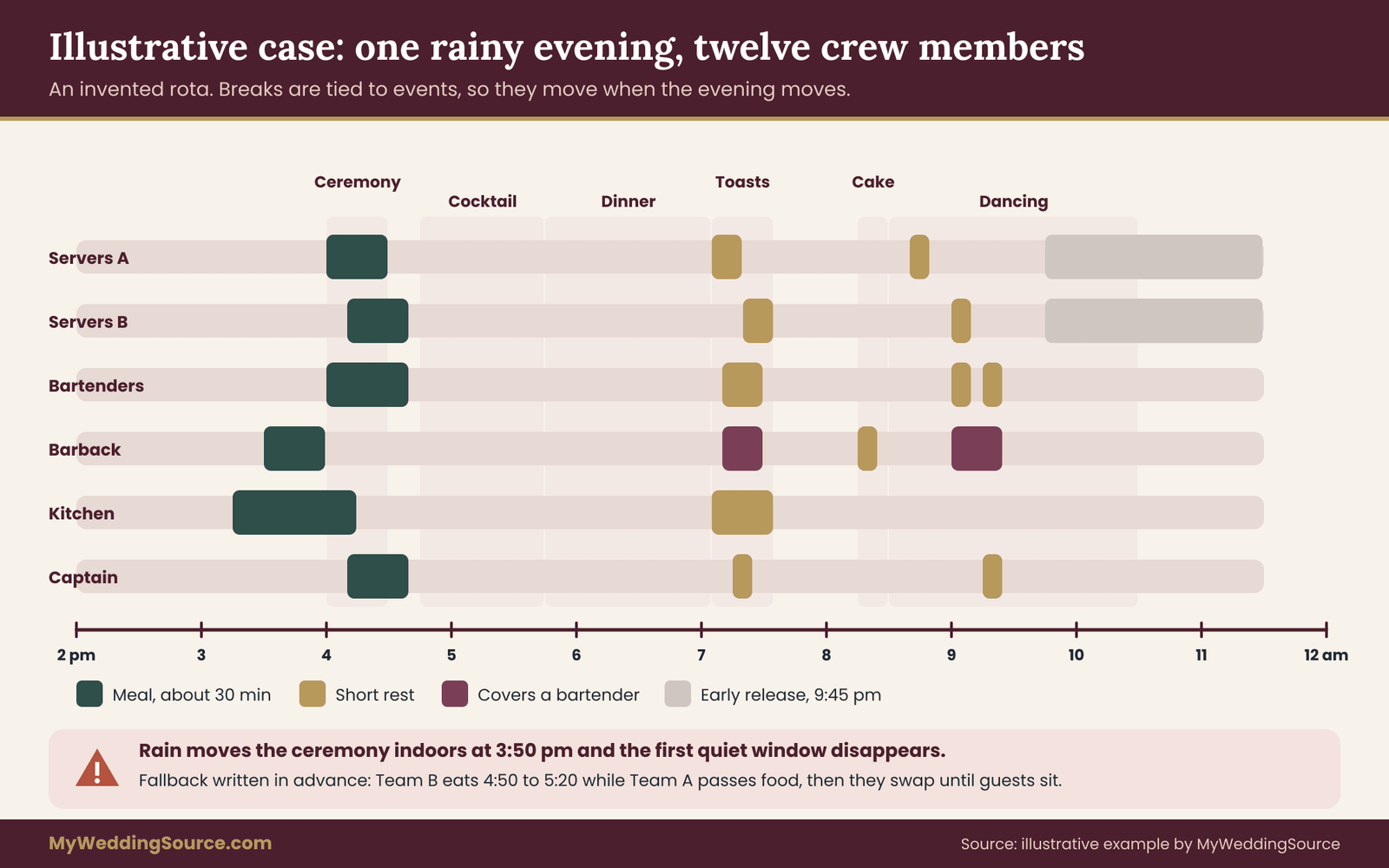
Crew call is at two in the afternoon. The ceremony is in the garden from four to four thirty. Cocktail hour runs from four forty-five to five forty-five. Guests sit at a quarter to six, salads go out at six, entrees from six twenty-five to seven oh-five, and toasts run from seven oh-five to seven thirty-five. Dessert and clearing follow, cake is cut at eight fifteen, dancing runs from eight thirty, last call is at ten thirty and the crew is released at eleven thirty after breakdown.
Step by step on the case
Posts. The bar is hard while open. The kitchen pass is hard during plating. The door to the garden is soft after guests are seated. The guest book table is soft. The floor is a set of semi-hard posts that need at least three servers during service. The barback and the captain are floaters.
Windows. The ceremony is the first and longest window, since the ballroom is set and the bar is closed. The toasts are the second. Cake cutting is a short third. Mid-dance is a rotating window.
Assignments. Team A, three servers, eats from four to four thirty. Team B eats from four ten to four forty. Both teams are in position by four forty-five. The two bartenders eat in the same window, one after the other, while the barback checks the bar. The kitchen staff eat at three fifteen and three forty-five, before the ceremony. The captain eats at four ten while the planner’s assistant holds the room.
During the toasts, Team A rests from seven oh-five to seven twenty and Team B from seven twenty to seven thirty-five. The first bartender rests from seven ten to seven twenty and the second from seven twenty to seven thirty, with the barback covering each. Kitchen staff rest in turn while the other holds the pass. During the cake cutting, the bar pauses for a few minutes with a small sign, and the barback takes a short rest.
During the dancing, one server at a time takes a ten-minute rest between eight forty and nine thirty, and bartenders rest at nine and nine fifteen, covered by the barback. Two servers are released at nine forty-five by agreement with the caterer, since the floor needs fewer hands late.
What the checkpoints found
At checkpoint one, Lena learns the barback is placed by a staffing agency, not employed by the caterer. At checkpoint two, the caterer and the agency each send a one-line rule note. They differ: the agency’s note describes a meal earlier in the shift than the caterer’s. Lena does not choose between them. She adjusts the rota so that the barback’s meal falls early enough to satisfy the stricter note and asks both to confirm.
At checkpoint three, overlaying the rota on the run of show shows that the second bartender’s final stretch, from nine fifteen to eleven thirty, is the longest unbroken run in the plan. The captain proposes releasing a bartender at ten thirty after last call, with the barback and one server handling breakdown of the bar. The caterer agrees to a revised rate in writing.
At checkpoint four, the caterer confirms all names and windows and notes that one server is nineteen. At checkpoint five, the captain records actual times on the day.
The surprise
On the day, rain moves the ceremony into the ballroom at three fifty. The reception room is now the ceremony room, and the first quiet window disappears. Crew meals cannot happen from four to four forty because the room is in use and the flip begins at four thirty.
Because the rota is attached to events, the plan has a fallback written at checkpoint three: if the ceremony window is lost, the three servers on Team A pass appetizers while Team B eats from four fifty to five twenty, and the teams swap from five twenty until the guests sit at a quarter to six, with the captain covering Team A’s gap.
Bartenders eat during the ceremony itself, since the bar is closed until the cocktail hour, in a back room, with the barback watching the bar cart.
The result is not perfect. Team B’s meal is twenty-five minutes, not thirty. The captain notes it in the log. The caterer decides afterward whether that matters under its own rule. The point of the case is that the evening did not produce a skipped break, since the fallback existed before the storm.
What the case teaches
Three lessons about wedding staff breaks come out of it. First, the rota is attached to events, so it moves when the evening moves. Second, a written fallback for the largest window is worth more than any other single line in the plan. Third, the legal questions were answered by the employers, in writing, before the day, and recorded afterward. Lena never had to interpret a rule. She only had to ask clearly and keep the answers.
Alternatives when relief is thin
Sometimes the plan for wedding staff breaks does not balance. The budget is tight, the venue allows only so many staff or the vendor cannot supply a floater. Before you accept a plan with gaps, run through the alternatives below. Each one trades something, and the trade should be chosen, not stumbled into.

Alternative one: shorten the day
The cleanest fix is often to reduce the span. A later call time for the dining room crew, a pre-set room delivered by the venue the day before or a shorter breakdown with a hard release time all cut hours without cutting service. The cost is that someone else does the early work: the venue, the rental company or a separate setup crew. A short conversation about who sets the room can recover an hour or more per person.
Alternative two: close or merge a post
A soft post that cannot be staffed can be closed or merged. A coat check in a mild season can become a rack with a sign. A favor table can fold into the guest book table. A separate dessert station can be served from the main bar line. Closing a post frees a person and often costs little. Do not close a hard post, and do not close a post that someone relies on for access or safety.
Alternative three: pause the bar
A planned bar pause during the toasts or the cake cutting gives bartenders a real rest without a floater. Announce it quietly with a small sign, and keep water and any non-alcoholic drinks available at a self-serve station. Guests rarely mind a ten-minute pause when they are listening to a speech. Check with the venue and the caterer first, since some contracts and licenses have conditions about service hours, and the person managing the bar should agree.
Alternative four: split the shift
For a long event with a natural gap, such as a midday ceremony and an evening reception, a split shift gives staff a long break between two work periods. It is the best fit for events where the dining room is idle for hours. It raises pay and travel questions that only the employer can answer, and some staff prefer a continuous shift. Ask the vendor if this is something they offer, and do not impose it.
Alternative five: add a floater for the middle hours
A single extra person from about five to nine, the peak of the evening, often solves most relief problems. Because the floater works a short shift, the cost is modest compared with adding a full-time server. The floater can be a barback, a runner or a planner’s assistant. If you cannot afford one, a trusted volunteer for a narrow task, such as watching a soft post for ten minutes, can fill a smaller role.
Keep volunteers away from hard posts and away from anything involving alcohol, hot food or heavy lifting, and remember that volunteer status raises its own questions.
Alternative six: change the format
Sometimes the right move is to change the service style. Family-style and buffet service shift the peaks and may open windows that plated service does not. A stations format spreads staff across more posts. A cocktail-style reception with fewer seated courses lowers the load on the floor. Format changes affect cost, guest experience and menu, so they belong in the larger planning conversation. They are on this list because they can solve a relief problem that nothing else will.
Choosing among the alternatives
Use a simple order of preference. First, try to shorten the span, since fewer hours helps everyone. Second, close or merge soft posts. Third, add relief where the need is highest, usually a floater or a second bartender for the middle hours. Fourth, pause a service in a quiet window with the vendor’s agreement. Fifth, change the format. Avoid the sixth option, which is to accept an uncovered hard post and hope. Ranking the choices this way keeps wedding staff breaks from being the first thing cut.
When you cannot afford any of them
If none of these works for your budget, the plan can still be honest. Even a modest budget can protect wedding staff breaks if you name the worst post. Tell the vendor which post you are most worried about and ask what they would do. Ask them to name the longest unbroken run in their own plan.
A vendor who understands the problem will often propose something you had not thought of, such as moving a staff meal to the ceremony window or putting a lead on the bar for one rest. If the vendor shrugs, treat that as information about the vendor.
Heat, food, water and restrooms: the practical side of wedding staff breaks
A break needs a place and a purpose. Even a perfectly timed rota fails if the staff have nowhere to sit, nothing to eat and no way to wash their hands. This section covers the physical conditions that make wedding staff breaks actually restful, and it is the part of planning most often left until the day.
A place to go
A named place is the first requirement for wedding staff breaks. Staff need a defined break area that is out of guest view. At a hotel or banquet hall, this is usually a staff room, and you should confirm it exists and is unlocked. At a tent, garden or barn, it may need to be created: a shaded corner, a few chairs, a table, a small cooler and a screen or a closed vehicle door that blocks the guest sightline.
The venue technical walkthrough guide covers how to check access routes, power and back-of-house space on a site visit, and the staff break area belongs on that checklist.
If staff must walk through the guest area to reach their break space, the break gets shorter. Walk the route yourself at the walkthrough and time it. A five-minute walk each way turns a ten-minute rest into no rest.
Water and heat
Heat changes how often wedding staff breaks should happen. For outdoor and tented weddings in warm weather, water, shade and rest are safety matters, not courtesies. The Occupational Safety and Health Administration publishes guidance on heat exposure for workers, and the basic ideas are consistent: access to water, shade or cooling, and rest, with extra attention for people new to the heat. An employer is responsible for protecting its workers, but you can help by providing shade, cold water and a cooler place to rest.
If the forecast is hot, shorten the intervals between rests instead of lengthening them, and put the most physical posts, such as the bar cart and the outdoor setup, on a shorter rotation. Dark uniforms in direct sun, black tent walls and hot kitchens make the day harder. Ask the vendor whether there is a heat plan.
Food
A meal that is ready on time is half of what makes wedding staff breaks work. A staff meal should be ready when the break window opens and should be something a person can eat quickly: a plate, a sandwich, a bowl. Confirm any dietary restrictions. Provide water and a place to sit.
Hand washing matters too: the FDA Food Code is the model that many states use for food service rules, and it includes expectations about handwashing for food workers. Staff who come back from a break to touch food or glassware need a sink and soap within reach.
If staff meals are part of the catering contract, check that the portion is included and the timing is clear. If not, an inexpensive arrangement, such as sandwiches for the crew, may be worth including in the plan. Treat this as one more reason to read the contract section above.
Restrooms
Staff restrooms are often an afterthought. A rest break that depends on a queue with guests is not a rest. Ask the venue where staff restrooms are and whether they will be open and stocked. At a private property or a rented tent, a separate portable restroom for crew may be a modest, useful addition.
Phones and quiet
A break is partly a mental pause. Staff often need to check messages from home, especially on long days. A designated place where phones are allowed, away from guests, is a small kindness that costs nothing. Give crew the planner’s number and a clear rule about when to use it.
Alcohol and the break
Staff should not drink on duty. Say so plainly in the briefing, and agree with the vendor how a staff toast or an end-of-night drink is handled, if at all. Some venues prohibit staff from consuming alcohol on premises at all. This is a rule for the vendor and the venue to set, and the couple should avoid offering drinks to the crew during the event.
Shoes, floors and feet
Long standing on hard floors is tiring, and the break that matters most may be one where a person can sit and change shoes. A chair and a clean place to put a bag are easy to supply. If the day includes grass, gravel or stairs, ask whether the vendor expects staff to wear specific footwear, and whether anything about the surface needs to be fixed in advance.
What good conditions look like
You will know wedding staff breaks are set up properly when a staff member can answer four questions without hesitating: where do I go, where is my food, where can I wash my hands and who covers my post? If any answer is “I’m not sure,” the break is at risk, whatever the rota says.
When wedding staff breaks fail: conditions to watch and fast fixes
Every plan for wedding staff breaks has conditions under which it stops working. Naming them in advance is part of the method, because it tells you what to watch on the day and when to fall back. Here are the failure conditions that come up most often, each with a quick response.
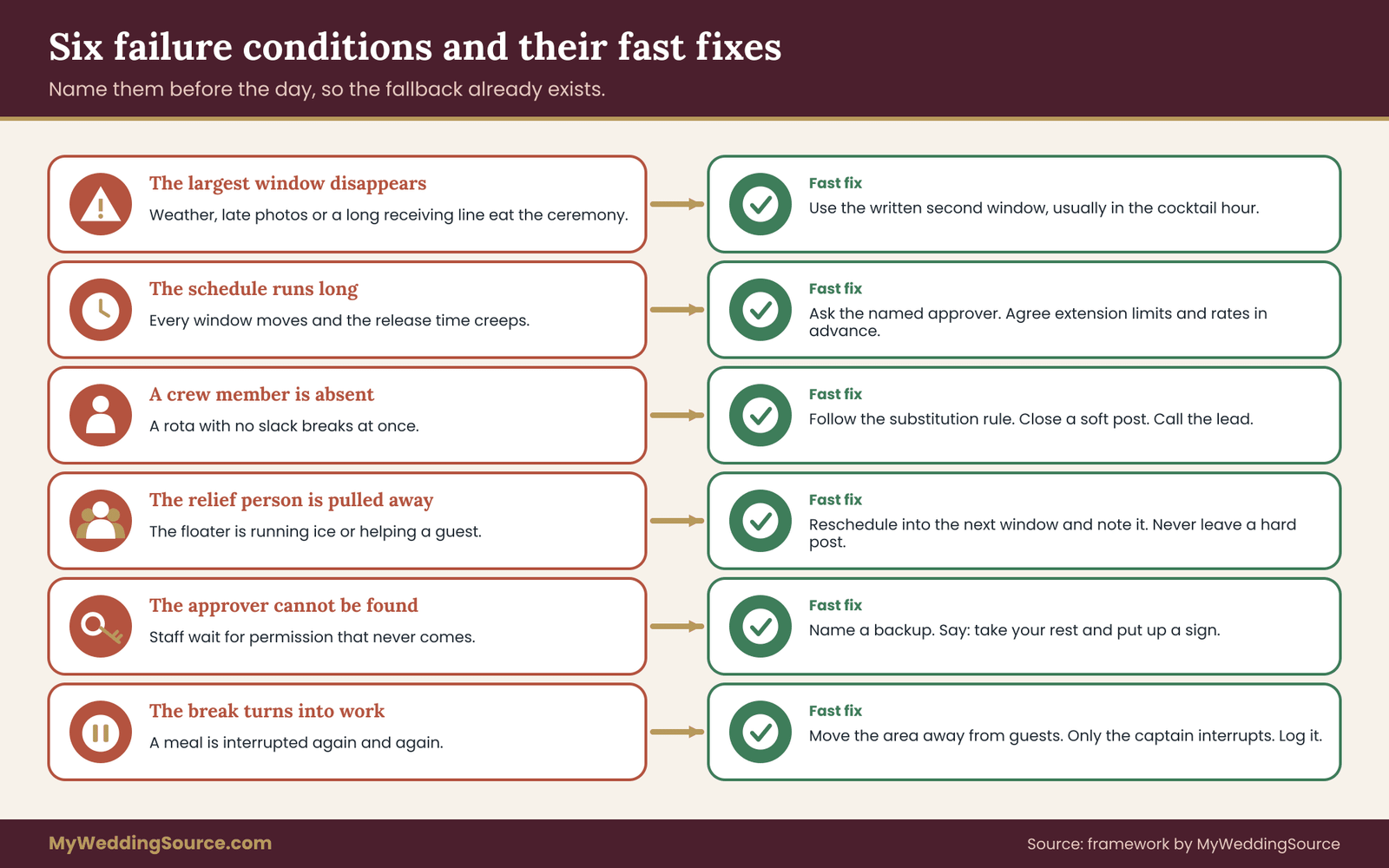
The largest window disappears
This is the rainstorm case. A weather move, a late photographer or a long receiving line can eat the ceremony window, which is usually the only time a full meal is possible. The response is the written fallback: a second window, usually inside the cocktail hour for the dining room crew, with the captain covering. If there is no fallback, the meal gets pushed past dinner, and that is the point at which people start going without.
The schedule runs long
If the evening runs thirty minutes behind, every window moves, and the question is whether the crew’s release time moves too. A late finish can push hours into overtime and strain tired staff. Ask the vendor to name an approver for extensions and a limit. For example, “we will confirm with the planner if the event will run past eleven.” Decide ahead of time who can authorize a later release and what it will cost, instead of negotiating it at eleven at night.
A staff member does not arrive or leaves early
One missing person can break a rota built with no slack. The vendor’s substitution rule is the first defense. The second is a rota with a thin buffer: if one server is absent, the floor can run on five and the captain steps in, but only for a defined period.
The next step is a decision about which soft posts to close. A third step is a call to the vendor’s lead for a replacement. The question of who is absent and who covers belongs to a different planning conversation, and this article stays with wedding staff breaks.
The relief person is pulled elsewhere
Floaters are in demand. A barback is asked to run ice, change a keg and cover a bartender at the same time. A planner’s assistant is pulled into a guest issue. When the floater is unavailable, the break should not simply be skipped. The captain should reschedule it into the next window and note it, and no hard post should be left uncovered in the meantime.
The approver is missing
If the person who approves wedding staff breaks is busy, absent or has left, staff may not know whom to ask. Name a backup approver and tell the crew. In the briefing, say: “If you cannot find the captain, ask the planner, and if you cannot find either, take your scheduled rest and put a sign on your post.” A plan that says wedding staff breaks happen at the scheduled time unless an approver says otherwise is more durable than one that waits for permission.
The break turns into work
A staff meal that is interrupted three times is not a meal. If a worker is repeatedly called away during a break, the break has failed, and the employer may need to treat that time differently. You can reduce interruptions by placing the break area away from the guest space and by agreeing that only the captain interrupts a break, and only for something urgent. Ask for the interruption to be noted in the log.
The crew is unfamiliar with the room
A crew that has never worked at the venue takes longer to find the staff room, the ice and the restrooms. Their first break may be consumed by hunting. Give them a map at the briefing or walk them through the route at call time.
The plan is too complicated to use
A rota that requires reading a grid of names at eight o’clock will be ignored. If the captain cannot explain the plan in a minute, it is too complicated. Cut it down to the essentials: meal windows, the toast rests and the relief for the bar. A simple plan for wedding staff breaks that is followed beats an elegant plan that is not.
Reading the warning signs
Signs that wedding staff breaks are slipping include a server who has not sat down in hours, a bartender who has not had water, slow table clearing and a captain who looks anxious. When you see these, do not wait for the next scheduled window. Ask the captain whether anyone is overdue and offer to cover a post for ten minutes yourself, or ask a trusted friend to do it. A small, quick relief often does more good than a perfect plan that arrives late.
A word on limits
There will be evenings when a break cannot happen on schedule. Wedding staff breaks that slip should slip visibly, not silently. Safety comes first: if a guest has a medical emergency, or a hard post cannot be left, the break waits. What matters is that the delay is noticed, a new time is set and the break happens as soon as it can. The record at checkpoint five is where you note it, so the employer can treat it correctly.
The day-of briefing: scripts, signals and one approver
A good rota for wedding staff breaks is useless if the crew has never heard of it. A short briefing before guests arrive turns the page into practice. It takes about five minutes and should include the planner or coordinator, the captain and, ideally, the leads from each vendor group.
What to cover in five minutes
Start with the windows. Say when the quiet windows are and who has which break. Then name the approver and the signal. Say where the staff area is and how to get there without crossing the guest space. Mention food, water and restrooms. End with the fallback: what happens if the ceremony window is lost.
A script might sound like this: “Teams A and B eat during the ceremony, thirty minutes each, staggered. Rests are during the toasts and the mid-dance stretch. The captain approves breaks. If you need one sooner, tap her shoulder or text this number. The staff room is behind the kitchen, and water is in the cooler by the door. If rain moves the ceremony, Team B eats from ten to five instead, and she will tell you.”
Keep it plain and brief. Do not read from a long page. Hand each lead a printed copy and put one on the wall of the staff area.
Speaking to the crew as a client
If you or a family member is the one giving the briefing, be careful about tone. The crew is working for their employer, not for you, and an instruction that sounds like an order can create friction. Phrase the plan as a request that is already agreed with their lead: “Your captain and I put this together so everyone gets a break. Please follow her lead.” Thank people. Learn the captain’s name. A crew that feels respected pays more attention to the details.
Signals that do not disturb guests
Choose a signal that does not draw attention. A hand on the shoulder, a nod toward the staff door or a short text to the captain is enough. Avoid walkie-talkie chatter in the guest area, and avoid announcing wedding staff breaks aloud. A server who walks across a quiet room to ask permission is exactly what the plan is meant to avoid.
The single approver rule
Each employer group should have one approver, and the crew should know who it is. Two approvers create conflicting answers. If you have more than one vendor group, each with its own captain, make sure they know each other and agree on the shared windows. A short conversation among leads before guests arrive solves most overlaps, such as the band wanting a break during the same quiet window as the bartenders.
Updating the plan on the fly
When the evening changes, update the rota out loud. If the toasts start late, tell the captain: “Toasts are fifteen minutes late, so rests move with them.” One sentence prevents a dozen separate questions. Have the captain tell the crew and mark the change on the printed copy. Do not assume the change will spread on its own.
Keeping the record
At checkpoint five, the captain, planner or a designated person records actual times in a notebook or a phone note: crew arrival, each meal, each rest, last guest, release. Two minutes at the end of each window is enough. The log helps the employer, who has recordkeeping duties, and it helps you if there is a question about the final invoice. Keep it with your other wedding records.
After the event
Within a week, ask the captain or planner how the wedding staff breaks went and what did not work. Which window was too short? Which relief was stretched? Was there a break that did not happen? Write the answers beside the rota. If you hire the same vendor again, for an anniversary or a family event, or recommend them to a friend, those notes are useful.
A thank-you to the crew is also worth sending, through the employer, since good scheduling is a form of courtesy that people notice.
If a worker raises a concern
If a staff member tells you they have not had a break, or a pay concern comes up, do not try to resolve it yourself. Say you will pass it to their lead, and do so at once. If the concern is about a legal right, the employer and the state labor agency are the right places. Pointing someone to the Department of Labor’s Wage and Hour Division, or to their state agency, is appropriate. Interpreting the law on the spot is not.
Your next steps
Start with an hour on a quiet evening. Draw the day as a strip from the earliest call time to the latest release, list the posts, mark each as hard, soft or floating, and shade the quiet windows. That page is the foundation for everything else, and it will show you at once whether your wedding staff breaks are realistic or optimistic.
Then take three actions in order. First, ask each vendor who employs their staff and what break and pay rules they follow, and ask for the answer in writing. Second, build the rota with a named reliever for every break, a fallback for the largest window and one approver per employer group. Third, send the rota to your vendors with the final timeline and ask them to confirm names, windows and approvers a week before the event.
On the day, hold a five-minute briefing, keep a simple log and update the plan aloud when the evening shifts. Afterward, write down what worked. A calm, specific plan for wedding staff breaks costs little, protects the people who make your evening run and keeps service steady through the last dance.
FAQ
Do wedding vendors have to give their staff breaks?
The rules for wedding staff breaks depend on the state and on the worker’s status. Federal law does not generally require meal or rest wedding staff breaks, but many states do, and they differ on length and timing. The vendor’s employer is responsible for following the rules that apply. Ask each vendor in writing what their staff receive, and check your state labor agency or the Department of Labor’s state summary for the rules in your area.
How many wedding staff breaks should a wedding crew get?
There is no single number for wedding staff breaks. A common planning pattern for a long shift is one meal of about thirty minutes and one or two short rests, spaced across the day. Your employers’ rules may require more or set different timing. Build the rota from the run of show, then confirm the final pattern with each employer, since state rules and company policies vary.
When is the best time for a wedding staff meal?
Usually during the ceremony, when the reception room is set and the bar is closed. That is typically the longest quiet window of the day. Have a written fallback, such as the cocktail hour, if weather or a delay removes it. Whatever time you choose, make sure the food is ready when the window opens and that staff can sit away from guests.
How do we cover the bar while bartenders take a break?
For wedding staff breaks at the bar, use a barback or floater, a lead who is qualified to serve, or a short planned bar pause during the toasts or cake cutting. Do not leave an open bar unattended. Check who is allowed to serve alcohol under your state and venue rules, since not every staff member is. Ask the caterer to name the reliever for each bartender rest in advance.
Are wedding staff breaks paid or unpaid?
Whether wedding staff breaks are paid is a question for the employer and the applicable law. In general terms, the Department of Labor says short rest breaks of about five to twenty minutes are usually counted as work time, while a meal period of at least thirty minutes can be unpaid if the worker is fully relieved of duty. State rules and company policies may differ, so ask the employer.
What if the event runs late and the crew’s shift gets longer?
Agree in the contract on how extensions are approved and priced, and name who can approve a later release. A longer day can add overtime costs for the vendor and fatigue for staff. If the evening runs long, check whether anyone is overdue for a break, release staff the floor no longer needs and confirm the extension rate in writing before the night begins.
Can volunteers or friends cover posts so staff can rest?
They can cover soft posts, such as a guest book table, for a short time. Keep them away from the bar, hot food and anything physically risky. Volunteer status raises its own questions about classification and responsibility, so ask your vendor or an adviser if the arrangement is more than casual help from a guest. Give each volunteer one clear task and one named person to ask.
Should we tell the crew about the rota, or leave it to the vendor?
Do both. Give the rota to the vendor lead in advance, then hold a brief day-of briefing with the lead present. Phrase it as the plan you and the lead agreed on, not as orders. The lead remains the person who approves wedding staff breaks and answers to the employer, and the briefing makes sure everyone hears the same plan at the same time.
Sources
- Breaks and meal periods, U.S. Department of Labor
- State meal and rest period requirements, U.S. Department of Labor, Wage and Hour Division
- Fact Sheet 22: Hours worked under the Fair Labor Standards Act, U.S. Department of Labor
- Fact Sheet 21: Recordkeeping requirements under the Fair Labor Standards Act, U.S. Department of Labor
- Overtime pay, U.S. Department of Labor, Wage and Hour Division
- Worker misclassification, U.S. Department of Labor, Wage and Hour Division
- Independent contractor (self-employed) or employee?, Internal Revenue Service
- State child labor laws, U.S. Department of Labor, Wage and Hour Division
- Heat exposure, Occupational Safety and Health Administration
- FDA Food Code, U.S. Food and Drug Administration