

Bridal outfit changes work best when the swap is treated like any other timeline item, with a start time, a length, a helper, a place to do it, and a photographer who knows when the bride will disappear and when she will walk back in.
Quick answer
Published planning guides put a straightforward change at roughly 15 to 30 minutes, and one planner who works on multi-outfit cultural celebrations builds in 40 to 45 minutes. Decide where the change falls by asking what you do not want to miss: the first dance, dinner, the toasts, the cake, or golden-hour portraits. Keep the first dress for the moments you most want photographed, tell your photographer, videographer, and DJ the exact plan, and give one named person the job of helping you. If a full second dress feels like too much, a detachable skirt, a bustle, or a new hairstyle can change the look without a long absence.
What bridal outfit changes are, and who they suit
A second look at the reception is optional, and plenty of couples skip it. The Knot describes it as a choice that depends on how the reception flows, whether there is a private place to change, and how much you want a second look. Bridal outfit changes are less about fashion than about logistics, because every minute you spend changing is a minute you are not with your guests or in front of the camera. This guide treats the change as a small project and gives you the pieces to plan it: a time budget, a map of when to change, a photographer cue sheet, a sunset check, and a care plan for the dress you take off.
Why people change at all
People who plan bridal outfit changes tend to give one of three reasons: comfort, variety, or tradition. Knowing which one is yours helps you choose the timing and the style of the second outfit.
Comfort for dinner and dancing
Jovani, a gown designer, notes that ceremony gowns can have heavy tulle, structured boning, dense beadwork, and long trains that are hard to manage on a crowded dance floor. Zola makes a similar point about mermaid silhouettes and tight corsets that are uncomfortable for dinner or dancing. If you already know that you will want to sit for a long dinner and dance for hours, that is a practical reason to plan bridal outfit changes.
Variety for photos and for the room
The Knot lists variety in photos as a benefit and notes that a second look can change the whole picture, because shoes, jewelry, or hairstyle can change along with the dress. Inside Weddings suggests making the second dress look clearly different from the first, and Bella Bridesmaids says the change is not worth much if the two looks are too similar. That is a reasonable test: if a guest could not tell you changed, the time away from the party bought very little.
Tradition and heritage
Some couples change because their culture expects it. The Knot gives the example of a Qi Pao for a Chinese heritage, and a Nigerian-focused planner writes about full wardrobe changes that include a professionally tied head wrap. If your celebration includes several outfits, skip ahead to the edge cases section, because the time budget changes a lot.
Reasons to skip a change
Bridal outfit changes are not a default, and the people who publish advice on them say so plainly.
Cost and effort
Zola notes that a second dress adds cost on top of an expensive first dress, and The Knot says choosing a second outfit can feel overwhelming on top of the wedding dress decision. The Knot adds that reception dresses are usually simpler, and Zola says second dresses are usually cheaper than ceremony gowns, though still an added expense. We could not find a published average price for a reception outfit that comes from more than a single seller, so we do not quote one here.
Time away from guests
Zola lists the change itself as time-consuming: unlacing, redoing hair, touching up makeup, changing shoes, and stepping away from guests. A reception with a short program may not have a natural gap for bridal outfit changes. Zola suggests asking how long the reception lasts, and if there is little time and little break, a change may not be worth it.
A gown that already works
Complete Weddings and Events writes that if your main gown is light, easy to bustle, and comfortable, you may not need a second look, while heavy or restrictive gowns are the ones planners tend to suggest changing out of. Some brides stay in one dress all night, and skipping bridal outfit changes is a perfectly good plan, and a well-fitted bustle is often all the adjustment a gown needs. Our guide to wedding dress train lengths explains how train length affects what you can do on a dance floor.
Alternatives that change the look without a long absence
If the main problem is a train or a heavy skirt, a smaller version of bridal outfit changes may solve it.
Convertible pieces
New York Dress describes gowns with detachable overskirts or trains that reveal a slimmer silhouette, removable sleeves or straps, and capes or toppers that lift away after portraits. Complete Weddings and Events also mentions detachable skirts, sleeves, and overskirts as ways to change the look without a full outfit change. Our guide to detachable wedding dress sleeves covers how those attachments are made and tested.
Bustle, shoes, and hair
New York Dress says a ballroom bustle hides the train under the skirt and can feel like a simpler second gown, and that nearly all full-length gowns can be bustled. It also suggests switching shoes after portraits or the first dance and adding a bolder lip or shimmer to signal a reception look in minutes. These are the cheapest bridal outfit changes there are, and none of them requires leaving the room.
How long bridal outfit changes take, and how to budget the time
Every source we read gives a different number for bridal outfit changes, which tells you something useful: the time depends on the outfit, the helper, and the distance to the changing space. Before you pick a window in the timeline, pick a number you trust.
What published guides say about duration
The published figures for bridal outfit changes are not directly comparable, because they describe different outfits and different amounts of fixing up. Here they are side by side, with the source named so you can judge them.
The ranges we found
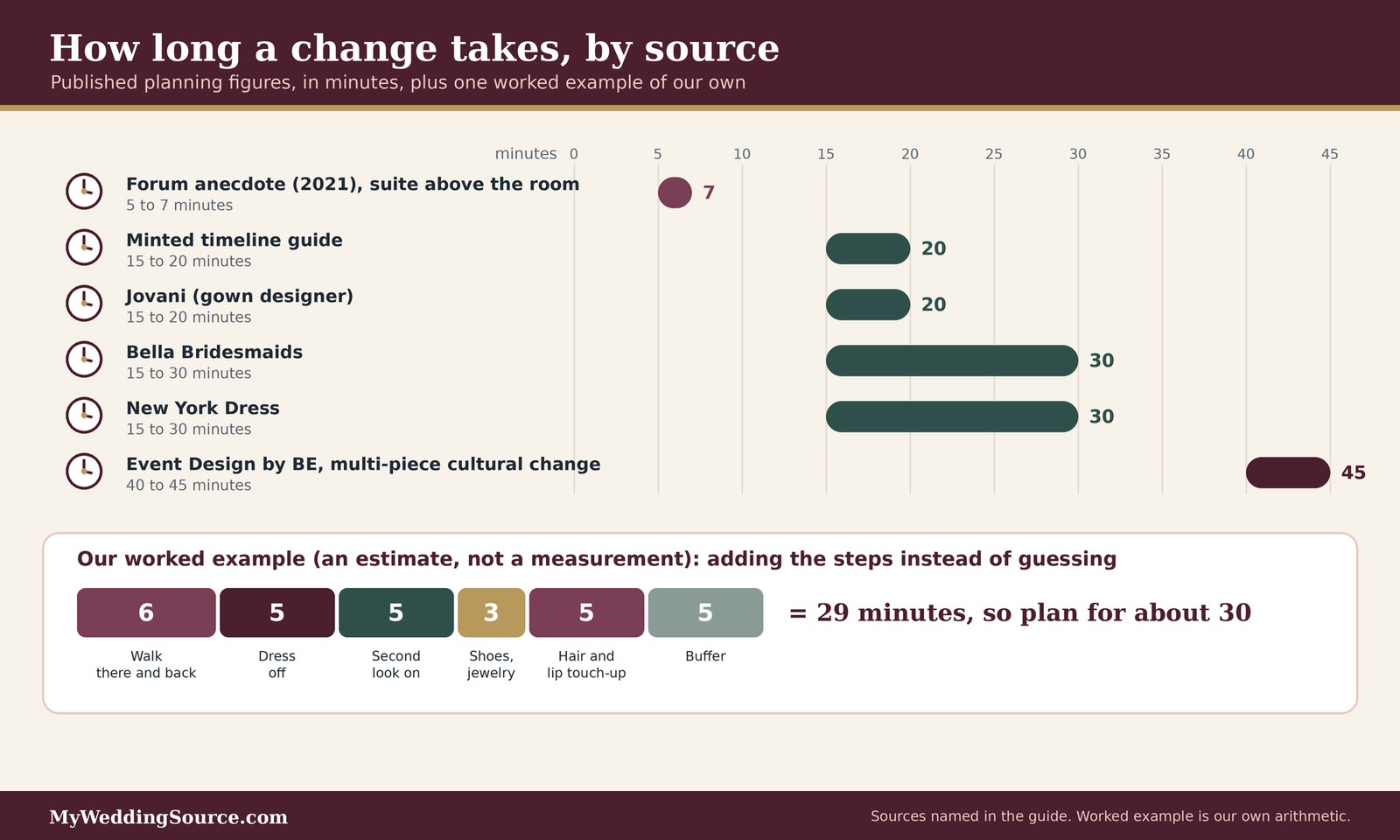
Minted’s timeline guide advises budgeting 15 to 20 minutes for bustling the dress or changing into a second look, and it lists dressing in general at 15 to 30 minutes. Bella Bridesmaids says a quick switch plus freshening up can take 15 to 30 minutes, and New York Dress gives a full outfit change as about 15 to 30 minutes. Jovani describes taking 15 to 20 minutes away from guests to change. A Nigerian-focused planner, writing about a full cultural wardrobe change that includes a professionally tied head wrap, advises against allowing only fifteen minutes and builds in 40 to 45 minutes.
One short anecdote
In a 2021 WeddingWire forum thread, one bride said she expected her change to take about five to seven minutes, mostly spent putting the wedding dress away, because her bridal suite was in a loft above the reception area. That is one person’s expectation in one thread, not a sample, but it shows how much a close changing room matters.
Building your own time budget
Instead of picking a number for your bridal outfit changes, add up the steps. The budget below is our own estimate based on the steps the sources describe, and it is meant as a starting point you adjust after a practice run.
The steps that take time
Walking to the changing space comes first, then undoing buttons or zippers, then stepping out of the first dress and into the second, then fastening it, then shoes, then hair and makeup, then the walk back and a short pause before an announced return. Inside Weddings and Bella Bridesmaids both point out that layers, buttons, and back zippers are hard to undo alone, so the helper and the closure type change the time more than anything else.
A worked example with our own arithmetic
Suppose the walk takes three minutes each way, taking the gown off takes five, putting the second look on takes five, shoes and jewelry take three, and a quick hair and lip touch-up takes five. That adds up to 24 minutes. Add a five-minute buffer, which Minted recommends padding around timeline items, and the plan is about 30 minutes. This is an illustration of how to add, not a measured result, and your steps will differ. The point of the exercise is to replace a guess with a list.
Why the buffer belongs in the plan
Minted advises padding each timeline item by at least five minutes, and sometimes ten to fifteen, and it describes a “30/5 rule” that gives thirty minutes to tasks that would usually take five. A bride who returns on time, calm, and with her lip color fixed is better for the party than one who rushes. Our guide to planning a wedding timeline shows how to build buffers into the whole day.
What makes the change shorter or longer
Four things move the time bridal outfit changes take. You can change all of them before the wedding.
Closures and layers
A gown with a back zipper and a few hooks is a quick job for a helper. A gown with a lace-up corset back, forty buttons, or a built-in crinoline takes longer on and off, and so does a second look with its own layers. Ask your tailor how the dress opens and ask how long a practiced helper needs. Our wedding dress fit and alterations guide explains how closures are chosen and fitted.
Distance and privacy
The Nigerian-focused planner recommends a bridal suite as close to the ballroom as possible, with the second outfit steamed, jewelry laid out, and the makeup artist ready before you arrive. Distance is an easy thing to ask about at a venue tour when you are planning bridal outfit changes: where would I change, how far is it, and is it private and locked?
Hair and makeup
New York Dress says it is easier to go from an updo to a looser style than the reverse, and it suggests bold lip color or shimmer for a quick reception look. If your plan includes a full hair change, add the time your stylist quotes, and see our wedding hair and makeup schedule for how to ask.
Practice
Inside Weddings says the most important step is to practice switching the outfit once you have both dresses, and to check whether you can do it alone. A trial run of bridal outfit changes with the actual helper, shoes, and a phone timer replaces every estimate on this page.
Choosing when to change: the six windows and what each one costs you
There is no single correct moment for bridal outfit changes. Each one trades something away, and the right choice depends on which part of the day you most want photographed in each dress. The windows below come from The Knot, Inside Weddings, Bella Bridesmaids, Jovani, Easy Weddings, and Complete Weddings and Events, combined into one comparison.
Windows early in the day
Early windows for bridal outfit changes give the second look more hours of wear and make the first dress a ceremony-and-portraits dress.
Right after the ceremony or portraits
The Knot lists changing right after the ceremony as useful if you want more comfort for photos or the reception feels less formal than the ceremony. Bella Bridesmaids says changing after the ceremony and official party photos, before the grand entrance, is best if you want the ceremony and reception to feel very different. The cost is that your first dress is photographed only in the ceremony and portraits, and you walk into the reception in the second look.
During or at the end of cocktail hour
The Knot lists cocktail hour as a time to mingle in your second look, and Inside Weddings suggests it if the second dress is fairly bridal, followed by a reveal at the grand entrance. Bella Bridesmaids suggests leaving cocktail hour a few minutes early and notes this works well when you had a first look before the ceremony. Minted says cocktail hour typically runs 45 minutes to an hour, so the window is limited, and it adds that if the ceremony space doubles as the reception space, vendors need that hour to transform it. Our guide to first look photos explains how an early portrait session frees up cocktail hour.
Windows during the reception
Most couples who plan bridal outfit changes do so after the first dance or around dinner, because guests are occupied and the bride is not missing the biggest moments.
After the entrance and first dance
Inside Weddings suggests changing after the first dance, while guests eat dinner or head to the buffet. Bella Bridesmaids says changing after the first dance keeps the first dance photos in your original dress and lets guests who missed the ceremony see it. Complete Weddings and Events says to have the DJ announce your return so guests move to the dance floor.
During dinner
The Nigerian-focused planner changes during the main dinner service, after the first dance, cake cutting, and greeting tables, because guests are eating and the dance floor energy is not interrupted. That plan assumes dinner service runs on time, and the planner notes that late kitchen service shifts the whole window. See our wedding vendor timeline for how to confirm the caterer’s schedule.
After dinner or before the dance party
Bella Bridesmaids says changing after the reception dinner falls during the shift to the dance party, so you miss some festivities but get a breather before dancing. The Knot lists changing after the VIP dances as a fit for party-style outfits such as a jumpsuit or mini dress. Your first dance, toasts, and cake stay in the first dress, and the second look carries the dance floor.
Windows late in the evening
Late bridal outfit changes protect the first dress and suit a different second look.
Late-night swap
Complete Weddings and Events suggests keeping the ceremony gown for most of the evening and changing for the final one to two hours, when dancing, the bouquet toss, and the send-off happen. The same source notes that changing late keeps the main gown away from frosting and spilled champagne.
Getaway outfit
Bella Bridesmaids says changing toward the end of the reception gives you the least time to show off the look but suits a getaway dress or an after-party outfit. Zola lists a getaway dress as a comfortable, travel-friendly option. If a send-off is part of your plan, tell the photographer which outfit you will wear for it.
A comparison of the six windows
The comparison table
The table below summarizes the trade each window makes. It is our own synthesis of the sources named above, not a ranking.
| Window | First dress is photographed in | Second look is photographed in | Main risk |
|---|---|---|---|
| Right after portraits | Ceremony, portraits | Cocktail hour, entrance, first dance, everything after | First dress has limited wear |
| End of cocktail hour | Ceremony, portraits, most of cocktail hour | Entrance, first dance, dinner, dancing | Short window; vendor flip may collide |
| After first dance | Ceremony, portraits, entrance, first dance | Dinner, toasts, cake, dancing | Time away during dinner program |
| During dinner | Through the first dance and often cake | Toasts, dancing | Late service shifts the plan |
| Before the dance party | Dinner, toasts, cake | Dancing, send-off | Miss some evening moments |
| Late-night or getaway | Nearly everything | Final dances, exit | Second look has little time on show |
What the table leaves out
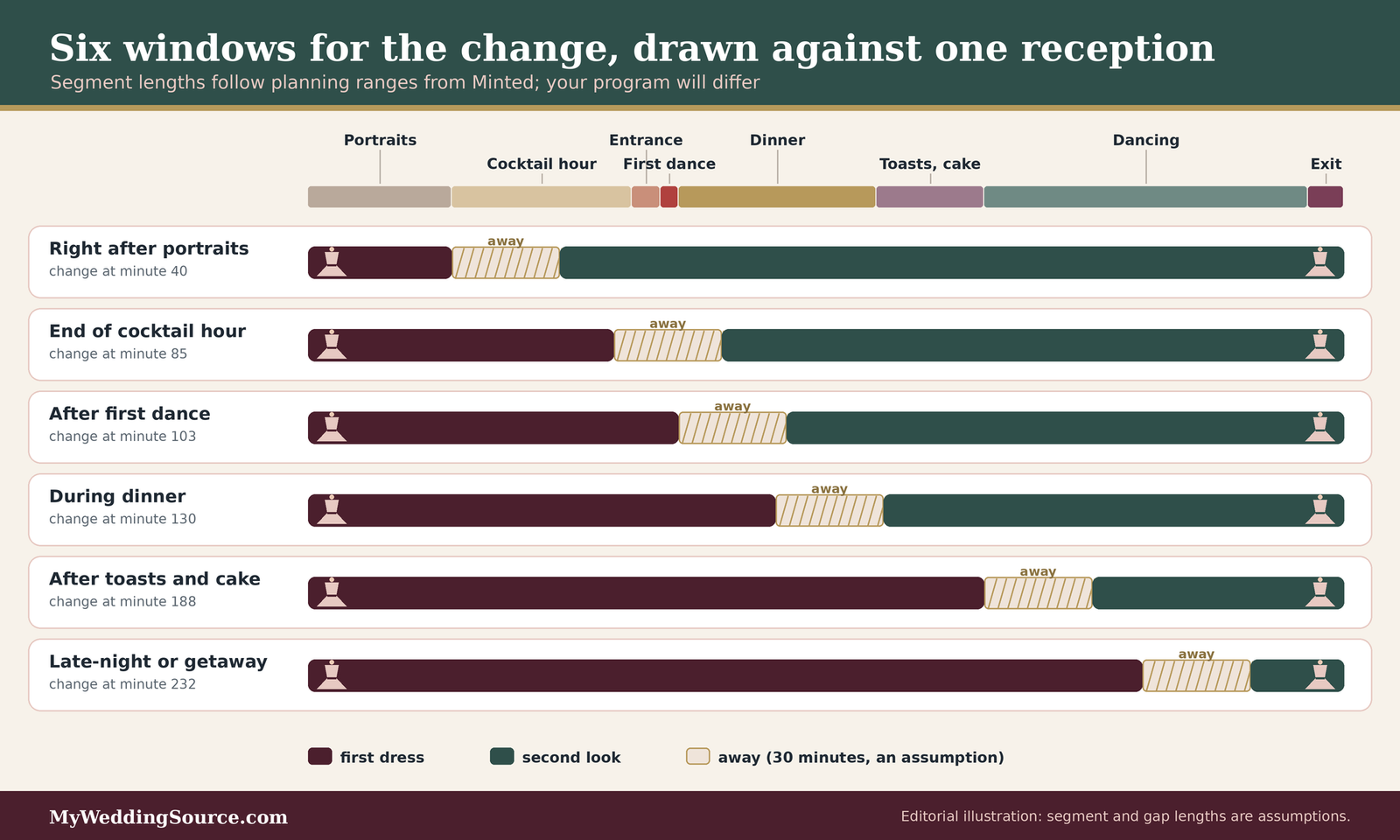
The table cannot show how long each stretch lasts, which depends on your program. The drawing below lays six windows against a typical reception order, using the durations Minted lists for each part of the evening. Those durations are Minted’s planning figures for a generic reception, not measurements of yours.
How to choose between them
Pick the window for your bridal outfit changes that protects your top three moments, then check it against the program.
List your three non-negotiable moments
Write down the three moments you most want in a specific dress. For many people those are the ceremony, the first dance, and the cake. Rule out any window that splits those moments across two dresses, and the choice is usually down to two.
Check it against the real program
Ask the DJ or band leader and the caterer what time dinner is served and what the order of the evening is. See our guide to DJ questions for how to ask about cues. If the window you picked is already full of toasts, move it.
Working with your photographer and videographer around the change
Most of the pictures at risk in bridal outfit changes are not the dress itself. They are the moments around it, so the photographer needs the plan in advance. Bella Bridesmaids and New York Dress both advise telling the planner, photographer, and videographer about the second look, even if the reveal is a surprise to guests. Complete Weddings and Events recommends documenting the change.
What to tell the photographer
Give the photography team the details of your bridal outfit changes in writing, not in passing on the day.
The window and the order of looks
Share the planned start and return times, which look is worn for which moment, and who will escort you. Our guide to wedding photographer shot lists shows how to ask for a list of must-have shots, and this plan belongs on it as a line item.
Where the photographer should and should not be
Decide whether the act of changing is photographed, since bridal outfit changes are rarely something every bride wants documented. Some people want a few pictures of the second dress hanging, the shoes, and the jewelry laid out, and nothing else. Others want the team to stay out of the room entirely. Either is reasonable, but say which one in advance so no one has to guess. Ask whether the second photographer or the videographer can stay with the party while the main photographer covers the preparation.
Bookend shots
A clean handoff between looks makes the album read well, and it is the part of bridal outfit changes most people forget.
The last frame in the first dress
Ask for a deliberate final portrait in the first dress before you leave, such as a quick couple photo or a portrait with your helper. It is easier to take one on purpose than to find out later that the last shot of the first look is a blurry one on the way out.
The first frame in the second look
Ask for a planned entrance or reveal shot, and a few close-up details of the second outfit. If a DJ announces your return, as Complete Weddings and Events suggests, the photographer can position for it.
Photographer coverage hours and the change
Bridal outfit changes do not have to mean 30 minutes without the camera if the plan is clear. Coverage hours are a separate question.
Check your contract’s coverage hours
Ask whether the contracted hours cover the whole window you have chosen and whether overtime applies if the program runs long. Our guide to wedding photography and the photography deliverables guide explain how to read coverage terms.
Plan for the unexpected
Minted advises padding timeline items, and bridal outfit changes are no exception. If the reception program shifts, ask the planner to tell the photographer immediately so the return can be covered, rather than staged afterward.
When bridal outfit changes collide with sunset
If you want golden-hour portraits and bridal outfit changes, both compete for the same part of the evening. The sunset time is a fixed point; everything else moves around it.
Finding your sunset time
Photographers tend to quote sunset times for the venue and date, and the number changes by hours between summer and winter.
Look up the exact time
Candid Studios, a wedding photography studio, recommends looking up the exact sunset time for your venue and date with a sun-time tool. NOAA’s Global Monitoring Laboratory publishes a Solar Calculator that reports sunrise, sunset, and solar noon for a chosen place and date, though the page says it is no longer actively supported and its values are intended for research and entertainment, so treat the result as a planning number and confirm it with your photographer.
Check the terrain
The same studio notes that in mountainous areas the sun can disappear behind peaks before the official sunset time, so the usable window may be shorter than the table suggests. A photographer who has shot at your venue will know.
How much light time you actually need
Published figures vary, and the source itself warns about its own inconsistencies, so plan with a buffer.
The golden-hour window
Candid Studios describes golden hour as roughly 20 to 40 minutes of soft, warm light, closer to half an hour than a full hour, starting about 30 minutes before sunset and ending a few minutes before the sun sets. It suggests protecting about 15 to 30 minutes for shooting. It also notes that blue hour begins roughly 20 to 30 minutes after sunset, a cooler alternative when the golden light is gone.
Where it can fit
The same source suggests ending the ceremony about 60 to 90 minutes before sunset to leave time for family photos and then couple portraits, and it lists a cocktail-hour session of 15 to 30 minutes and a reception escape of roughly 10 minutes between dinner and dances as options. Because those are a photographer’s suggestions, not rules, confirm them against your own venue.
A worked sunset example
Here is an example with a made-up sunset time. It is our own arithmetic and not a prediction for any venue.
The setup
Assume sunset is at 7:30 pm. Using the 20 to 40 minute window above, the good light would run from about 7:00 to 7:25. If a 20-minute portrait session is protected for 7:00 to 7:20, then the bride needs to be in the first dress, with hair and makeup fresh, at 7:00.
What that does to the change
If you were planning to change after the first dance and the first dance ends at 6:45, a 30-minute change would bring you back at about 7:15, which collides with the portraits. Moving the change to after the portraits, or doing portraits in the second look, avoids the clash. Moving the first dance earlier is another option. The right answer depends on which dress you want in the golden-hour photos.

Rain, heat, and other weather choices
Weather changes both the sunset plan and your bridal outfit changes.
Rain plans and photos
If your portraits depend on outdoor light, see our guide to wedding photography rain backup plans for how to move them. The change window should flex with the same plan.
Heat and fabric
Zola says a breathable short dress suits a warm outdoor reception, and Jovani says barn, beach, and garden settings suit breathable fabrics such as chiffon and organza and hemlines that will not snag on grass, gravel, or sand. For hot days, see our summer wedding heat plan.
Where to change: the room, the helper, and the handoff plan
The place and the people matter as much as the minutes in bridal outfit changes. This section also covers the practical questions people usually ask about carrying, hanging, and protecting two outfits on a busy day.
Choosing the changing space
A good space for bridal outfit changes is close, private, and ready before you arrive.
Distance, privacy, and access
Complete Weddings and Events recommends hanging the first gown in a locked room. The Nigerian-focused planner recommends a suite as close to the ballroom as possible. Ask the venue where you will change, whether it has a door that locks, a mirror, and an outlet, and whether it is the same room used for getting ready.
Pre-staging
Bella Bridesmaids says to have the second look pressed, hung, and ready to slip on, and to lay out shoes and jewelry early. The planner adds that the second outfit should be steamed, with jewelry laid out, before you leave the reception. Put a small mirror, water with a straw, blotting papers, and a pair of comfortable shoes in the room as well.
The helper and the bustle buddy
Hooks and zippers are hard to manage alone, and so is a bustle, so bridal outfit changes usually need a second pair of hands.
Choose one person and brief them
Inside Weddings says to arrange help in advance with your maid of honor, your mother, or a professional bridal dresser, and Bella Bridesmaids says to tell that person ahead of time when you will need them. For bridal outfit changes, pick someone who will stay calm, will not drink during the window, and has practiced the closures at least once.
The bustle
New York Dress describes three main types, American (over-bustle), French (under-bustle), and ballroom, and says to choose one with your tailor based on your silhouette. It suggests practicing fastening at the final fitting, recording a phone video, and assigning a bustle buddy. Our guide to wedding dress alterations covers how bustle work is typically scheduled.
Handling, storing, and protecting both outfits
Bridal outfit changes leave the first dress with no one wearing it, so someone should be responsible for it.
Where the first dress goes
Complete Weddings and Events recommends assigning a trusted, sober person to hang the first gown in a locked room in a breathable garment bag. Make sure the train is not on the floor, and keep the dress away from food and drinks. Our guide to wedding keepsake storage covers what happens after the day, and a separate guide on wedding dress stain removal from the same cluster will cover what to do about marks.
Wrinkles, damage, and liability
For bridal outfit changes, plan the second look to arrive pressed or steamed and ask whoever does the pressing what they have used on that fabric. Read the care label before steaming anything with beads, lace, or special trim. Under the Federal Trade Commission’s Care Labeling Rule, manufacturers and importers must provide care instructions that have a reasonable basis, and the label has to be attached securely and remain legible for the product’s useful life. A label that says “dryclean only” is only permitted if washing would damage the garment. We cannot promise any fabric outcome, and we are not giving cleaning advice: for beaded, lace, or silk dresses, ask a professional before steaming or spot treating. If a venue or a rental company holds either outfit, ask who is responsible for loss or damage and get the answer in writing. See our guide to wedding insurance for what a policy may and may not cover.
Cost to plan for
We could not find a reliable published average price for a reception outfit, so we do not quote one. Instead, list the line items and ask for quotes: the second outfit, alterations (a reception dress may need shortening or taking in, and one bride in a forum thread reported needing both), shoes and accessories, a helper or professional dresser if you hire one, any extra hair and makeup time, steaming or pressing, a garment bag, and storage or transport for the first dress. Zola suggests simpler fabrics and fewer embellishments to save, and also mentions resale sites and lower-priced bridal lines. Check the dress’s return and exchange policy before you buy a second look, and keep every receipt.
The carry plan: moving two outfits through a long day
If the ceremony and reception are at different places, or if you are getting ready somewhere else, bridal outfit changes mean the second look travels.
What goes in the car
Pack the second outfit in its own garment bag, labeled, with shoes and accessories in a separate bag. Hang it, do not fold it, if the car allows it. Give the bag to the person who will be at the reception first, not to the person who will arrive last. Take a photo of the packed bag so you can tell what is missing.
What stays with you
Keep small, essential items for bridal outfit changes on you or with the helper: a micro kit with fashion tape, safety pins, a mini sewing kit, stain wipes, heel grips, blotting papers, and reception lip color, as New York Dress suggests. Our wedding emergency kit guide lists more. Destination couples have extra handling steps, and our sibling guide on wedding dress shipping for destination weddings explains how to send a dress ahead.
Hair, makeup, shoes, and jewelry during the change
The dress is only part of bridal outfit changes, and these smaller pieces are often where a plan runs late.
Hair and makeup
Decide before the wedding whether hair and makeup are part of your bridal outfit changes at all, and who does it.
Touch-up or full change
New York Dress says bridal hair and makeup often runs a few hours, so a full redo is not a quick task, while a looser style or a bolder lip are quick. If you plan to change the hair, book a stylist for that slot or learn the steps yourself. Our guide to wedding hairstyles shows options that can be loosened easily, and the bridal hair and makeup planning guide covers trials.
The veil and hair pieces
If you wore a veil, the first thing to plan is how it comes out and who holds it. Our guide to wedding veil comb security explains how veils are anchored, which tells you how long removal takes and whether it can damage the style.
Shoes and hems
A different pair of shoes changes the hem.
Match the heel height
New York Dress warns that a hem tailored for stilettos will rise with flats, and suggests block heels or platforms of similar height. If the hem is the issue, see our guide to wedding dress hem length for flats vs heels. Tell your tailor about both pairs and confirm the hem with each, which the same source recommends.
Break them in
Wear the second pair around the house before the wedding. Shoes that feel fine for an hour can hurt after three, which matters when bridal outfit changes include shoes.
Underlayers and restrooms
What is under the dress changes the speed and the comfort of bridal outfit changes.
Undergarments
A strapless bra or shapewear that works under one dress may not work under another. Try both outfits with the same underlayers at fittings, or plan a swap and include it in the time budget.
The restroom
Bridal outfit changes are a natural moment for a restroom break, and a fitted dress makes that harder. Our guide to how to sit and use the restroom in a fitted wedding dress covers the steps and the helper’s role.
Edge cases that change the plan
The advice above assumes one ceremony, one venue, and one change. Real weddings are messier, and bridal outfit changes bend to fit them.
Cultural and multi-outfit celebrations
Some celebrations involve more than one of the bridal outfit changes described here, and the time budget grows with them.
More than one change
If your bridal outfit changes include two or more looks, the planner who wrote about the Nigerian wedding outfit change recommends syncing your styling team, makeup artist, photographer, DJ, and caterers, with a planner acting as timekeeper. Build each change as its own line, with its own buffer, rather than one long absence, and agree with the DJ how each return will be announced.
Accessories that take their own time
Some outfits include elements that need a specialist, such as a professionally tied head wrap in the example above. Book that person for the window, and ask how long they need.
Separate ceremony and reception venues
A gap between venues is a natural time for bridal outfit changes, and a risk.
Using the travel time
Minted says the gap between a ceremony and a reception at separate venues is about two hours and no more than three. If you change at the second venue, the second look must arrive before you do. Another option is to change at the first venue and travel in the second look, which means the portraits are done in the first dress.
Timing the arrival
If guests arrive at the reception before you, ask the planner what they will be doing. A change plus a drive can leave guests waiting longer than the program expects.
Late service, short programs, and slips
Programs run late, and bridal outfit changes are one of the pieces that can be moved.
When dinner runs late
The Nigerian-focused planner says late kitchen service shifts the whole change window. Ask your planner or day-of coordinator to decide in advance who can call the change early, delay it, or skip it.
When the reception is short
Zola suggests that if there is little time and little break, a change may not be worth it. A shorter plan is a bustle, a hair change, and new shoes.
The rest of the wedding party
Others may be changing too.
Grooms and partners
Easy Weddings mentions glitter tuxedos for grooms, so the same planning applies to anyone changing outfits: window, helper, room, photographer.
Mobility, access, and comfort
If stairs, narrow doors, or a long walk make the change harder, tell the venue and the planner early, and ask for a closer or more accessible room. The helper’s role becomes more important if mobility aids are part of the plan.
Build your transition plan: a card you can hand to your team
Everything above about bridal outfit changes becomes useful when it is written on one page. This is the novel part of this guide: a card for the bride’s helper, the photographer, and the DJ, with the same times on each.
The change card
One sheet, one set of times, shared with everyone who needs it.
What goes on the card
Fill in each line. Our example uses made-up times and our own arithmetic.
| Line | What to write | Example |
|---|---|---|
| Change window | Start and return time | 8:05 pm to 8:35 pm |
| Trigger | What moment starts the change | After first dance ends |
| Helper | Name and phone | Maid of honor |
| Room | Location, who has the key | Suite on second floor |
| Look 1 ends with | Last planned photo | Couple portrait at 8:03 pm |
| Look 2 begins with | Announced return | DJ intro at 8:35 pm |
| Hair and makeup | Touch-up or full change, who | Lip and loosen the updo |
| Dress 1 goes | Bag, hanger, room, who | Hung in locked suite |
| Backup | If dinner is late | Wait for toasts, then change |
Who gets a copy
Give copies to the helper, the planner, the photographer, the videographer, and the DJ or band leader. Put a printed copy in the room as well as on your phone.
The cue sheet for the DJ and planner
The return is a moment in your bridal outfit changes, and it needs a cue.
The announcement
Complete Weddings and Events suggests having the DJ announce your return to bring guests onto the floor. Agree on the sentence, the song, and who gives the DJ the signal. If you prefer no announcement, say so.
The fallback
Decide in advance what happens if you are not ready: the DJ plays another song, the planner holds the next moment, or the program moves on without you. A fallback you agreed on is easier to follow than one you improvise.
A practice run
A practice run replaces estimates about bridal outfit changes with real numbers.
What to rehearse
Rehearse your bridal outfit changes with the real helper, the real second look, and the real shoes. Time each step with a phone, and film the closure and bustle steps, as New York Dress suggests. Compare the total with your budget and adjust the card.
When to schedule it
Schedule it after your final fitting, so the dress is in its final shape and your tailor can adjust anything that took longer than expected. Our wedding party coordination checklist can hold the helper’s tasks.
Questions to ask before you commit to a change
Ask each question about bridal outfit changes of the right person, and write the answers on the card.
Questions to ask
- Venue: where would the bride change, how far is it from the reception room, does it lock, and is there a mirror, an outlet, and a place to hang two garments?
- Planner or coordinator: what is the real order of the evening, and who can move the change if dinner runs late?
- Photographer: how will you cover the window, which shots do you want before and after, and do the contracted hours cover it?
- Videographer: do you want a cue for the return, and should anyone follow the change?
- DJ or band: how will you announce my return, and what is the fallback if I am late?
- Tailor: how long does each closure and bustle take, and what should we practice at the final fitting?
- Seller of the second look: what is the return and exchange policy, and what are the care label instructions?
- Hair and makeup: what can be done in how many minutes, and can you be on site for the change?
Questions for the people who run the day
These people control the schedule your bridal outfit changes must fit.
Venue and coordinator
Ask the venue about the space and ask the coordinator about the order of bridal outfit changes. Venue contracts sometimes limit which rooms are available at which hours, so ask in writing.
Photography and music
Ask the photographer and DJ to repeat the plan for bridal outfit changes back to you, in their own words, to confirm that they understood it. If the DJ has a printed timeline, ask to see it.
Questions for the people who handle the clothes
These people control the dress, so they shape bridal outfit changes more than anyone.
Tailor and seller
Ask the tailor to describe the closures and the bustle and to mark them. Ask the seller for the care label wording and the return policy before you pay, and keep the paperwork.
Hair and makeup
Ask for a realistic estimate for the touch-up and tell the artist the dress’s neckline, because some necklines show a back or shoulders that need makeup.
FAQ: bridal outfit changes questions
Planning basics
Do I need a second dress for my reception?
No. Planning guides call it optional. It tends to make sense if your ceremony gown is heavy, has a long train, or is restrictive for dancing, and less sense if the reception is short or the gown is comfortable and bustled. A bustle, new shoes, or a hair change can give a different look without a full change.
When is the best time for bridal outfit changes?
There is no single best time. Common choices are right after portraits, near the end of cocktail hour, after the first dance, during dinner, or late in the evening. Choose the window that keeps your three most important moments in the dress you want, and check it against the program with your planner.
How long do bridal outfit changes take?
Guides we read range from 15 to 30 minutes for a standard change, with a Nigerian-focused planner advising 40 to 45 minutes for a full cultural change that includes a professionally tied head wrap. Add your own steps, include a buffer, and time a practice run with your helper.
Photos and timing
Will I miss photos or events if I change?
You can, if the plan is vague. Tell the photographer, videographer, and DJ the window and the return cue, ask for a final portrait in the first dress and a planned reveal in the second look, and avoid scheduling the change during moments you want covered, such as toasts or the cake.
What if golden hour falls during my planned change?
Look up your sunset time, then move one thing. Either take the portraits before you change, change before the golden-hour window and wear the second look for the portraits, or shift the first dance earlier. One photography studio describes golden hour as roughly 20 to 40 minutes, so check the plan with your photographer.
Who should help me change?
Pick one person, such as a maid of honor, your mother, or a professional bridal dresser, and tell them the window in advance. Layers, buttons, and zippers are hard to manage alone. Have them practice the closures and the bustle at least once before the day.
Garment care and cost
How do I protect the first dress after I change out of it?
Have a trusted person hang it in a locked room in a breathable garment bag, away from food and drinks, with the train lifted off the floor. Read the care label and ask a professional before steaming or treating beads, lace, or silk. We cannot guarantee any fabric result.
What does a reception outfit cost?
We could not find a reliable published average, so we do not quote one. Plan for the outfit, alterations, shoes, accessories, any helper, extra hair and makeup time, pressing, and storage. Zola says second dresses are usually cheaper than ceremony gowns, and suggests simpler fabrics to save. Get quotes and check return policies.
Your next steps
Decide whether and when
Name your three moments
Write down the three moments you most want in a specific dress, then choose the window for your bridal outfit changes that protects them. Check the choice against the real program with your coordinator, using our wedding vendor timeline guide.
Look up sunset
Find the sunset time for your date and venue, and ask your photographer whether portraits fit before or after the change.
Build the plan
Fill in the change card
Complete the card for your bridal outfit changes in this guide, share it with your helper, photographer, videographer, and DJ, and keep a printed copy in the changing room.
Practice once
Do a timed run of your bridal outfit changes after your final fitting with your helper and shoes, then update the card. For the wider plan, use our wedding planning timeline and wedding weekend event planning guides.
Sources & methodology
How we built this guide
What we relied on
This guide combines a federal rule on care labels, a federal science agency’s sunrise and sunset calculator, and published planning advice from wedding publications, gown designers, planners, and photographers. Where a statement comes from a company, we say so, because company advice reflects the seller’s products and habits. The time budget, the sunset example, and the change card entries are our own arithmetic and illustrations, and they are estimates. We checked these sources in November 2026, and published advice can change.
What we did not do
We did not test dresses, time real changes, or give legal, financial, or garment-cleaning advice. We did not find a reliable published average cost for a reception outfit, and we could not load the Federal Trade Commission’s consumer shopping advice page, so we relied on its business guidance on care labels. Ask your tailor, your venue, and your vendors about your own situation.
Source list
Government and regulatory sources
- Federal Trade Commission, Clothes Captioning: Complying with the Care Labeling Rule: https://www.ftc.gov/business-guidance/resources/clothes-captioning-complying-care-labeling-rule
- NOAA Global Monitoring Laboratory, NOAA Solar Calculator: https://gml.noaa.gov/grad/solcalc/
Wedding publications and planning guides
- The Knot, When to Change Into Your Second Dress for the Reception: https://www.theknot.com/content/when-to-change-into-second-dress-for-reception
- Zola, Should You Get a Second Wedding Dress for Your Reception: https://www.zola.com/expert-advice/should-you-get-a-second-wedding-dress-for-your-reception-zola
- Inside Weddings, How to Handle Changing Into a Second Bridal Gown: https://www.insideweddings.com/news/fashion/how-to-handle-changing-into-a-second-bridal-gown/41676
- Minted, Wedding Day Timeline: https://web.minted.com/wedding-ideas/wedding-day-timeline
- Easy Weddings, Wedding Outfit Changes: https://www.easyweddings.com.au/articles/wedding-outfit-changes/
Designers, planners, and photographers
- Bella Bridesmaids, How to Successfully Manage a Mid-Wedding Dress Change: https://bellabridesmaids.com/blogs/bridesmaids-buzz/change-wedding-dress-reception
- New York Dress, How to Transition Your Gown From Ceremony to After-Party: https://www.newyorkdress.com/blogs/fashion-blog/how-to-transition-your-gown-from-ceremony-to-after-party
- Jovani, Second Wedding Dress: https://www.jovani.com/blog/weddings-bridal/second-wedding-dress/
- Complete Weddings and Events, Do You Really Need a Second Dress for the Wedding Reception: https://completewedo.com/orange-county/blog/do-you-really-need-a-second-dress-for-the-wedding-reception/
- Event Design by BE, The Nigerian Wedding Outfit Change: https://www.eventdesignbybe.com/the-nigerian-wedding-outfit-change-expert-timeline-tips/
- Candid Studios, Golden Hour Wedding Photos: https://www.candidstudios.net/golden-hour-wedding-photos/
- WeddingWire community forum, Dress change timing (anecdotal, 2021): https://www.weddingwire.com/wedding-forums/dress-change-timing/b7e1a12d24732912.html