

The average wedding cost is a useful starting number and a poor final answer, because it blends tiny courthouse ceremonies with 250-guest ballroom evenings, and your own total will depend on guest count, place, and what each quote actually includes.
Quick answer
The Knot’s 2026 Real Weddings Study, which covers couples married in 2025, reports an average wedding cost of about $34,000 (the study’s own page shows $34,200 and the press release rounds to $34,000) for an average of 117 guests. Zola’s 2026 materials put its national figure at $36,000 with an average of 145 guests. The two surveys use different samples and definitions, so treat them as a rough range, not a target. To get a number you can plan around, start from a guest-count band, adjust for your region, collect three quotes per major category, and convert every quote to the same all-in basis before you compare.
What the average wedding cost number really measures
Headlines about the average wedding cost tend to arrive each winter, right after the big wedding-industry surveys publish. They are handy, and they are also easy to misread. This section explains where the figures come from, what they leave out, and why two respectable sources can disagree by a couple of thousand dollars in the same year.
Two large surveys, two different answers
In 2026 the two most-cited U.S. sources were The Knot and Zola. Both are wedding-planning companies, and both publish their numbers partly to show what their platforms know about couples. That does not make the figures wrong. It does mean the average wedding cost you read is shaped by who each company reaches.
The Knot’s Real Weddings Study
According to the company’s press release, the 2026 Real Weddings Study is based on 10,474 self-reported U.S. couples who married between January 1 and December 31, 2025, recruited by email through The Knot and WeddingWire membership. The release reports an average wedding cost of $34,000, an average of 117 guests, and an average of $292 per guest, up $8 from 2024. The Knot’s cost page lists $34,200 for the same study, which is consistent with rounding. Its history on that page runs from $19,000 in 2020 to $35,000 in 2023 and $33,000 in 2024, so the recent years sit in a fairly narrow band.
Zola’s cost index and surveys
Zola’s cost guide, last updated in March 2026 according to the page, draws on three things: the Zola Wedding Cost Index, built from platform budget-tool activity and vendor pricing; a 2026 Wedding Spend Survey of 720 couples surveyed within 180 days after their wedding; and the 2026 First Look Report of more than 11,500 couples getting married in 2026. It gives a national average of $36,000, unchanged from the prior year, and an average of 145 guests. The First Look report describes only its sample size, so we cannot say how respondents were recruited or weighted.
Planned, paid, and who is counted
A number only means something when you know the question behind it. Some figures describe what couples planned to spend, and some describe what they reported spending after the wedding. Some include the engagement ring, honeymoon, and rehearsal dinner, and some do not.
Planned budgets and final bills are different things
Zola’s First Look Report surveys couples who are getting married in 2026, so it captures expectations. The Knot’s Real Weddings Study surveys couples who have already married, so it captures reported spending. Zola’s page says 69 percent of couples exceed their original budget, which is a reminder that a planned average wedding cost and a paid one for the same wedding are often not the same number. Neither survey is an audit of receipts, and both rely on what couples remember or report.
What sits outside the headline
The Knot’s page lists the engagement ring ($4,600), honeymoon ($5,500), and rehearsal dinner ($2,800) as costs beyond the scope of its average wedding cost. Zola’s page lists a honeymoon ($5,300), engagement ring ($5,200), wedding rings ($1,500), and rehearsal dinner ($2,700) as additional costs but does not state whether they are inside its $36,000. If you add those items to the average wedding cost yourself, the figure you are comparing against changes by thousands of dollars, so write down which items you are counting before you compare anything to a survey. Our guide to honeymoon planning covers the largest of those add-ons.
Why an average is the wrong tool for one couple
The arithmetic mean behind any average wedding cost is pulled upward by a minority of very expensive weddings. The Knot’s page breaks its respondents into budget groups, and the gap is wide: couples in the lowest group spent about $8,900, the middle group about $26,400, and the top group about $70,300. When a middle group and a top group sit that far apart, the single average wedding cost describes very few real weddings.
The blend hides very different weddings
The same Knot page notes that the average wedding cost is a blended figure across very different weddings, and it quotes a planner who suggests that averages within a wedding type and region are more useful. That advice is the idea behind the rest of this guide. Instead of asking whether you are above or below the national average wedding cost, you ask what a wedding like yours costs where you live.
Use the national number as a sanity check only
A sensible role for the national average wedding cost is as a rough outer boundary. If your early estimate is a third of the national average wedding cost for a 100-guest evening in a major city, something is probably missing. If it is double the figure for a small weekday ceremony, something may be inflated. Beyond that, the national average wedding cost should not set your budget. Our wedding budget calculator is a better place to build your own figures once you have a local benchmark.

Start with the all-in price anatomy for average wedding cost
Every vendor quote behind an average wedding cost has layers. The headline number on a proposal is usually the base price, and the amount that leaves your account can be noticeably higher. Learning to peel the layers apart is the single most useful habit for anyone trying to compare a quote against an average wedding cost.
Break the quote into base price, required fees, and optional upgrades
A clean way to read any proposal is to sort every line into one of three buckets. The base price is what the vendor commits to deliver. Required fees are charges you cannot decline. Optional upgrades are things you could remove without changing the core service.
Show what the headline price omits
For anyone checking a quote against the average wedding cost, Zola’s cost guide reports that 75 percent of couples encountered at least one unexpected fee, and that the most common were postage (29 percent), alterations (29 percent), trial appointments (21 percent), and service charges (17 percent). It also reports that 57 percent of couples faced a mandatory venue service fee and that average hidden costs came to $3,314, about 9 percent of total spend. Those are Zola’s figures from its own surveys, and the hidden-cost estimate rests on how Zola defines hidden. Still, the pattern is useful: the extras are common enough that a budget with no cushion for them is incomplete.
The table below lays out the anatomy of one typical line, using layers you can look for on your own quotes.
| Layer | What it usually is | Question to ask | Can it change the total? |
|---|---|---|---|
| Base price | The service or product the vendor lists | What exactly is included, hour by hour or item by item? | Yes, if scope changes |
| Required fees | Service charge, administrative fee, setup, delivery, cleanup | Which fees are mandatory and which are optional? | Often not negotiable |
| Optional upgrades | Extra hours, premium options, add-on items | What happens if I skip this? | Yes, you control it |
| Taxes | Sales tax where the state applies it to services or goods | Is tax in the price or added on top? | Set by the state, not the vendor |
| Gratuity | A tip built into the contract, or left to you | Is gratuity already on the invoice? | Depends on the contract |
| Travel and logistics | Mileage, lodging for the vendor, parking, permits | Is this a flat fee, or billed at cost? | Rises with distance |
| What changes the total | Guest count, date, hours, location, final headcount deadline | Which of these does the price assume? | Directly |
Separate taxes, service charges, gratuity, and travel
These four are easy to blur together, and they behave differently. Taxes are set by the state or locality, and Zola’s page says sales tax applies to most wedding services and that some venues require extra liability insurance. Service charges and gratuities, Zola says, are often 18 to 22 percent of vendor costs. Delivery and setup can add $200 to $500 per vendor in some cases, again per Zola. Travel is the least predictable, because it depends on how far the vendor drives and whether they need a hotel. Ask for each of the four as a separate line, and ask whether the service charge is itself taxable where you live, since that varies by jurisdiction and we cannot answer it for you. A local tax professional or your state revenue agency can.
Cost check
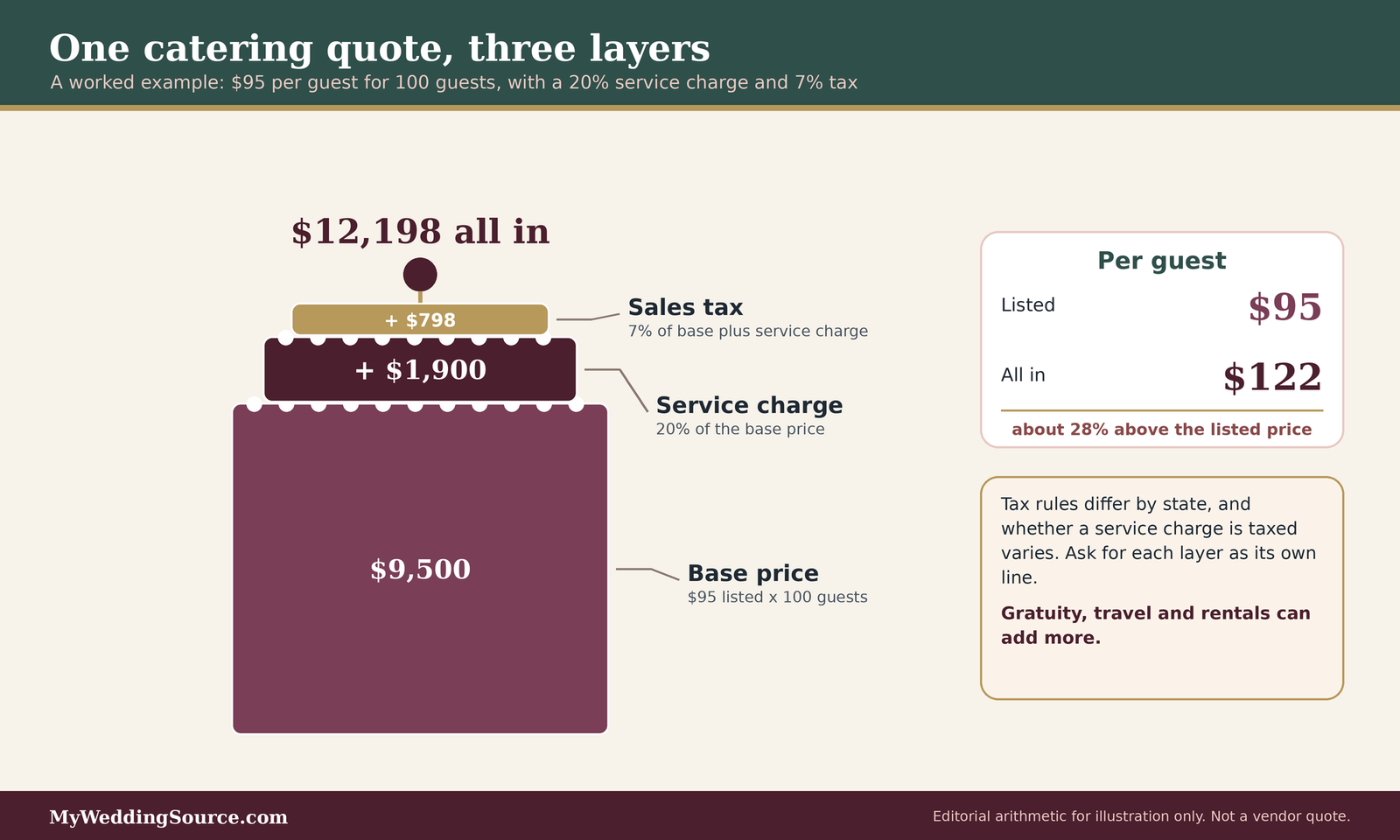
Here is a worked example, labeled as our own illustrative arithmetic and not as a quote from any vendor. Suppose a caterer lists $95 per person for 100 guests, which is $9,500. Add a 20 percent service charge ($1,900) to reach $11,400. Add a 7 percent sales tax on that subtotal, assuming the tax applies to the service charge too ($798), and the total is $12,198. That works out to about $122 per guest, roughly 28 percent above the listed $95. Your tax rate, your tax rules, and your caterer’s fees will differ, but the shape of the calculation will not. Always convert a per-person price into a per-person total before comparing it with a survey figure such as The Knot’s reported $80 average per person for catering.
Identify the billing unit
The billing unit is the thing the vendor multiplies to get your price. If you compare a per-person catering quote with a flat-fee photographer quote, or an hourly DJ with a package band, you are comparing different kinds of numbers. Naming the unit for every line is what makes a total comparable.
Explain per-person, per-hour, per-item, and package pricing
Per-person pricing, common for catering, bars, and some venues, moves with your final guest count. The Knot’s cost page says some costs are fixed, such as a DJ or photographer, while others, like catering and rentals, scale with guests. Per-hour pricing, common for photography, music, and officiants who travel, moves with the length of your schedule. Per-item pricing, common for florals, cake slices, and rentals, moves with how many pieces you order. Package pricing bundles several things at one price, which is convenient and can be good value, but it hides the cost of each part. If you might drop one item from a package, ask for the unbundled price, because the discount on the bundle may disappear. Our guide to wedding catering explains how caterers usually structure these charges.
Flag minimum spends and overtime thresholds
Two clauses can quietly change a total. A minimum spend is the amount you must reach in food and beverage at a venue, even if your guest count would not naturally get there. An overtime threshold is the point after which hourly charges begin, often for the venue, the band or DJ, and security. Ask for both in writing, ask what is counted toward the minimum (does it include tax and service charge, or only food and drink?), and ask how overtime is priced and who must approve it. These are the clauses most likely to turn a comfortable quote into an expensive night, and they are rarely visible in a headline number.
Explain why real couples pay different totals for average wedding cost
If the average wedding cost were a price list, every couple would land near it. They do not, and the reasons are not mysterious. A handful of drivers account for most of the variation, and some of them are choices while others are not.
Rank the cost drivers by impact
Not every driver moves the total equally. A useful ranking separates the factors that multiply many line items at once from those that change a single item.
Connect guest count, season, location, complexity, and time
Guest count is the multiplier in any average wedding cost. The Knot’s cost page reports average totals of $17,100 for weddings with 1 to 50 guests, $27,200 for 51 to 100 guests, and $43,300 for more than 100 guests. Location is the second multiplier, covered in more depth below. Season matters less than many couples expect: the same page shows January through March at $33,200, April through June at $34,300, July through September at $35,400, and October through December at $33,200, a spread of about $2,200 from the cheapest to the most expensive quarter. Complexity (a ceremony in one place and a reception in another, custom builds, multiple events) and time (a long evening versus a short afternoon) are harder to measure in a survey, but they show up in staffing, rentals, and hourly rates. The Knot also reports that a hometown wedding averaged $32,600, a domestic destination wedding $41,700, and an international destination wedding $43,700.
Distinguish controllable from structural drivers
Some drivers are choices. You decide the guest list, the day of the week, the number of events, the style of service, and how many vendors you hire. Others are structural: local labor costs, venue supply, and the going rate for the services you want in your area. Treat structural drivers as fixed facts to be measured with local quotes, and treat controllable drivers as the dials you can turn once you know the baseline. This is how a couple in a high-cost city can stay near a modest budget (by turning the guest-count dial hard) and a couple in a low-cost city can still overshoot (by turning every dial up). Our wedding planning guide covers how to decide which dials matter most to you.
Place matters, but not in a simple way
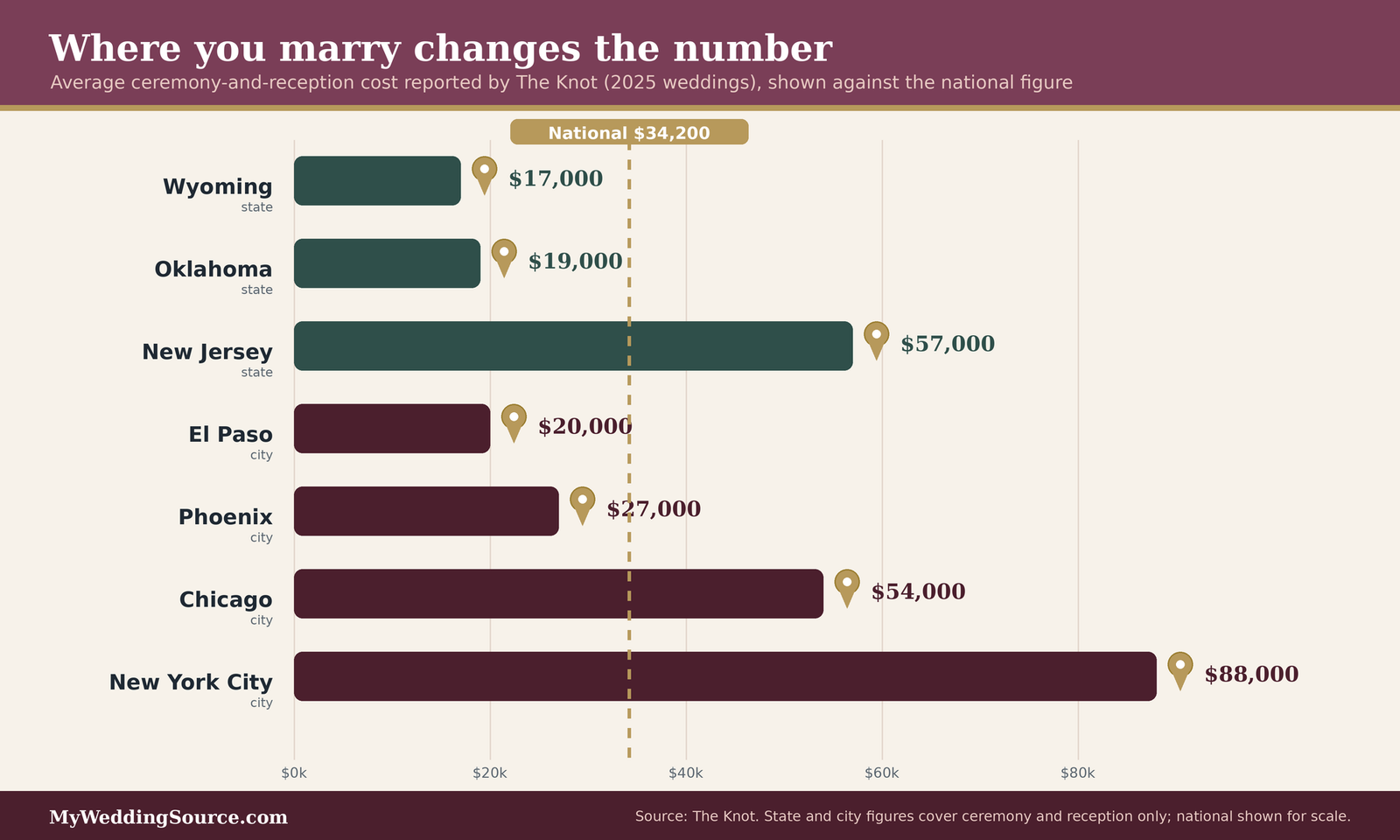
Geography is where the average wedding cost misleads most. The Knot’s page reports regional averages ranging from $29,000 in the Midwest to $48,400 in the Mid-Atlantic, and state averages from $17,000 in Wyoming to $57,000 in New Jersey, with New York City at $88,000 and El Paso at $20,000. Those state and city figures cover only the ceremony and reception and exclude the engagement ring, according to the page, so they are not directly comparable with the national number.
Regional and city gaps are larger than price levels alone
The U.S. Bureau of Economic Analysis publishes regional price parities, which compare overall consumer price levels across states and metro areas with 100 representing the national average. For 2024 the agency’s page lists California at 110.7, New Jersey at 108.8, Arkansas at 86.9, and Oklahoma at 87.8. Using our own arithmetic, New Jersey’s price level is about 1.24 times Oklahoma’s, while The Knot’s reported state averages for the two ($57,000 and $19,000) differ by a factor of about 3. This is an editorial comparison of two different measures, not a causal finding. It suggests, though, that overall prices explain only part of the gap, and that the size and style of weddings, the supply of venues, and the survey samples also play a role.
Why a metro benchmark beats a state average
Zola’s cost guide gives metro figures for a 150-guest wedding that illustrate the same point about the average wedding cost: Manhattan at $99,452, San Francisco at $84,649, Phoenix at $52,732, Kansas City at $42,135, and Milwaukee at $42,571. Those are Zola’s model figures for one guest count, so they are not directly comparable with The Knot’s reported averages. Even so, the range within a single guest count shows that where you marry can change the total by tens of thousands of dollars. When your venue is in a smaller town outside a major metro, the nearest metro benchmark may overstate your costs, and a quote from a local vendor is better evidence than either.
Use scenario ranges instead of a single national average
A scenario range for the average wedding cost is a few worked totals under stated assumptions. It replaces one number with a band, and it makes the assumptions visible so you can change them.
Build low, base, and high examples
The table below is our own illustrative model of the average wedding cost at three guest counts. It is built from The Knot’s reported category averages (venue $12,900, catering $80 per person, photographer $3,000, florist $2,800, DJ $1,800, officiant $260, cake $540, invitations $510, hair and makeup $150 per person for two people, wedding dress $2,100, and alcohol $2,800 at the average guest count of 117), and it scales only catering and alcohol with guests. We hold the venue constant for simplicity, though a real venue may change with the guest list. It leaves out rings, attire beyond the dress, the planner, videography, transportation, rentals, lighting, and entertainment, so it is a skeleton and not a complete budget.
| Item | Smaller: 50 guests | Middle: 100 guests | Larger: 150 guests | How we calculated it |
|---|---|---|---|---|
| Guest-independent items (photographer, florist, DJ, officiant, cake, invitations, hair and makeup, dress) | $11,310 | $11,310 | $11,310 | Sum of Knot averages |
| Reception venue | $12,900 | $12,900 | $12,900 | Knot average, held constant |
| Catering | $4,000 | $8,000 | $12,000 | $80 per guest |
| Alcohol | $1,197 | $2,393 | $3,590 | $2,800 divided by 117 guests, times guests |
| Skeleton subtotal | $29,407 | $34,603 | $39,800 | Sum |
| Cushion for taxes, insurance, and extras at 9 to 15 percent | $2,647 to $4,411 | $3,114 to $5,190 | $3,582 to $5,970 | Zola’s reported range of taxes and insurance, applied by us |
| Skeleton plus cushion | $32,054 to $33,818 | $37,717 to $39,793 | $43,382 to $45,770 | Sum |
| Ask your vendors | Will the venue change at this size? | Is the minimum spend reached? | Do rentals, staffing, and service charge rise? | Quote-comparison prompt |
Two cautions apply. First, adding up category averages is not the same as measuring the average wedding cost, because each category average covers only the couples who bought that category. Adding our skeleton items at the average guest count of 117 gives $36,370, about 6 percent above The Knot’s reported $34,200, which is a reminder that these pieces do not sum cleanly. Second, the middle column sits close to the reported national average only by coincidence of the inputs, so it should not be read as a validation.
State every assumption behind the range
Every number in a scenario hides a choice. Write down the guest count, the day of the week, the style of service (plated, buffet, stations, family style), the hours, the venue type, whether the bar is open, and the date range. Then write down what you excluded, since exclusions are where ranges quietly break. When you share a scenario with a partner, a parent who is contributing, or a planner, the assumptions are what let them argue with the number in a useful way. A range without assumptions is just a guess with a decimal point.
Cost check
Who pays also changes the figure. Zola reports that 88 percent of couples contribute their own money (29 percent fully and 59 percent partially), that couples paying 70 percent or more out of pocket spend about 23 percent less overall, and that heavily family-funded weddings cost nearly double self-funded ones. Those are Zola’s survey results, and they describe association, not cause. If parents or other relatives are contributing, agree on the number and the conditions in writing before you sign anything, and keep their contribution separate in your tracker so you can see your own share.
Build a local benchmark for average wedding cost
A local benchmark for the average wedding cost answers one question: what does a wedding like ours cost, here? You do not need a spreadsheet degree to build one. You need a defined reference wedding, a short list of vendors, and a consistent way to record what they tell you.
Define a reference wedding before you ask for prices
Vendors can only quote what you describe. A vague request (a summer wedding for a hundred people) invites a vague answer. A reference wedding is a one-page description that every vendor receives, so every quote is for the same event.
Write the one-page description
Include a guest count with a plausible range, a date or season, a day of the week, a start and end time, the number of hours of coverage you expect for each service, the setting (indoor, outdoor, tented, hotel ballroom, restaurant), whether it is one location or two, the style of food service, and whether alcohol is hosted. Add the details that change labor: stairs, distance from parking, and whether the venue provides tables and chairs. Our plan a wedding page and wedding planning checklist can help you think through what to include.
Choose a guest-count band
The Knot’s three bands (1 to 50, 51 to 100, and over 100) are a reasonable starting point for a reference class, because guest count is the largest multiplier. If you are unsure, price two bands (for example 60 and 110 guests) and see how much of the difference is real. The gap between them tells you how sensitive your total is to the guest list, which is often the most useful single finding from the exercise.
Collect price evidence in a consistent way
Evidence has levels. A survey average is the weakest for your wedding, a published vendor price range is better, and a written quote for your reference wedding is the strongest.
Gather three kinds of evidence
Start with the national and regional surveys of the average wedding cost for context. Next, gather what local vendors publish on their own sites or in their inquiry packets. Finally, request written quotes for your reference wedding from at least three vendors in each category that you consider major, which for most couples means the venue, caterer, photographer, and music. A city or county office that issues permits or licenses can also tell you about local requirements that affect cost. Our guide to the marriage license explains the one expense The Knot says is truly required.
Record the same fields every time
Use one row per quote, with the same columns: vendor, date quoted, what was included, billing unit, base price, mandatory fees, service charge, tax, gratuity, travel, deposit, payment schedule, cancellation terms, and the date the quote expires. A consistent record is what turns a pile of emails into a benchmark. It also protects you later if a vendor remembers a price differently.
Convert and compare
Once you have rows, you need to put them on the same basis as the average wedding cost you are testing. This is the step that most people skip and the one that matters most.
Convert every quote to an all-in per-guest figure
For guest-dependent items, divide the all-in total by guest count. For flat items, keep the total. This gives you two numbers per quote, a per-guest cost and a fixed cost, and lets you recompute a total at any guest count with simple arithmetic. Zola’s guide describes guest-dependent costs as roughly $150 to $300 per guest, excluding fixed items such as photography and music, which you can use as a rough check against your own per-guest figures, remembering that it is Zola’s estimate.
Read the spread, not just the middle
If three quotes for the same service cluster within 10 to 15 percent, you probably have a local going rate. If they differ by a factor of two, the vendors are probably quoting different scopes, and you should ask what differs before you pick the cheapest or the median. Write the range and the reason for the range in your tracker, and use the lower and upper ends as your low and high scenarios.
Compare quotes without being fooled by different packaging for average wedding cost
Once you have several quotes, the work shifts from collecting to comparing. Packaging is the usual obstacle. Two caterers can charge the same headline price and deliver very different evenings, because one includes tables, linens, and staff and the other does not.
Normalize inclusions before comparing totals
Normalizing means adjusting each quote until it covers the same scope, so it can be set beside an average wedding cost fairly. You are not deciding which vendor is better. You are deciding what each one would cost if it did the same job.
Create an apples-to-apples quote matrix
Build a grid with one column per vendor and one row per item that your reference wedding needs. For a caterer, rows might include food, service staff, bar staff, bar supplies, rentals (tables, chairs, linens, china, glassware), cake cutting, setup, cleanup, and the service charge. For a photographer, rows might include hours of coverage, number of photographers, edited image count, delivery format, usage rights, and travel. Mark each cell as included, excluded, or extra cost, and fill in the price for every excluded item. Our wedding photography and wedding reception guides describe what is commonly included in those services, which helps you spot what is missing.
| Item | Caterer A | Caterer B | How to normalize |
|---|---|---|---|
| Food per person | $90 | $78 | Keep as quoted |
| Service staff | Included | $1,400 extra | Add the extra to B |
| Tables, chairs, linens | Included | Not included; rental company quote $1,900 | Add the rental quote to B |
| Bar service | $18 per person | $12 per person, bar supplies extra $600 | Add supplies to B |
| Service charge | 20 percent, applied to food and bar | 22 percent, applied to everything | Apply each to its own base |
| Normalized all-in for 100 guests | Compute from rows above | Compute from rows above | Compare the totals, then the per-guest figure |
If you run the invented numbers for 100 guests, Caterer A comes to $9,000 for food and $1,800 for the bar, a subtotal of $10,800, and with a 20 percent service charge a total of $12,960. Caterer B comes to $7,800 for food, $1,200 for the bar, $600 for supplies, $1,400 for staff, and $1,900 for rentals, a subtotal of $12,900, and with a 22 percent service charge a total of $15,738. The cheaper per-person price turned out to be the more expensive quote. This is our own illustration, built to show the method, and real quotes will differ.
Assign a value to excluded rentals or labor
When a quote leaves out an item, the cost does not disappear. It moves to you or to a third party. Rentals, labor for setup and teardown, and day-of coordination are the usual hand-offs. Get a real quote for each excluded item rather than guessing, and include the cost of your own time if you plan to do it yourself, since friends and family doing labor is a cost too, even when no one invoices it. Our wedding decor guide covers how rentals and labor affect decor budgets, and our guide to seasonal wedding flowers shows how timing changes floral pricing.
Show where negotiation is realistic, and where it is not
Negotiation over the average wedding cost works best when it is about scope, timing, or flexibility, and works worst when it is about the vendor’s labor rate. Vendors often have more room to change what they deliver than what they charge per unit.
Separate scope changes from price cuts
A scope change alters what you buy: fewer hours, a smaller menu, a shorter bar menu, a smaller floral installation, a weekday date, or a different delivery format. A price cut asks for the same thing for less. Scope changes are usually easier for a vendor to agree to, because they reduce the vendor’s cost as well as your price. Price cuts for identical scope are harder, and they are less likely to succeed with a vendor whose calendar is already full. When you ask for a change, say clearly what you are willing to give up. Our wedding catering and open bar wedding guides outline common menu and bar adjustments.
List the questions that reveal hidden future charges
Hidden charges tend to show up after the deposit. The questions below are worth asking before you sign.
Questions to ask before you sign
- Which fees are mandatory, and is the service charge taxable where we are marrying?
- Is gratuity already included, and what is the percentage?
- What is the final headcount deadline, and can the count go down after it?
- What is the minimum spend, and what counts toward it?
- When does overtime start, and what does an extra hour cost?
- Which rentals, labor, delivery, and setup items are excluded?
- What are the payment schedule, the deposit, and the refund or transfer terms?
- What happens to my price if my date or guest count changes?
- Is there any fee for an outside vendor, a cake-cutting service, or corkage?
Read the contract as part of the price
Price and terms are two halves of the same decision, and both shape what your wedding really costs. A lower quote with a hard cancellation clause is not necessarily cheaper than a higher quote with flexible terms, and the contract is where those terms live. This guide does not give legal advice, and contract rules differ by state, so treat what follows as general education and have a lawyer review anything you are unsure about.
Check deposits, payment schedules, and cancellation terms
Look for the deposit amount, whether it is refundable, the dates of each payment, and what happens if you postpone or cancel. Look for who bears the loss if the vendor cannot perform, and whether a substitute of equal quality is promised. These terms are part of what you are buying, and it is reasonable to ask for changes before signing. Our guide to wedding etiquette covers the professional courtesies on both sides of the table.
What federal fee rules do and do not cover
In late 2024 the Federal Trade Commission finalized a rule on unfair or deceptive fees. A law-firm summary of the rule says it covers live-event tickets and short-term lodging, requires the total price including mandatory fees to be disclosed prominently, and does not extend to other industries. So the rule’s all-in price requirement does not itself reach a wedding caterer, photographer, or venue, which is why asking for the total in writing falls to you. State consumer-protection laws may apply to wedding vendors and differ by state, and we cannot assess them here.
Decide where the benchmark should change your plan
A benchmark for your average wedding cost is only useful if it informs decisions. The point of knowing your local number is to choose where to spend and where to hold back, and to do it early enough that you can still act.
Match spending to your priorities
Surveys can tell you the average wedding cost, and they cannot tell you what you care about. The Knot’s page reports that the average couple hires about 13 vendors and that its venue, photographer, and caterer are the most common bookings (89, 88, and 85 percent, according to the release). That is a description of what couples do, not advice about what you should do.
Rank your priorities before you look at prices
Write down the three things you most want the day to include and the three you could happily skip, before you see any numbers. Then check whether your benchmark leaves room for the first group. If it does not, adjust the guest count, the date, or the scope of the lower-priority items. This order matters, because couples who see prices first tend to anchor on whatever vendors show them. Our wedding invitations and wedding registry guides cover items that often land in the lower-priority group.
Consider the fixed items first
Fixed items, such as a photographer, DJ, officiant, and florist’s minimums, do not scale much with guests, so they set a floor under any average wedding cost regardless of size. The Knot’s reported averages for several of these (photographer $3,000, DJ $1,800, officiant $260) can help you estimate that floor. If you are planning a small wedding and the fixed items already exceed your budget, the guest count is not the dial that will fix it.
Plan for what the benchmark will not show
Even a careful estimate of the average wedding cost for your area understates some costs. It helps to name them in advance and decide how you will handle them.
Tips, thank-yous, and day-of extras
The Knot’s tipping cheat sheet suggests, for example, 15 to 20 percent of the food and drink fee for caterers and bartenders when gratuity is not already in the contract, 15 to 20 percent of the total fee for a wedding planner, and $50 to $200 per team member or 5 to 15 percent of the contract for a photographer or videographer. Its advice is that tips are unnecessary when gratuities already appear on a contract or invoice. These are one publication’s guidelines, and customs vary, so decide what fits your situation. If you are building a budget, add a line for tips so it does not surprise you.
A reserve, and where it should come from
Zola reports that 69 percent of couples exceed their original budget. A reserve, set at the start, is a calm answer to that finding. A common approach is to hold a percentage of the total aside and not to allocate it, and you can calibrate it to your own comfort, using the 9 to 15 percent range for taxes and insurance reported by Zola as a reference point. Do not treat that range as a rule. Treat it as a prompt to ask what your own extras are likely to be. This guide is general information and not financial advice, so consider how a reserve fits into your wider finances. Our engagement ring insurance and hidden costs guide explains one set of extras that often sits outside the wedding budget.
Keep the benchmark alive
A benchmark for the average wedding cost is a snapshot. Prices, dates, and your own plans change, so it should be updated as you book.
Update it with every signed contract
As each contract is signed, replace the estimate with the real number and recompute the remaining budget. This turns the benchmark into a running forecast. Our plan wedding timeline guide suggests when major bookings usually happen, which tells you when your benchmark should be firm for each category.
Revisit the guest list when the numbers move
If the forecast overshoots, the guest list is usually the strongest dial, because it moves catering, bar, rentals, and sometimes the venue at once. The Knot’s tiered averages (about $17,100, $27,200, and $43,300 for the three guest-count bands) show how much a guest-count decision can matter, though a survey tier is not a promise about your own costs. Make that decision early, since final headcount deadlines and venue capacity limit what you can change late.
Cost check
A simple decision rule: if your all-in forecast, including the cushion, is within about 10 percent of what you can comfortably pay, keep the plan and watch for creep. If it is more than that over, change scope or guest count before you book the next major vendor, not after. This rule is our own suggestion and a rule of thumb, not a standard, and you should adjust the percentage to your own comfort.
FAQ: average wedding cost questions
Understanding the numbers
What is the average wedding cost in the United States?
The Knot’s 2026 Real Weddings Study, covering couples married in 2025, reports about $34,000, while Zola reports $36,000 for 2026. The surveys sample different couples and define costs differently, so use them as a rough range and then build a local estimate for your own guest count and region.
Does the average wedding cost include the engagement ring and honeymoon?
Not in The Knot’s figure. Its page lists the engagement ring, honeymoon, and rehearsal dinner as costs beyond the average. Zola lists similar items as additional costs without stating whether they are inside its total. Decide what you are counting, then compare like with like.
Why do two sources give different averages?
They use different samples, timing, and definitions. The Knot surveys couples who already married, using email invitations through its membership. Zola draws on platform data, vendor pricing, and surveys of couples planning or just married. Neither is an audit of receipts, so expect differences of a few thousand dollars between them.
Is a national average useful for my budget?
Only as a rough outer check. The national average wedding cost blends very different weddings, and The Knot reports a spread from about $8,900 to $70,300 across its budget groups. A benchmark built from your guest count, your region, and written local quotes will be far more reliable than any national number.
Building your own benchmark
How do I find the average wedding cost in my city?
Start with regional and metro figures from major surveys for context, then request written quotes for the same reference wedding from at least three vendors in each major category. Record fees, service charges, tax, and gratuity separately. Your local quotes, not a published average, become your benchmark.
How do I compare vendor quotes fairly?
Put them on the same scope. List every item your wedding needs, mark each as included, excluded, or extra, and add a real price for excluded items such as rentals or labor. Then convert each quote to an all-in total and a per-guest figure before you decide which costs less.
How much should I set aside for fees and extras?
There is no official figure. Zola reports hidden costs averaging about 9 percent of spending and says taxes and insurance together can add roughly 9 to 15 percent. Treat those as reference points, add a reserve that fits your finances, and keep it unallocated until you have signed contracts.
Does a smaller guest list always lower the total?
Usually it lowers guest-dependent costs such as catering, bar, and rentals, and The Knot reports lower averages for smaller guest counts. Fixed costs such as photography, music, and an officiant do not shrink much, so a very small wedding can still cost more per guest than a large one.
Your next steps
Set up your benchmark
Write the one-page reference wedding
Put down a guest-count range for your average wedding cost estimate, a date or season, hours, setting, and the style of food service. Send the same description to every vendor so the quotes describe one event. Your wedding budget calculator can hold the numbers once they come in.
Request three written quotes per major category
Ask for venue, caterer, photographer, and music quotes with fees, service charge, tax, and gratuity shown separately. Our wedding planning checklist can help you decide the order in which to book.
Turn quotes into a decision
Normalize, then compare
Add real prices for excluded rentals and labor, convert each quote to an all-in total and a per-guest cost, and read the spread across vendors. If the quotes differ by a factor of two, ask what differs before choosing.
Fix the timeline for decisions
Decide your guest-count range early, since it moves most of the average wedding cost, and confirm headcount deadlines in writing. Our wedding timeline guide shows when major bookings tend to happen, and our wedding rings guide covers a purchase that often sits outside the venue budget.
Sources & methodology
How we built this guide
What we relied on
This guide combines published survey results on the average wedding cost from The Knot and Zola, a federal statistical agency’s regional price data, a federal rule summary on fee disclosure, and The Knot’s published tipping guidance. Where a figure comes from a company, we say so, because wedding-planning companies publish their numbers partly to showcase their platforms. The scenario totals, the per-guest arithmetic, the quote-normalization examples, and the price-level comparison are our own editorial arithmetic, built from the published figures, and they are estimates and illustrations, not quotes.
What we did not do
We did not survey couples, collect vendor quotes, or audit any survey’s data. We did not verify sales-tax rules in any state, and we do not give legal, tax, or financial advice. The Knot’s press release and its cost page give slightly different rounding of the same average ($34,000 and $34,200), and we report both. Check your own contracts, local rules, and finances before you rely on any figure here.
Source list
Surveys and industry sources
- The Knot Worldwide via Business Wire, 2026 Real Weddings Study press release (February 18, 2026): https://www.businesswire.com/news/home/20260218045442/en
- The Knot, The Average Wedding Cost, According to The Knot Data: https://www.theknot.com/content/average-wedding-cost
- The Knot, Wedding Vendor Tipping Cheat Sheet: https://www.theknot.com/content/wedding-vendor-tipping-cheat-sheet
- Zola, Average Cost of Weddings in 2026: https://www.zola.com/expert-advice/how-much-does-a-wedding-cost
- Zola, 2026 Wedding Trends: Zola’s First Look Report: https://www.zola.com/expert-advice/the-first-look-report-2026
Government and legal sources
- U.S. Bureau of Economic Analysis, Regional Price Parities by State and Metro Area: https://www.bea.gov/data/prices-inflation/regional-price-parities-state-and-metro-area
- Federal Trade Commission, Trade Regulation Rule on Unfair or Deceptive Fees, Federal Register (January 10, 2025): https://govinfo.gov/content/pkg/FR-2025-01-10/pdf/2024-30293.pdf
- Consumer Financial Services Law Monitor, FTC Releases Final Junk Fee Rule, Modified to Target Live-Event Tickets and Short-Term Lodging (law-firm summary): https://www.consumerfinancialserviceslawmonitor.com/2024/12/ftc-releases-final-junk-fee-rule-modified-to-target-live-event-tickets-and-short-term-lodging/