

Destination wedding guest cost usually lands somewhere between a pricey long weekend and a small vacation, and you can pin down your own number in one evening by itemizing travel, lodging, meals, events, attire and a gift before you RSVP.
The save-the-date lands in your inbox: four nights, a resort two flights away, a ceremony on Saturday and a welcome party on Thursday. The invitation itself cost nothing, which is exactly why it is hard to judge. The real price is spread across a flight, a hotel folio, a few dinners, an outfit and a gift, and most of those line items do not show up until you start pricing them one by one. Couples feel the same fog from the other side, because they are choosing a location and dates without a clear picture of what that choice does to their guests’ wallets.
This guide is written for both readers. If you are the guest, it gives you a worksheet, three illustrative trip totals and a decision scorecard so you can say yes, say no or say “ceremony only” without guilt. If you are the couple, it shows which of your choices move your guests’ bill the most, how room-block contracts really work, and what etiquette says about covering costs. Our companion piece on destination wedding guest costs covers the broader landscape of who pays what; this article is the build-your-own-number version, with sourced ranges and a framework for deciding.
One honest limit up front. National averages describe weddings in general, not your wedding in your destination, so every figure here is a ballpark to test against real quotes. Where we use a made-up example to show how the math works, we label it as illustrative, and where a number comes from a survey we name the sample so you can judge how far to trust it.
Why Destination Wedding Guest Cost Is So Hard to Judge Before You RSVP
A destination wedding asks guests to commit to a trip before anyone has priced the trip. Flights, hotel rates and event schedules all move after the save-the-date goes out, and the couple’s website often lists a hotel name but not a total. This section lays out what the most useful recent surveys actually say, why the headline averages understate a multi-night destination trip, and why your total can differ from a friend’s by thousands of dollars even when you attend the same wedding.
What do guests actually spend to attend a wedding?
What does the largest recent guest survey say?
The Knot’s Guest Study, fielded in October 2024 with 1,000 U.S. adults aged 18 to 54 who attended at least one in-person wedding that year, reports an average cost of $610 per wedding guest. The same study breaks that average apart by how guests got there: about $270 for a local wedding with no travel or lodging, about $840 for guests who drove, and about $1,680 for guests who flew. The gap between $270 and $1,680 is the whole story of why destination invitations feel heavy, because the same gift and outfit now sit on top of an airfare and several hotel nights. Treat these as survey findings from a sample of recent guests, not as a quote for any specific trip.
How do the numbers change for out-of-town guests and the wedding party?
A separate July 2024 survey of 1,024 Americans, run by DatingNews.com and reported by FOX 13, found averages of $360 for a local wedding, $901 for an out-of-town wedding and $1,131 for a wedding party member. It also found that 29% of respondents said they had skipped a wedding because it was too expensive. The two surveys use different samples and question wording, so their dollar figures do not match, but they agree on direction: distance and a role in the wedding party each add hundreds of dollars. That pattern is a useful sanity check when a friend says “it can’t be that much.”
| Source and sample | Guest group | Average spend |
|---|---|---|
| The Knot Guest Study, 2024, 1,000 U.S. adults | Any wedding | $610 |
| The Knot Guest Study | Local, no travel or lodging | $270 |
| The Knot Guest Study | Drove to the wedding | $840 |
| The Knot Guest Study | Flew to the wedding | $1,680 |
| DatingNews.com survey, July 2024, 1,024 Americans | Local wedding | $360 |
| DatingNews.com survey | Out-of-town wedding | $901 |
| DatingNews.com survey | Wedding party member | $1,131 |
Why is one national average a poor guide to your trip?
Averages blend the cousin who lives ten minutes from the venue with the college roommate crossing the country, so the middle number describes almost nobody. They also blend one-night stays with five-night resort weeks. A better habit is to use the averages only to find the right neighborhood of cost, then price your own trip line by line. If your own total comes in above the neighborhood, that is normal for a destination wedding rather than a sign you are overspending.
Why do destination trips usually cost more than the averages?
How much does a longer stay add?
Every extra night adds a room, a few meals and often another event. The Knot’s report that guest costs rose in part because of higher lodging costs and more two-night stays shows how quickly nights drive the total. At a destination wedding the typical stay is three to five nights, so lodging alone can exceed the entire average local-wedding spend. A simple illustration: four nights at $250 a night is $1,000 before tax or fees, which is already more than the $840 drive-in average.
Why do the number of events matter so much?
Destination weddings tend to bundle a welcome party, a ceremony, a reception and a farewell brunch into one itinerary, and guests often feel pressure to attend all of them. Each event is a reason to stay one more night and to pack one more outfit. Couples who host the meals at those events lower the guest bill; couples who list them as “suggested” while hosting nothing quietly raise it. As a guest, ask which events are hosted and which are simply on the calendar.
How do season and destination change the price?
Peak-season dates, holiday weekends and island or resort locations all push airfare and rates up, and weather can push them around in other ways. NOAA notes that the Atlantic hurricane season runs from June 1 to November 30, with most activity between mid-August and mid-October, which is why shoulder-season Caribbean discounts come with a weather trade-off. That trade-off is a reason to read cancellation terms, not a reason to avoid those dates entirely. A destination that looks inexpensive in a brochure can be expensive in practice if the only nonstop flight is on a peak day.

The Six Line Items in a Destination Wedding Guest Budget
A guest budget is easier to trust when it is split into the same six buckets every time: transportation, lodging, food you are not hosted for, events and extras, attire, and the gift. Splitting the total this way also shows you where the flexibility is, because some lines (a flight booked on a peak Saturday) are stubborn while others (a rented outfit, a shared room) are easy to bend. The sections below walk through each bucket with the most reliable sourced figure we could find and a plain note when no reliable national number exists.
What does it cost to get there?
How should you price the flight?
Start with the airline’s own fare for your dates, but keep a reference point handy. The U.S. Bureau of Transportation Statistics reported an average domestic fare of about $428 in the first quarter of 2026, with round-trip tickets averaging about $522 and one-way tickets about $305. That average includes taxes and required airline fees but leaves out optional charges like checked bags and seat selection. A resort route in peak season, or a destination served by one nonstop a day, can sit well above the national average, so use it as a floor for sanity checking rather than a forecast.
What else do you pay between your door and the venue?
The flight is rarely the whole transportation line. Add checked bags if your fare class charges for them, parking or a ride to your home airport, and the transfer from the destination airport to the resort, which can be a significant cost on islands and in remote venues. If guests share a transfer, the per-person cost drops, which is why it is worth asking the couple whether a group shuttle exists. Pet care or a house-sitter belongs here too, because it is a real cost that only exists because you are traveling.
What paperwork can add cost or delay?
For an international wedding you need a valid passport, and some countries want it valid for several months beyond your travel dates. The State Department lists routine passport processing at about four to six weeks and expedited service at about two to three weeks, and its renewal page lists a $130 fee for a passport book renewal plus $60 for expedited service. The same pages note that October through December is a quieter window than late winter through summer. If you are traveling in the next few months, check the processing times on the day you apply, because they change with demand.
What do you pay once you arrive?
What should you assume for lodging?
Lodging is usually the largest single line, and it is quoted in ways that make comparison tricky. Compare the total for your whole stay, including taxes, any resort or facility fee, and any parking, rather than the nightly headline. Rooms in the couple’s block may be priced per room or, in some resort packages, per person based on two people sharing; read which one you have. If you can share a room with a partner, friend or family member, divide the room total honestly, but confirm the hotel allows the occupancy before you promise anyone a split.
How much should you budget for meals you are not hosted for?
No reliable national figure exists for what guests spend on food at a destination wedding, because it depends so heavily on what is hosted. Count the meals you will actually pay for: the arrival-day dinner, any lunch on the free day, breakfast if it is not included, and the airport meals on travel days. Then multiply by your realistic daily spending rather than a hopeful one. If the resort is all-inclusive, ask exactly what “inclusive” covers, since premium drinks, a la carte restaurants and tips are frequently carved out.
What do events and excursions add?
Welcome parties, rehearsal dinners, group excursions, spa days and a farewell brunch each carry a price tag when the couple is not hosting them. Ask the couple or the wedding website which events are hosted and which are optional add-ons guests pay for. If you are in the wedding party, plan on events beyond the ceremony, because the DatingNews survey above shows wedding party members spending far more than other guests. A smart rule is to list every event on the itinerary and write “hosted,” “I pay” or “skip” beside it before you book a single night.
What do you buy before you go?
What will you wear, and what does it really cost?
The Knot reports that about 60% of couples choose a semi-formal dress code and 19% require formal or black-tie, and that 46% of guests cut back on wardrobe spending because of the economy. Destination dress codes often add a climate twist, such as lightweight fabrics for a beach ceremony or a shawl for a cool evening. Wearing something you own, renting, or borrowing keeps this line near zero, while a new outfit with shoes and alterations can reach several hundred dollars. Pick a number for this line first, then shop to it.
How much is a typical gift?
The Knot’s guest data puts the average wedding gift at about $150, with about $160 from close friends, family and the wedding party, about $140 from casual friends and about $120 from a guest’s date. Roughly 6% of guests gave no gift at all and about 25% joined a group gift. Many guests treat the cost of getting to a destination wedding as part of their gift, and many couples agree, so a smaller gift from a traveling guest is common and fine. If you cannot attend, the same source says you may send a gift up to a year after the wedding, though within three months is recommended.
What about parties and showers around the wedding?
Wedding party members and close family often face extra events before the weekend itself. The Knot’s Real Weddings Study reports that couples held showers (65%), bachelor parties (67%) and bachelorette parties (75%), and none of those costs are inside the destination trip price. If you are in the wedding party, add them to your worksheet right away and tell the couple early if the total is out of reach. Couples who plan these events can ask what the group can afford and choose accordingly, which is a kindness to everyone.
The Guest-Budget Worksheet and Three Illustrative Trips
Here is where the worksheet comes together. The method is simple enough to run on a notes app: list the six lines, price each from a real source, add a buffer, then compare the total to what you can pay without borrowing. We then show three made-up trips so you can see how the same method produces very different totals, and what moves the number the most.
How do you build your own number?
What are the steps?
Use this order so each number rests on something real. Write a total for each line, even if it is a rough placeholder, and replace placeholders as you get quotes.
- List the nights and events you would actually attend.
- Price the flight or drive on your exact dates, including bags and ground transfers.
- Price lodging for the full stay including taxes and any resort fee, and divide by the number of people sharing only if the hotel permits it.
- Count the meals and activities you will pay for, then add attire, passport or insurance costs and a gift.
- Add a 10% buffer, then compare the total with what you can spend without borrowing.
Once the number exists on paper, the decision stops being a feeling and becomes arithmetic. That shift alone often lowers the stress of an RSVP.
How big should the buffer be?
We suggest 10% of the subtotal as editorial judgment, not a statistic. Travel plans are full of small leaks: a bag fee that was not in the fare, a transfer tip, a resort fee that appears at checkout, a currency conversion margin, an extra night when a flight changes. A buffer keeps you from treating those leaks as emergencies. If your total is already stretching your budget, cutting a night or an event is more sensible than hoping the buffer covers it.
How do you turn the total into a savings plan?
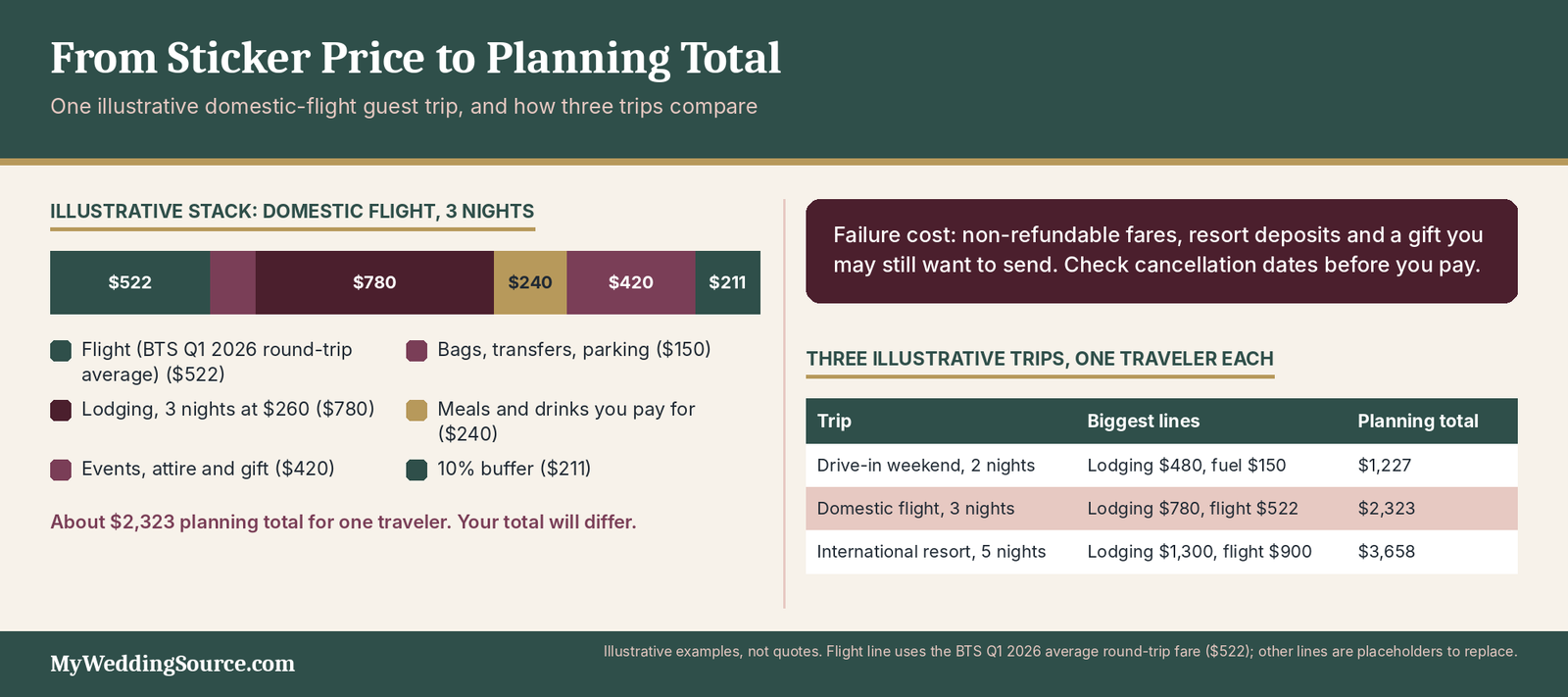
Divide the total by the months left before you need to pay. Flights and lodging are usually paid first, so also note when each deposit or balance is due, because that is when the cash actually leaves your account. In the illustrative domestic-flight trip below, a $2,323 total with eight months to go is about $290 a month, which is easier to see than a lump sum. If you would like to see how that sits beside your other goals, the wedding budget calculator approaches the same arithmetic from the couple’s side.
What do three illustrative trips look like?
Each column below is one traveler, with every line shown, and the final row adds the 10% buffer. These are illustrative examples, not quotes; the domestic flight line uses the BTS round-trip average, and the other lines are round placeholders for you to replace with real prices.
| Line item | Drive-in weekend (2 nights) | Domestic flight (3 nights) | International resort (5 nights) |
|---|---|---|---|
| Flight or fuel | $150 | $522 | $900 |
| Bags, transfers, parking | $0 | $150 | $120 |
| Lodging (taxes included) | $480 | $780 | $1,300 |
| Meals and drinks you pay for | $160 | $240 | $150 |
| Events and excursions | $75 | $120 | $200 |
| Attire | $100 | $150 | $200 |
| Gift | $150 | $150 | $150 |
| Passport and insurance | $0 | $0 | $305 |
| Subtotal | $1,115 | $2,112 | $3,325 |
| 10% buffer | $112 | $211 | $333 |
| Planning total | $1,227 | $2,323 | $3,658 |
What does the drive-in weekend teach us?
At about $1,230, the drive-in trip lands above The Knot’s $840 average for guests who drove, mostly because this example assumes two hotel nights at $240 and a new accessory budget. Lodging is the largest line, roughly two-fifths of the total. That is the typical pattern: when a wedding is within driving distance, the room is the big cost and the travel is small. Sharing a room or choosing a cheaper hotel tier can drop this trip toward $1,000 without losing any wedding events. It is also the trip where “ceremony and reception only, one night” is easiest to say yes to.
What does the domestic flight trip teach us?
At about $2,300, this trip is above The Knot’s $1,680 average for guests who flew, and the reason is not mystery inflation. Our editorial reading is that a survey average covers all kinds of weddings, including short local-feeling weekends, while a destination wedding commonly asks for three nights or more. This is the scenario where one choice, such as booking three nights instead of four or splitting a rental car, changes the total by several hundred dollars. It is also the trip most likely to be paid for by a mix of savings and a travel credit card, which brings its own considerations about interest if the balance is not paid in full.
What does the international resort trip teach us?
The international example is dominated by flight and lodging, with a passport renewal and trip insurance adding a lump that many guests forget. The NAIC says travel insurance usually costs about 5% to 10% of the trip price, and the $305 line above combines a passport renewal with a mid-range insurance placeholder. Sharing a room with a partner would cut the lodging line roughly in half, which would bring the per-person total closer to $3,000. Because this trip carries the most money at risk if plans change, it is also the one where you most need to read cancellation terms before paying.
Quote Traps: Hidden Fees, Service Charges and Apples-to-Apples Comparisons
Most surprises in a destination wedding guest cost come from comparing two quotes that do not include the same things. A hotel may show a low nightly rate and add a fee later; an airline may show a low fare and charge for the bag; a resort may say “all-inclusive” while excluding the premium restaurant the group dinner is booked at. This section names the common gaps so you can compare quotes on the same basis, and so couples can recognize which gaps they are creating for their guests.
Where do lodging quotes hide the real total?
How do resort fees and the FTC fee rule affect a hotel quote?
Resort and facility fees are mandatory daily charges that some properties add on top of the room rate. The Federal Trade Commission’s rule on unfair or deceptive fees took effect on May 12, 2025, and as Frommer’s summarizes it, hotels and other short-term lodging must show a total price that includes automatic fees at the start of the transaction. The rule does not ban resort fees, and it does not require taxes or other government charges to be included in that up-front total, though they must still be disclosed before you pay. Do not assume the rule covers every booking path, especially a property abroad or a package sold elsewhere; instead, ask for the all-in nightly total in writing.
What should you ask about a room block rate?
A room block is a set of rooms a couple reserves at a negotiated rate, and your own rate may be higher or lower than what the hotel shows to the public on a given night. Price the same dates on the hotel’s own site and a major booking site before you use the block, then weigh any difference against the block’s perks such as a free cancellation window or being near the group. Booking inside the block also helps the couple, because many contracts contain an attrition clause. Joy’s glossary explains that most contracts set a minimum between 75% and 90% of the block, with 80% the most common for weddings, and the person who signed the contract pays for the shortfall. That is why couples ask guests to book in the block, and it is a fair question for you to ask them whether the rate is actually a good one.
What does “all-inclusive” include, and what is a service charge?
All-inclusive means different things at different resorts: some include only house-brand drinks and a buffet, others include a la carte restaurants and activities, and most exclude spa services, excursions and sometimes tips. A service charge or gratuity is a percentage added to a bill for staff, and its rate and what it covers vary by property and by event. If the couple is hosting a dinner, ask whether the service charge is built into their contract or whether guests will see an added line. For your own meals, ask whether the menu price includes service, because a service charge of any size on a group tab is easy to miss.
Where do travel quotes hide the real total?
What can a low airfare leave out?
A low fare can be a basic-economy ticket that charges for a carry-on, a checked bag and an assigned seat. The BTS average fare figure cited earlier excludes those optional charges, which is a reminder that the number on the booking page is not always the number on your card statement. When you compare two itineraries, add the bag and seat charges you would really pay, and compare the total. Also compare the arrival time with the first event on the itinerary, because a late arrival can cost you a hotel night you cannot use.
How do currency and card fees change the total?
Some credit cards charge a fee on purchases made abroad or in a foreign currency, and the Consumer Financial Protection Bureau’s Regulation Z commentary treats those fees as finance charges when the card issuer imposes them. The fee level depends on the card, so check your card agreement rather than guessing. As an illustration only, a fee of 3% on $1,000 of spending abroad would add $30, which is easy to absorb but is also easy to avoid with a card that has no such fee. If a terminal offers to charge you in dollars instead of local currency, ask what exchange rate and fee apply before you say yes.
Are there destination taxes you pay on arrival?
Some destinations charge visitors a separate tourism fee that never appears on the airfare or the hotel bill. One example is the Visitax in Quintana Roo, Mexico, which TravelPulse reported in April 2025 as $17.75 per non-Mexican visitor, paid online by card. Amounts and collection methods for fees like this change, so treat that figure as a dated example and check the destination’s official tourism site and the State Department’s country page before you travel. Put a line for these small fees in your buffer, and leave room for the cash or card you need to pay them.
| Quote item | Ask before you book | Why it changes the total |
|---|---|---|
| Nightly rate | Is the rate per room or per person? | Double-occupancy pricing can rise for a solo traveler |
| Resort or facility fee | Is it in the all-in nightly total? | Daily fees add up over a multi-night stay |
| Taxes | Are taxes in the total or added later? | Local lodging taxes can change a total noticeably |
| Block cutoff | When does the block rate end? | After the cutoff, the rate may rise or rooms may sell out |
| Cancellation deadline | What is the last free-cancel date? | Missing it can turn a refundable room into a lost deposit |
| Fare type | Does the fare include a carry-on and bag? | Basic fares can add fees at the airport |
| Ground transfer | Is there a shared shuttle, and what does it cost? | A private transfer is costly if you ride alone |
| Service charge | Is gratuity included in meals and events? | Added percentages raise the bill |
| Card or currency fee | Does my card charge for foreign purchases? | A percentage fee applies to every purchase |
| Destination fee | Is there an arrival or tourism tax? | Fees outside the booking are easy to forget |
Should You Go? A Decision Framework for Guests
Deciding whether to attend a destination wedding is a mix of arithmetic and feeling, and both deserve respect. The arithmetic is your guest-budget worksheet; the feeling is how much this couple, and this trip, matter to you. The framework below separates the two so you can make a choice you will still feel good about a year from now, whichever way it goes.
How do you score the invitation?
What are the three numbers to compare?
Write down three figures: your planning total from the worksheet, the amount you can spend without borrowing or skipping other priorities, and the gap between them. A gap of zero or below means the trip fits; a small gap can often be closed by shortening the stay or sharing a room; a large gap is a signal to explore another form of attendance. This is general budgeting education rather than personalized financial advice, and your own circumstances, including debt and savings goals, are what matter most. The point is to see the gap in dollars, not as a vague worry.
How much should the relationship count?
Closeness changes how much of a stretch is reasonable. A sibling’s or best friend’s wedding may justify an expensive trip that a coworker’s invitation would not, and a wedding party role comes with obligations beyond attendance. A simple way to weigh this is to rate the relationship from one (acquaintance or colleague) to four (immediate family or wedding party) and let the rating move how large a gap you are willing to close. Most couples understand that a guest further out in their circle may choose to send a card and a gift instead of traveling.
Would you take this trip without the wedding?
Ask whether you would pay for this destination for a vacation. If the answer is yes, part of the cost is a trip you wanted anyway, and extending the stay by a day or two can make the spend feel more like a holiday than an obligation. If the answer is no, the full cost is a cost of attending, and the threshold for saying yes should be higher. Neither answer is wrong; it simply helps you see what you are really buying.
What are your options besides yes or no?
How do you decline warmly?
Reply by the RSVP deadline, because couples are counting heads for contracts and an early no helps them plan. A short, warm note works best: thank them, say you are sorry to miss it, and wish them a wonderful weekend. You do not owe an itemized explanation of your finances, and over-explaining can make the message feel like a negotiation. If you are close to the couple, a phone call before the written reply is a kind touch.
Can you attend only part of the weekend?
Many destination weddings welcome guests for the ceremony and reception only, with a shorter stay than the full itinerary. Ask the couple which events matter most to them, then plan nights around those, since each skipped night usually lowers lodging, meals and events together. Say clearly in your RSVP or message which nights you are arriving and leaving so the couple can plan seating and transport. If you do arrive late or leave early, the couple will likely appreciate your being straightforward about it.
What should you do about a gift and a card if you decline?
Sending a card with a warm message is still meaningful, and a gift is optional. The Knot says guests who cannot attend may send a gift up to a year after the wedding, though within three months is recommended. A smaller gift from someone who is already stretching to travel is common and appropriate. If you want to stay connected without spending, a handwritten note and an offer to celebrate when the couple is home can be worth more than a purchase.
| Your situation | Likely move | Why |
|---|---|---|
| Close family or wedding party, gap you can cover | Attend and plan early | The relationship and the budget both support it |
| Close friend, small gap | Attend, trim nights or share a room | Shortening the stay often closes the gap |
| Friend or relative, large gap | Attend ceremony only, or send regrets | A shorter trip lowers cost and keeps the connection |
| Colleague or distant guest, any gap | Decline warmly with a card | The invitation is an honor but not an obligation |
| Any guest, trip you would take anyway | Attend and extend the stay | Part of the cost is a vacation you wanted |
Ways Guests Can Lower the Total Without Skipping the Celebration
Once you have decided to go, the goal is to spend carefully rather than minimally. The most effective savings come early, when you can choose among options, and from protecting your money against the things that go wrong. This section covers both: the moves to make in the first weeks after the save-the-date, and the safeguards worth considering before you pay for a non-refundable trip.
What can you do before you book?
When should you start watching prices?
Start as soon as the save-the-date arrives, because airfare and room blocks are both easiest to compare before the group rush. The Knot’s save-the-date guidance suggests that couples send them six to eight months before the wedding, closer to eight for destination weddings, which gives you a long runway. Set fare alerts for your dates and nearby dates, and compare several airports if you have a choice. BTS reports the first-quarter 2026 average fare up 7.7% from a year earlier, so waiting without a plan is not obviously a bargain.
How can sharing cut the cost?
Shared rooms, shared rides and shared rentals are the quiet workhorses of guest savings. Splitting a two-bed room among friends can cut the lodging line by half, a shared airport transfer lowers a per-person fee, and a rental car for several people is often cheaper than separate rides. A group gift is another form of sharing: The Knot found about 25% of guests joined one. Agree on how to split before you book so nobody is surprised, and confirm the hotel’s occupancy rules.
How do you use points and cards carefully?
Rewards points can offset a flight or a room, and some cards include travel protections worth checking, but the benefits only help if the card is paid off. Check whether your card charges foreign transaction fees before you use it abroad. Look at your credit card’s travel protection terms instead of assuming they cover your trip, since the NAIC notes some cards offer trip cancellation or lost baggage coverage and that you should check whether it is enough. Keep a record of confirmations and receipts in one folder so a dispute or claim is straightforward.
How do you protect the money you spend?
What can travel insurance actually cover?
Travel insurance is a bundle of different coverages, and the useful question is which risk you would struggle to absorb. The NAIC says policies usually cost about 5% to 10% of the trip price, though cost varies with season, destination, traveler age and what the policy includes. Cancel-for-any-reason coverage is an add-on that must be bought within a set window and usually reimburses only part of the trip cost. This is general education, not insurance advice; ask a licensed agent or your state insurance department for details on a specific policy.
| Coverage type | What it generally does | What to check |
|---|---|---|
| Trip cancellation or interruption | Repays prepaid, nonrefundable costs for covered reasons | The list of covered reasons and exclusions |
| Cancel for any reason | Lets you cancel for reasons not otherwise covered | Purchase window, partial reimbursement and added cost |
| Travel medical | Covers short-term care abroad | Whether your health plan already pays overseas |
| Medical evacuation | Covers emergency transport to a suitable hospital | Limits and whether your plan covers it |
| Credit card benefits | May include cancellation or baggage coverage | Whether the limits are enough for your trip |
What does a refundable fare or flexible room buy you?
Flexibility has a price, but it is sometimes cheaper than losing a non-refundable payment. Federal rules also help in one narrow case: the Department of Transportation’s refund rule, as reported when it took effect in late 2024, requires automatic refunds when an airline cancels or significantly changes a flight and you do not accept the alternative. A significant change includes a departure or arrival more than three hours different on a domestic itinerary or six hours on an international one. That protects you from the airline’s changes, but not from your own change of plans, so read the fare rules.
How do you handle time off and storm season?
Time off is part of the cost. The Bureau of Labor Statistics reports that paid vacation leave was available to 80% of private industry workers in March 2026, which means about one in five lacks it, so unpaid days can be a real line item. If your trip falls in hurricane season, the NAIC notes that coverage for a storm generally will not apply once it has been named, so buy coverage early if you want it. Ask your employer about leave early, and plan your arrival day with a weather buffer.
What Couples Can Do to Shrink the Guest Bill
If you are the one planning the wedding, you cannot control airfare, but you control more of the guest bill than it may feel like. The Knot’s Real Weddings Study of 10,474 couples married in 2025 found that 17% of weddings were destination weddings, with an average guest count of 117 across all weddings. Those numbers mean your guests have seen this request before and are doing the same arithmetic you are. The choices below are ordered by how much they change a guest’s total, so you can decide which trade-offs are worth making.
Which choices set the guest price?
How much does the nearest airport matter?
More than almost anything else. A location with several daily nonstops from large cities gives guests more fare options than a destination reachable only through a connection, and a long drive from the airport adds a transfer cost. Before you commit, run sample searches from the three or four cities where most of your guests live, and note the lowest fares and the number of connections. That ten-minute test tells you whether you are inviting people to a trip that costs a few hundred dollars more than the alternative, and it costs nothing.
How do dates and length of stay change the bill?
Holiday weekends and peak-season dates raise fares and rates and shorten the supply of rooms. Our related pieces on Thanksgiving weekend wedding costs and guest etiquette and the December wedding budget show how dates alone can reshape what guests pay. Hurricane season dates matter too; the Atlantic season runs June 1 to November 30, so a late-summer Caribbean wedding deserves a rain and storm plan and clear cancellation wording. Shorter itineraries, such as two or three nights built around the ceremony, reduce lodging, meals and time off at the same time.
How many events should you require?
Each additional event is another reason for a guest to stay a night and buy a meal. A useful test is to separate “the wedding” from “the weekend”: the ceremony and reception are the wedding, while a welcome drink, a group excursion and a farewell brunch are optional hospitality. Host the meals you call part of the celebration, and label the paid extras clearly as optional. Guests will usually choose the extras that matter to them when they can see the cost, and that choice is easier than feeling obligated to attend everything.
How do you communicate cost and manage the contract?
What should the save-the-date and website say?
Send the save-the-date early. The Knot suggests six to eight months ahead, leaning toward eight for far-flung locations, and a destination wedding gives guests a reason to want even more notice. Put the dates, the location and the nearest airport on the save-the-date, and add a travel page to your website with an estimated cost range, the hotel block details with the cutoff date, and which events are hosted. If you are not sure what to say, our guide to destination wedding etiquette includes wording examples. Updating the page when prices change keeps trust high.
How should you handle a room-block contract?
Read the attrition clause before you sign, because the person who signs it carries the shortfall risk. Joy’s glossary suggests asking for a lower fill percentage such as 70% instead of 80%, a review date two to four weeks before the cutoff so you can release unneeded rooms, a resell credit so rooms the hotel resells reduce your shortfall, and a conservative starting block. Share your booking link early to see how many rooms are actually being booked. A contract that protects you also protects guests from being pushed into a hotel they cannot afford.
What can you offer without paying for everything?
You do not have to cover guests’ travel to be a generous host. Smaller gestures change the experience: hosting a welcome drink, arranging a group shuttle so everyone shares one transfer cost, offering a range of lodging prices, or choosing a venue with an affordable hotel nearby. If you want to help one or two people, do it privately, so nobody feels singled out. Our budget context for couples is in the 2027 wedding budget reality report, which shows where the money tends to go in the overall plan.
| Lever | Effect on the guest’s total | Trade-off for the couple |
|---|---|---|
| Choose a well-served airport | Lower and more varied fares | Fewer secluded venues to pick from |
| Shorter itinerary | Fewer nights, meals and days off | Less time with guests |
| Host key meals | Lowers food costs | Raises your catering budget |
| Offer lodging at several price points | Lets guests choose their level | More booking work and tracking |
| Shuttle for the group | Splits transfer costs | A line in your budget |
| Early save-the-date | More time to save and compare | Details must be settled sooner |
Etiquette: Who Pays, What to Say and When to Help
Money etiquette is where kindness and practicality meet. The common expectation is that hosts pay for what they host and guests pay for getting there, but there are good reasons to offer more help in specific cases. For fuller scripts and scenarios, see our guide to destination wedding etiquette; here we focus on cost-specific questions.
What do couples owe their guests?
Do hosts have to pay for guests’ travel?
No law or universal rule requires it, and common etiquette guidance is that guests at a destination wedding generally cover their own transportation and lodging. What hosts do owe is clarity: tell guests early what is hosted, what is optional and roughly what the trip will cost. Hosts who require attendance at a specific event, such as a ceremony on a remote island, may want to think harder about what help to offer. Choosing to pay for part of the trip is generous; assuming guests will not mind the cost without asking is risky.
What about the wedding party?
Wedding party members usually spend more than other guests, as the DatingNews survey above shows. Couples often cover or contribute to specific items such as lodging, hair and makeup, or a group dinner, though customs vary by community and budget. Have the conversation before the invitations go out: tell each person what the role involves, give an honest cost estimate, and ask whether it works for them. A good question is “What would make this feel manageable?” because the answer may be a smaller role rather than a bigger payment.
How do you help a guest who cannot afford the trip?
Offer privately and without pressure. Options include covering a night, paying for a shared transfer, or inviting the person to attend only the ceremony and reception. Some guests will decline the help because accepting feels hard, and that is fine; the offer still matters. Avoid announcing the gesture to the group or making the guest explain their finances.
What do you say, and how?
How should the website describe costs?
State what is known and mark estimates as estimates. An illustrative version of the wording: “We know travel is a big ask, so here is what we know. The welcome drinks, ceremony and reception are hosted. Rooms in our block start at an example rate of $250 a night before taxes and fees, and the block closes on a stated date. The Friday boat trip is optional and guests pay their own way.” Avoid pressure phrases like “we hope you will make it work,” which sound warm but can make a no feel harder.
How do you respond when a guest says they cannot come?
Reply quickly and warmly: thank them for letting you know, say you will miss them, and do not ask why. Do not tie the response to their gift or to future invitations. Count the regret as useful information, because it helps you finalize your guest count and any contracts that depend on it. If many close friends decline for cost reasons, treat that as a signal to review the dates, length or location rather than a sign anyone is being difficult.
What if a guest asks for a different hotel or a cheaper option?
Say yes where you can. A guest who books outside the block still travels to your wedding, and a flexible lodging policy lowers pressure on everyone. Explain that room blocks help you meet a hotel commitment and invite guests to book in the block when it works for them, without penalty if it does not. The couples who do this best treat the block as a convenience for guests rather than a requirement, while keeping an eye on the contract’s cutoff date.
FAQ: Destination Wedding Guest Cost
These are the questions guests and couples ask most often once the trip math is on the table. Answers here are general education; terms, prices and rules vary by destination, airline, hotel and insurer, so confirm anything that affects a payment.
Budget questions
How much should I budget to attend a destination wedding as a guest?
Use your own worksheet instead of a national average. For reference, The Knot’s Guest Study found an average of about $1,680 for guests who flew, and the three illustrative trips above range from roughly $1,230 to $3,660 before any savings from sharing a room. If your total is out of reach, the next best step is to shorten the stay or attend the ceremony and reception only. Add a 10% buffer for the small fees that appear during the trip.
Are destination wedding gifts smaller?
Often they are, because the travel is itself a significant expense. The Knot’s data shows the average gift is about $150, with lower amounts from casual friends and guests’ dates. Many guests and couples regard a traveling guest’s presence as the main gift. If you are stretched, a smaller gift or a group gift is a polite choice.
What if the room block costs more than booking myself?
Compare the all-in total, including taxes and fees, for the same dates and room type. If the public rate is lower and cancellation terms are acceptable, you may book outside the block, but tell the couple, since many block contracts depend on rooms booked. Ask whether the block rate includes perks such as breakfast or a cancellation window. A courteous message to the couple usually resolves it.
Etiquette questions
Is it rude to decline a destination wedding because of cost?
No. Couples who choose a destination know that some invited guests will not travel, and many plan for it. Reply by the RSVP deadline, say you are sorry to miss it, and send a card or a gift if you choose. You do not need to share your finances to decline.
Should the couple pay for guests’ travel?
Not as a general rule. Hosts typically pay for the events they host, while guests pay for getting there, though couples may choose to contribute for the wedding party or for specific guests. The most important step is telling guests early what the trip will cost and what is hosted. If you want to help, do it privately and without strings.
Can I attend only the ceremony?
Often, yes, if you tell the couple which nights you plan to attend. Some destination weddings welcome guests for just the ceremony and reception, which can lower lodging, meals and time off at once. Ask the couple which events matter most to them, and plan your trip around those. Clear communication helps them plan transport and seating.
Your Next Steps
The most helpful move is a small one: turn your questions into a short list and run them against real prices. The two groups below match where most readers are right now, whether you have an invitation in hand or are still choosing dates.
This week
If you are a guest
Copy the six lines into a note, then price your flight, lodging and any passport or insurance costs for the exact dates. Add a 10% buffer, compare the total with what you can spend without borrowing, and decide whether you are attending, attending partially or declining. If you are traveling abroad, check your passport’s validity and processing times at the State Department’s passport page, and see a clinic or doctor as early as you can; the Minnesota Department of Health recommends contacting a provider preferably four to six weeks before you travel.
If you are the couple
Run sample flight searches from your guests’ main cities, list every event as hosted or optional, and draft the travel page with an estimated cost range. Then use our destination wedding checklist to place each task on the calendar and the wedding planning hub to see how the guest bill fits into the larger plan. The aim is to answer “what will this cost me?” before anyone has to ask.
Before you pay a deposit
Guest checklist
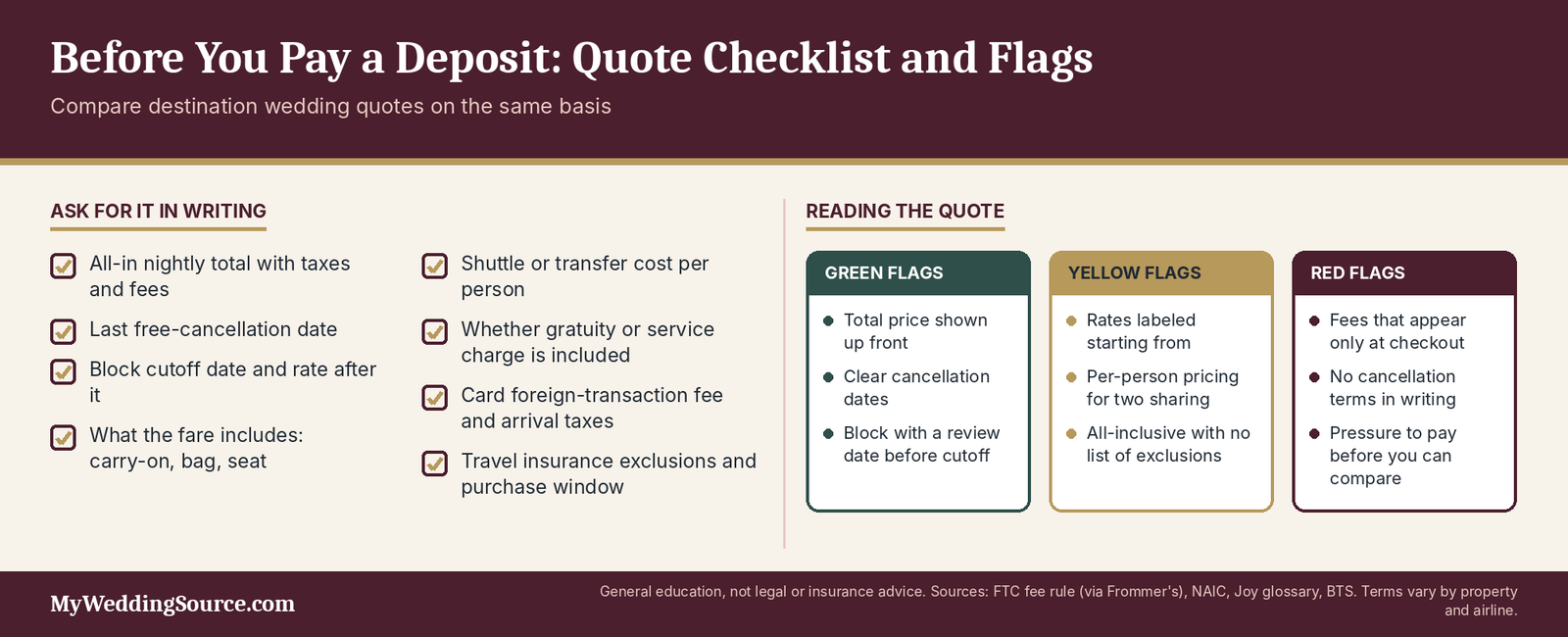
Confirm the all-in nightly total, the last free-cancellation date and what the fare includes, and save the confirmation emails. Check whether your card charges foreign transaction fees, whether any insurance you are considering covers your reason for canceling, and whether the trip falls in hurricane season. Pay with a method that gives you records, and note which payments are non-refundable. Put a calendar reminder two weeks before every deadline.
Couple checklist
Read the room-block contract’s attrition clause, review date and cutoff, and ask about a resell credit before you sign. Confirm which events you are hosting and what any service charge adds to the bill. Share the final details with guests as soon as they are settled, and keep the website current. Keep a list of contract deadlines in one place so a missed cutoff does not become a surprise.
Sources & methodology
- The Knot: Wedding Guest Cost — Guest Study averages ($610, $270, $840, $1,680), gift averages, attire and dress-code findings, tips for guests.
- The Knot Real Weddings Study 2026 data read-out (PDF) — 2025 destination wedding share, average guest count, sample of 10,474 couples.
- FOX 13 report on the DatingNews.com survey — local, out-of-town and wedding party guest averages; share who skipped weddings for cost.
- Bureau of Transportation Statistics, Q1 2026 average air fare — average domestic fare, one-way and round-trip figures, what the fare excludes.
- U.S. Department of State: passport processing times — routine and expedited processing windows, quieter application period.
- U.S. Department of State: renew a passport — renewal and expedite fees, validity advice.
- NAIC: Should I get travel insurance? — coverage types, exclusions, cancel-for-any-reason, typical cost.
- Frommer’s on the FTC junk fee rules — total-price requirement for short-term lodging and what is excluded.
- Joy: What is an attrition clause? — room-block attrition thresholds and negotiating points.
- CFPB Regulation Z, section 1026.4 — treatment of foreign transaction fees as finance charges.
- TravelPulse on Quintana Roo’s Visitax — example of a destination tourism fee (April 2025).
- The Knot: when to send save-the-dates — six-to-eight-month timing, eight for destinations.
- FOX 13 on the DOT automatic refund rule — refund trigger and significant-change definitions.
- Bureau of Labor Statistics, Employee Benefits release — share of private industry workers with paid vacation (March 2026).
- NOAA National Hurricane Center: climatology — Atlantic hurricane season dates and peak activity.
- Minnesota Department of Health: travelers — advice on seeing a provider four to six weeks before travel.
Methodology: We separate verified facts (government and agency pages such as BTS, the State Department, NOAA, BLS and the NAIC), survey findings (The Knot and DatingNews.com, whose samples we name), editorial judgment (the 10% buffer, the decision matrix and the relationship scale) and illustrative examples (all three trip totals, the 3% fee example and the sample website wording), which are labeled as such and are not quotes. We did not find a reliable national figure for guest meal spending or for typical destination-resort service charges, so we explain what drives those lines rather than inventing a number.
Freshness note: Recheck passport processing times and fees, airline refund and fee rules, FTC fee-rule guidance, destination tourism fees such as Visitax and hurricane-season dates before you book. Survey averages are refreshed by The Knot roughly each year; look for the next Guest Study and Real Weddings Study releases. This article reflects information available in October 2026 and is general education, not legal, financial or insurance advice.