
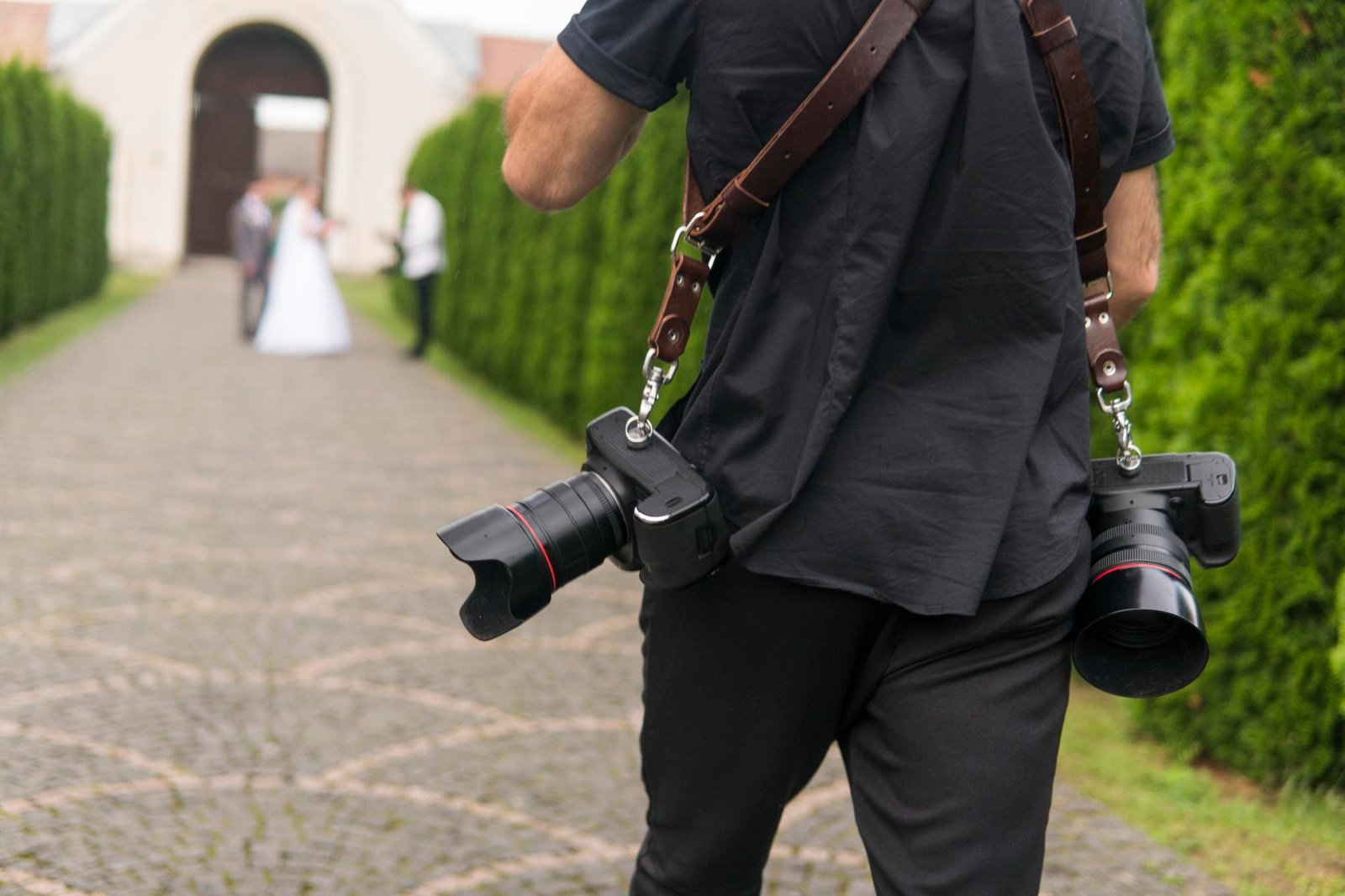
Wedding photography cost is not one price but a stack of five choices (hours, photographer experience, place and date, add-ons, and usage rights), and once you can see the stack, three quotes that looked unrelated become easy to compare.
Imagine three photographer quotes in your inbox: $1,900, $3,400 and $6,200. All three say “full wedding coverage,” all three have beautiful galleries, and none of them seems to be pricing the same thing. One covers six hours with a single photographer, one includes an engagement session and a second shooter, and one is a studio that includes an album but charges extra for travel and for the right to print your own photos. Comparing them by the headline number is like comparing three grocery receipts without reading what was in the bags.
This guide is built to fix that problem. It explains what national surveys say couples actually pay, why the averages disagree, and how coverage hours, experience, region, date, add-ons and licensing each move the total, along with the parts of the bill that rarely appear in a headline price: tax, travel and payment schedules. Pricing in this industry is complicated rather than secretive, because a photographer is selling a day of skilled work plus many hours of editing and delivery, and the quote reflects choices that only you can describe.
One caution before the numbers: every figure below is a survey finding, a published estimate or a labeled illustration, and none is a quote for your city, date or photographer. Use this as a framework for reading real quotes, not a substitute for them.
What Do Couples Actually Pay for Wedding Photography, and Which Number Should You Trust?
The honest answer is “about $3,000 to $4,400 as a national midpoint, with a spread from under $1,500 to well above $5,000.” Those figures come from different surveys with different methods, so the useful move is to understand each one rather than pick a favorite. This section lays out the benchmarks, explains why they diverge, and shows how photography fits inside the rest of your budget.
What do the major surveys and price guides report?
What does The Knot’s 2026 Real Weddings Study say?
The Knot’s study, which surveyed 10,474 U.S. couples married in 2025, reports an average photographer cost of $3,000. The spread matters as much as the average: the lower quartile was about $1,500, the middle was about $2,800 and the upper quartile was about $4,700, so half of couples paid between roughly $1,500 and $4,700. The Knot also reports that 88% of couples hired a professional photographer, which makes photography one of the most commonly hired vendors. Its article derives an hourly figure of about $375 by dividing $3,000 by an eight-hour day, and it is careful to present that as arithmetic rather than a reported rate. If you only remember one number, remember the quartiles, because they show that a quote of $1,500 or $4,700 is not automatically a red flag.
Why does Zola report a higher average?
Zola’s Wedding Cost Index puts the national photographer average at $4,400, with a typical range of $3,500 to $5,300, and describes photography as about 9% of a total budget. The difference from The Knot is not a contradiction. The Knot’s figure comes from a survey of couples who already married and reported what they spent, while Zola’s index draws on platform data that includes couple budgets, spending in its budget tool and vendor-reported pricing, and its page does not publish a sample size for the index. Different populations, different question wording and different years of data will produce different averages. One small inconsistency is also worth flagging: the body of Zola’s photographer page says $3,500 to $5,300, while the page’s meta description gives a lower bound of $3,300, so treat the low end as approximate.
What do photographer-written guides add?
Price guides from planning platforms and photography businesses fill in the structure the surveys leave out, with the caveat that they are marketplace and vendor estimates, not surveys of what couples paid. Joy’s wedding photographer cost guide, updated July 24, 2026, describes tiers from $1,000 to $2,500 for four to six hours up to $7,000 to $15,000 or more for 10-plus hours of editorial coverage. KEH, a camera retailer, wrote a budget guide in March 2026 that lists entry-level wedding work at $1,500 to $3,000, established photographers at $3,000 to $6,000, and luxury or destination work at $7,000 to $15,000 or more. A studio’s own 2026 blog gives a national full-day range of $2,500 to $5,500. These ranges overlap enough to be useful, and they agree with the surveys that $3,000 is a sensible midpoint rather than a floor or a ceiling.
| Source | What it reports | What the figure reflects | Date and caveat |
|---|---|---|---|
| The Knot Real Weddings Study | $3,000 average; $1,500 / $2,800 / $4,700 quartiles | Survey of 10,474 couples married in 2025 | Page updated May 8, 2026 |
| Zola Wedding Cost Index | $4,400 average; $3,500 to $5,300 typical | Platform data and vendor-reported pricing | Page updated Feb. 19, 2026; sample size not published |
| Joy photographer cost guide | $3,000 for an 8-hour day; tiers from $1,000 to $15,000+ | Planning-platform estimate | Updated July 24, 2026; not a survey |
| KEH budget guide | $1,500 to $3,000 entry; $3,000 to $6,000 established | Camera-retailer estimate of U.S. prices | Dated March 9, 2026; not a survey |
How does photography fit inside your whole budget?
What share of the budget is typical?
Photography usually lands in the high single digits of a total budget. Dividing The Knot’s $3,000 photographer average by its $34,200 average wedding cost gives about 9%, which lines up with Zola’s “about 9%” description and with The Knot’s budget guide, which suggests roughly 10% for photography and videography combined. Those shares are descriptive, not a rule, and a couple who cares intensely about photos and keeps the guest list small might reasonably spend a larger share without anything being wrong. The more useful use of the percentage is as a sanity check on a quote: on a $30,000 wedding, a 10% allocation is about $3,000, and a quote far above that is worth a conversation about what you would drop elsewhere. Our wedding budget calculator helps you test that trade-off against your own total.
Why does the hourly-rate shortcut mislead?
Dividing a package by its hours gives a convenient number, and it is also easy to misread. The $375-an-hour figure treats the photographer as someone who is paid only while the shutter is clicking, but a single wedding involves far more work than the coverage window. KEH reports that each hour of shooting typically brings two to three hours of additional work, with a whole wedding often totaling 30 to 50 hours, and an Adorama guide says an eight-hour job often represents 20 to 30 hours of total work. That behind-the-scenes time covers consultations, timeline planning, culling thousands of frames, editing, delivery and album design. So the “rate” in a package is really a share of a larger job, which is why hourly add-ons, quoted separately, often look different from the implied rate.

How Do Coverage Hours and Package Tiers Set the Price?
Coverage hours are the single most direct lever on your quote, and Zola’s photographer guide calls the combination of hours and number of photographers the biggest cost driver. The hours you buy determine which parts of your day get photographed at all, so this is a timeline decision as much as a money decision. This section explains what 6, 8 and 10 hours typically cover, how packages are tiered, and how extra hours are priced.
What do six, eight and ten hours actually cover?
What fits in six hours?
Six hours works when the wedding is compact: one location, a modest guest list and a tight sequence of events. Susan Stripling’s coverage guide describes six hours as an offering for intimate weddings and elopements, and notes that for most weddings the real choice is between eight and ten. In practice, six hours usually has to start close to the ceremony, which means skipping most of the getting-ready coverage or compressing portraits into the gap before and after the vows. It tends to end after dinner and toasts, before the dance floor fills. If you plan a first look or a long family list, check that the six hours do not run out before the cake. Our guide to first look photos shows how an earlier start changes the hour count.
What fits in eight hours?
Eight hours is the figure most sources treat as the standard starting point. David’s Bridal calls it the industry-standard starting point for full-day coverage and says shorter coverage means something meaningful will likely be dropped. Stripling’s sample eight-hour day has the photographer arriving at noon for getting-ready shots, a 2:00 p.m. ceremony, portraits and cocktail hour in the afternoon, dinner and toasts at 7:00 p.m., and a departure after the first dance and cake cutting around 8:00 p.m. Zola says most packages include eight hours of coverage, digital image rights and sometimes an engagement session. That makes eight hours the sensible baseline for comparing quotes, even if you end up buying more or less.
How are packages tiered, and what do extra hours cost?
What distinguishes a basic, standard and premium package?
Tiers are usually a bundle of hours, people and deliverables, and Zola’s description of them is a useful template. A basic package covers about six to eight hours with one photographer and treats an engagement session as an occasional add-on. A standard package covers eight to ten hours with one or two photographers and usually includes an engagement session, with an album often sold as an extra. A premium package covers ten or more hours with two or more photographers and usually includes both the session and an album. Zola’s page gives no dollar figures for the tiers, so use the structure to see what you are buying, and use local quotes to see what it costs.
| Tier | Typical hours | People and extras (Zola) | Published price signal |
|---|---|---|---|
| Entry or basic | 4 to 8 hours | One photographer; engagement session sometimes an add-on; no album | $1,000 to $2,500 for 4 to 6 hours (Joy); $1,500 to $3,000 (KEH) |
| Standard or mid-range | 8 to 10 hours | One or two photographers; session usually included; album often an add-on | $2,500 to $4,500 for 6 to 8 hours (Joy); $3,000 to $6,000 established (KEH) |
| Premium | 10 or more hours | Two or more photographers; session and album usually included | $4,500 to $7,000 for 8 to 10 hours; $7,000 to $15,000+ for 10 or more (Joy) |
What do extra hours cost, and when do you buy them?
Added hours are typically priced separately from the package, and published estimates vary. Joy lists additional hours beyond a package at $200 to $500 each, and Paperlust, a stationery and planning blog, lists $150 to $300 per additional hour, so a realistic planning range is a few hundred dollars per hour. Hours are cheapest when you buy them up front in the package and most expensive when you add them informally on the day, because overtime clauses sometimes use a higher rate or require full-hour increments. The safest practice is to ask for the overtime rate in writing and to decide in advance who may authorize extra time, since a delayed ceremony can quietly consume your last hour. Compare that rate to the implied package rate of $375, and ask why if the two differ sharply.
How do you choose the number of hours from your own timeline?
Work backward from the moments you cannot lose. List the events you cannot skip (for example getting ready, ceremony, family photos, couple portraits, toasts, first dance and a send-off), estimate how long each takes, and add the travel time between locations. Add a buffer of 30 to 60 minutes for delays, because weddings rarely start on the minute. The total is the hour count you need, and it may be seven or nine rather than the round number in the package menu. If your total falls between two tiers, ask whether the photographer will quote a custom number of hours, since many do.
How Much Does Photographer Experience Change the Price?
Experience is the second-largest driver after hours, and it is also the one that gets misread most often. A higher price can reflect speed, reliability and a deep archive of weddings in tricky light, and it can also reflect a brand and a waitlist that have little to do with the photos you will receive. This section shows what published guides say about experience tiers, what business costs sit inside a price, and how to judge value without assuming that more spending means better pictures.
What do different experience levels charge?
What does a newer photographer typically charge?
Newer photographers sit at the low end of published ranges, and many deliver strong work. Joy’s guide puts a budget starting point at $1,000 to $1,500 and early-career photographers with one to three years of experience at $1,200 to $2,500, with entry-level hourly rates of $150 to $200. Paperlust’s 2026 guide claims that newer photographers with full galleries may deliver comparable results at roughly 60 to 70% of established rates; treat that as one writer’s estimate rather than a measured fact. The trade-off is usually less track record in unusual conditions, such as a dark church, a harsh midday beach or a delayed ceremony. If you are leaning toward a newer photographer, ask to see two or three complete wedding galleries, not only a highlight reel, and ask who the backup is if they are ill on the day.
What do established and luxury photographers charge?
Established photographers with five or more years of full-time wedding work are priced meaningfully higher. Joy puts them at $3,500 to $6,000, with hourly rates of $400 to $600, and nationally recognized editorial photographers at $8,000 or more. KEH’s guide, which comes from a camera retailer, lists established wedding photographers at $3,000 to $6,000 and luxury or destination work at $7,000 to $15,000 or more. The two sources agree closely on the middle tier and diverge on the top, which is typical for a market where luxury pricing is set by individual demand. At this level the price often includes tighter booking calendars, more staffing, and deliverables such as albums, which is why the package contents matter more than the label.
What are you paying for besides camera time?
What does experience buy that a portfolio cannot show?
A portfolio shows the strongest frames, while experience shows up in the consistency of the ones you never see. Paperlust notes that established photographers charge more for shooting speed, consistency, and the ability to handle varied lighting and venues, and those traits matter most when the day does not go to plan. Reliability is part of the product too: one photographer interviewed by Rocky Mountain Bride calls a “no” to the question of carrying backup equipment a red flag and says she keeps a network of backup photographers who can step in if she cannot attend. In The Knot’s 2026 study data, 81% of couples cited photos or examples of the photographer’s work as a selection factor, ahead of price at 73%, so the portfolio is the first filter and the question list is the second. You cannot see backup planning in a gallery, which is why it belongs on your question list. Our wedding photographer questions guide has the full set to ask at a consultation.
Which business costs sit inside the price?
A wedding photographer is a small business, and a quote has to cover costs that do not appear on your invoice. KEH estimates a dependable professional kit at $8,000 to $15,000 or more, including two primary camera bodies, a backup body, fast lenses, flash and dual-card recording. It lists annual liability and equipment insurance at about $500 to $1,500 or more, and software, backup storage, gallery and accounting tools at about $100 to $300 per month regardless of bookings. KEH also notes that a $5,000 package does not equal $5,000 of take-home income after self-employment tax, licensing, and accounting or legal fees. None of this makes a given quote fair or unfair, but it explains why a price that looks high against an hourly wage can still be modest for a business with these fixed costs.
Why Does Wedding Photography Cost More in Some Places and on Some Dates?
The same photographer can quote differently for a Saturday in June than for a Friday in November, and photographers in dense, high-cost metros price differently from those in smaller markets. Region and date are not within your control the way hours are, but knowing the pattern helps you decide whether a local, traveling or off-peak option makes sense. This section covers regional averages, city estimates and the effect of day, season and guest count.
How do regions and cities compare?
What do The Knot’s regional averages show?
The Knot’s article reports regional photographer averages from the 2025 weddings: $3,700 in the Northeast and New England, $3,800 in the Mid-Atlantic, $2,900 in both the Midwest and the West, $2,700 in the South and Southeast, and $2,600 in the Southwest. The gap between the lowest and highest region is $1,200. Averages blur differences inside a region, since a major metro and a rural county in the same region can price very differently. Treat the table as a map of where the middle of the market sits, then collect local quotes from your own area.
| Place | Reported average | Range reported | Source and caveat |
|---|---|---|---|
| Mid-Atlantic region | $3,800 | Not given | The Knot, couples married in 2025 |
| Northeast and New England | $3,700 | Not given | The Knot, couples married in 2025 |
| Midwest / West | $2,900 | Not given | The Knot, couples married in 2025 |
| South and Southeast | $2,700 | Not given | The Knot, couples married in 2025 |
| Southwest | $2,600 | Not given | The Knot, couples married in 2025 |
| New York City | About $5,000 | $3,500 to $12,000+ | Joy estimate; Zola also cites about $5,000 |
| Chicago | $4,800 | $2,500 to $12,000 | Joy estimate, not a survey |
| Washington, D.C. | $4,200 | $3,000 to $10,000 | Joy estimate, not a survey |
| Atlanta | $3,200 | $2,000 to $6,000 | Joy estimate, not a survey |
| Minneapolis / Midwest | $2,800 | $1,800 to $5,000 | Joy estimate, not a survey |
| Salt Lake City | About $3,600 | Not given | Zola, single-city example |
What do city-level estimates add?
City estimates show how much a region’s average hides. Joy’s guide puts New York City at about $5,000 with a typical range of $3,500 to $12,000 or more, San Francisco and the Bay Area at $5,500, Los Angeles at $5,000, Chicago at $4,800, Boston at $4,500, Atlanta at $3,200 and Minneapolis and the Midwest at $2,800. Zola independently gives about $5,000 for New York City and about $3,600 for Salt Lake City, and says major cities generally cost more than smaller towns and suburbs. A studio’s own blog puts rural and low-density markets at $2,200 to $3,000. Note how wide each city range is: in every market there are photographers at the low end and the high end, so your goal is the right fit within your market.
What if you marry somewhere other than where you live?
Photographers price from their home base, so a destination or hometown wedding raises a choice between a local photographer and one who travels. The Knot’s average-cost article recommends comparing local photographer prices with those in your wedding location, and asking whether a travel fee applies, especially if the photographer will stay through the reception or after-party. In The Knot’s 2026 data, 17% of couples paid travel fees for the photographer they chose, which suggests that traveling is a common but not universal choice. A local photographer avoids travel costs and often knows the venues, while a traveling one lets you keep a style you love. Price both routes before you decide.
How do date and guest count change the quote?
Do the day of the week and the season matter?
They do, with a pattern that is easy to remember. Zola reports that Saturdays during peak season, May through October, carry the highest rates, while Fridays, Sundays and off-season dates from November through April can lower the price. Many photographers also have a limited number of Saturday slots, so a popular Saturday can be booked a year or more in advance; Joy suggests booking 12 to 18 months ahead when possible. If your date is flexible, ask each photographer whether a Friday, Sunday or off-season date changes the quote, and whether the discount applies to the package or only to add-ons. A date that moves a few weeks can be the most painless saving in the whole budget.
Does your guest count change the photography price?
Not directly, but guest count tends to travel with other things that do. The Knot reports average photographer costs of $2,000 for weddings with 1 to 50 guests, $2,700 for 51 to 100 guests and $3,500 for 101 or more. Yet a planner quoted by The Knot says a photographer’s costs are the same regardless of how many guests you have, and Zola says photography costs depend more on coverage hours and experience level than on guest count. These statements fit together: photographers do not charge per head, but larger weddings usually need longer coverage and a second photographer, and those add the dollars. If your guest list grows, ask how many hours and people the photographer recommends. Our wedding budget hidden costs guide covers how other line items scale.
Which Add-Ons Turn a Package Price Into Your Real Total?
The package fee is rarely the whole bill. Most couples add at least one extra, and the add-ons they choose can move the total by thousands of dollars. This section covers the common additions, what published estimates say about each, and the less obvious charges such as travel, rush delivery and tips. The point is to know which extras you are already buying inside a package and which are priced separately.
Which add-ons change the quote most?
How much does a second photographer add?
A second photographer is the most common significant add-on. In The Knot’s 2026 study data, 40% of couples reported paying extra for a second shooter, and Zola notes that second shooters are included in some standard packages and in premium packages that include two or more photographers. Published estimates for a separate second photographer vary: Joy lists $500 to $1,500 and Paperlust lists $300 to $700, so the range reflects hours, experience and market. A second photographer lets one person cover getting-ready at two locations, capture a partner’s reaction during a first look, and photograph cocktail hour while the lead handles family portraits. David’s Bridal says first look coverage alone is often worth the upgrade. Our second photographer and videographer cost guide compares that add-on in more detail.
How much does an engagement session add?
An engagement session is either bundled into the package or priced as an add-on, and published estimates for a standalone session run about $300 to $800 (Joy) or $400 to $800 (Paperlust). Zola says the session is sometimes an add-on for basic packages and usually included in standard and premium ones, and The Knot says some packages include it and may cost less than booking separately. Because the price of a session is hidden inside a bundle, ask for the package price with and without it before you decide whether it is a bargain. The session also helps you get comfortable in front of the camera, which pays off on the wedding day. Our guide to wedding engagement photos covers pricing, timing and contract details for sessions.
How much do albums and prints add?
Albums are among the most variable add-ons, because size, materials and design time all change the price. Joy lists a printed album at $500 to $2,000 and Paperlust at $500 to $2,000 or more, while KEH reports that professional albums cost a photographer $200 to $600 wholesale before design time and markup. Zola says a set of professional prints can raise a package price, and The Knot’s 2026 photography trends article notes that printed albums and framed art are returning, adding that photos should not live only in the cloud. Albums can usually be ordered after the wedding, so you do not need to decide in the first month. Ask whether the album price is locked in your contract or may change.
Which extras hide in travel, speed and added events?
What do travel fees cover, and how are they priced?
The Knot says a travel fee usually covers transportation, food and accommodations. Paperlust reports that travel is often charged at $0.50 to $1.00 per mile or as a flat fee, and that many photographers include travel within 50 to 100 miles of their base. Joy’s estimate for destination travel, lodging and per diem is $1,000 to $3,000, which can exceed the cost of the photography itself on a distant wedding. Ask for the travel policy in writing and ask whether your venue falls inside the included radius. If two venues are possible, ask each photographer to price both.
What do rush delivery, rehearsal dinners, extra days and drones cost?
Several smaller add-ons can arrive together. Joy and Paperlust both put rush delivery or expedited editing at $200 to $500, Paperlust lists rehearsal dinner coverage at $500 to $1,500, and Joy lists each additional day of a multi-day wedding at $1,500 to $3,000. Drone coverage is described by The Knot as typically offered by luxury photographers and “a pricey add-on” that requires special skills and licensing, and venue rules may restrict it. Our wedding videography guide explains the federal drone requirements. Add up only the extras that match events you are planning. Tipping is optional: Zola suggests about $100 for exceptional photographer service and $50 to $75 for a second shooter, Joy gives $100 to $200 as a standard amount, and Zola also says to plan a vendor meal for the photographer and any assistants.
| Add-on | Published range | Source and caveat | What to ask |
|---|---|---|---|
| Second photographer | $300 to $1,500 | Paperlust $300 to $700; Joy $500 to $1,500 | Hours covered and whether included |
| Engagement session | $300 to $800 | Joy and Paperlust estimates | Price with and without the bundle |
| Printed album | $500 to $2,000+ | Joy and Paperlust; KEH wholesale $200 to $600 | Size, pages and price lock |
| Extra coverage hour | $150 to $500 each | Paperlust $150 to $300; Joy $200 to $500 | Overtime rate in writing |
| Travel and lodging | $0.50 to $1.00 per mile; $1,000 to $3,000 destination | Paperlust; Joy | Included radius and who books lodging |
| Rush delivery | $200 to $500 | Joy and Paperlust | Standard delivery window |
| Rehearsal dinner | $500 to $1,500 | Paperlust | Hours and files included |
| Full print rights | $200 to $500 if not included | Paperlust | Release wording |

What Do Usage Rights, Delivery and Backup Terms Change About the Price?
Two quotes with the same hours and the same price can still differ sharply in what you are allowed to do with the photos and how safely they are kept. Rights, delivery and backup terms are the least visible part of a photography package and the part most likely to produce a surprise bill later, such as a fee to print your own wedding photos for your parents. This section explains the default rules, what a print release covers, and which delivery terms deserve a line in the contract. It is general education, not legal advice, and contract terms and state laws vary.
Who owns the photos, and what are you allowed to do with them?
What does copyright law say by default?
The U.S. Copyright Office says the photographer is generally the author and initial owner of a photograph, and that the author is the person who takes the picture. The main exception is a “work made for hire,” which applies when a photo is created within the scope of employment or when the photographer and the commissioning party expressly agree, in a signed writing, that the work fits a purpose listed in the statute. Separately, Section 204(a) of the Copyright Act says a transfer of copyright ownership is not valid unless it is in a written instrument signed by the owner. In practice, that means the wedding photographer usually keeps the copyright and gives you a license to use the images, and many contracts say so in a sentence or two. If you want a full transfer of copyright, you would need a signed agreement, and a photographer may price that differently.
What is a print release, and can it cost extra?
A print release, sometimes called usage or print rights, is permission to print the photos and share them for personal use, and it is the clause that decides whether you can print without going back to the photographer. Zola says most packages include digital image rights, and Paperlust lists full print rights at $200 to $500 when they are not already part of the package, so check which side of that line your quote falls on. The practical questions are whether the files arrive print-ready, whether you may print at any lab or must order through the gallery, and whether your parents may print copies. Ask for the answer to appear in the contract, since a verbal “of course you can print them” is hard to enforce later. If one quote includes rights and another does not, add the missing cost before you compare them.
How does the photographer’s own use of your images fit in?
Most photographer contracts reserve the right to use images for the photographer’s portfolio, website and social media, and some use names or venue details in captions. That is an ordinary and usually negotiable clause, and our wedding photographer portfolio and contract guide explains how it is typically worded. You can ask to limit it: no posting before the wedding, no photos of children or private moments such as vows, or private-gallery delivery only. Limits do not usually change the price, though a photographer who markets heavily on social media may feel strongly about the clause. Tell the photographer in the first consultation if any guest needs privacy, so it can be handled before the contract is signed.
What do delivery, editing and backup terms include?
How long does delivery take, and what costs extra?
Rocky Mountain Bride’s 2022 article calls six to eight weeks the industry standard for a full gallery turnaround, with a sneak peek often arriving much sooner; the photographer quoted there delivers one the day after the wedding and offers expedited full-gallery delivery for an extra fee. Joy and Paperlust both list rush delivery at $200 to $500. The wait reflects the volume of work: a candid studio blog estimates 40 to 60 hours of work for an eight to ten hour wedding, and KEH describes culling thousands of frames and then editing, color work and gallery delivery. Paperlust adds that most photographers never release RAW or unedited files, so ask about the count and resolution of edited images instead. Put the standard delivery window in the contract along with what happens if it slips, and ask for the rush price in advance if you have a deadline such as a holiday card or an album order.
How are your files backed up, and how long does the gallery stay online?
A wedding cannot be reshot, so ask how files are protected between the camera and the delivered gallery. KEH lists dual-card recording and cloud backup among the standard costs of a professional setup, and it is reasonable to ask whether your photographer shoots to two cards at once and how long they keep a backup of your files after delivery. Then ask how long the online gallery stays active, whether there is a fee to restore it, and whether you must download the files by a deadline. Whatever the answer, download your files soon after delivery and keep them in two places yourself. A line in the contract about backup duration is worth more than a general reassurance.
How Do Deposits, Payment Schedules, Taxes and Insurance Affect What You Pay?
Once you have chosen hours and add-ons, the quote still has a timeline: when you pay, how much of it you can get back, whether tax applies, and what protects you if something goes wrong. This is where a good photographer and a good contract make the difference between a minor inconvenience and a financial loss. The information here is general education, not legal or financial advice, and state laws and contracts differ.
How is payment usually structured?
How large is the retainer, and is it refundable?
Most photographers collect a retainer to hold your date. One photographer’s published payment-schedule guide, dated January 2025, says the retainer is typically 25% to 50% of the total and describes it as a nonrefundable deposit, adding that some photographers allow date changes with advance notice. That is a single business’s description, not a survey, so treat it as an example rather than a norm. On a $3,000 package, a 25% to 50% retainer is $750 to $1,500, which is the amount you could lose if you cancel. Ask what the retainer pays for (holding the date, the consultation, a first set of editing) and whether any portion is credited toward a rescheduled date.
When is the balance due?
The same photographer describes a common installment structure of 50% at booking, 25% midway through planning and 25% closer to the wedding, with the final balance usually due one to two weeks before the wedding and sometimes on the day itself. Paperlust notes that photographers are often among the first vendors booked after the venue deposit, which is why the retainer arrives early in your planning and may overlap with other large payments. Put the payment dates on your budget calendar when you sign, so that the final payment does not collide with the catering balance and your own travel costs. If you prefer a different schedule, ask early, because many photographers will adjust installments but not the total.
What do tax, credit cards and insurance add or protect?
Does sales tax apply to wedding photography?
It depends on the state, and the rules differ for services, prints and digital files. The American Society of Media Photographers explains that the general rule is that services that do not exchange tangible property are not taxable, yet each state keeps its own list of taxable services and photography often appears on it in some form. Its 2017 article, which may be outdated, lists states that tax digital images, including Alabama, Arizona, Colorado, Hawaii, Indiana, Texas and Washington, and states that exempt them, including California, Florida, Georgia, Illinois, New York and Ohio. South Dakota’s Department of Revenue guidance from July 2023 says photo and video sales are generally taxed at the state rate of 4.2% plus any municipal rate, and treats packages that combine sitting fees and photos as taxed where the photos are delivered. These examples show the range of rules, not what applies to you; ask the photographer whether your quote includes tax and where the tax is calculated.
Does a credit card give you any protection?
Paying by credit card can give you more recourse than a check or a bank transfer. The Federal Trade Commission explains that the Fair Credit Billing Act process covers credit cards and other revolving accounts and that disputable billing errors include charges for goods or services that were not delivered as agreed. You must send the dispute in writing so that it reaches the card issuer within 60 days after the first bill containing the error was sent; the issuer must acknowledge it within 30 days and resolve it within 90 days. A separate rule on quality problems has additional conditions, including an attempt to resolve the matter with the seller first. This is a description of the FTC’s consumer guidance, not legal advice, and a retainer you agreed to pay under a clear contract is not automatically a billing error. Ask whether paying by card adds a processing fee, since credit card processing is one of the costs Adorama lists among a photographer’s business expenses.
Does wedding insurance cover a photographer who does not show?
Sometimes, but it is a different product from the photographer’s own insurance. The Knot’s wedding insurance article, updated in March 2026, says vendor no-show coverage can cover cancellation or postponement when essential vendors fail to appear, including deposits paid to vendors who do not meet their contracts. It reports that a basic policy generally runs about $75 to $550, that liability coverage starts at about $100 and is often required by venues, and that “change of heart” is usually not covered. Cancellation or event coverage protects you; liability protects against guest injuries and venue damage; and a photographer’s own liability and equipment insurance protects the photographer’s business, with KEH noting that venues often require it. Read the policy for what counts as a covered vendor, and remember that terms vary by company and state.
How Do You Compare Two or Three Photography Quotes Apples-to-Apples?
The reason three quotes look unrelated is that each photographer builds a package differently: one bundles a session and a second shooter, one charges for them, and one includes fewer hours at a lower price. Comparing totals for identical deliverables removes that noise. This section shows what to normalize, walks through an illustrative comparison, and explains how to read a quote that looks unusually low or high.
What do you line up before you compare prices?
How do you match hours and people?
Start with coverage. Write down the start time, the end time, the total hours and the number of photographers for each quote, then choose the hours you actually need from your timeline and price every quote at that number. If one quote covers six hours and another eight, add the cost of two extra hours to the shorter one using that photographer’s overtime or added-hour rate. If one includes a second photographer and another does not, add the second photographer’s price to the second quote. The aim is to create three quotes for the same eight hours with the same people, so that the differences you see reflect talent and service rather than packaging.
How do you match deliverables and rights?
Next, line up what you receive: the number of edited images or an estimated range, whether an online gallery is included and for how long, whether the engagement session and an album are included, and whether you have print rights. Use the same checklist for every quote and fill in “not included” explicitly rather than leaving a blank. If a quote includes an engagement session and another prices it at $500, add that $500 to the second so the comparison is fair. This is also the moment to decide what you do not want: if you would rather skip an album, remove it from the quote that includes one and ask for the revised price. Finally, add the costs that never appear in a headline price, such as travel fees, overtime, rush delivery, sales tax, any card processing fee and a vendor meal, and ask each photographer for a written total with everything included.
What does a worked comparison look like?
What does the comparison look like in numbers?
The table below uses three invented quotes for the same wedding of about 100 guests, needing eight hours, a second photographer, an engagement session and print rights. The figures are illustrative arithmetic using amounts inside the published ranges above, not quotes from any photographer. Quote A has a modest headline price but excludes several things, Quote B bundles most of them, and Quote C has the lowest headline price but charges for hours, rights and travel separately.
| Line item | Quote A | Quote B | Quote C |
|---|---|---|---|
| Headline package | $2,800 (8 hrs, 1 photographer) | $4,300 (8 hrs, 2 photographers) | $2,200 (6 hrs, 1 photographer) |
| Extra hours to reach 8 | $0 | $0 | $500 (2 hrs at $250) |
| Second photographer | $600 | Included | $500 |
| Engagement session | $450 | Included | $400 |
| Print rights | Included | Included | $300 |
| Travel fee | $0 | $0 | $150 |
| Normalized total | $3,850 | $4,300 | $4,050 |
What does the comparison teach?
The headline prices span $2,200 to $4,300, a gap of $2,100, while the normalized totals span $3,850 to $4,300, a gap of only $450. The lowest headline price, Quote C, turned out to be the middle of the three once the missing hours and rights were added, and the highest, Quote B, was only $450 above the cheapest. That is why the final decision should rest on style, trust and fit, and not on a headline price alone. Do the same arithmetic with your real quotes, and share the table with your partner before you decide.
When is a quote unusually low or high a warning sign?
Neither low nor high is a warning by itself. The Knot’s quartiles show that half of couples paid between roughly $1,500 and $4,700, so a quote at either edge can be legitimate. The warning signs are different: no written overtime rate, no backup plan, vague deliverables such as “a selection of photos,” pressure to sign immediately, or an unwillingness to show full galleries or a contract before you pay. Green flags include a clear contract, a stated delivery window, a named backup process and a willingness to put answers in writing. Pricing is complicated, so ask before you assume, and give the photographer a chance to explain a line item you do not understand.
How Can You Control the Total Without Cutting What Matters Most?
Controlling photography cost is mostly a matter of buying what your day needs and declining what it does not, not of hunting for the lowest sticker. The biggest savings come from decisions about hours, date and add-ons, which are also the decisions you can make before you sign. This section covers the levers that move the total, shows three illustrative budgets, and names the items worth protecting even when money is tight. Nothing here implies that spending more or less produces better photos; the aim is a total that fits your plan and your comfort.
Which levers move the total most?
Can you buy fewer hours without losing key moments?
Hours are the lever with the most direct effect, and the way to use it is to build the timeline first. Decide whether you need getting-ready coverage, whether a first look can shorten the gap between ceremony and portraits, and whether you need the exit shots or can end after the first dance. If a first look lets you finish portraits before the ceremony, you may be able to end coverage earlier in the evening; our first look photos guide walks through that trade. Ask each photographer for a custom number of hours, since a package of seven and a half hours may cost less than the next tier up. Cutting an hour only helps if the photos you care about still fall inside the remaining time, so check your shot list before you trim. Our wedding photographer shot list guide helps you decide which moments matter.
Can you split the second photographer or other add-ons?
Many add-ons can be bought in smaller pieces. Instead of a second photographer for the whole day, ask for a second shooter for the first look and cocktail hour only, which David’s Bridal describes as the stretch where a second photographer adds the most coverage. Ask whether the engagement session is cheaper bundled than separate, since The Knot says some packages that include one may cost less than booking separately. Ask whether you can order an album after the wedding at the price quoted in your contract, so that you can decide once you have seen the gallery. Each of these keeps a feature available at a lower upfront cost, and none requires you to give up the photographer you like.
What do three illustrative budgets look like?
The table below shows three invented wedding profiles, using the Knot’s guest-count averages as the base package and adding extras from the ranges in Table 4. These are illustrations of how choices stack, not forecasts for your wedding. The small profile buys the package and a tip, the mid-size profile adds a second photographer and a session, and the large profile adds extra hours, an album and a travel fee. The same couple could land in any column, depending on how many of those extras they choose.
| Cost layer | Small (about 40 guests) | Mid-size (about 100 guests) | Large (about 150 guests) |
|---|---|---|---|
| Base package (Knot guest-count average) | $2,000 | $2,700 | $3,500 |
| Extra hours | $0 | $0 | $700 (2 hrs at $350) |
| Second photographer | $0 | $600 | $900 |
| Engagement session | $0 | $450 | $450 |
| Album | $0 | $0 | $1,000 |
| Travel fee | $0 | $0 | $300 |
| Tip and vendor meal | $140 | $145 | $200 |
| Illustrative total | $2,140 | $3,895 | $7,050 |
What should you protect even when the budget is tight?
Which contract terms are worth paying for?
Protect the terms that cost little and prevent the most damage: a written overtime rate, a named backup process, a stated delivery window, the print-rights wording and the cancellation terms. These cost nothing to ask for and can be the difference between a minor annoyance and a loss you cannot recover. If a cheaper quote lacks them and a slightly higher quote has them, the second may be the better value. Ask for the contract before paying the retainer, and read it with your partner.
Which hours are worth keeping?
Keep the hours that cover the moments you would be sad to lose, usually the ceremony, the family portraits, the couple portraits and the toasts, and be willing to trim the rest. A shorter, well-planned day can produce a better gallery than a long, rushed one, so write down your non-negotiable moments and share the list with the photographer. That way the hours you buy match the moments you want.

FAQ: Wedding Photography Cost Questions Couples Ask
Budget and package questions
How much should we budget for a wedding photographer?
A reasonable starting point is the national survey range of about $3,000 to $4,400, with a spread from roughly $1,500 to $4,700 across the middle half of couples. The Knot’s 2026 study reports a $3,000 average for couples married in 2025, and Zola’s index reports $4,400, so choose a number inside that span and then adjust for your region, hours and add-ons. A common planning check is that photography runs about 9% of a total budget, or roughly 10% when video is included. If your quotes come in above that, look at hours and add-ons before you assume the market is out of reach. Your own local quotes are the only figures that count.
Is it worth paying more for an experienced photographer?
It can be, but price is not a guarantee of results. Published guides place established photographers at roughly $3,000 to $6,000 and newer ones at $1,200 to $2,500, and the difference often reflects speed, consistency in difficult light and backup planning rather than a different style. The Knot’s 2026 data shows more couples cited photos and examples of work (81%) than price (73%) when choosing, which suggests the portfolio should lead. Look at two complete galleries from weddings like yours, ask about the backup plan, and decide whether the extra cost buys something you value. A newer photographer with a strong full gallery can be a sound choice.
Do we need a second photographer?
Not always. In The Knot’s data, 40% of couples reported paying extra for one, and published estimates for the add-on run about $300 to $1,500. A second photographer is most useful when the wedding has two getting-ready locations, a first look, a large guest list or a tight schedule for family portraits. Small, simple weddings often do well with one photographer and a clear timeline. If you are unsure, ask for a second shooter for only the busiest two hours instead of the full day.
Contract and payment questions
Is the photographer’s retainer refundable?
Often not. One photographer’s published payment guide describes the retainer as typically 25% to 50% of the total and nonrefundable, though some photographers allow date changes with advance notice. Contracts differ, and state laws vary, so read the cancellation and rescheduling clauses before you pay. Ask what the retainer covers, whether it can be credited to a new date and what happens if the photographer cannot attend. Paying by credit card may give you more recourse under the Fair Credit Billing Act if a service is not delivered as agreed.
Can we get the unedited files, and can we print our photos?
Most photographers do not release RAW or unedited files, according to Paperlust, so assume you will receive edited images only. Printing is a separate question and depends on the print release in your contract. Many packages include digital image rights, and some charge a few hundred dollars for full print rights when they are not included, so ask which applies. Get the wording in the contract, including whether relatives may print copies.
Your Next Steps
This week
Set your number and your hours
Pick a working budget for photography using the 9% to 10% guideline as a starting check, then compare it to the national ranges in Table 1. Build a rough timeline of your day, mark the moments you cannot lose, and estimate how many hours that requires with a 30-to-60-minute buffer. Decide whether you want an engagement session, a second photographer or an album, and note which are essential and which are optional. Share the list with your partner so you are comparing quotes against the same plan. If you want a framework for the whole budget, our wedding budget calculator can help you place photography among the other costs.
Request matching quotes
Contact three photographers whose full galleries you like and send the same message to each: your date, location, estimated guest count, hours needed and the add-ons you want priced. Ask each for a written total that includes travel, tax, overtime, print rights and anything else that applies. Ask for a contract sample at the same time so you can read the terms before you decide. Use the comparison table in this guide to line up the answers. If one photographer will not give a total, note it and move on to the next.
Before you pay a deposit
Check the contract line by line
Read the contract for the hours, the overtime rate, the delivery window, the print rights, the portfolio-use clause, the backup plan and the cancellation and rescheduling terms. Ask for anything unclear to be rewritten in plain language and keep the signed version. Make sure the contract names the photographer you met, and the second photographer if one is included. Confirm that the retainer amount and what it covers are stated. If anything seems unusual, a local attorney can review the document, since state laws vary.
Plan your payments and protection
Put the retainer, installments and final balance on your calendar so they do not collide with other vendors’ payments. Decide whether to pay by credit card, and ask whether a processing fee applies. Ask whether tax is included in the quote and where it is calculated. If you are considering wedding insurance, read what counts as a covered vendor and when to buy it, since terms vary. Then download and back up your files promptly after delivery and keep them in two places.
A useful companion piece: Wedding Venue Cost: Real Prices, Hidden Fees, and How to Control the Total.
Sources & methodology
- The Knot: Average cost of a wedding photographer — $3,000 average, quartiles, regional and guest-count averages, $375 implied hourly rate, travel-fee note (updated May 8, 2026)
- The Knot: 2026 Real Weddings Study data read-out (PDF) — 10,474 couples married in 2025; 88% hired a photographer; 40% paid for a second shooter; 17% paid travel fees; selection factors
- The Knot: Average wedding vendor costs — $3,000 photographer, $34,200 average wedding, planner comment that costs do not scale with guest count (updated June 24, 2026)
- The Knot: Wedding budget breakdown — roughly 10% for photography and videography (updated September 29, 2026)
- The Knot: 2026 wedding photography trends — drones as a pricey add-on, albums and prints returning, multiday coverage (updated October 28, 2025)
- The Knot: Wedding insurance 101 — vendor no-show, liability versus cancellation coverage, $75 to $550 policy range (updated March 23, 2026)
- Zola: How much does a wedding photographer cost? — $4,400 average, package tiers, seasonal pricing, NYC and Salt Lake City examples, tipping (updated February 19, 2026)
- Zola: How much does a wedding cost? — 2026 Wedding Cost Index methodology and photography figure (updated March 6, 2026)
- Joy: Wedding photographer cost — tier, experience, city, wedding-type and add-on estimates (updated July 24, 2026; estimates, not a survey)
- KEH: The real cost of shooting a wedding — photographer-side costs: gear, insurance, software, hours of work (March 9, 2026)
- Paperlust: How much does a wedding photographer cost? — tiers, hourly and add-on estimates, RAW files, travel (published July 17, 2026)
- Candid Studios: How much does a wedding photographer cost? — one studio’s tiers, regional ranges and delivered-image counts (updated August 11, 2026; vendor marketing, used with caution)
- Adorama: Wedding photography rates guide — total hours behind a wedding and the business expenses photographers must cover (updated October 12, 2026)
- Susan Stripling: How many hours of coverage do you need? — 6, 8 and 10 hour coverage and sample schedules
- David’s Bridal: Wedding day photography timeline — eight hours as a standard starting point and second photographer advice
- Rocky Mountain Bride: 12 questions about wedding photography — six to eight weeks for gallery delivery, backup equipment and backup photographers (June 2, 2022)
- Albany Capture: Wedding photographer payment schedule — one photographer’s retainer and installment example (January 24, 2025)
- U.S. Copyright Office: What photographers should know — authorship, initial ownership and work made for hire
- U.S. Copyright Office: Title 17, Chapter 2 — initial ownership and the signed-writing rule for transfers
- Federal Trade Commission: Using credit cards and disputing charges — billing-error disputes, 60-day deadline and issuer timelines
- American Society of Media Photographers: Sales tax help for photographers — state-by-state variation in taxing services and digital images (2017; may be outdated)
- South Dakota Department of Revenue: Photographers tax fact (PDF) — one state’s treatment of photo and video sales (July 2023)
Verified facts here are the published survey figures from The Knot’s 2026 Real Weddings Study and the Zola Wedding Cost Index, the statements of federal copyright law and FTC consumer guidance, and the state tax examples. The price ranges from Joy, KEH, Paperlust and Candid Studios are marketplace or business estimates, not surveys of what couples paid, and the payment-schedule example is a single photographer’s description. All comparison tables, three-quote scenarios, budget profiles and percentage-of-budget calculations are our own illustrative arithmetic, and statements about contracts, tax, cards and insurance are general education, not legal or financial advice, because terms and state laws vary.
Freshness note: recheck The Knot and Zola averages when each publishes its next annual study, normally early in the year, and re-verify the Joy, KEH and Paperlust ranges each quarter since they are updated without notice. The ASMP sales-tax article dates from 2017, so confirm your state’s current rules with its department of revenue. Verify percentages read from The Knot’s data PDF against the source before quoting them, and confirm every term in your own contract with your photographer.