
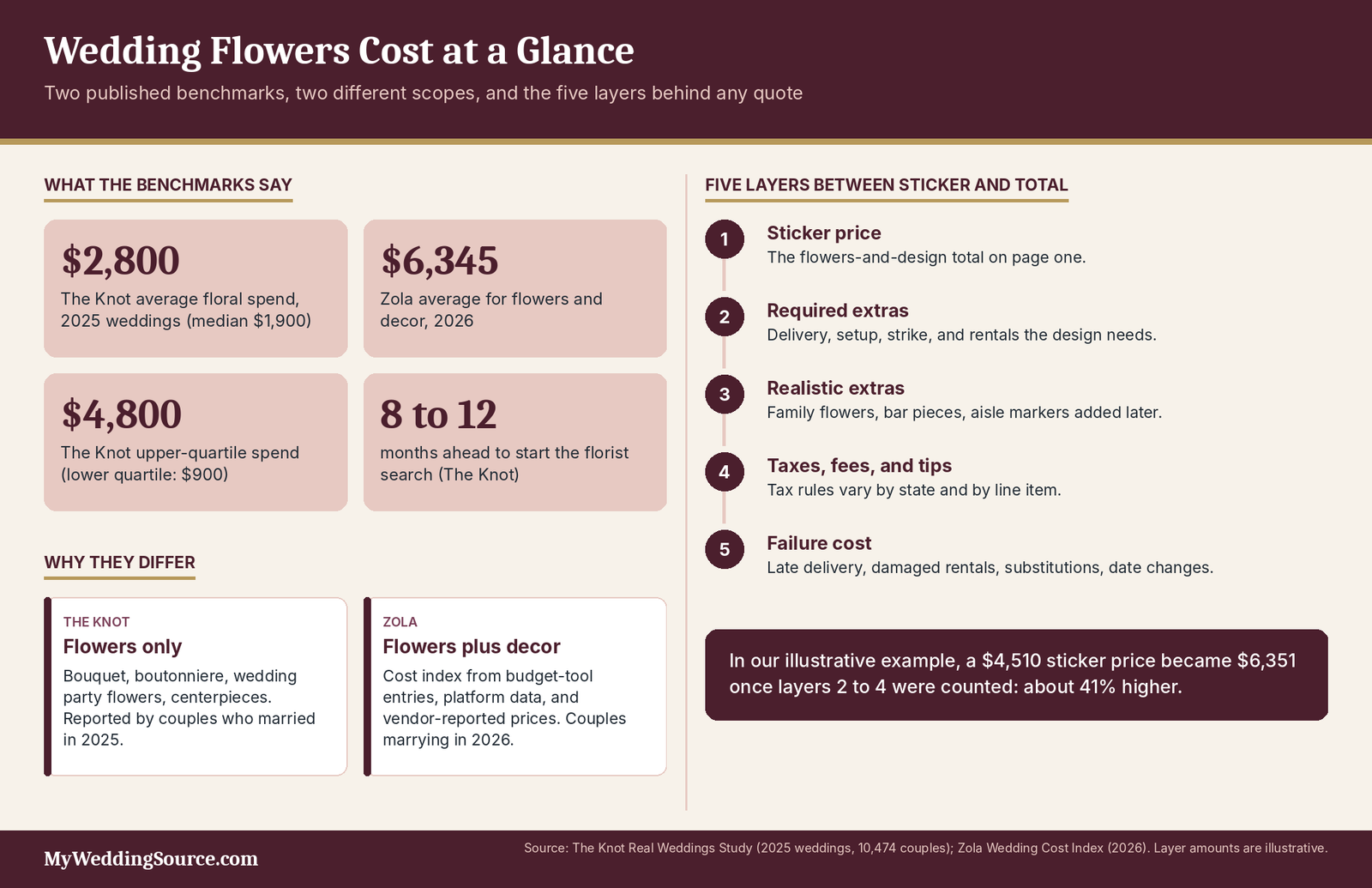
Wedding flowers cost about $2,800 in one major 2025 survey and $6,345 for flowers and décor in a 2026 cost index, so the number that actually matters is the all-in total on an itemized quote you have compared line by line.
If you have ever searched for wedding flowers cost and come away with an average that did not match any quote in your inbox, you are not misreading the internet. National figures blend courthouse bouquets with 20-table ballroom installations, and each publisher counts different things: some include only flowers, some fold in décor, and some are based on what couples remembered paying while others are based on platform data and vendor-reported prices. A florist quote, meanwhile, bundles flowers, design hours, transportation, rentals, and taxes, and the first number on the page is rarely the number you will pay.
This guide is the money-and-contract companion to our design-focused wedding flowers planning guide. It explains what the published averages measured, what individual pieces cost, how to read and compare florist proposals, how to control the total, what a substitution clause should say, and the general shape of deposit and cancellation terms. Design, color, and venue styling stay in the sibling guide, so this page sticks to prices, fees, and paperwork.
Florist pricing is complicated because the work is: flowers are perishable and priced by the stem, and the design is built by hand, delivered in a loaded van, and installed in a room the florist may be seeing for the first time that morning. Treat every figure below as a ballpark for sanity-checking, not a quote for your city or your date.
What do wedding flowers cost on average, and why do the major sources disagree?
“Average wedding flower cost” is not one statistic. It is what couples report spending after the wedding, what a cost index built from budget-tool entries and vendor-reported prices shows for flowers and décor, and what a rule of thumb says flowers should take from a total budget. Reading them side by side, with the year and sample attached, keeps you from anchoring on whichever figure you saw first.
What the 2025 and 2026 surveys actually measured
The Knot Real Weddings Study: couples who married in 2025
The Knot reports an average floral spend of $2,800 for couples who married between January 1 and December 31, 2025, with a median of $1,900, a lower quartile of $900, and an upper quartile of $4,800. The sample was 10,474 U.S. couples, and the article was updated in May 2026. The average is pulled upward by large installations, so the median is the better picture of a typical outcome; half of the couples in the study spent $1,900 or less. The Knot also says its average covers a bouquet, a boutonniere, wedding party flowers, and centerpieces, which means pieces such as a large ceremony installation may sit outside the typical figure for many couples.
Zola’s Wedding Cost Index: couples marrying in 2026
Zola’s published 2026 spending breakdown lists “Flowers & Décor” at $6,345, and its florist cost guide (published April 2024, last updated February 19, 2026) gives a typical range of $5,100 to $7,600 and describes flowers as about 13% of a wedding budget. Zola builds this figure from its Wedding Cost Index, which combines couples’ Budget Tool entries, platform data, and pricing reported by Zola vendors, and it separately surveyed 720 couples within 180 days of their weddings for its 2026 spend survey. The sample, the year, and the inclusion of décor all differ from The Knot’s study.
Where WeddingWire fits
WeddingWire is part of the picture, but not as a separate floral number we could verify. The Knot’s Real Weddings Study states that it surveys both The Knot and WeddingWire couples, so its figures already reflect WeddingWire users. We did not find a separate, dated WeddingWire florist average we could confirm, so we do not quote one; if you see one elsewhere, check the year, the sample, and whether it covers flowers alone or flowers plus décor.
Which number should you plan around?
The honest answer is that it depends on what you are buying, and the table below lines up the main benchmarks so you can see what each one does and does not tell you. A 40-guest dinner with a bouquet and a few table arrangements belongs near The Knot’s lower numbers. A 120-guest wedding with a focal installation and 12 centerpieces belongs closer to Zola’s range. Neither source is wrong; they are describing different weddings, and probably different counting rules.
| Source | Year and sample | Headline figure | What it likely includes |
|---|---|---|---|
| The Knot Real Weddings Study | Weddings in 2025; 10,474 U.S. couples | $2,800 average; $1,900 median; $900 to $4,800 quartiles | Bouquet, boutonniere, wedding party flowers, centerpieces |
| Zola Wedding Cost Index | 2026 spending; index from budget tool, platform data, vendor pricing | $6,345 average for flowers and décor; $5,100 to $7,600 typical | Flowers plus décor; influenced by arches and installations |
| Zola florist cost guide | Updated February 2026 | About 13% of budget; $1,000 realistic for a small wedding with personal flowers only | Ranges by piece and city examples |
| The Knot rules of thumb | Real Weddings Study and editorial guidance | About 8% to 10% of budget; around 15% if flowers are a priority | Budget share, not a price |
The median is not the minimum
Because The Knot’s lower quartile is $900, a quarter of couples spent less than that, and Zola’s own guide says $1,000 can be realistic for a smaller wedding or for personal flowers only. That matters if you feel behind when you see $6,345. A budget of $1,000 to $2,000 can still cover a bouquet, boutonnieres, and a handful of arrangements when the guest list is small or the design is simple. If a florist’s minimum is above your budget, ask what a scaled-down proposal would include before assuming the answer is no.
Percent-of-budget rules are sanity checks, not instructions
The Knot’s sources cite roughly 8% of the total budget for flowers in one article, about 9% for flowers and décor in another, and an industry rule of thumb of about 10%, rising to around 15% when flowers are a priority. Zola’s cost guide says about 13%. With a spread that wide, the useful move is to pick the share that matches how much flowers matter to you, then test it against an itemized quote. The same 10% gives $7,500 on a $75,000 wedding (The Knot’s own example) but $1,500 on a $15,000 one, which may or may not cover the design you want. Percentages tell you whether a proposal is proportionate to your plan, not whether it is fair.
What national figures leave out
National averages are silent on the things that make your quote different: your region, your date, your venue’s access, and the specific stems your palette calls for. Zola’s guide offers city examples, an average of about $8,000 in New York City and about $5,500 in Milwaukee, which hints at how much local labor and market conditions move the total. When you use a national figure, treat it as a conversation starter with a florist, not a number to negotiate toward.
What do individual wedding flower pieces cost?
Per-piece price ranges are among the most useful and least reliable numbers in this category. They vary by publisher, year, and what each range includes. Still, they help you spot a line item that is out of proportion. The table below uses Zola’s 2026-updated cost guide alongside an older Zola package guide last updated in 2024 so you can see how much two ranges from one publisher can differ.
Personal flowers: what you carry and wear
Bridal and attendant bouquets
Zola’s 2026 guide lists a standard bridal bouquet at $250 to $350 and a large bouquet with premium flowers at $500 or more, while its bouquet-specific page (updated September 2025) gives a broader $100 to $350 average, with no upper limit at the high end. Attendant bouquets run $80 to $150 each in the 2026 guide and $55 to $100 in the older package guide. The gap between these ranges is the point: bouquet price follows stem count, stem type, and wrap or ribbon details much more than the word “bouquet.”
Boutonnieres, corsages, and wedding party flowers
Boutonnieres are listed at $20 to $40 each and corsages at $30 to $50 in Zola’s 2026 guide, compared with $10 to $20 for a boutonniere in the 2024 package guide. A small piece is not a small job, because each one is wired or taped, wrapped, and pinned by hand, which is why a set of eight can cost more than a single centerpiece. Zola’s cost-cutting advice suggests shrinking the wedding party or using wrist corsages or single stems as alternatives, and The Knot suggests spending more on centerpieces and less on attendant bouquets if that matches your priorities.
Ceremony and reception pieces
Ceremony arch, altar pieces, and aisle décor
This is the widest range in the category. Zola’s 2026 guide lists an altar piece or arch at $500 for a simple design to more than $2,000 for an elaborate one, and aisle décor at $20 to $50 per row. Its older package guide gives $1,500 to $4,000 for a ceremony “structure” and $60 to $400 for a ceremony arrangement, and The Knot says a simple arbor piece could start at a few hundred dollars and quickly scale up to several thousand. The difference between an arrangement set on a table and a floral installation attached to a frame is mostly labor, mechanics, and height, so ask the florist which one the price assumes. If the arch itself is rented or built by a separate fabricator, that is a second line.
Centerpieces, head table, and bar or welcome table
Zola’s 2026 guide puts a low centerpiece at $100 to $250 each and a tall one at $250 to $500 or more, with a head or sweetheart table at $150 to $600 and a bar or welcome table at $100 to $300. For 15 tables it gives a total of $1,500 to $4,000, which is an easy way to sanity-check a quote: divide the centerpiece line by the table count and compare it to the per-piece range. The older package guide gives $75 to $600 for a centerpiece, and its wide range tells the same story as the bouquet figures.
Cocktail hour and cake flowers
We did not find a verified per-piece figure for cocktail-hour flowers, so treat that space as a choice rather than a standard line; reusing ceremony pieces there is a common way to avoid paying twice. Cake flowers are listed at $50 to $150 in Zola’s 2026 guide and $25 to $300 in the older package guide, and they are worth coordinating with the baker; our wedding cake cost guide covers the baker’s side of that budget. The bar or welcome table at $100 to $300 is the closest published stand-in for a cocktail-hour focal piece.
| Piece | Zola cost guide (updated Feb. 2026) | Older Zola package guide (updated Feb. 2024) | What moves the price |
|---|---|---|---|
| Bridal bouquet | $250 to $350; $500+ for large, premium flowers | $100 to $250 | Stem type, stem count, wrap details |
| Attendant bouquet | $80 to $150 each | $55 to $100 | Size match to the bridal bouquet |
| Boutonniere | $20 to $40 each | $10 to $20 | Hand construction, flower choice |
| Corsage | $30 to $50 | Not listed | Wrist versus pin-on, flower type |
| Ceremony arch or altar piece | $500 simple to $2,000+ elaborate | $1,500 to $4,000 structure; $60 to $400 arrangement | Height, mechanics, install time, frame |
| Aisle décor | $20 to $50 per row | Not listed | Number of rows, whether reused |
| Centerpiece | $100 to $250 low; $250 to $500+ tall | $75 to $600 | Height, stem count, vessel |
| Head or sweetheart table | $150 to $600 | Not listed | Length, whether a garland or runner |
| Bar or welcome table | $100 to $300 | Not listed | Size and visibility in photos |
| Cake flowers | $50 to $150 | $25 to $300 | Fresh versus sugar flowers, baker coordination |
What drives a florist’s price up or down?
A florist’s price has two engines: the cost of the stems and the cost of the work. The stems vary by variety, season, and where they are grown; the work varies by design complexity, venue access, and how many hours of labor sit on either side of the wedding. Knowing which engine is running a particular line item tells you which lever to pull. Swapping a pricey bloom helps with the first, and simplifying the install helps with the second.
The flowers themselves
Stem price by variety
Per-stem prices span more than an order of magnitude. In a list of budget-friendly options published by The Knot, a florist puts carnations at $0.75 to $1.50 per stem, tulips at $0.75 to $2, daisies and alstroemeria at $1 to $2, roses at $1.50 to $4, and hydrangeas at $2.50 to $6, while noting that peonies can cost $10 to $20 per stem and orchids as much as $35 (the article does not say whether these are wholesale or retail). Illustrative arithmetic, not a quote: 12 tables with 15 stems each is 180 stems, which is roughly $135 to $270 in carnations and $1,800 to $3,600 in peonies before labor, vessels, or tax. That gap is why the single most effective cost conversation is “which stems carry the look, and which can be a lookalike?”
Season, imports, and supply
Where a flower is grown matters as much as when. University of Illinois farmdoc daily reports that nearly 80% of the value of cut flowers sold in the U.S. comes from imports (2023 data), that cut-flower imports reached a record $1.98 billion in 2024, and that Colombia and Ecuador together supply about 88% of imports. The same article notes that tariffs on imports would likely raise prices for U.S. consumers, though it does not quantify the increase, and Zola’s 2026 First Look Report found couples worried about price increases in categories that include flowers because of possible tariffs.
Local, in-season, and “sustainable” are not always cheaper
The assumption that seasonal always means cheaper is only partly true. A florist quoted by The Knot says in-season flowers can cost more at their peak because demand is highest, and that peonies at the wrong time of year “will either be impossible or five times as expensive.” Zola’s bouquet guide adds that locally and sustainably grown flowers can cost more, and that small farms may need orders months in advance. Our November flowers guide goes deep on one month’s supply chain and substitutions.
The work around the flowers
Design hours, mechanics, and installation height
The labor in a floral quote is rarely visible, but it is substantial: designers build pieces by hand, prepare mechanics such as frames, cages, and water sources, condition the stems, and clean up after. The Knot quotes florists describing 10 to 14 hour days back to back and says the price of a wedding has to cover labor beyond the event day itself. Height and complexity multiply that work: a hanging installation needs rigging, ladders, and sometimes a second person, while a low arrangement on a table needs none of those. This is why The Knot advises keeping designs simple and standard in shape, since hard-to-reach venues and complex installations add delivery and labor costs.
Delivery, setup, and strike
Delivery, setup, and strike (removal of the flowers and rentals after the event) are separate tasks that may be billed separately or folded into the proposal. The Knot’s florist questions list asks about delivery, setup, and breakdown fees, which “can quickly add up,” and Zola says they can add several hundred dollars to the invoice. If the venue restricts load-in times or requires the florist to be out by a certain hour, confirm that in writing, because tight windows can mean extra staff; our venue guide covers the access questions to ask before you book.
Rentals, deposits, and minimums
Anything a florist owns and lends you, such as arches, stands, urns, candleholders, and specialty vessels, is a rental, and it may carry a refundable damage deposit, a return deadline, and a replacement-cost clause. The same pattern appears with other vendors; our linen rental guide shows how delivery, damage waivers, and replacement formulas turn a per-piece price into a larger bill. Many florists also have a minimum order or minimum event spend, which The Knot’s question list recommends asking about directly. Overhead explains part of this: The Knot’s florists point out that studio rent, taxes, and pickup and delivery fees are costs a quote has to cover, and they say these fees “always shock people.”
How is a florist quote built, and how do you compare two without guessing?
A florist quote is easiest to understand when you picture it as a stack: flowers and design at the bottom, then logistics, then rentals, then tax and fees at the top. A package price collapses the stack into one number, which is convenient and sometimes the right call, but it makes comparison harder because you cannot see what was included. The goal of this section is to give you a template for reading any proposal and a method for putting two or three of them on the same footing.
What a florist quote should contain
Line items, quantities, and design intent
The Knot says a florist quote should include a price for each item or item type, a line-item total, a full total, taxes, and any delivery, setup, or breakdown fees. Quantities matter as much as prices: “centerpieces” at $190 each means different things at 12 tables and at 18. If you are comparing three proposals and one lists fourteen items while another lists four, the shorter one is not necessarily simpler; it may just be less specific.
Labor, delivery, setup, and strike
Ask whether labor is built into each item’s price or billed as a separate line, and whether delivery, setup, and strike are one fee or three. Zola’s older package guide notes that its item estimates already include delivery, setup, and take-down, while its 2026 guide says those services can add several hundred dollars on top, which tells you that even published guides do not agree on what is inside the number. A contract that says only “delivery included” does not tell you whether strike is covered or who removes the arch at 11:30 p.m.
Rentals, minimums, and service or design fees
Look for the lines that appear only at the bottom or on a second page. Rentals, a damage deposit, a minimum spend, a design or consultation fee, and a “service” or “administrative” charge are all common ways of expressing real costs, and a good proposal makes them visible. The FTC’s Rule on Unfair or Deceptive Fees, which took effect May 12, 2025, requires all-in pricing for live-event tickets and short-term lodging; its FAQ does not list florists or other wedding vendors as covered businesses. That means itemization is something you ask for rather than something you can assume. Our wedding budget hidden costs guide covers how service charges and fees show up across vendors.
Taxes and tips
Sales tax treatment varies by state, and sometimes by line. New York’s tax department explains that florists there charge sales tax at the combined rate where flowers are delivered and that delivery charges are taxable, and a separate bulletin for caterers says that decorating and design services are taxable and that separately stating a charge does not change that. Those are New York rules, not a national rule, so check your state revenue department or ask the florist how each line is taxed. Tips are separate: Zola suggests $50 to $100 for the lead florist, or about 10% of the floral total, and a smaller amount for the delivery and setup team. Our vendor tipping guide covers how to budget for gratuities across the whole vendor team.
How to compare quotes apples-to-apples
Send the same brief to every florist
The fastest way to get comparable quotes is to send the same document to each florist: guest count, venue name, date, the list of pieces you want, a palette, a budget ceiling, and any load-in constraints. The Knot suggests asking for a “best-case” proposal at your full budget and a “bare-minimum” version covering only essentials, and Zola advises sharing your budget with the florist at the consultation so they can design within it.
Normalize the numbers with a worksheet
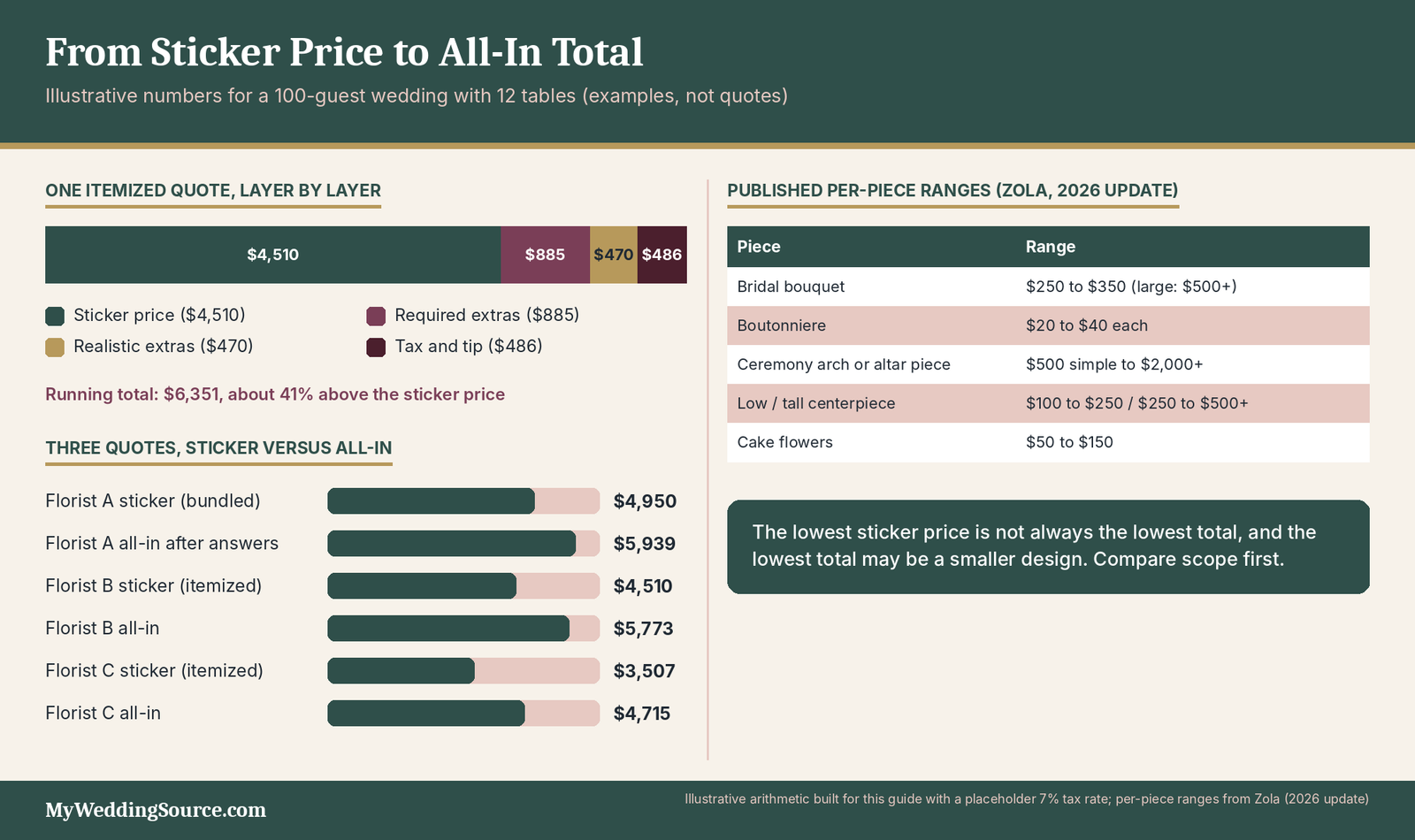
When quotes arrive in different formats, rebuild them in a single table. The comparison below is an illustrative example for a 100-guest wedding with 12 guest tables, not a real quote: Florist A sends a bundled package, while Florists B and C send itemized proposals. After asking Florist A for written answers on the items it left out, the totals look different from the first numbers on the page. Notice that the lowest sticker price is not the lowest all-in total in every scenario, and the lowest total may reflect a smaller design rather than a better deal.
| Line (illustrative) | Florist A (bundled) | Florist B (itemized) | Florist C (itemized) |
|---|---|---|---|
| Personal flowers (bouquets, boutonnieres, corsages) | Included in package | $890 | $697 |
| Ceremony focal piece | Included | $900 | $700 |
| 12 centerpieces plus head table | Included | $2,630 | $2,050 |
| Cake flowers | Included | $90 | $60 |
| Sticker price (flowers) | $4,950 | $4,510 | $3,507 |
| Delivery and setup | Included | $350 | $300 |
| Strike (pickup) | Not stated; $200 when asked | $175 | $250 |
| Rentals | Not stated; $400 when asked | $360 | $350 |
| Tax at an illustrative 7% | Not stated; applies when asked | $378 | $308 |
| All-in total before tip | $5,939 | $5,773 | $4,715 |
| Refundable damage deposit (cash flow) | Ask | $200 | $150 |
Yellow flags that deserve a question, not a conclusion
Most gaps in a proposal are omissions, not tricks, so treat them as questions. A package price with no itemization, a total with no tax line, “delivery included” with no mention of strike, a quote with no mention of rentals when the design obviously needs vessels or an arch, and a design described only by variety names are five common reasons two quotes cannot be compared. If a florist will not itemize at all, that is useful information, and it is reasonable to choose someone who will.
What does a wedding flower order really cost once every layer is counted?
Think of the true cost as five layers: the sticker price on the proposal, the required extras that make the design physically possible, the realistic extras that couples tend to add after the first draft, the taxes and fees on top, and the failure cost if something goes wrong. Much of the surprise in wedding budgets comes from the second through fifth layers, not from the flowers themselves. Our wedding budget hidden costs guide walks through the same pattern across venues, caterers, and rentals.
The five layers, one at a time
Layer one and two: the sticker price and the required extras
The sticker price is the number on page one of the proposal, which, as the comparison above showed, may or may not include delivery and strike. The required extras are the items without which the design cannot be delivered: the trip to the venue, installation time, removal, and the vessels or arch the florist rents to you. In our illustrative example, those required extras add $885 to a $4,510 sticker price, which is about 20%.
Layer three: the realistic extras
Realistic extras are the add-ons that many couples consider once the first proposal is on the table: boutonnieres for parents and grandparents, a few arrangements for the bar and welcome table, aisle markers, and flowers for a cake or a card table. In the example they total $470, which is modest, but they are also the easiest layer to underestimate because each one feels small.
Layer four: taxes, fees, and tips
Taxes and tips come last but not least. In the example, a 7% placeholder tax rate on the sticker price, extras, and rentals comes to $411, and a $75 tip for the lead florist brings the layer to $486. Your actual rate depends on your state and locality, and in some places labor or delivery lines are taxed differently from flowers. If a service charge or administrative fee appears, ask what it covers and who receives it. A “service” fee that funds the florist’s delivery team is a different thing from a fee added by a venue or caterer when they supply the flowers.
Layer five: the failure cost
Failure cost is the part of the budget that only matters if something goes wrong, which is why it is skipped. It could be a late delivery that requires a rush replacement, a damaged rented vase that triggers a replacement charge, a variety that is not available and a substitution you do not like, or a canceled or postponed date and the deposit that goes with it. You cannot remove this risk, but you can shrink it by reading the substitution, delivery, damage, and cancellation clauses before signing, paying by a method with dispute rights, and holding a modest reserve.
A worked example of the layers
Reading the layers in numbers
The table below applies the five layers to Florist B from the earlier comparison. The sticker price is $4,510, required extras add $885, realistic extras add $470, and taxes and tip add $486, for a total of $6,351, which is about 41% above the sticker price. The failure-cost row is not part of the total; it is a reserve to hold or a question to ask.
| Layer | Example items (illustrative) | Illustrative amount | Question to ask |
|---|---|---|---|
| 1. Sticker price | Flowers and design for 100 guests, 12 tables | $4,510 | Is this one price or itemized? |
| 2. Required extras | Delivery and setup $350; strike $175; rentals $360 | $885 | Which of these are optional? |
| 3. Realistic extras | 4 family boutonnieres $120; bar flowers $200; aisle markers $150 | $470 | What do couples often add? |
| 4. Taxes and fees | 7% placeholder tax $411; lead florist tip $75 | $486 | How is each line taxed? |
| Running total | Layers 1 to 4 | $6,351 | Is this inside my ceiling? |
| 5. Failure cost | Damage deposit at risk, rush replacement, canceled date | Reserve, not in total | What does the contract say? |
How much cushion to hold
There is no verified industry standard for a floral contingency, so this is editorial judgment. One editorial suggestion is to hold a 10% to 20% cushion above the sticker price of the floral line until the final proposal is signed, and to release it once the real extras are known. The cushion is a planning device, not a request for the florist to pad anything.
How can you control the wedding flowers total without making the design look thin?
The most reliable ways to lower a floral total change what the florist has to buy and build, not how much you respect their work. Those levers fall into two groups: design choices that reduce stems, labor, or rentals, and spending choices that decide where the money goes in the first place. Every one of them has a trade-off, so the table at the end of this section pairs each lever with what you give up. Start with the levers that cost you the least in photographs and the most in the invoice.
Design levers that change the invoice
Reuse ceremony flowers at the reception
Moving flowers from the ceremony to the reception is a frequently recommended way to get more from one purchase. The Knot suggests using a floral arch as the backdrop for the sweetheart table or moving aisle arrangements to the cake table, and Zola advises asking the florist to build the large ceremony display so it can be moved from the ceremony to the reception. In our illustrative example, using the $900 ceremony focal piece in place of a separate $350 head-table design could save up to $350, minus whatever the florist charges to move and reset it, so ask for that fee instead of assuming it is zero.
Use greenery and branches for volume
Greenery and branches give arrangements fullness with fewer expensive blooms, which is why The Knot recommends mixing them with flowers and Zola recommends them for filling tables and walls. The caveat is Zola’s own: greenery is not always cheaper, because the labor to build and place it can offset the savings. The practical approach is to ask for the same design brief in two versions, one flower-forward and one greenery-forward, and compare the totals rather than assuming which is lower.
Put seasonal or premium blooms where they show, and use lookalikes elsewhere
A focal-bloom strategy spends on the expensive flowers where people look and photograph, and keeps the rest of the room simpler. The Knot recommends building arrangements mainly from in-season flowers and adding pricier blooms as accents, and it names examples of lookalikes: garden roses for peonies and hydrangeas for sweet peas. Zola offers carnations or ranunculus in place of peonies or garden roses and suggests limiting costly blooms to focal pieces like bouquets or head-table décor. Zola also notes that choosing one flower type lets a florist buy in larger quantities, usually at a discount. Sharing your palette and shape preferences and letting the florist choose the stems is generally more flexible than naming specific varieties.
Choose fewer arrangements, sized for the room
Cutting the number of arrangements reduces stems, vessels, and placement labor at the same time, which is why it often saves more than switching flower types. Illustrative arithmetic using round numbers inside Zola’s published ranges: 12 tall centerpieces at $300 each cost $3,600, while 12 low ones at $175 each cost $2,100, a difference of $1,500. The trade-off is scale, since Zola warns that small displays can get lost in a large space and a designer quoted by The Knot says the way to make arrangements look expensive is to make them appropriate in size. A middle path is to put full arrangements on some tables and candles, greenery, or a few single stems on the others.
Spending levers that change where the money goes
Rank the pieces before you start cutting
Deciding which pieces matter most turns a vague “reduce the total” into a concrete list of what to protect. The Knot suggests spending more on the ceremony arch if it matters to you and trimming favors or place cards, and also notes that you might spend more on centerpieces and fewer on attendant bouquets. Zola suggests shrinking the wedding party so fewer bouquets and boutonnieres are needed. Our wedding budget guide helps you set the floral line against everything else you are paying for.
Rent, buy, or skip the hardware
Hardware such as arches, stands, urns, and candleholders can be rented from the florist or a rental company, bought, or skipped. The Knot lists dried flowers, for example spray-painted baby’s breath, as a lower-cost alternative to fresh in some designs. Dried and silk pieces avoid the cooling problem entirely, but they raise their own questions about venue fire rules and how they look in close-up photos. Whatever you choose, ask who owns the item after the wedding, since a florist-owned arch goes back in the van and a purchased one becomes your storage problem.
Ask for tiered proposals and package options
The Knot suggests asking for a high version that reflects your full budget and a low version covering only essentials, then refining a middle option, and it suggests asking, “What great things can you do with $__?” to learn what your number buys. Zola’s package guide describes simple, traditional, and premium bundles at increasing scope, and The Knot notes that venues with in-house florists or all-inclusive packages can cover centerpieces, boutonnieres, and bouquets. If your venue requires or recommends an in-house florist, confirm that the venue’s quote includes delivery, setup, strike, and any service charge.
Book early enough to choose
Time is a cost lever because last-minute bookings narrow your options. The Knot recommends starting the florist search between 8 and 12 months ahead, especially for peak season from May to October, and Zola says 9 to 10 months is the ideal booking window. Booking early also lets you shape the design around what will be in season, which affects which lever above is most useful.
| Lever | How it can lower the total | What you give up |
|---|---|---|
| Reuse ceremony pieces | Replaces a separate reception piece | Planning, moving labor, timing during cocktail hour |
| Greenery-forward design | Fewer premium stems per piece | Labor can offset savings; different look |
| Focal blooms plus lookalikes | Premium stems only where photographed | Less variety; fewer named flowers |
| Fewer, right-sized arrangements | Fewer stems, vessels, and placements | Sparser tables unless supplemented |
| Fewer attendants’ flowers | Fewer bouquets and boutonnieres | Wedding party size decisions |
| Dried or silk elements | Avoids perishability and some cooling needs | Fire rules, close-up photo quality |
| Tiered proposals | Shows what each budget level buys | A little more time up front |
| Early booking | More choice of florist and stems | Decisions earlier in planning |
Is DIY or wholesale wedding flowers cheaper once you count the risk?
DIY can cut the flower bill meaningfully, but it moves labor, cooling, transport, and day-of responsibility from the florist’s account to yours. The right question is not whether stems at a wholesale market are cheaper, but whether you have the time, space, helpers, and tolerance for risk to turn them into finished pieces. For some couples the answer is a clear yes, particularly for small, simple designs. For others, the hidden costs and risks erase the savings.
Does DIY actually save money?
The arithmetic on bouquets and centerpieces
Zola’s bouquet guide compares mid-tier flowers made by a florist with the same flowers made at home: a bridal bouquet at $150 to $200 from a florist versus $70 to $80 DIY, a bridesmaid bouquet at $55 to $75 versus $25 to $35, and a table centerpiece at $70 to $85 versus $28 to $35. The guide’s summary is that making bouquets yourself can cost about half as much as hiring a florist. Those figures are for materials and assume you already know how to build the piece.
The costs the comparison leaves out
The materials-only comparison does not include your time, tools, buckets, floral tape and wire, vessels, a vehicle to move stems, extra stems to cover errors, or the cost of a mistake. The Knot’s list of common flower mistakes warns that going DIY can mean you end up paying even more for flowers and supplies than expected. Time is the largest unpriced item: building pieces for a 100-guest wedding can take several people several hours, often during the busiest week of your planning. If you are comparing a $2,000 florist quote with a $900 DIY materials list, add a realistic value for the hours and the risk before deciding the gap is $1,100.
What can go wrong, and what is a middle path?
Cooling, conditioning, and timing
Fresh flowers need to be conditioned and kept cold. Oklahoma State University Extension says cut flowers should be held at 32 to 35 degrees Fahrenheit, that storage at 41 degrees can cause flowers to deteriorate up to four times faster than at 32, and that moving flowers directly from a cool room to a warm one can cause condensation. A home refrigerator is not a flower cooler, and a garage in July is not either. If you do not have a cold, clean space for the stems for the two or three days between pickup and the wedding, DIY becomes a quality risk, not just a time commitment.
The day-of problem
A florist’s value on the day is not only the flowers but the person who fixes things: a broken stem, a tipped vase, an arrangement that arrived tired, a venue that moved the ceremony indoors. In a DIY plan, that role falls to you, a relative, or a friend who may also be a member of the wedding party. The Knot lists wedding mistakes such as setting flowers out too early and not confirming water access at the venue, both of which are easier to manage when someone is responsible all day. If you choose DIY, assign a named person to set up, a named person to strike, and a backup, and do not make that person a bridesmaid who also needs to be in photos.
A middle path: split the work
A hybrid plan keeps professional help where mistakes are most visible and moves simpler work to you. One hybrid option has a florist make the bouquets, boutonnieres, and ceremony piece, then buy a single variety of stem for table vases that are arranged by friends the day before. A hybrid also leaves you a smaller DIY task, which is easier to cool, easier to transport, and easier to recover from if something goes wrong.
Substitutions are normal in floral work, and a good contract treats them as a planned part of the process instead of a surprise. Flowers are agricultural products with supply, weather, and shipping risks, and a florist who orders for a May wedding is making a prediction. What you want in writing is not a promise that every named stem will arrive, but a clear process for what replaces it, who decides, and what happens to the price.
Why substitutions happen
Supply, weather, and shipping
Because nearly 80% of the value of U.S. cut flowers comes from imports, many staples travel long distances before they reach your florist, and a weather event, a transport delay, or a shortage can change what is available in a given week. The Knot’s florists describe pandemic-era shortages in which some flowers weren’t available for a full year or two, which shows that supply disruptions can be longer than a week.
Out-of-season requests
The other common cause is a request for a flower that is out of season on your date. Peonies are the classic example: they have a short growing season, and a florist quoted by The Knot says that at the wrong time of year they are either impossible or about five times as expensive. A florist may offer a lookalike that is more economical and fresher, and The Knot’s advice is to look for a substitution that looks similar and costs less. If you love a specific variety, ask whether it is realistic for your date before it becomes a design commitment.
What a clear substitution clause covers
Describe the design, not just the variety list
The strongest protection is a proposal that describes the intent of each piece: color range, approximate size, shape, texture, and the role in the room. If the contract says only “12 peonies,” a substitution is a deviation from the contract, while a contract that says “blush focal blooms, large and open, with soft texture” gives the florist room to adapt without breaking the agreement. Our November flowers guide develops this idea of planning by visual job rather than by flower name.
Approval, notice, and price
Ask how the florist will tell you about a change, how quickly you can respond, and what happens if you do not. Ask also whether a lower-cost substitute reduces the price, and whether a higher-cost substitute is absorbed by the florist or passed to you. For a high-stakes item such as a bouquet, you may want approval rights; for background greenery, you may prefer to delegate. The table below summarizes the elements of a clear clause. It is general education and sample questions, not legal language, and terms and state laws vary.
| Clause element | Vague wording | A clearer version to ask about | Why it matters |
|---|---|---|---|
| What is being ordered | “Peonies and garden roses” | Palette, size, shape, and role for each piece | Gives room to adapt |
| Who approves | “Florist’s discretion” | You approve focal pieces; florist decides filler | Protects what you care about |
| Notice | Not stated | A set number of days before the event, by phone and email | Time to react |
| Price | Not stated | Credit if substitute costs less; florist absorbs if it costs more | Avoids surprise totals |
| Remedy | Not stated | What happens if the result is materially different | Defines a fallback |
What if you do not like the substitute?
The practical remedy is usually a conversation before the wedding, not a refund after it. That is why approval and notice matter: a photo of the proposed substitute sent three days ahead gives you time to say yes, adjust, or ask for a different option. If a substitution happens on the day without notice and the result is materially different from the proposal, document it with photos and contact the florist promptly, then read the contract’s remedy language.
What should you know about deposits, cancellation, and payment terms?
This section is general education, not legal advice. Florist contracts differ by business, and consumer protection and contract rules differ by state, so treat what follows as a list of questions to ask and clauses to read rather than a statement of what your florist or your state requires. If a contract is large, unusual, or confusing, a local attorney can review it. For the broader picture of vendor paperwork, our wedding vendor contract guide covers the clauses that show up across categories.
How deposits and payment schedules usually work
Retainers and deposits
Florists commonly ask for a deposit or retainer to hold your date and begin work, and the terms vary by business. Zola’s booking guide notes that most vendors’ retainers are non-refundable, so a canceled booking can be costly, and The Knot’s florist question list includes asking, “Is the deposit non-refundable?” The questions worth asking before you pay are whether the deposit is refundable in whole or in part, what it holds (your date, your design slot, or both), and whether it counts toward the final total. Get the answer in the contract, not in a conversation.
Payment schedule and the final count
Most contracts break payment into a deposit, one or more installments, and a final balance due before the wedding. The Knot advises reading the entire contract and checking the payment schedule, delivery terms, weather policy, and cancellation terms, and confirming that every arrangement you ordered is written in. Ask for the date by which you must give a final guest count or table count, because changes after that date may be billed. If you expect your numbers to move, ask what flexibility the florist has: a contract that fixes 15 centerpieces cannot easily become 12 a week before the wedding.
Date changes, postponements, and cancellations
The Knot recommends asking about postponement costs directly: “Will you owe a fee?” Terms can include a fee to move the date, a requirement to rebook within a window, a forfeited deposit if the florist cannot accommodate the new date, or a sliding scale where the refundable portion shrinks as the wedding approaches. If you are worried about a major date change, ask what is non-negotiable and what is flexible before you sign instead of after. Our wedding cancellation and postponement guide covers the wider planning side of changing a date.
Protecting your money
Pay in a way that preserves your options
Paying by credit card generally preserves dispute rights that cash, checks, and some payment apps do not. The FTC explains that not receiving what you ordered, or not accepting delivery as agreed, can be a billing error you can dispute, and that your written dispute must reach the card issuer within 60 days of the first statement that shows the error. The CFPB’s guidance on getting a refund for a product or service paid for by credit card says to contact the seller first, then ask the card issuer about a dispute. Card surcharges and processing fees may apply, so ask before you assume a card is free.
Keep a paper trail
Save the proposal, the signed contract, every invoice and receipt, and any email in which the florist agrees to a change. When you approve a design, ask for a revised proposal that lists the final pieces and quantities, and ask that any substitution you agree to be recorded the same way. Photos of the finished mock-up or the approved inspiration images are useful if the result later looks materially different from what you approved. Our wedding vendor contract guide has a more complete checklist.
Insurance is a separate question
Event insurance, vendor insurance, and venue liability requirements are three different things, and none of them is the same as your florist’s cancellation terms. A wedding insurance or cancellation policy, if you buy one, has its own covered reasons, exclusions, and claim process, so read what it says about vendor deposits before you assume it replaces a refund. A florist’s liability insurance typically protects the florist’s business and, in some cases, satisfies a venue’s requirement; it does not reimburse you for a design you did not like.
What do three sample floral budgets look like?
The three scenarios below are illustrations built from the line items in this guide, not benchmarks and not quotes. They use the same placeholder 7% tax rate and the same unit prices as the comparison earlier, adjusted for scope, so you can see how guest count and design ambition change the total. Scenario B is the same wedding as the worked example, so its total matches the five-layer table. Every figure should be replaced with a quote from a florist near you.
Three illustrative scenarios
Scenario A: a 40-guest wedding with a small, simple plan
A 40-guest dinner with five tables and a ceremony in the same room needs one bouquet, a few boutonnieres, a single ceremony arrangement, and a low arrangement per table. In our illustration, that comes to $1,676 with tax and a $50 tip, which sits close to The Knot’s reported $1,600 average for weddings with 1 to 50 guests. A couple with a $1,000 budget could drop the table arrangements to single-stem vases or candles, as Zola’s guide implies when it says $1,000 can be realistic for personal flowers only.
Scenario B: a 100-guest wedding with a focal ceremony piece and 12 tables
This is the design-forward middle: a ceremony focal piece, 12 centerpieces, a head table, a bar arrangement, aisle markers, and boutonnieres for family. In the illustration, the total is $6,351, which is above The Knot’s upper-quartile figure of $4,800 but inside Zola’s typical $5,100 to $7,600 range for flowers and décor. That is a useful reminder of how the two sources can both be right: they describe different scopes. If this total is above your ceiling, the levers above (reuse the ceremony piece, shift four tables to low arrangements, reduce premium stems) are where to look first.
Scenario C: a 175-guest wedding with an installation and 20 tables
A large guest list and a hanging or sculptural installation multiply every line: labor hours, rentals, delivery trips, and tax. The illustration totals $14,381, with the ceremony installation at $3,500 and 20 tables plus a head table at $5,200. The Knot’s reported $3,300 average for 101-plus guests and the top of Zola’s $5,100 to $7,600 range both sit well below this total, so a plan like this is a deliberate choice about where to put the money. Another of our guides, on November flowers, shows similar installation-heavy scenarios and how to adapt them.
| Line (illustrative) | A: 40 guests | B: 100 guests | C: 175 guests |
|---|---|---|---|
| Personal flowers | $420 | $1,010 | $1,400 |
| Ceremony (focal piece, aisle) | $250 | $1,050 | $3,500 |
| Reception tables and head table | $500 | $2,630 | $5,200 |
| Cake, bar, and other extras | $90 | $290 | $700 |
| Delivery, setup, strike | $200 | $525 | $1,400 |
| Rentals | $60 | $360 | $1,100 |
| Subtotal | $1,520 | $5,865 | $13,300 |
| Tax at a placeholder 7% | $106 | $411 | $931 |
| Tip for lead florist and team | $50 | $75 | $150 |
| Total | $1,676 | $6,351 | $14,381 |
How to use these scenarios
What changes between them
Guest count increases the reception line first, but design ambition increases the ceremony, labor, and rental lines faster. From A to B, the total grows about 3.8 times while guests grow 2.5 times; from B to C, the total grows about 2.3 times while guests grow 1.75 times. The difference is the installation and the added logistics, which scale with complexity more than with headcount.
How to adapt them to your wedding
Copy the table into a spreadsheet and replace each number with the line from a real proposal, adding rows for anything your wedding includes that these scenarios do not, such as flower crowns, a flower bar, or a send-off. Then apply the five layers: sticker, required extras, realistic extras, taxes and tips, and a reserve for failure. If your total is above your ceiling, change one lever at a time and see what moves, starting with the number of arrangements and the size of the ceremony piece. If the total is below your ceiling, resist the urge to spend the difference immediately; hold it until the final proposal is signed.
FAQ about wedding flower costs
Pricing and budget
Is $2,800 or $6,345 closer to what I will spend?
Neither is a prediction. The $2,800 figure is The Knot’s average for 2025 weddings, with a median of $1,900, and the $6,345 figure is Zola’s 2026 average for flowers and décor combined, with a typical range of $5,100 to $7,600. If you have under 50 guests and a simple plan, The Knot’s numbers are likely closer; if you want a ceremony installation, 100 guests, and styled tables, Zola’s range is likelier. The reliable method is to send the same brief to two or three florists and use their itemized answers.
Why do some florists have minimum spends?
A minimum helps a small business make sure a booking covers the time, labor, and overhead the date requires. The Knot’s florists mention studio rent, taxes, and delivery costs as expenses that a quote has to cover, and a minimum is one way of expressing that. Ask what the minimum includes (flowers only, or delivery and setup too), whether it changes by day of the week or season, and whether a smaller scope is possible with a different florist.
Should I tip my florist, and how much?
A tip is not always expected, but it is appreciated. Zola suggests about $50 to $100 for the lead florist, or about 10% of the floral total, and a smaller amount for the delivery and setup team, such as $20 per person up to the same amount as the lead. Tip after setup is done, and consider handing it out in an envelope. Our vendor tipping guide covers amounts across vendors so you can build the line into your budget early.
Contracts, taxes, and problems
Will I pay sales tax on wedding flowers?
Probably, but it depends on your state and on how the florist structures the invoice. New York’s tax department says florists there charge sales tax at the rate where the flowers are delivered, and that delivery charges are taxable. Other states have different rules, and some treat decorating or design services differently from flowers. Ask the florist to show tax per line on the proposal, and check your state revenue department for rules on labor, delivery, and rentals.
Can I get my deposit back if the date changes?
It depends on the contract, which is why the contract matters. Zola notes that most vendors’ retainers are non-refundable, and The Knot recommends asking whether the deposit is non-refundable and whether a postponement carries a fee. Ask specifically what happens if you move the date, shrink the guest count, or cancel, and get the answer in writing. This is general education, not legal advice, and terms and state laws vary.
What if the flowers arrive wrong or do not arrive?
Contact the florist immediately, take photos, and ask for a remedy in writing, since a fast conversation is more likely to produce a same-day fix than a later complaint. If the florist does not deliver what you paid for, the FTC and CFPB guidance above explains that a credit card billing dispute generally has to reach the issuer within 60 days of the statement showing the error. A written substitution and delivery clause makes this conversation much easier because it defines what was promised.
Your next steps
This week
Set a floral ceiling and rank your pieces
Pick a ceiling you can live with, using the benchmarks above as a sanity check, and then list every piece you might want in order of importance. Mark the three that matter most in photos and to your guests. Add a line for delivery, setup, strike, rentals, tax, and a tip so your ceiling covers all five layers, not just the sticker. Our wedding budget guide can help you place the floral line within the full plan.
Send one brief to two or three florists
Write a single brief with your date, venue, guest count, table count, palette, piece list, ceiling, and load-in constraints, and send it to two or three florists. Ask for itemized proposals with a high and a low version and a written answer on delivery, setup, strike, rentals, minimums, deposits, substitutions, and tax. Then rebuild the answers in a comparison table like the one above. Our sibling planning guide has a copy-and-paste brief template.
Before you pay a deposit
Read the six terms that move your money
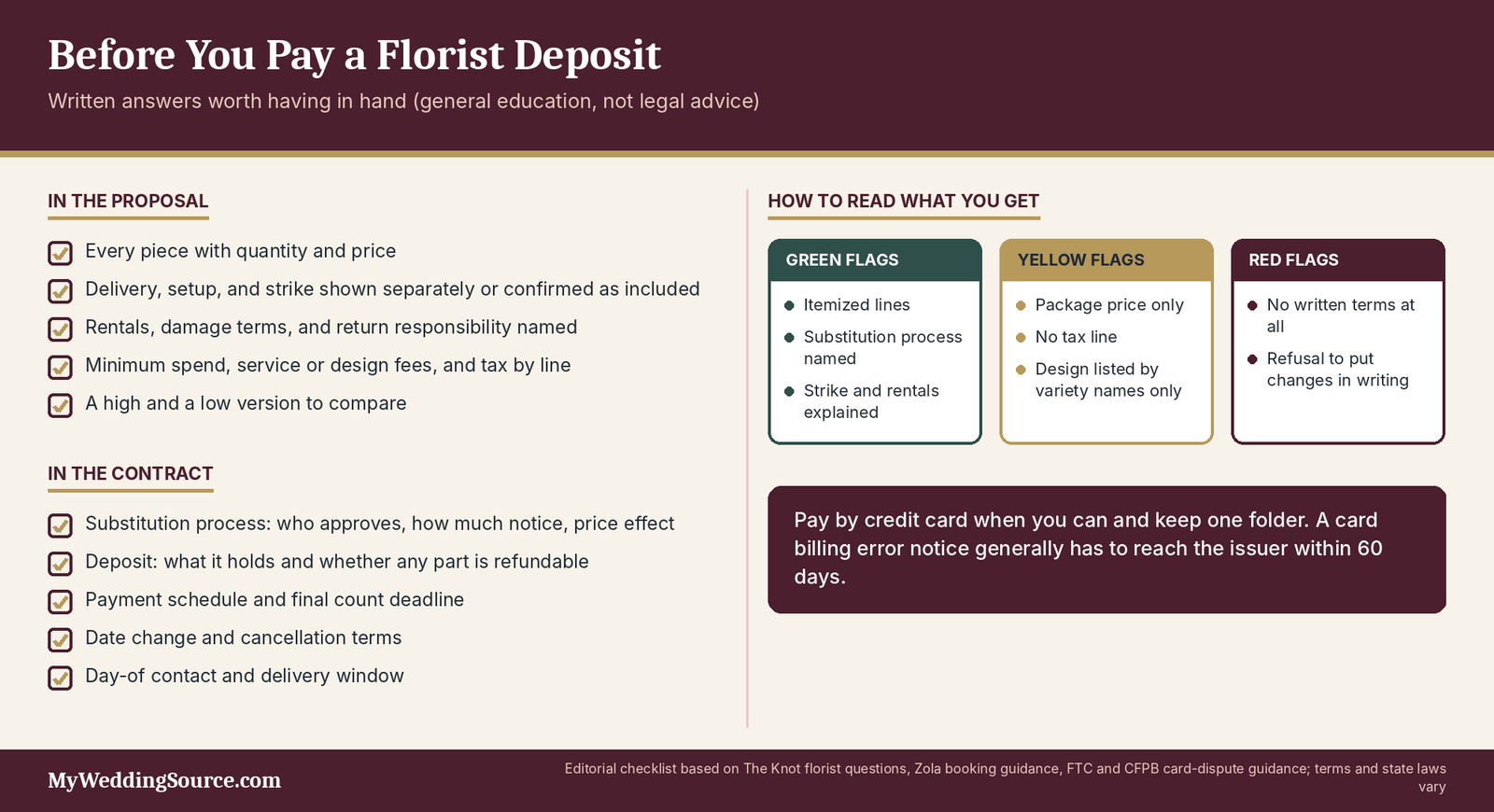
Before you sign, confirm in writing: the itemized pieces and quantities, the delivery, setup, and strike fees, the rentals and damage terms, the substitution process, the deposit and payment schedule, and the postponement and cancellation terms. If any are missing, ask that they be added instead of relying on a conversation. Terms and state laws vary, and this guide is general education, not legal advice.
Pay traceably and keep the record
Pay by a method that creates a record and, where possible, preserves dispute rights, and keep the proposal, contract, invoices, and approved changes in one folder. Put the final count deadline and the 60-day billing-dispute window in your calendar. Ask the florist for the name and number of the person who will be on site, so you know who to call. With those pieces in place, the flowers themselves can be the fun part again.
Sources & methodology
- The Knot: Average Cost of Wedding Flowers — 2025 weddings; average, median, quartiles, guest-count cuts, budget share, sample of 10,474 couples (updated May 2026)
- The Knot Real Weddings Study overview — study design among The Knot and WeddingWire couples; 2025 timeframe
- Zola: Wedding Florist Cost, What Couples Actually Pay — 2026-updated per-piece ranges, budget share, tips, city examples
- Zola: What Weddings Really Cost — 2026 Flowers & Décor average and the Wedding Cost Index method
- Zola: What’s Included in a Wedding Flower Package — older package tiers and per-item ranges (updated February 2024)
- Zola: How Much Should a Bridal Bouquet Cost? — bouquet ranges and DIY versus florist comparison (updated September 2025)
- Zola: How to Cut Costs on Wedding Flowers — savings tactics and the greenery caveat (updated September 2025)
- Zola: When to Book a Florist and Do You Tip Your Wedding Florist? — booking window, retainer note, tipping ranges
- Zola First Look Report 2026 — 2026 sample and couples’ tariff-related price concerns
- The Knot: Wedding Flower Mistakes — DIY overspending, early placement, and out-of-season warnings
- The Knot: Top 10 Expert Wedding Flower Tips and Wedding Florist Questions — reuse tactics, lookalike swaps, fees and deposit questions
- The Knot: Inexpensive Wedding Flowers and Why Are Wedding Flowers So Costly? — per-stem price ranges, labor, overhead, peony pricing
- farmdoc daily, University of Illinois — import share, values, and source countries (2023 and 2024 data)
- Oklahoma State University Extension: Care and Handling of Cut Flowers — cooling temperatures and condensation guidance
- New York State Department of Taxation and Finance: florists and caterers — one state’s treatment of delivery, decorating, and service charges
- FTC: Rule on Unfair or Deceptive Fees FAQ — scope (live-event tickets and short-term lodging) and May 12, 2025 effective date
- FTC: Using Credit Cards and Disputing Charges and CFPB: credit card refund steps — 60-day billing error window and dispute steps
Methodology. Verified facts here are the published figures and rules cited above, each tied to its publisher, year, and sample. Survey findings (The Knot, Zola) are self-reported or index-based and are not interchangeable, because they count different scopes and years. Per-stem and per-piece ranges are publisher or florist estimates, not quotes. The quote comparison, five-layer example, and three scenarios are illustrative arithmetic built for this guide with a placeholder 7% tax rate; the cushion suggestion and several framing choices are editorial judgment. We did not find a separate dated WeddingWire floral average we could verify, so none is quoted, and we do not give legal or personal financial advice.
Freshness note. Recheck The Knot’s Real Weddings Study release for 2026 weddings, Zola’s Wedding Cost Index and cost guide each winter, import and tariff conditions before booking, and your state’s sales tax rules for flowers, delivery, and decorating services. Prices in this guide were reviewed in October 2026.