
Including stepchildren in a wedding works when the child chooses the role, the adults carry the weight, and a quiet way out exists at every step. This guide gives you an age-appropriate opt-in matrix, scripts for asking, a worked example, honest alternatives and the conditions that tell you to stop and rethink.
Treat every ceremony role for stepchildren as an invitation, never an assignment. Settle the adult questions first (the couple, then each child’s other parent). Then offer each of the stepchildren a short menu that fits their age, from sitting with a trusted adult up to a speaking part. Ask privately, give a week to answer, accept “no” and “not sure” without discussion, and agree on a quiet signal for leaving mid-ceremony. A child who declines everything is still fully included.
Most advice about including stepchildren in a wedding starts from the couple’s wish: the day should feel like a joining of a family. That wish is kind, and it is also where the trouble begins. A child did not choose the marriage, may be carrying loyalty to another parent, and is being asked to perform warmth in front of eighty adults. When the ceremony needs the child to smile on cue, the child is working, not celebrating.
This article takes a different starting point. It asks what each of the stepchildren can comfortably say yes to, and builds the ceremony around those answers. You will get a five-level ladder of participation, an opt-in matrix organized by age, a sequence for the conversations that must happen before any child is asked, and a worked example with an invented family.
You will also get failure conditions, which are the signs that a role should be changed or dropped before the day. If you still need the basic order of a ceremony, the guide to the ceremony from start to finish covers it, and this article only adds the family-specific layer.
A note on scope. This is general planning information, not legal, tax, medical or mental health advice. Custody arrangements, parenting plans and family circumstances differ widely, and you should follow any court order or written parenting agreement that applies to your family and ask a qualified professional about anything beyond event planning.
What including stepchildren in a wedding really asks of a child
Before choosing roles, it helps to see the request from the child’s side. A wedding ceremony asks a child to do several different things at once, and only some of them are visible on the program.
Be seen. Walking, standing or sitting in a marked place means being looked at by a room full of people. Some stepchildren enjoy that. Others find it as stressful as a school presentation.
Perform a feeling. A hug at the end of the vows or a reading about “our new family” implies the child feels something specific. If they do not, they must hide it or be caught not feeling it.
Take a side, even silently. Children in two-household families often notice who is paying attention to whom. Standing with the couple can feel, to a child, like standing against a parent who is not in the room.
Give up something. A rehearsal, a fitting or a long photo session can take a weekend away from friends, sport or time with the other household. The child pays in time even when the role is small.
None of this means children should be left out. Many stepchildren want a role, and some are hurt by being treated as guests. The point is that the same role can be a gift or a burden depending on who chose it and whether it can be changed. Good planning for including stepchildren is mostly about making sure the child, not the adults, holds the choice.
Why pressure often looks like generosity
Stepchildren are often the most careful people in the room about adult feelings.
Pressure rarely arrives as a demand. It arrives as an offer worded so that refusing feels rude. “We would love you to be our ring bearer, it would mean the world” is a warm sentence, and it is also hard for a nine-year-old to answer with “I would rather not.” The child hears the adult’s hope and weighs it against their own wish, and children tend to protect adults’ feelings.
Watch for these quiet forms of pressure in your own planning:
- Announcing a role to guests, relatives or a vendor before the child has agreed.
- Buying the outfit first and asking afterward.
- Asking in front of other people, including siblings, grandparents or the other parent.
- Praising the child heavily after a “yes,” which makes a later change feel like a loss.
- Treating a hesitant answer as shyness to be coaxed instead of information to be respected.
The fix is structural, not emotional. You do not need to feel less enthusiasm. You need to build a process in which “no” is cheap: private asking, a response window, no purchases before agreement, and a standing offer to change the answer at any time up to the day itself.
Who counts as a stepchild here
This guide uses “stepchildren” to mean any child who will become, through the marriage, part of one partner’s household circle: children of a partner, whether they live with the couple full time, part time or rarely. It covers young children and adult stepchildren alike, since an adult child can feel just as unsettled by a parent’s remarriage.
It also applies when you are not yet sure what your relationship with the child is. A new partner of two years and a child who splits time between homes is a common case. You are not required to declare a family bond in the ceremony. A role can be small and still be honest. For broader questions about who decides what in a family-involved wedding, the guide on wedding decision rights covers how couples share input without losing control of their day.
The five-level participation ladder for stepchildren
The simplest way to offer choice is to stop thinking of a role as one thing. Instead, give each of the stepchildren a ladder with five rungs and let them stand on whichever rung feels right. The rungs are ordered by how visible and how demanding they are, not by how much you value the child.
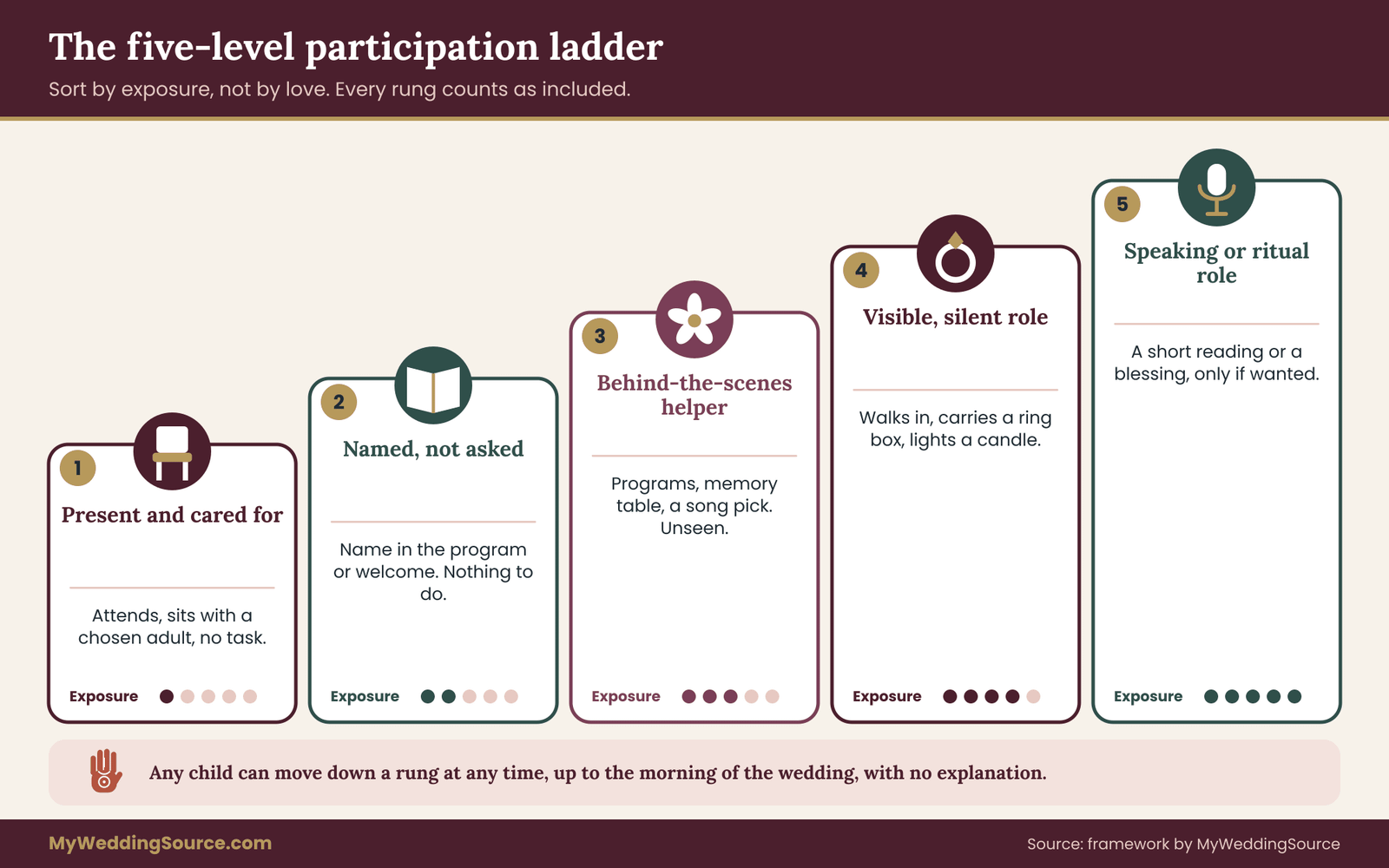
Level one: present and cared for. The child attends, sits with a chosen adult, and has no task. This is a full and honorable place. They are a guest of honor in the sense that someone is looking after them, and nothing will be asked of them. Many stepchildren, especially older ones, will choose this, and it should be treated as an ordinary answer, not a disappointment.
Level two: included by name, not by action. The child’s name appears in the program or the officiant’s welcome, or a chair is reserved with a small sign. They do nothing, but their place in the family is acknowledged. This suits children who want to feel counted without being watched.
Level three: behind-the-scenes helper. The child does a job guests never see: passing out programs before the ceremony, helping set a memory table, choosing a song for the cocktail hour, holding the guest book pen. The contribution is real, and the child chooses how much attention to receive.
Level four: a visible, silent role. Walking in the processional, standing near the couple, carrying a ring box, lighting a candle. The child is seen, but nothing has to be said. This is the level many couples jump to first, and it is the one most likely to feel like pressure when it is assumed.
Level five: a speaking or ritual role. Reading a short passage, saying a sentence during a ritual, speaking a blessing, or receiving a symbolic gift in front of guests. This level exposes the child’s voice and feelings, and it should only be offered to children who have shown they want it.
Two rules keep the ladder honest. First, any child can move down a rung at any time without explanation, up to and including the morning of the wedding. Second, the couple never makes a rung “the real one.” If you privately think level four is what a loving stepchild would pick, children will sense it and climb to a rung that does not fit them.
How the ladder differs from a list of roles
A list of roles (ring bearer, flower child, reader, junior attendant) sounds like a menu, but each item is a performance with a fixed script. A ladder sorts by exposure. That distinction matters because the same child may be happy to hold a ring box and unhappy to speak, or happy to help set tables and unhappy to be photographed.
It also makes the conversation easier. Instead of “Do you want to be in the wedding?”, which hides a dozen choices behind one yes or no, you can say, “There are a few ways to be part of it, from just coming and sitting with Grandma to helping with a job. Want to hear them?” The child can answer with a rung, not with an all-or-nothing verdict. For the practical side of adult care around young children at the event, see the guide on guest care for babies, children and older relatives.
The adult conversations that come before any child is asked
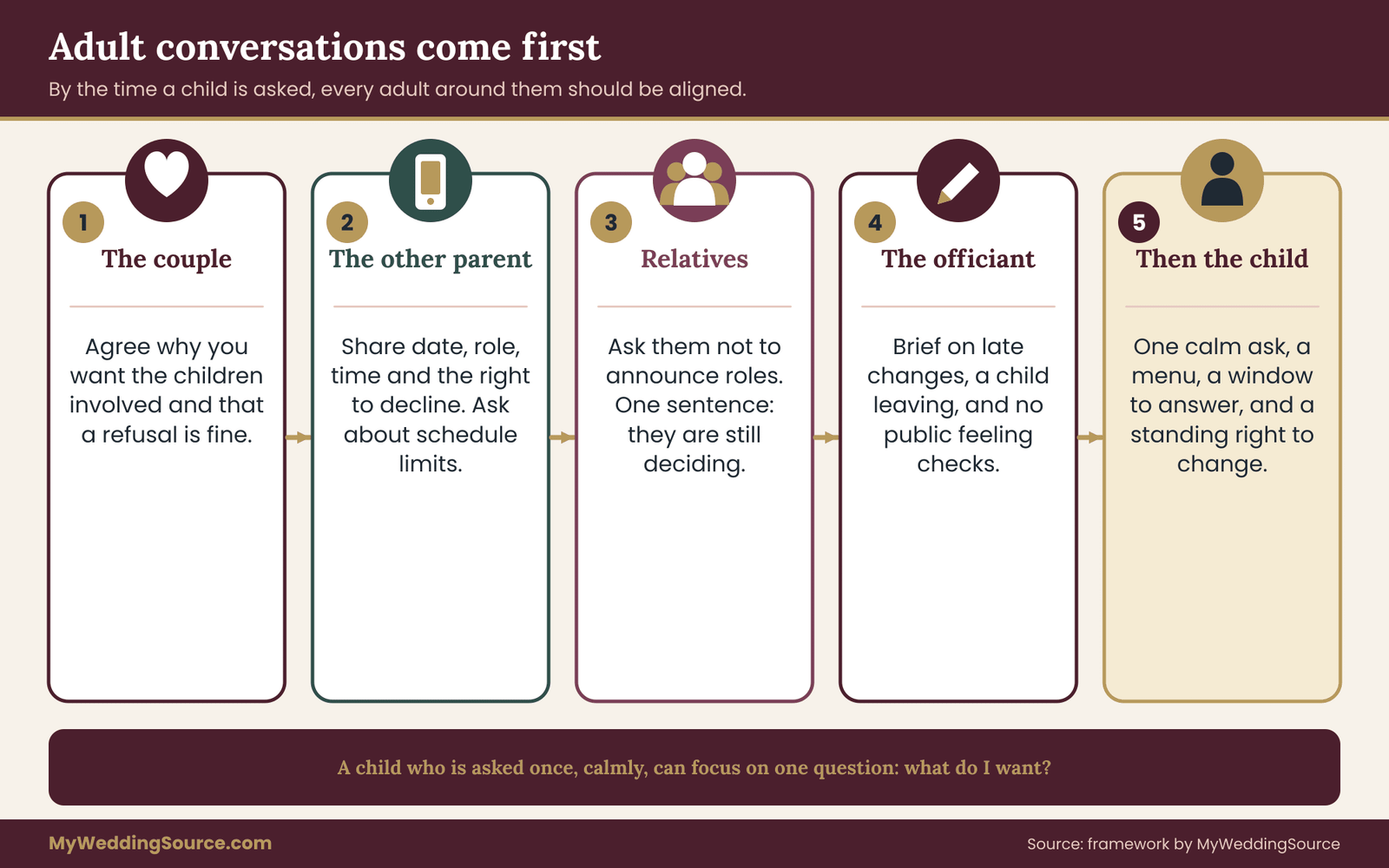
The most common mistake when including stepchildren is asking the stepchildren first. By the time a child is invited, four adult conversations should already be finished. Skipping them turns a child’s “yes” into a problem the adults must undo.
Conversation one: the couple agree on purpose
Sit down together and answer one question in writing: why do we want the stepchildren in the ceremony? Possible honest answers include “we want them to feel part of what is happening,” “we want photographs with everyone,” or “we want to mark the new household.” Each answer leads to different roles. If the real reason is “we want the pictures,” the child may only need to be in the family portrait list, not the processional.
Then agree on the line between wanting and needing. You may want the stepchildren to take part. You do not need it. Say aloud that a child who declines everything will not be treated as having failed, and that neither of you will sulk, bargain or hint. If one partner cannot say this honestly, the conversation about roles is not ready.
Also agree on who speaks to whom. A biological parent usually asks their own children, because the request carries less risk of sounding like a stranger’s demand. The stepparent can offer a separate, lighter invitation later, but the first ask should come from the person the child already trusts to hear “no” from.
Conversation two: the other parent, early and plainly
If a child has another living parent or guardian, that adult should hear about the plan before the child does, and from the child’s parent, not from the child. This is partly courtesy, and partly practical. A child who comes home saying “I am going to carry the rings” may be walking into a conflict they cannot manage.
Keep the message short and factual. Say the date, the role being offered, the time the child would be needed, and that the child can decline. Ask whether there are scheduling limits under a parenting plan, such as a weekend that belongs to the other household. Do not ask for permission to love the child, and do not ask the other parent to tell the child to say yes.
You are not required to agree on everything. If the other parent objects to a role, treat it as information about what the child is carrying and consider a lower rung. If the objection becomes a dispute about custody or legal rights, that is beyond wedding planning, and any written parenting agreement or court order should guide what is allowed.
Conversation three: the grandparents and relatives
Relatives often make announcements on the couple’s behalf. A grandmother who tells a cousin “the little one is going to be the flower girl” has created a role that now has an audience. Tell close relatives plainly that nothing is set until each child confirms, and ask them not to mention roles to the stepchildren themselves. Family etiquette varies, and the guide to wedding etiquette is a useful reference when relatives disagree about what is polite. Give them one sentence to repeat: “They are still deciding what they would like to do.”
Conversation four: the officiant
Brief your officiant before the program is written. Explain that some stepchildren may change their role late, that a child might leave mid-ceremony, and that the officiant should never say “and now, our new son” or ask a child to confirm a feeling in public unless that has been agreed in advance. A skilled officiant can smooth a gap in the ceremony without drawing attention. For what to ask when choosing one, the guide on wedding officiant requirements covers the basics.
The order matters more than the content
Notice the sequence: couple, other parent, relatives, officiant, then children. Each step narrows the chance that any of the stepchildren hears conflicting messages. One of the stepchildren who is asked once, calmly, with every adult already aligned, can focus on one question: what do I want? That is the whole purpose of the preparation.
The age-appropriate opt-in matrix for stepchildren
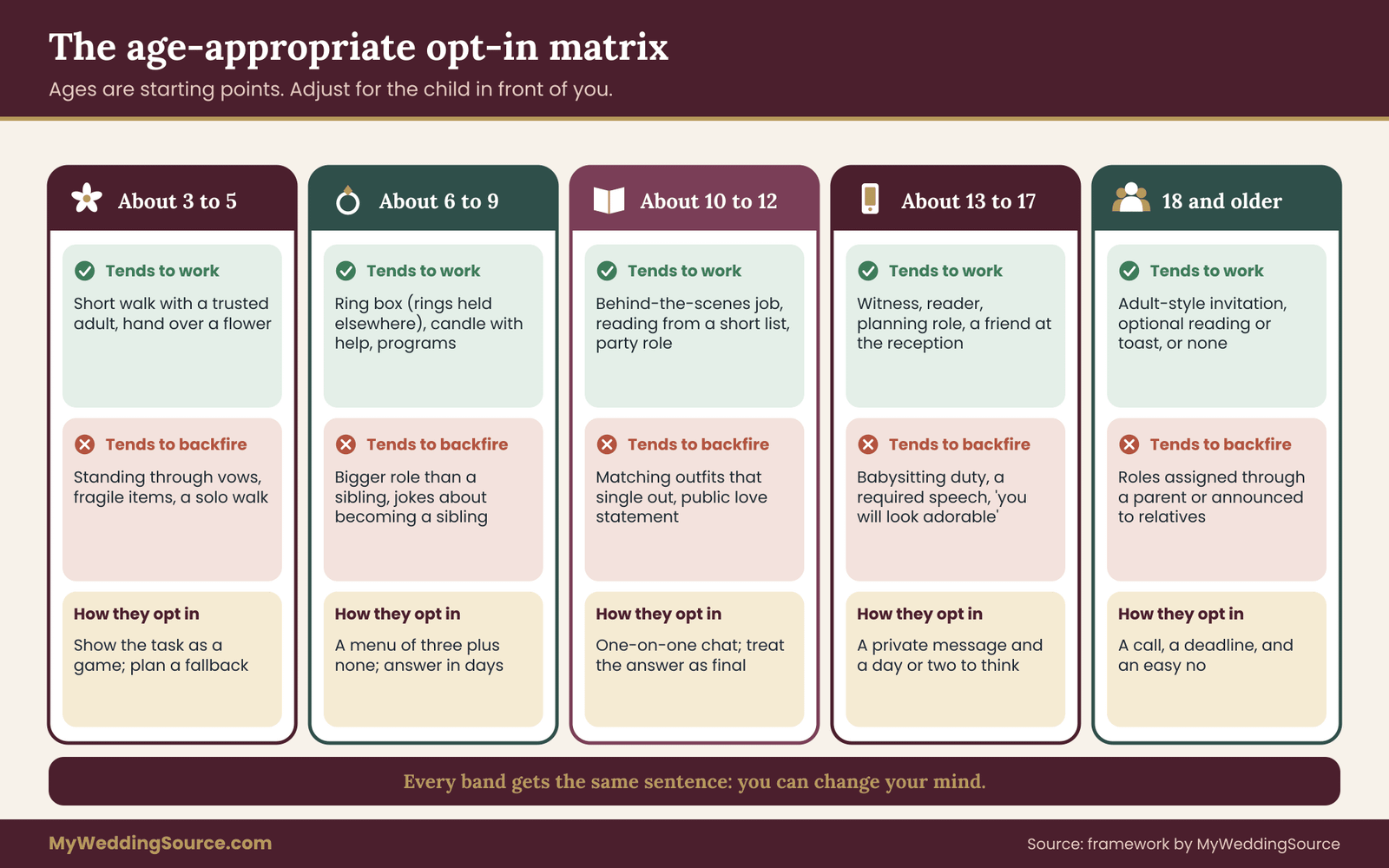
Ages are rough guides, not rules. A shy ten-year-old may belong with the younger band, and a confident seven-year-old may be ready for more. Use the bands as starting points, then adjust for the particular child. The matrix below describes five bands, and for each one the tasks that tend to work, the tasks that tend to backfire, and how the child opts in.
Band one: roughly three to five years old
Very young children live in the present moment. They cannot hold a long wait, and they may not understand what a ceremony is for.
Offers that tend to work: walking down a short aisle holding the hand of a trusted adult, handing a flower to someone sitting in the front row, sitting on a lap, wearing something comfortable. Keep the job to under a minute and have a second adult ready.
Offers that tend to backfire: standing still during vows, holding a fragile or valuable object, being the only child in the processional with no escort, any task that depends on remembering what to do next.
How the child opts in: do not ask “do you want to be in the wedding?” Show the task. Practice it as a game at home a few times, and treat “I do not want to” on the day as a normal answer. A child this age is best given a plan with a built-in fallback, such as “if you do not want to walk, Grandpa will carry the basket.” The adult on standby matters as much as the child’s task.
Band two: roughly six to nine years old
School-age children like clear jobs with a beginning and an end. They also like being trusted with something that matters, and they notice unfairness quickly.
Offers that tend to work: carrying a ring box (with real rings held elsewhere), lighting a candle with an adult’s help, handing out programs, reading one short line that has been practiced at home, choosing a song for the recessional.
Offers that tend to backfire: a role the child’s sibling has that looks bigger, public praise that feels like a test, jokes about becoming “the big brother” or “the big sister,” any speech they must write themselves.
How the child opts in: a short menu, three options at most, with a “none of these” option said out loud. A written card can help, since some stepchildren find it easier to point than to speak. Ask for the answer in a few days and let them change it.
Band three: roughly ten to twelve years old
Preteens are often at the peak of self-consciousness. They may love a role one week and refuse it the next, and they will notice if an adult is performing enthusiasm.
Offers that tend to work: a behind-the-scenes job, a place in the processional with a friend, a supporting role like holding a guest book, a reading from a short list they pick from, a role in the party afterward such as helping with a game or playlist.
Offers that tend to backfire: matching outfits that single them out, a role that requires dancing alone, a public statement about love for the stepparent.
How the child opts in: talk to them one on one, treat their answer as final unless they reopen it, and avoid asking in front of a sibling who may answer differently. Some preteens will say “I do not care,” which often means “I am not ready to say.” Offer a low-stakes level and leave the door open.
Band four: roughly thirteen to seventeen years old
Teenagers can make a sophisticated choice, and they also have the best-developed sense of when they are being managed. They tend to respond to respect for their privacy more than to warmth.
Offers that tend to work: a clear, adult-style invitation (what, when, how long), a role as a witness or reader, a role in planning, a place in the processional alongside the couple’s friends, permission to bring a friend to the reception, the option to skip the formal portraits.
Offers that tend to backfire: treating them as a child (“you will look adorable”), expecting them to babysit younger stepchildren, assuming they feel the same way as a younger sibling, requiring a speech.
How the child opts in: a short message or private conversation, a day or two to think, and an explicit statement that no is welcome. Some teenagers will want to attend without a role, and that is a legitimate choice. Do not equate attendance without a role with hostility.
Band five: eighteen and older
Adult stepchildren are guests with their own lives, and many have complicated feelings about a parent remarrying, especially after a death or divorce. They may also have partners and children of their own.
Offers that tend to work: an invitation in the same register you would use for any adult family member, a role they can say no to without friction (reading, witnessing, toasting), or no role at all with a seat in the family section.
Offers that tend to backfire: assigning a role through the parent, announcing it to relatives, expecting a toast, putting them in the processional by default.
How the child opts in: a phone call or private message, a reasonable deadline, and acceptance of a quiet “I would rather just be there.”
Reading the matrix without over-reading it
No matrix can describe your stepchildren better than they can.
The matrix is a way to avoid obvious mismatches, not a way to predict a child. The most useful sentence you can add to any band is the same: “You can change your mind.” A role that is easy to leave will be chosen more freely and kept more happily.
How to ask stepchildren: timing, setting and scripts
Stepchildren read tone faster than content, so how you ask matters as much as what you ask.
Once the adults are aligned, the asking itself is a small piece of craft. The goal is to make it easy for a child to give an honest answer, including an answer that disappoints you.
Pick the right moment
Ask early enough that the child can think, and late enough that the plan is real. For many families that means several months out for older stepchildren and a few weeks out for younger ones, since a long wait makes young children anxious or forgetful. Avoid asking right before a transition, such as a handoff between households, a school exam, or a holiday. Avoid asking in the car on the way somewhere, where the child cannot walk away from the conversation.
Choose a setting that is neutral and unhurried: a walk, a kitchen table with a snack, a shared activity where eye contact is optional. Many stepchildren talk more easily side by side than face to face. Keep the conversation short. Five to ten minutes is often plenty, and a child who is allowed to leave will often return with questions.
Who asks
The child’s own parent usually asks first, as noted earlier. The stepparent can add a brief, sincere line afterward, for example “I would be glad either way,” which carries no pressure. A stepparent who leads the request risks making the answer a verdict on the relationship. If you are the stepparent-to-be and you have a close bond with the child, you can ask together, but agree beforehand that the parent speaks first.
A script in three parts
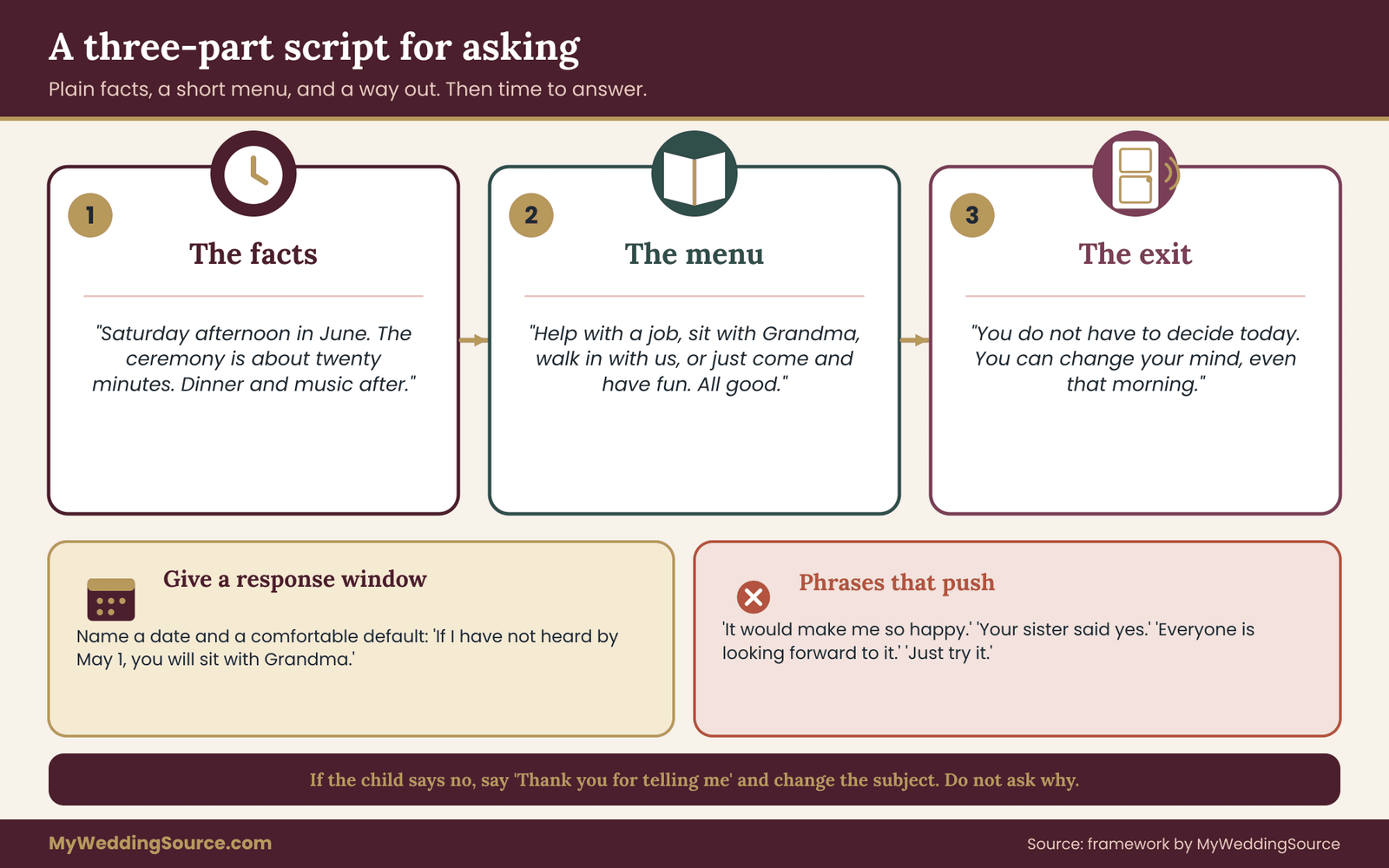
A workable script has three parts: the facts, the menu and the exit. Adapt the words to your voice and your child’s age.
The facts. Say what is happening and what the child would do, in plain terms. “The wedding is on a Saturday afternoon in June. The ceremony is about twenty minutes. There will be dinner and music afterward.”
The menu. Offer a few choices, from least to most visible, and include the choice to do nothing. “Some kids like to help with a job. Some like to sit with a family member. Some like to walk in with us. And some prefer to just come and have fun. All of those are good.”
The exit. Say how they can change their answer. “You do not have to decide today. You can tell me tomorrow, next week, or the morning of the wedding, and nothing bad will happen.”
Here is a short version for a younger child: “We are having a wedding party. Would you like to hear some jobs kids sometimes do? You can say no, and you can change your mind later.” For a teenager: “I would like you there, and you get to decide how much of a part you want. Here are a few options. There is no right answer, and I will not push.”
What to say when the child hesitates
Hesitation is not a refusal. It is also not a yes. A hesitating child is telling you something, and your response will teach them whether honesty is safe.
If the child goes quiet, say “That is okay. You can think about it.” Then stop. Do not fill the silence with reasons. If the child asks a question you cannot answer, say so, and offer to find out. If the child says “I do not know,” offer to come back to it later with a specific date.
If the child says “no,” say “Thank you for telling me.” Then do the hard part: change the subject. Do not ask why. A child who refuses and is then interrogated learns not to refuse. A child who refuses and is thanked learns that “no” is welcome, and that makes their future “yes” mean something.
What not to say
Some familiar phrases carry a hidden request. “It would make me so happy” puts the adult’s feelings on the scale. “Your sister said yes” puts a sibling’s choice in the way. “Everybody will be looking forward to it” brings in an audience. “Just try it, you might like it” invites the child to override their own caution. None of these is cruel, and each of them is a small push. Replace them with plain information: what, when, how long, and how to leave.
The response window
Give the child a clear time to respond, and say what happens if they do not. “If I have not heard from you by the first of May, I will assume you would like to sit with Grandma, and that is a great choice.” A default that is itself a comfortable option removes the pressure to produce an answer, and it protects against a silence that adults might misread as a yes.
Asking siblings together or apart
Siblings in a blended family often react to each other more than to the invitation. Ask them separately first, so that neither is swayed by the other’s answer. Then tell each that you have asked the other, to avoid secrets, and offer a chance to talk together if they wish. If one child accepts a visible role and the other declines everything, treat both answers as equally good. Do not praise the accepter in front of the decliner.
When stepchildren and the couple’s own shared children are both involved, keep the process the same for all. A child who sees that their sibling got a more flattering offer will notice it. Offering the same ladder to everyone, even when some stepchildren will obviously take different rungs, keeps the process fair.
Putting it in writing
A short written note after the conversation can help. It confirms what was said, gives the child a way to change their mind, and avoids later misunderstandings between households. Keep it brief, friendly and free of emotional language. “Thanks for talking with us. You chose to carry the ring box and sit with Aunt Jo during the ceremony. You can change this any time. Here is the plan for the day.”
If the child has two households, send the note to both parents so that each knows what was agreed. The note does not need to be formal. A text message or short email is enough, and it creates a shared record that reduces the chance of mixed messages.
Ceremony moments and the roles that fit each one
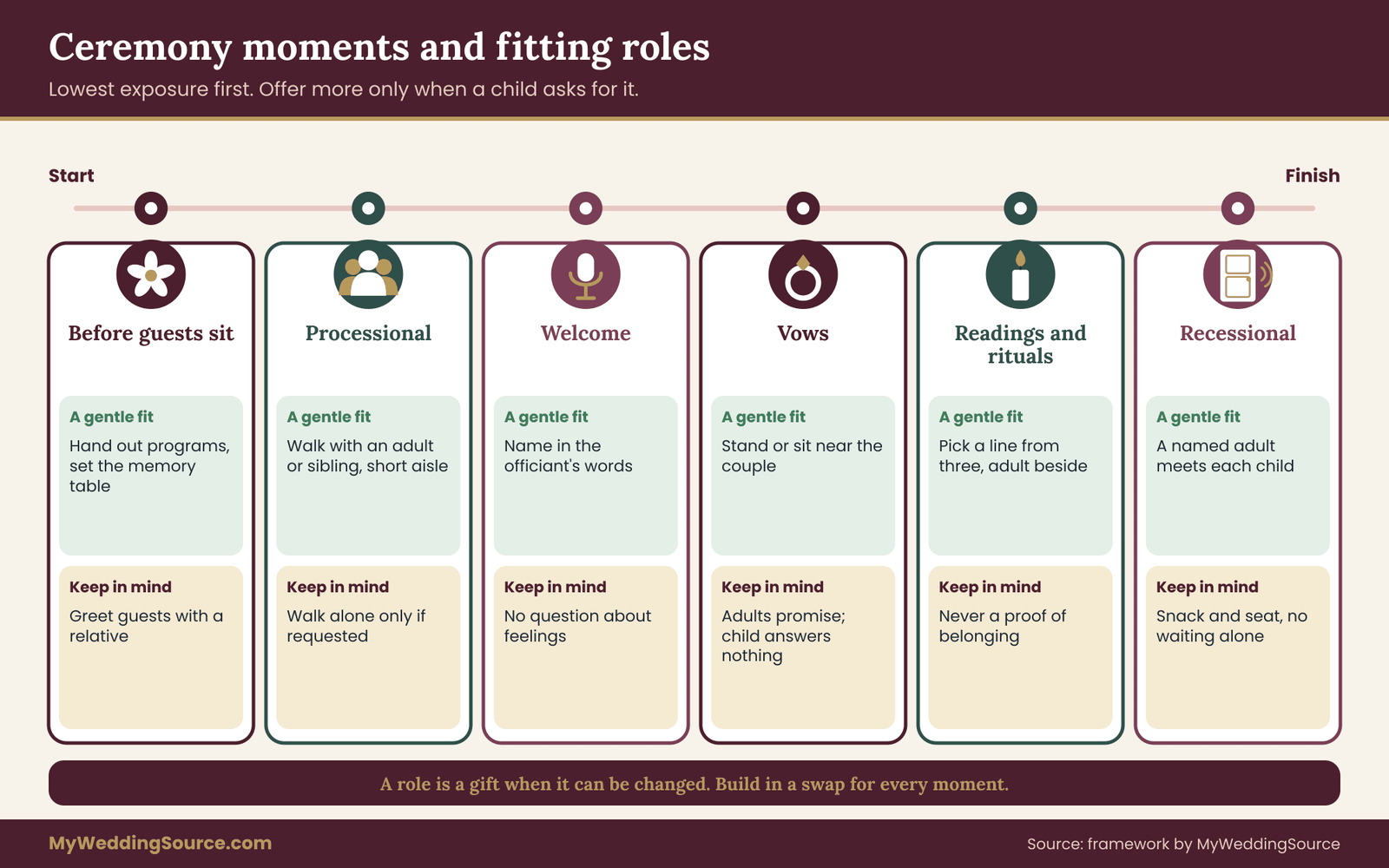
With the asking process in place, you can look at the ceremony itself and decide where a child’s participation, if they want it, fits comfortably. The guide to the wedding ceremony step by step covers the sequence in full. Here the focus is on which moments suit stepchildren and which are best left to adults.
Before the ceremony: low exposure, high meaning
The period before guests are seated offers the gentlest roles. A child can help arrange programs, greet guests alongside a relative, pass out small items such as petals or bubbles, or help decorate a memory table. These jobs give a child a place in the day without putting them on view, and they work well for children who like to be useful but not watched.
A pre-ceremony role also gives children something to do during a nervous wait. Many stepchildren who struggle with a long gap before the processional do far better when they have a job.
The processional
The processional is the most visible role and the most commonly offered. If a child chooses it, think about the details that can make it comfortable.
Let the child walk with someone, whether an adult, a sibling or a friend, instead of alone. Keep the aisle short if the child is small. Choose music that sets a gentle pace. Decide in advance where the child will go after arriving, whether that is a reserved seat, a spot next to the couple or the lap of a relative. Make sure the child knows the plan before the day, since surprises at the front are harder to handle than at home.
For a step-by-step view of how entrances work with different family structures, see the notes in the guide on processional order and cue sheets.
The welcome and the vows
The officiant’s welcome can acknowledge the stepchildren by name if they agree. Plain wording works best: “We are glad that Maya, Eli and Sam are here today.” It names the stepchildren without saying how they feel.
The vows themselves belong to the couple. Some couples add a separate promise to the stepchildren, but that is a different topic with its own risks, because it can imply obligations the child has not accepted. If you are considering one, keep it a promise from the adults, with nothing asked of the child. Do not frame it as a pledge the child must answer.
Readings and rituals
A short reading is the first real speaking role, and it needs honest rehearsal. Pick a passage the child chooses from three or four options, keep it under a minute, and have a printed copy in a folder so the child does not need to memorize. Offer an alternative such as having an adult read while the child stands beside them.
Rituals such as candle lighting, sand blending or a shared ring are popular for blended families, and they raise a distinct risk: they can ask the child to act out a feeling. A candle lit by a child as a quiet job is gentle. A ritual that says “we are now one family” with the child holding a symbol of merger may not match what the child feels. Frame the ritual as something the adults are doing and the child may join, never as proof of belonging.
The recessional and the first moments afterward
The recessional is easy to forget, and it is where stepchildren are most likely to feel lost. Decide who goes with whom, and where the stepchildren go afterward. A familiar adult should meet each of the stepchildren at the end of the aisle with a drink, a snack or a seat. Make sure no child is left standing alone while adults line up for congratulations.
A worked case: Dana, Marcus and three children
The following example is invented to show the method. It is not a case study, and no real family or outcome is described. Its purpose is to show how the ladder, the adult conversations and the matrix interact when the children want different things.
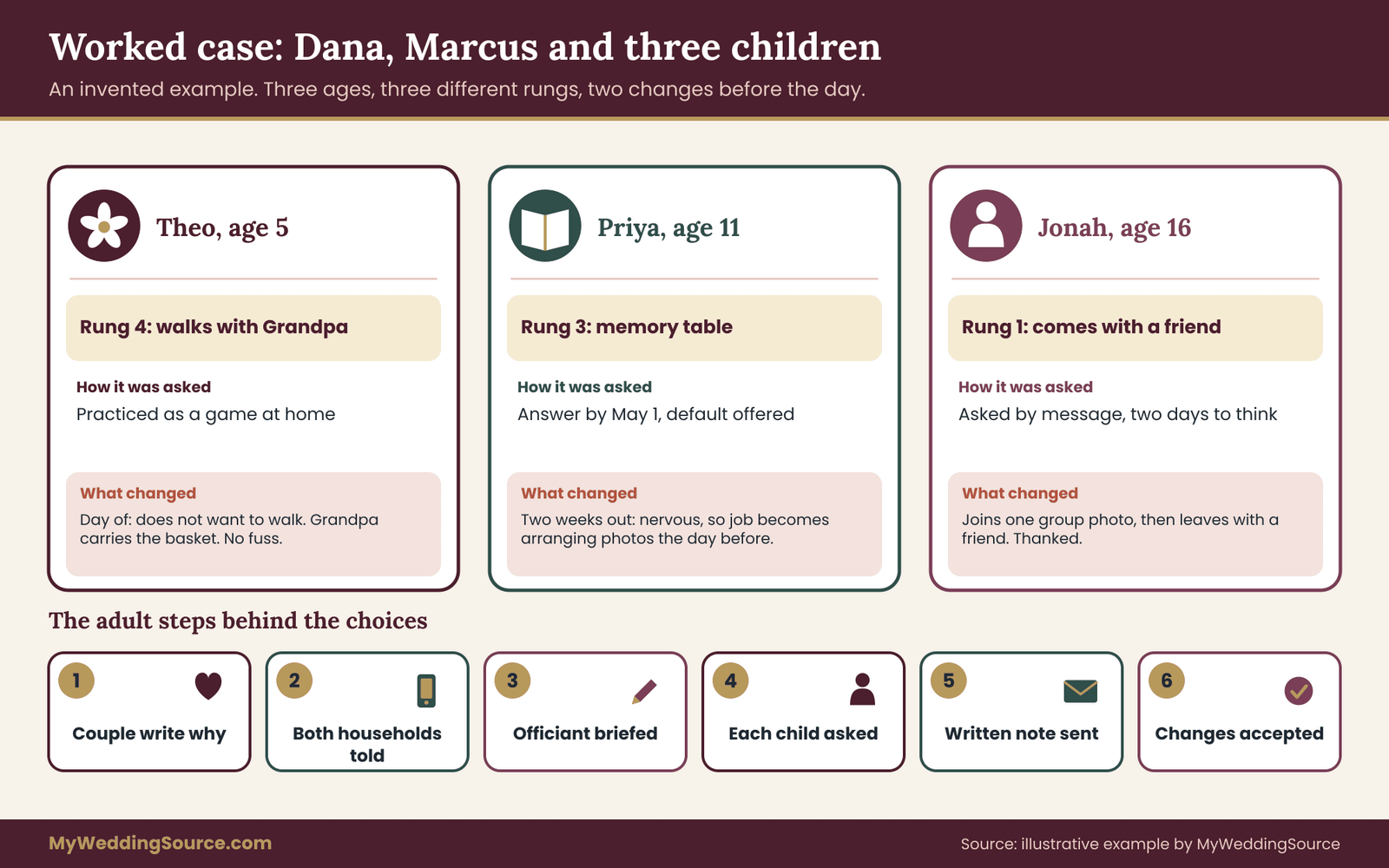
Dana and Marcus are marrying in late spring. Dana has two children from a previous marriage: Priya, who is eleven, and Theo, who is five. Marcus has a sixteen-year-old son, Jonah, who lives with his mother most of the week and with Marcus on alternate weekends. From Dana’s side, Priya and Theo are Marcus’s stepchildren-to-be. From Marcus’s side, Jonah is Dana’s. Three children, three age bands, two other households.
Step one: the couple write down why
Dana and Marcus each write a sentence about why they want the children involved. Dana writes that she wants her kids to feel the day belongs to them too. Marcus writes that he wants a family photograph and wants Jonah to know he is welcome. Comparing notes, they notice that Dana’s reason points to roles, and Marcus’s points to photographs and an open door. They agree to offer roles to anyone who wants them, and to put photographs on a separate track that does not depend on a role.
They also agree on the sentence they will both say if a child declines: “Thanks for telling us. We are glad you will be there.” Neither will ask why.
Step two: the other households
Dana contacts Priya and Theo’s father by message. She names the date, says the children may be offered small roles, and asks about any weekend conflicts under their parenting arrangement. He replies that the weekend is his, and offers to bring the children to the venue on Saturday. Dana thanks him and asks him to leave the question of roles to the children. He agrees to mention only that “there will be a wedding and you will be going.”
Marcus speaks to Jonah’s mother by phone. She asks whether Jonah must wear a suit and whether he must be photographed. Marcus says neither is required, and that Jonah will be offered a choice. She says she will drive him on Saturday morning. Both families now know the schedule, and neither has pressed the children.
Step three: the officiant and the relatives
Dana and Marcus tell the officiant that roles are not final until the week before, and ask for a welcome line that names all three children only if each agrees. They tell their parents the same thing and ask them to say, if asked, “They are still deciding.”
Step four: asking each child
Theo, age five. Dana does not ask whether he wants to be in the wedding. Over three weekends she plays a small game with a basket and some paper flowers, in which he walks to the couch and hands a flower to Grandpa. After the third round, she says, “On the wedding day you could do this for real. Or you could sit with Grandpa the whole time. Which sounds better?” Theo says he wants to do the flower game.
He then asks whether Grandpa can walk with him. Dana says yes. She tells him that if he changes his mind on the day, Grandpa will carry the basket instead.
Priya, age eleven. Dana talks to Priya on a walk. She describes the day, offers three options (sit with her grandmother, help set up the memory table, or walk in with her cousin), and adds a fourth, “or none of these.” Priya says she does not know.
Dana says she can answer by the first of May, and that if she does not, she will be set down for the memory table, which Dana thinks she might like. Priya later sends a text: “I want the memory table, but I do not want to be in the pictures with just us.” Dana thanks her, and the couple adjust the photo list so that Priya appears in group portraits with cousins and not in a portrait with only the couple.
Jonah, age sixteen. Marcus asks Jonah by message, and says plainly that there is no pressure and that Jonah can simply attend. He lists two options: be a witness for the marriage license, or sit with his grandfather. Jonah replies after two days: he would rather just come, and would like to bring a friend to the reception. Marcus says yes, and tells Dana. Jonah’s answer is treated as a full participation, because it is his own.
Step five: the written note
Dana and Marcus send each child a short note, copied to each other household, that states the chosen role. Theo’s note, read aloud by Dana, says he will walk with Grandpa and hand a flower to Grandma. Priya’s says she will help with the memory table. Jonah’s says he will come with a friend.
Step six: what happens when things change
Two weeks before the wedding, Priya tells Dana she is nervous about the memory table because she does not want to talk to guests. Dana offers to change the job to arranging photos the day before so that she does not have to stand at the table. Priya agrees. Theo, on the morning, does not want to walk. Grandpa carries the basket, Theo sits on his lap, and the flower is passed to Grandma by Grandpa. Nobody remarks on it.
At the ceremony, the officiant says, “We are glad Priya, Theo and Jonah are here with us today.” No child is asked to respond. After the ceremony, Dana and Marcus take family photographs with the children, but do not require them. Jonah chooses to join one group portrait and then leaves with his friend. Marcus thanks him.
What the example shows
Three points stand out. First, the children took three different rungs, from a sitting guest to a walking role, and every rung counted as inclusion. Second, the roles shifted twice without cost, because the plan allowed it. Third, the adults did the heavy lifting: the other parents were consulted, the officiant was briefed, and the relatives were reined in. The children were never asked to carry the symbolism of the day.
It also shows what the method does not do. It does not guarantee that the children feel joyful. Priya may remain uneasy about the marriage, and Jonah may stay distant. A well-built process for including stepchildren protects their choices. It cannot manufacture their feelings, and it should not try.
Adapting the case to your family
No two sets of stepchildren are alike, so treat the example as a pattern and not a template.
Your family will differ. The children may be fewer or more, the other households may be less cooperative, or the child may be an adult. The elements that carry over are the order (adults first), the menu (a ladder with a “none” option), the written note, and the standing right to change. If you remove any one of those, the method becomes a script for gentle pressure. If you keep them all, the details can vary widely and the structure will still protect the children.
Some families also find it helpful to build a one-page summary of each child’s choices, which both households can see and which the officiant, a planner or a trusted relative can use on the day. Keep it short, with the child’s name, chosen role, the adult responsible for them at each moment, the fallback and any comfort needs such as snacks, quiet time or noise sensitivity. Share it only with people who need it.
Alternatives when a child says no, or a parent objects
Even a well-run process will produce refusals, partial answers and objections. Treat these as normal outcomes. This section covers what to do with each, and how to keep including stepchildren in ways that do not depend on their taking a visible role.
When a child declines everything
Some stepchildren will say no to every offer, and the adults must be ready for it.
A child who says “I do not want to do anything” may mean exactly that. They may also mean “I do not want to be looked at,” “I am not sure how I feel,” or “I am worried about a parent.” You do not need to know which. What you can do is keep a few quiet options available, in case they want one later, and otherwise leave them alone.
Quiet options include a reserved seat next to a favorite adult, a place at a family table at the reception, a role in the playlist or the guest book that no one sees, a small keepsake given in private, or a letter they can read now or later. None of these needs to be announced. If the child asks for none of them, that is the answer.
The more important job is to keep the relationship separate from the ceremony. A child who declines a role should find the following week that the adults are exactly as warm as before. If the stepparent-to-be acts hurt, even subtly, the child learns that refusing costs something. Say to yourself, and to your partner, that the ceremony is a few minutes long, and the relationship with the child is much longer.
When a child says yes and then pulls back
Late changes are common and usually small. A child who agreed to carry a ring box may feel anxious two days before. Meet it the same way you would meet any other answer: “That is fine. Let us think about what would feel better.” Offer a lower rung or a different version of the same job. Do not remind the child that they said yes, and do not suggest that others are counting on them.
Build slack into every role so a swap is easy. A ring box can be carried by another person. A reading can be shared, or read by an adult with the child standing nearby. A processional can be shortened. A role that cannot flex is a role that will cause harm if the child wavers, and it should be redesigned or dropped before the day.
When the other parent objects
An objection from another parent can take many forms: a scheduling conflict, discomfort with the ceremony, worry about the child being cast as part of a different family, or a sense that the wedding is being used to claim the child. Respond to the worry, not the tone.
First, restate what is being offered in neutral terms, and what is not. “The role is to hand out programs for ten minutes. There is nothing in the ceremony that speaks about whose child they are.”
Second, ask what would make the other parent comfortable. Sometimes the answer is simple, such as a request that the child not be photographed with the couple alone, or that the child’s name not be placed in a printed family list. Third, accept a lower rung if the objection stands, and let the child know the adults have agreed on the plan without placing the child between them.
If an objection becomes a dispute that involves court orders, parenting plans or custody terms, step back from the wedding planning and follow whatever legal arrangements exist. A planner or officiant cannot resolve these, and a wedding is not the place to test them. When in doubt, ask a family law professional in your state, not a vendor.
When the relationship is very new
If you have been with your partner for only a short time, or if the stepchildren have met you only a few times, a visible role may overstate the relationship. Children often sense this. In such cases, a level-one or level-two role is often best: the child attends, is welcomed, and takes part in the party. Over time, the relationship can grow and later milestones, such as an anniversary dinner, can include a role the child chooses.
It is also fair to tell a child honestly that you are still getting to know each other. “I am glad you are coming. I am still learning what you like, so please tell me if something is not right.” That sentence does more than any ritual.
When a child is grieving
If the child’s other parent has died, a ceremony in which the child stands with a new stepparent can be painful. Some stepchildren want to include a remembrance of their parent. Others do not want any reference at all. Ask in private, and let the child decide whether to include a photograph on a memory table, a favorite song, a moment of silence, or nothing. Do not assume a remembrance will comfort. For ideas on including absent people without forcing the issue, start with the child’s wishes and add nothing they have not asked for.
If the child shows signs of strong distress, such as withdrawal, anger, sleep changes or persistent fear, a school counselor, pediatrician or licensed mental health professional can offer support beyond what a wedding plan can. The ceremony is not a treatment, and it should not be asked to heal anything.
Children with sensory, medical or developmental needs
Some stepchildren have needs that change what is possible. A child who is overwhelmed by noise, crowds or long waits may do better with a role that happens before guests arrive, or with a seat near an exit. A child who uses a wheelchair, hearing support or another accommodation should be asked what they need, instead of having the plan designed around an assumption. A parent or caregiver is usually the best source of practical detail, and the child should still be asked for their own preferences.
Think about practical things: a quiet room, noise-reducing headphones, a snack, a familiar adult always within reach, a printed schedule, a break plan. Add them to the one-page summary, and tell the venue, so staff know where the quiet room is. For accessibility questions at the venue itself, the Americans with Disabilities Act pages listed in the sources are a starting point, but check what applies to your own venue and contract.
Adult stepchildren and difficult relationships
When adult stepchildren are cool toward the marriage, or are estranged from a parent, the invitation itself may be the most that can be asked. Send it kindly, without explanation or guilt, and give them a clear way to decline. Do not use a role as a peace offering. A reading assigned to an unwilling adult child usually shows. If the relationship is strained, an honest conversation, ideally before the invitations go out, is better than a performance on the day.
Do not hold a seat in the front row as leverage. A seat with relatives and friends of the guest’s choosing is often more comfortable than a prominent one.
Alternatives to the ceremony role
If the ceremony does not suit a child, other parts of the wedding can offer something different:
- A pre-ceremony moment. A private walk-through of the venue, a few minutes alone with the couple, a small ritual at home before leaving.
- A reception role. Helping choose a song, running a small game, handing out cake, or taking charge of a photo booth.
- A keepsake. A framed photo, a letter, a small piece of jewelry or a handmade item given in private after the wedding.
- A family moment elsewhere. A dinner the night before, a brunch the next day, or a trip afterward that includes everyone.
These can be offered in addition to or instead of a ceremony role. They put the focus on the relationship, which is what most couples really want to affirm. If photographs are a concern, the guide to a wedding family photo list shows how to build a list that handles blended groups, and you can make each child’s portraits optional.
The practical test for any alternative
Stepchildren deserve alternatives that are real options, not consolation prizes.
Before offering anything, ask three questions. Can the child decline without anyone being told? Can the plan survive if the child changes their mind on the day? And would the offer still feel right if the child said “no” to every other option? If the answer to any is no, redesign the option. Including stepchildren is, at heart, the practice of offering things that remain kind even when refused.
The rehearsal, the outfit and the day itself
A good process for including stepchildren can still fall apart on the day if the logistics are loose. Stepchildren cope best when the arrangements are boring and predictable. This section turns the choices into arrangements: who is where, who is holding what, and what happens when something goes sideways. The aim is simple. Every one of the stepchildren should always have one named adult, one comfortable place to be and one easy way out.
The rehearsal: optional, short and kind
A rehearsal can help younger stepchildren, who like to know where they will stand and what comes next. It can also be a source of dread for older ones, since it means more time on display. Make it optional for any child whose role is simple, and keep it short for those who attend. Ten minutes at the venue, with a snack, often does more than an hour of walking.
If a child cannot attend the rehearsal, a short walk-through before the ceremony works too. Show them the aisle, the chair they will sit in and the exit. If the child is taking a speaking role, let them practice into the real microphone if there is one, so the sound of their own voice does not surprise them.
Never use the rehearsal to make a child perform a feeling. If the officiant says “now, look at each other and smile,” children may freeze. Ask the officiant to give instructions that are about movement, not emotion: where to stand, when to walk, where to look.
Outfits: comfort and consent
Clothing can be a quiet pressure point. A suit that itches, shoes that pinch or a dress that restricts movement can make a child miserable by the second hour. Offer a few options within a color palette instead of a single required outfit. Let the child try the clothes at home, wear them for a full evening before the wedding, and keep a comfortable change in the car.
Matching outfits can signal belonging, and they can also single a child out. Some stepchildren like to coordinate with the couple’s party. Others want to dress as themselves. Ask, and accept an answer. Do not buy before agreement, and do not treat a refusal of an outfit as a refusal of the family.
Teenagers in particular should have a say in what they wear and how they are styled. A requirement to change their look is a request for more than a role.
Name an adult for every child
Stepchildren who know exactly who to find feel safer, even if they never need to.
For each of the stepchildren, decide in advance which adult is “theirs” at each stage of the day: getting ready, travel, ceremony, photographs, dinner, the end of the night. This adult is not the child’s keeper in a controlling sense, but a point of contact who knows the plan, the fallback and the comfort needs. Choose someone the child likes, who is not also doing a major job such as giving a toast or managing vendors.
Avoid giving the job to the couple themselves. They will be busy, emotional and constantly pulled away. Avoid giving it to a sibling who is also a child. A grandparent, aunt, uncle, family friend or hired caregiver can work well. If you hire a caregiver, check references and agree on duties in writing before the day.
Make the arrangement explicit and visible. Give each adult a card with the child’s name, role, fallback, any allergies or medical notes, and a phone number for the parent. Brief the adult on the quiet signal described below.
The quiet signal and the exit plan
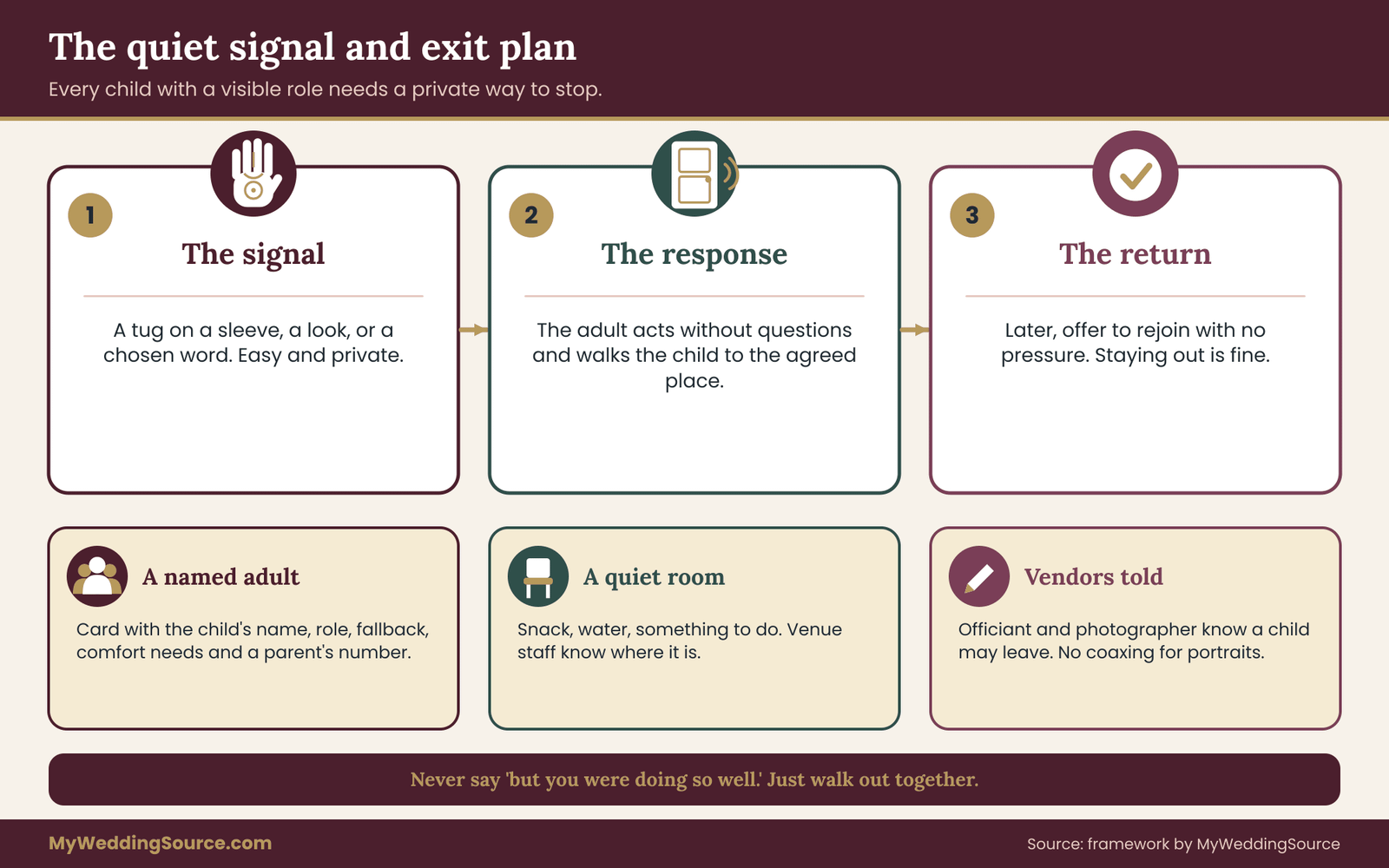
Every child with a visible role needs a way to leave without announcing it. The plan has three parts.
The signal. Agree on a small gesture or word that means “I want to stop.” Younger children can tug an earlobe or touch the adult’s sleeve. Older ones can use a text, a look or a phrase they have chosen. The signal should be easy and private.
The response. When the signal is given, the adult acts without asking questions. They take the child’s hand, walk them to the agreed place, and stay with them. They do not say “but you were doing so well” or “just a little longer.”
The return. Afterward, the adult offers the child the option to rejoin, with no pressure. If the child wants to stay out, that is fine. Tell the officiant and the photographer that a child may leave and that the ceremony will continue.
A quiet room near the ceremony space, with a snack, water and something to do, makes the exit plan much more effective. Tell the venue about it in advance, and ask for a staff member who knows where it is.
Vendors and the photographer
Photographers, videographers and planners should receive a short briefing about each of the stepchildren. Include the child’s name, the role, the adult responsible, the fallback, and any rules about photographs. Some stepchildren will not want to be photographed up close, and some parents will have rules about how images of their children are shared. Ask the parents what they permit before the day, and write it down.
If a child declines a portrait, the photographer should not coax them. A good photographer takes candid images from a distance, and often gets better ones. If you need a formal family photograph, schedule it for a time when the stepchildren are fresh, not after a long dinner, and keep it brief. For image-use boundaries more generally, the guide on wedding photography consent is a useful reference. Ask any vendor who posts images online to follow the families’ wishes.
Food, rest and the length of the day
Many problems on a wedding day are really hunger, tiredness or boredom. Children who are fed, rested and occupied cope with a ceremony far better. Provide a snack before the ceremony, and make sure meals are timed for children’s needs. Provide a place to rest, and something for quiet time, such as a book, a tablet or a game. Ask the venue about a children’s meal.
A long day with no break will wear on a stepchild who also has to manage the emotional weight of the event. Build in pauses. A child who has a hidden half-hour to recover will often return in a better mood.
The reception: more choice, less script
The reception is generally a better place for children to feel included, because there are fewer fixed roles and more room for movement. Offer a table with other stepchildren, a space with activities, and permission to leave the dance floor or the room. Avoid putting stepchildren on the spot with a toast, a dance or a spotlight moment unless they ask for one.
If a child wants to dance with the couple or with the stepparent, treat it as a gift. If a child does not, treat that as a choice. The same principle holds at the end of the night: a child can leave when they need to, with a trusted adult, and without being told they are missing something.
A short pre-ceremony check
Thirty minutes before the ceremony, one person, ideally the planner or a calm relative, should walk through a quick check. Have the stepchildren eaten? Does each child know where they will sit or stand? Does each have an adult? Is the quiet room ready? Does anyone want to change their role? Ask each child directly, in private, and accept a change. Pass any changes to the officiant, the photographer and the music lead, so no one is surprised.
Failure conditions: when to change the plan or drop the role
Most of this guide is about making a yes easy. This section is about noticing when a plan has stopped working. A role should be changed, lowered or dropped when any of the following conditions appears, even if the child has not complained.
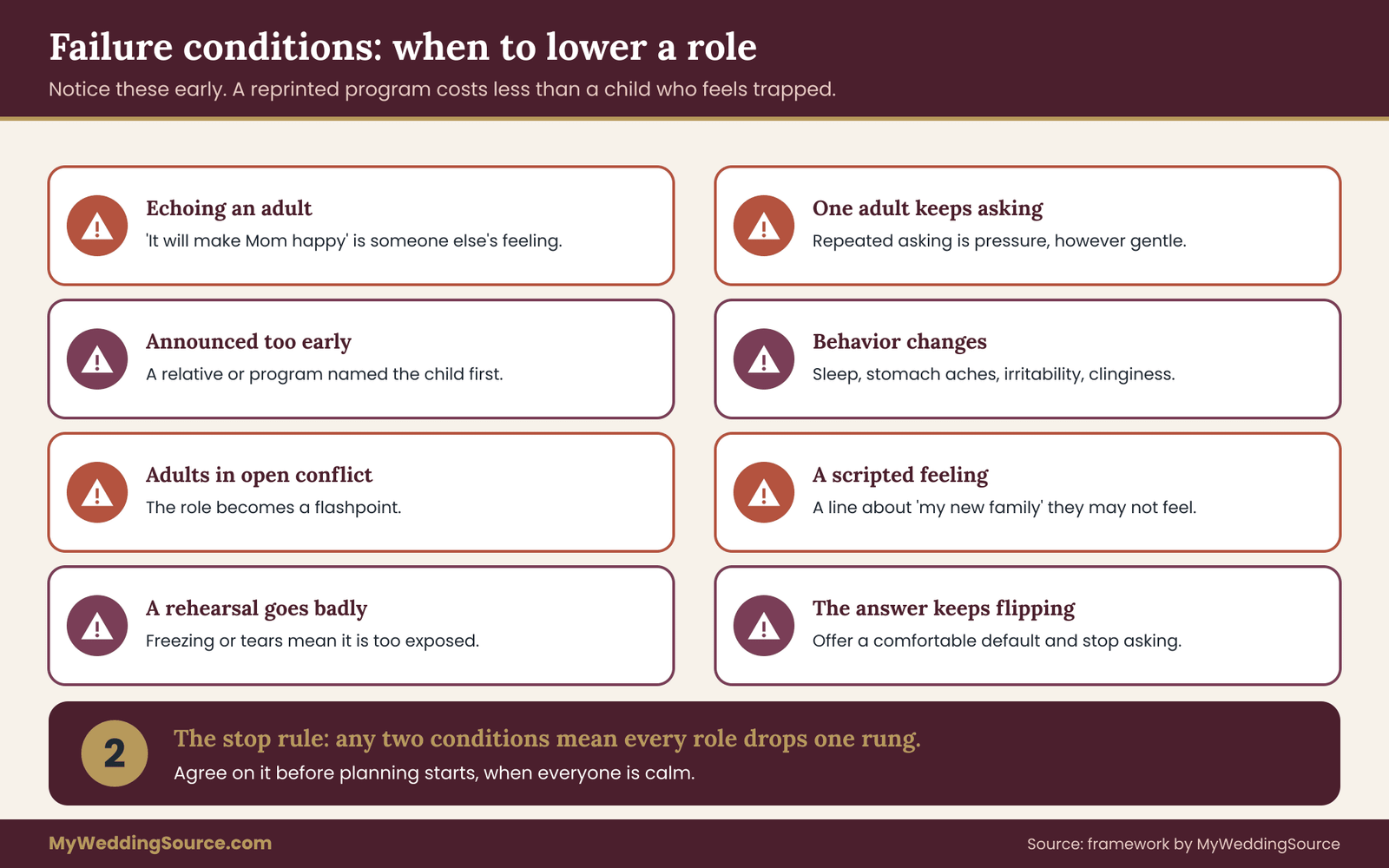
The child answers in a way that sounds like quoting an adult. If a ten-year-old says “I want to do it because it will make Mom happy,” the role is carrying someone else’s feelings. Pause and ask a neutral question: “If nobody would be sad either way, what would you pick?” If the answer changes, the role should too.
Only one adult is talking to the child about it. When one parent keeps raising the topic, the child is being asked repeatedly. That is pressure, however gentle the tone. Agree among the adults on a single conversation and a single follow-up.
The role was announced before the child agreed. If a relative, a vendor or a printed program has already named the child, the child may feel they cannot refuse. Correct the record quietly. Tell the person that plans are not final and reprint if needed. A reprinted program is cheaper than a child who feels trapped.
The child’s behavior changes around the wedding. Sleep problems, stomach aches, irritability, refusal to see the stepparent-to-be, or unusual clinginess can all be signs of stress. They may have nothing to do with the wedding, and they may. Lower the stakes, talk to the parent, and consider asking a school counselor or pediatrician for guidance if the changes persist.
The other household and the couple are in open conflict. If the adults are fighting about the wedding, a child’s role may become a flashpoint. Reduce the role to the lowest level, and settle the adult dispute separately.
A role requires the child to say something they may not feel. A line about “my new family” or a promise to love a stepparent is a script about feelings. Replace it with a factual line, or let an adult speak instead.
A rehearsal goes badly. If a child freezes, cries or refuses, that is useful information. It does not mean the child is difficult. It means the role is too exposed. Offer a lower rung and thank the child for showing you.
The child’s answer keeps flipping. Some stepchildren genuinely cannot decide. Offer a default that is comfortable and does not need further decisions, and stop asking.
A simple stop rule for the couple
Decide before the planning begins that any two of these conditions are a signal to lower the role of every one of the stepchildren by one rung. You can write it on the same page as the plan. A rule agreed in calm weeks is easier to follow than a judgment made on the morning of the wedding, when everyone is tired and emotions are high.
What counts as success
It helps to define success before you start. A successful wedding for stepchildren is one in which every child was asked kindly, chose freely, was looked after on the day, and could leave or change roles without cost. It is not one in which every child cried happy tears, hugged the stepparent or said the right words in a photograph. Children who feel respected tend to become more open over time, and children who feel managed tend to withdraw.
If you are tempted to measure success by the photographs, remember that a candid image of a child laughing at the reception tells more than a posed portrait of a child tolerating one.
After the ceremony: keeping the invitation open to stepchildren
The wedding is one day. The relationships continue. What happens in the weeks afterward often matters more to a child than anything in the ceremony.
Keep the same tone
Stepchildren watch how adults behave after the day, because that is where the real message sits.
If a child declined a role and you stayed warm, keep being warm. If a child took a role and found it hard, say “Thank you for doing that, I know it was a lot,” and do not add “next time.” A child who sees that the adults remain steady after a hard day learns that the relationship can hold some difficulty.
Offer small, private follow-ups
A week or two later, a low-key activity can mark the change. This might be a meal the child picks, a game night, a drive to a favorite place or a short trip. Keep it light. Do not make it a conversation about feelings unless the child starts one.
Avoid giving gifts that carry symbolic weight, such as a family medallion or a necklace with matching pieces, unless the child asks for something like that. A neutral gift that reflects the child’s interests is better.
Share photographs with care
Before posting images of stepchildren online, check what both households are comfortable with. Some parents prefer that images of their children are not shared publicly. Others are happy with a private album. Ask, and keep a short record of what each parent said. If a child asks you not to post a photo, take it down. A child’s wishes about their own image deserve respect even when the law does not require it.
Revisit roles over time
Stepchildren change quickly between ages ten and sixteen.
A role chosen at ten may feel different at fourteen. Anniversaries, graduations and later family events are chances to offer new choices. Use the same ladder, the same private asking and the same right to say no. Over years, this builds the trust that no ceremony can create on its own.
When the family keeps growing
If the couple later have a child together or other stepchildren join the household, the same principles apply. Offer each of the stepchildren the same kind of choice, avoid comparing, and keep the older stepchildren’s roles from being replaced by the youngest. For broader questions about how families handle etiquette, expectations and awkward moments, the guide to common wedding etiquette questions is a helpful reference.
Your next steps
Use this short list to move from reading to doing. Each step takes under an hour, and the order matters.
- Write your reason. Each partner writes one sentence about why you want to include the stepchildren. Compare, and agree on the roles that match.
- Choose the rungs. List the five levels of participation, and cross out any you are not willing to see declined.
- Talk to the other households. Share the date, the options and the response window, and ask about scheduling limits.
- Brief relatives and the officiant. Ask everyone to say “they are still deciding” until the child confirms.
- Ask each of the stepchildren privately. Use the three-part script: the facts, the menu, the exit. Give a response window with a comfortable default.
- Write a short note. Confirm the choice, copy both households, and restate the right to change.
- Name an adult for every child. Give each a card with the role, the fallback and the comfort needs.
- Set the quiet signal and the quiet room. Tell the venue and the photographer.
- Agree on the stop rule. Two failure conditions mean the role of every one of the stepchildren drops a rung.
- Check in after. Offer something small and private within two weeks.
FAQ
Should stepchildren always be part of the wedding ceremony?
No. Stepchildren should be welcomed at the wedding, and a role is optional. Some stepchildren thrive with a task, and others prefer to attend and sit with a trusted adult. Offer a range of choices, including doing nothing, and accept the answer. Attendance with warmth is a full form of inclusion, and a child who declines a role has not failed or rejected the family.
At what age can a child decide whether to take part?
There is no single age. Young children can choose between simple options if they have seen what the task involves, and older stepchildren can weigh the full picture. Offer choices to every age, scaled to what the child can understand. For very young children, use a plan with a built-in fallback so a change on the day costs nothing.
Who should ask the stepchildren to take part?
Usually the child’s own parent should ask first, since the child already trusts that adult to hear a “no.” The stepparent-to-be can then add a short, low-pressure line of welcome. Ask in private, away from siblings and relatives, and give a few days to answer. If the child has another parent, that parent should hear about the plan before the child does.
What if the other parent does not want the child involved?
Listen to the concern, restate exactly what is being offered, and ask what would make the parent comfortable. Often a lower rung or a change in photographs solves it. Do not put the child between the adults. If the disagreement involves a court order or parenting plan, follow those documents and seek advice from a family law professional.
What if a stepchild says yes and then changes their mind?
Treat it as normal. Say “that is fine,” offer a lower rung or a different version of the job, and do not remind the child of the earlier yes. Build roles so someone else can step in, such as an adult carrying the basket or reading the passage. A change is information about what the child needs, not a problem to correct.
Is it wrong to include a child in the vows?
It is not wrong, but it carries risk. Vows that ask a child to promise love or loyalty can assign feelings the child has not chosen. If you want to acknowledge the stepchildren, a promise from the adults, with nothing asked of the child, is gentler. Ask the child whether they want to be named at all, and let them decline.
What if my stepchildren are adults?
Treat them as you would any adult family member. Send a clear invitation, offer a role only if they might want it, and accept a quiet “I would rather just be there.” Do not use a role to repair a strained relationship or assign it through the parent. A seat among people they are comfortable with is often the kindest offer.
How do I know the plan is working?
Look at what the stepchildren do, not only what they say. A child who is eating, joking, asking practical questions and able to say no without fear is likely comfortable. Warning signs include repeating adult phrases, sudden withdrawal, and refusal to talk about the day. If signs persist, lower the stakes and consider asking a school counselor or pediatrician for guidance.
Sources
The following official and primary-source organizations publish general guidance on children, families, disability access and consumer information. Check each for current rules and recommendations that apply to your situation.
- HealthyChildren.org, American Academy of Pediatrics
- Centers for Disease Control and Prevention, child development
- Child Welfare Information Gateway, U.S. Department of Health and Human Services
- Administration for Children and Families
- Eunice Kennedy Shriver National Institute of Child Health and Human Development
- American Psychological Association
- Americans with Disabilities Act, U.S. Department of Justice
- USA.gov, family and parenting information
- National Institute of Mental Health
- The Knot, wedding ceremony planning resources