
Choosing a wedding date looks like a calendar question, but it is really a logistics question: which day can the people, the vendors and the travel routes you depend on actually support? This guide gives you a method for choosing a wedding date that holds up, including how to test guest availability, how to read vendor capacity, how to plan around travel disruptions, and when to put a hold on a day.
Start by naming the two or three people or places that cannot be replaced, then build a window of three to five candidate dates around them. Check those dates against your most important guests, your venue and your critical vendors before you tell anyone else. Add a buffer day for travel, look at typical weather for that place and month, and ask every vendor what happens if the wedding date has to move. Commit only when the venue contract is signed and the key people have said yes.
Most couples pick a date the way they pick a restaurant for a big birthday: they look at what feels right, then phone around and hope for a table. That works for a dinner. It works poorly for a wedding, because the day depends on dozens of separate calendars, and most of them have nothing to do with you. A venue can only host one event per day. A photographer can only be in one place. A grandmother who has to fly across the country has to be well enough to travel that week, and that week has to be one when flights are not at their worst.
So the real task when choosing a wedding date is to find the day where the fewest of those calendars collide. This article is long because the decision has several layers. You do not need to use every part. If you are in a hurry, read the first three sections, run the worksheet, and come back to the rest when a specific problem shows up.
What choosing a wedding date really involves
A wedding date is the point where five different sets of constraints meet. Seeing them as separate lists keeps you from letting one of them quietly decide for the others.
People. These are the guests whose presence matters most, and the people who must be there for the ceremony to happen at all: the couple, the officiant, and often parents, grandparents and the wedding party. Their schedules, health, work and family obligations set the first limit.
Place. The venue sets the second limit. Many venues have a short list of dates they can still sell, and some will only hold a date for a few days or weeks without a deposit. In busy regions, the venue calendar is often the single biggest constraint on when you can marry.
Vendors. Photographers, caterers, musicians, florists and rental companies each have a capacity of one or a few events per day. The more specialized the vendor, the narrower the choice. If one photographer is the only one you can imagine, their calendar becomes part of your decision.
Travel. Guests who do not live nearby need a way to get there and a way to get home. Flight schedules, road conditions, school and work calendars, and the weather in between all shape whether a wedding date is comfortable or a gamble.
Money. Prices change with the season and with the day of the week. The same venue and the same caterer can cost noticeably different amounts on a peak Saturday than on a Friday in a quiet month. Money rarely decides the wedding date by itself, but it often decides which of several workable dates you take.
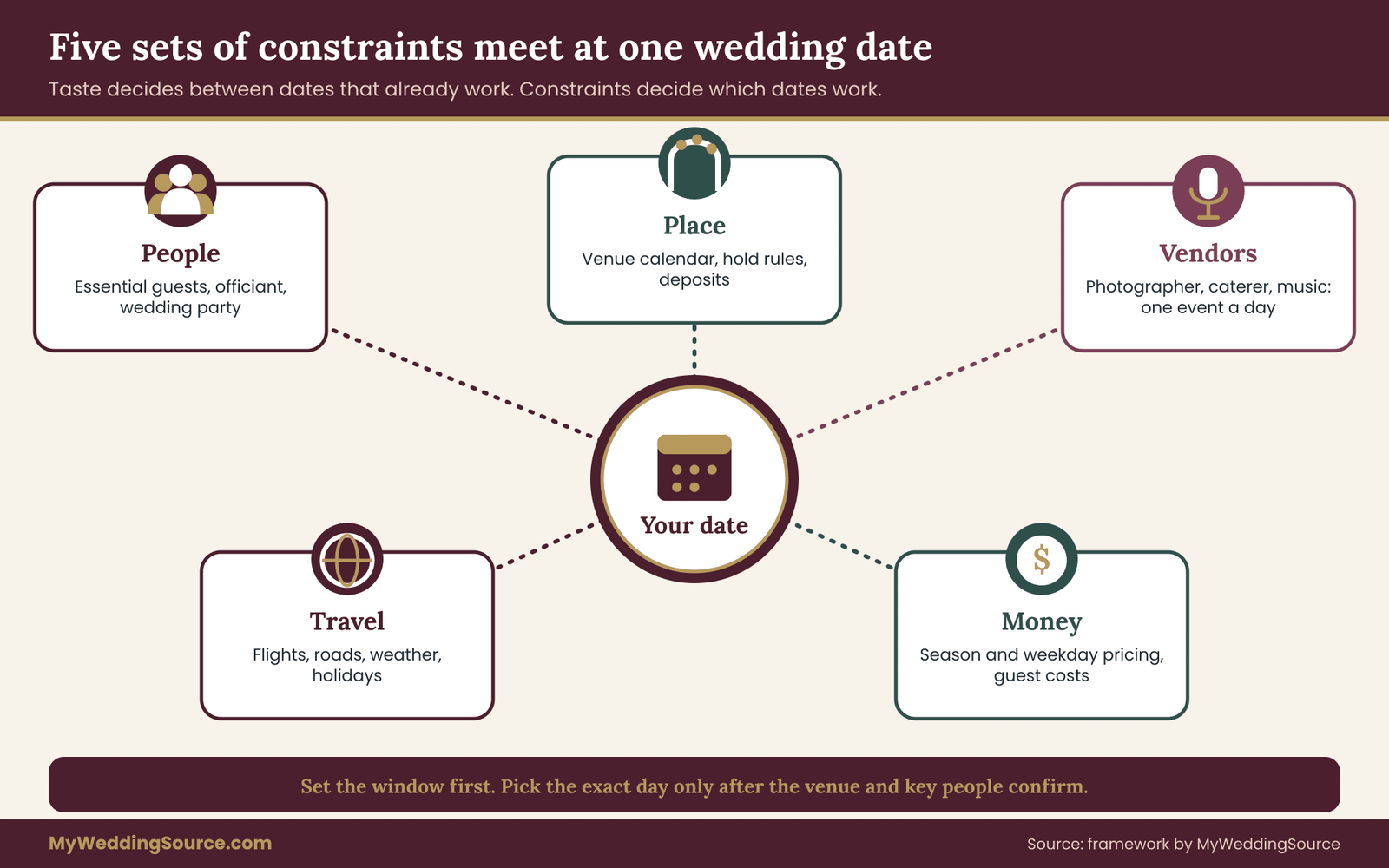
Notice that none of these is about taste. Taste matters, and it comes in later when you choose between dates that already work. If you start with taste (“we want October”) you can end up with a date that is lovely and unworkable. If you start with constraints, you end up with a short list of workable dates, and then taste can do its job.
Why a single date is the wrong target
People often ask, “What is the best date?” A better question is, “What is the widest window in which this wedding would work?” A window gives you room when a venue is booked on your first choice, or when a key guest has a surgery scheduled that month. A single date gives you nothing to fall back on.
In practice that means choosing a wedding date in two steps. First you choose a window, for example the second half of September or the first three weekends in May. Then you choose the exact day inside it, once you know which days the venue, your vendors and your key guests can actually do. Couples who skip the first step often feel forced to choose between two bad options at the end.
Name your nonnegotiables before you open a calendar
Before you start comparing days, write down what cannot move. This takes about ten minutes and saves weeks of back and forth. A nonnegotiable is something where, if it falls through, you would seriously consider a different date or even a different plan.
Typical nonnegotiables include a particular venue, a particular officiant or religious leader, a parent or grandparent who must attend, a photographer whose style defines what you want, a season because of the setting you picture, or a budget ceiling that rules out the highest-priced days. Everyone has a different list. Some couples have one item. Some have five.
Keep the list short. If every item is a nonnegotiable, nothing is, and you will end up negotiating with yourself at the worst moment. A useful test is to ask: “If this one thing were impossible, would we move the wedding?” If the honest answer is “probably not, we would find a way,” then it is a preference, not a nonnegotiable.
Sort everything into three buckets
Take a sheet of paper or a shared note and make three lists.
- Fixed. Things that cannot move. Examples: the venue you have already toured and love, the wedding date a parent returns from overseas, the month you are legally or religiously unable to marry in.
- Strong preferences. Things you would pay or travel for, but could swap if you had to. Examples: a spring wedding, a Saturday, a particular band.
- Nice to have. Things you like but would drop without regret. Examples: a specific weekday, a long-weekend extra day, matching a symbolic date.
When you later find two dates that both work, compare them on the strong preferences first, then the nice-to-haves. This keeps the decision honest and stops a small preference from outvoting a large constraint.
Agree on who has a say
A date decision goes badly when it becomes a negotiation between families. Decide early who is allowed to influence it. For most couples the answer is the two of them, plus anyone who is paying and has attached conditions to the money, plus a short list of people whose attendance is essential.
That does not mean you ignore everyone else. It means you ask them about availability, not about preference. “Is the first weekend of October a problem for you?” is a useful question. “What month would you like us to marry?” opens a conversation you may not want. If a family member has strong views, hear them out once, write them down, and decide as a couple later.
Build a short list of candidate windows
With nonnegotiables in hand, turn them into windows. A window is a stretch of one to three weeks, and you want three to five of them. More than that gets confusing; fewer than three leaves you stuck if one fails.
Start from the fixed items. If you love a venue and it has only a handful of open Saturdays across the next eighteen months, your windows come from that list. If your officiant is booked solid in summer, your windows fall in spring or fall. If a grandparent can only travel between certain months for health reasons, those months become the frame.
Then apply the filters that rule out whole stretches of time.
- Weather you cannot work around. Look at typical conditions for the place and month using long-term averages, not a single memorable year. NOAA publishes climate normals, which are 30-year averages of temperature, rainfall and snowfall for locations across the United States, and they are a sensible way to see what is usual for a given place. They describe what is typical, not what will happen on a specific day.
- Holiday weekends and major events. Federal holidays, school breaks, large local events and sports seasons all affect hotel availability and travel prices. More on this later.
- Your own commitments. Work deadlines, exams, a pregnancy due date, a planned move or a military deployment can wipe out a window without anyone else being involved.
- Religious or cultural calendars. Some faiths and traditions avoid certain days or periods for weddings. Ask your officiant or community leader early, because the answer can eliminate whole weeks.
When you finish you should have a few windows, each with a short reason why it is on the list. Write that reason down. When a venue says “that weekend is taken” you will be glad to remember why you wanted it.
Who you ask first: the essential-guest check
You cannot poll every guest before you pick a wedding date, and you should not try. What you can do is run a quiet check with the small group whose absence would change how you feel about the day.
Most couples can name eight to twelve of these people without much thought. They tend to be parents, siblings, grandparents, closest friends and anyone traveling a long way who is hard to replace. Treat this group as your essential guests. If most of them can attend a given date, the date is viable. If a few of them cannot, you can still choose it, but you are choosing it knowingly.
Ask in a way that does not commit you. Something short and friendly works well. A sample message, which you can adapt:
“We are looking at a few possible weekends for the wedding and want to check we are not picking one that is impossible for you. Would any of these cause a problem: the second weekend of October, the last weekend of October, or the first weekend of November? No pressure and nothing is booked yet. We just want to hear about conflicts before we narrow it down.”
This message works for three reasons. It names specific weekends so people can check calendars. It makes clear the wedding date is not final, so no one feels pressured. And it asks for conflicts instead of preferences, which gets you facts.
A note on tone: send these one by one, to individuals or small groups, rather than in a big group chat where people will start debating each other’s schedules. If someone replies with a problem, thank them and ask if there is a date near it that would work. Then move on.
Choosing a wedding date around guest availability
Guest availability is the part couples worry about most and manage least well. The worry is understandable, because you will never find a date that suits everyone. The way through is to decide in advance how many conflicts you can live with, and which ones.
Think in tiers, not in a headcount
Not every guest affects your decision equally. Sorting them into tiers makes the trade-offs visible.
Tier one: the day does not happen without them. The couple, the officiant, and anyone whose presence is a condition of the ceremony. For some families this includes parents or grandparents. If a tier-one person cannot attend, you change the date.
Tier two: the day would feel wrong without them. Close family, the wedding party, a best friend of twenty years. You can still marry without them, but you would be sad about it. Aim to have almost all of tier two available.
Tier three: you very much want them there. Extended family, close friends, people who are important but whose absence would not change the day. Expect some conflicts here and do not let a handful of them drive the decision.
Tier four: everyone else. Colleagues, neighbors, distant relatives. Some will not come regardless of the date. Plan for that without taking it personally.

A useful rule: choose a wedding date that works for all of tier one, nearly all of tier two, and most of tier three. Do not try to work around tier four at all. If you find yourself moving a wedding date because one cousin has a conflict, ask whether that cousin is really tier two.
Where guest conflicts actually come from
Few guests are unavailable because they dislike your date. Almost all conflicts fall into a few predictable categories, and knowing them helps you spot trouble early.
School calendars. Families with children are bound by school years. A date near the start of a school year, the end of a term, or during exam weeks is hard for them. Colleges and universities have their own cycles, so a wedding on the weekend of final exams or move-in day can lose a lot of young guests. School calendars differ by district, so if your guest list leans on one town, check that district’s published calendar.
Work cycles. Accountants and tax preparers are stretched before the spring tax deadline. Retailers are tied up in the holiday season. Teachers have summers off but are tied down in September. Farmers and growers have harvest seasons that do not move. If a big share of your guests share a profession, check the busy season for that work.
Other family events. Graduations, other weddings, reunions, major birthdays and christenings tend to cluster in May, June and September. If your wedding date sits on a popular weekend, expect some overlap.
Religious and cultural observances. Holy days, fasting periods and festivals vary by faith and by community. If a large part of your guest list observes a particular calendar, ask someone who knows it well, and do not guess.
Sports and local events. College football weekends, marathon weekends, big concerts and conventions can empty hotels and fill roads. This matters most in cities that host them.
Health and care duties. Guests who care for a family member, who are pregnant, or who are recovering from a medical procedure may have limits you cannot see. Ask without prying.
Holiday weekends: what actually changes
Many couples consider a holiday weekend because it gives guests an extra day off. The case for it is real. A three-day weekend lets people travel without taking leave, and it gives everyone a day to recover afterward. Planners quoted by The Knot and WeddingWire describe this as the main attraction of Memorial Day, Fourth of July and Labor Day weekends.
The trade-offs are just as real. Venues and vendors are in demand on those weekends, and some charge holiday rates. Staff may expect higher pay, which flows into your quote. Airfares and hotel rooms are in demand as well, so guests tend to pay more to get there, and some will already have family plans. Long-weekend traffic can make guests and vendors late. If you are considering a holiday weekend, plan to send your save-the-dates earlier than you otherwise would, book a hotel block as soon as the date is set, and ask each vendor whether they apply holiday pricing.
The federal calendar also shifts. In 2027, three federal holidays fall on weekends and are observed on neighboring days: Juneteenth on Friday, June 18, Independence Day on Monday, July 5, and Christmas Day on Friday, December 24, according to the government’s published holiday schedule. Private employers do not always follow the federal observance, so the “long weekend” your guests get may differ from the one you imagine. Ask a few guests what their employers do. The lodging side of holiday weekends is covered further below.
Travel-day math for guests who are not local
Ask yourself, for every group of out-of-town guests, how long the trip takes and what it costs. A guest who drives ninety minutes can attend a Saturday afternoon wedding without a hotel. A guest who flies four hours across time zones needs, at minimum, a night before and a night after, which makes the true cost of attendance two nights of lodging, two days of lost work and a round-trip flight.
Those costs matter more than they appear. The more a wedding date costs a guest, the more likely they are to decline. You can lower the cost in several ways: choose a weekend where flights are cheaper, pick a venue near an airport, negotiate a hotel block, or offer a longer window so guests can book early.
If most of your guests are traveling, give extra weight to the date’s position relative to holidays and school breaks. A wedding two weeks before Thanksgiving will often compete with the guest’s decision to save travel money for the holiday. A wedding in the middle of a school vacation week may be easier for families with kids and harder for everyone else.
What to do when someone can’t come
You will eventually pick a date and find that someone important has a conflict. Before changing anything, ask three questions.
First, is the conflict firm or negotiable? A friend who “might have a work trip” is different from a sibling whose child is being born that week. Second, which tier is this person? Third, can the situation be partly solved? A guest might arrive late, leave early, or join the rehearsal dinner but miss the ceremony.
If a tier-one or tier-two guest has a firm conflict, look at the next best date in your window. If a tier-three guest has a conflict, it is usually kinder and simpler to accept it and ask them to join you in a smaller way, such as a dinner after the wedding. Etiquette guidance often repeats the same point: there will be a conflict for someone on every date, so choose the one that works best for the people who matter most.
Writing the wedding date-check message
Early in the process, you will be asking people to look at their calendars without committing. A few small habits make that go well.
Ask for conflicts, not opinions. Give two or three options, not one. Say clearly that nothing is booked. Thank people for replying, even when the reply is “I cannot do the first one.” If you need to reach a lot of people, use individual messages or small groups, not a big thread.
Here is a second example, for a family member who is likely to be asked to travel:
“We are close to choosing a wedding date and want to check one thing with you first. Would the weekend of May 14 or May 21 work for travel? If either is hard because of work, health or other plans, tell us, and we will take that into account. We have not told anyone else yet, and nothing is booked.”
When you reach the point of sending a formal notice, our guide to save-the-date timing covers when to send it and what to include. Until then, keep the wedding date private, because a wedding date shared too early becomes a wedding date that is hard to change.
Vendor capacity: how it limits choosing a wedding date
Guests can often adjust. Vendors usually cannot. A caterer who has booked a large wedding on your Saturday cannot be in two places, and a photographer who works alone has exactly one wedding per day. This is why vendor capacity is the most rigid part of choosing a wedding date, and why many couples find the decision has been made for them the moment they call around.
What “capacity” actually means
For a vendor, capacity is the number of events they can serve to a standard they are willing to put their name to. For a solo photographer or officiant, it is one per day, sometimes one per weekend. For a larger caterer or rental company it may be several, but only if staff, vehicles and equipment allow. Popular days, which means Saturdays in peak months, fill first. When a vendor says “we are booked,” they are describing a real limit, not a sales tactic.
Capacity also explains why the best vendors in a small market are often booked a year or more ahead for peak dates. Guidance from planners and wedding sites commonly puts the lead time for a peak-season Saturday at twelve to eighteen months, with six to nine months being workable for off-peak dates and smaller events. Treat those as ranges, not rules. In a small town with few venues, the lead time may be longer. In a large city with many options, shorter may work. Ask the venues and vendors you care about how far ahead they usually book.
Peak, shoulder and off-peak, and what they mean for you
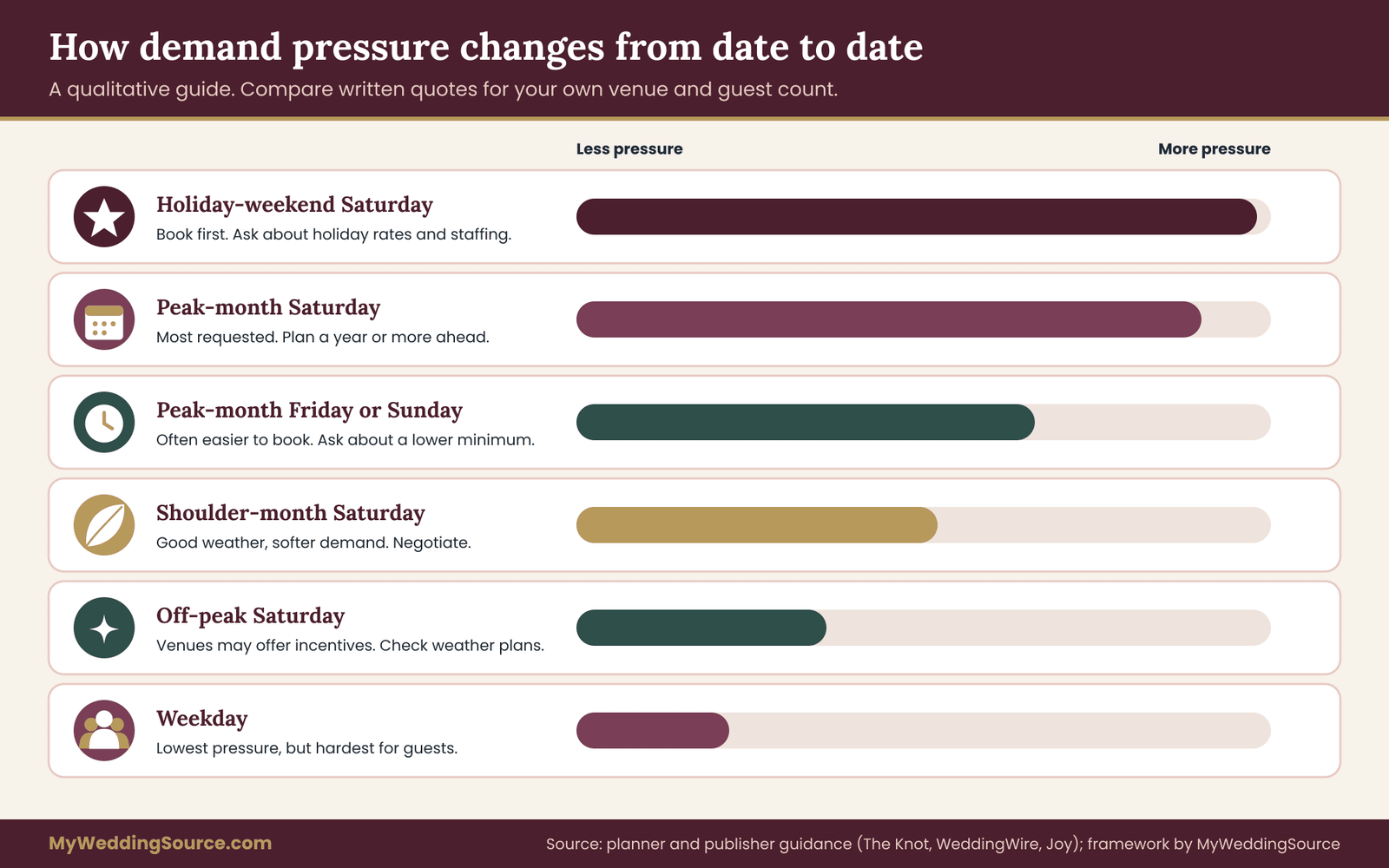
Wedding demand follows a pattern that is fairly stable across the United States, with regional variations. Nationally, late spring through early fall is the busy period, and September and October are often cited as the most popular months. Saturdays are the most requested day. Venues and vendors know this and price accordingly, so an off-peak day often costs less.
The terms are simple.
- Peak means the months and days most couples want. Prices are highest and availability is lowest.
- Shoulder means the weeks just before and after peak. The weather is often still good, demand is lower, and some vendors are willing to discount or at least negotiate.
- Off-peak means the quiet months and days, such as winter months in many regions, and weekdays and Sundays. Venues often offer incentives because they would rather fill an empty date at a lower price than leave it empty.
Several wedding sites report that off-peak dates can lower costs substantially. One planning guide suggests weekday weddings can cut venue costs by twenty to forty percent compared with a peak Saturday; another claims off-peak timing can save thirty to fifty percent of total cost. Treat numbers like these as claims from individual publishers, not guarantees. The only figure that matters for your wedding is the price in a written quote from your own venue for your own date. Ask for quotes for two or three different days and compare them directly.
Start with the critical-path vendors
Some vendors are replaceable on short notice. Others are not. The second group sets your wedding date. Ask yourself, for each vendor, “If they were unavailable, how hard would it be to find an equivalent?”
The venue. For most couples, the venue is the most constrained item. If you have a clear first choice, find out which dates are open before anything else. If you are flexible on venue, open dates become a way to shortlist venues.
The officiant. A religious leader, a family friend or a civil officiant has to be available, and in some faiths there are rules about which days they can officiate.
The photographer and videographer. Many couples treat photography as non-replaceable because the style matters. A photographer who is booked on your wedding date is not an option, even if their pricing is perfect.
The caterer. Particularly where the venue has an exclusive caterer list, or where you want a specific cuisine, the caterer’s calendar can matter as much as the venue’s.
Music. A band with a particular sound is hard to replace. A DJ is usually easier, though top DJs book early for peak dates.
Everything else, such as florists, rental companies, hair and makeup and transportation, is usually easier to adjust, though not always. Flowers are tied to seasons and supply. A large rental order on a peak weekend can be limited by inventory. A hair and makeup team for a large wedding party can be hard to book on a busy Saturday.
A practical way to use this: list your critical-path vendors in order of how much you care. Contact them first with two or three candidate dates. Once you know which dates they can do, your candidate windows shrink to those that work for all of them. That result is far more useful than a long list of dates you can only hope will work.
The questions that reveal real availability
An inquiry that says “Are you free on June 14?” gets a yes or no. A better inquiry gets you information you can use.
- Which of these dates are currently open, and are any under a hold from another couple?
- How long can you hold a date for us without a deposit, and what does a hold mean in writing?
- If another couple wants the same date during our hold, do we get a chance to confirm first?
- Do you have a minimum spend, or a different price, for a Saturday in this month versus a Friday or Sunday?
- Do you apply a holiday surcharge for this weekend?
- Are you the only person who would work our wedding, or do you have a team? If a team, who would be there?
- If we need to change the wedding date after signing, what is your policy, and what does it cost?
- If you cannot make the wedding date because of illness or an emergency, what is your backup plan?
Questions seven and eight are the ones people skip. They are also the ones that matter most when something goes wrong, which is why they appear again in the contract section below. If you want a structured way to vet a vendor beyond the date, our vendor due diligence checklist covers what to confirm before you sign.
Holds, deposits and what each one really does
The words “hold” and “booked” are used loosely, and the difference between them can cost money.
A courtesy hold is an informal agreement to keep a wedding date for you for a short period, often a few days to a couple of weeks. It typically costs nothing, and it usually does not bind either side. If someone else wants the wedding date, the vendor may ask you to decide or release it.
A deposit is a payment that reserves the wedding date. Whether it is refundable depends entirely on the contract. Some deposits are fully refundable for a limited time. Many are non-refundable from the moment you pay. Do not assume.
A signed contract is what actually commits both sides. Until then, a vendor can sell your wedding date to someone else, and you can walk away without penalty. After it, the terms govern, including what happens if you change the date, cancel or reschedule.
Ask each vendor for the policy in writing, and read it before you pay. Payment rights and obligations vary by contract and by state, and this article is not legal advice. If a contract is large or unusual, consider asking a lawyer to review it, and consult your state attorney general’s consumer protection office if you have a dispute you cannot resolve.
Pricing by season and day: using the pattern without being fooled by it
It is true that off-peak days often cost less. It is also true that a cheaper date can cost more in other ways. A winter wedding in a northern state may save on the venue but add heating, weather contingency and the risk that guests cannot get there. A Sunday wedding may be cheaper at the venue but expensive for guests who have to take Monday off. A weekday wedding may save money while reducing attendance, because fewer guests can travel midweek.
The right way to compare is to price the whole package, not a single line. For two candidate dates, ask for a total from the venue and a total from the caterer, and compare them. Then ask whether your essential guests can attend each one. A date that saves a few thousand dollars and loses ten important guests is rarely a bargain. Our wedding budget guide shows how to turn these quotes into a plan you can track.
When a date is booked and the vendor you love is not free
This happens often enough that you should plan for it. When your first-choice vendor is booked on your best date, you have four options.
- Move the date to one the vendor can do. This works best when your window is flexible.
- Choose a different vendor and accept a different style or price. This works best when the date is not flexible.
- Ask for a referral. Many vendors keep a list of colleagues they trust and are glad to pass on a name.
- Check for a team member. A larger studio may have an associate photographer or a second team who can take your date at a different price.
The worst option is to put pressure on a fully booked vendor. They cannot clone themselves, and a vendor who squeezes in an extra event may deliver a worse result.
Travel disruptions: the risk behind the calendar
A date that looks perfect on paper can fail because of something that has nothing to do with the wedding: a storm, a closed highway, a grounded fleet. You cannot predict any of these for a specific day. What you can do is choose a wedding date and a plan that tolerate normal levels of disruption, so that one late flight does not become a crisis.
Start with what is typical, not with what you remember
People tend to judge a month by the one year they remember well. A cold, wet May in your memory does not mean May is a poor choice, and one glorious October does not mean the next one will repeat it. For a fair picture, use long-term averages.
NOAA’s Climate Normals are 30-year averages of measurements such as temperature, rainfall and snowfall, calculated for weather stations across the country. The current set covers 1991 through 2020. They tell you what is typical for a place and a month, which makes them useful for judging how often a wedding date is likely to be hot, cold, wet or dry. They do not forecast a given day, and they will not tell you about a freak storm. Use them to rule out dates that are poor on average, not to promise good weather on the ones that remain.
When you look at a place’s normals, check four things: the average high and low for your time of day, the typical rainfall for the month, the chance of snow or ice if you are in a cold region, and whether sunset falls before or after your planned ceremony and photos. A wedding that ends at dusk in June and at 4:30 p.m. in December is a different event.
Weather risks that depend on the season and the region
Rather than memorize a list, learn which kinds of disruption are most likely for your location and month.
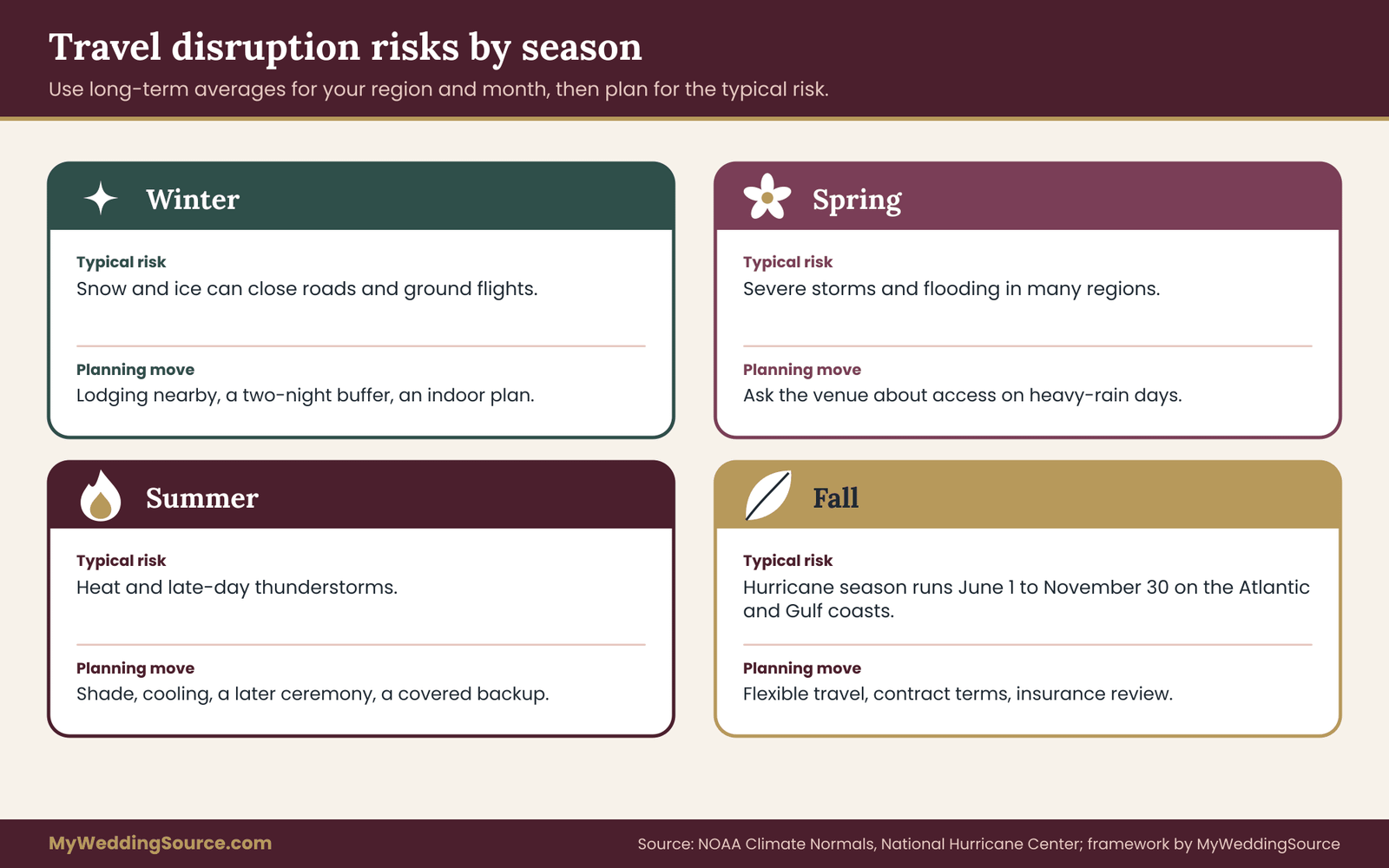
Hurricane season. The Atlantic hurricane season officially runs from June 1 to November 30, a window chosen because it covers about 97 percent of Atlantic tropical cyclone activity, according to the National Hurricane Center. Activity usually peaks in late summer and early fall, with the statistical peak around the second week of September. If your wedding or your guests’ travel touches the Gulf Coast, the Southeast or the Atlantic coast during those months, you are exposed to a risk that can close airports and force evacuations days ahead. It does not mean avoid those places. It means plan for it with contract terms, insurance and flexible travel.
Winter storms. In northern states and mountain areas, snow and ice are likely from late autumn to early spring. A storm that closes a road or grounds flights a day before the wedding can keep guests away or strand vendors. If you choose a winter date in a cold place, choose a venue with lodging on site or nearby, and consider a two-night buffer for guests. Our winter wedding weather plan covers contingency steps in detail.
Summer heat and thunderstorms. In many regions, late afternoons in summer bring heat and sudden storms. An outdoor ceremony at 4 p.m. in July can be uncomfortable or interrupted. Choosing a later ceremony, shade, a covered backup and an indoor option reduces the risk. See our outdoor wedding rain plan for how to set trigger times and decide who makes the call.
Spring storms and floods. Many regions have severe weather seasons in spring. Rivers can flood, and roads can be closed. If your venue is near water or on a rural road, ask what happens during heavy rain and whether they have had access problems before.
Wildfire smoke, extreme heat and poor air quality. In some regions, smoke and heat have become a regular factor in late summer. They can affect outdoor events and guests with breathing difficulties. Ask your venue about its policy and backup if air quality is poor.
None of these risks should push you into a bunker. The point is to match your choice of date to a plan: indoor space, flexible schedule, lodging nearby and written terms about what happens in extreme conditions.
Flights: why delays are mostly not about the weather
If many guests are flying, delay risk deserves attention. Airlines report on-time performance and the causes of delay to the Bureau of Transportation Statistics, which publishes the data. The categories include delays caused by the airline itself, extreme weather, the national aviation system, security, and late-arriving aircraft, meaning a flight that left late because the plane arrived late from its previous trip.
In the BTS data, late-arriving aircraft has been the most common single cause of delayed arrivals in recent years, at around forty percent of delays in the 2010 to 2019 period, and it again topped the list of causes in 2023. That has a practical meaning: a plane delayed in one city causes delays later in the day in other cities. A guest on a Saturday-morning flight to a Saturday-afternoon wedding is exposed to every delay that has built up since dawn.
You cannot control that, but you can build around it. The simplest rule is to encourage out-of-town guests to arrive the day before the wedding, not the morning of. If you can, schedule the ceremony in the afternoon or evening rather than late morning. If the wedding is early in the day, expect that a few guests will miss it.
The buffer plan
A buffer is simply extra time between travel and the event. It costs a night of lodging and lowers the chance that one delay ruins attendance. Plan it as a four-day window, even if most guests will only use two of the days.
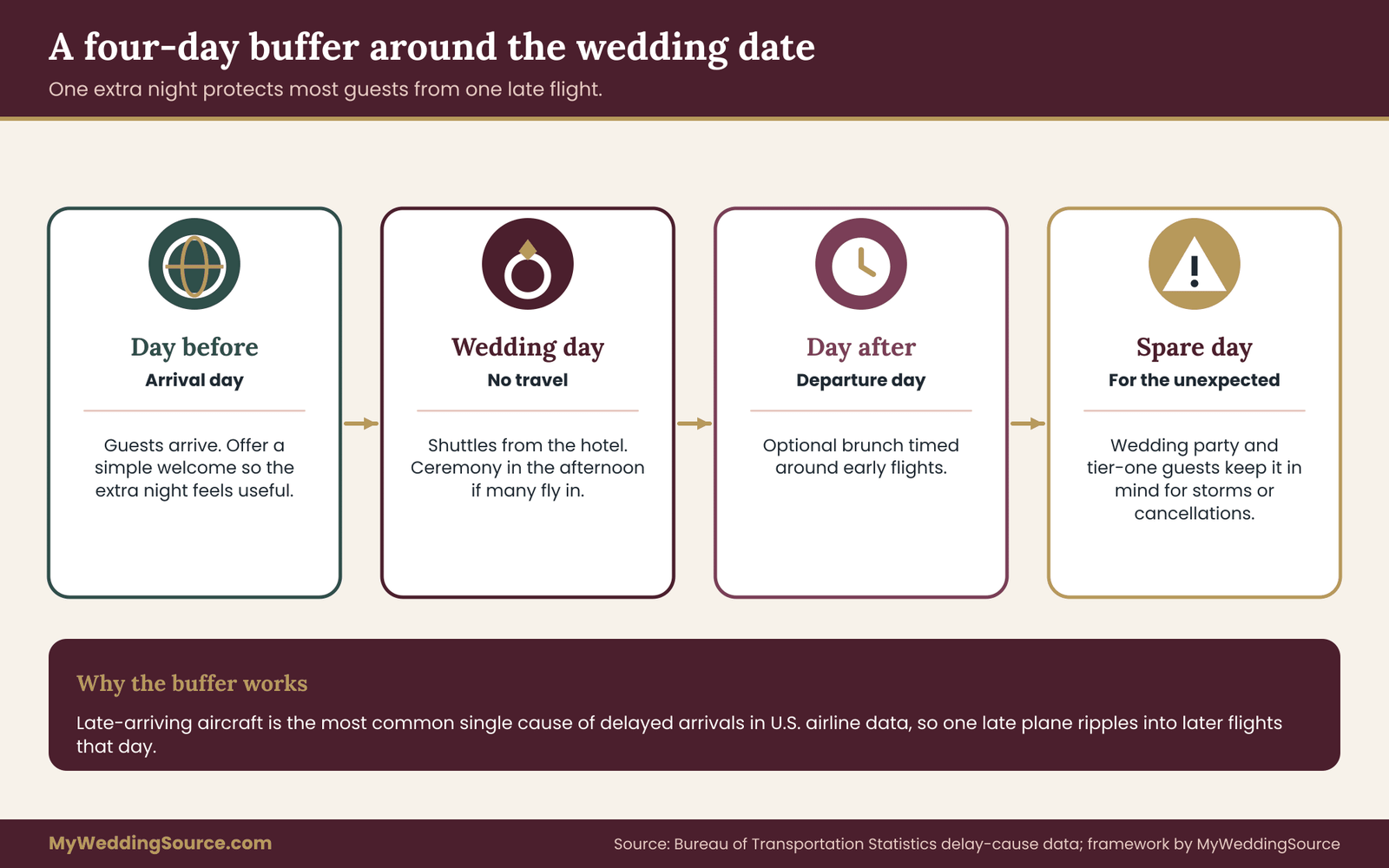
The day before the wedding is the arrival day. Encourage guests to arrive then. Offer a simple welcome, such as an informal dinner or drinks, so the extra night feels useful and not like a cost.
The wedding day should have no travel for guests who can avoid it. If the venue is remote, arrange transportation from the hotel, because a missed shuttle can mean a missed ceremony. Our guide to wedding guest transportation planning explains how to schedule and staff it.
The day after is the departure day. Do not plan a late-morning event that conflicts with early flights. If you want a farewell brunch, make it optional and set the time so most guests can still make their flights.
A spare day at either end is useful if the weather is bad or flights are canceled. You do not need to offer it to everyone, but your wedding party and your tier-one guests should have it in mind.
For the couple and the wedding party, arriving two days before is a sensible default. You will be tired, you will have last-minute tasks, and you cannot afford to be the people stuck at an airport.
Road trips and ground disruptions
Not everyone flies. For guests who drive, the main risks are traffic, road closures and weather. A wedding on a holiday weekend, or on a day when a major local event is happening, can add hours to a drive. If your venue is on a single access road, ask about alternate routes and what happens if the road closes. In rural areas, check the cell coverage and provide directions that do not depend on a signal.
Vendors travel too. A florist or photographer driving two hours on a Saturday morning is exposed to the same traffic. Ask them how early they plan to arrive. A vendor who plans to arrive an hour before they must start is working without a buffer.
Lodging: protecting guests from the cost and the risk
Lodging is the part of travel that you can influence most. A hotel block, which is a group of rooms held at a negotiated rate, makes it easier for guests to stay near the venue, and it gives you leverage when the hotel has few rooms available. Read the contract carefully, since blocks can include an attrition clause that makes you responsible for rooms that are not filled. Our guide to holiday wedding travel and hotel blocks explains how those terms work and which questions to ask.
Book the block as soon as the date is firm, and before you send save-the-dates. In busy periods, such as holiday weekends or when a large event is in town, rooms disappear quickly, and some of your guests may be paying much more than you expect.
Insurance and contract terms that matter when travel goes wrong
Because disruptions are unpredictable, the contract and the insurance are your safety net. Three points are worth checking.
- Date-change terms. Does each vendor allow you to move the wedding date, and what does it cost? Some allow a change for a fee, some require a new deposit, and some do not allow it at all.
- Force majeure and cancellation clauses. These describe what happens if an event becomes impossible because of something outside anyone’s control. They vary widely, and they may not cover bad weather that is merely inconvenient.
- Event insurance. Some couples buy a policy that reimburses certain costs if the event is canceled or postponed for covered reasons. Coverage, exclusions and costs vary by insurer. Read what is and is not covered, and compare it to what your contracts already provide. Our wedding insurance guide explains what policies typically do and do not cover.
Guests handle their own travel risk. You can help by telling them in plain terms that flight changes may happen, and by suggesting refundable or flexible fares if they are traveling far. You do not need to give travel advice, but a short, kind note on the wedding website goes a long way.
A decision method for choosing a wedding date
Everything so far feeds into one process. The aim is to move from a wide field of dates to one signed date in a fixed order, so that each step uses what the previous one learned.
Step one: set the frame
Write your nonnegotiables, your strong preferences and your nice-to-haves. Choose three to five windows that survive the first filters: weather, holidays, your own commitments and religious calendars. This takes an evening.
Step two: probe the venue and the critical vendors
Contact your first-choice venue and two or three critical-path vendors with your windows. Do not ask “Are you free on this exact day?” Ask which dates inside each window are open, and for a written quote for each of the open dates. Keep a short log: who you asked, when, what they said and when the answer expires.
At this stage, you are collecting facts. You are not committing to anything. If a venue wants a deposit before it will say whether a date is open, ask whether it will hold the wedding date for a few days without payment, and what happens if another couple asks in the meantime.
Step three: probe the essential guests
With a list of dates that the venue and vendors can do, run the essential-guest check. Send the date-check message to your tier-one and tier-two guests. Ask for conflicts. Keep a log here too.
Step four: score what is left
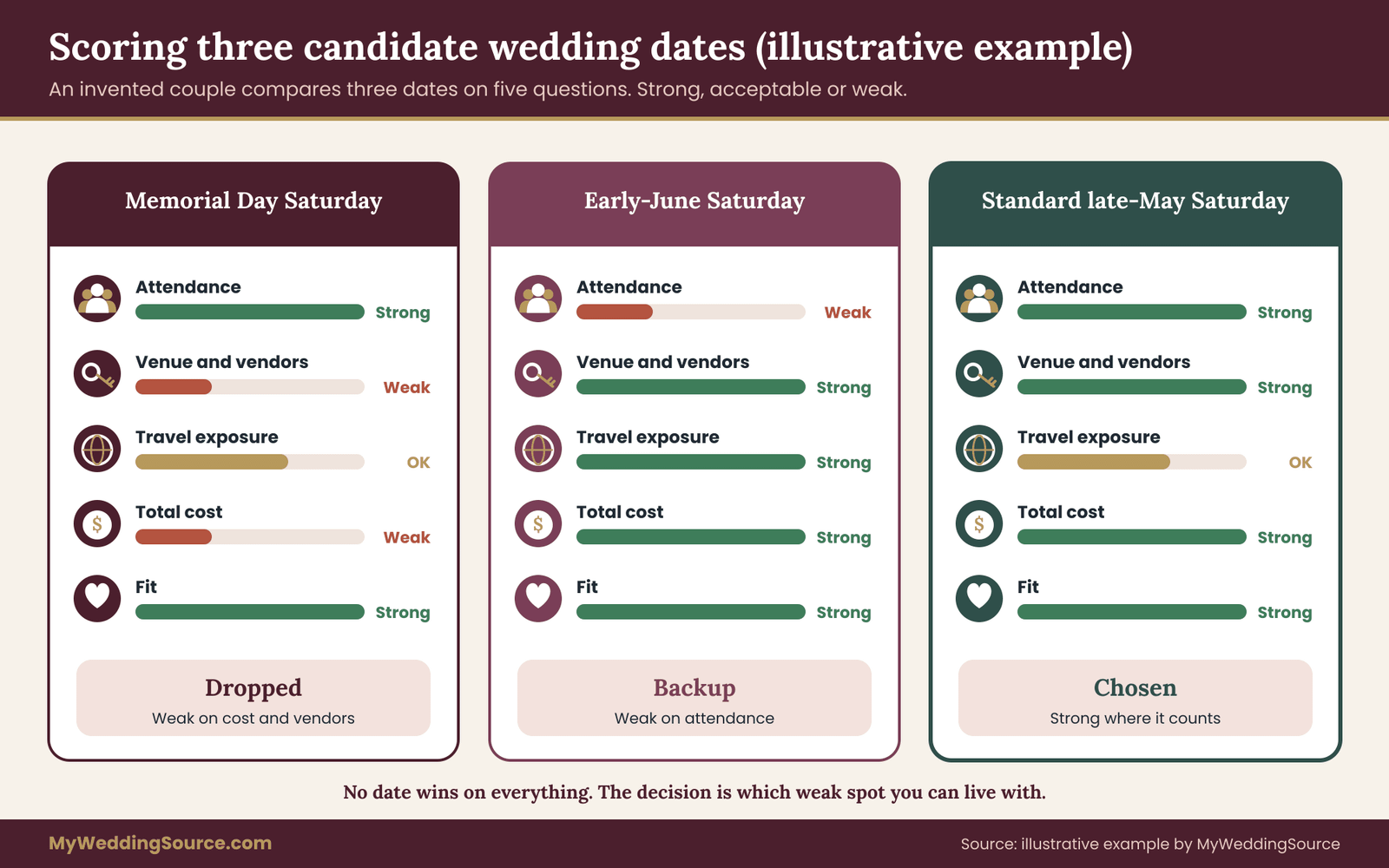
Now you probably have a handful of workable dates. To choose between them, give each one a simple score on five questions. You do not need a spreadsheet. A sheet of paper with a grid you draw works, or a note on your phone.
- Can the people who matter attend? Count how many tier-one and tier-two guests said yes.
- Do the venue and critical vendors have it? Confirmed, on hold or unavailable.
- How exposed is the travel? Look at weather risk for that place and month, the position relative to holidays, and how many guests must fly.
- What does it cost as a total? Use the venue and caterer quotes for each date, plus a note on whether guests will pay more to attend.
- Does it fit what you want? Season, mood, weekday, daylight.
Score each as strong, acceptable or weak. A date with no weak marks on questions one and two is a candidate. A date that wins on cost but is weak on attendance is rarely the right choice.
Step five: hold, test and commit
Choose your preferred date and your backup. Ask the venue to hold the preferred date, and ask for a hold on the backup if the venue will allow it. Tell your critical vendors which date you are leaning toward and ask them to confirm they are still free. Then wait for answers before you sign.
When the answers come in, sign the venue contract first, since it is the least flexible. Read the cancellation and date-change clauses before you pay. Then sign with your critical vendors in the order of how hard they would be to replace.
Only after the venue and key vendors are signed should you tell the wider guest list. A date announced before the contracts are signed is a wedding date you may have to take back.
A worked example
The following story is illustrative. It is a composite built to show the method, not a report of a particular couple.
Maya and Daniel live in Chicago. His parents live in Phoenix, and her grandmother lives in Tampa and can travel only with her daughter. They want an outdoor ceremony and a small reception for about ninety people.
Nonnegotiables. They list three: the lakeside garden venue they love, Maya’s grandmother attending, and Daniel’s brother as best man, who coaches a college team and cannot travel in the fall season. Strong preferences: a Saturday, a ceremony before sunset, and a budget that avoids peak pricing.
Windows. The brother’s coaching schedule removes September through November. The grandmother’s doctor prefers that she avoid very hot weather, which removes July and August. Winter is too cold for an outdoor ceremony. That leaves three windows: the last three weeks of May, the first two weeks of June, and the first two weeks of October if the brother can get a weekend off.
Probing the venue. The garden venue has two Saturdays open in late May, one in the first half of June and none in October. They ask for quotes. A late-May Saturday costs more than the June Saturday because it falls on the Memorial Day weekend. The other late-May Saturday is open and priced at the standard peak rate.
Probing the photographer. Their first-choice photographer is free on the standard late-May Saturday and on the June Saturday, but booked on Memorial Day weekend.
Probing the guests. They message eleven essential guests with three dates. Daniel’s parents say the early June date conflicts with a family event. Maya’s grandmother’s daughter says the late-May date works but asks whether the ceremony can start in the afternoon, because the morning flight from Tampa has been unreliable.
Scoring. The Memorial Day date is weak on cost and on vendor availability, so they drop it. The early June date is weak on attendance because Daniel’s parents cannot come. That leaves the standard late-May Saturday. It scores strong on attendance, vendors and fit, and acceptable on travel, because late spring storms are possible. They choose it, with the early-June date as a backup.
Commit. They ask the venue for a short hold, confirm with the photographer, read the venue’s date-change clause and sign. They book a hotel block at one of the wedding guest hotels for the Friday and Saturday nights and schedule the ceremony for 4:30 p.m. Then they send save-the-dates.
Notice how little of this involved personal taste. Their taste, an outdoor spring wedding, was satisfied by a wedding date that the constraints had already selected.
Hold dates, deadlines and cancellation checkpoints
Choosing a wedding date does not end at signing. A date is a series of commitments with deadlines, and knowing them in advance keeps you from losing money or options.
Checkpoints to put on your calendar
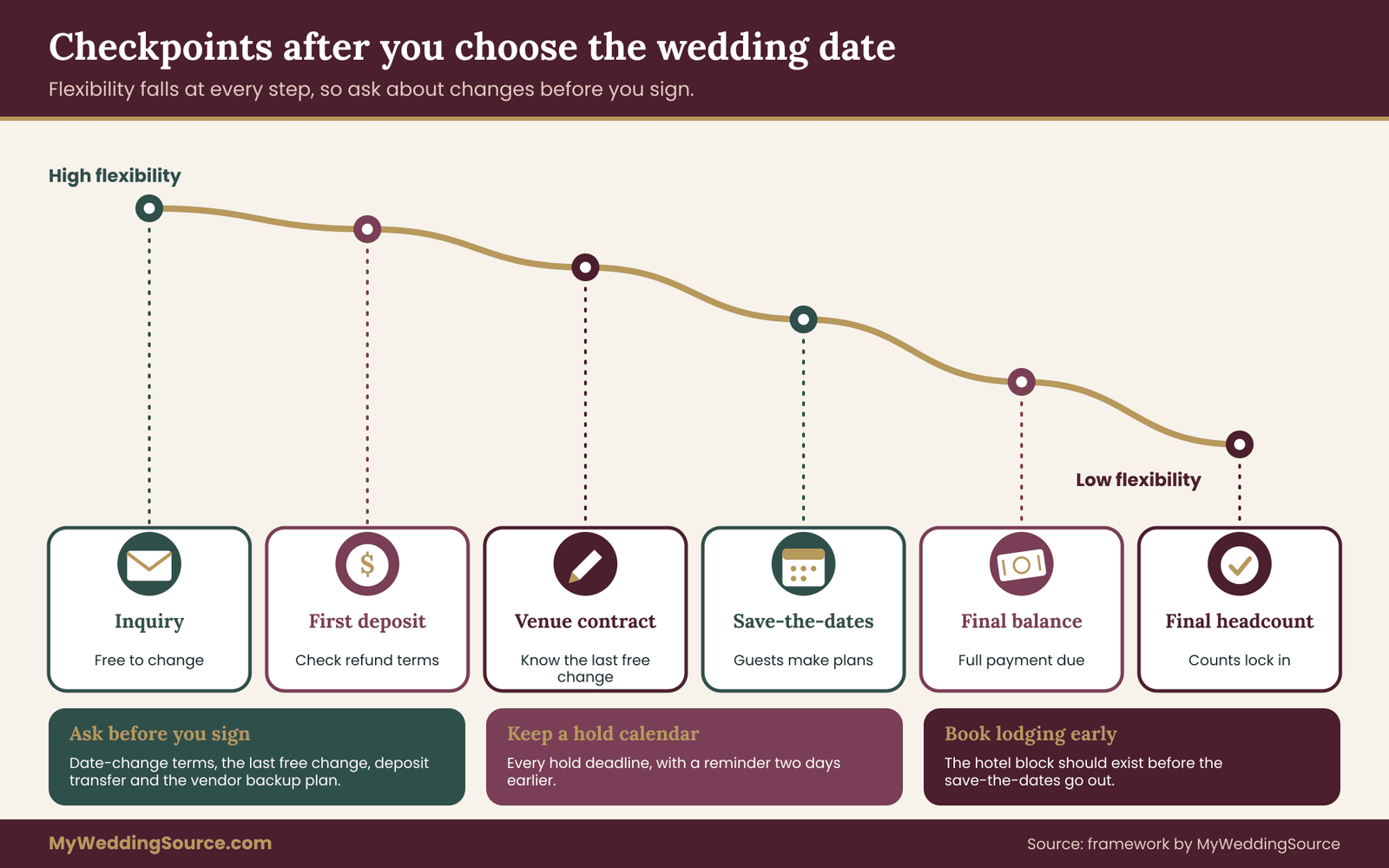
Think of the weeks between choosing the wedding date and the wedding as a series of checkpoints. At each one, something becomes harder or more expensive to change.
Before you pay anything. Check availability, read contracts, ask about date-change terms. Everything is free to change here.
When you pay the first deposit. Your options narrow. Find out whether the deposit is refundable and until when. If you are signing with several vendors, record each deposit amount and its refund terms in one place.
When the venue contract is signed. This is the main commitment. If you must change the wedding date after this point, you may lose a deposit, pay a change fee or both. Know the deadline for the last free change, if any.
When you send save-the-dates. Now other people have made plans. Changing the date costs goodwill as well as money. The timing of those notices is covered earlier in this guide.
When the final balances are due. Contracts usually set a date, often some weeks before the event, when the full payment is due and the final guest count is locked in. After that, cancellations typically cost the remaining balance.
When the final guest count is due. Caterers and venues need a headcount by a certain day. If you are still unsure of the date or the guest list, ask for a later deadline.
Questions to ask about changing a wedding date
Before you sign any contract, ask each vendor:
- Can the date be changed, and what is the last day I can do so without a fee?
- What does a change cost: a flat fee, a percentage, or a new deposit?
- If I move the date, will the deposit transfer, or do I forfeit it?
- If you cannot do the new date, what happens to my payments?
- If the event cannot happen because of something outside our control, such as severe weather or a government order, what do the contract terms say?
Write down the answers, or better, find them in the contract text. A vendor’s verbal reassurance is no help when the person who gave it has left the company.
Be careful with the “temporary” hold
Some venues offer a “pencil” hold with a deadline. If you let the deadline pass without confirming, the hold lapses and the date goes back on sale. Put the deadline on your calendar with a reminder two days earlier. If you need more time, ask for an extension before the hold expires, not after.
If you hold two dates at once, tell the venue. A vendor who learns later that you tied up two Saturdays without saying so may be less accommodating next time. Many venues allow a backup hold but may give you a shorter time limit.
When you have to change the date
Sometimes you must move a date: a family emergency, a vendor’s cancellation or a major disruption. If it happens, work through the same list in order.
First, call the venue and ask what open dates exist and what the change policy says. Then call your critical vendors and ask the same questions. Then check with the essential guests. When you know a new date is viable, update your hotel block and tell the guest list in one message that gives the new date, the reason in one sentence and what to do about travel plans.
Be kind and brief. Guests who have booked flights will want to know whether their tickets can be changed. If you can help, for example by sharing the airline’s rules or offering a hotel block that is flexible, say so. If you cannot, say that too.
How money shapes choosing a wedding date
Budget is the reason many couples start looking at off-peak dates, and the numbers can be striking. Several planning publishers argue that moving off a peak Saturday can save a significant share of the total cost. The figures differ widely between sources and regions, and none of them applies to your wedding until a vendor writes it into a quote. Treat the savings as a hypothesis to test.
Where the savings really come from
Most of the saving on an off-peak date comes from a few places.
Venue fees. A venue’s rental price and food-and-beverage minimum often vary by season and by day. A Friday or Sunday may carry a lower minimum than a Saturday in the same month.
Vendor availability and negotiation. Vendors with free dates are more willing to bargain, to include extra hours, or to offer a package. If your wedding date is a quiet one for them, you have more leverage.
Seasonal supply. Flowers and some foods are cheaper in season. A wedding in peak bloom can use local stems. A winter wedding that wants out-of-season blooms may pay for shipping.
Holiday surcharges. Some vendors charge extra for holiday weekends, and staff may need holiday pay. Avoiding those weekends removes the surcharge.
Where a cheaper date costs more
Savings on the venue can be offset elsewhere.
- Heating, cooling and weather plans. A winter date may require tents with heating, generators or extra lighting. A summer date may call for shade, fans or cooling stations.
- Guest costs and attendance. A weekday date may be cheaper for you and costlier for guests, who must take time off. Some will not come, which may lower your catering bill and also your guest list.
- Short days. A November evening wedding starts getting dark early. That affects photography and any outdoor plan.
- Extra nights. If you want a longer weekend, you pay for more rooms or events.
The way to compare is to build the full picture for each wedding date. Ask the venue and the caterer for a total, add anything weather-related and add a rough view of guest costs. A date that saves money and keeps your essential guests is a good deal. A date that saves money and loses them is not. If you want a method for tracking quotes against a total, our wedding budget guide lays out a plan you can follow.
A caution about averages
You will see national averages for the cost of a wedding on a given day or month. Be skeptical of them. They combine very different places, guest counts and styles, and the methods behind them are not always clear. The only numbers worth using for your decision are local quotes for your own guest count. If you cannot get quotes, use published ranges only to understand direction, such as “peak Saturdays cost more than Fridays,” and do not plug them into your budget as facts.
Situations that change the usual advice
The general method holds for most couples. A few situations need special handling.
Religious and cultural calendars
Many faiths and cultures have days and seasons when weddings are discouraged or not performed. Some have days that are considered especially auspicious. Because these differ widely, do not guess. Ask your officiant or a respected member of your community, and ask early. If your families belong to different traditions, ask both and look for dates that respect each. A conflict you learn about in advance is a minor inconvenience. A conflict you learn about after you have signed a contract can be painful.
For guests, the same applies. If a significant portion of your guest list observes a fast, a holy week or a major festival, consider how the wedding date overlaps. You do not have to avoid every conflict, but a thoughtful couple tries not to choose a wedding date that puts large numbers of guests in an impossible position.
Blended families and shared custody
If you or your partner share custody of children, check the custody calendar before you choose. Holiday and school-break schedules are often fixed by agreement. A wedding that collides with a child’s scheduled time with the other parent can create tension that is difficult to fix after the fact. Talk to the other parent early, in neutral terms, and give them the candidate dates.
Divorced parents who both need to attend may also need separate travel plans and rooms. That can influence how many nights you plan for and which hotel you choose.
Pregnancy, illness and recovery
If someone in your wedding is expecting a baby, undergoing treatment or recovering from surgery, treat their health as a hard constraint. Ask them what they can manage, and do not make them justify it. Consider how far they must travel, how long the day is and whether there is a quiet space for rest. If the person is you or your partner, give yourselves slack. A date too close to a due date or a procedure is a gamble you probably do not need to take.
Military, shift work and seasonal jobs
Military personnel may have deployments and training schedules that are fixed with little warning. Shift workers may be able to swap shifts if they ask early. People in seasonal jobs, such as agriculture, tourism and retail, may be tied up during their busy season. If key guests work in these fields, ask about their calendar first, and be prepared to choose a date that suits them.
Weekday and Sunday weddings
A Friday, a Sunday or a weekday can be a sensible choice if budget is a priority and your guest list is flexible. Consider these points.
- Friday evenings can work well for local guests, because the work week has ended. Out-of-town guests may need to leave work early.
- Sundays are often cheaper and pair well with brunch or lunch receptions. Guests who must return home for work on Monday may leave early.
- Midweek dates are the cheapest and hardest for guests. A midweek wedding right before a holiday weekend is often seen as an attempt to cut costs by discouraging guests, so think about how the choice will read.
If you choose a weekday, give guests extra notice. Send save-the-dates earlier, and make it easy for them to book time off.
Small weddings and elopement plus celebration
Small weddings have more flexibility. With twenty guests, you may find a wedding date that works for nearly everyone. Some couples marry in a small ceremony on a date that suits them and hold a larger celebration later, on a wedding date that suits the guests. That arrangement lets each event use the calendar that fits it, though it can mean paying for two events. It is worth considering if your guest list is large and scattered.
Destination weddings
If you are marrying away from where most guests live, the wedding date matters even more, because everyone is traveling. Check flight availability and prices from the main departure cities. Avoid dates that collide with local festivals or peak tourist weeks, when lodging can be scarce. Send save-the-dates well ahead, so guests can book travel early. Our guide to holiday wedding travel and hotel blocks covers the lodging issues that come up when many guests travel at once.
What to do when the wedding date conflicts with someone you love
At some point, a person who matters to you will say they cannot come. It stings, even when you saw it coming. A few thoughts may help.
You are allowed to choose. Every date conflicts with someone. If you wait until nobody has a conflict, you will never choose. The goal is to choose a wedding date that works for the people who matter most and to be gracious about the rest.
Ask what would make it possible. Sometimes a guest can come for part of the weekend, or can travel by a different route. Listen without pressure, and offer options without insisting.
Do not guilt anyone. A tone of disappointment is fine. A tone of blame is not. People remember how they were treated when they said no.
Keep the relationship. If someone cannot attend, plan a way to see them afterward. A dinner, a call on the day or a photo album are small gestures that matter.
Know when to change the date. If a tier-one guest, such as a parent or sibling, has a firm conflict, change the date if you can. If you cannot, talk to them honestly about what you can do. There is no formula, and you will not always feel certain.
Common mistakes when choosing a wedding date
These come up often, and most are avoidable.
Starting with a wedding date instead of a window. A single date has no fallback. Start with a range, and narrow it using real availability.
Telling people before it is real. Announcing a wedding date before the venue contract is signed creates pressure to keep it, even when something better turns up or something goes wrong.
Skipping the critical-path vendors. Couples sometimes choose a date with the venue and then find that their photographer, officiant or band is not free. Ask the critical vendors before you commit.
Treating a hold as a booking. A courtesy hold can lapse. Put the deadline on your calendar, and get the terms in writing.
Ignoring the buffer. A wedding with no travel buffer for guests and for you is a wedding where one delay becomes a crisis.
Using last year’s weather. One unusual year is not a pattern. Use long-term averages, and plan for variation.
Letting one preference override a constraint. A Saturday in October is lovely. If it means the grandmother cannot attend, think carefully before you choose it.
Forgetting the contract terms about changes. Many couples read the price and skip the date-change and cancellation clauses. Those clauses matter most when something goes wrong.
Not telling guests how to plan. Guests who learn of the date late, or who do not know about the hotel block, pay more or stay away. A clear, early message is part of the plan.
A one-page worksheet
You can copy this outline onto a sheet of paper or into a note and fill it in as you go.
Frame – Nonnegotiables (venue, people, officiant, season) – Strong preferences – Nice to have – Windows (three to five, with reasons)
Probing – Venue: dates open, quote, hold deadline – Photographer: dates open, quote, backup contact – Officiant: dates open – Caterer or other critical vendor: dates open, quote
Guests – Tier one: who, reply, conflicts – Tier two: who, reply, conflicts – Travel: number flying, number driving, hotel block needed
Scoring (strong, acceptable, weak for each candidate) – Attendance – Venue and vendors – Travel exposure – Total cost – Fit with what you want
Commit – Preferred date, backup date – Hold deadlines – Contract terms: date change, cancellation, force majeure – Hotel block booked – Save-the-date send date
Checkpoints – Deposit due dates, refundable until – Final balance date – Final headcount date – Last free date-change deadline
When the worksheet is full, you have chosen a wedding date on evidence instead of hope. You can also hand it to a planner, a parent or a partner, and they will see the same picture you do. If you are building a broader plan, our wedding planning checklist shows where this decision sits among the other early tasks.
Telling guests once the wedding date is firm
When the venue and key vendors are signed, tell your guests. Keep the announcement simple and complete: the wedding date, the city and venue, any travel buffer you recommend, the hotel block and when a formal invitation will arrive. Put the same information on your wedding website so guests can find it later.
For guests traveling a long way, add a short note about flexible fares and the travel risk in that season. You are not giving advice, only being considerate. Something like this works:
“We know many of you are traveling. Where you can, we suggest booking refundable or changeable fares, and arriving the day before, in case of weather or delays. A block of rooms is held at the hotel until the end of next month.”
If your wedding is on a holiday weekend, in hurricane season or in a cold region in winter, say so plainly and give guests a way to ask questions. Guests are generally forgiving of a date that is inconvenient, and not forgiving of surprises.
FAQ
How far in advance should we start choosing a wedding date?
Start by thinking about the date as soon as you have a rough idea of the season and your guest list, which for many couples is twelve to eighteen months ahead for a peak Saturday. Off-peak dates and small weddings can be planned in less time. The better test is how long your critical venue and vendors need: ask them how far ahead they book, and work backward from that.
Should we pick the venue first or the date first?
For most couples, choose a window first and the venue within it. If you have a venue you love and few open dates, let the venue’s availability set your window. In either case, avoid committing to a single date before you know that the venue and the critical vendors can do it.
Is a Saturday always the best day for a wedding?
No. Saturday is the most requested day, which makes it the hardest to book and often the most expensive. Friday and Sunday can be good choices for budget and availability. The right day is the one that works for your essential guests and your vendors, so compare the quotes and the attendance for each.
Is a holiday weekend a good idea?
It can be. Guests often have an extra day off, which makes travel easier. Costs for venues, vendors, flights and hotels may be higher, and some guests have family plans. If you choose a holiday weekend, send save-the-dates early, book a hotel block as soon as the date is set and ask vendors whether they add a holiday charge.
How do we check whether the weather will be a problem?
Use long-term averages rather than a single year. NOAA publishes climate normals for locations across the United States, which describe typical temperature, rain and snow for each month. Check the hurricane season dates if you are on the Gulf or Atlantic coasts, and look at winter storm risk if you are in a cold region. Averages cannot forecast a specific day, so also build a backup plan.
Should we encourage guests to arrive the day before?
If many guests are flying, yes. Airline delays often build up through the day, because a plane that arrives late causes later flights to depart late. A guest who arrives the day before is far less exposed to that risk. A casual welcome gathering that evening gives the extra night a purpose.
What if our first-choice vendor is booked on our best date?
You have four options: move the date to one the vendor can do, choose another vendor, ask the vendor for a referral to a colleague they trust, or ask whether a team member or associate is available. Which one makes sense depends on how flexible your wedding date is and how important that vendor is to you.
What should we ask vendors about changing the wedding date later?
Ask whether the date can be changed, the last day to change it without a fee, what a change costs, whether the deposit transfers to the new date, and what happens if the vendor cannot do the new date. Ask what the contract says about events that become impossible for reasons outside anyone’s control. Get the answers in writing.
Your next steps
Spend one evening on the frame. Write your nonnegotiables, sort your preferences and choose three to five windows with a reason for each. The next day, contact your venue and your two or three critical vendors and ask which dates in those windows are open, with a written quote for each.
Within the week, send the short date-check message to your tier-one and tier-two guests. Then score the remaining dates, pick a preferred date and a backup, and ask for holds. Read the wedding date-change and cancellation clauses before you sign anything. Once the venue and key vendors are signed, tell your guests, book the hotel block and put the checkpoints on your calendar.
Sources
- Federal holidays, U.S. Office of Personnel Management
- Understanding Climate Normals, NOAA
- Climate Normals 1991-2020 documentation, NOAA National Centers for Environmental Information
- Climatology of Atlantic hurricane season, National Hurricane Center
- Percent of flight delays by delay cause, Bureau of Transportation Statistics
- Understanding the reporting of causes of flight delays and cancellations, Bureau of Transportation Statistics
- Airline on-time reporting rule, 14 CFR 234.4, Electronic Code of Federal Regulations
- Holiday wedding pros and cons, The Knot
- Memorial Day weekend weddings, The Knot
- Holiday weekend wedding etiquette, WeddingWire
- How to pick your wedding date, Joy
- Five things to consider when selecting your wedding date, Wedgewood Weddings
- Choosing a wedding date, Marry Me Tampa Bay
- Holiday weekend weddings: worth it?, California Wedding Day