
Vendor meals are the plates, boxes or buffet access you provide to the working people at your wedding: photographers, musicians, the planner’s team, florists, rental crews. This guide gives you a plain specification you can fill in for each group, a policy check for timing, dietary needs and contract language, and a worked case so you can test your own numbers.
Treat vendor meals as a small, written specification instead of a favor you sort out on the day. For each vendor group, decide who counts, when they eat, what they can eat, where they eat and who pays, then put that decision into the vendor contract and the catering order. Give working people a real break before the guests are served, ask about allergies in advance, and keep the vendor meals count separate from the guest count. If a vendor’s own contract already says the meal is required, follow that wording.
Almost every wedding has the same quiet argument somewhere in the planning file. A photographer’s vendor contract asks for a hot meal. The band’s rider mentions “hospitality”. The caterer’s quote lists a vendor meal count that nobody remembers approving. The couple’s parents assume the staff will eat leftovers. On the day, the DJ has been standing for six hours and has had a handful of crackers, and the second photographer is sitting on a loading dock with a sandwich from a gas station.
None of this is hard to prevent when vendor meals are planned early. It is the kind of problem that disappears once someone writes down a handful of decisions in the right order. That is what this article does.
It is narrow on purpose. It does not teach you how to plan a wedding menu for your guests, and it does not cover the full staffing plan for a wedding day. Those topics have their own guides on the site, including building a wedding menu for different ages and dietary preferences and the broader question of who handles setup, service and breakdown. This guide covers only the people who work your wedding and need to eat while they do it.
A note on scope. This is general planning information, not legal, tax or financial advice. Wage, break and worker-classification rules differ by state and by situation, so the article points to the agencies that publish them and leaves the conclusions to you and your advisers.
What vendor meals cover and who is on the list
Start with a definition you can say out loud. Vendor meals are food provided to people who are at your wedding to do a job, rather than to attend it. That definition sounds obvious, and it still clears up a surprising number of disagreements, because it separates three groups that are often mixed together.
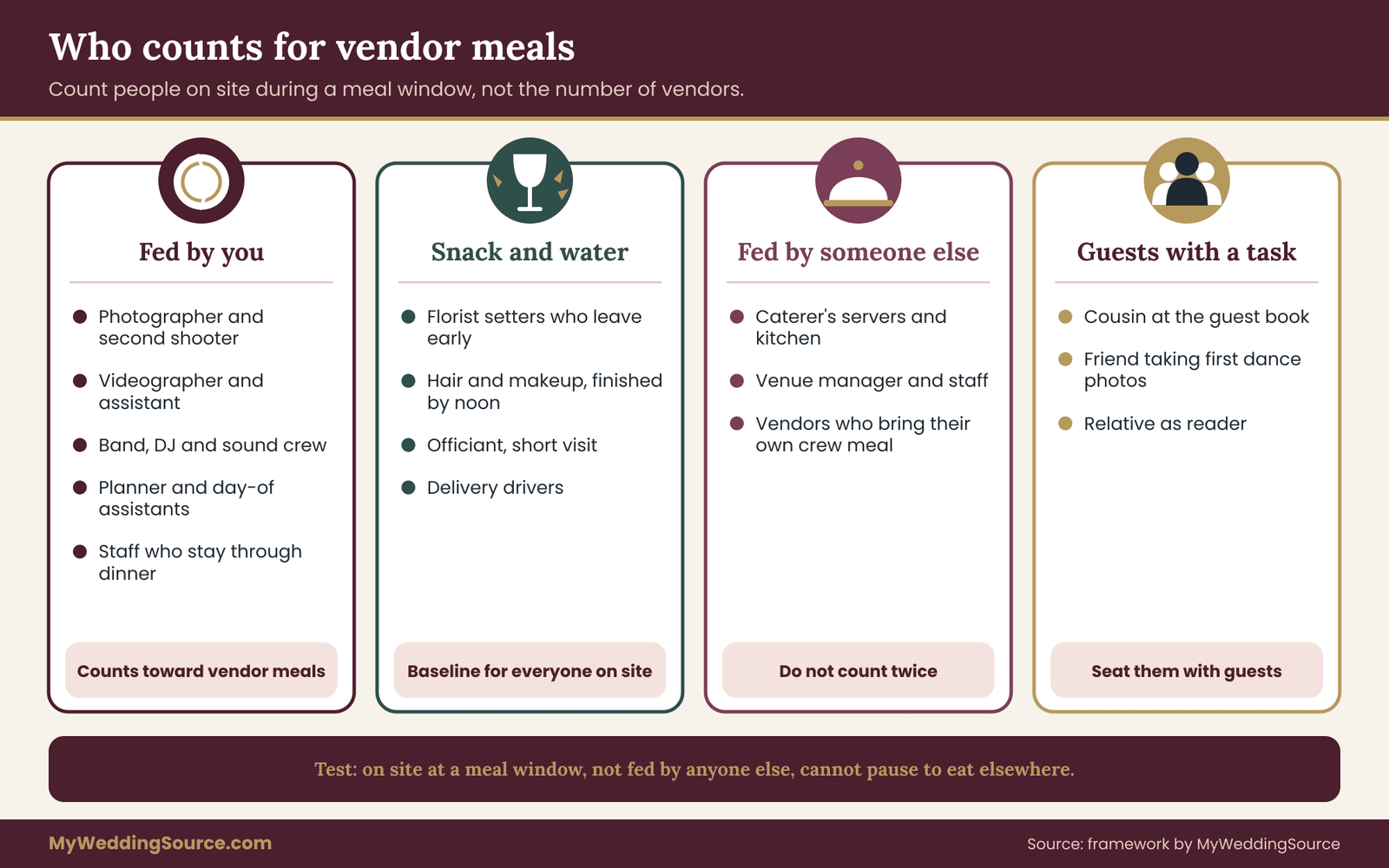
The first group is the people you or your venue hired directly or through a vendor company: photographers and videographers, the DJ or band, the planner or day-of coordinator and assistants, the florist’s setup team, the officiant if the officiant is working rather than a family friend.
The second group is the venue and caterer’s own staff, such as servers, bartenders, kitchen crew and the venue manager. Their meals are normally the caterer’s or venue’s business, and they eat on their own schedule under their own employer’s rules.
The third group is people who work for the wedding but are also guests, for example a cousin who agreed to run the guest book table or a friend who is photographing the first dance. Those people are guests who have taken on a task, and they sit with the guests.
Vendor meals, as this guide uses the term, apply mainly to the first group. The second group matters because your caterer’s quote may include a staff meal line or a policy for it, and you should know which of its people are covered. The third group matters because confusing it with the first can quietly double your headcount.
Why vendor meals get their own line
You can include vendor meals in the guest count and hope for the best. Many couples do, and many weddings go fine. The reason to give vendor meals their own line is that the failure modes are different from guest meals.
Guest meals fail loudly. A plate that arrives cold or a missing vegetarian entree is noticed by twenty people at once.
Vendor meals fail quietly. Nobody complains, because the people involved are professionals who are being paid and who will not make a scene. They simply work the rest of the night tired, hungry and a little less generous with their attention than they would otherwise be. If the photographer is the one who missed the meal, you may see it in the quality of the dance floor photos. If the musician is the one, you may see it in the second set.
There is also a money reason. A vendor meal is almost always priced by the caterer, either at a reduced per-person rate or at the full guest rate, and the difference across a dozen or more people is real. If the line is not specified, it appears as a surprise on the final invoice, when you have the least room to negotiate.
The roster comes before the menu
Before anyone discusses food, build the roster. A roster is a list of every working person who will be on site for any part of the day, with three facts attached: when they arrive, when they leave, and who employs them. You need the employer fact because the vendor, not you, usually decides how their people are scheduled and paid.
A roster for a mid-sized wedding often looks like this in prose: the photographer and a second shooter, a videographer and assistant, a two-person DJ team or a four-piece band plus a sound tech, the planner and one assistant, three florist setters who leave before the ceremony, and a rental crew that returns after the reception. That is already around fifteen people, and only about half of them are on site during dinner.
That last point is the heart of this section. The number of vendor meals is not the number of vendors. It is the number of people who will be on site during a meal window and who will not be fed some other way. The florist’s setters who leave at three in the afternoon do not need a dinner plate, though they might need a bagged lunch if load-in started at nine. The rental crew that arrives at the end of the night may need nothing at all.
Ask each vendor for their expected headcount and on-site hours in writing. Most vendors answer in a single message. If a vendor’s contract already includes a headcount, compare it with the message, because contracts sometimes carry an older number from the first quote.
What the list should not include
Leave the venue’s and caterer’s own employees off your vendor meals list unless your catering contract explicitly says otherwise. Servers and kitchen staff are the caterer’s workforce, and the caterer normally feeds them under its own policy. Adding them to your count can mean you pay twice, once through the per-person vendor rate and once through the catering company’s built-in labor pricing.
Leave off, too, the hair and makeup artists who finished in the morning, any vendor who delivered and left, and the officiant who arrives for the ceremony and leaves right after the signing. Each of them might still deserve a drink and a snack, which is a separate and much cheaper decision than a full meal. The specification in the next section gives you a way to separate meals from snacks and water so that the line stays honest.
The vendor meals specification: seven lines for each group
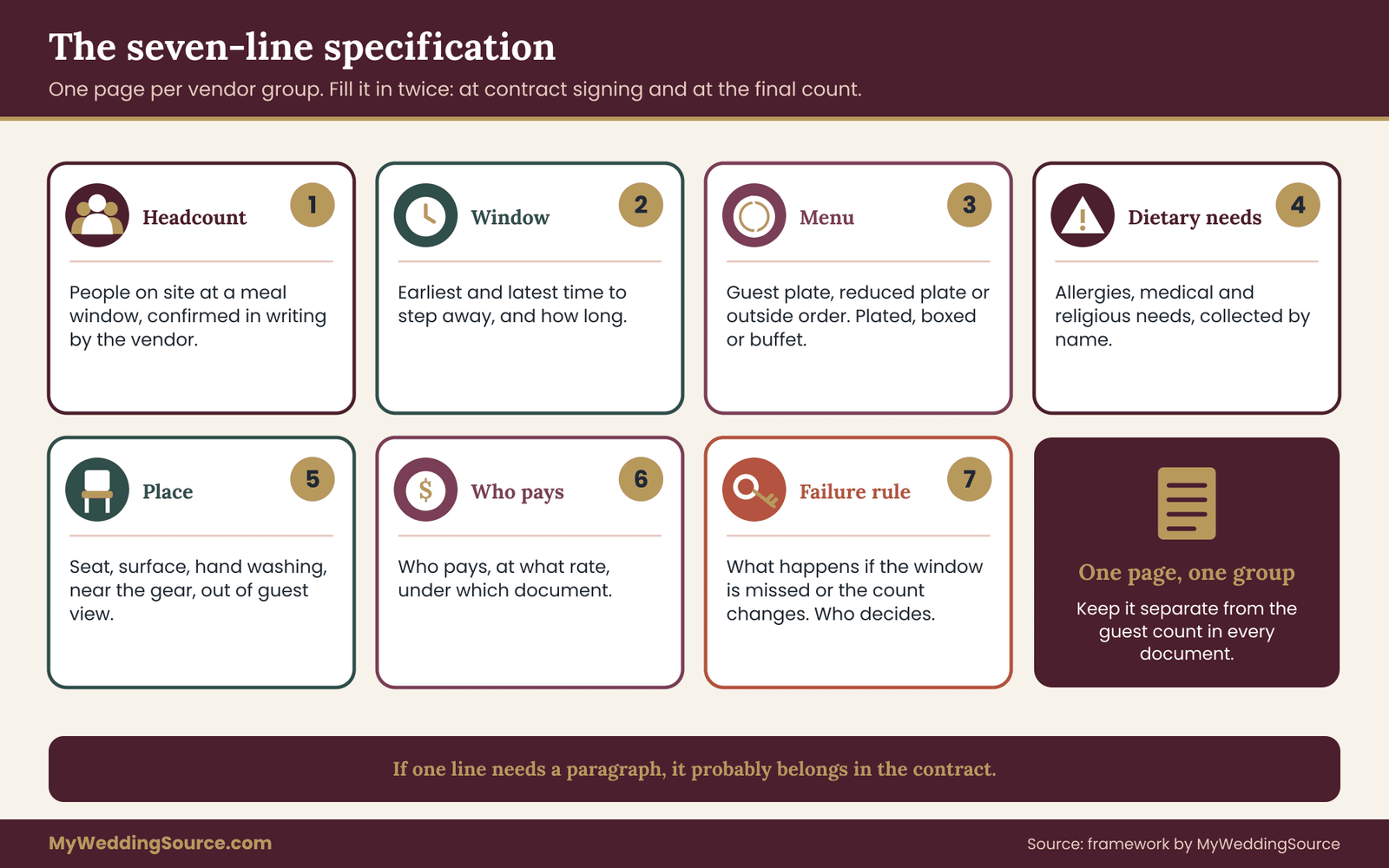
The core deliverable of this guide is a short specification. It has seven lines, and you fill it in once for each vendor group, not once for each person. A group is a set of people who share an employer, an arrival time and a meal window. The photographer and second shooter are one group. The band and its sound tech are one group. The planner and assistant are one group. Three or four groups cover most weddings.
Here are the seven lines, followed by what each one decides.
Line one: headcount. How many people in this group will be on site during a meal window, as confirmed in writing by the vendor. Not the contracted number from the first quote, and not your estimate.
Line two: window. The earliest and latest time the group can step away for a meal without leaving a gap in coverage, and how long the break needs to be.
Line three: menu. What they will be served, drawn from the same kitchen as guest food or from a separate source, and whether it is a plated meal, a boxed meal or a buffet portion.
Line four: dietary needs. The allergies, medical diets and religious or ethical restrictions each person has reported, collected before the final menu is locked.
Line five: place. Where the group eats, how close it is to the work area, and what it needs to be usable: a seat, a table, hand washing, shade or heat, a place to put equipment.
Line six: payer and price. Who pays, at what rate, under which document, and whether the meal is included in the vendor’s fee or billed to you.
Line seven: failure rule. What happens if the window is missed, the food runs short, or the count changes on the day, and who is authorized to decide.
How to fill in the specification without making it a project
The vendor meals specification should fit on one page. If a group needs more than a few sentences per line, the group is probably two groups or the vendor has unusual requirements that belong in the contract instead.
Fill it in two passes. The first pass happens when you sign each vendor contract: gather the headcount, the on-site hours and any meal terms the vendor already requires. The second pass happens when you finalize the catering order, usually several weeks before the event: confirm the count, collect dietary information, and lock the window against the final timeline. Between those two passes the specification stays a draft, and drafts are allowed to be wrong.
The reason to use two passes is that vendor information changes. A band that said four musicians in January may add a sound engineer in June. A photographer who planned to work alone may bring a second shooter after the guest count grows. If you try to finalize vendor meals at the first pass, you will revise it anyway. If you wait for the second pass with no earlier draft, you will discover requirements too late to negotiate them.
The decision rule for who counts
A simple rule settles most roster questions. Count a person for vendor meals if all three of these are true: they will be on site working for at least a stretch of the day that includes a normal meal time, nobody else is responsible for feeding them, and their work cannot pause for long enough to eat elsewhere.
The first test excludes the delivery driver and the person who set up and left. The second test excludes the caterer’s employees, who are the caterer’s responsibility, and any vendor whose contract says the vendor provides its own crew meals. The third test excludes people with natural gaps, such as an officiant who is free for an hour before the ceremony and can eat before they arrive.
Apply the rule to each person, not to each group, and then group the survivors. You will occasionally find that a group splits: the band’s trumpet player may be on a different schedule from the rest because the band arrives in two cars. Splitting is fine. It is better to list two small groups than to give one large group a window that fits half of it.
Meal, snack, or water: three levels, not one
A specification that says only “vendor meal” forces you to choose between a full plate and nothing. That is a poor choice for the many people whose time on site is short. A more honest list has three levels.
A meal is a real plate or box with a protein, a starch or grain, and vegetables, eaten seated, with enough time to finish. A snack is something portable that holds someone for a couple of hours: fruit, sandwiches cut in halves, cheese and crackers, a pastry from the cocktail hour trays. Water and coffee are the baseline for everyone who works on site, regardless of anything else you decide.
Assign each group a level for vendor meals. Someone who works the morning set-up and leaves by noon gets water and a snack. Someone who is on site for a stretch that spans a normal dinner gets a meal. Anyone who is on site for more than a full working day gets water and a snack plus a meal, because a single meal in a long shift is not enough.
This is not a legal threshold. It is a planning threshold, and you can set it where your budget and your vendors’ contracts allow. What matters is that the level is written down for each group and that the caterer knows how many of each to prepare.
The count versus the final guest count
One practical habit saves a lot of trouble: keep vendor meals separate from the guest count in every document. If your final headcount to the caterer is one hundred forty plus sixteen vendor meals, send it as two numbers, with the vendor meals priced on their own line. When the two numbers are merged into one hundred fifty-six, nobody can tell later whether a change to the guest list also changed the vendor meals, and the invoice cannot be checked.
Separate numbers also protect your seating plan. A venue’s capacity rule or a table layout is built around the guest count. If vendor meals are folded into it, someone may start seating the photographer at a guest table with a place card. That is a lovely gesture at some weddings and a problem at others, and it should be a choice, not a side effect of arithmetic.
For more on how a changing guest count affects what a caterer charges, the guide on cash-flow planning for deposits, final balances and reserve timing explains why the final-count date matters for the whole budget, not just the menu.
A short script for collecting the facts
Most vendors answer faster when you ask for specific facts in a fixed order. Here is a message that works for nearly any group, adapted to a note you can send by email or the vendor’s portal.
“We are finalizing the catering order and want to feed your team properly. Could you confirm in writing: how many people will be on site, their arrival and departure times, any food allergies or dietary needs, and whether your contract or crew policy requires a specific type of meal or break?”
That single message covers lines one, four and part of line two of the specification. The reply becomes the written confirmation you can attach to the file. If a vendor responds with a count that differs from the contract, ask which is correct and ask them to confirm it in the same thread, so the record is clean.
What a vendor’s own requirements usually look like
Some vendors have a standard clause. A photography contract might say that a meal must be provided if coverage runs beyond a stated number of hours, and that the photographer may take the meal at a time of their choosing. A band’s agreement may list drinks, a hot meal and a private place to eat. A planner’s contract may say nothing, because the planner assumes the caterer will cover it.
Read each contract for four kinds of language: a required meal, a required break, a required place to eat, and a payment term if the meal is not provided. If a contract has a payment term, such as a fee for a missed meal, that term becomes part of your budget. Do not guess about it. Ask the vendor how the fee works and when it applies, and record the answer.
If a contract is silent, say so in the specification and use the default level for that group. Silence in a contract is not a promise either way. It simply means the decision is yours to make and to write down.
Timing vendor meals around the wedding day schedule
Timing is where most vendor meals plans succeed or fail. The food can be perfect and still useless if it arrives while the person it was meant for is mid-task. The fix is to place the meal window by working backward from what each group cannot leave, rather than forward from when dinner is served.
Think of the wedding day as a series of fixed moments and flexible gaps. The fixed moments are the ones where a specific person must be present: the processional, the vows, the entrance, the toasts, the first dance, the cake cutting, the last song. The gaps are everything else. A vendor meal belongs in a gap that is long enough to eat and wind down, and close enough to the vendor’s gear that they do not have to pack up or leave it unattended.
Start from the fixed moments
Take your run-of-show or timeline and mark, for each group, the moments they cannot miss. For a photographer, those are the ceremony, the grand entrance, the toasts and the cake cutting. For a band, they are the cocktail hour set if it is live, the entrance and the dance sets. For a DJ, they are nearly everything, because the DJ runs the microphone for announcements and cues the toasts.
Then look at what remains. A photographer’s longest gap often falls during the guests’ dinner service, after the entrance and before the toasts, when the room is quiet and there is little to photograph beyond table details. A band’s gap falls between sets or during dinner, and a DJ’s gap is usually shortest and may require a staggered arrangement or a snack at the console.
The point is not that every group eats at dinner. The point is that you identify each group’s real gap, check it against the timeline, and then ask the caterer to plate vendor meals so they are ready at that time.
A rule of thumb for placing the window
A workable rule is to place the meal window in the middle third of a vendor’s time on site, and to avoid the first hour after arrival and the last hour before departure. Early in a shift, people are busy with set-up and settling in, and they usually have not eaten much before they left home. Late in the shift, people are focused on wrap-up and travel. The middle is where a meal helps most.
For someone who arrives at noon and leaves at midnight, the middle third runs from about four to eight in the evening. For a florist’s setter who arrives at nine and leaves at two, the middle third falls around eleven, which makes a lunch more sensible than a dinner. The rule keeps you from defaulting everyone to the dinner hour just because that is when the caterer is busiest.
This rule is a planning heuristic, not an official standard. If a vendor’s contract states a window, use the contract. If a vendor tells you they prefer to eat at a certain point, take their word for it, because they know their own workflow.
Staggering when the group cannot leave together
Some groups cannot eat at the same time. A two-person DJ team usually has one person at the console and one handling lighting or the dance floor. A photographer and second shooter may need to cover two spaces. A planner and assistant rarely eat at the same moment, because one of them is always watching the room.
When a group has to stagger, specify two windows, not one, and ask the caterer for two service times or for a plate that holds well. Hot food that sits is a food safety issue as well as a quality issue; the federal food safety guidance generally says perishable food should not stay at room temperature for more than two hours, and for no more than one hour when the air temperature is above ninety degrees.
If a second person’s window is more than an hour after the first, ask the kitchen to hold their plate properly or serve it at the time they are ready.
When the guests are served first, and when they should not be
There is a common assumption that vendors should eat after the guests, as a matter of manners. In practice, several groups should eat before the guests are served, not after.
The photographer is the clearest example. Guests being served is a good time to photograph details and candid moments, but the toasts and dancing follow soon after, and a photographer who eats late will miss them. Many photographers prefer to eat while the guests are in the first course, so they are free when the toasts begin. A band that has a set after dinner usually wants to eat before the guests, so they are ready to start on time. A DJ who must announce the first dance after the meal wants something that does not take long.
The reverse is also true. Some people on your vendor list should eat after the guests because their job is to serve the room. The coordinator cueing dinner service and the planner managing the kitchen do their most important work while food is being delivered. Their window often falls after the main course, when the room has settled.
Tying the vendor meals window to the dinner timeline
The simplest way to coordinate vendor meals is to add vendor meals as lines on the same dinner timeline the caterer already uses. Suppose guest service starts at a given time. The caterer’s timeline might then have a line that says the photographer and second shooter are served a short time after the first course goes out, the band is served at the same time, and the coordinator is served once the main course is cleared.
The exact minutes depend on the venue, the kitchen and the menu. What you want is a stated order and a stated approximate time for each group, shared with the caterer, the coordinator and the vendors. A vendor who knows their plate will arrive at a particular time will plan their work around it. A vendor who does not know will ask someone, usually at the worst moment.
If your timeline lives in a shared document, the guide on vendor timelines explains how to keep one version that every vendor sees. Add the vendor meals lines to that version and nowhere else.
How long the break should be
People often ask for a number. The honest answer is that a meal break should be long enough that the person can sit, eat, drink something and spend a few minutes not thinking about the job. For a sit-down meal that is more than a few minutes. For a quick plate while standing, it is less.
A federal reference point helps here. The U.S. Department of Labor explains that a bona fide meal period is generally thirty minutes or more and is a period in which the employee is completely relieved from duty.
Rest breaks of short duration, usually five to twenty minutes, are treated differently. Those rules apply to employees in covered situations, and your vendors may be employees, independent contractors or business owners, so they are a reference rather than a requirement for you. They do show the scale that professional employers use, and that scale is a sensible planning target: about thirty minutes for a meal, with a few short pauses in addition.
When the schedule slips
Weddings run late. Ceremonies start late, cocktail hours stretch, dinner is delayed by a kitchen issue or a speech. A good vendor meals plan expects this and states what happens.
Write a simple rule into the specification: if the schedule is more than a stated number of minutes behind, the coordinator moves vendor meals earlier, not later. Delays should not eat into the vendors’ windows, because the vendors’ later obligations, such as the first dance or the exit, are usually tied to the end time, not to the delay. In plain terms, the plan should protect the break by shifting it, not skipping it.
Name one person who can make this call. In most weddings that person is the coordinator or planner, and in smaller weddings it is the caterer’s event lead. If nobody is named, vendors will ask the couple, and the couple should not be the ones fielding questions about food during the reception.
A quick check for your own timeline
Open your timeline and look for any stretch where a vendor group is on duty for more than a handful of hours without a gap long enough to eat. If you find one, you have three options: move a fixed moment, add a second person to cover the gap, or provide a snack that can be eaten while working. Each option has a cost, and the right choice depends on the vendor. Ask them which they prefer. Photographers and musicians have strong opinions, and their answer is usually faster and better than anything you could guess.
Dietary needs and allergens in vendor meals
Dietary needs are the second most common source of vendor meals problems, after timing. The reason is simple: guests are asked about their diets on the response card, and vendors are not. A guest list collects allergies as a matter of course. A vendor roster does not, so the caterer prepares a standard plate and the first sign of a problem is a person saying quietly that they cannot eat it.
The fix is to collect the same information from vendors that you collect from guests, with a little more care, and to pass it to the caterer in the same format.
What to ask, and how to ask it
Ask for allergies, medical diets, religious or ethical restrictions, and strong dislikes, in that order of priority. Allergies and medical diets are safety information. Religious and ethical restrictions are matters of respect. Dislikes are preferences, and you can honor them when it is easy but they do not need to drive the menu.
A short question works better than a form. Something like: “Does anyone on your team have a food allergy or a dietary requirement we should tell the caterer about?” Add that the information goes only to the caterer. Vendors are sometimes reluctant to share medical details with a client, and a clear statement of who will see the answer helps.
Collect the answer by name, not by group. “One of our people is vegetarian” is not usable on the day, because a plate marked with a name or a role is the only way a server can deliver the correct one. If a vendor prefers to share initials or a role, such as “second shooter”, that is fine as long as the caterer can match the plate to a person.
The major allergens, in plain terms
The U.S. Food and Drug Administration lists nine major food allergens: milk, eggs, fish, crustacean shellfish, tree nuts, peanuts, wheat, soybeans and sesame. These are the ones most often involved in serious allergic reactions, and they are the ones a caterer is trained to track. When a vendor reports an allergy, ask which food is involved and whether the reaction is mild or severe, and pass both pieces of information to the caterer exactly as given.
Do not try to judge risk yourself. You are not asking the vendor to prove anything, and you are not deciding whether an allergy is serious enough to matter. Your job is to relay the information accurately and to confirm that the kitchen has received it. The kitchen decides how to prepare a safe plate.
Cross-contact and the shared kitchen
Cross-contact happens when an allergen gets onto food that should not contain it, through shared utensils, surfaces, oil or hands. A vendor with a severe allergy needs a plate prepared with attention to this, not just a plate that omits the ingredient. Ask the caterer directly how they handle it. A good caterer will describe a process, such as separate utensils, a clean prep area and plating the allergy meal first or separately. A vague answer is a reason to ask again or to ask for a named person who can explain.
The same care applies to buffets. If vendors eat from a buffet, a person with a severe allergy may not be able to trust the serving utensils, which are often shared. A plated or boxed meal prepared in advance is often safer for a person with a serious allergy, which is one of the reasons that boxed and plated vendor meals are common even when guests are served buffet-style.
Religious, cultural and ethical needs
Some vendors will not eat pork, some will not eat meat on certain days, some follow halal or kosher practices, and some are vegetarian or vegan by principle. These are not allergies, and treating them as optional preferences is a mistake. For a person who follows a religious diet, an item that is technically free of the forbidden ingredient may still not be acceptable if it was prepared with shared equipment.
Ask the vendor what they need rather than assuming. Some will say a vegetarian plate is fine, and some will say it must be certified. Pass the specific requirement to the caterer and ask whether it can be met. If it cannot, tell the vendor ahead of time so they can bring their own food. A vendor who is told two weeks before the wedding that their needs cannot be met can plan. A vendor who finds out at dinner cannot.
When someone is fasting or working a long day
Occasionally a vendor will be fasting for religious reasons on the day of your wedding, or will have a medical need to eat at set times. These are not common, but they happen, and they are easier to handle when you know in advance. A fasting vendor may need a meal after sunset rather than at the dinner hour, or may need food they can take with them. A vendor with a medical schedule may need a snack at a certain time and a place to take it.
Ask a general question in your vendor message that covers this: “Is there anything about timing we should know?” A vendor with a fasting need or a medical schedule will usually mention it. If you are not told, you do not need to guess.
Lining up the caterer’s questions
Caterers have their own questions about vendor meals, and it helps to answer them in advance. Typical questions include the final count, any dietary needs by name, whether vendors should receive the guest menu or a simplified one, the service time for each group and the place where food should be delivered. A caterer who has these answers can staff and plan. A caterer who does not will improvise, and improvisation is a risk for allergies.
Provide the information in one message that the caterer can attach to the event order. A clean format is a short list with one line per person: name or role, group, service window, dietary need, and place. This is the same list you will use as the specification, and it doubles as the record that you told the caterer what you knew.
Same menu, reduced menu, or separate menu
There are three ways to build vendor meals from the kitchen’s point of view, and each has trade-offs.
The same menu means vendors receive the guest entrees, plated or boxed. It is simplest to explain and usually the most generous. The cost is the guest rate or close to it, and some caterers charge a reduced rate for vendor plates while others do not. Ask which applies.
A reduced menu means the caterer prepares a simpler plate for vendors, such as a single protein with sides, a pasta or a sandwich platter. It is cheaper and often faster, and it can be easier to adapt for dietary needs because the kitchen controls a smaller set of ingredients. The trade-off is that some vendors may feel the meal is lesser than the guests’, which is not a problem for most but can matter to a few.
A separate menu means vendors receive something sourced outside the caterer, such as a delivery order or a prepared box from a local restaurant. It is the most flexible and may be the best choice when your caterer has a strict policy against feeding non-guests. The trade-off is that you take on the coordination and the food safety responsibility, including how long food sits before it is eaten.
A decision rule for choosing among the three
If the caterer offers a vendor rate and your budget allows it, use the same or a close variation of the guest menu. If the caterer charges close to full price for vendor meals and your headcount is large, a reduced menu is a reasonable compromise. If the caterer’s policy or your venue’s rules do not allow vendor meals at all, a separate menu is the fallback, and you should tell the venue before you order.
Whichever you choose, write it into the specification under line three. Then check that the caterer’s quote and your decision say the same thing. Mismatches in vendor meals pricing are one of the most common reasons for a surprise on the final invoice.
Where vendor meals are eaten and how they are served
A meal is not only food, and vendor meals are no exception. It is also a place, a surface, a chair and a few minutes of quiet. Many vendor meals plans fail not because the food was wrong but because the place was: a folding chair in a hallway, a plate balanced on a speaker case, a cold corridor next to the dish pit.
Choosing the place
Look for a spot that meets four needs. It should be private enough that the vendor is not on display to guests while eating. It should be close enough to the work area that the vendor can return quickly and keep an eye on equipment. It should have a seat and a surface. And it should be clean, with a way to wash hands.
Venues vary a great deal. A hotel ballroom may have a back-of-house room set aside for staff, and a barn or a garden may have a tent or a corner of a catering area. A restaurant may offer a table in the bar during off hours. Ask the venue manager where vendors normally eat. If the answer is “wherever they find room”, create a place yourself: a small table and four chairs in a quiet corner is enough.
For musicians and photographers, being near their equipment matters. Cameras, instruments and sound gear are expensive and easy to disturb. A place with a line of sight to the gear, or a room that can be locked, lets them eat without worry. Mention this when you describe the place to the vendor, because it signals that you have thought about their working conditions.
Guest-facing or hidden
There is a question of whether vendors should eat visibly. Some couples like to seat the photographer or the band at a table in the reception room, with a place card, as a gesture of thanks. Others prefer vendors to eat out of sight so that guests are not distracted and the room stays focused on the couple.
Both are fine, and the choice depends on the vendor and the venue. A seat in the room works when there is space and the vendor is comfortable, but many photographers and musicians prefer privacy and a break from being watched. If you offer a seat in the room, make it clear that it is optional. A vendor who would rather eat elsewhere should be able to say so without feeling that they have turned down a favor.
Whatever you choose, keep vendor seating out of your guest seating count. A reserved seat at a guest table is a seat that cannot be given to a guest, and venues with a capacity limit may count it. The guide on wedding reception guest flow covers how seating and movement fit together if you want to check your layout.
Service formats compared
There are four common ways to serve vendor meals, each with a distinct profile.
A plated meal arrives at a table at a set time. It is the most hospitable and the easiest to adapt for allergies, since a plate can be prepared separately and labeled. The drawback is that it requires a server and a seat at the time, and a vendor who is called away may return to a cold plate.
A boxed meal is packed in advance and handed over. It is flexible, easy to eat at a work area, and easy to hold for a vendor whose window is uncertain. The drawback is that it can feel less generous, and it requires the kitchen to pack carefully so that hot and cold items stay appropriate.
A buffet portion means vendors go through the guest buffet after the guests, or a separate staff buffet is set. It is efficient for large vendor groups. The drawbacks are the timing, because vendors must wait for guests to finish, and the allergy risk from shared utensils.
A drop-off order is food from a restaurant or a delivery service. It suits venues that do not allow outside caterers to serve non-guests, or situations where the caterer cannot provide vendor meals at all. It puts the coordination and the food safety on you or your planner.
A decision rule for the format
Match the format of vendor meals to the group. A small group with a firm window, such as the photographer and second shooter, is well served by a plate or a box delivered at the right moment. A larger group with a flexible window, such as a band with a sound tech and a lighting operator, can use a plated meal or a buffet portion.
A group with an allergy should receive a plated or boxed meal prepared by the kitchen under its allergy process. A group that is not covered by the caterer can receive a drop-off order and a table.
If you are unsure, ask the vendor. Most will tell you immediately what works. A photographer will say they prefer a box they can eat quickly, and a band will say they want a hot meal and a quiet room. Their preference is usually the best guide.
Beverages, snacks and the baseline
Water, coffee and a few snacks are the baseline for everyone who works on site. They cost little, and they make the biggest difference to how a long day feels. Ask the caterer to include a water station and a basic snack option in the vendor area, and ask that vendors may help themselves, without asking permission.
Be careful with alcohol. Some vendors do not drink on the job, some contracts forbid it, and some venues have rules about staff drinking. A good default is to offer soft drinks and water, and to leave alcohol out of the vendor area unless a vendor’s contract or a conversation says otherwise. This is a courtesy to the vendor, who may be driving, and it avoids a policy problem with the venue.
Food safety at the vendor table
Vendor meals often sit longer than guest meals, because vendors eat when their window allows, not when the kitchen is ready. Food that sits warm is a risk. The U.S. Department of Agriculture and foodsafety.gov guidance describes a temperature range in which bacteria grow quickly, and recommends that perishable foods not sit out for more than two hours, or one hour in hot weather.
Ask the caterer how they hold vendor meals. A box that stays in a cooler until the vendor is ready is safer than one that sits on a counter. A plated meal that is held in a warming cabinet is acceptable if the kitchen has one. If a vendor’s window is late, ask the caterer to prepare the meal later, not early. This is a standard request, and a good caterer will understand it.
The handoff on the day
Name a person who is responsible for vendor meals on the day. It might be the coordinator, the caterer’s event lead, or a trusted friend in a small wedding. This person checks the count, tells vendors when their meal is ready, resolves allergy questions and deals with changes. The role takes a few minutes of attention, spread across the evening, and it prevents the most common problem: everyone assuming someone else is handling it.
Give that person a one-page card with the groups, the windows, the places, the dietary needs by name and the failure rule. Print it. Phones die and emails get lost, and a paper card at the coordinator’s elbow is the most reliable tool available.

Putting vendor meals into contracts
A vendor meals plan that lives only in conversation is fragile. People change roles, memories shift, and what seemed settled in March is disputed in August. The contracts are where the plan becomes enforceable, and where small, specific language prevents large disagreements.
There are two kinds of contract to consider. The first is each vendor’s own agreement, which may already include a meal term. The second is the catering contract or event order, which should state how many vendor meals you are ordering, at what price and under what conditions. If you have a general guide to vendor agreements, the one on wedding vendor contracts covers the structure, and this section focuses only on the meal terms.
What to look for in a vendor’s contract
Read the meal language in each vendor agreement for five things.
Whether a meal is required, and under what conditions, such as coverage beyond a number of hours. Whether the vendor may choose the time. What type of meal is acceptable, such as a hot meal or a plate comparable to guests. Where the vendor must be able to eat, such as a private area. And what happens if the meal is not provided, whether the vendor may leave, take a break, charge an additional fee or simply continue.
Ask about any term that is vague. “Meal provided” can mean a plate, a sandwich or a gift card. A sentence in an email that clarifies the term is useful, and an amendment is better if the term affects cost.
What to write into the catering contract
The catering contract or event order should state the vendor meals count and the date by which you can change it, the price per vendor meal and what it includes, whether the menu is the guest menu or a reduced one, the service format, and the dietary accommodation process. It should also say who is responsible for vendor meals on the day and what happens if the count changes within the final days.
A reasonable catering clause, in plain language, sounds like this: “Client will provide a final count of vendor meals by the final guest count date. Vendor meals are priced separately from guest meals, served as agreed on the event order, and prepared according to the dietary information supplied. Additional vendor meals ordered after the final count date are subject to availability.”
That is an example of the kind of structure to look for, not legal language, and you should ask the caterer to provide their own wording or confirm yours. If your contract is long, a single line on the event order is often enough, as long as the contract refers to the event order.
Counting, caps and overages
Three numbers matter: the count you ordered, the count the caterer prepared, and the count actually served. If any of them differ, you want to know why. Ask the caterer to report the vendor meals actually served on the final invoice or in a day-after message. The report is useful if there is a dispute, and it improves your next event.
Also ask whether the caterer charges for meals that were ordered but not eaten. Many caterers charge for the final count regardless of attendance, which is standard, and it is a reason to be careful with the count. If your count is high, you pay for meals no one eats. If it is low, you may face an extra charge or a shortage on the day.
The purchase order habit
A vendor meal is a small purchase, and small purchases benefit from the same discipline as large ones. A short purchase confirmation, listing the quantity, price, terms and delivery time, is a simple way to prevent misunderstandings. The guide on vendor purchase orders from scope agreement to acceptance describes this habit in more detail, and a one-line version applies to vendor meals.
Who pays, and how it is recorded
In most weddings, the couple pays for vendor meals, either as a line on the catering invoice or as part of the vendor’s fee. Some vendors include their own crew meals in their pricing and do not ask you for anything. Some planners pay for their own team’s meals. Some venues include vendor meals in their package.
Record who pays for each group in the specification and in your budget. If a vendor includes meals in their fee, write that down, so you do not also order meals for them. If you are paying the caterer, check that the price per vendor meal matches the quote and that no group has been counted twice. These checks take minutes and often catch an error that would otherwise appear on the final bill.
The vendor meals policy check: pay, breaks and who is the employer
So far the specification has dealt with practical questions. This section adds a check on a quieter one: whether your vendor meals plan interacts with wage, break or classification rules. It is a check, not a legal analysis. The rules differ by state, by employer and by the worker’s status, and you should not draw conclusions from a general article. What you can do is notice when a question arises and send it to the right person.
Who is the employer in each case
Start with a plain fact. In most weddings, the couple is not the employer of the vendors’ staff. A photography studio employs its second shooter or hires that person as a contractor. A band leader pays the musicians. A planning company pays its assistants. The couple hires the vendor, and the vendor manages its own people, including their schedules, breaks and pay.
This matters because break and meal rules, where they apply, usually attach to the employer. If the studio employs the second shooter, the studio is responsible for giving that person a legally required break, if any applies. Your role is to make it possible: provide food, give a window and avoid putting the vendor in a position where a break cannot happen.
There are exceptions. If you hire a person directly, such as a family friend paid to coordinate or a student paid to run errands, you may be the employer in a legal sense, and different rules may apply. Whether you are is a question for the labor agency in your state or for an adviser. The guide on vendor due diligence helps with the broader process of confirming who you are actually hiring.
What federal guidance says in general terms
The U.S. Department of Labor publishes plain-language fact sheets on the Fair Labor Standards Act. Several points are relevant to meals and are worth knowing in general terms, with the caveat that they apply only to covered employees and that state law may add more.
Federal law does not require employers to give meal or rest breaks, though many states do. When an employer does provide a meal period, a bona fide meal period is generally unpaid only if it lasts at least thirty minutes and the employee is completely relieved from duty. If an employee must work while eating, the time is generally counted as hours worked. Short rest breaks of about five to twenty minutes are generally counted as work time.
The practical lesson for a couple is narrow. A vendor who must keep working while eating, for example by watching a sound board with a plate in hand, may not be getting a break in the sense that matters to their employer. A real window, even a short one, is usually better than a nominal meal that the worker cannot actually stop to eat. The Department’s state meal-break page lists what each state requires, and your vendors’ employers are responsible for following it.
Meals furnished as part of pay
Sometimes a vendor’s contract or an employer’s policy treats a provided meal as part of compensation, and sometimes tax rules address meals that employers furnish. Those rules concern the employer’s books, not yours. The IRS publishes guidance on the tax treatment of employer-provided meals, and any question about it belongs with a tax adviser for the vendor’s business. A couple paying a caterer for a vendor meal is making a purchase for a wedding, and the tax treatment of that purchase is a separate matter.
If you hire a family member or friend as a paid helper, or if your wedding is also a business event, the situation may differ. In that case, ask a qualified professional and do not rely on a general guide.
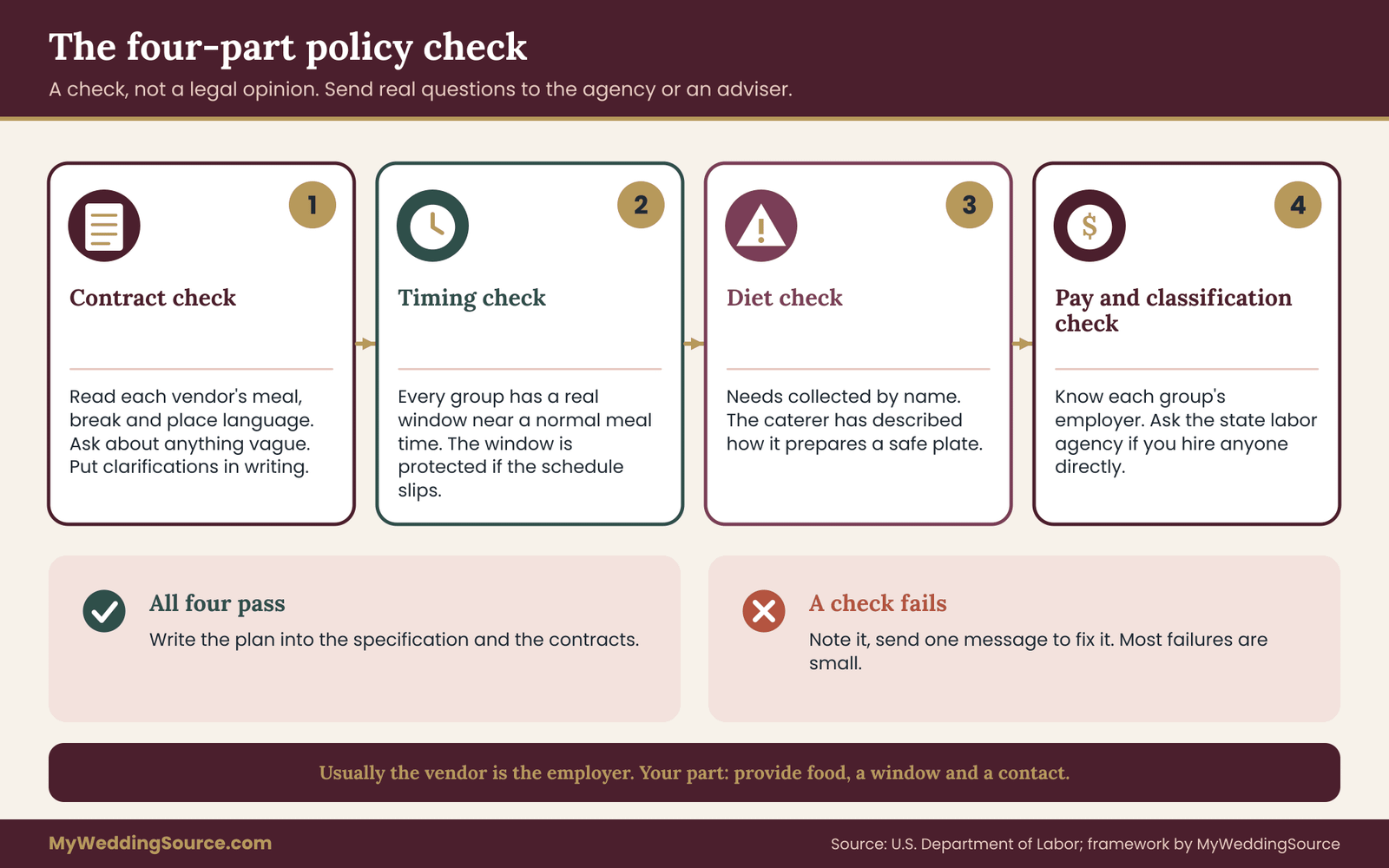
The four-part policy check
Here is a compact check you can run once the specification is drafted. It has four parts and takes about fifteen minutes.
Contract check. For each vendor, have you read the meal and break language? Does your plan satisfy it? Where it is silent, have you asked? If any contract requires something your plan does not provide, fix the plan or ask the vendor to confirm in writing that the plan is acceptable.
Timing check. Does each group have a real window that fits the timeline, close to a normal meal time for the hours they work? Is the window protected if the schedule slips? Has someone been named to make the call?
Diet check. Has each person had a chance to report allergies and needs? Has the caterer received the information by name? Has the caterer described how it will prepare a safe plate?
Pay and classification check. For each group, do you know who employs them? Is any person someone you are employing directly? If yes, have you asked the state labor agency or an adviser whether break or wage rules apply? Does anyone’s contract make the meal a condition of payment?
If every part of the vendor meals check passes, you are done. If any part fails, note the failure and decide how to fix it. Do not treat a failure as a catastrophe, since most are small and fixable with a message.
Questions that belong with an adviser
Some questions are beyond a planning guide. If a vendor says they are classified a certain way and you are not sure it is correct, that is not your call. If a vendor’s staff has a dispute with their employer about breaks, it is theirs to resolve. If you are paying anyone directly and unsure of your obligations, ask your state labor department or a qualified adviser.
Your role in vendor meals is to avoid creating a problem. Provide food, provide a window, and give a clear point of contact. That is a good outcome even if the legal questions are never raised.
A worked case: one dinner, eighteen people on the vendor list
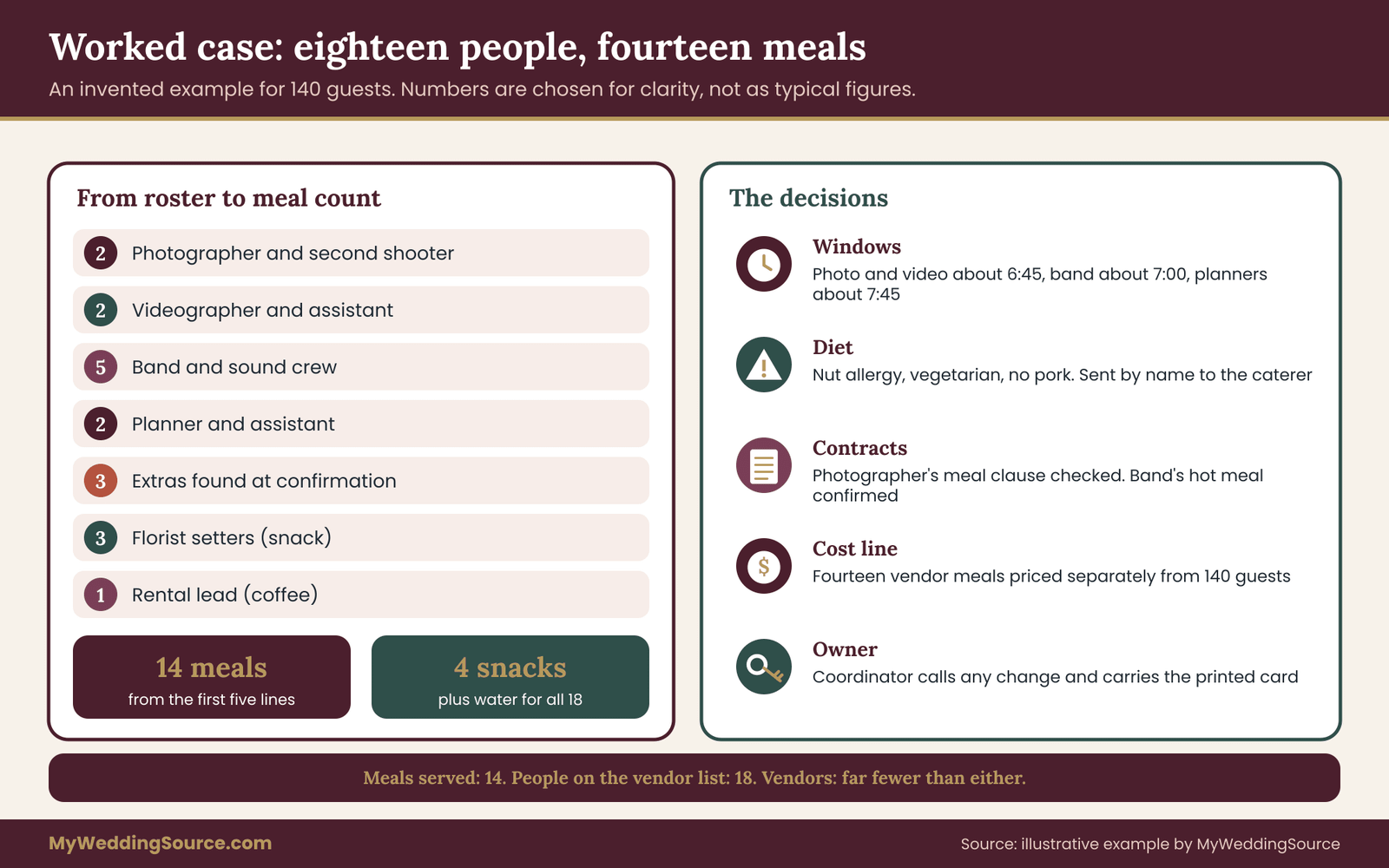
A worked example makes the specification concrete. The following case is invented for illustration. It is not a real wedding, and the numbers are chosen for clarity and not as typical figures.
The setup
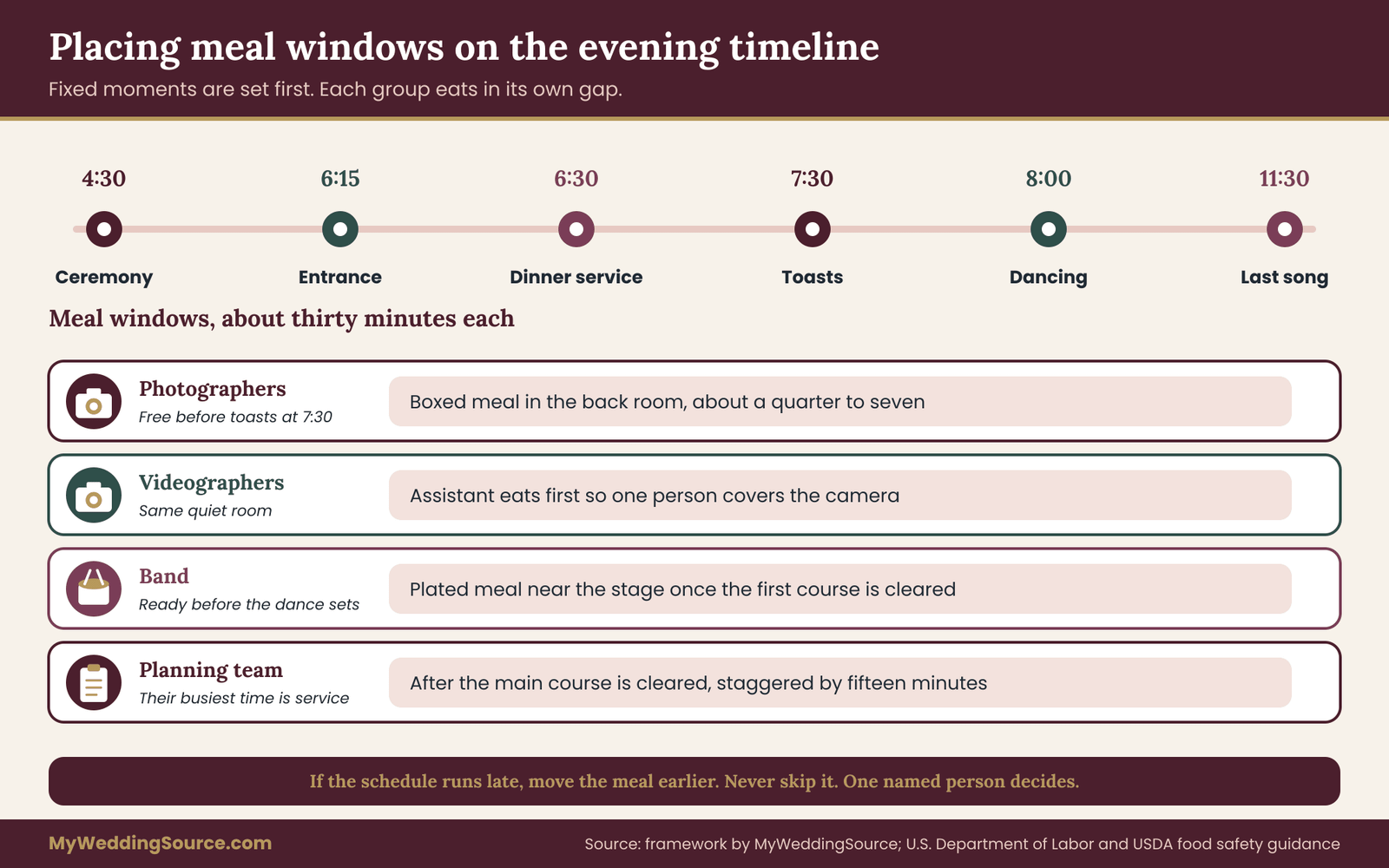
A couple is planning a Saturday wedding for one hundred forty guests. The ceremony begins at four thirty in the afternoon, cocktail hour runs until a quarter past six, and dinner service starts at six thirty with toasts at seven thirty and dancing from eight until eleven thirty. The reception is at a hall with a caterer who cooks on site.
The couple builds a roster for vendor meals. The photographer and second shooter arrive at two and leave at ten. The videographer and an assistant arrive at three and leave at nine. A four-piece band with a sound technician arrives at three for setup, plays the ceremony and cocktail hour and then the dance sets, and leaves at midnight. The planner and one assistant arrive at ten in the morning and leave at midnight. Three florist setters arrive at nine and leave at two. A rental crew will return at midnight.
Applying the decision rule
The florist setters are on site for five hours in the morning and early afternoon, and they leave before the ceremony. They get water and a snack, with a boxed lunch if the vendor’s contract asks for it. The rental crew arrives after the reception, so they receive nothing from the couple, though the caterer may offer coffee.
That leaves four groups for meals: the photographers, the videographers, the band and the planning team. Counted by person, that is two, two, five and two, for eleven.
The couple’s roster also includes a lighting operator and a second sound person the band had not mentioned until the confirmation message, and a day-of assistant the planner added, which raises the total to fourteen. Adding the three florist setters for snacks and the rental crew’s lead for coffee brings the vendor list to eighteen, with fourteen meals and four snack-and-water entries.
Setting the windows
The photographers’ longest gap falls after the first course is served at six thirty and before toasts at seven thirty. The couple asks the caterer to serve the photographers a boxed meal at about a quarter to seven in the back room, giving them roughly thirty minutes. The videographers’ gap is similar, and they eat at the same time in the same room, though the assistant eats first so that one person always watches the camera position.
The band plays through cocktail hour and has a break before the first dance set. They are served a plated meal at about seven, as soon as the first course is cleared, in a room near the stage. The planning team cannot eat while the kitchen is serving, so they eat after the main course is cleared, at about a quarter to eight, with the planner and assistant staggering by fifteen minutes.
Dietary information
The couple sends the message from earlier to each vendor. The replies identify a second shooter with a tree nut allergy, a videographer assistant who is vegetarian, and a band member who does not eat pork. The couple forwards the names and needs to the caterer, who confirms that the nut allergy plate will be prepared first with clean utensils and labeled with a name, that the vegetarian plate is available from the guest menu, and that the band member’s plate will use chicken instead of the pork option.
Contract and cost handling
The photography contract says a meal must be provided when coverage runs beyond six hours, and the couple checks that eight hours of coverage triggers it. The band’s agreement lists a hot meal and a private place to eat. The planner’s contract is silent, and the couple decides to treat the planner’s team as one group with a plated meal.
The caterer’s quote lists vendor meals at a reduced rate per person, but does not say whether the four snack-and-water entries are included. The couple asks, and the caterer says water and a snack tray are included in the vendor area at no charge. The couple confirms the final count of fourteen vendor meals, separate from the guest count, in writing by the deadline.
What the case shows
Several things stand out. The number of meals, fourteen, is not the number of people on the vendor list, eighteen, and it is not the number of vendors. The windows are set by what each group cannot leave, not by one common dinner time. The dietary information is collected by name and passed to the caterer. And the contracts are read before the plan is finalized, so no vendor is surprised on the day.
Alternatives to a catered vendor meals plate
The caterer’s plate is not the only way to feed working people. Sometimes it is not allowed, sometimes it is too expensive, and sometimes it does not fit the vendor’s needs. Knowing the alternatives for vendor meals lets you choose deliberately, and not default to whichever option the caterer mentions first.
Vendor brings their own food
Some vendors prefer to bring their own meals, especially those with a strict diet, a long drive or a habit of eating at set times. A photographer may pack a lunch and a snack, and a band may have a standing arrangement with a restaurant. If a vendor offers, accept gracefully, and ask whether there is something you can provide instead, such as a place to eat, a cooler or hot water.
The trade-off is that you lose some control over timing and place, and the vendor may feel they are not being looked after. If the contract requires you to provide a meal, bringing their own may need a written note. A vendor who brings their own food should still be told where to eat and given water.
A cash or card allowance
Some couples offer a meal allowance instead of a plate, such as a stated amount the vendor can spend on a nearby restaurant or a delivery order. It is flexible, handles allergies well, and suits vendors with unusual hours. The drawbacks are that it moves the coordination to the vendor, it requires an agreement on the amount and the proof, and it may not be practical at a remote venue.
If you use an allowance, write it down: the amount, how it is paid, and whether receipts are needed. Do not leave it as an informal promise. A message that says “we will cover up to a stated amount for the team’s dinner” is enough to keep both sides clear.
Delivery from a nearby restaurant
A restaurant delivery order works when the caterer cannot serve vendors or when the venue does not allow it. You pick a restaurant, send a list of what each person needs, and ask for delivery at a stated time to a stated door. Check the venue’s rules about outside food and the delivery route. Some venues restrict deliveries to a loading dock, and some require notice.
This option shifts food safety to you. Food that arrives early and waits is at risk, so schedule delivery close to the window. Ask the restaurant about allergies directly, and confirm labeling. The risk is manageable, and it helps to assign one person to receive the order and check it.
Shared cocktail hour trays
Cocktail hour trays are sometimes extended to vendors as a light meal, especially for short engagements or vendors with a flexible schedule. It is cheap and easy, and it has two limits. Trays are designed for guests, and a vendor taking food from them can look awkward. And the food may not add up to a meal for someone who has been on site for many hours.
If you use this approach, set aside a separate tray or a separate part of a tray for vendors, and tell them. A set-aside tray in the vendor area removes the awkwardness and ensures there is enough.
No meal, with a conversation
For very short engagements, such as a two-hour ceremony musician or an officiant who arrives shortly before the ceremony, no meal may be the right decision. The key is to say so, so the vendor knows what to expect and can eat before or after. A friendly line in the confirmation, such as “we will have water and light snacks, and we are not providing a meal for this booking”, prevents a misunderstanding. This is not unkind. It is clear, and vendors usually appreciate clarity.
Choosing among alternatives
A quick way to choose a vendor meals option is to answer three questions about each group. How long are they on site? Does their contract require a meal? Can the caterer serve them? If they are on site many hours and the contract requires a meal, use a caterer’s plate or a restaurant order. If they are on site briefly and the contract is silent, use a snack and water. If the caterer cannot serve them, choose between delivery and an allowance. Record the choice in the specification and tell the vendor.
Failure conditions: when vendor meals plans break
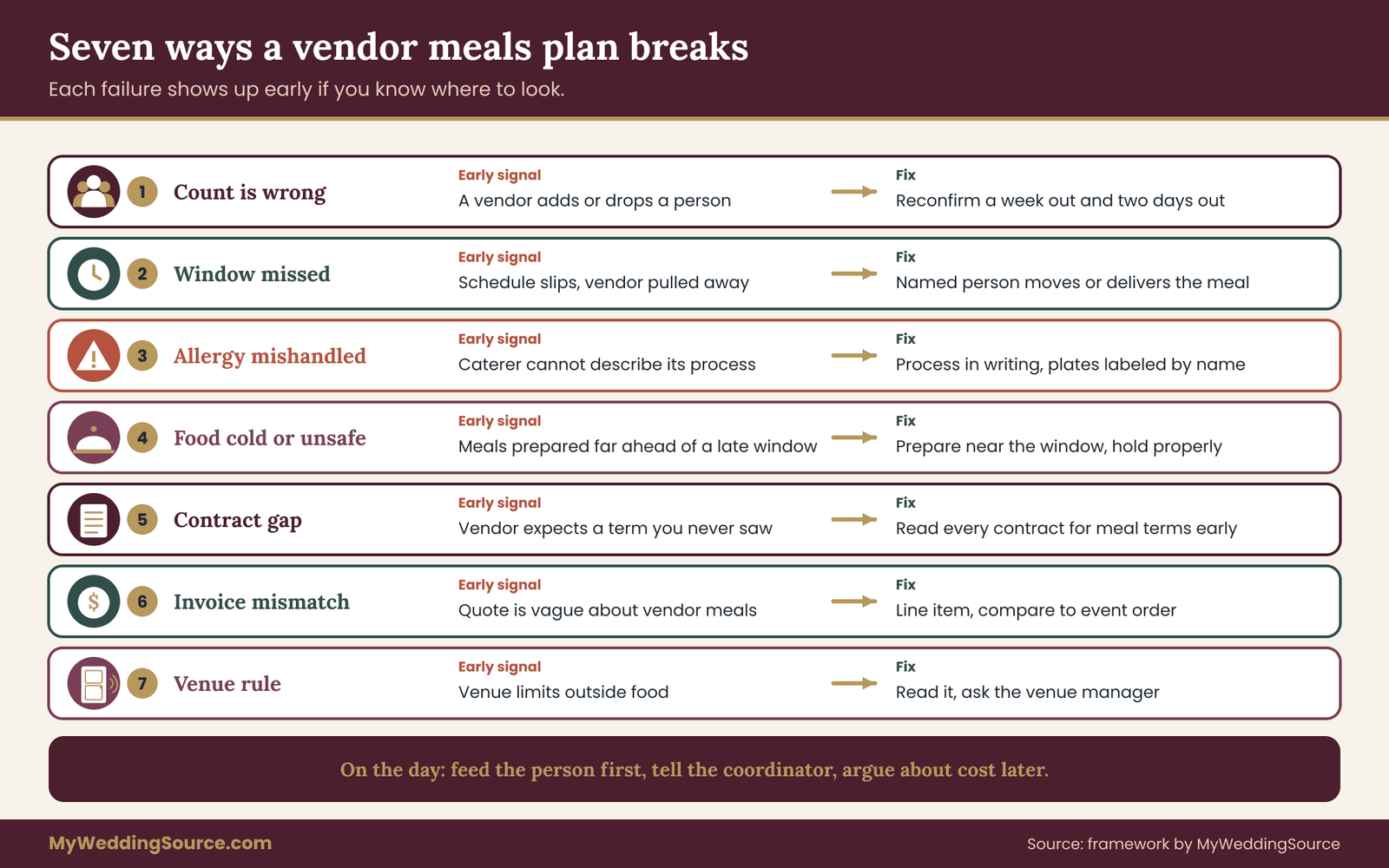
A good plan names its own failure points. Vendor meals plans tend to fail in the same seven ways, and each has an early signal and a simple fix.
The count is wrong. The vendor added a person or dropped one, and the caterer prepared the old number. The early signal is a vendor message that mentions a team size different from your record. The fix is to reconfirm headcounts a week before the final count date and again two days before the event, and to ask the caterer for a few spare plates, if the contract allows it.
The window is missed. The schedule slipped or a vendor was pulled into a task. The early signal is that a group has not eaten when their window ends. The fix is the named person, who can move the window or deliver the meal to the work area. This is the reason to assign someone, and it costs nothing.
An allergy is not handled. A plate went to the wrong person, or the kitchen did not receive the information. The early signal is a caterer who cannot say how it handles allergies. The fix is to ask for the process in writing, to label plates by name and to confirm the plan with the kitchen the week of the event.
The food is cold or unsafe. It sat too long. The early signal is a plan that has food prepared early for a late window. The fix is to ask the kitchen to prepare vendor meals close to the window, and to hold them appropriately.
The contract is silent or contradictory. The vendor expects something the caterer’s quote did not include. The early signal is a vendor message that mentions a requirement you did not know about. The fix is to read all vendor contracts for meal terms early and to resolve conflicts before the final count.
The invoice does not match. The final bill includes charges you did not agree to. The early signal is a quote that is vague about vendor meals. The fix is to ask for a line item, to compare the invoice with your event order and to raise questions promptly. Raise any difference promptly, before the final balance is paid.
The venue forbids it. Some venues do not allow vendor meals from outside caterers, or require vendors to eat in a particular place. The early signal is a venue contract with a clause about outside food or staff meals. The fix is to read the venue contract for meal and food terms and to ask the venue manager directly.
What to do when something fails on the day
Vendor meals failures will occasionally happen despite good planning. A simple response order works in most cases. First, make sure the person is fed, even if it is a sandwich from the kitchen. Second, tell the coordinator, so the issue is recorded. Third, do not argue about cost in the moment. Fix the problem and settle the invoice afterward.
If a vendor is genuinely upset, apologize without excuses and ask what would help. Most are professionals and will accept a simple apology and a corrected plate. The record you made, the specification and the messages, then makes the follow-up conversation short.
The post-event check
A day or two after the wedding, spend ten minutes on a review. Compare the vendor meals you ordered with the meals served, check the invoice against the event order, and note anything you would change next time. If a vendor was unhappy about food, ask them for feedback. If the caterer did well, say so, because it helps their business and your relationship.
Then close the vendor meals file. File the specification, the vendor messages and the invoice together. If you need a general reference for managing vendor relationships, the guide on wedding vendor contracts is a good starting point, and the broader wedding planning checklist can help you see where this task fits.
Your next steps
You can complete the whole job in a few short sittings.
- List every working person on site, with arrival and departure times and the employer for each, and confirm the numbers with each vendor in writing.
- Apply the decision rule to decide who receives a meal, who receives a snack and water, and who receives nothing.
- Fill in the seven-line specification for each group: headcount, window, menu, dietary needs, place, payer and price, and failure rule.
- Collect allergy and diet information by name and send it to the caterer in one message.
- Read each vendor contract for meal, break and place terms, and ask about anything vague.
- Put the vendor meals count, price and service format into the catering contract or event order as a separate line.
- Add vendor meal times to the shared timeline, name a person responsible on the day and give that person a printed card.
- After the event, compare the order, the meals served and the invoice, and file the records.
FAQ
Do I have to feed my wedding vendors?
There is no general rule that a couple must feed vendors. Some vendor contracts require a meal, usually when coverage or work runs beyond a stated number of hours, and then you should follow the contract. Where a contract is silent, the decision is yours. Water and a snack are a sensible baseline for anyone working long hours. Check each agreement before assuming either way.
How many vendor meals should I order?
Order vendor meals for the number of people who will be on site during a meal window and who nobody else is feeding. That is usually fewer than the total number of vendors, because some people leave before dinner and the caterer feeds its own staff. Ask each vendor to confirm their headcount in writing, and keep the vendor meals count separate from the guest count.
When should vendors eat during the reception?
Place each group’s window in a gap where they have no fixed duty, usually in the middle of their time on site. Photographers and bands often eat while guests are served the first course, so they are ready for toasts and dancing. Planners and coordinators often eat after the main course is cleared. Ask each vendor, because they know their own workflow.
Do vendor meals have to be the same as guest meals?
No. Vendor meals can use the guest menu, a reduced menu or food from another source. The guest menu is simple and generous, a reduced menu may cost less, and a separate order may be necessary if the caterer cannot serve vendors. Pick one, write it into the catering contract and check that the quote matches your decision.
How do I handle vendor food allergies?
For vendor meals, ask each vendor whether anyone on their team has an allergy or dietary need, and collect the answer by name. Send it to the caterer and ask how the kitchen prepares allergy plates, including cross-contact controls. Confirm the plan the week of the event, and label plates by name so servers deliver the right one. Never guess about risk.
Are vendors entitled to a break by law?
That depends on the state, the vendor’s employer and the worker’s status. Federal law does not require meal breaks for most workers, though many states do, and the Department of Labor explains how breaks are treated when they are given. The vendor’s employer is generally responsible for following the rules. Check your state labor agency, and ask an adviser if you hire anyone directly.
What should be in the contract about vendor meals?
The catering contract or event order should state the vendor meals count, the date the count is final, the price per meal and what it includes, the menu, the service format and how dietary needs are handled. A vendor’s own contract may state when a meal is required and what type. Ask for any vague term to be clarified in writing before you sign.
What if the venue or caterer will not feed vendors?
Ask the venue and caterer what they allow, and read the contract for rules on outside food. If vendor meals from the caterer are not possible, choose an alternative such as a restaurant delivery, a meal allowance or vendors bringing their own food. Tell vendors early so they can plan, and confirm that the venue permits the delivery and gives them a place to eat.
Sources
- U.S. Department of Labor, Wage and Hour Division
- U.S. Department of Labor, Fact Sheet 22: Hours Worked Under the FLSA
- U.S. Department of Labor, State Meal Break Requirements
- U.S. Department of Labor, Employment Relationship (worker classification)
- U.S. Food and Drug Administration, Food Allergies
- FoodSafety.gov, Keep Food Safe
- USDA Food Safety and Inspection Service
- Centers for Disease Control and Prevention, Food Safety
- Internal Revenue Service, Publication 15-B: Employer’s Tax Guide to Fringe Benefits
- U.S. Small Business Administration, Hire and Manage Employees