A storm warning during an outdoor wedding is not mainly a weather problem. It is a decision-rights problem: someone has to be allowed to stop the ceremony, the music and the photographs, and move a hundred people, before anyone is sure it is necessary. This guide shows how to name that person, write down the alert triggers in advance, and assign every guest a shelter and an owner.
Choose a Caller in writing before the day, with a named backup, and make it someone who is not the couple, a parent or the photographer. Give a separate Watcher the job of monitoring official alerts. Attach each alert level (watch, thunder heard, severe thunderstorm warning, tornado warning) to a standing order that already says who moves whom and where. When the trigger arrives, nobody debates. The order runs, and the storm warning decision has already been made.
Most outdoor weddings have a rain plan. Far fewer have a storm warning plan, and the difference matters. A rain plan answers the question “where does the ceremony go if it drizzles?” A storm warning plan answers a harder one: “who has the authority to interrupt a ceremony that is in progress, and what exactly happens in the next ten minutes?” Those are different documents, written for different moments, and a well-designed rain tent can still be the wrong place to stand when lightning is close.
A storm warning needs its own page in the planning binder.
The usual failure is not ignorance. People at weddings generally know that storms are dangerous. The failure is hesitation. The planner looks at the couple. The couple look at the officiant. The officiant looks at the venue manager. The photographer is mid-shot. A grandparent says it is probably going around. Four minutes pass, and nobody has done anything wrong in particular, because nobody was ever told the decision was theirs.
This article is built around fixing exactly that. Every section ties back to one question: what happens in the first ten minutes after a storm warning reaches your venue? It gives you a four-seat call chart, a way to attach official alert levels to pre-approved actions, a shelter responsibility chart, a method for estimating how long it takes your own guests to reach cover, one worked example, and an honest section on where the whole approach breaks down.
A note on scope. This is general planning information, not legal, safety or emergency-management advice, and nothing here guarantees anyone’s safety. In a real emergency, local authorities, the National Weather Service and qualified venue staff decide what is safe, and their instructions outrank anything written here.
Why a storm warning needs one named decision maker
Consider what a wedding actually looks like at the moment a storm warning is issued. Guests are seated in rows facing one direction, which means most of them cannot see the sky behind them. The couple are emotionally committed to a moment that cannot easily be restarted. Vendors are working to timelines that cost money to break. Everyone present has a reason to wait one more minute, and every reason is understandable.
Group hesitation of this kind has a well-known shape. When responsibility is shared, each person assumes someone else is watching and someone else will act. A named Caller removes that assumption. It converts a group conversation into a single sentence from a single person, and it means the other people present know what to do the instant they hear it.
The second reason to name one person is speed of authority, not speed of thought. The Caller does not need to be a meteorologist. The Caller needs to be allowed to act on official information without asking permission. A venue manager who has seen many storms but has no standing to interrupt the couple’s ceremony is less useful than a calm friend who has been explicitly handed that power in writing.
The third reason is that a named decision maker can be rehearsed. You can walk the person through the venue, show them the shelter, hand them the sheet with the triggers, and let them ask questions. You cannot rehearse “everyone will figure it out together.”
None of this means the couple stay out of everything. They help write the standing orders, they approve the shelter choices, and they decide in advance how they would like a paused ceremony to resume. What they do not do on the day is hold the decision. The day-of version of the couple is the least equipped person in the area to weigh a risk against their own wedding.
A useful test is to ask your venue, your planner and your closest family member the same single question separately: “If the National Weather Service issues a severe thunderstorm warning for our location during the ceremony, who stops it?” If you get three different answers, or three shrugs, you have found the gap this guide closes.
For the wider picture of everything that needs an owner on the day, the wedding planning checklist is the right place to start. This article stays narrow on purpose: one hazard, one decision, one chain of command.
What a storm warning means, and what it does not
The first requirement for any decision is shared vocabulary. The National Weather Service uses a small set of terms consistently, and a call chart works only if everyone reads them the same way.
A watch means conditions are favorable for a hazard to develop. It is an invitation to prepare, not an order to act. A warning means the hazard is occurring or imminent in the area, and it is the signal to take action now. An advisory sits below both and flags conditions that are inconvenient or hazardous without necessarily being dangerous. The ordering is simple: watch means be ready, warning means go.
For outdoor wedding purposes, four warning types matter most. A severe thunderstorm warning is issued when a storm is producing, or is about to produce, damaging wind of 58 miles per hour or more, hail an inch or larger, or both. A tornado warning means a tornado has been indicated by radar or reported, and the instruction is to take shelter immediately.
A flash flood warning concerns rapidly rising water, which matters for low-lying venues, access roads and parking fields. And lightning, which does not need a storm warning to be deadly, is handled by a separate rule covered later.
Notice how different these are from a “chance of showers” forecast. A forecast tells you what might happen over a day or a region. A storm warning tells you what is happening, or is about to, near a particular place. That difference is why the call chart attaches orders to official warnings rather than to a general sense that the weather looks bad.
Two common misreadings cause most of the trouble. The first is treating a watch as a storm warning because the sky looks dark, which leads to constant false alarms and eventually to ignoring the system. The second, and more dangerous, is treating a storm warning as a watch because the sky looks fine where you are standing. Warnings are issued for areas, and storms move. Clear sky overhead does not cancel a storm warning for your location.
Wedding guests also tend to mix up “a storm warning is issued” with “a storm warning is in effect.” Issuance is the moment the alert is sent. It stays in effect until it expires or is canceled. Your standing order should say what happens at issuance and what has to happen before the order is lifted, and those are two separate events. A warning that expires at a stated time does not mean the danger ended at that minute, and the call chart should never rely on the clock alone.
It also helps to remember that the same storm can generate several products over its life. A watch may be in effect for the afternoon, a severe thunderstorm warning may appear for a few counties at once, and a tornado warning may be issued for a smaller polygon inside that area. Each product has its own time and boundary. Your Watcher needs to know which product covers the venue’s actual location, not just the town name on the invitation.

If you want the official definitions in the agency’s own words, the National Weather Service and Ready.gov pages listed in the Sources section are short and worth reading together with your Watcher, because shared vocabulary is half of what a standing order depends on.
The four seats of the call chart
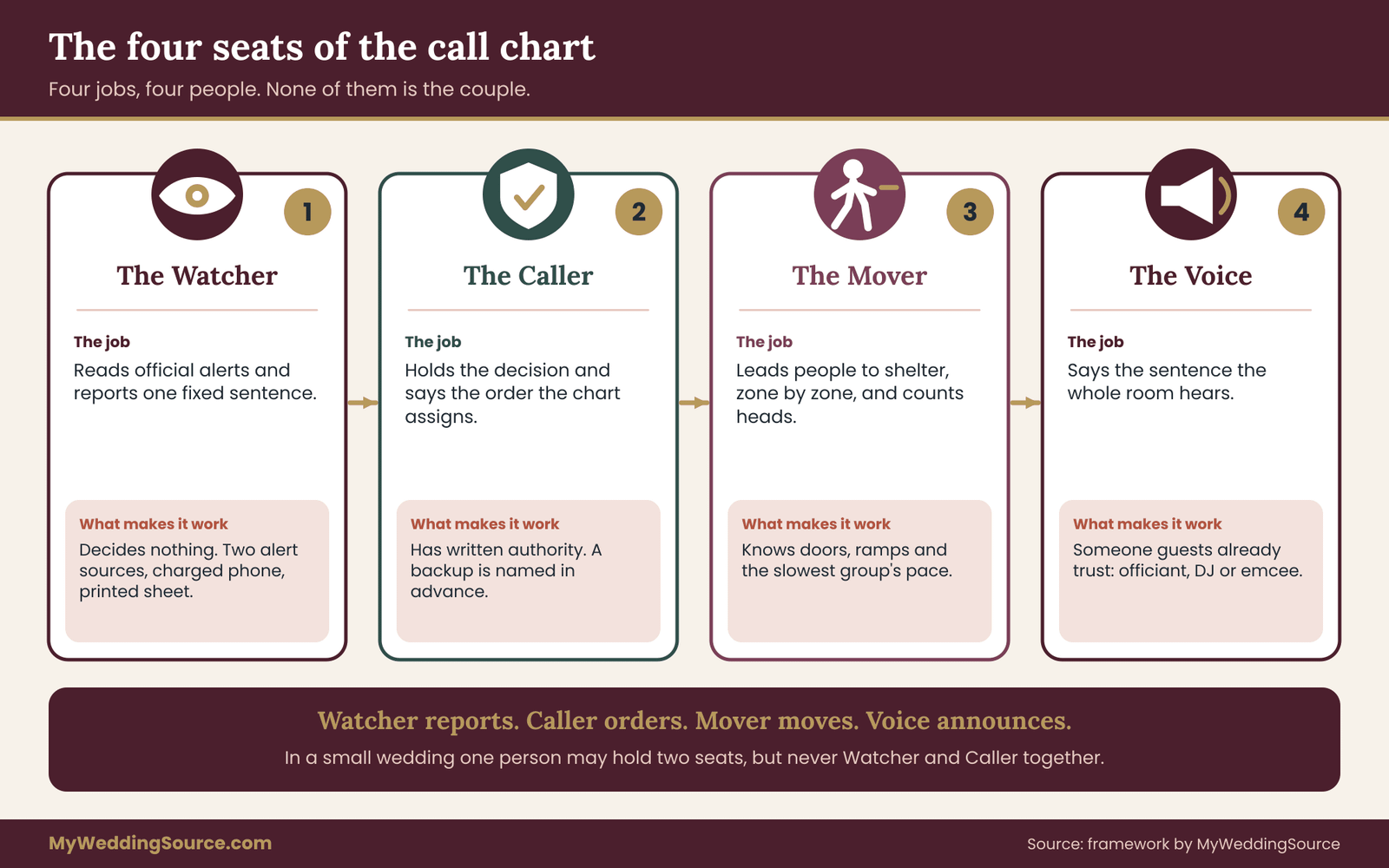
The method in this article is a four-seat call chart. Each seat has one job, and no seat is the couple. Here is what each person does and why the roles are split.
The Watcher monitors official alerts and nothing else. This person carries a phone with weather alerts enabled, a battery-powered radio or a second reliable source, and the printed trigger sheet. The Watcher does not decide anything. The Watcher reports, in a fixed sentence, which alert has been issued and for what area. Keeping this role separate matters because the person watching the radar is usually also tempted to interpret it, and interpretation is where delay creeps in.
The Caller holds the decision. When the Watcher reports a trigger, the Caller issues the order that the chart already assigns to that trigger. The Caller has been given written authority by the couple and by the venue to stop any wedding activity, including the ceremony, without asking permission. A backup Caller is named for the moments when the first is in transit, in the restroom or already helping someone.
The Mover leads the physical shelter response. This is often the venue’s operations lead or a senior member of the planning team. The Mover knows where each group goes, which doors open, who needs assistance and how long the walk takes. In larger weddings there are several Movers, one per zone, each with a high-visibility item so guests can find them.
The Voice says it out loud. A guest hearing “everyone please move inside” from an unfamiliar person may hesitate. A guest hearing it from the officiant, the DJ or the emcee, who already holds the room’s attention, generally moves. The Voice is a person the guests already trust to speak in that room, and the script is short, calm and scripted in advance.
The reason for four seats rather than one is bandwidth. Watching, deciding, moving and announcing are four different mental loads. Asking one person to do all of them in the first minute invites exactly the delay the chart exists to remove. At a small wedding one person can hold two seats, but never the Watcher and the Caller together, because the person who interprets the alert should not also be the person who has to act on it.
Seats can be filled by vendors, venue staff, planners or trusted guests. Where the venue has its own severe weather procedure, which many do, your seats should plug into it rather than compete with it. The venue’s staff almost always know the building’s shelter spaces better than you do, and a good first phone call is one that asks who the venue considers the decision maker for a weather stop.
If the answer is “the couple,” that is a gap to close, and the section on contract language later in this article explains how.
Finally, the seats are not a hierarchy of importance. They are a relay. The Watcher passes a sentence to the Caller, the Caller passes an order to the Mover and the Voice, and the Voice passes it to the guests. Each handoff is a single short phrase, and each person knows what the next one needs to hear.
The official alert triggers that start a storm warning response
A trigger is a specific, observable event that starts a specific action. The word matters because it removes judgment from the first minutes. “If it looks bad, we will move” is a feeling. “If the National Weather Service issues a severe thunderstorm warning that includes the venue, the Caller says the sheltering sentence” is a trigger.
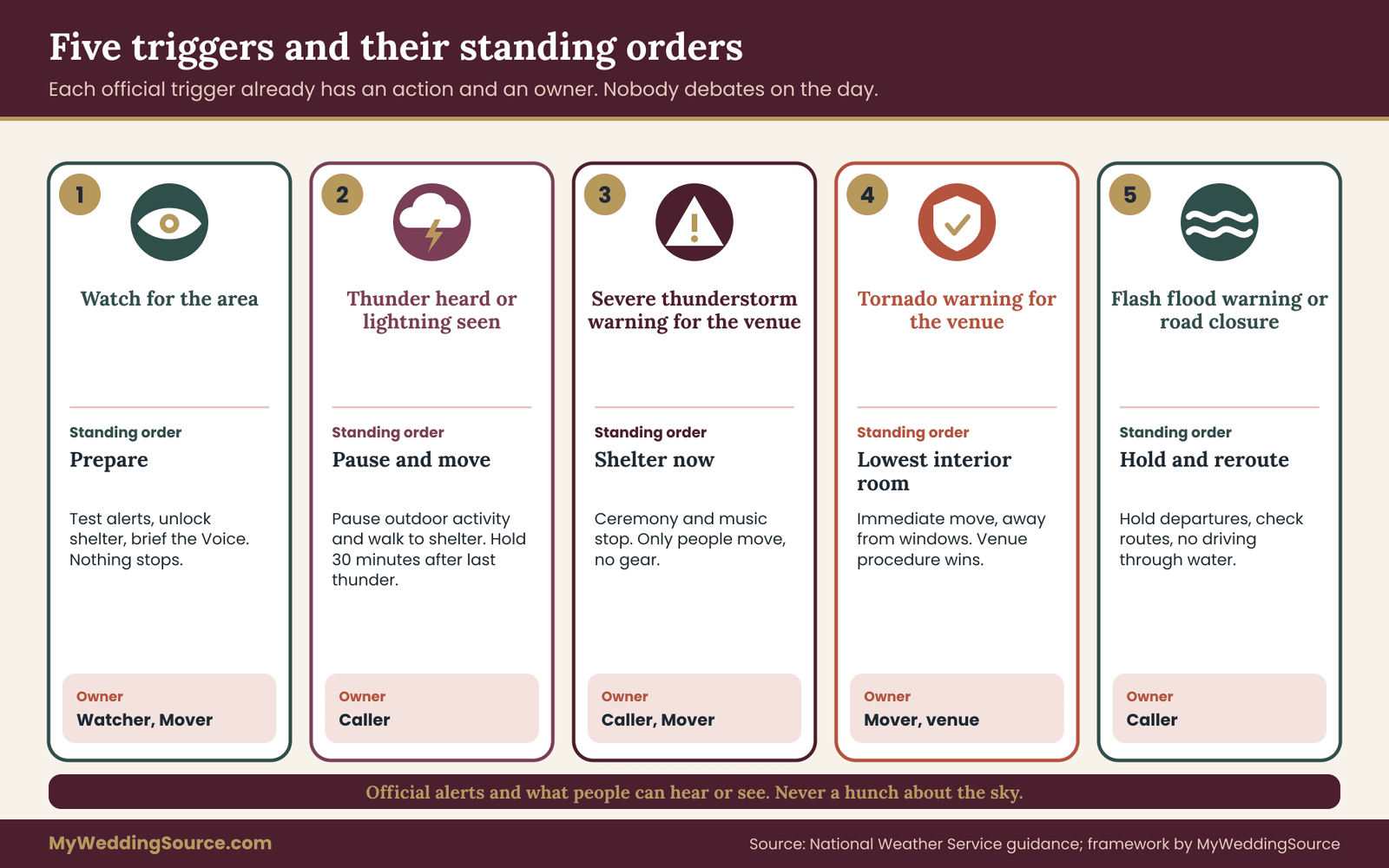
The chart in this article uses five triggers, arranged from earliest to most urgent. They are ordered by how much time they give you, not by how frightening they sound.
Trigger one: a watch is issued for your area on the day. This is a preparation trigger. Nothing stops. The Watcher confirms alerts are working on every device, the Mover walks the shelter route once and confirms doors are open, the Voice reviews the script, and the Caller checks that the backup Caller is within reach. A watch is also the moment to ask the photographer and the band whether their equipment can be unplugged and covered quickly.
Trigger two: thunder is heard or lightning is seen. This is a physical trigger that does not depend on any alert. The National Weather Service guidance is simple: if you can hear thunder, you are close enough to be struck, and outdoors is not a safe place. The standing order is to pause outdoor activity and move to the designated shelter. This trigger exists because lightning can occur before a storm warning is issued and sometimes outside the warned area.
Trigger three: a severe thunderstorm warning includes the venue. Everyone moves to shelter now. The ceremony stops. Music stops. Vendors secure equipment only if they can do it within the time budget, and otherwise leave it. This is the trigger most often hesitated over, because a thunderstorm warning feels less dramatic than a tornado warning. The wind speeds and hail it describes are enough to topple tents, launch chairs and arches, and hurt people.
Trigger four: a tornado warning includes the venue. This is an immediate shelter order into the lowest, most interior space available, away from windows. There is no securing of equipment. There is no waiting for the end of a song. If the venue has a tornado procedure, the Mover follows it, and it overrides the chart.
Trigger five: a flash flood warning or local road closure affects access. The ceremony may not need to stop, but arrival and departure plans do. The Caller decides whether guests stay put, whether shuttles run and whether anyone drives through standing water. The agency advice on flooded roads is blunt: turn around instead of driving through water of unknown depth.
Each trigger has one more feature: a source. The Watcher should know which source counts as official for each. Warnings come from the National Weather Service. Local emergency management offices may add instructions. A phone app that summarizes the weather is useful for situational awareness, but the chart should be written around official alerts so that the Watcher is not forced to decide which app is right.
It is also worth writing down what is not a trigger. Dark clouds are not a trigger. A parent saying “I think it’s blowing over” is not a trigger. A radar screenshot a guest shows the Watcher is not a trigger, though it may prompt the Watcher to check an official source. Keeping the list short and strict is what keeps the system believable.
Guests will tolerate a few pauses, but they will not tolerate a storm warning response that fires at every cloud. When every flicker of the sky causes a stop, people begin to resent the Caller, and resentment is the thing that eventually causes someone to ignore a real alarm.
The trigger sheet should fit on one printed page, in large type, with the five triggers in order, each with its standing order and its owner. Print two copies. Give one to the Watcher and one to the Caller, and keep a third with the venue contact. Phones die, apps crash and cell service often disappears when many people use it at once, which is why the sheet should exist on paper.
The wedding day digital contingency plan explains how to build an offline-first runbook for this kind of day, and the trigger sheet belongs inside it.
A standing order is a pre-approved action that the Caller may issue without further permission. The difference between a standing order and an instruction is that a standing order has already been agreed to by everyone whose consent would otherwise be needed, which is why the Caller can say it without hesitation.
Writing standing orders requires four decisions per trigger. First, what stops. Second, where people go. Third, who moves them. Fourth, what the Voice says. Everything else is detail.
For the preparation trigger, the order is mostly checking. Nothing stops, but the Mover is told to be near the shelter route and the Voice is told to stay within reach of the microphone. The Caller sets one decision point: if the next official update upgrades the situation, the standing order for the next trigger runs at once, with no further check-in.
For the thunder trigger, the order is a paused ceremony and a calm move. The Voice says a short sentence, the Movers open the way, and guests walk to the shelter at normal pace. The couple, the officiant and the wedding party move with everyone else. There is no ceremony “finish.” This is the order most likely to be debated, so it helps to put it in writing in a conversation with the officiant well before the day.
Many officiants are used to this and some are not, so it is better to find out early.
For the severe thunderstorm warning, the order is the same movement with more speed and no equipment securing beyond the immediate. Chairs stay where they are. Flower arrangements stay where they are. The only items that move are people, and anything a person can pick up in one hand while walking.
For the tornado warning, the order is shelter immediately. The Voice uses a different, shorter sentence. The Mover directs people to the lowest floor, interior rooms and corridors, away from windows and large roofs. Guests are asked to crouch low and cover their heads if the Mover or venue procedure says to. The chart does not substitute for the venue’s own tornado procedure, and where the venue has a basement, a storm room or a designated space, that space wins.
For the flash flood trigger, the order concerns movement and not shelter. The Caller holds departures until the Mover confirms routes, redirects parking and checks with the venue about access road conditions. Where the venue is on a floodplain, this is a conversation to have long before the wedding, not on the day.
A good standing order also names its end. When does the pause lift? For lightning, the commonly cited National Weather Service guidance is to wait 30 minutes after the last thunder before going back outdoors. For warnings, the answer is that the storm warning has expired or been canceled and the Watcher has confirmed no new warning covers the venue. The Caller, not the Voice and not any guest, says when activity may resume.
One practical point: the order must be sayable. If the Voice has to read a paragraph, the paragraph will not be read. A good sheet gives each trigger one sentence for the Voice and one sentence for the Mover, large enough to read at arm’s length in poor light. For example: “We are pausing the ceremony and moving inside for everyone’s safety.
Please follow the staff members with orange vests.” That is a sentence a person can say with a steady voice while looking at a crowd. Rehearse it aloud once, because a storm warning is a poor moment to hear your own voice for the first time.
Because the standing orders are agreed in advance, the Caller’s actual job on the day is small. Hear a sentence, say a sentence, and confirm that the Mover has begun. That smallness is deliberate. A Caller who has to weigh the aesthetics of the ceremony against the sky is doing the job the chart was meant to take away.
If you want the broader view of how a ceremony is cued, the wedding ceremony cue sheet guide shows where a pause line and a restart line fit among the officiant, music and reading cues, and the storm warning pause is easiest to run when it already has a place on that sheet.
The 30-minute rule and why wedding timelines fight it
Lightning is the hazard that most often collides with a wedding schedule, because lightning does not follow the alert system’s rhythm. A warning has an issuance time and an expiration time. Lightning does not. It can strike before the first official alert and after the last one, and the National Weather Service guidance is built around the sounds and sights you can observe directly.
The widely taught rule is that people should move to a safe place when thunder is heard and should wait about 30 minutes after the last thunder before returning outdoors. Wedding timelines collide with this at once. A 30-minute hold can push a ceremony into a golden-hour photography window, shorten a cocktail hour, bump a dinner service or leave a band playing an empty tent.
The right response is not to shorten the hold. A storm warning does not care about the dinner schedule, so the schedule has to bend. It is to build a timeline that can absorb it. A ceremony scheduled with a meaningful buffer before the next fixed commitment, such as dinner service, has room to pause. A ceremony that has no buffer and is followed by a hard venue curfew has to make a choice in advance: move it indoors, move it earlier, or accept a shortened schedule if the pause happens.
Ask the caterer, the photographer and the band one question: “If the ceremony pauses for 30 to 45 minutes, what moves and what is lost?” Their answers give you a priority list for compressing the evening if you need to. A caterer might hold appetizers, or plate food later.
A photographer might shift portraits to the end of the evening. A band might shorten its first set. None of those are disasters, and all of them are easier to accept if you chose them in advance than if you are improvising under pressure.
The vendor timeline is the right home for this conversation. The wedding vendor timeline guide is useful for seeing where the buffer needs to sit, and a one-line note on each vendor’s schedule, saying “pause allowance: 45 minutes before dinner moves,” is enough to make the difference.
There is also a human side. Guests who have been moved into a hot, crowded barn or lobby with no information become anxious faster than guests who know what the next step is. The Voice should plan a second announcement, perhaps ten minutes after the first, that says what is being monitored, when the next update will come and what guests can do in the meantime. Water, restrooms and a place for older relatives to sit matter more than anything on the decor list at this point.
Finally, accept that some hours of some days will not be suitable for an outdoor ceremony. In regions where afternoon thunderstorms are common in summer, the choice of ceremony time is itself a storm warning decision, made months in advance. The same applies in tornado-prone seasons. A morning or early-afternoon ceremony that finishes before the typical storm window is a quieter, cheaper protection than any amount of tent.
The shelter responsibility chart for a storm warning
The trigger sheet answers “when.” The shelter responsibility chart answers “who takes whom, and where.” It is the second half of the deliverable and it is the half most weddings are missing. Without it, a storm warning becomes a crowd of well-meaning people walking in six directions. Telling guests to “go inside” is an instruction. Knowing that Door B opens onto the lobby, that the lobby holds 90 standing, that Priya from the planning team is walking the ceremony rows and that Mr. Alvarez’s wheelchair needs the side ramp is an operation.
Start by dividing the outdoor space into zones. A zone is a group of people who will leave together and who have one Mover. A ceremony lawn with 120 chairs might be two zones, left and right, or three, with the wedding party and family as their own. A cocktail area with scattered standing groups is usually one zone with a Mover at each exit. Vendor areas, such as the DJ position, the photographer, the kitchen tent or the bar, are their own zone, with the vendor’s lead as the Mover.
Next, give each zone three facts: its shelter, its route and its owner. The shelter is a specific space inside a substantial building, not “the venue.” The route is the path to it, including which doors, ramps or steps. The owner is a named person who has walked the route at the venue walk-through and who knows how long it takes.
The chart then adds four special groups that need a different answer from the general crowd. Guests who use wheelchairs, walkers or canes and need ramps or elevators. Children and the adults responsible for them, particularly those who are separated from parents during a ceremony, such as flower children or ring bearers. Older relatives and anyone with a medical need that makes a fast walk difficult. And the wedding party, the officiant and the couple, who are in the front, in formal clothing, often with long trains or unfamiliar shoes.
For each special group, assign a specific escort, not a general responsibility. “A family member will help Grandpa” is not an assignment. “Marcus walks Grandpa to the side ramp and stays with him in the lobby” is. If a person is assigned as an escort, they are also excused from every other role on the chart, including photography and toasts, for the duration of the pause.
Rehearse a route once, in ordinary shoes, at the venue walk-through. The route that matters is the one you will use under a storm warning, in wet shoes, with a crowd. The guide to the wedding venue technical walkthrough explains what to measure and what to ask at that visit, and the shelter route is a good extra item to add: count the doors, check which ones lock from the outside, find the ramps, and time the walk at a slow pace.
Here is a compact way to hold the whole chart in mind, in words rather than a grid. Every zone has a shelter, a route and an owner. Every special group has an escort. Every vendor lead knows whether they are leaving equipment or staying with it. And the Caller, the Watcher and the Voice each know which zone they will stand near, so that the three of them are not clustered in one place when the order is given.
There is also a head count. The Mover for each zone should know roughly how many people are in it and, once in shelter, should do a simple count or a visual sweep. This is not a roll call and does not need names. Its purpose is to catch the guest who went to the restroom, the child who wandered to the garden, or the vendor who stayed with a camera.
If someone is missing, the Mover tells the Caller, and the Caller decides whether to send anyone to look. In practice the answer is almost always that no one goes outside during an active warning, and the missing person is located by phone.
Finally, assign shelter capacity. A shelter chart that ignores capacity is not a storm warning chart, it is a hope. Walk through the venue and estimate how many people can stand or sit in each shelter space without crowding the exits. If the total capacity of the sheltered areas is smaller than the headcount, that is a finding, not a failure.
It tells you that either the guest list, the ceremony location or the shelter choice needs to change, and it is much cheaper to learn that six months out than on the day.
The venue itself often holds relevant records, including occupancy limits and fire-code postings for each room. These numbers are set by local authorities and the venue, and they may be lower than what feels comfortable for a short, emergency stay. Ask the venue for the posted capacity of each candidate shelter room and treat it as a ceiling rather than a target.

Where guests can and cannot shelter, and the move time budget
This is the section that people often want to skip, because it spoils the picture. Still, every storm warning plan has to face it. The hard truth is that most of the things that make an outdoor wedding beautiful are not safe places during a thunderstorm.
According to National Weather Service guidance, no place outside is safe when thunderstorms are in the area. The safe options are a substantial, fully enclosed building with plumbing and electrical wiring, or a hard-topped metal vehicle with the windows closed. Open structures do not qualify. That list of things that do not qualify matters a great deal at weddings: tents, canopies, pergolas, gazebos, pavilions, open-sided barns, porches, dugouts and covered patios.
They may keep the rain off. They do not protect against lightning, and a tent or canopy can become dangerous in strong wind.
This has a direct consequence for planning. A rain tent is a rain plan, not a storm plan. A tent that is perfect for a drizzle can be the wrong place to be during a storm warning, and the tent company, the venue and the couple often assume it is the shelter. The chart should say explicitly where people go when the tent is not safe, and the tent should be on the list of things people leave, not things people stay in.
Tornado situations add another layer. Safe shelter from a tornado is the lowest floor of a sturdy building, in an interior room without windows, such as a hallway, bathroom or closet. Large-span rooms with big roofs, like gymnasiums, barns and ballrooms with wide ceilings, are weaker choices, and vehicles and temporary structures are not safe.
The practical way to handle this is to ask the venue directly: “Where do you send people during a tornado warning, and how many can it hold?” If the venue has no answer, that is a significant piece of information.
Many outdoor venues are historic barns, farmhouses, gardens or parks with few substantial buildings. Some have none at all. If the nearest substantial building is a short walk away, the chart uses it. If the nearest is a ten-minute drive, the chart might include vehicles as shelter for lightning, with the Mover coordinating who rides with whom, though this is a poor option for a tornado warning and should be discussed with the venue.
If there is genuinely nowhere appropriate, the right answer may be to change the ceremony site or hold it indoors. That is a hard conclusion, and one worth reaching on a walk-through rather than during a storm.
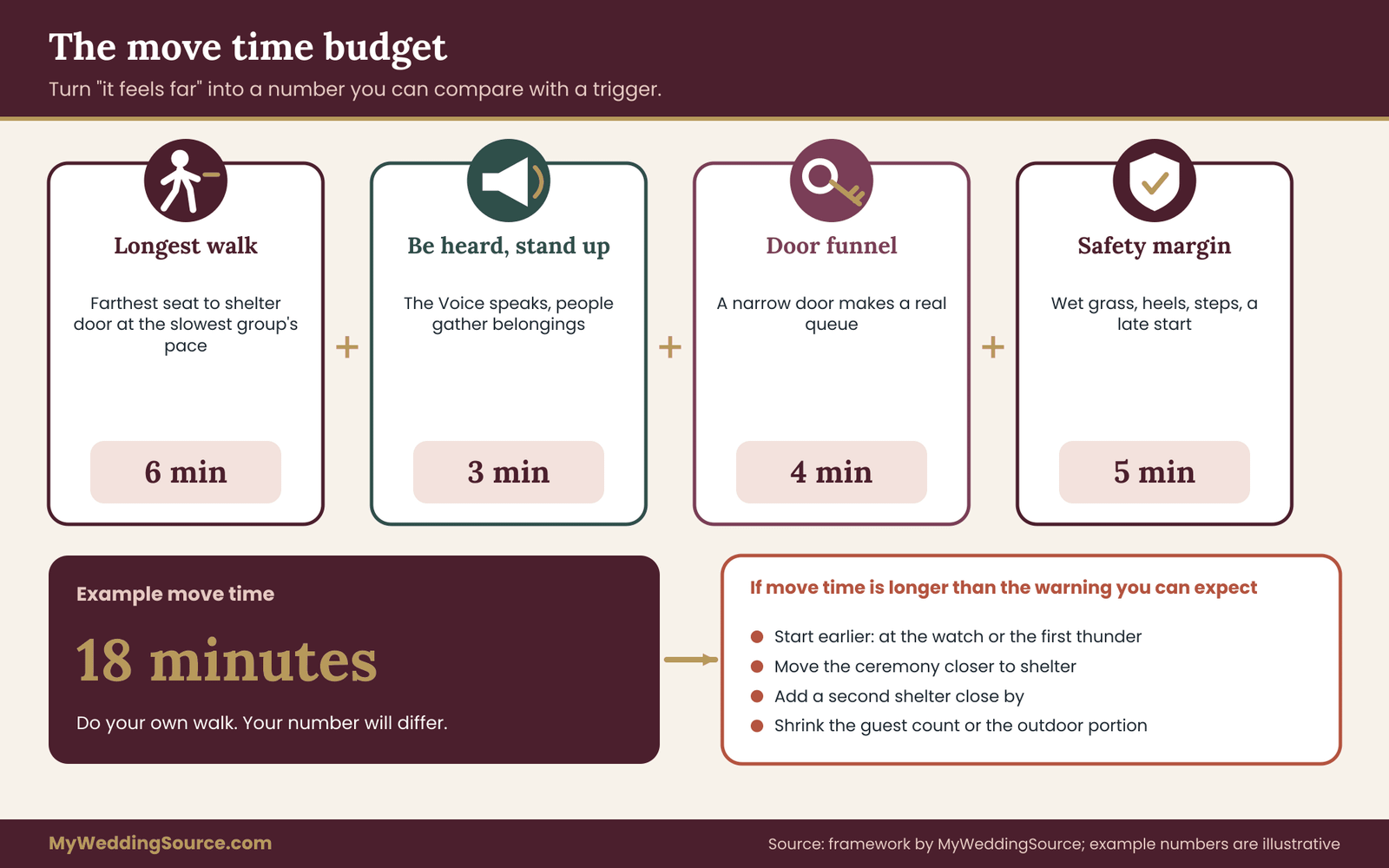
Now to the second half of the section: time. A shelter is only useful if people can reach it before the hazard arrives. The move time budget is a simple calculation you do once, in advance.
Start with the longest walk, from the farthest seat or position to the shelter door, using the pace of the slowest group, not the average one. Add the time it takes the Voice to be heard and for people to stand and gather their belongings, which is often two or three minutes in a large group.
Add a few minutes for the group to funnel through the doors, because a door that fits a handful of people at once has a real queue. Add a safety margin. The total is your move time.
Then compare it to how much warning you can reasonably expect. A warning may arrive with some lead time or very little. Lightning can arrive with none. This comparison tells you which triggers can realistically be handled at the point of the storm warning and which have to be moved earlier. If your move time is twelve minutes and a typical severe thunderstorm warning might leave you less than that, then the preparation trigger or the thunder trigger has to start the movement, not the storm warning itself.
This is where decisions often change. A couple who finds that their ceremony lawn is a twelve-minute walk from shelter has three real options. Move the ceremony closer to the shelter. Add a second, closer shelter such as a vehicle plan or a shuttle. Or accept a lower threshold, deciding that the ceremony starts the move at the first watch with active storm cells nearby, not at a storm warning. None of these is wrong. They are different tradeoffs, and the budget is what makes the tradeoff visible.
A worked example appears in a later section. For now, the principle is that the move time budget turns an abstract feeling (“it is far”) into a number you can compare to a trigger. It is also the single most useful piece of evidence to bring to the venue, the planner or the officiant when you ask for a change. “Our slowest-group move is about twelve minutes” is much harder to dismiss than “I’m worried about the walk.”
One more point on vehicles. If the chart names cars or shuttles as a lightning shelter, the vehicles should already be parked close, with drivers present and doors open. Nobody should drive toward or through a storm to reach a better shelter, and a drive across the property during a storm warning is a separate decision the Caller should settle before the day, not during a storm warning.
Finally, think about what guests are carrying. Formal clothing, heels, long dresses and canes all slow people down. Rain adds slippery grass and wet steps. Have the Movers think about the surface of the route in the rain, not just in the dry, and consider placing a few staff members at steps, thresholds and ramps. An umbrella is not a reason to wait for a storm warning to start, and a standing umbrella tray at the shelter door is a small, useful thing to arrange.
Getting a storm warning to the Watcher: sources, signal and backups
The best call chart in the world fails if the Watcher does not hear about the alert. A storm warning that nobody hears is the same as no storm warning at all. This section is about the plumbing: where official warnings come from, how they reach a person standing in a field, and what to do when the usual route fails.
Start with the source. In the United States, severe weather warnings are issued by the National Weather Service, and the same warnings appear through several channels. The agency’s website shows the current alerts for a location, and a forecast page for the venue’s exact address is more reliable than one for the nearest large city, because warnings are drawn for specific areas.
The Storm Prediction Center publishes outlooks that show where severe storms are most likely on a given day, which is useful in the days before the wedding as an early signal.
Wireless Emergency Alerts are short messages that compatible phones receive when the phone is in a warned area, including for tornado warnings and flash flood warnings. They do not require an app. They depend on phone settings, which users can change, and on cell coverage. At a wedding, that means the alert may reach many phones at once, which is helpful, but it also means some guests may have turned alerts off, and the Watcher cannot rely on it alone.
NOAA Weather Radio All Hazards is a dedicated radio service that broadcasts warnings continuously. A battery-powered receiver with an alert tone costs little compared with the rest of a wedding budget and does not depend on cell towers, which is exactly why it is useful in rural venues and crowded parks. Ask whether the venue already has one, and if not, consider borrowing or buying one for the Watcher.
Local emergency management offices and many counties run notification systems that people can sign up for with a phone number or address. Some venues are registered with these. Ask the venue whether it receives local alerts and who at the venue sees them. A venue that monitors the weather for its own staff can act as a second Watcher, and the two should agree on a shared phrase for confirming an alert.
Choose redundancy deliberately. The Watcher should have at least two independent routes: for example, a phone with official alerts turned on and a battery weather radio. If the venue has a lightning detection system or its own severe weather procedure, that counts as a third. The principle is simple: the alert should reach the Watcher even if cell service drops and the phone is in a pocket.
Three practical rules help.
First, the Watcher keeps a phone charged and carries a small battery pack. A Watcher whose phone dies at four o’clock has no function at five.
Second, the Watcher reads the official alert text, including the area it covers and its end time, and does not paraphrase from memory. A warning for a neighboring county is not a storm warning for the venue, and the polygon drawn on the map matters. The Watcher should know the venue’s county, its nearest town and any named features in the alert text.
Third, the Watcher reports in a fixed sentence: the type of alert, the area, and whether it includes the venue. “Severe thunderstorm warning, our county, includes the venue, valid until six fifteen.” Nothing more. The Caller then says the order. This keeps interpretation and argument out of the first minute, and it works the same whether the Watcher is a seasoned planner or a cousin who volunteered.
The week of the wedding has its own routine. Several days out, the Watcher and the Caller check the outlook for severe storm risk. The day before, they confirm the trigger sheet is printed, the shelter is open and the Movers know their zones. On the morning, they check again, and a short text to the vendors, with the Caller’s name and number, tells everyone who is making the decision. Contact lists and backup communication matter here too, because cell networks are often overloaded just when an alert comes.
One more point about technology: do not let a guest’s phone alert become the system. Phones in a crowd sometimes all sound at once, which can start movement without the Caller. That can be a good thing if the people are moving toward the right shelter, and a bad thing if they scatter. The Voice should be ready to speak immediately when guests’ phones sound, so the room hears one calm instruction instead of fifty different interpretations.
Everything above assumes the Caller has the authority to stop a wedding. Without it, a storm warning is just information. That authority lives in documents, not in goodwill, and it often has to be created.
Start with the venue contract. Read the sections on inclement weather, safety, force majeure and the venue’s right to modify or stop an event. Many venues reserve the right to halt an event when conditions are unsafe, and some name the venue manager as the decision maker. That can be good, because it comes with experience.
It can also create a conflict if the couple’s chart names a different Caller. Resolve this before signing, in writing: either the venue manager is the Caller for weather stops, or your Caller is, with the venue’s agreement that its staff will follow the chart.
Ask the venue specific questions and write the answers down. Where is the designated shelter, and what is its capacity? Is it available at all hours of the event, or locked at certain times? Who at the venue monitors weather, and do they have the authority to move guests? Does the venue have a written severe weather procedure, and can you have a copy?
Is there a charge for using indoor spaces during an emergency, and does the contract commit to them being available? These are routine questions for professional venues, and the answers tell you a lot about how much to rely on them.
Next, vendor agreements. A vendor contract might say nothing about weather stops, which leaves open whether the vendor can leave an unsafe site, whether equipment stays outside, whether a delay triggers overtime and who pays for lost time. A short clause or an email confirmation can settle these. The conversation is not adversarial. Good vendors want clarity too, because the alternative is an argument during a storm. The wedding vendor contract guide covers the terms worth checking in any vendor agreement, and weather stops fit naturally beside cancellation and overtime.
Rental companies deserve their own attention. A tent, a dance floor or a lighting rig typically comes with a wind limit or a set of conditions under which the company will not allow it to stay up, and it may require staff to remove or secure it. Ask what the company’s safe-wind threshold is, who decides when the structure is unsafe, whether the rental contract assigns that authority to the company or to you, and what happens when the company says to evacuate.
The wedding rental planning checklist is helpful for the wider set of questions to ask about rented structures and equipment.
Think about insurance carefully, and cautiously. Some event insurance policies cover cancellation or interruption for certain weather events and exclude others. Terms differ widely, and they often require specific conditions to be met. It is not possible to say here what any policy covers. The practical step is to read the policy language on weather, ask the insurer or the broker how an interrupted ceremony or an evacuation would be treated, and keep records. If the policy requires notice within a deadline, put that deadline on the calendar.
Finally, deal with the authority of the Caller. A short written authorization, signed by the couple and, if possible, acknowledged by the planner and venue, is enough. Put the words storm warning in it, so no one can argue later about what the Caller was allowed to do. It might say that the Caller is authorized to pause or stop any activity and to direct guests and vendors to shelter in the event of a storm warning, and that the couple will not countermand that decision.
It need not be a legal document. Its purpose is to give the Caller social and practical cover. A guest who objects can be told, truthfully, that the decision is not the Caller’s alone, that it was agreed in advance by the couple and that it follows official alerts.
It also helps to tell your officiant, photographer and DJ directly. A short conversation, something like “If the Caller says we are pausing, we pause, and we will restart together when the Caller says so,” is quick and prevents the most common friction. A vendor who has been told in advance is more likely to cooperate than one who is surprised.
Last, consider refunds, credits and rescheduling in the case where a storm cancels part of the event. Contracts vary, and most vendors will not refund a service that was provided in part. Knowing this ahead of time keeps the Caller from feeling pressure to protect the schedule for financial reasons. The couple’s willingness to accept a loss in the worst case is what makes a quick decision possible in the moment.
A worked case: one storm warning at a farm venue
The following example is invented for illustration. The names, numbers and timings are made up to show how the chart works, and they are not a record of a real wedding or a prediction for yours.
Imagine a couple, Dana and Theo, marrying at a working farm. There are 110 guests. The ceremony is on a lawn beside the barn at four o’clock, followed by cocktails on the same lawn, and dinner in an open-sided tent at six. The farmhouse is a substantial building about a three-minute walk from the lawn. The barn is large, open on one side and has a hayloft. A parking field is across a gravel lane.
Before the day. Dana and Theo name Rosa, their planner, as the Caller, and the venue’s owner, Ben, as the backup. Rosa is not a family member and has run outdoor events before. Theo’s cousin Imani is the Watcher. Ben’s farm manager is the Mover for the lawn, with two staff members as zone Movers. The DJ, Carlos, is the Voice because he already holds the microphone.
At the venue walk-through, Rosa asks Ben where people go in a severe storm. Ben says the barn. Rosa asks whether the barn is a safe shelter in lightning, and Ben, to his credit, pauses and says the farm has always used the farmhouse and the hayloft was never meant for people. They agree that the farmhouse living room and kitchen are the shelter for thunder and severe thunderstorm warnings, with the basement for a tornado warning.
Rosa writes down the capacity Ben thinks is safe, which is about 60 people in the main floor rooms and 40 in the basement, and realizes the total does not cover 110 guests.
That finding changes the plan. The couple decides to keep the ceremony outdoors but agrees to a shorter, 20-minute ceremony, and to use the two shuttle vans parked near the farmhouse for the second wave of guests during a lightning pause. For a tornado warning, the venue’s basement and the neighbor’s storm cellar, which Ben has arranged, are the options, with staff directing guests in two groups.
The move time budget. Rosa times the walk from the farthest chair to the farmhouse porch at the pace of Dana’s grandmother, who uses a walker. It takes about six minutes. She adds three minutes for the Voice to be heard and people to stand, and four for the farmhouse doors, because the front door is narrow and the side door is a ramp. She adds a margin of five minutes. The total is about eighteen minutes.
She then compares this with a typical warning lead time and decides that eighteen minutes is too long to wait for a storm warning. So the thunder trigger and the watch-with-active-cells trigger will start movement earlier, and the ceremony is scheduled to finish by four-thirty, well before the typical late-afternoon storm window in that region.
The day. At noon, the National Weather Service has a severe thunderstorm watch in effect for the county. Imani checks that alerts work on two devices and the weather radio is on. Rosa texts the vendors with her number and the sheet’s one-sentence version of the rules. The Mover walks the route and opens the side door.
At 3:35, Imani sees an official update showing a line of storms west of the county. At 3:50, she hears distant thunder. Under the chart, thunder is a trigger. She tells Rosa the fixed sentence: “Thunder heard, no warning yet.” Rosa says to the Voice, “We are pausing seating and moving inside.” The guests, who are still arriving, are directed to the farmhouse and the vans. The ceremony does not start.
At 4:10, a severe thunderstorm warning is issued for the county, including the farm. Imani reads it out. Rosa confirms the order is already running. Carlos tells the room that the storm warning has been issued, that the ceremony will resume when it is safe, and that the next update will be in ten minutes. The guests settle into the farmhouse and a few ride out the squall in the vans. Wind rips two umbrellas from the lawn, and a decorative arch falls over, but nobody is outside.
At 4:35, the storm passes, thunder fades and the storm warning expires at 4:45. Under the chart, the lightning hold is about thirty minutes from the last thunder, and Imani logs the time of the last rumble. The ceremony restarts at about 5:20, and the couple chooses to shorten the cocktail hour and move dinner by fifteen minutes. The caterer, who had been told about a possible forty-five minute pause, adjusts without fuss.

What the example shows. The storm warning itself was ordinary. What made the day work was that the response to a storm warning had been written down. First, the Caller’s decisions were small, because the chart had made the big ones. Second, the findings that mattered came from the walk-through, not from the weather: the barn was not a safe shelter, and the shelter capacity was smaller than the guest list.
Third, the move time budget moved the start of the response earlier than the storm warning. Fourth, the Voice was already trusted by the room. Fifth, the vendors adjusted because they had been told in advance.
What could have gone differently. If Ben had said “the barn is fine,” the chart would have sent 110 people into an open-sided structure with a hayloft during a thunderstorm. If Rosa had been the Watcher and the Caller, she might have been mid-conversation with the florist when the thunder came.
If Dana’s grandmother had had no named escort, the staff might have moved the general crowd first and left the slowest group for last. If the DJ had been told nothing, the pause might have been announced by a guest, and the room might not have listened.
Now consider the harder version of the same day, where the storm warning arrives with no lead time. The thunder trigger never fires because the wind and rain come first, and Imani’s phone sounds at 4:05 with a tornado warning. The standing order is shelter immediately. The Voice uses the short sentence.
The movers send the lawn zones to the basement and the neighbor’s cellar. Nobody secures anything. Nobody waits for the end of the vows. A few guests grumble about the dress and the shoes. A few days later, no one remembers the grumbling, but the couple remember that they did not hesitate.
This second version also shows why the chart specifies different shelter locations for different warnings. A farmhouse living room is a reasonable place to wait out lightning. For a tornado, the basement is better, and it only works if someone has opened it, knows its capacity and has decided who goes there first.
Finally, notice what the example does not include. There is no forecast beyond official alerts. There is no radar interpretation. There is no argument. There is no attempt to estimate whether the storm will miss the farm, which is exactly the kind of guess the chart is designed to remove. The Watcher’s job was to read and report, and the Caller’s job was to say the sentence.
Every part of the response to the storm warning was settled before the afternoon began. When a storm warning is issued for the place where a hundred and ten people are standing, the simplest chart is the one that works.
If you adapt this example to your own wedding, keep the structure and change every number. Your lawn, your shelter, your slowest group and your region’s storm season will produce different times, and the point of the exercise is to produce your own figures, not to borrow someone else’s. The wedding planning checklist can hold the finished chart alongside everything else that needs an owner on the day, and a copy of the trigger sheet in the planner’s binder is worth more than a sentence in an email.
Pressure on the Caller: how a storm warning decision gets delayed
A chart removes ambiguity, but it does not remove people. Every storm warning decision lands on a person, and that person needs support. The Caller will face pressure, and most of it will be kind, reasonable and wrong. Knowing the common forms in advance, and having a sentence ready for each, is a large part of what makes the chart work.
The couple
The couple are the hardest case, because the wedding is theirs and the moment is unrepeatable. The usual pressure is not an order but a hope: “Can we just do the vows first?” or “It looks like it is moving around us.” The answer is that the couple already decided this when they signed the authorization. A kind and firm sentence is enough: “You asked me to make this call, and the standing order says we go. I will tell you the moment it is safe to come back.”
It helps to prepare the couple for how it will feel. A paused ceremony feels like a loss, even when it is the right call. Tell them in advance that the first ten minutes will feel awful and that the second ten will feel like relief, because nearly everyone is glad afterwards that nobody was standing under a tent frame in strong wind. Tell them also that the wedding does not end. The ceremony resumes, and many couples find that the story of the pause becomes part of the day’s warmth.
The officiant, photographer and wedding party
Officiants and photographers are trained to keep the moment going. A photographer in mid-sequence may ask for one more minute. A groomsman may want to go back for the rings. An officiant may want to complete a sentence. These are the quiet delays that add up.
The fix is the advance conversation. In the week before, tell each of them that the Caller’s sentence is final, that equipment and moments can be recovered later and that the pause is not a judgment about their work. A photographer who has been told will usually be the first person through the door with a camera bag.
For the wedding party, brief them as a group at the rehearsal or in the morning. They are the most visible people at the ceremony, and if they move promptly, the guests follow. If they stand around waiting to see what the couple will do, the guests will too.
Family and guests
Parents and grandparents often carry a calm confidence that comes from decades of storms that did not cause harm. “We’ve seen worse” is one of the most dangerous sentences at a weather stop, because it sounds like experience. The right reply is not an argument but an assignment: “I need your help getting Grandma to the farmhouse. Can you walk with her?” People rarely refuse a job that makes them useful.
For guests generally, set expectations ahead of time. A line on the wedding website and a small sign at the entrance, in plain wording, can say that the ceremony may pause for weather, that staff will direct guests to indoor shelter, and that a short announcement will explain what is happening. Guests who know the system exists are calmer when it runs. The guide to wedding guest care planning discusses the needs of children and older relatives, and both groups deserve a named escort in your chart.
Some guests will want to leave, and they are entitled to. Say so. A guest who prefers to drive home should be told clearly that the decision is theirs, that the Caller cannot guarantee conditions on the road and that official alerts apply to driving as well as to standing outside. The Caller does not try to hold anyone, and does not argue.
The venue and vendors
Venue managers sometimes want to preserve the event and the reputation of the site, and vendors want to protect equipment and income. Both are legitimate. Both can delay a call. The chart’s answer is that the authority has already been settled in the contracts, and that the Caller is simply applying agreed terms.
If a vendor resists, the Caller can offer one concrete choice: “You can leave the equipment and move now, or stay with it and accept the risk. I am not asking you to leave your gear, but I am asking everyone else to go.” Vendors working for the couple are not employees of the Caller, and the Caller cannot make them leave.
What the Caller can do is make clear that the venue’s shelter is available and that no one will be blamed for choosing it. If a vendor insists on staying outside during a lightning or tornado trigger, the Caller or the planner notes it and moves on, because the rest of the room needs to be moved.
Scripts that help
Short scripts reduce friction. Each one assumes a storm warning has been issued and the standing order is already running. Here are a few, offered as starting points, not fixed wording.
To the couple: “This is the moment we planned for. We are moving. I will bring you back as soon as it is safe.”
To the room: “Please stop where you are, and follow the staff in orange vests to the farmhouse. We will resume when the National Weather Service warning has passed.”
To a reluctant guest: “I understand. The decision was made in advance and it follows official alerts. Would you help me by walking with this group?”
To a vendor: “We are following the storm warning. If you can secure your gear in the next minute, please do. Otherwise, leave it and come in.”
To the Watcher, afterwards: “Thank you. What time was the last thunder, and is there any new alert for our area?”
None of these requires charisma. They require repetition and calm. A Caller who says the same short sentence three times, in the same tone, usually ends the discussion.
Why the pressure never really goes away
It is worth acknowledging a hard fact about this kind of decision. If the Caller calls it correctly and the storm turns out mild, people say it was unnecessary. If the Caller waits and the storm is severe, people say it was too late. In both cases, the Caller is judged on an outcome the Caller could not control. That is exactly why the decision belongs to a pre-agreed rule and not to a person’s read of the sky.
The couple can make this explicit. A sentence in the authorization, such as “We understand that a storm may turn out milder than the alert suggested, and we will not hold the Caller responsible for acting on it,” protects the relationship between the couple and the person they asked to do an uncomfortable job.
Time pressure from the schedule is another quiet force. A cake that needs to be cut at a set hour, a hired car with a fixed pickup, a band whose set is paid by the hour and a venue with a strict curfew all push toward starting again before it is safe.
The best protection is the pause allowance on the vendor timeline. The wedding vendor timeline guide is a good place to record how much slack each vendor can absorb, and a Caller who has those numbers in hand has an answer to the schedule question without improvising.
Finally, remember that the people with the most to lose from hesitation are the ones with the least say: children, older guests, anyone who cannot move quickly. The chart exists to protect them, and the Caller can keep that in mind. A moment of embarrassment for adults who are fit to run is a very small price against a delay that affects people who cannot.
Alternatives to a named Caller
The four-seat chart is not the only way to handle a storm warning, and it is not right for every wedding. Here are the realistic alternatives and what each one trades away.
Let the venue decide. Many professional venues have trained staff and written procedures, and for a wedding held entirely on their grounds this can be the best answer. The trade is control and clarity. You must confirm in writing that the venue’s decision includes pausing a ceremony, and you must ask who the venue’s decision maker is at the moment of the alert.
The risk is a venue that is quick to protect its equipment but slow to interrupt guests, or one whose staff are stretched thin at the exact moment the alert comes.
Hire a professional. A planner or a day-of coordinator with severe-weather experience can fill the Caller seat, and some event safety professionals can supply a weather service or an on-site monitor. This adds cost and does not remove the need for a shelter chart, but it adds experience and detachment. Ask what the person’s authority is under your contract, and who steps in if they are unavailable.
Move the ceremony indoors. The simplest and most reliable approach is to hold the ceremony in a substantial building and use the outdoors for photographs and cocktails only. This removes the hardest decision, because the highest-stakes ten minutes of the day are indoors. The cost is the loss of the outdoor setting, which may be the reason for the venue. A middle path is to hold the ceremony outdoors only when the forecast is clearly quiet, with a firm indoor switch time the evening before.
Schedule around the storm window. In regions with predictable afternoon storm seasons, an early ceremony reduces exposure without any alert system at all. The tradeoffs are a fixed date, guest travel time and the sun angle for photographs. This is a design choice, not a response, and it works well alongside the chart.
Shorten or split the outdoor portion. A brief outdoor ceremony with a short guest count lowers move time. A split plan, where the ceremony is short and the rest of the evening moves indoors, reduces exposure. This is practical for small weddings and for venues with limited shelter.
Use an official-only trigger. Some couples prefer a plain rule: any official severe weather warning for the venue moves everyone, and no one interprets anything else. This is a simplified version of the chart. It is easy to explain and easy to follow. Its weakness is lightning, which can occur without an alert, so it still needs the thunder trigger.
Cancel or postpone in advance. Where the forecast shows a high risk of severe storms, the Caller or the couple might decide in the preceding days to relocate or reschedule. This decision uses the same logic as the chart, applied to the outlook, and it should be made with the vendors and the venue, because of contracts and deposits. It is rarely free, which is why it is the last alternative, not the first.
None of these is perfect. A named Caller with a chart is the most flexible, and it combines well with the others: a professional as the Caller, an indoor ceremony as the default, an early start as a design choice.
Failure conditions: when a storm warning chart breaks
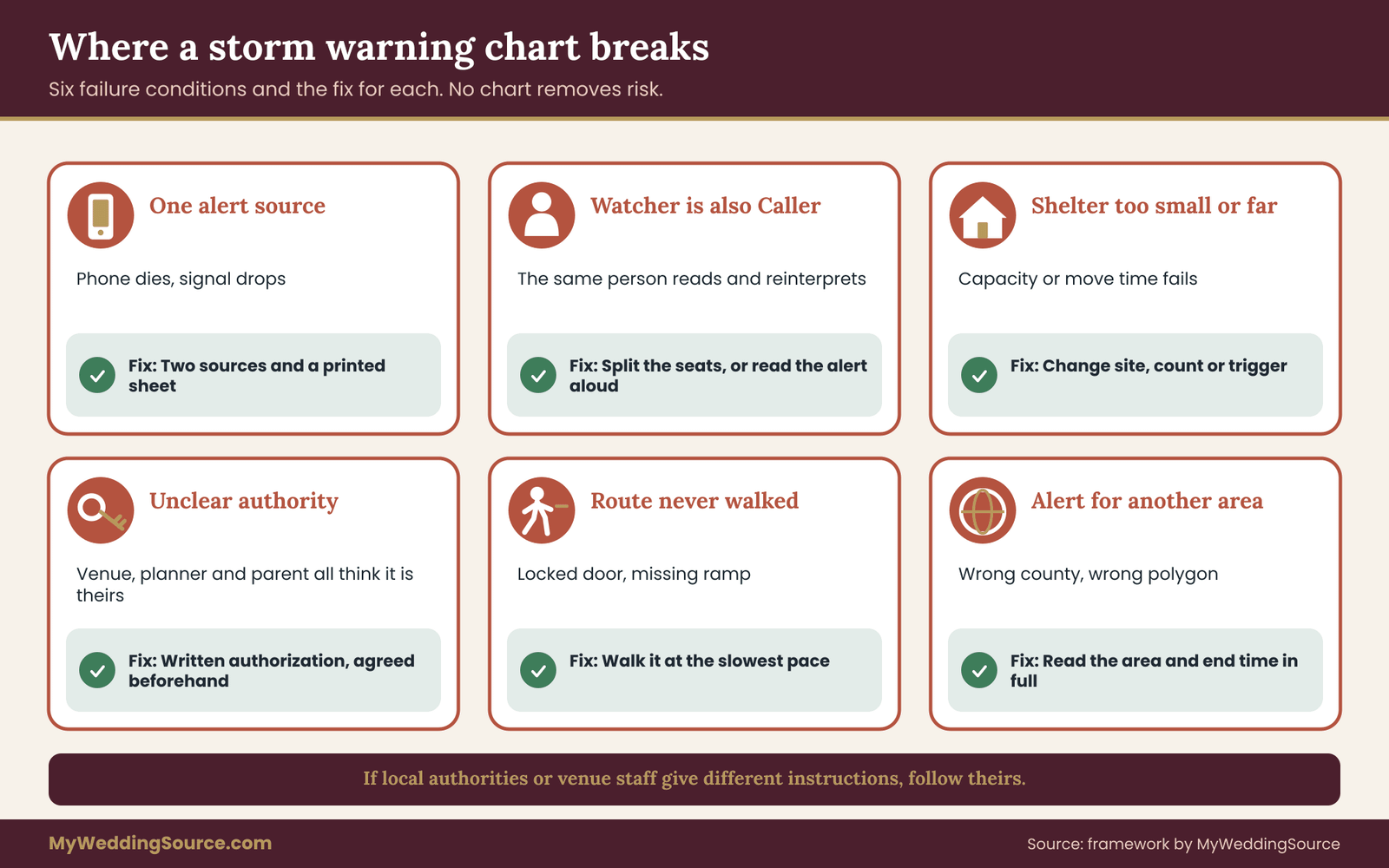
A chart that claims to be foolproof is a hazard in its own right. No storm warning plan is foolproof, and this one has limits. Here are the situations where this approach fails, and what to do about each.
No one with a working alert. If the Watcher’s phone dies, signal drops and no radio is present, the first trigger is missed. The fix is redundancy and the printed sheet. The failure condition is a Watcher with a single source.
The Watcher and the Caller are the same person. In a small wedding this is sometimes unavoidable. The fix is a written rule that the Caller acts on any alert the Watcher reads out and does not reinterpret. If you cannot separate the seats, name a second person to check the official alert text out loud.
Shelter that is too small or too far. If the shelter holds fewer people than the guest list, or the move time exceeds the available warning, the chart cannot work as written. The fix is to change the site, the guest count or the trigger, as discussed in the move time budget.
Unclear authority. If the venue manager, the planner and a parent each believe they hold the decision, the chart produces an argument. The fix is written authorization and a pre-wedding conversation with every party.
Nobody rehearsed the route. A shelter that no one has walked is a theory. Doors can be locked, ramps can be missing and signs can be wrong. The fix is a walk-through with the Mover, in ordinary shoes, at a slow pace.
An alert that is not about your location. The Watcher may react to a storm warning for a different area, or miss a storm warning because it was issued for a polygon that includes the venue but not the town. The fix is a Watcher who reads the alert text and knows the venue’s location by county and nearby landmarks.
A fast event. Some hazards develop with very little notice, including sudden winds, lightning from a nearby cell and rapid flooding. A chart based on official alerts may lag behind. The thunder trigger and the habit of looking at the sky are the safety net, and the Caller should be explicit that anyone can raise a concern and that the Watcher will check.
A culture of overruling. If the couple, the family or the vendors habitually argue with decisions, the chart can erode. The fix is the advance conversation and the written authorization, and, if the Caller is not respected, a different Caller.
Overreliance on the chart. A written plan is not a promise of safety. Storms can behave in ways no one expects, and no plan removes risk. Local authorities, the National Weather Service and qualified venue staff have the final word, and if they give instructions that differ from the chart, follow theirs.
After the storm warning: restart, communication and records
When the storm warning expires or is canceled, and the thunder hold has ended, the Caller does not simply say “back to normal.” A short restart check comes first. The Watcher confirms that no new warning covers the venue. The Mover checks that the outdoor area is safe, looking for fallen branches, wet or damaged flooring, loose structures and electrical equipment that got wet. The vendors confirm that their equipment is safe to use, and the venue approves the space. Only then does the Caller restart.
It helps to restart in a defined order that the couple has agreed to in advance. The ceremony might resume from the point of pause or from a shortened version, and the Voice announces it. Where the ground is wet, the Mover might choose a drier area, and guests might need to carry their chairs. The restart can also be a chance to simplify, to shorten the cocktail hour or to move to the indoor space.
Communication matters afterward too. Guests who left early should receive a short text or a post on the wedding website saying what happened and what is next. Vendors should receive a revised timeline. If anyone was hurt or frightened, the Caller or planner follows up kindly, and if anyone needs medical attention, the venue’s emergency procedure and local emergency services take over.
Keep records. Even a short record of the storm warning, with times, helps the next decision. A one-page note with the times of the alert, the order issued, the time of last thunder, the time of restart and any damage is useful for insurance, for vendors and for your own memory.
Photographs of any damage to rented items or the venue are worth taking before anything is moved. Keep copies of the alert text if you can. The records are also the raw material for the next event, for you or for a friend who asks how it went.
Finally, give the Caller a thank-you. The person who made a hard call and took the social cost of it did the couple a real service, and deserves to be thanked in a way they will remember.
Your next steps
Work through these in order. Each one is small, and together they take a few evenings.
- Name a Caller and a backup, in writing, and make sure neither is the couple, a parent or the photographer.
- Name a Watcher with two independent alert sources and a charged phone.
- Name a Mover for each zone, and a Voice the room already trusts.
- Walk the venue with the Mover. Find the real shelter, the route, the doors and the capacity, and time the walk at the slowest group’s pace.
- Write the move time budget and compare it with how much warning you can expect.
- Print the five-trigger sheet, with a one-sentence order for each trigger, and keep copies with the Caller, the Watcher and the venue.
- Ask the venue, tent company and vendors who holds weather authority, and get their answers in writing.
- Tell the officiant, the photographer, the DJ and the wedding party how the pause works.
- Add a short line to the wedding website and an entrance sign explaining that the ceremony may pause for weather.
- Check the outlook a few days out, and on the morning, confirm everything on the sheet.
FAQ
Who should make the call when a storm warning is issued during an outdoor wedding?
Choose one person in advance, in writing, who is not the couple, a parent or the photographer. A planner, day-of coordinator or venue manager often fits. Name a backup too. The person does not need to forecast anything. They act on official alerts using standing orders everyone has already agreed to, so there is no debate when the alert arrives.
What is the difference between a storm watch and a storm warning?
A watch means conditions are favorable for severe weather to develop, so it is the time to prepare. A warning means severe weather is occurring or about to occur in a specific area, so it is the time to act. For a wedding, a watch means checking alerts, shelters and routes, while a storm warning means moving people to shelter according to your chart.
Is a wedding tent a safe place during a thunderstorm?
No. National Weather Service guidance says tents, canopies, pavilions, pergolas and other open structures do not protect people from lightning, and strong wind can make them dangerous. Safe shelter is a substantial, fully enclosed building with plumbing and electrical wiring, or a hard-topped metal vehicle. Treat a tent as protection from rain, and plan a separate indoor shelter for storms.
How long should guests wait before going back outside after thunder?
The commonly cited National Weather Service guidance is to wait about 30 minutes after the last thunder before returning outdoors. Any new thunder restarts the count. A storm warning may expire sooner or later than that, so the Caller should confirm no new warning covers the venue, and then decide when to restart.
Can the couple overrule the Caller during a storm warning?
They should not, and it helps to say so in a short written authorization signed beforehand. The point of naming a Caller is that the person with the most emotional stake in the day is not the one weighing risk during the first minutes. The couple help write the orders, then agree to follow them.
What if the venue has no safe indoor shelter for everyone?
Treat that as a planning finding, not a surprise. Ask the venue for its written severe weather procedure and capacity of each space. Options include holding the ceremony closer to a substantial building, reducing the guest count, using a nearby building by agreement, or moving the ceremony indoors. Do not rely on an open barn or tent as the plan.
How do I make sure someone actually receives the official alerts?
Use at least two independent sources, such as phone alerts from the National Weather Service and a battery-powered NOAA Weather Radio, and give them to a dedicated Watcher. Keep a charged battery pack and a printed trigger sheet. Ask the venue whether it receives local alerts too, so two people are watching, and agree on a shared sentence for confirming one.
Does this guide guarantee my guests will be safe?
No. No plan can guarantee safety, and storms can behave unpredictably. A written chart reduces hesitation and confusion, but local authorities, the National Weather Service and qualified venue staff make the real decisions in an emergency, and their instructions come first. Use this guide as a planning aid, and confirm local rules and procedures with your venue and local officials.
Sources
- National Weather Service: weather.gov
- National Weather Service: lightning safety
- National Weather Service: thunderstorm safety
- National Weather Service: tornado safety
- National Weather Service: NOAA Weather Radio
- NOAA Storm Prediction Center
- Ready.gov: Thunderstorms and lightning
- Ready.gov: Tornadoes
- Ready.gov: Alerts and warnings
- FEMA: Federal Emergency Management Agency