

Wedding cash flow is about when money leaves your account, not just how much the wedding costs. A budget can add up perfectly and still leave you short in the one month when three vendors want their deposits. This guide shows how to turn a wedding budget into a monthly payment ledger, time deposits and final balances, pick safer ways to pay, and hold a reserve sized by real risks instead of a guess.
List every contract with its amount, due date, payment method and refund terms. Sort those payments by month, then lay your income and savings against them to find the months where cash runs short. Fix those months by moving a due date, changing the payment method or delaying a purchase. Keep a separate reserve for the risks you can name, and release it only after the last final balance is settled.
Two couples can plan the same wedding for the same total and have very different years. One has a steady plan: savings go in every month, deposits come out in small steps, and the last big payments land after a bonus. The other has the same money, but a venue deposit, a dress order and a photographer retainer all fall in the same six weeks, right before a rent increase. Nothing is wrong with the second couple’s budget. Their wedding cash flow is what breaks.
This article is built for that second problem. It assumes you already have a rough budget. If you do not, start with our wedding budget guide and come back here once you have totals for the major categories.
Why wedding cash flow is not the same as a wedding budget
A budget answers one question: how much will each part of the wedding cost? Cash flow answers a different one: on which dates will I need to hand over money, and will it be available that day?
The difference matters because wedding payments do not arrive evenly. Many vendors want a deposit to hold the date, a mid-way payment as the event approaches, and the balance weeks before the wedding. Some charge on delivery, such as a dress or custom stationery. A few charge after the wedding, when a rental company inspects the items or a caterer adjusts the bill to the final headcount. Meanwhile, your money comes in on a different rhythm: paychecks, quarterly bonuses, a parent’s gift that arrives in a lump, savings that grow slowly.
Put those two rhythms on one calendar and you see where they collide. That collision is the whole subject of wedding cash flow planning.
Three things a budget cannot show about wedding cash flow
Sequence. A budget lists categories. It does not say that the photographer’s retainer is due before the florist’s, or that the dress balance and the final catering payment land within a week of each other.
Conditions. A deposit that is refundable until a set date is a different risk than one that is non-refundable from the moment you pay. A budget treats them as the same number.
Timing of risk. Most surprises arrive late. Headcount changes, a vendor overtime request, a weather backup: these show up in the last weeks, when most of your money is already committed. A budget has no place for that, and a cash flow plan does.
The four waves of wedding cash flow
Almost every wedding follows the same broad pattern, even when the details differ. Think of it as four waves.
Wave one: deposits that hold the date. These come first, often a year or more before the wedding. The venue, the photographer and videographer, the band or DJ, and sometimes the caterer ask for money up front. Photographers and videographers in particular often expect full payment or a substantial retainer to secure a date, because a booked date is a day they cannot sell again.
Wave two: mid-stage purchases. In the middle months you pay for the dress order, stationery, rings, bridal party attire, a hotel block or travel for the honeymoon. Some of these have a deposit and a delivery balance. A wedding dress, for example, is usually ordered with a deposit and the balance is due when it arrives, typically several weeks before the wedding.
Wave three: final balances. In the last month or so, most vendors want the remainder. Industry guidance commonly places the photography, video and music balances about thirty days before the wedding, and catering, florals and lighting about two weeks before, though each contract sets its own dates. The venue usually wants to be paid in full before decor and setup begin. The caterer’s final bill depends on headcount, so the amount is not known until the guest list settles.
Wave four: day-of and after. On the day you hand out tips and pay any vendor who collects a balance on site, such as hair and makeup. After the wedding, some contracts let a rental company charge for damage once items are returned, let a caterer adjust the invoice up or down to actual consumption, and let a transportation company bill the final time driven.
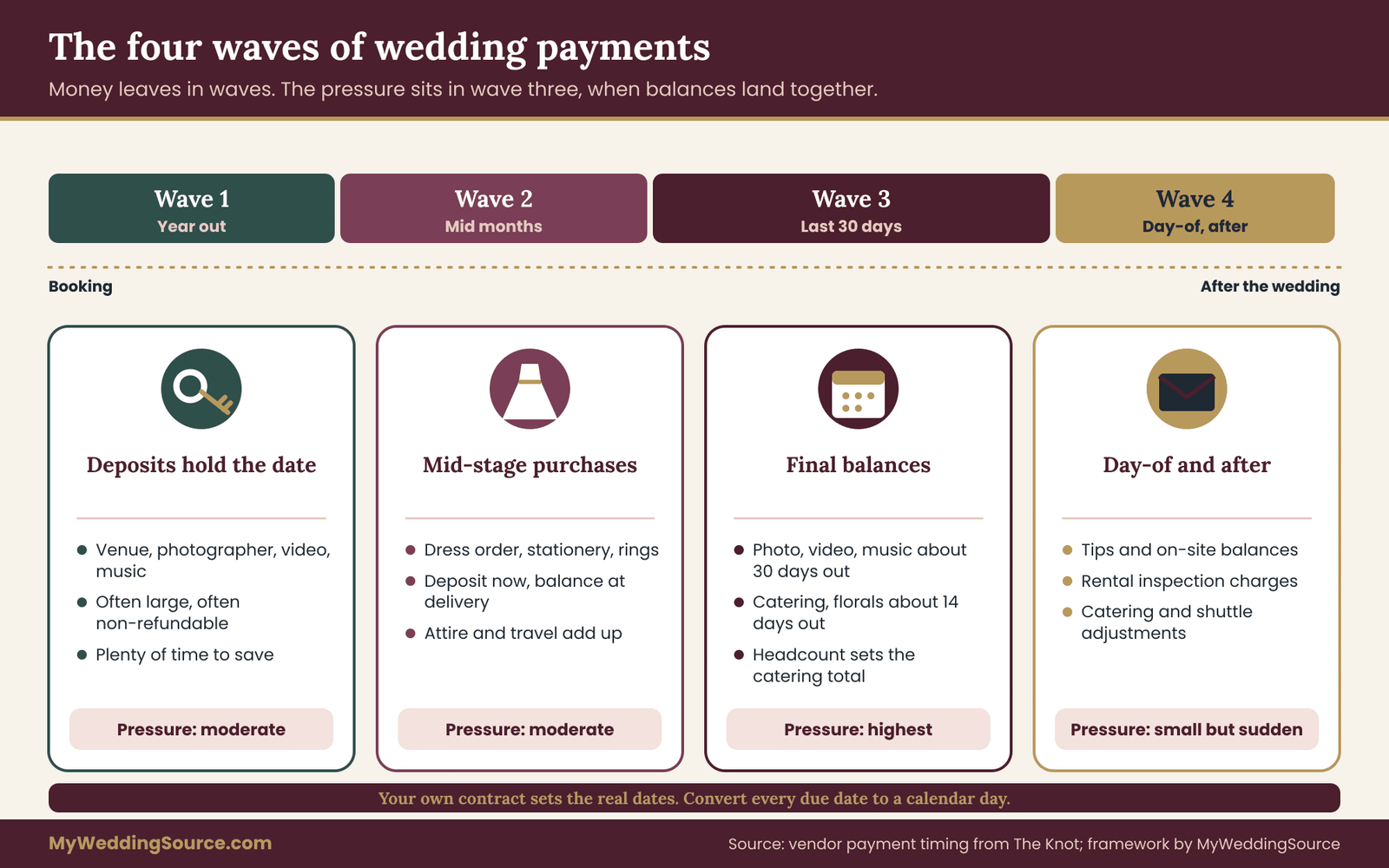
The pattern explains why the stress rarely sits where people expect. The first deposits feel big, but you have time to save for them. The real pressure is wave three, when several large balances arrive together and you cannot easily move them. Waves one and three are also where a wedding cash flow calendar helps most.
Know your numbers before you plan wedding cash flow
You need three sets of figures to start. None takes long, but skipping any of them makes the rest guesswork.
What you have now. The cash you can commit to the wedding today, kept separate from your emergency savings and everyday money. Be honest about this number. People often count money that is already spoken for.
What you can add each month. A realistic amount from income, after rent, bills and other fixed costs. If your pay varies, use the lower of your recent months, not the average.
What others will contribute, and when. A parent’s contribution, a family gift or a sibling’s help is only useful if you know when it arrives and whether it comes with conditions. A pledge to “help with the venue” is different from a transfer that has cleared. Treat pledges as uncertain until the money is in your account.
Then collect your contracts. If a vendor has only sent a quote, ask for a proposed payment schedule in writing. A quote with a total and no due dates tells you almost nothing about cash flow.
The contracts that move the calendar most
Not every vendor affects your cash flow equally. The ones to read first are the ones with the largest amounts and the least room to negotiate.
- The venue. Usually the biggest single payment, with a deposit, a second installment and a final balance.
- Catering and bar. Large amounts that depend on headcount, with a final balance that can change late.
- Photography and video. Often a large share up front.
- Dress and attire. Deposits at order, balances at delivery, alterations paid at pickup. Our guide to wedding dress fit and alterations covers the later costs that people forget.
- Rentals. Deposits plus a possible post-event charge. See our wedding rental planning checklist for what to ask about damage terms and pickup.
Once you have those, add the smaller items. They matter for the total but rarely change the calendar. ## How to build a monthly wedding cash flow ledger
A wedding cash flow ledger is a plain list of every payment you expect to make, ordered by date, with the money you expect to have beside it. You can keep it in a spreadsheet, a notebook or a shared note. The tool does not matter. What matters is that each payment is recorded in the same way and the list is updated whenever a contract changes.
Give every wedding cash flow payment the same six fields
Each line in the ledger needs six pieces of information. If you cannot fill one in, that is a question for the vendor.
- Who and what. The vendor and the item, for example “Venue, second installment.”
- Amount. The exact figure from the contract, or your best estimate marked as an estimate.
- Due date. The calendar date, not “30 days before.” Convert it. A date described as thirty days before the wedding is a specific day you can put in your phone.
- Method. How you will pay: card, bank transfer, check, cash, or a payment plan.
- Refund status. Refundable, partly refundable until a date, or non-refundable. Add the date the status changes.
- Dependency. What the amount depends on, such as final headcount, hours of coverage or delivery of an item.
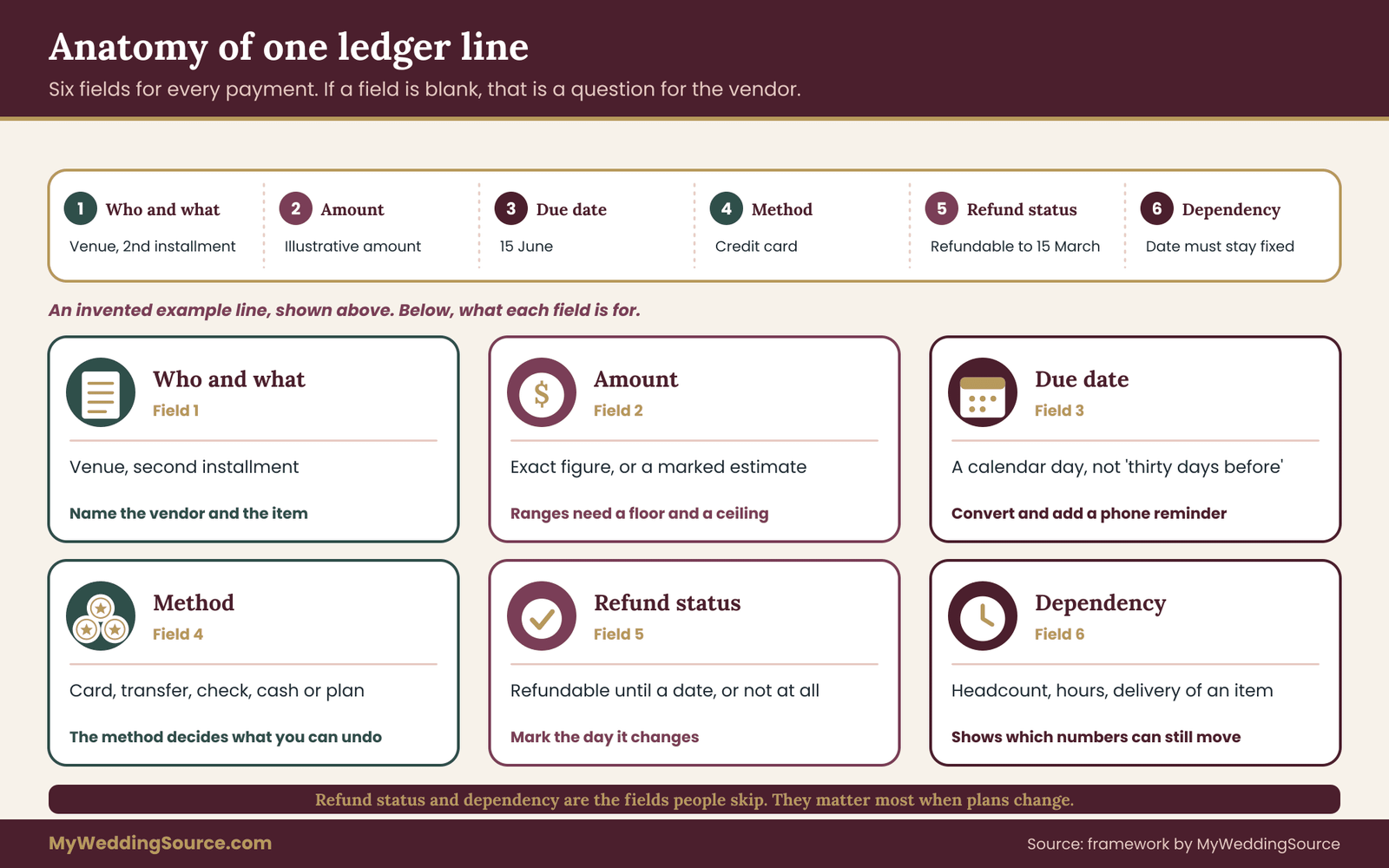
The refund and dependency fields are the ones people leave out. They are also the ones that make the ledger useful when plans change. If the final catering balance depends on headcount, the ledger tells you it is a range, not a single number, and you can plan for the high end.
An illustrative wedding cash flow ledger
The lines below are an invented example, not a price guide. They show the format.
- Venue, deposit. Paid at signing, non-refundable, depends on nothing.
- Venue, second installment. Due about six months before. Refundable only until a stated date. Depends on the date staying fixed.
- Caterer, final balance. Due two weeks before. Depends on the final guest count, which is due ten days before. This is a range.
- Dress, balance. Due at delivery, expected five to six weeks before. Depends on the shop’s delivery date, which can slip.
- Photographer, final balance. Due thirty days before. Fixed amount, depends on hours of coverage.
- Alterations. Paid at pickup, at the final fitting. Estimate only until the seamstress quotes.
- Tips and day-of payments. Cash or envelopes, paid on the day. Depends on the number of staff.
Notice how different these lines are. Some are fixed, some are ranges, and some depend on events you do not control. A good ledger shows that difference instead of pretending every number is firm.
Order your wedding cash flow by month, then total each month
Once all payments are listed, group them by month and add up what leaves in each one. For every month, write three numbers: money out, money in and the running balance after both. The running balance is the one to watch. If it ever goes below zero, you have found a cash flow problem months before it hurts.
Mark any month where the money out is more than about twice your normal monthly contribution. These are your pressure months. Most couples find two or three of them. Common culprits are the month with the venue’s second installment, the month with the dress balance, and the month with the large final balances.
The wedding cash flow payments people forget
A wedding cash flow ledger that lists only the big contracts will be too optimistic. Add these before you trust the totals.
- Marriage license fees and any required documents. Our wedding planning checklist has the paperwork side.
- Travel, lodging and meals for the couple and for any vendors you agreed to feed or house.
- Hair and makeup trials, and fittings.
- Postage for invitations and any reply cards.
- Gratuities and meals for vendors who work long hours.
- Overtime fees and extra rentals that show up in the last week.
- Cash for the final headcount increase, because it nearly always goes up, not down.
- Post-wedding costs: dry cleaning, return shipping, a possible charge from a rental company.
None of these is large on its own. Together they can add up to a pressure month of their own.
Choosing a tool for your wedding cash flow ledger
The best tool is the one you will open every week. A spreadsheet is the usual choice because it adds and sorts for you. A paper notebook works if you like writing things down and update it on a schedule. A budgeting app can help, though many are built for monthly household spending and do not handle a date-driven list of payments well. If you use an app, check that it lets you enter future payments and see a running balance.
Whatever you pick, set it up so a partner or helper could read it without explanation.
What a wedding cash flow spreadsheet needs
Keep it plain. One sheet holds the list of payments with the six fields described earlier, plus a column for status: not yet due, paid, disputed or closed. A second sheet or section holds money coming in. A third holds the monthly summary, where each month shows money out, money in and the running balance.
The running balance is simple arithmetic: this month’s balance equals last month’s balance, plus the money in, minus the money out. If you want a formula, build it once and copy it down the column. The important part is that it is built from dated lines, not from category totals.
Add a few labels that help your eyes. Mark payments that are refundable in one color and non-refundable in another. Mark ranges, such as a headcount-based balance, so you do not mistake an estimate for a firm figure. Mark any payment you have already confirmed in writing.
One source of truth for wedding cash flow
Wedding information tends to scatter across email, text messages, photos of contracts and sticky notes. Choose one place for the ledger and one folder for the documents, and move everything there. If a vendor texts you a new amount, copy it into the ledger the same day. If two people edit the ledger, agree on who is responsible for the final version, so you never pay from an outdated copy.
When a wedding cash flow plan meets a price change
Prices after signing are not always fixed. A vendor may add a service charge, apply a fee that was in the fine print or ask for more for an extra hour. Some of these are legitimate under the contract. Some are not. How you respond affects your calendar.
First, compare the new charge to the contract. If the contract allows it, the question becomes how to pay for it. If the contract does not, ask the vendor in writing to explain the basis. Keep the tone neutral: “Our contract lists a total of this amount. Could you point us to the clause that allows the added charge?”
Second, decide where the money will come from before you agree. Your options are, in order: reduce something else in the same vendor’s scope, such as an hour of coverage or an optional extra; use the portion of the reserve that was set aside for price changes; or shift a later, non-urgent purchase. Draw on the reserve last, and record each use, so you can see how much is left.
Third, update the ledger and the stress test. A price change in the largest contract may change which months are under pressure, so rerun the calendar.
Wedding cash flow rules for an unexpected cost
A few simple rules reduce hurried decisions.
- Under a set amount, decide quickly. Agree with your partner on a figure below which either of you can approve an extra cost without a meeting.
- Over that amount, wait one day. A night’s sleep is cheap, and most vendors do not require an answer within the hour.
- Ask what it replaces. If an addition is worth paying for, something else should be worth cutting, or the reserve should be named as the source.
- Record it. Every approved change goes in the ledger with its date and reason.
These rules are less about the money than about keeping the plan readable. A ledger that records every change is one you can trust in the last month, when you have the least time to double-check.
Map your income onto your wedding cash flow calendar
A wedding cash flow plan that only lists payments is half a plan. Add the money coming in, using the same months.
Where wedding money comes from and when it arrives
Your own savings and monthly contributions. The most reliable source. Put the monthly contribution on the ledger as a regular inflow.
Family contributions. Ask each person when the money will arrive, in what form, and whether any condition is attached. Some contributions are a lump sum, others are paid in installments or paid directly to a vendor. A direct payment to a vendor still counts, but it should appear on your ledger so you do not pay the same invoice twice.
Bonuses, tax refunds and other irregular income. These can help, but only if you are fairly sure of the date and amount. Treat them as a bonus to the plan, not as part of it, until they land.
Credit cards. A card can smooth out timing, and it carries protections discussed below. It is also borrowing. If you use one, put the card payment on the ledger in the month you expect to pay it off, and watch the interest if you carry a balance.
Buy now, pay later plans. These split a purchase into installments. The Consumer Financial Protection Bureau has described this kind of credit as a close substitute for a credit card, but one that often has less standard disclosure and fewer dispute rights, and with late fees that some users pay. If you use one, put every installment on the ledger and read the terms on late fees and autopay first.
Gifts at the wedding. Cash gifts that arrive at or after the wedding are real, but they arrive after most of the bills. Do not count them against payments due before the wedding, and do not plan the whole budget around them.
Find the gap month in your wedding cash flow
With payments and income on the same calendar, look for the month where cumulative money out first outruns cumulative money in. That is your gap month.
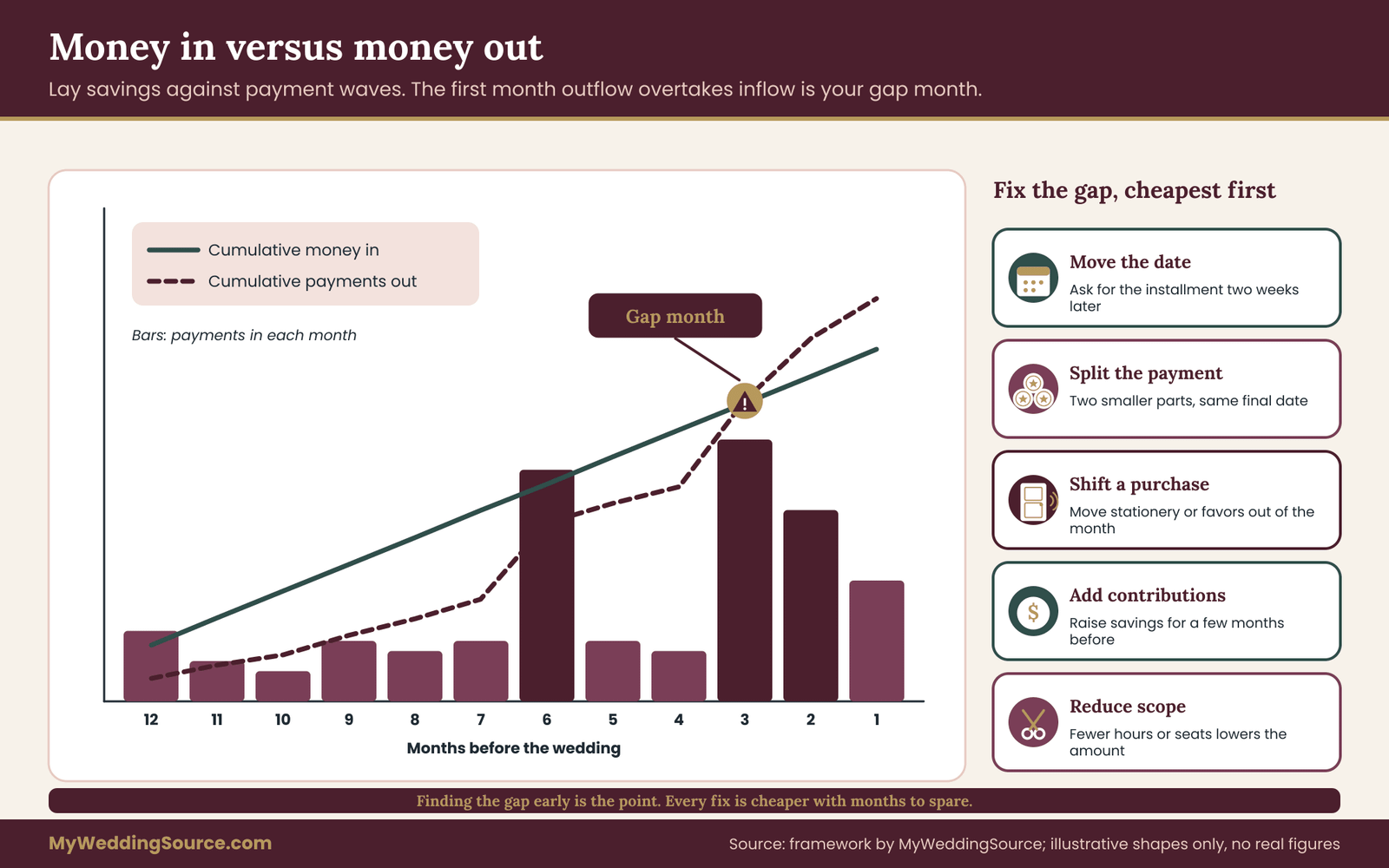
The gap month is not a failure of the plan. It is a piece of information. You now know the date you need to solve, and you have months to do it. Common solutions are in the next section. The point of finding it early is that every fix is cheaper and easier when you have time.
Fixing a wedding cash flow pressure month without borrowing
When a month looks too heavy, work through these options in order, from cheapest to most costly.
- Move the date, not the amount. Ask the vendor if a payment can fall two or three weeks later, or be split into two. Many will agree, especially when the payment is not tied to a delivery date. A short, clear message works: “Our payment lands in the same week as another large deposit. Could we move the second installment from the first of the month to the fifteenth? We will sign an updated schedule.”
- Split a large payment. Two smaller payments a few weeks apart can fit into a cash flow where one large one cannot.
- Shift a purchase. Move a non-urgent item out of the pressure month. Stationery printing, favors and decor can often wait.
- Increase contributions for a few months. Lower other spending temporarily, before the pressure month, to build a cushion.
- Use a card for a payment you can repay in full soon. Paying by credit card can bridge a short timing gap if you will clear the balance on the next due date. It also provides billing dispute rights, covered below. It only works if you will actually pay the balance, since interest quickly erases the benefit.
- Reduce scope. If none of the above works, trim the plan. Fewer hours of coverage or a smaller headcount lowers the amount before it is due, which is cheaper than borrowing later.
What to avoid: borrowing against a pressure month without a plan to repay by a specific date, or promising a vendor a payment you have not found the money for. Both turn a timing problem into a debt problem. ## Deposits, retainers and final balances: what each one means for wedding cash flow
The words vendors use for early payments are not standard. “Deposit,” “retainer” and “booking fee” can mean different things in different contracts, and the difference decides how much of your money is at risk.
A deposit usually reserves a date and counts toward the total. Whether it is returned if you cancel depends on the contract. A retainer is often described as payment for holding a date or for the vendor’s time, and many vendors treat it as non-refundable because the date they held could have been sold. A final balance is the remainder of the contract price, usually due before the event. A payment plan spreads the total into scheduled installments. It does not usually change the total due date, so check whether the last installment still falls before the wedding.
The label is less important than the written terms. Two payments both called “deposit” can be treated very differently, so read the cancellation and refund language, not just the heading.
Non-refundable does not always mean what people think
Many wedding contracts describe some or all of a payment as non-refundable. Contract writers often frame such fees as payment for work or availability already provided, rather than as a penalty for cancelling, and the legal idea behind it is liquidated damages, meaning a pre-agreed amount that stands in for the vendor’s likely loss. Whether a particular clause is enforceable depends on your state and the specific wording.
You do not need to resolve that question to plan your cash flow. For wedding cash flow purposes, you only need to treat non-refundable money as spent from the moment you pay it, and to plan your ledger so you never pay a large non-refundable amount before you are confident in the date, the headcount range and the vendor. If a clause seems unusual or the amount is large, a short consultation with a lawyer in your state is cheaper than a dispute later. This article is general information, not legal advice.
Contract questions that protect your wedding cash flow
Before you sign, ask each vendor these questions and get the answers in writing. They shape your ledger more than the price does.
- What is due at signing, and is any of it refundable?
- What are all the other due dates and amounts? Can you send a written schedule?
- If we change the date, what happens to the money we have paid?
- If we cancel, which payments do we still owe, and which are returned?
- If you cancel or cannot perform, what do we get back and how quickly?
- Does the final balance depend on headcount, hours or other changes? When is the last day to adjust?
- What forms of payment do you accept, and do you add a fee for cards?
- Are there late fees, and when do they start?
- What additional charges could be added after the event?
- Who is our contact if a payment problem comes up?
Question seven deserves extra attention. Some vendors add a surcharge when you pay by card, which changes your wedding cash flow numbers. Others offer a discount for paying by check or transfer. Compare the cost of that fee against the protection a card gives you, covered next. For a broader checklist of what to verify before you hand anyone money, see our wedding vendor due diligence checklist.
Final balances: where wedding cash flow numbers can still change
Final balances look simple, but several things can move them.
Headcount. For catering and bar service, the final bill is tied to the confirmed number of guests. Contracts usually set a date by which you must confirm the number, and often a rule that you pay for at least that many even if fewer show up. Find out whether you can go up after that date, and at what price.
Hours. Photographers, DJs and planners often charge for extra hours. A timeline that runs late can add a charge on the day.
Add-ons. An extra rental, a late-night snack or a backup generator is easy to approve in the moment and easy to forget when you add up the total.
Taxes, service charges and gratuity. Some contracts list a price before taxes and service fees. Others include them. Ask for the all-in figure, because a ten or twenty percent difference on a large invoice is a meaningful part of the wedding cash flow in the last month.
Payment methods and the protections they give your wedding cash flow
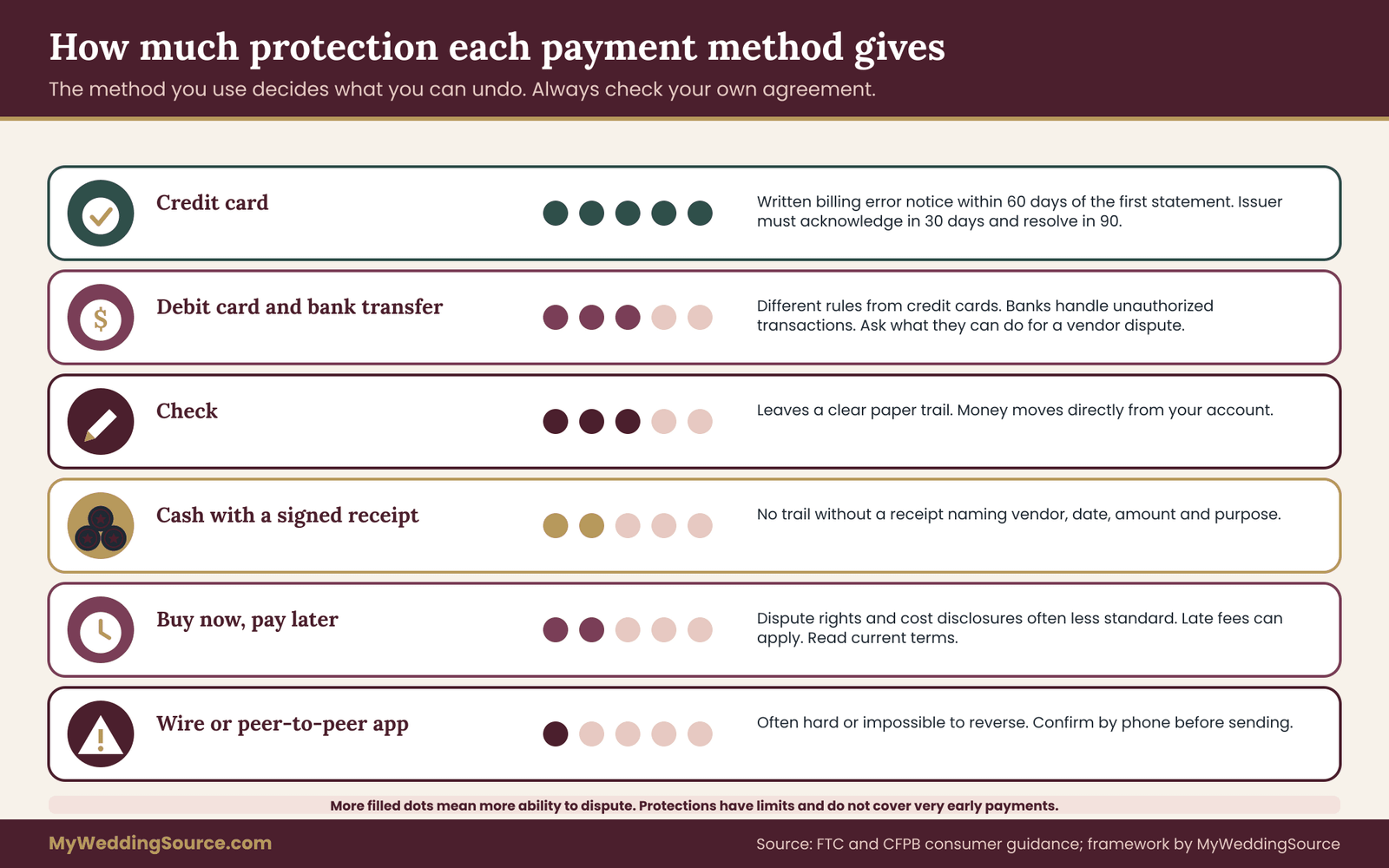
How you pay decides what you can undo. This is the least glamorous part of the wedding cash flow plan and one of the most useful.
Credit cards and wedding cash flow
A credit card gives you the strongest federal dispute rights of the common payment methods. Under the Fair Credit Billing rules summarized by the Federal Trade Commission, billing errors include being charged for goods or services you did not accept or that were not delivered as agreed. To use the process, you send a written notice to the card issuer’s billing error address within 60 days after the first statement that shows the charge. The issuer must acknowledge the dispute in writing within 30 days and resolve it within 90 days. While a dispute is pending, you may hold back the disputed amount and related finance charges, though you still owe the undisputed part of your bill.
There are limits. For disputes about the quality of goods or services, the rules can attach conditions such as the size and location of the purchase, and you are generally expected to have tried to resolve the problem with the seller first. The Consumer Financial Protection Bureau also notes that disputes over defective goods or services may follow a different process than billing errors. Check your card agreement for the details.
The practical lesson is about timing. The 60-day clock starts when the charge first appears on a statement. A deposit paid eighteen months before the wedding may be long past the window if the vendor later fails to deliver, so the card does not protect a very early payment against a late failure. The rules matter most for final balances and for payments made in the last few months.
Debit cards, checks and bank transfers
Debit card purchases, checks and bank transfers move money directly out of your account. They are handled under different rules than credit cards, and in practice it can be harder to get money back if a vendor does not deliver. Banks have procedures for unauthorized transactions, which are not the same as a vendor dispute. If you plan to pay this way, ask your bank what it can and cannot do, and keep every receipt and message.
Checks leave a clear record, which helps. Wire transfers and some peer-to-peer payment apps are often hard or impossible to reverse once sent. Treat them with extra care, and never send money to a person or account that you reached through an unverified message.
Cash
Cash has no paper trail unless you create one. If a vendor asks for cash, ask for a signed receipt that names the vendor, the date, the amount and what it covers. For day-of tips and small payments cash is normal. For larger sums, a traceable method protects you.
Buy now, pay later and payment plans
A vendor-run payment plan is simply a schedule. A third-party installment product is a loan, with its own terms. The CFPB’s 2022 study of this kind of credit found that dispute rights and cost disclosures are often less standard than with credit cards, that some users pay late fees, and that borrowing can stack quickly across several lenders. Rules in this area have been changing, so read the current terms before you agree to anything and put every installment on your ledger.
Protecting yourself from payment scams
Wedding payments attract scammers because the sums are large and the deadlines are real. The CFPB and FTC both advise confirming payment instructions by a channel you already trust. A few habits help.
- If a vendor emails new bank details, call the number on your contract before you send anything.
- Be suspicious of any request that creates urgency or asks for payment in an unusual form.
- Pay by a traceable method where possible.
- Keep a copy of the invoice, contract and every payment confirmation.
If you think you have been scammed, contact your bank or card issuer immediately, and report it to the FTC. Speed matters.
Keeping wedding cash flow records that will matter later
A payment dispute is won or lost on paper. For every vendor, keep a folder with the signed contract, every invoice, every payment confirmation and any message that changes a term. Take screenshots of online payment pages. If a vendor agrees to a change by phone, send a short email afterward that summarizes it: “Thanks for confirming today that the second installment will be due on the fifteenth instead of the first.” That one line can save you. ## The wedding cash flow reserve: timing, size and where to keep it
A reserve is the part of wedding cash flow set aside for costs you cannot fully predict. It is separate from the ledger, which covers costs you can. Couples often confuse the two and spend the reserve on a deposit they could have planned for, leaving nothing when the real surprise arrives.
What the reserve does for wedding cash flow
Be specific. A reserve that is “for anything” gets spent on anything. A useful reserve covers a short list of named risks.
- Headcount growth. More guests than the number you planned for, after the catering deadline.
- Price changes. A vendor adds taxes, service charges or a fee that was not in the first quote.
- Overtime and extras. An extra hour of coverage, a late-night rental, a generator.
- Weather or logistics backup. A tent, a heater, a shuttle or an indoor option you decide to pay for late.
- Vendor replacement. A vendor cancels or cannot perform, and you pay more to replace them on short notice.
- Everyday life. A car repair or a medical bill that arrives in the same month as a final balance.
That last item is easy to ignore, and it is the reason the reserve should sit apart from the wedding spending. The Consumer Financial Protection Bureau’s research on saving habits found that households with a regular saving habit reported far fewer difficulties paying bills after a financial shock than households that did not save. The authors are careful to say this is an association, not proof of cause, but the practical point holds: a wedding is a large, scheduled expense that can collide with an unscheduled one.
Size it from real risks, not a rule of thumb
You will find many suggestions online for how large a wedding reserve should be, usually expressed as a percentage of the budget. Those numbers vary widely and rarely come with evidence. A better method is to build the reserve from your own contracts.
- List the risks that apply to you. An outdoor wedding has weather risk. A buffet with open attendance has headcount risk. A wedding that depends on one photographer has replacement risk.
- Put a figure on each, using your own quotes. For headcount, take the per-person catering cost and multiply by the number of extra guests you consider plausible. For overtime, take the hourly rate in the contract. For a tent backup, ask for a quote.
- Add them up. The total is your reserve target.
- Compare it to what you can afford. If the target is higher than your available money, decide which risks to reduce rather than which to ignore.
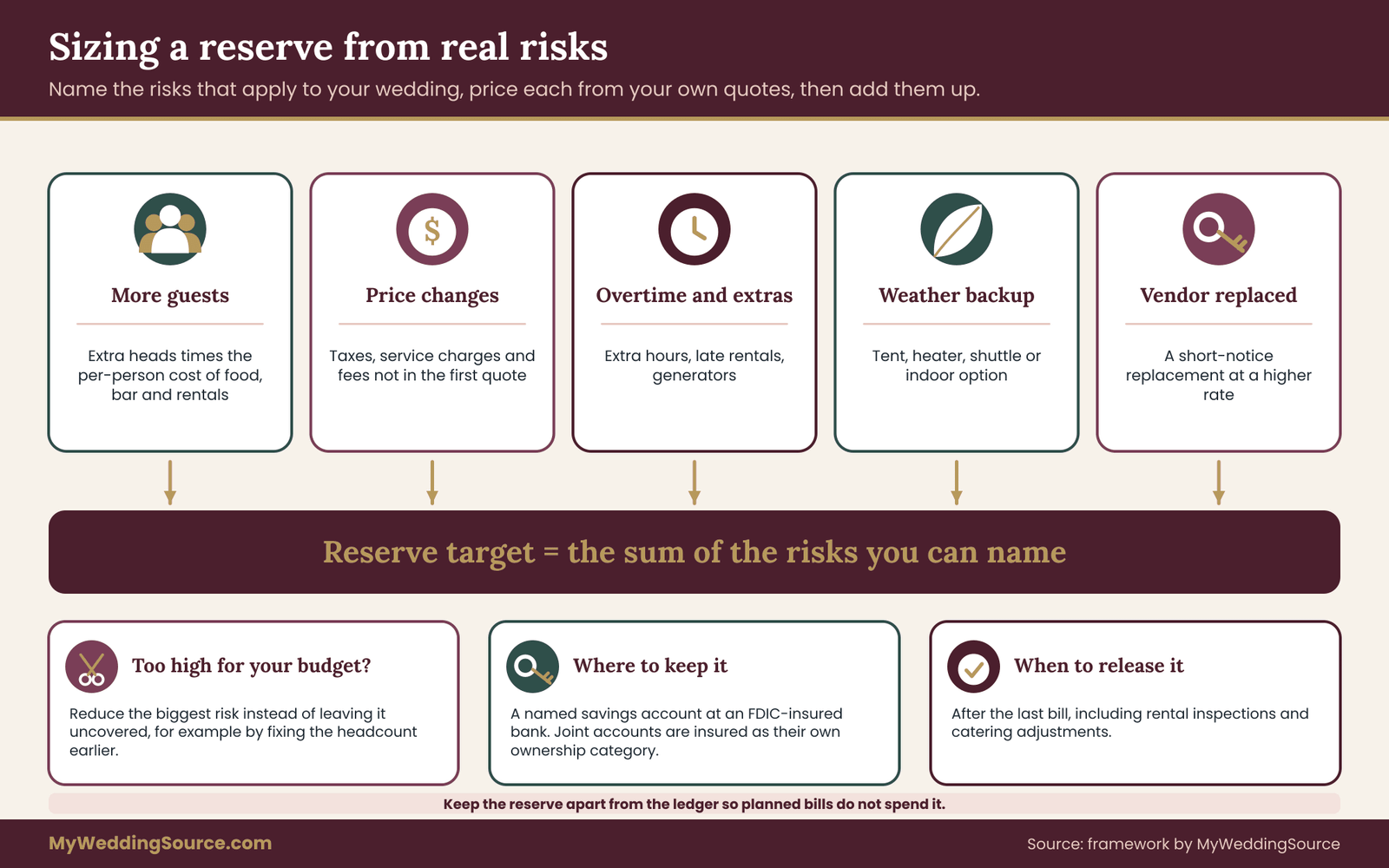
This method has two advantages. It gives you a number you can defend, and it shows you which risks are expensive. If one risk accounts for half of the reserve, that is a cue to reduce it, perhaps by fixing the headcount earlier or by choosing a venue with an indoor space.
Where to keep the reserve
Keep the reserve in an account that is easy to reach, not easy to spend on impulse. A savings account at an FDIC-insured bank is the usual choice. The Federal Deposit Insurance Corporation insures deposits up to $250,000 per depositor, per insured bank, for each ownership category, and joint accounts are a separate category from single accounts. Stocks, bonds and mutual funds are not covered by that insurance, and money you may need within a year is generally not a good fit for investments that can lose value.
Two practical points. First, name the account. Many banks let you label a savings account, and a label such as “wedding reserve” makes it harder to treat as spare cash. Second, if you and your partner hold the money jointly, agree in advance who may spend it and for what, so a surprise bill does not become an argument.
When to fund it and when to release it
The reserve should be in place before the final balances come due, not after. Plan to have it fully funded by the time you pay the first large final balance, which is usually about a month before the wedding. If you build it slowly, count it as a monthly line on your ledger so it competes fairly with other costs.
Release it only when the last bill is settled. That includes post-wedding charges. Some contracts let a rental company charge after inspecting returned items, a caterer adjust the bill to actual consumption, or a transportation company bill for the final time driven. A reserve that has already been spent on the honeymoon cannot cover those.
A sensible order for what happens to leftover reserve money: pay any final post-wedding charges first, put some toward your regular emergency savings, and treat the rest as spendable only when every contract is closed.
Stress-testing your wedding cash flow before it matters
A stress test asks a simple question: if this goes wrong, does your wedding cash flow survive? You run it on paper, with your ledger, before any of it happens. Five scenarios cover most of the real risk.
Scenario one: the guest count goes up and wedding cash flow shifts
Assume ten extra guests, or a number that is realistic for your list. Multiply by the per-person cost of catering, bar, rentals and favors. Does the reserve cover it? If the catering contract has a deadline after which you cannot add guests, find out the price of going over.
Scenario two: one vendor raises a charge
Choose your largest vendor and add a ten to twenty percent change to the final invoice, perhaps through taxes, service charges or hours. This is not a prediction. It shows how sensitive your plan is to the largest line. Find the line with the most flexibility in the contract and the one with the least.
Scenario three: a vendor drops out
Suppose the photographer cannot work and you hire a replacement at a higher rate on short notice. What happens to the deposit you paid the first one? What is the cost difference? Our wedding vendor timeline helps you see which vendors you need to book early and which you can replace more easily.
Scenario four: you need to change the date
Look at your contracts and add up what you would lose or owe if you moved the date. This is rarely a happy exercise, but it tells you how locked in you are. Our guide to wedding insurance explains what some event policies cover and what they exclude.
Scenario five: your income is interrupted
If one of you lost income for two months, how would your wedding cash flow hold up, and which payments could you still make? Which would you pause? This is the scenario people most want to skip. It is also the one that shows whether the wedding is sitting on top of your ordinary finances or beside them.
A worked wedding cash flow example, with invented figures
The following is an illustration to show the method. The names and amounts are made up, and your numbers will differ.
Ana and Marcus plan a wedding with a total budget they are comfortable with. Their ledger shows three pressure months: the month the venue’s second installment is due, the month the dress balance arrives, and the month with the large final balances. In the dress month, their running balance dips below zero by a small amount.
They test three fixes. First, they ask the dress shop whether the balance can be due at pickup instead of at delivery, which would move it by three weeks. The shop agrees. Second, they ask the venue to split the second installment into two payments a month apart. The venue agrees to a revised schedule in writing. Third, they decide to delay the favors order by a month. With those three moves, the running balance stays positive in every month, and they keep their reserve untouched.
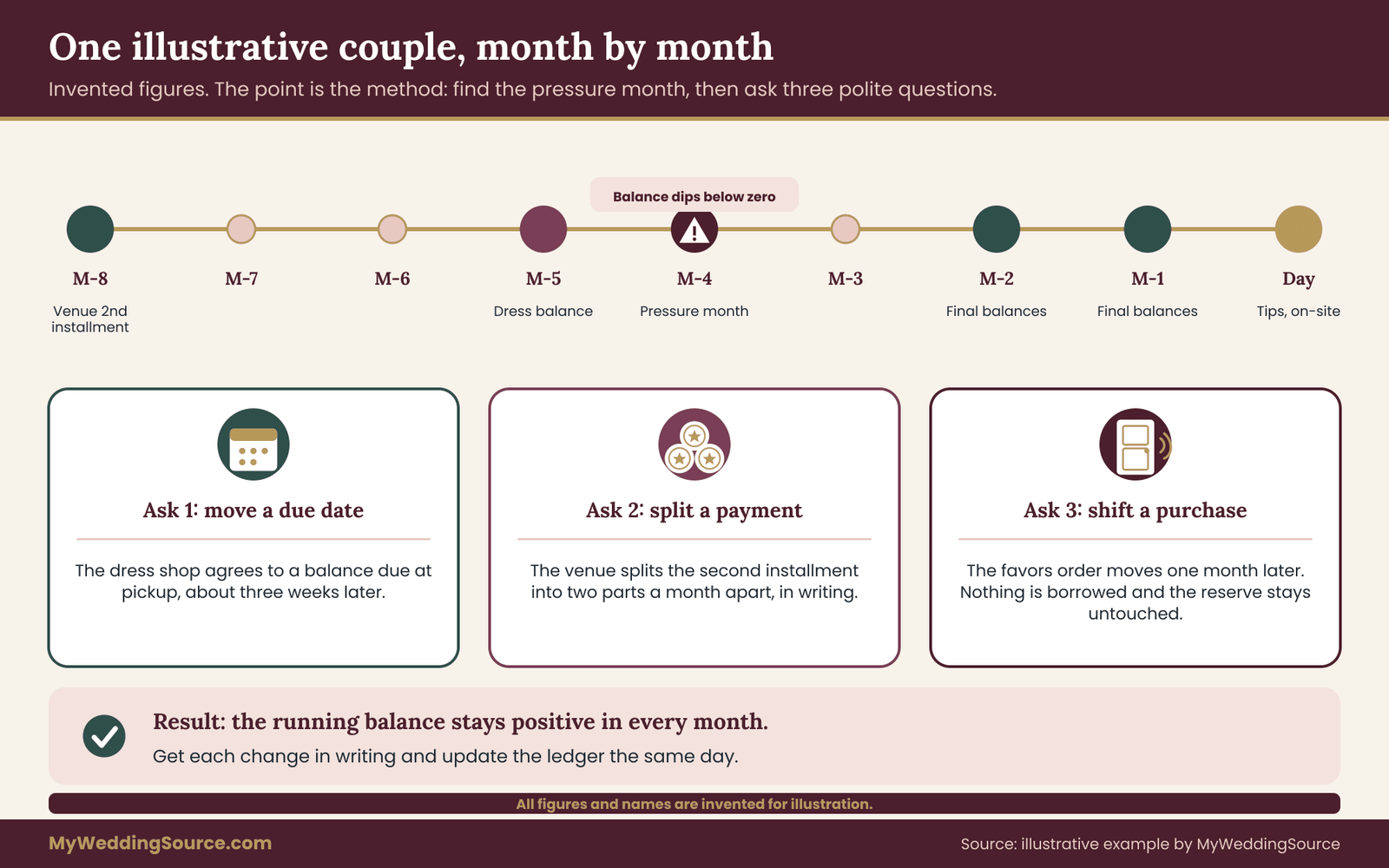
Nothing in this example required borrowing. It required knowing the problem early and asking three polite questions. That is the usual shape of a cash flow fix. ## The last thirty days of wedding cash flow
The final month is where the ledger earns its keep. Most large balances come due, headcount settles, and small cash needs pile up. Most wedding cash flow risk in this stretch comes from headcount, hours and add-ons, so check those first. A short, ordered routine keeps it calm.
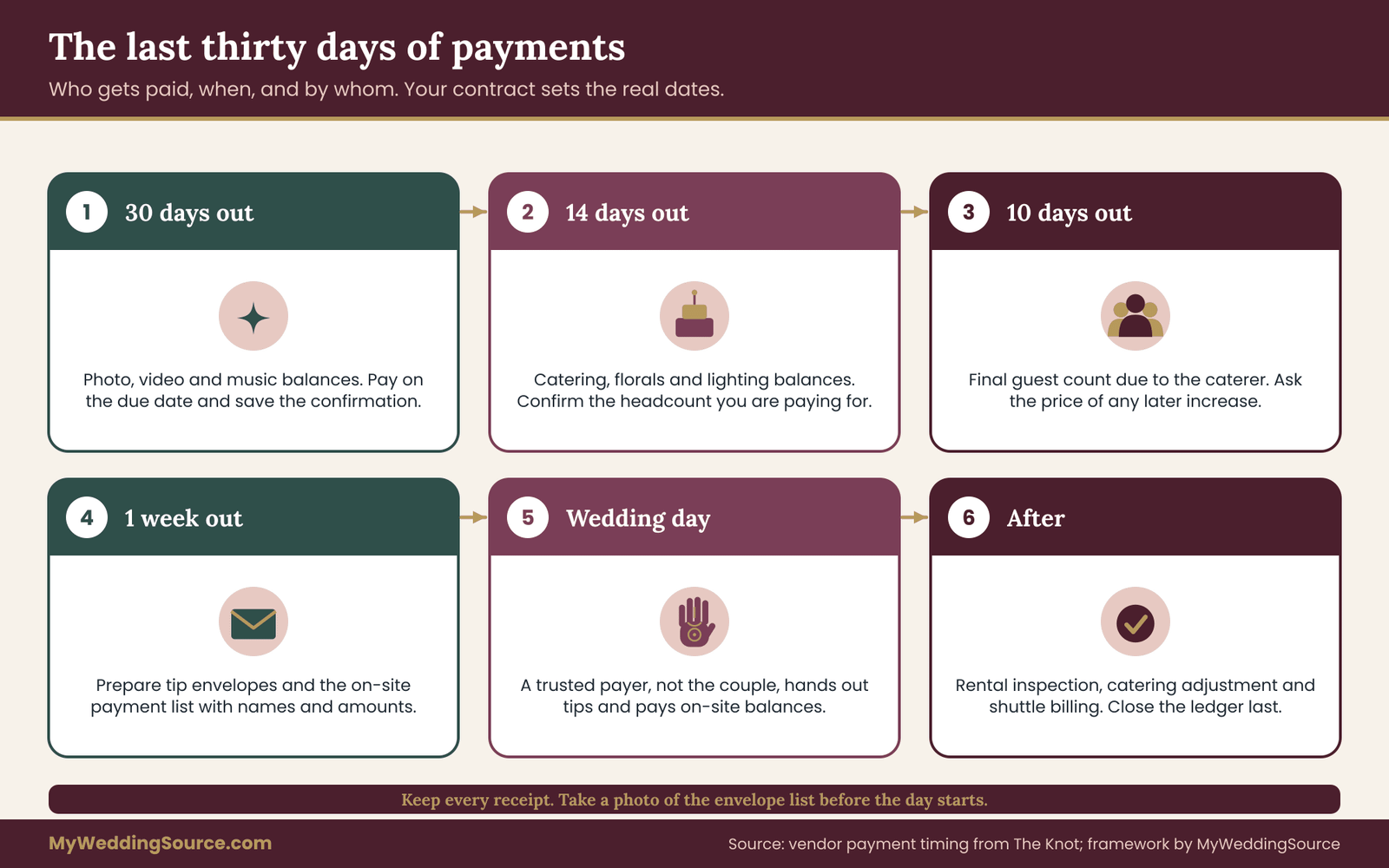
Thirty days out: balances and confirmations
Photography, video and music balances are commonly due around this point, though your contract sets the real date. Pay each one on or just before the due date, by the method you chose in your ledger, and save the confirmation. Ask each vendor for a final invoice or a written confirmation that the balance is paid in full.
At the same time, confirm the details that affect other payments: the day-of timeline, the hours of coverage, the venue access times and the contact person for each vendor. If a timeline change would add hours, find out the cost now, when you can still choose.
Two to three weeks out: headcount and catering
Catering, florals and lighting balances often fall about two weeks before the wedding. Before you pay the caterer, finalize your headcount with the caterer’s deadline in front of you. Confirm in writing the number you are paying for, the price per head and whether taxes and service charges are already included.
Re-read the cancellation and change terms on any vendor you have not yet paid in full. Last-minute changes are cheapest before the final invoice is generated.
One to two weeks out: the cash and the envelopes
Prepare what you will pay on the day. Tips are typically the largest day-of cash item. Guidance from The Knot describes tipping catering staff, bartenders, delivery personnel and musicians, and suggests a modest amount per performer, with envelopes prepared ahead of time. Whatever you decide, put the amounts on your ledger so you are not working them out at the reception.
Some vendors, such as hair and makeup artists, collect a final balance on the day. Add those to the list. Include any meal or break you owe vendors under your contracts.
Choose one person to handle day-of payments, someone who is not in the wedding party and not you. A planner, a trusted relative or a friend can do it. Give them a list of who to pay, how much, when and in what form, along with the envelopes. They should also carry a copy of each contract for reference.
The day before and the wedding day
Make sure your day-of payer has everything. Check that you have a way to cover a surprise, such as a card with room on it, set aside for that purpose. Take a photo of the envelope list so that you know what was handed out.
On the day, ask your payer to note what they paid and to whom, and to get a receipt if a vendor offers one. Do not carry the list yourself. You will be busy and happy, and neither state helps with arithmetic.
After the wedding: closing out your wedding cash flow
Your wedding cash flow does not end at the reception. Keep the ledger open until every item is closed.
- Rentals. Wait for the inspection and any damage charge. Check that a deposit is returned.
- Catering. If the contract adjusts the bill to actual consumption, watch for a final invoice or a refund.
- Transportation. Confirm the final time billed.
- Vendor meals and tips you missed. Send them promptly.
- Photos and video. Make sure all deliverables arrived before you consider the vendor paid in full if your contract ties a final payment to delivery.
- Records. Keep contracts, invoices and payment confirmations. Many people keep them for years, since insurance, tax or a dispute can make them useful.
When the last charge clears and your wedding cash flow is finally at zero, release the reserve as described earlier and mark the ledger closed. Our twelve month wedding checklist shows where these payment tasks sit in the wider planning timeline.
Sharing the money behind your wedding cash flow
Money questions inside a wedding often have little to do with arithmetic. They are about who feels responsible for what. A few habits keep the cash flow plan from turning into a family problem.
Wedding cash flow between partners
Decide early how you will pool money, who can approve a payment, and how you will handle disagreements about spending. Agree on a limit above which both of you must approve. Keep the ledger where both of you can see it. If one person handles the payments, the other should still be able to read it at any time.
Wedding cash flow with parents and other contributors
If someone else is paying part of the wedding, talk about the terms before the money moves. Cover four points: how much, in what form, when it arrives and whether any condition is attached to it. Conditions are the part that causes trouble later. If a contribution comes with expectations about the guest list, the venue or the date, you need to know that before you rely on the money.
Put the arrangement in writing, even informally, by email. Something as simple as, “Thank you for the offer to cover the photographer. To confirm, you will pay the vendor directly in two installments on these dates,” protects everyone from misunderstanding. If a contributor pays a vendor directly, mark the item as paid by them in your ledger so you do not double pay.
Gifts of larger sums can have tax implications for the giver in some situations. This is a question for a tax professional, not a planning guide.
The wedding party
Attendants usually pay for their own attire and travel, and sometimes for events such as a shower or a bachelor or bachelorette party. Those costs belong to them, but they affect the cash flow of the people paying. Tell them the likely costs early, and give dates when payments are due. Our wedding party coordination checklist covers how to share costs and expectations before anyone commits.
When a payment problem hits your wedding cash flow
Some problems are small, such as a late invoice. Others are serious, such as a vendor who stops responding. Start with the least dramatic step that could work.
A payment you cannot make on time
Contact the vendor before the due date, not after. Explain briefly, offer a specific new date or a split payment, and ask them to confirm in writing. Vendors are generally more flexible with someone who calls early than with someone who goes silent. Check the contract for late fees and for any clause that lets the vendor cancel if a payment is missed.
A vendor who is not delivering
Work through these steps in order, keeping records at each one.
- Write to the vendor, describe the problem and say what you want: delivery, a fix or a refund, with a date.
- Review the contract for what it says about cancellation, refund and dispute resolution.
- Contact your card issuer if you paid by credit card. Send your written billing error notice inside the 60-day window described in the FTC’s guidance. The CFPB advises contacting the seller first and then, if that fails, asking the card company whether it can reverse the charge.
- Contact your bank if you paid by another method, and ask what is possible.
- Report it. Complaints to the FTC and to your state attorney general’s office help others, and sometimes help you.
- Consider legal advice or small claims court for larger amounts. Rules and limits vary by state.
The FTC offers a sample letter for disputing credit and debit card charges that you can adapt. Keep the tone factual: what you paid, what was promised, what happened and what you are asking for.
A vendor who asks for payment outside the contract
Be cautious when a vendor asks for a new amount, a new method or an unusual transfer that is not in the contract. Ask for the change in writing and confirm by a number you already have. If the request seems wrong, trust that feeling and take your time. A genuine vendor will not mind a short delay.
Common wedding cash flow mistakes
Most problems come from a short list of habits.
- Planning from totals instead of dates. The budget works, the calendar does not.
- Paying early without a reason. Paying a final balance months before it is due removes your leverage and ties up cash you might need.
- Counting pledged money as received. A promised contribution is not available until it arrives.
- Spending the reserve on planned costs. Then the unplanned ones have nothing to draw on.
- Ignoring post-wedding charges. Rental damage, catering adjustments and transportation can all arrive after the day.
- Using a payment method without checking its protections. The cheapest method is not always the safest.
- Leaving out small items. Tips, postage, trials and fees add up.
- Forgetting the card statement. A card paid in full each month is a tool. A balance carried for a year is a loan.
- Not writing agreements down. Verbal changes do not help in a dispute.
- Waiting until the last month to look at the calendar. Every fix is cheaper earlier. ## Negotiating a payment schedule that fits your wedding cash flow
Many couples assume payment dates are fixed. Often they are not, especially for small and mid-sized vendors, who care more about getting paid in full than about the exact day. Asking is free. The way you ask makes a difference.
What vendors care about when they agree to your wedding cash flow
A vendor generally wants three things: the date secured, the money in hand before the event, and as little risk of a dispute as possible. If you can offer security on those points, you have room to ask for flexibility on timing. You are more likely to get a yes if you ask early, are specific, and put the new schedule in writing.
Some payments are harder to move. A deposit that holds a date is usually needed to hold it. A payment tied to a purchase the vendor must make on your behalf, such as custom materials, may be firm. Final balances close to the event are usually firm too. The middle installments are often the most movable.
Scripts that work
Short and respectful beats long and apologetic. These are samples to adapt.
To move a date:
“We are happy with the contract and want to keep it on track. Our second installment lands in the same week as another large payment. Would it be possible to move it from the first to the fifteenth? We will sign an updated payment schedule if that helps.”
To split a payment:
“Could we pay the second installment in two parts, half on the first and half two weeks later? The total and the final date would stay the same.”
To trade timing for something the vendor values:
“If we paid the final balance a week earlier than the contract requires, could the second installment move to the fifteenth?”
To ask about a card fee:
“We would like to pay by card for the record-keeping. Is there a surcharge, and is it lower if we pay part by check?”
In each case, end by asking for the change in writing, and thank them whatever the answer. A vendor who says no today may say yes to something else later.
What not to do
Do not stop paying and hope no one notices. Do not promise a date you cannot meet. Do not ask a vendor to accept a verbal promise in place of the contract. If a vendor agrees to a change, an email is enough, but it must exist.
Wedding cash flow in special situations
The wedding cash flow method above works for most weddings. A few situations bend it.
A long engagement
A planning period of two years or more changes the risk. The earliest deposits are paid far from the event, so more can change before the wedding: a vendor can close, prices can move, your own plans can shift. If you must pay early, favor vendors with clear refund terms and a track record. Keep records of every payment, and recheck each vendor’s status once a year. If you can delay a non-urgent payment until closer to the date, do it, because money in your account earns you flexibility.
A short engagement
The opposite problem. With only a few months, you pay many deposits and balances in a compressed window. Your ledger will show one long pressure period instead of three separate ones. Build the plan around what you have in hand, not on what you hope to save. Lean on vendors that accept smaller deposits, and consider a smaller guest count or fewer vendors to match your cash. A good option for a short engagement is to choose fixed-price packages, because they reduce the chance of a surprise charge.
Irregular income
Freelancers, seasonal workers and commission-based earners face uneven months. Build the ledger from your lowest recent months, not your average, and treat the good months as a bonus. Consider paying vendors early in strong months for payments you know are coming, and hold a larger reserve for the lean ones. Tell vendors early if you may need a payment to fall in a particular month.
A destination or out-of-state wedding
Distance adds friction. Payments may go to a vendor in another state or country, sometimes in another currency. Check whether the vendor accepts a payment method with dispute protection, find out about exchange rates and bank fees, and be wary of requests for wire transfers, which are hard to reverse. Budget for travel to visit the venue before the wedding, and for vendors you need to bring in, who may charge travel and lodging. Our honeymoon booking checklist covers a related set of payments, such as flights and deposits, that follow similar timing rules.
A small or micro wedding
Smaller weddings often have simpler payment schedules but fewer buffers. A single vendor charge can be a large share of the total. Keep a reserve, even if it is small, and watch for minimum spends and fees that stay fixed regardless of guest count.
Two households contributing
When several people give money, the ledger needs one extra column in your head: who is paying what. Keep a separate list of which contributor covers which payment. Share the status of the ledger on a regular schedule so that everyone knows what has been paid.
A review rhythm that keeps your wedding cash flow honest
A wedding cash flow ledger helps only if it is current. A light routine is enough.
Weekly, ten minutes. Check the next two weeks of payments. Confirm the money is in the right account. Look for any invoice that arrived and has not been added.
Monthly, thirty minutes. Update the ledger with new contracts, changes and payments. Recalculate the running balance. Look at the next three months and ask whether any pressure month has appeared.
At each milestone. After you confirm the headcount, after a vendor changes a term, and after any contribution arrives, re-run the stress test from the earlier section. A change that looks small can alter the plan.
Thirty days before the wedding. Do a full review. Compare the ledger to each contract, one vendor at a time, to confirm that every amount and date matches.
A reminder in your phone for each due date, set a few days ahead, costs nothing and prevents the late fees that nobody enjoys.
Build your wedding cash flow calendar in one evening
If you have not started, you can build a working version in an evening. Here is the sequence.
- Gather contracts and quotes. Put them in one folder. Mark anything missing a payment schedule and ask for it.
- Make a list of payments. For each, record the six fields: who, amount, due date, method, refund status and dependency.
- Sort by date. Group by month and total each month.
- List your income. Add monthly contributions, expected gifts with dates and any irregular income you are confident about.
- Calculate the running balance. Find the months it goes negative, and the months where money out is far larger than usual.
- Fix the gaps. Work through the options: move a date, split a payment, shift a purchase, adjust contributions.
- Name your reserve. List your risks, put a figure on each and add them up.
- Run the five stress tests. Adjust where the plan breaks.
- Set reminders. One for each payment, a few days early.
- Schedule your reviews. Weekly, monthly and at the thirty-day mark.
Done once, this takes a few hours. It saves far more than that in avoided late fees, stressful months and hurried decisions. ## Reading payment clauses that shape wedding cash flow
Contracts are written to protect the vendor. You do not need to rewrite them, but you do need to understand what each payment clause does to your calendar. The three examples below are invented paraphrases, not quotations from real contracts.
Example one: the stepped installment
A contract says one third is due at signing, one third six months before the event, and the remainder thirty days before. The first payment is non-refundable. The second is refundable if you cancel more than ninety days before the event. The third is not refundable.
What it does to your ledger: it creates three dated lines with three different refund states. The key date is the ninety-day mark, after which the second payment becomes non-refundable. Put that date on your calendar as a decision point, not just a payment date. If you are going to change course, do it before the line goes from refundable to spent.
Example two: the headcount floor
A catering clause says you pay for the confirmed guest count, set ten days before the event, and that you may not reduce it below ninety percent of the number you gave at signing. You may increase it up to forty-eight hours before, at the quoted price per head plus any applicable service charge.
What it does: your minimum catering cost is fixed earlier than you think. Reducing your guest list after signing may not lower the bill. For the ledger, mark the final balance as a range with a floor and a ceiling, and use the ceiling when you decide what to hold in reserve. Before you send invitations, ask yourself whether the number you gave at signing is one you can live with.
Example three: the post-event adjustment
A rental clause says the deposit is returned within two weeks after pickup, less charges for damage or missing items, determined by the rental company’s inspection. A separate line says a cleaning fee applies if linens are returned stained.
What it does: part of what you paid is conditional and comes back later, not at the wedding. In the ledger, record the deposit as an inflow that is uncertain, dated two to three weeks after the event. Do not count it as available for other purposes until it arrives. Take photos of the items at pickup and return, and ask who will count the pieces. Our wedding rental planning checklist has a section on damage terms.
What the examples have in common
Each clause shapes wedding cash flow by creating a date that matters more than the payment date. A refund cutoff, a headcount deadline and an inspection window are all points where money changes status. When you read a contract, underline those dates first. They belong on the calendar beside the payment due dates, because they tell you when a decision becomes expensive.
Two illustrative couples and their wedding cash flow
These are composites with invented figures, written to show how different situations lead to different choices.
Wedding cash flow for a couple with a fixed date and a steady paycheck
They have eighteen months, a regular monthly surplus and a modest contribution from a parent that arrives in two installments. Their ledger shows no negative months, but two heavy ones. They keep the plan simple: contributions go into a dedicated account each payday, the parent’s payments are marked with expected dates, and they use a credit card only for the final balances, which they pay off the same month. Their reserve is built from three named risks, and they set a monthly reminder to review the ledger.
The lesson is that a steady income makes the plan easy, but it still needs a calendar. Their risk was not money. It was losing track of which payment was due when.
Wedding cash flow for a couple with freelance income and a short engagement
They have seven months, uneven earnings and a venue that wants a large payment early. Their ledger, built from their lowest recent months, shows a gap in month four. They ask the venue to split the second installment, move the stationery order later and trim the guest list by a few seats, which lowers the catering floor. They hold the reserve as a separate amount in a savings account and refuse to touch it for planned costs.
The lesson is that a smaller, flexible wedding with a clear calendar can be easier on cash flow than a larger one with a generous budget on paper.
Wedding cash flow questions couples ask
The questions below come up often enough to answer directly. Longer answers appear in the FAQ.
Should we pay vendors early to be safe? Usually not. Pay on the contract’s due dates, unless an early payment buys you something specific, such as a discount in writing. Paying early removes your leverage if something goes wrong.
Should we use one credit card for everything? A card gives strong dispute rights and a single statement, but only pay with it if you will clear the balance, and check for surcharges. Remember that the dispute window starts when the charge appears on a statement.
Is it fine to ask for a payment plan? Yes. Many vendors already have one. A written schedule is better than an informal promise.
FAQ
How far in advance should I start planning my wedding cash flow?
As soon as you sign the first contract. The first deposit is the point where a ledger starts to matter, and every later contract adds lines. If you have not started, build the ledger now from the contracts you have and the quotes you expect, then update it as more arrive. A late start still helps, because even a few months of notice lets you move dates or split payments.
What is the difference between a deposit and a retainer in wedding cash flow?
Terms vary by vendor, so read the contract. A deposit usually reserves a date and counts toward the total. A retainer is often described as payment for holding your date or the vendor’s time and is more likely to be non-refundable. Neither word guarantees a refund or a lack of one. Ask what is refundable, until when, and under what conditions.
When are final balances usually due?
It depends on the vendor and the contract. Industry guidance often puts photography, video and music balances at about thirty days before the wedding, and catering, florals and lighting about two weeks before, with the venue paid before setup begins. Some vendors want payment sooner. Use your contract’s dates, not general guidance, and convert each one to a calendar date.
How big should a wedding reserve be?
There is no reliable universal figure. A better approach is to name the risks that apply to your wedding, such as extra guests, an overtime charge or a weather backup, put a cost on each from your own quotes, and add them up. If the total is more than you can afford, reduce the risks, for example by fixing the headcount earlier, rather than leaving them uncovered.
Is it safe to pay wedding vendors by credit card?
A credit card gives the strongest federal dispute rights among common payment methods. You must send a written billing error notice to the issuer within 60 days of the statement that first shows the charge, and the issuer has set deadlines to acknowledge and resolve it. The protection has limits and does not cover a very early payment if the problem appears much later. Check your card agreement and any vendor surcharge.
Can I use buy now, pay later for wedding costs?
You can, but read the terms first. The Consumer Financial Protection Bureau has found that these products often offer less standard disclosure and fewer dispute rights than credit cards, and some users pay late fees. Put every installment on your ledger and make sure the last one still falls inside your plan. Rules in this area have been changing, so check the current terms.
What should I do if a vendor asks for a new payment method or new bank details?
Pause. Do not send money based on an email or text alone. Call the vendor at a number you already have, from your contract, and confirm the request. Ask for the change in writing. Payment-redirection scams are common, and wires and some payment apps are hard to reverse. If you already sent money, contact your bank or card issuer immediately.
What happens to the reserve after the wedding?
Hold it until every bill is settled, including any post-event adjustments for rentals, catering or transportation. Then use some of it to refill your everyday emergency savings. Treat any remainder as spendable only after all contracts are closed. If you need a way to plan the rest of the year, our wedding budget guide shows how to fold the leftover into your next goals.
Your next steps
To get your wedding cash flow under control, pick one evening this week. Gather every contract and quote, and for each payment write down the six fields: who, amount, due date, method, refund status and dependency. Sort them by month and add up each one.
Then lay your income against the same months. Find the first month where the running balance goes negative, and choose one fix: move a date, split a payment or shift a purchase. Send that request today, in writing.
Finally, list the risks that apply to your wedding, put a figure on each and decide how much reserve you can hold. Set reminders for every due date, and book a short monthly review in your calendar. You will know where your wedding cash flow stands every month, and you will find problems while they are still cheap to fix.
Sources
- Using credit cards and disputing charges, Federal Trade Commission
- Sample letter disputing credit and debit card charges, Federal Trade Commission
- How do I dispute a charge on my credit card bill, Consumer Financial Protection Bureau
- How do I get a refund, Consumer Financial Protection Bureau
- What is a chargeback, Consumer Financial Protection Bureau
- Study details the rapid growth of buy now, pay later lending, Consumer Financial Protection Bureau
- How can I spot and avoid scams, Consumer Financial Protection Bureau
- Perceived financial preparedness, saving habits and financial security, Consumer Financial Protection Bureau
- Understanding deposit insurance, Federal Deposit Insurance Corporation
- When to pay wedding vendors, The Knot
- ReportFraud, Federal Trade Commission
- Submit a complaint, Consumer Financial Protection Bureau
When the last invoice is paid, the paperwork still matters. Our guide to wedding records covers which contracts, receipts and deadlines to keep and for how long.
Some vendors add a fee when you pay by card. Learn what to ask about a credit card surcharge before it changes your payment schedule.