
A vehicle breakdown on the way to your wedding can strand flowers, a cake, rentals or an entire sound system, and the fix is rarely as simple as “send another truck.” This guide gives you an alternate transport permissions and arrival sequencing sheet: who may move the goods, who may enter the site, what arrives first, and when to stop improvising and switch to a simpler plan.
When a vendor’s vehicle breaks down, do four things in order. Get the vendor’s exact location, cargo and what is still working. Decide who may carry the cargo instead, and write that permission down. Re-sequence arrivals using the latest safe arrival time for each item, working backward from the first guest. Set a stop time after which you switch to a simpler fallback. Fill in the sheet before the wedding, so on the day you are only changing names and times.
Most wedding planning documents assume that every vendor arrives on time in a vehicle that works. That assumption holds almost every time, which is exactly why nobody has a plan for the time it does not. A vehicle breakdown, such as a failed transmission or a flat tire on a highway shoulder, is a small event in the vendor’s day and a large event in yours, because everything in your timeline that depends on that van now has a question mark beside it.
A vehicle breakdown is also an unusually fixable problem, if you have decided a few things in advance. Unlike a storm or a venue closure, the people involved are known, the cargo is known, the destination is known, and the clock is visible. What is usually missing is not resources. It is permission and order. Someone has to be allowed to carry the goods, someone has to be allowed to drive onto the site, and someone has to decide which delivery goes first now that the neat schedule is broken.
This article builds one document that answers those questions for any vehicle breakdown that touches your vendors: the alternate transport permissions and arrival sequencing sheet. It is a working tool, not a theory. You will see what each field means, how to fill it out for each vendor, how to use it in the first minutes after a call, and a worked example with invented names and times so you can see the sequencing logic run.
A note on scope. This is general planning information, not legal, insurance or safety advice. Anything involving injury, a hazard on a roadway, or a dangerous vehicle belongs with 911 and qualified responders, and rules for commercial vehicles, insurance and permits differ by state and by contract. Where a rule matters, the guide points you to the agency that issues it so you can confirm the current version.
What a vendor vehicle breakdown actually breaks
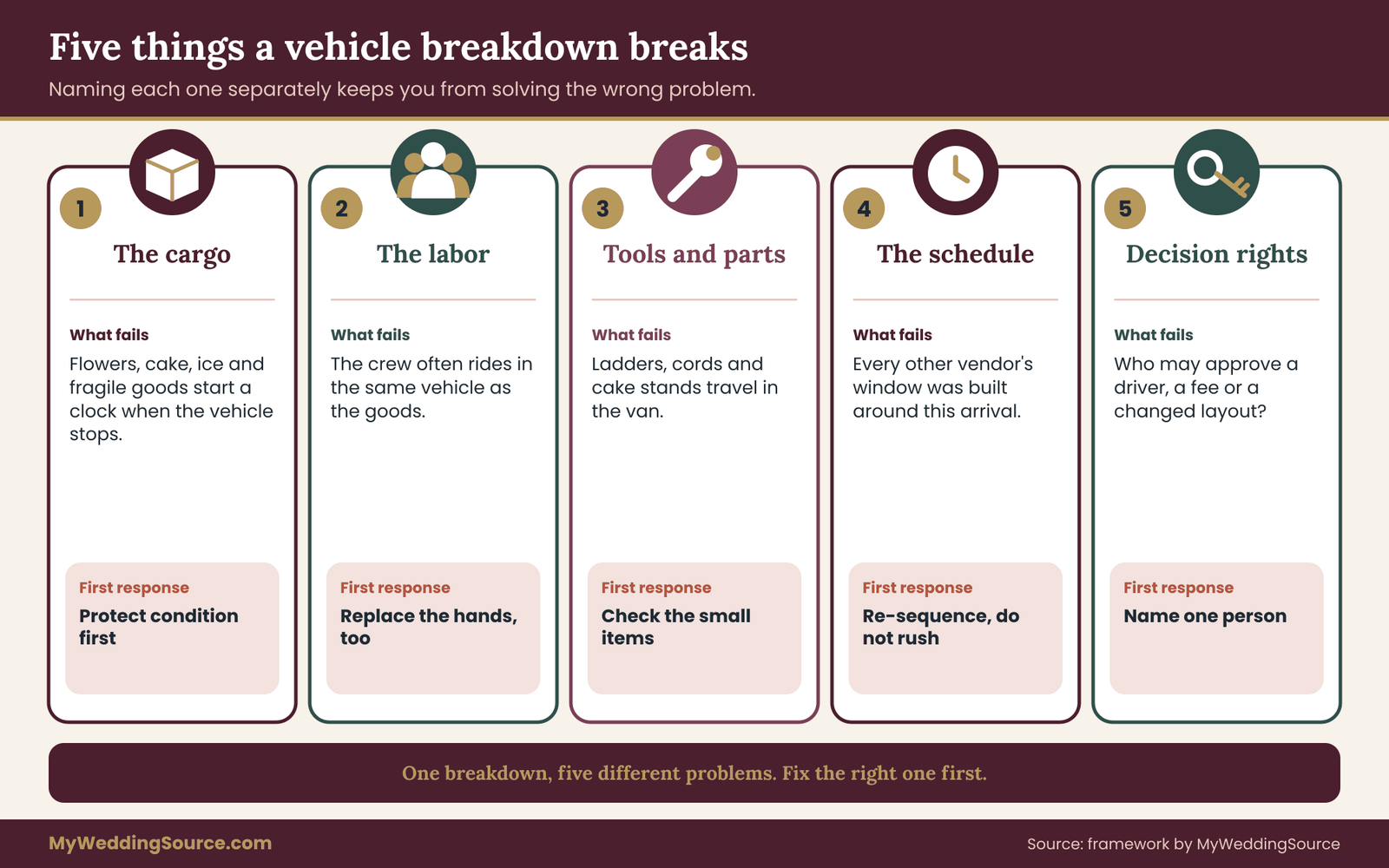
When people hear “the van broke down,” they picture a single problem: the goods are late. In practice a vehicle breakdown breaks up to five different things at once, and each needs a different response. Naming them separately keeps you from solving the wrong one.
The cargo. Some cargo waits patiently on a roadside, and some does not. Flowers, cake, ice and anything that must stay cold or upright are on a clock that started when the vehicle stopped. Linens, signage and boxed favors are tolerant of a delay but vulnerable to rain, theft and handling.
The labor. A vehicle often carries the people as well as the goods: a florist and an assistant, a band and its equipment, a rental crew. If the vehicle is stuck, so are the hands that would have set up the room. Replacing the cargo without replacing the labor leaves boxes on a loading dock and no one to build the arch.
The tools and small parts. The thing that makes a setup work is often small: the ladder, the zip ties, the extension cords, the steamer, the cake stand. These ride in the same vehicle. A substitute delivery that moves the headline items but leaves the tools behind can fail at the last step.
The schedule. Every other vendor’s access window, load-in order and setup time was built around this vendor’s arrival. A late delivery after a vehicle breakdown does not just push one item; it can block the caterer’s staging space, crowd the loading area, or collide with a hard venue cutoff.
The decision rights. This is the one nobody notices until it matters. Who is allowed to approve a substitute driver, an extra fee, a replacement product or a changed layout? If the couple is dressing and the planner is across town, the answer can be nobody.
Why the permissions half matters as much as the logistics half
Logistics questions have visible answers: a cargo van, a courier, a friend with a pickup. Permission questions are quieter, and they cause most of the delays that follow a vehicle breakdown. A replacement driver may be unable to get through a locked gate. A rental van may be taller than the venue’s covered drive allows. A friend may offer to carry a cake, and the vendor’s contract or insurer may care very much whose hands it is in. A venue may require advance notice for any unfamiliar vehicle.
None of these is a reason to avoid improvising after a vehicle breakdown. They are reasons to settle the questions ahead of time on paper, so that the improvisation on the day is quick and safe instead of quick and risky.
Who this guide is for
It is written for couples, planners and day-of coordinators who manage vendors directly, and for the friend or family member who has been handed the job of “being in charge of the vendors.” If you hire a full-service planner, much of this is already their work, and you can use the sheet to check that they have it. If you are coordinating yourselves, the sheet is the one thing worth preparing in the last two weeks.
It is not about vendor reliability in general, picking vendors, or what to do when a vendor does not show up at all. For the broader day-of picture, the wedding planning checklist covers the whole timeline. This article stays on one event, a vendor vehicle breakdown: a vendor’s vehicle stops working between the vendor’s starting point and your site.
The first fifteen minutes after a vehicle breakdown call
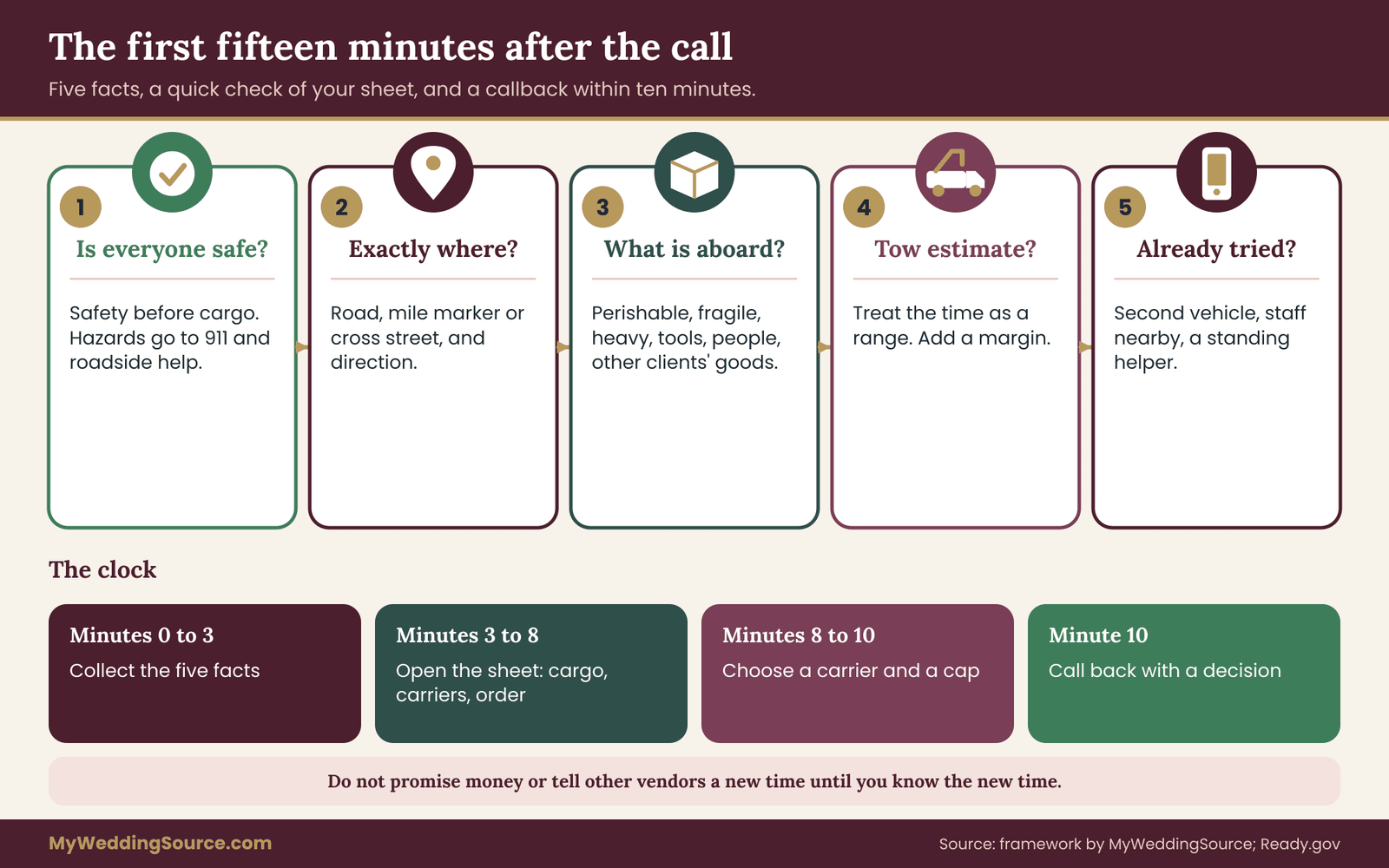
The call about a vehicle breakdown usually comes from an unfamiliar number, and the first sentence is often an apology. The temptation is to start solving immediately. Resist that for about ninety seconds and collect five facts, because every later decision depends on them.
Fact one: is everyone safe? Ask this before anything else, and mean it. A vendor on a highway shoulder or in traffic may be in real danger, and nothing about a centerpiece matters more than that.
If there is any hazard, the vendor’s priority is getting people clear and calling roadside help or 911, and your job is to stay off the phone as soon as the facts are collected. A vendor who is safe and calm can handle the next steps. A vendor who is not should not be asked to coordinate deliveries.
Fact two: where exactly are they? Get a road name, mile marker, exit or cross street, and the direction of travel. You need it for the next decision, which is whether a substitute can reach them faster than the repair can happen.
Fact three: what is in the vehicle? Ask for the cargo by category: perishable, fragile, heavy, tools, people. Ask what is on the vehicle that is not yours, because many vendors carry other weddings’ items on the same route.
Fact four: what is the vendor’s own estimate? Ask what the roadside provider or tow service has said about the arrival time, and whether the vehicle is repairable on the spot or will be towed. Treat the vendor’s estimate as a range, not a promise, and add a margin.
Fact five: what does the vendor already have in motion? Many vendors have a second vehicle, an employee nearby or a standing arrangement with another business. Ask what they have already tried before you propose anything.
The script for the first call
Short, calm and specific works better than a long expression of concern. Something like this keeps the call under three minutes:
“Thanks for telling us right away. First, is everyone safe? Okay. Tell us where you are, what is in the vehicle, and what the tow or roadside service said. We will work on a backup from our end and call you back in ten minutes. What do you need from us?”
Notice what that script avoids. It does not ask the vendor to guarantee anything, and it does not ask how this happened. Both questions can wait until the vendor is out of the road.
The ten-minute callback
Before you call back, open the sheet and do three things in this order. First, mark the vendor’s cargo type and the latest safe arrival time, which the next section explains how to calculate. Second, check the permissions line for that vendor: who is already approved to carry or deliver on their behalf. Third, check the arrival order to see which other vendors are affected if this delivery slips by thirty, sixty or ninety minutes.
If the sheet was filled out before the vehicle breakdown, those three checks take less than five minutes. If it was not, it is still worth ten minutes on the phone with a pen, because the sheet turns a stressful open question into a short list. The wedding vendor timeline guide shows how to build the day’s schedule that the sheet depends on.
What not to do in the first fifteen minutes of a vehicle breakdown
Do not tell the vendor to “just rent a truck” without asking about insurance and the cargo. Do not promise anyone extra money before you know what the substitute will cost. Do not ask a guest or family member to drive without first confirming that the vendor and the person agree on what they are carrying and how it will be handed over.
And do not tell other vendors the schedule has changed until you know how it has changed. Sending three people a wrong time is worse than sending nobody a time for ten minutes. ## The alternate transport permissions sheet, field by field
The sheet for a vehicle breakdown has two halves. The first half, permissions, answers who may move what and where it may go. The second half, arrival sequencing, answers what arrives in what order. Each vendor whose goods travel by vehicle gets one line on each half. For a typical wedding that is between five and ten vendors: florist, baker, rentals, caterer or bar service, band or DJ, photo booth, lighting, and anyone delivering décor.
Prepare the vehicle breakdown sheet two to three weeks before the wedding, confirm it with each vendor in writing the week of, and keep a copy where the person in charge on the day can reach it from a phone. A one-page document in a shared folder is better than a clever app that nobody has opened.
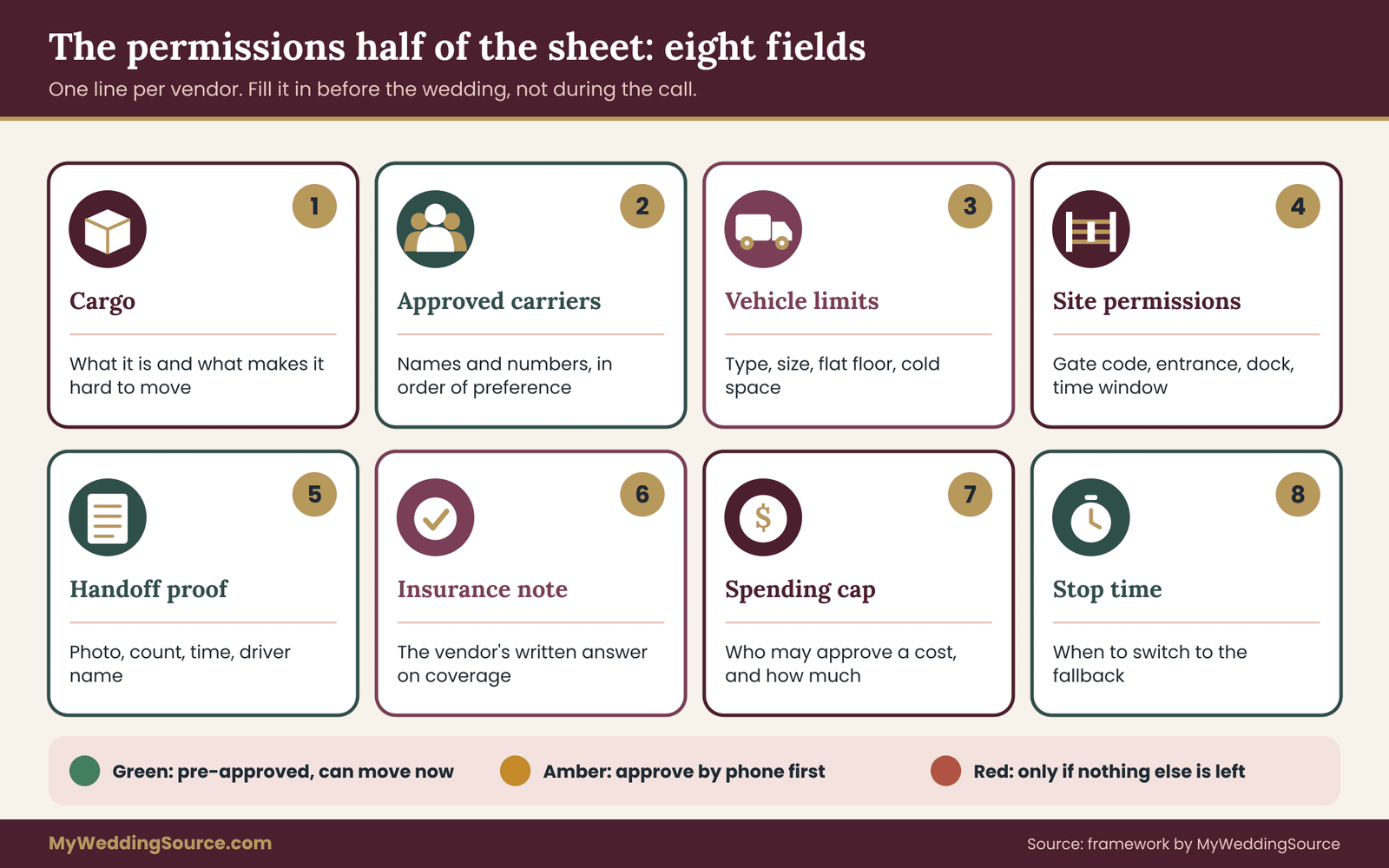
Permissions half: eight fields
Field one: the cargo. Write what is being carried, in plain words, and the one thing that makes it hard to move. “Three buckets of loose flowers and eight boxed arrangements, must stay upright and out of heat.” “Three-tier cake, must stay level, delivered assembled.” “Forty folding chairs and eight round tables, no special handling.” The point is to let a stranger understand the job in one sentence.
Field two: the approved carriers. List the people and businesses you accept as substitutes, in order of preference. This might be the vendor’s second vehicle and staff, a named employee or partner, a local business the vendor already works with, or a courier service the vendor names. Write names and phone numbers. Leave a line blank for “other, with vendor’s approval by phone,” because the first three options may all be unavailable.
Field three: the vehicle limits. Record the vehicle type the substitute may use and any limits the site imposes: maximum height or length, whether a vehicle with a lift gate is needed, whether a van must have a cargo area separate from the cab, whether the load needs refrigeration. If the cargo is a three-tier cake, a hatchback with the seat folded down is a very different proposal from a cargo van with a flat floor.
Field four: the site permissions. This is the field that people forget. Write the gate code or the name of the person who opens the gate, the entrance a delivery vehicle must use, the loading zone or dock, the time window in which loading is allowed, any restrictions on engine idling or noise, and whether the venue needs advance notice of an unfamiliar vehicle or driver. The venue technical walkthrough guide explains how to gather these details during a site visit, and they belong on the sheet.
Field five: the handoff proof. Decide what record the handoff creates. At minimum: a photo of the cargo at pickup, a count, the time, the name and phone number of the driver, and a photo on arrival. For high-value or perishable items, add the temperature or condition on arrival. A hand-signed note is fine. The goal is to avoid an argument later about what left the vendor and what arrived.
Field six: the insurance and liability note. Record, in one or two lines, what the vendor says about coverage when someone else carries their goods. You are not drafting a legal opinion; you are noting the vendor’s answer. “Vendor says their business policy covers goods in transit by approved carriers. Friend or family driving is not covered.” If you do not know, write “unknown, ask before approving.” The certificate-of-insurance questions in the vendor due diligence checklist are a good place to start gathering this.
Field seven: the spending authority. Name the person who can approve an extra cost, and the cap. “Planner may approve up to an agreed amount for a rental van or courier. Anything above that needs a call to the couple’s designated contact.” The cap is yours to set. The point is that no one on the day has to ask whether they are allowed to say yes.
Field eight: the stop time. Write the clock time after which the substitute plan stops being worth it and you switch to the fallback. This one deserves its own section, below, because it is the most useful field and the hardest to fill in honestly.
The latest safe arrival time
Every vendor line needs one number: the latest time the goods can arrive and still work. You calculate it by working backward from the moment the item is first needed.
Take the time the item is first seen or used by guests. Subtract the time needed to set it up or install it. Subtract the time needed to unload and move it to the setup area. Subtract a buffer for the unexpected, such as a slow elevator or a missing key. The result is the latest safe arrival time.
A short example with invented numbers. Ceremony flowers are first seen at 4:30 p.m. when guests arrive. Setup takes about forty-five minutes with two people. Unloading and carrying from the loading zone to the ceremony space takes about fifteen. A thirty-minute buffer covers small delays.
Add those three together and you get ninety minutes, and ninety minutes before 4:30 is 3:00 p.m. That is the latest safe arrival for the flowers. If a vehicle breakdown pushes arrival past 3:00, you are no longer inside the plan, and the stop time on the sheet should sit close to that number.
Notice that this number depends on which item the vehicle breakdown strands. Ceremony flowers have a later deadline than the cake, which has a later deadline than the rental tables, which must be in place before anyone can do anything else. Writing a latest safe arrival for each vendor produces the arrival order almost on its own.
Three levels of permission
To keep the sheet usable during a vehicle breakdown, give each approved carrier one of three levels.
Green: pre-approved. The vendor has said yes in writing, the venue knows the name, and the person has a phone number on the sheet. Green carriers can start moving the moment the plan is activated.
Amber: approve by phone. The option is realistic but needs a quick confirmation from the vendor or the venue, such as a rental van the vendor must authorize or a courier whose rates must be checked. Amber carriers need a short call and a text confirming the decision.
Red: do not use unless nothing else is left. Examples are a guest driving valuable or perishable goods, a rideshare driver carrying fragile items without a container, or a vehicle that cannot protect the cargo from heat. Red does not mean forbidden. It means the downsides are known and someone senior has to accept them.
This three-level system is simple on purpose. In a stressful moment, nobody reads a paragraph. They look for the color.
Choosing the substitute: six options and how each one fits
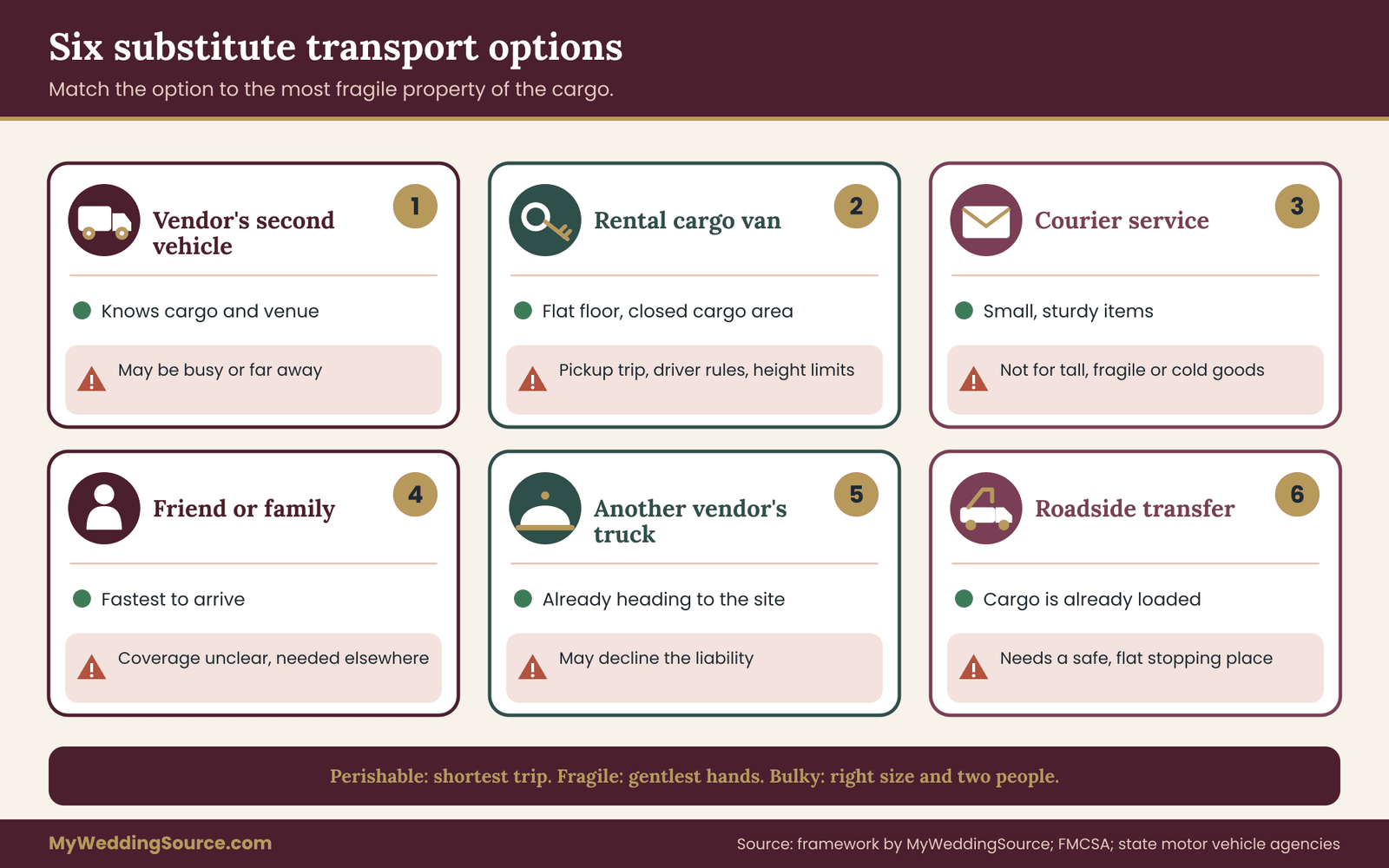
Once a vehicle breakdown has happened and you know what the cargo is and what the permissions allow, you choose from a short list. Here are the six options that come up, what each is good at, and where each one tends to fail. None is the right answer every time.
Option one: the vendor’s own second vehicle or staff
This is the best option after a vehicle breakdown when it exists. The vendor knows the cargo, the venue, the setup and the product. Many small vendors have a second vehicle, a partner or an employee who can load what is left or make a second run. The weakness is time: a second vehicle may be across town, loaded with another job, or an hour from its own starting point. Ask the vendor how long it would take, and ask what that vehicle is currently doing.
Option two: a rental cargo van or truck
After a vehicle breakdown, a rented van gives you a flat floor, a closed cargo area and the ability to move bulk. The weaknesses are the pickup trip, the paperwork, and the driver. Someone has to collect the rental, load the cargo in a safe way, and drive it.
Rental terms vary, and some do not allow certain loads or require specific driver ages and licenses. Check the rental company’s current rules rather than assuming. It also helps to remember that a larger vehicle may not fit venue restrictions on height, length or turning room.
Option three: a courier or delivery service
A professional courier can be the right answer for small, sturdy items: signage, boxed favors, a bag of linens, a replacement part. Many are unsuited to fragile, tall or perishable goods, and a driver who has not seen your cargo cannot protect it. When you call, say plainly what the load is, how fragile, whether it must stay upright or cold, and where it must go. If the service cannot take it, that is useful information, not a failure.
Option four: a friend, family member or wedding party member
A trusted person with a suitable car is the fastest option and the most common one. It also carries the most variation. Good fits are a person who has driven the vendor’s cargo before, a person who knows the venue, or someone with a vehicle that suits the load.
Poor fits are a person who is also needed elsewhere, a person with a small car and a large cargo, or anyone whose absence leaves a gap, such as a parent or a member of the wedding party who has to be somewhere at a specific time. Ask the vendor whether they will release the cargo to someone who is not their staff, and whether their insurance changes.
Option five: another vendor’s or the venue’s vehicle
Sometimes a caterer, a rental company or a venue has a truck going to the same place at the same time. The caterer’s refrigerated van may be able to take a cake. A rental driver on the same route may be able to carry chairs. This works when the other business is willing and the cargo fits. It fails when the other business does not want the liability of carrying someone else’s goods, which is a reasonable position. Ask politely and accept a no.
Option six: roadside transfer to a different vehicle
If the vehicle breakdown happened somewhere a second vehicle can reach, a substitute can meet it and take the cargo directly. This is faster than a return trip to the vendor’s shop in some cases, because the cargo is already loaded and the vendor knows exactly where it is.
It requires a safe place to stop, a second vehicle that can reach the location, and enough hands to transfer the load safely. It is not appropriate on a busy highway shoulder, in rain, or with items that cannot be moved without special equipment. If the location is not safe for a transfer, the right answer is to wait for the tow and move the cargo from a safe place.
A short rule for matching cargo to option
Use the cargo’s most fragile property to decide how to respond to the vehicle breakdown. If the item is perishable, choose the option with the shortest door-to-door time and a cold or shaded cargo space, even if it costs more. If it is fragile, choose the option with the most careful handling, usually the vendor’s staff or a vehicle with a flat protected floor.
If it is bulky, choose the option with the right size vehicle and two people, because a rented van and one tired driver will lose time at the unload. If it is tools and small parts, use the cheapest fast option, because the items are replaceable and the main risk is time. And if it is people, a rideshare or a short taxi is usually the answer, because labor can travel separately from goods. ## Site permissions: getting a replacement vehicle through the gate
A vehicle breakdown can be solved on the road and still fail at the front gate. The substitute driver arrives with the right cargo and finds a locked entrance, a security guard with no record of them, a height bar, or a “no deliveries after four” sign. Every one of those is avoidable if the sheet carries the site details, and if the venue has been told in advance that backup arrangements are possible.
What the venue should know before the wedding
During the final venue confirmation, add one short request to the usual list. Tell the venue contact that a vehicle breakdown on the day may mean a vendor’s vehicle is replaced by another, and ask what they need when that happens. Most venues have a simple answer: a phone call to the on-site manager, a name given to the gate, a vehicle description.
A few have formal rules, such as insurance certificates for any commercial vehicle on the property, or vehicle size limits on a historic driveway. It is much better to learn this in a calm email two weeks ahead than at a locked gate at two in the afternoon.
Ask these questions, in your own words:
- Who is the person on site who can open gates and loading areas, and what is their phone number on the day?
- Is there a limit on vehicle height, length, weight or turning room at the entrance, the drive or the loading zone?
- Do unfamiliar vehicles or drivers need to be announced in advance, and how?
- Are there hours, noise rules or neighbor rules that restrict loading, engine idling or backup alarms?
- If the usual loading area is occupied, where is the second choice?
- Can a vehicle wait on site for an hour, or must it unload and leave?
Write the answers on the sheet. If the answer to any question is “we would have to check,” that item is a risk to resolve before the wedding, not a footnote.
Vehicle size is a permission, not just a measurement
Vehicle height and length are often listed on a site’s access information, and they matter more after a vehicle breakdown, when you switch to a rental. A cargo van that fits under a covered drive is not the same as a box truck that does not.
A university campus, a historic house, a garden venue with a narrow service road and a hotel with an underground garage can each rule out the vehicle you were about to rent. If the original vendor vehicle was a small van and the replacement is a larger truck, ask whether the same entrance works.
Also consider the unload itself. A tall cargo area with a lift gate needs a flat surface and room for the gate to lower. A rented vehicle with a ramp needs a clear path. A vehicle with no lift gate and a heavy load needs a second person on the ground. These details sound minor until you are watching a driver try to hand-carry forty chairs from a curb a long way from the ballroom.
Local rules that touch a roadside rescue after a vehicle breakdown
Rules about stopping on a roadway, commercial vehicle operation, and loading zones come from state and local agencies. The U.S. Department of Transportation and its Federal Motor Carrier Safety Administration publish the rules that apply to many commercial vehicles that cross state lines, and your state’s motor vehicle agency covers local rules. You do not need to master them.
You do need to avoid asking a vendor or a friend to do something that is clearly outside the rules: for example, driving a rented truck that requires a license class the driver does not have, or carrying a load that is not secured. If you are unsure whether a substitute arrangement is allowed, ask the rental company, the vendor or the agency, and when it is a close call, choose the more conservative option.
The venue’s own staff as a resource
Venue staff often know the neighborhood better than anyone on your team, which helps when a vehicle breakdown sends you looking for local help. They may know a local business with a van, a dolly to borrow, a closer loading entrance, or a nearby rental store with Saturday hours. Ask them, early in the process, for any local resources they would use in a pinch. A short list of “who the venue calls” is worth having on the sheet, and it costs nothing but a phone call.
Liability and insurance when someone else carries the goods
Insurance questions are the part of the vehicle breakdown sheet that makes people most uncomfortable, and the part where a short, plain conversation helps the most. The aim is not to resolve every legal question. The aim is to know what each party believes about coverage before the situation arises, and to avoid creating avoidable gaps on the day.
What to ask each vendor
Add three vehicle breakdown questions to your regular vendor check-in. First, do you have a backup vehicle or a standing arrangement with another business if your vehicle fails? Second, if someone else carries your goods, does your business insurance still apply, and does it matter who that person is? Third, if the goods are damaged or lost while being carried by a substitute, who is responsible for replacing them?
Do not expect a vendor to read out a policy. Ask for a short written answer by email, and keep it with the contract. A vendor who says “we handle it” is giving you an answer, but a one-line email is better evidence than a phone call you cannot reproduce. The wedding vendor contract guide explains which clauses a contract should address, including substitutions and delivery responsibilities, and which you can ask to have clarified in writing.
Three common arrangements, and what each means for you
The vendor remains responsible. The vendor arranges the substitute, pays for it and remains responsible for the cargo until it is delivered. This is the cleanest arrangement. It also means the vendor chooses the substitute, so your sheet should list people and businesses the vendor already trusts.
The vendor authorizes someone else to carry. The vendor releases the cargo to a person you name, such as a friend or planner. Now the situation depends on the contract language and the vendor’s insurance, and on the carrier’s own vehicle insurance. Many auto policies treat commercial use differently from personal use. Ask before assuming. When in doubt, the carrier should know the cargo is not covered by their ordinary personal policy.
The couple takes responsibility. In a time crunch, a couple may say, “we will take it from here.” That can be reasonable, and it is a decision, not a default. Write it down: what was handed over, in what condition, at what time, and who accepted responsibility. A short message or photo exchange is enough.
The carrier’s side of the question
Anyone who agrees to move a vendor’s goods should be asked three plain things. Does your vehicle have room and a safe way to secure the cargo? Are you comfortable driving it, with the load, to this site? Do you understand that you are taking responsibility for something that belongs to someone else?
A “yes” to all three, on a message, is a better start than a casual wave. Many people who say “of course I will” would say something different if they thought about a three-tier cake on a hill road. The sheet’s red level for guests exists because good intentions do not secure a load.
Roadside providers and tow services
When a vehicle breakdown strands a commercial van, the vendor typically calls a roadside service or a tow company, and that service has its own rules about what it will carry and who may ride along. Do not plan around it, and do not interfere. The vendor controls the vehicle until the cargo is out of it. Your sheet’s role begins when the cargo can be moved to a safer place, or when the substitute is on the way.
What this section cannot settle
Coverage, liability and the cost of damaged goods after a vehicle breakdown depend on the contract and on the policies involved. If a substantial loss occurs, the right next step is a conversation with the vendor, the venue and, where relevant, an insurance professional or attorney. This guide cannot predict who will owe what in a particular case, and it does not try to. ## Arrival sequencing when a vehicle breakdown delays load-in
The second half of the sheet is the order in which things arrive. Under normal conditions the order is already in the vendor timeline, and nobody thinks about it. A vehicle breakdown removes one item from the order, and the rest has to be reshuffled in a way that keeps the room usable. This is the part that most planners do from instinct, and instinct works until two things go wrong at once.
Why order matters more than speed
It is tempting to treat the delay from a vehicle breakdown as a race: get it there as fast as possible. But a delivery that arrives fast and in the wrong order can cause more harm than one that arrives later and in the right order.
If the lighting rig arrives before the tables are set, the crew cannot position it. If the cake arrives before the cooler space is free, it sits in the sun. If the florist arrives before the rental chairs are in place, there is no clear aisle to decorate. Sequence is the real constraint.
The six columns of the sequencing half
Each vendor line on the second half of the sheet has six entries.
Arrival rank. The planned order of arrival, one, two, three. This is the baseline plan.
Earliest and latest arrival. The earliest time the vendor can be on site without blocking others, and the latest safe time described earlier. The window between them is the slack. A vendor with a three-hour window is flexible. A vendor with a fifteen-minute window is not, and should be protected.
Depends on. Which other vendors must finish before this one can start. Tables and chairs come before linens, linens before place settings, place settings before centerpieces. Sound check comes after the stage is clear. The caterer’s tent needs power before the kitchen starts.
Can wait. Whether the item can arrive after guests do, with the schedule adjusted around it. A dessert table, a photo booth and a late-night snack are usually in this group. A ceremony arch, a sound system and chairs are not.
Space needed. The loading zone, the staging area or the room the vendor needs. Two vendors needing the same corner cannot overlap.
Fallback. What the vendor would do without the missing item, if the item cannot arrive at all.
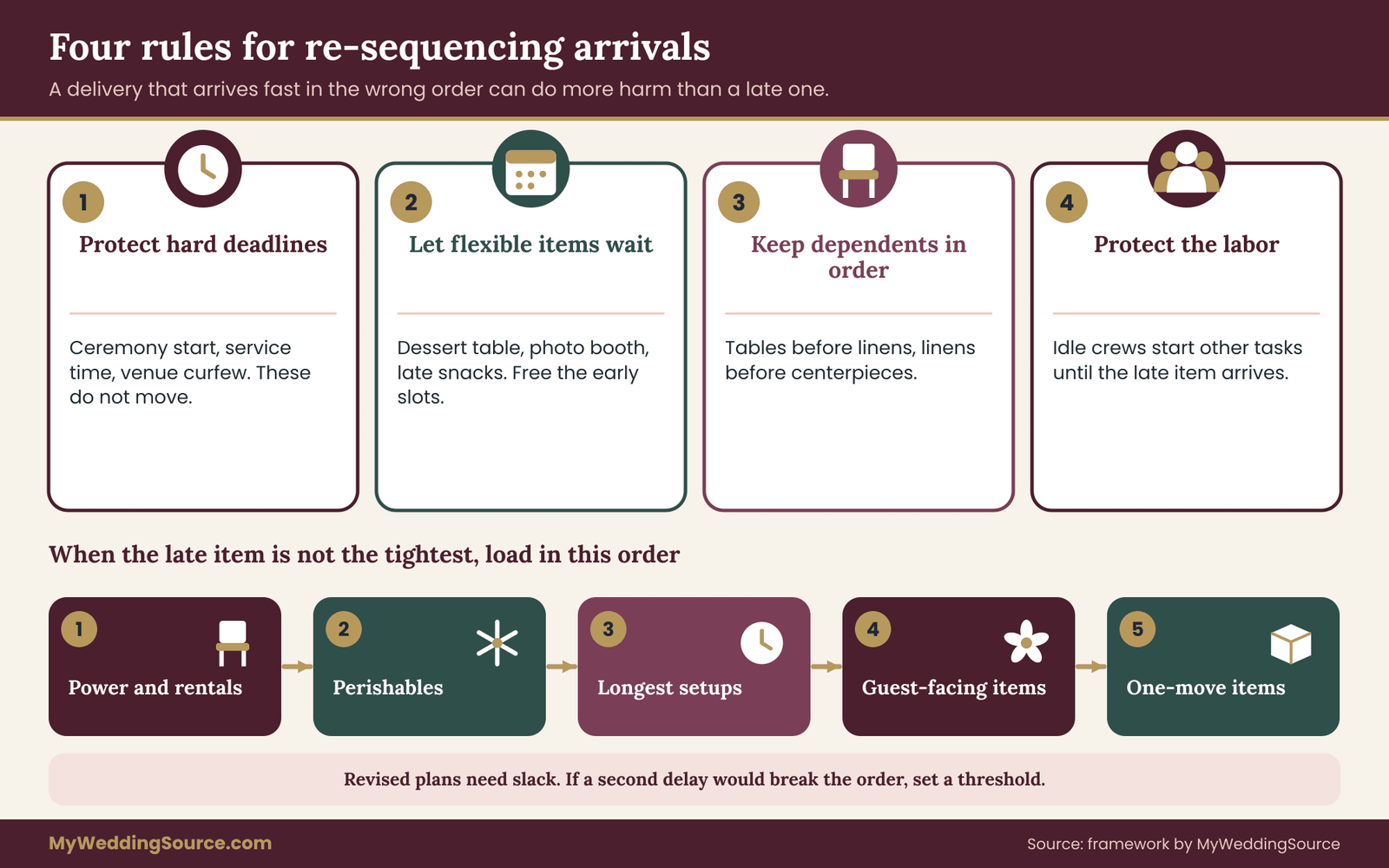
Four rules for resequencing
When a vehicle breakdown makes a delivery slip, work through these four rules in order. They are simple enough to apply on a phone with one hand.
Rule one: protect the hard deadlines. Anything that has a clock outside your control, such as the ceremony start, the caterer’s service time, a venue curfew or a hard stop for the vendor load-out, stays where it is. The schedule bends around those. If the ceremony is at 4:30, it is still at 4:30 unless the couple decides otherwise.
Rule two: let flexible items wait. Move the items that can arrive later, and keep their earlier slots free for the deliveries that cannot. This is the single most useful trick. If the late item is something that can arrive during the cocktail hour, the vehicle breakdown becomes a small shuffle rather than a crisis.
Rule three: keep dependent items in their natural order. If the late item is a prerequisite for others, such as the rental tables, move the dependent items later as well, in the same order, rather than letting them arrive early and clutter the space. A tidy loading zone is worth more than a few minutes of speed.
Rule four: protect the labor. If the late item takes setup labor with it, the people who would have set it up can be used on other tasks in the meantime. The florist’s assistant can start on a different arrangement, a rental crew can place the tables for the next room, a caterer’s staff can help with a staging area. This keeps hands busy, and it can shave twenty minutes off the setup when the missing item finally arrives.
A decision rule for what goes first
When the vehicle breakdown strands an item that is not the one with the tightest deadline, use this ordering. First come items that are needed by other vendors in order to start. Second come items that are perishable or time-sensitive once they arrive. Third come items with the longest setup. Fourth come items that guests see first. Fifth come items that can be placed in one move at the end.
Notice what this does. It puts rental infrastructure and power ahead of décor, and it puts perishable food ahead of long-lasting items. It also puts the items that guests see first, such as the welcome table and the ceremony space, ahead of reception décor, which tends to be viewed later and by more forgiving eyes.
Sequencing for a single loading zone
Many venues have one loading area, one elevator and one path to the main space. In that setting, two vendors at the same time is a traffic problem, and a vehicle breakdown makes it worse because the substitute arrives at an unpredictable moment.
A workable approach is a loading zone log. One person, usually the planner or the person named on the sheet, holds a simple list with the vehicles expected and their times, and radios or texts each driver when the zone is clear. If a substitute arrives during another vendor’s unload, the log tells the person whether to wave the new driver through, ask them to wait, or direct them to a second spot. The log can be a notes page. What matters is that one person owns it.
When two vendors are late at once
Two vehicle breakdowns on the same day are rare, and a late delivery caused by traffic or an accident on a shared route can look the same. When two items slip, return to rule one: the hard deadlines do not move. Then rank the late items by how visible and how essential they are.
The ceremony space comes before the cocktail hour, and the cocktail hour comes before the reception. It also helps to look at the substitute resources in the sheet, because two late vendors might need the same helper. A single friend with a pickup cannot be in two places.
Communicating the changed order
Once the order is set after the vehicle breakdown, tell each affected vendor in writing with a specific time and a specific place. Include the new arrival time, the entrance, the contact person and any changed instructions. Avoid vague phrases such as “later this afternoon.” If the new time is a guess, say so: “We expect the florist at 2:45 and will confirm by 2:15.” The wedding day digital contingency plan explains how to keep a reliable way to message everyone when phone service is poor.
What a good revised order looks like
A good revised order after a vehicle breakdown has three qualities. It keeps the hard deadlines. It uses the slack in flexible items to absorb the delay. And it leaves a margin. If the new plan has no slack left, a second delay will break it, so the revised order should include a clear threshold: “If the florist is not here by three, we switch to the fallback.” That threshold is the bridge to the failure conditions later in this article.
A reminder about people, not only goods
When a vehicle breakdown changes the order, the people who were waiting for a delivery are idle, and idle people are tempted to leave, make a different plan or hover. Give them something specific to do or a definite time to return. A caterer who is told “your space opens at two” will plan around it. A caterer who is told “we are not sure” will start worrying about their own schedule, and your vehicle breakdown delay becomes a bigger one. ## A worked case: the florist’s van fails at one o’clock
The following example of a vendor vehicle breakdown is invented for illustration. The names, times and details are made up, and the point is to show the sheet running, not to describe a real event. Treat the numbers as placeholders and replace them with your own.
The setup
Dana and Marcus are marrying at 4:30 p.m. at a garden venue about forty minutes from the nearest city. The ceremony is outdoors, followed by a cocktail hour on the terrace and a reception in a covered pavilion. Dana’s cousin Priya has agreed to be the day-of contact for vendors, and she carries the sheet on her phone.
Four vendors move goods by vehicle: the florist, the baker, the rental company and the band. The rental company’s crew has already delivered tables, chairs and linens that morning. The baker delivers the cake at 2:30 p.m. The band arrives at 3:15 p.m. to set up for a sound check. The florist’s van is due at 1:30 p.m., because ceremony arrangements need about forty-five minutes to install, and the venue’s loading gate is staffed until 5:00 p.m.
The call
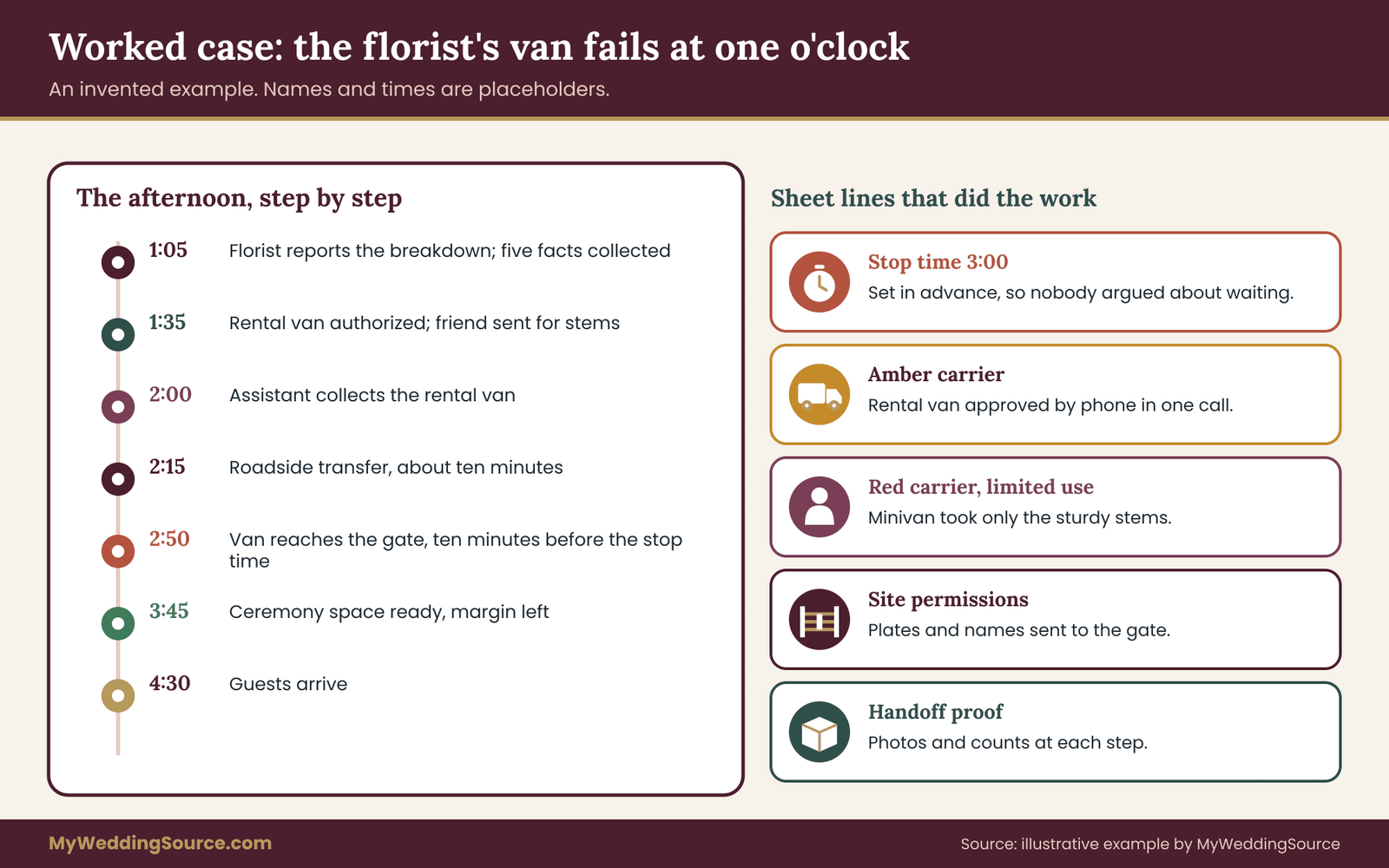
At 1:05 p.m. the florist calls Priya to report a vehicle breakdown. The van has lost power on a county road about twenty-five minutes from the venue. The florist and her assistant are safe, parked on a wide gravel pull-off, and a tow service has said it will arrive within an hour. The van holds the ceremony arrangements, the bouquets, the boutonnieres, two buckets of loose stems and the florist’s tool case.
Priya asks the five questions. Are you safe: yes. Where exactly: the road name and a nearby intersection. What is in the vehicle: arrangements, bouquets, loose stems and tools, no other client’s cargo. What did the tow service say: about an hour, towing to a shop, no on-site repair. What have you already tried: she called her studio partner, who is on another delivery an hour away.
What the sheet says
Priya opens the sheet for the vehicle breakdown. The florist’s line shows these entries. The cargo is boxed arrangements, bouquets and loose stems that must stay upright and out of direct sun. The approved carriers are the studio partner as green and a local rental van company the florist uses as amber. The vehicle limits are a closed vehicle with a flat floor, no open truck bed.
The site permissions note that the gate attendant knows the florist’s name and needs a name and plate for any other vehicle. The handoff proof is photos at pickup and arrival and a count. The insurance note says the florist’s policy covers goods in transit with approved carriers, and that friends and family are not approved. The spending authority is Priya, up to a cap the couple set. The stop time is 3:00 p.m.
The sequencing half says the ceremony flowers have a latest safe arrival of 3:00 p.m., computed with forty-five minutes of setup, fifteen to carry and thirty of buffer. The loose stems and bouquets can arrive later, up to 4:00, because they go to the couple and the wedding party rather than to the ceremony space.
Choosing the substitute
Priya has about ninety minutes of slack after the vehicle breakdown, before the 3:00 stop time, and she needs to pick an option quickly. She walks through the list in order.
The studio partner is green on the sheet, but she is an hour away on another delivery, so she is not a realistic option in time. The amber option, a local rental van, is close to the venue, and the florist says she can authorize it by phone.
A rented van needs a driver, and the florist’s assistant, who is standing beside the broken van, has a normal license and the rental company confirms by phone that this is enough for a standard cargo van. A rideshare can bring the assistant to the rental location in about fifteen minutes.
Priya also weighs a roadside transfer. The pull-off is wide, flat and out of traffic, and the cargo is in boxes that two people can carry. That makes a roadside transfer after the vehicle breakdown reasonable, so the rental van will drive to the florist rather than the cargo going back to a shop.
She declines one offer. The venue manager mentions a farm stand nearby with a van that sometimes helps, but there is no written approval from the florist and no way to confirm the cargo would be protected. She also considers a friend of the couple who lives near the pull-off and has a minivan.
The minivan is red on the sheet because it is a personal vehicle without a flat floor. The florist, asked directly, would rather not send the arrangements that way, but she would accept it for the loose stems and bouquets, which are sturdy and travel upright in buckets.
The decision
Priya chooses a split. She authorizes the rental van for the ceremony arrangements, with the assistant as driver and the florist staying with the tow. She sends the friend with the minivan to collect the bouquets, boutonnieres and loose stems. She texts the venue manager and the gate attendant the plate numbers and names for both vehicles. She also sets a check-in rule: the assistant will text from the rental pickup, from the roadside transfer and from the gate.
Both vehicles are moving by 1:35 p.m. The assistant collects the van at about 2:00 after the paperwork, reaches the pull-off at 2:15, and the transfer takes about ten minutes. The van reaches the gate at 2:50, ten minutes before the stop time, and the minivan arrives a little after that.
What changed in the sequencing
The ceremony flowers were originally due at 1:30, with setup finished by 2:30. The vehicle breakdown moves arrival to 2:50, which leaves one hour and forty minutes until guests arrive. The carry takes about ten minutes and setup takes forty-five, so the ceremony space is ready by about 3:45 with roughly forty-five minutes of margin.
The baker is due at 2:30 and the band at 3:15, and all three share one loading area. Priya checks the loading zone log. The cake goes in first because it is perishable and needs the cooler space. The florist’s van waits a few minutes in the lot and is waved through when the baker leaves. The band is asked to hold in the parking area until the loading zone is clear, which adds a delay of about ten minutes to a schedule that had room for it.
The assistant has no helper for the carry, so Priya sends two members of the venue staff, which cuts the carry to about ten minutes.
The record
At each step of the vehicle breakdown response, Priya’s phone captured the record: the photo at pickup, the count of boxes, the time of the transfer, the plate number of the rental van, and a photo of the arrangements on arrival. One arrangement had a bent stem, which was fixed on site in a few minutes. The florist, back from the shop later that evening, provided a written summary of what happened and how much the rental van cost.
What the example shows
Three things stand out about this vehicle breakdown, and they apply beyond florists. First, the sheet did most of the work before the call. The latest safe arrival, the approved carriers, the site permissions and the stop time were already on paper, so Priya was choosing among prepared options rather than building them.
Second, splitting the cargo helped. Not every item needed the same carrier, and sending the sturdier items by a lower-grade option protected the fragile ones. Third, the vehicle breakdown mattered less than the margin. A thirty-minute buffer in the latest safe arrival time turned a rough hour into a manageable afternoon.
Where the example could have gone wrong
It is worth reading the same vehicle breakdown with a few small changes. If the gate attendant had left at 2:00 without telling anyone, the rental van would have waited at a locked gate. If the sheet had not listed the venue contact, Priya would have lost ten minutes finding one.
If the stop time had been missing, the team might have argued about whether to keep waiting for the tow. And if the florist had not already told the couple which items were most important, Priya would have had to guess. Each of those is a missing line on the sheet.
Adapting the example to other vendors
The same structure works for any vendor hit by a vehicle breakdown. For a baker, the latest safe arrival depends on how long the cake can stand at room temperature, and the carrier should be someone with a flat vehicle floor and air conditioning. For a rental company, the latest safe arrival is set by the vendors who depend on the tables and chairs, so it is usually earlier than the florist’s.
For a band, the cargo includes heavy equipment and people with specialized skills, and the substitute vehicle needs room for both, or the sound technician can travel separately from the gear. For a caterer, the question is food safety first and schedule second, and the next section explains why. ## When the substitute plan fails: stop rules for a vehicle breakdown
Every plan has a point at which it stops being the right plan. A substitute arrangement that is still reasonable at 1:30 can be a bad bet at 3:00, and the people involved are the worst judges of when that point has passed, because they have already put effort into it. That is why the sheet has a stop time, and why it is written before the day.
Failure conditions worth writing down
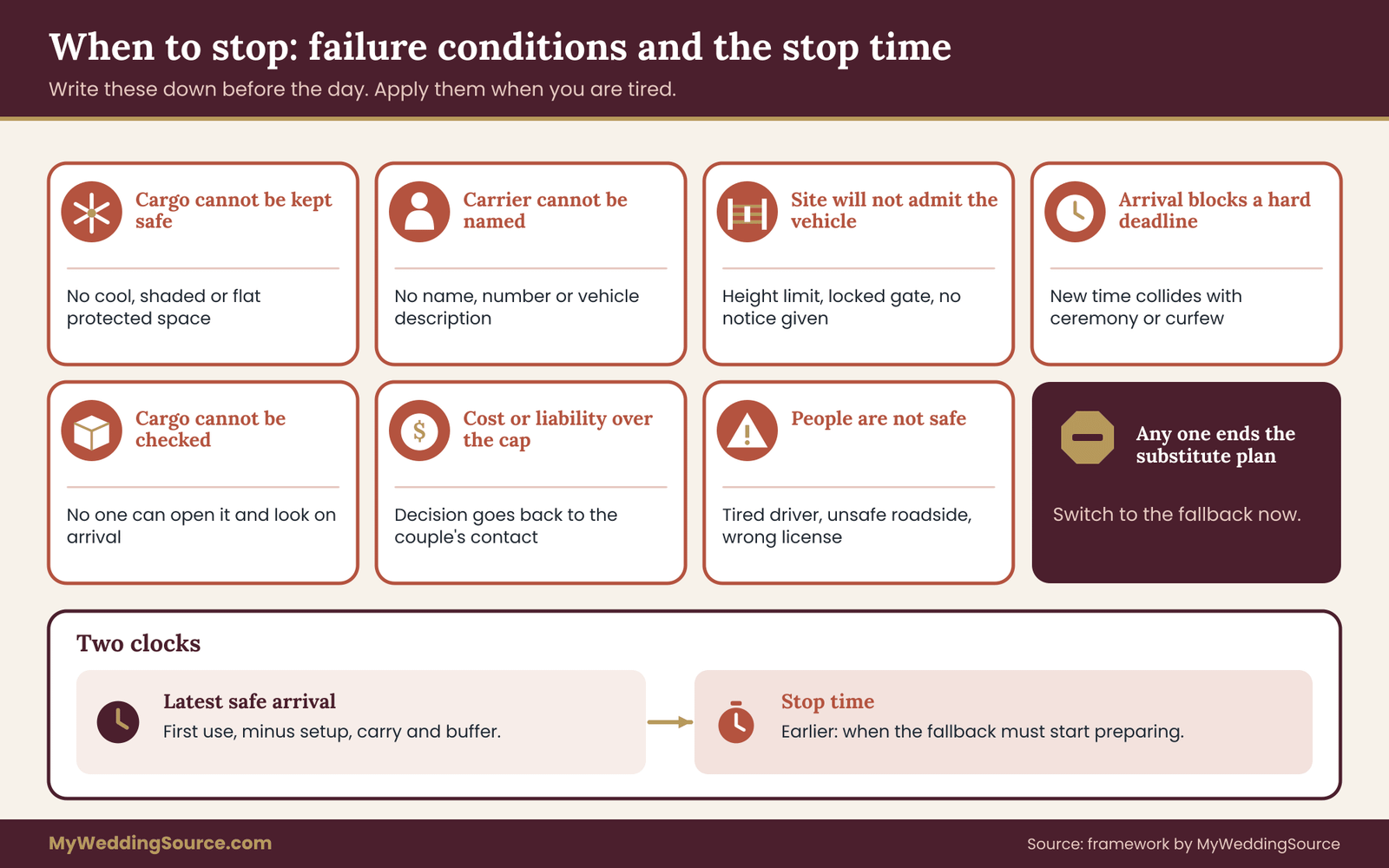
A failure condition is a fact that, once true, ends the substitute plan whether or not the clock has run out. Write these on the sheet in advance, in plain words. These are the ones that come up most often after a vehicle breakdown.
The cargo cannot be kept safe. For perishables, this means you cannot confirm a cool, shaded cargo area. For fragile items, it means there is no flat protected floor or no one who can hold the load steady. If the answer to “will this arrive in the condition it left?” is “probably not,” the plan has failed, even if the vehicle is moving.
The carrier cannot be named or reached. A substitute who cannot give a name, a phone number and a vehicle description is not a substitute. This is not about distrust. It is about knowing whom to call when the vehicle is twenty minutes overdue.
The site will not admit the vehicle. If the gate, the height limit or the venue’s rules make entry impossible and cannot be resolved in time, the plan has failed at the last step.
Arrival would block a hard deadline. If the new arrival time collides with a ceremony start, a caterer’s service time or a venue curfew, you are trading one problem for another.
The cargo cannot be checked on arrival. If no one on the receiving end can open a box and look, the handoff has no safety net. A sealed, unverifiable delivery is a risk.
The cost or the liability has passed the cap. If the substitute requires spending beyond the sheet’s cap, or accepting a liability the person on site cannot accept, the decision goes back to the couple’s designated contact, and it should not be made quietly.
The people are not safe. Any plan that asks someone to drive tired, to transfer cargo at an unsafe roadside, or to drive a vehicle they are not licensed or comfortable operating has failed. Stop, and let qualified responders and professionals handle the road.
How to set the stop time
The stop time is not the latest safe arrival. It is a little earlier, and it marks the last moment at which the fallback is still possible. If the latest safe arrival for the ceremony flowers is 3:00, the fallback might need forty-five minutes to prepare, so the stop time might be 2:15. The logic: after the stop time, there is no longer enough time to run the fallback properly, so you must commit to one path or the other.
Think of a vehicle breakdown as running two clocks. One counts down to the latest safe arrival of the original goods. The other counts down to the point at which the fallback has to start. The sheet should show both.
What to do at the stop time
At the stop time for a vehicle breakdown, the person in charge looks at three facts. Where is the substitute right now? What is its confirmed arrival time? How much margin is left? If the substitute is within sight of the gate and the margin is positive, the plan continues.
If the substitute is not confirmed, or the margin is thin, the fallback starts. This should be a short, calm decision, not a debate. The person in charge can tell the vendor, “We are switching to the backup at two fifteen. If your cargo arrives later, we will still use it where we can.”
Why people miss the stop time
Two things push people past the stop time during a vehicle breakdown. The first is optimism: the tow is “nearly there,” the van is “five minutes away.” Experienced coordinators learn to treat every estimate as a range and to plan for the late end. The second is sunk effort: a rental van has already been booked, a friend has already left. Neither is a reason to delay the fallback. A stop time is valuable precisely because it is made when you are calm and applied when you are not.
Fallbacks by vendor when the goods cannot arrive
A fallback for a vehicle breakdown is a simpler version of the same function. It is not as good as the original, and it does not have to be. It has to keep the day running with something that serves the purpose. Here are fallbacks for the vendors most often affected by a vehicle breakdown. They are starting points; adapt them to your own wedding.
Florist
If a vehicle breakdown keeps the main arrangements from arriving, scale to what is possible. A local grocery or flower market may have stems and containers that can be arranged quickly by a few people. The ceremony can use the bouquets alone, a small number of aisle markers or the venue’s own greenery.
The couple’s bouquets and boutonnieres are the highest priority, because they appear in every photo. A florist stuck on the road can sometimes guide a volunteer by phone, and the written record of what was ordered helps with any credit later.
Baker
A cake stranded by a vehicle breakdown has several fallbacks. The baker may have a smaller backup cake or a set of sheet cakes ready at the shop. A local bakery may be able to supply a plain cake that can be decorated on site with fresh flowers.
Or the cutting ceremony may use a small display cake with the service dessert from the caterer. Which of these works depends on the contract and the baker’s capacity, and it is worth asking about when you book. The baker, not the venue, should say what is possible.
Rental company
A vehicle breakdown at the rental company is among the most disruptive, because everything else depends on them. Fallbacks include a second rental company with local stock, the venue’s own furniture, tables brought by the caterer, or a simpler layout with fewer tables and cocktail-style seating. Ask the venue what furniture it has on hand during your final walkthrough.
Band or DJ
A band caught in a vehicle breakdown can reduce its setup: a smaller sound system, an acoustic set, a playlist on the venue’s own speakers for the cocktail hour while the equipment finishes loading. If the vendor’s equipment is stuck, a local rental company for sound systems may provide a basic setup. Reception music can start a little later with little harm, while ceremony music is harder to replace. The wedding day digital contingency plan covers how to prepare backup audio files and playlists.
Caterer and bar
For food and drink, the first question is safety. Cold items that have stood in a warm vehicle for too long cannot be served, regardless of how they look. The U.S. Food and Drug Administration’s Food Code and the federal food safety agencies publish guidance on time and temperature limits for perishable foods, and a caterer’s food safety plan should follow them.
Federal food safety guidance generally warns against leaving perishable food out for more than two hours, or one hour when the air is above ninety degrees. Ask your caterer what their own rule is, and let them make the call. A fallback may be a reduced menu, a local restaurant’s tray service or a delayed first course, with the venue’s help.
Lighting, décor and signage
These are the easiest to compromise on, because they are mostly visual. A reduced lighting plan with candles, string lights or the venue’s own lighting can carry a reception. Signage can be handwritten or printed at a local shop. The key is not to let a minor item delay the major ones. If a vehicle breakdown strands the signs and the programs, the ceremony still starts on time, and the programs can be read from a single phone photo at the entrance.
The couple’s own transportation
This article centers on a vendor vehicle breakdown, but the same sheet can cover a wedding party limousine, a shuttle or a getaway car. The cargo is people. The latest safe arrival is the time the ceremony begins minus a buffer, the substitute is a rideshare or a friend with a car, and the permissions are mostly about who knows the pickup address. For guest shuttles, the guest hotel coordination guide is the better place to start.
When a partial delivery is the best outcome
After a vehicle breakdown, the goal is sometimes not to rescue everything. If half the cargo can arrive, bring that half, and let the rest follow when the tow is done. A partial setup that is correct is better than a complete setup that is rushed. State clearly which items are in the first group, so the setup crew does not wait for items that are not coming. ## Money, contracts and records after a vehicle breakdown
Once the goods from the vehicle breakdown are in the room, the practical questions shift to cost and responsibility. These are the questions that cause friction in the weeks after the wedding, and a few minutes of record keeping on the day makes them easier to answer.
Who pays for the rescue
There is no universal answer to who pays after a vehicle breakdown, and the contract is the first place to look. A vendor who is responsible for delivery usually bears the cost of getting the goods there, including a rental van, a courier or a tow. Some contracts shift certain costs to the client, especially for changes the client requests. Some include a clause about events outside the vendor’s control. Many say nothing specific.
A fair approach, if the contract is silent, is to separate three costs. The first is the cost of the substitute transport, which the vendor usually carries because delivery is part of the service. The second is the cost of lost time or extra labor, which depends on who caused the delay and what the contract says.
The third is the cost of any item that was damaged or could not be used, which is usually a conversation about a credit or refund. You do not need to settle these on the day. You do need to record them. The wedding vendor contract guide explains what to look for in delivery and substitution clauses.
What to ask the vendor for afterward
Within a day or two of the vehicle breakdown, send a short, calm message. Thank the vendor for working with you under pressure, summarize what happened in three or four lines, and ask for what you need: a written account of the substitute costs, an itemized list of anything not delivered, and the vendor’s proposed credit or adjustment. Avoid accusations. The vendor’s vehicle broke down, which is an ordinary risk of a business that moves goods, and the way they handled it is the thing to evaluate.
A message might read:
“Thank you for getting everything here on the day. For our records, could you send a short summary of what happened, the cost of the rental van, and any items that were not used? We would like to settle the final invoice once we have that.”
Payments and disputes
If a dispute arises over a final payment after a vehicle breakdown, hold the records and keep the discussion in writing. The Consumer Financial Protection Bureau explains how billing disputes on credit cards work, including time limits for reporting errors, and the details matter, so read the current guidance before relying on a rule you half remember.
A vehicle breakdown is rarely a reason to dispute a charge. It becomes one only if goods or services were not delivered as agreed and the vendor will not resolve it. The cash-flow planning guide explains how final balances and reserve funds can absorb surprises like a rental van or courier fee.
The record to keep
Collect these items in one folder, ideally on the day itself.
- The phone log: times of calls, who called whom, and what was decided.
- Messages with the vendor, the carrier, the venue and the planner.
- Photos of the cargo at pickup, at transfer and on arrival.
- Receipts for any substitute transport, rentals, couriers or tolls.
- The name, phone number and vehicle details of every carrier.
- The written insurance note from the vendor, if one was provided.
- A short written note of the final decision about credits or refunds.
These records belong with your other wedding files, and the wedding records guide shows how to organize and retain them.
What to learn from the incident
A week after the vehicle breakdown, spend ten minutes on three questions. What did the sheet get right? What was missing: a phone number, a gate code, a cap? And is there a vendor whose backup plan should be rethought? Update the sheet, and if you ever plan another event, you start from a better version.
Preventing the problem before the wedding
A vehicle breakdown cannot be prevented by the couple, since the vehicle belongs to someone else. But its impact can be reduced a great deal by decisions made weeks earlier. Most of them are cheap or free.
Questions to ask each vendor during final confirmation
- How many vehicles do you have, and do you have a backup for a wedding day?
- What time will you leave, and by what route?
- Will anyone be on the road with you, and can you text us when you leave and when you are halfway?
- Do you have roadside coverage, and what does it include?
- If your vehicle fails, whom do you call first, and how long would a replacement take?
- Can any of the items be delivered the day before?
Consider earlier delivery for items that tolerate it
Some items can arrive a day early without harm: rentals, signage, non-perishable décor, favors. Moving delivery from the wedding day to the day before removes the highest-risk part of the schedule, because a breakdown on a quiet day leaves time to fix it. This might cost extra, or the venue might not allow early access. Ask, and decide whether the cost is worth the reduction in risk. For items that must arrive on the day, ask for the earliest slot that the venue allows.
Build buffer into the timeline
The latest safe arrival calculation includes a buffer for a reason. If every vendor is scheduled to arrive at their latest safe time, one delay breaks the order. Schedule arrivals early enough that a thirty- or sixty-minute delay still fits. The vendor timeline guide shows how to space arrivals so that delays have room to be absorbed.
Use check-in points
A vendor who texts “leaving now” and “ten minutes out” gives you notice. A missed check-in is an early warning that something may be wrong, and it triggers the sheet before the vendor has time to call. Ask each vendor to agree to two check-ins.
Keep the sheet short and findable
The best vehicle breakdown sheet is one page, readable on a phone. Resist the urge to add detail. The goal is to find the green option, the gate code and the stop time in under a minute. A shared folder, a pinned message and a printed copy in the planner’s bag are all reasonable. The rental planning checklist is a helpful companion for the vendors with the most gear.
Your next steps
- List every vendor whose goods could be stranded by a vehicle breakdown, and note the cargo and the first time each item is seen by guests.
- Calculate the latest safe arrival for each, using setup time, carry time and a buffer.
- Ask each vendor the vehicle breakdown prevention questions and keep the written answers.
- Ask the venue about vehicle limits, gate procedures, advance notice and a second loading choice.
- Name the approved carriers for each vendor and give each a green, amber or red level.
- Set the spending authority and the stop time, and tell the day-of contact.
- Put the vehicle breakdown sheet where the day-of contact can reach it, and ask each vendor for two check-in texts.
FAQ
What should I do first when a vendor reports a vehicle breakdown?
Ask whether everyone is safe, then get the exact location, what is in the vehicle, and what the roadside or tow service has said. Do not promise money or start sending people yet. Collect those facts in about two minutes, then check your plan for the vendor’s approved substitutes and latest safe arrival. Call back within about ten minutes with a decision.
Can a friend or family member carry a vendor’s goods?
Sometimes. It works best for sturdy items and when the vendor agrees in writing and the person has a suitable vehicle. It works poorly for perishable or fragile goods, or when the person is needed elsewhere. Ask the vendor how their insurance treats a non-staff carrier, and tell the carrier plainly that they are taking responsibility for someone else’s property.
How do I decide when to stop waiting and switch to a fallback after a vehicle breakdown?
Write a stop time before the wedding. Set it earlier than the latest safe arrival, by the time the fallback needs to prepare. At that time, check where the substitute is and whether its arrival is confirmed. If it is not, switch. Estimates from tow services and drivers are ranges, so plan for the late end.
Who pays for a rental van or courier after a vehicle breakdown?
It depends on the contract. The vendor usually carries delivery costs, since delivery is part of the service, but contracts differ. Keep receipts, record who approved what, and ask the vendor for a written summary of costs and credits after the wedding. If the contract is silent, discuss it calmly and in writing instead of settling it on the day.
What does the venue need to know about a replacement vehicle?
Usually a name, a vehicle description, a plate number and an arrival time. Some venues also need advance notice, an insurance certificate for commercial vehicles or compliance with size limits. Ask during your final confirmation, and put the on-site contact and gate procedure on the sheet, so the driver is not stopped at an entrance.
Should perishable items such as cake or flowers be moved on the roadside?
Only if the place is safe and the cargo can be moved without damage. A wide, flat pull-off away from traffic can work; a highway shoulder does not. If a safe transfer is not possible, the vendor waits for the tow and moves the cargo from a safer place. Keep perishables cool and shaded, and let the vendor decide.
Can I prevent a vehicle breakdown from affecting my wedding?
You cannot prevent a vehicle failure, but you can reduce its effect. Ask vendors about backup vehicles and check-in points, schedule arrivals with a buffer, consider delivering sturdy items the day before, and prepare the transport sheet in advance. These steps cost little and turn a vehicle breakdown from a surprise into a decision you already prepared for.
Is this the same as a plan for a vendor who does not show up?
No. A vehicle breakdown means the vendor is working and reachable but stuck. A no-show means no contact and no goods. The sheet helps with both, but a no-show needs a different first step, which is finding a replacement vendor. Here the vendor is part of the solution, since they know the cargo and the venue.
Sources
- Ready.gov: Business continuity planning
- Ready.gov: Make a plan
- U.S. Department of Transportation
- Federal Motor Carrier Safety Administration
- National Highway Traffic Safety Administration
- FDA: Food Code
- FoodSafety.gov
- National Weather Service
- Consumer Financial Protection Bureau
- USA.gov: Motor vehicle services