
A wedding cocktail hour works when you settle three things early: how long it runs, what guests eat and drink, and where they stand while the ceremony space turns into a dining room.
Picture the moment right after the ceremony. Your guests have been seated for twenty minutes, the sun is in someone’s eyes, and the two of you are about to disappear for photos. Whatever happens in the next hour is the part of the day guests will spend mostly without you, which is exactly why the wedding cocktail hour deserves its own plan instead of a line item that says “appetizers and bar.” Planned well, it is a relaxed bridge between the ceremony and the reception that gives your photographer time, your caterer time, and your guests something pleasant to do.
This guide covers the whole hour from the guest’s side and the contract’s side: what it is for, how long it should run, how it interacts with photos, a first look, and the room flip, which bar format fits, how much food to order, what to pour for people who are not drinking, and how to handle allergens, heat, rain, and accessibility. It also puts numbers on the staffing and per-guest cost, and it ends with a decision scorecard you can fill in before you sign anything. Where a figure comes from a published source we link it, and where it is an industry rule of thumb or our own illustration we say so, because caterer ratios and pour counts vary by region, venue, and crowd. Alcohol service and food safety are areas where rules differ by state and venue, so the legal and safety sections are general education, not legal or medical advice.
What the cocktail hour is for, and what to decide first
A cocktail hour is a scheduled, hosted gap, and scheduled gaps are where weddings succeed or stumble. Before you choose a single canapé, it helps to name the job you want the hour to do, because the answer changes the length, the food, and the bar. The two sections below sort out the purpose and the format that fits your venue.
What jobs does a cocktail hour actually do?
It gives the two of you and your photographer a protected window
While guests mingle, the couple, the wedding party, and the families can finish portraits without anyone standing around watching. That window is the main reason many photographers push for it, and it is why a rushed cocktail hour can cost you photo time rather than save money. If you are planning around a photographer’s schedule, our wedding photography timeline shows how portrait blocks usually fit around the ceremony and reception, and the practical rule is to decide your portrait list first and size the hour around it. A cocktail hour that is too short forces you to choose between photos and your own guests.
It gives the venue and caterer time to reset the room
If your ceremony and reception share a space, or the ceremony happens in the same ballroom where dinner will be served, the staff needs guests out of the way to flip chairs into tables, set the head table, and light the candles. This is the room flip, and it is usually the real reason the hour exists. Guests experience it as a social break, while the crew experiences it as a countdown with a fixed amount of work in it. Ask your venue how long a flip takes for your guest count and who is on the crew, and you will know the minimum length your cocktail hour can safely be.
It gives guests a place to arrive, relax, and meet each other
People travel, park, find seats, and sit through a ceremony before anyone hands them a drink, so the hour is when the day actually becomes a party. It is also the part of the wedding where two sides of a family, old friends, and coworkers first meet, which is why seating and spacing matter more than decor. Guests who are not drinking, not eating the offered food, or not comfortable standing for an hour still need somewhere to belong. Treat the cocktail hour as hospitality first and a menu second, and the details in this guide get much easier to prioritize.
Which format fits your wedding?
Separate cocktail space after a seated ceremony
This is the most common setup: guests walk from the ceremony to a patio, courtyard, lobby, or lawn where drinks and bites are waiting. It works well because it gives the crew a clean room and gives guests a change of scene. Its weak points are the walk, the weather, and the need for a second set of tables, bars, and staff. If you are still choosing a site, the layout question belongs in your wedding venues guide checklist, because a venue with only one indoor space limits what this format can do.
Reception-only, combined, or no cocktail hour at all
Some weddings fold the cocktail hour into the reception: guests find seats, a bar is open, and passed bites arrive while people settle in. Others skip it, especially for a morning or afternoon ceremony followed by a brunch or a seated lunch. Skipping it saves staffing and rentals, but it removes the buffer that protects portrait time and the room flip, so you would need another way to cover those two jobs. A small wedding at a restaurant, for example, may have no flip at all and can use a shorter reception-style opening instead.
How long should it run, and how does it fit photos, a first look, and the room flip?
Timing is the part of a cocktail hour that reaches into every other vendor’s schedule. A thirty-minute change in one place moves the kitchen, the photographer, the DJ or band, and the venue coordinator, so it is worth building the hour backward from the grand entrance rather than forward from the ceremony. The sections below explain the usual length, how photos shape it, and what to do when the schedule slips. For the broader risks across the whole day, see our guide to wedding day timeline failure points.
What is a realistic length, and what sets it?
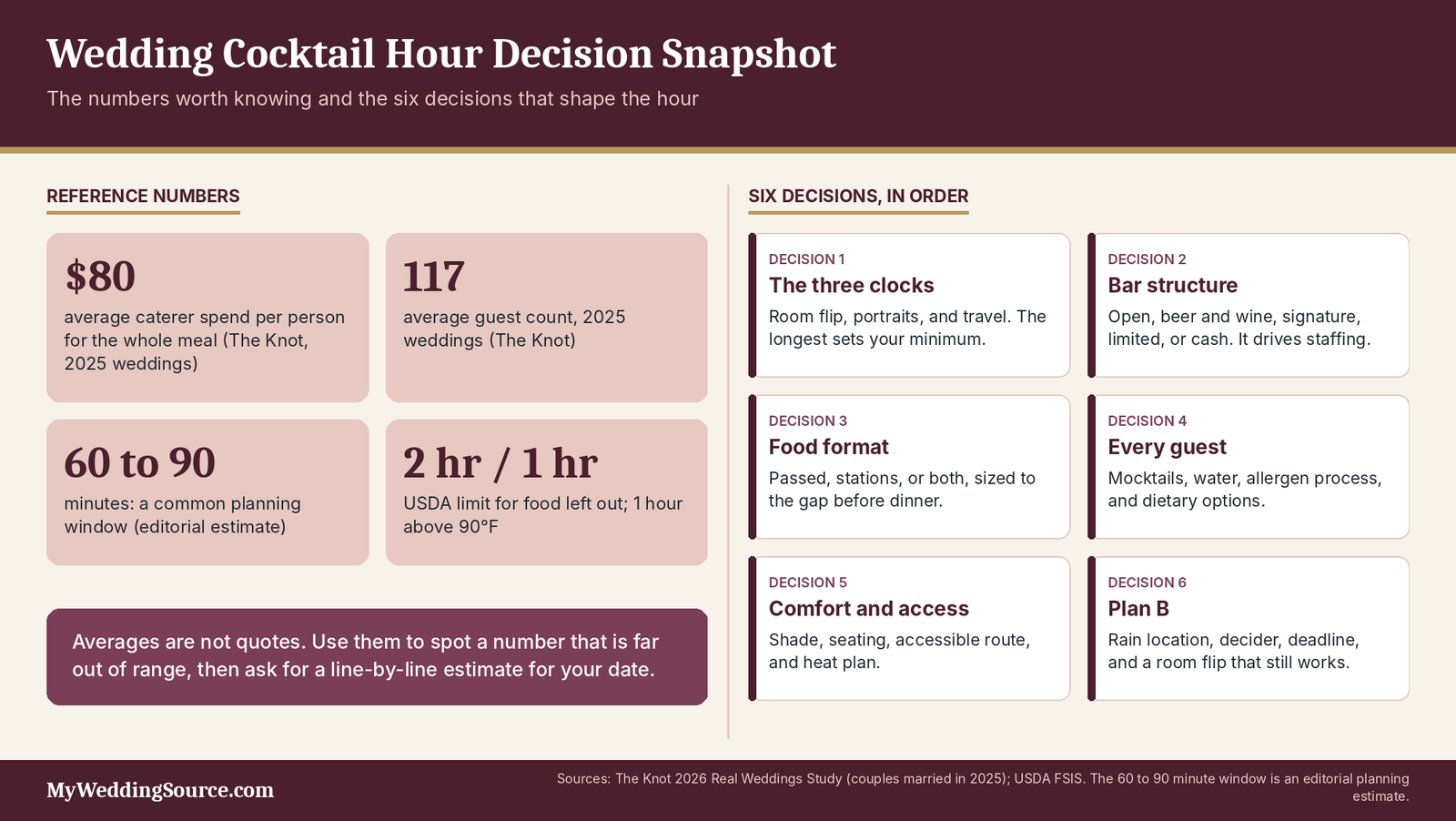
There is no official standard, so the numbers in this section are editorial planning estimates, not rules. Industry advice commonly lands somewhere around an hour, and many timelines run between 60 and 90 minutes. The right number for you is the longest of a few separate clocks.
The minimum is the longest of three clocks: flip, portraits, and travel
Look at three clocks and take the longest one. The first is how long the venue needs to flip or finish the dining room. The second is how long your photographer needs for the portraits that cannot happen before the ceremony, usually family groupings and wedding party photos if you are not doing a first look. The third is any travel, such as a shuttle between a ceremony site and a reception site. If the flip takes 50 minutes, portraits take 40, and the walk takes 10, then 60 minutes is workable only if those things happen at the same time, and 75 to 90 gives you a cushion. Write those three numbers down before you accept a venue’s sample schedule.
Longer is not automatically kinder to guests
A cocktail hour that stretches past roughly 90 minutes tends to hurt more than it helps. Guests are standing, drinking before dinner, and watching the clock, and the kitchen’s timing starts to drift as food waits. Late afternoon heat, a mostly alcohol-forward bar, and light food make a long hour more expensive and harder to manage. If your portraits genuinely need more time, consider moving some of them earlier, as the next section explains, rather than extending the guests’ wait.
Match the length to what comes next
A short, light hour makes sense before a seated dinner that begins soon after. If dinner is delayed because of speeches, a long receiving line, or a second venue, add substantial food or a few more minutes of cushion so the bar does not do all the work. Guests who are drinking on a mostly empty stomach for an extended hour are a hospitality problem and, as the liability section explains later, a risk. Match the food to the gap between the ceremony end and the first plated course, not to a number you read somewhere.
How do photos and a first look change the cocktail hour?
With a first look, portraits move before the ceremony
A first look lets you take many couple, wedding party, and family photos before the ceremony, which can free the cocktail hour so the two of you can attend most of it. The trade-off is an earlier start, more pre-ceremony time dressed up, and a ceremony moment that is less of a surprise. For many couples the ability to be at their own cocktail hour is the whole point. If this appeals to you, our wedding photographer shot list can help you decide which groupings genuinely need to happen after the ceremony.
Without a first look, the hour is a portrait window
If you wait until after the ceremony for photos, the cocktail hour becomes the portrait window, and you will likely miss some of it. Family formals tend to be the least predictable part of the day, because relatives wander off, children get hungry, and groups take longer to assemble than they look on paper. Ask your photographer how long they allow for each block and give them a written list with names, which makes the work faster. A realistic plan lets the couple join the last part of the hour, enter the room together, and still keep some of the golden-hour light if the ceremony is in the late afternoon.
| Scenario | Ceremony ends | Cocktail hour | Couple during the hour | Main risk |
|---|---|---|---|---|
| First look, separate space | 4:30 p.m. | 4:30 to 5:30 p.m. | Greets guests, short sunset photos | Early start, longer dressed time |
| No first look, separate space | 4:30 p.m. | 4:30 to 6:00 p.m. | Portraits for most of the hour | Missing guests, drift in family photos |
| Combined space, no flip | 4:30 p.m. | 4:30 to 5:15 p.m. | Greets guests, then enters | Too little time for any portraits |
What happens when the schedule slips?
The cocktail hour is the shock absorber of the wedding day, and it absorbs delays in both directions. A ceremony that starts late pushes the hour later, and a kitchen that is behind pushes dinner later. You want a plan that tells people who decides what.
If the ceremony runs late
Tell the caterer in real time, not at the next scheduled check-in. If the kitchen does not know, hot passed items come out too early, cold items sit, and food quality drops while guests wait. Ask the coordinator or day-of lead to text the catering manager when the ceremony actually starts and ends. A fifteen-minute delay is easy to absorb when the right people know; the same delay creates waste and frustration when only one person knows.
If the couple is still in photos when the hour ends
Decide in advance who has permission to move dinner. A common solution is to extend the bar for 15 minutes and send out one more tray, rather than seating guests at empty tables. Another is to have the DJ or emcee announce a short delay with a drink-in-hand toast. What matters is that one person, usually the coordinator, makes the call and the caterer hears it directly. If you do not have a coordinator, our wedding planner questions list includes day-of coverage questions worth asking before you decide who will carry the clock.
Which bar format fits a cocktail hour?
The bar is the largest swing factor in cocktail hour pricing and the one most likely to be described in vague terms on a first quote. This section focuses on how bar choices behave during the cocktail hour specifically, including speed of service and pour counts. For a deeper look at package pricing, fees, and contract language across the whole reception, see our guide to open bar wedding hidden costs.
How do the main bar structures compare?
Full open bar, beer and wine, and signature drinks
A full open bar pours liquor, beer, and wine at no charge to guests, a beer and wine bar limits the menu, and a signature-drink bar offers one or two house cocktails alongside beer and wine. The Knot’s open bar cost guide describes these as the common packages, adds partially open bars as a budget alternative, and quotes one bar professional saying the price gap between a beer-and-wine bar and one with liquor is about $10 to $15 per person. That gap is one planner’s estimate for a full reception, not a national average, so use it as a prompt to ask for both prices in writing. For a cocktail hour in particular, a beer, wine, and one signature drink menu often keeps lines short because fewer recipes are being made at once.
Limited bars and consumption bars
A limited bar offers a fixed list, such as one vodka, one whiskey, a few mixers, beer, and wine, which lowers the bar inventory and speeds service. A consumption bar bills for what is actually poured, which can save money with light drinkers but is hard to budget until the day is over. Because the cocktail hour is the first, thirstiest hour, a consumption bar tends to run busiest there, so ask for a not-to-exceed number or a deposit schedule. If you choose a limited list, say clearly on a menu sign what is available, so guests do not feel they are being turned down at the bar.
Cash bars and ticket systems
A cash bar charges guests for their drinks, and some couples use a hybrid, such as a hosted cocktail hour and a cash bar later, or two drink tickets per guest. Guests generally appreciate being told how it works ahead of time, for example on the wedding website, so nobody arrives expecting to pay or not to pay. A cash bar does not erase your responsibilities: the person selling alcohol needs the right license for your state and venue, and the venue’s rules may still apply. If a venue says cash bars are not allowed or must run through their bartenders, ask for that in writing so you are comparing real options.
Bringing your own alcohol
Some venues let you supply alcohol and charge a corkage fee, while others require that everything go through the house bar or a licensed vendor. The savings are real in some cases and illusory in others, because bartenders, glassware, ice, mixers, and insurance are separate costs. Our corkage and cake-cutting fees guide walks through per-bottle, per-guest, and flat-rate fee models and the questions to ask before you buy a single case.
| Structure | How the cost behaves | Works well when | Watch for |
|---|---|---|---|
| Full open bar | Highest per-guest price, most predictable | You want guests never to think about cost | Long lines if only one bar and one bartender |
| Beer and wine | Lower alcohol and staffing costs | Casual weddings, tight budgets | Guests who expect cocktails |
| Signature drinks plus beer and wine | Moderate, labor lighter than full bar | You want a personal touch with short lines | Batch drinks that run out or taste weak |
| Limited bar | Lower inventory, predictable menu | You prefer a short, clear list | Guests who want a favorite spirit |
| Consumption bar | Billed by pour, varies with crowd | Light drinkers, flexible budgets | Surprise total, first hour busiest |
| Cash bar | Lowest cost to you, guests pay | Very tight budgets, long receptions | Guest reaction and license rules |
How many drinks should you plan for one hour?
What counts as a drink, and why a pour is not always one
The U.S. definition of a standard drink is any beverage with 0.6 fluid ounces, or 14 grams, of pure alcohol. The National Institute on Alcohol Abuse and Alcoholism lists a standard drink as about 12 ounces of regular beer at 5 percent, 5 ounces of table wine at 12 percent, or 1.5 ounces of 80-proof spirits. It also notes that a 12-ounce beer at 10 percent counts as two standard drinks, and that restaurant pours of wine and large cocktails often exceed one standard drink. The related Rethinking Drinking site adds that light beers often contain roughly 85 percent of the alcohol in regular beer, so “light” does not mean low alcohol. That matters for a signature cocktail with two ounces of spirits or a generous wine pour, because the same “one drink” per guest is not the same amount of alcohol for every guest.
A planning range for the first hour
There is no authoritative national figure for drinks per guest during a cocktail hour, so treat this as an editorial planning estimate: many bar professionals plan roughly one to two drinks per drinking guest for the first hour, then closer to one an hour afterward. Not every guest drinks, and the share varies with the crowd, the time of day, and the culture of your families. The Knot’s cost page reports an average alcohol cost of $2,800 for couples married in 2025, which is a useful sanity check on total spend but says nothing about a single hour. Ask your bar provider to show how they get from your guest count to a bottle or pour count, and ask what they do if the first hour runs faster than expected.
Passed hors d’oeuvres or stations: what should guests eat?
Food during the cocktail hour does two things at once: it keeps guests comfortable while drinks are served, and it sets expectations for the dinner to come. The right amount is rarely the most you can afford, and it is almost never the least the caterer will offer. This section explains the service styles, a realistic quantity range, and the safety rules that apply when food sits out.
How do passed items and stations differ?
Passed hors d’oeuvres
Servers carry trays through the crowd, which keeps lines out of the bar area and lets guests who are busy talking still get food. Passed service is labor-intensive because each tray needs a person, and it works best for small, neat, one- or two-bite items that do not require a plate or fork. Hot items rely on timing with the kitchen, which is why the real-time notification plan in the timing section matters. For a crowd of 100 or more, ask how many servers will pass and how many trays are in rotation, because a menu of six items passed by two servers produces a very uneven experience.
Food stations
Stations let guests serve themselves from a cheese and charcuterie spread, a raw vegetable display, a chef-attended carving or pasta station, or a dip bar. They spread guests around the space, offer more volume per dollar for some foods, and give people with dietary needs an easy way to see what is in the dish. They need table space, power or heat sources, attendants for anything that is cut or cooked, and signage. A station placed next to the bar creates a traffic jam, so keep them separate and in plain sight of each other.
A hybrid of both
A common and practical approach is two or three passed items plus one or two stations, which gives guests a reason to move and takes pressure off the servers. The passed items offer something immediate, while the stations handle volume and variety. Hybrids cost more in labor than a single station, so price both versions before you commit. If you are weighing seated dinner styles at the same time, our guide to plated versus buffet wedding hidden costs explains how service style changes staffing, and the broader wedding food and catering hub gathers related guides.
How much food is enough?
Quantity is where couples overspend or panic, so it is worth anchoring the discussion in a clear context. The Knot’s 2026 Real Weddings Study, a survey of 10,474 U.S. couples married in 2025, reports an average caterer spend of $80 per person for the whole meal service. Whether your cocktail hour sits inside that number or on top of it depends on the contract, so ask.
Quantity ranges by situation
The pieces-per-guest ranges below are industry rules of thumb that we could not tie to a single authoritative source, so treat them as labeled estimates. Menus differ in how filling each piece is, which is why the useful number to get from your caterer is a count per guest written into the quote. Think of the table as a way to spot a menu that is far too light or far too heavy for the gap you are filling.
| Situation | Pieces per guest (estimate) | Service style | Note |
|---|---|---|---|
| 45 to 60 minutes before a seated dinner | 3 to 5 | Passed, maybe one station | Light starters, dinner is the main meal |
| 60 to 90 minutes before a seated dinner | 5 to 8 | Passed plus stations | Longer gap means more substance |
| Dinner delayed by travel or long receiving line | 8 to 10 | Add a substantial station | Prevents drinking on an empty stomach |
| Heavy hors d’oeuvres replace dinner | 12 to 18 or more | Stations plus passed | Ask caterer to confirm it counts as a meal |
Variety, dietary balance, and wearability
For roughly 100 guests, four to six distinct items is a comfortable editorial range: enough that nobody feels excluded, not so many that the kitchen is overwhelmed. Include at least one vegetarian item, one that avoids common allergens, and one that is substantial rather than airy. Think about wearability, too: sticky glazes, leafy bites, and messy dips are hard to manage in a dress or suit while holding a glass. A small stack of napkins at every station and a visible place to put empty picks and plates reduces the clutter.
Food safety when food sits out
Food held at room temperature has a clock on it. The USDA Food Safety and Inspection Service says to discard perishable food left out more than two hours, or more than one hour when the temperature is above 90°F, and to keep hot food at 140°F or warmer and cold food at 40°F or below. The CDC estimates that foodborne illness sickens 48 million people in the U.S. each year, and its four core habits are to clean, separate, cook, and chill. For a summer lawn cocktail hour, that means ice-nested trays, small replenished platters rather than one big display, and a caterer who can tell you how they are holding temperatures. Ask for the caterer’s license and health inspection information if you are not sure, and be cautious with raw bars and seafood displays outdoors.
Who staffs the hour, and what does it cost per guest?
Staffing is the invisible half of a cocktail hour quote. Food and liquor are easy to picture, but the bartenders, servers, and support crew who turn them into a smooth first hour are what you are really paying for, and they are also where short hours go wrong. This section gives planning ratios, lays out the cost layers, and walks through a transparent per-guest example you can adapt.
How many bartenders and servers does one hour need?
Bartenders and bars
For a straightforward beer, wine, and one-cocktail menu, planning around one bartender for every 50 to 75 guests is a common estimate. A full bar with made-to-order cocktails slows each pour, so many providers staff closer to one bartender for every 40 to 50 guests, and they often add a second bar location once a crowd passes roughly 100. The first hour is the rush, because everyone arrives thirsty at once, so a bar that looks adequate at 7:00 p.m. can be overwhelmed at 5:00 p.m. Ask your provider whether they stage extra staff during the cocktail hour and release them afterward, which is often cheaper than staffing for the peak all night.
Servers for passed food and stations
For passed hors d’oeuvres, a common planning estimate is one server for every 25 to 40 guests, with fewer guests per server when the menu has many items. Stations that are cut or cooked to order need their own attendant, while a self-serve cheese board may only need someone to refill it. The easiest way to test a proposal is to divide your guest count by the number of servers on the quote and ask whether the person doing the math feels comfortable. If the answer is that servers also run the stations and clear glassware, expect slower trays.
Support roles and hour minimums
Behind the visible staff are people who set up the bar, restock ice, carry cases, and pick up glasses. Some providers include them and others bill them separately, so ask who handles ice, glassware, trash, and breakdown. Many bartenders and servers are scheduled with a minimum number of hours, which means a one-hour cocktail window can bill for several. If the bar also serves the reception, that is fine, but if the cocktail hour is a stand-alone event at a different location, you may pay for a long minimum around a short service.
| Role | Planning ratio (estimate) | Add more when | Ask your provider |
|---|---|---|---|
| Bartender, beer and wine | 1 per 50 to 75 guests | Guests arrive all at once | Is there a second bar for 100+ guests? |
| Bartender, full cocktails | 1 per 40 to 50 guests | Menu has several complex drinks | Are bar backs included in the price? |
| Passed-food server | 1 per 25 to 40 guests | Menu has six or more items | How many trays rotate at once? |
| Station attendant | 1 per cooked or carved station | Station is cut to order | Are attendants billed per hour? |
| Support (bar back, bussing) | 1 to 2 for 100 guests | Heat, long distances, many glasses | Who handles ice and glass pickup? |
What are the cost layers behind the quote?
From sticker price to realistic total
::: {.mws-callout} What this actually costs: Pricing here is genuinely complicated, and layered quotes are normal for caterers and bar providers. A realistic cocktail hour budget has five layers, and the clearest way to compare quotes is to ask for a written estimate that lists every layer for your date, guest count, and hours, then divide the total by your guest count.
- Sticker price: the per-piece food price, per-person package, or bar package rate you were quoted.
- Required extras: bartender and server labor, minimum hours, setup, and any food and beverage minimum your venue requires.
- Realistic extras: glassware, ice, garnishes, napkins, cocktail tables and linens, signage, and a non-alcoholic station.
- Taxes and fees: service charge, administrative fees, and sales tax, which can apply to food, alcohol, and labor differently by state.
- Failure cost: overtime if the hour runs long, extra pours if the schedule slips, and a rain-plan setup fee if the cocktail hour moves indoors.
Service charge, gratuity, and tax
A service charge is a fee built into your contract, and it is not automatically a tip for your servers, so ask how it is distributed. The Knot’s vendor tipping guidance says that if no service charge or gratuity appears in the contract, couples commonly tip 15 to 20 percent of the food and drink fee, split among waitstaff and bartenders, and that tips are unnecessary when gratuities already appear on the invoice. Sales tax varies by state and locality, and whether it applies to the service charge or to labor depends on local rules, so ask the vendor and, if the amount is large, a local tax professional. Our wedding vendor tipping guidance goes deeper on who gets what.
Extras couples forget to price
The extras are small until they are added together. Cocktail tables, linens, extra glassware, drink dispensers, and ice are common items, as are trash service, power for lighting or a speaker, restroom capacity, and a rain tent. If you are renting tableware and furniture from an outside company, delivery windows and pickup fees can add a layer, and the cocktail hour space often needs different furniture from the dinner room. Ask your venue and caterer which of these are included and which you will source yourself.
What does one hour cost per guest? An illustrative comparison
The three scenarios
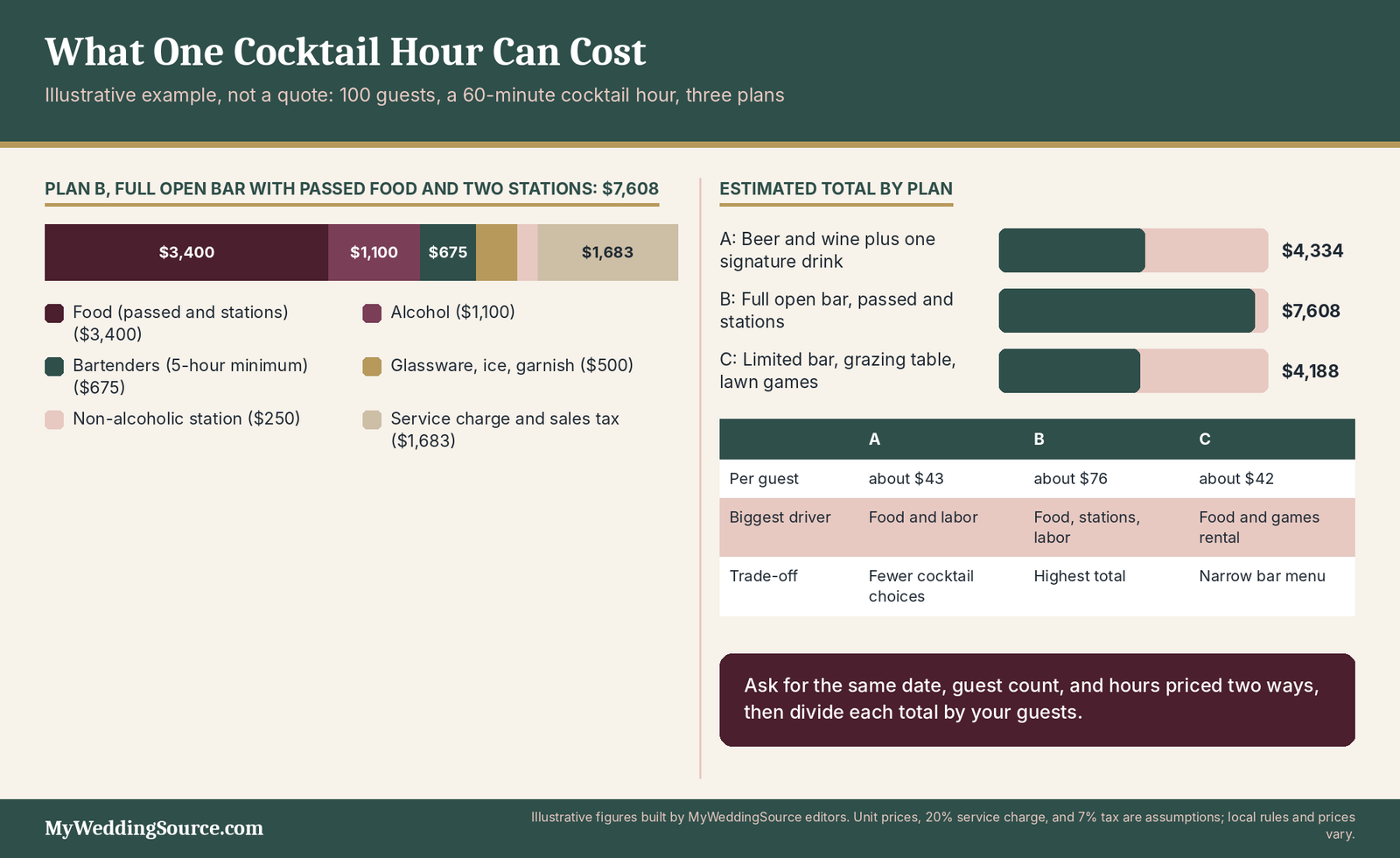
Imagine 100 guests, a 60-minute cocktail hour, and three plans. Plan A is a beer and wine bar with one signature drink, four passed pieces per guest, and one light station. Plan B is a full open bar with five passed pieces and two stations. Plan C is a limited bar with wine and two signature cocktails, three passed pieces, one grazing table, and a rented lawn game set. We used these assumptions: passed pieces at $3.25 (A), $4.00 (B), and $3.00 (C); stations at $6, $14, and $5 per guest; a service charge of 20 percent and sales tax of 7 percent on everything except the games rental; and bartenders billed for a five-hour minimum.
| Line | A: Beer and wine plus one signature | B: Full open bar, passed and stations | C: Limited bar plus games |
|---|---|---|---|
| Food (passed items and stations) | $1,900 | $3,400 | $1,400 |
| Alcohol (servings at assumed cost) | $525 | $1,100 | $600 |
| Bartenders (hourly, five-hour minimum) | $400 | $675 | $400 |
| Glassware, ice, garnish | $300 | $500 | $300 |
| Non-alcoholic station | $250 | $250 | $250 |
| Lawn game rental | $0 | $0 | $400 |
| Subtotal | $3,375 | $5,925 | $3,350 |
| Service charge (20%) | $675 | $1,185 | $590 |
| Sales tax (7%) | $284 | $498 | $248 |
| Total | $4,334 | $7,608 | $4,188 |
| Per guest | about $43 | about $76 | about $42 |
How to read the comparison
Notice that the biggest swing is food and labor, not alcohol. Plan B costs about $33 more per guest than Plan A, and about 70 percent of the subtotal gap is the extra food, stations, and bartender hours. The Knot’s 2026 Real Weddings Study reports an average caterer spend of $80 per person for the full meal, so a cocktail hour that costs $76 per guest in this illustration would be nearly the same as the average whole-meal figure, which is a sign that Plan B is a premium design. Also remember that in many contracts the cocktail hour food is included in the per-person catering price, and the bar is a separate package, so your real marginal cost may be different from any one line here.
What a thirty-minute overrun can cost
Failure cost is the layer people notice last. If Plan B runs an extra half hour because portraits or the room flip slipped, and guests drink about one drink per hour, the added alcohol is roughly 100 guests times half a drink at $5.50, about $275, plus bartender time past the minimum and the service charge. In this illustration that lands near $400 before tax, which is small compared with the total but easy to forget in a budget. The larger cost is usually not the money; it is the kitchen holding food and the guests waiting, which is why the real-time communication plan in the timing section matters.
What do non-drinkers, and guests with dietary needs, find at your cocktail hour?
Guests who do not drink alcohol or who need to avoid certain foods are usually the quiet majority at any large gathering, and they notice the details. A thoughtful non-alcoholic menu and a clear allergen process make the hour comfortable for everyone and also protect you from last-minute problems. This section covers both, with the food-safety scope limited to general education.
What should the non-alcoholic menu include?
A real second menu
Offer at least two mocktails, a non-alcoholic beer or wine option if your provider can source one, sparkling water, and a still option. Serve them in the same glassware as the cocktails so guests who are not drinking alcohol are not visually singled out. A mocktail with fresh citrus, herbs, and a good syrup costs less than most signature cocktails in alcohol but still needs labor and garnishes, so price it as a drink, not as a free extra. In our cost illustration earlier in this guide, the non-alcoholic station was priced at $250 for 100 guests, or $2.50 per guest, which is an editorial assumption.
Water, shade, and hydration
Water is the quiet hero of any outdoor hour. The CDC’s heat guidance advises drinking water throughout the day and notes that beverages high in sugar, sodium, caffeine, and alcohol may work against hydration. Put water at the entrance of the cocktail space, on the bar, and near seating, and use dispensers with spigots so guests do not rely on a bartender. A pitcher on a table is nice; a labeled station with ice, cups, and a trash can is better.
The many reasons a guest is not drinking
Guests skip alcohol for countless reasons: driving, pregnancy, medication, recovery, religion, culture, age, or simple preference. You never need to ask which reason applies, and your staff should not either. Make non-alcoholic drinks easy to find on the bar menu, and brief the bartenders to treat every order the same way. A guest who feels comfortable asking for water or a mocktail is far more likely to stay for the whole evening.
How do you handle allergens and dietary needs?
This is general education about planning, not medical advice. Guests with allergies or medical dietary needs should always speak with the caterer or their own clinician about their situation, and nothing in this guide replaces that conversation. The aim here is to give you operational questions to ask, not clinical answers.
What the nine major allergens are, and what labeling law does not cover
The FDA recognizes nine major food allergens: milk, eggs, fish, crustacean shellfish, tree nuts, peanuts, wheat, soybeans, and sesame, with sesame added by the FASTER Act effective January 1, 2023. Food Allergy Research & Education describes the same nine as the foods that cause most reactions. The labeling rules mainly apply to packaged foods, and the FDA notes that most unpackaged food sold by food-service businesses is outside the scope of that law. In practice, that means a cocktail hour canapé has no federal label, so the caterer’s process and your own questions are the safeguard.
How to collect information from guests
Ask for dietary needs on the RSVP card or website, and word it as a question about allergies and restrictions, not as a request for medical history. Give a clear deadline, a contact person, and a way to follow up, because guests with serious allergies often want to talk to the kitchen directly. Share the list with the caterer in a single organized document, not through multiple messages. For dinner, the same list should drive plated meals or buffet arrangements, which is a good moment to check that the cocktail hour and dinner teams are working from the same information.
What a good process looks like on the day
Look for a caterer who labels items with common allergens, uses separate utensils and serving pieces, and tells servers what is in each tray. The FDA defines cross-contact as the inadvertent introduction of a major food allergen into a product, so ask how the kitchen prevents it on shared surfaces and fryers. Ask that guests with serious allergies be introduced to a staff member who can answer questions about ingredients rather than relying on a general answer from a server. If your caterer cannot describe a procedure, treat that as useful information.
Gluten-free, vegan, religious, and cultural needs
Not every restriction is an allergy, and not every guest is comfortable asking. Gluten-free guests, vegans, halal and kosher guests, and those avoiding pork or beef all deserve clear signage and at least one substantial option, which is easier to do at a station than at a passed tray. Our caterer question list below can be copied into an email.
| Question for the caterer | Why it matters | A good answer sounds like |
|---|---|---|
| Which items contain the nine major allergens? | Packaged-food labels do not cover this | A written menu with allergens per item |
| How do you prevent cross-contact on shared trays? | Fryers and boards can transfer allergens | Separate utensils, surfaces, and labeled trays |
| Who will talk to a guest with a serious allergy? | General server answers can be unreliable | A named chef or manager on site |
| Can you prepare a separate plate for a guest on request? | Cocktail items cannot always be adjusted | Yes, with a deadline for guest notice |
| How will servers know what is in each tray? | Passed trays move fast | A tray card or a briefing before service |
How do music, games, and layout shape the guest experience?
A cocktail hour can have excellent food and a well-run bar and still feel flat if guests have nowhere to stand, sit, or look. Entertainment and layout are the cheapest places to improve the hour, because they are mostly decisions rather than line items. The goal is a space where people naturally drift, meet each other, and always know where the next drink or bite is.
What music and entertainment work for the hour?
Live acoustic sets, playlists, and DJs
A solo guitarist, a string duo, a jazz trio, or a curated playlist all work, and the right choice depends on your venue and budget more than your taste. Live musicians add atmosphere and cost more, while a playlist run by the DJ or coordinator is simple and flexible. If your DJ or band is already booked for the reception, ask whether a short cocktail set or a playlist is included, since it may be cheaper than hiring a separate act. Our comparison of wedding band versus DJ cost explains how those two choices are usually priced, including what is bundled for ceremony and cocktail music.
Sound, power, and local rules
Outdoor cocktail hours often need power for speakers, microphones, and lighting, and the nearest outlet may be far from the music spot. Ask the venue about amplification limits, noise curfews, and who can run cables, because outdoor sound rules vary by town and by property. A microphone for announcements is useful in case guests need to be redirected, a timeline shifts, or the emcee needs to call people into dinner. Test the sound at the actual spot where the music will happen, not in the ballroom.
Lawn games and activities
Cornhole, bocce, giant tic-tac-toe, and ring toss are popular because they give guests something to do with their hands and a reason to talk to strangers. They need a flat, mowed, mostly dry surface, shade for players, and space away from the bar line so thrown bags do not hit a queue. Think about footwear and clothing: heels on grass and long skirts in a tossing game are a mismatch, and some guests will want to watch rather than play. Keep alcohol away from anything heavy or thrown, and assign someone, perhaps a family member or a rental company attendant, to reset the games and keep children safe.
How do you lay out the space so guests keep moving?
Where bars and stations go
Do not put the main bar at the entrance, because every guest arriving at once will form a queue that blocks the door. Place one bar near the entry path but off to the side and a second one deeper in the space, so guests spread out rather than clustering in one place. Stations should be away from the bars and from each other, ideally in sight lines that invite exploration. For a crowd of 100 or more, ask your caterer or planner to draw a quick map of the cocktail area showing bars, stations, tables, trash, and restrooms.
Seating and standing mix
A cocktail hour does not require everyone to stand, and many guests cannot or do not want to. A mix of high-top cocktail tables, a few lounge groupings, and standard chairs scattered along the edges gives people options. As an editorial planning estimate, enough seats for roughly a third of guests is a comfortable starting point, with more if your guests skew older or the hour runs long. Place some of that seating in shade and near the bar so that guests who are less mobile can reach it without crossing the whole space.
Signs, restrooms, and where the glasses go
Guests need to know where the bar is, where the restrooms are, and where dinner will be served. A small sign at the ceremony exit, a person who points the way, or a printed map solves most confusion. Empty glasses and plates are the silent hazard of a cocktail hour, so provide visible drop-off points and ask the staff to circulate and clear them. Make sure the restroom capacity matches the guest count, particularly if you are using a venue where the cocktail space is far from the building.
How do you keep the hour comfortable, accessible, and rain-ready?
Comfort and access decide whether guests stay for the full hour or quietly migrate to their cars. Weather decides whether the hour happens where you planned it. Both are areas where an early conversation with the venue is cheaper than an improvised fix.
What should you check for accessibility and heat?
Routes, surfaces, and seating
The 2010 ADA Standards for Accessible Design set minimum requirements for newly designed or altered public accommodations and commercial facilities, which includes many wedding venues, but they do not automatically describe what a rented tent, a gravel path, or a lawn setup looks like on your date. Ask the venue how guests with mobility devices get from the ceremony to the cocktail space, whether the surface is firm and stable, and whether there is an alternate route if the main path is not usable. Ask whether a section of the bar can serve a seated guest or whether staff will bring drinks to a table. Reserve a few accessible seats near the bar and shade, and keep walkways between tables wide enough for a mobility device to pass.
Heat, sun, and who is most at risk
The National Weather Service describes the heat index as a measure of how hot it feels when humidity is combined with air temperature, gives the example of 96°F air at 65 percent humidity feeling like about 121°F, and warns that full sunshine can increase heat index values by up to 15°F. The CDC lists people 65 and older, young children, pregnant people, and those with heart disease or asthma among higher-risk groups, and names cramps, heavy sweating, dizziness, headache, weakness, and nausea as warning signs. A cocktail hour in direct sun on a humid afternoon is therefore a safety question as well as a comfort one. Plan shade, cold water, a cooler indoor spot guests can retreat to, and a staff member who knows what to do if a guest looks unwell.
Cold, wind, glare, and noise
Heat is not the only comfort problem. Low evening sun can leave guests squinting at each other, so face seating away from the sun where you can. In cooler seasons, ask about patio heaters, blankets, and a warm indoor retreat, and check whether wind will blow napkins and candles across the space. Some guests find crowds and noise tiring, so a quiet corner with a few chairs gives them a place to take a break without leaving the party.
How do you build an indoor-outdoor weather plan?
Name the trigger, the decider, and the deadline
Choose a person with authority, often the coordinator or venue manager, and agree on a time such as a few hours before the ceremony when the call is made. Agree on the trigger, such as a specific forecast, a radar reading, or a heat index threshold. Make sure the caterer, bar team, and musicians hear the decision from the same person at the same time. Our guide to an outdoor wedding rain plan has a longer framework for tents, deadlines, and cost.
The room-flip trap
Here is the problem that surprises many couples. If the cocktail hour is normally outside and rain moves it into the ballroom, the room that needs to be flipped for dinner is now full of guests. You then need a second indoor space, a covered area, or a tent, or the dinner must start later. Ask the venue where cocktail guests would go if rain forced them indoors, how many people that space holds, and whether the crew can still flip the dining room. If the honest answer is that it cannot happen, you have learned something important before signing.
| Condition | Example trigger (set your own) | Move | Who decides |
|---|---|---|---|
| Rain or storms | Forecast or radar a few hours out | Covered patio, tent, or second indoor room | Coordinator or venue |
| Heat | High heat index in the forecast | Shade, misting fans, indoor retreat | Coordinator and couple |
| Cold or wind | Low temperature or gusts | Heaters, sidewalls, move indoors | Venue manager |
| Late ceremony | Ceremony ends well after scheduled | Extend bar, add food, notify kitchen | Coordinator |
| Space too small indoors | Guest count exceeds backup capacity | Stagger entry, open second room | Venue manager |
What should you know about alcohol liability, licensing, and insurance?
This section is general education, not legal or insurance advice. Alcohol laws differ by state and sometimes by county or venue, insurance policies differ by insurer, and a licensed attorney or insurance agent in your state is the right person to answer questions about your specific event. What follows is meant to help you ask better questions of your venue, bar provider, and agent, not to replace them.
How do liability and licensing work in general terms?
Dram shop and social host concepts
FindLaw’s overview describes dram shop laws as civil laws that make alcohol sellers answerable for harm caused by patrons they overserved, and describes social host liability as applying similar principles to private people who host gatherings where alcohol is served. The details differ widely: some states have no dram shop statute, standards for what the server knew or should have known vary, and rules about minors differ. For a wedding, the practical question is who counts as the seller or the host in your state, which depends on who holds the license and who pays. Ask your venue and bar provider how they understand their role, and ask an attorney if the answer affects your decisions.
Who is allowed to pour
The federal Alcohol and Tobacco Tax and Trade Bureau says it enforces the Federal Alcohol Administration Act to ensure that only qualified persons engage in the alcohol beverage industry, as described on its regulated commodities page, but rules for retail service at an event are generally set by states and localities. That is why some venues require that all alcohol be served by their licensed bartenders, why a cash bar may need its own license or permit, and why a friend behind a folding table may not be allowed at all. Before you plan a do-it-yourself bar, ask the venue and your state’s alcohol beverage control agency what is permitted, and ask whether a one-day permit is needed.
Service practices to ask about
Ask whether servers are trained in responsible alcohol service, how IDs are checked, what the policy is when a guest appears intoxicated, and when last call happens. Training requirements vary by state, so a trained team is a reasonable ask but not a universal legal requirement. Agree in advance that bartenders may decline service without needing your permission, and tell your family that this is part of the plan, not an insult. Provide water and food, because slow pacing and available food make the bar team’s job easier.
A ride plan for every guest
NHTSA reports 11,904 deaths in drunk-driving crashes in 2024, about 32 per day, and says the blood alcohol limit is 0.08 in all states except Utah, which uses 0.05. NHTSA advises hosts to make sure every guest has a sober way home. Practical choices include a shuttle, ride-share information on the program or website, a hotel block within walking distance, and a bar that closes before the event ends. This is also a kind thing to do for the guest who has been enjoying the party and is not sure how to get home.
What insurance questions should you ask?
Cancellation, event liability, and vendor insurance are different
NerdWallet’s wedding insurance explainer distinguishes liability coverage, which pays for injuries or property damage during the event and often includes host liquor liability, from cancellation or postponement coverage, which reimburses you if you must cancel or delay for covered reasons. It reports liability limits that generally range from $500,000 to $5 million and says that coverage for one type can cost less than $100, while policies with both can exceed $1,000, depending on guest count, location, and limits. A third layer is the vendor’s own insurance, such as the caterer’s or bar provider’s liability coverage, which protects the vendor and sometimes the venue. These are insurer-specific products, so read the policy documents and ask your agent what is and is not covered.
What the venue’s policy does and does not do
NerdWallet notes that a venue’s own liability policy typically covers the venue, not you. Many venues require couples to carry their own event liability policy, and some require proof before the date. Ask the venue for its insurance requirements in writing, including minimum limits and whether it must be named as an additional insured. If a policy is required, ask when proof is due, because the process can take time.
Certificates and host liquor liability
Ask your caterer or bar provider whether they carry liquor liability coverage and whether they can provide a certificate of insurance for the venue. If the venue asks you to buy host liquor liability, ask whether it applies when a licensed vendor serves the alcohol, what the limits are, and what is excluded. Insurers define terms differently, so do not assume that a policy bought for a birthday party or a bar mitzvah has the same wording. Keep copies of every certificate and policy with your contracts.
How do you decide? A cocktail hour scorecard
By this point you have a lot of options and probably a few strong feelings. A scorecard turns the pile of questions into a short comparison, so you can see where a plan is solid and where it depends on luck. Use it on your own plan, or on two competing plans.
How do you score a plan?
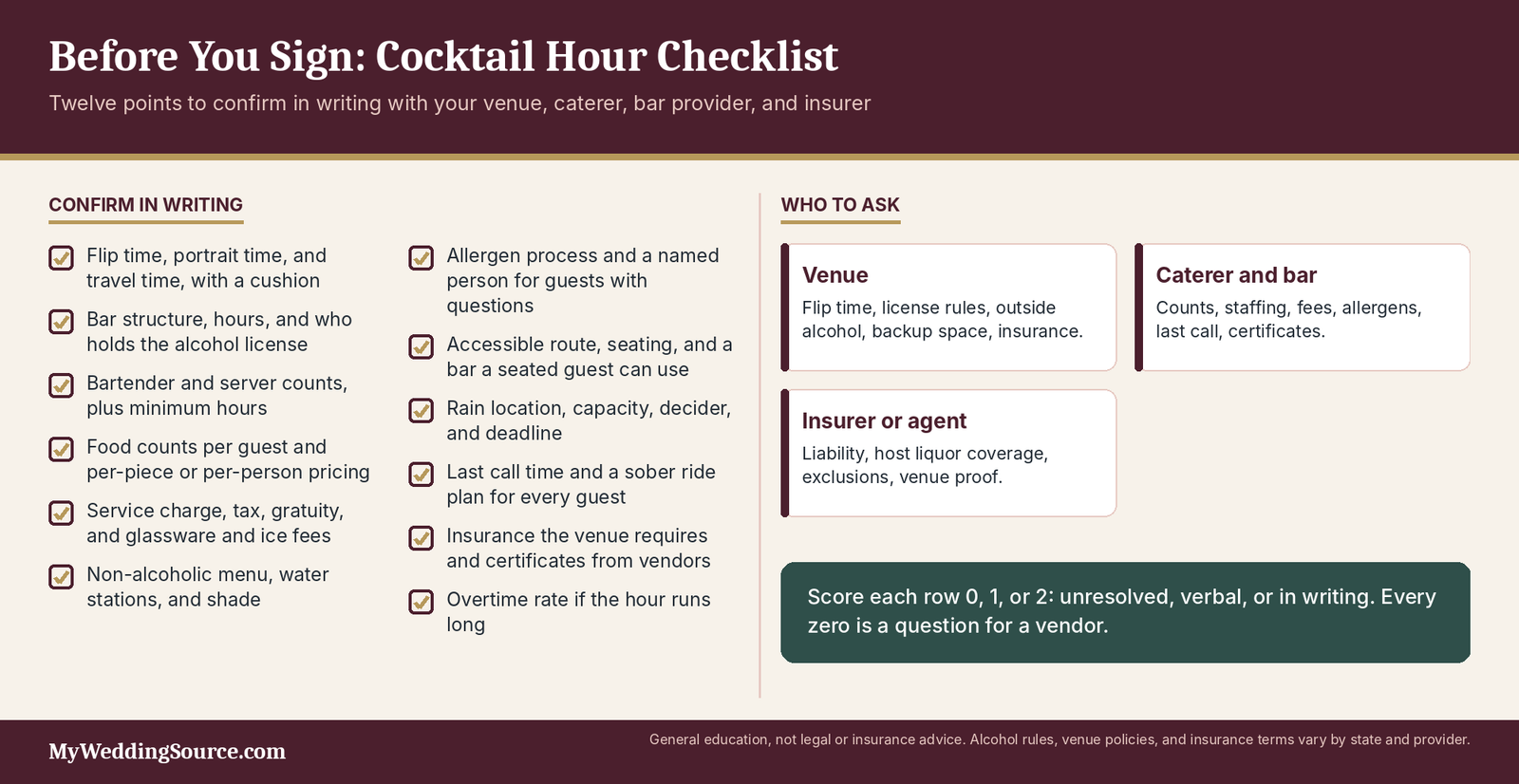
Score each row from 0 to 2: 0 means unresolved, 1 means answered verbally, and 2 means confirmed in writing. The top score is 16, but the point is not to reach it; the point is to see which rows are still 0, because each zero is a question for a vendor. If your only answer to a row is “I think so,” it is a 1 until the answer is in writing.
The eight rows
| Criterion | What to check | Evidence for a 2 |
|---|---|---|
| Timing | Flip, portraits, travel clocks written down | A signed-off timeline with buffers |
| Bar | Structure, license, pour plan, last call | Written package and license confirmation |
| Food | Pieces per guest, styles, safety plan | Menu with counts and temperature holding |
| Staffing | Bartender and server ratios, minimum hours | Staff counts and hours on the quote |
| Inclusion | Non-alcoholic menu, allergens, dietary options | Written allergen process and menu |
| Comfort | Shade, seating, water, accessible route | Site map and confirmed accessible route |
| Weather | Backup space, trigger, decider, deadline | Written plan with capacity numbers |
| Safety and risk | Insurance, ride plan, server practices | Certificates and a ride plan in place |
A worked example
Imagine a couple choosing between a lawn cocktail hour with a full bar and a covered courtyard with a beer, wine, and signature menu. The lawn plan scores 2 on timing, bar, food, and safety, 1 on staffing, inclusion, and comfort, and 0 on weather because the backup room is the dining room, for a total of 11 out of 16 with an obvious gap. The courtyard plan scores 2 on timing, inclusion, comfort, and weather, and 1 on bar (the license is not confirmed), food, staffing, and safety, for 12 out of 16. The numbers are not the decision; they are a list of what the couple must resolve with each venue before signing, and the lawn plan’s single zero is the first call to make.
What to do when scores tie
When two plans tie, choose the one that fails more gracefully. A plan with a good indoor backup, a clear decider, and flexible staffing absorbs surprises better than a plan with a spectacular setting and no fallback. If the scores are close and cost differs, consider whether the cheaper plan scores low on rows that matter to your guests, such as comfort and inclusion.
What are the signals to slow down?
Vague quotes and unclear counts
Phrases like “assorted appetizers” or “open bar package” with no counts, hours, or staffing numbers make comparison impossible. Ask for the counts, the hours, and the name of each line item. A reasonable vendor will answer, and the answer becomes your protection if the day goes differently from the plan.
Weather, allergen, or license answers that stay vague
If a venue cannot name a backup location, a caterer cannot describe an allergen process, or a bar provider cannot say who holds the license, treat that as information. Ask follow-up questions in writing and note who answered. Any one of these may have a simple answer, but all three are worth resolving before a deposit.
Pressure to decide before you have the paperwork
You should have time to read the contract, compare quotes, and check insurance requirements. If a deadline feels short, ask what happens if you need two more business days, and whether the quote holds. A reasonable vendor will usually accept that time to read is part of the deal.
FAQ: wedding cocktail hour questions couples ask
Planning and timing questions
Do we still need a cocktail hour if we do a first look?
Often yes, because the room flip and your guests’ transition still need time even if most portraits are done. With a first look, you may be able to shorten the hour or attend more of it, but the venue still needs a reset window and guests still need a place to wait. If your ceremony and reception are in the same room, the flip clock is usually the reason the hour exists. Confirm the flip time with your venue before you decide to cut anything.
Should we attend our own cocktail hour?
Many couples want to, and a first look or a smaller portrait list makes it possible. If you cannot be there for the whole hour, plan to join the last 15 to 20 minutes, greet guests, and then enter the room together. A short appearance means more to guests than a long absence, and it lets you taste the food your caterer has been working on. Tell your photographer which parts of the hour you want to be present for, so the portrait schedule respects that choice.
Drinks, money, and risk questions
Is a cash bar rude?
Etiquette views vary by community and family, and there is no universal rule. Many couples prefer to host at least the cocktail hour so that guests are not asked to pay at arrival. If budget or venue rules point to a cash bar, say so clearly on your website, offer free non-alcoholic drinks, and consider a hybrid such as a hosted first hour or drink tickets. Also check that the license and permit rules allow selling drinks at your venue.
How much should we tip the bartenders and servers?
Check the contract first, because a service charge or gratuity may already be included. The Knot’s tipping guidance says that when no service charge or gratuity appears in the contract, couples commonly tip 15 to 20 percent of the food and drink fee, split among waitstaff and bartenders. Ask who distributes the money and when the final invoice is due.
Do we need event insurance for a cocktail hour with alcohol?
It depends on your venue, your vendors, and your state, so there is no single answer. Many venues require couples to carry event liability insurance, and some require host liquor liability when alcohol is served. Ask the venue for its written requirements and ask your insurance agent how coverage applies when a licensed vendor serves the drinks. This is general education, not insurance or legal advice.
Your next steps
This week
Write down your three clocks
Ask your venue how long the room flip takes, ask your photographer how long the portraits need, and note any travel time between spaces. Put the numbers in a single note and decide your target cocktail hour length from the longest clock plus a cushion. Share the note with your coordinator or whoever is holding the timeline.
Request an itemized quote for two bar structures
Ask your caterer or bar provider to price your guest count and hours for two versions, such as a beer, wine, and signature drink bar and a full open bar. Ask them to list food counts, staff counts, minimum hours, service charge, tax, and glassware and ice. With two itemized quotes you can compare per-guest cost and see which lines move. Add the scorecard from this guide and note which rows are still at zero.
Before you pay a deposit
Confirm the bar, license, and insurance in writing
Ask who holds the alcohol license for your event, who serves, and what the policy is for outside alcohol and corkage. Ask what insurance the venue and vendors require and carry, and when proof is due. Confirm the ride plan, last call time, and who has authority to decline service. Keep the answers with your contract.
Confirm the weather plan and allergen process
Get the backup location, capacity, decision time, and decider in writing, and confirm that the room flip still works if the cocktail hour moves. Ask your caterer to describe their allergen process, to send a menu with allergens per item, and to name a person who will speak with guests who have serious allergies. Share your dietary list by the caterer’s deadline. Last, make sure water, shade, and accessible seating appear on the site map, not just in conversation.
Sources & methodology
- The Knot 2026 Real Weddings Study — study overview, publication date (February 17, 2026), and population (U.S. couples married in 2025).
- The Knot 2026 Real Weddings Study data read-out (PDF) — 10,474 respondents, average guest count of 117, and average caterer spend of $80 per person.
- The Knot, average wedding cost — average alcohol cost of $2,800 for 2025 weddings.
- The Knot, open bar wedding cost — bar package types and a bar professional’s estimate of a $10 to $15 per person gap between beer-and-wine and liquor bars.
- The Knot, how much to tip wedding vendors — service charge versus gratuity and commonly cited 15 to 20 percent tipping when no gratuity is included.
- NIAAA, what is a standard drink — definition of a U.S. standard drink and typical serving sizes.
- NIAAA Rethinking Drinking — what counts as a drink, and the note that light beer is not low-alcohol beer.
- FDA, food allergies — nine major allergens, FALCPA and FASTER Act, labeling scope, and the definition of cross-contact.
- Food Allergy Research & Education, common allergens — overview of the nine allergens that cause most reactions.
- USDA FSIS, leftovers and food safety — two-hour and one-hour rules and hot and cold holding temperatures.
- CDC, about food safety — annual foodborne illness estimates and the clean, separate, cook, chill practices.
- CDC, about heat and health — hydration, shade, warning signs, and higher-risk groups.
- National Weather Service, heat index — heat index definition and the effect of full sunshine.
- ADA 2010 Standards for Accessible Design — scope of accessibility requirements for public accommodations.
- NHTSA, drunk driving — 2024 fatality figures, legal limits, and host guidance.
- TTB, beverage alcohol — federal role in qualifying alcohol industry members.
- FindLaw, dram shop laws — general definitions of dram shop and social host liability and state variation.
- NerdWallet, wedding insurance — liability versus cancellation coverage, typical limits, and sample cost ranges.
Methodology. Verified facts here come from the linked government, nonprofit, and publisher pages as of October 2026, including the NIAAA standard drink definition, the FDA allergen list, the USDA time limits, and the NHTSA statistics. Survey findings come from The Knot’s study of 10,474 couples married in 2025 and describe national averages, not prices for any city or vendor. Pieces-per-guest, drinks-per-hour, staffing ratios, the 60 to 90 minute window, and the one-third seating figure are industry rules of thumb that we could not trace to a single authoritative source, so they are labeled as estimates, and the cost scenarios are illustrative examples built from stated assumptions, not quotes. Legal, insurance, and allergy topics are general education only; laws, venue rules, and policies vary, so confirm them with your venue, vendors, insurer, and a qualified professional.
Freshness note. Recheck The Knot figures when the next Real Weddings Study is published (typically early in the year), reconfirm NHTSA statistics when new annual data is released, and review state alcohol, licensing, and insurance rules with your venue and agent before you sign. Local ratios, minimum hours, and service charges change often, so treat every number here as a starting point for a current written quote.