

Planning family photo combinations when parents are divorced is mostly a matter of counting, ordering, and talking early: you decide which pairings of people you want, write them down by name, give each household its own turn in front of the camera, and leave room in the schedule for the moments that run long.
Quick answer
Treat each parent household as its own small photo session. List every combination by name (for example, “Mom (Lisa) and Joe,” not “parents”), rank them as must-have, should-have, or only-if-easy, and tell your photographer about the family situation weeks ahead. In our worked example, a divorced and remarried set of parents adds about three core family photo combinations to the list, which is roughly nine extra minutes at three minutes each (our estimate, not a standard). Call each household separately, take the easiest side first, and keep five-minute buffers between blocks. Photographers’ guides we read agree on the broad approach but differ on minutes per photo, so confirm timing with your own photographer.
Why divorced parents change the photo list
Most family photo lists were written for a simple picture: one mother, one father, a couple of siblings, and two sets of grandparents. When the parents have separated, remarried, or never lived in the same home, that picture no longer describes the family, and a list copied from a generic template will leave people out or put people together who would rather not be. Family photo combinations when parents are divorced need to be planned on purpose, because the default list does not know who gets along.
What a “combination” actually is
Photographers use the word combination, or grouping, for any distinct set of people who pose together with the couple. The same person can appear in many family photo combinations, and each one costs time, so the number of family photo combinations is the thing worth controlling.
One photo, one set of people
A combination is defined by who stands in the frame, not by how many shutter clicks it takes. “Couple with Partner A’s mother and stepfather” is one combination. “Couple with Partner A’s mother, stepfather, and brother” is a second one, even though two of the same people appear in both. Counting this way lets you predict the schedule before the wedding day instead of discovering it at the church steps.
Why the list grows
With married parents, a single “couple with parents” frame covers both of them. When parents live in separate households, that one frame usually becomes at least two, and any stepparent, half-sibling, or new partner adds more pairings. The Knot notes that divorced parents usually mean more family photo combinations and more time, and suggests building that into the schedule rather than squeezing it in.
What the couple is really protecting
It is easy to treat the photo list as a diplomacy problem. It helps to remember what the pictures are for: a few frames each family will actually keep, taken without anyone feeling cornered.
Both parents feel seen
For many couples the goal is simple: each parent leaves with portraits that show them with the couple, and neither one feels like an afterthought. That does not require identical numbers of frames. It does mean each household gets a fair turn, a clear call time, and a photographer who knows their names. Our own wedding photo shot list guide covers the universal frames; this guide covers the part that changes when the family map is more complicated.
The couple’s comfort counts too
Several sources we read put the couple’s wishes first. One divorced-parents guide suggests preparing your list before the photographer asks and giving anyone affected advance notice. Another says you do not have to stage a single “one big, happy family” photograph if your parents are not on good terms. Your wedding day will be remembered through these images, so it is reasonable to decide what you can live with before you decide what others expect.
What this guide covers, and what it does not
This is a planning guide for photographers’ lists, schedules, and conversations. It is not family counseling, etiquette law, or legal advice, and it does not tell you what any particular family should do.
Where the advice comes from
We read wedding-planning publications, a university extension article, an etiquette site, and several working photographers’ blogs. Most photographers describe their own habits, so we treat their timing numbers as ranges, not rules. The sources are listed at the end, with the date we checked them.
Limits worth knowing
We found no study of how long divorced-family portraits take, so the timing in this guide is a model built from photographers’ stated ranges and our own arithmetic, and it is labeled as an estimate wherever it appears. If custody arrangements, a court order, or safety concerns affect who may be near whom, speak with the relevant professionals. We cannot advise on that.
How many family photo combinations to expect
Before you write names, count. A rough count tells you how long the session will run, how much to ask of your photographer, and whether you need to trim. The numbers below come from one worked example, not a survey, so use them as a method rather than a forecast.

Counting family photo combinations with married parents
Start with the simple case so you can see what divorce adds. We assume one partner has parents who are still together, one sibling, and no grandparents in the portraits (add those later).
Four family photo combinations per partner side
For one partner whose parents are married, a short, typical list has four frames: the couple with the partner’s parents, the couple with the parents and the sibling, the partner alone with the parents, and the partner with the sibling. The Knot’s shot list uses the same building blocks: the couple with parents, each partner with parents, and each partner with siblings. This is our simplified version of that list, not a quotation of it.
What we left out
We left out grandparents, aunts and uncles, cousins, and the wedding party, all of which are separate lists. Photographers’ guides generally keep formals to close family and move larger groups to cocktail hour or the reception. A photographer’s guide from Orlando, for example, suggests saving extended family and casual guest photos for later in the day.
Counting family photo combinations when parents are divorced and remarried
Now change one thing: the partner’s parents live in two households, and each has remarried. Everything else stays the same.
Seven core family photo combinations
Each household gets three frames: the couple with the parent and stepparent, the partner alone with that parent, and the couple with that household including the sibling. Add the partner with the sibling, and the total is seven. That is three more than the four in the married-parents case. If the siblings are half-siblings who live in only one household, the count will shift, so redo it for your own family.
The optional “parents together” frame
Some couples want one frame with both biological parents, and some definitely do not. We count it as an eighth, optional combination and mark it conditional, meaning it happens only if both parents have said yes in advance. The Wezoree guide says that if both parents can be civil for a couple of minutes, a combined shot may work, while The Knot says that if parents are not on good terms, you can skip photos where they pose together.
Turning the count into minutes
A count of family photo combinations only helps if you can turn it into time. The sources disagree, which is useful: it shows that the right number depends on the photographer and the group.
What photographers’ guidance says about time per grouping
The numbers vary. The Knot suggests about two extra minutes for each additional combination. One Orlando photographer says roughly one to two minutes per combination. A family-photo guide from Wezoree puts it at about two to three minutes. Morgan Nagle’s family-formals post allows three to five minutes per photo, with larger groups on the higher end, and Susan Stripling’s planning guide says groupings of more than four people can take four to five minutes.
Our estimate: three minutes each
For planning, we use three minutes per combination, which sits in the middle of the ranges above and leaves room for moving people in and out. At that rate, the married-parents partner needs about twelve minutes, the divorced-and-remarried partner with seven core family photo combinations needs about twenty-one, and the optional eighth frame adds three. This is our arithmetic, so treat it as a planning model and ask your photographer for their own number.
Time is the cost to watch
A longer family session does not always cost extra money, but it can cost minutes from cocktail hour or require a longer coverage block. Photographers charge for time in different ways, so we do not offer a price here. Ask whether the extra time fits inside your current hours, and see our guide to vendor overtime rates before you agree to extend anyone’s day.
Start with the conversation, not the list
A perfect list is useless if a parent first hears about it on the wedding day. Several of the sources we read converge on one idea: talk to people early, one at a time, and make your ask small and concrete.
Talk to each parent first
You do not need a family meeting. A short call or coffee with each parent, close together in time, is often enough. The Mississippi State University Extension article suggests sitting down with parents to discuss how everyone can take part, and notes that writing a script beforehand can help when tensions are high. That article dates to 2011 and is marked as possibly outdated, so we use it for the general principle only.
Private, short, and specific asks
Keep each ask to one or two sentences about the photos themselves. For example: “We would love a picture of the two of us with you and Joe, and another with just you. Would you be comfortable with that?” Specific questions are easier to answer than broad ones, and they do not force a parent to comment on the other household. One divorced-parents guide advises making your request clearly, then giving everyone space to process it rather than debating in the moment.
What to say if someone hesitates
If a parent is hesitant, ask which frames feel uncomfortable instead of whether they can “be nice.” You may learn that the issue is one pairing, such as a stepparent in the shot or standing beside the other parent, and that everything else is fine. Offer a version that gives them what they want, such as a solo frame with you, and keep the conversation short. You can come back to it later, and a second conversation is allowed.
Choose a neutral messenger when needed
If you expect friction, you do not have to be the one to carry every message.
Planner, sibling, or trusted friend
The MSU Extension piece suggests a wedding planner, clergy member, or trusted friend to help present the plan and keep a discussion on track. For photos, a sibling who knows both households can work well as the family helper on the day. Pick someone who is calm, organized, and not themselves a party to the disagreement.
When you should do it yourself
For close, loving relationships, a message from a messenger may feel colder than a quick call from you. Use your judgment. A reasonable split is that you speak to your parents about their own frames and let a helper handle logistics such as call times and where to stand.
Give the photographer the family map
Almost every photographer’s guide we read says the same thing in different words: tell the photographer about divorce, remarriage, and tension before the wedding. Inside Weddings says that doing so helps the day go more smoothly.
Names, relationships, and sensitivities
Send a one-page family map listing each person’s name, relationship to each partner, and which household they belong to. Add short, neutral notes such as “does not want to pose next to Dad” or “Joe and Lisa are remarried; Joe raised Partner A.” Photographer Susan Stripling’s planning guide similarly asks couples to flag deaths and divorces so people are addressed correctly. Keep the notes factual and private, and send them to the photographer and your helper only.
What a photographer can and cannot do
An experienced photographer can sequence groups, use siblings as buffers, move people along politely, and keep certain people out of certain frames. They cannot read the room without information, and they cannot change how two adults feel about each other. Use their experience, and be willing to follow their suggestions on posing and order, as The Knot advises. ## Writing the shot list so nobody is mislabeled
A vague list of family photo combinations is the most common source of awkward moments. If the photographer calls “parents” and four adults walk forward, someone is about to be misplaced. A precise list of family photo combinations when parents are divorced fixes that before the day starts.
Name people, not roles
Roles such as “parents,” “family,” or “in-laws” stop working as soon as there is more than one household. Names do not.
“Parents” is not specific enough
Melanie Grizzel makes the point directly in an advice column on her blog: do not simply write “parents” when stepparents are in the picture. Instead, name each person and note anyone who should not appear in the same photo. A role-based list also hides assumptions, such as whether “parents” includes a stepparent who helped raise you, which only you can answer.
A naming format that works
Number each combination, name every person in it, and keep the order of names consistent. Morgan Nagle’s family-formals post uses a numbered list of names, and notes that names alone are enough because the photographer can call them out. Here is a sample for one partner:
- Partner A, Partner B, Lisa (Partner A’s mother), Joe (Lisa’s husband)
- Partner A and Lisa
- Partner A, Partner B, Lisa, Joe, Sam (Partner A’s brother)
- Partner A, Partner B, Mark (Partner A’s father), Dana (Mark’s wife)
- Partner A and Mark
- Partner A, Partner B, Mark, Dana, Sam
- Partner A and Sam
Add a column for “needs agreement from” so your helper knows which frames require a yes in advance.
Rank the family photo combinations
Not every combination has equal weight. Ranking them is the single best way to protect the schedule, because you decide in advance what to drop instead of arguing about it while people wait.
Must-have, should-have, only-if-easy
Mark each combination as one of three levels. Must-haves are the frames you would be sad to lose, such as the couple with each parent. Should-haves are good additions, such as full households with siblings. Only-if-easy frames are extras, such as the combined parents shot or extended relatives. One planning guide recommends ranking so you know what to protect if time runs short, and suggests listing the core shots first.
What to protect when time runs short
If something delays the session, drop from the bottom of the list, not from the household that is waiting. The point of ranking is fairness: cutting the third frame for every household is easier to explain than cutting everything for one. Give your helper and photographer the ranked list, and say plainly that you have already decided what goes first.
Plan for stepparents, half-siblings, and new partners
The more people in a household, the more important it is to decide who belongs in which frame. These choices are personal, so we describe options without prescribing them.
Stepparents
Several sources suggest including stepparents as separate family photo combinations rather than folding them into a generic “parents” frame. The Knot says stepparents can be included in the same way as parents, with separate family photo combinations for each. Bridal Guide notes that you can include a stepparent you are not close to by taking a few shots of you and your partner with your father and stepmother, so your father has a keepsake and both feel appreciated. Whether you include a stepparent is your decision, and that guide treats it as one.
Half-siblings, stepsiblings, and new partners
If a half-sibling or stepsibling is part of your life, list them under the household where they belong and name which frames they are in. Wezoree suggests including step-family members who have played meaningful roles and watching for children who feel caught between loyalties. A parent’s new partner who is not remarried to them is a judgment call: include them in household frames if the parent asks and you agree, or photograph them separately at the reception. Say so on the list so the photographer is not guessing.
The candid coverage timestamp and buffer plan
This is the part of the plan that turns your list of family photo combinations into a schedule. It assumes formals take place right after the ceremony, which several sources describe as the most common choice, though you can adapt the same logic to other times. Every timestamp is a suggestion built from our counting model, so shift them to match your own day.
Choose when family formals happen
Before you fill in minutes, decide where the session sits in the day. That choice changes who is available and how patient they will be.
Before, after, or during cocktail hour
The Wezoree guide lists four options: before the ceremony, right after it, during cocktail hour, or a hybrid. It describes right after the ceremony as the most popular, with pre-ceremony shots suiting immediate family and some relatives feeling hurried. A hybrid works well for divorced families: take the must-have immediate-family frames early and hold larger groups for later. If you are doing a first look, our guide to first look photos explains how that moves the schedule.
What changes with divorced parents
Two things change. First, you need to know in advance whether both households will be in the same place at the same time. If they will not be comfortable waiting side by side, you can stagger their call times so one household finishes before the other arrives. Second, the number of family photo combinations is higher, so the block is longer. Build the longer block into your timeline first, because squeezing it in later usually means cutting someone’s turn.

A sample plan for one divorced side
The example below uses the family from the counting section. Partner B’s parents are married (four family photo combinations). Partner A’s parents are divorced and remarried (seven core family photo combinations and one optional frame). We assume three minutes per combination and five-minute buffers.
The timestamps
| Time | What happens | Minutes |
|---|---|---|
| 4:30 to 4:35 | Buffer: recessional ends, guests exit, helpers gather Partner B’s family | 5 |
| 4:35 to 4:47 | Partner B’s side, four combinations | 12 |
| 4:47 to 4:52 | Buffer: reset, helper calls Partner A’s mother’s household | 5 |
| 4:52 to 5:01 | Mother’s household, three combinations | 9 |
| 5:01 to 5:10 | Father’s household, three combinations (called after the first group leaves) | 9 |
| 5:10 to 5:13 | Partner A with sibling | 3 |
| 5:13 to 5:16 | Optional: both parents with Partner A, only if agreed in advance | 3 |
| 5:16 to 5:21 | Buffer: thank everyone, release family to cocktail hour | 5 |
The total is 51 minutes, or 48 without the optional frame. Photographers’ guides we read range from about 20 minutes for a small immediate family to 30 to 40 minutes for blended or extended ones, so this plan is longer than a simple list on purpose. It reflects eleven core family photo combinations plus buffers.
Why the order works
The easy side goes first, which builds momentum and gets Partner B’s family out of the way before the harder logistics begin. The households are called separately, so no one is standing in line beside someone they would rather avoid. Siblings come last because they can be pulled in at any point and are the natural bridge between households. Anna Shastie’s guide suggests photographing the largest group first and then removing people for smaller family photo combinations, which keeps people from wandering away. You can follow that logic inside each household block.
How to set your own buffers
A buffer is empty time on purpose. It absorbs the lost glasses, the late cousin, and the grandparent who needs a moment to sit down.
Where buffers belong
Put a buffer at the start, between big blocks, and at the end. Zola suggests building in five-minute buffers throughout the day to absorb last-minute changes, and Susan Stripling suggests padding the family call time, for example by asking family to arrive at 11:45 when formals begin at noon. Your timeline should show those padded call times to family, and the real start time only to the photographer and helpers.
Adjust for place, weather, and walking
Buffers should grow when the group is large, when people must travel, or when there are older relatives. If photos happen at more than one location, Zola advises including travel time. Rain moves everything, so keep our guide to wedding photography rain backup next to your timeline, and agree in advance which frames can move indoors. If you want a day-of timeline for every vendor, our wedding vendor timeline and wedding timeline guides cover the broader schedule.
Candid coverage that keeps the day balanced
Formal portraits capture who stood next to whom. Candid frames capture what the day felt like. When formals are limited by choice or circumstance, candid coverage is how you make sure each parent still has images of themselves with you. Our candid wedding photography guide explains the style in detail; here we focus on the family layer.
Why candids matter more with limited formals
If you skip a combination, you have not lost the chance to photograph that person. You have moved it from a posed setting to a natural one.
Equal frames, not forced frames
The aim is balance. If one household gets a long formal session because everyone is willing, the other household can be given more candid attention, such as a few moments of connection during dinner or the reception. The Knot suggests taking the traditional shot first and then capturing a relaxed, candid moment, which often comes out naturally.
Tell the photographer who matters in each moment
A photographer cannot guess which candid moments matter. Give them a short list of moments that matter to each parent: a hug before the ceremony, the walk down the aisle, a toast, a dance. For a deeper look at how documentary-style coverage works, our documentary wedding photo coverage guide is a good companion.
A candid checklist for each household
The table below lists moments worth photographing for each parent. The windows are our suggestions, not industry standards.
Moments to cover for each parent
| Moment | Rough timing | What to ask for |
|---|---|---|
| Getting ready or arrival | Before the ceremony | A natural frame of the parent with you or arriving with their guest |
| Seating or escort | Ceremony start | The parent’s walk or seat, and their reaction to the ceremony |
| Receiving a hug after the ceremony | Right after the recessional | A candid frame near the first group, before formals |
| Cocktail hour | Right after formals | A few minutes at each household’s table, taken separately |
| Toast or speech | Reception | Each parent who speaks, plus their family’s reaction |
| A dance or exit | Evening | A frame with each parent, if you do parent dances |
If you have one photographer, they cannot be in two places at once. Ask whether a second shooter is included for the moments that overlap, such as arrivals at two different houses.
Telling the photographer who is who
Give the photographer a face-to-name aid: a printed family map or phone photos. Candid coverage depends on recognizing people when no one is posing, and a photographer who has never met your family will be guessing. If you have time, introduce the photographer to each household before the ceremony, so the first time they meet is not when they need to find someone.
Checking the balance afterward
After the wedding, review the gallery as a whole instead of frame by frame. This is where fairness shows up.
Count the frames, gently
A simple count of how many frames each household appears in will show whether anyone was missed. If one household has far fewer, ask the photographer whether other frames exist that were not included in the first selection. Some galleries are curated, and some photographers keep extras. Our guide to wedding photography deliverables explains what to ask for in a contract.
Sorting without overwhelm
If you plan to make albums for parents, sort images by household first, then choose a few favorites. Our guide to sorting wedding photos for albums gives a calm approach. You are also free to make one album per household, or a single shared album, depending on what works for your family. ## When someone says no, or only partly yes
Even a well-run conversation can end with “I would rather not.” That is a normal answer, and the plan works better if you decide in advance how to respond. The goal is not to win the photo. It is to keep the rest of the session calm.
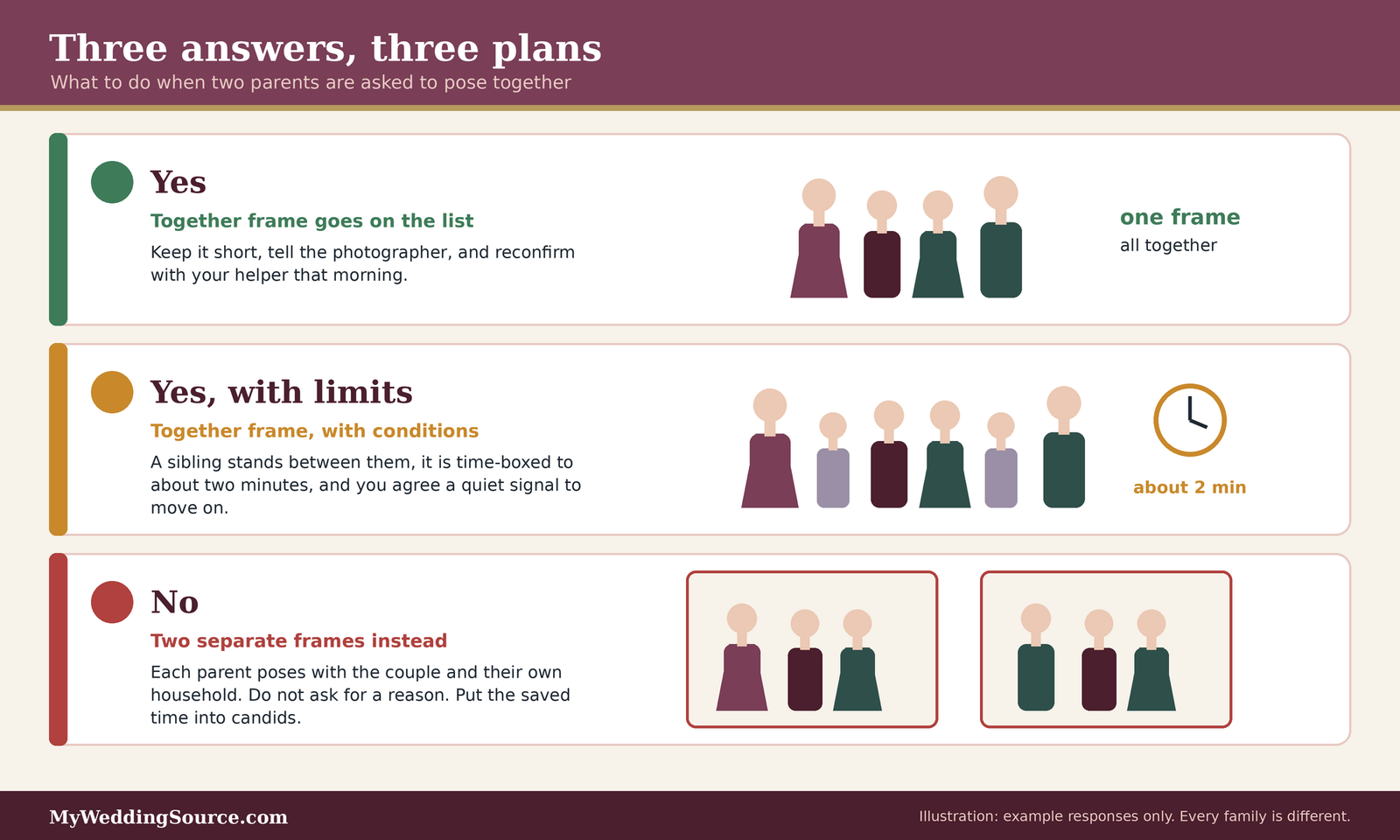
Three answers, three plans
Treat the answer to each conditional combination as one of three outcomes. The sources we read all point toward a version of this, though none uses these labels.
A clear yes
If both people say yes, put the combination on the list, tell the photographer, and schedule it with a small buffer. A yes is not permission to stretch it: even willing parents tend to tire after a few minutes of posing, so keep the frame short. Confirm the yes a second time on the morning of the wedding through your helper, because moods can change on the day.
A yes with limits
Some parents will agree to a short frame as long as certain conditions are met: a sibling stands between them, it takes one minute, or a stepparent is not in the shot. The Wezoree guide suggests using siblings or grandparents as buffers in group shots and agreeing on a signal with the photographer for when to move on. Write the conditions on your list, and tell the photographer exactly what you agreed. A time-boxed frame, say two minutes, is a kind way to say yes and also a kind way to say stop.
A clear no
If a parent says no to a pairing, believe them and move to separate frames. The Knot says to skip photos where parents pose together if they are not on good terms. Take each parent with you separately and with their own household, and move the budget of attention to candids. Do not ask a parent to explain. You are not trying to settle anything between them, only to avoid making the day harder than it already is.
Keep reluctant relatives in smaller groups
The Wezoree guide notes that reluctant or difficult relatives are better placed in smaller groups so their mood does not spread to everyone. That is practical for a wedding where several people are anxious about the same frame.
Use siblings and grandparents as the bridge
Siblings, grandparents, and the couple themselves are natural connectors between households. If you want both sides in a large group, put those people between the adults who would rather not stand together. Beyond that, plan the physical layout with your photographer, since the photographer decides who stands where.
Agree on a quiet signal
Pick a way for the photographer to end a frame without announcing it, such as a nod to your helper or a phrase that sounds like part of the routine (“one more and we are done”). The Wezoree guide recommends agreeing on a signal in advance. A signal gives the photographer a way to keep the schedule without singling out one person.
On the day: the family helper
Even a good list does not walk itself to the front of the church. Someone needs to collect people and call names.
One helper per household
Anna Shastie’s guide suggests asking one person from each side, such as a sibling, cousin, planner, or family friend, to know the relatives and gather them on the day. For a divorced family, a helper per household makes sense: each helper knows who is who and can approach their own relatives without crossing into awkward territory. The Wezoree guide also suggests briefing family wranglers beforehand.
What the helper carries
Give each helper a printed copy of the ranked list, the call times, and the photographer’s phone number. Tell them which frames are conditional, which are limits, and what to do if someone refuses: move on, tell you later, never negotiate in front of others. Our wedding party coordination checklist and group-chat rules guide cover how to brief the people helping on the day.
Edge cases for family photo combinations
Not every set of family photo combinations will match the example, because not every divorced family looks like it. Some have estranged parents, several households, or a parent who is paying for the wedding but is not close to you. These situations are worth a few lines each.
Painful, recent, or absent situations
Some family situations are heavier than a scheduling problem. Plan with care and do not push.
A recent divorce or strong tension
Inside Weddings notes that parents whose divorce is recent may still be hurting, and that even amicable splits can carry tension. If a divorce is fresh, shorten the list, rank for comfort, and consider pushing joint frames to the optional tier. A one-minute frame per parent may be kinder than a long session with everyone present. You can always add frames later if the day is going well.
An estranged or absent parent
If a parent is not attending, or you are estranged, you are not obligated to stage any photo that includes them. Tell your photographer plainly and without a long story, so they do not call for someone who is not there. If the missing parent is deceased, a photographer can take a keepsake frame, such as the couple with a photograph or a meaningful object, if you want one. That is a personal choice.
More than one divorce
Families with several remarriages can end up with three or four households involved. That changes the arithmetic.
When both partners have divorced parents
If both partners have divorced parents, mirror the plan: seven core family photo combinations for each side gives fourteen, which at our three-minute estimate is about 42 minutes before buffers. That is much longer than the 20 to 40 minutes some photographers suggest for family portraits, so you will probably need to trim, split the session, or move some frames to cocktail hour. Decide before the day which frames are must-haves.
When there are many households
For three or more parental households on one side, return to your ranked list and cut from the bottom. A single frame with the couple and each parent may be enough, and the full households can be photographed at the reception. Susan Stripling’s guide notes that groupings beyond the basic list take two to five minutes each, so a long list quickly becomes a long session. Use your ranking.
Hosts, stepparents who raised you, and minors
Some roles do not fit a clean template. Here are three that come up often.
Parents who are hosting
If a parent is hosting or paying, you may feel pressure to give them more frames. Emily Post’s seating guidance notes that the same arrangement applies even if the father is hosting, which shows etiquette treats hosting separately from family position. Keep the list fair and say so kindly if asked. A host can receive a thank-you in a toast without needing extra photos.
A stepparent who raised you
If a stepparent raised you, they may deserve the same weight as a biological parent in your own list. Inside Weddings notes that honoring stepparents too visibly may make some of them uncomfortable, so ask them how they feel before you decide. A private conversation tells you what they want, and the list can follow.
Children and custody schedules
If your wedding includes children from a parent’s remarriage, check with their parents about photos, and about whether a child will be with someone else on the day. We are not giving legal advice, and custody arrangements are for the families to manage. For photographers, a note about who will be present with whom is enough.
Questions to ask, and what to tell other vendors
Photographers vary in how they handle family sessions. A short conversation before you book will show who has done this before.
Questions to ask your photographer
- Have you photographed families with divorced or remarried parents, and how do you handle the sequence?
- How many minutes do you usually allow per combination, and how many combinations fit in your standard timeline?
- Can you take separate frames for each household, and keep certain people out of certain frames?
- Will you use my printed list, and who will you call names with?
- Is a second shooter available for candid moments that overlap?
- What happens if the family session runs long: does it come out of cocktail hour or add paid time?
- How do you deliver images, and can they be organized by household?
What to ask the photographer
Use the questions in the callout above as a starting script. Ask them early, in your first call, not after you have signed.
Experience and process
The strongest answer is a calm description of how they sequence groups, call names, and handle a refusal. A photographer who has done this before will have a method, such as largest group first, then smaller family photo combinations, as Anna Shastie describes. A photographer who answers with “we will figure it out” is not necessarily a bad choice, but you will need to supply more of the structure yourself.
Time, extra hours, and what changes the price
Ask how long the family session usually takes and what happens if it runs over. Some photographers include a set number of hours and charge for extra time, and the details vary. Get the policy in writing, and read our vendor overtime guide so you know what to look for. We do not know your photographer’s rates and will not guess at them.
What to tell the planner, officiant, and DJ
Photographs are only one place where family structure shows up. The same information helps other vendors.
Seating, introductions, and the ceremony
Emily Post’s guidance suggests that when divorced parents get along they can share the front row, and when there is strain, a planned alternative keeps them separated, with ushers given clear instructions. Our wedding seating chart and processional order guides can help with the rest. MSU Extension adds that telling the officiant, caterer, and band or DJ about the family situation helps everyone be acknowledged.
Toasts and announcements
Inside Weddings suggests giving each parent a chance to toast, and MSU Extension notes that a place can be made for everyone in the celebration. If you plan toasts, share the order and names in advance so the DJ introduces each person correctly. Our wedding speeches guide has more on structure.
After the day: sharing and delivery
How you share the photos matters as much as how you take them.
Delivering to each parent
Ask the photographer whether the gallery can be shared with specific guests, and decide whether you will pass it along yourself. If parents live in different households, a shared link means everyone sees everything, which may be fine or not. You can also send each parent a short selection that matches their frames.
Posting and permissions
Before posting family photos online, ask the people in them, especially stepparents and minors. Our guide to wedding photography usage rights for vendors and social media covers how photographers and couples may use images. Delivery terms and licenses are set by your contract, so read it, and consult a lawyer for anything unclear. This is not legal advice. ::: {.mws-faq} ## Frequently asked questions
Planning and timing
How many family photo combinations should I plan when parents are divorced?
Plan for more than a simple list. In our worked example, one partner with divorced and remarried parents needs seven core family photo combinations, against four when parents are married. That is our own count, not a standard. Rank every frame, then confirm with your photographer how many fit in the time you have.
How long do family photos take when parents are divorced?
Sources vary. The Knot suggests about two extra minutes per additional combination, while other photographers allow up to five. Our planning model uses three minutes each, so seven family photo combinations come to about twenty-one minutes, plus buffers. Your photographer’s own estimate should replace ours, especially for large or blended families.
Should divorced parents be photographed together?
Only if both are comfortable. The Knot says to skip photos where parents pose together if they are not on good terms, and another guide suggests a short combined shot if both can be civil. Ask each parent privately, mark the frame as optional, and photograph each one separately either way.
What if the couple wants to skip some pairings?
That is a reasonable choice. Bridal Guide says you do not need to stage one big happy family photograph if your parents are not on good terms. Tell your photographer which frames to drop, rank the rest, and use candid coverage so every parent still appears with you in natural moments.
People and logistics
How do I handle stepparents in family photos?
Treat stepparents as their own family photo combinations instead of folding them into “parents.” The Knot says stepparents can be included like parents, with separate frames for each. Name each person on the list, ask them privately how they feel about it, and keep a few frames of you with each household.
What should I tell my photographer about the family?
Send a one-page family map: names, relationships, households, and any sensitivities, such as who should not pose together. Inside Weddings and others say telling the photographer ahead of time helps the day go more smoothly. Share it only with the photographer and your family helper, and update it if plans change.
Who should call people for the photos?
Ask one trusted person from each household, such as a sibling, cousin, planner, or friend, to gather relatives. Anna Shastie’s guide suggests a helper from each side who knows the family. Give them the printed list, call times, and a plan for what to do if someone says no.
Where can I learn more about the standard family list?
Start with our wedding photographer shot list and wedding photo shot list guides for the standard frames, then add the household-specific family photo combinations from this guide. Share the finished list with your photographer a few weeks ahead, because they may suggest changes based on the location and the number of people. :::
Your next steps
Before you talk to anyone
Count and rank your family photo combinations
Write your family map, count family photo combinations with the method above, and mark each as must-have, should-have, or only-if-easy. A one-page draft makes every later conversation shorter. Use our wedding photo shot list as the starting template, then add your household frames by name.
Decide what you can live with
Choose the frames you would be sad to lose and the ones you can drop. Say them out loud to your partner first. When you both agree on the priorities, it is easier to hold the plan if someone pushes back.
Over the next few weeks
Talk to each parent and your photographer
Speak with each parent about their own frames, then send the photographer the family map and ranked list. Ask the questions in the callout above, and confirm how extra time is handled. Our wedding photography deliverables guide explains what to get in writing, and our wedding planning checklist places this task in the wider schedule.
Build the timeline with buffers
Fill in your own timestamps using three minutes per combination (or your photographer’s number) and five-minute buffers. Share the padded call times with family and the real times with the helpers and the photographer. Add a rain plan using our wedding photography rain backup guide.
On the day
Brief your helpers
Give each household helper the printed list, call times, and the plan for a refusal. Remind them to move on if someone declines and to tell you afterward, not during.
Check the gallery afterward
When the photos arrive, count the frames for each household and ask about any gaps. Then sort them by household for albums, using our guide to sorting wedding photos for albums without getting overwhelmed.
Sources & methodology
How we built this guide
What we relied on
This guide combines advice from wedding-planning publications, an etiquette organization, a university extension article, and several working photographers’ blogs. Where a statement comes from one of them, we say so, and we treat photographers’ timing figures as personal ranges, not industry rules. The combination counts and the timeline are our own arithmetic and are estimates. Sources were fetched and read in November 2026; we did not verify that they have not changed since.
What we did not do
We did not survey photographers or families, and we found no study of how long divorced-family portraits take. We do not give legal, financial, or counseling advice. Families differ, and a plan that suits one may not suit another. Ask your photographer for their own timing, and speak with the right professionals about custody or safety questions.
Source list
Wedding publications, etiquette, and extension sources
- The Knot, How to Take the Best, and Most Efficient, Family Wedding Portraits: https://www.theknot.com/content/must-have-family-wedding-photos
- Zola, A Guide to the Ideal Wedding Photography Timeline: https://www.zola.com/expert-advice/how-long-do-wedding-photos-take
- Inside Weddings, How to Handle Divorced Parents at Your Wedding: https://www.insideweddings.com/news/planning-design/how-to-handle-divorced-parents-at-your-wedding/3499/
- Bridal Guide, Keeping the Peace: How to Plan a Wedding When Your Parents Are Divorced: https://bridalguide.com/node/175315
- Emily Post Institute, Ceremony Seating Arrangements: https://emilypost.com/advice/ceremony-seating-arrangements/
- Mississippi State University Extension, Communicate When Wedding Planning with Divorced Parents (2011, marked as possibly outdated): https://extension.msstate.edu/news/feature-story/2011/communicate-when-wedding-planning-divorced-parents
- Amicable, Nine Tips for Planning a Wedding with Divorced Parents: https://amicable.io/divorced-parents-at-wedding-tips
Photographer and planner blogs
- Susan Stripling, Planning for Family Photos on Your Wedding Day: https://susanstripling.com/blog/planning-for-family-photos-on-your-wedding-day/
- Anna Shastie Photography, What Family Photos Do I Need at My Wedding?: https://annashastiephotography.mypixieset.com/blog/orlando-wedding-family-formal-shot-list/
- Morgan Nagle, Tips and Tricks: Handling Family Formals on Wedding Days: https://morgan-nagle.squarespace.com/blog/2019/10/7/tips-and-tricks-handling-family-formals-on-wedding-days
- Wezoree, The Complete Guide to Wedding Family Photo Etiquette: https://wezoree.com/inspiration/guide-to-taking-family-photos-at-your-wedding
- Melanie Grizzel, Ask M: How to Handle Complicated Family Photos: https://melanie-grizzel-bm77.squarespace.com/sheblog/2016/07/12/ask-m-how-to-handle-complicated-family-photos