
Wedding greenery types are the leafy, needled, trailing and silvery stems that sit behind, between and around the blooms in your flowers, and they decide more about how the arrangements look at hour six than the flowers do. This guide gives you an original sample vase-life log and a source availability map, so you can compare foliage texture, hold time and seasonal supply before you commit to any of the greenery types.
Pick three to five candidate greenery types and test each before you sign anything. Ask for a sample, record how it looks at arrival, after hydration and at each checkpoint through your event’s required hold, and score firmness, color, shedding and residue. Beside the log, draw a source availability map for your month with a confirmed source, a named substitute and a decision date. A stem that holds its score through your event plus a safety margin, with a source confirmed in writing, earns a place. The rest are swaps.
Greenery is the part of a floral order that couples rarely choose on purpose. Flowers get names, colors and inspiration photos. Greenery gets a line that says “some eucalyptus and whatever is fresh.” Then on the wedding day the eucalyptus is a different gray than the sample picture, the trailing vine has gone limp on the arch, and the garland has dropped a drift of small leaves on a white linen runner.
None of that is the florist’s fault by default, and none of it is bad luck. It is what happens when foliage is chosen by photograph. A photograph shows one of the greenery types at its best moment, in good light, at an unknown age. It cannot show you how that stem behaves after eight hours in a warm tent or whether a supplier can deliver it in your month at all.
This article is about choosing wedding greenery types with evidence you generate yourself. The evidence has two parts. The first is a sample vase-life log, a simple record of how real stems look over the hours your event needs them. The second is a source availability map, a one-page view of where each stem would come from in your month and what happens if that source fails.
A scope note before we start. This is general planning information, not legal, safety or medical advice, and plant safety, allergy and permit questions need plant-specific checks with the right authority, which the sources at the end point to. Nothing here is a measured result: every number in the examples is invented to show the method, and your own samples will behave differently.
The method sits beside, not instead of, the design work. If you have not yet decided on the overall look, the guide on choosing a wedding color palette is a good place to settle the colors that greenery will sit against. Here we assume you already know roughly what you like and want to know what will survive. If you are still comparing florists, the vendor due diligence checklist covers the wider checks.
What wedding greenery types are, and what vase life means
Florists use the word greenery loosely, and the looseness causes confusion. In this guide, wedding greenery types means any foliage or woody or needled stem that is chosen mainly for its leaves, branches or texture rather than for a flower. That covers cut branches with broad leaves, trailing vines, evergreen boughs, ferns, aromatic herbs, and silvery or gray foliage. It also includes the small-leaved fillers that florists tuck into bouquets.
The line between greenery and flowers is not firm. A branch of flowering quince is a flower in spring and foliage later. A hydrangea leaf is a leaf, even when the bloom is the star. For planning purposes, ask one question of any of your greenery types: is it here for its color and form of bloom, or for its surface, outline and leaf color? If the second, treat it as greenery and test it like greenery.
Vase life is the length of time a cut stem stays acceptable in water. It is usually quoted in days by growers and wholesalers, and for flowers it is partly a function of variety, harvest stage and handling. For foliage, vase life is often longer than for blooms, but it is also less predictable, because foliage fails in different ways. Some wilts. Some curls at the edges. Some stays upright and then drops leaves the moment someone touches it.
For a wedding, the number on a care sheet is only the start. What you actually need is a different quantity, which this article calls the required hold. The required hold is the number of hours between the moment a stem is delivered to the venue or placed in its arrangement and the moment the last photograph or the last guest has moved on, plus a margin for delay.
A garland that goes up at noon for a seven o’clock ceremony and stays through a late dinner has a required hold of perhaps twelve hours. A bouquet that is carried for forty minutes has a short one, but a hard one, because it spends the time out of water and in hands.
Vase life and required hold are different measures, and the gap between them is where weddings go wrong. A stem from one of the longer-lasting greenery types can still fail a short hold because it is sensitive to heat or to being out of water. A stem with a short listed vase life can be fine for a three-hour cocktail hour. You only find out by matching the stem to the hold.
The log in this guide treats all greenery types that way. It asks how the stem looks at the checkpoints inside your event, not how long a reference says it can last in ideal conditions. If you want the reference numbers too, ask your wholesaler or grower for their post-harvest handling sheet for each stem, and quote them as supplier statements rather than as facts.
The second concept is texture, which is the look and feel of the leaf surface and the density of the foliage. A glossy broad leaf, a fine needle, a fuzzy gray leaf and a lacy fern frond catch light very differently and read differently in photographs. Texture matters for appearance, but it also predicts behavior. Fine, soft foliage generally loses water faster than thick, waxy leaves, which is a tendency and not a rule. The log lets you test the tendency on your own stems.
The third concept is availability. Greenery types that exist in a catalog may not exist in your month, in your region, or in your quantity. Supply of greenery types changes more than most couples expect, because many foliage crops are cut from field or woodland plants whose supply follows weather and the growing calendar, and many others are imported and subject to shipping time.
Why a sample log beats a photograph
A photograph is a good tool for choosing a mood and a poor one for choosing among greenery types. Three problems come up again and again.
The first is age. Inspiration photos rarely say when the stems were cut. Greenery photographed in the first hours after styling looks different from the same greenery at the end of a day. A lot of the soft, trailing, silvery looks that people love in photos depend on stems that were placed that morning.
The second is context. A photo of a garland on a stone mantel tells you nothing about the same garland on a wooden arch in direct sun. The temperature, the light, the water source and the handling all change the outcome, and none of them is in the picture.
The third is selection. Every photo is the best frame from a set. A florist’s portfolio image of eucalyptus is a real stem, but it is a stem that was cut, conditioned and chosen to look good. The sample you are handed in a consultation is a stem selected for the same reason. A log that follows the sample forward in time is a way to see what the selected stem does after the selecting stops.
There is also a human reason to prefer a log. A conversation about “how long will it last” invites a confident reply and a vague one. A written record invites specifics: what was the stem’s condition at arrival, how was it cut and hydrated, where was it kept, what did it look like at the end.
Florists who handle foliage well, whatever greenery types they favor, tend to appreciate a client who asks in these terms, because it tells them what matters. It also gives you something concrete to refer to if the delivered stems differ from the sample.
A log does not replace the florist’s judgment. A good floral designer will know which stems have performed for them in your climate and will have conditioning habits that a home trial does not reproduce, such as a long hydration in cold storage. Treat your log as a shared language with them. If their stems pass your test, you both gain confidence. If a stem fails, you both learn something before the money is spent.
One caution on scale. This is not a laboratory. You are not running a controlled experiment, and you should not publish or quote your results as data. You are making a practical comparison between a few stems, under roughly the same conditions, to see which ones are stable enough for the job. That is a modest claim, and it is the right size for the decision.
Think of the log as a small amount of homework that replaces a large amount of worry. The cost of testing greenery types is a handful of stems, a few vases or buckets, a phone camera and a notebook. The saving is the chance to find out in a kitchen, months before the wedding, that a favorite vine wilts within hours of being cut.
The next section sets up the log itself. After that, we look at texture, the six main families of greenery types, the source map, the trial method, a worked example, and then the job-by-job matching and the questions to ask vendors. You can read straight through or jump to the part you need, but the log and the map are meant to be used together.
Building the sample vase-life log
The log is one page per candidate stem, or one notebook page per stem if you work on paper. It has a header, a set of checkpoints and a verdict. Nothing in it needs special equipment. What matters is that every stem is recorded the same way, so you can compare them without trusting your memory.
Start with the header. Write the name of each of the greenery types you test, starting with the common name and, if the supplier gives it, the botanical name, because common names overlap. Silver dollar eucalyptus and baby blue eucalyptus are different stems with different leaf shapes, and some “ruscus” and “myrtle” labels cover more than one plant. Record the supplier, the date and time you received the sample, how it was packed, and whether it arrived in water. Note the stem length and the number of stems you were given.
Next, record the arrival condition in plain words and one photo. Look for firm leaves, an even color, clean cut ends and no sticky or musty smell. If the stem arrives already tired, write that down. A sample that looks poor on day zero is information about the supplier’s handling, and it matters just as much as the stem’s species.
Then record your handling. Note the cut you made, whether you stripped lower leaves, what water you used, and whether you added a flower food or cleaner. Use the same handling for all the greenery types in the trial, even if a particular stem might prefer something different. If you want to test a special treatment, such as a long cold soak, run it as a second row for the same stem, so you can compare.
The checkpoints come next. A good default is to score each stem at arrival, after a few hours in water, at twenty-four hours, at forty-eight hours, and at your event’s required hold plus a margin. If your required hold is twelve hours, your last checkpoint could be at hour twenty-four. If the greenery will go up two days early, add a checkpoint at hour seventy-two. Use real clock times so that you can see the pattern, and photograph the stem at each checkpoint against the same background in the same light.
At every checkpoint, give the stem four scores from one to four. The scale is the same each time.
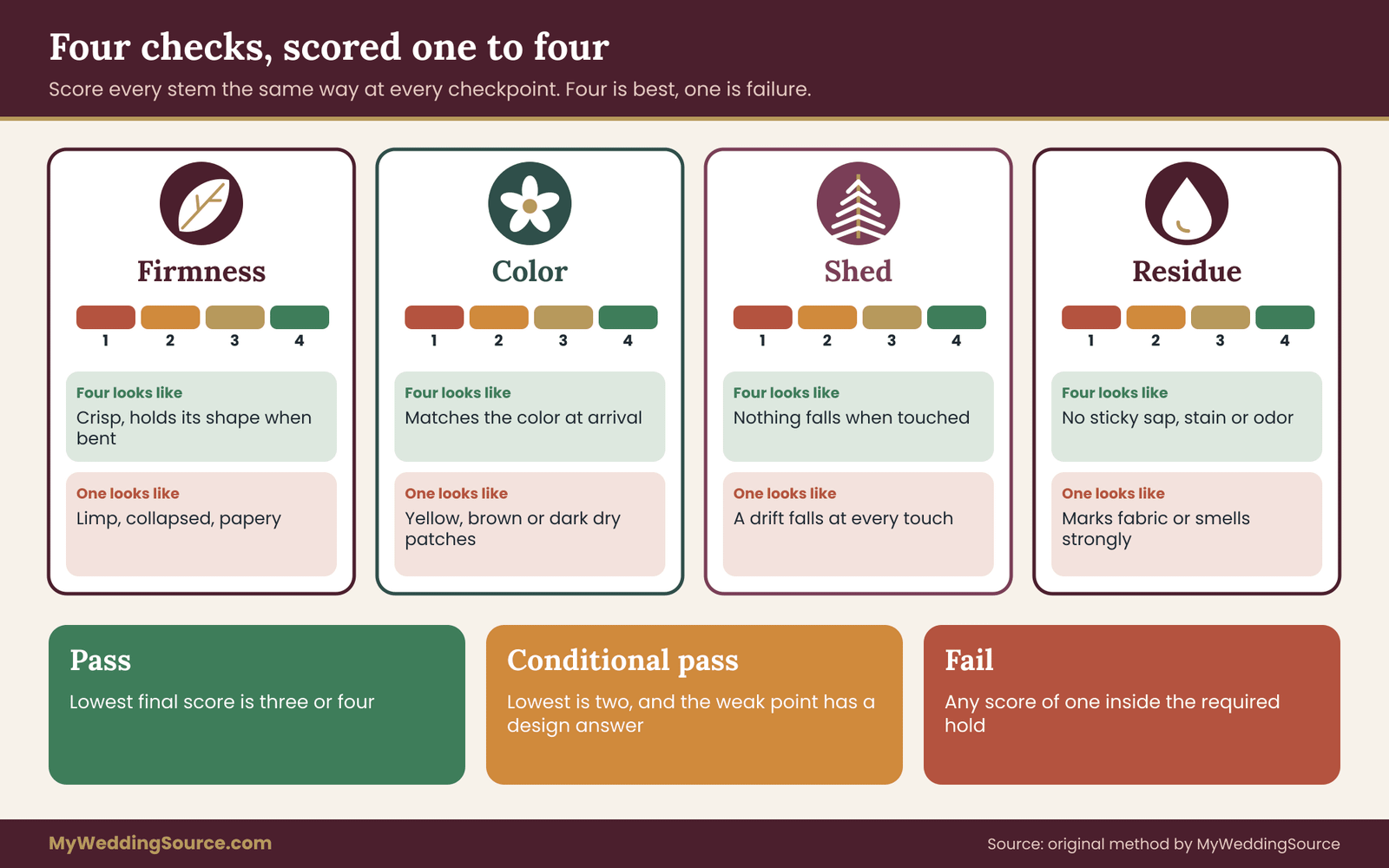
Firmness. Four means the leaf or needle is crisp and holds its shape when lightly bent. Three means a slight softness. Two means visible droop or limp tips. One means the stem has collapsed or the leaves have gone papery.
Color. Four means the color matches arrival. Three means a small shift, such as a slightly duller green. Two means obvious change, such as yellowing, browning at edges or graying where it should not gray. One means large dark or dry patches.
Shed. Four means nothing falls when you touch the stem or tap the vase. Three means a leaf or two. Two means a steady scatter. One means a drift of leaves or needles each time the stem is handled. Collect what falls on a white sheet of paper if it helps you see it.
Residue. Four means no sticky sap, no stain and no notable smell. Three means a faint smell or slight stickiness. Two means a clear smell or sap that transfers to your hands. One means it marks fabric, skin or paper, or has a smell that you would not want near a dinner table.
Each score is a judgment, and judgments drift. Two ways to reduce the drift are to score in the same place at the same time of day, and to have a second person score a few of the stems without seeing your numbers. If you and a friend disagree by more than a point, take a second photo and write why.
The last part of the page is the verdict. A simple rule keeps it honest. A stem passes if its lowest score at the final checkpoint is three or four. A stem is a conditional pass if its lowest score is two and the weak point is something you can design around, such as shedding in a place where nobody will see or touch it. A stem fails if any score reaches one inside the required hold. Write the verdict and the reason in one sentence.
Add a short notes field for things the scores miss. A vine may score well and still tangle badly. A fragrant herb may score well and make a plated dinner taste of rosemary. A branch may be firm but too stiff to wire into a garland. The notes are the place to record what you learned about how the stem feels to work with.
If your florist is willing, ask them to keep a parallel log for the same stems on their side, with their own conditioning. If two logs agree, the stem is safe. If they differ, you have found a conditioning question to ask, and that is a useful discovery.
A final point on scope. Run the trial with three to five greenery types at first, not fifteen. Greenery decisions usually reduce to a few that carry the design, such as one large-leaf branch, one trailing or soft stem, one fine texture and one accent. A short log of a few greenery types that you actually finish is more valuable than a long one you abandon.
Foliage texture: a ladder you can read before you buy
Texture is the part of greenery that couples tend to describe vaguely and florists tend to describe precisely. The gap between the two causes mismatches. A useful way to close it is a texture ladder for greenery types: a short scale with a name for each rung, so you can say where you want a design to sit and where each candidate stem actually falls.
Think of the ladder for greenery types in two directions. The first direction for greenery types is scale, from fine to bold. Fine foliage has small leaves or needles, such as thyme, fine ferns, cedar and some myrtle. Medium foliage has leaves roughly the size of a thumbnail or a fingertip to a palm, such as many eucalyptus types, olive, and boxwood-style sprigs. Bold foliage has large leaves that read from across a room, such as magnolia, large salal, monstera and some palm leaves.
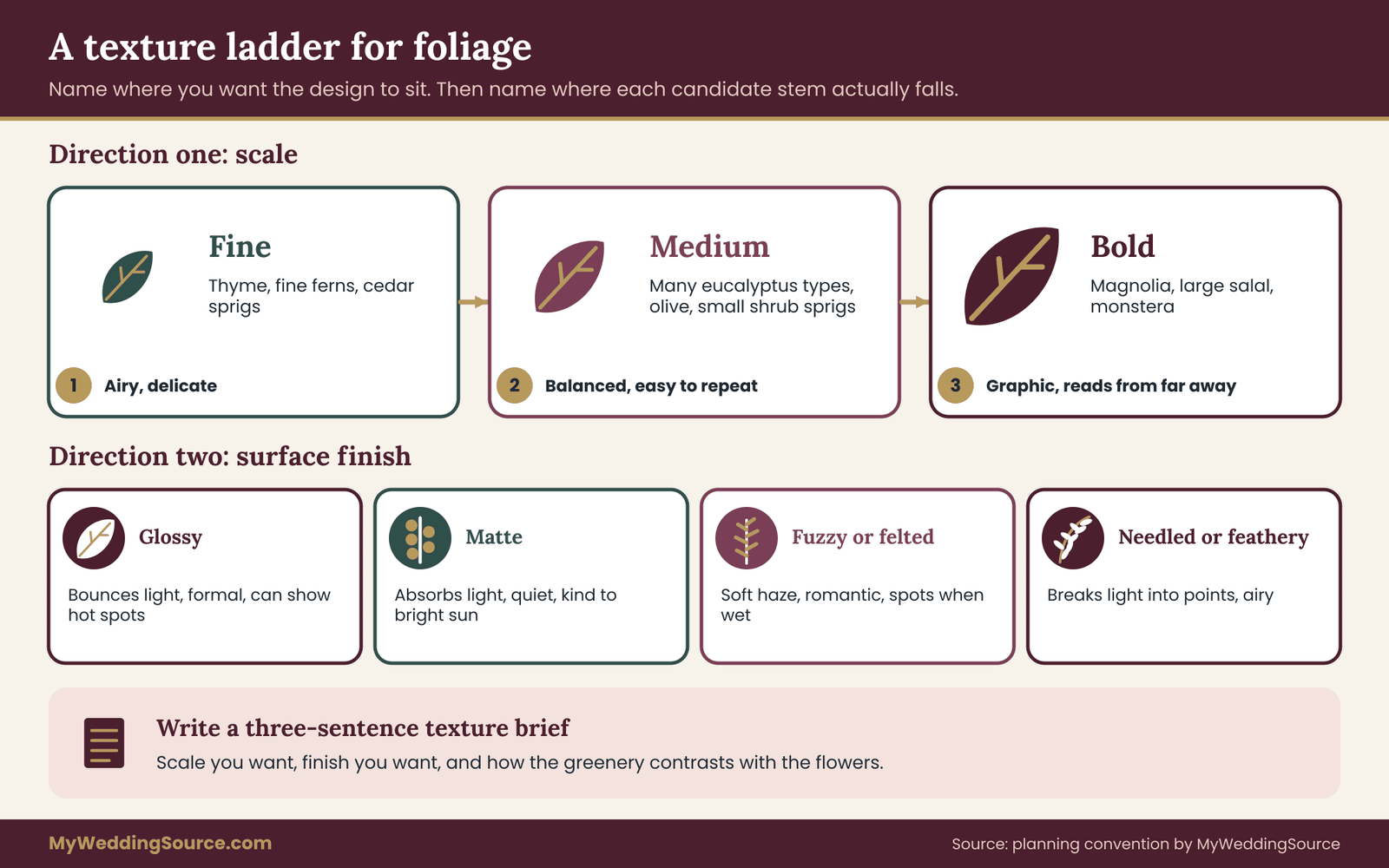
The second direction is surface finish. A leaf can be glossy, which bounces light and reads as clean and structured. It can be matte, which absorbs light and reads as quiet. It can be fuzzy or felted, as with lamb’s ear and some silvery stems, which holds a soft haze of light. Or it can be needled or feathery, which breaks light into small points and reads as airy.
Scale and finish combine in useful ways. A bold glossy leaf is graphic and formal. A fine matte sprig is delicate and a little wild. A medium fuzzy silver leaf is soft and romantic. When you collect inspiration photos for greenery, sort them by these two directions before you sort them by name. You may find that the greenery types you love are not a species but a combination, such as medium scale with a matte finish. That is far more useful to a florist than a list of plant names.
Texture also predicts how greenery types handle. This is where it ties back to the log. As a rough tendency, thick waxy leaves tend to hold water well, and thin soft leaves tend to lose it faster. Fuzzy leaves can hold moisture on their surface and may spot or mold if packed wet. Needled evergreens often hold their form well but can shed needles in warm rooms. These tendencies are only starting points, and you should treat them as hypotheses that the log confirms or corrects.
A third consideration is the contrast between your greenery and the blooms. In art direction terms, texture works by contrast and repetition. A bouquet of smooth round blooms looks richer against fine or fuzzy foliage than against another smooth mass. A bouquet of already fussy, ruffled flowers often looks calmer against a bold, simple leaf.
The point is that greenery texture is chosen in relation to the flowers, not in isolation. If you are working on the flower side as well, how floral shape, texture and color relate is the next layer, and you can take it up with your florist after you have your greenery shortlist.
Finally, think about camera and light. Glossy leaves can throw hot spots in flash or in direct sun, and a bold glossy leaf photographed at an angle to a window can look like a mirror. Matte and fuzzy leaves rarely do that. If your ceremony is at midday in open sun, a matte or silvery leaf may photograph more kindly than a glossy one.
If the venue is dim, glossy foliage can bring light into the arrangement. Add a line to your log for how each stem looks on camera at your checkpoint photos. It is a small observation that makes later choices simpler.
To use the ladder in practice, write a short brief with three sentences. The first names the scale you want the design to sit at, such as medium with a few bold accents. The second names the finish, such as mostly matte with one silvery stem. The third names the contrast with the flowers, such as softer than the blooms, not busier.
Share it with your florist before sample day. Candidate greenery types then arrive already sorted, and the log runs faster because you are testing stems that already fit.
Six wedding greenery types and what each tends to do
Sorting greenery types into families helps you test smartly, because stems in the same family tend to fail in similar ways. The six families below are a working convention, not a botanical classification, and a stem can sit in two of them. For each family, the notes cover the look, the usual job, the failure mode to watch in your log, and one planning question to put to a supplier.
Everything here is a tendency. Species, harvest stage, growing region, storage and the weather in your week all change the outcome. Use the families of greenery types to decide which stems to put in your first trial, and let the log decide the rest.
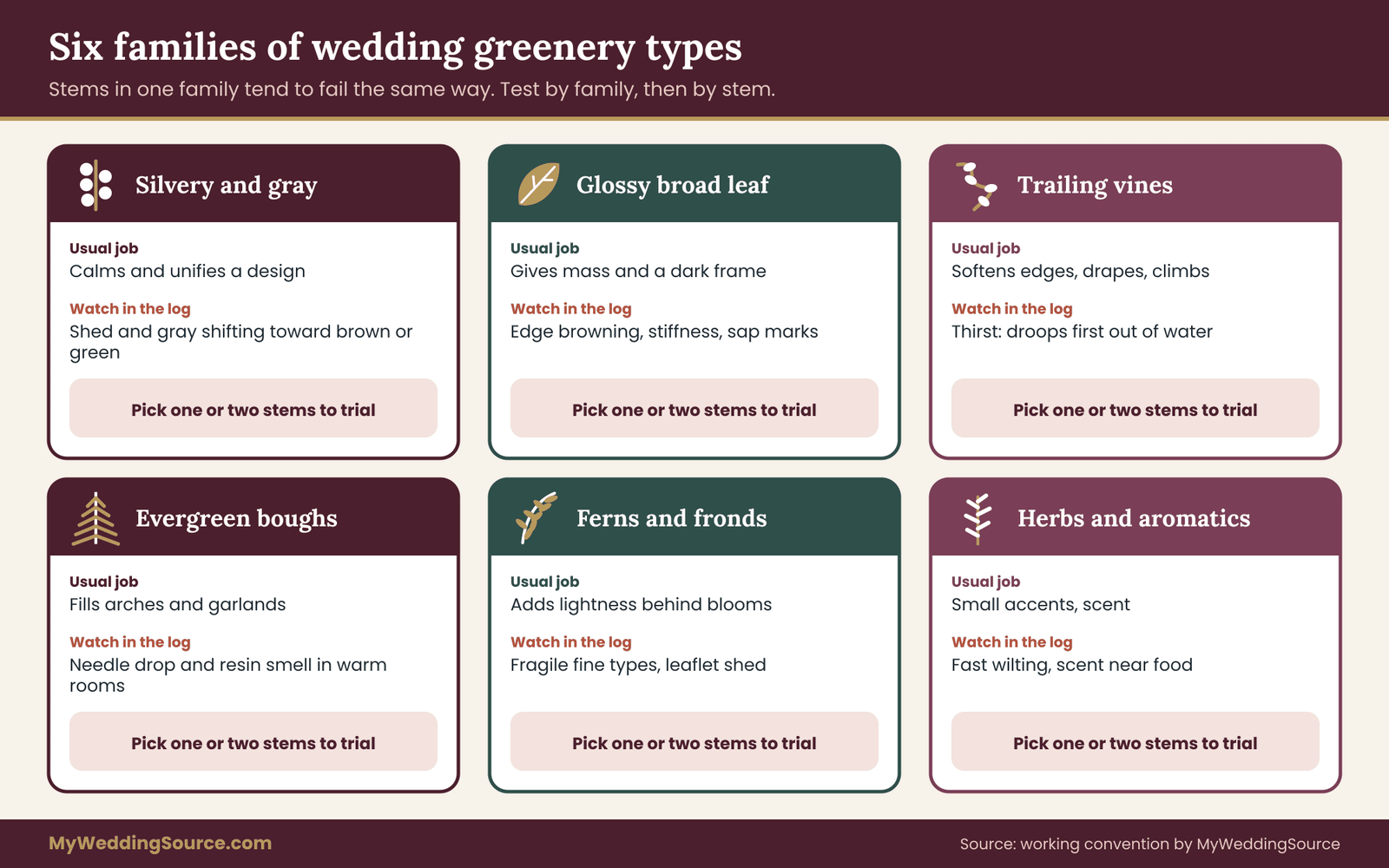
Silvery and gray greenery types. This family includes the eucalyptus varieties, olive branches, dusty miller, lamb’s ear, artemisia and some sage. The look is soft, cool and slightly dusty, and it pairs easily with blush, white, cream and muted blues. The usual job is to calm and unify an arrangement, or to serve as the main backdrop for a bouquet or a garland.
The failure modes vary among these greenery types. Some eucalyptus holds well in water and dries gracefully in place, which makes it a popular choice for arches that stand for hours. Fuzzy stems such as lamb’s ear and dusty miller can wilt quickly if they are cut at the wrong stage or kept warm, and their felted surface can look dull or spotty when wet.
Olive branches can shed small leaves when handled. In the log, watch firmness and shed for this family, and pay attention to whether the gray color shifts toward green or brown by the last checkpoint.
The planning question for these greenery types: which variety exactly, and is it fresh-cut, imported or preserved? The answer changes the look, the hold and, as the availability section explains, the odds of getting it in your month. Also check safety by name. Eucalyptus appears on the ASPCA’s list of plants that can harm pets, so households with animals and venues with animals around deserve a plant-specific check.
Glossy broad-leaf greenery types. Magnolia, salal, laurel, camellia, pittosporum, ruscus and boxwood-style sprigs belong here. The look is structured, clean and a little formal. The usual job is to give mass, weight and a dark green frame that makes flowers read brighter. Broad leaves also work as a backing for cascade bouquets and as the body of a long runner.
Many of these greenery types have thick, waxy leaves, which tends to help them hold up in water and in warmth. The failure modes are different: stiffness that makes them hard to bend into a garland, edge browning on some varieties as they age, and glossy surfaces that can show water spots, fingerprints or dust. Magnolia leaves can show a brown, felted underside that some designs use on purpose. In your log, watch color and residue, and use the notes field to record how workable the stem felt.
The planning question for these greenery types: how much does the supplier need to cut for you, and how far ahead can it be cut? Large-leaf branches may be cut in quantity and shipped or driven in, and their quality depends on handling in transit. Plant safety matters here, too. Some shrubs in this family, including boxwood, appear on pet-toxicity lists, so check each plant by name before it goes near a table where animals or small children will be.
Trailing vine greenery types. Ivy, smilax, jasmine vine, clematis-type vines, sweet potato vine and similar stems fall here. The look is romantic, natural and flowing. The usual job is to soften a hard edge, trail from a bouquet, drape a table runner or climb an arch. Nothing else gives that loose, living line.
The failure mode for these greenery types is thirst. Thin, trailing stems have long distances for water to travel and large leaf surfaces that lose it quickly, so they are some of the most likely to wilt in heat or out of water. Some vines also tangle badly and some are almost impossible to work once they have started to curl. In your log, put extra weight on firmness at the last checkpoint and photograph the trailing end specifically, not only the bunch.
The planning question for these greenery types: does the design need the vine to hang free, or can it be wired to a damp base or a water source? A trailing vine on an arch with no water access has a very different hold than the same vine in a bouquet held in a vase until the processional.
Ask the supplier whether the stem is cut or potted, and note that some varieties are better handled as living plants than as cut stems. English ivy is among the plants listed as harmful to pets by the ASPCA, so check names there as well.
Evergreen and needled greenery types. Cedar, fir, pine, spruce, juniper and similar conifers belong here, along with holly-type and berry foliage in winter. The look is textured, scented and seasonal. The usual job is to fill an arch or a garland with volume and structure that holds its shape.
Among greenery types, conifers often hold their form well in cool weather, which is why they dominate winter weddings. In warm rooms they can shed needles quickly and give off a strong resin smell and sticky sap. The residue and shed scores are the ones to watch, and the smell goes in the notes field. A fresh bough may smell wonderful in an outdoor setting and overwhelming at a plated dinner. Some berry and holly stems are toxic if swallowed, so keep them away from where guests and pets can reach.
The planning question for these greenery types: where do the boughs come from, and how long since cutting? Evergreens used for winter holiday displays are in heavy demand, so ask about availability for the specific weekend if your date sits near a holiday.
Fern and soft frond greenery types. Leatherleaf, plumosa-style asparagus fern, Boston-type fronds, maidenhair and similar fine, feathery stems belong here. The look is soft, green and slightly vintage. The usual job is to add lightness behind flowers, to fill a hand-tied bouquet, or to give a table piece a gentle halo.
The failure mode depends on the fern. Some leathery fronds are quite durable in water. Fine, delicate types such as maidenhair are fragile, droop quickly and may be better used as a living plant than as a cut stem. Plumosa-type foliage may shed small leaflets. Record the shed score closely, and notice whether the stem looks equally good under bright flash and in dim light.
The planning question for these greenery types: is the fern fresh-cut or a leatherleaf-type stem handled for the florist trade? The two are very different in hold. Check plant safety by name, because several plants called ferns, including asparagus fern, are on pet-toxicity lists and many others are not.
Herb and aromatic greenery types. Rosemary, mint, sage, thyme, lavender foliage, bay and basil fit here. The look is rustic and kitchen-garden, and the key feature is scent. The usual job is a small accent, a boutonniere, a table sprig or a bundle of aromatic stems in a vase. Rosemary and bay stay particularly firm and are common in woody designs.
Of all greenery types, herbs have the widest range of failure modes. Basil and mint wilt fast and bruise easily, and basil in particular dislikes cold. Woody rosemary and bay can hold for a long time but shed needles or leaves when handled. Scent is the real variable. A strong herb on a dinner table competes with the food, and some guests react badly to strong fragrances. Record scent in the residue score and in the notes, and keep aromatic stems away from the places where meals are served.
The planning question for these greenery types: is this for display or for food use? If a stem is going to be eaten, garnished on a plate or placed near a cake, it must be a food-grade herb handled as food, not a florist stem that may have been treated differently. Ask the supplier, and keep the florist’s cut stems and the kitchen’s herbs separate.
One note on all six families of greenery types. A strong greenery design usually uses only two or three of them, in a clear ratio, and repeats them. Six families in one bouquet is a clutter problem, not a variety bonus. The log will help you narrow the greenery types to the ones that earn their place, and the matching section later in the article assigns families to jobs.
The source availability map
A stem from any of the greenery types that passes your log still has to arrive. The source availability map is the second half of the method, and it answers a question the log cannot: if you choose this stem for this weekend, where does it come from, who confirmed that, and what is the plan if it fails?
The map is a single sheet. Down the left side, list your shortlisted greenery types, the ones that passed or conditionally passed the log. Across the top, list the places a stem could come from. Draw it by hand if you like. For each of the greenery types, mark the lanes that could realistically supply it in your month and circle the lane you expect to use.
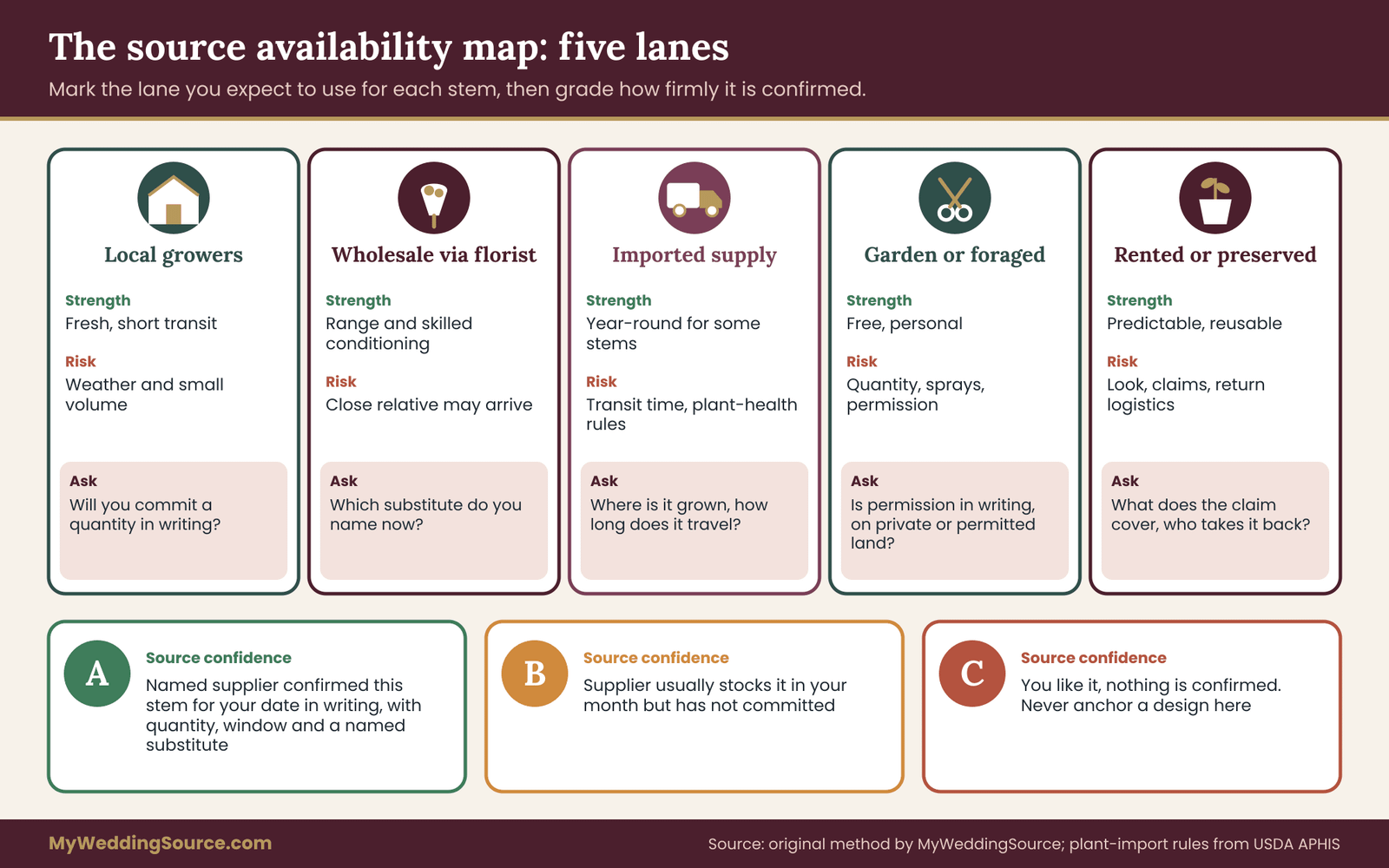
There are five lanes worth naming for greenery types.
Local growers and farms. These are cut-flower farms, orchards, nurseries and woodland cutters within driving distance. The strengths are freshness, short transit and the chance to see the stems before you commit. The risks are weather and scale. A late frost, a wet week or a poor harvest can cut supply, and a small grower may not have the volume for a long garland. Ask whether they will agree to a quantity in writing and what the cut and delivery windows are.
Regional wholesale through your florist. Most florists buy greenery from wholesale suppliers who bring in stems from farms and importers. The strengths are range, consistency and conditioning by people who handle foliage daily. The risk with some greenery types is that the variety is a “what is available this week” decision, so your named stem may arrive as a close relative. Ask your florist what they typically stock in your month and whether they will name a substitute in advance.
Imported and long-distance supply. Many popular greenery types are grown in warmer climates and travel by air or truck. The strengths are year-round supply of certain varieties. The risks are cost, transit time, customs and plant-health inspection. Plant imports are subject to rules that the U.S. Department of Agriculture’s Animal and Plant Health Inspection Service administers, so a florist who handles imported stems carries that compliance. You do not need to manage it yourself, but you can ask where a stem is grown and how long it travels.
Garden and foraged supply. A friend’s garden, a family property or a permitted woodland can supply foliage that is free in money and expensive in time. The strengths are personal meaning and zero cost. The risks are quantity, quality control, pesticide use, timing and permission. Do not cut greenery on public land without checking the agency’s rules, because many parks and forests restrict or prohibit collection and require permits.
The National Park Service and U.S. Forest Service publish their own rules for the places they manage. Private land needs the owner’s permission in a form you can keep.
Rented, potted or preserved supply. This lane covers living potted plants, preserved foliage that has been treated to hold its shape, and artificial stems. The strengths are predictability and reuse. The risks are look, claims and return logistics. Preserved and artificial stems carry marketing claims about sustainability and durability, and the Federal Trade Commission’s Green Guides set the standard for environmental marketing claims in the United States. If a seller makes a claim such as “eco-friendly,” ask what it covers and what the basis is.
For a stem to move from a hope to a plan, mark it with a source confidence grade. The grades are simple.
Grade A means a named supplier has confirmed this exact stem for your date in writing, with a quantity and a delivery window, and a substitute is named. Grade B means the supplier regularly stocks the stem in your month and expects to have it, but has not committed. Grade C means you like the stem and have not confirmed anything. A design that is mostly Grade C greenery types is a wish list, not a plan.
The rule that follows is that none of your anchor greenery types should sit at Grade C. Anchor stems are the ones that appear in most placements, such as the main eucalyptus type or the main trailing vine. Aim for Grade B by the time of your florist’s proposal, and Grade A by the date the florist needs to place orders. Accent stems, the ones used sparingly for texture, can stay at Grade B without much risk, because a swap is cheaper.
Next, add a month overlay. This is where seasonal availability enters, and where you need to be careful about claims. Broad patterns exist across greenery types. Woody and evergreen stems such as conifers and many shrub foliages are commonly easier to find in the cold months. Leafy branches and soft green growth come on in spring and early summer.
Late-summer and autumn bring seed heads, colored leaves and heavier stems. Soft herbs and tender trailing stems prefer warm weather. But these are general tendencies, and exact dates depend on your region, your supplier and the year. Do not copy a seasonal calendar from a magazine and treat it as a promise.
Instead, build the overlay from sources you can name. Ask your florist what they usually have in your month and what they struggle with. Ask a local grower or the wholesaler for a typical window. Check whether your state’s cooperative extension service or a regional growers’ association publishes a seasonal guide for cut flowers and foliage, because those are the closest thing to a local authority. Then mark each of the greenery types on the map with three words: reliable, check or unlikely.
A stem marked unlikely is not removed from your greenery types. It moves to the swap list, with a similar stem that is more likely, matched on scale, finish and color. A trailing vine that is unlikely in your month might be swapped for a different trailing stem with a similar line. A silvery stem that is unlikely might be swapped for another silvery stem or for a matte green with a similar scale. The goal is to keep the visual role and change the plant.
The last columns of the map are practical. Add the lead time the supplier needs, the minimum order, the delivery or pickup window, and the date by which you or your florist must decide. Add your quantity estimate in plain terms, such as “two buckets” or “enough for a six-meter garland plus margin,” and agree the margin with the florist. Greenery is bulky, and running short is far more visible than having a few extra stems.
When the map and the log sit side by side, you can see where your greenery types stand. A stem might pass the log and have an unreliable source, which makes it a candidate for a pre-order or a swap. A stem might be easy to get and fail the log, which makes it a poor use of your money. A stem might pass both, which is where your design anchors belong. The two documents together give you a short list of greenery types that behave well and exist.
A last piece of discipline concerns the date. Mark the date you will make final choices, and work back from it. If your supplier needs the order several weeks ahead, your log must be finished before then, with time left to run a second round if the first fails. Couples who start their logs three weeks before the wedding find themselves choosing between untested stems. Couples who start months ahead can afford to throw out a stem.
You can pair this with your overall timeline. If you are building a vendor schedule, the wedding vendor timeline is a useful place to slot the decision dates for greenery alongside the rest of your orders. And if the wedding date itself is still open, the guide to choosing a wedding date explains how seasonal supply is one of several inputs worth weighing before you commit.
Running the trial and scoring the stems
With the log page and the map sketch ready, the trial itself takes about a week of low-effort attention. This section is the method in order, with the decision rules that turn scores into choices.
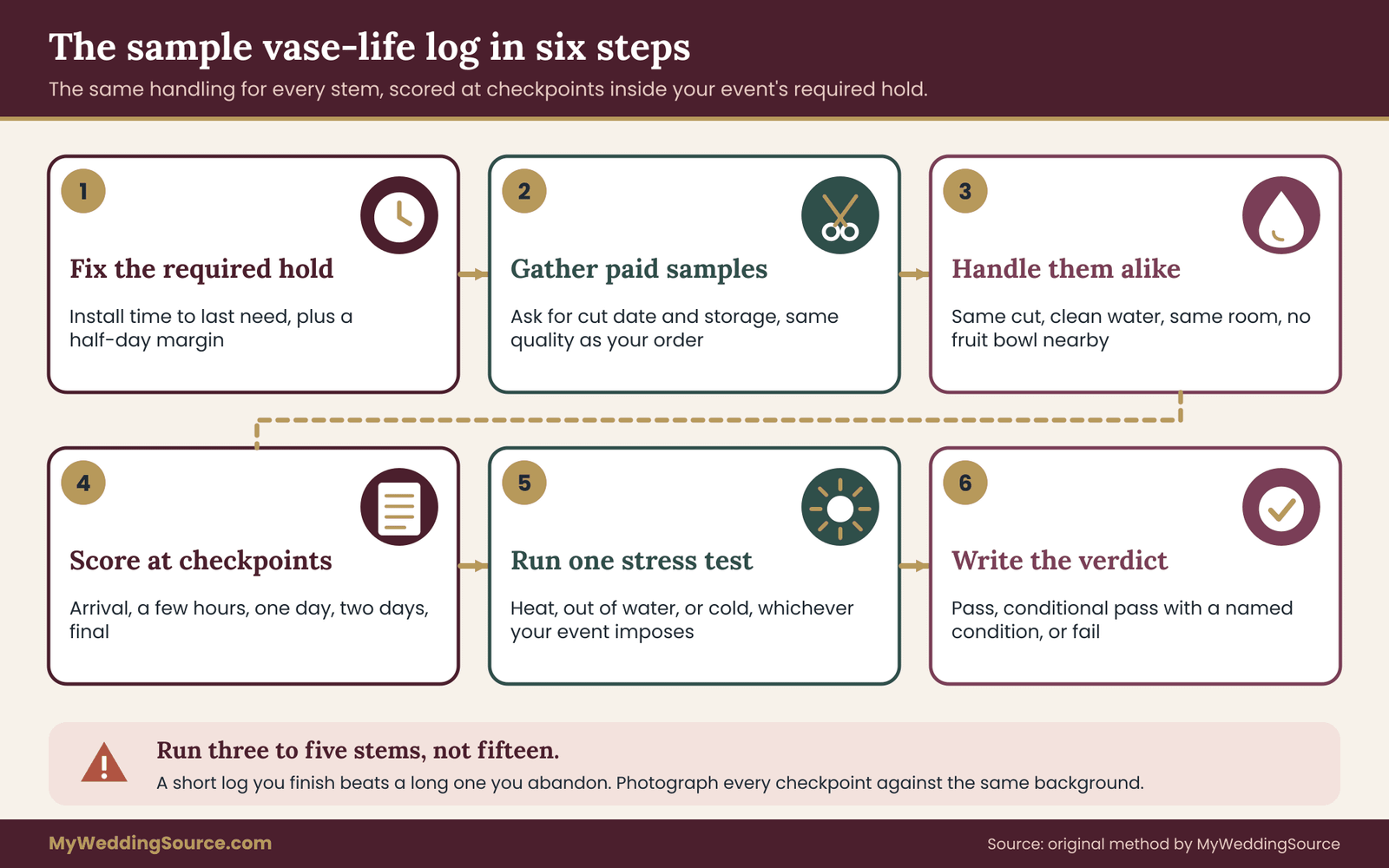
Step one: fix the required hold. Write down two clock times for each placement. The first is when the stem goes into its final position or arrangement. The second is when it is last needed, such as the end of photographs or the end of dinner. The gap between them is the required hold for that placement.
Add a margin of about half a day for delays, early setup or a late finish. The final checkpoint of your log sits at the required hold plus margin. Each placement can have a different hold, so a garland that goes up early and a bouquet carried for an hour are two separate tests.
Step two: gather samples of the greenery types under normal terms. Ask your florist or supplier for samples of each shortlisted stem, and ask that they be the same quality as your order, not their best. If a supplier is willing, pay for a small bunch. A paid sample is a fair request and avoids the pressure to be polite about weak stems. Ask when the stems were cut and how they were stored.
Step three: handle all greenery types the same way. Unpack on arrival, and photograph the stems as they came. Trim the ends with clean shears, remove leaves that would sit below the waterline, and stand them in clean water in clean containers. Keep all samples of your greenery types in the same room, away from fruit bowls and direct sun. Fruit can give off ethylene, which speeds the aging of some plant material, and heat accelerates water loss in everything.
Step four: score at your checkpoints. At each time you set, give each of the greenery types its four scores, take a photo and write a note. Do it at the same hour each day if you can. A calendar reminder on your phone keeps the log honest, because the point of the exercise is that it records what happens, not what you hoped would happen.
Step five: run the one stress test that matters most. Choose the condition that your event will actually impose and apply it to a spare stem or two. If the stem will be in a bouquet, take a stem out of water for the length of your carry time and score it afterward. If the stem will be on an outdoor arch, put a stem in a warm, bright spot, out of water, for the time it will spend there.
If it will sit in a cold church or hall, test it cool. One honest stress test tells you more than many gentle ones. Treat the result as a comparison between stems, not as a prediction of the exact outcome on the day, because wind, sun and handling will differ.
Step six: apply the decision rule. Use the three-outcome rule from earlier. A stem passes when its lowest score at the final checkpoint is three or higher. It is a conditional pass when the lowest score is two and the weakness has a design answer, such as placing it where it will not be touched, giving it a water source, or shortening the required hold by installing it later. It fails when any score is one inside the required hold. Write the verdict beside the stem and keep the log.
A note on what a verdict means. A failed stem is not a bad stem. It is a stem that does not fit this job, in this weather, with this hold. The same vine that fails on an unwatered arch may do well in a bridal bouquet with a water source. Record jobs, not just stems, for each of your greenery types.
A conditional pass should always come with a named condition. “Fine if installed no earlier than noon” is a condition. “Probably fine” is not. Treat the condition as a line in your florist’s brief.
Step seven: compare the passing greenery types on cost and handling. Once you know which greenery types are stable, ask for quotes per bunch or per placement and compare. Cost is the last filter, not the first, because a cheap stem that fails is the most expensive choice you can make. If two stems pass and one costs noticeably more, ask whether the more expensive stem does a job the cheaper one cannot, such as holding a long trailing line.
If it does not, the cheaper one wins. This is cost logic from your own quotes. Do not rely on a generic claim about what greenery types cost, because prices change with season and region, and the guide on setting a wedding budget is the right place to decide how much of the flower line you want greenery to consume.
Step eight: repeat once if needed. If a favorite stem fails, you have two honest options. Test a swap from the same family, or test the same stem with a different handling, such as a longer cold soak recommended by the supplier. One repeat is sensible. Three repeats is a signal that the stem is wrong for the date.
Some small habits make a big difference to the quality of the log. Label every container with the stem name and the cut time. Photograph against a plain white or neutral card. Keep one control stem, a stem that you hydrate and leave alone, so that you can see what the others did relative to it.
Record room temperature if you have a thermometer. Do not change the handling mid-trial without writing it down. And do not score only when you feel like it, because the days you skip are often the days when something happened.
If a venue visit is possible, run part of the trial there. A stem left in the actual room for a few hours, with the actual lighting, tells you about air conditioning, sun through windows and the real temperature in a way a kitchen cannot. If a venue will not allow it, ask what the room temperature is at the time of the event and mimic it as best you can.
A venue technical walkthrough is useful for questions about access, water and conditions that bear on how long greenery can stand there.
A worked example with three invented greenery types
The example below is invented to show the method. It is not a test result, and the stems and scores do not describe how any real variety behaves. Your own samples will differ, and they should be what you rely on.
Imagine a couple, Nadia and Owen, planning an October wedding at a rural venue with an outdoor ceremony at three in the afternoon and a tented dinner. Their florist will install a ceremony arch and two long garlands at eleven in the morning, and the garlands stay up until the last guests leave around ten at night. The required hold for the arch and garlands is eleven hours, and with a half-day margin the last checkpoint sits at roughly twenty-three hours after installation. They shortlist three greenery types.
The first is a matte, silvery eucalyptus type, medium scale. The second is a trailing ivy-type vine. The third is a cedar bough, fine to medium in scale, with a scent.
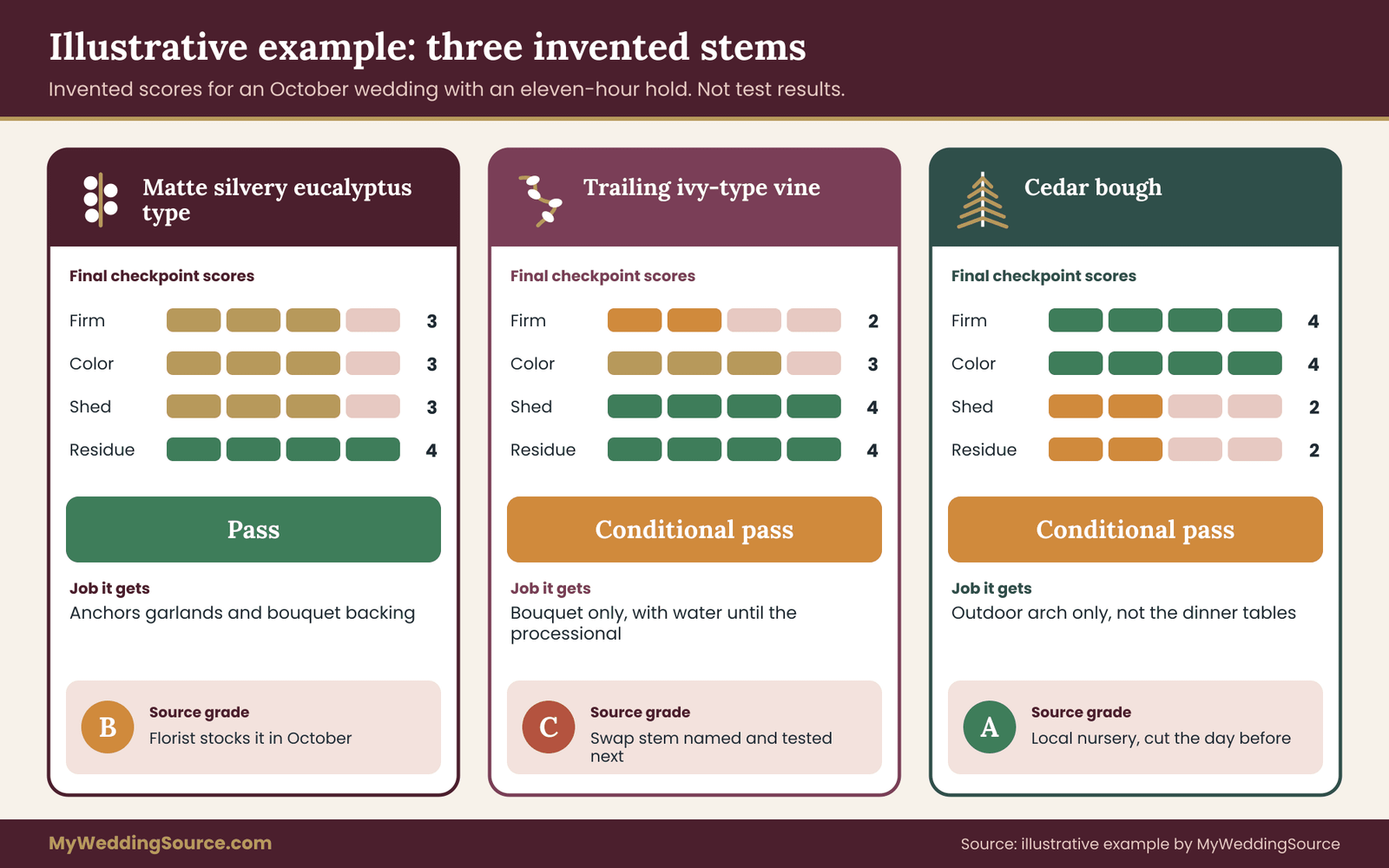
Nadia collects a sample bunch of each from the florist and sets them up in the kitchen. At arrival, all three score fours across the board. At hour six, the eucalyptus is still all fours, the vine shows a firmness of three, and the cedar shows a shed score of three because a few needles dropped when she carried the vase to the window.
At the final checkpoint, in the stress test, they left a stem of each in a warm, bright corner for eleven hours, out of water, to imitate the arch. The invented scores read as follows. The eucalyptus: firmness three, color three, shed three, residue four. It passes, with a note that the gray has warmed slightly toward green. The ivy-type vine: firmness two, color three, shed four, residue four.
It is a conditional pass, and the condition is a water source or a later install time. The cedar: firmness four, color four, shed two, residue two, with a heavy resin smell. It is a conditional pass for the arch, outdoors, and a no for the dinner tables.
Then they fill in the source map. The eucalyptus is something their florist stocks in October. It is Grade B, and the florist agrees to confirm by a set date. The vine is a Grade C, because the florist says it depends on what the wholesaler has, and the florist offers a different trailing stem as a named swap. The cedar comes from a local nursery that has agreed to cut it the day before. That is a Grade A, with a quantity and a delivery window in writing.
The decision follows for the three greenery types. The eucalyptus anchors the garlands and the bouquet backing. The cedar is used on the outdoor arch only, where its scent is a plus and nobody touches it, and not on the dinner tables. The vine is kept only for a hand-tied bouquet with a water source until the processional, and the florist’s swap is tested next. Nadia schedules a second small trial for the swap stem and writes the decision dates on the map.
Notice what the method did for these greenery types. It did not choose the prettiest stem. It matched each stem to a job it could finish, it flagged the one with an unreliable source before any money was committed, and it created a document that the florist could act on. The whole exercise cost a few bunches and some attention.
The same couple could have reached a different result with the same stems in a different month, in a cooler venue or with a water source on the arch. That is the point of logging conditions. A score for any of the greenery types belongs to a job and a setting, not to the plant alone.
Matching wedding greenery types to jobs
By now you have a shortlist of greenery types with verdicts and a map of where they come from. The next step is to assign them to placements. Each placement puts a different demand on foliage, and the same stem can be perfect in one and wrong in another. Think of it as casting greenery types, not shopping.
Start by listing your placements. A typical wedding might have a bridal bouquet, attendant bouquets, boutonnieres and corsages, a ceremony arch or backdrop, aisle markers, a head table garland, guest table pieces, a cake or dessert-table accent, and perhaps a welcome sign or a mantel. For each, write the demand in one line: how long it must hold, whether it has water, whether it is touched, how close it is to food, and how it will be photographed.
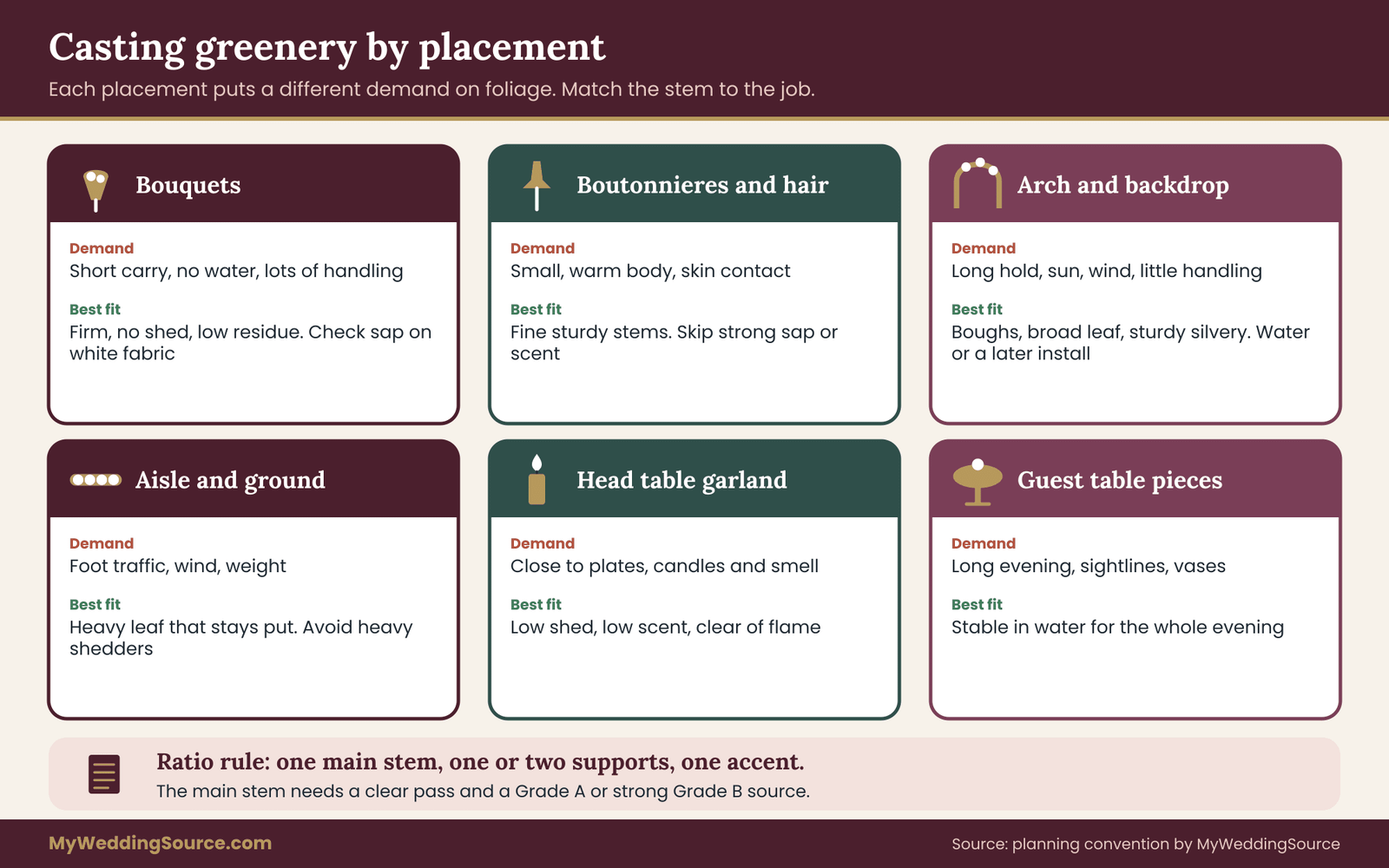
Bouquets and handheld pieces. The demands are a short carry, no water at the moment of use, a lot of handling and close photography. Foliage must be firm and must not shed or leave a mark on a dress. Thick, waxy and medium-scale greenery types usually suit, and the stems must be easy to bind. Trailing vines are lovely here, and the earlier stress test with a stem out of water answers whether yours can do the job.
Check the residue score carefully: sap on a white dress is a problem you cannot undo. Ask your florist how the bouquet is built to keep water at the stems until the last moment.
Boutonnieres, corsages and hair pieces. The demands are small scale, skin or fabric contact and several hours on a body that is warm. Fine, sturdy stems such as a woody herb, a short eucalyptus sprig or a fern leaf tend to behave. Avoid stems with strong sap, strong scent or known skin irritation, and be careful with anything that might drop leaves into a collar or hair. For a person with sensitive skin, ask them first, and have a backup that is a plain fabric or paper accent.
Ceremony arch and backdrop. The demands are a long hold, large scale, exposure to sun, wind and heat, and almost no handling. Boughs, broad leaves and sturdy silvery stems often do well, particularly if the structure holds water or can be misted by a staff member. Trailing vines need a water source or a later install. Photographs from a distance mean that scale and volume matter more than fine detail. The overall impression is shape, which is why the vendor’s mockup matters more than a detail photo.
Aisle markers and ground pieces. The demands are low placement, foot traffic, wind and sometimes a lawn that gets wet. Foliage that drops leaves is a problem here because it spreads. Sturdy, heavy-leaf stems that stay put and do not blow away are safer. If your aisle is outdoors in a breeze, ask the florist about weights and anchoring, and consider what happens if a short rain shower arrives.
Head table garlands and runners. The demands are a long hold, length, proximity to place settings and candles, and a lot of close viewing. The greenery should not shed onto plates, and it should not carry a strong smell into the meal. Residue and shed scores are the ones to read first. Use the matte or glossy greenery types you tested for neat dropping behavior, and keep strongly scented stems such as cedar or aromatic herbs at the edges or away from the table.
If candles are part of the design, ask your florist and venue about safe spacing between flames and dry foliage, because dry needles and leaves burn.
Guest table pieces. The demands are a long hold, low or high placement, and the need to avoid blocking sightlines. Greenery here often sits in vases with water, which helps. Stems that stay stable in a vase for the whole evening are the point. If you are working through table height rules, a sightline check against your table heights is helpful, and your log tells you which stems will still stand upright at dessert.
Cake and dessert accents. The demands are food proximity and cleanliness. Greenery that touches a cake must be a stem that is safe to be near food, and sellers and bakers have their own rules about it. Many bakers prefer that florist stems do not touch the cake surface and that stems are wrapped or placed on a separate base. Discuss this with your baker before you finalize, and keep inedible or untested foliage off any surface where food sits.
Welcome signs, mantels and photo corners. The demands are medium hold and moderate viewing. These are good places for the stems that passed with a condition, because the condition is easy to meet. A conditional vine with a water source is a good fit for a sign arrangement that is set up carefully.
When you assign greenery types to jobs, use the ratio rule. A strong design usually relies on one main stem that appears in almost every placement, one or two supporting stems for contrast and one accent used sparingly. A main stem anywhere in a placement should be a Grade A or strong Grade B on your map and a clear pass on the log. A supporting stem should be at least a conditional pass with its condition met in that placement. An accent can carry more risk because the loss is small.
Colors need a decision here too. Greenery types are not a single neutral. Gray-green, blue-green, olive, dark forest and bright lime each push the palette differently, and foliage in autumn may turn to rust and burgundy. A color palette guide walks through how the colors you choose for flowers, linens and stationery interact, and you can place your verdicts on greenery types into it as a color decision, not only a texture one.
Last, write a one-page casting sheet. List each placement, the main, supporting and accent stems, the quantity estimate, the water arrangement and the install time. Share it with your florist alongside the log and the map. It turns a shared folder of photos into a clear instruction set, and it gives them a chance to correct any plan that the stems do not support.
Safety, sap, allergies and pets
Greenery looks harmless and is not always, and some greenery types need care. Several widely used foliage plants can irritate skin, upset a stomach or harm a pet, and florists treat these facts with different levels of attention. The responsible way to handle plant safety on a wedding is to check each plant by name, not by family and not by feel.
Start with the plants themselves. The ASPCA maintains searchable lists of plants that are toxic and non-toxic to dogs, cats and horses. Look up every one of your greenery types by its common and botanical name. Some stems that florists use in volume, including eucalyptus, ivy and boxwood, appear on these lists, which does not mean they cannot be used, but it does mean that a household with a curious dog, a venue with resident animals or a ring bearer who is a dog deserves a thoughtful placement.
If a pet is part of your wedding, keep arrangements out of reach, and ask a trusted person to watch for chewing.
If an exposure happens, the response is not to search a forum. Call a poison control service or your veterinarian. In the United States, America’s Poison Centers operate a national help line for human exposures, and the ASPCA runs an animal poison control service. Put those contact details on the venue emergency sheet, along with the names of the plants in the arrangements, so that a responder can be told exactly what was eaten.
Next, think about children. Toddlers put leaves and berries in their mouths. Berries on holly-type foliage, small decorative fruits and trailing stems at a low height are all items to keep out of a child’s reach. If your wedding has a children’s table or an area for kids, ask the florist to design it with plain, non-toxic, easy-to-clean pieces, and check the names of the plants against a reputable list.
Then consider skin. Some plant sap can irritate skin on contact. This is why the residue score in the log matters: a stem that leaves a sticky film on your hands is a stem to be handled with gloves by the person who builds the garland and kept off the bodies of people with sensitive skin. If someone in the wedding party reacts to plants, ask them directly and offer an alternative for the piece they will wear.
Pollen and scent are different from toxicity. Greenery generally produces less pollen than flowers, but foliage can still have strong scent, and some guests react to fragrance. Strongly scented greenery types such as cedar, eucalyptus, rosemary and mint can bother people with sensitivities. You cannot promise that an arrangement is free of allergens, and you should not.
A better practice is to ask guests with known sensitivities what affects them and to place strongly scented arrangements away from their seats. For medical questions, a guest should talk to their own clinician. The Centers for Disease Control and Prevention publishes general information on allergies that you can point them to.
Food is a separate category. Foliage near food must be safe to be near food, and anything that touches food should be a food-grade herb or a plant designated for it, handled as food. The U.S. Food and Drug Administration provides general food safety information. A florist’s stem that was cut, treated and shipped as a decorative item is not a garnish. Keep decorative greenery off plates, cake surfaces and serving utensils.
A final safety item is fire. Dry foliage and open flame do not mix. Ask your venue about its candle and open-flame policy, and ask your florist to keep greenery away from candles, with margin. The vendor due diligence checklist includes the kind of questions that cover insurance and safety obligations across vendors, and you can fold the plant safety questions in with them.
Write your plant safety decisions about greenery types into the casting sheet. For each stem, add a line: checked against the ASPCA list on this date, result noted, placement adjusted if needed. Plant safety changes as new information comes in, so a check made years ago is not a check for your wedding.
Vendor questions and written terms for wedding greenery types
Your log and map give you something most clients lack: specifics. The final step is to carry those specifics into the conversation and the contract. The goal is not to be difficult. It is to make the florist’s job clearer and to leave a record that both sides can use if a delivered stem differs from the sample.
Open with the documents. Send your florist the casting sheet, the log and the map, along with your texture brief. Ask them to read it and reply with what they can match, what they would change and why. A florist who is experienced with foliage will have opinions about conditioning and about what is reliable in your month, and those opinions are what you are paying for.
Then ask the questions that the documents suggest. Keep them concrete.
On sourcing: Which of these greenery types do you buy regularly in my month, and from whom? Which will be fresh-cut and which imported? What is your usual lead time for ordering? What happens if the supplier cannot deliver the stem I chose, and who decides the substitute?
On handling: How do you condition each of these stems, and how long before the event do you cut and process them? Where do they sit between conditioning and delivery? What is your plan for the arch and the garlands in heat or wind, such as misting, water tubes or installing later?
On performance: Have you used these greenery types for events of this length and in this kind of venue? Which ones do you consider risky for the hold I need, and what would you use instead? Are there stems where you would keep the pieces in water until the last moment?
On safety: Are any of these greenery types on pet or child toxicity lists, and how would you place them? Will any pieces have strong scent, sap or thorns? Are the stems near food or the cake treated, and will anything touch food?
On quantity and margin: How many stems or bunches per placement are you planning, and how much extra do you build in? What happens if I add a placement or the guest count changes?
On logistics: Who sets up, when, and what water source or equipment do they need from the venue? Who removes the greenery after the event, and where does it go? If composting is possible, will you handle it? The waste reduction guide covers the broader question of what happens to materials after a wedding, and floral composting is part of that.
Next, translate the answers into terms that belong in the agreement. A contract that says “greenery as available” gives you nothing to refer to. A contract that names the anchor stems, the allowed substitutes, the install time and the quantity gives you a standard to compare against.
Ask for these items in writing: the named anchor greenery types and their count or length; the substitute list with the swap rules, matched on scale, finish and color; the delivery and install window; any condition on a stem, such as a water source or a later install; and what the florist will do if a stem is unavailable or arrives in poor condition.
You can also ask for a written statement about the quality of what is delivered, in plain terms: stems fresh, firm and free of visible damage on arrival. If your florist has their own terms, read them, and ask about anything you do not understand. The broader guide to the wedding vendor contract explains the clauses that usually matter, including substitutions and cancellations, and you can use it alongside the greenery-specific items above.
Be careful with claims. If a supplier says a stem is local, organic, sustainably grown, pesticide-free or eco-friendly, ask what the claim means and what supports it. Many such labels are marketing terms with no single legal definition, and the Federal Trade Commission’s Green Guides explain how environmental claims should be made. A supplier who can say “grown within a set distance, cut on this day, no synthetic sprays used in this field” is giving you something checkable.
A supplier who says “eco-friendly” with no detail is not. If a claim matters to you, ask for the detail, and if it matters enough to change your choice, ask for it in writing.
Money matters belong here, too. Ask for itemized quotes for the greenery types, with greenery listed separately from flowers so that you can compare against your own budget. Ask how deposits and balances are handled, and what happens to the deposit if you must change stems for supply reasons.
A swap for supply reasons should not change the price without agreement in writing. If you are comparing two florists, give them the same casting sheet and ask for quotes on the same greenery types, because comparing two proposals built on different assumptions tells you nothing.
Keep a short record of approvals. After a mockup or a revised proposal, send a one-line email confirming what was agreed: “Confirming the garland uses the eucalyptus and the cedar, with the vine only in the bouquet, installed at eleven.” A written confirmation is the easiest way to close the loop, and it keeps both sides pointing at the same document. For a broader framework on checking vendors before you commit, a checklist for vetting wedding vendors is a sensible companion.
Edge cases that change the plan
The method above handles the typical wedding. Several situations bend it, and it is worth knowing in advance which ones apply to you.
Heat and direct sun. A hot afternoon is the most common cause of tired greenery. If your ceremony is outdoors in warm weather, move the install as late as the schedule allows, ask for stems that scored well in your warm stress test, and arrange for water access and shade for anything that must stand early. Consider whether the highest-risk pieces can be built in the final hour, not the morning.
Wind and rain. Outdoor greenery on stands or arches is subject to movement. Heavy-leaf stems and conifers fare better than light, trailing ones. If rain is possible, ask what the plan is for a move indoors, and whether the florist can build the piece in sections that carry well. Wet foliage can look dull or spotty, which you can test by misting a stem.
Multi-day events. If you have a welcome event, a ceremony and a farewell brunch, the same greenery may have to serve several days. Extend your log to cover the whole span, and consider planning a refresh by the florist for the second or third day. Some greenery types that pass a single day fail across three.
Long transport. A drive of several hours with stems in a hot vehicle is a stress test you did not plan. Ask the florist how stems travel, whether in water or in boxes, and how long they sit between loading and arrival. For destination weddings, ask whether the florist or a local supplier will source greenery at the destination, because importing stems across state or national lines may trigger plant-health rules.
USDA’s Animal and Plant Health Inspection Service is the agency to ask about plant material crossing borders, and the florist’s wholesaler can often handle it, but a couple carrying their own foliage in luggage should check first.
Do-it-yourself greenery. If you or your family will cut and arrange the greenery, the log becomes more important, not less. You are the conditioning department. Plan the cutting day, the storage place, the water, the transport and the person who will fix pieces on the wedding morning. Start the trial early, run it in the real storage conditions, and have a backup plan with a florist or a wholesaler for a rescue order. Do not assume that a friend’s garden can supply the quantity of a long garland.
Foraging and permits. Cutting greenery on public land is often restricted. Check with the agency that manages the site, such as the National Park Service for park units, before you cut anything, and get written permission from private landowners. Do not take plants that are protected, and do not cut on a road verge or in a preserve without checking. A permit conversation takes time, so start it early.
Potted and living greenery. Potted plants can be rented or bought, and they offer a long, steady hold. The trade-offs are weight, return logistics, plant health and the need to water. If you plan to keep them afterward, check that they will survive your home. A rental planning checklist covers delivery, return and condition terms that apply to rented plants as they do to furniture.
Preserved and artificial greenery types. These can fill gaps in a design where a fresh stem will not hold or where a supply is unreliable. They carry their own questions about appearance, claims and storage. Treat them as a design choice, not as a failure, and apply the same log logic to the look: photograph them under the actual lighting before you commit.
Allergies and sensitivities in the wedding party. If someone in the party reacts to plants or scent, adapt their pieces first. A substitute accent for that person is a simple fix, and asking early avoids a last-minute scramble.
A late change. If the florist needs to swap a stem close to the date, use the log as a shared reference. Ask for a photo of the replacement, check it against the texture brief, and ask the florist to confirm in writing that the swap matches the scale, finish and color you approved. A short, specific request is more likely to be met than a general worry.
Your next steps
Start with a short list and a calendar, then build the log and the map around them.
- Write your placements and the required hold for each, with a half-day margin.
- Write your three-sentence texture brief: scale, finish and contrast with the flowers.
- Choose three to five candidate greenery types, drawing on two or three of the six families.
- Look up each of the greenery types by name on the ASPCA lists and note the result.
- Ask your florist for paid samples and the cut date of each.
- Run the log at your checkpoints and the one stress test that matches your event.
- Draw the source availability map, grade each source A, B or C, and name a substitute.
- Write the casting sheet and send it, with the log and map, to your florist.
- Ask for the anchor stems, substitutes and install window in writing.
- Set the decision date and book a second small trial if a stem failed.
FAQ
What are the most common wedding greenery types?
The common families are silvery or gray foliage such as eucalyptus and olive, glossy broad leaves and shrub foliage, trailing vines, evergreen boughs, ferns and soft fronds, and aromatic herbs. Which of these greenery types suit you depends on your month, your venue and the hold your event needs. A short trial of three to five greenery types tells you more than a list.
How long does wedding greenery last once it is cut?
It varies by stem, harvest stage, handling and conditions, so no single number is reliable. Some foliage holds for days and other stems wilt in hours when warm or out of water. Ask your supplier for their handling sheet, and run your own checkpoint log across the hours your event needs, plus a margin for delays.
Is it safe to use eucalyptus and ivy around pets?
Check each plant by name. The ASPCA lists plants that are harmful to pets, and eucalyptus and English ivy appear among them. That does not rule them out, but it affects where they go. Keep arrangements out of reach, tell your florist about animals present, and call a poison control service or a veterinarian after any suspected exposure.
Can I get any greenery types in any month?
No. Supply follows growing seasons, weather and import schedules, so some stems are easy in one month and scarce in another. Ask your florist what they regularly stock in your month, grade each stem by how firmly a supplier has confirmed it, and name a substitute with matching scale, finish and color for any stem that is uncertain.
Should greenery types be listed separately in a florist quote?
Yes, it helps. Itemizing greenery alongside flowers lets you compare proposals and see what you are paying for. Ask for the anchor stems, quantities, substitutes and install window in writing. If a supply problem forces a swap, ask that any price change need your written agreement rather than being decided on the day.
Can we cut greenery from a park or a friend’s garden?
Only with permission. Many public lands restrict or prohibit collecting plants and may require permits, so check with the managing agency before cutting anything. On private land, get the owner’s permission in writing. Also consider whether the quantity, quality and pesticide use suit a wedding, and have a florist as a backup source.
How do we keep greenery from shedding on tables?
Choose stems that scored well on the shed check in your log, place shedding stems away from plates and walkways, and use vases with water where possible. Ask the florist to condition stems well and to install as late as practical. Test tapping a stem over white paper to see what actually falls.
Can we compost the greenery after the wedding?
Often yes, if the stems have not been sprayed or wired and your area has a program that accepts them. Ask your florist to separate wire, foam and plastic from plant material, and check with your local composting service about what it takes. The EPA publishes general composting information. Plan who collects the stems and when.
Sources
- ASPCA toxic and non-toxic plants
- Poison Control, America’s Poison Centers
- USDA Animal and Plant Health Inspection Service
- Federal Trade Commission, Green Guides and advertising guidance
- U.S. Food and Drug Administration, food safety information
- Centers for Disease Control and Prevention, allergy information
- National Park Service, special park uses and permits
- U.S. Forest Service, forest products and permits
- USDA Agricultural Marketing Service
- U.S. Environmental Protection Agency, composting and food waste information