

A boutonniere and corsage look like the smallest line on a florist’s order, yet they are worn on the body for ten hours or more, so the choices that matter are practical ones: who gets one, how big it is, what holds it on, and how it survives heat and hugging.
Quick answer
A boutonniere is a small flower worn on a lapel or shirt, and a corsage is a small arrangement worn on a dress or the wrist. The Knot lists the usual wearers as the couple, parents, grandparents, the wedding party, ushers, and the officiant. Build a name-by-name list first, choose pin-on or wrist by the garment, and confirm the fastener with each wearer. Keep the flowers cold in their box until about an hour before they are worn. Prices below are published ranges and our own estimates, so get a written quote.
Most guides to the boutonniere and corsage stop at “men wear one, women wear the other.” That answer fits a tidy photograph and fails at the real moments: a grandmother in a beaded jacket who cannot be pinned, a groomsman in a thick wool coat on a cold day, a ring bearer who is four years old, an outdoor ceremony in July. This guide works from those moments. It covers the people, the placement, the sizing, the pins and magnets, the heat, the cost, and the day-of handoff, and it flags where the sources disagree or say nothing.
A note on sources before we start. We did not make or test any flowers, and we have no relationship with any florist named here. Where a claim comes from a florist’s website, we say so, because shop advice reflects that shop’s methods. Prices come from published menus and one national survey, and your own quote will differ. Nothing here is medical advice; the section on magnets mentions implanted medical devices only to tell you to ask the wearer’s doctor.
What a boutonniere and corsage are, and who gets one
The words are French-sounding and often misspelled, and the pieces themselves are simple. Before the list of names, it helps to be clear about what you are ordering, because florists use the two words for a family of products with different sizes, fasteners, and prices.
Two pieces with different jobs
A boutonniere and corsage do the same social job, which is to mark someone as part of the day. They differ in where they sit and in how they are built, and those differences drive nearly every decision later in this guide.
The boutonniere
A boutonniere is a small flower or cluster, usually with a little greenery, worn on the left lapel of a jacket or on a shirt over the heart. The Knot describes the traditional spot as the left side, over the heart, and notes that it is also the easiest spot for people to see when the wearer is standing and greeting guests. It is typically made on a short stem wrapped for handling, and it is held on by a pin pushed through the fabric.
The corsage
A corsage is a larger piece, usually a few blooms with foliage and ribbon. The Knot says it is pinned to the bodice of a dress or tied to the wrist with ribbon. A florist who sells both styles, Fiore Designs in Los Angeles, describes the wrist version as a choice for dancing, active events, and delicate fabrics, and the pin-on version as a choice for structured garments, straps, sleeves, and jackets that can carry the weight.
Where the words overlap
Some florists make a “wristlet” on an elastic or a bracelet base, and some make a pin-on corsage small enough to wear on a lapel. You will also see “pocket square” arrangements, a larger floral piece mounted on an insert. When you order, describe the piece by where it goes and what it is attached to, not only by name, and the florist can match the build to the garment.
The people who usually wear one
Customs vary by family, region, and religion, so no list is official. The Knot’s published list is a good starting point because it is specific and widely used, and we use it here as the base.
Who wears a boutonniere
The Knot lists the groom or grooms, fathers of the couple, stepfathers, grandfathers, members of the wedding party, ring bearers, ushers or greeters, male officiants who are not wearing religious garb, and other honored guests such as readers. Its short rule is that anyone in a suit may wear one.
Who wears a corsage
The Knot’s list for corsages is the mothers of the couple, stepmothers, grandmothers, members of the wedding party such as junior bridesmaids, flower girls, and house party members, female ushers or greeters, female officiants not in religious clothing, and other honored guests. Bridesmaids normally carry bouquets, so when a bridesmaid appears on a corsage list it is usually because the couple chose a wearable flower for a role without a bouquet.
Who usually does not
Guests without a role usually do not receive one, and the couple’s own flowers are ordered separately. The wedding party and family pieces can be coordinated with the bouquets, and our guide to seasonal wedding flowers explains how season and supply can change which stems you can count on.
Where practice is not settled
Three questions come up often enough to settle early, because each one changes the count or the build.
Officiants and religious garb
The Knot’s wording is careful: officiants who are not wearing religious clothing may wear one. That leaves a gap for clergy in robes or vestments, where a pin through a garment can be inappropriate. Ask your officiant what they prefer before you order, rather than assuming. Our guide to the wedding officiant covers the conversation about logistics in more detail.
Choosing by garment, not gender
Because the names are tied to men’s and women’s traditions, they can feel awkward for a wedding party of mixed genders or for people who dislike the labels. A simple workaround is to ask each person what they will wear and how they want to wear it. Someone in a suit jacket can take a lapel piece, someone in a dress can take a pin-on or wristlet, and someone who prefers neither can carry a small posy or skip the flower. The goal is a piece that fits the clothes and the person.
Who pays
Etiquette authority Emily Post describes the traditional split this way: the bride’s family covers ceremony and reception flowers and the bridesmaids’ flowers, while the groom’s family covers the groomsmen’s boutonnieres and corsages for the immediate family on both sides, and corsages can be skipped if the florist order already includes them. She adds that these divisions are traditional and vary with circumstances. Many couples now pay for everything out of one budget, and our guide to how to pay for a wedding covers how families split costs today.
Build the headcount before you talk to a florist
A florist cannot price a boutonniere and corsage order without a count and a few details. The Knot’s advice is to write the recipient list before the wedding so the florist knows how many pieces to make. We suggest going one step further and making the list a small working document, because the same list will drive your delivery plan on the day.
Draft the boutonniere and corsage list in layers
Start with the people who are certain, then add the maybes, and keep them in separate columns so you can drop or add them without redoing the whole sheet.
Family first
List the couple, both sets of parents, stepparents, and grandparents. Add siblings who are not in the wedding party only if you want them marked. For each name, note the garment they plan to wear, because that decides pin-on, wrist, or neither. If a grandparent is unsure, record “ask” rather than guessing.
Attendants and helpers
Add groomsmen, bridesmaids if they are receiving wearable flowers, ushers, a ring bearer, flower girls if any, readers, the officiant, and anyone who greets guests or manages the guest book. The Knot’s lists include ushers and greeters, which is useful for the friend who has a working role but no formal title.
The preference column
The Knot suggests asking loved ones whether they would rather have a corsage or a boutonniere and whether they are comfortable with a pin or a wrist style. Put the answer in its own column. A short text message works, and it avoids the situation where the florist’s box holds a pin-on for someone who cannot wear one.
Count spares and special cases for the boutonniere and corsage order
The base count is rarely the order count. A few extra pieces and a few notes on sizing turn a list into an order.
A small number of spares
Our suggestion, not a published rule, is to ask your florist whether they recommend one or two spare boutonnieres and one spare corsage. Pieces get crushed in a car, a pin bends, and a late addition happens. Some florists include a spare, and some charge for it, so ask and write down the answer.
Children and ring bearers
The Knot advises telling the florist the ages of any ring bearers so the boutonnieres are sized correctly. A full-sized piece on a small child can look heavy and can pull a thin jacket. Our reading of that advice is to give the florist the child’s age and the garment, and let them recommend a smaller build with a lighter bloom.
Late additions
People get added after the list is sent: a new stepparent, a friend who agrees to do a reading, an officiant who changes. Ask your florist for a final change date, and treat it as a hard deadline on your own plan. Our wedding planning checklist is a good place to record it alongside your other vendor dates.
Match each boutonniere and corsage to the person
The boutonniere and corsage list is only useful if each line says what the person will wear and how they want to wear it. A short note beside each name prevents most of the problems in later sections.
Record the garment
For every boutonniere and corsage, write the fabric and structure: wool suit jacket, thin cotton shirt, beaded dress, sleeveless silk, cardigan, robe. A pin works well through a lapel and poorly through a thin silk. A heavy corsage can drag a lightweight dress. The garment note is the single most useful piece of information you can give the florist. Our guides to wedding party attire and groomsmen suits vs. tuxedos cover the clothing side.
Record the wearing conditions
Note whether the person will be outside in the sun, hugging dozens of guests, dancing, holding a baby, or standing in a receiving line. Those conditions decide whether a lighter, tighter piece is smarter than a fuller one. A grandmother who will sit most of the day has different needs from a best man who will carry a toddler.
Where it goes: lapel, shirt, bodice, wrist
Placement is where a boutonniere and corsage meet the clothes, and it is where most day-of trouble starts. The illustration below shows the four common positions and the question to ask at each one.
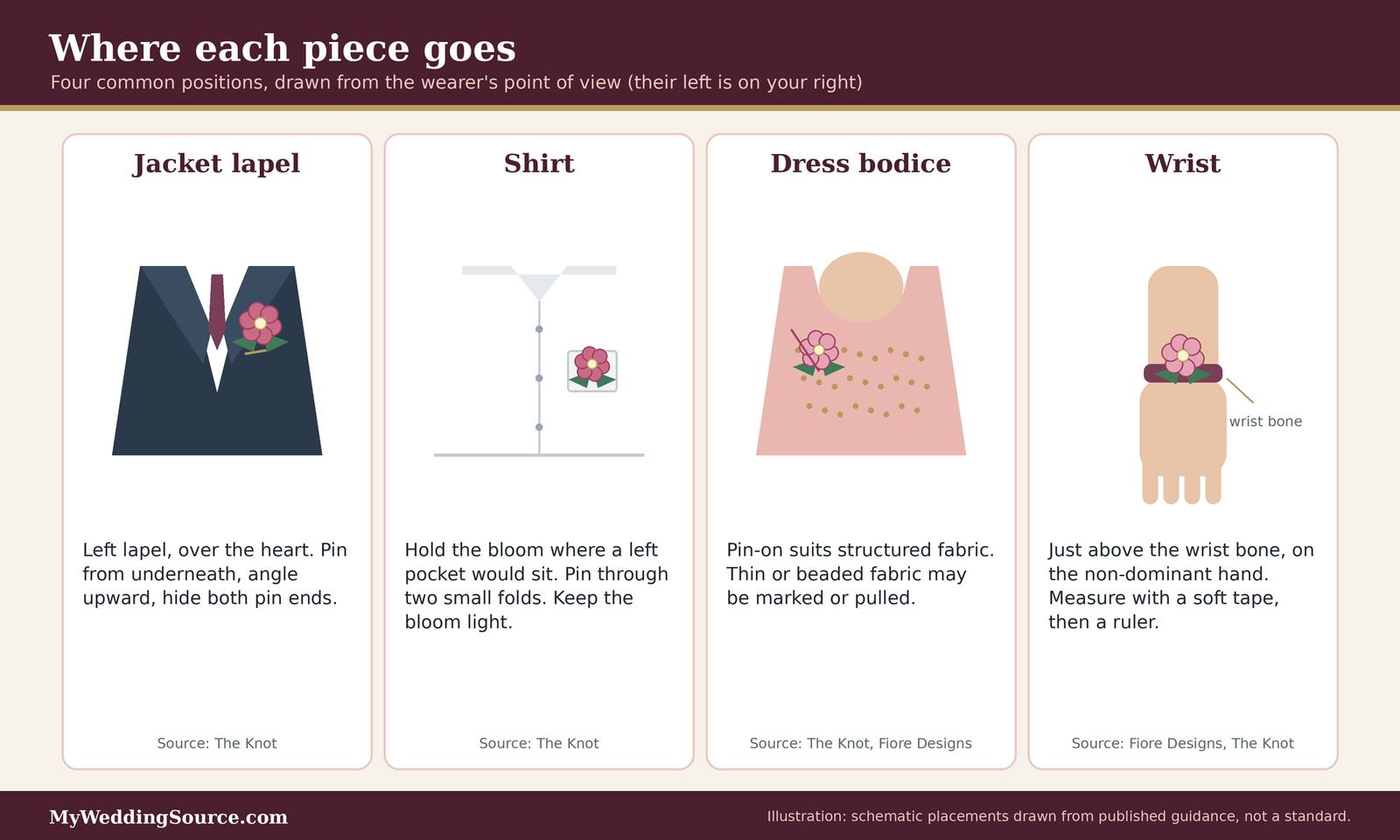
Placing a boutonniere on a jacket or shirt
A boutonniere has three common homes. Which one fits depends on whether the wearer has a jacket, a buttonhole, and a bloom light enough for the fabric.
The lapel
On a suit jacket, the usual spot is the left lapel. The Knot’s pinning steps are to fluff the bloom and settle the greenery, lift the lapel, push the pin through from underneath into the thickest part of the stem, angle it slightly upward, and bring it back through so both ends stay hidden. If the lapel has no buttonhole, it suggests pinning at the center of a notched or peaked lapel just below the notch. Hiding both pin ends protects the wearer and the people who hug them.
The shirt
Without a jacket, for example at a summer or beach wedding, the piece can go on a shirt. The Knot’s method is to hold the bloom where a left pocket would sit, pinch a small fold of fabric, push the pin horizontally through it, place the bloom beside the fold with the pin above the stem, then pinch a second fold on the other side and pin through both. It adds that a heavy bloom can make a thin shirt sag, so keep it light. If you are planning a warm-weather look, our guide to beach wedding dresses may help you think about the whole outfit.
The pocket
The Knot also describes tucking the piece into a pocket with only the bloom showing, and pinning the stem to the back of the shirt for heavier blooms so it does not slip out. We would use this only when the wearer has a real pocket that closes reliably, and we would test it with a few steps and a hug first.
Placing a corsage
A corsage has two main homes, plus a few workarounds when neither is comfortable.
On the dress
The Knot says a corsage is pinned to the bodice of a dress. Fiore adds that a pin-on suits structured garments, thicker straps, and jackets. A pin through a lightweight fabric can leave a visible hole or pull the fabric, so for thin, silky, or heavily beaded materials the wrist is usually safer.
On the wrist
The Knot says a wrist corsage is preferred for heavily beaded or delicate dresses, and often for officiants who use their hands a lot. Fiore describes it as a choice for dancing and says to wear it on the non-dominant hand just above the wrist bone. A wrist corsage keeps the pin away from the dress, but it can catch on a sleeve, brush a bouquet, or collide with a watch, so ask about those.
The alternatives
When neither works, the options are a small piece pinned to a purse strap, a posy carried in the hand, a flower tucked into the hair, or no flower at all. These are ordinary practice rather than rules, and a florist who hears the garment and the situation can often suggest one. For a bride’s mother in a high-necked jacket, for example, a lapel-style pin-on may be the cleanest answer.
Sizing the boutonniere and corsage
Sizing has three parts: the scale of the flower, the fit on the wrist, and the weight on the garment. A piece that is wrong on any of the three will be taken off by lunchtime.
Scale
Scale is a design judgment, so ask the florist to describe the finished size in inches and to show a photo of a similar piece on a person. The Knot’s advice on ring bearers is the clearest published sizing rule: tell the florist the age so the boutonniere fits. We would extend that logic to anyone small, for example a petite grandmother, a young flower girl, or a guest with a narrow lapel.
The wrist
Fiore’s instructions are to measure just above the wrist bone with a soft tape, then check the length against a ruler. Tell the florist whether the wearer wants a snug or looser fit, and mention any watch or bracelet worn on that arm. A florist can only act on measurements you send, so record each wrist in inches and keep the numbers in the preference column.
Weight
The Knot warns that a heavy bloom can make a thin shirt sag. The same applies to a corsage on a light dress. Ask the florist to weigh the finished piece if that matters, or to tell you whether it suits the fabric. Fresh flowers hold water and wire adds weight, so a piece that feels light in a box can feel heavy by evening. ## Pins, magnets, and wristlets: what holds the boutonniere and corsage on
The fastener is the least glamorous part of a boutonniere and corsage and the one that causes the most grumbling. Three systems are common: a straight pin, a magnetic backing, and a wristlet. The drawing below shows how each works, and the sections after it explain when each fits.
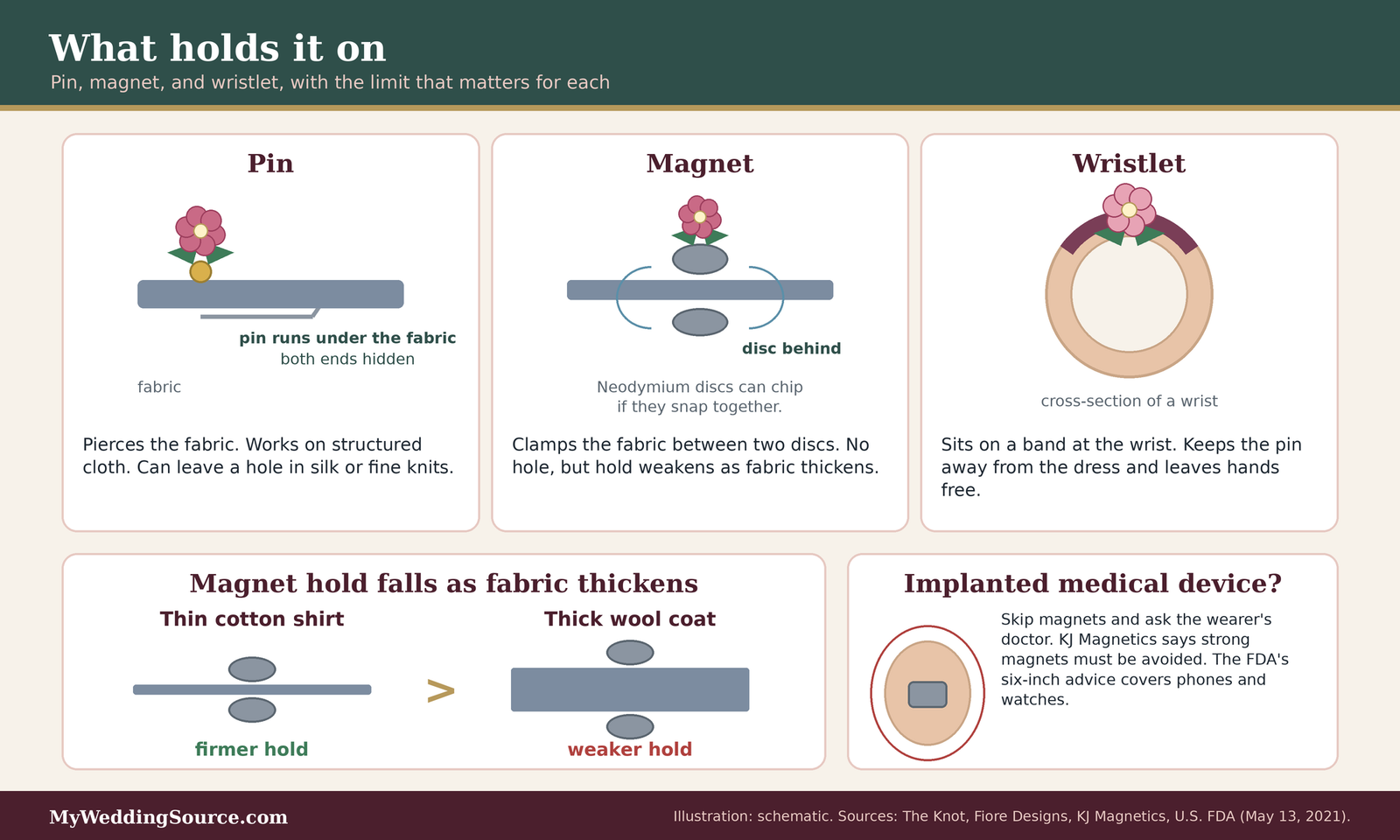
Pins for a boutonniere and corsage
A pin is the traditional method, it works on most structured fabrics, and its limits are well understood. It needs fabric thick enough to hold it and a wearer who does not mind a point near the chest.
How a pin is placed well
The Knot’s steps are consistent across lapel, shirt, and pocket: push the pin through from underneath, aim it at the thickest part of the stem, angle it slightly upward, and bring it back out so that both ends are hidden under the fabric. Fasten it securely enough to survive dancing, hugging, and sitting. A pin that is visible, loose, or pointed outward is the usual cause of a pricked guest.
Where a pin struggles
A pin pierces the fabric, so it can leave a hole, and the hole is more visible in silk, satin, and fine knits than in wool. Thin fabric also lets a heavy bloom pull. If you are unsure, ask the wearer to try the pin on the garment, and if they hesitate, switch to a wrist or a different location. The Knot’s tips on shirts, with two folds of fabric and a light bloom, are the most careful published workaround.
Magnets
A magnetic fastener clamps the fabric between two magnets, one in front and one behind, so nothing pierces the garment. Our only technical source on magnetic pins is a magnet manufacturer, KJ Magnetics, which explains the physics and the limits, and we rely on it for that purpose. We did not test any florist’s magnet product.
What a magnet does well
KJ Magnetics says magnetic pins need no piercing and leave no holes in tightly woven fabric such as neckties, and that thin cotton shirts work well with small discs. For a wearer with a delicate shirt, a rented tuxedo that cannot be marked, or a tie that should stay unpunctured, that is a real benefit. Magnets can also be quicker for a rushed morning.
Where a magnet struggles
The same source says holding strength falls as the fabric between the magnets thickens, so thick wool coats are generally impractical, and that magnetic fasteners hold less firmly than traditional pins. It adds that strong neodymium magnets are brittle and can chip if they slam together, and that two magnets can be hard to separate. For a flower that must survive a hug, ask the florist to test the magnet on the actual garment, or on the same fabric, before the wedding day.
The implanted device question
KJ Magnetics says strong magnets must be avoided by anyone with a pacemaker or similar implanted device. Separately, the U.S. Food and Drug Administration, in a notice published May 13, 2021, recommends keeping cell phones and smart watches at least six inches from implanted medical devices, especially cardiac defibrillators. That notice is about phones and watches, not florist magnets, and it does not set a rule for a boutonniere. We are not giving medical advice. Our practical suggestion is simple: if the wearer, or anyone who will hug them closely, has an implanted device, use a pin or a wristlet, and let the wearer’s doctor answer any question about magnets.
Choosing by garment
Pick the fastener for each boutonniere and corsage from the garment and the wearer, not from habit. The table below is our own summary of the published guidance above, and it assumes you will confirm each choice with the florist and the wearer.
| Situation | Pin | Magnet | Wristlet | Our note |
|---|---|---|---|---|
| Wool suit jacket lapel | Works well | Often too thick | Not applicable | Pin is the default |
| Thin cotton shirt | Possible with fabric folds and a light bloom | Can work with small discs | Not applicable | Test on the actual shirt |
| Silk, satin, or fine knit | Risk of a visible hole | Can work if thin | Good alternative for corsages | Prefer the least marking option |
| Heavily beaded dress | Hard to place | Often unsuitable | Preferred by The Knot | Use a wristlet |
| Rented tuxedo | Check the rental terms | May avoid marks | Not applicable | Ask the shop |
| Wearer has an implanted device | Fine | Avoid; ask the wearer’s doctor | Fine | Do not guess |
| Active role, dancing, lifting children | Secure pin, light bloom | May shift | Keeps hands free per Fiore | Choose the most secure option |
How to use the table
For any boutonniere and corsage, read across the row that matches the wearer’s garment, and choose the cell that is both safe and secure. If two cells look equally good, choose the one that marks the clothes least. Then send the florist a one-line note for that person: garment, fastener, and any limit. The table is a decision aid, not a standard, and a florist may reasonably disagree for a specific design.
When to ask for a test piece
A test is most useful when the fabric is unusual, the wearer is anxious, or the piece is heavy. Ask whether the florist will make a practice piece, or whether a similar piece on a similar fabric can be shown. Some shops charge for a test, so ask first. The goal is to find a failure at the florist’s studio, not at a ceremony.
Heat, water, and the cold chain
Flowers are cut stems out of water, and a boutonniere and corsage are small, so they have little water to draw on. They are also close to a warm body. That combination makes heat the most common cause of a sad piece in the late photographs. The drawing below follows one piece from the florist’s box to the reception.

What heat does to a boutonniere and corsage
The published advice on heat is practical and fairly consistent, though most of it is written about bouquets and aisles, and we apply it by analogy to smaller pieces.
Heat-tolerant stems
Zola’s guide to heat-tolerant flowers lists anthuriums, dahlias, delphinium, zinnias, cymbidium orchids, proteas, sunflowers, gerbera daisies, carnations, lisianthus, chrysanthemums, and garden roses, and for tropical or beach settings hibiscus, birds of paradise, and some lilies. Fifty Flowers, a wholesale seller, names chrysanthemums, daisies, carnations, Peruvian lilies, succulents, craspedia, anthurium, cymbidium orchids, protea, and birds of paradise as hardy, and says craspedia works well in boutonnieres and corsages.
Stems that wilt first
Zola says hydrangeas and peonies often wilt in hot weather and that out-of-season or delicate blooms need extra care. Sources disagree about some stems, so treat any list as a starting point. A florist who has made pieces for your season in your region is a better guide than a general list.
Why small pieces are different
No source we found measures how long a boutonniere or corsage lasts on a person, and none gives a lifespan in hours. We would not trust anyone who promises one. What the sources do say is that wearable flowers spend most of the day out of water, that sturdy blooms hold up best, and that heat, sun, and storage matter more than the price of the flower.
Cold storage and timing for a boutonniere and corsage
The cold chain is the simple idea of keeping flowers cool until the moment you need them. The sources give consistent guidance, with one important limit.
The refrigerator step
Fiore says to keep a corsage in its box in the refrigerator, away from fruit, and not to mist it unless the florist advises. It adds that you should take it out about an hour before wearing, and keep it away from heat, direct sun, and car dashboards. Our suggestion is to ask your florist whether the same applies to your pieces, because some designs, such as those with certain succulents or wired parts, may differ.
Why fruit is a problem
Oklahoma State University Extension explains that ripening fruit releases ethylene gas, which can damage nearby cut flowers even at very low levels, about 100 parts per billion, and that refrigeration lowers both the gas’s production and flowers’ sensitivity to it. In practice, that means the box should not share a shelf with apples, bananas, or other ripening fruit.
A home refrigerator is not a florist’s cooler
The same extension sheet says growers hold cut flowers at 32 to 35 degrees Fahrenheit and that small temperature increases can sharply shorten vase life, with flowers at 41 degrees declining up to four times faster than at 32 degrees. That finding describes commercial cut flowers in storage, not a finished boutonniere in a kitchen, and we have no source for the temperature of a home refrigerator. Treat the refrigerator as a way to buy time, not as a way to hold flowers for days. It also warns that moving flowers from cool to warm rooms causes condensation, so keep them in the box until they are needed.
When the day is hot
If your forecast is hot or your venue is sunny, a few adjustments cost little and help a great deal.
Pin on last
Zola advises adding boutonnieres at the last moment, and Fiore says to put a corsage on after dressing and after hairspray or perfume, as close to leaving as possible. Practically, that means designating someone to hand pieces out and pin them in the final hour, not hours before photographs. Our guide to the wedding photographer shot list can help you plan when the family and wedding party portraits will happen so the flowers are fresh for them.
Choose the sturdy build
For a hot-weather boutonniere and corsage, ask for hardy stems, more foliage and fewer open petals, and a smaller piece. A smaller build has less surface to dry out. Zola mentions faux, dried, and succulent alternatives where needed, and some couples choose a mix, with fresh flowers for the family and a long-lasting piece for the wedding party. We cannot cite a source for how any particular alternative performs, so ask your florist.
Plan shade and water
If the ceremony is outdoors, build a few minutes of shade into the schedule. Zola notes that cut blooms left in sun without water tend to wilt, and its advice for outdoor aisles and altars is to use potted plants or non-floral decor. That advice supports a simple plan for wearable pieces: keep spares in their box in a cool spot, and replace a wilted piece rather than defending it. For more on outdoor settings, see our guide to garden wedding venues.
Choosing flowers and styles for a boutonniere and corsage on a long day
Once you know who is wearing what and how it is attached, you can choose what it is made of. The aim is a piece that looks like part of your wedding and survives the schedule.
Sturdy stems and where they fit
The published lists of hardy flowers overlap, and the overlap is the most useful part.
Stems that appear on more than one list
Carnations, chrysanthemums, cymbidium orchids, anthurium, protea, lisianthus (Zola), and craspedia (Fifty Flowers, for boutonnieres) all appear in guidance about heat or durability. Garden roses and spray roses appear in Zola’s list. Ask your florist which of these are available on your date, since season and supply can limit the choice.
Stems to treat carefully
Hydrangeas and peonies are the stems Zola flags for heat. Our guide to seasonal wedding flowers explains why some of these stems are scarce or expensive at certain times. If a favorite stem is delicate, it can sometimes appear in a bouquet that sits in water, while a sturdier stem appears in the wearable pieces.
Foliage and texture
A greenery-only boutonniere is a legitimate design. ThePricer, which compiles published florist menus, lists greenery-only boutonnieres at about $15. Foliage tends to be sturdy, and texture, such as berries or grasses, can add interest without a delicate bloom. We cannot cite a source for the durability of any specific foliage, so ask.
Styles beyond the single bloom
A boutonniere does not have to be a single flower. Several options exist, with different prices and trade-offs.
Pocket squares
As an alternative to a boutonniere and corsage in the usual sense, ThePricer reports that floral pocket squares, a larger arrangement on a mounted insert, start around $45 to $50 in the menus it compiled. They suit a jacket with a breast pocket and a wearer who wants a bolder look. They are larger and usually costlier than a pin-on, so ask whether the insert sits securely and whether it suits the wearer’s jacket.
Mixed materials
Some couples combine fresh and non-fresh materials, for example a small fresh bloom with dried or faux elements. Zola mentions faux, dried, and succulent alternatives. A mixed piece can hold its shape longer, and it can be a good compromise for a keepsake. Ask your florist what the finished piece looks like in a photograph, since mixed materials can read differently up close.
Not wearing one
Some wearers will say no, and that is fine. A person who dislikes pins, has an allergy, or feels uncomfortable with the tradition can skip it, or carry something small instead. Ask once, record the answer, and move on.
Matching the bouquet and the clothes
A good boutonniere and corsage set looks related to the bouquet without copying it.
Echo, do not duplicate
Repeat one flower, one color, or one type of foliage from the bouquet in the family and wedding party pieces. That gives a visual thread without requiring the same stems in every piece. Our guide to wedding decor covers how to carry a palette through a room.
Make the couple distinguishable
Many couples have a slightly different piece for the groom, such as a different flower or a bit more detail, so he stands out from the groomsmen in photographs. The Knot lists the groom first among boutonniere wearers, and a difference in the build is a common way to mark him. Ask your florist to show how the pieces will look side by side. Our guide to bridesmaid dresses may help you plan colors that suit the flowers. ## What a boutonniere and corsage cost
Money is where a boutonniere and corsage order is easiest to misjudge, because the pieces are small and the line items are many. The published numbers are thin. The Knot reports a total flower figure but not per-piece prices, so the per-piece figures below come from florist menus compiled by a price-research site, and they are a guide, not a quote.
What this actually costs
ThePricer, which compiles published florist menus, reports that a fresh, florist-made boutonniere usually costs about $15 to $30, with upgraded designs around $30 to $65 and couture pieces from $90 to $125. Fiore Designs says a simple pin-on corsage starts around the mid-$20s and a wrist corsage costs more. For scale, The Knot’s study of 10,474 couples married in 2025 reports an average of $2,800 for all wedding flowers. Delivery fees, minimums, rush charges, and tax can add to any of these, so compare itemized written quotes.
Reading the price signals
Several factors move the price of a single boutonniere or corsage, and the sources agree on most of them.
What raises the price
ThePricer lists premium or rare flowers, more blooms, and fuller or sculptural designs as price drivers, and says a pocket square costs more than a pin-on. It also lists full-service wedding florists and luxury event pricing as sitting well above neighborhood shops, and delivery fees, event minimums, rush rules, taxes, and card fees as add-ons. Fiore adds that wrist corsages cost more than pin-ons because of extra finishing, and that a rush order may bring substituted flowers or a simpler design.
What the survey figure does and does not tell you
The Knot’s $2,800 average covers bouquets, boutonnieres, wedding party flowers, and centerpieces together, and the study reports a median of $1,900, a lower quartile of $900, and an upper quartile of $4,800. It says nothing about how much of that goes to wearable pieces. The Knot also suggests budgeting about 10 percent of a total wedding budget for flowers, or closer to 15 percent for couples who prioritize them. Those are a planning guide, not a rule. Our wedding budget calculator can help you test a number against your full budget.
Contract language that touches the price
The Knot notes that a florist may set prices at booking but that flower costs can rise before the wedding, and that a florist may absorb some of the increase or pass it on. Ask how your contract treats that, and whether the boutonniere and corsage prices are fixed or may change.
A worked scenario for a boutonniere and corsage order
The scenario below is ours, built from published ranges and our own assumptions. It is arithmetic, not a forecast, and your count and quotes will differ.
The assumptions
Imagine a wedding with a groom, four groomsmen, one ring bearer, two fathers, two grandfathers, an officiant, and one reader who wear boutonnieres, for 12 in total. Add two mothers, two grandmothers, and one stepmother who wear corsages, for 5 in total. Then add our suggested spares of two boutonnieres and one corsage. That makes 14 boutonnieres and 6 corsages, or 20 pieces. For prices, we use ThePricer’s $15 to $30 for a boutonniere, and for corsages an assumed $25 to $45, where $25 reflects Fiore’s “mid-$20s” start and $45 is our own allowance for a wrist build.
The arithmetic
At the low end, 14 boutonnieres at $15 come to $210 and 6 corsages at $25 come to $150, so $360. At the high end, 14 at $30 come to $420 and 6 at $45 come to $270, so $690. The range is therefore about $360 to $690 before delivery, tax, and any minimums. Against The Knot’s $2,800 average for all flowers, that range is roughly 13 percent to 25 percent. The two numbers come from different samples, so treat the comparison as an illustration of scale only.
What it shows
In this scenario the boutonniere and corsage order is a modest part of a flower budget, but they are not trivial, and a count that grows from 12 to 20 pieces changes the total by hundreds of dollars. The cheapest way to control the cost is to decide the list early, not to choose cheaper flowers late.
Normalizing two quotes
Two florists will rarely quote the same thing in the same way. Divide each quote into the same units before comparing.
Step one: put both quotes on the same count
Use your list: 14 boutonnieres and 6 corsages. If one florist quotes a package for 16 and another quotes per piece, restate both for 20 pieces, and note any piece that is a pocket square or an upgraded build.
Step two: add every fee, then divide
Add delivery, design or setup fees, minimums, and rush charges to the pieces, then divide by the number of pieces. The table below shows a hypothetical pair. These are not real quotes, and we invented the figures to show the method.
| Line | Quote A | Quote B |
|---|---|---|
| 14 boutonnieres | $22 each, $308 | $18 each, $252 |
| 6 corsages | $38 each, $228 | $32 each, $192 |
| Delivery | $60 | Included |
| Design or setup fee | None | $85 |
| Total before tax | $596 | $529 |
| Per piece | $29.80 | $26.45 |
| Question to ask | Are spares and pinning help included? | Does the fee cover delivery to two addresses? |
Step three: compare what the number leaves out
Quote B is $67 lower in this example, since $596 minus $529 is $67, but the lower total says nothing about flower quality, size, substitution rules, or whether the florist will pin pieces on. Fiore notes that the lowest quote is not always the best value. Ask each florist what happens if a flower is unavailable, and get the answer in writing.
A timeline and checkpoints for the boutonniere and corsage order
A boutonniere and corsage order has a short life: it is decided in advance, made close to the date, and used in a few hours. The schedule below is our suggestion, not a published standard, and your florist’s own deadlines come first. Our wedding planning timeline shows where this fits among larger tasks.
Before the wedding
Most of the work happens weeks ahead, and it is mostly a matter of recording details.
At booking
Add the boutonniere and corsage order to the florist contract along with the bouquets and decor. Ask about minimums, delivery, substitution rules, and the date by which you must give a final count. The Knot advises ordering with a list in hand, and Fiore says that early orders give florists more flower choice and better color matching, especially in prom season and spring wedding months.
A few weeks out
Send the final list: names, garments, fastener, wrist sizes, and any limits. Our suggestion is to send it as a single sheet and ask the florist to confirm in writing that they have it, including spares. If your wedding is in a busy season, our wedding planning guide can help you place this task among others.
The week before
Confirm delivery time and place, who will receive the box, and where it will be stored. Make sure someone has a clear shelf in a refrigerator away from fruit. Pack a small kit: spare pins, a few pieces of floral tape, and a small pair of scissors. Our suggestion is to have one person responsible for the box.
On the day
The day-of plan is short, and the main risk is that nobody owns it.
Delivery and storage
When the box arrives, put it in the refrigerator, away from fruit, and keep it closed. Fiore says to hold pieces by the wristlet, stem wrap, or backing, not the blooms, so ask whoever handles them to do the same.
The pin-on window
For the boutonniere and corsage, our suggestion is to pin pieces on in the last hour before the ceremony, after everyone is dressed and any hairspray or perfume is on. Fiore says to take pieces out about an hour before wearing and to put a corsage on after dressing, as close to leaving as possible. The Knot says to give pieces to recipients before the ceremony so they can wear them during the processional.
The photographer’s cue
Tell the photographer who wears what so details are captured while the flowers are fresh. Our guide to the wedding photographer shot list includes ideas for detail shots. Photographs of the pieces in their box, before they are worn, are often the cleanest record of the design.
Checkpoints that catch problems
For a boutonniere and corsage order, a checkpoint is a small test with a clear pass or fail. The table below is our own method, built from the sources above, to catch problems when they are still cheap to fix.
| Checkpoint | What to measure or check | Pass | If it fails |
|---|---|---|---|
| The list | Every wearer named, with garment and preference | No “ask” entries left | Message each person; add a default |
| Wrist size | Measured above the wrist bone in inches, with watch noted | Soft tape and ruler agree | Remeasure; tell the florist |
| Scale | Florist’s stated piece size in inches | Fits the lapel or wrist without crowding | Ask for a smaller build |
| Fastener | Pin or magnet tested on the actual fabric | Holds through a hug; leaves no mark | Switch to a wrist or a different location |
| Delivery | Box arrival time and storage place | In a cool spot, away from fruit | Move it; call the florist |
| Pin-on | Time pieces go on | Within the last hour, after dressing | Reassign the task |
| Photos | Pieces still look fresh at the first portrait | Flowers are firm and in place | Swap in a spare |
Why checkpoints beat a single check
A single check, such as “the florist has the list,” can pass while another step fails, such as a wrist size that was never measured. The checkpoints are small and ordered so that an early failure is corrected before the next step depends on it. If you do only two, do the fastener test and the delivery plan.
What to record
After each checkpoint, write down the date, the result, and the person responsible. If a florist or a family member asks about a detail later, the sheet answers it.
When something is off, and what cannot be undone
Even a careful plan meets surprises. Most problems with a boutonniere and corsage can be fixed quickly if you know which fixes are safe.
Safe fixes on the day
A small kit and a calm helper solve most problems.
A drooping or wilted piece
Swap in a spare, if you have one, and keep the original in its box. The OSU Extension sheet notes that wilting shortens flower life and that recutting stems under water removes air blockages, but those steps apply to cut stems, not to a wired and taped piece. Ask your florist whether a wilted piece can be refreshed, rather than guessing.
A piece that does not fit
If a wrist corsage is too tight, loosen it if the build allows, or switch to a pin-on. If a boutonniere sags on a thin shirt, move it to a sturdier fold or a lapel, or use a smaller piece. Our suggestion is to have spares in a range of sizes if the budget allows.
A missing piece
When someone is left out, a small flower from a bouquet or a spare piece often works. Ask the florist whether a leftover stem can be repurposed. A spare also helps with a late addition, such as a guest asked to do a reading.
Choices that cannot be undone
A few decisions are hard to reverse. It helps to know which ones.
A pin through delicate fabric
A pin leaves a hole, and a hole in silk or satin may not close. Check the garment with the wearer first, and use a wrist or a different location when in doubt. If the garment is rented, check the rental terms before piercing it. Our guide to wedding dress alterations explains how fabric behaves when it is altered, which is relevant when a mark is a concern.
A magnet near a medical device
If the wearer has an implanted device, avoid magnets and ask the wearer’s doctor about any questions. This is one of the few cases where a quiet check in advance matters more than a fix afterward.
A flower you cannot replace
If a particular stem is unavailable on the day, a substitute is the only option. Ask your florist what the substitution rule is in your contract. Our guide to wedding etiquette can help you handle conversations with family if a promised flower changes.
Record the specifications
After the wedding, a short record of your boutonniere and corsage choices helps with future events and with anyone who wants to keep or recreate a piece.
What to save
For your boutonniere and corsage records, save the florist’s contact details, the final list, the wrist sizes, the stems used, the fasteners, and the invoice. A photo of each piece before it was worn is useful. If you plan to keep a piece, ask the florist or a preservation service about options, and ask what the result will look like, since results vary and we cannot cite a source for any method.
After the day
Fiore’s advice about storage applies to leftover fresh pieces: keep them cool and away from fruit if you want them to last longer. Otherwise, a piece can be photographed, thanked, and set aside. If you used a rented jacket or borrowed garment, check it for pin marks before returning it.
Questions to bring to your florist
Take the questions below to your florist meeting about the boutonniere and corsage order. They are short, and each one comes from a problem described above.
Before you sign
Ask these questions when you compare florists and read the contract.
Ask the florist
Questions to ask
- What is the finished size of each piece, in inches, and can you show a photo on a person?
- Which fastener do you recommend for each garment, and will you test it on the fabric?
- Can you make a smaller build for a ring bearer, and what do you suggest for a wearer who cannot be pinned?
- Which stems do you use in hot weather, and how have they performed at venues like mine?
- How should the pieces be stored, and for how long, before they are worn?
- Are spares included, and what is the final change date?
- Do you charge for delivery, rush, or minimums, and what happens if a flower is unavailable?
Ask yourself
Do I have a name, a garment, and a fastener for every piece? Do I know who will pin them on, and when? Does anyone on the list have a medical or allergy concern I should raise? If any answer is unclear, resolve it before the order is final.
When you compare quotes
Use the normalization method above for the boutonniere and corsage quotes. Ask for itemized quotes in writing, keep them in one folder, and compare per-piece cost after fees. Our wedding budget calculator is a good place to record the chosen amount.
Keep the answers
Write the answers on your sheet and send a recap email to the florist. A recap email creates a record without making the conversation feel formal.
Share the plan
Send the final boutonniere and corsage plan to the person who will handle the box on the day. A single page with the names, garments, fasteners, and the pin-on window helps them do it. If the ceremony location has special rules, our guide to the wedding ceremony can help you plan around them.
FAQ: boutonniere and corsage questions
People and placement
Who usually wears a boutonniere and corsage at a wedding?
The Knot lists the groom, fathers, stepfathers, grandfathers, wedding party, ushers, ring bearers, and non-robed male officiants for boutonnieres. It lists mothers, stepmothers, grandmothers, wedding party members, female ushers, and non-robed female officiants for corsages. Families vary, so confirm your list with each person.
Which side does a boutonniere go on?
Traditionally on the left, over the heart. The Knot says it can be pinned to the left lapel, or to a shirt where a left pocket would sit. Push the pin through from underneath, aim it at the thickest part of the stem, and keep both pin ends hidden so nobody gets pricked.
Should a corsage be pinned on or worn on the wrist?
It depends on the garment. The Knot prefers a wrist corsage for heavily beaded or delicate dresses and for officiants who use their hands a lot. Fiore says pin-ons suit structured garments, straps, and jackets. Ask each wearer which they prefer before you order.
Fasteners and safety
Are magnetic boutonniere backings a good idea?
They can be, with limits. KJ Magnetics says magnetic pins avoid holes in fabric and work well with thin cotton shirts, but hold less firmly than pins and are generally impractical on thick wool coats. Ask your florist to test one on the actual garment before the day.
Is a magnet safe for someone with a pacemaker?
We cannot give medical advice. KJ Magnetics says anyone with a pacemaker or similar implanted device must avoid strong magnets, and the FDA recommends keeping phones and smart watches at least six inches from implanted devices. If a wearer or close hugger has one, use a pin or a wristlet and ask their doctor.
Heat, storage, and cost
How do I keep a boutonniere and corsage fresh in hot weather?
Keep them in their box in the refrigerator, away from fruit, and take them out about an hour before wearing, according to Fiore. Pin them on last, choose sturdy stems such as carnations, chrysanthemums, or craspedia, and avoid delicate stems like hydrangea and peony in heat, as Zola advises.
How much does a boutonniere and corsage cost?
ThePricer’s compilation of published menus puts a fresh florist-made boutonniere at about $15 to $30. Fiore says a simple pin-on corsage starts around the mid-$20s, with wrist styles costing more. Delivery, minimums, rush fees, and tax can add to these. Get itemized written quotes, and compare per-piece cost after fees.
How many extra pieces should I order?
There is no published rule. Our suggestion is to ask your florist whether one or two spare boutonnieres and one spare corsage are advisable, since pieces can be crushed, a wearer may be added late, or a flower may wilt. Some florists include a spare and some charge, so ask.
Your next steps
Make the list
Write the names and garments
Start with the boutonniere and corsage recipient list, add the garment and fastener for each person, and send it to your florist with wrist sizes in inches. Our wedding planning checklist is a good place to track the order.
Check the people-side details
Confirm with your officiant, your parents and grandparents, and anyone with a medical or allergy concern. Our guide to wedding etiquette can help with delicate conversations.
Protect the flowers
Plan the cold chain
Pick the refrigerator shelf, name the person who handles the box, and set the pin-on window. Add all three to your wedding planning timeline.
Compare quotes
Use the normalization steps above, keep the totals in your wedding budget calculator, and choose the florist whose answers you trust, not only the lowest number.
If this is on your list, see also Wedding Arch Ideas: Styles, Sizing, Wind Safety and Real Costs.
Sources & methodology
How we built this guide
What we relied on
This guide combines published wedding-planning guidance from The Knot, Zola, and Emily Post, florist and wholesaler advice on ordering, storage, and hardy stems, a price-research site’s compilation of published florist menus, a magnet manufacturer’s technical notes, a university extension fact sheet on cut-flower handling, and a U.S. Food and Drug Administration notice on magnets and implanted devices. Where a statement comes from a shop or a seller, we attribute it, because their advice reflects their own methods and prices. The per-piece prices are published ranges and our own assumptions, and the worked scenario and quote comparison are editorial arithmetic with invented figures, not market data.
What we did not do
We did not make, wear, or test any boutonniere, corsage, pin, or magnet, and we do not recommend a florist. We found no source that measures how long a boutonniere or corsage lasts on a person, and no source for the temperature of a home refrigerator, so we make no claim about either. Prices and policies were current when we read them and may have changed. Nothing here is medical, legal, or financial advice. Confirm all details with your florist and, for any implanted device, the wearer’s doctor.
Source list
Government and public university sources
- U.S. Food and Drug Administration, Magnets in Cell Phones and Smart Watches May Affect Pacemakers and Other Implanted Medical Devices (May 13, 2021): https://www.fda.gov/radiation-emitting-products/cell-phones/magnets-cell-phones-and-smart-watches-may-affect-pacemakers-and-other-implanted-medical-devices
- Oklahoma State University Extension, The Care and Handling of Cut Flowers: https://extension.okstate.edu/fact-sheets/the-care-and-handling-of-cut-flowers.html
Wedding-industry and etiquette sources
- The Knot, Who Gets Wedding Corsages and Boutonnieres: https://theknot.com/content/who-gets-wedding-corsages-and-boutonnieres
- The Knot, How to Put on a Boutonniere: https://www.theknot.com/content/how-to-put-on-a-boutonniere
- The Knot, Average Cost of Wedding Flowers (2025 Real Weddings Study): https://www.theknot.com/content/average-cost-wedding-flowers
- Zola, Heat-Tolerant Flowers for Your Summer Wedding: https://www.zola.com/expert-advice/heat-tolerant-flowers-for-your-summer-wedding
- Emily Post Institute, Wedding Expenses: The Traditional Division: https://emilypost.com/advice/wedding-expenses-the-traditional-division
Florist, wholesaler, and manufacturer sources
- Fiore Designs, How to order a corsage: https://fioredesigns.com/journal/care-how-to/order-corsage-guide
- Fiore Designs, Corsages and boutonnieres guide: https://fioredesigns.com/journal/care-how-to/corsages-boutonnieres-guide
- Fifty Flowers, 10 hardy wedding flowers that are easy to arrange and last all day: https://fiftyflowers.com/blogs/wedding-flowers/10-hardy-wedding-flowers-that-are-easy-to-arrange-and-last-all-day
- ThePricer, The cost of a boutonniere: https://www.thepricer.org/the-cost-of-a-boutonniere/
- KJ Magnetics, Magnetic pins and brooches: https://www.kjmagnetics.com/blog/magnetic-pins-and-brooches