
Petite wedding dresses work best when you shop by height as well as size: measure from collarbone to floor in your actual shoes, choose proportions that suit your frame, and budget for the hem and fit work that a gown cut for a taller body will almost certainly need.
You find a gown you love, the consultant clips it up the back, and then you look down at the skirt pooling around your feet like a puddle of tulle. The waist seam sits near your hips, the sleeves swallow your hands, and the train that looked graceful on the hanger now needs a second person to manage. None of that means the gown is wrong or that you are hard to fit. It means the pattern was drafted for a taller body, and the fix is a mix of choosing the right cut, giving the right measurements and planning for alterations before you pay.
This guide is built for anyone who will wear a wedding gown or a dress-style outfit and is generally 5’4” and under, which is the cutoff most retailers use for petite. It explains what petite actually means, which measurements to take, how silhouettes, necklines and fabrics behave on a shorter frame, what hems and trains cost, and how veils, shoes and accessories change the picture. It also covers where petite gowns are sold, a realistic shopping timeline, and how your dress code, the season and your wedding party affect the choice. It never assumes a particular body, gender, age, budget or wedding style, and nothing here is a rule you have to follow.
Two honest limits before we start. Most height-based styling advice comes from retailers and bridal editors, so it is useful guidance rather than science, and the sources sometimes disagree with each other, which we point out as we go. Prices, size ranges and policies also change by season, so treat every brand named here as a starting point to verify on the seller’s own page.
What “Petite” Actually Means in Bridal Shopping
Bridal shopping has its own vocabulary, and “petite” is easy to misread because it describes proportion, not just a number on a tag. This section sets out where the height line falls, why standard gowns create specific fit problems, and how to decide whether a petite-cut gown or an ordinary gown with alterations suits your situation.
How do retailers define petite, and why does height matter?
What height counts as petite?
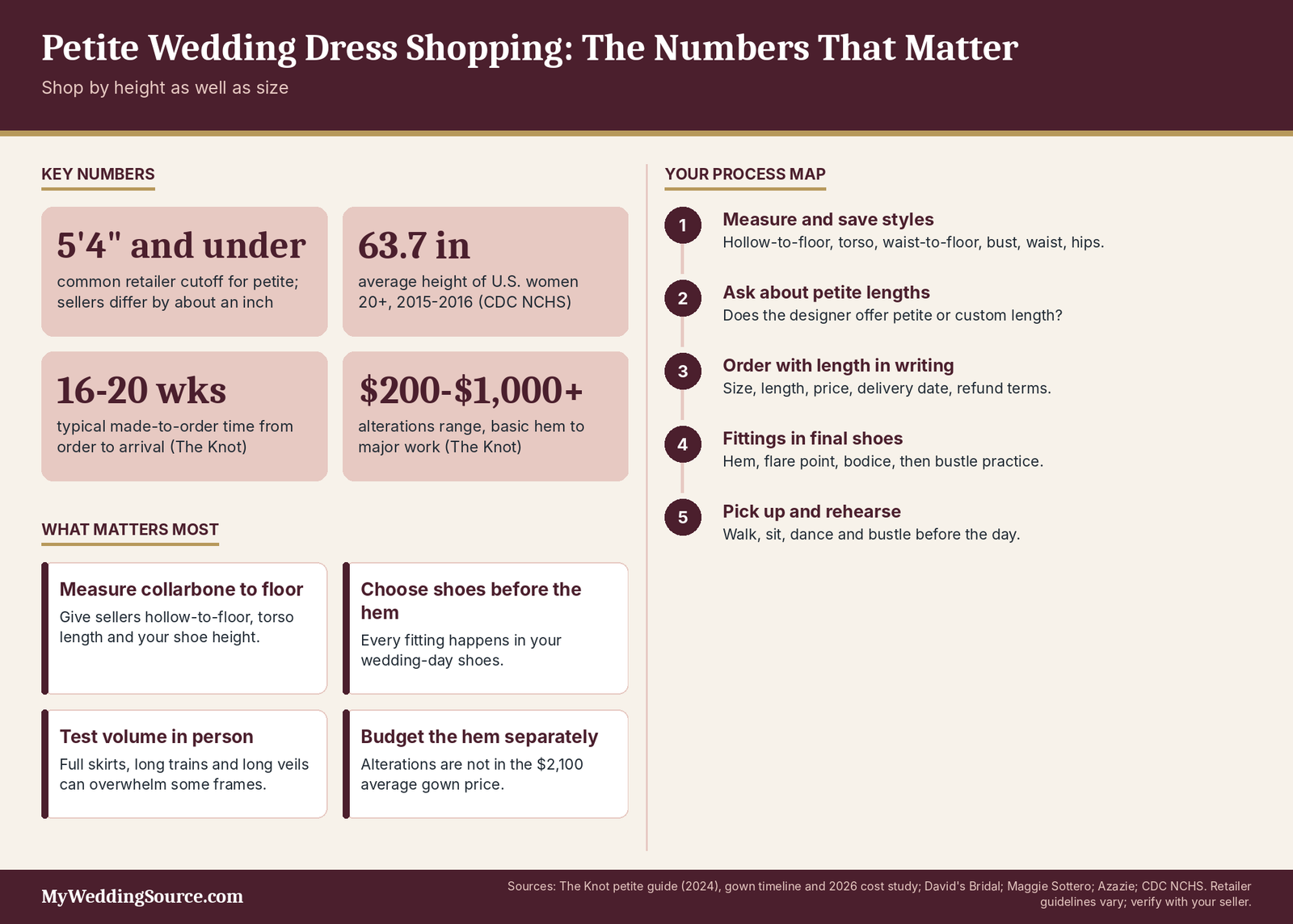
Most bridal retailers draw the line at 5’4” and under, but not all of them draw it in the same place. The Knot’s petite gown guide uses 5’4” and under, David’s Bridal’s petite sizing page uses the same cutoff, and Maggie Sottero’s petite guide says 5’4” and under in its body text while its intro says under 5’5”. The line is a retailer guideline rather than a medical or scientific category, so verify it on the brand’s own page. For context, the CDC’s National Center for Health Statistics reports an average height of about 63.7 inches for U.S. women aged 20 and over in 2015 to 2016, so the petite cutoff sits very close to the national average rather than at an unusual extreme.
| Source | Petite cutoff stated | Note |
|---|---|---|
| The Knot (petite gown guide, 2024) | 5’4” and under | Says nearly half of American women fall here |
| David’s Bridal | 5’4” and under | Petite gowns come in sizes 0P to 14P |
| Maggie Sottero | 5’4” and under (intro says under 5’5”) | Describes petite cuts as scaled in sleeves, bodice and waist |
| Azazie (short bride guide) | Under 5’4” | Says standard gowns are built for taller frames |
Why do standard gowns fit shorter frames awkwardly?
Azazie’s guide for short brides says most bridal gowns are cut for brides roughly 5’7” to 5’9”, which is a retailer’s editorial claim rather than a published industry standard. That gap shows up in more places than the hem. The waist seam can land below your natural waist, the bodice can run long so the neckline gapes, the sleeves can extend past your wrist, and a skirt that flares at the knee on a taller body may start at mid-calf on yours. Azazie notes that shortening a standard-length hem can remove 4 to 6 inches of fabric or more, which also changes how the skirt falls and where any lace or beading sits.
Is petite the same as small?
No, and mixing the two up causes real ordering mistakes. Height and size are separate measurements: a petite person can wear any bridal size, and a person of any height can have a small frame. Petite sizing, such as David’s Bridal’s 0P to 14P range, adjusts proportion (Maggie Sottero describes shorter sleeves, narrower shoulders and bodices, higher waistlines and scaled-down lengths), while a standard size number follows your bust, waist and hip measurements. If you are both petite and shopping in extended sizes, the sizing logic in our plus size wedding dresses guide applies to the width side, and this guide covers the length side.
Do you need a petite cut, or will a standard gown work?
When is a petite cut worth looking for?
A petite cut is most useful when your torso is short, since bodice length is the hardest thing to change later. If gowns tend to put the waist seam below your natural waist, or the neckline gapes on most styles, a pattern drafted with a shorter bodice starts you closer to the finish line. Petite sizing can also reduce the hem work: The Knot notes that petite-specific sizing can mean no alterations are needed, and it describes Justin Alexander petite designs as allowing a chapel train without major alterations. Treat those claims as a reason to ask, because how much a cut helps depends on the style, the designer and your exact proportions.
When does a standard gown plus alterations make sense?
A standard gown is often the practical route when the style you love is not made in a petite cut, when you are only slightly under 5’4”, or when your proportions are average through the torso and the main issue is skirt length. A simple hem is one of the more routine alterations, and column and A-line skirts are generally easier to shorten than layered or heavily beaded ones. The decision usually comes down to the construction of the gown: a plain crepe sheath hems cleanly, while a lace skirt with an appliqued border needs a seamstress who can reposition the lace. If the hem is the only change you need, a standard size with good alterations can look just as intentional as a petite cut.
What if you are just above the petite line?
The line is blurry on purpose, and many people between roughly 5’4” and 5’6” run into the same hem and proportion questions in a milder form. The measurements in the next section matter more than the label, so use your collarbone-to-floor figure and the gown’s published length rather than deciding whether you “qualify.” If you fall between a petite and a regular size, ask the consultant to show you the gown’s length measurement and compare it with yours, since two inches of difference changes how much hem work you are signing up for. Our wedding dresses guide covers the broader buying process that applies regardless of height.
The Measurements That Matter: Hollow-to-Floor, Torso, and Shoes
Dress size gets the attention, but for a petite shopper the length measurements decide how much work the gown needs. This section explains the measurements sellers ask for, how to take them without guessing, and why your shoes change nearly every number.
Which length measurements should you give a seller?
What is hollow-to-hem or hollow-to-floor?
Hollow-to-floor runs from the dip at the base of your neck, the hollow between your collarbones, straight down to the floor. Retailers use it to compare your body with a gown’s length, and some call the gown-side figure hollow-to-hem. Azazie’s help center says hollow-to-hem is a key measurement for its standard-size dresses, with an example of 60 inches for a size A10 in a floor-length style, and that standard sizes cannot be lengthened while extra length is available through custom sizing. Conventions differ between brands, including whether to measure barefoot or in shoes, so follow the exact instructions on the seller’s form rather than a general rule.
Why do torso length and waist-to-floor matter?
Torso length, measured from the shoulder to your natural waist, predicts where the bodice and waist seam will land. Waist-to-floor shows where the skirt starts relative to the hem and matters most for fit-and-flare and mermaid shapes, where the flare point needs to fall at a flattering place on the leg. Azazie’s short-bride guide lists both, along with knee height for midi and tea-length styles. If your torso is short or long compared with your overall height, tell the consultant up front, because two people of the same height can need very different bodice adjustments.
How do you measure at home without guessing?
Use a soft tape, wear fitted clothing and a thin supportive bra, and have a friend hold the tape so you can stand naturally. Azazie’s custom-size instructions say not to change your height or hollow-to-floor numbers to make a dress shorter or longer, and not to reduce measurements in anticipation of weight loss; if you are concerned, it suggests ordering a standard size. Measure twice on different days, write the numbers down with the date, and record whether you wore shoes. Bring the list to appointments so the consultant is working from your figures instead of eyeballing you in a mirror.
| Measurement | What it tells the seller | Who needs it |
|---|---|---|
| Hollow-to-floor | How much length the gown must lose or gain | Salon, online brand, seamstress |
| Torso length (shoulder to waist) | Where the waist seam and bodice land | Consultant and seamstress |
| Waist-to-floor | Where the skirt flare should start | Seamstress, custom-size forms |
| Sleeve length (shoulder to wrist) | Whether sleeves need shortening | Seamstress |
| Shoe height | How high to set the hem | Everyone, at every fitting |
How do your shoes change the numbers?
How much does heel height change the hem?
Every inch of heel moves the hem up by roughly an inch, so a gown hemmed for flats will drag in heels and one hemmed for stilettos will look short in flats. Sources suggest different comfortable ranges: Azazie’s short-bride guide calls 2 to 3 inches practical for a full wedding day, while its petite-bride guide gives 2.5 to 3.5 inches, which shows how much this is a matter of preference and stamina. Maggie Sottero simply advises setting the hemline according to your shoe height. The takeaway is to choose the shoes first, hem second, and test them for hours rather than minutes.
What if you want to wear flats or switch shoes?
Flats are a perfectly valid choice, and The Knot says so directly, but they mean the gown is hemmed shorter and you lose the lift a heel would give you. A common slip is hemming for heels and then changing to flats for the reception, which leaves a trip hazard of extra fabric on the floor. If you want to swap, ask the seamstress whether a bustle can take up the difference, or hem for the shoe you will wear longest and plan the transition. Bring both pairs to the final fitting and walk, sit and turn in each before you decide.
When should you decide on shoes?
Before the first fitting, because the hem cannot be set accurately without them. The Knot’s timeline advises locking in undergarments and accessories before the first fitting, and we would add shoes to that list. Buy them early enough to break them in, and keep the insoles and any heel grips you will actually use. Wear the same pair to every appointment so the seamstress sees the hem as it will look on the day, and confirm that the shoes will be comfortable on the surfaces at your venue.
Silhouettes, Necklines, and Proportion: What Tends to Work and What to Test
Silhouette advice for shorter brides tends to circle one idea, which is to create long visual lines and avoid cutting the body into small horizontal segments. That is a useful tiebreaker between two gowns you like equally, but it is not a rule, and the sources disagree often enough to prove it. This section lays out the common shapes, then the details that change proportion, and flags where the advice conflicts so you can test for yourself.
Which silhouettes are worth trying?
How do A-line and empire gowns behave?
A-line gowns widen gently from a fitted bodice and create what Azazie calls a long, unbroken vertical line, which is why several sources name them the most reliable starting point for a shorter frame. Maggie Sottero describes the A-line as versatile because it does not overemphasize any one proportion, and The Knot suggests it as a compromise for people who like ball gowns but worry about volume. Empire waists sit just below the bust, which The Knot says can make legs look longer and reduce bodice alterations, and Azazie adds that they suit shorter torsos and pair well with chiffon or stretch crepe. Try both and check where the seam lands against your natural waist in the mirror.
What about sheath, fit-and-flare, mermaid and trumpet shapes?
Column and sheath gowns follow the body in one line, which The Knot says makes them easy to hem, and Azazie says they work best in stretch fabrics for comfort. Fit-and-flare and mermaid shapes show the figure through the hips and then widen, so the flare point matters: Azazie warns it can start at mid-calf on a shorter body when it should begin nearer the knee, and a seamstress can sometimes move it at the first fitting. The Knot also recommends mermaid and trumpet gowns for petite shoppers as a fuller look than a ball gown without extra fabric. In our editorial view these shapes also demand a precise fit through the hips and can limit walking range, so test stairs and seating before you order.
Can a petite person wear a ball gown?
Yes, and plenty of people do. The advice to be careful with ball gowns is about proportion, not permission: Essense of Australia says it does not recommend a very full ballgown for a petite bride because it may overwhelm the figure, while Azazie says a moderately full skirt in lightweight tulle can work if the waist seam stays at your natural waist. The variables that matter are the skirt’s width, the number of layers, the weight of the fabric and how high the gown starts to flare. If a full skirt is the look you want, ask to try a lighter tulle version and a less voluminous petticoat before you rule it out.
Are short, tea-length and midi gowns easier?
Often they are, because they remove the biggest alteration. Azazie’s short-bride guide notes that midi and tea lengths are often the easiest route since they avoid significant hem work, and its petite-bride guide ties lengths to height bands, suggesting shorter hems for those under 5’0” and midi to tea length for 5’0” to 5’3”. The Knot cautions that midi dresses can fit like maxis on a shorter frame, so check where the hem actually lands on your leg. Short and tea-length gowns also suit particular dress codes, covered later, and they show off shoes, which is a design choice rather than a compromise.
| Silhouette | What it does for a shorter frame | What to check |
|---|---|---|
| A-line | Clean vertical line, defined waist | Skirt weight and hem pooling |
| Empire | Raises the visual waist, simplifies the bodice | Seam sits just below bust, not on it |
| Sheath or column | Unbroken line, easy to hem | Fabric stretch, seam lines, walking ease |
| Fit-and-flare, mermaid, trumpet | Shows the figure, adds some fullness | Flare point height, stairs, sitting |
| Ball gown | Dramatic, formal presence | Layers, weight, waist seam position |
| Tea or midi | Little to no hemming, shows shoes | Where the hem hits the leg, dress code |
Which details change proportion the most?
How do necklines and sleeves affect height?
The sources agree on a general idea and then split on the specifics. The Knot recommends lower necklines such as sweetheart and plunging styles, and says showing some skin can create an illusion of height. Azazie likewise favors V-neck, sweetheart and scoop shapes, but it also lists off-the-shoulder as helpful in one guide and lists wide off-the-shoulder and cap sleeves among things to avoid in another, which is a good reminder that these are tendencies. Thin straps and cleaner shoulder lines suit some people, while others feel more balanced with sleeves. For sleeves, Maggie Sottero notes that cap, flutter and long sleeves often need shortening, so ask for the sleeve to be set while you wear your shoes and stand naturally.
Where should the waist seam and bodice sit?
The waist seam matters more than the skirt shape for how the whole gown reads. A seam that falls below your natural waist visually shortens the legs, a point Azazie makes when it lists dropped waistlines among styles to limit. If the bodice is simply too long, shortening it vertically is a bigger job than hemming, and Azazie’s guide notes custom sizing can adjust the drop while standard sizes need a check at the first fitting. Stand straight, bring your arms to your sides, and ask the consultant to show you where the seam lands compared with your body before you judge the gown.
How do fabric, color and detail scale play in?
Fabric weight changes how much visual volume a gown carries. Azazie suggests lighter fabrics such as chiffon, stretch crepe, single-layer tulle and matte satin for a shorter frame, and says heavy duchess satin and multi-layer tulle can dominate it. Detail scale can matter too: large appliqués, wide horizontal ruffles and thick sashes create horizontal breaks that some people like and others find overwhelming, so try them before you commit. Azazie also suggests a consistent tone from bodice to skirt to keep the vertical line, but a contrast panel, color accent or patterned lace is entirely your call. For a fuller look at shapes, see our wedding dress styles guide.
Hems, Trains, Bustles, and Other Alterations
For most petite shoppers, alterations are not an optional extra but the second half of the purchase. This section covers the changes a shorter frame typically needs, what they cost, how the fitting calendar works, and what even a skilled seamstress cannot fully fix. Because other guides on this site cover alterations generally, we focus on what is specific to length.
What changes does a shorter frame usually need?
How much hem work are we talking about?
Sources give a range because the answer depends on the gown’s length, your height and your shoes. Azazie’s short-bride guide says shortening a standard-length gown can remove 4 to 6 inches or more, its petite-bride guide says short brides often need 6 to 10 inches removed, and its ordering rule suggests planning for a hem alteration of roughly 3 to 6 inches. That spread is the honest answer: ask a seamstress to pin the hem on you with your shoes on and measure how much comes off. Hem the gown with the shoes you will wear, and keep the hem about an inch off the floor so you can walk without stepping on it.
What are the flare point, waist seam and bodice fixes?
These are the changes that make a shortened gown look intentionally cut for you. Azazie’s short-bride guide lists repositioning the flare point, adjusting the bodice drop and shortening sleeves as typical petite alterations, and rates hem shortening as low to moderate in complexity. Moving a flare point or a waist seam often requires opening the skirt or bodice, which gets harder with lace, beading or a structured corset. Ask the seamstress at the first fitting what each change involves, because a flare point moved after the hem is set can mean redoing both.
Which straps, sleeves and neckline tweaks come up most?
Shortening straps is a first priority, according to Azazie, since straps that are too long let the bodice drop and gape. Maggie Sottero notes that tailoring can also add support or coverage, raise a bodice to achieve the right neckline, and shorten cap, flutter or long sleeves to land correctly at the wrist. If your bust is smaller, The Knot says tailoring the neckline can prevent fabric from draping. These fixes are generally less expensive than structural changes, but they stack, so ask for an itemized quote.
What do you do about trains and bustles?
Long trains look dramatic and are hard work on a shorter frame, so the choice is between a shorter train, a bustle or a train-free gown. Maggie Sottero says a long, dramatic train may need shortening to stay proportional, and Azazie suggests sweep or chapel trains over cathedral trains, which need constant management. The Knot lists chapel trains among its petite picks and notes some gowns are train-free as a benefit. Whatever you choose, practice the bustle at the second and final fittings, because a bustle that sits too high or hangs unevenly on a shorter back is much easier to fix before the wedding day.
What does it cost, and how long does it take?
How much should you budget for petite alterations?
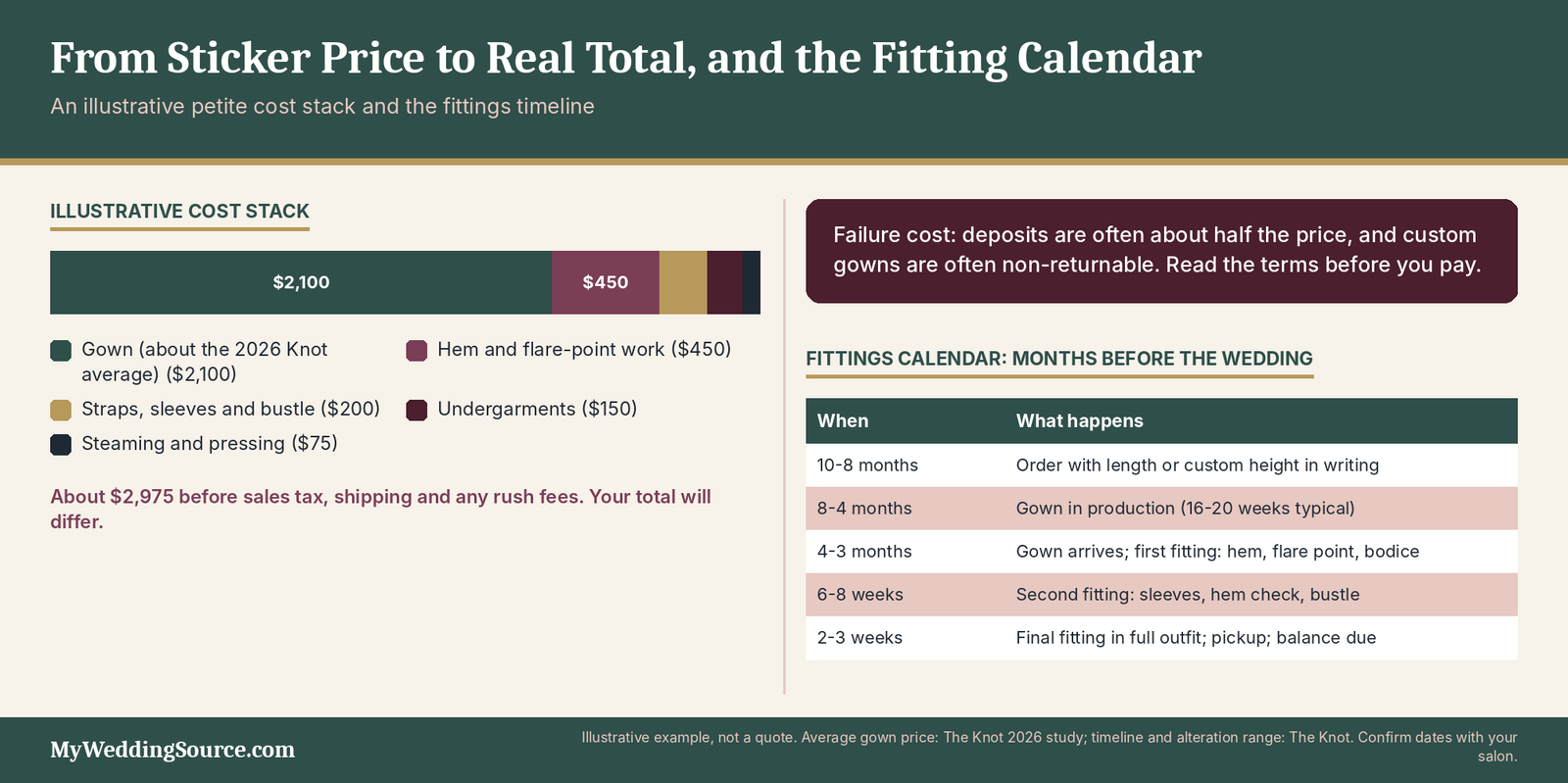
The Knot’s timeline guide puts alterations at about $200 for a basic hem to more than $1,000 for major adjustments, and The Knot’s average-cost page states that alterations are not included in the average gown price. Azazie says shorter brides typically spend more than average on hemming because structured gowns need larger, more complex adjustments, but it does not give a figure, so we treat it as direction rather than data. Cost depends on how many layers of skirt and lining the seamstress must hem, whether the border is lace or beaded, and how many other changes you add. For a deeper look at how fees stack, see our guide to wedding dress alterations and hidden costs.
When do the fittings happen?
The Knot’s timeline places the first fitting about 3 to 4 months before the wedding, once the gown arrives, a second fitting 6 to 8 weeks out and a final fitting 2 to 3 weeks out. Azazie’s petite-bride guide suggests a somewhat earlier schedule of 8 to 10 weeks, 4 to 6 weeks and 1 to 2 weeks, and recommends focusing the first visit on the hem, flare point and bodice drop. Book the seamstress as soon as you order, since The Knot notes they fill up fast and rush fees may apply if you wait. Bring your wedding shoes, undergarments and any veil or belt to every appointment.
What can a seamstress not fix?
Alterations have limits, and knowing them keeps expectations realistic. Shortening length is generally easier than adding it, and standard sizes cannot be lengthened, as Azazie’s help center notes. A bodice that is much too long, a pattern that depends on a precisely placed lace border or a gown that is far too large are harder rescues, and heavy changes can remove or distort design details. This is the best reason to give honest measurements at ordering and to choose a petite or custom length when a gown offers one.
| Alteration | Typical difficulty | Raise it at |
|---|---|---|
| Hem shortening | Low to moderate | First fitting |
| Flare point repositioning | Moderate | First fitting |
| Bodice drop or waist seam | Moderate | First fitting |
| Straps and sleeves | Low | First or second fitting |
| Bustle and train shortening | Low to moderate | Second fitting, practice at final |
Veils, Jewelry, and Accessories in Proportion
Accessories can change the apparent length of a gown as much as the hem does, and they are easy to get wrong because they are bought separately and often late. This section covers veil lengths in inches, how to scale jewelry and hairpieces, and how removable layers and undergarments fit into the plan. The same principle applies throughout: try each piece with the actual gown, shoes and hairstyle.
How long should a veil be?
What do the standard veil lengths measure?
Veil lengths are standardized only loosely, and The Knot notes they can vary by a few inches depending on the designer. Its guide lists a birdcage veil at about 9 inches, shoulder at 20, elbow at 25, fingertip at 42, waltz at 60, chapel at 90 and cathedral at 114 inches. Those figures describe the veil itself, measured from where it attaches at the head, so where it lands on your body depends on your height and where you place the comb. Use the table below as a map, then try the real veil on, since a 42-inch veil reaches different places on different people.
| Veil length | Approximate size (The Knot) | Where it tends to land |
|---|---|---|
| Birdcage | 9 inches | Around the chin or face |
| Shoulder | 20 inches | At the shoulders |
| Elbow | 25 inches | Near the elbows |
| Hip length | 36 inches | At the hips |
| Fingertip | 42 inches | Near the fingertips |
| Waltz | 60 inches | Between knee and ankle |
| Chapel | 90 inches | Floor, extending behind the gown |
| Cathedral | 114 inches | Well beyond the hem |
Which veil lengths suit a shorter frame?
The Knot’s veil guide does not give a height-based rule, but it notes that petite brides may find a fingertip veil too long and may prefer a hip-length veil of about 36 inches. Its general advice is that a veil should be at least as long as the dress train, so a gown with a sweep train and a cathedral veil would be a deliberate contrast rather than a match. Long, simple veils can add the vertical line some shoppers like, as Maggie Sottero suggests, while in our editorial judgment a very long veil can also overpower a smaller person or snag on a bustle. Try a few lengths with the gown on, in front of a full-length mirror, and take a photo of each.
How do jewelry, belts and other layers fit in?
How do you scale jewelry and hairpieces?
Maggie Sottero advises keeping jewelry and hairpieces proportional to the gown’s motifs so they neither overwhelm nor underwhelm the frame. In practice that often means one statement piece rather than several, and a hairpiece that echoes the gown’s detail without adding a lot of height or width. The Knot suggests matching veil style to the gown, such as simple sheer tulle with a heavily detailed dress. Wear your hairstyle, or at least the hairpiece, to the final fitting to see the whole picture.
What about belts, capes, overskirts and sleeves?
Many of these are separable pieces, which makes them low-risk to test. Maggie Sottero says detachable sleeves, overskirts, capes, gloves and belts should be included in your alterations, and notes that overskirts and capes add volume that can be removed later. Azazie warns that wide sashes and waistbands create a horizontal break that some find unflattering on a shorter torso, while a thin belt can define the waist without much bulk. If you want a ceremony layer and a simpler reception look, an overskirt is one way to get two gowns from one purchase.
Which undergarments protect the line of the gown?
Azazie recommends choosing undergarments to suit the neckline, such as a strapless bustier for sweetheart or scoop necks, high-waist smoothing shorts for fitted shapes and adhesive cups for low backs. It also suggests no petticoat or a minimal one, because extra underskirt volume can overpower a shorter frame. Built-in cups or boning are, in its view, preferable where proportion matters most. Whatever you choose, buy it before the first fitting, as The Knot advises, and wear the same pieces to each appointment so the seamstress is fitting your actual silhouette.
Where to Shop for Petite Gowns and What They Cost
Petite gowns are sold in several kinds of places, and the right route depends on your timeline, budget and how much of the fit work you want a professional to handle. This section compares the main routes, then looks at what the numbers say about price, including what we can and cannot say about whether petite costs more.
What are your main shopping routes?
How do bridal salons and designer lines handle petite sizing?
A bridal salon carries samples from a handful of designers, and you order your size from the designer, so the question to ask is whether that designer makes a petite or made-to-measure option. The Knot names Olivia Bottega, Justin Alexander and Morilee among designers offering petite-focused or made-to-measure options, and describes made-to-measure as increasingly common. Try on samples in person, because The Knot warns that online models have different proportions from your own, then ask the consultant to describe the length the designer will make. Call ahead so the salon can pull petite or shorter-length samples and confirm which of them it can order in your height.
What do chains and online brands offer?
Chain and online sellers tend to publish their sizing rules, which makes comparison easier. David’s Bridal says its petite gowns run from 0P to 14P for people 5’4” and under, and Azazie offers sizes 0 to 30 plus custom sizing, where extra length or a specific height can be specified. Azazie’s help center says to order custom sizes about four months before your event and not to alter your height or hollow-to-floor measurements. Online shopping saves time but gives you fewer chances to try before you buy, so confirm return and exchange rules, and who pays for shipping, before you pay.
Are off-the-rack, sample, resale and non-bridal options worth a look?
Yes, and they matter for short timelines. The Knot reports that 55 percent of respondents bought off the rack, and an in-stock gown skips the 16-to-20-week wait. Sample sales and resale can offer lower prices, but samples are often a single size and may be hemmed or worn, so ask whether the hem has already been altered and by how much. Non-bridal options such as petite evening dresses, white cocktail dresses or separates can also work, and The Knot’s petite guide includes some from fashion retailers with petite size ranges.
What does a petite gown cost?
Is the average gown price a useful benchmark?
It is a ballpark, not a quote. The Knot’s 2026 Real Weddings Study surveyed 10,474 U.S. couples married in 2025 and found an average gown cost of about $2,100, with lower-budget couples at roughly $1,200, middle-tier couples at about $2,000 and higher-budget couples at about $3,200. Regional averages ranged from about $2,000 for hometown weddings to about $2,900 for international destination weddings. The study notes that alterations are not included, and none of these figures separate petite from standard gowns.
What do individual petite gowns cost?
The Knot’s petite guide, updated in October 2024, listed specific gowns and prices that give a feel for the range, though prices change and you should check current ones. That article’s prices ran from $359 for a Cocomelody A-line to $1,895 for a Watters gown at Anthropologie, with Azazie and David’s Bridal options in the $369 to $749 range and a $1,290 Olivia Bottega listing. These are list prices for specific styles, not averages, and they exclude alterations.
| Gown (The Knot, Oct. 2024) | Size range listed | List price |
|---|---|---|
| Cocomelody, A-Line Lace Tulle | 0 to 18, custom available | $359 |
| Azazie, Xena | 0 to 30, custom available | $439 |
| David’s Bridal, DB Studio Long Sleeve V-Neck | 0P to 30W | $450 |
| David’s Bridal, Off Shoulder Satin | 0P to 30W | $699 |
| Olivia Bottega, Heist | 0 to 30, custom available | $1,290 |
| Watters Tilly (Anthropologie) | 0 to 16 | $1,895 |
Does petite cost more, and what does a realistic total look like?
We could not find reliable data showing that petite gowns cost more or less than standard ones, so we will not claim either. What can be said is that a petite cut may reduce hem work, while custom length or heavy alterations may add to the bill. Here is an illustrative scenario, not a quote: a $2,100 gown, $450 for hem and flare-point work, $200 for strap and sleeve shortening plus a bustle, $150 for undergarments and $75 for steaming and pressing adds up to about $2,975 before sales tax, shipping or rush fees. A simple gown needing only a hem could land well below that, and a lace gown with a long train could land above it. Our wedding dress cost guide goes deeper on price types.
Timeline, Appointments, and Order Terms
Timing is where petite shoppers can gain the most, because a longer runway allows for made-to-order length, a proper hem and a relaxed fitting schedule. This section sets out the calendar, then shows how to run an appointment as a shorter shopper and what to get in writing before you pay.
When should you start, and what if time is short?
What does the calendar look like?
The Knot recommends starting 9 months to a year before the wedding and buying 8 to 10 months out, with making a dress taking four to six months on average. It reports a made-to-order lead time of 16 to 20 weeks from order to arrival, so a gown ordered 8 months out arrives with time to spare for fittings. The same guide says couples surveyed started about 10 months out and typically bought around 7.5 months before the wedding. Add your hair and makeup trial, shoes and veil to the calendar so they are decided before the first fitting.
| When (before the wedding) | What happens | Petite-specific note |
|---|---|---|
| 12 to 9 months | Browse, measure, call salons | Take hollow-to-floor and torso measurements |
| 10 to 8 months | Appointments, purchase, written terms | Record length or custom height on the order |
| 8 to 4 months | Gown in production | Choose shoes and veil length |
| 4 to 3 months | Gown arrives; first fitting | Wear final shoes; set hem, flare point, bodice |
| 6 to 8 weeks | Second fitting | Check hem, sleeves, practice bustle |
| 2 to 3 weeks | Final fitting and pickup | Full rehearsal; balance due |
What are your options if the wedding is closer than that?
Fewer than 16 weeks does not rule out a gown, but it narrows the routes. In-stock and off-the-rack gowns skip production, short and tea-length styles skip most hem work, and sample sales can deliver a gown immediately. Ask any made-to-order seller about rush production and any fee in writing, because The Knot says rush fees may apply but gives no amount. Book the seamstress at the same time you buy, since a tight schedule leaves less room for a second fitting.
How do you run an appointment as a shorter shopper?
What should you say when you book?
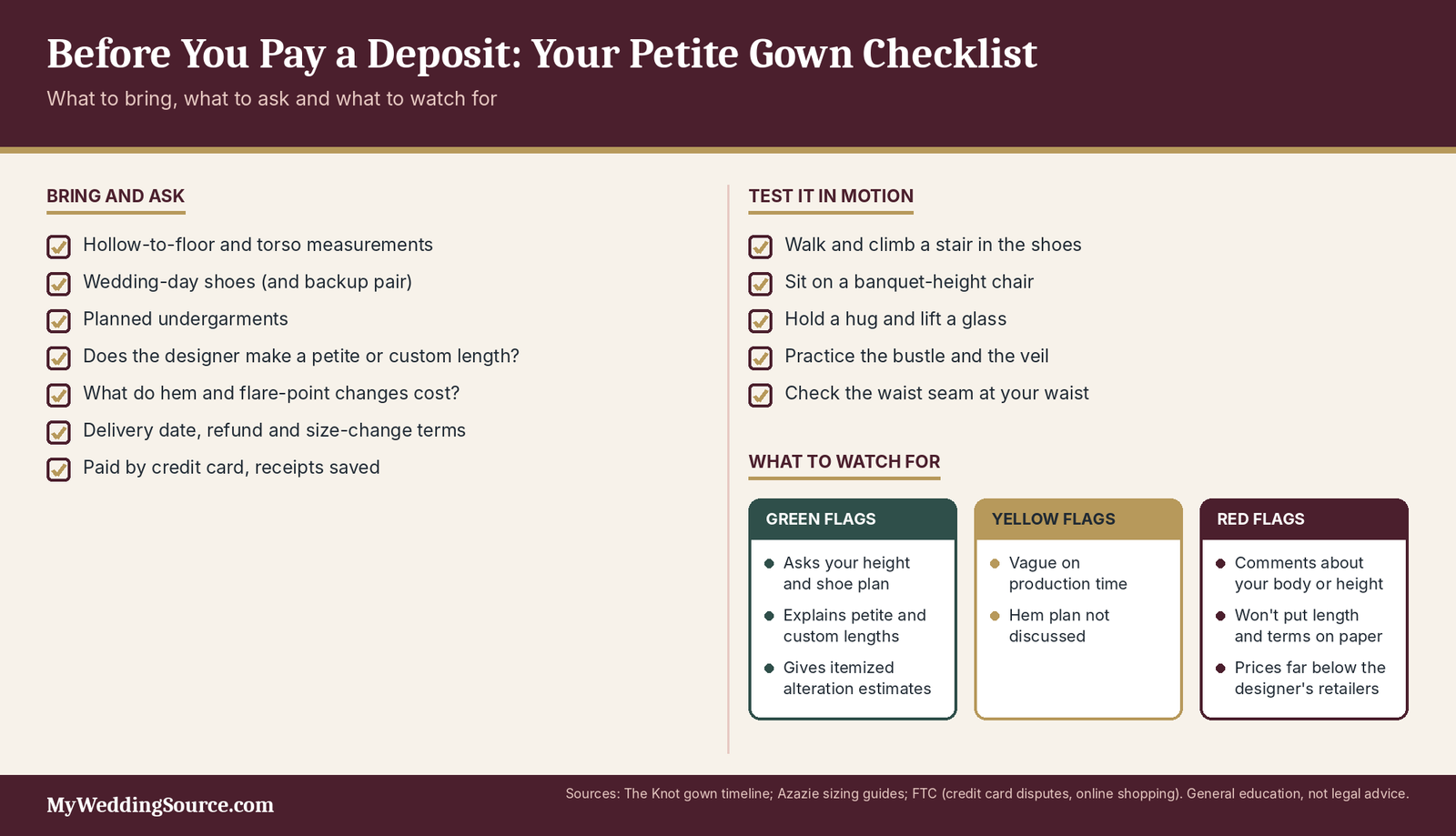
State your height and shoe plan when you book: “I’m about 5’2”, I plan to wear 2-inch block heels, and I’d like to try petite or shorter-length samples if you have them.” That one sentence lets the salon pull relevant gowns, tell you honestly which designers offer petite or made-to-measure lengths, and schedule enough time. Ask whether samples are hemmed or pinned for shorter people, and bring your measurements and your shoes. The Knot’s data show most respondents visited two stores and tried on seven dresses, so plan for a few appointments rather than one.
How do you judge a gown that doesn’t fit the sample?
Salon samples are usually made in a standard length, so expect to see a gown clipped, pinned or held up, and ask the consultant to show you what it will look like hemmed. Look at model photos with care, since The Knot notes online models have different proportions from yours; check the listed model height if the retailer provides it. Stand on a box or wear heels in the appointment to see the intended hem. If the sample’s waist seam is far off your waist, ask whether the designer can adjust it or whether that is a hard fit problem.
What belongs on the order form?
Which details should be in writing?
Record the designer, style number, size, color, price, deposit and balance due date. For a petite order, also write down the length or custom height you gave, whether a petite or custom length applies, and the promised delivery window. Ask what happens if the style is discontinued, whether size or length changes are allowed and what the refund and cancellation terms are. Deposits are often about half the price according to The Knot, and custom gowns are commonly non-returnable, so these terms matter before you pay.
How do you pay safely?
Pay by credit card when you can. The FTC says paying by credit card gives the strongest protection if something goes wrong and that you may dispute a charge for an item that was not delivered as agreed, with a written dispute that must reach the issuer within 60 days of the first bill showing the error. The FTC also warns against paying online sellers with gift cards, wire transfers, payment apps or cryptocurrency, and says unusually low prices on brand-name items are a warning sign of counterfeit sellers. Keep the order confirmation, the return policy and every email in a folder. This is general education, not legal advice, and rules vary by state.
Matching Your Gown to the Dress Code, the Season, and Your Wedding Party
The dress code you set for your wedding, the season and the ground under your feet all shape which length makes sense, and a shorter frame makes those choices more noticeable. The published dress-code definitions are written for guests, but they are a useful shared vocabulary for couples, too. This section turns them into decisions about your own hem, fabric and shoes, and then looks at your wedding party and guests.
How does the dress code change the length you choose?
What do black-tie and formal weddings call for?
The Knot’s dress code guide, updated in July 2026, describes black tie as strict, with floor-length gowns whose hems graze the ground or the top of the shoes. Black-tie optional is described as floor-length evening gowns or elevated midi dresses, and formal as slightly less strict, with floor-length a safe bet while elegant cocktail dresses and jumpsuits are also appropriate. For a petite shopper, a floor-length hem means the full alteration work covered earlier, so schedule it. A formal event also suits a shorter, structured sheath or a midi in rich fabric if you prefer less hem, but check how your venue, family and photographer expect the look to read.
How do semi-formal, casual and beach weddings differ?
The same guide calls semi-formal the most popular wedding dress code, with midi dresses, wrap dresses or jumpsuits all appropriate. Casual weddings are described as relaxed but still elevated, with something like a long sundress with a nice neckline, and beach or resort weddings call for maxi or midi dresses and breezy fabrics, not formal gowns. These are the settings where tea length and midi shine for petite shoppers, because the hem work is minimal and the gown moves easily on sand, grass or a dance floor. If your ceremony is a courthouse visit, a short white dress or suit may be the easiest and most comfortable answer.
How does your partner’s attire fit in?
Proportion works both ways, and a partner in a tailored suit or tuxedo will have their own fit questions. Our guide to groom’s wedding attire covers sizing and tailoring for that route, including the details a tailor needs to see. If you and your partner differ a lot in height, think about shoes, veil height and how the two of you will look in photographs standing side by side, and bring this up at the planning stage. Matching formality matters more than matching colors, so coordinate length and fabric weight with the dress code you set.
How do the season and venue change the choice?
What changes for fall and cooler weddings?
The Knot’s fall attire guide, updated September 2026, recommends denser fabrics such as velvet, brocade and heavy satin for outdoor autumn events because they resist wind better than chiffon, and layers such as a tailored blazer, pashmina or coat, especially as evenings turn crisp in October and November. Closed-toe shoes and block heels or wedges are suggested over thin stilettos, which sink into soft ground. For a petite bride, that means thinking about the hem before the shoes: a wool wrap or cape should be fitted over the gown, and a boot will change the hem measurement. The Knot notes that frequent autumn rain often leaves the ground damp, so check the forecast for your date and plan the hem and shoes for soft, slippery turf.
What if the wedding is hot or outdoors?
Lighter fabrics and shorter hems can help in heat, but the CDC lists muscle cramps, unusually heavy sweating, dizziness, headaches, weakness and nausea as signs of heat illness, so plan shade, water and breaks regardless of the gown. The CDC also offers a HeatRisk dashboard that forecasts heat risk by ZIP code, which is worth checking in the week before the wedding. A shorter hem or a bustle also keeps the skirt out of damp grass and off stairs. If you are dressing for an outdoor ceremony, practice the walk on a similar surface in your shoes.
What should petite bridesmaids, parents and guests wear?
The same fit questions apply to your wedding party and guests, so tell them the dress code early and be flexible about length. Azazie publishes a separate guide on bridesmaid styles for petite bridesmaids, and it is worth asking any bridesmaid retailer whether it offers petite sizes or custom lengths. For guests, The Knot’s dress code guide gives expected lengths by code, and its definitions for cocktail, semi-formal and casual are a good place to start when you are choosing what to wear to a wedding as a guest. If a bridesmaid or relative is shorter than the rest, a midi or knee-length dress can look more intentional than a hem pinned up at the last minute.
Frequently Asked Questions About Petite Wedding Dresses
These are the questions readers most often have when they start shopping, answered briefly with pointers to the sections above. Details change by seller, so confirm anything that affects your money on the order form.
Fit and shopping questions
Do I need to buy a petite wedding dress if I am 5’4” or under?
Not necessarily. Petite sizing is helpful if your torso is short or if the style you love is offered in a petite cut, but a standard-size gown with good alterations is a common and reasonable route. The main question is how much length and bodice change the gown needs, so give the seller your hollow-to-floor and torso measurements and ask what they would adjust. A useful test is whether the gown you love is offered in a petite cut at all, and if not, whether a seamstress who handles bridal hems is already lined up. If the hem is the only issue, a standard gown can work well.
How much should I budget for hemming a wedding dress?
The Knot puts alterations at about $200 for a basic hem to more than $1,000 for major work, and a petite hem on a layered or lace gown may sit higher in that range. Azazie says shorter brides typically spend more on hemming than average, but it gives no figure. Ask for an itemized quote at the first fitting, and keep a separate line in your budget for the bustle, straps and sleeves.
Can I wear a ball gown or a long train if I am petite?
Yes. The advice to be careful is about proportion and handling, not about what you are allowed to wear. Try a lighter tulle, fewer layers and a higher waist seam, and consider a sweep or chapel train with a bustle, since Azazie notes cathedral trains need constant management. Test the gown in motion before you decide, including sitting, climbing a stair and turning in the shoes you will wear. If a full skirt feels like too much, an A-line with a modest sweep can give you the same romance with less to manage.
Timing and day-of questions
How early should I order, and what if I am short on time?
The Knot recommends buying 8 to 10 months before the wedding, with a made-to-order lead time of 16 to 20 weeks. If your date is closer, look at in-stock gowns, sample sales, and tea-length or midi styles that need little hemming, and book the seamstress the day you order. Ask any seller about rush fees in writing, and confirm the exact delivery date before you pay a deposit.
What shoes should I wear to the fittings?
Wear the pair you plan to wear for most of the day, or bring both if you plan to change. The hem depends on the shoe, so a gown set for heels will drag in flats. Azazie suggests 2 to 3 inch heels as practical for a full wedding day, and block heels for grass, and the exact choice should be what you can stand in comfortably.
Your Next Steps
Shopping is easier when the first few actions are small and specific. The two lists below separate what to do this week from what to settle before you leave a deposit, and each can be done in an afternoon.
This week
Measure and write down your numbers
Take hollow-to-floor, torso length, waist-to-floor, sleeve length, bust, waist and hips, and note whether you wore shoes. Write the date and the shoe height beside each. Save five to ten gowns you like and note their silhouette, length and train, so you can compare them with your numbers. If you wear shoes with a heel, put the height at the top of the page.
Call three places with the same questions
Ask each salon or seller whether the designers they carry make petite or made-to-measure lengths, what the lead time is, what the deposit is and how the hem is handled. Ask whether any samples are petite or hemmed, and what alterations cost. Write down the answers side by side so you compare the same things. Our wedding planning hub can help you fit this into a larger timeline.
Before you pay a deposit
Get the length and terms in writing
Make sure the order lists the designer, style, size, color, any petite or custom length, the price, deposit and balance, and the delivery window. Ask for the refund, size-change, cancellation and discontinued-style terms, and keep a copy. Pay by credit card and keep the receipt.
Book your seamstress and fitting dates
Reserve a seamstress who works on bridal hems and ask about the fitting schedule, rush fees and how many fittings the quote includes. Put the first fitting about 3 to 4 months out on the calendar, and bring your wedding shoes and undergarments to each visit. Ask for an itemized estimate before the first fitting.
Sources & methodology
- The Knot, The Best Petite Wedding Dresses, According to a 5-Foot Tall Fashion Editor (updated Oct. 11, 2024) — petite definition, silhouettes, necklines, trains, shoes, brands and 2024 list prices
- The Knot, Average Cost of a Wedding Dress (2026 Real Weddings Study, updated Feb. 18, 2026) — average cost, budget tiers, regional averages and what the average excludes
- The Knot, When to Buy Your Wedding Dress (updated Jan. 9, 2025) — shopping timeline, production time, deposits, fittings, alteration range and shopping statistics
- The Knot, Wedding Veil Styles and Lengths (updated June 17, 2025) — veil lengths in inches and matching advice
- The Knot, Wedding Dress Codes (updated July 8, 2026) — dress code definitions and expected lengths (written for guests)
- The Knot, What to Wear to a Fall Wedding (updated Sept. 16, 2026) — fall fabrics, layers, shoes and ground conditions
- David’s Bridal, What Is Petite Sizing? — 5’4” and under cutoff and 0P to 14P size range
- Maggie Sottero, A Petite Bride’s Guide to Finding The One — petite proportions, silhouettes, hem, sleeves, trains and accessories
- Azazie, Style Tips for Petite Brides — height bands, measurements, shoes, alteration planning and fitting schedule
- Azazie, Tips for Choosing Wedding Dresses for Short Women — silhouettes, hem lengths, fabrics, common fit problems and train length
- Azazie Help Center, What Is Hollow to Hem? — hollow-to-hem definition and the 60-inch example
- Azazie Help Center, How to Measure for Your Custom Size Dress — custom-size measuring rules and ordering lead time
- Essense of Australia, Wedding Dress Sizing Guide — fittings with shoes, full ball gowns and petite brides
- CDC NCHS, Mean Body Weight, Height, Waist Circumference, and BMI Among Adults (NHSR No. 122) — average adult women’s height, 2015 to 2016
- CDC, About Heat and Health — heat illness symptoms and the HeatRisk dashboard
- FTC, Using Credit Cards and Disputing Charges — billing-error disputes and the 60-day window
- FTC, Online Shopping — safe payment methods, fake sellers and record keeping
Methodology: Height definitions, prices, timelines and veil lengths are retailer or editorial statements from the sources above, with the date noted where it matters; the average gown cost and sample size are survey findings from The Knot, and the average height is a federal survey result. Most silhouette, neckline, shoe and hem guidance comes from bridal retailers and editors who sell or review gowns, so we treat it as informed editorial opinion and point out where sources disagree. The cost example is an illustrative scenario, not a quote, and the petite-specific notes in our timeline table are editorial judgment. This article offers general education only; contracts, cancellation rights and consumer protections vary by state.
Freshness note: Brand size ranges, retailer policies and list prices change by season, and the 2024 prices from The Knot’s petite guide are the most likely to be out of date. Recheck the petite cutoff, size ranges and custom-length options on each seller’s own site before you shop, and revisit the cost figures each fall when The Knot and Zola publish new data.