
A wedding first dance goes smoothly when you treat it as a 90-second production with a song, a cue, a spot on the floor and a plan B, rather than a talent show you have to wing.
You picked the song months ago. It lives on your first-date playlist, it makes your partner tear up in the car, and neither of you has any idea what to do with your arms while it plays. Then the DJ sends one email with three questions: which version of the song, how long should it run, and who is pressing play. Suddenly a decision that took thirty seconds has a runtime, a file format, a place on the reception timeline and, possibly, a dance lesson invoice attached to it.
This guide walks through the whole path from “we think we want one” to “we know exactly what happens at 6:55 p.m.” It covers how to choose a song and cut it down, what lessons and choreography actually cost, how to brief a DJ or band, where the dance fits in the evening and on the floor, what to do about nerves and different bodies, and the alternatives when a spotlight dance is not for you. It also explains the music licensing basics that come up with live bands and wedding videos, because that is the part couples most often learn about from a surprised vendor. Nothing here assumes a traditional couple, a formal ballroom or a budget with room for a choreographer.
One honest limit before we start. Prices below come from national surveys and published price pages, which describe a range, not a quote from any studio or band in your city. The licensing section is general education, not legal advice, and the rules and venue policies that apply to your event can differ, so ask your venue and vendors and get the answers in writing.
What is a first dance for, and do you actually need one?
A first dance is the one moment of the reception that has an audience, a camera pointed at it and no script unless you write one. Because it feels obligatory, many couples plan it before asking what job it needs to do for their evening. This section covers what the dance does on the schedule, how long it should run, and when skipping it is a sensible choice.
What job does the first dance do at a reception?
How does the first dance work as a transition?
The first dance usually marks the point when the evening shifts from “sit and watch” to “get up and move.” In The Knot’s sample reception timeline, the couple’s grand entrance is followed by the first dance about ten minutes later, and then guests sit for dinner. That placement gives guests a clear signal that the party has started, and it gives photographers a predictable window while the light and the room are at their best. If your reception is a casual barbecue with no grand entrance, the same job can be done by a short toast and a song, so the dance is optional rather than structural. The takeaway is to decide what you want the moment to signal before you decide what song to play.
What is the first dance for your photographer and videographer?
For your photo and video team, the first dance is a short, well-lit, emotionally readable scene that is easy to frame, which makes it one of the more reliable parts of the reception. They need to know when it starts, which side of the room you will face, and whether a second song or a guest invitation follows. If you plan a dip or a twirl, tell them in advance so a second shooter can be in position to catch it. Averages from The Knot’s 2026 Real Weddings Study put the typical photographer at $3,000 and videographer at $2,300 for couples who hired them, so the time you give them to prepare is already paid for. Sending a one-line cue sheet a week ahead costs nothing and prevents the photographer from guessing.
Does the first dance set the tone for the dance floor?
Often it does, in a small way, because guests take cues from how comfortable the couple looks and what the first song sounds like. A romantic ballad followed immediately by an up-tempo song tells guests the floor is open and nobody needs to wait for permission. A slow song that ends in a long silence while the DJ looks for the next track does the opposite, and guests go back to their drinks. That is why many DJs ask what you want played immediately after the dance, and why it is worth naming one crowd-friendly song. The practical step is to choose the second song as deliberately as the first.
How long should a first dance be, and can you skip it?
How long should your first dance run?
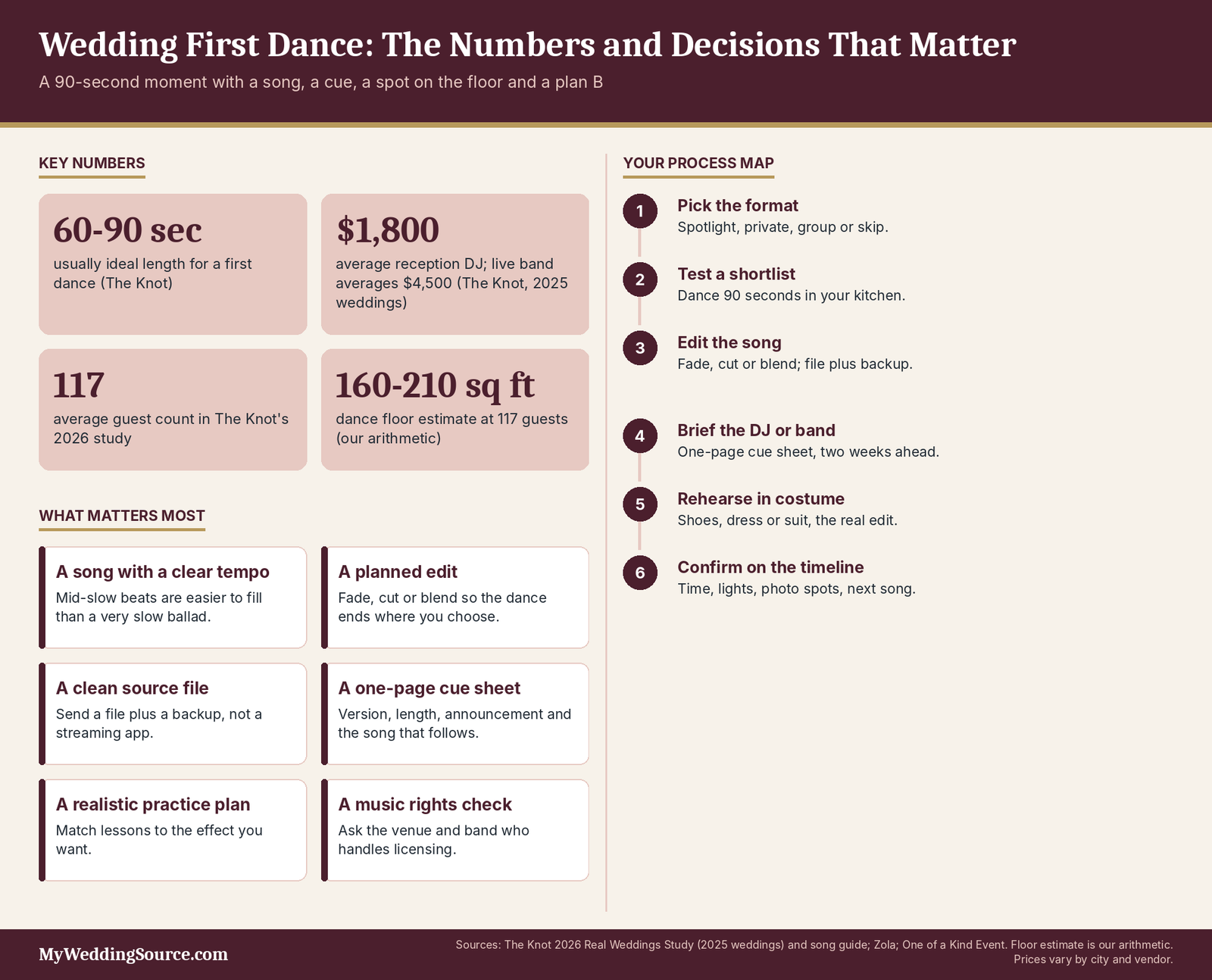
The Knot’s first dance song guide says there is no strict rule but recommends a short song, with 60 to 90 seconds usually ideal, which often means using only a portion of the track. Many popular songs run three to five minutes, which is a long time to sway under attention if you are not a confident dancer. A shorter dance also protects your timeline, since the opening of the reception is often squeezed by dinner service. On the other hand, a couple who loves dancing might happily take a full three minutes, so treat the 90 seconds as a default rather than a rule. The decision point is how long the two of you can look relaxed, not how long the song is.
When is skipping the first dance a good decision?
Skipping makes sense when the dance would cause real discomfort, when your venue’s time window is tight, or when the day’s energy is better served by getting everyone onto the floor at once. It also makes sense when a medical or mobility issue makes standing dances hard for one of you, though adapted options exist and are covered later. Guests tend to care more about food, music they can dance to and hearing the toasts. If you skip, tell your DJ and photographer, because both may have built cues around the moment. A short announcement such as “Please join us on the floor” turns the skipped dance into an invitation instead of a gap.
How do you choose a first dance song that works on the floor?
Choosing the song is the part everyone enjoys until two people with different playlists have to agree. A song that moves you in headphones can behave very differently in a ballroom with a sound system, a room full of relatives and a DJ who has to start it cleanly. This section covers how tempo and structure affect the dance, what couples are choosing right now, how to settle a disagreement, and when a custom or live version is worth the effort.
What makes a song easy to dance to in front of people?
Does tempo matter more than meaning?
Tempo matters more than most couples expect, because a very slow song forces long, hard-to-fill beats, while a very fast one turns a slow dance into a sprint. A mid-slow tempo gives you room to sway, step, turn and talk, and it lets you add a small move without rushing. If the song you love is a slow ballad, you can still use it, but you may want to start at a moment where the rhythm is clear and end at a natural pause. Try a test: play the song in your kitchen and see whether you can fill 90 seconds without feeling stuck. The consequence of ignoring tempo is a dance that feels much longer than it is, so a quick kitchen test now saves a lot of awkward swaying later.
Should you read the lyrics before you commit?
Yes, read them, because a song that sounds romantic can say something odd once your grandmother is listening. Classic examples include songs about breakups, obsession or things that go badly wrong in verse three, and wedding forums are full of stories from couples who noticed this only when the chorus started. A quick pass through the lyrics for profanity, awkward references or a surprise sad ending takes five minutes. If the chorus is lovely but the second verse is a problem, an edited version can often skip it, which connects to the editing section below. The bottom line is that you do not need flawless lyrics, only ones that you are comfortable hearing in front of everyone you love.
What are couples actually choosing?
The Knot’s top 10 list of first dance songs is based on its Real Weddings Study of nearly 17,000 couples who married in 2024, published in April 2025. It ranked “Can’t Help Falling in Love” by Elvis Presley first, followed by “Joy of My Life” by Chris Stapleton, “Life With You” by Kelsey Hart, “At Last” by Etta James and “Lover” by Taylor Swift. The list gives the ranking only, with no play counts, so it shows what was popular among that group of couples and not how many chose each song. It is a useful reminder that a mix of country, classic and recent pop dominates the list. Use it to spot patterns or to rule out a song you suspect half your guests have heard at a recent wedding, but not as a recipe.
How do you settle a disagreement or go beyond a streaming track?
What if you and your partner want different songs?
Start by each making a shortlist of three, then listen to all six together with no commentary and mark the ones you could each live with. If one song is a clear emotional anchor for one partner, it often wins the dance, and the other partner’s pick can become the second song or the first song of the open dancing. Another approach is to pick a song neither of you has attached to a past relationship or memory, which avoids ownership battles. The decision should end with both of you agreeing to the same file, so there is no argument at the soundboard.
Is a custom or live version worth the trouble?
A custom version, such as a cover by a friend, a string arrangement or an original song, can make the dance feel specific to you, but it adds planning steps. You need a recording or a live performer, a sound check, a plan for the cue and a backup if the performer is late or the room acoustics are poor. Live performance of a well-known song also raises the licensing questions covered near the end of this guide, which are usually handled by the venue or the band but are worth asking about. If you want the effect without the risk, you can use a recorded cover from a performer you trust and keep the original as a fallback. Choose live only if someone owns the logistics, because a song that starts late on the day tends to be remembered for the wrong reasons.
How do you edit the song and make sure it plays correctly?
Editing and playback are the unglamorous halves of the first dance, and they are where most avoidable surprises live. A song that is the wrong length, the wrong version or loaded from an app that decides to show an ad will undo careful planning in about four seconds. This section covers how to shorten a track, who does the work, what file to hand over and why a streaming app is a risky source on the day.
How do you shorten a four-minute song to 90 seconds?
Should you fade out, loop or edit the song?
You have three realistic options: fade the song out at a chosen point, make a clean edit that joins two sections, or let the DJ blend the first dance into the next song. A fade is the simplest and works for most pop songs, but it can feel abrupt if you stop in the middle of a phrase. An edit that cuts from the first chorus to the final chorus and ending sounds more intentional, and it gives you a natural finish for a dip or a kiss. A blend works well when you want the floor to open straight away, because the DJ can bring in the next track at the end of a phrase while guests are still applauding. Whichever option you pick, listen to the finished version out loud so you know exactly where the last note falls.
Who should do the edit?
Many DJs will make a short edit for a first dance as part of their service, and some will do it for an extra fee, so ask early what is included. You can also do it yourself with free audio software such as Audacity, which lets you mark a section, cut it and add a fade with a short learning curve. A friend who produces music can help, and a band can often play a shorter arrangement if you tell them the target length at rehearsal. Avoid last-minute edits, because a rushed one tends to leave a click at the join or a chop in the middle of a word. A reasonable timeline is to finalize the edit at least two weeks before the wedding and send it to your DJ or band with the cue sheet.
What file should you send, and how many copies?
Send the highest-quality file you legitimately own, ideally a lossless or high-bitrate audio file rather than a recording of a screen. Name it clearly, such as “First Dance – Final Edit – 1:25”, so no one grabs an older version in a hurry. Send it to your DJ or band, keep a copy on a USB stick in your day-of bag, and give a third copy to your coordinator or a trusted friend. If the venue uses its own sound system, the DJ or the venue’s audio tech is usually the person who handles the file. The goal is that a laptop crash, a forgotten cable or a dead phone cannot take your song with it.
Why is a streaming app a risky source on the day?
What do the terms of service say about public use?
Streaming services grant listeners permission for personal use, not for running a venue. Spotify’s user agreement, last updated September 4, 2026 at the time of our check, grants “permission to make personal, non-commercial use of the Spotify Service and the Content,” and prohibits using the service in any way not expressly permitted. The agreement does not address wedding receptions specifically, so this is not a statement that playing a playlist at your party breaks any law. It is, however, a sign that streaming accounts are built for listening, not for performance, which is one reason many DJs work from their own purchased or downloaded files instead. If a vendor insists on streaming from a personal account, ask what happens if the connection drops.
What can go wrong technically?
The practical risks are more likely than the legal ones. A streaming app may crossfade into the next song, play an advertisement if you are on a free tier, pause for a notification or lose Bluetooth with the sound system. Offline mode helps, but it still depends on the app staying logged in and on nobody bumping the phone. A local file on a laptop, a USB stick or the DJ’s controller avoids all of these problems. If you are using a venue’s house sound system with no DJ, bring a wired connection, a charged device with notifications off, and a second device with the same file.
What do dance lessons, choreography and rehearsal really cost?
The first dance is one of the few wedding line items where the price range runs from nothing to several thousand dollars depending on how much you want to learn. Published prices are patchy, so this section shows the numbers that exist, labels the arithmetic that is ours and sketches three illustrative scenarios. Nothing here is a quote from a studio, and prices vary widely by city and teacher.
What do lessons cost, and how many do you need?
What do published lesson prices look like?
Zola’s guide to wedding dance lessons puts professional lessons at roughly $50 to $100 or more per hour, with higher rates in New York. Thumbtack’s wedding dance lesson cost page says costs can range from $100 for a single lesson to $2,500 for a dozen weekly classes, and it lists one San Jose studio’s per-couple packages, including three 45-minute lessons for $259 and seven one-hour lessons for $595. These are two different sources with different samples, and Thumbtack does not state the year of its figures, so treat them as a rough band. Group classes are usually cheaper than private lessons, since the cost is shared. A studio package may drop the hourly rate, but only if you will really use all the sessions.
How many lessons do different goals need?
Zola’s guide offers a helpful ladder: about one to three lessons for basic steps and comfort, two to five for a few moves such as turns or dips, three to eight to add an entrance and an ending pose, and ten to twenty for a fully choreographed number. Those counts are a teacher-informed rule of thumb, not a measured result, and a quick learner or a couple who has danced before may need fewer. Choose the rung that matches the effect you want, not the one that sounds most impressive. If you are unsure, book an introductory lesson first, because a teacher can tell you in one session whether your song and your goals fit together. Teachers also often advise starting at least three months before the wedding, since last-minute bookings tend to cost more and leave less time for practice.
Which option fits your goal and your budget?
What do three illustrative scenarios cost?
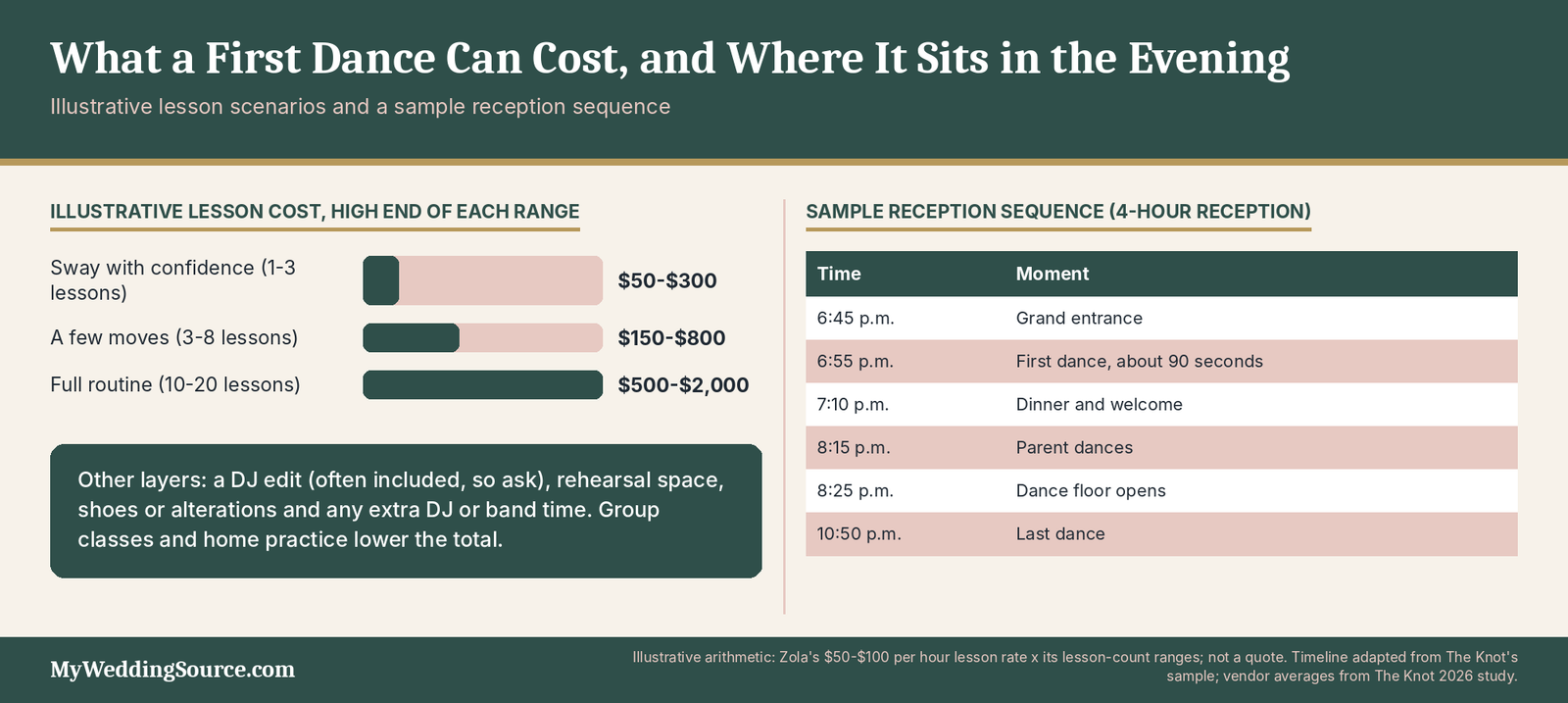
The table below applies Zola’s $50 to $100 per hour range to the lesson counts above. These are our own multiplication, labeled illustrative, and not a studio price list. If you live in a high-cost city, use the higher rate, and if you buy a package, expect the total to shift.
| Scenario | Lessons | Illustrative cost | What you get |
|---|---|---|---|
| Sway with confidence | 1 to 3 | $50 to $300 | Basic steps, posture, a simple turn |
| A few moves | 3 to 8 | $150 to $800 | Turns, a dip, an entrance or ending pose |
| Full routine | 10 to 20 | $500 to $2,000 | Choreography to the full edit |
How do you lower the cost without lowering the quality?
Zola suggests practicing at home for 20 to 30 minutes a couple of times a week, filming your sessions to see what needs work and choosing a simpler routine if your goal is comfort. You can take a group class with family members who are also dancing, which splits the cost and reduces the pressure. Another option is an introductory lesson to find a teacher you click with before buying a package. Some couples ask guests to contribute toward lessons instead of buying a registry gift, which is a gracious way to turn a gift into something you will actually use. The thing to avoid is buying twelve lessons because the package price per hour looks better, then finding out in lesson three that you only needed four.
What other costs sit around the dance?
What are the small extras couples forget?
The extras are rarely large, but they are the ones that surprise people. They include a DJ edit fee, a rental of studio space for a dress rehearsal, alterations if the dress or suit needs to move differently, and shoes with a surface that works on the floor you will be dancing on. The table below pulls the layers together so you can see which line items you actually need.
| Cost layer | Typical range | What it depends on |
|---|---|---|
| Lessons | $0 to $2,500 | Number of lessons, city, group vs. private |
| Song edit | Often included, or ask | DJ policy, whether you edit yourself |
| Rehearsal space | $0 and up | Home, studio rental, venue walkthrough |
| Shoes or alterations | Varies | Dress or suit fit, floor surface |
| Extra DJ or band time | Ask | Contract hours, overtime rate |
What does it cost if you skip lessons entirely?
Skipping lessons costs nothing in cash, and a simple sway with a rehearsed ending is enough for many couples. The risk is not a failed dance but figuring it out under observation, so a few evenings of kitchen practice are worth it even if you never meet a teacher. Use your edit as the structure: decide on the opening position, the middle moment and the ending, and practice those three beats while a phone films from the side. Spending money is optional, but practicing is not.
How do you coordinate the first dance with your DJ or band?
The DJ or band is the person who presses the button, introduces you and makes the next song happen, so the first dance depends more on this relationship than on your footwork. A clear brief gives them what they need, and a vague brief produces an awkward silence. This section covers what to put on the brief, what changes when a live band is involved and who is responsible for each task.
What should your DJ or band know before the wedding?
What belongs on a one-page first dance brief?
Put the song title, artist, the exact version or file, the start and end points, the length, the cue to begin and the announcement wording on a single page. Add what plays right after, whether you want a second dancer group to join at a certain moment and any lighting request such as dimmed overheads or a spotlight. Include the pronunciation of your names, because the announcement is the moment your DJ is most likely to stumble over them. Send it at least two weeks before the wedding and confirm that the DJ has acknowledged it, then bring a printed copy to the wedding. A good brief is one that a stranger could follow if your regular DJ were out sick.
What does the vendor cost, and what is included?
The Knot’s 2026 Real Weddings Study, which surveyed 10,474 U.S. couples married in 2025, reports an average reception DJ at $1,800 and a live band at $4,500. The study does not say how it computed the averages, and the figures presumably reflect only couples who hired each type of vendor, so your quote could be well above or below. What matters is what the package includes: the number of hours, setup and sound check, wireless microphones, an emcee for announcements, basic uplighting and any song edits. If the contract does not mention a first dance edit or an announcement, ask whether they are included or billed separately. If you are weighing a DJ against a band, compare the hours, equipment and extras each quote includes before you compare the sticker prices.
What changes with a live band?
Can the band play your song the way you want it?
Ask whether the band already knows your song, how long it takes them to learn one and whether they charge extra for a new arrangement. A band may play it in a different key or tempo to suit the singer, and the live version may be shorter or longer than the recording you love. Many bands will agree to a short rehearsal or a recording of their version before the wedding, so ask for one. If the band does not play your song well, you can ask the band to play a recording of the original during the dance and begin live music afterward. The risk of skipping this question is that you hear the live version for the first time as you start dancing.
How do you handle sound checks, breaks and space?
A band needs a stage or floor area, power outlets, a sound check and a place to leave cases, all of which affect where you dance. Ask the venue and the band to agree on the setup before the wedding, and confirm who provides microphones and monitors. Bands take breaks, usually during dinner, so find out whether a DJ or a playlist will cover the first dance if it falls during a break. A common compromise is a recorded first dance track played through the band’s system, followed by live music from the next song. Your coordinator or venue contact should also confirm that the load-in time and the room flip do not collide with the dance.
Who is responsible for each task?
How can a responsibility matrix prevent day-of confusion?
The matrix below assigns the common first dance tasks so that no one assumes a vendor or a friend is handling something that is actually unassigned. Adjust it to your team; if you do not have a coordinator, the task shifts to you or a trusted friend. Print it with the cue sheet and share it with your photographer and videographer.
| Task | You | DJ or band | Coordinator or venue |
|---|---|---|---|
| Choose and approve edit | Yes | Reviews file | Informed |
| Provide file and backup | Yes | Receives | Holds a copy |
| Announce and cue the dance | Approve wording | Executes | Signals when ready |
| Lighting and spot on floor | Request | Adjusts if equipped | Confirms venue rules |
| Photo and video positions | Share plan | Informed | Briefs photographers |
| Backup if song fails | Provide | Plays backup | Monitors |
What if something goes wrong anyway?
A cue can be missed, a file can refuse to play or a microphone can squeal, and the best response is a calm, pre-agreed fallback. Agree that if the song fails, the DJ will play a second song immediately, and that you will keep dancing as if nothing happened. Tell your photographer you will not stop, so they can keep shooting. If a wireless microphone fails, the announcement can be skipped. Guests have no idea what the plan was, so they only see how you react.
Where does the first dance fit in the reception timeline and the room?
Timing and space decide whether the first dance feels natural or squeezed. The same 90 seconds can be a highlight at 6:55 p.m. with the room full and the light warm, or a rushed afterthought at 8:40 when guests are tired and the caterer needs the floor. This section looks at where the dance usually sits in the evening, how it relates to other events and what the dance floor itself needs.
When should the first dance happen?
Right after the entrance, or later in the evening?
The most common placement is straight after the grand entrance, and The Knot’s sample reception timeline shows exactly that, with the dance starting about ten minutes after the entrance and guests sitting for dinner after it. The article notes that the first dance can also wait until after the first course. Doing it early gets the spotlight over with and avoids a long wait while you are hungry, but it also means you dance before dinner and may not yet have relaxed into the evening. Doing it later, after the first course or after dinner, lets the room settle and can put the dance closer to the open dancing. Choose the order that matches your nerves: if waiting makes you more anxious, go early.
How does it fit with parent dances, toasts and cake?
In The Knot’s sample, parent dances come later, at around 8:15 p.m. as guests finish their meal, and the dance floor opens soon after. Toasts happen between courses, and cake cutting comes late in the evening, close to an hour before the end. The article says it typically does not stop the party for cake cutting and uses it as a photo opportunity. A common mistake is placing the first dance, parent dances and toasts so close together that guests get a long run of formal moments with no breaks. Spread them with food, movement or a lively song in between so the room keeps its energy.
What does a realistic first dance timeline look like?
The table below borrows the structure of The Knot’s sample, which assumes a 4-hour reception that starts with a cocktail hour at 5:30 p.m. The times are an example and will shift with your guest count, service style and whether you have a DJ or band.
| Time | Moment | Why it sits here |
|---|---|---|
| 6:45 p.m. | Grand entrance | Guests are seated, attention is high |
| 6:55 p.m. | First dance (about 90 seconds) | Opens the floor before dinner |
| 7:10 p.m. | Dinner and welcome | Kitchen timing starts here |
| 8:15 p.m. | Parent dances | Guests finishing their meal |
| 8:25 p.m. | Dance floor opens | Dinner is cleared |
| 10:50 p.m. | Last dance | Ends the night on a high |
If you are building the cocktail hour around the entrance, our wedding cocktail hour guide shows how to work backward from the doors opening, and the same logic applies to the first dance.
How should the dance floor be set up?
How big does the dance floor need to be?
One supplier guide, One of a Kind Event’s dance floor sizing guide, recommends about 4.5 square feet of floor for each dancer and assumes that 30 to 40 percent of guests will be dancing at once. Its examples are a 12-by-15-foot floor, or 180 square feet, for 100 guests and a 15-by-18-foot floor, or 270 square feet, for 150 guests. Using The Knot’s average of 117 guests and the same assumptions, that works out to roughly 160 to 210 square feet, which is our arithmetic, not a vendor quote. The first dance itself needs far less space, but the floor must also hold your photographer and the guests who join you later. Ask your venue for a scaled diagram that shows the floor, the DJ or band, the tables and the exits at your guest count.
What about surfaces, lighting and sightlines?
The surface matters as much as the size. Grass, gravel, a tent floor or a polished ballroom each change what shoes work, and a heel can sink into turf or slip on wood. Ask what flooring the venue provides, whether a portable floor is needed, and who pays for it. For lighting, ask whether the room can dim the overheads, whether a spotlight is available and whether it needs an operator. Sightlines are the last piece: make sure guests at the back can see, that the photographer has space and that the DJ’s speakers will not drown out the couple’s conversation.
Where should guests stand or sit?
If you want guests circled around the floor, tell the coordinator so they do not leave chairs or a gift table in the way. Keep the route from your table to the floor short. A tidy seating layout also helps the parent dances, because relatives can reach the floor without crossing the room, which is where our wedding seating chart guide is useful. Fire codes and exit paths are set locally, so ask the venue before you move furniture. Ask guests to keep phones down for the first dance if you want a clear view for photos, and say so in the announcement.
How do you handle nerves, bodies and different abilities?
The common fear about the first dance is not the choreography but being watched. It is also the part of the wedding where bodies, shoes, dresses, disabilities and anxiety show up, and where a little planning makes a large difference. This section covers practical ways to calm the nerves, the gear and clothing that affect movement and how to adapt the dance for mobility, size, height or disability.
What helps when the idea of dancing in public makes you tense?
What practice routines reduce nerves?
Rehearse the first 20 seconds until it is automatic, because the start is when nerves are highest. Zola suggests practicing at home for 20 to 30 minutes a couple of times a week and filming yourselves to see what needs work. Add one dress rehearsal in the shoes and clothing you will wear, ideally in a room with a similar floor. Practice with the edited version, not the full song, so the ending is familiar. The result of rehearsal is that your body knows what to do when your mind is racing.
When is it more than jitters?
If the thought of being watched causes intense, persistent fear that affects daily life, the National Institute of Mental Health describes social anxiety disorder as a common condition in which people feel anxious or fearful about being judged by others, with symptoms such as blushing, sweating, trembling or a rapid heart rate. NIMH notes that cognitive behavioral therapy is a well-established treatment and that a primary care provider can help with a referral. This guide is not medical advice, and ordinary wedding nerves are very common. The point for planning is that you have permission to design the dance around your comfort, including a private dance or no dance at all.
How do you adapt the dance for your bodies and your clothing?
How do you plan for mobility, disability or chronic pain?
A first dance does not have to be standing, upright or long. A partner can dance with a wheelchair user by rolling, spinning or holding hands, and a person with a cane or walker can sway in place or take a few steps while the other partner circles. If either of you has a medical condition, talk with your doctor about limits and ask a teacher with experience in adaptive or inclusive dance to design the routine. Also tell your coordinator so they can clear a path and check that any ramps or flooring work. The aim is a dance that looks and feels like yours.
How do you manage a long dress, train, shoes or a significant height difference?
A long dress, a train or a suit with a tight jacket changes how you can move, so practice in the actual clothing or a close substitute. Ask your seamstress about a bustle or a way to lift a train before you start, and tell the fitter whether you plan to dance in heels or flats. A height difference is usually easy to manage by choosing the hold, such as one arm on the shoulder, a side-by-side sway or hands clasped. Each couple decides who leads and who follows, and there is no rule that the leader must be a man or the follower a woman.
What are the alternatives to a traditional spotlight dance?
A traditional first dance is one option among several, and the alternatives can be more fun for people who are not drawn to a solo performance. Each one changes the logistics a little, so it helps to know what you are asking of your DJ, your photographer and your guests. This section covers private dances, group versions and how parent dances and other special dances fit into the same evening.
What other ways can you open the dancing?
What does a private first dance look like?
A private dance can happen in a quiet room before the reception, during the portraits or at the end of the evening when most guests have left. The cost is simply the time, and you may want to add 10 to 15 minutes to your timeline. This option suits couples who are shy, who want to avoid a performance and who still want the song to mean something. Tell your DJ you will not be dancing on the floor so they do not wait for you.
How does a group first dance work?
In a group first dance, the couple starts alone for the first verse or chorus and then the DJ invites everyone to join. This reduces the time you are alone under the spotlight and fills the floor with energy. It works best with a song that builds, so the invitation arrives at a lift in the music. Plan the invitation with the DJ in advance, and make sure the floor is large enough for people to join. If you have guests who do not want to dance, they can stay seated, because the invitation is an offer, not an order.
Can you choose a different moment, such as a last dance?
Some couples save their special dance for the end of the night, when the room is relaxed and the floor is full. A last dance can be a slow song for the couple, a singalong with all guests in a circle, or a quiet moment before the send-off. This option works if you know you will be too nervous earlier or if you want to give your guests the party first. The cost is that your photographer must stay late enough to capture it, so check your contracted coverage hours. If you do both a short first dance and a last dance, you get two moments instead of one.
How do parent dances and other special dances fit in?
Do you need separate parent dances?
You do not, and many couples combine them, use a medley, or ask parents and others to join the floor mid-song. If you have blended families, divorced parents or someone who has passed away, the planning is delicate, and a group dance or a toast may feel kinder than a series of separate spotlights. Ask each person ahead of time whether they want to dance, because some do not. The Knot’s sample timeline places parent dances after the first course, so you can follow that or move them earlier. Keep each dance short, around 90 seconds, so the evening does not sag.
How do cultural or family dances work with a first dance?
Many families have traditional dances or customs, and a first dance can sit alongside them or be replaced by them. Ask elders what the custom involves, who leads it, how long it runs and what music or musicians are needed, then give the DJ or band that information in writing. Some traditions need extra floor space, extra time or specific instruments, so confirm with the venue. These details are best solved by a conversation, not a guess. The result is a dance that honors your family and does not surprise the vendors.
What do you need to know about music licensing for a first dance?
Music licensing sounds like a corporate topic, but it comes up at weddings in three places: a live band covering your song, a DJ playing recordings in a venue, and a videographer setting your first dance to a famous track. The rules are federal copyright law, applied through organizations and contracts, and the practical answers often depend on who owns the room. This section is general education, not legal advice, and the rules and venue policies that apply to your event can differ.
Who is responsible for performance licenses at a wedding?
What is a performing rights organization, and what does it license?
In the United States, songwriters and publishers usually license public performances through performing rights organizations, such as ASCAP, BMI and SESAC, and each one licenses only the works it represents. A license from one does not cover another’s songs, which is why businesses that play a wide range of music often need more than one. These organizations typically license the business that plays the music, not the individual musician. ASCAP’s licensing page explains that a public performance happens in a public place or at a place where people gather, other than a “small circle of a family or its social acquaintances.” The practical takeaway is that the license usually sits with the venue, not with you.
Does a private wedding count as a “public” performance?
This is the part where the sources do not fully agree. Federal law, in section 101 of the Copyright Act, defines performing “publicly” as performing at a place open to the public or at any place where a substantial number of persons outside of a normal circle of a family and its social acquaintances is gathered. A wedding with 117 guests, which is the average in The Knot’s 2026 study, may or may not fit within that circle depending on the guest list and the venue. A 2015 transcript of an ASCAP representative, quoted in an event-industry explainer from Entire Productions, said no license is needed for a private event like a wedding reception, while the same article says venues typically pay blanket fees and some pass them to clients. Because the transcript is dated, treat it as a reason to ask, not as an answer.
What do the licensing organizations say about DJs and bands?
BMI’s licensing FAQ says that when music is performed by a live band, DJ or karaoke, the business owner must obtain permission from the copyright owner, and that performers are not the ones licensed because the business or organization is authorizing the performance. It adds that cover songs need permission too. ASCAP’s page says that the business owner generally obtains the license because they receive the main benefit, but also that “all who participate in, or are responsible for, performances of music are legally responsible,” so a musician cannot assume the venue’s license covers everything. Neither page addresses weddings directly. In practice, your best protection is to ask the venue what licenses it holds and to ask the band or DJ how they handle licensing for covers.
What about wedding videos and live streams?
Why does a wedding film need a different kind of permission?
Putting a song under a video is a different right from performing it in a room. A licensing vendor’s wedding video music guide explains that a popular song generally needs a sync license for the composition and a master license for the recording, often held by different parties. That page is vendor marketing and its estimate of $5,000 to $50,000 per chart song is unverified, so use it only as a sign that famous songs are not priced for wedding films. The U.S. Copyright Office’s basics circular separates musical works from sound recordings, which helps explain why two rights holders are involved. Many videographers therefore use licensed library music, and some will use your song in a private film only on request, so ask what they do.
How do live streams and social posts fit in?
If you stream the ceremony or reception, ASCAP’s page says that a performance streamed through a licensed platform such as YouTube or Facebook does not need an additional ASCAP license for that streaming activity, while streaming through your own platform requires a separate license. Posting the film afterward is a different question, because platforms scan uploads and may mute, block or monetize a video that contains copyrighted music. Even private or unlisted posts can be scanned. Ask the videographer which tracks they will use, whether you may post the film publicly and what the delivered file contains. If posting matters to you, ask for a version with licensed music.
What should a quick risk check look like?
The table below summarizes common music uses at a wedding, who usually handles the licensing and what to ask. It is a planning aid built from the sources above, not a legal opinion, and your venue and vendors may do things differently.
| Music use | Who usually handles it | What to ask |
|---|---|---|
| DJ plays recordings at the venue | Venue, sometimes the DJ | “Does the venue hold PRO licenses?” |
| Live band plays cover songs | Venue or band, varies | “Who is responsible for licensing covers?” |
| Band plays original music | Band owns the songs | “Is all of your set original?” |
| Videographer uses a popular song | Videographer, with permission | “Which tracks, and may we post the film?” |
| Livestream through YouTube or Facebook | Platform license applies | “Which platform, and is it public?” |
| Playing from a personal streaming app | Not designed for events | “Can the DJ use their own files?” |
FAQ: wedding first dance questions
These are the questions couples ask most often once the song is chosen and the planning gets real. Each answer is short and points back to the section that covers it in more detail.
Planning questions
Do we have to do a first dance?
No. A first dance is a custom, not a requirement, and plenty of couples skip it, do it privately or invite everyone onto the floor at once. The decision is mainly about your comfort and your timeline. If you skip it, tell your DJ and photographer so they do not wait for a cue that never comes. The alternatives section above has options that keep the meaning without the spotlight.
How long should the first dance be?
The Knot’s song guide suggests 60 to 90 seconds as usually ideal, which often means editing the song. Plan the edit with your DJ at least two weeks before the wedding and listen to the final version out loud. If you love dancing, you can go longer, but remember the timeline: a 90-second dance leaves more time for dinner and open dancing. Decide how long you can look relaxed and work backward from there.
What if neither of us can dance?
Choose a slow, steady song, practice the first 20 seconds until it feels automatic and plan an ending such as a kiss or a hug. One to three lessons are often enough for basic steps and comfort, according to Zola’s guidance. A sway is a legitimate first dance, and most guests will be watching your faces, not your feet. If nerves are the real issue, a private or group first dance may suit you better.
Music and vendor questions
Can we play our song from Spotify?
Technically it is possible, but it is risky. Spotify’s user agreement grants permission for personal, non-commercial use, and a streaming app can crossfade, show ads or lose connection at the worst moment. A downloaded or purchased file on a device your DJ controls is the safer path. Ask your DJ which sources they use and send them the final edit as a file.
Does a live band need a license to play our song?
Under the sources above, the business that authorizes the performance, usually the venue, is the party licensing organizations look to, and BMI says performers are not the ones licensed. Whether a private wedding needs one at all can depend on the specifics, and sources differ. Ask your venue whether it holds licenses from the major organizations and ask the band how it handles cover songs. If the answers are vague, get them in writing.
Can our videographer use our first dance song in our film?
It depends on the license. A popular song generally needs permission from both the composition and the recording rights holders, and platforms may mute or remove a video that uses it without permission. Many videographers use licensed library tracks and may offer a version with your song for private viewing only. Ask before the wedding and put the answer in the contract.
Your next steps
The first dance is a small piece of the evening, but it touches your DJ, photographer, venue and timeline, which is why it benefits from a short checklist. The steps below are ordered by when they matter, and they fit into the rest of your planning, such as the wedding planning hub and your reception timeline. Do the first group this week, the second before you sign or pay anything, and the third in the final two weeks.
This week
Decide the format and the shortlist
Choose between a spotlight dance, a private dance, a group dance or no dance, and each of you pick three songs. Listen to all six together and cut the list to one or two finalists. If you are still early in your engagement and gathering ideas, our guide to the first 30 days of engagement covers the broader to-do list. Write down the length you are aiming for, which is usually 60 to 90 seconds.
Do a kitchen test
Play the finalist song in your living room, dance to the first 90 seconds and film it. Watch it together and decide whether the tempo works, whether the lyrics are comfortable and whether you want lessons. If lessons are a yes, book an introductory session now, because teachers often advise starting at least three months before the wedding. If not, schedule two or three short practice evenings.
Before you pay a deposit or sign a contract
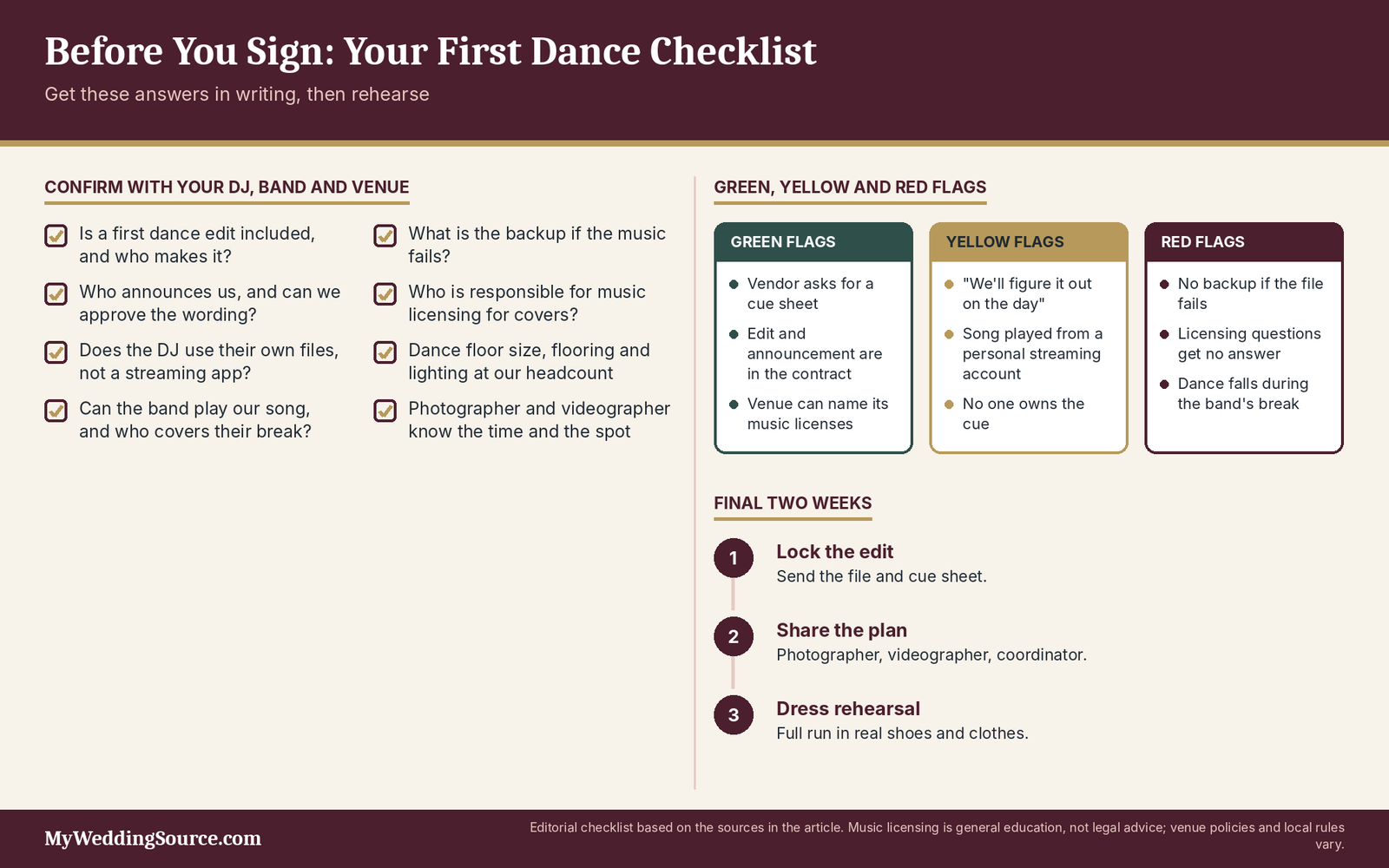
Questions worth asking your DJ or band
Ask these before you sign and make sure the answers appear in the contract or an attached cue sheet. If a vendor says “we’ll figure it out,” ask what that means in practice. A good vendor will not mind the questions.
Questions worth asking your venue
Ask about the dance floor size at your guest count, the flooring, the lighting options and the sound system, as well as whether the venue holds music licenses. Find out when the room flip happens and whether your catering schedule leaves room for the dance, and share the timeline with your caterer so dinner service and the dance do not collide. Our wedding venue guide and the food and catering hub can help with other venue questions. Get answers in writing, especially about licensing, power and the dance floor.
In the final two weeks
Lock the edit and the cue sheet
Finalize the edit, send the file and the one-page brief to your DJ or band, and give a backup to your coordinator. Share the cue sheet with your photographer and videographer, including where you will stand and what follows the dance. If you are working on the rest of the music, your wedding reception playlist should include the song that follows the dance. Confirm the time of the dance on the final timeline.
Do a full dress rehearsal
Put on the shoes, the dress or suit and any accessories, and run the dance start to finish with the edit. Practice the entrance, the first 20 seconds, the ending and the moment you invite guests, if you plan to. Film it once more and fix one thing. Then stop, because the most useful thing you can do the night before is rest.
Sources & methodology
- The Knot Real Weddings Study overview — study scope: U.S. couples married in 2025, survey of The Knot and WeddingWire members.
- The Knot, average wedding vendor costs — 2026 study of 10,474 couples; DJ $1,800, live band $4,500, photographer $3,000, videographer $2,300.
- The Knot, most popular first dance songs — top 10 ranking from nearly 17,000 couples married in 2024, published April 2025.
- The Knot, first dance song guide — 60 to 90 seconds as usually ideal; excerpting songs.
- The Knot, reception timeline — sample sequence of entrance, first dance, dinner and parent dances.
- Zola, should I take wedding dance lessons? — hourly lesson rates, lesson-count ladder, practice and savings suggestions.
- Thumbtack, wedding dance lesson cost — price range and one studio’s package examples.
- One of a Kind Event, dance floor sizing guide — supplier rule of thumb for floor size.
- Spotify End User Agreement — personal, non-commercial use grant.
- ASCAP, licensing help — definition of public performance, business owner and performer responsibility, streaming.
- BMI, licensing FAQ — business owners and live band, DJ and cover-song permissions.
- U.S. Copyright Act, Chapter 1 — definition of performing “publicly.”
- U.S. Copyright Office, Circular 1 — musical works and sound recordings.
- Entire Productions, licensing for private events — industry explainer including a 2015 ASCAP representative’s statement.
- Artyfile, wedding video music licensing guide — sync and master rights and platform risks; vendor marketing.
- National Institute of Mental Health, social anxiety disorder — description and treatment overview.
Methodology: vendor averages and the song ranking are survey findings from The Knot, and we do not know how the averages were calculated or how many couples chose each song. Lesson prices are published estimates from Zola and Thumbtack; the scenario table and the 160 to 210 square foot floor estimate are our own arithmetic and are labeled illustrative. The licensing section summarizes what the licensing organizations and the statute say and where the sources disagree; it is editorial analysis and general education, not legal advice. Venue policies and studio prices vary by place, so we have not generalized them.
Freshness note: recheck The Knot figures when the next Real Weddings Study appears, each year, and recheck Spotify’s terms, the licensing organizations’ pages and your venue’s policies before you sign a contract. Lesson prices should be confirmed with local studios, since the Thumbtack page does not state its year.