
If you want to donate wedding dress pieces after the wedding, the real work is matching one gown to one organization that wants it, can use it, and will tell you honestly what happens next. This guide gives you a four-gate screen for acceptance, condition, shipping and paperwork, so the gown ends up somewhere useful instead of in a bin or a return pile.
Before you donate wedding dress items, run the gown through four gates in order. First, confirm in writing that the organization accepts bridal gowns right now. Second, grade the condition honestly and photograph it. Third, price the handoff, including cleaning, packing and postage. Fourth, ask what receipt you will get and how the gown will be used. If a gate fails, change the destination, not the standard.
Most advice on how to donate wedding dress pieces stops at “find a charity and drop it off.” That works for a plain, clean, current-style dress and a nearby shop with open doors. It fails for the more common case: a heavily beaded gown, a gown with a stain you never fully treated, a dress that is clean but very specific in style, or a gown that has to cross three states to reach the one program that wanted it.
Those failures are not about generosity. They happen because the gown and the recipient were never checked against each other, which is the usual story when people donate wedding dress items on impulse. A bridal charity that outfits people who cannot afford a gown has different needs than a thrift shop with a general clothing rack. A theater department wants different things than a program that remakes fabric into small burial gowns for babies. Each of them can be the right home, and each can be the wrong one for your particular dress.
This guide is deliberately narrow. It does not tell you how to sell a gown, how to price it, or how to preserve it for a daughter. Those decisions have their own guides on the site, and the broader after-wedding care picture lives in the wedding dress fit and alterations guide. Here the only question is the one in the title: should this gown be donated, and if so, to whom and how.
A short note on scope. This is general information, not legal, tax or financial advice, so confirm tax and charity details with the issuing agency or a qualified professional.
What this guide covers and what it does not
The guide follows the order a couple, or one partner, actually faces the decision. It starts with whether donation is the right path at all, because plenty of gowns would do more good somewhere else. It then lists the kinds of organizations that take gowns, and gives you a screen for each of the four gates. After that it walks through a worked case, lays out alternatives, names the conditions under which you should stop, and finishes with scripts you can paste into an email.
Three ideas run through the whole guide, and it helps to hold them in mind now.
The recipient decides, not the donor. When you donate wedding dress items, a gown is only a donation once someone agrees to receive it. Until then it is an offer. An organization that has no use for a gown pays to dispose of it, and that cost is real, even if nobody sends you an invoice. The site’s wedding waste reduction audit looks at that kind of hidden cost across the whole event.
Condition is a fact, not a feeling. Most people describe their own dress as “basically perfect” for the same reason they would describe their own handwriting as “mostly legible.” You are too close. The condition gate gives you a grading method that does not depend on how you feel about the dress.
The handoff is part of the gift. A gown that arrives creased, damp, or crushed after a long mail trip is a worse gift than the one you intended. Cleaning, packing and shipping are not afterthoughts. They decide whether the organization can use what you send.
Who this guide is for
It is written for people who are done wearing the dress and have decided, or are close to deciding, to donate wedding dress items instead of keeping them. That includes someone who wore a gown once and wants it to help another person, someone who bought a gown and changed plans before the wedding, someone who inherited a gown from a relative’s closet and does not want to store it, and someone clearing a home after a move. The method to donate wedding dress items works the same in all of those cases.
It is also useful if you are not sure yet. Reading the first two sections costs little, and they will tell you whether a different path fits better before you spend money on cleaning or postage.
When you should donate wedding dress instead of selling it
Choosing to donate wedding dress items and choosing to sell them are both ways of passing a gown on, and the right choice depends on a few concrete things about the dress and about you. None of them requires you to put a number on the gown.
The case for donating. You choose to donate wedding dress items because you want the gown to go to someone who would otherwise not have one, or to a program with a clear purpose, and you do not want the work of listing, answering questions, photographing and shipping to individual buyers. You accept that you will not be paid. If your reasons are mostly about time and purpose, giving the gown away is a sound choice, and no one needs to be talked into it.
The case for selling or consigning. You paid a meaningful amount for the dress, the money matters to your household, and the gown is recent, clean and in a size and style that other people look for. Resale has its own set of decisions, covered in the site’s other writing on after-wedding dress choices. If the money matters, read about those first and come back here if the gown does not sell.
The case for reworking or keeping. If the gown has sentimental weight, or a seamstress could turn it into a christening gown, a blouse, or a veil for a sibling, a donation can wait. A gown given away is hard to retrieve. A gown kept for a year costs only storage space.
A simple first filter
Ask three questions before you contact anyone about a plan to donate wedding dress items, and write down the answers.
First: would I be genuinely fine if this gown never earned me a dollar? If the honest answer is no, pause on donation and look at resale.
Second: is anyone in my family, or in my close circle, who might want it? A cousin getting engaged next year is a better outcome than a stranger, and it takes one text to find out.
Third: do I have the time and cash to clean it, pack it, and move it? A donation is not free for the donor. A gown that needs professional cleaning, plus packing materials, plus postage or a drive, carries a cost. If that cost is higher than you are willing to pay, the answer may be a local drop-off or no donation at all.
“Before I list this anywhere, does anyone in the family want the dress?”
That single question, sent to a group chat, resolves more gowns than any research does. Plenty of dresses leave the house in a cousin’s car rather than a donation box.
Timing matters less than people think
There is no deadline that forces you to donate wedding dress items in the first weeks. A gown can wait a month or two in a breathable bag while you recover from the event. What does not help is waiting years in a plastic bag, because stains age and fabric yellows. If you are going to donate wedding dress items, move at a calm pace within the first several months, and clean the gown soon after the wedding. Early cleaning matters for every destination, because the stain you cannot see today is the one that shows up next spring.
One rule to settle with your partner
If two people bought, wore, or paid for the gown, agree on whether to donate wedding dress items before anyone sends an offer. It sounds obvious. In practice a gown can be promised to a charity by one person, to a cousin by another, and to a resale account by a third, and the second conversation is always the painful one. Make the decision in a single sentence and write it down: “We have decided to donate wedding dress items, and we will ask these three organizations in this order.”
Where to donate wedding dress: the kinds of recipients
Anyone who wants to donate wedding dress items will find that organizations fall into a handful of types. The descriptions below are general patterns, not claims about any named group. Rules differ from one organization to the next and change over time, so treat each type as a starting hypothesis that you confirm directly.
Bridal gown charities and gown libraries. Some nonprofits collect gowns and give or lend them to people who could not otherwise afford one, or to a group with a specific need. These programs often have the most specific standards, because their clients are choosing a dress for their own wedding day. They tend to want clean, wearable, reasonably current gowns, and some take only certain sizes or styles. Their requirements are usually posted, and an inquiry usually gets a clear answer.
General thrift and resale stores run by charities. A charity-run store takes a wide range of goods, and a wedding gown is one of many items on a given day. The store sells the gown to a shopper, and the proceeds fund the organization’s work. These stores are easy to reach, but they decide gown by gown, and a gown that does not sell may leave the floor sooner than you would like. Stores differ on whether they accept bridal gowns at all.
Programs that repurpose fabric. Some volunteer groups turn donated gowns into small garments for babies who die shortly after birth, for use by hospitals or families. These programs depend on volunteer sewers and on fabric that can be cut and sewn, so they can sometimes accept gowns with stains or damage that other recipients cannot. They may ask for the gown to be mailed to a coordinator, and they may have times when they are not accepting more.
Theater, film and school programs. A drama department, a community theater, a costume shop or a student film may welcome a gown that a bridal charity would not. They care about silhouette, color and stage effect more than about perfect condition. Their capacity is often small and their storage is limited, so they ask for a photo first.
Programs for specific groups. Some organizations serve military families, people facing medical hardship, or communities with a shared tradition. They may match a gown to a person, and they often have shipping arrangements or volunteer drivers. Their needs are specific, and a gown outside the specification wastes everyone’s time.
Local one-off helpers. A church closet, a community center, a school counselor’s office, or a neighborhood group may know someone who needs a dress for a ceremony. These are the hardest to find and often the warmest. They are also the least predictable.

When you donate wedding dress items, the right recipient is rarely the first one you think of. It is the one whose stated needs overlap with the gown you actually have. The sections that follow give you a way to check that overlap quickly.
Why the recipient type changes everything
A gown that is a poor fit for a bridal charity can still be a good fit for a fabric repurposing program or a theater. Seeing the types side by side stops you from judging a gown by a single standard. A stained but structurally sound gown is a failure for a clients-wear-it program and an acceptable donation for a program that cuts fabric. A very dramatic ball gown that is hard to alter is a weak fit for a thrift shop rack and an excellent fit for a stage.
The practical result, when you donate wedding dress items, is a short list of two or three candidates of different types, not a single charity. If the first says no, you already have the next ask ready, and you have not lost weeks.
What to leave off your list
Before you donate wedding dress items, skip anyone you cannot verify. Look for a clear name, a physical or mailing address, a way to contact a person, and a description of what they do with donated gowns. A group that answers every question with enthusiasm and no specifics is a poor choice. So is a group that asks you to pay a fee to “process” a donation without explaining where the money goes. Real organizations sometimes ask for shipping help, but they say so plainly and tell you what it covers.
Gate one: acceptance before you pack anything
The first gate is the cheapest to run and the most often skipped. Acceptance means a named person at the organization has agreed, in writing, to receive your gown on a stated date by a stated method. Until that happens, nothing else in this guide should cost you money.
Why insist on it? Because acceptance policies change without notice. A shop that took gowns last year may have stopped because of storage. A program may pause intake when volunteers are short. A nonprofit may only accept gowns in certain months, or in specific sizes. A website that is out of date can send you to a closed door. Your gown, cleaned and boxed, is then in your car with nowhere to go.
What “accepts wedding gowns” should really mean
When someone says yes, make them say what the yes covers. Four details are enough.
Which gowns. Style, size range, age, and whether they want the whole outfit or only the dress. Some programs want the veil, slip and petticoat as well. Some do not want them and cannot store them.
Which condition. Ask whether cleaning is required before drop-off and whether they want a professionally cleaned gown or one that is simply washed or aired. Ask what they do with a gown that has a stain or a missing button.
Which method. Drop-off at a counter, pickup at your door, or mail. For mail, ask who pays postage and where the box must go. A donation center that cannot take a box that arrives unannounced will send it back or discard it.
Which date. Many organizations can receive a gown only during particular hours or only at certain times of year. Get the exact window, and write down who agreed to it.
How to find candidates without guessing
Start with the places that already know you, because they have watched other people donate wedding dress items before. A local bridal salon often knows which charities take gowns, because they get asked every month. A wedding venue coordinator, a tailor, and a dry cleaner who handles gowns are equally good sources, since they see where gowns go. Ask each of them one question: “If a client wanted to give away a clean wedding gown, where would you send it?”
Then verify what you hear. A registered charity can usually be checked through the Internal Revenue Service’s tax-exempt organization search, which tells you whether an organization is recognized by the IRS as tax-exempt and eligible to receive deductible donations. The search does not tell you whether the group is well run or whether it wants your gown, but it screens out groups that are not what they say they are. The Federal Trade Commission also publishes advice on checking a charity before giving, which is worth a read if a group approached you rather than the other way around.
For the specific question of whether a store, program or collection point wants gowns, there is no substitute for contacting them. A short email with photos usually gets an answer in a few days, which is why it is the best first move when you donate wedding dress items.
The acceptance message
A good first message is short and gives the recipient what they need to say yes or no quickly. It names the gown by silhouette, color, size and fabric, states the condition honestly, offers photos, and says how you can deliver. It does not tell a life story, and it does not ask for a tax letter in the first line. You can find a script for it near the end of the guide. For now, the principle is simple: make saying no easy, because a quick no is more useful than a polite maybe.
Reading the answer
When you donate wedding dress items, treat three kinds of answers differently.
A clear yes with details is what you want. Record the date, the name, and the method, and move to the condition gate if you have not already.
A soft yes sounds like “sure, bring it by anytime” with no questions asked. It is not necessarily wrong, but it means nobody has looked at your gown. Send photos anyway, and ask whether a particular person should receive it.
A no is also useful. Ask whether they know another program that would take the gown. People who run these programs often know the neighbors in their field.
If two organizations say yes, choose the one whose use of the gown you find more convincing, then tell the other politely. A kind decline keeps the door open for next time.
Gate two: condition grading for a donated gown
Condition is the second gate because it is where your gown meets reality. Before you donate wedding dress items, grading the gown, ideally before you contact anyone, keeps you from describing a better dress than you have.
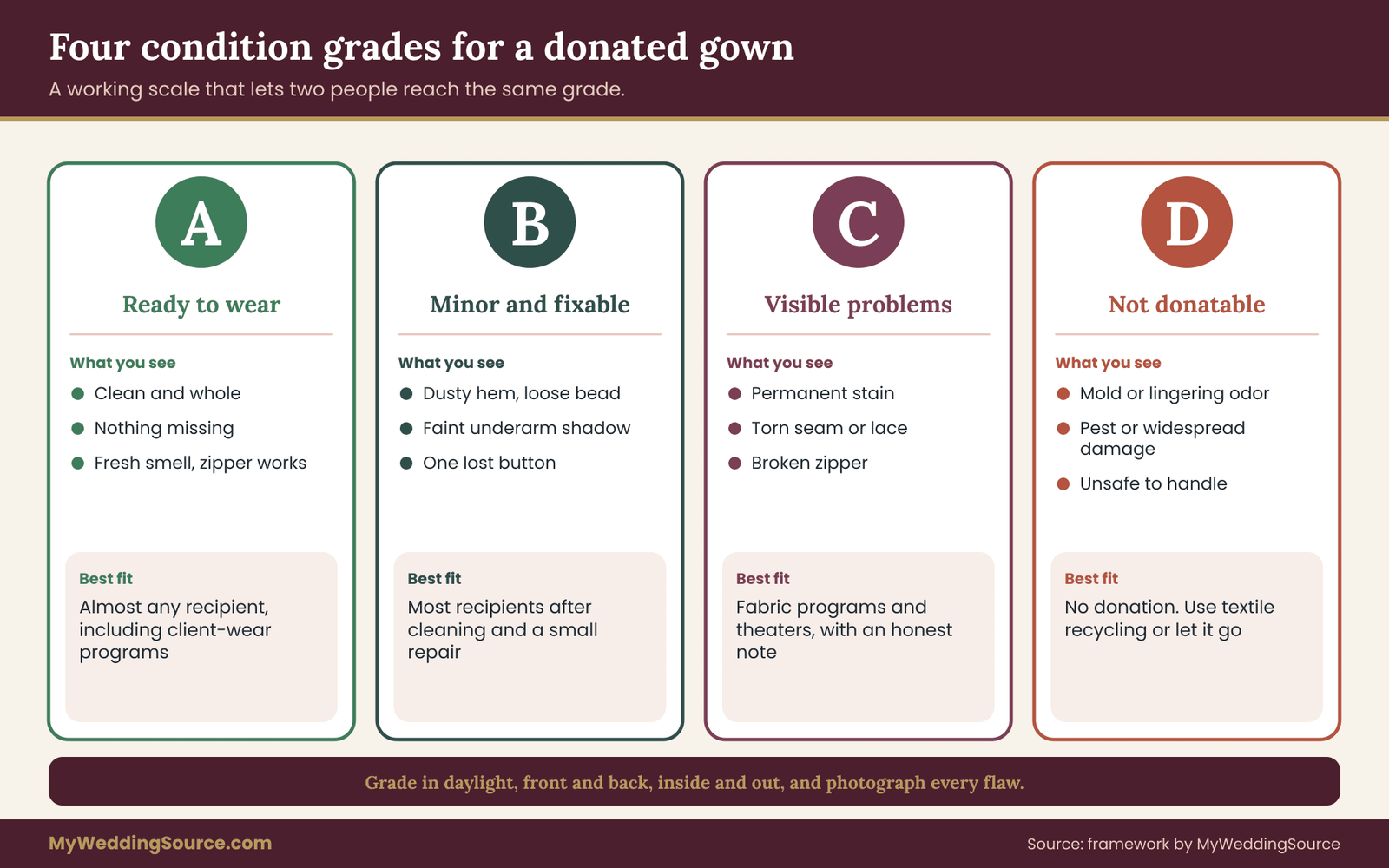
The method has four grades for anyone who wants to donate wedding dress items. They are not industry standards. They are a working scale for this decision, built so that two people looking at the same gown would reach the same grade.
Grade A: ready to wear. Clean, whole, nothing missing, no visible marks in normal light, fresh smell, zipper or laces work, hem intact. A gown at this grade lets you donate wedding dress items to every recipient type, including a client-wear program.
Grade B: minor and fixable. Light marks on the hem from walking, a loose bead or two, a snagged thread, a faint yellow shadow under the arms, or a lost button that can be replaced. These are the issues most worn gowns have. A professional cleaning often fixes the marks. The rest need a small repair or an honest note to the recipient.
Grade C: visible problems. Permanent stains, torn seams, damaged lace, broken zipper, or fabric that has yellowed unevenly. A gown at this grade is a poor fit for any program where a client wears it, and may still suit a fabric repurposing program or a theater. Be direct about this in your message.
Grade D: not donatable. Mold, a persistent odor, widespread fabric damage, pest damage, or anything that would make handling unsafe or unpleasant for volunteers. Do not ship a grade D gown. Ask a textile recycler instead, or let it go.
How to grade without fooling yourself
Do the inspection in daylight, by a window, with the gown on a hanger or flat on a clean sheet. Work from the top down.
Start with the bodice and underarms. Look at the inside as well as the outside, because perspiration marks sit inside the lining and darken over time. Check every seam line for tiny gaps. Run a finger along the zipper and check that the teeth meet. If it laces, pull the laces through and look for fraying.
Then the skirt and hem. Gowns drag the ground in ways the wearer rarely notices, and the hem collects dirt, grass, and the odd coffee splash. Turn the hem up and look at the inside edge. Look at the train bustle points, because they take stress.
Finally the details. Count missing beads in a patch you can see, then estimate the proportion across the gown. A missing handful on a heavily beaded gown is normal. A bare patch is a Grade C problem. Smell the gown and the storage bag. Mustiness is easier to catch than to describe.
Take photos at each step: whole gown front and back, bodice detail, hem detail, the label and the worst flaw. Those photos double as your acceptance message attachments and as a record if a question comes up later. Keep them with the rest of your paperwork, as described in the wedding records guide.
Stains, odors and the honest note
If your gown has a stain, say so, and say where. Recipients are rarely upset by a flagged flaw. They are upset by one they discover on the intake table, because it makes them doubt everything else you said. A single plain sentence works: “There is a faint mark on the left side of the hem, about the size of a coin, that did not lift after cleaning.”
Cleaning is a separate decision when you donate wedding dress items, and the gate three section prices it. For now, remember that cleaning is not always the right move. A gown that is already Grade A needs only airing. A gown headed for a fabric program may not need cleaning at all, because the recipient will cut away the damaged parts. Ask before you spend.
The sizing note
Size is part of condition when you donate wedding dress items. A gown that fits a narrow range of sizes is a harder placement than a gown with room to alter. Note the label size and a few measurements: bust, waist, hips, hollow-to-hem length, and how much seam allowance is inside. Measurements travel better than a label, because sizing varies by maker and by decade. If you want a sense of how alteration allowances work, the seam allowances inside the gown tell a recipient how flexible it is.
When the grade changes the destination
When you donate wedding dress items, the grade, more than any other fact, narrows the list of recipients. Grade A and B gowns suit almost every type. Grade C gowns suit fabric and stage programs. Grade D gowns suit none. If your honest grade is lower than you hoped, that is not a failure. It is the exact information that lets you choose a recipient who can use the gown, rather than one who will politely accept it and quietly discard it.
Gate three: the handoff and shipping
A gown that passes acceptance and condition can still fail at the handoff. Gate three covers everything between your closet and the recipient’s intake table: cleaning, packing, transport and cost. Many people who plan to donate wedding dress items underestimate this step, because a donation sounds free. It rarely is, and pretending otherwise leads to either a skipped cleaning or an abandoned plan.
Three handoff routes
There are three ways a gown reaches a recipient when you donate wedding dress items. Each has a different effort level, a different cost driver and a different risk.
Drop-off. You carry the gown to a counter or a donation door. The cost is your time and fuel. The main risk is arriving when nobody is trained to receive a gown, so it gets set on a general pile. Call ahead, ask for a named person, and bring the gown in a garment bag on a hanger.
Pickup. A volunteer or a collection service comes to you. The cost is usually nothing, but the date is theirs, and the pickup window may be several hours. The risk is that the gown sits in a van with other bags. Ask how it will be carried, and offer to hang it in a spare closet until they arrive.
Mail. You pack the gown and send it to a coordinator. The cost is packing materials and postage, which scale with weight and box size. A beaded ball gown can be heavy and bulky. The main risks are crushing, moisture, and a box going to the wrong place. Mailing is the standard route for programs that serve people far from where gowns are collected.
Pricing the handoff in advance
Before you commit, estimate three numbers and write them in your notes.
The first is cleaning, if the recipient asks for it. Call a cleaner who handles bridal gowns and ask for a quote based on fabric and embellishment. Get it in writing. Do not guess, because bridal cleaning prices vary widely by fabric, beadwork and region, and a quote is the only reliable number.
The second is packing. A gown in a sturdy box with acid-free tissue and a plastic outer wrapper to block moisture costs more than a bag. Ask the recipient what they prefer. Some want a hanging gown; others want a boxed one.
The third is transport. For mail, use the carrier’s online calculator with the actual box dimensions and weight. Compare ground services and tracked services; the tracked option has a record if something goes missing. The United States Postal Service and private carriers both publish rate tools on their sites, and the numbers change, so check the current one on the day you ship rather than relying on a figure from a blog.
Add the three together, because the total is the real price to donate wedding dress items this way. If the total feels higher than the value of the gift to you, say so before you proceed. You can ask the recipient whether they cover postage or provide a prepaid label. Many programs do, or can suggest a cheaper option.
“Do you cover shipping, or should I send the gown unboxed to a drop point nearby?”
The cleaning decision
Should you clean the gown before you donate wedding dress items? The honest answer is that it depends on the recipient and the grade. A client-wear program or a store usually wants a clean gown. A fabric repurposing program often prefers an uncleaned gown to a poorly cleaned one, because the wrong chemical can set a stain. A theater may not care.
When cleaning is wanted, choose a cleaner who works with wedding gowns, ask how they handle beads, lace and sequins, and ask whether they will tell you about stains that did not come out. Receive the gown back with a note that lists what was treated. That note can go in the box.
If you intend to preserve rather than donate, cleaning is covered in the site’s writing on after-wedding dress care. To donate wedding dress items well, the rule is to clean to the recipient’s expectation and no further.
Packing a gown for a trip
Packing is where careful donors lose their gown. Use these steps.
Lay the gown flat on a clean sheet. Pad the folds with acid-free tissue or clean white cotton, so no hard crease sets across the bodice. Fold as few times as you can. Put the bodice and any beaded parts on top, where nothing presses on them.
Wrap the gown loosely in a breathable layer, then place it in a box that is a little larger than the folded gown. Avoid vacuum bags and tight plastic, which trap moisture. If you worry about rain, add an outer plastic wrap around the box, not the gown.
Label the box on two sides with the recipient’s name, the contact person and your return address. Slip a printed note inside with your name, the gown description and the date. Photograph the packed box and the label before you seal it.
Ship with tracking. Keep the receipt and the tracking number with your photos.
What to do if the gown cannot travel
Some gowns are too delicate, heavy or voluminous to mail sensibly. If a gown meets that description, you can still donate wedding dress items to a local recipient, which is the better choice even if the mission matches less well. A gown that arrives in good condition at a theater down the road does more good than a perfect-match program that receives a crushed box.

Gate four: the receipt and the paper trail
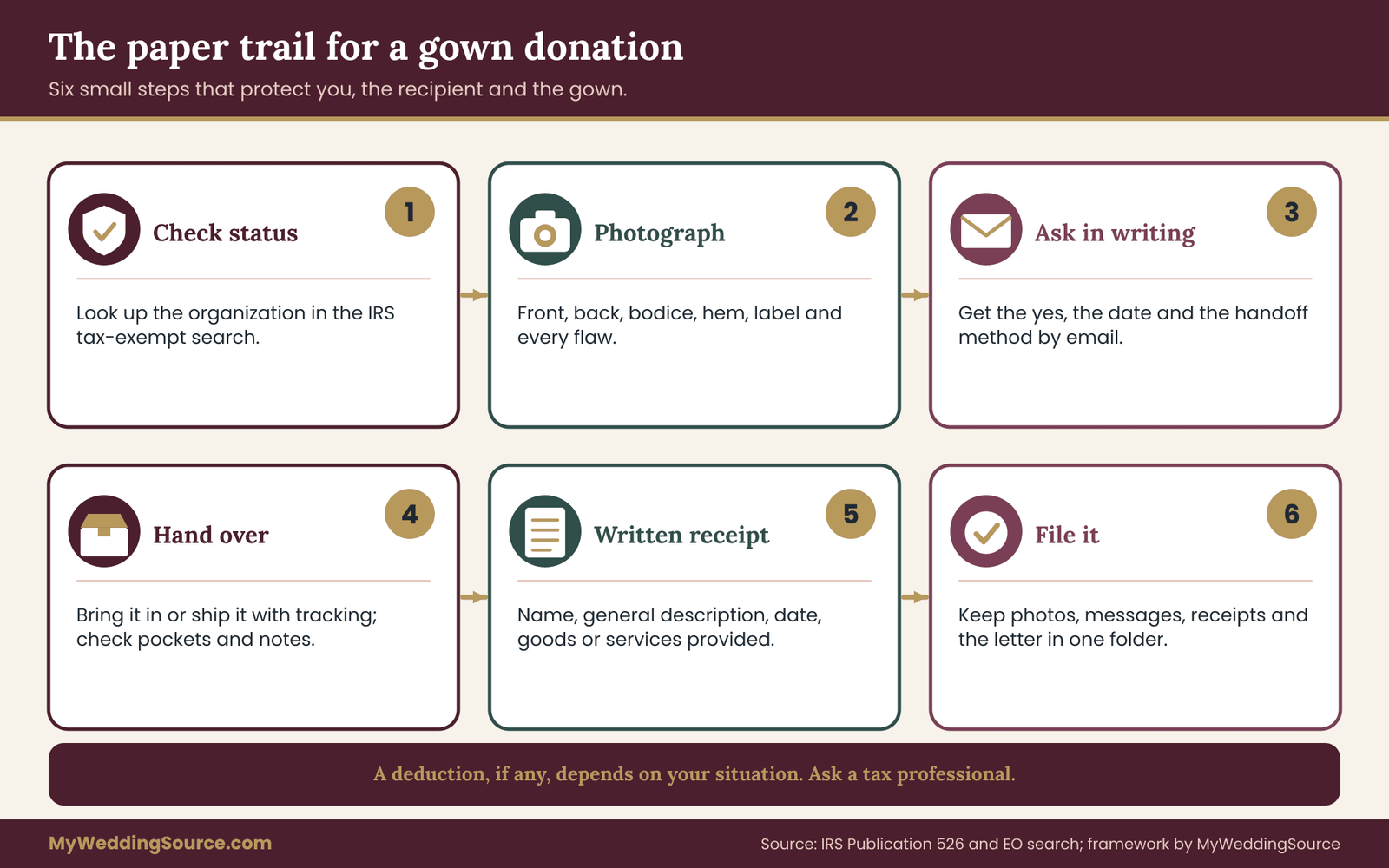
The fourth gate is about documentation when you donate wedding dress items. It protects you if you intend to claim a deduction, protects the recipient if a question arises, and protects the gown from vanishing into a system where nobody can say where it went.
What the tax rules generally say
Tax rules change and apply differently to each household, so this section describes general ideas and points to the source. Read the Internal Revenue Service publication on charitable contributions, and ask a qualified tax professional about your situation.
In general terms, if you donate wedding dress items to a qualified charity, the gift may be deductible only if you itemize deductions. Many households take the standard deduction instead, in which case there is no deduction to claim.
If you do itemize, a donation of used clothing or household items generally must be in good used condition or better. The IRS explains that an item in poor condition may not qualify, and the amount you can claim is generally the fair market value of the item at the time of the gift, not the price you paid. Fair market value of a used gown is often far below the purchase price, and the IRS has a separate publication on how to determine the value of donated property.
For larger noncash gifts, additional paperwork may apply. Written acknowledgments from the charity are generally needed above certain amounts, and a separate form may be required for noncash gifts above a threshold. Check the current publications for the thresholds, since figures can change. Do not rely on a blog post, including this one, for a number.
What to ask the recipient
Whatever the tax picture, ask the organization three questions before you donate wedding dress items.
First, will you give a written receipt that names me, describes the gown in general terms, states the date, and says whether any goods or services were provided in return? Most organizations that deal with donors have a standard form. A receipt does not state a value, because the donor decides on one. It documents the gift.
Second, is the organization recognized by the IRS as a charity eligible for deductible gifts? You can check this yourself, as described under gate one.
Third, how will the gown be used? “We sell it in our shop,” “we lend it to clients,” “we cut it into garments for hospitals,” and “we pass it to a costume shop” are all acceptable answers. A group that cannot answer the question is a warning sign.
Keeping your own record
Create one folder, paper or digital, for the day you donate wedding dress items. In it put the photos of the gown, the grading notes, the acceptance email, the cleaning quote and receipt, the shipping receipt and tracking number, and the charity’s written acknowledgment. If you valued the gown, add a note on how you did it and what you compared it to, such as similar used gowns for sale. Do not invent a value; use evidence.
This folder also belongs in your broader archive. The site’s guide to organizing wedding records after the event shows how long to keep each kind of paper, and a donation file fits neatly into the money and keepsakes families it describes.
Privacy and the label
Before you donate wedding dress items, check for notes, names or personal items left in pockets, linings or the garment bag. Some gowns carry a stitched name, a date inside the hem or a monogram. Decide whether you want those removed. If you do, ask the recipient first, because a repurposing program may prefer a gown with its seams intact.
If you are donating in memory of someone, or want the gown to go to a particular kind of person, tell the organization plainly. They can tell you whether they honor such requests. If the answer is no, you can choose a different recipient or accept that the gown will go to whoever needs it.
The gate summary
The four gates fit together as a flow. Acceptance comes first because it can be tested without cost. Condition second because it decides which acceptances are real. Handoff third because it prices the plan. Paper last because it records what you did. If a gate fails, go back to the type list, pick the next candidate, and run the gates again with what you have learned. The gown has not failed. The match has.
The comparison card: scoring any organization before you donate wedding dress items
The four gates tell you what to check when you donate wedding dress items. The comparison card tells you how to weigh what you find when two or three organizations are still in the running. It is a plain worksheet, one card per organization, and it fits on a sheet of paper or in a notes app. It is not a ranking of charities. It is a way to compare how well each one fits your gown.
Each card has five lines. Fill them in from the organization’s own answers, not from a guess.
Line one: acceptance. Write yes, soft yes, no or unknown, with the date and the person’s name. Give a soft yes half credit in your head, because nobody has seen the gown.
Line two: condition match. Compare your grade with what they require. A Grade A gown matches everyone. A Grade C gown matches only a few. Write “match,” “partial” or “mismatch.”
Line three: handoff cost. Add cleaning, packing and transport using the quotes you collected. Write the total and who pays what.
Line four: paper. Write what receipt you will get and when. Note any hesitation about the question.
Line five: use. Write one sentence about what happens to the gown, in the organization’s words.
Reading two or three cards side by side
Lay the cards next to each other and look for a clear winner on acceptance and condition match first. Those two lines decide whether the gown can be used at all. A cheap handoff to an organization that will not use the gown is worse than a costly handoff to one that will.
Handoff cost comes next. If two organizations are equal on acceptance and match, the cheaper handoff usually wins, unless the more expensive one uses the gown in a way that matters more to you. That is a values question, and the card lets you see it plainly instead of burying it.
Paper is a tiebreaker, not a gate, unless you need a deduction. If you do, an organization that cannot give you a written acknowledgment drops a line.
Use sits last on purpose. It is the line most likely to tempt you into choosing the story over the fit. A moving use is worth something, but it does not help if the program cannot accept your gown.
A decision rule you can say aloud
Here is the rule in one sentence for anyone who wants to donate wedding dress items: choose the recipient with a written yes and a condition match, then pick the cheaper handoff, and use the paper and the use line to break ties.
If no recipient reaches a written yes and a match, do not donate yet. Either fix a fixable condition, extend the search, or move to an alternative. The next sections cover both.
When the card says “wait”
Two outcomes should make you pause. One is that every organization on your list shows a mismatch on condition, which means your gown belongs in a different category than you thought. The other is that every handoff cost is higher than you want to pay, which means you need a local option or a different plan. A pause is a legitimate result. It is better than an expensive donation that does not help anyone.

A worked case: one gown, three candidate organizations
The following example of how to donate wedding dress items is invented to show the method. It is not a report of a real donation, and the organizations are described by type, not by name. No prices appear, because any number would be made up. The point is the sequence of decisions.
The gown
A couple, call them Dana and Marcus, finish their wedding in October. Dana wore a lace A-line gown with a chapel train, a lightly beaded bodice and a back zipper with covered buttons over it. The gown is ivory. After the wedding it spent three weeks in a garment bag in a closet. Dana does not want to keep it. She wants it to go to someone who will wear it, and she has no interest in selling, so she decides to donate wedding dress items.
Step one: the first filter
Dana asks the three filter questions. She is happy to receive no money, so donating fits. She texts her family and a close friend and nobody wants it. She estimates she can spend an afternoon and some money on cleaning and a drive, but not a long mail trip. The plan to donate wedding dress items goes ahead.
Step two: the grade
In daylight, Dana photographs the gown. The bodice is clean. Under both arms there is a faint yellow shadow inside the lining. The hem has gray dust and a small brownish mark about the size of a thumbnail near the back. Two covered buttons are loose. The zipper works. Two beads are missing from the waist. She grades the gown B: fixable with cleaning and a small repair.
Step three: three candidates
Dana asks her dry cleaner, a bridal salon and a friend who volunteers at a community theater where gowns go. She comes back with three candidates of different types: a local charity that lends gowns to clients, a charity-run thrift store in the next town, and the community theater’s costume closet.
She sends each a short message with photos and the honest grade note.
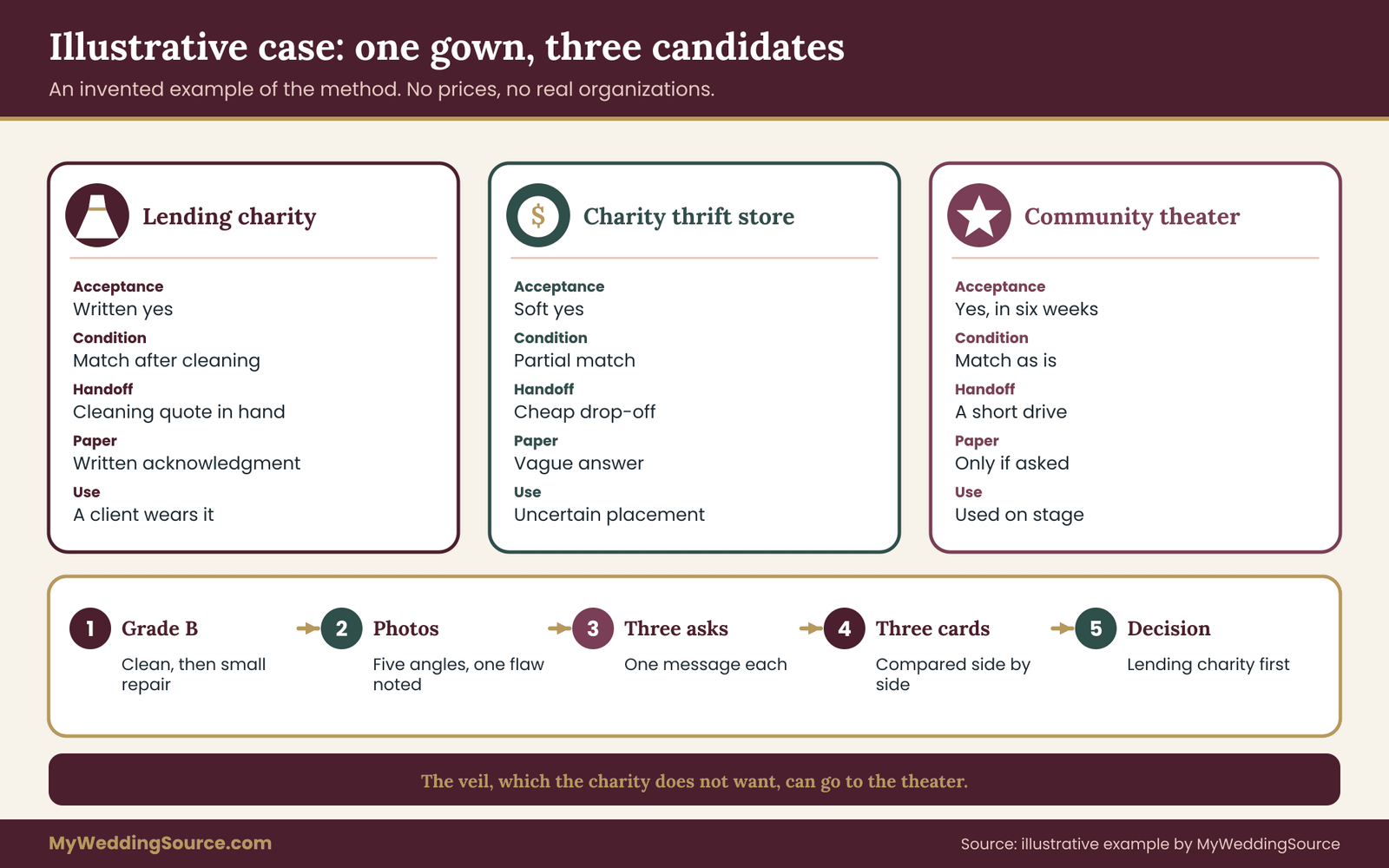
The lending charity replies in two days. They would like the gown, but they need it professionally cleaned and want the buttons secured. They ask her to drop it off during a Saturday intake window. They say they can send a written acknowledgment.
The thrift store replies the next day with a soft yes: bring it anytime, any attendant can take it. Nobody asks to see photos. When Dana asks whether they have a bridal rack, the reply is that they place gowns where there is room.
The theater replies by saying a gown with that silhouette would be useful for an upcoming production. They do not need cleaning, but they can only take it after the show closes, six weeks away, because storage is full.
Step four: the cards
Dana fills in three cards before she commits to donate wedding dress items to anyone.
The lending charity has a written yes, a condition match after cleaning and buttons, a handoff she has quoted, a written acknowledgment, and a clear use: a client will wear the gown at her own wedding. The thrift store has a soft yes, a partial match, a cheap handoff, a vague paper answer and an uncertain use. The theater has a yes with a delayed date, a match at the current condition, no handoff cost beyond a drive, and no paper unless she asks.
Step five: the decision
By her own rule, Dana picks the lending charity: written yes and match first. She asks the cleaner for a quote on the gown with a request to flag any stains that remain. She sews the loose buttons herself, because that is a ten-minute job. She sets up the folder for her records.
She tells the thrift store and the theater thank you and that she has chosen another path. She asks the theater whether they would like a gown in the future, and offers the veil, which the charity does not want, if they have a use for it.
What the example shows
The decision to donate wedding dress items was not obvious at the start. The thrift store was the fastest answer. The theater needed the least work. The lending charity was the only one that would put the gown on a person who needed it, and it was also the only one that asked for the most effort. A card made the trade-offs visible, and a rule made the choice calm.
The example also shows two things that are easy to miss. First, Dana’s honest grade and photos are what produced a precise answer from the charity. A vague message would have produced a vague one. Second, the leftover items had a second home. A veil, a slip or a belt can often go to a different recipient than the gown, and splitting an outfit across two organizations is a perfectly normal result.
Where the case could have gone differently
Any plan to donate wedding dress items can branch like this. If the cleaner had reported a stain that did not lift, the lending charity might have declined. Then Dana would have returned to the theater, which accepts the gown as it is.
If the charity’s intake window had been full, the gown could have waited in its bag until the next one. If the cost of cleaning had been higher than Dana wanted to pay, she could have asked whether the charity would accept the gown uncleaned or whether they work with a partner cleaner. Each branch leads to a sensible result because the gates and the card were in place.
Alternatives when you cannot donate wedding dress items
Sometimes the gates say no. The gown is Grade C and nobody nearby will take it, the handoff costs more than the gift is worth to you, or no organization on your list can give you a clear yes. That is not the end of the road. A failed plan to donate wedding dress pieces usually points to a different path that fits better, and it is better to switch early than to force a poor match.
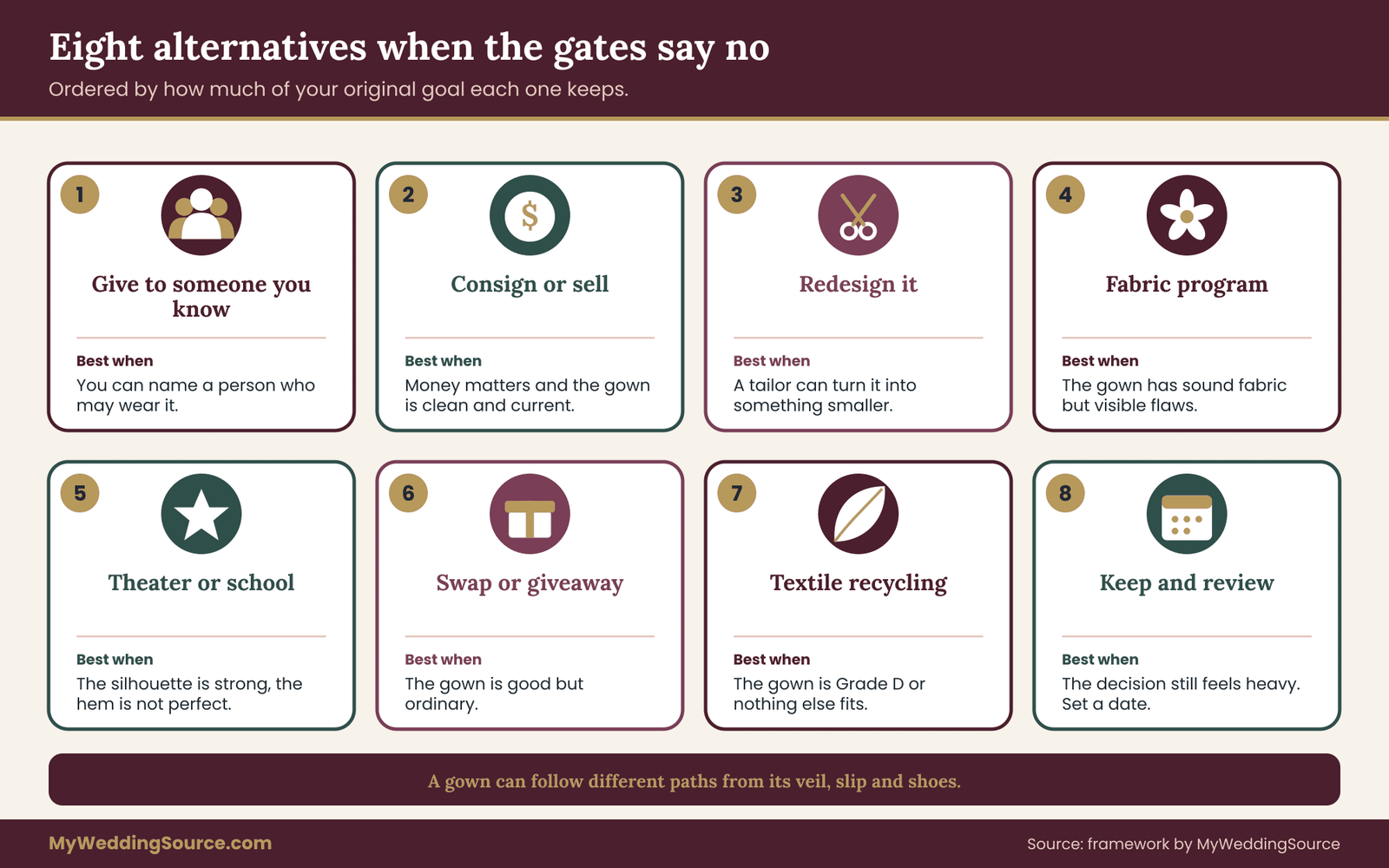
The alternatives below are ordered by how much of your original goal they keep. When you set out to donate wedding dress items, your goal was probably some mix of “the gown gets used,” “I do not want to store it,” and “I do not want a big project.”
Give it to someone you know
The simplest way to donate wedding dress items is to give them to a person you can name. A relative, a friend of a friend, a coworker’s niece, a neighbor planning a small ceremony. The gate method still helps here, in a lighter form. Photograph the gown, grade it honestly, and describe it. The advantage is that the recipient can try it on, you skip the paper and the shipping, and you know what happens next.
One caution. Gifts between people have no tax receipt, and a gown handed over with unspoken expectations can strain a friendship. Say plainly whether you want it back, whether she may alter it, and whether you mind if it is resold. A single clear message avoids awkwardness later, and the usual courtesies in the site’s wedding etiquette guide apply to a gift like this. If she plans to wear it, she will probably need changes, and the guide to fitting and altering a wedding dress explains what is realistic.
Consign or sell, if money returns to the picture
A gown that fails the donation test because it is too good to give away for nothing may belong in resale. Condition grades A and B, a recent silhouette and a standard size are exactly what resale buyers look for. Price, platform and listing choices are their own subject, and the site covers them separately. If you land here, you have not wasted effort: the photos, the grade notes and the measurements you collected for donation are the same ones a listing needs.
You can also split the outcome. Sell the gown and donate part of the proceeds, if the purpose of the gift was to support a cause. That is a different act from donating the gown itself, and the tax and receipt picture is different too, so ask a professional if you plan to claim anything.
Redesign or repurpose it yourself
If you cannot donate wedding dress items as they are, a gown that is too damaged for a client-wear program may still make a christening gown, a ring pillow, a handkerchief, a bag or a veil for a sibling. Some tailors and seamstresses specialize in this. If a tailor will rework the gown, the written agreement matters, because the process is irreversible. The site’s writing on gown redesign agreements covers what to put in one.
If you are not the sentimental type, consider a smaller version of the same idea. Cut a swatch of lace for a keepsake box and donate the rest.
Send it to a fabric program
Programs that make small garments for babies who do not survive birth, and similar volunteer projects, can use gowns that fail a client-wear test. They need sound fabric and enough of it, and they work with volunteer sewers. They usually ask you to mail the gown, so the handoff gate applies in full. Ask whether they want the gown cleaned, whether they take beaded gowns, and whether they are accepting donations now. Pauses are common, because volunteers can only sew so many garments.
This route often carries the most emotional weight. Some donors find it meaningful, and some find it hard. Think about which you are before you commit. If a gown has strong memories, a different path may be gentler.
Theater, film and school programs
Costume closets are a useful place to donate wedding dress items that are visually strong and structurally sound. They care less about a faded hem and more about silhouette, color and how the gown moves. Their limits are space and timing. Many can only take a gown when a production wraps or a new season begins, so a short wait is normal. Ask for the contact who handles costume intake, and send a photo.
A swap, a resale event or a donated sale
Some communities run gown swaps, giveaways or donation events, often coordinated by a nonprofit, a faith community or a school. These events are a simple way to donate wedding dress items that are in good shape but unremarkable, because the audience is a group of people looking for a dress. Ask the host how gowns are handled, who may take one, and whether you are told where yours went. You do not get a receipt for a swap, in most cases, but you may get the satisfaction of seeing it picked up.
Textile recycling, as the last resort
When a gown is Grade D, or when every alternative has failed, textile recycling is a responsible endpoint. Look for a service that takes clothing and fabric for reuse or recycling and ask what they do with items that cannot be resold. Be careful with bins whose operators are unclear. A bin that does not name the organization behind it is not a charity, even if it looks like one. The site’s guide to reducing wedding waste covers disposal choices more widely and is a good companion read for gowns that have run out of options.
Keep it, and set a review date
A final choice, if you are unsure you should donate wedding dress items now, is to keep the gown for now. Store it flat or hanging in a clean, breathable bag, away from heat and sunlight, and set a calendar reminder to revisit the decision in six months. A gown kept for a reason, with a date to decide again, is a plan. A gown kept because the decision felt heavy is a closet problem.
Mixing paths for one outfit
A wedding outfit is more than a dress. There may be a veil, a slip, a petticoat, gloves, a belt, a shawl and shoes. Each piece can follow its own path, so a plan to donate wedding dress items should cover every piece.
The gown may go to a lending charity. The veil may suit a theater or a sibling. The shoes may go to a general charity store, if they are clean and little worn, or to a friend. Accessories with sentimental value may stay in a keepsake box. Splitting the outfit across several recipients is not scattered thinking. It is simply matching each piece to the place where it is most useful.
The site’s overview of wedding day accessories covers what pieces commonly make up a bridal outfit, which helps when you are listing everything you own that could be passed on.
Make a one-page plan.
Write each item on a line with a destination, a method and a date. For example: gown, lending charity, drop-off on a Saturday; veil, theater costume closet, mail after the show; belt and gloves, friend, hand over next week; shoes, charity store, drop-off with the gown. This one page keeps the project from drifting, and it gives your partner a way to help.
Money and budget logic.
Passing a gown on rarely changes your wedding budget in a large way, but it is worth looking at honestly. If you sell, the proceeds reduce your net cost of the dress. If you donate wedding dress items, you may get a tax benefit in some situations, which depends on whether you itemize and on the gown’s value. If you keep, you carry a storage cost, small but real. If you rework, you pay a tailor.
Put these on one page next to your wedding costs, using the approach in the site’s wedding budget guide, so the gown decision sits in the same place as your other money choices rather than floating alone. The exercise sometimes shows that the cheapest path is not the one that felt right at the start, and that is useful to know.
Failure conditions: when to stop and change course
A method to donate wedding dress items is only useful if it tells you when to quit. The conditions below are the points at which you should stop pushing forward with a donation, no matter how much effort you have already put in. Each one is specific, so you can recognize it.
Failure one: no written yes after two rounds. You asked three organizations, waited a reasonable time, sent one polite follow-up to each, and you still hold no written acceptance. Stop. Do not clean, pack or ship. The silence is an answer, and the next step is an alternative from the previous section.
Failure two: the grade is D. Mold, a persistent odor, pest damage or widespread fabric failure. A donation recipient should not have to handle that. Use textile recycling or let the gown go. Do not describe it to a charity as “a bit musty” and hope.
Failure three: the handoff costs more than you will pay. You priced cleaning, packing and postage and the total made you wince. Do not push through on goodwill and resent it later. Ask the recipient for a cheaper route, find a local one, or choose a different path.
Failure four: the recipient cannot explain the use. Questions about how the gown will be used meet vagueness or a change of subject. This does not prove wrongdoing, but you are entitled to know. A group that will not tell you what it does with donations has not earned your gown.
Failure five: pressure or fees. Someone asks you to pay a processing fee without explaining it, rushes you to decide, or asks for payment details you do not expect. Treat that as a reason to leave. Legitimate organizations may ask you to cover shipping to their site, and they explain it. Anything else is suspect. The Federal Trade Commission publishes guidance on checking charities, and the IRS search tool helps you confirm tax-exempt status.
Failure six: the plan depends on a deduction that may not exist. If your main reason to donate wedding dress items is a tax benefit, run the numbers with a professional before you spend money. Many households do not itemize. The value of a used gown is often modest. A donation that makes sense only for a deduction can fall apart when you learn the deduction is small or absent.
Failure seven: the gown is promised twice. If two people made two commitments, stop and settle it before either organization prepares for your gown. This is awkward and fixable, and far easier on day one than on day twelve.
What to do when you stop
Stopping a plan to donate wedding dress items does not mean starting over. Keep the folder: your photos, grade notes and messages carry forward to any alternative. Write one line in the folder explaining why you stopped, with the date. That line prevents you from repeating the same failed step six months later.
Then pick the next path using the alternatives list. If the cause was condition, look at repurposing or recycling. If the cause was cost, look for a local or friend-based route. If the cause was trust, return to the verification steps and try a different organization.
Common mistakes to avoid
A few patterns repeat in donation stories, and each is preventable.
Cleaning first, asking later. People who donate wedding dress items often pay for cleaning before they know whether the recipient wants a cleaned gown. Ask first.
Sending a box unannounced. A box that arrives with no warning may be refused, returned at your cost or lost in a stockroom. Always send after a written yes.
Describing the gown by feeling. “Perfect,” “like new,” and “barely worn” are claims. Photos and a grade are evidence.
Forgetting the small pieces. Veils, slips and belts get lost between the closet and the car. Make a list, and tick it as items go into the box.
Skipping the receipt. A receipt is a thirty-second request when you donate wedding dress items at drop-off. It is hard to get weeks later.
Treating the first no as a failure. The first no is a data point. It tells you the type was wrong. Move on to the next type.
Scripts to use before you donate wedding dress items
The messages below are templates for anyone who wants to donate wedding dress items, in plain language. Adapt them to your gown and your voice. Keep them short. A recipient who reads your message in one pass is more likely to answer.
First message to an organization
“Hello, I have a wedding gown I would like to donate, and I wanted to check whether you accept bridal gowns right now. It is an ivory lace A-line with a chapel train, labeled a size 8, worn once. I can send photos. The hem has light dust and there is a small mark near the back. I can drop it off, ship it or arrange pickup. Could you tell me whether it fits your program and what condition you need it in?”
This message names the gown, states a flaw, offers photos and gives options. It asks one question at the end, not five.
Follow-up after photos
“Thank you for replying. Photos are attached: front, back, bodice, hem and the small mark. Measurements are bust, waist, hips and hollow-to-hem. Do you need the gown cleaned before it arrives, and would you like the veil and slip as well?”
Asking about shipping
“Do you cover shipping, or do you have a preferred carrier or drop point? I would like to pack it the way you prefer, so it arrives in good shape.”
Asking about the receipt
“Could you provide a written acknowledgment that lists my name, a general description of the gown, the date and whether any goods or services were given in return? I will keep it with my records.”
Asking how the gown will be used
“Could you tell me in a sentence how a donated gown is used by your organization? I want to be sure it goes where it is needed.”
Declining politely
“Thank you for your help. I have decided to give the gown to another program, so I will not be sending it to you. I appreciate your time, and I may reach out again if I have another item.”
Asking someone you know
“I am clearing out my wedding gown and wanted to offer it to you first. It is a size 8 and has light wear. You are welcome to try it on and alter it. If it does not fit, no worries at all.”
A short list to keep nearby
Before any message goes out, check you have these: photos from five angles, measurements, the grade and one sentence on the worst flaw, your preferred handoff route and a rough window of dates. With those five items in hand, a message to donate wedding dress items takes about ten minutes.
Timing your messages
Send messages on a weekday morning, give an organization a week, and follow up once. If you do not hear back, move to the next candidate, and keep a log of what you sent. A tidy log of dates and names keeps you from sending duplicate offers or forgetting who said what while you donate wedding dress items. The log belongs in your donation folder next to the photos.
Keeping the tone calm
When you donate wedding dress items, you are offering a gift, not asking a favor. That framing helps in both directions. Be grateful, but do not apologize for the gown, and do not oversell it. A calm message tells a busy intake coordinator that you are organized and honest, and that is the kind of donor whose gown gets an answer.
Your next steps
Start small and in order. This week, text your family and close friends once, with a photo, to see whether anyone wants the gown. Then do the daylight inspection, take the photos, and assign a grade. Write down the five facts you will need for any message: grade, measurements, the worst flaw, your preferred handoff and your dates.
Next week, build a list of three candidates of different types, and send each the first message. Fill in a comparison card for every answer. Pick the organization with a written yes and a condition match, price the handoff, and only then clean, pack or ship. Keep the folder as you go, and add the gown to your broader wedding planning checklist so it does not drop off the list.
If the gates say no, take that seriously and choose an alternative. A gown that goes to a cousin, a costume closet or a fabric program counts as a good outcome. The point of the exercise is not to donate wedding dress items at any cost. It is to put each piece where it will be used, with as little waste, money and regret as possible.
FAQ
Is it worth trying to donate wedding dress items if the gown has a small stain?
Often yes, but choose the recipient carefully. A client-wear program may decline a visible stain, while a fabric repurposing program or a theater may still accept the gown. Say exactly where the mark is and how big it is, attach a photo, and ask before cleaning. Honest detail lets the organization decide quickly and prevents a wasted trip.
Do I have to clean the gown before I donate it?
Not always when you donate wedding dress items. Many organizations that lend or sell gowns want a clean one, but some repurposing programs and theaters prefer to receive it as it is, because the wrong cleaning method can set a stain. Ask the recipient first. If they want cleaning, get a written quote from a cleaner who handles bridal gowns before you commit.
Can I deduct the gown on my taxes?
If you donate wedding dress items, a deduction depends on your situation. In general terms, a deduction may be available only if you itemize, the organization must be a qualified charity, and used clothing generally needs to be in good used condition or better. The deductible amount is usually fair market value, not the purchase price. Read the IRS publications on charitable contributions and ask a tax professional.
How do I check that an organization is a real charity?
Before you donate wedding dress items, use the Internal Revenue Service’s tax-exempt organization search to see whether a group is recognized as eligible to receive deductible gifts. Then check that the group has a physical or mailing address, a named contact and a clear description of how it uses gowns. The Federal Trade Commission also offers advice on checking a charity before you give.
Who pays to ship a donated gown?
It varies when you donate wedding dress items. Some programs provide a prepaid label or cover postage, some ask donors to pay, and some prefer local drop-offs. Ask before you pack anything. If the cost is more than you want to spend, ask whether a closer drop point exists, or consider a local recipient such as a theater, a school program or a friend.
What should I do with the veil, slip and accessories?
When you donate wedding dress items, treat each piece as its own decision. Some gown programs want the whole outfit, others only the dress. A veil may suit a theater or a relative, and clean shoes may fit a general charity store. Ask the recipient what they can use, and keep a short list of what goes where so nothing is left behind.
Should I sell the gown instead of giving it away?
Consider selling if money matters to your household and the gown is clean, recent and in a common size. It makes sense to donate wedding dress items when you want the gown to help a specific person or program and you do not want the work of listing and shipping. Many people try one path and switch to the other, which is fine.
What if no organization wants the gown?
If you cannot donate wedding dress items anywhere, move to an alternative. Offer it to someone you know, ask a theater or school costume closet, try a fabric program, or consider rework or recycling. If the gown is badly damaged or smells of mildew, textile recycling is a responsible choice. Keep your photos and notes, since they help with any of these paths.
Sources
- Publication 526, Charitable Contributions, Internal Revenue Service
- Publication 561, Determining the Value of Donated Property, Internal Revenue Service
- Tax Exempt Organization Search, Internal Revenue Service
- Charitable contributions, written acknowledgments, Internal Revenue Service
- About Form 8283, Noncash Charitable Contributions, Internal Revenue Service
- Charity and donation advice, Federal Trade Commission, Consumer Advice
- Caring for textiles, Conserve O Gram series, National Park Service Museum Management Program
- Smithsonian Institution
- Shipping and mailing, United States Postal Service
- Charity Navigator