
A museum reception works when the party and the collection never compete for the same square foot. This guide gives you a three-zone method for a museum reception in an art museum: a guest boundary map, a load-in path for every vendor, and clear conditions for when to change the plan.
Treat the museum reception as three zones. The object zone holds the art and stays closed to the museum reception. The buffer zone is a controlled strip where staff escort vendors and guests. The event zone is where the party happens. Give every vendor one written path card, schedule load-in so heavy traffic finishes before guests arrive, and hold the museum’s own staff to the boundary map you agreed on. If a rule, a route or a staffing level cannot be confirmed in writing, change the plan before you sign.
An art museum is one of the most beautiful places to hold a museum reception, and one of the least forgiving. The room that looks like a stage set to you is, to the museum, a storage and display environment for objects that cannot be replaced. Paintings hang a few inches from where a guest will stand with a drink.
Sculpture sits on a plinth in the middle of what you hoped would be a dance floor. The freight door that your caterer needs is the same door a registrar uses to bring in a loan from another institution.
Couples often learn this late. They fall in love with a gallery during a tour, put down a deposit, and only then discover that florists may not bring in water, that the elevator fits one cart, that the stair to the atrium is closed to heels, and that a museum guard must walk with each vendor. None of that makes the venue a bad choice. It means the plan has to be built around the building’s limits from the first conversation, and the plan has to exist on paper.
This article is written for the part of the work that usually gets skipped: how things physically move through the museum, and where guests are and are not allowed to go. It does not repeat the general question of whether to marry in a museum or a library, which belongs to a broader discussion of museum and library weddings. Here the focus is narrower and more practical. How do you protect the exhibits, and how do you route people and equipment so that protection actually holds on the night?
A note on scope. This is general planning information, not legal, insurance or conservation advice. Every museum sets its own event policy, and those policies change, so the museum’s event office and its collections staff have the final word on anything described here.
Why a museum reception is not an ordinary venue booking
Most wedding venues are built to absorb a party, and a museum reception is the exception. Floors tolerate dance shoes, walls tolerate a few removable decorations, and the staff expects deliveries, spills and noise. A museum is built for the opposite. The building protects its collection from light, vibration, humidity swings, dust, pests, touch and accident. Event hosting is a secondary use, usually something the museum offers to raise money and welcome new audiences, and it is bolted onto a system designed for something else.
That difference shows up in four ways that matter to planning.
The collection sets the limits, not the event office. The person who sells you the rental is usually not the person who decides what can happen near the art. That decision belongs to collections, conservation, registrar or security staff, and sometimes to lenders who have attached conditions to individual works. When two parts of the museum disagree, the stricter one wins, and it may not tell you until you ask.
Rules are specific to places, not just to the building. One gallery may be fully open to the museum reception. The next may be closed for the night. A third may be open only for a seated, standing-room-only moment, with no drinks past a line on the floor. You are planning a patchwork, and the patchwork can change when exhibitions are installed or removed.
Staff are part of the plan. At a museum reception, security officers, gallery attendants and event staff are not decoration. They are how the boundary gets enforced. A boundary that depends on stanchions alone will fail by the second hour. A boundary that has a named person standing at it, with a radio and a script, tends to hold.
Timing is tighter than it looks. Museums have visitors by day, installation crews by night and cleaning in between. Your window for load-in, setup, event and teardown is often shorter than a typical hall rental, and parts of it may be shared with other activity in the building.
None of this argues against a museum reception. It argues for doing the paper work first. The broader wedding venues guide covers how to compare venue types, costs and questions in general. What follows is the specialist layer you add once an art museum is on your shortlist.
What you are protecting, in plain terms
It helps to name the threats in the order a conservator would, because the list explains the rules you will be given. Museums that care for collections generally think about a familiar set of agents of deterioration: physical force, theft or vandalism, fire, water, pests, contaminants, light and ultraviolet radiation, incorrect temperature, and incorrect humidity. Conservation organizations publish plain-language versions of this list, and the Sources section at the end points to a few.
Now read that list as the planner of a museum reception. Each item has a party equivalent.
Physical force is a cart that clips a plinth, a guest who steps back to take a photo and touches a canvas, or a chair that swings into a wall label. Theft and vandalism are the reason bags, wraps and coats stay out of certain rooms. Fire is the open flame on a centerpiece, a fog machine, a hot plate at a food station. Water is a florist’s bucket, a bar ice melt, a spilled drink and a leaking cooler.
Pests arrive with food crumbs, cut flowers and cardboard boxes. Contaminants include smoke, aerosol sprays, glitter and dust from fabric draping. Light and UV mean flash photography, uplighting that lingers on works on paper, and a long evening in a gallery where blinds are usually closed. Temperature and humidity swing when a hundred and twenty guests and a hot kitchen change the air.
Once you see the rules this way, the limits on a museum reception stop feeling arbitrary. A ban on candles is a fire rule. A ban on cut flowers in some rooms is a water and pest rule. A rule that vendors wear soft-soled shoes or that carts use rubber wheels is a physical force and vibration rule.
The reason matters, because it lets you propose a workable substitute instead of arguing with the rule. Battery candles solve the flame concern. Sealed, dry floral designs solve the water concern in a room where fresh stems are not allowed.
The three-zone map for a museum reception
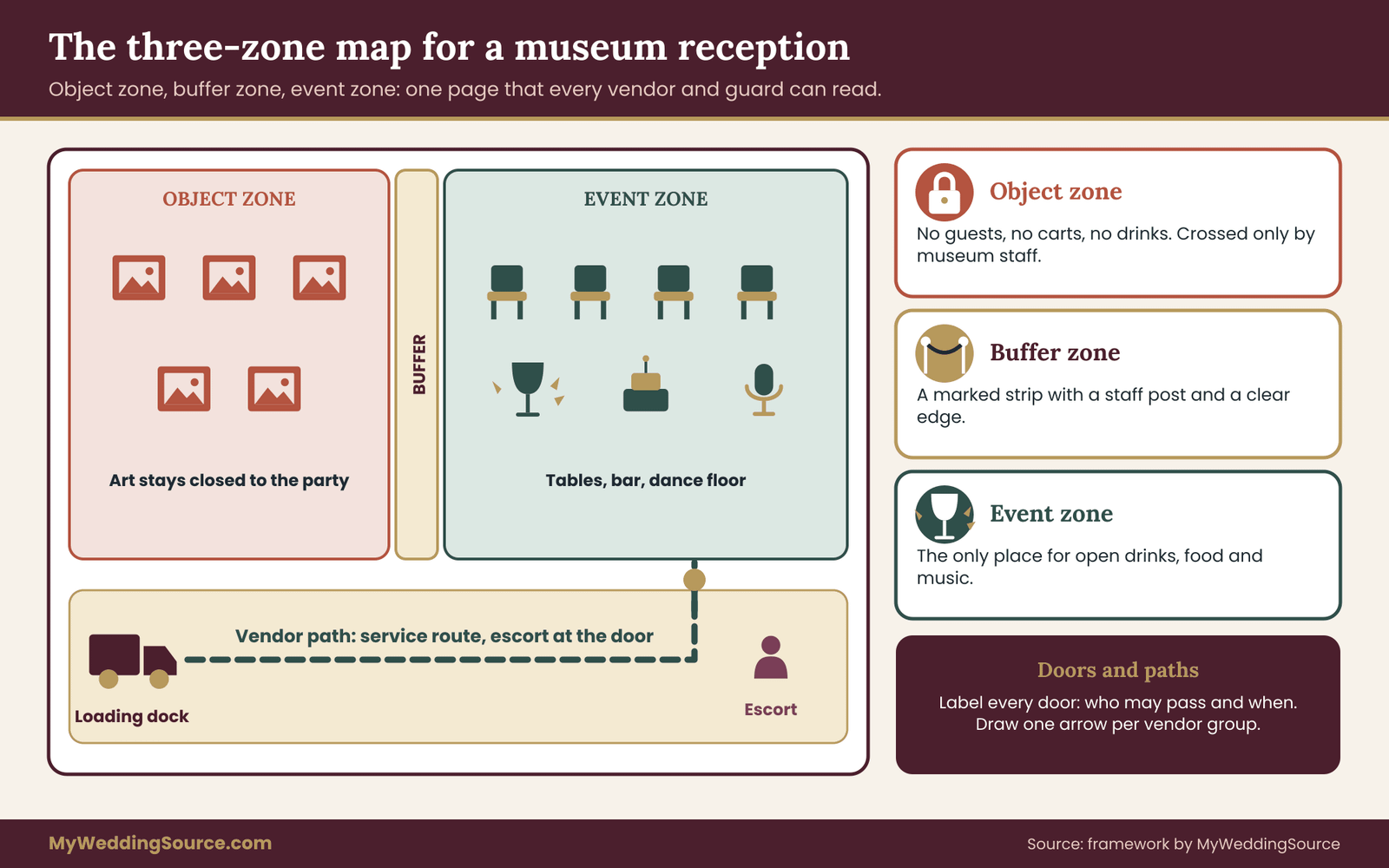
The method for a museum reception fits on a single page. Draw the floor plan of the museum spaces you will use, then color each area as one of three zones.
The object zone is any space where art is within reach, within splash range or within the swing of a tray. Guests and vendors do not enter it during the museum reception. If it has to be crossed, it is crossed by museum staff only, or not at all. Sometimes an object zone is a whole gallery with its doors closed. Sometimes it is a single large sculpture in the middle of an otherwise open hall, protected by a floor mark and a staff member.
The buffer zone is the strip between the objects and the party. It is where vendors move equipment under escort, where guests pass through a controlled doorway, and where a staff member stands. It has a defined width, a visible edge and a plan for what happens when someone crosses it. In a hall full of art, the buffer may be a distance from each wall, marked on the floor with tape or stanchions. In a corridor, it may be the whole corridor.
The event zone is where the museum reception takes place: tables, bar, dance floor, stations, stage. It has no art in reach, or only art the museum has agreed is safe to have nearby, such as large works behind glazing or objects mounted well above head height. The event zone is the only place with open drinks.
The map has two more elements. Doors are drawn where zones meet, each with a label for who may pass and when. Paths are drawn as arrows from the loading dock to the event zone, one per vendor group, showing the route, the cart type, the escort and the hold points.
The sections that follow explain how to read the museum’s rules and decide which galleries fall into which zone, how to build a path card for each vendor, and how to handle food, guests, sound and photography. They end with a worked example, the alternatives and the contract language. Together they turn the three-zone map into something you can hand to the museum and your vendors.
The figure below shows the idea in one view.
Reading the museum’s event rules before a museum reception is booked
Event rules for a museum reception are rarely one document. There is usually a rental agreement, a list of policies and guidelines, a vendor information sheet, an insurance requirement and a facility map. Some of the most important limits live only in the heads of the registrar and the head of security. Your first job is to turn those scattered limits into one list you can check each vendor against.
Start by asking for the documents in writing, then ask the questions the documents do not answer. A calm, specific request works better than a general one. “Please send your vendor guidelines, your approved vendor list if you keep one, your insurance requirements and your floor plan with the museum reception spaces marked” is easy for an event manager to answer. “What are your rules?” is not.
Which spaces are included, exactly? Ask for the rental areas by name on a floor plan, not by description. “The main hall” can mean the atrium alone or the atrium plus two adjoining galleries. Ask which spaces are available for guests during the event and which are available only to vendors and staff before it.
What are the hard limits on the collection? Ask for the list in the museum’s own words. Common items include no open flame, no red wine or colored liquids in certain rooms, no confetti, glitter or petals, no adhesive on walls, no objects on or leaning against walls or plinths, no helium balloons near ceilings, no fog or haze, no flash photography near light-sensitive works, and no food or drink within a stated distance of any work.
These vary. Do not assume a rule from another venue applies here, and do not assume one is missing because nobody mentioned it.
Who enforces the rules during the museum reception? Ask how many museum staff will be on duty, what their roles are, who pays for them and what they are allowed to do. A guard who may ask a guest to step back has a different value to you than one who may only observe and call a supervisor.
What happens if something is damaged? Ask how the museum handles an incident, who must be informed, and how the cost is allocated. This is a contract question, and the answer shapes your insurance. Rely on the museum’s written insurance requirements and on your own insurance broker for the answer.
What is the schedule for the building? Ask when the galleries close to the public, when installation or maintenance crews are in the building, whether any exhibition is being installed or removed in the weeks around your date, and whether another event shares the building that day.
That final question matters more than it sounds for any museum reception. An exhibition changeover can turn a gallery you toured last spring into a closed construction zone on your date. A loan arriving from another institution can restrict freight elevator use for hours. If the museum cannot tell you now, ask when it will know, and put that date in your calendar.
Turning the answers into one rules sheet
Once you have the documents, write a one-page rules sheet for the museum reception in your own words. It should have five headings, and each rule should be a short sentence a vendor can follow without reading the full policy.
The headings are: what is allowed, what is not allowed, what needs approval, who approves it, and what the deadline is. A rule such as “No fresh cut flowers in the sculpture hall” belongs under not allowed, with a note on what is allowed instead. A rule such as “Candles of any kind need written approval from the fire marshal and collections” belongs under approval, with the name of the person who signs off and the date by which they must hear from you.
Send the museum reception sheet to the museum event manager and ask them to confirm it is correct. This is not a formality. Your reading of a policy and the registrar’s reading may differ, and you want to find that out in a friendly email three months ahead, not at the loading dock at four in the afternoon on the day.
A few cautions as you build the sheet.
Do not let the sheet become the rule. If your sheet and the museum’s document disagree, the museum’s document wins, and the sheet should be corrected. Keep a line at the bottom that says it summarizes the museum’s policies and that the museum’s own documents govern.
Mark anything that is a preference rather than a rule. Some museums have a preferred caterer list because the staff knows the building, not because a policy requires it. Learn which is which. Preferences can sometimes be negotiated, and requirements cannot.
Note which rules come from lenders. A work on loan may carry its own display conditions, including light levels, distance and handling. Ask the museum whether any lender conditions affect your museum reception spaces, and treat the answer as binding.
Questions for the conservator liaison
Many museums have a staff member who connects the event team with the people who care for the collection. Where that person exists, a short, focused meeting is worth the time. Come with the floor plan and the draft rules sheet, and ask about the works in the rooms you want, not about the museum in general.
Ask which objects in the event spaces are most sensitive to light, vibration, touch and humidity, and whether any are due to be moved, lent or rehung before your date. Ask how far from each work a guest holding a drink is acceptable, and whether the museum would rather see a rail, a floor mark or a person at that line.
Ask whether a crowd of a hundred or more people could change the room’s temperature or humidity enough to matter, and whether the museum monitors it. Ask what the museum would want to know first if a guest brushed against something, so that your incident script matches theirs.
The liaison’s answers shape the whole museum reception. They also tell you how the museum thinks. A team that answers these questions readily, with specifics, is one you can plan with. A team that answers with a general “we will take care of it” may be saying that the rules are looser than you assumed, or that nobody has yet looked closely at your plan.
For general discipline on vetting vendors and the paperwork around them, the site’s vendor due diligence checklist gives a calm structure that fits well with a museum’s insurance and approval steps.
Deciding which galleries stay closed, open or screened at the museum
With the rules sheet in hand, go back to the floor plan of the museum reception and classify every space you might touch. There are three practical categories, and they map onto the zones from the three-zone method.
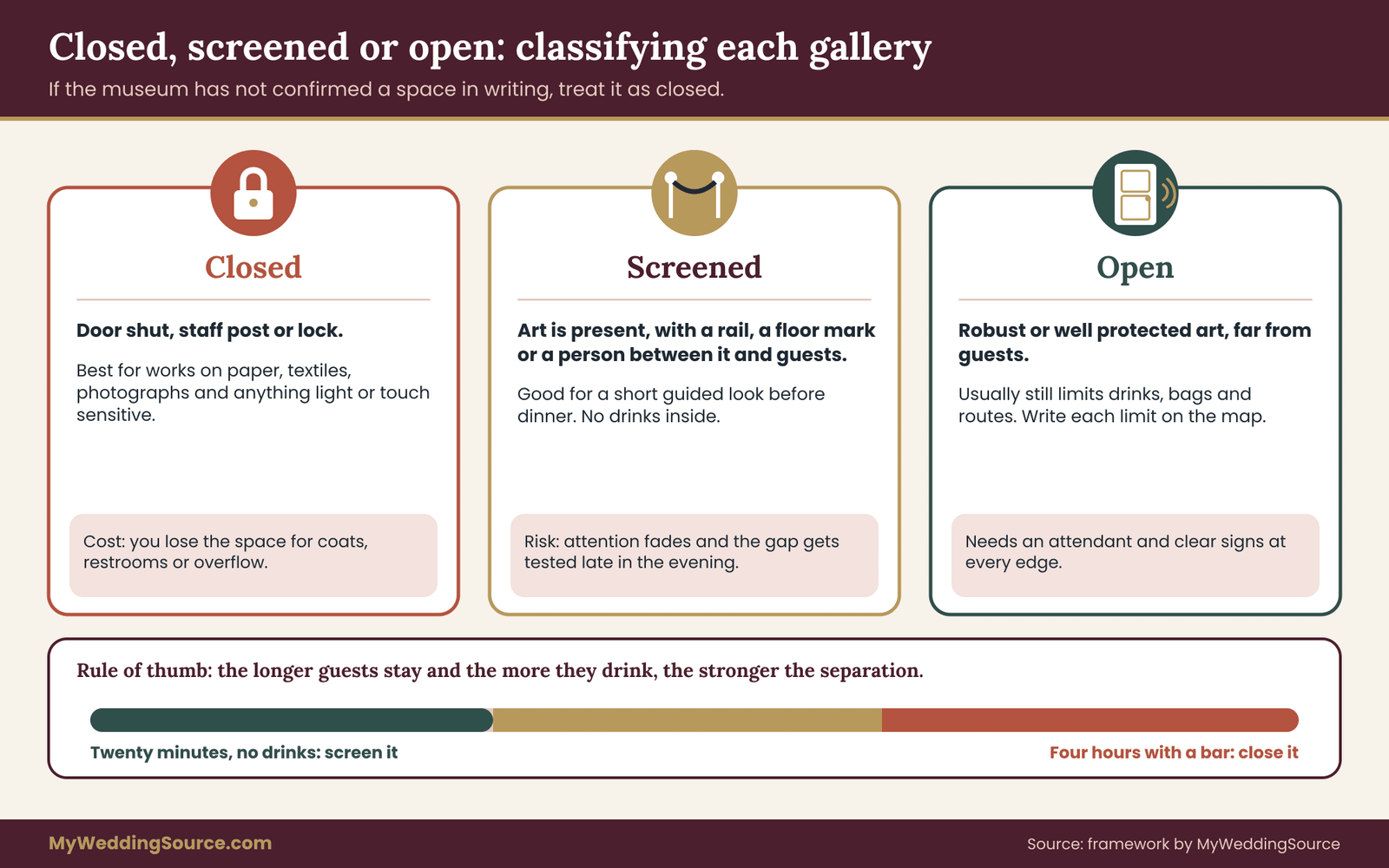
Closed galleries are object zone, with the doors shut and a staff member or lock holding the line. Closing is the safest and often the simplest answer for a gallery with works on paper, textiles, photographs or anything that is sensitive to light, touch or humidity. It also costs you space. If the closed galleries include the room next to the atrium, you lose a natural overflow area, and you will need a plan for coat check, restrooms or a quiet room somewhere else.
Open galleries are event zone, or buffer zone under supervision. A museum will typically allow open galleries only when the art in them is robust, well protected or placed far from the guests. An open gallery usually still carries limits. Guests may have no drinks inside it, may have to leave bags outside it, or may be permitted only to walk through. Ask the museum what each open gallery’s limits are and write them on the map.
Screened spaces are in between. The art is physically present but separated from the guests by something other than a closed door: a rope line, a rail, a glass wall, a distance marked on the floor, a staff position. Screening works for moments such as a short, guided viewing during cocktail hour. It works less well for a long evening, because attention fades and a determined or tipsy guest will find the gap.
A useful rule of thumb is that the longer guests will be in a space, and the more drinks they will have, the stronger the separation should be. A twenty-minute viewing before dinner can be screened. A four-hour dance should not be held in a room where a painting hangs behind the bandstand unless the museum has deliberately approved that exact arrangement.
Walk the museum with these categories in mind and ask the museum to confirm each space in writing. If the museum hesitates about a space, treat it as closed until told otherwise. Starting from closed and opening up is much safer than the reverse.
A short checklist for the walkthrough
A site walk with the museum is the best use of an hour you will have while planning a museum reception. Go early, bring the floor plan, and bring the people who will carry the plan out: the planner or coordinator, the caterer’s manager, the florist and the person who runs the sound. If you can only bring one vendor, bring the caterer, because food and beverage has the most contact with the collection.
On the walk, follow the route a vendor would use, from the loading door to the event zone, and note the following. Measure door widths and elevator interiors, and ask for the weight rating. Check the floor surface and ask which carts and wheels are approved. Look for thresholds, ramps and steps that a cart cannot cross.
Find the nearest restroom to the event zone and the nearest one that is not inside the object zone. Locate the electrical outlets that you are allowed to use, and ask whether power must come from the museum’s panel or from a generator, which many museums do not allow indoors.
Note every place where the path crosses a gallery with art in it. If a vendor route must pass through an object zone, ask the museum whether it can be re-routed, or whether the gallery can be cleared or protected for the load-in window. This is the single most common trouble spot in a museum reception, and it is far easier to solve on paper.
For a broader approach to site measurements and vendor needs, the guide to venue technical walkthroughs lists what to measure and record, and much of it applies here. The additions at a museum are the collection-specific items: object distances, lender conditions and the escort plan.
Take photos where the museum allows it, and ask before you do. Some museums restrict photography inside galleries even for planning. If photos are not allowed, sketch and label instead.
Vendor path cards for a museum reception
The most useful single document in a museum reception plan is not the floor plan. It is the path card, a half-page sheet given to each vendor that describes exactly how that vendor’s people and equipment will move through the building. A floor plan shows where things go. A path card shows how they get there without touching anything they should not.
Build one card per vendor group for the museum reception, not per person. Typical groups are catering and bar, florals and décor, rentals, sound and lighting, photography and video, cake and dessert, and any entertainment. Each card has the same eight fields, so that the museum can scan them quickly and compare.
Gate and arrival window. Which door the vendor uses, and the time window in which they may arrive. Museums often assign dock slots to prevent two trucks arriving at once.
Vehicle and parking. What kind of vehicle is expected, where it may stand, how long it may stay, and where it goes after unloading. A truck that sits at the dock all evening blocks every other vendor and sometimes the museum’s own deliveries.
Route, in words and on the map. Name each door, corridor, elevator and room the vendor will use, in order. If the route crosses a buffer zone, say so. If it avoids a gallery, say which one.
Equipment and wheels. List carts, dollies, racks and hand trucks, and say which are approved for the floors. Ask the museum whether wheels must be rubber, whether floors need protective runners, and whether a loaded cart may use the elevator or only the freight lift.
Escort. Who walks with the vendor. A museum may require a staff escort in any gallery with art. Put the escort’s role on the card, not their name, since the person on duty may change.
Hold points. The places where the vendor must stop and wait for clearance before going on. A hold point is usually a doorway between the buffer zone and the object zone, or a place before a stair.
Hazard list. Anything on the vendor’s cart that the museum has restricted, such as liquids, heat sources, aerosols, helium or cut stems. If the vendor does not have any of these, the card says so.
Exit and cleanup. How the vendor leaves, what they remove, what they leave for the museum to handle, and who confirms the space is clear.
When the cards for the museum reception are done, line them up and check them against each other. Two vendors using the same elevator at the same time is a conflict you can see on paper. Two vendors needing the same outlet is another. A florist staging stems in the same corridor where the caterer is moving hot boxes is a third. Fix those on the cards, and you avoid arguing about them in a hallway.
The site’s rental planning checklist is a useful companion here, because rental deliveries and pickups are often the heaviest load-in and the easiest to forget on a path card.
Writing a card that a stranger can follow
The test of a path card for a museum reception is whether a delivery driver who has never been to the museum, and who has never spoken to you, can follow it. Write for that person.
Use door names the way the museum uses them, not your own labels. If the museum calls the dock “Receiving” and you write “back door,” someone will get lost. Include a line about how to reach a person at the museum, by role and by the phone number the museum has approved for event-day use. Do not rely on a personal cell number that might not be answered.
Keep sentences short. “Enter at Receiving. Check in with the dock supervisor. Wait for escort. Use the freight elevator to level two. Turn left. Stop at the rope line.” works better than a paragraph. If you want to add reasons, put them in a separate line.
Add a small sketch. It does not need to be good. An arrow over a floor plan is often clearer than half a page of text.
State the penalty for leaving the route in kind terms. A short line such as “If you are unsure where to go, stop and call the contact on this card” does more than a warning. Most breaches happen because someone does not want to bother anyone and takes a shortcut.
Finally, give the card to the museum for review before you give it to the vendor. If the museum edits it, use the museum’s version.
The load-in sequence for a museum reception
With cards written, you can sequence the day of the museum reception. Load-in is a puzzle with three constraints: the dock can handle only so much at once, the museum has staff for only so many escorts, and heavy or wet work has to finish before the building starts to look like an event.
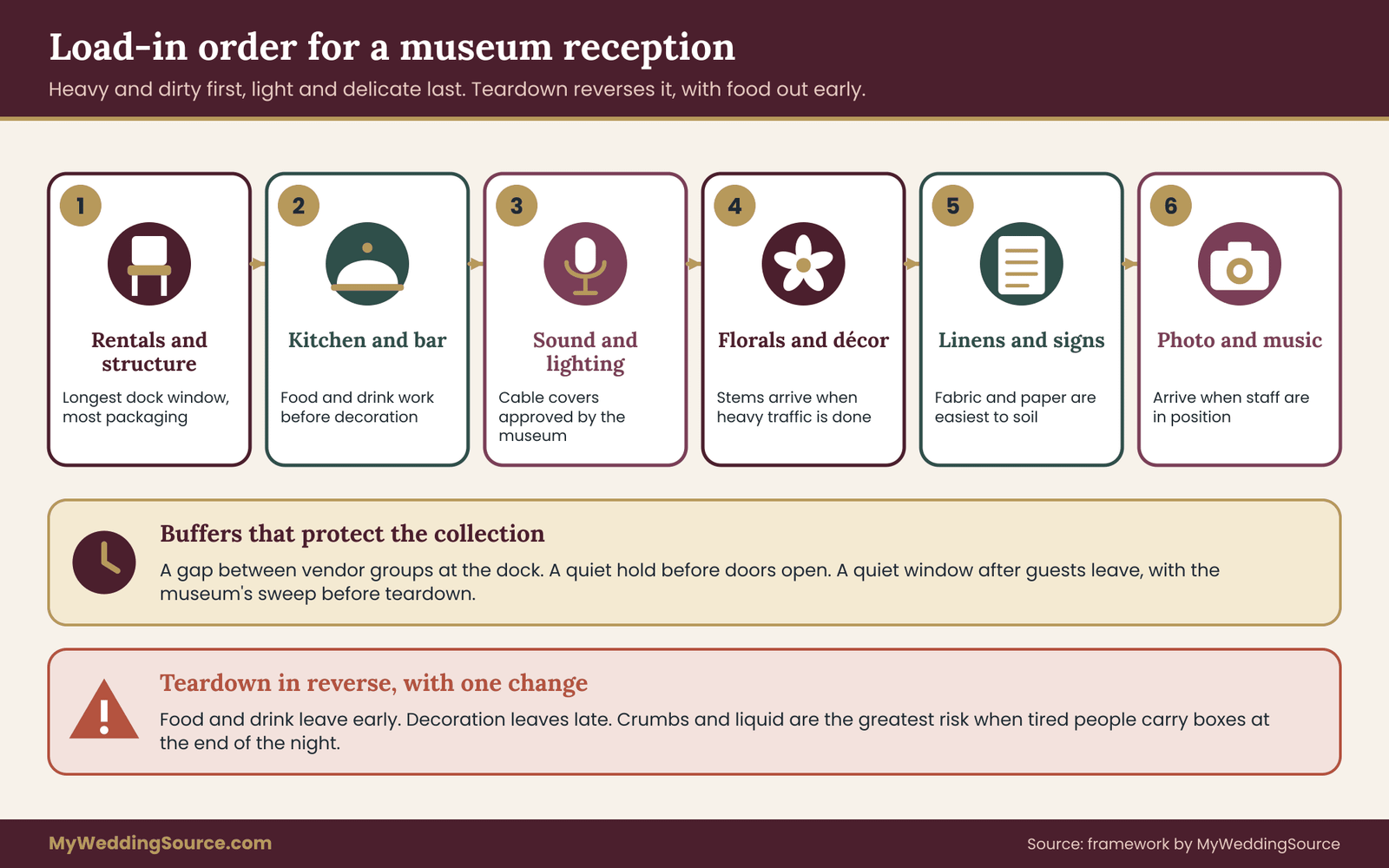
A workable order for a museum reception follows a simple logic, from heavy and dirty to light and delicate.
First, rentals and structure. Tables, chairs, staging, dance floor and any large equipment come first, because they are the heaviest and the hardest to maneuver through narrow routes. The rental company needs the longest dock window and the most staff, and it generates the most boxes and packaging.
Second, kitchen and bar. Catering equipment, cold storage and bar setup follow. Food and drink are the highest risk to the collection, so they work in the space before decoration begins. Setting the kitchen early also lets the museum check it before guests are near.
Third, sound and lighting. Power and cabling are placed after the floor is set and before the tables are dressed. Cable runs across a floor need covers that the museum approves, and the runs should be taped or ramped so that a trip is unlikely.
Fourth, florals and décor. Flowers and decorative items arrive when the heavy traffic is over. This also reduces the time that stems and water spend in a space with art. If the museum bans fresh stems in the event hall, this step is where substitutes are placed.
Fifth, linens, place settings and signage. Fabric and paper go last among the setup, since they are the easiest to soil.
Last, photographers and entertainers. They arrive when the room is ready, which is also when the museum staff are in position.
Teardown after a museum reception reverses the order, with one change. Food and drink should leave early and decoration late, because crumbs and liquid are the greatest risk when tired people are carrying boxes at the end of the night. Plan a staff sweep of the buffer zone before the last vendor leaves.
Work out the times with the museum’s dock schedule in hand. A good habit is to write the schedule in fifteen-minute steps for the first and last hours, since that is when conflicts appear. In the middle of the day the pace slows and the steps can be longer.
Time buffers that actually protect the collection
A tight schedule at a museum reception makes careful people hurry. Hurry is what breaks things. Build in buffers, and put them where the museum’s staff can see them.
Leave a gap between vendor groups at the dock. If caterers finish unloading at three and florals are due at three, there will be a traffic jam at three. A thirty-minute gap costs nothing and prevents a lot of friction.
Leave a hold before guests arrive, with no vendor movement. In the last thirty minutes before doors open, vendors should be finishing in place, not carrying new things across the floor. If something is missing, a runner brings it by the agreed path with an escort.
Leave a quiet window after the museum reception ends. Guests leave, staff close doors, the museum checks galleries, and vendors begin teardown only when the museum says so. A teardown that starts while guests are still saying goodbye mixes two kinds of traffic in one space.
Add a margin for the museum’s own tasks. Security may need to sweep galleries, collections staff may check an object after the museum reception, and a registrar may want a walk with you to sign off on the condition of the space. These are part of the rental, not obstacles to it.
Food, drink, flowers and flame at a museum reception
If you list the ways a museum reception can harm art, most of them arrive through four doors: food, drink, flowers and flame. Museums handle each differently, and the rules are worth understanding, because a good substitute depends on the reason behind the limit.
Drink. Liquid is the most common cause of trouble at a museum reception. A spilled glass can stain a floor, run toward a plinth or splash an unprotected surface. Many museums keep drinks out of rooms with art, or confine them to a defined area with floors that can take a spill. Red wine, dark juices and sugary drinks often get special attention, because they stain and attract insects.
The practical answer is to place bars in the event zone, far from any object, and to serve in a way that limits spills: sturdy glasses, no overfilled pours, and bar staff who watch the line.
A bar placed at the edge of a buffer zone, in a spot that looks convenient, is a classic mistake. Guests carry their drinks away from the bar toward whatever is interesting, and in a museum, that is the art. Put the bar where the next interesting thing is the dance floor or the garden, not a gallery.
Food. Crumbs, grease and smell all matter at a museum reception. Pests are drawn to food residue, and a museum’s pest management program works to keep food away from the collection. Food stations, passed trays and plated dinners each carry different risks. Passed appetizers travel with guests, which makes them the hardest to control. Seated dinners keep eating in one place, which makes them the easiest. Stations fall in between, and they create lines that can spill into a buffer zone if the space is tight.
Ask the museum whether passed food is allowed in open galleries at all. If it is not, plan cocktail hour in a space where it is, and have a seated or station approach in the main room. Choose items that do not shed crumbs or drip: skip the flaky pastry and the sauce that runs. The site’s guide to cocktail hour planning covers how long to run it and how to keep it comfortable, and the museum limits simply add one more constraint.
Flowers. At a museum reception, fresh flowers bring water, pollen, insects and petals. Many museums limit them to certain rooms, require containers with sealed or low-water designs, or ban them in galleries altogether. Pollen can stain surfaces. Petals can end up where they should not. Insects hitch rides on stems.
A florist who understands this can do very well in a museum reception. Dry and preserved arrangements, sealed vessels, foliage in place of heavy blooms, or arrangements built on a base that cannot leak all work. Ask the museum what it accepts and then give the florist the written answer. A florist should never learn the rule at the door.
Flame. Open flame at a museum reception is almost always restricted, and the restriction is often set by the fire code as well as by the museum. Candles in glass, tea lights and sparklers may be banned in a space even when a venue elsewhere would allow them. Battery candles are the common substitute and look fine in a room with reasonable light. Check with the museum whether battery candles are approved, since some have restrictions on color temperature or on moving parts.
Keep this in perspective: a museum reception can still be warm. A museum is not trying to remove all warmth from your wedding. It is trying to keep the art safe, and there are ways to create atmosphere, such as lighting, linen, music and thoughtfully chosen furniture, that do not carry risk.
Dealing with the “just this once” request
At some point during a museum reception a guest, a relative or even a vendor will ask for an exception. Someone wants a candle for the cake, a quick toast with red wine in the gallery with the best view, or a photo with the sculpture. The pull is strongest when the building is lovely and the mood is warm.
The best protection is to decide in advance who can say yes, and to make the answer almost always no. The answer-maker should be the museum staff member on duty, not you, and not the planner. You should not be put in the position of enforcing rules at your own wedding, and the staff member’s authority is clearer than yours.
Give your family and wedding party a simple line to use: “The museum has set the rules for the galleries, and the staff will help if there is a question.” It gives people a place to send a request without turning it into a personal disagreement. For a request that may be reasonable, such as a photograph in a gallery that is otherwise closed, the staff member can check with collections and often arrange it as a scheduled moment with an escort.
Guest boundaries that hold up through a museum reception
A boundary map for a museum reception is only as good as the way guests learn it. Most guests at a museum reception are respectful, but they are also in a beautiful place, they have drinks and music, and they are looking around. Without clear cues they wander.
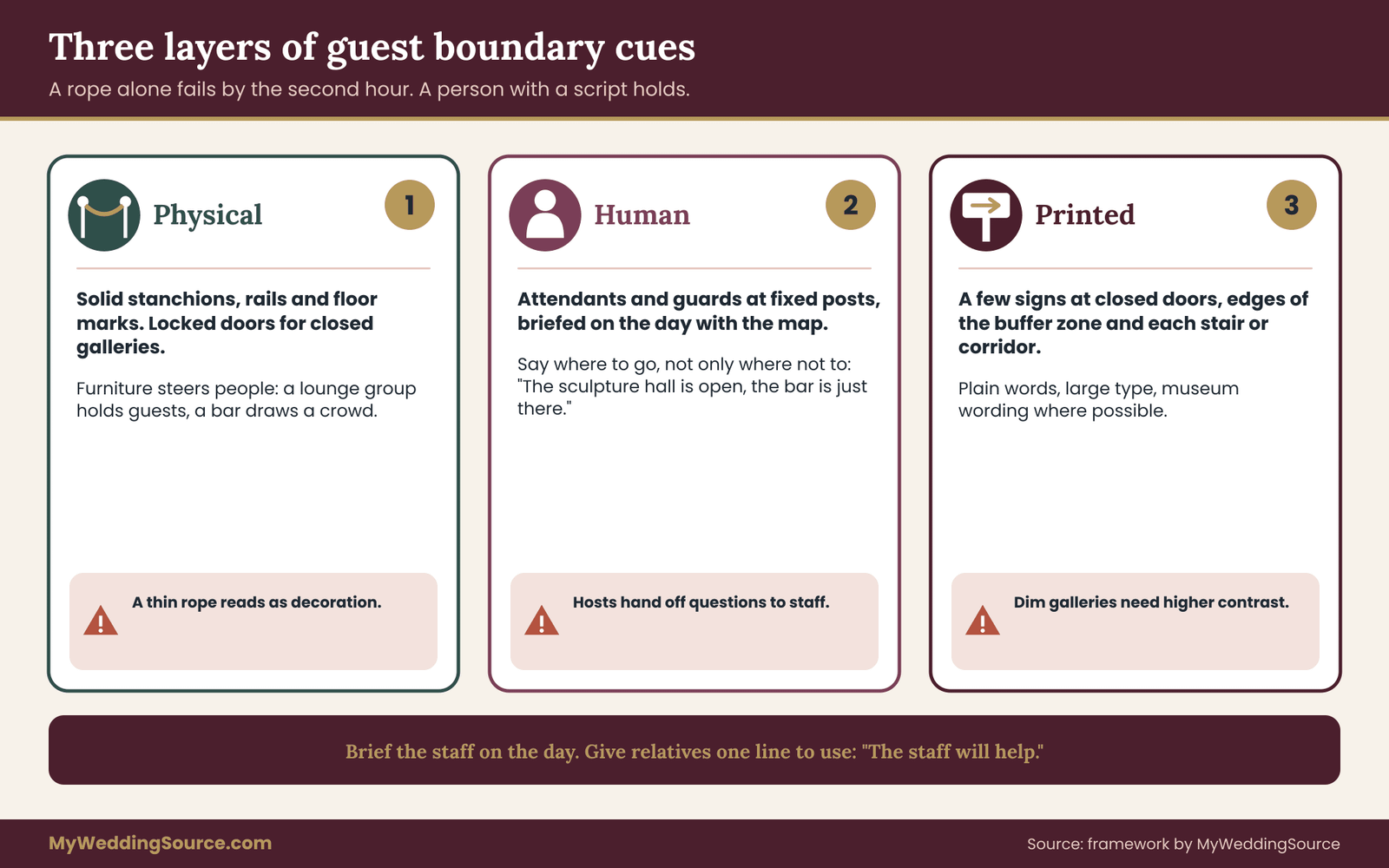
Think about three layers of cue: physical, human and printed.
Physical cues are the barriers and the layout. Stanchions, rails and floor marks show the edge of a buffer zone. Doors closed and locked make a boundary absolute. Furniture placement also steers people, because a lounge group of sofas tends to hold guests in place, and a bar draws a crowd.
A physical barrier should be obvious and should look intended. A single thin rope across a doorway reads as a decoration. A solid stanchion with a sign and a staff member reads as a boundary.
Human cues are the staff. Gallery attendants, security officers and event staff each stand in the places the plan assigns. The plan should say how many staff are needed, where they stand and what they say. “This gallery is closed for the evening, but the sculpture hall is open and the bar is just there” is more useful than “You can’t go in there.” It tells the guest where to go instead of only where not to.
Brief the staff before the event. A short meeting on the day, with the map, the schedule and the contact list, makes sure that everyone knows who is responsible for what. Make sure that any hosts, ushers or wedding party members assigned to help know to hand off questions to staff, not to enforce rules themselves.
Printed cues are the signs. A small number of well-placed signs does more than many. Place a sign at each closed door, at the edge of each buffer zone and at each decision point such as a stair or a corridor. Use plain language and the museum’s approved wording where possible. The site’s guide to wedding signage as a system covers readability and placement in more detail, and it applies directly here: size, contrast and distance matter more in a dim gallery than in a bright hall.
Planning guest flow around the art
At a museum reception, guests move toward what they want: food, drink, seats, the restroom, the dance floor and a view. If those things are placed well, most guests will not try to go where they should not. The guide to reception guest flow goes through entry, seating, food and exit in a general setting. At a museum reception, add one rule. Put every desirable thing inside the event zone, and make the route between them clear and wide.
Restrooms are a common problem at a museum reception. If the nearest restroom is through a gallery, guests will take that route, and some will linger. Ask the museum which restrooms are open to guests, mark the route and place a staff member at the turn. If restrooms are far away, build that into your timeline, because lines form and people wander.
Coat and bag check matters more than usual. Many museums ask that large bags, umbrellas and coats stay out of galleries, because they swing and bump. A coat check at the entrance, staffed and clearly marked, solves this. It also reduces the risk of theft and keeps bags off the floor in the event zone.
Think about the guests who need extra help. Wheelchair users, guests with canes and older relatives need clear, level routes with seating. Museums are generally required to be accessible to the public, and many have excellent accessible routes, but those routes may not be the same as the ones used for your museum reception. Ask the museum which routes are accessible, and make sure that the boundary plan does not block them. If a stair is closed to guests, confirm that an elevator route is open and signed.
Children need their own plan. A museum is exciting to a child, and a long evening makes running and touching more likely. If children are on the guest list, tell parents the boundaries in the invitation or the welcome note, and consider giving older children a small task, such as handing out programs, to keep them near the event zone.
Place a staff member near the nearest open gallery. A quiet corner with seating and a few activities in the event zone gives families somewhere to go that is not a gallery, and it makes the whole museum reception calmer for everyone.
Finally, plan for the moment when the museum reception ends. Guests tend to leave in waves, and at the end they drift. Have staff in position, lights set and a clear path to the exit and the coat check, so that no one is wandering in a dark gallery looking for the door.
Sound, light and photography in a museum reception
At a museum reception, music, lighting and cameras change the building as much as food does, in ways that are easy to overlook. A gallery with hard walls and a high ceiling is a loud room. A gallery that is normally dim for the sake of the art may be lit for a party. A camera with a flash is a tiny, repeated pulse of bright light in a place designed to limit exposure.
Sound. For a museum reception, large, hard-surfaced rooms with stone or glass carry noise a long way, and sound has a physical component as well as a social one. Low frequencies can travel through floors and walls, and a museum may have limits on amplified sound near fragile objects or in rooms close to galleries that stay closed.
Ask whether there are volume limits, whether there are rooms where amplified music is not permitted and whether the museum has a preferred sound approach. A string trio in the atrium and a DJ in a separate hall is a reasonable split in a building where one room is much more sensitive than another.
Place speakers away from walls with art on them, and ask the sound vendor to aim them so that the main energy goes at the dance floor and not at the nearest gallery door. A planner who tests the sound before guests arrive, with the museum’s person listening in the adjoining spaces, will catch problems early. Lean on your sound vendor’s experience in hard-surfaced rooms and on what the museum tells you.
Light. Light affects art in two ways. Visible light and ultraviolet radiation cause cumulative damage, especially to works on paper, textiles, photographs and some pigments. Heat from lamps can also warm a surface. A museum usually controls light levels carefully in the galleries, and it may not want to change them for an evening. A party may want to do the opposite and add color, uplighting and moving lights.
Keep museum reception lighting away from the art. In a hall that has art on the walls, the museum may require that your lighting be aimed away from works, that it does not raise the room’s heat noticeably and that it uses fixtures that do not emit significant UV. A vendor who works in museums will know this. Ask for the lighting plan in writing, including fixture types, positions and any gels, and have the museum approve it.
Colored uplighting on a plain wall can look fine in a room without art. On a wall with a painting, it is a conversation to have with collections staff first. If the answer is no, a few well-placed lamps and string lights in the event zone, away from the walls, can still make the room feel warm.
Photography and video. Flash is the headline issue at a museum reception, since many museums restrict it near works on paper, textiles and other light-sensitive objects, and some restrict it throughout. Ask whether flash is allowed in the event zone, in the buffer zone and in each open gallery. Your photographer will adapt, using higher sensitivity, faster lenses and available light, and often prefers to anyway. Make sure that the photographer has the rules in writing before the event, not just on the day.
Other camera issues include tripods and light stands, which can tip and need floor protection, drones, which are almost always prohibited indoors, and photographing the art itself. Museums may control how images of their collection are used. A portrait of a couple in front of a painting may be fine for your personal album and subject to different terms if a vendor wants to use it in marketing.
Ask the museum about image use, and check what your own photographer’s contract says about publishing images. The guide on wedding photography consent covers how couples and guests can set boundaries for photos and image use, which helps with the guests’ side of the question.
Consider staging a limited, scheduled portrait session in a gallery that is otherwise closed. Many museums will allow it with an escort and a short time window, before guests arrive. This gives you the art in the background without opening the room for the whole event. It also lets the photographer work in better conditions, with fewer people in the frame.
A worked example of a museum reception, with invented numbers
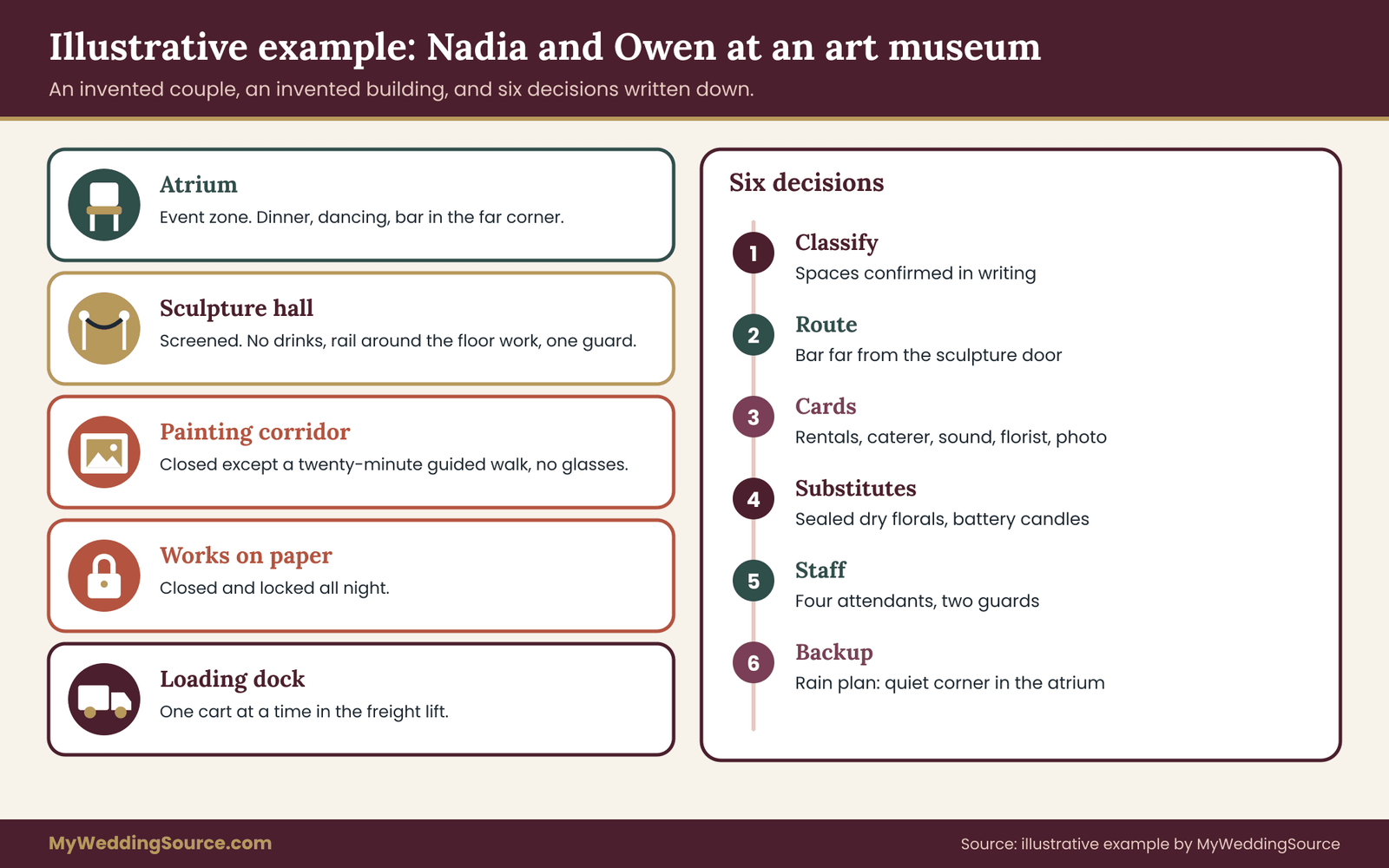
To make the method concrete, here is an illustrative case. The couple and the museum are invented, and the numbers are chosen to show the reasoning, not to represent any real venue or typical quote.
Nadia and Owen are planning a reception for about one hundred and ten guests at a mid-sized art museum. The museum has a large atrium with a stone floor, a sculpture hall off the atrium, a long corridor of paintings, a gallery of works on paper behind a locked door and a loading dock on the lower level reached by a freight elevator. The museum’s event office has offered the atrium and the sculpture hall for the event, with the corridor available for a short walk-through before dinner.
Step one: classify the spaces. They ask the museum for a list of which spaces are which, in writing. The works-on-paper gallery is closed for the night and locked. The corridor of paintings is screened: open for a guided, drink-free walk during a defined window, with two attendants. The sculpture hall has several large works on plinths and one on the floor. The museum allows guests but not drinks, and asks that the floor-standing work be fenced with a rail and watched by a guard. The atrium is the event zone.
Step two: decide what moves where. Dinner and dancing go into the atrium. Cocktail hour goes into the atrium’s edge, and the bar is placed in the corner farthest from the sculpture hall doorway. The sculpture hall becomes a viewing space with no drinks, entered through a door where a staff member holds a tray for glasses. The corridor is used once, for a twenty-minute guided walk led by a museum educator before dinner, and guests leave drinks in the atrium.
Step three: path cards. The caterer, rental company, florist, sound vendor and photographer each get a card. The freight elevator takes one cart at a time, so the cards stagger the rental company at the start, the caterer second, the sound vendor third and the florist last. The museum requires an escort for any vendor crossing the corridor. The cards route everyone around it instead, through a service hall, to avoid the escort bottleneck.
Step four: substitutes. The florist cannot bring fresh stems into the sculpture hall, so arrangements there are dried grasses in sealed bases. In the atrium, fresh florals are allowed in sealed containers with trays. The museum bans open flame, so the tables carry battery candles. The cake is cut in the atrium, and the museum asks that the cake table sit on a protective mat.
Step five: staff and signage. The museum agrees to four attendants and two security officers. One is at the corridor door, one at the sculpture hall rail, one at the works-on-paper door, one in the atrium and two floating. Signs at each closed door read in the museum’s wording. The wedding party is given the standard line for relatives.
Step six: contingencies. Rain closes the garden terrace, which would have been the spillover space. The plan moves the quiet area to a corner of the atrium and trims the cocktail hour by fifteen minutes. A conversation with the museum a month earlier made sure that the corner was available.
The point is not that this museum reception plan is right for every museum. It is that every decision was recorded, mapped and approved, and each vendor knew its own path. When a florist asked about adding a hanging installation, the answer was clear: not in this space, and here is the one that is allowed.
Running the evening: roles, signals and an incident script
A museum reception plan only matters if people carry it out at seven in the evening, with music playing and the room full. The day-of operating plan for a museum reception is short, and it assigns four things: who is in charge of the boundary, who speaks to the museum, how problems are reported and what happens first when something goes wrong.
One person speaks to the museum during the museum reception. Usually this is the planner or a day-of coordinator. If you have no planner, appoint a calm, organized friend or relative who is not in the wedding party and who will not be at the center of every photograph.
Give that person the contact sheet and the authority to make small decisions. Everyone else routes questions through them. Without a single contact, the museum’s staff end up fielding requests from the caterer, the florist, a parent and the DJ at once, and the answers conflict.
One museum contact holds the keys to the building. Learn their title and how to reach them by radio, phone or in person for the whole event. Ask who the backup is if that person is called away.
A short, shared signal list. In a noisy room, people need simple signals. A staff member who has to ask a guest to leave a gallery should not have to explain it to a whole table. Agree on a few phrases and on who may use them. Define what counts as an urgent matter: a spill near an object, a guest in a closed gallery, a vendor off route, a fire alarm, a medical emergency. Decide in advance which of these go straight to the museum and which the coordinator handles.
An incident script. If something touches or threatens an object, the first step is to stop the activity and keep everyone away, without moving or cleaning anything. Moving a damaged object can make the damage worse, and cleaning can destroy evidence a conservator needs. The coordinator notifies the museum contact at once.
Staff handle the object. People who were nearby give their account later, calmly and in writing. This is a good point to be clear with your vendors: nobody tries to fix anything. A museum prefers to hear about a small incident immediately rather than discover it the next morning.
A similar script applies to guest incidents. If a guest becomes unwell, staff call for help and the coordinator keeps the area clear. If a guest drinks too much and becomes unsteady near art, a staff member walks them to a seat, and the coordinator asks the bar to adjust service. These are ordinary events at any reception, and the museum setting only raises the stakes slightly.
When a museum reception is not the right choice
A museum reception can be wrong for a particular couple. Say so early, with a clear head, because the cost of changing course drops as you decide sooner. The following conditions are signs that this specific museum or this specific plan may not work.
The museum will not put its rules in writing. If the answers are verbal, vague or contradictory, the rules can change on the day. A museum that is confident in its procedures will usually share them.
The usable event zone is too small for the guest count. If, once the object and buffer zones are drawn, the remaining space seats fewer guests than you plan to invite, the answer is not to squeeze. Fewer guests, a split event or a different venue are all better than putting tables into a buffer zone.
The load-in route crosses the object zone with no alternative. If every route from the dock to the museum reception passes through a gallery of fragile work, and the museum will not clear or protect it, the plan cannot be made safe.
Staffing is not available or not affordable. Escorts and attendants are the means of enforcing your boundaries. If the museum cannot provide enough of them, or if the cost pushes the museum reception beyond your means, the boundaries will rest on goodwill.
The insurance requirement cannot be met. If a vendor cannot provide the coverage the museum asks for, or you cannot arrange the event coverage required, the booking is at risk. Resolve this before you pay anything non-refundable.
The museum reception calendar is uncertain. If the museum may install or remove an exhibition near your date, and it will not commit to which spaces will be available, you could lose the main attraction of the venue. Ask for the right to adjust or cancel without penalty if the available spaces change.
The vendors you want cannot work under the rules. If your caterer will not follow the beverage limits, or your sound vendor cannot meet the volume rules, you can change vendors, but you should do so deliberately, not at the last minute.
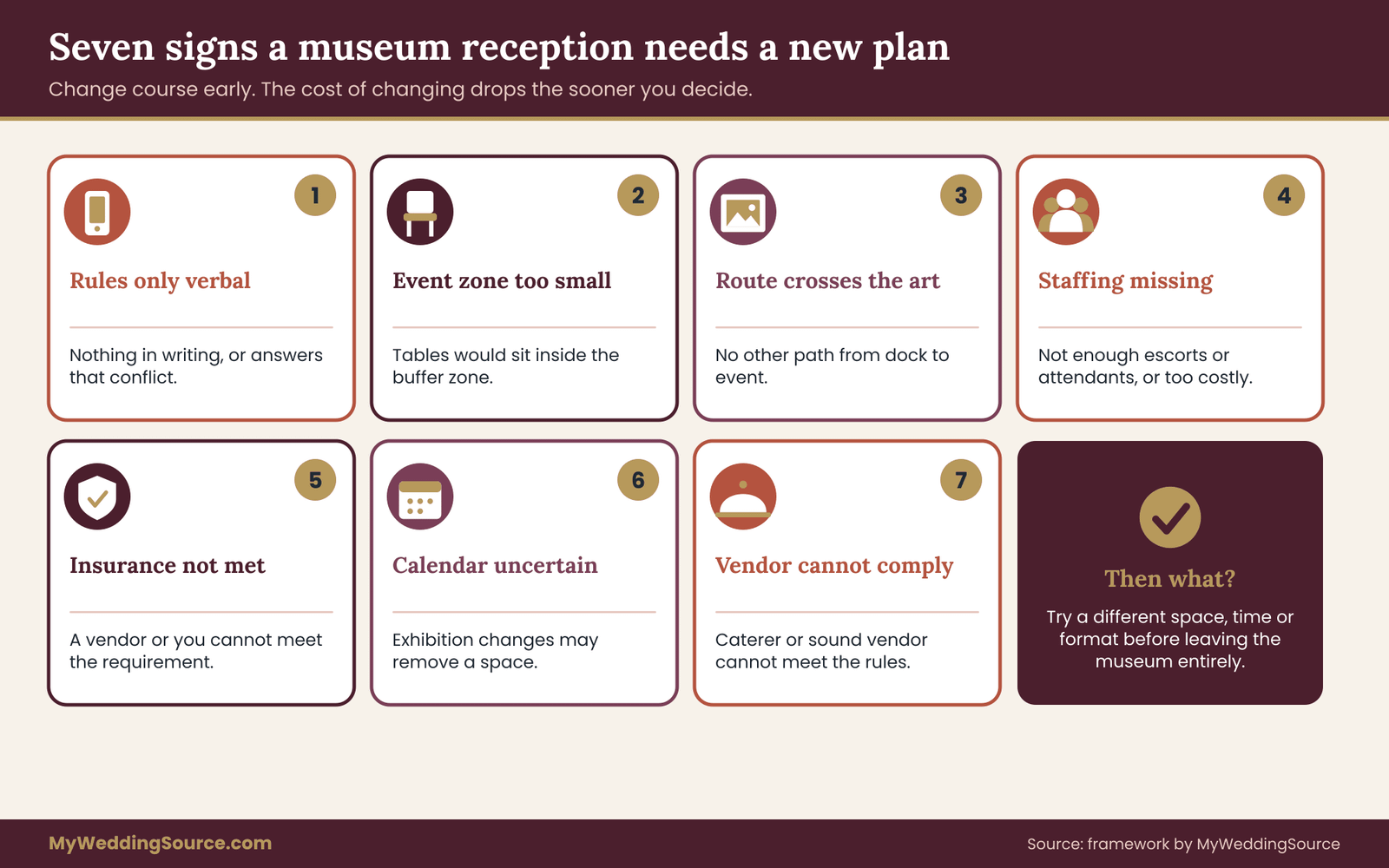
If one of these appears, you do not have to give up on the museum entirely. A different space, a different time or a different format may work.
Season, calendar and the museum’s own schedule
A museum’s year has a rhythm that affects a museum reception more than most couples expect. Major exhibitions open and close on fixed dates, and the weeks around those dates are busy with installation. School groups, member events and public holidays fill the building in some seasons. Fundraising galas often take the best dates in autumn and spring. Ask the event office which weeks are quietest, when the building is least likely to be under construction and whether any rooms are scheduled for conservation work during your window.
Weather also matters indoors. In winter, wet coats, snow and salt on shoes bring moisture and grit onto stone floors that the museum works hard to keep clean. In summer, humidity and heat strain air handling when a full room of people arrives. Neither is a reason to avoid a season. Both are reasons to ask the museum what it does about them, and to plan coat check, entry mats and cooling with the museum’s input.
Alternatives that keep the feeling without the risk
Wanting a museum reception is usually about atmosphere: beauty, quiet, a sense of occasion, a backdrop that does not look like every other venue. There are several ways to keep much of that while reducing the exposure.
A museum reception in the atrium only. Many museums have a large, robust public hall that can host a seated dinner and dancing with no art in reach. This is the simplest version of a museum reception, and often the strongest. The galleries remain closed, and guests can still feel the building around them.
A ceremony or dinner at the museum, dancing elsewhere. If the museum has limits on amplified music or late hours, the party can move to a nearby space after dinner. This requires transport and a second set of vendors, but it protects the collection and the museum’s rules at the same time.
A museum with an outdoor space. A sculpture garden, courtyard or terrace can have fewer collection risks than an interior gallery, although outdoor sculpture has its own protection needs and weather adds a layer of planning. Ask the museum for its rain plan in writing.
A daytime event. A lunch or afternoon museum reception may fit better with a museum’s calendar than a late evening, since staff and security are already on site, and natural light supports a gentler atmosphere. It also avoids the problem of long, alcohol-heavy hours.
A partner or neighboring venue. Historic houses, gallery spaces, libraries, botanical gardens and cultural centers often have similar character, with fewer collection constraints. Compare them using the questions in the site’s wedding venues guide, and apply the same three-zone thinking wherever objects are present.
A visit instead of a hosting. A museum may offer private after-hours tours. A short guided visit with the wedding party, followed by a dinner in a restaurant, gives the setting without the logistics of a full event.
Each alternative has its own trade-offs in cost, guest count, flexibility and atmosphere. The right one is the one you can run safely and calmly.
Contract language and cost logic for a museum reception
Everything in this guide to a museum reception is worth little if it lives only in your notes. The agreement with the museum, and the agreements with your vendors, should carry the map and the rules. You do not need to write the contract yourself, and you should not try to alter the museum’s legal terms without advice. You can, however, ask for the operating details to be attached and for a few specific points to be stated clearly.
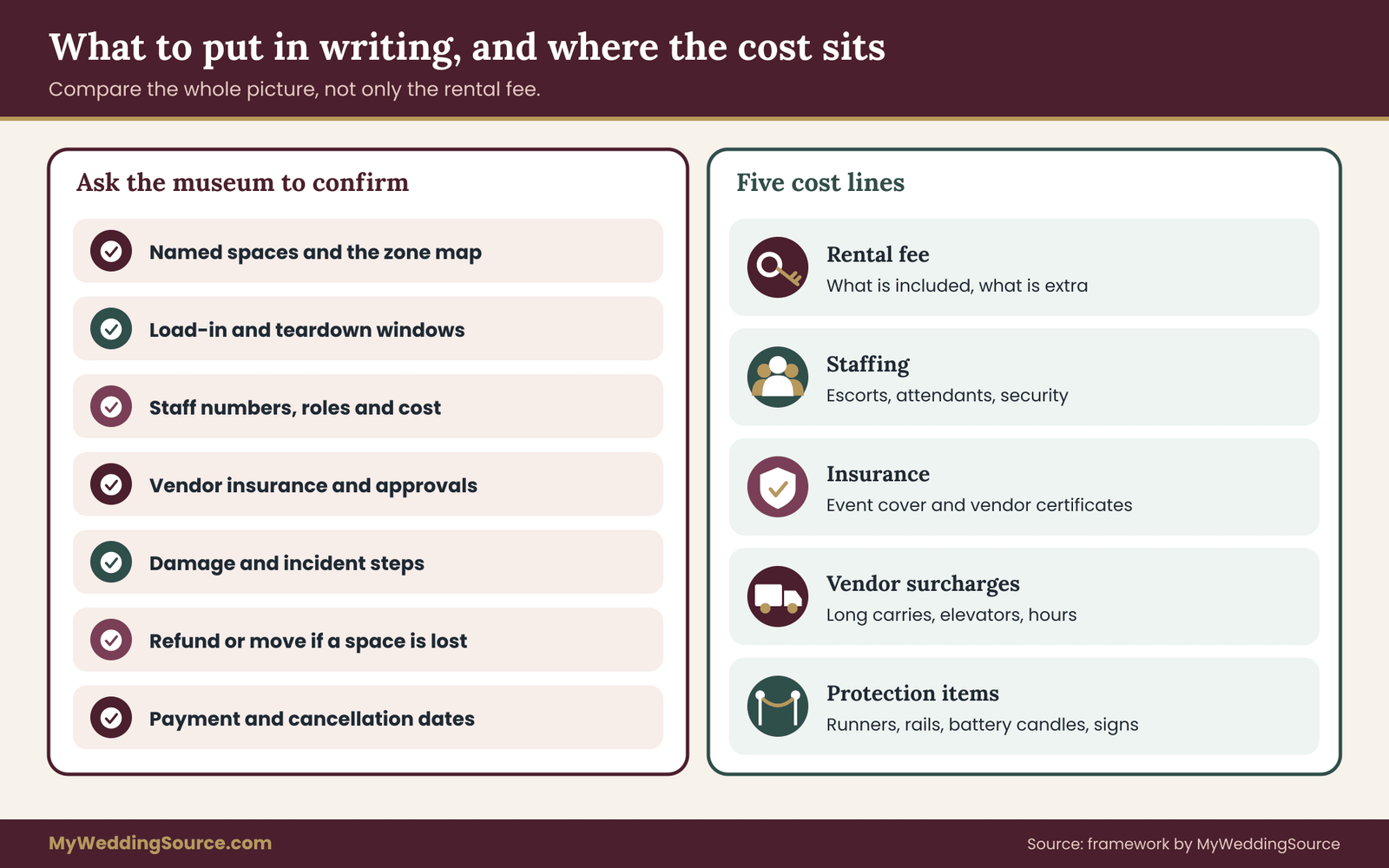
Ask for these items for the museum reception in writing, either in the agreement or in an attached schedule.
The named spaces and the approved layout. The agreement should list which spaces are included and attach the floor plan with the three zones marked. If the layout changes later, the change should be approved in writing by the museum.
The load-in and teardown windows. Dates, start and end times for each, and the dock slots assigned to vendor groups. If the museum has the right to move a window, ask what notice it must give.
Staffing. The number of museum staff for the museum reception, their roles, the hours they are on duty and how their cost is calculated. Ask whether the cost changes if the event runs late.
Vendor requirements. Insurance limits, the form of the certificate, who must be named on it and when it is due, plus any approved or required vendor list. The site’s vendor contract guide explains what to look for in a vendor agreement, and the museum’s requirements should line up with it.
Damage and incident procedure. Who must be told, how quickly, how the museum assesses damage and how responsibility is decided. Read this clause with care, and ask your own insurance adviser to read it as well.
What happens if spaces change. If an exhibition installation, a loan, a safety issue or a building problem takes a space away, what are your options? A good agreement gives you the right to change the plan, receive a refund of some or all of the rental or move the date without a punitive charge.
Cancellation and rescheduling. The schedule of payments, the deadlines and the refund terms. Compare them with your vendor agreements so that you do not owe a caterer after the museum cancels.
If a clause is unclear, ask the museum to explain it in plain language and to confirm the explanation in an email. If the museum will not, that is itself information. For anything with legal weight, a licensed attorney in your state can read the document with you.
Thinking about cost without guessing at numbers
A museum reception often carries different cost lines from a standard hall, and the difference is easy to underestimate. This section gives a way to think about cost that does not depend on any specific price, since fees vary widely and change often. Ask the museum for its current fee schedule and your vendors for their current quotes.
Look at five categories of cost for a museum reception.
The rental fee. This often covers the space and basic services for a fixed period, and it may be higher for evenings and weekends. Ask what is included, such as tables, chairs, restroom attendants, utilities and cleaning, and what is extra.
Staffing. For a museum reception, escorts, attendants, security, facilities staff and an event manager are real costs. They are also the cost that most directly buys protection for the collection. A cheaper rental with thin staffing can be more expensive in the end if it exposes you to a damage claim or forces you to restrict the event.
Insurance. Event liability coverage and vendor certificates cost money and take time. Ask the museum what it requires and compare quotes from insurers early, because deadlines for certificates can be several weeks before the date.
Vendor surcharges. Some vendors charge more for difficult load-ins, long carries, stairs, elevator waits, restricted hours or special equipment. A caterer who has worked in museums may have a standard fee for it. Ask for it to be itemized so that you can compare quotes fairly. Give every vendor the same written description of the museum’s conditions so that their quotes can be compared fairly.
Protection and substitutes. Floor runners, mats, rails, stanchions, battery candles, sealed floral containers and signage are small items that add up. Some are supplied by the museum, and some by your vendors. Decide who provides each one and write it down.
When you compare a museum reception with another venue, compare the whole of these categories, not only the rental fee. A museum can look cheap or expensive depending on what the fee covers. A rental fee that includes staffing and basic furniture may beat a lower fee that leaves you to hire security and rent a hundred chairs.
A decision rule for protection versus convenience
When a conflict arises between what is convenient and what protects the art, use a simple rule: protect first, then reduce the cost of protecting. If a boundary is expensive to staff, shrink the space it needs to cover. If a route is hard to escort, find a different route. If a vendor cannot meet a rule, find a substitute within the rule. Do not reduce the protection to save money, because the cost of a damaged object is borne by someone and is unlikely to be small.
This rule also helps with disagreements within the family. A relative who wants a particular gallery for portraits can be given a scheduled window. A friend who wants to bring a special centerpiece can be shown the rule sheet. People generally accept limits when they see the reason and the alternative.
Your next steps
Start with three actions this week for your museum reception. Ask the museum for its event documents, floor plan and vendor requirements, in writing. Walk the building with the museum’s event manager and mark the three zones on the floor plan. Then write one path card for the vendor with the heaviest load, usually the caterer or the rental company, and ask the museum to review it.
In the following weeks, build the cards for the remaining vendors, finish the rules sheet and attach the approved map to the agreements. A month before the date, hold a short coordination call with the museum and the vendors, walk through the schedule and confirm the contacts. On the day, run the plan as written and let the museum’s staff do their job. A well-planned museum reception looks easy to the guests, and that ease comes from the map nobody sees.
FAQ
Can we have a museum reception inside the galleries?
Sometimes, but it depends on the museum and the art. Some museums keep all events out of the galleries and use an atrium or hall. Others allow limited use of robust galleries with strict rules on drinks, flame and routes. Ask which spaces are included, in writing, and treat any space the museum has not confirmed as closed.
Who decides what is safe near the art?
Usually collections, conservation, registrar or security staff, not the event sales team. Loan agreements can add conditions for specific works. Ask the event office to put you in touch with, or relay answers from, the people who decide, and ask for their answers in writing so that your vendors can follow them.
Can we use candles or sparklers at a museum reception?
Open flame is commonly restricted or banned in museums, both for fire safety and for the protection of the collection. Battery candles are the usual substitute. Ask the museum what it allows, whether any approval is needed and who gives it, and tell your decorator and caterer the answer before they plan their setups.
Are fresh flowers allowed?
It varies. Some museums allow them in certain rooms, in sealed containers or with trays. Others ban them in galleries because of water, pollen and insects. Dried, preserved or foliage-based designs are common alternatives. Ask for the rule by room, and give your florist the written answer well before the event.
How many museum staff will we need at the event?
The museum usually decides, based on the spaces used, the guest count and the layout. Expect attendants at the edges of closed or screened galleries and at least one security presence. Ask the museum for the number, the roles and the cost in writing, and ask whether the number changes if the event runs late.
Can vendors bring their own carts and equipment?
Often yes, but the museum may restrict wheel types, floor protection, elevator use and routes. Put the rules on each vendor’s path card, and ask the museum to approve the card. Vendors who work in museums regularly may already know the requirements. If a vendor’s equipment does not fit, ask them for an alternative.
What if the museum changes an exhibition near our date?
It can happen, and it can change which spaces are available. Ask the museum when its exhibition schedule is set and what it will do if a space is lost. Ask for the right to adjust the plan, move the date or receive a refund, depending on the change, and have that written into the agreement.
Is photography allowed during the reception?
Usually, with limits. Flash may be restricted near light-sensitive works, tripods and stands may need floor protection and drones are commonly banned indoors. Ask for the rules, give them to your photographer in writing and ask the museum about image use if any vendor wants to publish photos taken near the art.
Sources
- American Alliance of Museums
- Smithsonian Museum Conservation Institute
- National Park Service Museum Management Program, Conserve O Gram series
- Canadian Conservation Institute, Agents of deterioration
- American Institute for Conservation
- Library of Congress, Preservation
- ADA.gov, U.S. Department of Justice Civil Rights Division
- National Fire Protection Association
- Institute of Museum and Library Services