
A museum wedding venue or a library offers a setting no ballroom can match, but it also comes with rules written to protect collections and serve the public, not to host a party. This guide gives you a six-gate review for judging event rules, guest experience and vendor fit before you pay a deposit, plus a worked case and a plan for what to do when the answer is no.
Treat a museum wedding venue as an institution that agrees to host you, not as a venue that sells you a day. Run every candidate through six gates: who may rent, what the room protects, what the building allows, how public hours and staff shape your schedule, whether your vendors can work there, and how guests will actually move through the space. A museum wedding venue that passes all six gates is worth the extra paperwork. One that fails any gate in writing, such as no outside caterer, no amplified sound or no access for your vendors on the day, should be replaced early, while your date and your money are still flexible.
Picture the invitation first. Guests walk up broad steps, pass a stone entrance and find a ceremony set beside a skylit atrium. Or a reading room with tall shelves and brass lamps, quiet in a way no hotel ballroom ever is. That picture is why couples ask about a museum wedding venue every year, and it is a fair reason to ask.
The picture leaves out everything behind the doors. Collections have owners, donors, loan agreements and insurers. Public buildings have occupancy limits, fire inspectors and accessibility duties. Staff are trained to say no to anything that might touch an object, and they are usually right to. A couple who learns these facts after signing a contract has a very different wedding from the one they imagined.
This guide is written for the planning stage, when you can still choose. It does not tell you which museum or library to book, and it does not rank institutions. Rules differ from one building to the next, and they change with directors, exhibitions, loans and renovations. What you can do is learn the questions that sort a workable venue from a doomed one, ask them in the right order, and keep everything in writing.
A note on scope. This is general information, not legal, insurance or financial advice. Local fire codes, health rules, public records laws and each institution’s own policies decide what is allowed in your case, so confirm the current rules with the people who issue and enforce them.
What a museum wedding venue is, and how a library differs
The phrase “museum wedding venue” covers a wide range of buildings. At one end is a large art museum with a dedicated events team, a rental price list and a standard contract. At the other is a small local history museum run by a handful of staff and volunteers, where the rental of a single room supports the budget for the year. Natural history museums, science centers, house museums, maritime museums and university collections all land somewhere between.
Libraries are just as varied. A grand central library with a rotunda, a rare book room and a ballroom-style hall behaves differently from a branch library with a community meeting room. Many public libraries do not rent space for private celebrations at all. Others rent a single room, outside public hours, to approved groups. University and special libraries, such as law, medical or rare-book libraries, may host events only for affiliates or donors.
What the two have in common
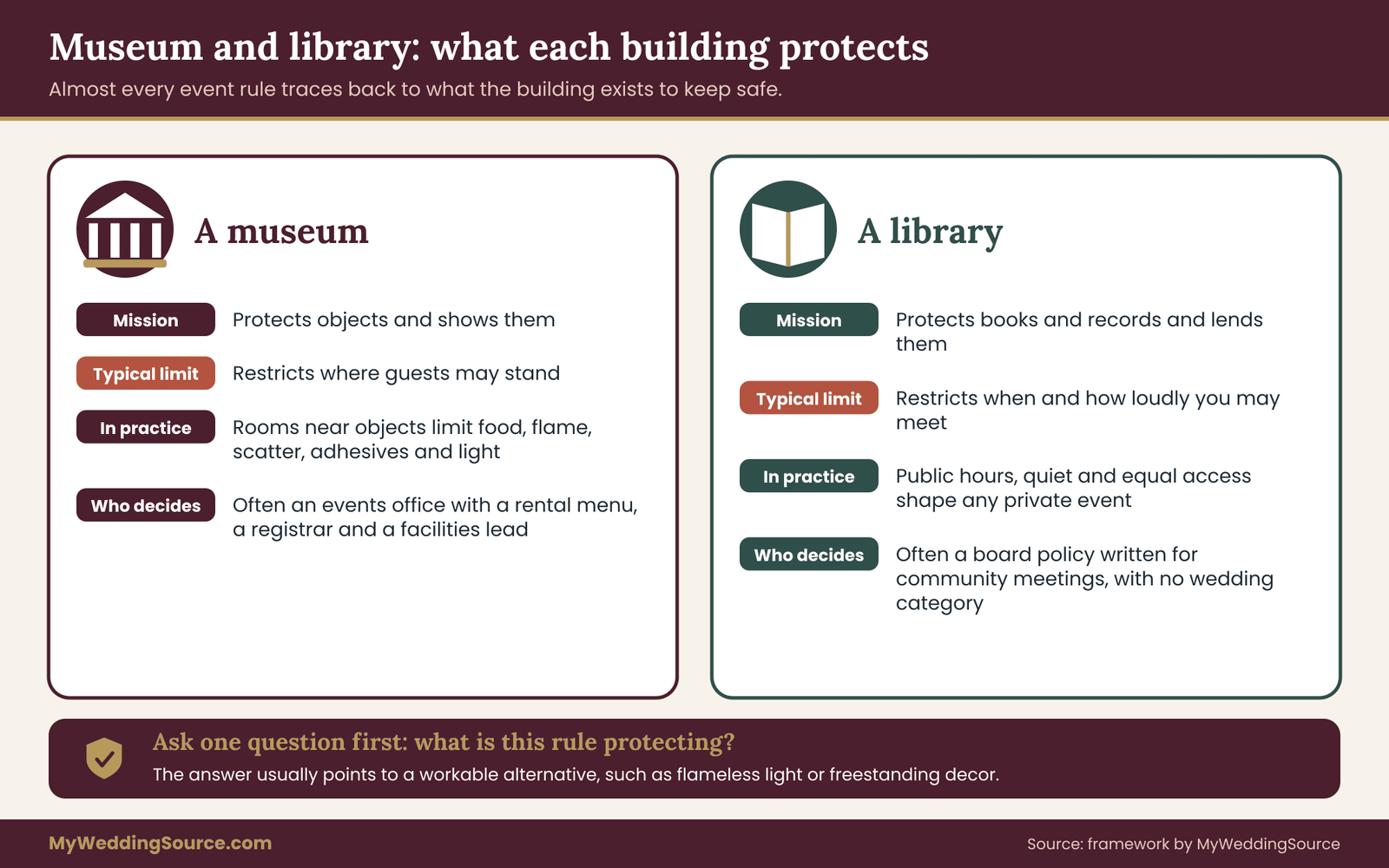
Both kinds of institution exist to keep something safe and make it available to people. A museum protects objects and shows them. A library protects books and records and lends or reads them. Your event is a guest in that mission, and almost every restriction you meet traces back to it.
That shared purpose explains the shape of the rules. Water, food, open flame, adhesives, crowds, heat and light all threaten paper, textiles, paint, wood and metal in different ways. Conservators spend careers learning how. Professional bodies such as the American Alliance of Museums and the American Library Association publish standards and guidance that shape how institutions think about use of their spaces, and the American Institute for Conservation maintains resources on caring for collections.
Where they differ
The differences matter for planning more than the similarities do. A museum usually owns a defined set of valuable, often irreplaceable objects, and a rental plan is built around keeping a distance from them. A library holds a larger volume of items, many of which circulate, and its rules grow from public service: open hours, equal access and quiet.
In practice that means a museum tends to restrict where your guests may stand, while a library tends to restrict when your event may happen and how loud it may be. A museum often has a staffed events office with a rental menu. A library may have a trustees’ policy, a board approval step and a meeting-room form written for community groups, with no concept of a wedding at all.
The category that is neither
A third group of museum wedding venue options sits between them: civic and cultural buildings that combine functions. A city hall with an art collection, a cultural center with a gallery and a reading room, a historic mansion run as a museum, a university library with a gallery wing. The review in this guide works for all of them, because it starts from the same questions: what is protected, who decides, and what has to happen on your day.
Why a museum wedding follows different rules than a ballroom
A ballroom exists to host events. Its rules are about turning rooms over, managing noise and billing for extras. Almost everything is negotiable because the venue’s business depends on yes. A cultural institution’s business is not weddings. The event is a rental, which brings in revenue and visitors, but the building’s first duty is somewhere else.
This changes how every conversation goes. In a ballroom you ask what is possible. In a museum you ask what is permitted, by whom, and in which room. The answers are often more specific than you expect, and more final.
The authority chain
Look at who actually decides. In a hotel, the events manager can usually approve a change. In a museum wedding venue the chain may run through several people: an events coordinator who knows the rental menu, a collections manager or registrar who knows what is on the walls and in cases, a facilities lead who knows the fire system and the loading route, a security supervisor who runs the doors, and sometimes a director or board who approves unusual requests.
The person you talk to first rarely holds all of those answers. When a coordinator says “we can probably do that,” treat it as a request that still has to clear the other desks. Ask who else has to approve it, and ask for the approval in an email or in the contract’s event rider. A spoken yes at a tour does not survive a staff change.
Rules that are written for objects, not for you
Many restrictions read as unreasonable until you picture the object. A rule against tape or adhesives on walls sounds fussy until you learn that some surfaces cannot take a removal without damage. A ban on candles sounds dull until you think about open flame near paper, textile or wood. A limit on food to one gallery or hall makes sense when you know pests are a constant concern for collections, and a single dropped canapé can matter.
None of this means the institution is against you. It means the rule was likely written after something went wrong, or after a conservator explained what could. Couples who ask “what is this rule protecting?” tend to get better answers, and sometimes a useful alternative, than couples who ask “can we make an exception?”
Rules that are written for the public
A second family of rules comes from public access. A museum or library with public funding, a charter or a nonprofit mission usually cannot close an entire building to the public without a reason, a schedule and sometimes a vote. Your event may be limited to an evening, to a single wing, or to hours when the museum wedding venue would otherwise be closed. Your guests may have to pass a security screening that regular visitors also pass.
Accessibility duties apply as well. In the United States, the Americans with Disabilities Act sets requirements for places of public accommodation, and museums and libraries fall under it. For a wedding that matters twice: an inaccessible route is a reason to reject a museum wedding venue, and a museum wedding venue that has done the work may have a better path than you assume. The guide to accessible wedding venue red flags covers the questions to ask about routes, restrooms and seating.
Where the real cost hides
The rental fee is rarely the full price of a museum wedding venue. Costs often show up as staffing requirements, security guards for rooms that must stay supervised, required insurance, a mandatory approved vendor list, extra hours for load-in, and fees for after-hours facilities staff. This guide will not guess at figures, because they differ by institution and city. What you can do is ask for a complete list of every mandatory charge, in writing, before you compare it with a ballroom quote.
A useful habit is to ask the same question in two ways: “What does the rental fee include?” and “What will we pay for that the rental fee does not include?” The second question is the one that produces the surprises, and it is better to meet them in a meeting than on a final invoice. The broader guide to wedding venues explains how to compare quotes across venue types in general terms.
What a museum wedding venue does well
None of the above is an argument against these buildings. Staff at a good events office have hosted many weddings, know which rooms photograph well, know where the flow breaks down and have a tested way to handle a rainy arrival. The architecture does decorating work you would otherwise pay for. Many institutions let guests visit an exhibition as part of the evening, and that can give a wedding a sense of occasion that a plain room cannot.
A fair summary is that a museum or library wedding trades flexibility for character, and that every museum wedding venue sets its own price for that trade. If you can accept fixed rules, a set vendor path and an earlier end time, you get a setting that tells guests where they are. If you need open flexibility on food, music, décor and timing, a different kind of venue is a better fit, and the sections near the end of this guide on alternatives will help you choose one without feeling you have settled.
The six-gate review for a museum wedding venue
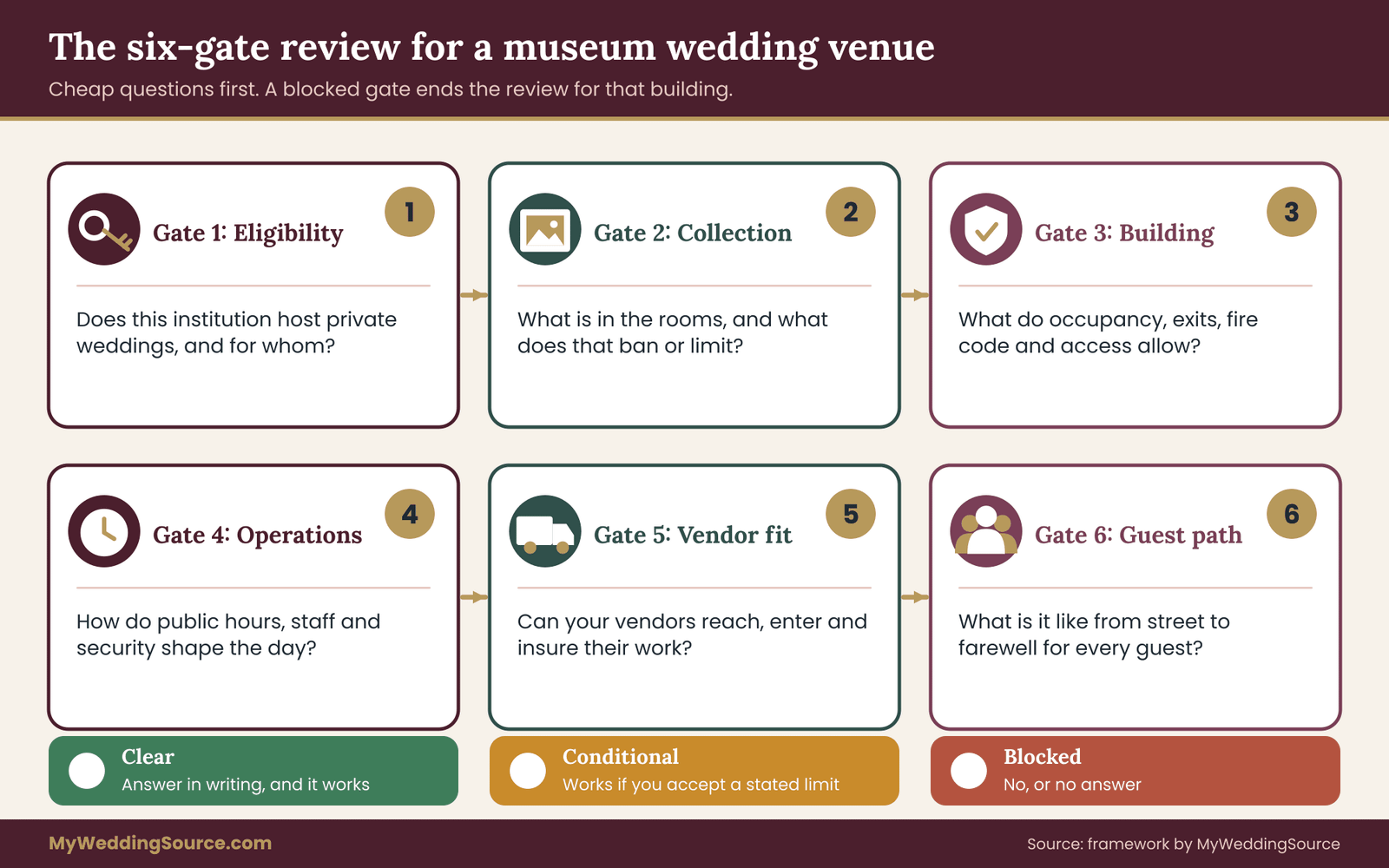
Touring a beautiful building is a poor way to judge it. The beauty is real, the staff are charming, and by the end of the walk-through you have already placed your ceremony in the atrium. A structured review slows that down. The six-gate review below puts the questions in an order that surfaces deal-breakers early, before you fall for a room or pay a holding fee.
Each gate asks one question. Each gets a rating of clear, conditional or blocked. “Clear” means you have the answer in writing and it works for you. “Conditional” means it works if you accept a stated limit, such as a food restriction or an end time. “Blocked” means the answer is no, or you cannot get one.
The six gates in order
Gate one: eligibility. May a private wedding happen here at all, and for whom? Some institutions rent only to members, donors or affiliates. Some rent only certain rooms. Some do not host ceremonies.
Gate two: collection protection. What is in or near the rooms you want, and what rules does that create for food, drink, flame, décor, crowds and amplified sound?
Gate three: building and safety. What do the fire code, occupancy limit, egress routes and accessibility requirements allow for your guest count and layout?
Gate four: operations. How do public hours, staffing, security and neighboring events shape your schedule?
Gate five: vendor fit. Can your caterer, florist, rentals company, music provider and photographer actually work in this building, through its loading route and under its insurance rules?
Gate six: guest experience. What will it be like for a guest, from the street to the farewell, including older guests, guests with disabilities, children and people who do not know the building?
Why this order
The gates run from cheap questions to expensive ones. Eligibility takes one email. Collection protection takes a conversation and a floor plan. Building limits need documents. Operations need a calendar. Vendor fit needs your vendors to read the museum wedding venue’s rules, which takes time. Guest experience needs a walk-through with a plan in hand.
If you reverse the order, you may spend two months on a vendor review for a building that never agreed to host you. A failure at gate one costs you an email. A failure at gate five, after you have signed, can cost a deposit.
Keeping the review honest
Write the rating for each gate on a single page, with the source of the answer next to it: the staff member’s name, the date and the document. A rating without a source is a hope. When two answers conflict, such as a coordinator saying open flame is fine and the written policy saying it is banned, the written policy wins until the institution says otherwise in writing.
Do the review for every museum wedding venue on your list, not just the favorite. It is easy to apply a harsh test to a museum wedding venue you doubt and a gentle one to the one you love. Using the same gates for both gives you a fair comparison, and the guide to venue technical walkthroughs can help you gather the measurements and access details that gates three and five depend on.
Gate one and gate two: who may rent, and what the room protects
The first two gates are about permission and protection. They are the ones that most often end a plan, and the ones couples most often skip.
Gate one: eligibility and the rental pathway
Start with the simple question: does this institution rent space for private weddings? Look for an events or rentals page, a rental brochure or a policy document. If you cannot find any, ask by email. A short message works well, and you can adapt it.
“We are planning a wedding for about a given number of guests on a date range. Does your institution host private weddings or receptions, and which spaces are available for that? Could you send the rental policy and a list of any mandatory fees?”
The reply will usually sort the museum wedding venue into one of four pathways.
An open rental program. The institution lists rooms, prices and a standard process. This is the easiest case. Gates two to six still apply, but you are working inside a system that expects weddings.
A limited program. The institution rents some rooms, often only after hours or only for receptions, and may not allow ceremonies in galleries. You may be offered a lobby, a courtyard, a hall or a lecture room rather than the space in the photographs.
A members-only or sponsor-only program. The room is available to members at a certain level, donors, trustees or affiliates. If you are not one, ask whether a membership tier opens the door and what it costs. Be careful here: joining only to rent may or may not be appropriate, and that is a decision to make openly with the institution rather than around it.
No private events. The answer is no, or “only for institution-hosted events.” Accept it, thank them and move on. There is nothing to negotiate.
Public libraries and the meeting-room question
Public libraries need their own paragraph because their rules often start from a different place, even when a grand central library offers a hall that works as a museum wedding venue. Many public libraries make meeting rooms available to community groups on a first-come basis, with policies about commercial use, fundraising and charging admission. A private wedding may not fit those policies at all, and some libraries rule out social events.
The American Library Association publishes guidance on meeting room policies and the principle of equitable access, which explains why a library might hesitate to give a private party special treatment.
If your heart is set on a public library, read its facility use or meeting room policy before you write. Look for the words “private event,” “social function,” “alcohol,” “food” and “after hours.” If the policy bans alcohol or social functions, you have your answer for that building. A friends-of-the-library foundation, a historic wing run by a separate trust, or a special collections library may operate under different rules, so ask who actually controls the room you like.
Gate two: collection protection
If the museum wedding venue rents the space, the next question is what the space is protecting. Ask for the answer in terms of rooms, not generalities. Which rooms contain objects, books or records on open display? Which are empty? Which have temporary exhibitions that change? Which are connected by corridors that guests must cross?
The distinction that matters is between spaces with collections and spaces without. A courtyard, a lobby, a café, a lecture hall or an annex typically has no objects at risk, and the rules there are closer to an ordinary venue’s. A gallery, a historic room with original furnishings or a reading room with open stacks carries the heaviest limits. Many institutions will only allow a standing cocktail hour or a seated dinner in the least sensitive space, and will route guests past the collections with rope lines or closed doors.
Questions that reveal the collection rules
Ask these in writing, and ask them room by room.
- Is food allowed in this room? Is drink allowed? Are only clear drinks allowed?
- Are open flames, including candles and heated serving trays with fuel, permitted anywhere?
- May we use confetti, petals, rice, bubbles, sparklers or any other scattered item?
- May we hang, tape, pin, nail or lean anything on walls, columns or railings?
- Are there floor limits on heels, rolling carts, heavy rentals or dance floors?
- Is amplified sound allowed, and at what level and hours?
- Are photography flashes, tripods and lighting stands allowed near objects?
- Will staff or guards need to supervise any room, and who pays for them?
Why exhibitions change your answers
One detail catches couples out: an exhibition schedule is not fixed. A room that was empty at your tour may hold a loan from another institution at the time of your wedding, with strict conditions on light, temperature, humidity and distance. Loan agreements often come with limits the host museum cannot change. If your plan depends on a specific gallery, ask whether its contents on your date are confirmed, and ask for the right to move or cancel without penalty if a loan or installation changes the answer.
The same logic applies to libraries. A reading room might be closed for conservation work, or a special collection might be on display in the hall you wanted. Get the status of any construction, installation or exhibition on your date in the contract, not just in the tour notes.
A short exercise that saves weeks
Before the next tour, draw a rough plan of your preferred layout on one page: ceremony space, cocktail space, dinner space, the route between them and the vendor load-in route. Then mark each space with “objects present” or “no objects.” The plan tells you at a glance how many of your wishes sit in sensitive rooms, and it gives the events office something concrete to answer. A museum wedding venue that responds to a plan with a clear yes, no or “with these changes” is one that has done this before.
Gate three: the building’s safety limits at a museum wedding venue
Gate three is about the building rather than the collection. A room may be empty of objects and still be a poor fit if the fire code, the exits or the floor do not match your plans. These limits are set by law and enforced by officials, so they have far less give than the institution’s own preferences.
Occupancy is a legal number, not a suggestion
Every public assembly room has a maximum occupancy set under the local fire and building code. The number depends on the room’s area, its exits and how the space is arranged. It is not the same as the number of chairs that physically fit. A layout with tables, a dance floor and a buffet uses floor area differently from a standing reception, and the permitted count can differ between the two.
Ask for the posted occupancy of each room you plan to use, and ask for it under the layout you intend. A hall rated for a large standing crowd may seat far fewer people at round tables. The guide on wedding occupancy limits and seating explains how capacity numbers change with the arrangement, and it is worth reading before you rely on a figure from a brochure.
Count everyone. Vendors, musicians, photographers, catering staff and the institution’s own security can all count toward the room’s total depending on how the authority applies the rule. If your guest list sits close to the maximum, ask the museum wedding venue whether its staff count toward the limit and whether the fire marshal reviews event layouts.
Egress and the paths nobody photographs
Exits matter as much as capacity. Historic buildings sometimes have a grand entrance that looks like the way in and out, and a short list of actual code exits that are narrower and elsewhere. The routes from your rooms to those exits must stay clear. Tables, bars, lounge groupings, a photo backdrop and a floral installation can all block them if placed carelessly.
Ask whether the institution requires a layout approval. Many do, and some require the fire marshal or a facilities manager to sign off on the floor plan. Treat this as a design input rather than an obstacle. If your florist’s plan for an arch fails the approval, you learn it two months early instead of on the morning of the wedding.
Fire systems and what they mean for décor in a museum wedding venue
Smoke detectors, sprinklers, alarm panels and suppression systems all create practical limits. A fog machine, a haze effect or heavy theatrical smoke can set off a detector. Large draped fabric near sprinkler heads can interfere with coverage. Open flame is restricted because of the risk to the building and everything in it, and “flameless” candles are the usual substitute.
Fabric that hangs from the ceiling or covers walls is often held to a flame-resistance requirement. The issue is common enough that it has its own article: see wedding ceiling draping approvals for the documents and questions that usually come up. If a museum wedding venue has historic ceilings or a plaster surface, hanging anything may be forbidden outright, which pushes you toward freestanding structures instead.
Accessibility as a gate, not an afterthought
The Americans with Disabilities Act applies to museums and libraries as public accommodations, and the ADA website explains what the law generally requires of such places. For a wedding, three questions cover most of what you need to learn.
First, is there an accessible route from the arrival point to every room you will use, including the restroom, the ceremony space and the dining space? Historic buildings may have a separate accessible entrance, a lift or a longer route. Second, is the route actually usable on the day, with doors unlocked and staff aware, or does it depend on a guard with a key? Third, can a guest who uses a wheelchair, a walker or a cane sit and move with the rest of the party rather than at the edge of the room?
Do not rely on a general statement that “the building is accessible.” Ask for the route to be walked, in person or on a video, and ask where an accessible drop-off sits relative to the door. If a route changes on your date because of construction or an exhibition, ask for the alternative in writing.
Floors, weight and the surface under a dance floor
Floors in cultural buildings are often the object of care in their own right. Marble, terrazzo, historic wood and stone all react to heels, rolling carts, heavy rentals and moisture. Institutions may require floor protection, restrict heavy equipment to certain routes, or forbid a temporary dance floor from being fixed down with adhesive. A rule against stiletto heels on a historic wood floor is not an insult, it is a repair bill avoided.
If dancing is part of your plan, ask which rooms allow a temporary dance floor and how it may be assembled. A modular floor that sits on the existing surface without adhesive is often accepted where tape is not. The institution may want to see the product specification, and your rental company can send it.
Gate four: public hours, staffing and security
Gate four concerns time and people. A ballroom can open for you at noon and close when the party ends. A museum wedding venue has a public schedule, a staff schedule and a security schedule, and your wedding must fit into the gaps.
The shape of your day inside public hours
Most museums and libraries host private events only outside public opening hours. That gives you a late afternoon or evening slot at best, and for a library, possibly a Sunday or an evening when the museum wedding venue is closed. The same questions apply at every museum wedding venue, so ask for three timestamps: when you may begin load-in, when guests may arrive, and when the last guest and the last vendor must be out.
The gap between load-in and guest arrival is often shorter than a ballroom’s, because the building may be open to visitors until a fixed time. That has consequences. A florist who needs three hours to install may have only ninety minutes. A rental company may be allowed to deliver only through a certain door at a certain time. Build your vendor schedule from the institution’s windows, not from your preferred timeline.
The end of the evening is equally fixed. Staff leave at a set time, the alarm system is armed, and overtime may be charged by the hour. An early end time reshapes the whole program, so choose your speeches, dances and farewell around it rather than trimming them on the night.
Staffing and who pays for it
A museum wedding venue usually requires some of its own staff to be present. Expect an event supervisor, security guards, facilities or engineering staff, and sometimes a coat or visitor-services attendant. Some institutions require additional guards for each gallery that stays open to guests. The cost of these staff is passed to you, and the number can rise with your guest count or the number of open rooms.
Ask how staffing is calculated, what the hourly or per-post rate is, and what happens if the event runs over. Ask whether the staff are on site from load-in to load-out or only during the event. Those differences can change the total by a large amount even where the rental fee looks identical.
Security, screening and bag policies
Security at a museum wedding venue is built for objects. Guests may pass a screening point, bags may be checked, large bags or umbrellas may be refused or stored, and some items, such as tripods, large cases and professional lighting, may be banned from galleries. Your vendors face the same rules.
Plan for the guest-facing side of that. A guest arriving in formal clothes with a clutch and a coat should not be surprised by a bag check. If the building screens bags, a short note on the invitation website, “bags are checked at entry,” prepares people and lets them leave extra items at home. If the museum wedding venue requires a guest list at the door, ask who maintains it, and how late arrivals and plus-ones are handled.
Neighboring events and shared spaces
Another operations question is whether you have the museum wedding venue to yourself. A museum may host a lecture in an adjoining hall, a library may keep a reading room open, and a courtyard may be shared with a café. Ask what else is happening on the day and where its guests will be. If your ceremony is in a shared space, ask whether the public will pass through it and how that is handled.
Where privacy matters, such as for an officiant’s reading or a quiet vow exchange, ask the museum wedding venue how it separates spaces. A closed door and a guard can be enough. A glass wall and a public corridor may not be. This also affects photography, since passers-by, including other visitors, can appear in photos. If the space is not exclusively yours, say so to your photographer and ask the institution how it handles visitors near your guests.
Weather, closures and the day a museum wedding venue closes
Public buildings close for reasons private venues do not: a municipal holiday, a power outage, a security incident, a staffing shortage or a facility repair. Ask what the institution’s policy is if it must close or cancel your event, whether it can offer an alternative date or a refund, and who decides. If the building has outdoor spaces, ask for the rain plan in writing, with the indoor room named and its capacity stated.
A cancellation clause that allows the museum wedding venue to cancel without a full refund is a risk you should know about before signing. A good contract spells out the alternatives. Compare that clause with a ballroom’s firm deposit terms before you decide which risk you prefer.
Gate five: vendor fit inside a museum wedding venue
For a museum wedding venue, gate five is where many plans that survived the first four gates quietly fall apart. A museum wedding venue often controls who may work inside it, how they arrive, what they carry and what insurance they hold. A vendor who is perfect in every other way may be unable to meet those terms.
Open, approved or exclusive vendor lists
Institutions handle vendors in one of three ways. An open policy lets you hire anyone who meets the insurance and conduct rules. An approved list requires you to choose from vendors the institution has vetted, and sometimes allows you to propose an outside vendor who then goes through an approval step. An exclusive arrangement tells you that one caterer, and sometimes one rental or décor company, is the only choice.
Ask which model applies before you fall for a room, because it changes the cost and your freedom. If the caterer is exclusive, the food and service will be set by that company’s menus and prices. That is not automatically a bad deal, since the caterer knows the building, the kitchen situation and the staff. But it removes your ability to compare quotes, and you should treat the caterer’s proposal as part of the museum wedding venue price. Judge it line by line, against what you actually need.
Catering: the most restricted trade
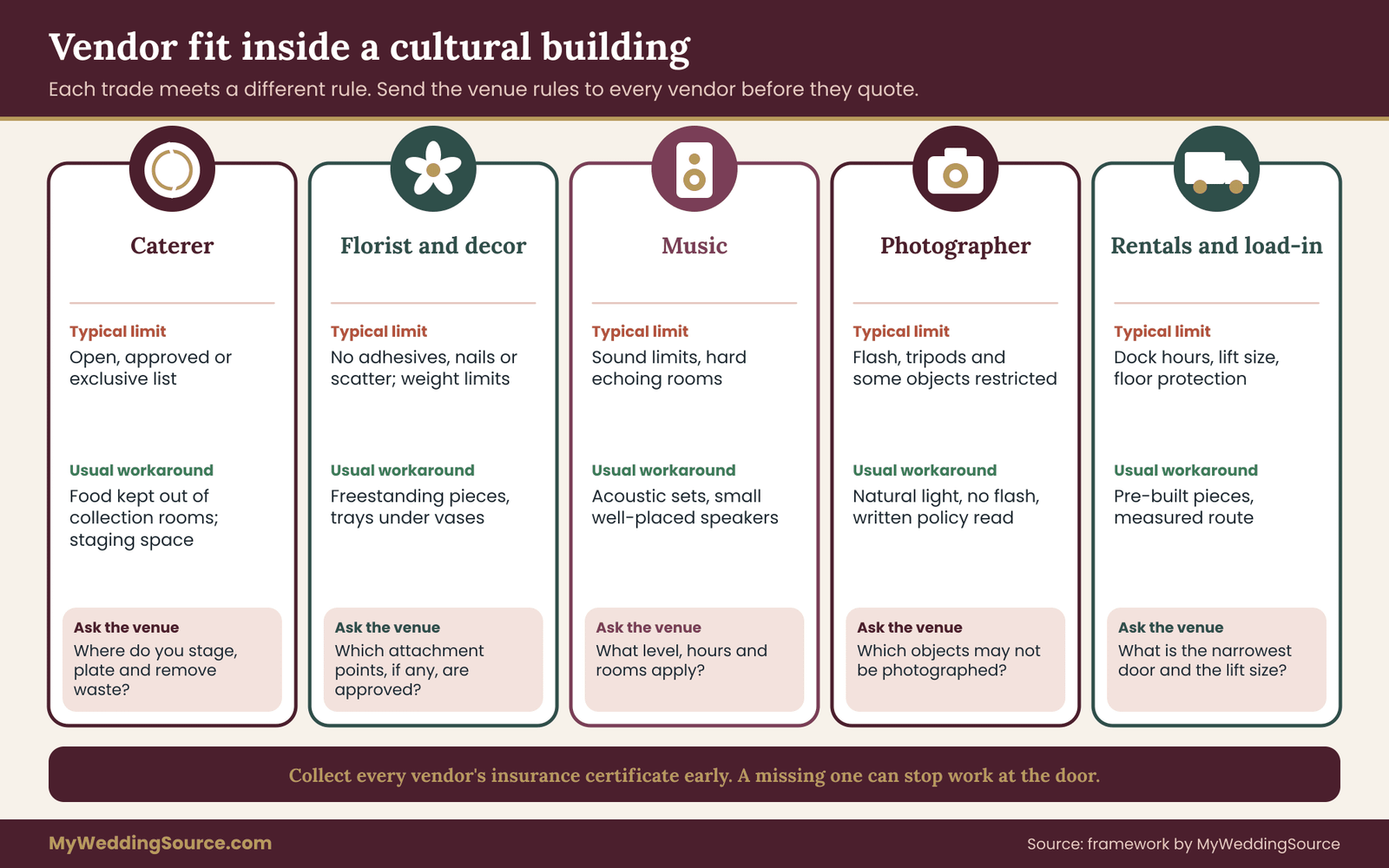
Food and drink pose the highest risk to collections, so catering rules are usually the tightest. Common conditions include a fixed list of permitted caterers, a requirement that cooking happen off site or in a designated service area, a ban on food in gallery spaces, and rules about glassware, red wine, dark beverages and ice. Some institutions limit alcohol to certain rooms, require licensed bartenders and set their own last-call time.
Ask the caterer, not just the museum wedding venue, three questions. Has the caterer worked in this building before? Where does the caterer stage, hold and plate food, and is there a kitchen, a prep room or only a corridor? How will waste, grease and used linens leave the museum wedding venue without crossing sensitive spaces? An experienced caterer will answer without hesitation. An inexperienced one will say they will figure it out, and that is a warning.
Local health rules also apply. Caterers need the permits and food safety documentation required by the local health authority, and some institutions ask to see them. The FDA’s Food Code is a model that many state and local authorities adopt in some form, so it is a useful reference when you ask what documentation a caterer should hold.
Loading, freight and the route a vendor must take
A beautiful entrance is almost never the vendor entrance. Equipment, flowers, rentals and food arrive through a loading dock, a service door or a freight elevator, sometimes at a set hour and with a staff escort. Heavy items may need floor protection on the route, and tall items may not fit through a doorway or in a lift.
Give every vendor the load-in route in writing, with dimensions of the narrowest door and the elevator, the permitted hours, the parking or staging arrangements and the contact who opens the door. The guide on venue loading dock rules lists what to ask, and it is worth sending to your vendor team before they quote. If a vendor cannot do the route, the price they quote has not accounted for the real work.
Insurance and the certificate of insurance
Nearly every museum wedding venue requires vendors to carry liability insurance and to provide a certificate naming the institution as an additional insured. Requirements, including limits and the exact wording, vary. A florist, a DJ, a photographer or a rental company that is a sole operator may not hold the policy the museum wedding venue requires, and may need to buy a short-term policy for the event.
Ask for the museum wedding venue’s insurance requirements early, in a single document, and pass it to every vendor with a deadline. The guide to certificates of insurance for wedding vendors explains the terms involved. You may also be asked to buy event liability coverage yourself. Insurers and brokers can tell you what is available, and the museum wedding venue can tell you what it requires. Do not assume the vendor’s policy covers you or that yours covers the vendor.
Florals, décor and rentals
Décor is limited by the object rules, the fire rules and the weight and floor rules together. Typical restrictions include no adhesives on walls, no nails or hooks, no confetti or petals, limits on pollen-heavy or staining flowers, no standing water near objects, and limits on how close an installation may come to a display case. Flowers in water are a concern near collections because of spills and humidity, and some institutions require them to stay in specified areas.
A designer who works from the rules rather than against them tends to deliver a stronger look. Freestanding structures, potted greenery that can be moved, hanging pieces that attach to approved points, and lighting that sits on stands rather than walls are all common solutions. Ask the institution for photographs of past events so your designer can see what has been approved in the same rooms.
Music, sound and the room itself
Hard surfaces, stone floors and high ceilings produce long echoes, which can make a string quartet glorious and a DJ unintelligible. Many institutions limit amplified sound, restrict the speaker types or set a decibel level. Libraries often have sound-sensitive neighbors in the form of reading rooms or study spaces within earshot.
Match the sound plan to the room. A speech in a hard-surfaced atrium may need a small, well-placed speaker system and a microphone with a good pickup pattern, not a large system pushed hard. The guide to ceremony acoustics and live music explains how room character affects what guests hear. If a DJ will play recorded music, ask whether the institution holds a performance license or whether you need to confirm that with the music provider.
Photography and video
Cultural institutions often have photography rules that apply even to hired photographers. Flash may be banned near light-sensitive objects. Tripods, light stands and drones may be restricted. Some objects may not be photographed at all because of loan terms or copyright. A few institutions require that images taken inside be used only for personal purposes, which affects whether a photographer can use them in marketing.
Ask your photographer to read the museum wedding venue’s photography policy and tell you in writing what they can and cannot deliver. A photographer who can work in low natural light without flash is an asset here. Also ask whether the images of artwork, exhibits or displays in your photos can be shared online, since some objects have usage conditions of their own.
Gate six: the guest experience from door to dessert
The last gate is the one that decides whether the day feels like a wedding or a museum visit. A venue can pass every operational test and still leave guests cold, tired, lost or bored. Gate six asks you to walk the event the way a guest would.
Draw the guest path
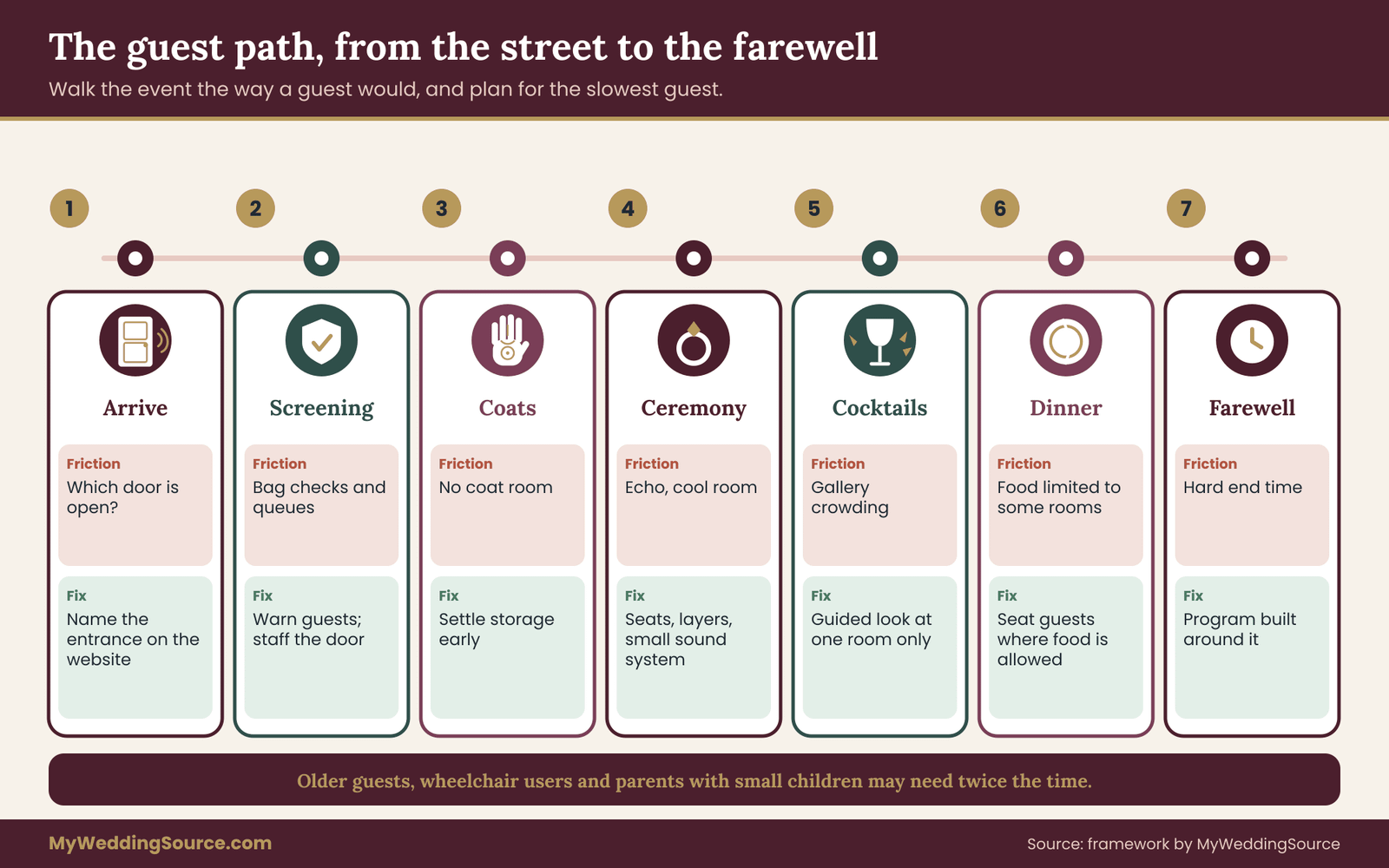
Map the guest’s journey in order. Arrival and drop-off. Screening and entry. Coat and bag handling. Restroom location. Ceremony seating. Move to the cocktail space. Dinner. Dancing, if any. Farewell and transport. At each step note where guests will wait, where they might get confused, where they may need help, and how long it will take.
Cultural buildings are often big. A walk from the entrance to the ceremony space can take several minutes, through corridors that echo and rooms that guests will want to stop in. An older guest, a guest with a mobility device or a parent with a small child may need twice as long as the others. Plan seating along the route, add a welcome point, and assign someone to guide.
The “wow” and the wait
Part of the appeal of a museum or a library is that guests get to see it. Many institutions allow guests to visit an exhibition during a cocktail hour, sometimes with a guide. That can turn a standard cocktail hour into a highlight of the evening. It can also create congestion, tired feet and a line at the gallery entrance.
If the museum wedding venue allows guest access to galleries, ask how it manages it. Is there a limit on the number of guests at a time? Are guards stationed? Are drinks allowed in? Will guests be asked to leave bags behind? Make a decision about who this feature is for. A short guided look at one room can please everyone. A free roam of a large building tends to fragment the party and delay dinner.
Comfort: temperature, light and seats
Collections are kept at conditions chosen for the objects, not for people in formal clothes. Rooms can be cooler than you expect, lighting may be low to protect light-sensitive items, and humidity controls can make a ceremony feel stuffy or dry. Seating may be limited to what the institution can supply, and heavy historic chairs may not be allowed to move.
Plan for guests to be comfortable in the museum wedding venue as it is. Tell them about layers on your wedding website. Ask the museum wedding venue what the temperature will be and whether it can adjust it for your event. Check that there is enough seating at every stage, including for guests who cannot stand for a long cocktail hour. A small number of quiet seats near the entrance and the restroom can make a large difference.
Children, older guests and guests with needs
Cultural buildings can be wonderful for children and daunting for parents. Objects, cases, stairs and echoes present risks that a ballroom does not. If children are invited, decide how they will be supervised and where they may go. Some institutions have rules about unattended children in galleries, and you may be asked to assign adults.
For older guests and guests with disabilities, build the comfort plan into the guest path. Where is the nearest accessible restroom to each stage? Where can someone sit in the ceremony without a long walk? Is there a quiet room? If lodging is part of the same concern, ask the hotel about accessible rooms early.
Directions, signs and wayfinding
Guests rarely know which door is the event entrance. Cultural buildings often have several, with only one open for the evening. Tell guests which entrance to use, where to park or be dropped, and what the entry process is. Signs inside may be limited by the same wall and adhesive rules as décor, so plan for freestanding signs and ask for permission to place them.
Some institutions provide their own staff to direct guests. Others expect you to do it. A volunteer at the door, in a clearly marked role, is worth more than a map no one reads, and it takes pressure off the institution’s guards, who are not there to welcome people.
Common restrictions at a museum wedding venue, item by item
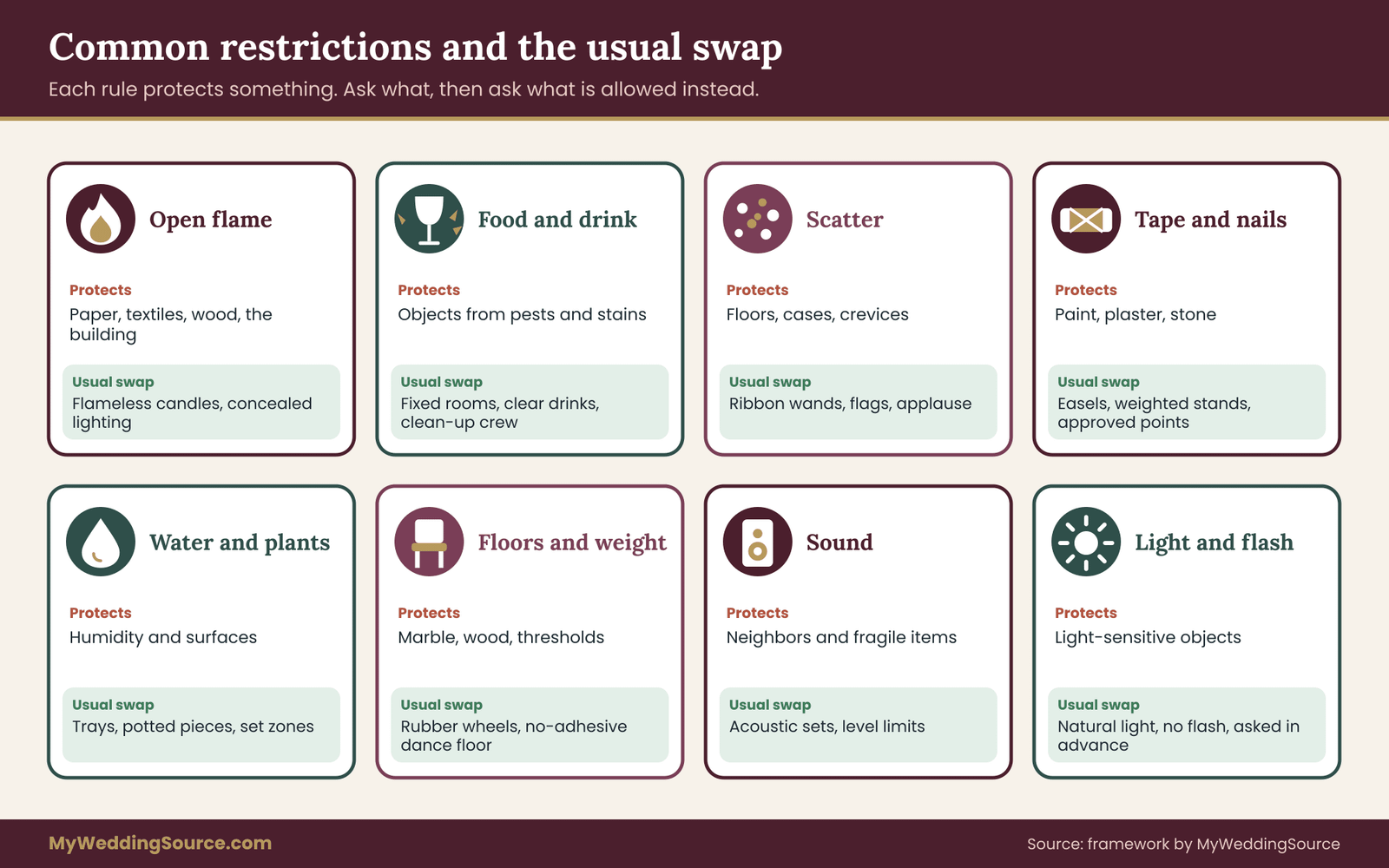
A museum wedding venue will not give you a free hand, and restrictions are easier to live with once you know the reason behind each one and the usual way around it. The list below covers the rules that most often shape a museum wedding venue contract. For each, you will find what the rule protects, what institutions commonly allow instead, and the question that gets a clear answer.
None of this describes any single building. Treat it as a map of where to look, then confirm each point with the museum wedding venue that is hosting you.
Open flame, candles and heat
Flame near paper, textiles, wood and varnished surfaces is a fire risk to the building and to objects that cannot be replaced. Candles, sparklers, flaming dessert presentations, chafing fuel cans and torch-style centerpieces are the usual casualties. Many institutions ban all open flame, while some allow candles in enclosed glass holders in specific rooms, and some allow fuel-heated warming trays only in the service area.
The common substitute is a battery-powered flameless candle, which gives a similar glow without the risk. Warm-looking lighting from small fixtures, lanterns with electric lights and concealed uplighting does the same job. Ask: “Is any open flame permitted anywhere, including in the service area, and is flameless lighting acceptable?”
Food and drink
Food invites pests, stains surfaces and attracts moisture. Cultural institutions often follow integrated pest management practices, where preventing food from entering collection spaces is a first line of defense. The National Park Service’s museum publications and the Library of Congress preservation resources discuss why food and drink are kept away from collections.
Typical rules limit eating and drinking to specific rooms, require guests to finish a drink before entering a gallery, or allow only clear liquids in certain areas. Red wine may be limited or banned in some rooms. Some institutions require a clean-up crew and trash removal before the guests leave. Ask: “Which rooms may have food, which may have drinks, and are there restrictions on type, such as red wine or dark sauces?”
Anything that scatters
Confetti, petals, rice, glitter, balloons with ribbons, bubbles and foam can settle into carpets, floor joints, crevices and display cases, and are hard to remove. Many institutions ban all of them. Some allow a single approved item outdoors, such as bubbles on the front steps, or a paper-free alternative such as ribbon wands.
An exit moment is possible without scatter: guests can wave ribbons, hold small flags or simply applaud. Ask: “May we use any scattered item at the entrance or exit, and where would cleanup responsibility fall?”
Adhesives, tape, nails and hooks
Tape and adhesives can pull paint, damage plaster or leave residue on stone and wood, even when marketed as removable. Nails and hooks leave holes. As a result, many venues ban attachments to walls, columns, railings and historic fixtures, and some forbid draping from anything that was not designed to carry weight.
Freestanding alternatives include easels for signs, stands, weighted bases for installations, and hanging systems that attach to approved rigging points where they exist. Ask: “Are there approved attachment points, and who may use them?”
Water, humidity and live plants
Live flowers and plants bring water, soil and pollen into a building designed around controlled humidity. A spilled vase can stain a floor, and a large number of plants can change humidity in a small room. Some institutions limit the number of floral pieces, ban large installations in galleries, restrict certain species for their pollen, or require vases to sit in trays.
Some historic buildings and conservatories have different conditions because plants are part of the setting. Ask: “Are there limits on live flowers, water vessels or potted plants, and are any rooms off limits?”
Floors, weight and moving things
Heavy rentals, rolling carts and sharp heels can damage floors, and heavy stands can damage thresholds. Institutions often require protective coverings on the load route, rubber-wheeled carts and limits on the weight of installations. Ask: “What floor limits apply, and what protection is required on the load-in route?”
Sound, music and noise
Amplified music can disturb nearby galleries, reading rooms or neighbors and can create vibrations that matter near fragile objects. Institutions set decibel limits, restrict instrument types or confine amplified sound to certain rooms. Acoustic or lightly amplified music is often the simplest approach.
Ask: “Are there limits on amplified sound, instrument types or hours, and is there a staff member who will measure the level?” For the room itself, the earlier section on sound explains why hard surfaces matter, and your music provider can advise on what works.
Light, flash and photography
Light causes fading and damage to some materials. Flash photography, bright video lights and some stage lighting are therefore restricted near light-sensitive objects. Photography of certain objects may be banned entirely for loan or rights reasons.
Ask: “Which rooms allow flash and lighting equipment, and are there objects we may not photograph or publish?”
Smoke, haze and effects
Detectors respond to anything that looks like smoke. A haze machine, a cold spark fountain, a fog effect or dry ice can trigger an alarm, which may bring the fire department and an invoice. Many venues ban all such effects. Ask: “Are fog, haze, dry ice and cold spark effects permitted, and have they ever triggered an alarm?”
Bags, coats, strollers and large items
Large bags, umbrellas, strollers and bulky items may be banned from galleries or must be stored. Coat check may be provided, or may not. Coats matter if your event runs in cold weather and the museum wedding venue cannot supply a coat room, so settle that early.
Animals, smoking and other conduct rules
Pets and service animals are treated differently. Service animals are generally allowed in public accommodations under the ADA, while pets may be banned. Smoking and vaping are usually prohibited indoors and sometimes anywhere on the grounds. Some venues have conduct rules about touching objects, leaning on cases or climbing on steps. Brief your wedding party on these on the day, because guests tend to follow what the party does.
Library-specific points to check
Libraries add several considerations that do not appear in museum rental brochures. They matter because a library is, above everything, a place that must remain usable by the public.
Public status and equal access
A public library is often governed by a board and a set of policies about meeting rooms, fees, alcohol and the use of the building. Policies that allow a community meeting may prohibit private social events or charge admission. A library may also be bound by public records and open meeting rules that affect how a rental agreement is handled, such as whether it is a public record. Ask what the policy says before assuming a rental is possible.
Stacks, special collections and handling
Open stacks hold books people will check out the next day. Special collections hold rare or fragile material that is usually kept in controlled areas. In either case the institution will want guests kept away from shelves, away from the materials and out of closed areas. A reading room with books on the shelves may allow a ceremony if the shelves are roped or screened, and not allow food at all.
Do not ask to move books, to use them as décor or to display them. Display is a professional decision involving the collection, and even an offer of a donation will not change the policy. If you want books in the story, ask whether the library may curate a small display of its own, or bring your own copies of books that matter to you, kept in a case or on a stand that you control.
Quiet and neighbors
A library’s public service continues in other rooms. A ceremony with music in one room may share a wall with a study area. Libraries sometimes limit events to hours when the library is closed to patrons for that reason. Ask whether any part of the building will remain open, and how sound will be handled at the boundary.
Technology, networks and equipment
Libraries often have good Wi-Fi, projectors and screens, but these belong to the library’s own systems. Ask whether you may connect your own equipment, whether the library provides a technician, and whether the equipment is available on the date. If you plan a livestream for guests who cannot attend, ask whether the library’s network allows it and whether the museum wedding venue has any rule about filming inside.
Fees, receipts and procurement
A public library or a municipal building may require a fee schedule approved by a board, a signed form, a deposit that is handled as a municipal payment, and sometimes a different set of payment methods than a private venue. Ask how and when payment is made and how the deposit is returned. These processes can be slow, so build time in.
Reading the restrictions as a package
Restrictions rarely arrive one at a time. A venue that bans flame, scatter, adhesives and flash is telling you its priority is the object. A venue that bans amplified sound, requires a quiet close and limits hours is telling you its priority is the public. The pattern tells you what kind of wedding the room can hold.
Use the pattern to shape your plan rather than fighting it. If flame, adhesives and scatter are off the table, you will rely on lighting, freestanding décor and sound rather than ritual effects. If amplified sound is limited, you will choose live acoustic music and a short, well-paced program. If hours are tight, you will shorten the schedule. A museum wedding venue that suits you is one whose restrictions you can turn into a design, not a list of grievances.
Worked case: two buildings, six gates, one decision
The case below is invented to show the method. The couple, the buildings and the answers are illustrative, not real institutions, and no prices appear because real costs depend on the building and the year. What matters is how the ratings turn into a decision.
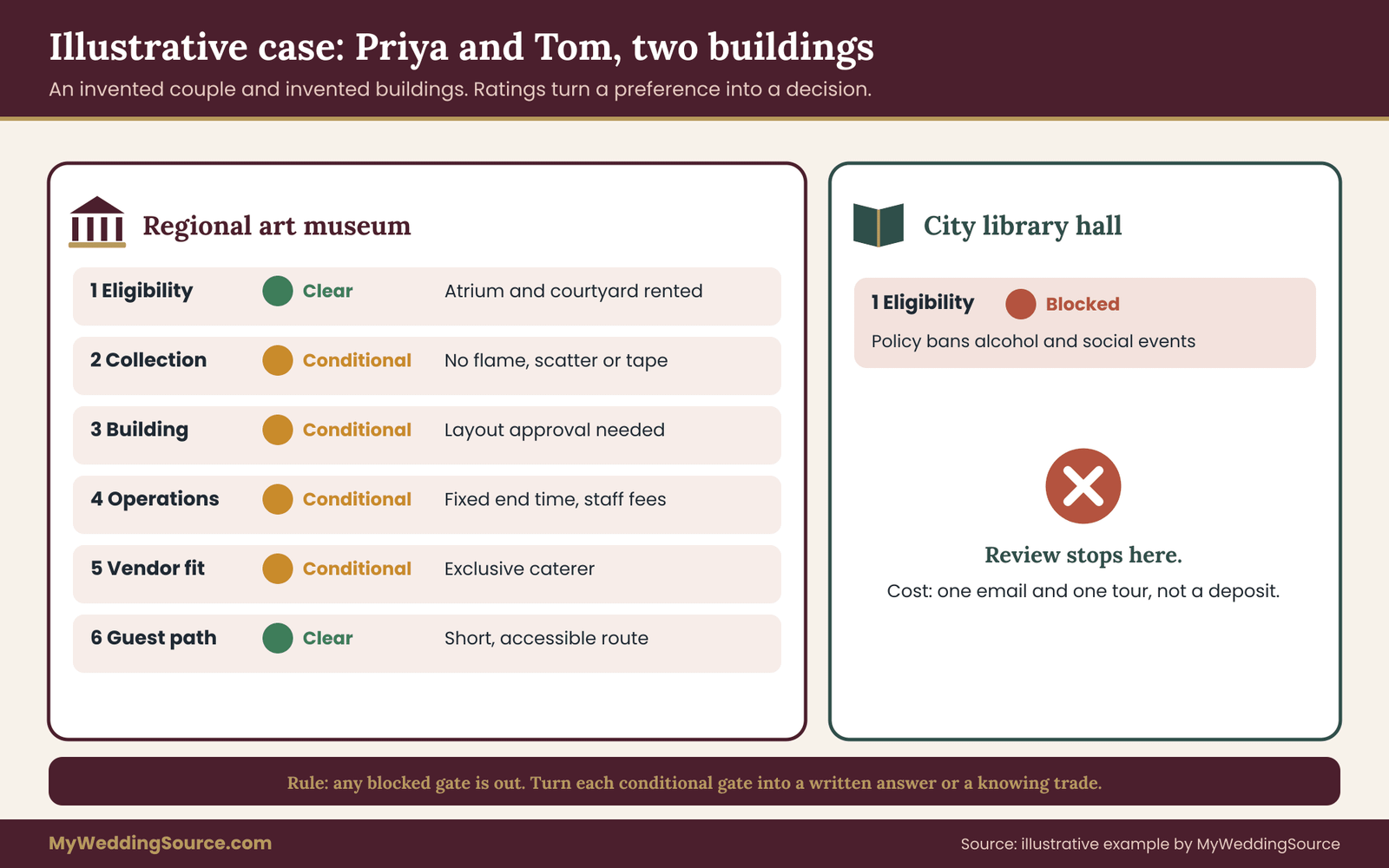
Priya and Tom want a wedding for about ninety guests on an autumn evening. They have found two cultural venues they love. The first is a regional art museum with an events office, a glass-roofed atrium and a sculpture courtyard. The second is a historic reading hall inside a city library. They run both through the six gates, using email and one tour each.
The art museum
Gate one, eligibility. The museum rents the atrium and the courtyard for evening receptions. Ceremonies are allowed in the courtyard and in the atrium, but not in galleries. Rating: clear.
Gate two, collection protection. The atrium holds a few large sculptures on stable bases that cannot be moved. Food and drink are allowed in the atrium and courtyard but not in the galleries. Open flame is banned everywhere. Scatter and adhesives are banned. The rule set is strict, but it is written down and it fits their plans. Rating: conditional, because they must give up candles and a petal toss.
Gate three, building and safety. The atrium’s posted occupancy supports a seated dinner for the guest list once vendors and staff are counted, but only with a layout that leaves two exit aisles open. The accessible route is a separate entrance with a lift to the atrium. Rating: conditional, pending a layout approval.
Gate four, operations. Load-in begins after public hours close, and guests arrive ninety minutes later. The event must end at a stated time, with a charge for overtime beyond it. Security staffing is required and priced per post. Rating: conditional.
Gate five, vendor fit. The museum has an exclusive caterer. The florist and the rental company must supply insurance certificates, and the loading route goes through a freight lift with a limited door height. The florist can handle it with a modified plan. The couple’s preferred caterer is not allowed, which they have to accept or walk away. Rating: conditional.
Gate six, guest experience. The walk from the entrance to the atrium is short and accessible. A guided look at one gallery during cocktails is offered. The atrium is cool in the evening, and the stone surfaces echo. Rating: clear, with a note about sound and layers.
The library hall
Gate one, eligibility. The library’s facility policy is written for community meetings. It bans alcohol and social functions, and it requires that any event be open to the public. A wedding does not fit. Rating: blocked.
Priya and Tom write to ask whether a friends foundation or a separate historic wing has a different policy. The answer is no. The library’s board has not approved private weddings. The review stops there, and they have lost an email and a tour, not a deposit.
Turning ratings into a decision
The couple uses a simple rule they wrote before the tours. A venue with any blocked gate is out. A venue with more than two conditional gates needs a second conversation before any deposit. Each conditional gate must be turned into a clear one through a written answer, or accepted knowingly as a trade.
The museum has four conditional gates, so they ask for four written answers. They get a layout approval process and a deadline, an overtime schedule, a list of approved vendors with the caterer’s sample menus, and confirmation of the guided gallery visit. Two of the conditions become clear. Two remain conditional by choice: no candles, and the exclusive caterer.
What they decide and what they give up
They choose the museum. They accept flameless lighting, a ribbon wand exit instead of petals, the exclusive caterer after reading its menus, and an earlier ending time. In exchange they get an atrium ceremony, a courtyard cocktail hour and a short guided visit to one gallery.
They also set two rules for themselves: no signature until the event rider is attached to the contract, and no vendor deposit until the museum has accepted the vendor’s insurance certificate. The rider lists the rooms, the load-in window, the end time, the staffing charges, the restrictions on flame, scatter, adhesives and sound, and the exclusive caterer’s responsibilities. That document is the center of the file.
What the case shows
Notice what the method did not do for either museum wedding venue. It did not rank the two buildings by beauty, and it did not ask the couple to guess. It reduced a vague preference to a short list of answers they could verify, and it produced an early stop for the venue that could not host them. The same pattern works for a different pair of buildings, and for different priorities. If the couple valued a free choice of caterer above everything, the museum would have failed gate five and the answer would have changed.
When a museum wedding venue is the wrong fit: failure conditions and alternatives
A review of any museum wedding venue is only useful if it can say no. This section sets out the failure conditions that should end a plan, the conditions that can be repaired, and the alternatives that keep what you loved about the idea.
Failure conditions: walk away
Treat these as ending the plan for that building, whatever the room looks like.
- The institution does not host private weddings, or the policy bans social events or alcohol and the institution will not make an exception in writing.
- The room you need is the only room where your core requirement, such as a ceremony or a dinner, is not allowed.
- The legal occupancy of the space under your layout is lower than your confirmed guest count, and the institution cannot offer a second room.
- There is no accessible route to the main rooms and no workable alternative, and you have guests who need one.
- Your essential vendor cannot work under the building’s rules, and the institution will not approve an alternative.
- The institution will not put its rules, charges and cancellation terms in a written contract or rider.
- The total mandatory cost, once staffing, security, insurance and exclusive vendors are added, exceeds what you can afford, even if the rental fee alone does not.
- The institution can cancel or move your event for its own reasons without an acceptable remedy.
Conditions you can usually repair
Some problems are fixable with a design change or a negotiation.
A ban on flame is fixed with flameless lighting. A ban on adhesives is fixed with freestanding décor. A short load-in window is fixed with a simpler floral plan or a pre-built design. An early end time is fixed with a tighter program and an earlier start. A restriction on food in the main hall is fixed by moving dinner to an approved room or an off-site reception. An insurance gap for a vendor is fixed by a short-term policy.
The test is whether the repair changes something you care about. Losing candles is a small cost for many couples. Losing the right to dance may not be. Write down the three things the wedding cannot do without, and judge every repair against them.
The split-venue alternative
A common compromise separates what the museum wedding venue does best from what it does badly. A couple holds the ceremony or the cocktail hour at the museum or library and moves dinner and dancing to a nearby restaurant, hotel or hall that welcomes a full reception. Guests get the setting for the part where it matters, and a kitchen and a sound system for the part where they are needed.
This arrangement has its own logistics: transport between sites, a timeline for the move and a second contract. It tends to work best when the two sites are close, when there is a plan for older guests and when the first venue has a firm end time. A ceremony in a library reading room, followed by a reception around the corner, can suit a couple whose main wish is the setting for their vows.
Photography only
If the building will not host the event, it may still allow wedding portraits. Many institutions offer a photography permit or a time slot for portraits, sometimes with a fee, and sometimes only outside public hours. Ask your photographer whether they have worked there before, and read the photography policy before you plan the shots. A short portrait session in a place you love, followed by a reception elsewhere, can keep part of the picture without the full list of restrictions.
Other venues with the same feeling
If the institution says no, the feeling you wanted often exists elsewhere. Historic houses, university halls, botanical gardens, old theaters, restored warehouses and civic buildings that exist to host events can offer character with fewer collection rules. The guide to wedding venues explains how to compare venue types and what to ask each. Use the same six gates on any of them, because a historic house that is run as a museum may have the same restrictions as the museum itself.
Settling on a decision date
A final thing to decide is when to decide. A museum wedding venue may hold a date for a short time, and an events office may be slow to answer. Set a date by which the six gates must be complete, and tell the museum wedding venue. If the answers are not in by then, move on to the next candidate. Slow answers during planning often predict slow answers when something goes wrong on the day.
Contracts, insurance, timeline and cost logic for a museum wedding venue
The review of a museum wedding venue gives you answers. The contract turns them into promises. For a museum wedding venue, the paperwork deserves more attention than for a typical rental, because so many of the rules sit in policy documents, rider pages and emails rather than in a single price sheet.
The event rider: one page that holds the rules
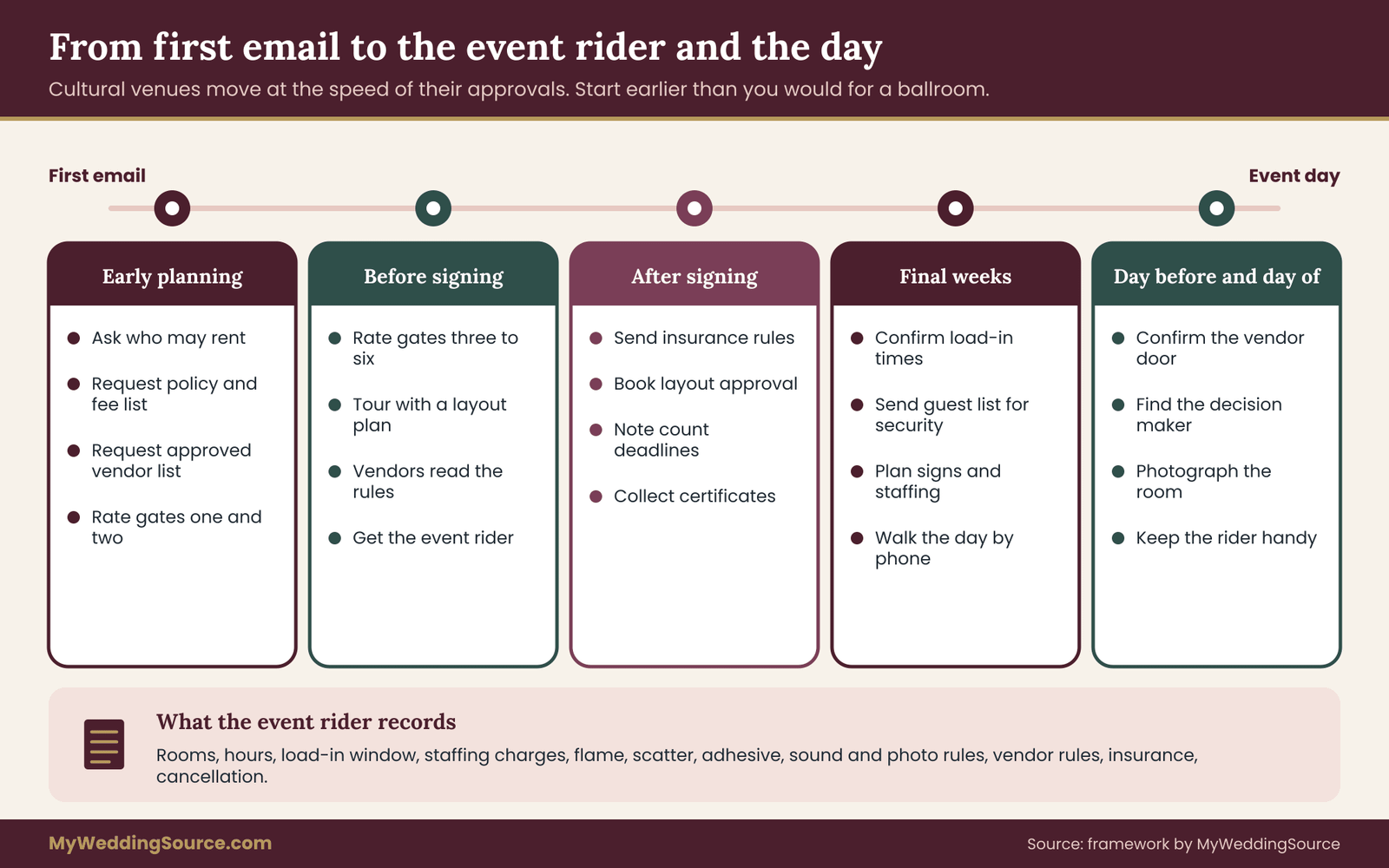
Ask the museum wedding venue to attach an event rider, or build one yourself and ask them to confirm it. The rider is a short schedule to the contract that records the specifics: the exact rooms, the dates and hours, the load-in and load-out windows, the staffing and security charges, the layout approval process, the restrictions on flame, scatter, adhesives, sound and photography, the vendor rules and the insurance requirements.
A rider matters because staff change, brochures go out of date and tours are remembered differently. If the rider says candles are banned and the coordinator once said they were fine, the rider wins, and you will have known all along. Ask also for a list of every mandatory charge and a statement of which charges are estimates and which are fixed.
Cancellation, changes and the institution’s right to move you
Read the sections on cancellation and relocation with care. A museum wedding venue may reserve the right to cancel for safety, a loan installation, a public emergency or a change in policy, and the remedy may be a refund of what you have paid without any compensation for other costs. That is a risk to weigh, not necessarily a reason to refuse, but you should know it before you sign.
Ask what happens if the room you booked becomes unavailable. Will the institution offer a comparable room, a new date or a full refund? Who decides what counts as comparable? Ask what happens if you cancel or reduce the guest count, and how deposits are treated. Ask a lawyer to review the contract if the stakes feel high.
Insurance: what the institution may require
Institutions commonly ask the client to buy a short-term event liability policy, name the institution as an additional insured and provide the certificate before the event. Some also ask for coverage related to alcohol service. The details vary, so ask for the requirement in writing and have your insurance broker or provider confirm what meets it.
Vendors each carry their own policies. Collect their certificates early, send them to the museum wedding venue for approval, and keep the approvals in your file. A single missing certificate on the day can stop a vendor at the door. Keep a list of which vendors have been approved, when and by whom.
A timeline that fits the approvals
Cultural venues move at the speed of their approvals, so start earlier than you would for a ballroom. The following sequence is a guide, not a rule, and you should adjust it to the institution’s own calendar.
Early planning. Use the first two gates to build a short list. Confirm eligibility and the broad rules. Ask for the rental policy, the fee list and the approved vendor list. Do this before you fall for a room.
Before signing. Complete gates three to six for your top choice. Tour with your layout plan. Ask each key vendor to read the rules and confirm in writing that they can work there. Get the rider.
After signing. Send the insurance requirements to vendors, with a deadline. Schedule the layout approval. Ask the institution for the deadline to confirm the final guest count and the date by which any changes in room, menu or timing must be filed.
In the final weeks. Confirm the load-in schedule, the guest list for security, the signage plan and the staffing. Hold a call with the events coordinator and your key vendors to walk the day in order.
The day before and the day of. Re-confirm contact numbers, the door that opens for vendors and the person who is on site with authority to decide. Photograph the room before setup, so any later question about its condition can be answered.
Cost logic: comparing a museum quote with a ballroom quote
A fair comparison of a museum wedding venue and a ballroom needs the same items on both sides. Start with the fee and list everything mandatory: staff, security, insurance, exclusive vendors, equipment, cleaning, overtime, layout approval, parking and any deposit. Then add what the museum wedding venue does not provide that a ballroom would, such as tables, chairs, linens, glassware, audio systems, a kitchen and coat check. Then subtract what the building gives you, such as décor you do not need to buy, because the architecture does the work.
The result is a more honest number than the rental fee alone. Some couples find the museum wedding venue costs more than they expected. Others find it costs less, because the museum wedding venue replaces décor and the program is shorter. Do not guess which you are. Collect the numbers and compare them item by item, and ask your venue to clarify any line you do not understand.
One more cost deserves attention: the cost of constraint. A restricted schedule, a required caterer and an early end time can all reduce the value of what you buy. The cost is not always in money. A couple who wants a long, loose party may feel it more than one who wants a polished dinner. Be honest about which one you are.
What to say: short scripts for common moments
Clear, polite messages move the process faster and leave a record. Adapt these to your own voice.
“Thank you for the tour. Before we decide, could you send the rental policy, a list of mandatory charges and the vendor requirements? We would like to review them with our caterer and florist.”
“Our caterer is not on your list. Is there an approval process for outside caterers, and what documents would you need from them?”
“We would like to use a small number of flameless candles in the atrium. Could you confirm in writing that this is permitted and note any limits?”
“Could we add the event rider to the contract, so that the rooms, hours, staffing charges and restrictions are recorded in one place?”
“Our guest list may reach the room’s posted limit once vendors are counted. Could you confirm how staff and vendors count toward the occupancy?”
After the event
After the wedding, the institution may inspect the space, and you may have post-event charges for overtime, cleaning or damage. Ask when the final invoice will arrive and how any security deposit is returned. Keep the rider, the approvals and your photos of the room in the same folder as your contract. If a dispute arises, a clear paper trail will help you resolve it calmly.
If the experience is good, write to the events team and thank them. Cultural venues remember couples who respected the building, and your note may help the next couple get a yes.
Your next steps
Choosing a museum wedding venue starts with one page and one email. On the page, list your guest count range, your date range, the three things the wedding cannot do without, and the rooms you would like. Then email each candidate building and ask whether it hosts private weddings, which spaces are available, and for the rental policy and a list of mandatory charges.
When the replies arrive, rate gate one and gate two. Drop any building that is blocked. For the rest, collect the occupancy, access and hours answers, and send the vendor rules to your caterer, florist, music provider and photographer. Walk each venue with a floor plan and the venue technical walkthrough checklist in hand. Keep a single page with the six gates, a rating for each and the source of each answer. Only then, with an event rider in hand, should you sign and pay a deposit.
FAQ
Do museums and libraries actually host weddings?
Many do, but not all. Some museums have events offices and standard rental programs. Some small institutions rent a single room. Many public libraries do not host private social events, because their policies are written for community meetings. Ask by email whether private weddings are allowed, which spaces are available and whether a rental policy exists, before you tour or plan anything around the museum wedding venue.
Can we have a ceremony and a reception in the same museum?
Sometimes. Many institutions allow a ceremony in an atrium, courtyard or hall and a reception in the same or a nearby space, but not in galleries with objects on display. Rules on food, drink and music vary by room, so ask for each room separately. If dinner is restricted, a split arrangement with a nearby restaurant or hall may keep the setting and the full meal.
Can we bring our own caterer to a museum wedding venue?
It depends on the museum wedding venue. Some have an open policy with insurance and food safety requirements, some use an approved list and some have one exclusive caterer. Ask which applies before you commit. If your preferred caterer is not allowed, check the exclusive caterer’s menus and service style, and judge the total cost against a museum wedding venue where you can choose freely.
Are candles, confetti and decorations allowed?
Often not. Open flame, confetti, petals, glitter and adhesives are commonly banned because they threaten objects, floors and walls. Flameless candles, ribbon wands, freestanding décor and discreet lighting are the usual substitutes. Ask for the rules in writing, room by room, and have your designer plan around them from the start rather than asking for exceptions late.
How many guests can a museum or library hold for a wedding?
The legal limit is set by the local fire and building code for each room and depends on the layout, since tables and a dance floor use space differently from a standing reception. Ask for the posted occupancy under your intended layout, and ask whether staff and vendors count toward it. Do not rely on a brochure figure alone.
Is a museum or library wedding venue accessible?
Museums and libraries are public accommodations under the Americans with Disabilities Act, so many have accessible routes, but historic buildings may use a separate entrance or a longer path. Ask to see the route from drop-off to every room you will use, including restrooms, and ask whether it will be open and staffed on the day. Confirm it before you sign.
Do we need special insurance?
Often yes. Institutions commonly require event liability coverage that names them as an additional insured, and they require certificates of insurance from vendors. Requirements differ, so ask for the exact wording in writing and have your insurance provider confirm what meets it. Collect each vendor’s certificate early, because a missing one can prevent a vendor from working on the day.
What if the venue refuses most of our plans?
Count the refusals against the six gates. If a gate is blocked, such as no private events, no access for your vendors or too small for your guest list, move to another venue early. If the refusals can be repaired with a design change, such as flameless candles, adjust the plan. A split venue or a portrait-only visit can keep part of the idea.
Sources
- American Library Association, policies, guidance and intellectual freedom resources
- American Alliance of Museums, standards and resources for museums
- American Institute for Conservation, caring for collections and finding a conservator
- National Park Service, Museum Management Program, Conserve O Gram series
- Library of Congress, Preservation resources for collections care
- Northeast Document Conservation Center, preservation leaflets
- ADA.gov, U.S. Department of Justice, Americans with Disabilities Act information
- National Fire Protection Association, codes and standards
- International Code Council, building and fire code information
- U.S. Food and Drug Administration, FDA Food Code