
A wedding backdrop is the surface or structure behind your ceremony, sweetheart table, cake, photo area or stage, and the rental type you choose (fabric, hardwall or modular) decides how much floor it takes, how long it takes to install and what the venue has to approve. This guide compares the three families on those practical terms so you can read a quote with confidence.
Judge every wedding backdrop rental with four gates: Fit (how much floor and wall it needs, including bases and braces), Path (whether every piece can travel through the doors, halls and elevators to its spot), Clock (how many crew-minutes it needs to go up and come down inside your access window) and Hold (how it is anchored, what it is made of and who approves it). Fabric usually wins on Path and storage. Hardwall usually wins on a finished, solid look but costs the most Path and Clock. Modular sits between them. Get all four answers in writing before you pay a deposit.
Most couples choose a wedding backdrop from a photograph. The photograph shows the front. It does not show the six feet of floor behind it, the crew of three who carried it in, the weighted feet that sit where a bridesmaid will stand, or the two hours it took before guests arrived. Those hidden facts are what a quote and a contract are for, and they are what separate a calm setup from a frantic one.
This article is about that hidden side. It does not try to pick a style for you, and it does not rank vendors. It gives you a way to compare fabric, hardwall and modular rentals using floor space and install time, two things you can measure and ask about, and it shows a worked example with invented numbers so you can see the logic before you use your own.
A note on scope. This is general planning information, not legal, safety, engineering or financial advice. Rigging, flame-resistance rules, electrical work and anchoring are decided by your venue, its fire authority and qualified professionals, and the rules vary by building and by place. Use the questions here to start those conversations, and take the answers from the people who are responsible for them.
What a wedding backdrop rental really includes
When a rental company says “backdrop,” it may mean any of several things. It might be a sheer panel hung from a stand. It might be a painted wall built from wood or foam panels. It might be a metal grid that holds greenery, flowers or lettering. It might be a round or hexagonal frame that stands alone like a doorway. Before comparing prices or looks, pin down what is physically arriving.
A wedding backdrop rental usually bundles four things: the face (what guests and cameras see), the structure (what holds the face up), the ballast or anchoring (what keeps the structure upright) and the labor (who brings it, sets it and takes it away). Two quotes with the same face can differ sharply in the other three, and that is where cost, floor space and time hide.
The face is the easy part to judge. Fabric, painted board, mirror-finish acrylic, artificial greenery, wooden slats, velvet, lights, lettering and florals can all be a face. Structure is less visible. A face can hang from a ceiling grid, clip to a pipe frame, bolt to a truss, slot into a rail, or lean against a wall. Each structure has a different footprint and a different install method, so the structure matters more to your day than the face does.
Ballast and anchoring get the least attention in photos and the most attention from venues. A freestanding structure needs weight or bracing so it will not tip when someone leans on it, when a door opens nearby or when an air vent pushes on fabric. Sandbags, water bases, steel plates and cross-bracing take floor space, and they have to be hidden or accepted as part of the look.
Labor is the last piece. Some rental companies deliver and install with their own crew. Some deliver to the door and leave you to build it. Some will install but charge for waiting time if the room is not ready. When a quote says “delivery included,” ask what that word covers, because a delivery to a loading dock and an installation at the aisle are very different services.
Why does all this belong in a comparison of types? Because each type tends to bundle these four things differently. Fabric tends to be light, with a thin structure and a larger share of its cost in labor and steaming. Hardwall tends to be heavy, with its structure built into the panels and most of its cost in transport and carrying. Modular tends to be flexible, with a repeating frame and many small parts. Knowing the tendencies lets you ask sharper questions, though your specific quote always overrules a general rule.
One more point before the families. The place a wedding backdrop goes changes which questions matter. A ceremony backdrop on a lawn faces wind and soft ground. A ballroom stage backdrop faces ceiling height and access windows. A photo-wall corner faces queues and crowd flow. A cake-table backdrop faces heat and traffic. This guide keeps coming back to location, because the same rental can be an easy choice in one setting and a poor one in another.
The three wedding backdrop families in plain terms
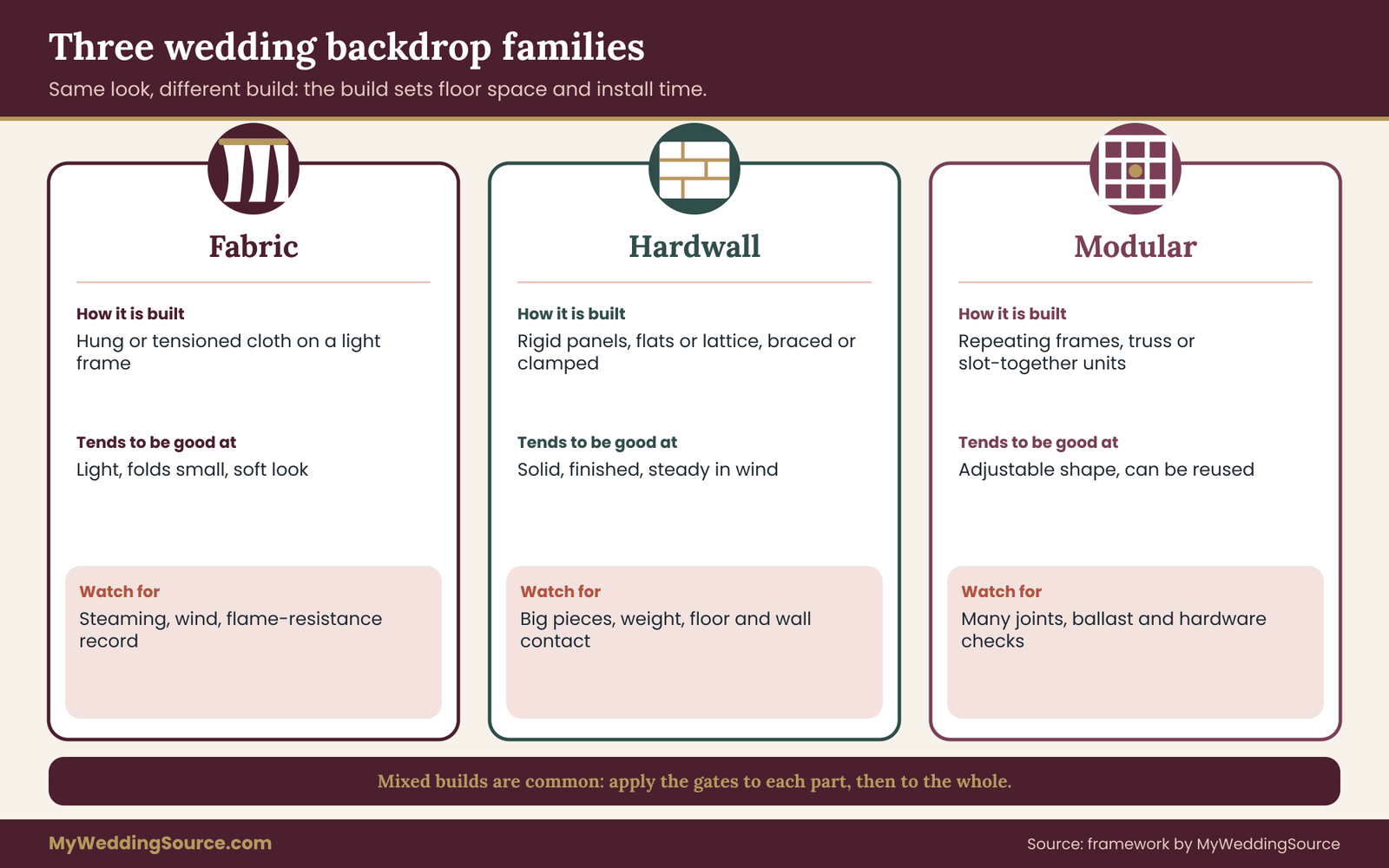
Rental inventories use their own names, so you will see “drape wall,” “flat,” “wall panel,” “frame,” “arch” and “grid” used loosely. For comparison, it helps to sort everything into three families by how the wedding backdrop is built and how it stands.
Fabric. The face is cloth: sheer voile, chiffon, velvet, sequin-style fabric, linen-look material, or stretch fabric pulled over a frame. Fabric is either hung or tensioned. Hung fabric drops from a rail, a pipe-and-drape stand, a ceiling point or a truss. Tensioned fabric is stretched across a frame and stands without needing to hang from anything above. Fabric is soft, light and quick to move, and it needs steaming and care because wrinkles show in photographs.
Hardwall. The face is rigid: wood, painted board, foam board, mirrored or acrylic panels, lattice, or finished flats that look like a wall. Hardwall usually arrives as large panels that are joined, braced and sometimes screwed or clamped together. It is heavy, it has a solid look and it does not move in wind or from air vents. It also has the biggest pieces to carry and the strictest floor and wall questions, because it can mark floors and sometimes needs fixing points.
Modular. The face and structure are made of repeated units: square or hexagonal frames, truss sections, grid panels, slot-together rails, or stackable boxes. Modular systems can be built to many shapes, from a flat wall to a curve to a standalone arch, and the units can be sized to fit the stairs and elevators of a venue. The tradeoff is the number of parts and joints. More parts can mean more install time and more visible seams unless the face is added over them.
Real products blur these lines. A frame with stretched fabric is modular structure with a fabric face. A wooden arch with hanging fabric is hardwall structure with a fabric face. A truss wall with silk greenery is modular structure with an artificial floral face. When a quote blurs the lines, ask which part drives the floor space and which part drives the install time, because that part decides which family’s rules apply.
A helpful habit is to separate “look” from “build” in your notes. Write the look you want in one line, such as “warm, soft, layered, light.” Then write the build in another, such as “tensioned fabric on a freestanding frame.” You can often get the same look from more than one build.
A soft, layered look might come from hung fabric, from a frame with stretched cloth or from modular greenery with fabric swags. If the look is what you love, the build is negotiable, and the build is where the floor space and the install clock live.
Be careful with the assumption that one family is cheaper. Fabric often costs less to rent and more to install per square foot of visible face because skilled steaming and hanging take time. Hardwall costs more to rent and to move, and it can be fast to place once it is in the room.
Modular can be inexpensive for a basic wall and expensive for a complex shape. Price comparisons across types only make sense when the footprint, the path and the clock are the same, which is exactly what the next section sets up.
The four-gate check for any wedding backdrop
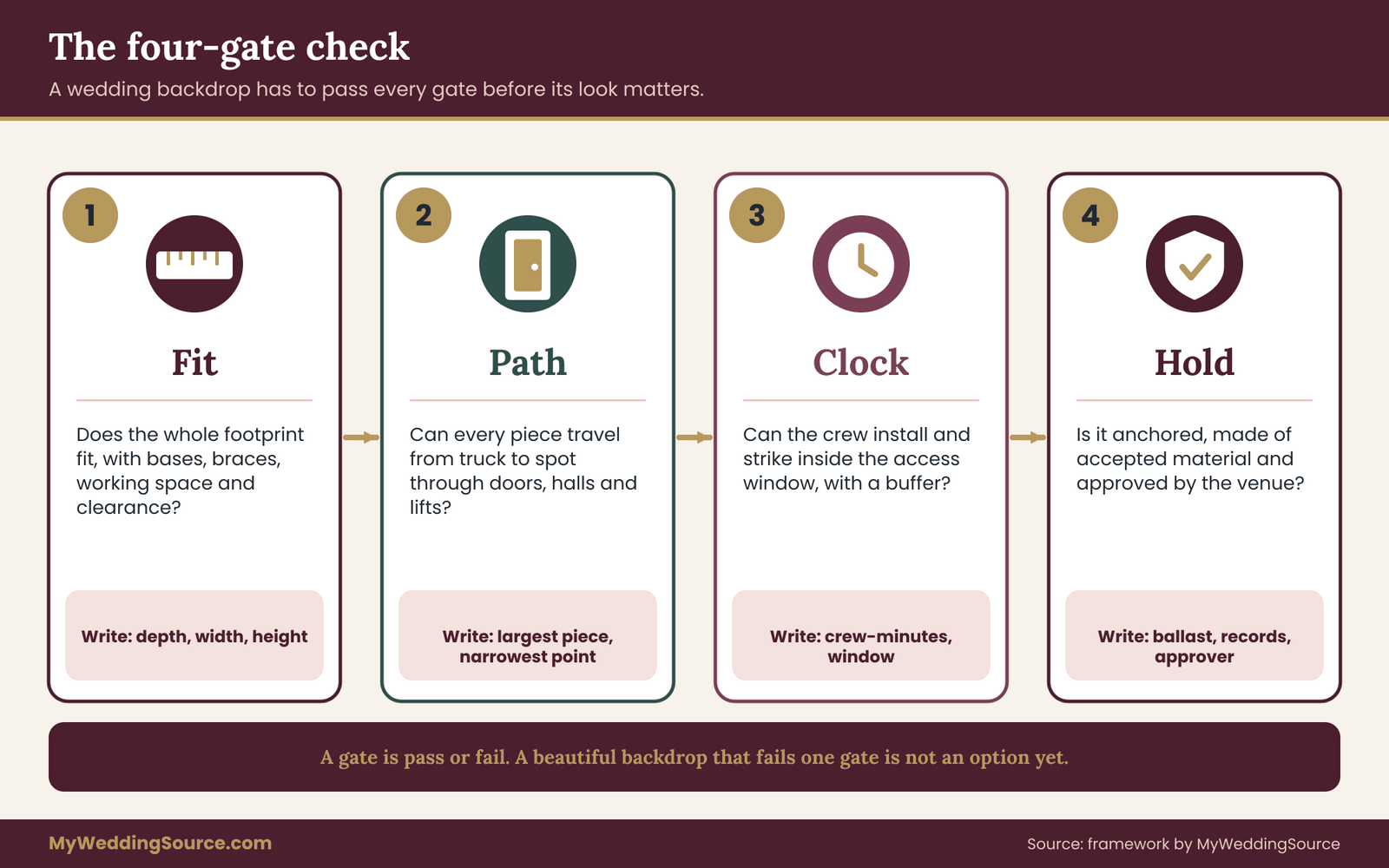
A good comparison needs the same questions asked of every option. The four-gate check is a short sequence that does this. A wedding backdrop has to pass all four gates before its look matters. If it fails one, you either change the build, change the location, or change the plan.
Gate one: Fit. Does the wedding backdrop’s whole footprint fit the spot, including bases, braces, steps, the working space behind it and the clearance in front of it? The visible width is not the footprint. The footprint is the floor and wall space the structure needs to stand safely and be reached by the people who install and strike it.
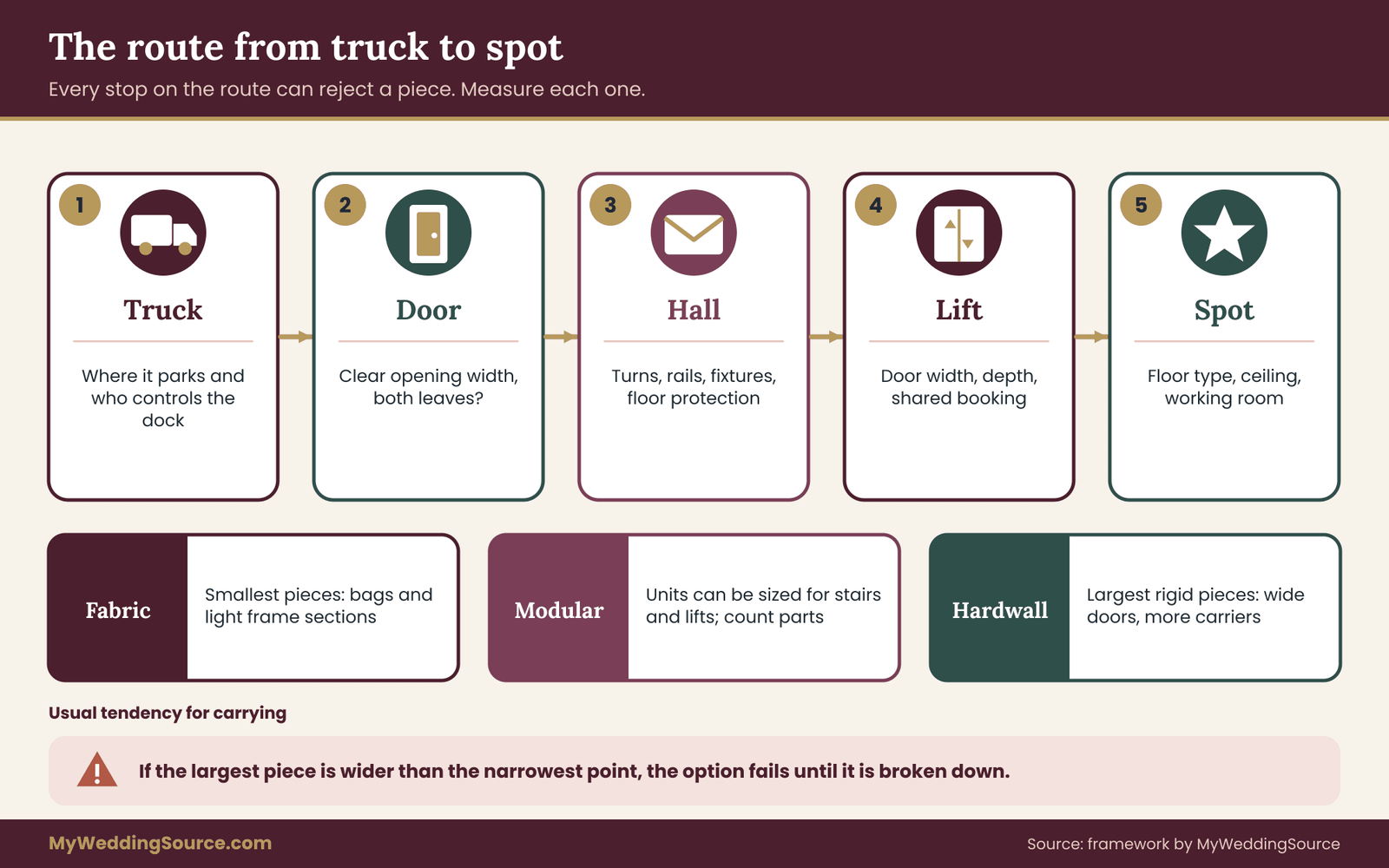
Gate two: Path. Can every piece travel from the truck to the spot? Doors, corridors, corners, stairs, elevators, ramps, thresholds and weather all limit what can pass. A wedding backdrop that fits the spot but not the route is not a real option.
Gate three: Clock. Can the crew set it up and take it down inside the time the venue gives them, with a margin for problems? Install time is a number, and you can ask for it. So is strike time, which is often shorter for the vendor and more constrained for the venue.
Gate four: Hold. Is it anchored safely, is it made of material the venue accepts, and has someone with authority approved it? This gate covers ballast, wall and ceiling contact, flame resistance, electrical needs and exits.
The order matters. Fit comes first because it is cheap to test with a tape measure and a floor plan. Path comes second because it eliminates options early, before you fall in love with a piece that cannot enter the building. Clock comes third because it needs vendor input. Hold comes last because it needs venue and fire-authority input, which takes the longest.
Each gate produces a short written answer, not a feeling. For Fit, write the depth, width and height in inches or feet with the base included. For Path, write the largest piece’s dimensions and the narrowest point on the route. For Clock, write install minutes, strike minutes and crew size. For Hold, write the anchoring method, the material certificate or treatment you were told about, and the name of the person who approved it. Four short lines per option is enough, and it makes three quotes comparable at a glance.
Why call these gates instead of a checklist? Because a checklist invites you to tick most boxes and move on. A gate is binary. If a wedding backdrop cannot get through the door, it does not matter that it is beautiful. Treating the four checks as gates keeps you from trading away a hard constraint for a soft preference, which is the most common way couples end up with a wedding backdrop that needs a last-minute rescue.
There is a fifth question that sits outside the gates: what is it for? A ceremony backdrop might need to frame two people and an officiant, face a seated audience and look good from one angle. A reception backdrop might need to stand for hours behind a sweetheart table. A photo wall might need to withstand a queue of guests and handbags.
The purpose sets which gate is tightest. Ceremony backdrops are often tight on Clock because the room flips. Photo walls are often tight on Hold because people lean on them. Sweetheart tables are often tight on Fit because they sit near service paths.
For the first pass, you do not need quotes. You need the venue’s floor plan, a tape measure or a measured drawing, and the access times. If your venue offers a technical walkthrough, use it to collect these facts, and the venue technical walkthrough guide explains what to measure and whom to ask. Bring that sheet to every rental conversation so each company answers the same questions about the same room.
Gate one: measuring wedding backdrop floor space
Floor space is the quiet cost of a wedding backdrop. A hardwall flat that looks flat to the camera might need braces that reach several feet behind it. A freestanding fabric frame might need wide feet to stay upright. A round arch might need a base ring larger than the arch itself. If you do not measure the real footprint, you may discover on setup day that the wedding backdrop collides with a stage lip, a door swing, a speaker or the first row of chairs.
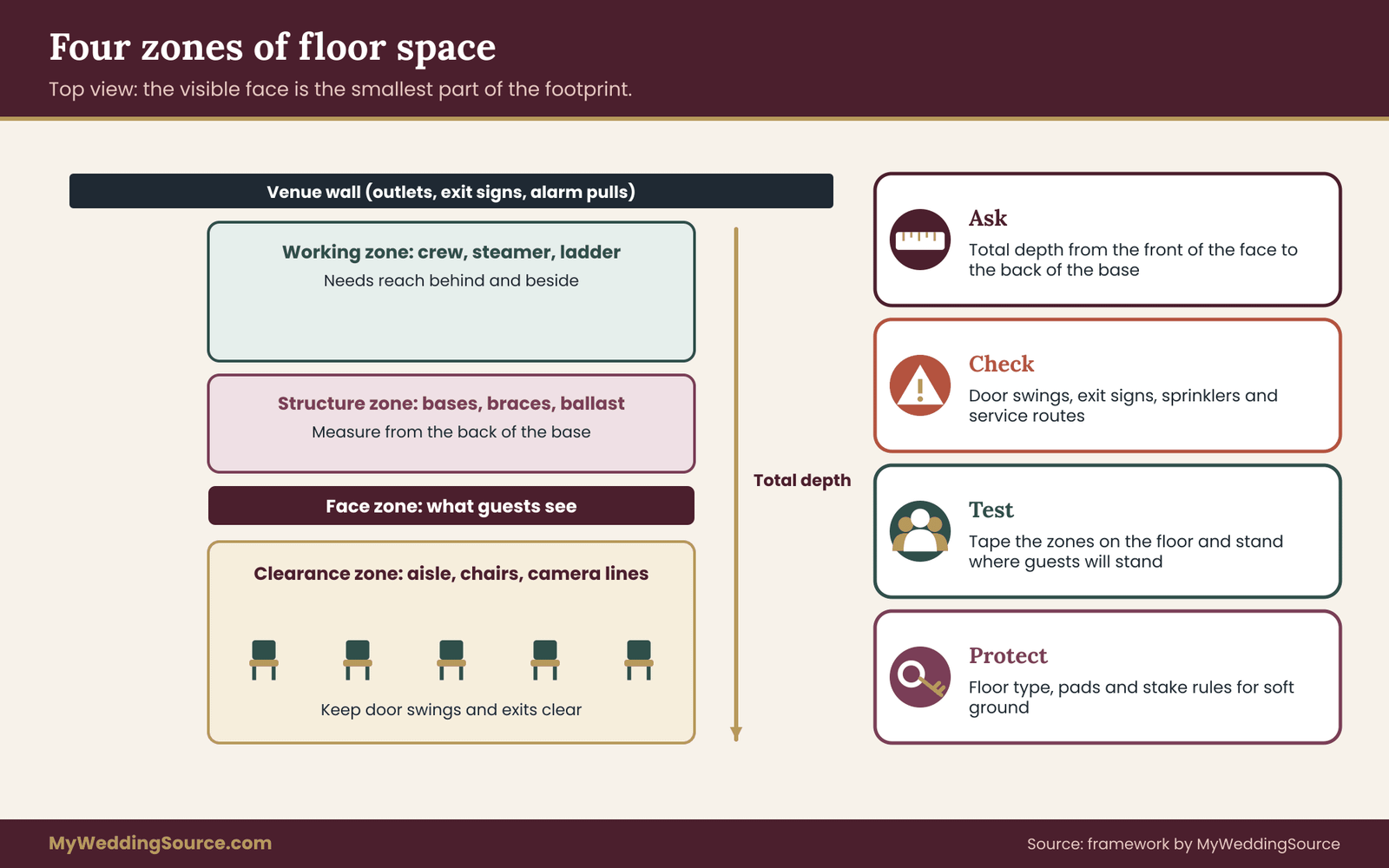
Start with four zones around the spot. The first is the face zone: the visible width and height of the wedding backdrop. The second is the structure zone: the depth taken by frames, bases, braces and ballast. The third is the working zone: the space the crew needs behind or beside the wedding backdrop to build it, steam it, adjust it and take it down. The fourth is the clearance zone: the space in front of the wedding backdrop that must stay open for people, chairs, aisle, camera lines and sightlines.
Ask the rental company for the structure zone as numbers. A useful question is: “What is the total depth from the front of the face to the back of the base, and does anything extend beyond the face on either side?” Then ask for the width of the base footprint and for any required clearance for installation. A professional will have answers. If a company can answer only about the face, treat that as a signal that you will need to ask more.
Do not forget height. The visible height is only part of it. Ask about the overall height with the top rail or finial, and about the height of the tallest part during assembly. Some frames are assembled lying down and tilted up, which needs ceiling clearance equal to the diagonal of the frame, not only its height. A wedding backdrop that is nine feet tall when standing might need a good deal more clearance while it is raised, and that fact matters in rooms with lower ceilings, soffits or hanging fixtures.
Wall relationships matter too. Some backdrops stand against a wall and can be braced to it with permission. Others stand a few feet away so they can be walked around. A gap behind a wedding backdrop can be handy for a hidden walkway or for staff, and it can also make the wedding backdrop look like a prop on a stage.
If your venue has outlets, thermostats, sprinklers, exit signs, fire extinguishers or alarm pulls on that wall, the wedding backdrop must not hide or block them. Walk the wall and mark them on your drawing.
Fabric tends to have the smallest structure zone when it hangs from an overhead point, because it needs almost no floor space. It has a large working zone, however, because someone has to reach the top, and may need a ladder or lift whose own footprint must be counted. Tensioned fabric on a frame has a moderate structure zone, since the frame needs a base.
Hardwall usually has a moderate to large structure zone because of braces and bases, and a large working zone because panels are carried flat and tilted. Modular is variable, and its footprint depends on how deep each frame unit is and whether it must be braced.
Here is a simple method to check Fit on paper. Draw the room to scale, or use the venue’s plan. Mark the spot. Draw the structure zone with the quoted depth and width. Add the working zone, using a reasonable crew space on each open side. Then draw the clearance zone for chairs or people. If any zone overlaps a door swing, an aisle, a service route, a speaker stack, a stage lip or an exit path, move the wedding backdrop or change the build.
Then check Fit on the floor. On the walkthrough, use painter’s tape or chalk-safe markers where allowed to outline the structure zone, or mark corners with sticky notes on a measuring tape. Stand where a guest, a photographer and an officiant will stand. If the wedding backdrop’s structure zone eats the space those people need, the design is too large for the spot, whatever the drawing says.
Finally, check the floor itself. Grass, sand, gravel, tile, carpet, wood and stage decking all affect which bases work. Some bases mark floors. Some rock on soft ground. Some need protective pads, and the pads add a little to the footprint. Ask whether the venue has floor protection rules for heavy items, and whether the rental company brings its own pads or expects the venue to approve them. A good answer prevents a damage charge later.
If you are weighing two spots in the same room, apply the same four zones to each. A wedding backdrop that is tight against a wall in one spot may have a generous working zone in another, and a small difference in depth can decide whether your photographer can use the full width.
Gate two: getting a wedding backdrop through the building
Path is where many wedding backdrop plans quietly fail. The largest hardwall panel may be eight feet by four feet. The venue’s service door may be thirty-six inches wide. The freight elevator might be reserved for another event. The corridor to the ballroom might have a turn that a flat panel cannot make. None of this shows in the photograph, and none of it is the couple’s fault, but it becomes the couple’s problem when a crew stands at a loading dock with a piece that will not go in.
Walk the route as if you were carrying the largest piece. Start where the truck will stop and end at the spot. Note every door, with its clear opening width and whether both leaves open. Note corridors, including any turns and the width after you account for railings, fire extinguishers and wall-mounted fixtures. Note stairs, ramps, thresholds and elevators, with the elevator’s door width, interior depth and weight limit if posted. Note surfaces that need protection, such as polished stone, wood or fresh carpet.
The largest piece and the awkward piece are different questions. The largest piece is the one with the biggest dimension. The awkward piece is the one that cannot be tilted, folded or taken apart, such as a rigid framed arch or a pre-built panel. Ask the rental company for both, with dimensions and weights if available. A reputable company will know its largest piece and whether it can be broken down.
Compare the families on Path. Fabric usually has the smallest pieces. A frame can be carried in sections and fabric arrives folded in bags, so a narrow service route is rarely a problem. The catch is that fabric must be steamed in the room, which creates a working need rather than a path need. Hardwall usually has the largest and most rigid pieces.
Panels do not fold, and they can be heavy enough to need two or more people, a cart or a dolly. Hardwall also puts more pressure on corner turns and elevators. Modular tends to carry well, because its units can be sized for stairs and elevators, but it brings a large number of small pieces that must be counted and tracked.
Weather turns a path problem into a protection problem. A route across an outdoor courtyard, a loading dock or a parking lot in rain means wet fabric, warped board or slippery footing. Ask how the company protects the wedding backdrop in transit and during carrying: covers, bags, wraps, sealed trucks. Ask whether the crew will lay protective runners in wet areas. Remember that a wet panel is heavier and may leave water marks on a finished floor.
Stairs and elevators need honest answers. If the room is on an upper floor and the freight elevator is shared, the venue may schedule it for specific times. Ask the venue for the booking process, the length of each slot and any fees. Ask the rental company how many trips the wedding backdrop needs. A wedding backdrop that needs six elevator trips and a slot that allows four will fail on the day even if every piece fits the car.
A worthwhile question to the venue is who controls the loading dock and the elevator on the day and how deliveries are scheduled. Venues often stagger rentals so that florists, rental crews, caterers and band equipment do not all arrive together, and your wedding backdrop’s delivery window may be fixed by that schedule. Ask for the venue’s written delivery rules early, since they usually set the time you are allowed to unload.
Accessibility belongs in Path too. Backdrops and their bases must not narrow routes that guests with wheelchairs, walkers or strollers need. Ask your venue about its accessible routes and keep those routes open when the wedding backdrop is in place. The ADA’s published guidance on accessible routes explains the general expectations, and your venue can tell you what applies to its building. If the wedding backdrop sits near an aisle, include cables, base feet and ballast bags in the clear-width check, since they protrude.
Finally, think about the return trip. Strike has its own path. A venue may require the wedding backdrop to leave by a specific door, at a specific time, before the lights go up or before cleaning begins. If the wedding backdrop is behind a sweetheart table or a dance floor, guests may still be present when the crew needs to enter. Ask how the company handles that, and whether strike must wait until the venue closes.
Write the Path result as one sentence per option: “Largest piece is X by Y, the narrowest point is Z, and the route needs N trips.” If the largest piece is wider than the narrowest point, mark the option as failed until the company says how it will break the piece down. This one sentence, collected before booking, prevents the dock-side surprise.
Gate three: install and strike clocks for each wedding backdrop type
Install time is the hours and minutes between the crew arriving at the spot and the wedding backdrop being finished, adjusted, checked and ready to photograph. Strike time is the same in reverse. Both have to fit inside the access window your venue gives you, along with every other vendor’s work, and both depend on crew size.
Ask for install time as crew-minutes: how many people, for how long. “Two people, ninety minutes” is a clear answer. “About an hour or so” is not. Crew-minutes tell you how the time scales if you add people, and they let you compare two quotes with different crew sizes. Ask also whether that number includes unloading, carrying, building, steaming, dressing the face with florals or greenery, and cleanup. A number that covers only the building step is not the number you need.
Fabric install time often has two parts. The structure goes up quickly, and then steaming, smoothing and positioning take longer than people expect, because creases and sagging are visible. Hung fabric needs steady hands and sometimes a ladder or a lift, and hanging points must be approved. Tensioned fabric needs the frame set square and the cloth stretched evenly. Strike time for fabric is usually shorter than install, since there is no steaming, though folding and bagging need care to avoid new wrinkles.
Hardwall install time depends on how it is assembled. Panels may be placed and clamped together, or bolted to a frame, or leaned and braced. Seams may need filling, touching up or covering. Heavier panels need more people at once, and a crew cannot split a panel across two shifts. Strike is often quick if panels simply come apart, but slow if they were glued, caulked or screwed in a way that needs repair. Ask what happens to seams and paint.
Modular install time depends on part count. Each unit connects to the next, and each connection takes a little time. The crew may also need to level the frame, add braces and hang or clip the face. If the system is well designed, the repeated steps are fast. If the system is improvised or has been rented many times with missing hardware, the clock stretches. Ask whether the units are kept as a complete set and whether the company has an assembly sequence.
Add buffer. Install estimates are normally given for a good day: parts all present, route clear, venue ready, no other crews in the way. Real days have delays. A practical rule is to schedule the install so that it finishes well before the first hard deadline, such as when photographers begin detail shots or when the venue opens doors.
How much buffer depends on risk, and a complex backdrop deserves more than a simple one. There is no honest universal number, so ask the company how often installs run longer than quoted and why.
The access window is the other half of the clock. Ask your venue when the room is first available, when it must be ready, whether another event uses the room before you and when the room must be cleared. Ceremony rooms that flip to reception rooms have two clocks: one to install the ceremony backdrop before guests arrive, and another to move or remove it during cocktail hour.
A wedding backdrop that takes ninety minutes to build will not fit a thirty-minute flip, and the answer is not to hope. It is to choose a build that moves in minutes, or to place the ceremony backdrop where it can stay.
Strike clocks run into the end of the night. Guests leave, music stops, caterers clear and the venue wants the room back. If your contract says the rental company must collect items at a particular time, check whether that time matches the venue’s curfew and whether anyone will be there to hand over the items. A late strike might be charged by the hour. The rental planning checklist covers pickup windows and return handoffs for rentals generally, and the same rules apply to a wedding backdrop.
There is a trade between crew size and cost. More crew means a shorter clock and a higher labor charge. Fewer crew means a longer clock and a lower charge. The right balance depends on how tight your window is. If you have hours, a smaller crew is fine. If you have forty-five minutes, buy the larger crew. Ask the company to price both so you can decide with numbers instead of guessing.
Write the Clock result as a line: “Install N people for M minutes including steaming or finishing, strike P people for Q minutes, the room is available from time A, and the hard deadline is time B.” If M plus a buffer does not fit between A and B, the option fails the gate.

Gate four: anchoring, flame resistance and approvals for a wedding backdrop
The last gate is the one that carries consequences. A wedding backdrop that tips, burns, blocks an exit or damages a ceiling is a safety and liability problem, not a style problem. The gate has four parts: how the wedding backdrop stands, what it is made of, what it touches and who has approved it.
How it stands. Every freestanding backdrop needs a stable base. Ask the rental company how the structure is ballasted and what it was designed to withstand. Some bases use steel plates, some use sandbags, some use water-filled feet and some use cross-bracing that spreads the load. Ask whether the ballast is rated for the structure’s height and face. A tall, wide fabric face acts like a sail indoors when a door opens or a vent blows, and outdoors it acts like one all day.
Be wary of any plan that depends on guests not touching the wedding backdrop. Guests lean on photo walls, children run past arches, and wedding party members use frames as handholds. A structure meant for a ceremony where only the couple stands near it may not be suitable for a photo corner where fifty people pose against it. Match the stability to the foot traffic you expect, not to the best-behaved version of your day.
What it is made of. Many venues and local fire authorities set rules about fabrics, decorations and materials used in assembly spaces. A common concern is flame resistance: whether draping and decorative material is treated or inherently resistant to flame spread. NFPA 701 is one widely referenced test method for flame propagation of textiles and films, and the National Fire Protection Association publishes it.
Your venue or fire authority decides which standard applies and which paperwork they accept, so ask them directly and ask the rental company to supply a certificate or treatment record for the specific fabric.
Hardwall has its own material questions. Foam board, wood, plastics, paints and adhesives each have different behavior in fire and different fumes when new. Mirror and acrylic panels have breakage and reflection questions, so ask the venue directly about mirrored surfaces. Artificial greenery, silk flowers and fabric flowers that cover a modular grid are decorations too, and they may fall under the same rules as drapery.
What it touches. List every contact point between the wedding backdrop and the building: floor, wall, ceiling, rigging point, ceiling tile, sprinkler head, fixtures, doors and windows. Floors accept weight and may not accept screws or adhesives. Walls may accept tape but mark under it. Ceilings usually carry strict rules, and hanging from a ceiling, a beam or a lighting grid is rigging that requires qualified approval. Ask the venue what it permits, who must approve, whether its own staff must do the work and whether there is a fee.
Do not hang anything from sprinkler pipes, fire alarm devices, emergency lighting or exit signs. That is not a question to negotiate. Do not cover exit signs, extinguishers, pull stations or sprinkler heads. A freestanding backdrop that blocks sight of an exit sign is as much a problem as one hung from the ceiling.
If lights are part of the wedding backdrop, add an electrical check. Ask where the power comes from, what load the lights draw, how cables are routed and covered, and whether the venue’s electrician or the rental company’s technician must make connections. Cables across walkways need covers that guests with mobility devices can cross. Warm, low-voltage lights are not exempt from heat and power questions.
Who has approved it. This is the part most often left vague. Ask the venue for the approver’s role: event manager, facilities manager, fire marshal or an outside inspector. Ask what they need to see: a drawing, dimensions, a material certificate, an insurance document, the vendor’s name. Ask by when. Write down the answer and attach it to your file. If a venue says “that should be fine,” ask for the sentence in an email.
The certificate of insurance is part of Hold. Many venues require outside vendors to carry liability insurance and to name the venue as an additional insured. If the rental company is bringing and installing a wedding backdrop, ask whether they will provide the certificate and what limits they carry. Your venue’s own requirement is the one that counts, so get its wording in writing.
Responsibility for damage sits in the contract. Ask who is responsible if the wedding backdrop is damaged by guests, wind, rain or a venue’s staff. Ask what the damage waiver covers and what it excludes. Ask whether there is a deposit for hardwall, and under what conditions it is returned. The wedding vendor contract guide explains the clauses to read before signing, and this is the place to apply them: scope, access, delivery, setup, changes, damage and cancellation.
Write the Hold result as four lines: the anchoring method with its rating or description, the material record for the face and structure, the contact points with the building and the approver with the date of approval. If any line is blank, the option has not passed the gate.
Each family carries its own Hold profile. Fabric is light, so anchoring is usually about preventing tipping and sail effect, and the main approval question is flame resistance of the cloth and any overhead hanging point. Hardwall is heavy and stable once braced, so the main questions are the weight on the floor, the contact with walls, what the paint and adhesives are, and whether the panels can fall forward if bumped.
Modular depends on its joints. A well-made system with locking connectors is stable, and a system with loose pins or missing clamps is not, so ask how the company checks hardware between rentals.
A short script helps when you contact the venue. You might say: “We are considering a freestanding backdrop about this wide and this tall, with a base this deep. It would stand here on the plan. We would like to confirm whether it needs approval, who gives it, what paperwork you need and by when.” That wording gives the venue the facts in one message and asks for the four answers you need.
If the wedding backdrop includes fabric or greenery, add one line: “The rental company can provide a flame-resistance record for the fabric. Will that satisfy your fire authority, or do you need something else?”
A short script also helps with the rental company. You might say: “Please send the total footprint including bases, the weight of the heaviest piece, the install and strike time in crew-minutes, how it is ballasted, and the material record for the face. Please also say what you need from the venue.” A company that sends a clean reply is usually a company that has done this before.
Plan for rejection. Occasionally a venue will say no to a specific build: no ceiling hangs, no open flame near fabric, no screws in floors, no adhesives on walls. That is the reason to have two options that pass the gate before you commit, not one. A second option does not have to be as striking. It has to be approvable.
Two small habits make Hold easier. First, send the drawing, not only the photo. A photograph shows the look. A dimensioned drawing shows the build, and approvers decide on builds. Second, ask the rental company to put the venue’s approval requirements in the contract as a condition, so that if the venue refuses a build, you can switch to a compliant alternative without losing the deposit. Wording such as “subject to venue approval, with substitution of an equivalent compliant option” is reasonable to request, though terms are theirs to accept or decline.
Finally, keep a record on the day. Photograph the wedding backdrop in place, including the base, the contact points and the way cables are routed. If anything is damaged later, those images help sort out responsibility. They also help you ask for a credit if the installed backdrop differs from what you were shown.

Wedding backdrop rental types side by side
With the gates in hand, the three families can be compared in prose without pretending that one wins everywhere. What follows are tendencies, not guarantees. Individual products vary, and your quotes should overrule any general statement here.
Fit. Hung fabric takes the least floor, because the structure is above you, but it needs an approved hanging point and a working zone for a ladder or lift. Tensioned fabric on a frame needs a base with a modest footprint, and it can usually sit close to a wall.
Hardwall typically needs the most depth for braces or bases, and it needs a working zone for carrying and tilting panels. Modular ranges widely: a flat wall can be shallow, while an arch or a curved wall needs a wider base ring and bracing.
Path. Fabric is the easiest to move, because folded cloth and disassembled frames fit through narrow doors and small elevators. Modular is next, as long as the units are sized for the building and counted carefully. Hardwall is the hardest, because rigid panels need clear routes, wide doors and sometimes two or more carriers per piece. The difference is large enough that venue access can decide between types before looks come into it.
Clock. Fabric installs fast in structure and slow in finishing, so ask for the steaming and smoothing time. Hardwall can install fast when panels simply stand and join, and slow when seams, paint touch-ups or heavy bracing are needed. Modular installs steadily, with time that scales with the number of units and joints. On strike, fabric and modular tend to come down faster than hardwall that has been fixed in place.
Hold. Fabric raises the flame-resistance and hanging-point questions and is the most sensitive to wind and air movement. Hardwall raises weight, contact, adhesive and tipping questions and is the steadiest in wind. Modular raises joint integrity, ballast and the face material, and its stability depends on hardware quality. Outdoors, hardwall and well-ballasted modular systems handle wind better than loose hung fabric, though all of them need a wind plan.
Look and flexibility. Fabric gives soft, layered, romantic looks and can be shaped around a curve, a window or a stage. Hardwall gives a finished, architectural look, and it can hold heavy decoration such as lettering, shelves or floral installations without sagging. Modular gives flexibility: shapes, heights and widths can be adjusted, and the same system can be reused as a ceremony backdrop and later as a photo wall. When a single backdrop must serve more than one purpose in a day, modular is often the reason.
Cost behavior. Without quoting any prices, the pattern is that fabric costs are shaped by labor and steaming, hardwall costs by transport, weight and carry crew, and modular costs by part count and complexity. Cost also moves with distance, delivery windows, stairs, extra trips and strike timing. A quote that looks cheap on the rental line may carry more in delivery, labor, waiting time and damage waivers, so compare totals for the same install and strike scope, not the line items alone.
Reuse and waste. Rental is already a reuse model, and the question is what happens to consumables. Foam board and paint touch-ups may be thrown away after one event. Fabric is washed or steamed and reused. Modular parts are reused until they wear out. If waste matters to you, ask what happens to the wedding backdrop after the event and whether any part is single-use.
Put these tendencies next to your venue facts instead of choosing by taste first. A ballroom with a narrow service door, a short load-in window and a low ceiling nudges you to fabric on a frame or a modular wall, whatever the Pinterest board says. A garden with soft ground and wind nudges you to ballasted modular or hardwall, and it makes loose hung fabric a risk. A historic building with strict wall rules may push you toward freestanding structures that touch only the floor.
Mixed builds are often the answer. A modular frame can carry a fabric face. A hardwall base panel can sit under hung drapery. A freestanding arch can frame a sheer panel that blows less than a full wall of fabric. When you combine families, apply the gates to each part separately and then to the whole, because the weakest part sets the result.
A final comparison point is repair. If something goes wrong on the day, which family is easiest to fix? A wrinkle in fabric can be steamed again if a crew member is on site. A scuffed panel can be touched up if the company brought paint. A loose modular joint can be re-clamped if hardware is available. A cracked hardwall panel may have no quick fix. Ask whether a crew member stays for the ceremony or leaves after install, because the answer determines who can respond to a problem in the room.
A worked example: one ballroom, three quotes
The numbers below are invented to show the method. They are not prices or industry figures, and your own quotes will differ. The aim is to show how the four gates change a decision that looked like a matter of taste.
Imagine a couple, Maya and Daniel, planning a ballroom wedding with a ceremony and reception in the same room. They want a soft, warm backdrop behind the ceremony, which will later sit behind the sweetheart table. The venue gives them access to the room starting at two o’clock, requires everything to be ready at four-thirty when the photographer begins detail photos, and needs the ceremony chairs flipped to dinner tables during cocktail hour.
The service door is about three feet wide, the freight elevator is shared and the ceiling is about twelve feet high with sprinkler heads.
They collect three quotes. Quote A is a hung sheer fabric wall from a pipe-and-drape stand. Quote B is a painted hardwall flat with a framed arch opening. Quote C is a modular frame system with a stretched fabric face and optional greenery.
Gate one, Fit. Quote A says the stands are about twelve feet tall, with a base depth of about two feet. Quote B says the flat is about nine feet tall and eight feet wide in two panels, with rear braces reaching about four feet behind. Quote C says the frame is about nine feet tall, with a base depth of about two and a half feet.
The couple’s stage space behind the sweetheart table is about five feet deep before a service door, so Quote B’s braces would reach the service door’s swing and block it. Quote B fails Fit at that position and would have to move forward, taking space from the dance floor.
Gate two, Path. Quote A pieces fold into bags and the longest pole is about six feet. Quote B has two panels, each about four feet wide and nine feet tall, and cannot be tilted through a three-foot door. Quote B would have to enter through the loading dock and a wider route, which needs the freight elevator for several trips. Quote C breaks into sections that fit the door. Quote B passes Path only with the venue’s wider route confirmed.
Gate three, Clock. Quote A needs two people for about ninety minutes, including steaming. Quote B needs three people for about sixty minutes once in the room, plus freight elevator time and seam touch-up. Quote C needs two people for about seventy-five minutes. The room flip during cocktail hour is the real constraint: the couple needs the wedding backdrop to move from behind the ceremony to behind the sweetheart table in about thirty minutes.
Quote A’s fabric would have to be taken down and re-hung. Quote B’s panels would have to be carried across the room. Quote C’s frame can be lifted by two people and slid into place on casters or glides, if the base supports it, and the vendor must confirm that.
Gate four, Hold. Quote A needs a hanging point or heavy stands, and the venue has said no ceiling attachments, so the stand must be freestanding with ballast. The fabric needs a flame-resistance record. Quote B needs a floor protection plan for the heavy panels and approval for the brace footprint. Quote C needs ballast, a flame-resistance record for the face and a wind check for the doors to the terrace, since the cocktail hour spills outside.
Result. Quote B fails Fit and strains Path and Clock. Quote A passes Fit and Path but fails the cocktail-hour move unless they accept a second backdrop or a fixed position. Quote C passes all four gates if the vendor confirms the move and the ballast. The couple’s taste might have favored the hardwall for its finished look, and the gates showed that a modular frame with a fabric face gives a close look and fits the room.
They then ask Quote C for three things in writing: install and strike crew-minutes, the ballast method with its rating and the cocktail-hour move with who will do it. They send the venue the dimensioned drawing and ask for approval. They also keep Quote A as a fallback and ask its vendor to hold the date, because a second option that passes the gates protects them if the venue rejects the first.
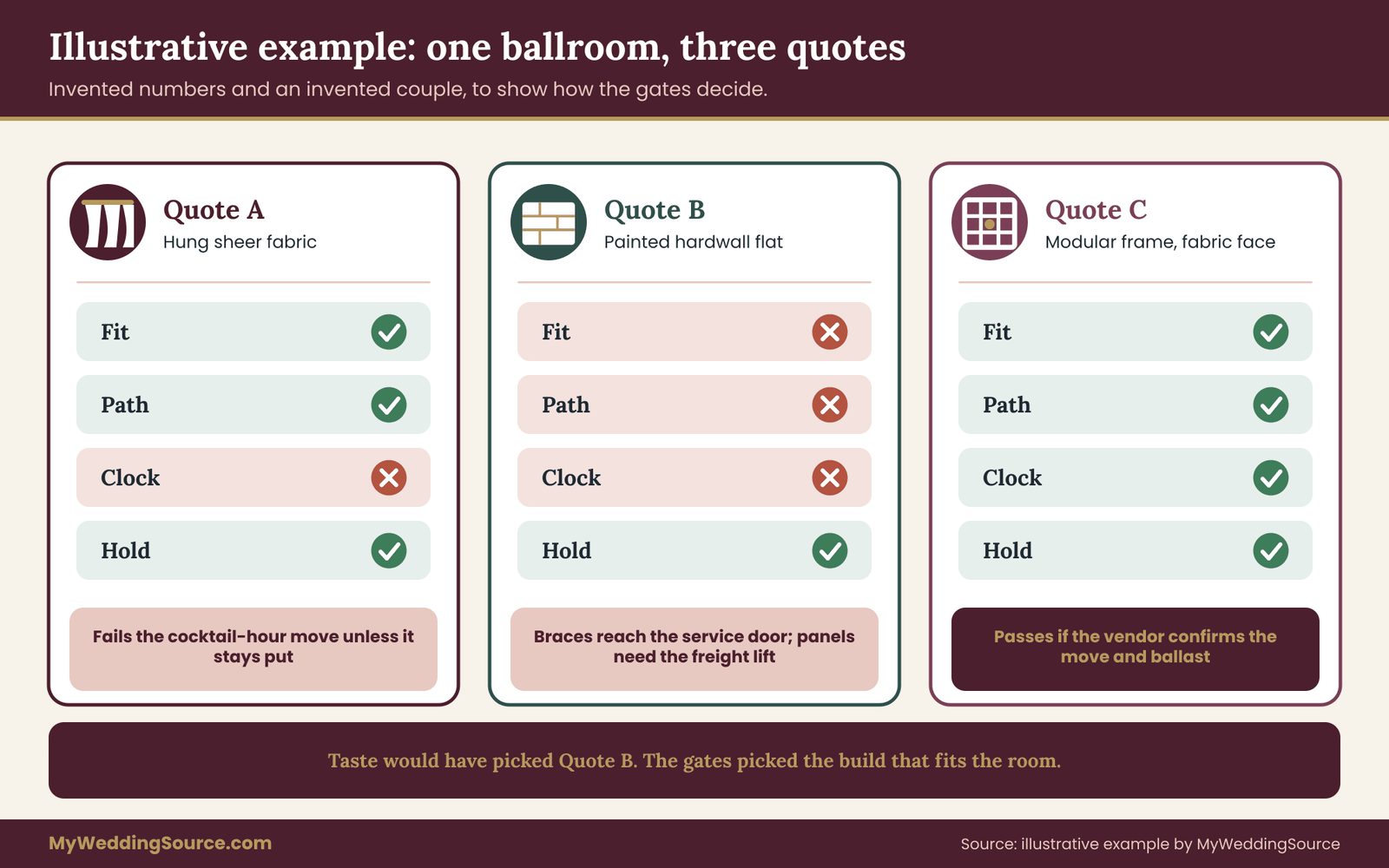
What does the example teach? The deciding facts were all about space, route, time and holding, and none were about color or texture. The look can be adjusted within a family, and the build cannot be changed on the day. The same example with a garden ceremony, soft ground and wind would flip the ranking, and a modular or hardwall build with strong ballast might beat loose hung fabric. The method stays the same and the results move with the venue.
Edge cases that change which wedding backdrop works
The gates handle the ordinary situation. A few unusual situations bend them, and it is worth knowing which gate each one stresses.
Outdoor ceremonies and wind. Outdoors, Hold becomes the tightest gate. A fabric face works like a sail, and a hung fabric wall on a stand is the most exposed. Ask the rental company what wind conditions the wedding backdrop was designed for, what ballast is needed outdoors and what their rule is for taking it down if conditions worsen.
Check the forecast with the National Weather Service as the date approaches, and agree in advance who decides to remove or lower the wedding backdrop and at what point. Open-weave or sheer panels and frames with gaps let air through and carry less load than solid faces, but they still need anchoring.
Soft ground. Grass, sand and gravel change footprints. Narrow feet sink, and weights can shift. Ask whether the structure uses wider feet or ground plates, and whether stakes are allowed. Stakes can hit irrigation lines or utilities, so ask the venue or property owner before any ground penetration. On sand, a base that works on a deck may tilt, so ask for the exact configuration used on beaches.
Stages and platforms. A raised stage helps visibility and complicates bases. Ask about the stage’s load rating and whether a wedding backdrop can be braced to it. Decking edges and gaps can catch feet. Include the stage lip in the Fit drawing, and make sure the wedding backdrop does not push anyone toward the edge.
Low ceilings and fixtures. If your ceiling is low, you may not be able to tilt a tall frame upright. Ask how the frame is raised and whether it can be assembled standing. Soffits, chandeliers, sprinklers, projector mounts and hanging signs all limit height, and the rental company should know the clear height before quoting. The venue’s own measurement is the one to trust.
Ceremony-to-reception flips. Whenever a wedding backdrop must move during the event, Clock and Path return in a new form. Ask who moves it, how many people, how long and what happens to the face while it moves. A moved fabric face can pick up creases or scuffs.
A moved hardwall needs a clear path and careful carrying. A modular frame on glides is easiest, if the floor allows. Where moving is hard, plan one position that works for both parts of the day, or use two simpler backdrops instead of one that must travel.
Photo walls and queues. A wedding backdrop for a photo area has to take repeated contact, cameras and flash. Matte surfaces photograph better than shiny ones under flash, and seams may show. Fit now includes the queue: where do guests stand while waiting, and does the line block a route? A photo wall near a bar or a door can create a bottleneck. The reception guest flow guide covers how people move through a room, and the same thinking applies to where a photo wall can live without blocking traffic.
Accessibility and sightlines. A wide or tall backdrop can block sightlines from seats or wheelchair positions. Raised bases and floor-level cables can create trip points. Ask the venue where accessible seating will be placed and check that the wedding backdrop does not obscure it. A wedding backdrop with a stepped base should be tested by walking and rolling past it, not only looking at it.
Heat, candles and lights. Open flame near fabric, paper or foam is a hazard and is often restricted. If your look includes candles, ask the venue what they allow and keep flames away from drapery. If lights sit on or behind the wedding backdrop, check heat and cable routing. LED lights generate less heat than older bulbs, though power and cable rules still apply.
Rain plans. If a ceremony might move inside, the wedding backdrop might need to move too. Ask whether the rental company can deliver to both locations, whether the second location has been through the gates and whether a change fee applies. A wedding backdrop that passes the gates in the garden may fail Fit or Path in the tent or the hall. Planning the rain location at the same time saves the day-of scramble.
Late changes to the guest count or layout. If the room layout changes after the wedding backdrop is chosen, the clearance zone changes with it. A larger guest count may push chairs into the wedding backdrop’s working zone. Send any layout change to the rental company so they can confirm that the footprint still works. It is much easier to adjust a drawing than a built wall.
Small venues and shared spaces. In a restaurant, a courthouse annex or a community hall, the room may serve other people before or after you. A wedding backdrop may need to be fully removed by a set time, and it may not be allowed to block regular exits or service lines. In these cases, a light fabric frame that one or two people can set and remove quickly is often the practical choice, and a heavy hardwall is rarely welcome.
Questions to ask each rental company before you pay a deposit
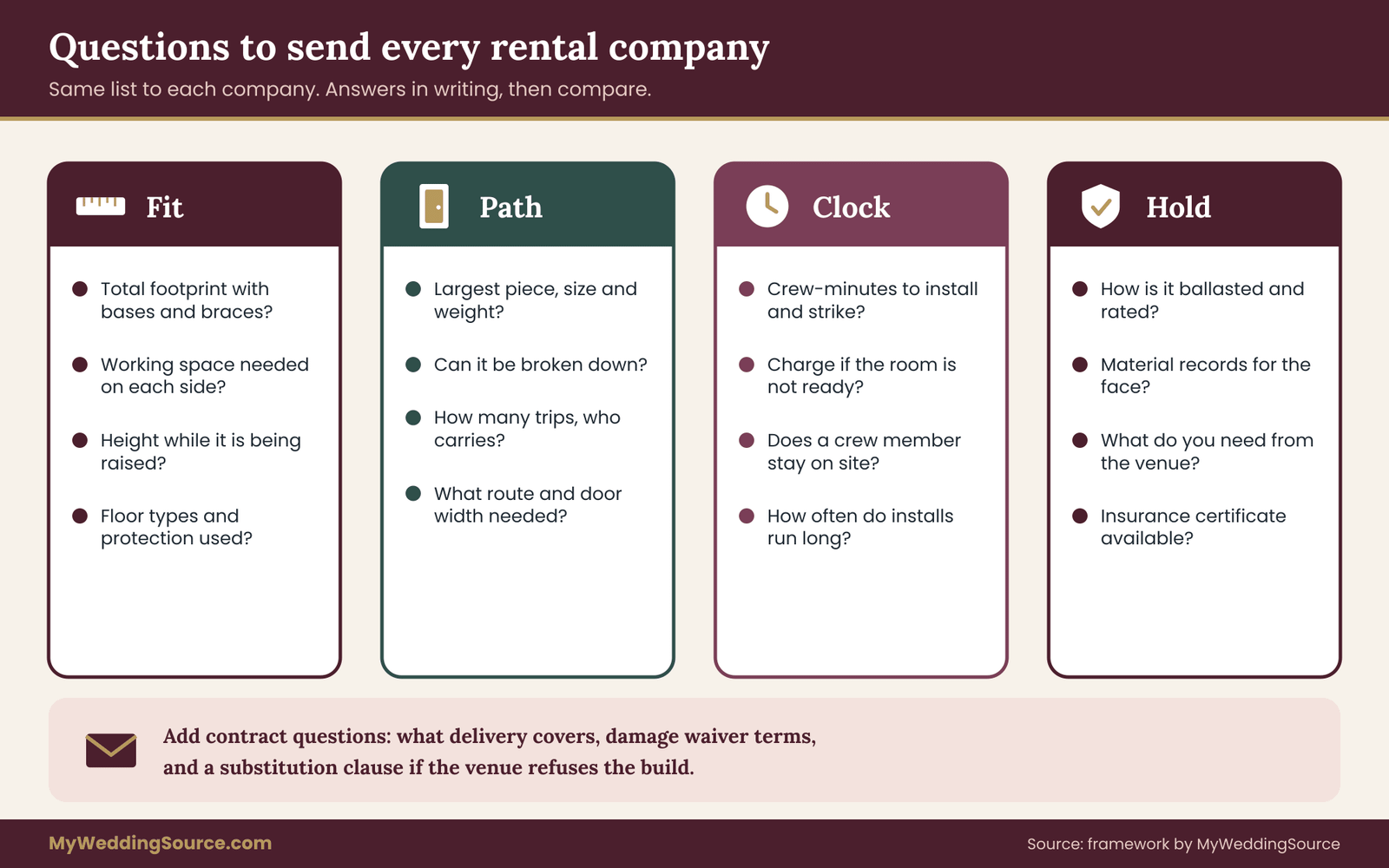
Questions work best when they match the gates. Send the same list to each company and compare answers in writing. Some of these may feel direct. That is fine. A company used to weddings will answer them without fuss.
For Fit, ask: What is the total footprint, including bases, braces and any part that extends beyond the face? What working space do you need on each side and behind? What height do you need during assembly? What floor types can the base stand on, and what protection do you use? Can you work from my floor plan and mark the spot?
For Path, ask: What is the largest piece, with dimensions and weight? Can it be broken down? What door width, elevator size and route does it need? How many trips will it take? What happens if the route is not available? Who carries it and who protects the floors?
For Clock, ask: How many crew will set it up, and for how long, including unloading, building, steaming or finishing and cleanup? How long does strike take? What happens if the room is not ready on time? Is there a charge for waiting? How often do installs run longer than the estimate, and what causes it? Can a crew member stay during the ceremony?
For Hold, ask: How is it ballasted, and what is it rated to withstand? What material records exist for the face and structure, including any flame-resistance treatment? What contact does it need with the floor, walls and ceiling? What do you need from the venue? Do you carry liability insurance, and will you provide a certificate if the venue requires it?
For the contract, ask: What exactly is included in delivery, installation, and strike? What is the cancellation policy? What changes are allowed and by when? What does the damage waiver cover and exclude? What is the deposit and when is it returned? What happens if the venue refuses the build? What substitutions are allowed? Many of these are standard contract topics, and the wedding vendor timeline can help you place each due date on a calendar.
Ask for the answers in a single written quote or an email thread, not a phone call. If a quote does not list footprint, crew-minutes, ballast and approvals, ask the company to add them. A vendor who will not put these in writing may still do a good job, though you carry more risk and should plan extra buffer. Treat vague answers as unknowns that must be resolved before payment, not as small details.
Keep a one-page comparison for yourself in plain sentences: the four gate lines for each option, with the total price for the same install and strike scope. When you share it with a partner, a planner or a parent, they can follow the reasoning in a minute. When the venue asks a question, the answer is already on the page.
Consider timing. Popular rental inventory books up for busy dates, and a venue approval can take time. The earlier you begin the gates, the more options you keep. If your date is close, start with Path and Hold, since those two can remove an option fastest, and move to Fit and Clock with the survivors.
If you are using a planner or a venue coordinator, ask them what they have seen work in the room. They may know which doors are tight, which times the elevator is free and which rental companies have installed there before. That local knowledge does not replace the gates, and it can shorten the process. A company that has worked in your venue often needs fewer clarifying questions, though you still need the answers in writing.
Cost logic and common mistakes with a wedding backdrop rental
Prices vary by region, season, inventory and company, and any figure printed here would be out of date or wrong for you. Cost logic is more durable than cost numbers. The aim is to compare quotes on the same scope so that a difference in price reflects a real difference in what you get.
Start by listing what each quote includes: the rental of the structure, the face, ballast, delivery, installation, strike, steaming or finishing, florals or greenery, lighting, floor protection, a damage waiver and any minimum charges. Then list what it excludes. Many surprises come from exclusions, such as stairs, waiting time, an extra elevator trip or a charge to return after midnight.
Compare totals for the same scope. If Quote A includes install and strike and Quote B includes only delivery, they are not comparable. Ask both for a total with the same services. Then adjust for the gates: a lower price that needs a bigger crew, a wider route or an extra freight booking may cost more by the end. A higher price that fits your access window with room to spare may be the cheaper day.
Think about the cost of failure. If a wedding backdrop fails the venue’s approval at the last minute, you may pay for a replacement, for rush delivery and for a change of look. If it fails on the day, you may pay in lost photo time and in stress. A second approved option, held by the vendor with a small hold fee if needed, can cost less than a rescue. Ask whether the company will hold an alternate for a modest charge and what the terms are.
Think about reuse of what you pay for. If the same modular frame can serve as the ceremony backdrop, the photo wall and the sweetheart table backdrop, it may replace two separate rentals. A single flexible rental can cost less than two fixed ones, though only if the transitions are practical. The Clock gate tells you whether they are.
Keep your budget honest by tracking backdrop costs where they actually land. Some belong to the wedding backdrop vendor, some to the venue (such as an elevator fee or an approval charge) and some to a florist or lighting company if they dress the structure. The wedding budget can help you see where decor sits in the whole plan, and the wedding vendor purchase order checklist is a useful pattern for writing down scope, price and acceptance for each item.
Common mistakes follow the gates. The most frequent is choosing the face first and discovering the build later. A related one is measuring only the face, and then finding the braces on setup day. Another is assuming the route works because the room is large, when the doors are small. Another is trusting a vendor’s rough install time without asking for crew-minutes and buffer. Another is treating flame resistance and anchoring as the vendor’s problem alone, when the venue and its fire authority have the final say.
Some mistakes are quieter. Ordering a color without checking how it looks next to the room’s walls and lights can leave a wedding backdrop that clashes with the setting, and the wedding color palette guide gives a way to test colors against fixed surfaces such as carpet, wood and linens. Placing a wedding backdrop where the photographer cannot step back far enough costs usable photos.
Forgetting that the wedding backdrop will be seen from the back, by guests walking behind or by staff, leaves a visible mess of braces and cables. A simple cover or a short screen can solve this if planned early.
Another mistake is leaving the wedding backdrop out of the day-of schedule. Whoever is in charge on the day needs the install time, the vendor contact, the approver’s name, the flip time and the strike time, and the ceremony timing in the ceremony step-by-step guide shows where a flip or a setup window sits in the sequence. Give those details to your planner, venue coordinator or a trusted friend, so that you do not field questions while getting ready.
One more is silence after booking. Rental companies and venues change staff, and details slip. Confirm the final dimensions, the delivery window and the approval a week or two before the date, and again two days before. A short email that restates the plan with the four gate lines gives everyone a chance to catch a mismatch while it is still cheap to fix.
Finally, do not let the method crowd out the pleasure. The gates exist to protect the look you chose, not to replace it. Once a wedding backdrop passes all four, you can enjoy choosing fabric, greenery, color and lettering knowing that the structure beneath it will stand, fit, arrive and come down on schedule.
Your next steps
This week, get the venue’s floor plan, the access times and the door and elevator measurements, and draw the spot with its four zones. Next, choose two builds from different families that look right to you, and send each rental company the same list of questions. Ask for footprint, largest piece, crew-minutes, ballast and material records in writing, plus a total price for install and strike.
When the answers arrive, write the four gate lines for each option and mark any gate that is blank or failed. Send the best option to the venue with a dimensioned drawing and ask for approval and the paperwork they need. Keep the second option warm in case the first is declined. If you are unsure which questions to put to the venue first, the technical walkthrough guide is a good place to start, and the rental checklist helps you place pickup and return dates.
Once approved, put the install window, the flip time and the strike time on your day-of schedule and share it with the people who will be in the room. A wedding backdrop that has passed all four gates is a quiet success, and nobody will notice the planning behind it.
FAQ
Which wedding backdrop type is easiest to install?
It depends on the venue and the build. Fabric on a light freestanding frame is usually the quickest to carry in and the simplest to set, though steaming adds time. Hardwall can be fast once in place but needs more carriers and clear routes. Modular is steady and predictable if the set is complete. Ask each company for install time in crew-minutes, including finishing, instead of relying on the type alone.
How much floor space does a wedding backdrop need?
More than its visible width suggests. Count the structure zone (bases, braces and ballast), a working zone for the crew, and a clearance zone for people and sightlines. Ask the rental company for the total footprint in writing, including anything that extends past the face, and draw it on your floor plan before booking. Check door swings, exits and service paths.
Is hardwall better than fabric for a wedding backdrop?
Neither is better everywhere. Hardwall gives a solid, finished look and resists air movement, though it is heavy and needs clear routes and floor protection. Fabric is light and easy to move, though it needs steaming, wind care and flame-resistance records. Choose by the venue’s doors, access time, ceiling and approvals, and choose the look within the type that passes.
Do I need venue approval for a rental wedding backdrop?
Often yes, especially for anything hung, attached to walls or made of fabric. Venues and fire authorities set their own rules on rigging, flame resistance, anchoring and exits. Send the venue a dimensioned drawing and ask who approves it, what paperwork is required and by when. Get the answer in writing and keep it with your vendor contract.
What is flame resistance and why does it come up?
Flame resistance describes how a fabric or decoration behaves when exposed to fire. Many venues ask for a certificate or treatment record for draping and decorative materials, and NFPA 701 is one widely referenced test method. Your venue or its fire authority decides what it accepts, so ask what they require and ask the rental company to supply matching paperwork.
Can a wedding backdrop move from the ceremony to the reception?
It can if the build allows it. A light modular frame on glides or casters can often be moved by two people in minutes, while a hung fabric wall or a hardwall flat is harder. Ask the company who moves it, how long it takes and how the face is protected. If the move is hard, use a position that works for both or rent two simpler backdrops.
How early should I book a wedding backdrop rental?
As early as your venue and date are settled, because approvals, inventory and install windows all take time. Popular dates can run short on rental stock, and a venue may need days or weeks to review a build. If your date is close, start with the Path and Hold gates, since they remove unworkable options fastest, and ask the company to hold a second option.
What should be in the rental contract for a wedding backdrop?
The exact items, dimensions and footprint, delivery, installation and strike times, crew size, who is responsible for damage, deposit and cancellation terms, and what happens if the venue refuses the build. Ask that the quote name the ballast method and the material records. Request a clause for substituting an equivalent compliant option if approval fails, and confirm whether that is accepted.
Sources
- NFPA standards and codes, National Fire Protection Association
- Occupational Safety and Health Administration, U.S. Department of Labor
- ADA information and technical assistance, U.S. Department of Justice
- National Weather Service forecasts and wind advisories, NOAA
- Consumer Product Safety Commission
- Federal Trade Commission, consumer advice on contracts and fees
- International Code Council, International Fire Code
- Entertainment Services and Technology Association, rigging and safety standards
- U.S. Fire Administration, FEMA
- Consumer Financial Protection Bureau, disputing a charge