
Wedding photography consent is the set of agreements that decide who gets photographed, which pictures are kept, and where they end up. Most couples never write any of it down, then find out at the reception that a guest hates the camera, a photographer posted a picture nobody approved, or a cousin’s phone video is already public. This guide shows how to plan wedding photography consent on purpose: a short privacy preference form for guests, a shot-exclusion brief for your photographer, and plain rules for everyone else with a phone.
Treat wedding photography consent as three separate questions: may this person be photographed, may the picture be kept, and may it be shared and where. Ask guests about their boundaries before the day with a short form, give your photographer a written list of people and situations to avoid or handle carefully, and state your phone and posting rules where guests will see them. Check what your photographer contract says about who owns the images and how they may be used, because photographers usually keep the copyright and license the pictures to you.
Here is a situation that comes up more often than couples expect. A guest hides behind a pillar every time the photographer walks past. She is not shy. She left a relationship that was not safe, she has a legal reason to keep her location private, and nobody told the photographer. Three weeks later a photo of her appears on the couple’s public gallery, tagged with the venue’s name.
Nobody in that story meant harm. The couple wanted a complete record of the day. The photographer wanted a rich portfolio. The guest wanted to see her friend marry. What was missing was a plan, and a plan costs an hour of thought and a few short messages.
This article is long because the topic has layers, and the layers behave differently. Read the first sections to understand the structure. Use the form and the brief when you are ready to act. Come back to the sections on children, safety and aftercare when those situations show up on your guest list.
What wedding photography consent covers
People use the word “consent” loosely, so it helps to pin down what is actually being agreed to. Wedding photography consent is not one yes or no. It is a stack of smaller permissions, and a guest may be fine with some and not with others.
Being photographed. This is the most basic layer of wedding photography consent. At a wedding, most guests expect to appear in candid photos. By accepting an invitation, they are usually accepting that, but they are not accepting everything, and some people have good reasons to opt out.
Being included in the couple’s collection. A picture taken in passing is different from a portrait that goes into a gallery, an album or a framed print. A guest might be fine with the first and not the second.
Being shared privately. A gallery sent to forty guests by link is more contained than a public post, but it still moves the image beyond the room.
Being shared publicly. Social media, a wedding blog, a vendor’s website and a printed magazine all reach strangers. Public use is where most objections live, because it cannot be called back.
Being used by someone else for business. Photographers often want to show their best work. Venues and florists want to show how their work looked on the day. That is commercial use of an image, and it follows different rules from your own personal use.
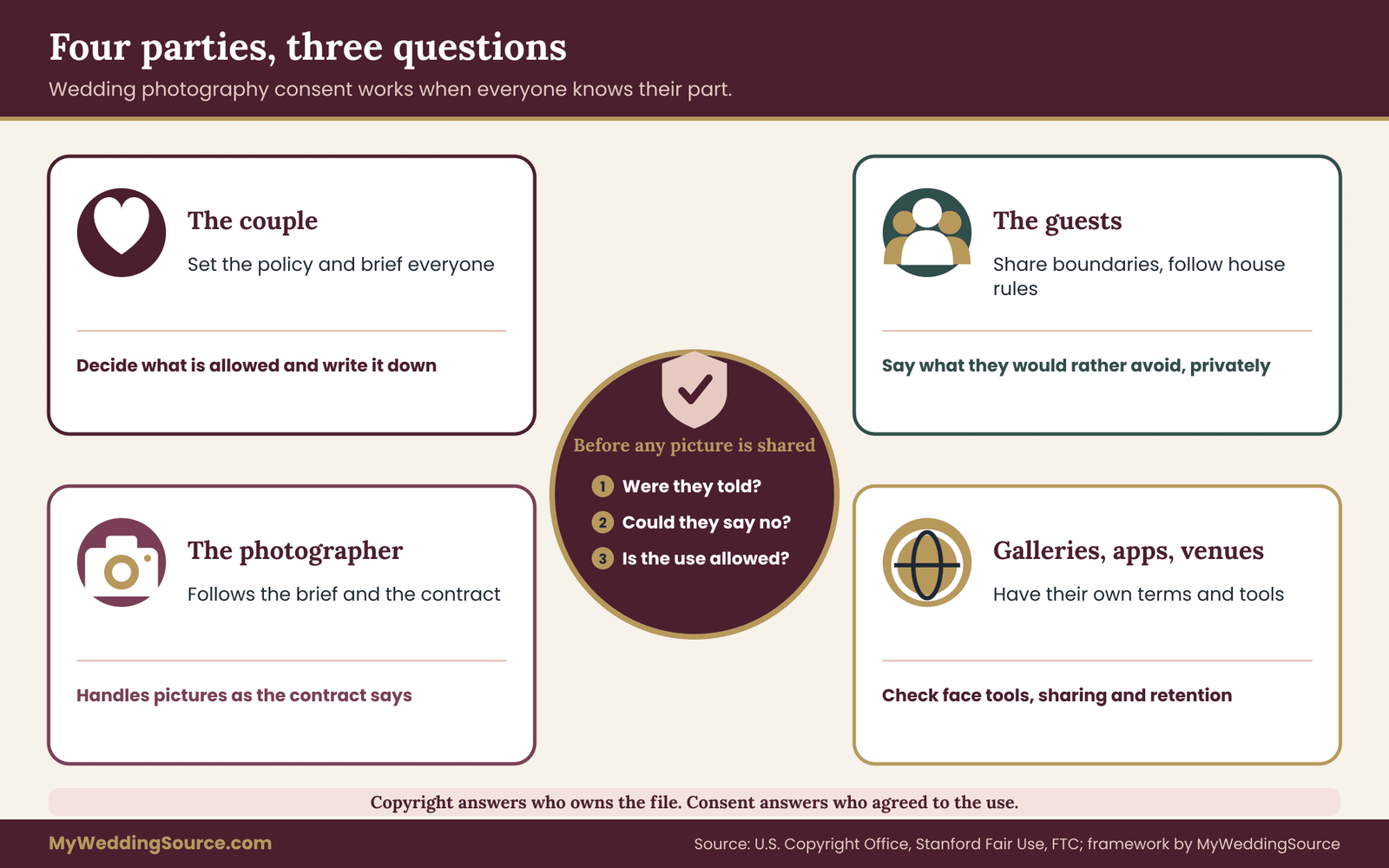
Keeping these layers of wedding photography consent apart gives you a better question to ask. Instead of “Is everyone fine with photos?” you can ask “Is anyone not fine with being published, or being photographed at all?” The second question finds the problem cases without turning your wedding into a legal seminar.
The three questions behind every decision
Whenever a picture is about to be taken, kept or shared, three questions sit underneath.
- Was this person told, in a way they could understand, what would happen to the picture?
- Did they have a real chance to say no, without social cost?
- Does the person using the picture have a right to use it that way?
The first two are about the guest. The third is about the people holding the images: you, your photographer, your guests with phones. When you plan wedding photography consent, you are designing answers to all three before the day arrives.
What the law does and does not settle
Most of this guide to wedding photography consent is about courtesy, planning and risk, not law. Still, it helps to know a few facts so you do not rely on guesses. This is general information for the United States, not legal advice, and details vary by state.
Copyright belongs to the photographer by default. According to the U.S. Copyright Office, the person who takes a photo is usually its author and first owner, and the protection exists from the moment the picture is made. The main exception is a work made for hire, where an employer or a commissioning party can be treated as the author. For a wedding, that only applies if the photographer is your employee or the contract meets the legal rules for a commissioned work and says so in writing. In practice, nearly all wedding photographers keep the copyright and give you a license to use the photos.
Transfers need paperwork. A copyright can be transferred, but generally the transfer has to be in writing and signed by the owner. If you want to own the copyright, put that in the contract. Owning a physical or digital copy of a picture does not make you the copyright holder.
Copyright is not the same as consent. Who owns a picture says little about whether the people in it agreed to be published. A photographer can own every image and still need a guest’s permission for certain uses. And a guest can agree to appear in a picture without the photographer having the right to use it commercially.
Using someone’s image to promote a business usually needs a release. Stanford’s fair use guidance explains that using a recognizable person’s image to sell or endorse a product or service generally needs a signed release. Editorial or expressive uses, such as news, documentaries and informational pages, usually do not. The line between the two is often unclear and decided case by case, and claims in this area are commonly brought as right of publicity claims. A wedding photographer’s marketing sits closer to the commercial end than most people assume, which is why the contract should address it.
A private event is not a public street. In a public place, people have limited expectations of privacy. A private wedding at a venue is different: the host sets the rules for who may photograph, and guests can reasonably expect a bit more control. Hosting rules are not law, but they are enforceable as house rules, and most guests will follow them.
Some uses carry extra rules. Facial recognition, biometric data and the privacy of minors are areas where state laws and platform terms vary. The Federal Trade Commission has taken action against a photo app that used customers’ pictures for facial recognition without clear consent, which is a reminder that apps hosting your wedding photos are making their own choices about your guests’ faces.
None of this means you need a lawyer for a normal wedding, but it does mean wedding photography consent is partly a contract matter. It does mean that wedding photography consent is partly a contract question. The agreement with your photographer is where most of the real decisions get written down, so it deserves careful reading. If your photographer’s terms are unusual or you have a specific concern, an attorney can review them for a modest fee.
Who is responsible for what
Confusion about responsibility causes most wedding photography consent problems. Here is a sensible split, which you can adjust.
The couple decides the policy. You set the boundaries you want, collect guest preferences, brief the photographer and tell guests the rules. You are responsible for the instructions you give, even if someone else delivers them.
The photographer follows the brief, takes reasonable care with sensitive situations and handles the images according to the contract. A good photographer will also tell you if a request is unworkable, for example if a list of excluded guests is too long to follow during a fast-moving ceremony.
A point person carries the brief on the day. This is someone from your side, such as a sibling, a friend or a planner, who the photographer can ask quickly: “Is it okay to photograph the table by the window?” You should not be the one answering these questions at your own wedding.
Guests follow the house rules for phones, posting and tagging, and respect each other’s preferences. They are not legally bound by your wishes, but most will follow a clear, kind request.
Venue and other vendors may have their own photo rules and their own cameras. A venue may allow only certain photographers, or may photograph the space for its own marketing. A videographer, a DJ with a camera and a photo booth company are all adding to the pile of images. Each needs to know the rules.
Our vendor due diligence checklist lists what to verify with any vendor before you sign, and the photography part of it is worth reading alongside this guide.
Why guests have boundaries in wedding photography consent, and why you rarely hear about them
You will not hear most objections unless you ask. Guests do not usually volunteer “please do not photograph me” to a couple who is busy planning a wedding. They say nothing, then avoid the camera or leave early. The cost of that silence is small if the reason is a bad hair day. It is large if the reason is safety.
Understanding the range of reasons helps you write a form that does not feel intrusive. People hold back from photos for many reasons, and most are ordinary.
Safety. A guest may have left an abusive partner, may be a witness in a legal case, may have a protective order, or may be in a state address confidentiality program, where survivors of domestic violence, sexual violence and stalking can keep a home address private. Pictures with location details, recognizable backgrounds or tagged names can expose them.
Family situations. Custody arrangements, contested adoptions, estrangements and strained family relationships all affect whether a child or an adult wants to appear in photos that relatives will see. A child’s picture on a public feed can cause real conflict between separated parents.
Work. Some guests work in roles where a public presence causes trouble: teachers, healthcare workers, public officials, people in security or law enforcement. Others simply do not want an employer to see them at a party.
Health and recovery. A guest who is sober may not want photos at the bar posted. Someone with a medical condition, a recent surgery or a treatment that changed their appearance may not want to be photographed or tagged.
Religion and modesty. Some guests have religious or personal reasons for not appearing in published images, or for appearing only in certain contexts.
Identity and privacy preferences. A person who has not told everyone about a transition, a relationship or a legal name change may need control over where their image appears. Others are just private people.
Past experiences. Harassment, doxxing, a viral picture they did not choose. Once bitten, people tend to be careful.
You do not need to know which of these applies to which guest. Your wedding photography consent form should make it easy for anyone to say “please do not publish me,” or “please do not photograph me,” without explaining why.
Design a wedding photography consent form that people will actually answer
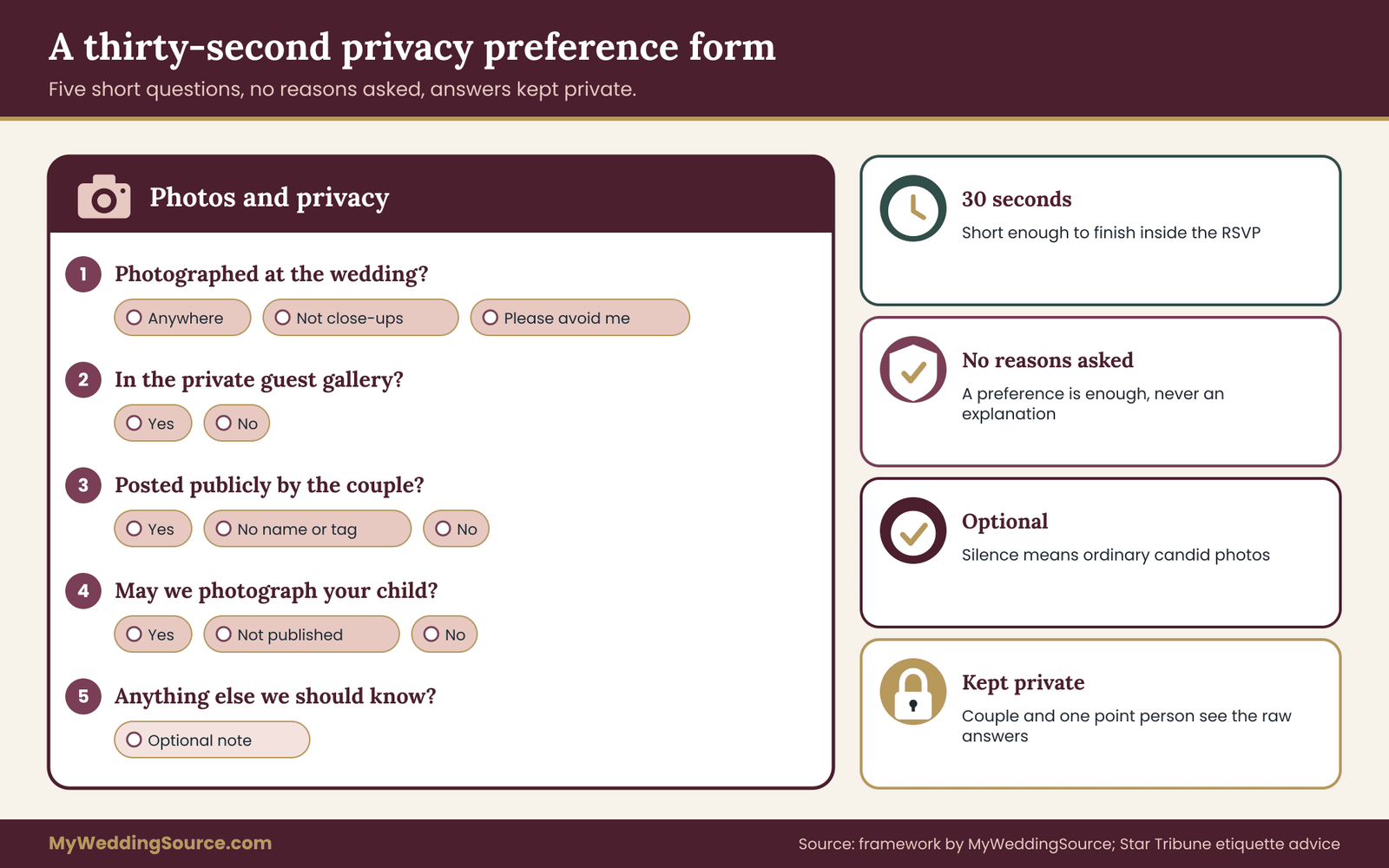
A privacy preference form is a short set of questions that turns wedding photography consent into something guests can answer privately. It can be part of your RSVP, a separate page on the wedding website or a one-question add-on to a paper reply card. The key design rule is that answering it should take thirty seconds and require no explanation.
What to ask on a wedding photography consent form
Start with the smallest set of questions that gets you the information you need. Here is a version that works for most weddings.
- Photos taken at the wedding. “Are you comfortable being photographed during the wedding?” Options: yes, anywhere; yes, but not close-up portraits; please avoid photographing me; please check with me first.
- Sharing with other guests. “Are you comfortable appearing in the private gallery shared with guests?” Options: yes; no.
- Public posting. “Are you comfortable with photos that include you being posted publicly by the couple?” Options: yes; yes, but no name or tag; no.
- Children in your party. “If you are bringing a child, may we photograph them?” Options: yes; yes, but not published; no.
- Anything else. “Is there anything else your photographer or we should know?” Free text, optional.
That is five questions. You can cut further. Many couples keep only the second and third, plus the free-text box. If you cut, keep the public-posting question, because that is where the worst surprises happen.
Avoid questions that ask for reasons. “Why do you want to opt out?” pushes people toward lying or not answering. A form that says “No reasons needed” works better.
How to word the introduction to your consent form
The introduction matters more than the questions. It sets the tone, and it tells guests what you are going to do with their answers. Keep it short, warm and specific. Here is a sample that you can adapt.
“We will have a photographer at the wedding, and we plan to share pictures with guests afterward. We would like everyone to be comfortable. If there is anything about photos you would rather we avoid, such as being photographed, being shared, or being posted online, tell us here. You do not need to explain, and your answer stays between us and the photographer.”
Notice what it does. It names the photographer, so guests know who is taking pictures. It promises a limited audience for the answers. It says that no explanation is required. And it uses ordinary language instead of legal terms.
Where to put the wedding photography consent form
Choose the place guests are already filling out information, so wedding photography consent feels like part of the RSVP.
- The RSVP. If you use an online RSVP, add the questions at the end. Response rates are highest here because guests are already engaged.
- A separate page. A “Photos and privacy” page on the wedding website works as a backup for guests who skip optional questions. Link to it from the RSVP.
- A paper card. For older guests who reply by mail, add a short line to the reply card: “Please tell us if you would prefer not to be photographed or not to appear online.” A phone number or email makes it easy to reply.
- A personal message. For anyone you already suspect has a concern, a private text works better than a form.
Do not make the wedding photography consent form mandatory. A required question about privacy preferences invites false answers and annoyance. Leave it optional and reassure people that silence means they are fine with ordinary candid photos.
Handling the answers to your wedding photography consent form
The answers to your wedding photography consent form are sensitive. Treat them like the information they are.
Limit who sees them. The couple and one trusted point person should have the raw answers. The photographer needs a brief, not the whole spreadsheet, with names and instructions for the specific people involved. Do not forward the full list to the entire wedding party.
Store them safely. Use a password-protected document, a locked note or a private folder, not a shared group chat. Delete the raw answers after the wedding gallery is delivered, unless you need them for a follow-up.
Do not use them for anything else. Answers to a photo-privacy question are not a mailing list, a seating chart input or an excuse to ask follow-up questions. If someone says “no photos, no names,” that is the entire message.
Confirm quietly. For people with serious privacy needs, a short reply helps: “Thank you for telling us. We will make sure the photographer knows.” Do not ask for details, and do not repeat the reason.
What if a guest asks for something your wedding photography consent plan cannot do
Some requests are easy: “Please don’t post me on Instagram.” Some are hard: “Please don’t photograph me at all, but I will be in the front row for the ceremony.” You have options.
You can seat the guest outside the camera’s main lines, for example at a table at the edge of the room rather than the front. You can tell the photographer to avoid the person during formal shots, though you cannot guarantee they will never appear in the background of a group picture. You can agree to blur or remove the guest from published images. And you can be honest if something is not possible: “The ceremony is wide open and the photographer will be shooting from the aisle, so we cannot promise you will never appear in the background. Would it help if you sat in the second row on the side?”
Honesty about wedding photography consent is kinder than overpromising. A guest who is told the truth can decide whether to attend, to sit somewhere different or to ask for a different arrangement. A guest who is promised the impossible learns the truth when it is too late.
The wedding photography consent ladder: choosing your own policy
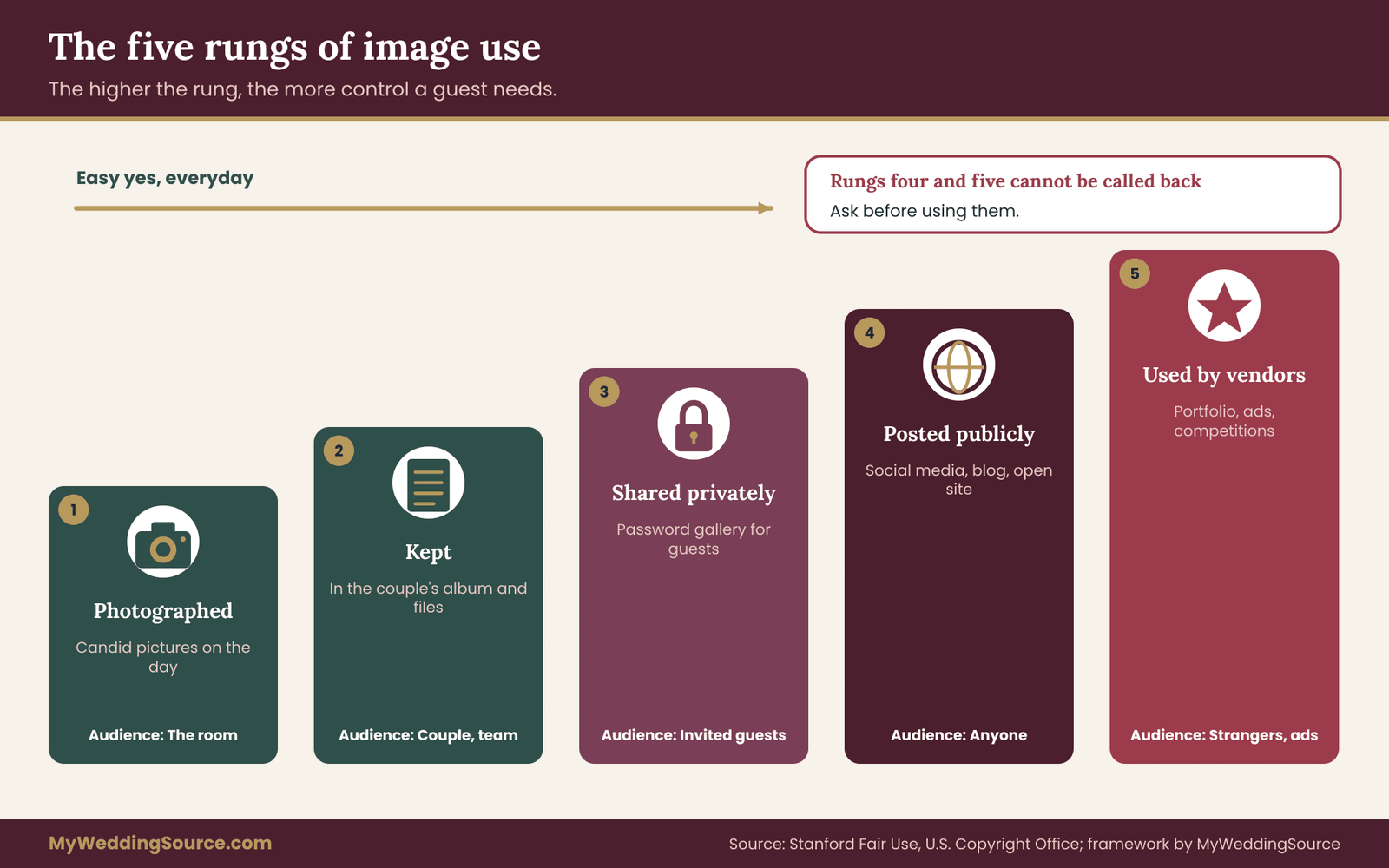
Beyond the guests’ preferences, you need your own policy. Think of wedding photography consent as a ladder with five rungs. The higher the rung, the more control the guest needs and the more the image moves away from the room.
Rung one: photographed. The photographer takes candid pictures. This is the default at nearly every wedding and the lowest bar.
Rung two: kept in the couple’s collection. The picture goes into your album, your gallery and your files. The guest is mostly trusting you.
Rung three: shared privately. A password-protected gallery or an invitation-only album. The audience is limited to guests and family.
Rung four: posted publicly by you. Social media, a blog, a wedding website with open access. The audience is anyone.
Rung five: used by vendors for marketing. The photographer, venue or florist uses the picture in a portfolio, advertisement or competition entry. The audience is strangers, and the use is commercial.
In wedding photography consent, most guests will accept the first three rungs without a second thought. The last two need more care, and your policy should say what you do at each. A common policy is: photographed and kept by default, shared privately by default, posted publicly only for people who have said yes or have not said no and are not in a sensitive category, and used by vendors only with written permission.
The right policy depends on your guests and your comfort level, and it is fine to be stricter than most couples.
For a closer look at how photographers’ own usage terms work, including social media credits and portfolio rights, see our guide to wedding photography usage rights for vendors and social media.
The shot-exclusion brief: putting wedding photography consent in writing
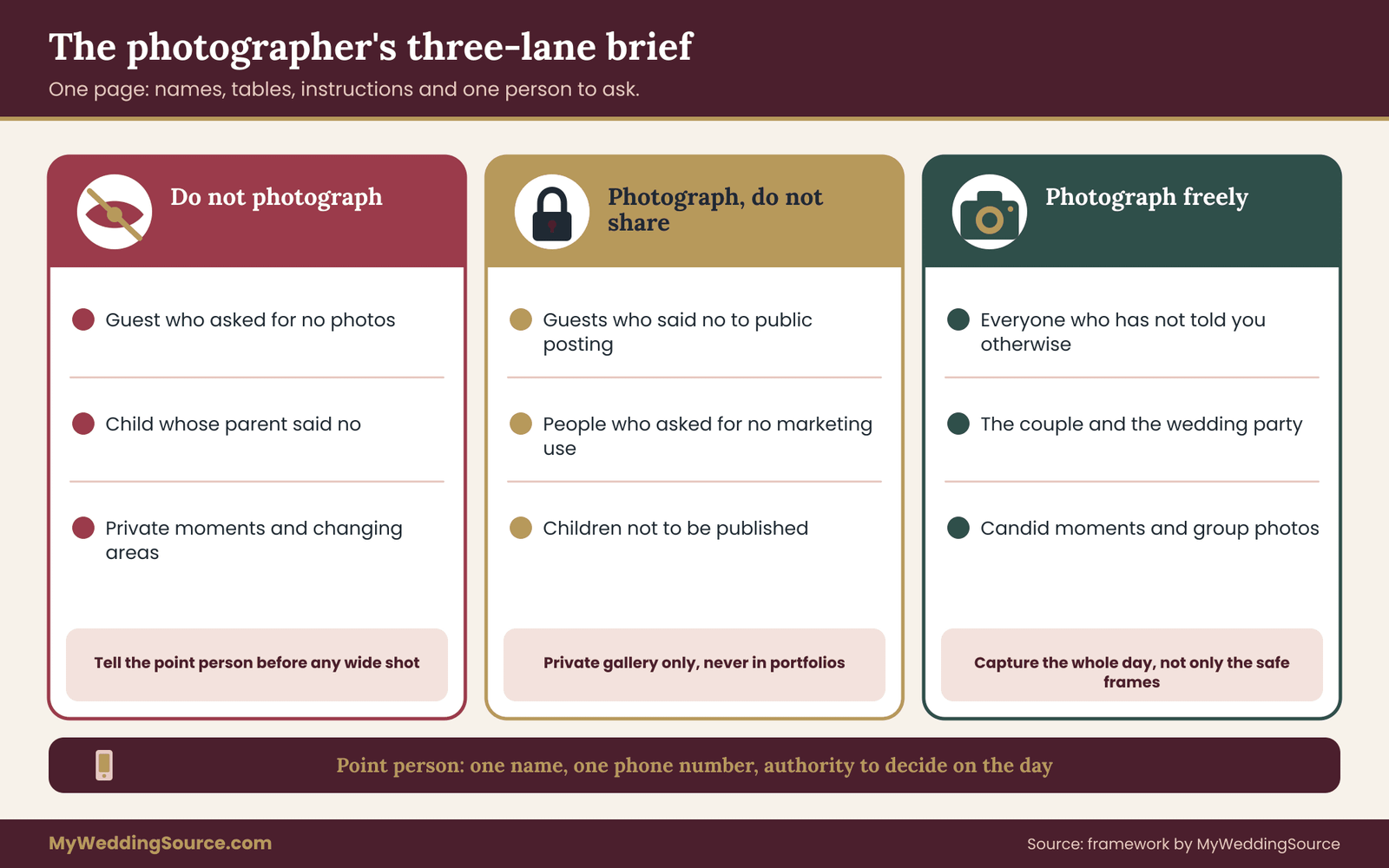
A photographer cannot read minds, and they meet most of your guests for the first time on the day. If you want certain people or situations handled differently, the only reliable way is a written brief that they can read and carry in their head. We call it a shot-exclusion brief, though most of it is really a shot-management brief: what to avoid, what to handle carefully and what to photograph freely.
Keep it to one page, because wedding photography consent instructions only work if they are read. A photographer working a ten-hour day does not want a legal memo. They want names, faces, places and clear instructions.
The three lanes of wedding photography consent
Sort everything into three lanes.
Lane one: do not photograph. The person or situation should not appear in any image if it can be avoided. This is the strictest lane and should be short. Examples: a guest with a safety concern who has asked not to be photographed, a child whose parent has said no, a situation such as a private conversation or a vendor dispute.
Lane two: photograph, but do not share. The person can appear in the couple’s private collection, but not in anything public and not in any marketing. This is the most common lane for guests who are fine with appearing in the album but not on the internet.
Lane three: photograph freely. Everyone else. Spell this out as well, because a photographer who is told only about restrictions may become hesitant and under-shoot the rest of the day.
What goes in each entry
For every person in lane one or two, the entry should give the photographer enough to recognize and handle them.
- A name and a way to recognize them. A first name, a table number or a seat location, and a short description. Better still, give the photographer a photo from the engagement or rehearsal if the guest agrees.
- The instruction. “Do not photograph” or “photograph but do not publish.”
- How to handle the group shot problem. “If this person is in a group shot, tell the point person before shooting.” Or: “Avoid including this person in the family photos, and if they are in a wide shot, flag it so we can blur or crop.”
- Who decides. The name of the point person who can answer questions quickly.
Do not include the reason. The photographer does not need to know why a guest has asked for privacy, and the less sensitive information that sits in a document, the safer everyone is. If a photographer asks, tell them it is a privacy preference and leave it at that.
Sample wording
Here is a one-page brief you can adapt. The names are placeholders.
Photo preferences for [couple names], [date]
Point person for questions on the day: [name, phone number]
Please do not photograph: – [Guest first name], seated at table [X], wearing [short description]. If they appear in a wide shot, tell [point person] before delivering. – [Child’s first name], with [parent’s name]. Parent has asked for no photos of the child.
Please photograph, but do not publish or use in marketing: – [Guest first name], table [X] – [Guest first name], table [Y]
Please photograph freely: everyone else, including children whose parents have not told us otherwise.
Other requests: No photos in the preparation rooms unless invited. Please do not publish images showing the venue’s address or house number. Please check with [point person] before posting to social media or sending images to blogs. Please do not use facial recognition tools or automatic tagging on any images.
Two things are worth noticing here. The brief gives instructions without explaining reasons. And it adds general rules that apply to everyone, such as no posting without checking and no facial recognition, which avoids singling anyone out.
Telling the photographer on the day
A brief is only useful if the photographer remembers it at hour eight. Make that easy.
Send it two weeks ahead. The photographer should read it, ask questions and tell you if anything is unworkable. If you send it at 9 p.m. the night before, you will get a hurried reply at best.
Meet the point person. Introduce the photographer and the point person at the start of the day. It takes a minute and sets up a working relationship.
Use visual signals. For a large wedding, a signal helps the photographer identify who is who without reading names. A small discreet ribbon, a colored dot on a place card or a table marker can work, but only if the guest agrees. Never mark a guest in a way that draws attention to them. For a guest with a safety concern, a visible marker defeats the purpose. A photo and a table number is safer.
Walk the room before the ceremony. Ten minutes before guests arrive, the photographer and point person can walk the seating plan and the key locations. It is much easier to point at a table than to describe one.
Plan for the chaos hours. The ceremony, the first dance, speeches and the dance floor are fast. The brief will matter most in the other hours: cocktail hour, dinner, quiet moments. Brief your photographer on the situation, not just the names.
For how photography fits into the rest of the day, see our wedding photography timeline, and for the group shots that need planning, the wedding family photo list.
Contract terms that shape wedding photography consent
The shot-exclusion brief tells the photographer what to do on the day, and the contract carries wedding photography consent into the years after it. The contract decides what happens to the images afterward. Read it with consent in mind, and ask for changes in writing if something does not fit.
Ownership and license
As noted earlier, most photographers keep the copyright and license the images to the couple. Typically that license covers personal use: printing, sharing with family, posting on your own social media with credit. It usually does not allow you to sell the pictures or edit them heavily. If you want something outside the normal license, write it into the contract before you sign.
Why does this matter for consent? Because the license defines what you can legally do with the images, including what you can authorize others to do. If you tell a guest “I will never post your picture,” you want to be sure the contract does not force you to share, and that you control the gallery. If the photographer can post anything they like, your promise to the guest is hollow.
For more on how deliverables and licenses work in practice, see our guide to wedding photography deliverables.
The clauses to look for
Ask your photographer about each of these wedding photography consent clauses. Good photographers will have answers, and many will be glad you asked.
- Portfolio and marketing use. Does the photographer have the right to use your images in their portfolio, on social media, in ads or in competitions? Does the contract make that mandatory, or can you opt out entirely, or exclude certain images?
- Model release. Does the contract include a model release for you? Does it cover your guests, and if so, how? A release signed by the couple does not automatically cover guests, and a wise photographer knows that. Ask how they handle guests in marketing images.
- Excluded images. Can you list specific people or images that cannot be used in marketing? Can you ask for removal later?
- Gallery privacy. Is the online gallery password protected? Who can download? Can guests share links? Can you turn off downloads or watermark? Can you set an expiry date?
- Third-party platforms. Which services does the photographer use for gallery hosting, culling, editing or AI? Do any of them run facial recognition or analyze images for other purposes? A photo app that turns on facial recognition by default can do things with guests’ faces that nobody agreed to.
- Second shooters and assistants. Who else will be photographing, and are they bound by the same brief and contract?
- Drone use. If a drone is involved, who obtains permissions, and what does the footage cover?
- Retention. How long does the photographer keep the original files? When are they deleted? Can you request deletion?
- Cancellation and replacement. If the photographer cannot attend, who replaces them, and are the replacement’s terms the same as the original?
- Dispute handling. If you or a guest asks for an image to be removed, what is the process and the timeline?
Not every photographer will agree to every request. Some have standard contracts they will not change. When that happens, you can decide whether the trade-off is acceptable or hire someone else. A photographer who refuses any limit on public posting is telling you something about how they handle their clients’ guests.
Questions to ask at a consultation
If you are still choosing a photographer, use the first call to learn their approach.
- “How do you handle guests who do not want to be photographed?”
- “Have you ever had a guest object to publication? What happened?”
- “What do you post publicly, and how soon after the wedding?”
- “Do you ask permission before using guest faces in marketing?”
- “Can we approve or veto images before you post them?”
- “Where do you store the images, and for how long?”
You are not interrogating them. You are checking that their normal practice fits yours. A photographer who answers these without defensiveness is usually a good sign.
Put wedding photography consent changes in writing
If your photographer agrees to anything unusual, such as skipping social posts entirely or deleting images after a year, get it in the contract or an email that is part of the contract. Verbal promises are easy to forget, and the person who made them may not be the person who does the editing. Written terms protect both sides.
Guest phones, other cameras and posting rules for wedding photography consent
Your photographer is one camera among many. At a typical wedding, nearly every guest carries a phone that shoots high-resolution photos and video, uploads automatically and can post to the world in seconds. The most careful wedding photography consent plan can be undone by one uncle with a public Instagram account and the best intentions.
You cannot control every phone, and you should not try. What you can do is set expectations clearly, make them easy to follow and focus your effort on the moments and categories that matter.
Choose how strict your wedding photography consent rules should be
There is no single right level. Think about what you are trying to protect.
Fully unplugged. No phones at all during the ceremony, and often during the reception. This protects privacy and keeps the photographer’s view clear, but it is hard to enforce and feels strict to some guests. It works best for small weddings and for couples with strong reasons.
Unplugged ceremony only. Phones stay away during the ceremony, then guests can take pictures during cocktail hour and the reception. This is the most common compromise. It protects the moment when the photographer needs a clean frame and when the couple would rather see faces than screens.
Phones welcome with posting rules. Guests can take pictures anytime, but are asked not to post certain things, or not to post before the couple does. This is the most relaxed and works well when your main concern is online posting rather than the camera in the room.
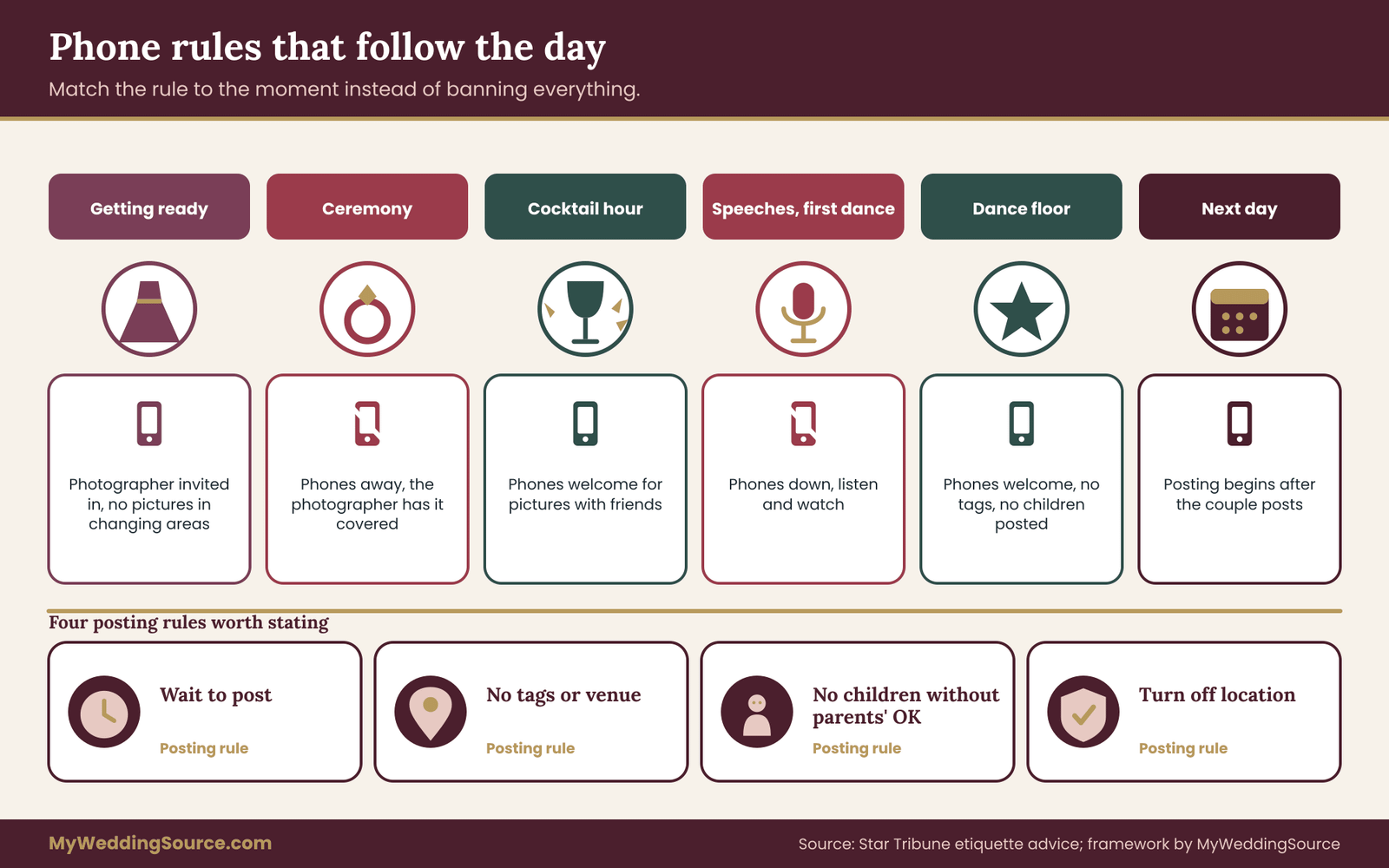
Zones and moments. Phones allowed at the cocktail hour and dance floor, not at the ceremony, speeches or the first dance. It treats the day as a set of moments with different rules.
Choose based on your guest list and your own priorities. If you have guests with serious safety concerns, a stricter rule is easier to defend than a case-by-case one. If most guests are older and unlikely to post, a light touch is fine.
Where to say it
A rule nobody sees is not a rule. Say it in several places, in a consistent and friendly way.
The wedding website. A short “Photos and phones” section tells guests what to expect before they arrive. This is the one place where you can explain a bit more than a sign can.
The invitation or a small insert. One sentence is enough: “We have a photographer and would love for you to be present. We will share pictures after the wedding.”
The ceremony program. A short note tells people who arrive without having read the website.
A sign at the ceremony entrance. The sign is the last chance to reach everyone before the ceremony starts. It should be short, readable from a few feet and kind.
A spoken reminder. The officiant or an usher can say a sentence before the ceremony. This is the most effective, because people stop, listen and put their phones away.
The reception. A small sign at the entrance or on the tables can set the rules for posting, such as no tagging or no posting before the couple does.
Marking the same message in several forms may seem like overkill. It is not. Most guests only notice one of them.
Wording that sounds like you, not a lawyer
Etiquette advice on wedding photography consent repeats a simple point: ask as a favor, not as a command. A request that explains the benefit to guests lands better than one that sounds like a prohibition. Here are some samples, which you can reword.
For a sign at the ceremony:
“We want to see your faces. Please put phones and cameras away for the ceremony. Our photographer will capture it, and we will share the pictures with you.”
For an officiant’s announcement:
“Before we begin, a quick request from [couple names]. They would love for you to be fully here with them, so please silence your phones and keep them tucked away until the ceremony is over. Their photographer has it covered, and you will receive the pictures.”
For the website:
“We are having a photographer, and we would love for you to be present with us during the ceremony. We ask that guests keep phones and cameras away until the ceremony ends. After that, take as many pictures as you like. If you post anything online, please avoid tagging the venue and please do not post photos of children without checking with their parents. Thank you.”
For a more privacy-focused rule at the reception:
“Please enjoy the party and take pictures with friends. If you would like to post, please wait until we have shared our own pictures, and please do not tag people or the venue without asking. Some of our guests prefer not to be online, and we are grateful for your care.”
Notice that none of these threaten consequences. A threat creates resentment. A kind explanation creates cooperation, and the people who ignore it were going to ignore anything.
Rules worth stating
If you want guests to follow posting rules, tell them exactly what you are asking. These are the rules that matter most in practice.
- Wait to post. Ask guests to hold off on posting until you have shared your own pictures, or until the next day. It gives you control over the announcement and avoids guests who are not yet in the know seeing something out of context.
- Do not tag without asking. Tags make people searchable. Ask guests not to tag others and not to tag the venue, if location privacy matters to you.
- Do not post children without checking. A parent has the right to decide whether their child appears online. A guest is not in a position to decide for them.
- Mind the background. A photo that shows a guest in the background, drinking or in an unflattering moment, can cause real trouble. Ask people to crop or avoid posting pictures of others who have not seen them.
- Use your hashtag carefully. A hashtag lets anyone see every picture in one place, including strangers. If you use one, make it private or skip it, and tell guests that posting with it is public.
- Turn off location tags. Many phones add location data to photos and posts. Ask guests to turn it off for pictures they plan to post.
You do not need all six wedding photography consent rules. Pick the ones that match your concerns, and phrase them as requests.
Who enforces your wedding photography consent rules
If you are going to set a rule, someone has to be there to carry it out. It should not be you. Choose one or two people, such as a friend or sibling, or an usher, who can gently remind guests.
A gentle reminder looks like this: “Hi, the couple asked that we keep phones away for the ceremony. I can hold onto that for you if you like.” It takes ten seconds and rarely causes friction. If a guest ignores it, do not make a scene. The photographer is still taking pictures, and a single phone is not a disaster. Reserve your energy for the moments that matter.
For a guest who has a serious privacy concern, the stakes are different. A quiet word to the point person lets them handle it: guiding the photographer away, asking another guest to put their phone down, or moving the guest to a better seat.
Other cameras and who is in charge of them
Guests’ phones are not the only extra cameras.
Videographers. A videographer has the same consent questions as a photographer, with the added issue of audio. Speeches and vows are recorded, and people who speak assume they are being recorded. Tell speakers in advance. Check the video contract for the same clauses as the photo contract.
Livestreams. If you stream the ceremony for remote guests, tell in-person guests that they may appear on camera, and consider seating guests who prefer privacy outside the shot. A password-protected stream and a short expiry help.
Photo booths. A photo booth company often keeps copies of the images and may use them for marketing. Read the terms, and ask whether prints and digital files are shared with anyone else.
Drones. Drones raise additional questions about airspace, venue permission and who owns the footage. Do not assume a drone is allowed, and tell guests if one will be used.
Venue and vendor cameras. Some venues photograph events for their own marketing, and florists or planners may take pictures of their work. Ask each of them about their practice and, if needed, restrict it in the contract.
Social media content creators. If a friend or vendor is making short videos for social media, they are in effect another photographer. Give them the same brief.
Wedding photography consent at the rehearsal dinner and other events
Wedding photography consent does not start and end on the wedding day. Rehearsal dinners, welcome parties and farewell brunches have their own photographers, phones and posting. Many of the guests are the same, so the same rules apply. A short note in the event invitation or on the website covers it. For how these events fit together, see our wedding weekend event planning guide.
Children, safety and other sensitive situations in wedding photography consent
Most of the work above is about preferences. This section concerns wedding photography consent when the stakes are higher. This section is about situations where an image can do real harm. Treat these parts of wedding photography consent with more care than the rest of your plan, even if they affect only one or two people.
Wedding photography consent for children
A child cannot give meaningful consent to being photographed and posted. A parent or guardian decides. That sounds simple, but weddings are crowded with other people’s children: flower girls and ring bearers, nieces and nephews, kids of guests, children of friends who do not know your other friends.
Ask the parents, not the child. For the children in the wedding party, the question is easy: ask their parents in the same conversation as you ask about the dress or the schedule. For other children, the privacy form’s child question covers it.
Give parents the choice at the level of publication. Many parents are happy for their child to be photographed and included in your private album but do not want their child’s picture on a public feed. That is a reasonable position. The Common Sense Media guidance on posting children’s photos describes the usual concerns: lost control once a picture is online, a permanent digital footprint, location details in the background, and tagging that links a child to a name.
Be careful with names and places. A picture of a child with a full name in the caption, the school’s logo on a shirt and a recognizable street behind them gives a stranger more information than most parents would choose to share. For your own posts, use first names only, avoid captions that mention schools and crop out street signs.
Watch for family complications. Separated parents may disagree about whether a child appears online. A parent who is not at the wedding may be upset to see a picture of their child with a stepparent. The Common Sense guidance notes this, advising people to consider how a co-parent might feel about photos they are not part of. If you know a child’s family situation is delicate, ask the parent privately, and follow their answer.
Avoid other people’s children in your own public posts. A simple rule: post pictures of children only if the child belongs to you or the parent has said yes. For a group photo that includes someone else’s child, either crop it or ask.
Tell the photographer. Add the children who should not be photographed or published to the brief, and make sure any assistants know.
Wedding photography consent for guests who may be at risk
This is the part of wedding photography consent that couples most often miss, because the people affected rarely say so. Survivors of domestic violence, stalking and sexual violence may have moved, changed their name, joined an address confidentiality program or hidden their location from someone dangerous. The Safety Net Project at the National Network to End Domestic Violence explains that many states run programs that let participants keep their home address private. In wedding photography consent, a photo is a small thing until it shows where someone is.
An image can give away location in several ways. The background, such as a landmark or a street sign. A caption or tag that names the venue or town. A geotag, the hidden location data that phones add to photos. A visible face, shared with a name, on a public page. Advocacy resources for survivors note that pictures and posts can reveal location through such details, and recommend checking whether cameras add location data before posting.
You do not need to identify who is at risk. You need to make it easy for anyone to ask for protection, and to build protections that apply to everyone.
Make the opt-out easy. The privacy form’s “no photos” and “no posting” options are the main tool. Make sure the form reaches everyone and that a “no” is accepted without questions.
Offer a private route. Add a line: “If you have a safety concern about photos, you can contact [name] directly.” A private text or phone number gives a guest a way to ask without writing it in a form.
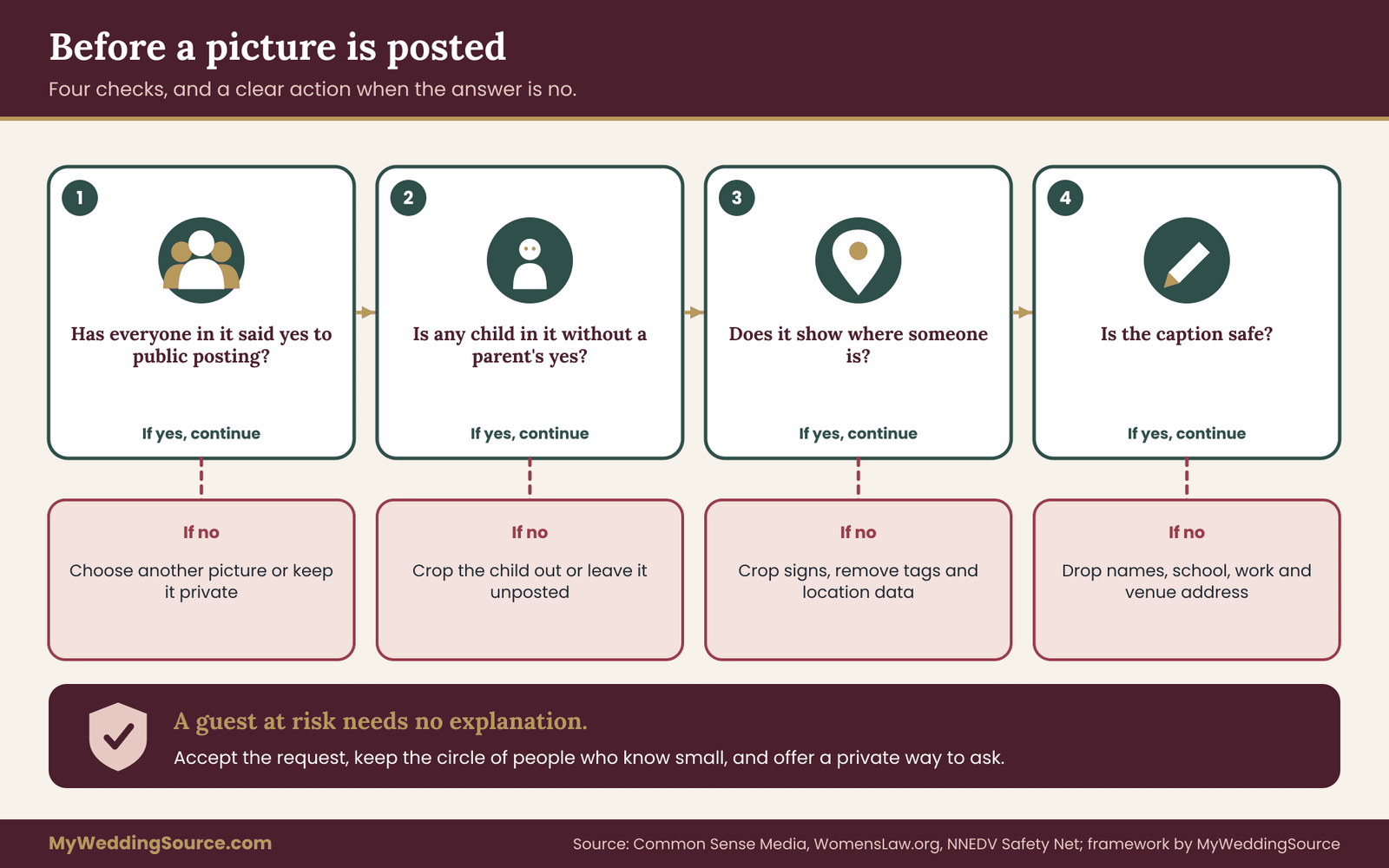
Do not publish the venue or the full guest list. If you share pictures publicly, avoid tagging the venue, avoid naming guests and avoid captions that say who was there.
Strip location data. Before sharing images, remove the location data embedded in the files. Most photo editors and gallery services have a setting for it. Your photographer can confirm whether the files they deliver contain location data.
Seat with care. A guest who has asked not to be photographed will be easier to protect at a table away from the aisle and the dance floor. Ask the guest what they prefer.
Never mark or announce the person. The point person and photographer need to know. No one else does.
Plan for guests who ask on the day. Someone may decide at the last minute that they do not want to be photographed. Give the point person authority to act: pass the message to the photographer, ask nearby guests to avoid photographing them and, if needed, help the guest leave quietly.
If you or a guest are concerned for personal safety, the National Domestic Violence Hotline at 1-800-799-SAFE (7233) can help.
Other situations where wedding photography consent needs thought
Intoxicated guests. A picture that looks harmless in the moment can be embarrassing or costly later. Agree with your photographer on a simple rule: no photos of guests who are visibly unwell or unable to consent, and delete those that slip through before delivery.
Private spaces. Restrooms, changing areas and preparation rooms are private. Photographers should be invited, not assumed. Tell the wedding party the rule: no pictures in changing areas, and photographers enter only when everyone is ready.
Grief and distress. Emotional moments are part of a wedding. A guest crying at a memorial table or a parent overwhelmed during the ceremony may not want that image shared. Use judgment, and ask before posting close-ups of strong emotions.
Guests with health conditions. Someone using a mobility aid, undergoing treatment or recovering from surgery may not want pictures that show it. Ask discreetly, or simply follow their lead on the day.
Guests in recovery. A guest who is sober may not want pictures at the bar, or pictures with drinks, to be posted. A photo of a guest holding a drink can reach a sponsor, an employer or a family member who does not know.
Professional or public guests. A guest with a public role, a high profile or a job with scrutiny may have stricter needs. Ask them directly, not through a form.
Religious and cultural practices. For some guests, certain images are inappropriate, such as photos of people in certain ritual clothing or in certain spaces. If you have guests from a tradition you are not familiar with, ask them or a family member what is respectful.
Photos of the wedding party before the ceremony. The getting-ready period is often intimate. Agree with each person what the photographer may capture, and confirm that anyone who is uncomfortable can say so. Our wedding party coordination checklist covers who is responsible for what.
When a guest says no to wedding photography consent on the day
It will happen, though rarely. A guest notices the photographer, feels uncomfortable and says so. Here is a script for the point person.
- Thank them. “Thank you for telling me. I will take care of it.”
- Do not ask why. The reason is theirs.
- Tell the photographer. A quiet word, with a description of the guest, is enough.
- Check the plan for the rest of the day. If the guest is at the front table, ask whether a different seat helps.
- Check in later. A short message the next day confirms the guest was heard.
The aim of wedding photography consent is that a guest who says no experiences the wedding as a place where their preference was respected, not as an argument.
After the wedding: wedding photography consent in galleries and removal requests
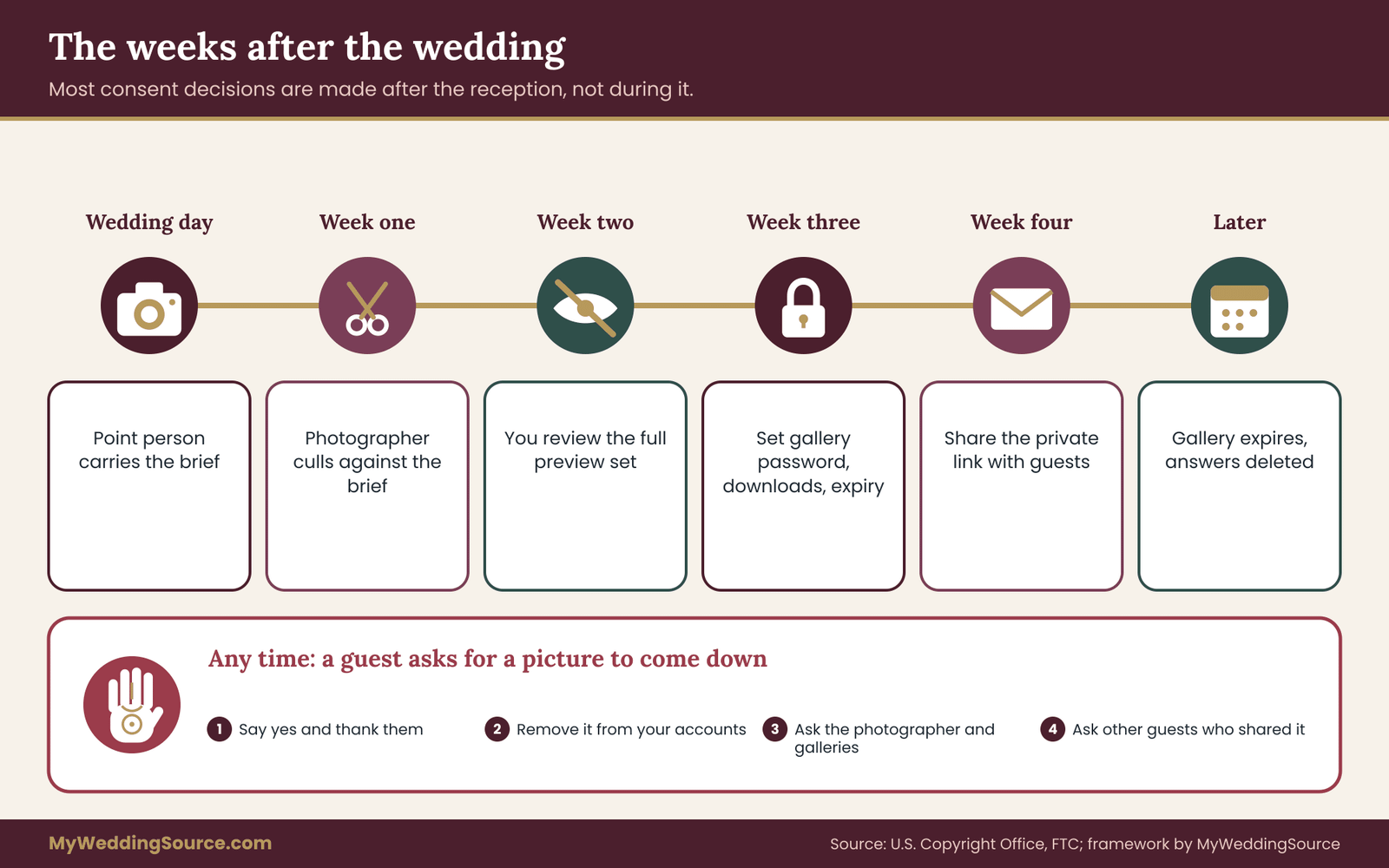
Wedding photography consent does not end when the reception does. The images exist for years, and most of the decisions that matter happen in the weeks after: which pictures are delivered, how they are shared and what happens when someone asks for one to come down.
Ask the photographer to cull with the brief in mind
Culling is the process of choosing which images to keep and edit from the thousands taken. It is the best moment to apply your wedding photography consent preferences, because a picture that never reaches the gallery cannot be shared by accident.
Ask your photographer to apply the brief during culling. Images of guests in the do-not-photograph lane that slipped through should be removed. Images of guests in the do-not-share lane should be flagged or kept out of the public set. Images of intoxicated, undressed or distressed guests should be dropped. Ask for a short confirmation that this was done.
If you want to review before the gallery goes live, ask for a preview of the full set. You can then flag anything that conflicts with your promises to guests, before it reaches a single guest.
Set up the gallery with privacy in mind
Online galleries are convenient and also the easiest way for images to travel. Check these settings before you share any link.
- Password protection. The gallery should require a password or a private link, not just a public URL.
- Download rules. Decide whether guests can download full-size files, small files or nothing. Full-size downloads are the ones most likely to end up elsewhere.
- Sharing links. Ask whether a link can be forwarded. If you want a limited audience, use an invitation-only system.
- Expiry. A gallery that expires in six months or a year is less likely to be forgotten, shared and indexed.
- Face recognition and tagging. Some photo-sharing and wedding gallery tools can group photos by face and let guests find pictures of themselves. This is convenient. It also means the service is analyzing faces, which some guests do not want. The Federal Trade Commission has warned that photo services may use images, including the faces of friends and family, in ways people do not expect, and has urged people to review and use any facial recognition settings. Ask your gallery provider whether this feature exists and whether it can be switched off.
- Search engines. A private gallery should not be visible to search engines. Check that it is not indexed.
Ask the photographer how long galleries stay online and what a standard delivery includes.
Your own posting and wedding photography consent
When you post your own pictures, wedding photography consent puts the decision about publication on you. A few habits help.
Check each picture against your list. Before posting a group shot, look at everyone in it. If anyone is in the do-not-publish lane, choose another image or crop.
Skip tags and location. Tag only people who have said yes, and leave out the venue if you promised location privacy. Turn off automatic geotagging.
Be cautious with captions. A caption that names relatives, mentions where someone lives or works, or says what someone was drinking gives more than the picture does.
Use the audience tools. Post to a close-friends list or a private account if you want a smaller audience.
Review old posts. If a guest later asks you to remove a picture, do it quickly and without argument.
Vendor marketing and wedding photography consent: approve before it appears
Photographers, venues, florists and planners may want to use your pictures. They may also assume they can. Your contract should say what is allowed, and you can also add the following preferences in an email.
- Ask each vendor to check with you before posting images of the wedding.
- Ask that guests in your do-not-share lane never appear in marketing.
- Ask that children not appear in marketing without parental approval.
- Ask that the venue name and address not appear in captions or tags if location privacy matters.
A vendor who wants to use your pictures should send a preview and give you a few days to respond. A reasonable photographer will not object to that. If they do, find out why before you sign.
If a guest withdraws wedding photography consent and asks for a picture to come down
You will occasionally get a message like this: “I saw the picture on your account. Could you take it down?” Treat it as a request, not a complaint; this is wedding photography consent working as intended. The fastest, kindest answer is yes.
A short reply works:
“Of course, thank you for telling us. I have taken it down. If there are other pictures you would like removed, send me a message and I will take care of it.”
Then act. Remove the image from your accounts, ask the photographer to remove it from their site and any gallery, and check the pictures you shared with others. Be honest about what you cannot do. If someone else has already shared the image, you can ask them to remove it, but you cannot force them.
If a guest posts something you did not want
A guest posts a picture of you, or of another guest, that crosses a line. Here is a sequence that works.
- Pause before reacting. Most guests post out of excitement, not malice.
- Check whether you actually asked for this rule. If your website and signs told guests not to post, you have a basis for asking. If you never said anything, ask without blame.
- Message privately. “We loved seeing your pictures. Would you mind taking down the one with [name]? They would prefer not to be posted. Thank you.”
- Allow time. People may not see the message for a day.
- Use the platform tools if needed. Social platforms have reporting processes for images shared without permission, especially for children and for safety-related requests.
For serious situations, such as images that threaten someone’s safety, a lawyer or a local advocacy organization can advise on options.
Keeping and deleting what you hold after wedding photography consent is settled
After the wedding, you hold two kinds of material: images and the preference answers. They need different handling.
Images. Keep your own copies in at least two places, and label folders so that it is clear which pictures are for private use only. Do not forward your whole gallery to people who did not attend.
Preference answers. Delete them after you have delivered the gallery, or keep only a minimal record, such as “do not post” next to a name, in case a vendor or guest asks later. Do not keep detailed notes about why someone chose a setting.
The photographer’s files. Ask when the original files are deleted and whether you can request earlier deletion. Many photographers keep originals for a set period.
Backups. If your photographer stores images in a cloud service, ask which one. The terms of that service are part of the story.
Who owns the pictures, and how ownership relates to wedding photography consent
Copyright and wedding photography consent often get mixed up, so here is a plain summary.
The photographer usually owns the copyright. The U.S. Copyright Office says the photographer is generally the author and first owner, with exceptions for work made for hire. For wedding photographers hired as independent contractors, the exception rarely applies unless the contract is built that way.
You usually hold a license. The license says what you can do with the pictures: print, share, post. Anything beyond that, such as selling the pictures or letting a third party use them, needs the photographer’s permission.
A transfer needs a signed writing. If you want the copyright itself, get it in writing and expect to pay for it. Many photographers refuse, and those who agree often charge a lot.
Guests have rights too, though different ones. A guest does not own the picture. They can still object to certain uses, particularly commercial ones, and their wishes matter to you as a host.
Registration is the photographer’s business. The Copyright Office recommends that photographers register their work, and a registration is needed to bring an infringement suit. If you are in a dispute over images, ask the photographer whether they registered. You do not need to register your own pictures unless you took them yourself.
Guest photos belong to the guest. The cousin who took a picture on their phone owns its copyright, and can usually post it. You can ask them not to. You cannot make them.
This summary is general. For specific disputes, a lawyer who works with copyright is the right person to ask.
Worked example: wedding photography consent from start to finish
The following is an illustration, not a real case. The names and details are invented to show how the pieces fit together.
The wedding. Priya and Marcus are marrying on a Saturday in October with ninety-eight guests. They have one photographer with a second shooter, a videographer and a photo booth. Fourteen children are invited, including a six-year-old flower girl and an eight-year-old ring bearer.
Eight months out: the form. They add a short “Photos and privacy” section to their RSVP with the five questions from earlier. Seventy-nine guests reply. Sixty-three tick “yes, anywhere” and “yes” to public posting. Eleven tick “yes” to photos but “no” to public posting. Three ask not to be photographed at all. Two guests write in the free-text box: one asks that photos of her child not be published, and one writes only, “Please call me.”
The phone call. Priya calls the guest who wrote “Please call me.” The guest says she has a protective order against a former partner and moved states a year ago. She wants to attend, and she does not want any picture of her online, ever. Priya says yes without asking more. They agree that she will sit at a side table near an exit, that her name will not appear on any list given to vendors, and that she can leave if she feels unsafe. Priya asks whether she would like a photo of her to be given to the photographer. She says no. They agree she will wear a specific color and sit at table nine.
Six months out: the photographer’s contract. Marcus asks the photographer about marketing use. The standard contract allows portfolio and social use of any image. They negotiate: portfolio use allowed for images of the couple and the wedding party, no guests in marketing without written approval, no facial recognition tools, and a gallery with a password and a one-year expiry. The photographer agrees and adds the changes in writing.
Two weeks out: the brief. The couple sends a one-page brief. It lists the three guests who asked not to be photographed, with table numbers, the eleven who asked for no public posting, the three children whose parents asked for no publication and a point person, Priya’s sister Anika. The brief adds general rules: no location in captions, no tags, check with Anika before posting.
The day. The ceremony is unplugged, with a sign at the entrance and a line in the program. The officiant asks guests to put phones away. At the reception, a sign says phones are welcome, and asks guests not to tag the venue or post photos of children. During dinner, the second shooter nearly photographs a guest from the do-not-photograph list. Anika sees it and steps in with a quick word. The guest at table nine never appears in a frame.
After. The photographer culls the images, removing eleven where a do-not-photograph guest appeared in the background. The couple reviews a preview gallery, flags four group shots for cropping and approves the set. They share a password-protected link with guests. A week later, one guest asks Priya to take down a photo from her public account. She does so within the hour. The photographer posts six images from the couple’s portraits and none of the guests.
What worked. The couple spent about three hours on the form, the contract changes and the brief. They never had a conflict. The one close call was solved by a point person who knew the brief.
What was not perfect. A cousin posted a video from the dance floor that included two guests from the do-not-post list. Anika messaged her, and the cousin took it down the same night. It could not be undone for the hours it was up. The couple accepted that a plan reduces risk but cannot eliminate it.
Common mistakes in wedding photography consent
Most problems with wedding photography consent come from the same short list of errors. Knowing them lets you avoid them.
Assuming silence means yes. Guests who say nothing have not agreed to everything. They may simply not have been asked. An explicit, easy opt-out catches the people who would otherwise suffer quietly.
Asking for reasons. A form that demands an explanation discourages honest answers. Ask for the preference and nothing more.
Sending the whole list to everyone. The raw answers are sensitive. The photographer needs a brief. The wedding party does not need the list.
Relying on memory. A photographer who was told on the phone two months ago will not remember a table number at the reception. Put it in writing, and bring a printed copy.
Skipping the contract. The most common surprise is a clause that allows the photographer to post, license or reuse any image. Read it before you sign, and change it if needed.
Promising too much. “No one will ever see your picture” is a promise you cannot keep. “We will not publish your picture and we have asked the photographer to avoid you” is a promise you can.
Forgetting the other cameras. A strict policy for the photographer does nothing about the videographer, the photo booth and forty phones.
Being rigid about phones. A rule that bans phones all day creates conflict, and one that bans nothing creates risk. Match the rule to the moment.
Ignoring children. Other people’s children are the most common source of upset after a wedding. A sentence on your website prevents most of it.
Treating a request as an attack. A guest who asks you to take a picture down is not criticizing you. Say yes, and thank them.
Leaving the point person unprepared. The person who carries the brief needs to read it, know the guests and have the authority to act.
Never deleting. Raw preference answers and unused images pile up. Set a date to delete what you no longer need.
A timeline for planning wedding photography consent
You do not need to do all of this wedding photography consent work at once. This sequence spreads the work across the planning period.
Twelve to nine months out. – Decide your own comfort level: how public do you want your wedding to be? – When you interview photographers, ask the consent questions listed earlier. – Read the contract for marketing use, gallery privacy and retention. Negotiate changes before you sign. – Add photography to your list of vendor checks in the wedding planning checklist.
Eight to five months out. – Draft the privacy preference form and add it to your RSVP or website. – Write your phone and posting rules, and add them to the website. – Choose your point person and tell them what the role involves. – If you plan a livestream, drone or photo booth, add the same questions to those contracts.
Four to two months out. – Send the form to guests with your invitations, after your save-the-dates have gone out. – Follow up privately with anyone who writes in about safety or children. – Check the guest list for children and for guests you know have particular needs, and ask them directly.
One month out. – Compile the answers into the brief, with names and table numbers. – Send the brief to the photographer, the videographer and any assistants. – Order signs and program inserts with your phone and posting wording. – Brief the officiant on the announcement.
One week out. – Confirm the final seating chart and update the brief. – Print the brief for the point person and the photographer. – Tell your wedding party the rules for getting-ready photos and private spaces.
The day. – Introduce the photographer and point person. – Walk the room with the seating plan. – Check that signs are in place and ushers know the message.
One to four weeks after. – Ask the photographer to confirm culling against the brief. – Review the preview gallery and flag problems. – Set gallery privacy, downloads and expiry before sharing. – Delete or minimize the preference answers.
Ongoing. – Respond quickly to removal requests. – Remind guests of the posting rules if they ask about sharing. – Revisit your settings if a gallery or app changes its policy.
What this guide to wedding photography consent cannot settle
A guide to wedding photography consent is useful for planning, not for resolving legal disputes. A few limits are worth stating.
Laws differ by state and situation. Rules about image rights, publicity, recording, minors and biometric data vary. If a specific question matters, such as a dispute over commercial use of an image, ask a lawyer who handles that area.
Contracts decide most outcomes. Your agreement with the photographer and other vendors matters more than general principles. Read and negotiate it.
Guests are not bound by your rules. You can ask, and most guests will comply. You cannot control a determined person with a phone.
Platforms change their policies. Photo apps, galleries and social networks update their terms and features, including facial recognition and sharing settings. Check the current terms of any service you use.
Safety needs more than a form. If someone’s safety is at risk, a privacy form is one tool among several. Encourage the guest to work with an advocate or the police, as appropriate, and follow their lead.
The examples are illustrations. The worked example above is invented to show the method. Your wedding will have different people, different constraints and different solutions.
FAQ
Do wedding guests have to give wedding photography consent?
Not formally, in most cases. A guest at a private wedding generally expects candid pictures, and most are happy with that. But expectation is not the same as agreement to every use. Asking guests about their boundaries before the day, and respecting a no, is a courtesy and a sensible way to avoid harm. For uses that promote a business, such as a photographer’s advertising, a signed release is the safer route.
Who owns the wedding photos, me or the photographer?
Usually the photographer owns the copyright, and you receive a license to use the pictures for personal purposes. The U.S. Copyright Office describes the photographer as the author and first owner, with an exception for work made for hire. If you want to own the copyright, the transfer generally has to be in writing and signed. Read your contract to see exactly what you can do.
Can my photographer post pictures of my guests?
Only if your contract and the guests’ circumstances allow it. Many photographer contracts allow portfolio and social media use, sometimes with a release for the couple but not the guests. Ask for a clause that keeps guests out of marketing unless you approve, and add your do-not-share list to the brief.
What should a wedding photography consent form ask?
Keep it short. The most useful questions are whether the guest is comfortable being photographed, whether they are comfortable appearing in the private gallery, whether they are comfortable with public posting, and whether children in their party may be photographed. Add an optional free-text box. Do not ask for reasons.
How do I explain wedding photography consent rules without offending guests?
Ask as a favor and explain the benefit. A request such as “We would love you to be present, so please keep phones away during the ceremony” lands better than a ban. Put the message on the website, in the program, on a sign and in a spoken reminder. Offer a clear alternative, such as taking pictures after the ceremony.
What if a guest says they cannot be photographed for safety reasons?
Say yes, do not ask for details and keep the information to the smallest group possible. Brief the photographer with a name, table and instruction, and ask your point person to handle questions. Avoid public tags and location details, remove location data from shared files, and seat the guest where they feel secure. The National Domestic Violence Hotline can offer help at 1-800-799-7233.
Can I ask guests not to post pictures of children?
Yes, and it is a good idea. Parents decide whether their child appears online, and guests should not decide for them. A line on your website saying “please do not post photos of other people’s children without checking with their parents” covers most situations.
What if someone posts a photo I did not want online?
Message them privately and kindly, and ask them to take it down. Most people are glad to, particularly if you explain that a guest prefers not to be online. If the image is harmful or threatens someone’s safety, use the reporting tools on the platform, and consider advice from a lawyer or advocacy organization.
Your next steps
Start with three small actions this week. First, read your photographer’s contract and note anything about marketing use, gallery privacy and retention. Second, write the five-question privacy form from this guide and add it to your RSVP or website. Third, choose your point person and tell them what the role involves.
Then, over the following weeks, write your phone and posting rules, draft the one-page brief and send it to your photographer. After the wedding, check the gallery settings before you share anything. A few hours of planning will cover most of what can go wrong, and the rest is handled the way good hosts handle everything: by listening and responding quickly.
Sources
- What photographers should know about copyright, U.S. Copyright Office
- Copyright basics, U.S. Copyright Office
- What photographers need to know about copyright law, Copyright Alliance
- When to use a release, Stanford Copyright and Fair Use Center
- Is it safe to post pictures of my kid online? Common Sense Media
- Address confidentiality programs, Safety Net Project, National Network to End Domestic Violence
- Safety when browsing the internet, WomensLaw.org
- Ever photo app settlement and facial recognition, Federal Trade Commission
- How can you ask guests not to bring cellphones to a wedding? Star Tribune
- Couple’s guide to wedding photography contracts, The Wed
- How to write a wedding photography contract, Expert Photography
- Do I need a model release for wedding guests? Engaged Legal
Photo and guest-image rules only work if the files are handled safely. Read our digital contingency plan for backup communication, storage and access permissions.
Some guests prefer not to appear online. See how to word wedding photo posting requests so private guests stay off social media.