

A national park wedding permit is the written permission a park superintendent gives for a ceremony, a photo session or a small celebration on land the National Park Service manages, and the rules behind it change from one park to the next. This guide gives you a lookup-and-lead-time worksheet for any national park wedding: four gates to pass, three clocks to watch, and a plain list of conditions that should make you stop and rethink.
For any national park wedding, do four things in order. First, confirm which agency manages the exact spot you picture. Second, find that park’s own wedding or special-use page and its superintendent’s compendium. Third, match your plan (ceremony only, ceremony plus photographer, small reception) to the permit type the park uses. Fourth, work backward from your date using the park’s stated processing time, plus extra weeks for corrections. Spend non-refundable money only after a permit is issued in writing.
Plenty of couples fall for a canyon rim, a lakeshore or a grove of old trees long before they ask who owns it. That is a normal way to choose a place, and it usually works out fine for a picnic, though a national park wedding asks more of the choice.
For a wedding it creates a specific kind of trouble. The dream spot turns out to be inside a federal unit with its own permit office, its own group-size rules and its own list of things you cannot bring. By the time you learn that, you may have printed invitations or paid a photographer.
This article is built for the moment before that. It does not repeat how city and county parks handle ceremonies, which the broader wedding venues guide touches on. It does not try to describe any one park’s rules either, because those rules belong to the park and they change. What it gives you for a national park wedding is a repeatable way to find the right answer yourself, in the right order, with a record you can show to vendors and family.
A note on scope. This is general information, not legal advice, and no guide can replace the written answer you get from the park you choose. Where a rule matters, the article points you to the office that issues it so you can confirm the current version before you commit money or send invitations.
Why a national park wedding is not the same as a city park booking
Most people have booked a picnic shelter or a gazebo at some point. You pick a date on a city website, pay a fee and get a confirmation. It is tempting to assume a national park works the same way, only more scenic. In practice the two systems differ in four ways that matter for a wedding.
The land manager is a federal agency with a conservation mission. The National Park Service manages its units to protect resources and to let people enjoy them without harming them. A wedding is a use that the park has to weigh against that mission. A city park mostly weighs your booking against other bookings. A national park weighs your booking against soil, wildlife, historic fabric, visitor flow and staff capacity. The answer you get may be a conditional yes, a yes in a different spot, or a no.
Permission is often discretionary. In a city park, if the shelter is free on your date and you pay, you generally get it. In a national park, a permit is a decision made by a superintendent or a delegated staff member, using the park’s own policies. Two parks that look alike on a map can answer the same request differently.
Rules are written at the park level. Each unit publishes its own list of closures, restrictions and special conditions. That list sits inside a document usually called the superintendent’s compendium. Group-size thresholds, areas where ceremonies are not allowed, rules about chairs, amplified sound and drones all tend to live there or in a park-specific page. There is no single national list you can memorize.
Entrance is separate from permission. Paying the park entrance fee, or holding an annual pass, lets you and your guests enter. It does not, on its own, authorize a ceremony. Think of entrance as the key to the front gate and the permit as the key to a particular room.
None of this means a national park wedding is a bad idea. Many couples hold a small, simple national park wedding ceremony every year, and park staff handle these requests routinely. It means the planning order for a national park wedding is different. In a city park you can choose a date and then ask. In a national park you ask, learn the shape of the answer, and then choose the date.
What “national park” means on a map
People use the phrase loosely. The National Park Service manages more than four hundred units, and only a portion carry the formal title “national park.” Others are national monuments, historic sites, memorials, battlefields, seashores, lakeshores, recreation areas, parkways and preserves. The wedding rules can differ by designation. A battlefield or memorial, for example, may treat ceremonies very differently from a recreation area with a developed beach.
For this guide, “national park wedding” covers any ceremony or wedding-related event on land managed by the National Park Service, whatever the unit is called. Other federal agencies manage land that looks similar to a visitor: the Forest Service, the Bureau of Land Management and the Fish and Wildlife Service each run their own permit systems. The first gate in the worksheet exists to sort this out, because a surprising number of beautiful places sit next to each other under different managers.
Who this guide is for
This guide fits you if you are planning a national park wedding at a specific park, or a short list of parks, and you want to know how to find the correct rules and how early to start. It also fits you if a venue, planner or relative told you “just get a permit” and you are not sure what that means in practice.
It does not fit you if your only question is how to decorate a public space, how to handle a denied application or how to plan a guest list. Those questions have their own articles, and you will find links to related guides where they matter.
What a national park wedding permit usually covers
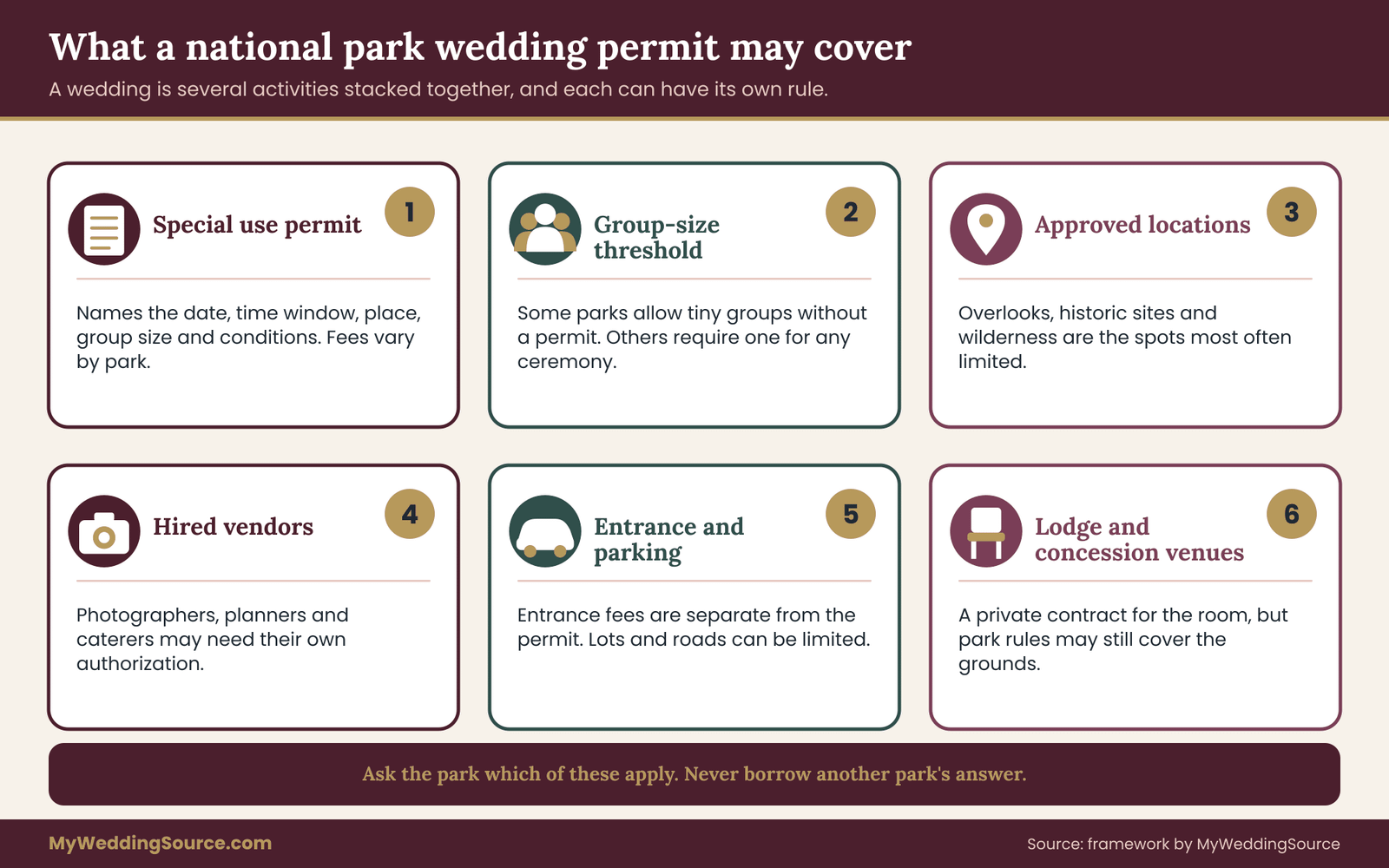
The phrase “wedding permit” suggests one document. Real requests are messier, because a wedding is several activities stacked together, and a park may treat each one separately. Before you start the lookup for a national park wedding permit, it helps to know the usual building blocks. You will see the names vary, so treat this list as a vocabulary rather than a promise about any park.
Special use permit. This is the common category for activities that are not ordinary visitor use. Many parks process a ceremony, an elopement or a wedding-party photo session as a special use. The permit names the date, the time window, the location, the maximum group size and a set of conditions. Some parks ask for an application fee when you apply and may add charges for staff time or site monitoring. The park’s page will say what applies.
Group-size thresholds. Some parks let very small groups hold a ceremony in open areas without a permit, and require a permit above a certain number. Other parks require a permit for any ceremony. The threshold, if any, is a park decision. Never borrow a number from a blog post about a different park.
Location-specific permission. Even with a permit, a park may confine ceremonies to a short list of designated areas. Popular overlooks, historic buildings, cemeteries, backcountry and designated wilderness are the places most likely to be limited or closed to ceremonies.
Commercial service rules. Hiring a photographer, a planner, a caterer or a rental company may trigger a separate rule, because commercial activity in a park is regulated on its own track. Parks often require commercial operators to hold an authorization or insurance, or to work under a permit of their own. Some parks set conditions on the couple’s permit instead. You need to know which, because it decides who has to do the paperwork.
Entrance and parking. Guests pay entrance fees like any visitor unless an exemption applies. Large groups may need a plan for vehicles, because trailhead and overlook parking is limited and some roads have timed or seasonal access.
Concession and lodge venues. Some parks have lodges, restaurants or historic buildings run by private companies under contract with the Park Service. If you rent a room from one of these, you sign a private contract, but outdoor areas, grounds and the surrounding landscape may still fall under park rules. Ask both parties who controls what.
The marriage license is a separate track
A park permit lets you hold a ceremony on that land. It does not make you legally married. The legal side runs through the state where the ceremony takes place, usually through a county or local clerk, and through an officiant who meets that state’s rules.
Parks that cross state lines make this a real question: which state’s rules apply to the spot where you stand? If your ceremony will be legal and not only symbolic, check the license and officiant requirements for that state early. The guide on wedding officiant requirements explains how to verify an officiant before the day.
One more distinction helps. A national park wedding permit is not a reservation in the way a restaurant table is. In many parks a permit gives you the right to hold the event at that place during a window, but it does not stop other visitors from being there. A public overlook stays public. If you need privacy, say so in your request and listen carefully to the answer, because many parks cannot offer it.
What a permit does not do
It is worth saying plainly what a national park wedding permit will not do, so you do not plan around a promise nobody made. A permit does not waive park rules that apply to everyone, such as rules on wildlife, fires, closures and trail use.
It does not guarantee good weather access, since roads and trails can close for snow, flooding, fire or maintenance. It does not transfer if you change the date or location without the park’s agreement. And it does not cover vendors who are not named, in parks that require vendors to be listed.
Each of these points becomes a line on the national park wedding worksheet in the next section. The aim is to turn a vague national park wedding idea, “we need a permit,” into a short list of specific questions with specific places to find the answers.
The four-gate lookup worksheet for a national park wedding
The national park wedding worksheet has four gates. You pass them in order, and you write something down at each one. The order matters because each gate narrows the next. Skipping to the permit application before you know who manages the land is how people end up with a form for the wrong office.
Gate one: confirm the land manager. Which agency manages the exact spot, not the general area? Output: one agency name and one named unit.
Gate two: find the park’s own rules. Where does this unit publish its wedding or special-use information and its list of restrictions? Output: two saved pages and a contact.
Gate three: match the plan to a permit type. Which of your activities need permission, from whom, and under what conditions? Output: a one-page list of activities with a permit label beside each.
Gate four: build the lead-time clock. When must each step happen so the permit, the vendors and the invitations line up? Output: three dated clocks and a “decision by” date.

The evidence ladder
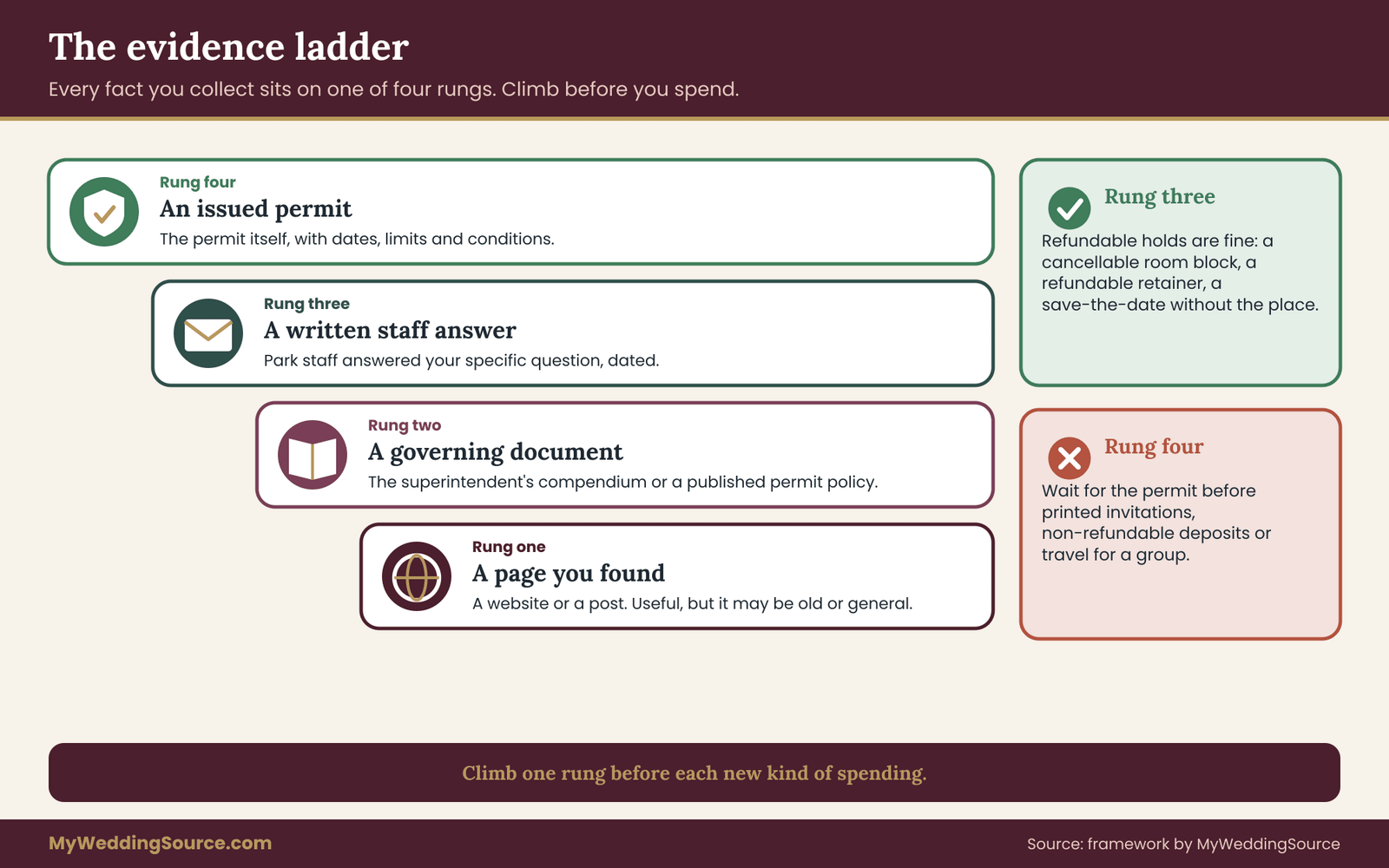
Alongside the gates, the national park wedding worksheet uses a simple ladder to rate how solid each answer is. Every fact you collect for a national park wedding, from “ceremonies are allowed at this overlook” to “photographers need their own authorization,” sits on one of four rungs.
Rung one: a page you found. The park’s website says something. This is useful, but websites can be out of date, and a page may describe the general rule without your details.
Rung two: a governing document. The superintendent’s compendium, a published permit policy or the actual regulation. These carry more weight because the park uses them to make decisions.
Rung three: a written staff answer. A park staff member answered your specific question in writing, with a date. This is the first rung that speaks to your situation.
Rung four: an issued permit. The permit itself, with its conditions, dates and signature or approval. Nothing else is a permit.
The decision rule that goes with the ladder is the most useful single idea in this guide: refundable commitments can rest on rung three, but non-refundable commitments wait for rung four. A refundable hotel hold, a cancellable photographer retainer or a save-the-date that does not name the park are all reasonable at rung three. A printed invitation naming the park, a non-refundable deposit on a rental or a travel booking for forty people should wait until you hold the permit.
Why a worksheet instead of a checklist for a national park wedding
A checklist tells you what to do. A worksheet records what you found, so that the next person, whether that is your partner, a planner or a vendor, can see the evidence. That matters here for a practical reason: park staff turnover and policy updates are real, and the person who answered your email in January may not be the person who processes your application in April. A dated record of your national park wedding research protects you from both memory and misunderstanding.
Keep the worksheet in one shared document. Each line should have four columns in your head, even if you write them as sentences: the question, the answer, the source and the date. When you do this, you can reread your own file months later and know which facts were confirmed and which were assumed.
Setting the scope before you begin
Before gate one, write down your own national park wedding plan in plain language, because every later question depends on it. A few lines are enough.
Describe the event type: a ceremony only, a ceremony with a photographer, a ceremony followed by a small picnic, or a multi-day gathering. Give a guest count range, not a single number, because parks care about whether you are above or below a threshold. Name your ideal date and two alternates.
Write the specific place you picture, using a landmark name, a trail name or a map pin you can describe in words. List the items you hope to bring: chairs, an arch, a speaker, flowers, food, drinks, candles, a vehicle for a guest who cannot walk far.
Then add two honest lines. What would you change if the park said no to your first-choice spot? And what would make you walk away from the park entirely? Couples who answer those two lines before they start tend to make calmer decisions when the replies arrive. The failure conditions section later in this guide builds on them.
Gate one: confirm who manages the land for your national park wedding
This gate sounds trivial and it is the one most often skipped. Public land is a patchwork. A viewpoint listed on a travel website as “in the national park” may sit on a state park, a county preserve or a national forest that borders the park. A beach called by the park’s name may be managed by a city. The agency matters because it decides everything that follows: which permit office to contact, which fees apply and which rules govern.
Start with the park’s own site. The National Park Service publishes a page for each unit, with a map, directions and contact details. Find your unit there and look for the place you picture. If the spot is named on the park’s map or in its visitor information, that is a good sign that the Park Service manages it. If you cannot find the spot, it may belong to someone else.
Check boundaries with a map, not a travel blog. Park maps show boundary lines. Many units include private inholdings, neighboring state land or local government land inside or beside the boundary. If your spot sits near the edge, open a mapping tool and look for boundary lines, then confirm by phone or email with the park.
Ask one direct question. The cleanest way to settle ownership of a national park wedding site is to write to the park and ask: “Is this location, described as follows, managed by the National Park Service, and if so, which office handles ceremony requests?” Include the landmark name, the nearest road or trail and the coordinates if you have them. A staff member can usually answer in a sentence.
Common ownership surprises
A few patterns show up often enough to be worth knowing.
A gateway town may run its own parks and beaches right outside the entrance, which is where a national park wedding sometimes ends up. The scenery is similar and the permit is a city permit. That can be an advantage if the national park says no, and it can be a trap if you assume the national park’s rules apply.
A national forest or a Bureau of Land Management area may share a long border with a national park. These agencies run their own special-use systems, often with different fees and lead times. If you land in one of them, the worksheet still works, but you restart at gate two with that agency’s pages.
A state park may sit inside the borders of a national park unit or beside it. The Fish and Wildlife Service runs national wildlife refuges that welcome visitors, and ceremonies there follow refuge rules. Tribal lands, private lodges and conservation easements add further layers.
Some units contain areas managed by a partner, for example a historic structure operated by a nonprofit, or a visitor center run by a cooperating association. If your spot is a building or a patch of grounds with a named operator, you will need two answers: the operator’s and the park’s.
Out of the park but near it
Some couples planning a national park wedding find at gate one that the dream spot is actually just outside the boundary. That is useful news. It may make the permit simpler, but it also changes what you can say in your invitations, because “near the national park” and “in the national park” are different statements for a national park wedding invitation, and guests who plan their entry fees around the difference deserve accuracy.
What to write down at gate one
Record the unit’s official name, the specific place name and the managing agency. Record how you confirmed it: a map, a staff email or both. Record the contact route the park suggests for ceremony requests, because some parks use one office and some route requests to a permit coordinator, a visitor services office or a recreation website.
If a staff member gave you a name, write it down with the date. If the answer is that the spot is not in the national park at all, mark gate one as “redirect” and begin gate two with the correct agency.
A last practical point. Early contact does not commit you to anything. Asking a park a question is not an application. You can write to two or three parks about a national park wedding in the same week, compare the answers and choose with real information instead of a guess.
Gate two: find the park’s own national park wedding rules
Once you know the unit, you need the documents that govern it. These are easier to find than most people expect, and reading them takes less time than a long phone call. The goal is two saved pages and one named contact for your national park wedding.
The park’s wedding or special-use page. Most park websites have a section for permits and special uses. Look for headings such as “Weddings,” “Special Events,” “Permits and Reservations,” “Special Park Uses” or “Commercial Use.” Not every park uses the word “wedding.” Some describe ceremonies under a general “events” page. If you cannot find it from the menu, use the site’s search box with words like “wedding,” “ceremony,” “special use permit” and “elopement.”
The superintendent’s compendium. This is a yearly or periodically updated document in which the superintendent lists the park’s specific closures, use limits and designated areas. It is where you learn things like areas closed to the public, limits on group size and rules about amplified sound, alcohol or the use of certain equipment. Parks usually post it on their “Laws and Policies” page. It reads like legal text, so skim for headings and use your browser’s find function for words such as “wedding,” “ceremony,” “group,” “special event,” “alcohol,” “amplified” and “unmanned aircraft.”
The regulations behind it. The compendium rests on federal regulations for national parks, found in Title 36 of the Code of Federal Regulations. You do not need to read all of it, but it helps to know that the rules on special events, public assemblies and closures sit in Part 1 and Part 2. If a park staff member quotes a section number, you can look it up on the federal government’s official regulations site and read the plain text yourself.
A named human contact. Look for a permit office email or phone number on the special-use page. If there is none, use the park’s general contact form and ask to be routed to whoever handles special park uses.
How to read a park page without being misled
National park wedding pages vary in quality. Some are detailed and some are one paragraph. Use a few reading habits so that a thin page does not trick you into a false conclusion.
Look for the date of the last update. If the page shows no date, treat it as rung one on the ladder and confirm with staff. Policies change, and a page written years ago may describe a process that has moved online or changed hands.
Read what is missing as well as what is there. If the page lists allowed areas but does not mention chairs, music or alcohol, the silence is not permission. It means you need to ask.
Watch for conditional words. “May,” “generally,” “usually,” “subject to approval” and “at the discretion of the superintendent” all mean the same thing in practice: the answer depends on your request. Write down the conditional words, because they point to the questions you should send.
Note the seasons. Many parks have different rules in different seasons. Wildlife breeding periods, snow, fire danger, high visitor months and road construction all shape what is possible. A permit for a summer date may carry conditions that a shoulder-season permit does not.
Saving evidence the right way
Save each page as a PDF or take a dated screenshot that shows the web address. Add the date you saved it to the filename. A web page can change without notice, and months later, if you and a staff member disagree about what the page said, a dated copy settles the question. Do the same with the compendium. Keep these in the shared worksheet folder along with your correspondence.
If your reading leaves open questions, write them as a numbered list and send them in one message. A park coordinator can answer a clear list far faster than a series of separate emails, and a single dated reply is easier to file.
A message that works
Park staff receive many national park wedding requests, and a short, specific message gets a better reply than a long story. Here is a model you can adapt.
“Hello. We are planning a small wedding ceremony of about thirty guests in [park name], tentatively on [date], with [date] and [date] as alternates. We would like to hold it at [place]. Could you tell us whether ceremonies are allowed there, which permit applies, what the application process and processing time are, and whether a photographer would need separate authorization? Thank you.”
Notice what the message does. It gives a guest range, offers alternate dates, names a place the staff can find on a map and asks four questions that map to the next gate. It does not ask for a favor, and it does not hint that the plan is fixed. That tone matters, because the staff member is deciding how much flexibility to offer.
Send the same message to each park on your short list. When the replies arrive, put them side by side in the worksheet. Differences in processing time, fees and location limits often settle the choice between two parks that looked equal.
Mistakes at gate two of a national park wedding search
Three mistakes recur. The first is trusting a blog or social post written about another park or another year. Treat those as inspiration, not evidence. The second is relying on a vendor’s statement that “the park lets everyone do this.” Vendors may be right, but they are not the permit authority, and a vendor who has worked in one park may not know the rules of the one you picked. The third is mixing up the rules for filming, which are widely discussed online, with rules for ceremonies. They are related but not identical.
Gate three: match your plan to a permit type
Gate three turns your national park wedding plan into a list of activities and attaches a permit status to each one. It is the heart of the worksheet, and it is where the original angle of this guide earns its keep. Most confusion about a national park wedding comes from treating the event as a single thing, when each part of a national park wedding has its own answer. Park staff think in activities, and so should you.
Take your scope notes from the start and break the event into pieces. For each piece, ask two questions: does this need permission, and from whom? Then record the answer with its rung on the evidence ladder.
The ceremony itself. Is a permit required for this group size at this place and time? Is the spot an approved ceremony location? What are the time window and the group limit?
Photography and video. Does the park treat a wedding photographer as a commercial operator? Many parks do, and may require the photographer to hold a commercial authorization or permit, or to be listed on yours. If you take your own photos, the rules are usually simple, but ask.
Setup items. Chairs, arches, aisle runners, signs, tents, canopies and decorations are often the most restricted part of a park ceremony. Some parks allow nothing that stays on site, and some allow items that guests carry in and carry out. This is also where you should ask about anything that could damage vegetation or soil.
Sound. Amplified music, speakers and microphones are limited in many parks. Quiet acoustic music, such as a guitarist, may be treated differently from a speaker system. Ask what level of sound is allowed and where.
Food and drink. A picnic is ordinary visitor behavior, but a catered meal, a bar or a cake table is a different activity. Alcohol rules vary widely and may be restricted to certain areas or prohibited. Ask about trash and wildlife rules for any food, because wildlife risk is a real reason for limits.
Vehicles and access. Where will guests park? Does anyone in your group need vehicle access to a spot that is normally walk-in? Are there road closures or timed entry?
Officiant and vendors. Will anyone else enter the park to provide a service? Parks that require commercial permits often count officiants, florists and planners too. Ask whether they need authorization of their own.
Labeling each activity
Beside each activity, write one of four labels. “Allowed” means the park said so in writing at rung three or higher. “Allowed with conditions” means yes, but with limits you have recorded. “Needs separate permission” means another permit or authorization is required, with a name attached.
“Not allowed or unknown” means you either got a no or you have no answer yet. Treat “unknown” as the same as “no” until you get a written reply. It is the safest default for a national park wedding, and it keeps you from building a plan around a guess.

When your plan includes a reception
A ceremony in a park can be followed by a celebration elsewhere, and for a national park wedding that is often the simplest route. If you plan to hold any meal, dancing or a bar inside the park, ask about it specifically. Some parks permit a small reception-type gathering in a developed area, and others treat anything beyond a ceremony and photographs as outside what a permit covers.
If the park says no to the reception but yes to the ceremony, your plan is still workable: hold the ceremony in the park, then move guests to a nearby venue, a lodge or a restaurant outside the boundary. The broader wedding ceremony step-by-step guide can help you shape the ceremony so that it works in a shorter window.
Who applies for a national park wedding permit, and who is named
Ask who the permit will be issued to. In most cases it is issued to one of the couple, who then becomes responsible for compliance. That person signs, pays the fees and answers for what happens. Decide in advance which partner takes this role, and make sure the contact information is one that you will actually monitor, since park offices may reach out with questions or conditions at any time.
If a planner or a venue will handle the application for you, ask to see the final permit and its conditions. The responsible party on paper is still you, and you should read every line.
Insurance and liability for a national park wedding
Many special use permits ask for proof of liability insurance, and some name the government as an additional insured. Whether yours does is a park decision. Ask early, because insurance can take days to arrange and may be a separate cost. Vendors who are already insured may be able to supply certificates. Do not assume a homeowner’s policy or a wedding insurance policy satisfies the park’s requirement, since the park defines what it will accept.
The permit as a conditions list
When the national park wedding permit arrives, read it as a list of conditions, not a green light. Highlight the date, the time window, the location, the maximum number of people, the allowed items, the vendor rules, the weather and closure provisions, the cleanup requirements and the cancellation terms. Copy each condition into your worksheet as a task with an owner.
A permit that says “no amplified sound” means you must tell your musician. A permit that says “chairs must be removed immediately” means someone must be assigned to carry them out. Conditions turn into obligations the moment you accept the permit, and those obligations are easier to meet when each has a name beside it.
Gate four: the lead-time clock for a national park wedding permit
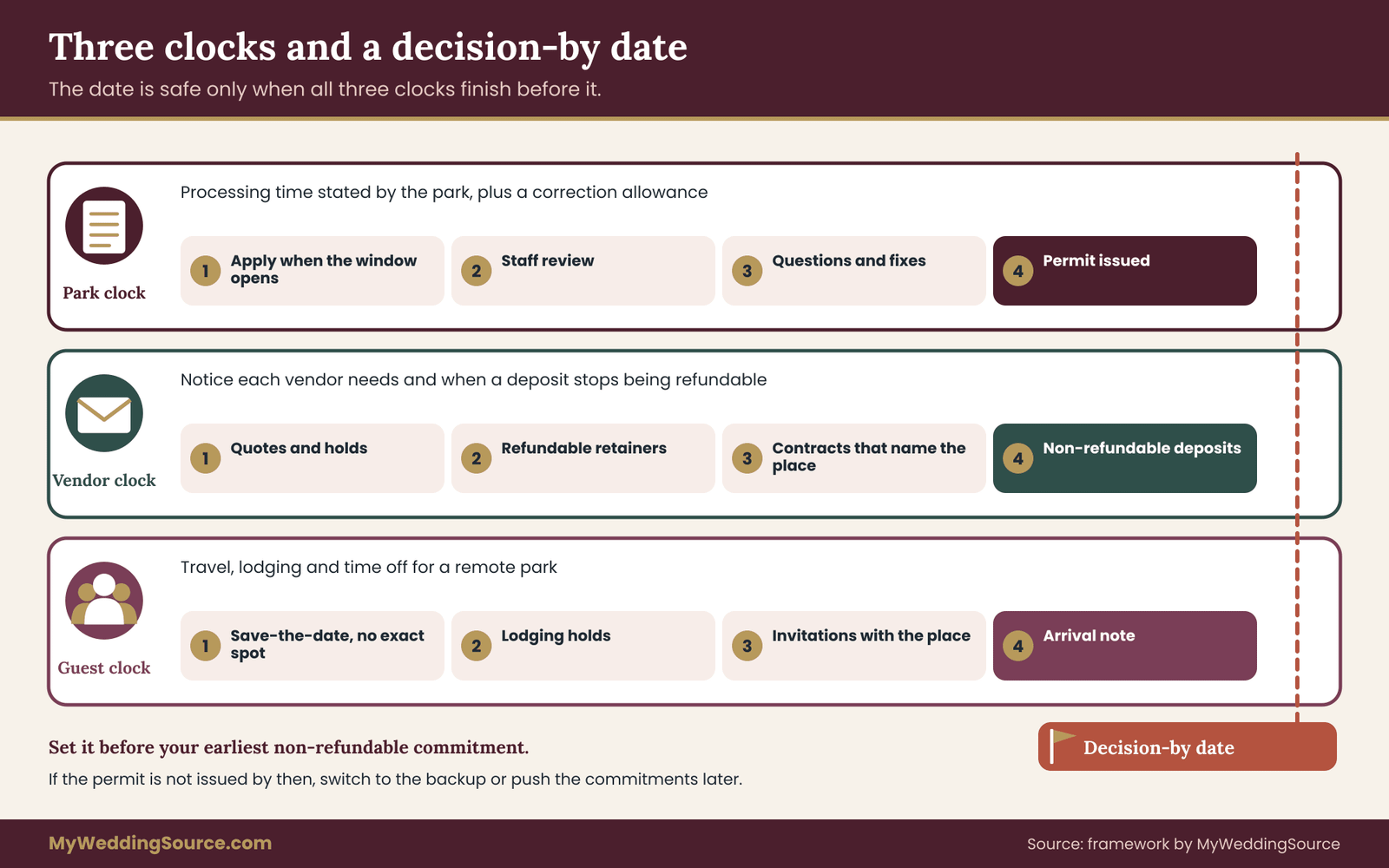
Gate four is where most national park wedding couples either save themselves months of stress or create it. The idea is simple. A national park wedding involves three separate clocks that run at different speeds, and your date is only safe when all three finish before it. Most trouble comes from watching only one of them.
The park clock. This is how long the park takes to process, approve and sometimes revise a permit, plus any waiting period before you may apply at all. Some parks accept applications only within a window before the event. Others ask for a long minimum lead time, and busy parks may close certain dates early. The park states its own figures. Do not guess them, and do not use a number from another park.
The vendor clock. This is the notice that each vendor needs, and the point at which their contract becomes costly to cancel. A photographer’s retainer, a rental company’s deposit and an officiant’s booking each have their own terms. The wedding vendor contract guide explains the clauses to look for, especially the ones about cancellation and changes of location. The vendor clock matters because the longer you wait for the permit, the more vendors might fill their calendars on your date.
The guest clock. This is the time guests need to travel, book lodging and take leave from work. For a remote park, that can mean far more notice than for a city venue. Lodging near popular parks can fill well before the season. The guest hotel coordination guide covers the room-block side of this, and the point here is simply that the guest clock often starts before the permit is final.
How the three clocks interact
The clocks do not simply add. They overlap and constrain each other. For a national park wedding, the park clock constrains the other two, because you cannot confirm the place until the permit exists, but vendors and guests cannot wait forever. The solution is a staged approach that lets you move forward on refundable terms while the permit is pending.
Use this sequence for a national park wedding. Work backward from your target date. First place the guest notice date: when must the save-the-date go out so that travelers have enough time? Next place the vendor decision dates: when must the photographer and officiant be locked? Then place the park’s processing time and add a buffer. The national park wedding permit decision date, the day by which you need an issued permit or must switch plans, belongs before the earliest non-refundable commitment, not after it.
The “decision by” date
The single most useful output of gate four is one date: the decision-by date. It is the latest day on which you can still choose between “proceed in the park” and “move to the backup.” Calculate it by taking the earliest non-refundable commitment, such as a printed invitation run, a travel purchase or a vendor deposit with no refund, and subtracting a buffer for a correction round.
If the park’s stated processing time is longer than the time between today and that date, you have a conflict, and the fix is either to push the commitment later or to submit the application sooner.
The correction allowance
Applications come back with questions. A park may ask for a clearer map, a vendor list, an insurance certificate or a smaller group size. Each round of questions adds days. Plan for at least one round, and for two if your plan includes vendors, amplified sound or a location the park may consider sensitive. This is not pessimism. It is how permit offices normally work, and a buffer built for it costs you nothing if the application sails through.
Seasons and calendars for a national park wedding
Parks are busiest in certain seasons, and the permit office may be as well. Spring and summer weekends often draw the most requests, and weekday or shoulder-season dates may be easier to schedule. Staffing can also change with the calendar. Holidays and federal funding lapses can slow offices or change what a park can approve.
Ask the park whether any known closures, construction or seasonal limits affect your date. The twelve-month and shorter planning calendars on this site, such as the twelve-month wedding checklist, can help you place these steps beside the rest of your planning.
Writing the national park wedding clocks down
Create three lines in the worksheet, one per clock, each with four dates: start, earliest finish, latest safe finish and the consequence of missing it. The consequence line is the one people skip, and it is the one that tells you what to do. For example: “Park clock, latest safe finish: the decision-by date. If missed: switch to the backup site and send the revised save-the-date.” Having the consequence written beforehand turns a stressful moment into a routine one.
A worked case for a national park wedding permit
The following national park wedding example is invented to show the worksheet in motion. The couple, the park and the numbers are fictional, and any figure marked as an assumption is there to make the arithmetic visible, not to describe a real park. Use it as a pattern, then replace every detail with your own findings.
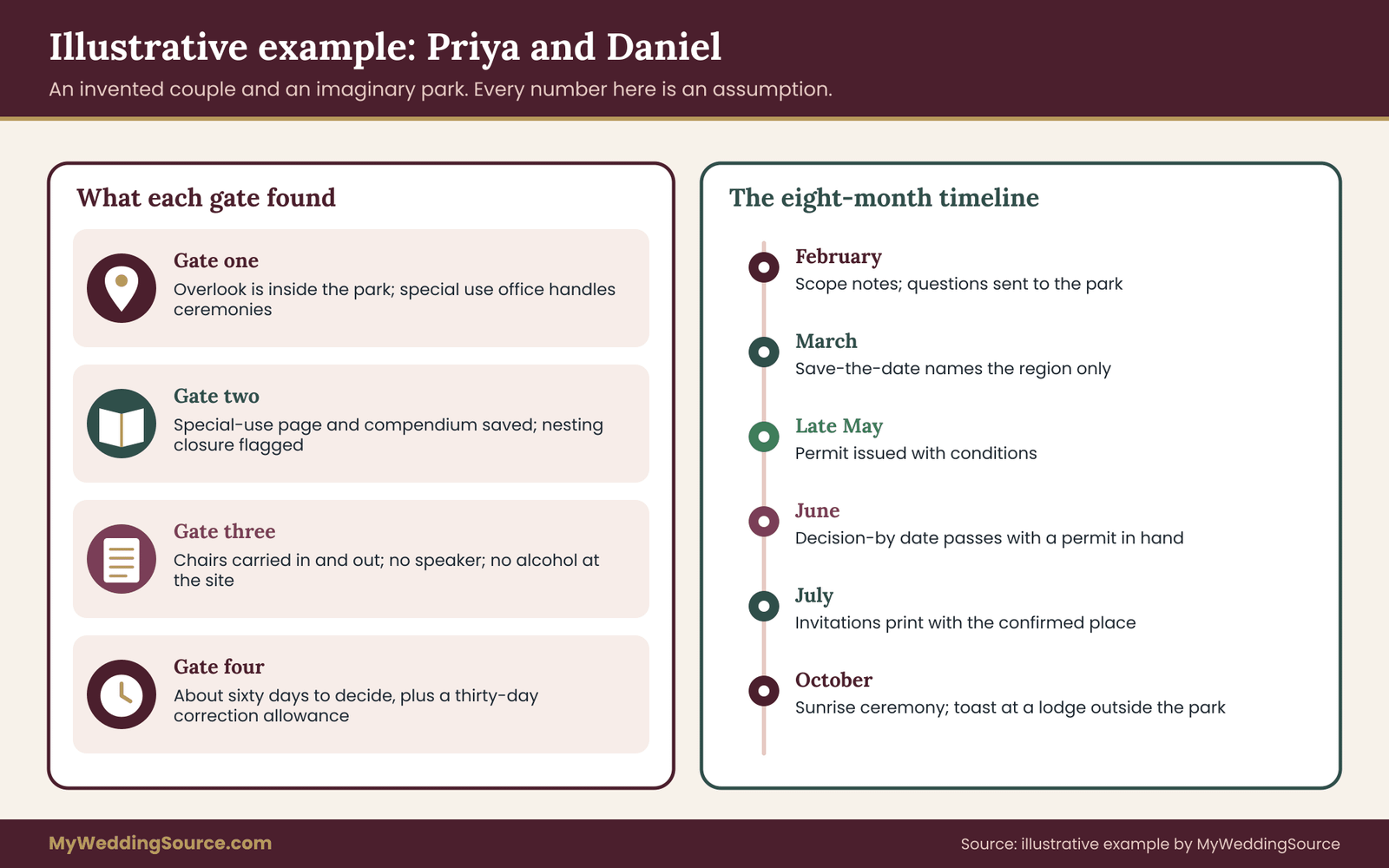
The situation. Priya and Daniel, a fictional couple, want a sunrise ceremony for about thirty-five guests at a canyon overlook in “Example Canyon National Park,” an imaginary unit. They hope to marry on a Saturday in early October, and it is currently the first week of the previous February. That gives them roughly eight months.
Gate one in the example
They find the overlook on the park’s official map, but it sits near the boundary. They write to the park, describing the overlook by name and its distance from the nearest road. The reply comes in four days: the overlook is inside the park, managed by the Park Service, and ceremonies at that overlook are handled through the park’s special use office. They record the reply as rung three and mark gate one as passed.
Gate two in the example
On the park’s website they find a “Special Park Uses” page that describes ceremonies and says applications are accepted within a stated window before the event. In the compendium they find a line stating that groups above a stated number need a permit, that amplified sound is limited and that unmanned aircraft are prohibited.
They save both as dated PDFs. They also notice that the overlook is closed to all visitors during a stated bird-nesting season that overlaps with part of the early-October window, so they ask about it. Staff reply that the closure ends before their date but could be extended by conditions, so the date stays provisional.
Gate three in the example
Priya and Daniel list their activities. The ceremony itself needs a permit. Their friend will photograph the ceremony, but the guests will also use phones. Because the friend is not paid, they ask whether this counts as commercial photography. The park says no, as long as no fee is charged.
They want twenty chairs for older relatives; the park says chairs may be carried in and out the same day but not left on site. They want a small speaker for the officiant; the park says no amplified sound at the overlook, so the officiant will project without it. They want a champagne toast; the park says alcohol is not permitted at that overlook, so they plan the toast at a lodge outside the boundary.
They label each activity. Ceremony: allowed with conditions. Photography: allowed. Chairs: allowed with conditions. Sound: not allowed. Alcohol: not allowed at the site, move it. Drone: not allowed.
Gate four in the example
The park states, in this imaginary example, that applications are decided in about sixty days and may be filed up to a year before the event, and that popular dates fill early. Priya and Daniel set their clocks.
Park clock. They submit as soon as the application opens for their date. At sixty days plus a thirty-day correction allowance, the earliest realistic finish is early May, and the latest safe finish, before the next commitment, is mid-June.
Vendor clock. Their officiant requires a deposit that is refundable until ninety days before the wedding. Their rental company’s chairs are not needed, since guests will carry chairs in. The lodge outside the park asks for a deposit at booking. They decide to book the lodge for the toast on a refundable rate and hold the other vendors until the permit is issued.
Guest clock. Guests need to travel to a remote area, and lodging is limited. They send a save-the-date in March that names the region but not the specific overlook, with a note that the exact location will be confirmed.
Decision-by date. Their earliest non-refundable item is the invitation print run in July. They set a decision-by date of mid-June, with a backup site, a county park near the park’s edge, already researched and contacted.
What happened next in the example
The permit is issued in late May with conditions: a stated group maximum, a one-hour window at sunrise, chairs carried in and out, no amplified sound, no alcohol, and a requirement to carry a copy of the permit at the event. Priya and Daniel put each condition on the task list with an owner. A cousin takes responsibility for chairs, and the officiant is told about the no-microphone rule. They send invitations in July with the confirmed location.
The national park wedding example shows several habits worth copying. Each answer has a rung. The save-the-date avoided naming a place that was not yet approved. A backup was prepared before it was needed. The toast moved to a place where it was allowed instead of being fought for. And at no point did the couple spend non-refundable money on rung-three information.
Reading the national park wedding example honestly
The example is tidy on purpose. Real replies can be slower, vaguer or stricter. A park might cap groups below the guest list, move the ceremony to a different spot or decline a date altogether. The point is not that the answer will be yes. It is that the worksheet makes each answer visible early, while changing course is still cheap. If Priya and Daniel had received a no in March, they would have lost a few weeks of planning, not a deposit and a printed invitation.
The item-by-item check for a national park wedding ceremony
Gate three produces a list of activities. This section goes deeper, for a national park wedding, on the items that park staff most often question, so that your questions are specific and your plans do not rely on an assumption. None of these items has a universal answer. Each one is a prompt for a written question to your park.
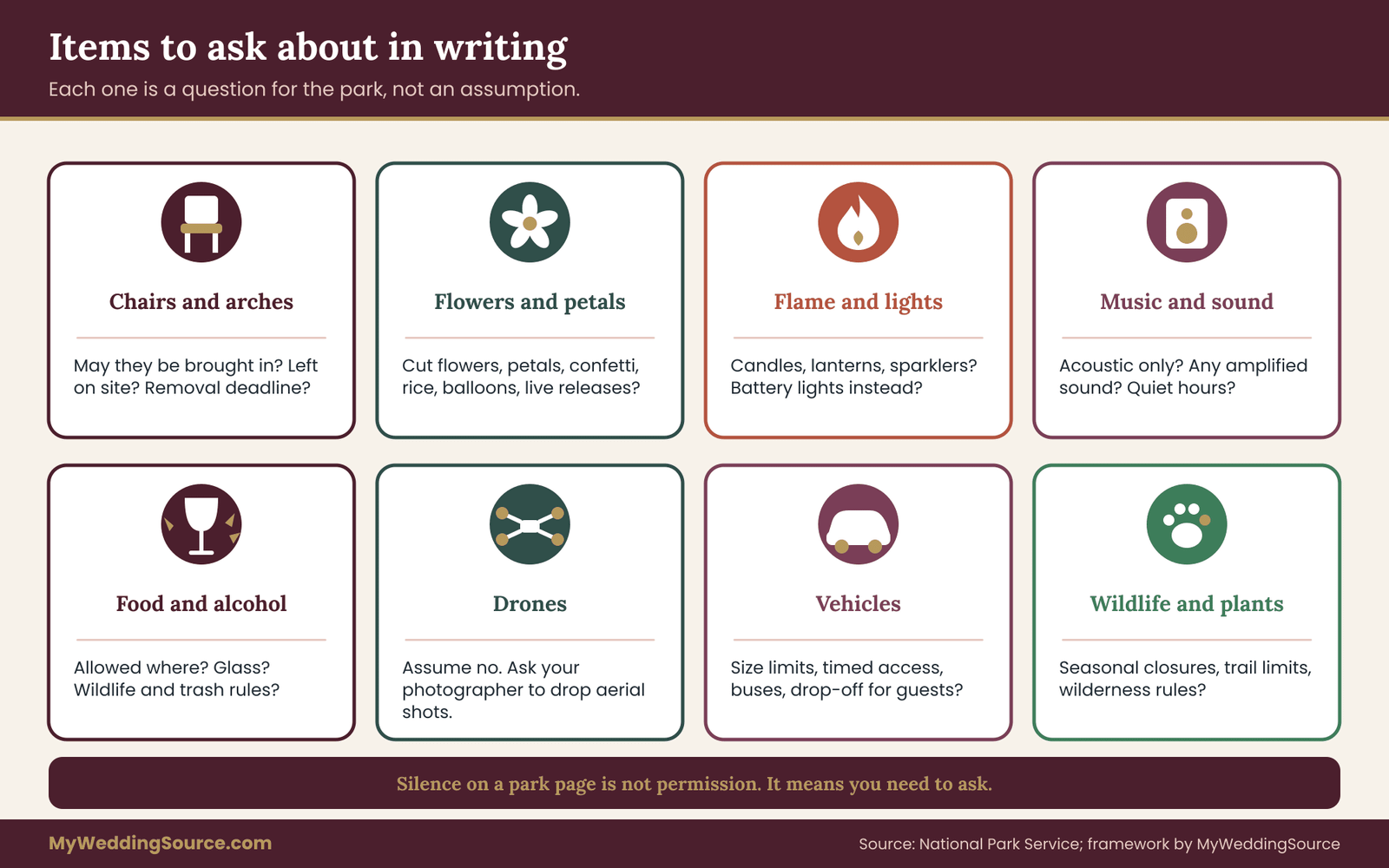
Chairs, arches and aisle decor. Parks care about trampling, anchoring and litter. A freestanding arch with stakes in the ground may be refused where a lightweight piece that guests carry in is accepted. Ask what may be brought, whether anything may be left on site, what the removal deadline is and whether the park wants a plan for cleanup. If your ceremony needs seating for guests who cannot stand, say so. Ask about at least a few chairs even in parks that discourage setup.
Flowers and greenery. Loose petals, flower arches that shed and live plants can all be restricted, partly to avoid introducing seeds or pests and partly because petals attract wildlife and add litter. Ask whether cut flowers are allowed and whether petals or confetti of any kind may be used. Many parks prohibit throwing rice, confetti or birdseed, and some prohibit releasing balloons, doves or butterflies. The park’s answer is the only one that counts.
Candles, lanterns and fire. Open flame is a serious matter in places with fire risk. Assume that candles, sparklers and bonfires need explicit permission and may be prohibited, especially in dry months. Fireworks are widely prohibited in parks. Battery-powered lights are a common substitute, and they are worth asking about if your ceremony runs near dusk.
Music and sound. Ask three questions. Is any music allowed? Is amplified sound allowed? What is the quiet-hours rule? An unamplified violinist, a solo singer or a recorded song played softly on a phone are different from a speaker system, and parks may treat them differently. Sound also affects other visitors and wildlife, which is why limits are common.
Alcohol and food. Some parks allow alcohol in certain developed areas, such as campgrounds or lodges, and prohibit it at overlooks, trails or historic sites. Some parks restrict glass. For food, the main issue is wildlife and trash. A park may ask that all food be consumed in a defined area and all waste be carried out. If a caterer is involved, the commercial-service rules apply.
Drones. The National Park Service has long prohibited launching, landing or operating unmanned aircraft on park land, with narrow exceptions. A wedding photographer who offers aerial footage cannot assume the park is an exception. Ask your vendor to drop aerial shots from any contract for a park location, or to take them somewhere outside the boundary where the law allows it.
Vehicles. Some roads or lots have size limits, timed access or seasonal closures. Large rental vehicles, limousines and shuttle buses may be restricted. If you hope to bring a bus, ask whether bus operators need their own authorization, because commercial passenger services in parks often fall under a separate authorization system.
Wildlife and plants. Rules protect animals and habitat. Expect restrictions on leaving established trails, approaching wildlife, feeding animals and picking plants. Seasonal closures for nesting or breeding can apply to entire areas. Ask about any wildlife conditions on your date, and share them with guests in advance so no one is surprised.
Wilderness and backcountry. Designated wilderness within a park has its own legal framework, including limits on group size and bans on mechanized and motorized equipment. A backcountry elopement is a very different request from an overlook ceremony. If your plan involves hiking in, ask about wilderness permits, group-size limits, camping permits and any requirement to follow leave-no-trace practice. These can involve separate offices from the one that handles frontcountry ceremonies.
Photographers and videographers at a national park wedding
This area deserves extra attention because it is where couples most often discover a second permit requirement. Parks treat commercial photography and filming as a regulated activity. Many require a wedding photographer to hold a permit or authorization, to carry insurance or to be named in the couple’s permit. Other parks treat a small ceremony with a single photographer as ordinary use and impose no extra step. The difference is entirely the park’s choice, so ask.
When you interview photographers, ask directly: “Have you worked in this specific park, and which authorization did you use?” A photographer who has done it before can describe the process and may already hold a current authorization. A photographer who has not should be willing to learn the process with you.
Put the responsibility in writing in the contract: who applies, who pays, what happens if the authorization is denied and what refund applies if the shoot has to move. The wedding photography consent guide covers guest boundaries and image use, which is a separate question from park permission, and both matter at a public site where other visitors may appear in your photos.
Guest-facing rules for a national park wedding
Whatever the park allows, your national park wedding guests should know about it before they arrive. A one-page note, sent after the permit is issued, can cover the date and time, the exact meeting point, parking, entrance fees, how to find the spot on foot, the walking distance, what to wear and what not to bring. Guests tend to follow rules when the rules are explained as part of the plan, not discovered at the gate.
The conditions that tend to surprise people at a national park wedding
Looking across typical park conditions, a handful appear again and again as surprises. The group maximum counts everyone present, including the officiant, the photographer and children, in many permits. The time window often covers setup and cleanup, not only the ceremony. A permit may require you to carry a copy, or to check in with a ranger.
Some parks require a monitor or a staff presence for certain locations, sometimes at a cost. And most permits state that the park may cancel or change conditions for safety, weather, resource protection or closures. Read that last line closely, since it affects your backup plan.
Guests, access and safety at a national park wedding
A beautiful location can be hard to reach. Many sites chosen for a national park wedding are far from cities, high in elevation, without cell service and exposed to weather. A good plan treats the guests’ journey as part of the event, not an afterthought.
Distance and arrival. Ask the park how long it takes to reach the spot from the entrance, and whether the last stretch is on a trail, a paved path or a road. Guests who drive long distances and then hike may be tired and late. Build a buffer between arrival and the start time, and tell guests when and where to gather.
Accessibility. The park’s accessibility information is a starting point, not a final answer. Ask about surfaces, slopes, distances and the nearest accessible parking. Federal rules require that many park facilities and programs be accessible, but a natural overlook may have limited options. If any guest uses a wheelchair, walker or cane, ask whether a vehicle may drop them close to the spot and whether the permit can include that. The accessible wedding venue red flags guide lists the signs to watch for and can help you ask better questions.
Cell service and communication. Assume that coverage may be weak or absent. Share the meeting point and a printed map in advance, agree on a gathering time that does not depend on texts and give one person a plan for contacting emergency services. The digital contingency guide covers backup communication and file handling for days when connectivity fails.
Weather and altitude. Mountain and desert parks can swing from hot to freezing within hours. Check the National Weather Service forecast for the specific area, not the nearest town, and tell guests to bring layers, water, sun protection and sturdy shoes. High-elevation sites can affect older guests and anyone with heart or lung conditions. Offer a short-walk option and a seat for those who need it.
Safety around hazards. Cliffs, water, wildlife and uneven ground are normal in parks. Choose a ceremony spot with a flat area away from edges, and ask staff about any known hazards. Remind guests that photographs near drop-offs are not worth a fall. If children attend, name an adult responsible for them.
Emergency planning. Know the nearest ranger station or visitor center, the park’s emergency number and the closest medical facility. Carry a basic first aid kit and water. Tell guests where to find an adult in charge if something goes wrong.
Lodging and logistics for a remote national park wedding
Lodging inside and near popular parks can book months ahead, and prices are often higher in peak seasons. Guests may need to stay in gateway towns, and the drive from town to the park may add time. Share lodging options early, and consider a morning or late-afternoon ceremony that works with check-in and check-out times. Room blocks, where a hotel is willing to offer one, can help with price and availability.
Plan for the fact that your guest count is a national park wedding permit variable. If the park caps the group at a number lower than your list, you need a decision before invitations go out: trim the ceremony guest list and invite others to the celebration afterward, or choose a different location. A two-tier arrangement, with a small ceremony in the park and a larger gathering elsewhere, is a common and gracious solution.
Alternatives when a national park wedding is not possible
Sometimes the answer is no. The date is taken, the group is too large, the spot is closed for nesting season or the park does not allow ceremonies where you hoped. A no is not a failure of planning. It is information, and the worksheet is designed so that you receive it while alternatives are still cheap. This section lays out the main routes, ordered by how much of the original idea they keep.
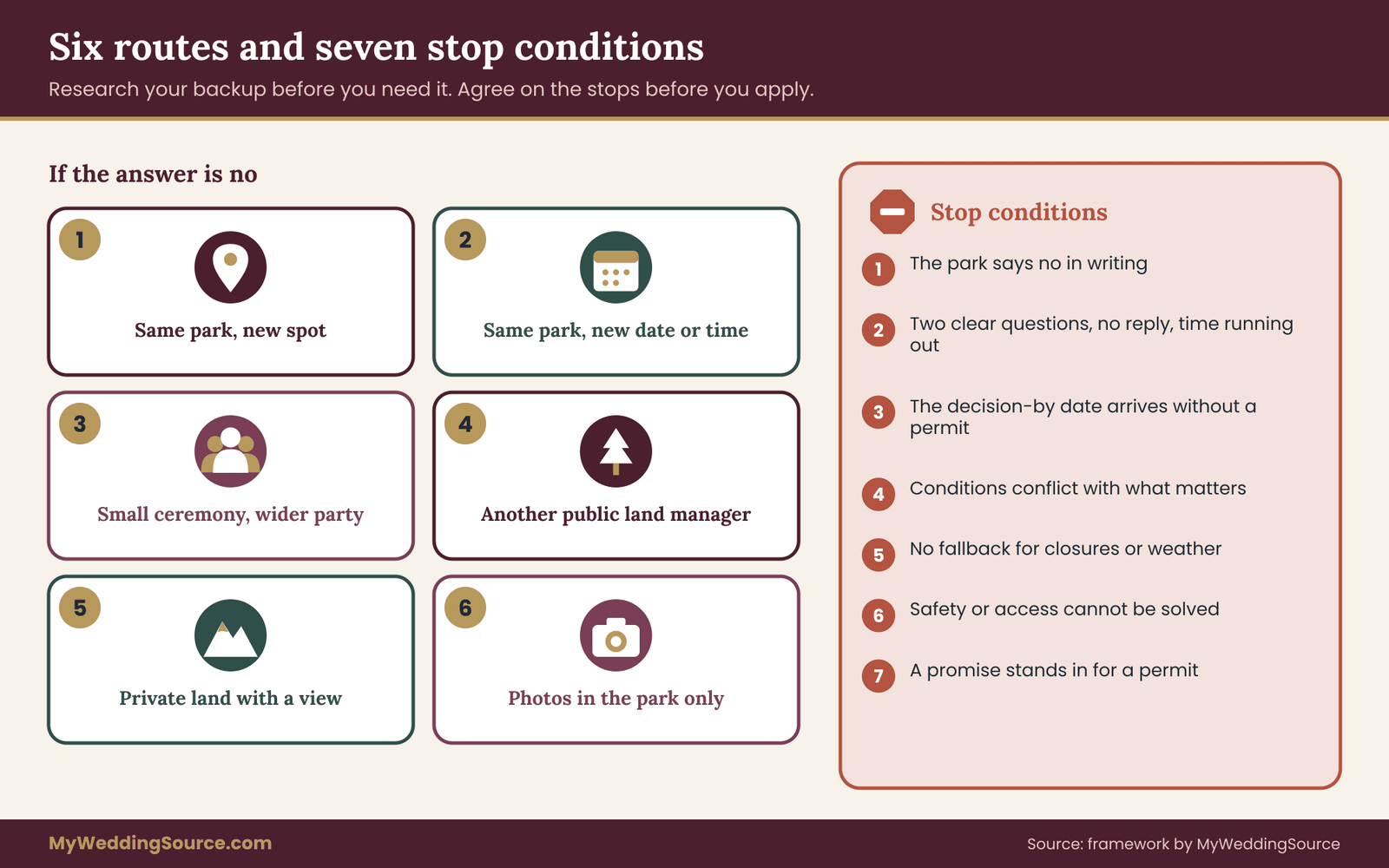
Route one: keep the park, change the spot for the national park wedding. Ask the park staff where ceremonies are allowed. Parks that restrict an overlook often have a designated area, a picnic grove or a historic site that welcomes ceremonies. The photographs may differ, but the setting, the sky and the mountains are still there. This is the first question to ask after a no, because staff know which areas work.
Route two: keep the park, change the date or time. A weekday, a shoulder season or an early morning can open options that a Saturday afternoon in July does not. Ask the park which dates and times are easiest to approve. A sunrise or a late-afternoon ceremony can also avoid crowds and heat.
Route three: shrink the legal event, widen the celebration. Hold a very small ceremony, or even a private exchange of vows, with the number the park allows, and then gather the larger group elsewhere. Some couples sign their license at a courthouse or in a simple ceremony earlier, and then hold a symbolic ceremony in the park with whoever can be there.
If you take this route, be clear in your invitations about which event is which. Check the license and officiant rules for each state involved if the legal and symbolic parts happen at different times.
Route four: a different public land manager. A state park, a county or regional park, a national forest or a Bureau of Land Management area can offer similar scenery with different rules. State and local systems often use online reservations and may have more predictable fees and lead times.
The worksheet works the same way: confirm the manager, find the rules, match the plan and build the clocks. If you choose a city or county park, the broader discussion of public park ceremonies on this site applies, and comparing setting types helps you see what each one trades away.
Route five: private land with a view. A lodge, ranch, vineyard or private overlook near the park can offer a setting with the same backdrop and a simpler permission structure. Private venues set their own rules but are not subject to the park’s permit system, though local land-use and event rules may still apply. Ask the venue what its permits cover and whether it has hosted weddings before.
Route six: photographs in the park, ceremony elsewhere. If the park permits photography but not ceremonies in your chosen spot, you can hold the ceremony at a different venue and use the park for portraits. Ask about the photography rules, since a portrait session with a hired photographer can be a commercial activity even without a ceremony.
Choosing between routes for a national park wedding
Use three questions to choose. What matters most about the park: the exact view, the symbolism, the feel of the setting or the journey itself? How many guests need to be present at the ceremony? And how much flexibility does the date have? If the exact view matters most, route one or two keeps it. If the guest count matters most, route three or four does. If the date is fixed, route five is usually the most reliable.
Write your first and second national park wedding alternatives into the worksheet with their own gate-one through gate-four notes. A backup you have researched is very different from a backup you have only imagined. If the first choice falls through, you move into the second with a head start, which saves weeks.
Telling guests about a change to a national park wedding
If the plan changes, tell guests promptly and plainly. A short message with the new place, date and time, the reason in one sentence and a note about travel and lodging is enough. You do not owe a long explanation. If invitations were already sent, send a clear correction, and consider asking guests to confirm that they received it. The principle is simple: one clear message, early, through the same channels you used before.
Failure conditions for a national park wedding: when to stop, reroute or pause
A good national park wedding worksheet defines the points at which you stop. Without them, couples keep pushing a plan that the evidence no longer supports, because they have already invested time and hope. Failure conditions are the antidote. Write them down before you begin, and agree on them as a couple, so that no one has to argue for the retreat in the middle of a stressful week.
Stop condition one: the park says no in writing. A written no to your place, date or activity is a stop. Do not keep pressing the same office with the same request. You may ask whether a different spot or date is possible, which is route one or two, but do not treat a no as an opening to negotiate. If you disagree with the reasoning, ask for it politely in writing, and then decide.
Stop condition two: the reply is vague and time is running. If you have asked a clear question twice and received nothing specific, treat the silence as a “not yet,” set a deadline and move to the backup if the deadline passes. A park office may be busy, but you cannot plan around an unanswered email.
Stop condition three: the decision-by date arrives without a permit. This is the main failure condition from gate four. If the date passes and you hold no issued permit, you switch to the backup or push the non-refundable commitments later. The test is mechanical so that hope does not move the line.
Stop condition four: conditions conflict with what matters. A permit that arrives with a group cap far below your list, a time window too short for the ceremony or a ban on the thing that makes the place meaningful may technically be a yes and practically be a no. Ask yourselves whether the event under those conditions is still the wedding you want. If not, say so and reroute.
Stop condition five: the plan depends on something no one controls. Weather, wildfire smoke, road closures, funding lapses and wildlife closures can affect a park. If your plan has no workable fallback, such as a covered area, an alternate date or a nearby indoor space, a sudden closure becomes a crisis. If you cannot build a fallback, treat the plan as fragile and consider a lower-risk site.
Stop condition six: safety or access cannot be solved. If a guest cannot reach the site safely and the park offers no workable accommodation, the plan fails in a way that matters more than any permit. Look for a different spot or a different park before looking for a workaround.
Stop condition seven: a vendor or a relative promises what the park has not. If someone says “we know the ranger” or “it’s always fine,” treat it as rung one at best. Do not let a promise stand in for a permit.
What to do after a national park wedding plan stops
A stop is a decision point, not a collapse. Name which condition triggered it, check the worksheet for the backup and message the people who need to know. Then update the worksheet with the new gate notes and the new decision-by date. Restarting with information is far better than restarting from nothing, and many couples find the second plan is simpler and calmer than the first.
The pause option
Some failure conditions point not to a different place but to a different time. If a closure, a funding lapse or a long processing queue makes your date unworkable, ask whether the same plan is possible on a later date. A short delay, handled calmly, costs less than a rushed move to a place you do not love.
Check your vendor contracts for what a date change costs, and ask the park whether your application can be amended or must be refiled. Whichever route you take, plan a site visit before the date, because photographs and maps rarely show distances, slopes or shade.
Your next steps
You do not need to finish the national park wedding worksheet in a weekend. Work through it in short sessions, and stop each time you hit a question only the park can answer.
- Write your national park wedding scope notes: event type, guest range, date and two alternates, the place in words, and the items you hope to bring. Add your two honest lines about what you would change and what would make you walk away.
- Pass gate one. Confirm the managing agency for the exact spot, and write to the park with one direct question if the map leaves doubt.
- Pass gate two. Save the park’s special-use page and the superintendent’s compendium as dated files. Find a named contact.
- Send one clear message with your numbered questions, and send it to every park on your short list.
- Pass gate three. List each activity, label it allowed, conditional, separate or unknown, and note the rung of evidence beside it.
- Pass gate four. Draw the three clocks, add the correction allowance and set a decision-by date before your earliest non-refundable commitment.
- Research one backup route fully, with its own gates, before you need it.
- Hold non-refundable spending until you have the permit in hand, and send a save-the-date that names the region, not the exact spot, until then.
- When the permit arrives, convert every condition into a task with an owner, and send guests a one-page arrival note.
If you are still comparing sites, the wedding venues guide can help you weigh a public park against other settings, and the park’s own staff are the final word on their land.
FAQ
Do I always need a permit for a national park wedding ceremony?
Not always, but you should not assume either way. Some parks allow very small groups to hold a ceremony in open areas without a permit, and others require a permit for any ceremony. The rule is set by each park, usually in its special-use page or superintendent’s compendium. Ask the park in writing, describe your group size and spot, and keep the reply.
Where do I find the correct national park wedding rules for one specific park?
Start with that park’s official page on the National Park Service website and look for weddings, special events or special park uses. Then find the superintendent’s compendium, usually under laws and policies, and search it for ceremony, group, alcohol and amplified sound. Finish with a short written question to the permit office so you have a staff answer on your situation.
How far ahead should I apply for a national park wedding permit?
The park states its own processing time and application window, so use those figures and not a number from a blog. Add time for at least one round of questions, and set a decision-by date before your first non-refundable payment. Popular dates and seasons may fill early, so ask the park when applications open for your date.
Does my entrance pass or fee cover a national park wedding ceremony?
Usually no. An entrance fee or annual pass lets people enter the park, but a permit is separate permission for a particular activity. Special use permits may carry their own application or cost-recovery fees. Ask the park what applies to your request, and tell guests that they will need to pay entrance fees or hold a valid pass.
Does my photographer need a separate permit?
It depends on the park. Many parks regulate commercial photography and may require a permit, an authorization or insurance, or may name the photographer in your permit. Others treat a small ceremony with one photographer as ordinary use. Ask the park directly, and put responsibility for any authorization in your photographer’s contract in writing.
Can I bring a drone, decorations or alcohol?
Plan on no until the park says otherwise. The National Park Service has long prohibited operating drones on park land with narrow exceptions, and decorations, open flame and alcohol are commonly restricted. Each park sets its own conditions, so ask about every item you hope to bring and write down the answers.
What if the park denies my national park wedding request or the date is taken?
Ask what the park can offer instead, such as a different spot, date or time. If it cannot, use your backup: another public land manager, a private venue near the park, a smaller ceremony with a wider celebration elsewhere, or photographs in the park with the ceremony somewhere else. A written no is a reason to switch routes, not to keep pressing.
Is a permit the same as being legally married?
No. A park permit only allows an event on that land. A legal marriage depends on the license and officiant rules of the state where the ceremony happens. Check the clerk’s requirements for that state early, especially if a park spans more than one state, and confirm that your officiant is eligible there.
Sources
- National Park Service
- Find a Park, National Park Service
- Recreation.gov, federal recreation reservations and permits
- Electronic Code of Federal Regulations, Title 36 (Parks, Forests, and Public Property)
- U.S. Department of the Interior
- U.S. Forest Service
- Bureau of Land Management
- U.S. Fish and Wildlife Service
- Federal Aviation Administration, unmanned aircraft systems
- National Weather Service