
Park ceremony permits are the written permissions that let you hold a wedding ceremony in a public park, and they come from whichever agency controls that exact piece of ground. This guide gives you a way to find that agency, work out whether the site can really hold your guests, and decide early whether to proceed, adjust or move.
Do not start with the permit form. Start with discovery. Identify who owns and manages the specific park, then list every other office that can add a condition: the recreation division, police, fire, public health, transportation and any group that runs a building or a lot inside the park. Walk the site with a feasibility checklist. Then apply, and keep every answer in writing. Park ceremony permits differ by agency, by park and by group size, so each answer belongs to one site and one date only.
A public park looks like the simplest wedding venue there is. The grass is free to look at, the trees are already there, and nobody sends a minimum spend. Then you try to find out whether you can put forty chairs under those trees on a Saturday in June, and the simplicity disappears. The park may be run by a city, a county, a state agency or the federal government. A path might belong to one agency and the parking lot beside it to another. A shelter might be reserved through a different office than the lawn behind it.
That is why this article treats park ceremony permits as a discovery task instead of a single application. You will learn how to map the agencies that can say yes or no, how to test a site before you fall in love with it, which rules tend to shape a ceremony, and what a clean failure looks like. A failure here is not a disaster. It is an early, well-documented reason to change the plan while you still have options.
A note on scope. This is general information, not legal advice, and park rules change by agency, site and season, so confirm each one with the office that issues it. The article stays on the permit and site question for a ceremony in a public park. It does not cover the full venue search, which is explained in the wedding venues guide, and it does not walk through the rest of the ceremony script or order of events.
What park ceremony permits actually cover
People use the word “permit” for several different things, and mixing them up is the first source of confusion. When someone says they have park ceremony permits, they might mean any of the following, and each one has a different owner.
An event or use permit. This is the main document. It gives you the right to hold a gathering at a stated place, on a stated date, between stated hours, with a stated number of people. It may also list what you can bring, such as chairs, an arch or a sound system.
A reservation of a facility. A picnic shelter, a pavilion, a garden or a rose arbor is often reserved separately from the open lawn. Reserving the shelter does not always give you the right to hold a ceremony in front of it, and holding a ceremony on the lawn does not always give you the shelter for guests.
A condition or approval from another office. Fire, police, public health or transportation staff sometimes attach conditions to a larger gathering. They may also review the plan before the park office issues anything.
A vendor authorization. Some parks require that outside vendors, rental companies or photographers hold their own permission, carry insurance or register with the park before working on site.
A special authorization for specific items. Alcohol, amplified sound, open flames, tents, vehicles on grass and drones are common examples. Each can require its own approval, or can be flatly prohibited.
Park ceremony permits, in short, are a bundle. The bundle for one park might be one page, and the bundle for another might be four documents from three offices. Your job is to find out which bundle applies to you, and the sooner you know, the more choices you keep. Park ceremony permits reward early questions more than early payments.
What park ceremony permits do not give you
Park ceremony permits grant permission, not a promise of an experience. They do not make the park private. In most public parks the lawn stays open to everyone else unless the rules say otherwise, so joggers, dog walkers and families may pass through your ceremony. Park ceremony permits usually do not guarantee restrooms, parking, shade, power or good weather, and they rarely guarantee that the spot you want will not be used by someone with an earlier request.
It also does not substitute for the paperwork of the marriage itself. The legal requirements for a license and an officiant are a separate topic, and the wedding officiant requirements page explains how those usually work. A park office issues permission to use the land, not permission to marry.
The difference between “allowed” and “approved”
Many parks publish general rules that say weddings are “allowed.” For park ceremony permits, that wording only opens the conversation. That word is not the same as “approved for your date and your plan.” Think of it as two stages. The first stage says the park accepts weddings at all. The second stage says this specific request for this specific place and day has been reviewed and granted. A reader who mistakes the first stage for the second can mail invitations to a ceremony that has no permission behind it.
Treat the website language as a starting clue and nothing more. The reliable fact is a written approval with your date, your location, your hours and your headcount on it.
How park ceremony permits get decided: the agency ladder
The most useful picture for park ceremony permits is a ladder, and it works for any kind of public land. Each rung is a type of office that might have a say. You climb it from the top, asking at each rung whether that office has a requirement, and you stop only when every rung has an answer, even if the answer is “no requirement from us.”
Here are the rungs, in the order that usually saves the most time.
Rung one: the land manager. Whoever owns or manages the land sets the baseline. For a city park that is usually a parks and recreation department. For a county or regional park it is a county or regional authority. For a state park it is a state parks agency. For a national park, forest or other federal land it is a federal agency such as the National Park Service or the Forest Service. Start by confirming which of these actually manages the ground you are standing on, because signs and maps can be misleading at borders.
Rung two: the specific unit or district. Within a large agency, one local office often handles permits for one park or one group of parks. Larger systems may route requests through a central permit office, and smaller ones through the park manager’s desk. Find the local office and the named person or role who handles special events.
Rung three: the recreation or events division. Many cities separate the people who maintain the land from the people who rent it. If the facility reservation sits in a different division, you may need to call both.
Rung four: the safety and public-health offices. Police, fire and public health do not usually issue the park permit, but they can set conditions on a gathering. Ask the land manager whether any of them review requests like yours, and at what size.
Rung five: the operators inside the park. Golf courses, nature centers, concession buildings, historic houses, botanical gardens and conservancies may control a path, a garden or a parking area that your guests need. A nonprofit that maintains a garden can have its own rules even though the land is public.
Rung six: the neighbors of the rules. Utilities, transportation departments, neighboring jurisdictions and alcohol licensing offices can matter in narrow cases, such as a street closure, a shared road or a drink service.

Not every ladder has all six rungs filled. A small neighborhood park might have only rungs one and two. A large regional park with a lake and a garden could use all six. The point of the ladder is to prevent the most common mistake, which is to ask one office and assume that its answer covers everything.
Why the ladder beats a single phone call
Imagine a couple who call the city’s recreation line and are told that a lawn can be reserved for a ceremony. That answer is true. But the lawn sits beside a garden run by a conservancy, the path to it crosses a county trail, and the only parking is in a lot managed by the school district next door. The first office never mentioned any of that because it was not asked. The ladder makes you ask, and that is why it suits park ceremony permits so well.
Each rung also tells you something about timing, and timing is where park ceremony permits quietly go wrong. Rung four offices tend to want plans well in advance. Rung five operators may have their own booking calendars. If you learn about them late, you may be forced to choose between a date and a plan.
How to tell which rung an answer came from
Write the rung next to every answer in your log. “Rung one, city parks department, said the lawn is open to the public during any permit.” That small label keeps you from treating a general statement as a site-specific one. It also tells you whom to call again when something changes.
If an office says it does not handle a question, ask who does. Offices rarely mind pointing you onward, and “who would decide that?” is the most productive sentence in the whole process.
Running discovery on park ceremony permits step by step
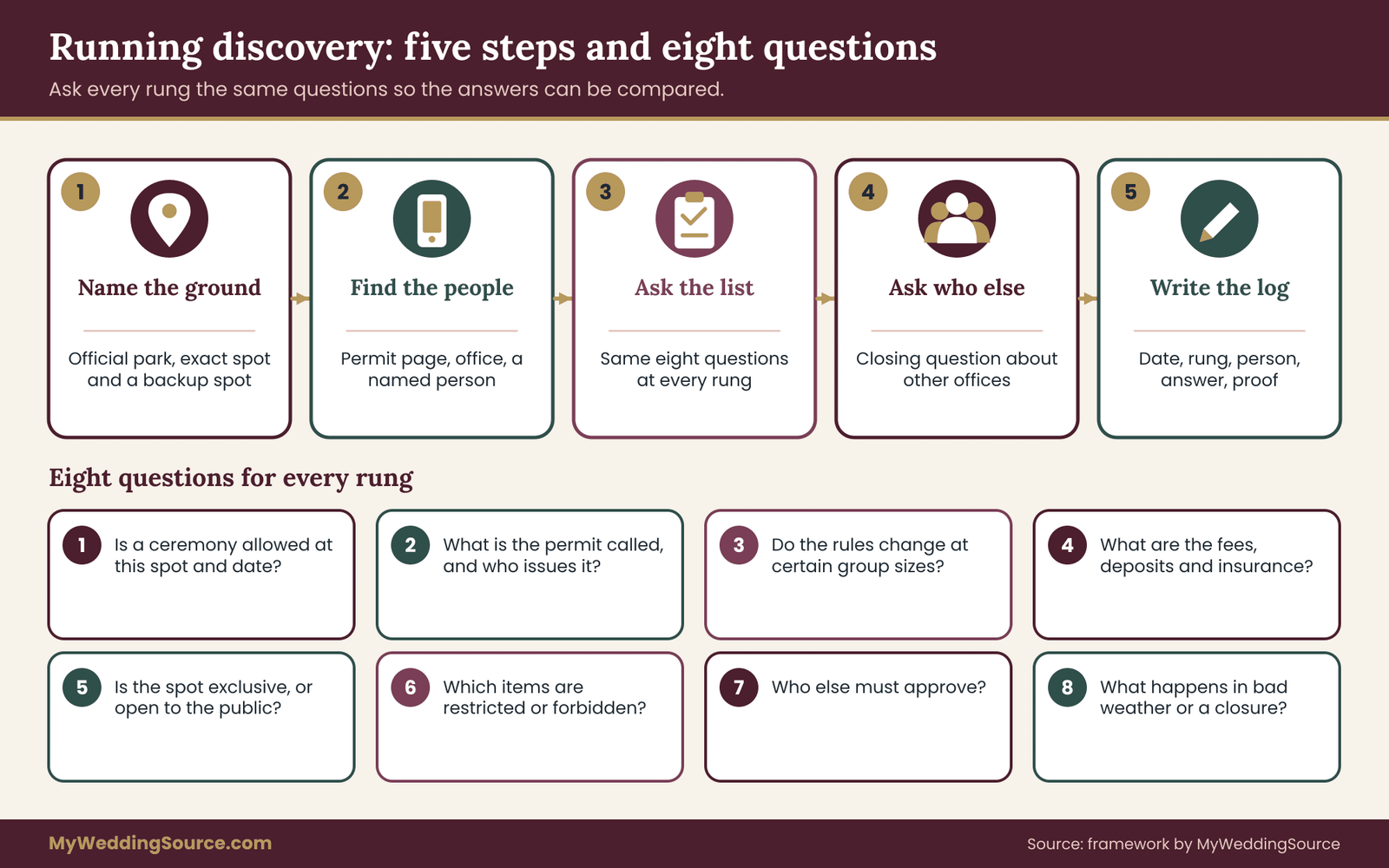
Discovery is the part of the process most couples skip when they chase park ceremony permits, and it is the part that decides whether the rest goes smoothly. It has five steps, and each produces a record you will use later.
Step one: name the exact ground
Pin down the park, the spot inside it and the alternative spot. “The park by the river” is not an answer. Use the official park name, the name of the lawn, shelter, garden or overlook, and the nearest cross street or parking lot. Take a photograph of any posted sign at the spot and note the agency name printed on it.
Then check the boundary. Open a map from the land manager, not a general mapping app, and see whether the spot is inside the park or on a neighboring parcel. Waterfront edges, trails and parkways are common places where one agency’s land ends and another’s begins.
Step two: find the permit pages and the people
Search the land manager’s website for park ceremony permits, or for pages about special events, facility rentals, weddings, ceremonies or “special use.” Different agencies use different words, which is why a search for “wedding permit” sometimes finds nothing even when a perfectly good page exists under “special events.” The national directory of local and state governments on USA.gov is a reliable starting point when you cannot tell which government runs the park.
Save the page address and the date you read it. Rules get updated, and a note that says “read in November, rules might change” protects you later.
Next, find a human. Most permit offices list a phone number or an inquiry form. Write down the name of the person you speak with, the date, and the answer. If you only get a general mailbox, that is acceptable, but keep the reply.
Step three: ask the same short list of questions at every rung
Consistency matters more than cleverness when you compare park ceremony permits across offices. Use the same list each time so you can compare answers across offices.
First, is a ceremony of our kind allowed at this exact spot, and on our date? Second, what is the permit called, who issues it, and how do we apply? Third, does the permit change at certain group sizes, and where are the lines? Fourth, what are the fees, deposits and insurance requirements, and when are they due?
Fifth, is the spot exclusive during our time, or will it remain open to the public? Sixth, which items are restricted or forbidden: chairs, arches, tents, amplified sound, alcohol, vehicles, open flames, confetti, drones? Seventh, who else must approve? Eighth, what happens if the weather is bad or the site is closed?
That eighth question is the one that hurts most when ignored. Some park ceremony permits include a rain policy; others are silent. Get it in writing, because it decides what your backup plan has to do.
“Hello, we would like to hold a short wedding ceremony at the lakeside lawn on a Saturday this spring. Could you tell me who issues the permit for that spot, what the application involves, and whether other offices review it?”
Step four: ask the second question, “Who else should I check with?”
At the end of each conversation, add a closing question: “Is there any other office or organization that sets conditions for a ceremony there?” Many answers to this question reveal rungs you had not seen, such as a conservancy that maintains the garden or a transportation office that controls the road to the park. A good closing question takes ten seconds and can save a month.
Step five: write the discovery log
A discovery log for park ceremony permits is a simple record with one entry per answer. Each entry has six parts: date, office and rung, person’s name or role, the question, the answer in your own words, and the proof (an email, a page address, a screenshot or a document number).
The log serves three purposes. It lets you compare what different offices said. It lets a partner, parent or planner pick up the task without repeating calls. And if an approval is ever disputed, it shows what you asked and what you were told.
Do not paraphrase a number or a condition from memory. If an office says a permit is required above a certain headcount, write down the exact number and ask them to confirm it in an email. A discovery log full of “I think they said” entries is only a slightly better version of a guess.
When offices disagree
Occasionally two offices give conflicting answers, for example one says tents are allowed and the other says they are not. Do not average the answers. Ask the office that issues the permit to confirm which rule governs, and ask for the answer in an email. If the issuing office is vague, ask which document contains the rule, such as a park ordinance or a posted rule sheet, and read it yourself.
When the conflict cannot be resolved quickly, treat the stricter answer as the working rule and keep asking. A plan built on the stricter answer cannot be undone by a later correction. A plan built on the looser answer can.
Testing the site: a feasibility checklist before you apply
Park ceremony permits tell you whether you may hold a ceremony. Feasibility tells you whether you should. A site can be fully permitted and still be a poor place to marry, because the toilets are a ten-minute walk away or the path cannot take a wheelchair. Do the feasibility work before you pay a fee for park ceremony permits, because a fee paid for a poor site is a fee you may not recover.
The checklist has eight checks. Visit the site at the same time of day and the same day of the week as the planned ceremony, because a park on Tuesday at noon and a park on Saturday at five are different places.
Check one: ground and footing. Walk the aisle route in the shoes the wedding party will wear. Note slopes, roots, sprinkler heads, soft ground, gravel and surfaces that might hold standing water. Heels sink in grass that looks dry, and a short aisle across wet lawn can be a safety issue for older guests.
Check two: space. Stand where the couple will stand and look back. Estimate how many chairs the flat, usable ground can hold without blocking a path. Do not count the slope, the tree roots or the area under low branches. If a standing ceremony is planned, still leave room for the aisle and for the people who need seats.
Check three: shade, sun and wind. Note where the sun will be at the ceremony hour and which direction the wind tends to blow. A ceremony facing straight into low sun is hard on guests and photographers, and the same direction can cause the couple to squint through the vows.
Check four: sound. Stand at the ceremony spot and listen. Traffic, a nearby playground, a train line, a splash pad, a mower schedule and an adjacent shelter with its own party can all overwhelm quiet vows. If the park forbids amplified sound, think about how a short ceremony carries to the back row without it.
Check five: restrooms and water. Find the nearest restroom, check whether it is open on your date, and time the walk from the ceremony spot. Ask the park office whether restrooms are cleaned on weekends and whether any are closed seasonally. Drinking water points matter in hot weather.
Check six: parking and drop-off. Count the spaces, ask whether they are shared with other park users and whether the lot is paid. Find the closest legal drop-off for guests with limited mobility and for the couple’s vehicle. A beautiful lawn with a 15-minute walk from the nearest parking space is a different event for a guest in a mobility device.
Check seven: access and accessibility. Look at the surface of the route from the parking area to the seating, the width of the path, the presence of curb cuts, and where an accessible space for a wheelchair or walker could sit in the ceremony layout. The accessible venue red flags article lists the issues to look for, and most of them apply to parks as much as to buildings.
Check eight: other users. See who else uses the spot. Is it on a popular trail, near a playground, near a dog area or beside a shelter that other groups can reserve? You are not trying to eliminate the public. You are trying to understand how much of it will be present.
Score each check with a simple three-level mark
For each check, mark one of three levels: workable as is, workable with a fix, or not workable. Keep the marks honest. A “workable with a fix” needs a named fix and a named person responsible, such as renting a small generator for sound or hiring a mat for the soft stretch of lawn.
A site with one or two “workable with a fix” marks is normal. A site with any “not workable” mark on ground, access or restrooms deserves a pause, because those are the failures that cannot be repaired with decor. The next section ties this scoring to the decision to proceed with park ceremony permits.

Visit twice if you can, before you pay for park ceremony permits
A single visit teaches you the site at one hour. A second visit, at a different time or day, tells you whether your first impression was typical. If a second visit is not possible, ask the park staff what the site is usually like at your planned time, and write their answer in the log. Ask also about events that regularly use the park on that weekend, such as a race, a festival or a sports tournament.
Turning discovery and feasibility into a go or no-go decision
By now you hold two bodies of evidence: the discovery log, which says what the agencies require, and the feasibility marks, which say what the ground can support. The decision rule joins them. It has three outcomes, and you should name which one you are in before spending money on anything refundable only in part.
Go. Every rung of the ladder has an answer, no feasibility check is marked not workable, and every “workable with a fix” has an owner. You can apply for park ceremony permits with confidence that the site and the process fit the plan.
Adjust. One or two rungs are still open, or one feasibility check needs a change in the plan: a smaller guest list, a shorter ceremony, an earlier hour, a different spot in the same park. You can proceed, but you apply for the permit only after the adjustment is decided, because a permit is usually tied to the details you give.
Move. A rule cannot be met or a check cannot be fixed. Examples include a guest count above what the site allows, a spot that cannot be reserved for the hour you need, or a route that cannot take guests who use mobility devices. Move to another spot, another park or another date before you commit anything that cannot be undone.
The reason to name the outcome is psychological as much as practical. Couples who love a site tend to read every ambiguous answer as a yes. Writing down “adjust” or “move” makes the doubt visible.
The two questions that settle most cases
When a case is borderline, two questions usually break the tie. First, can the most affected guest get to a seat and a restroom without help? If not, the site fails regardless of how pretty it is. Second, if an office changes its mind a month before the date, do we have a second location that already meets the same tests? If not, you are holding a plan with a single point of failure.
Neither question depends on the specific park, and both apply to any set of park ceremony permits. Both are worth asking even when the permit process looks easy.
Headcount, capacity and the number that changes the rules
Guest count affects park ceremony permits more than almost any other detail, so deal with it early. It decides which permit applies, whether more offices review the request, how many restrooms and parking spaces are expected, and whether a spot can be reserved at all.
The rules usually work through thresholds. Below one line, a gathering may need no permit or only a simple reservation. Above that line, a special event permit may apply. Above another, additional review, insurance, a site plan or fees may be added.
For park ceremony permits, the lines differ widely between agencies, and they are not always published in an obvious place. This guide will not name specific numbers because they vary and they change. Ask each office where its lines fall, and ask the same question in two ways: “At what headcount does a permit start to apply?” and “At what headcount do other offices review the request?”
Count the people who are not guests on park ceremony permits
The headcount that matters to a park office is rarely the guest list alone. It often includes the couple, the officiant, the wedding party, children, vendors working on site, a photographer, a musician, and sometimes the people who set up and take down. If a threshold sits near your guest list, the extra people may move you across it.
Ask the office what it counts. Some count only attendees. Some count everyone present at any time. Some count peak occupancy at the same moment. Each definition leads to a different answer for the same wedding, so a written definition is worth more than a number.
Peak and flow
A ceremony of a modest size can still feel crowded if everyone arrives in the same ten minutes. Think about peak, not only total. Guests arrive within a short window, then leave together, and the park paths and parking lots have to handle both surges. A site with one narrow entry can be a problem at a headcount that would be easy at a wide lawn with several approaches.
Sketch the flow on a map: where cars stop, where guests walk, where the seating sits, where the couple enters, and where everyone goes afterward. Giving the park staff this sketch during discovery often prompts useful comments, such as a note that a nearby service road is closed to the public.
What to do when your list sits near a line
If your headcount sits close to a threshold, you have three honest choices. You can reduce the list, which may involve hard conversations covered in the guest list guide. You can accept the higher tier and its requirements. Or you can change the format, for example by holding a smaller ceremony at the park and a larger gathering somewhere else. Each choice has a cost in feelings, money or complexity, and it is better to decide deliberately than to drift across the line without noticing.
Do not hold the list just below a line and then invite extra people informally. The park office will rely on the number in the permit, and an attendance far above it could invalidate the permission on the day.

Site rules that shape a park ceremony
Once the permit path is clear, the rules inside it decide what the ceremony can look like. These rules are where park ceremony permits most often surprise couples, because they come from park ordinances rather than from the permit form.
Seating, structures and decor
Chairs are the most frequent question. Some parks allow rented chairs, some allow only folding chairs that you carry in and out, and some allow no chairs at all on certain surfaces. An arch, an altar or a backdrop may be allowed if freestanding, forbidden if staked into the ground, or permitted only with weighted bases. Tents and canopies often trigger a separate rule, sometimes tied to size. Ask for the rule in terms of the actual objects you plan to bring. The same park ceremony permits can treat a folding chair and a rented arch very differently.
Decor has its own set of limits. Parks commonly restrict attaching items to trees, scattering petals or rice, releasing balloons or lanterns, and leaving anything behind. They also commonly require that you remove everything you bring, including trash, and leave the spot as found. If decor is a big part of your vision, review a dedicated decor rule set before you settle on the site.
Sound and music
Amplified sound is regulated in many parks, and park ceremony permits often say so directly, either by a rule in the permit or by a general noise ordinance. Some parks forbid it, some allow it only at a stated volume, and some allow it only for the ceremony and not for a reception. Acoustic instruments, such as a guitarist, a string trio or a single singer, are usually easier. If you plan a processional with music, ask exactly what is permitted, and read the ceremony step by step page to see which moments need sound at all.
A small battery speaker is not a loophole. If a rule prohibits amplified sound, a small speaker is amplified sound.
Alcohol, food and flame
Alcohol rules inside park ceremony permits range from outright bans to permission with a separate approval. When alcohol is allowed, it is often limited to a certain area, time or container type, and the approval can require licensed servers or additional insurance. Food service is another variable. A simple champagne toast, a picnic or a caterer each triggers different rules, and the caterer may need its own permission. Open flames, candles, grills and fireworks are commonly restricted, especially in dry seasons, and some parks ban them outright during periods of fire danger.
Vehicles, access and setup times
Driving onto grass or a path to unload is often prohibited. If it is allowed, there may be a route, a time window and a weight limit. Vendors who rely on vehicle access need to know this early, because a rule against vehicles can change a rental company’s pricing and staffing. The wedding rental planning checklist can help you ask rental companies the right questions about delivery and pickup.
Setup and takedown time are part of the permit window in many parks. If the permit covers a two-hour block, set up and cleanup may need to fit inside it. Ask whether the permitted time includes setup, guest time and cleanup, or only the ceremony.
Photography, drones and filming
Personal photography is usually fine. Professional photography sometimes needs a vendor permit or a fee, especially if it involves equipment, lighting or a commercial shoot on a busy day. Drones are commonly restricted in parks, and in some federal lands they are prohibited. The questions to ask about park ceremony permits are simple: Does our photographer need their own permission, and may we use a drone? If the park office says a drone is not allowed, that is the end of the matter.
If you want a deeper look at consent for guest photography on the day, the site’s guide on photography consent covers the guest side of that question. This guide stays with the park’s own rules.
Posted rules versus park ceremony permits
Posted rules on a sign at the entrance are often the park’s general rules. Park ceremony permits may add or relax rules for your event. Read both. If a posted rule says “no amplified sound” and your permit says a small speaker is allowed, the permit governs, but keep a copy in hand in case a ranger or a neighbor asks.
Applying for park ceremony permits: the packet, fees and timing
With a go or adjust decision in hand, you can build the application. Most offices ask for similar information for park ceremony permits, so assemble it once and reuse it. Think of it as a packet that answers every question a reviewer is likely to have before they ask.
What goes into the packet
Start with the basics: the date, the start and end times including setup and cleanup, the exact spot, the headcount with and without vendors, and a contact person who will be reachable on the day. Add a short description of the ceremony in plain terms, such as “a twenty-minute outdoor ceremony with seated guests, one acoustic musician and no amplified sound.”
Next, add the plan items a reviewer will want to see. A simple sketch of the layout shows seating, aisle, any structure, the path from parking, restroom location and where vendors will stage. A list of everything you will bring, such as chairs, an arch, signs and a small table, helps the office check each against the rules. A list of vendors and their roles lets the office check whether any need their own permission.
Finally, add supporting documents. These commonly include proof of liability insurance if required, vendor insurance certificates, a signed agreement to the park’s rules, and a deposit. Each office defines these differently, so treat this list as a prompt rather than a rule.
Fees and deposits for park ceremony permits
Fees can include an application fee, a use fee for the spot, a facility fee for a shelter, a damage deposit, a staffing fee if rangers or police are needed, and sometimes a cleaning fee. Some are refundable, some are not, and some are refundable only if you cancel before a set date. This guide deliberately gives no amounts, because they vary widely and change. Ask each office for a current written fee schedule.
Cost logic matters more than the numbers. Before you pay anything, separate fees into three groups: those you cannot get back, those you can get back under conditions, and those that are deposits returned if the site is left clean. Your budget should carry the first group in full, the second group at risk, and the third group as temporary cash tied up. The wedding budget page explains how to keep line items like these visible instead of hidden inside a catch-all category.
Insurance and liability on park ceremony permits
Some park offices require proof of general liability insurance for events above a certain size or with certain features, and some ask that the park be named as an additional insured. Others require nothing. When insurance is required, ask what coverage amount is expected and whether a short-term event policy meets the requirement, then confirm the details with the insurer, not the park office, because the park office cannot interpret a policy. Vendors may carry their own coverage, and the park may ask for their certificates.
The wedding vendor contract guide covers how to make sure each vendor’s responsibilities and insurance are written into the agreement. For park ceremony permits, the practical point is to collect certificates early, because a vendor who needs a week to obtain one can slow your whole application.
Timing park ceremony permits: how early to ask
Timing for park ceremony permits varies a great deal. Popular parks with limited ceremony spots can book up long before a season, and some accept requests only within a stated window. Smaller parks may handle requests in a few weeks. Agencies that route requests through several reviewers need more time.
Rather than guessing, ask two questions at the start of discovery: “How far ahead can we apply?” and “How long does review usually take?” Then count backward from your date and add a cushion. If review takes several weeks and you want time to adjust or move, you need a buffer that covers a second application at another site.
Application mistakes that cost time on park ceremony permits
The most common errors in park ceremony permits applications are small. A date that does not match the hours listed. A headcount that leaves out vendors. A spot described by a nickname rather than the official name. A missing insurance document. A deposit paid by a method the office does not accept. Reviewers who find an inconsistency often pause the whole request, and a pause can mean losing a date to another applicant.
Before you submit, read the packet aloud against the discovery log. Every number and every name should match. It takes ten minutes and prevents the most common delays.
Keep the approval, and read it twice
When the approval arrives, read every line. Check the date, times, spot, headcount and every condition. Look for conditions that did not appear in discovery, such as a required rain location, a restriction on a particular item or a required on-site contact. If something does not match, ask for a correction in writing before you spend anything else.
Save the approval for your park ceremony permits in three places: a digital copy in your records, a printed copy for the day, and a copy with the person who will be your on-site contact. Park staff, rangers or another party may ask to see it on the day, and being able to hand it over calmly is worth the paper.
Timeline: working backward from the ceremony date
The process for park ceremony permits is easier when it has a calendar. The sequence below uses relative timing rather than fixed dates, because every agency differs. Adjust it to what you learn in discovery.
Start of planning. Choose two or three candidate parks and spots. Run the first pass of discovery on each: identify the land manager, find the permit pages, and ask about application windows. This step eliminates sites that cannot take your date or headcount before you invest further.
Early in planning. Visit the best candidates with the feasibility checklist. Choose a first choice and a backup spot, ideally in a different park or at a different type of site. Complete the discovery log for the first choice, including the closing question about other offices.
Before any deposit. Make the go, adjust or move decision. Do not pay a non-refundable fee before this decision, and do not mail invitations that name the park before the approval is in hand. Save-the-date messages can be general, such as “an outdoor ceremony in the area,” until the permission is real.
At application. Submit the packet for park ceremony permits at the earliest opening the agency allows. Keep proof of the date and time you submitted. If the agency handles requests in order of arrival, that order can matter.
After approval. Read the approval twice, tell vendors the exact rules, and update the plan. Provide each vendor with the sections of the approval that affect them: setup hours, vehicle access, sound, and removal.
Several weeks before. Confirm every detail with the permit office, including any conditions that must be met in advance, such as final headcount or insurance certificates. Ask whether anything has changed about the site: construction, closures, a new rule or a conflicting event nearby.
The week of. Check the forecast and the site status. Reconfirm the on-site contact, vendor arrival times and the backup plan. If a closure notice appears, ask the office what it means for you.
The day. Arrive early, carry the printed approval, and treat the site with care. Remove everything you brought. Photograph the spot after cleanup in case a deposit question arises later.
After. Return any borrowed items, send thanks to the office if appropriate, and keep the approval and photos with your records.

Do not let park ceremony permits drive the invitation
One easy mistake is to name the park on a printed invitation before the approval arrives. If the permit is denied or changed, you will be reprinting or sending a correction. The wedding invitation etiquette page covers how to word invitations when details might change, and the safe practice is to send the full location only after the permission is in writing.
Guests in a public park: what they need to be told
A park ceremony asks more of guests than a ceremony in a hall, whatever the park ceremony permits say. They may walk farther, stand on uneven ground, share space with strangers and find their own parking. Park ceremony permits control what you may do, but they do not tell guests what to expect. That is your job, and a short, clear guest message can prevent most of the day’s small troubles.
The guest information sheet
Write one page that answers the questions guests actually ask. Where is the ceremony, in words a stranger can follow, with the official name of the spot and the parking lot to use? What time should they arrive, and what time does the ceremony start? How far is the walk from parking, and what is the surface like? Where are the restrooms? What should they wear, given the ground and the weather? Is there seating for everyone, and where can someone who needs to sit arrive early?
Add what your park ceremony permits require of guests. If the park forbids rice, confetti or alcohol outside a stated area, say so kindly and plainly. If guests must not bring pets, chairs or drones, say it once. Guests tend to follow rules they understand, and they ignore rules that feel like surprises.
The wedding guest list guide already explains how to decide who is invited. This section is about what to tell them after they have said yes.
Arrival, parking and drop-off
Parking often becomes the weakest part of a park ceremony. Public lots serve everyone, and on a nice weekend they can fill early. Tell guests which lot to use, which alternate lot to try, and how much extra time to allow. If the lot is paid, say how payment works and whether guests need to carry coins, an app or a card.
Offer a drop-off point for guests who cannot walk far. Confirm with the park office that vehicles may stop there, even briefly. Assign one person to meet guests at the drop-off and guide them to seats, because a friendly person at the curb solves problems before they begin.
Carpooling is worth suggesting when parking is tight. Guests staying at the same hotel can share rides, and a few well-organized carpools can free a dozen spaces.
Comfort: sun, heat, cold and bugs
Outdoor ceremonies expose people to the weather, and park rules may limit what you can add. If tents are not allowed, shade may be scarce. Tell guests to expect sun, and consider offering water, folding fans or umbrellas where the rules allow them. In cool weather, mention layers. For insects, a small basket of repellent near the seating can help if the park allows it.
Heat and cold affect older adults, young children and pregnant guests more quickly. The wedding guest care planning guide covers babies, children and older relatives in more detail. For a park ceremony, the main lessons are to seat vulnerable guests in shade, keep the ceremony short and offer water before it starts.
Sharing the park with the public under park ceremony permits
Most park ceremonies take place with other people nearby. A cyclist may pass the aisle. A child may run through the back row. A dog may wander over. This is normal and rarely harmful, but it is better to plan for it than to be startled by it.
First, check whether your park ceremony permits give you any exclusive use. Some do for the seating area; many do not. If it does not, treat the public as a feature of the day. Ask a friend to stand politely at the edge of the area and answer questions from passersby.
Second, do not block a public path unless the permit explicitly allows it. A rule that guests must keep a path open is common, and breaking it can invite a complaint that leads to a ranger visit.
Third, accept that a few strangers will watch. If privacy matters a great deal for the vows themselves, consider a very small private moment before or after the public ceremony, at a quieter spot.
Signs for the day
Park ceremony permits sometimes limit signs, stakes and anything affixed to trees or posts. A small freestanding sign at the parking lot and another at the turn to the ceremony spot is often enough, and the rules about whether they are allowed should be asked during discovery. The wedding signage system guide explains how to plan readable signs, and the same principles hold in a park: large lettering, short words, and a person at each decision point instead of too many signs.
Children, pets and quiet moments
Children can move quickly in an open space, so name an adult for each child and decide where children can stand or sit. Pets are often restricted in parks by leash rules, and a pet at the ceremony may be allowed only on a leash and with a handler. If a pet is part of the ceremony, ask the office whether it is permitted and plan a handler who is not a guest.
Plan for the moments when something goes wrong. A child cries, a phone rings, a passerby shouts. A calm officiant who pauses and continues is the best remedy. Tell the officiant about the likelihood of interruptions so they are not surprised.
Vendors and rentals in a public park
Vendors working under park ceremony permits are guests of the site, and the park’s rules apply to them as much as to you. Rule violations by a vendor can put your park ceremony permits at risk, so brief every vendor on the park’s rules before the day.
What each vendor needs to know
Give every vendor the part of the approval that affects them. A florist needs setup hours, vehicle access and the rules about removing materials. A musician needs sound rules and power access. A rental company needs the route, the surface and the delivery window. A photographer needs to know about professional photography rules and drones. A caterer, if any, needs food service rules.
Ask each vendor whether they have worked in public parks before and whether they know of any special requirements. A vendor who has handled park ceremony permits before will often point out issues you missed.
Power, water and waste
Most parks offer little power, and what exists may not be available to you. If you need power for music or lighting, ask whether a quiet generator is allowed or whether battery equipment is the only option. Water points are sometimes limited, and handwashing or drinking water may need to be brought in. Waste is a bigger issue than it seems, because parks usually expect you to take away everything you bring, including trash. Plan for bags, a hauler and a person assigned to the task.
Rentals and delivery
Rental delivery is often the hardest part of a park ceremony. Trucks cannot always reach the spot, and carrying chairs across a lawn takes time and people. Ask the rental company how many staff they send, how far they will carry items, and whether they charge for extra distance. Confirm pickup timing, because the permit window may end before the rental crew arrives.
The wedding rental planning checklist is a helpful reference for what to ask rental companies in general, and the venue technical walkthrough guide shows how to measure and test access routes. Both ideas translate well to a park, where the “building” is the ground itself.
Vendor paperwork in a folder
Create a single folder, physical and digital, with the approval, vendor insurance certificates, vendor contacts, the layout sketch and the park office’s contact. Give a copy to your on-site contact. When someone asks a question on the day, the answer should be in that folder.
The day-of contact
Name one person, not a partner or a parent, to be the on-site contact for the park, vendors and guests. This person carries the approval, knows the rules and has the authority to make small decisions. Give them the office’s phone number and the backup plan. When something unexpected happens, they should not have to ask the couple.
This is the quiet advantage of well-handled park ceremony permits. When rules are known and written down, a calm helper can resolve most day-of questions in a minute, and the couple can stay in the ceremony.
When park ceremony permits fail: stop conditions and alternatives
Every process built on park ceremony permits has failure points, and it is kinder to yourself to name them before you meet them. A failure condition is a specific, observable fact that means the current plan cannot go forward as written. Defining these in advance turns a sudden crisis into a prepared decision.
This section is about conditions that arise while you are working through park ceremony permits, not about the separate question of what to do after an official denial, which deserves its own treatment. Here the aim is to notice early signs and to act before you reach that point.
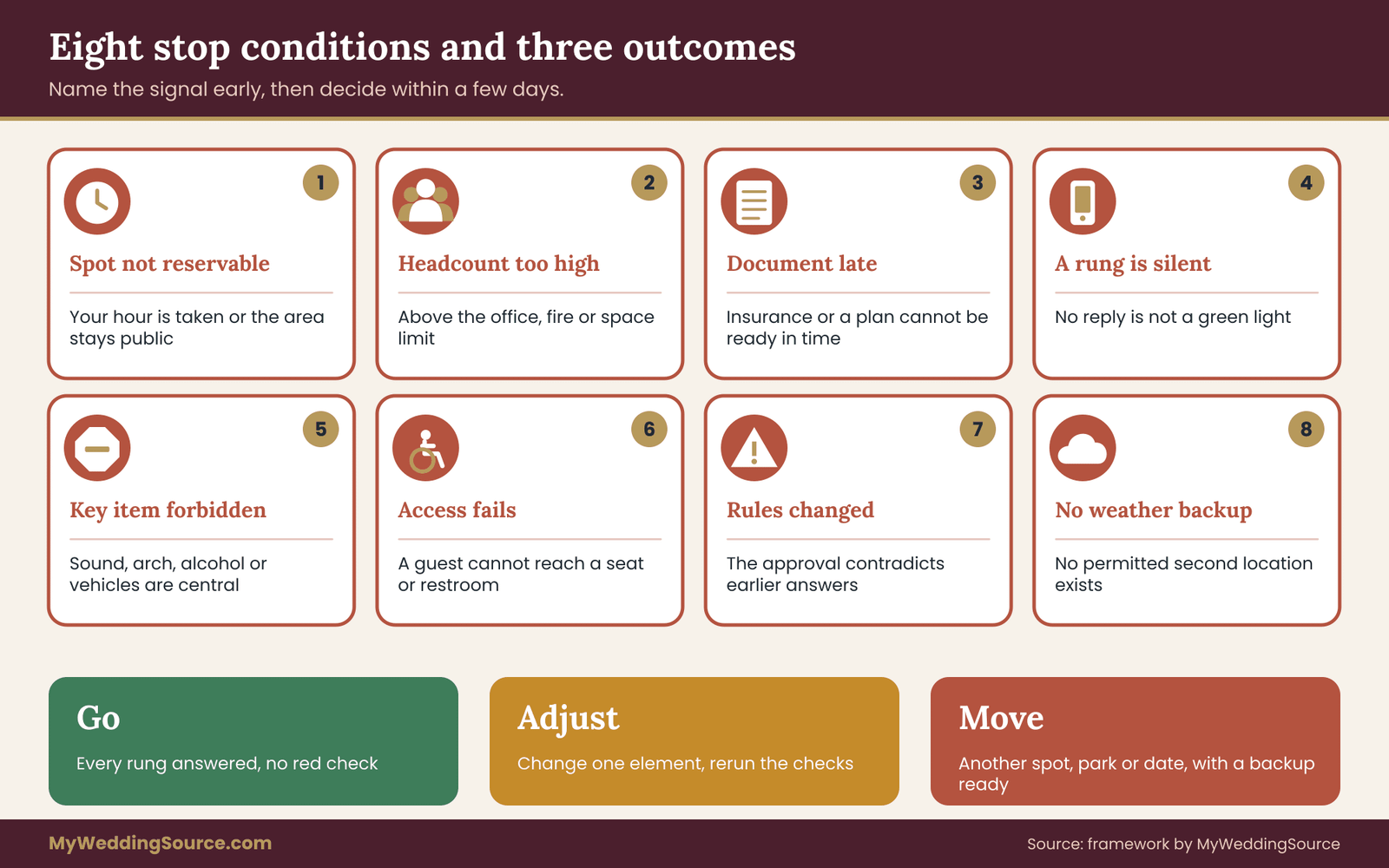
Eight stop conditions
Treat each of the following, in your park ceremony permits work, as a signal to pause, reassess and either adjust or move. They are drawn from the ladder and the checklist, so each one has a source you can point to.
One: the spot cannot be reserved for your hour. The office says the area is open to the public during any permit, or a conflicting booking covers your time. If exclusivity matters to you and cannot be granted, adjust the hour or choose another spot.
Two: the headcount exceeds the site’s limit. Whether the limit is stated by the permit office, by fire or by the physical space, you cannot invite above it. Reduce the list, change the format or move.
Three: a required document cannot be obtained in time. Insurance, vendor certificates or a site plan may take longer than the application window allows. If a required document cannot be in hand before the deadline, either find a different path or choose a later date.
Four: a rung of the ladder will not answer. An office never replies, or replies with an answer that does not address your question. A silent rung is not a green light. Escalate politely, ask for a named contact, and set a date by which you will treat silence as a reason to move.
Five: a restricted item is central to the plan. If amplified sound, an arch, alcohol or a vehicle route is forbidden and the ceremony does not make sense without it, then the site and the plan conflict. Change the plan or change the site.
Six: access fails for a guest who matters. If a guest who uses a wheelchair, a walker or a cane cannot reach a seat and a restroom with dignity, the site fails. This is not a decor problem. It is a basic hospitality failure, and the accessible venue red flags article helps you test it.
Seven: the rules differ from what you were told. The approval contains conditions that contradict earlier answers. Ask for clarification in writing, and if the difference is material, treat it as a new discovery cycle.
Eight: the weather policy is missing and no safe backup exists. If the permit has no rain or heat policy and you have no second location that is permitted and tested, a single storm can cancel the ceremony. Fix this before paying large nonrefundable costs.
What to do when park ceremony permits hit a stop condition
Do not argue with the stop condition. Write it down, identify which of the three outcomes you are now in, and decide within a few days. A stop condition that lingers undecided becomes a quiet failure, because time keeps running while your options narrow.
If you decide to adjust, change the specific element that caused the problem and rerun the affected checks. If you decide to move, use the backup plan you prepared, or begin discovery at the next site immediately, using the same ladder. Because you kept a discovery log, you can reuse what you learned about process, timing and questions even though the site details change.
Alternatives when a park does not work
Moving away from your first park ceremony permits does not have to mean giving up on an outdoor ceremony. Several alternatives keep much of what the park offered, and each has a different permit story.
A different spot in the same park. The simplest change is a different lawn, overlook or garden in the same park, which keeps the agency and the process. It is often the fastest alternative, because the discovery work carries over. The key is to rerun the feasibility checklist, since a new spot can fail on a different check.
A different park under a different agency. A nearby county, state or city park may offer a similar look with different rules. The agency ladder starts again, but you now know which questions to ask and how long each answer takes.
A reservable shelter or pavilion. A shelter or pavilion reserved through a recreation office often offers a covered space, a fixed capacity and a predictable booking process. It trades some of the open-air feeling for reliability, and it can solve weather, restroom and power problems at once.
A garden or arboretum with its own wedding program. Gardens and similar sites that host weddings regularly tend to have clear rules, set fees and staff who know the process. They are venues in the usual sense, with the cost that comes with that.
Private land with permission. A friend’s or relative’s land, a farm or a camp may suit a small ceremony. This path replaces public permits with private permission, and local rules about gatherings may still apply. The same questions of access, capacity and weather apply there as in any park.
A split plan. Hold a short legal ceremony in a simple, easily permitted place and a larger celebration elsewhere. This is not a lesser wedding. It is a way to put the permit risk on the smaller, more flexible half of the day.
Compare alternatives on the same eight checks
Run each alternative through the feasibility checklist rather than trusting a first impression. A covered shelter might fix weather and fail on parking. A garden might fix permits and fail on budget. Use the same marks, workable, workable with a fix and not workable, so you compare like with like. The wider wedding venues guide also helps if you decide to widen the search beyond parks.
A backup for park ceremony permits that actually works
A backup plan is only real if it has its own park ceremony permits or reservation. A shelter you have not reserved, a hall you have not asked or a lawn you have not checked is a hope, not a plan. A real backup has a named spot, a written answer from the managing office and a deadline by which you decide to use it.
For weather, agree on a decision time with your officiant and your day-of contact. A common pattern is to check the forecast a set number of hours before, then decide by a clear rule, such as “if lightning is forecast in the window, we move.” Official weather services publish guidance on lightning safety, and the guidance is a good source for the rule itself. Write the rule and tell guests how they will hear about a change, by text or on the wedding website, so no one is standing in the rain at the wrong spot.
Be honest about the cost of changing
Changing plans costs something. It might be a second fee, a change fee, a vendor’s reschedule charge or an awkward conversation with family. Estimate that cost of re-doing park ceremony permits before you commit to a plan with no backup, and compare it to the cost of a backup you maintain from the start. In many cases a small, early backup, such as a reserved shelter with a refundable deposit, costs less than a late scramble.
Know when to let the park go
Some couples hold onto a site because it was the first idea. If three stop conditions appear, or if the backup looks better than the original on most checks, say so aloud. A ceremony that fits the site is better than a site that is forced to fit the ceremony. Letting go of a park is not failing at the plan. It is the plan working.
A worked case: park ceremony permits for one city park
The following is an invented example, built to show the method, and it does not describe a real park, couple or agency. Any rules mentioned belong to the story only. Your own answers will differ, and you must collect them from your own offices.
The couple and their park ceremony permits plan
Maya and Tomas want a short ceremony for about sixty guests at a lakeside lawn in a city park on a Saturday afternoon in late spring. They plan seated chairs, a simple arch, one acoustic guitarist and a small reception afterward elsewhere. They have found a lawn they love and they have a date in mind.
Running the ladder on park ceremony permits
Maya starts with rung one and confirms that the lawn belongs to the city parks department. A sign at the spot names the department, and the department’s map shows the lawn inside park boundaries. At rung two she finds that one office handles special events for all city parks and that it accepts applications within a stated window before the date.
At rung three she learns that shelters are reserved through a separate recreation division, and that the lawn can be permitted without a shelter. At rung four the events office says that fire and police review events above a headcount that her list does not reach, but that the office counts vendors in the total. Counting the couple, the officiant, the guitarist and the photographer, her number rises by a few people, still below the line.
At rung five she notices a small nature center near the lawn. A phone call shows it has its own parking lot with posted rules and that weddings are not allowed to use it. This matters, because the main parking lot is a ten-minute walk. At rung six she finds that the street beside the park does not need a closure for her plan.
Feasibility: the eight checks
Visiting on a Saturday at the planned hour, Maya and Tomas mark the checks. Ground and footing: workable with a fix, because the aisle crosses a soft patch near a sprinkler line, so a mat is needed. Space: workable, with room for the seating on the flat area. Shade, sun and wind: workable with a fix, since the late sun hits the lake side, so the ceremony will face away from it. Sound: workable, because the nearby playground is quiet at that hour.
Restrooms: workable with a fix, since the nearest is a ten-minute walk, so they ask the park office whether a portable unit is allowed.
Parking and drop-off: not workable as is, because the main lot is far and the nature center’s lot is off limits. Access: workable with a fix, since a paved path exists but ends before the lawn, so a temporary mat and an accessible seating area are needed. Other users: workable with a fix, because the lawn is on a popular trail, so a helper will keep the path open.
The decision
Maya names the outcome as adjust, not go. The parking check is the sticking point. She asks the events office whether a drop-off at a service road is possible, and the answer is yes for a limited time with a named contact. She now has a fix. She also decides to reduce the guest list slightly to stay comfortably below the review line, and she holds the invitations until the approval is issued.
Applying for park ceremony permits and the backup
With the packet for park ceremony permits ready, Maya submits at the opening of the application window. The packet includes the layout sketch, the vendor list, the headcount including vendors and a note that no amplified sound will be used. A week later, the approval arrives. She reads it twice and spots a condition that did not appear in discovery: the permit holder must keep a path open along the lake.
She plans for this by placing the seating so a path stays clear and by assigning a helper. She also reserves a covered shelter at another park through a different office with a refundable deposit, and writes a weather rule with the officiant: if lightning is forecast for the window, they move.

What the case shows
The case is not about a perfect park, and the park ceremony permits in it are invented. It shows how the ladder surfaced a nature center the first call missed, how the feasibility checklist turned a vague worry into a specific parking problem, and how the outcome label moved the couple from hope to decision. The final plan has a clear approval, a fix for each weak check, a backup with its own reservation and a list of items vendors can follow.
If the events office had refused the drop-off, the stop condition on access would have triggered, and the couple would have moved to the shelter or another spot. That outcome would have felt like a loss only if they had not planned for it.
Failure conditions in the case
Look at the case through the eight stop conditions. The parking issue came close to stop condition six, because guests with limited mobility could not reach the lawn without a long walk. The condition about conflicting rules did not arise. The silent rung condition never occurred, but would have if the events office had not replied, in which case Maya would have set a date to treat silence as a reason to move.
Defining these conditions in advance is what made the choice calm. When the parking issue appeared, there was already a rule for what it meant and who would decide.
Your next steps
Choose the order that fits your stage, and work through it one item at a time.
- Pick two candidate parks and spots, one first choice and one backup, and write the official names of each.
- Identify the land manager for each spot, and find the page and the person who handle special events or ceremonies.
- Run the ladder, asking the same questions at every rung, and ask the closing question about other offices.
- Keep a discovery log with date, rung, person, answer and proof for every conversation.
- Visit each site at the planned day and time with the eight-check feasibility list, and mark every check.
- Name your outcome: go, adjust or move. Write down which, and why.
- Build the application packet, read it against the log, and apply at the earliest opening.
- After approval, read it twice, brief every vendor, assign an on-site contact and reserve a backup with its own permission.
Check current rules, fees and forms for park ceremony permits with the issuing offices before you act, because they change.
FAQ
What are park ceremony permits?
Park ceremony permits are the written permissions that allow a wedding ceremony at a specific public park, spot, date and time. They are issued by the agency that manages the land, and other offices may add conditions. The permit may cover use of the space, a facility reservation, vendors and special items such as sound or alcohol. Each agency defines its own process, so confirm with the local office.
Do I always need park ceremony permits for a small wedding?
Not always. Some parks allow very small gatherings without a permit, while others require one for any ceremony, especially with chairs, an arch or vendors. The threshold varies by agency and by what you bring. Ask the managing office at what headcount and with which items a permit applies, and ask them to confirm the answer in writing before you plan around it.
How do I find out who issues the permit?
Start by confirming which government or organization manages the exact spot, using the official park map and any posted sign. Then look for the special events, facility rental or special use page of that agency, and call the listed office. The state and local government directory on USA.gov can help when you cannot tell who runs the park. Ask who else sets conditions too.
How early should I apply?
It depends on the agency. Popular parks may accept requests only in a set window and fill quickly, while others review requests over a few weeks. Ask two questions at the start: how far ahead can we apply, and how long does review take? Then count back from your date, and add a cushion for adjustments or a second application at another site.
Will the park be private during my ceremony?
Often not. Many public parks stay open to everyone even during a permitted event, unless your approval grants exclusive use of a defined area. Ask the office whether the spot is exclusive during your hours. If it is not, plan for passersby, keep any path open and consider a helper to answer questions politely at the edge of the area.
Can I bring chairs, an arch, music or alcohol?
Maybe, and each item has its own rule. Some parks allow rented chairs and freestanding arches but restrict staking, tents or tree attachments. Amplified sound and alcohol are commonly limited or banned. Ask about each item by name, get the answer in writing and brief your vendors, because a vendor’s mistake can put your approval at risk.
What if the weather is bad or the park closes?
Ask the permit office what its weather and closure policy is before you apply, since some permits have a rain policy and others are silent. Build a backup spot that has its own written permission, set a decision time with your officiant and write a clear rule, such as moving if lightning is forecast. Tell guests how you will announce a change.
What if one office says yes and another says no?
Do not average the answers. Ask the office that issues the permit which rule governs and request the answer by email, or ask which document contains the rule and read it yourself. Until it is resolved, plan on the stricter answer, because a plan built on the stricter rule cannot be undone by a later correction. Record both answers in your log.
Sources
- National Park Service, U.S. Department of the Interior
- U.S. Forest Service, U.S. Department of Agriculture
- State and local governments directory, USA.gov
- State government directory, USA.gov
- Americans with Disabilities Act information, ADA.gov
- Americans with Disabilities Act standards and guidelines, U.S. Access Board
- Lightning safety, National Weather Service
- National Recreation and Park Association
- Bureau of Land Management, U.S. Department of the Interior