
A wedding at home looks simple on a mood board and turns out to be a small construction project with a guest list. This guide gives homeowners and couples a seven-gate readiness audit for a wedding at home: who must approve it, what the property can physically hold, what the utilities can carry, how to treat the neighbors, and where liability sits, with a worked case and clear conditions for stopping.
Before you pay a single deposit for a wedding at home, run seven checks in order: authority (who can say yes), property limits, utilities, neighbors and local rules, liability and insurance, vendor access, and weather recovery. Score each gate Go, Fix or Stop. A Stop at the first or fifth gate ends the plan, because no amount of good decoration fixes a lease that forbids events or a policy that excludes them. A wedding at home works when every gate is Go or a Fix you have actually scheduled.
Couples choose a wedding at home for good reasons. The setting means something, the date is not fought over with a venue calendar, the vendor list is open, and the money that would have gone to a site fee can go to food, rentals and people. Those reasons are real. They are also why so many home weddings are planned from the pretty end: the arch, the lights, the long table on the lawn.
The ugly end is where they succeed or fail. A water line that cannot feed a caterer, a driveway that cannot take a delivery truck, a neighbor who learns about the party from the tent crew, an insurance policy that never contemplated eighty guests. None of these is exotic. Each one is findable weeks before the event if somebody asks the question on purpose.
This article is built around one tool, the readiness audit, and one habit, writing the answer down. The audit is not a legal review and it is not an inspection. It is a structured way to find out what you do not yet know about your own property while there is still time to change the plan. You will also see how to use the audit to choose between a full wedding at home and a smaller version of it.
A note on scope for anyone planning a wedding at home. This is general information, not legal, tax or financial advice. Property rules, permits, noise limits, insurance terms and alcohol laws are set locally and change, so each section points you to the kind of office, professional or document that gives the current answer for your address.
What a wedding at home really asks of a property
Start with a plain description of what happens to a house and yard on a wedding day. For several hours, perhaps a few days counting setup and teardown, a residential property becomes a place of assembly. Dozens of people arrive within a short window. They need somewhere to park, somewhere to walk, somewhere to sit, somewhere to eat, a place to use a restroom, and a way out if something goes wrong.
Vendors arrive earlier and leave later, with heavy equipment, and they need power, water, shade, a place to stage and a route that does not cross the guest area.
Homes are designed for a few people living quietly, not for that load. Floors, lawns, septic systems, electrical panels, driveways and street frontage all have limits, and almost nobody knows what theirs are until the day something exceeds them. A venue that hosts events has already answered these questions, in its permits, its insurance, its layout and its staff. When you host a wedding at home, you are taking on that work yourself.
That is not an argument against doing it. It is an argument for treating the property like a venue for one afternoon of planning, and asking the venue questions of it. The venue technical walkthrough guide on this site covers the measuring and access questions for any site, and many of those questions apply here, with the difference that the owner and the host are the same people.
Three different people under one roof
A wedding at home usually involves three roles that are easy to blur. The couple are the hosts of the event. The homeowner may be one of them, or a parent, a relative, a friend or a landlord. The household is everyone who lives on the property and will have to live with the result on Monday.
Blurring these roles causes quiet trouble. A couple getting married at a parent’s house may assume the parent’s enthusiasm settles every question, when the parent’s lender, the neighborhood association or the next-door neighbor have not been asked. A homeowner who is also the bride may carry the cost of every unforeseen item without noticing it, because there is no venue invoice to show it.
Write down, early, who is the homeowner of record, who is the event host, who lives there, and who makes the final decision when a gate comes back Fix or Stop. The decision-maker should be one named person. The wedding venues guide explains how professional venues divide the same responsibilities, which is a useful contrast.
What the audit does and does not do
The audit has a narrow job. It finds the facts that decide whether a wedding at home is feasible, and it turns each fact into a verdict and a next action. It does not replace a licensed electrician, a septic inspector, an insurance agent, a local permitting office or an attorney. Where a gate depends on their expertise, the audit tells you what to ask them and what a worrying answer sounds like.
It also does not promise success. A property can pass every gate and still have a bad day because of weather or a vendor failure. What the audit prevents is the avoidable kind of failure, the kind that is knowable in advance.
The seven-gate home readiness audit
The audit has seven gates, and the order is deliberate. Early gates are about permission, which is cheap to check and expensive to get wrong. Middle gates are about physical capacity, which determines the guest count. Late gates are about operations, which determine whether the day runs smoothly. If you check in this order, a hard Stop shows up before you have spent money on everything that depends on it.
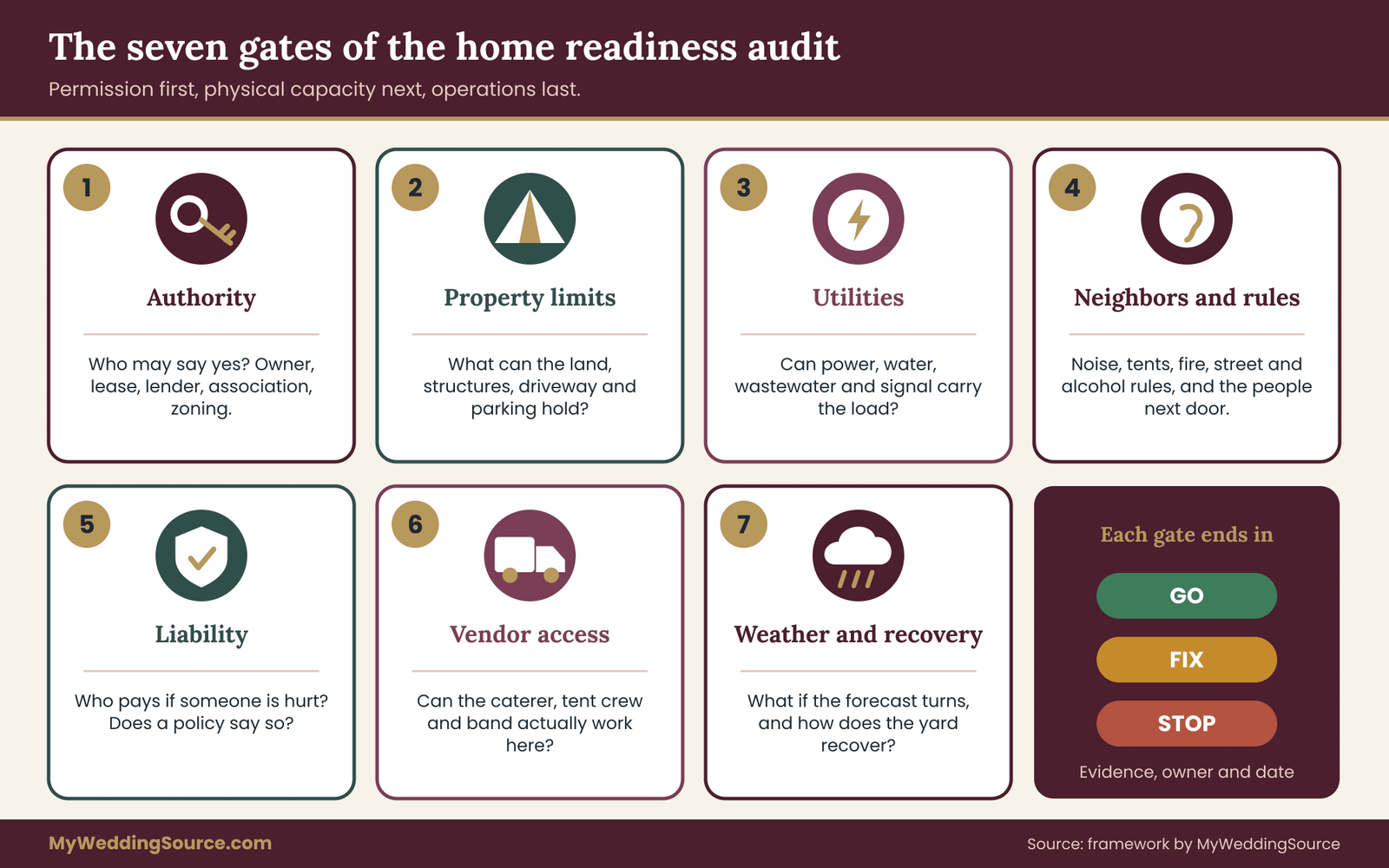
Gate one: authority. Who has the legal and contractual right to host an event at this address? This covers ownership, leases, mortgages, homeowners associations, deed restrictions, zoning and home occupancy rules.
Gate two: property limits. How many people and how much equipment can the land, structures and driveways take? This covers the footprint, ground conditions, slopes, structures, access routes and parking.
Gate three: utilities. Can power, water, wastewater and connectivity carry the load? This covers circuits, generators, taps, restrooms, septic or sewer, internet and cell coverage.
Gate four: neighbors and local rules. What do the people nearby and the local authorities expect? This covers noise rules, tent and fire rules, street use, alcohol rules and the neighbors themselves.
Gate five: liability and insurance. Who pays if someone is hurt or something is damaged, and does any policy actually say so? This covers the homeowner’s policy, event coverage, vendor certificates and alcohol service.
Gate six: vendor access. Can the professionals do their jobs here? This covers the kitchen, staging, loading, restrooms for staff, trash and the schedule.
Gate seven: weather and recovery. What happens if the forecast turns, and how does the property get back to normal afterward? This covers shelter, backup plans, cleanup and restoration of lawn and garden.
How verdicts work
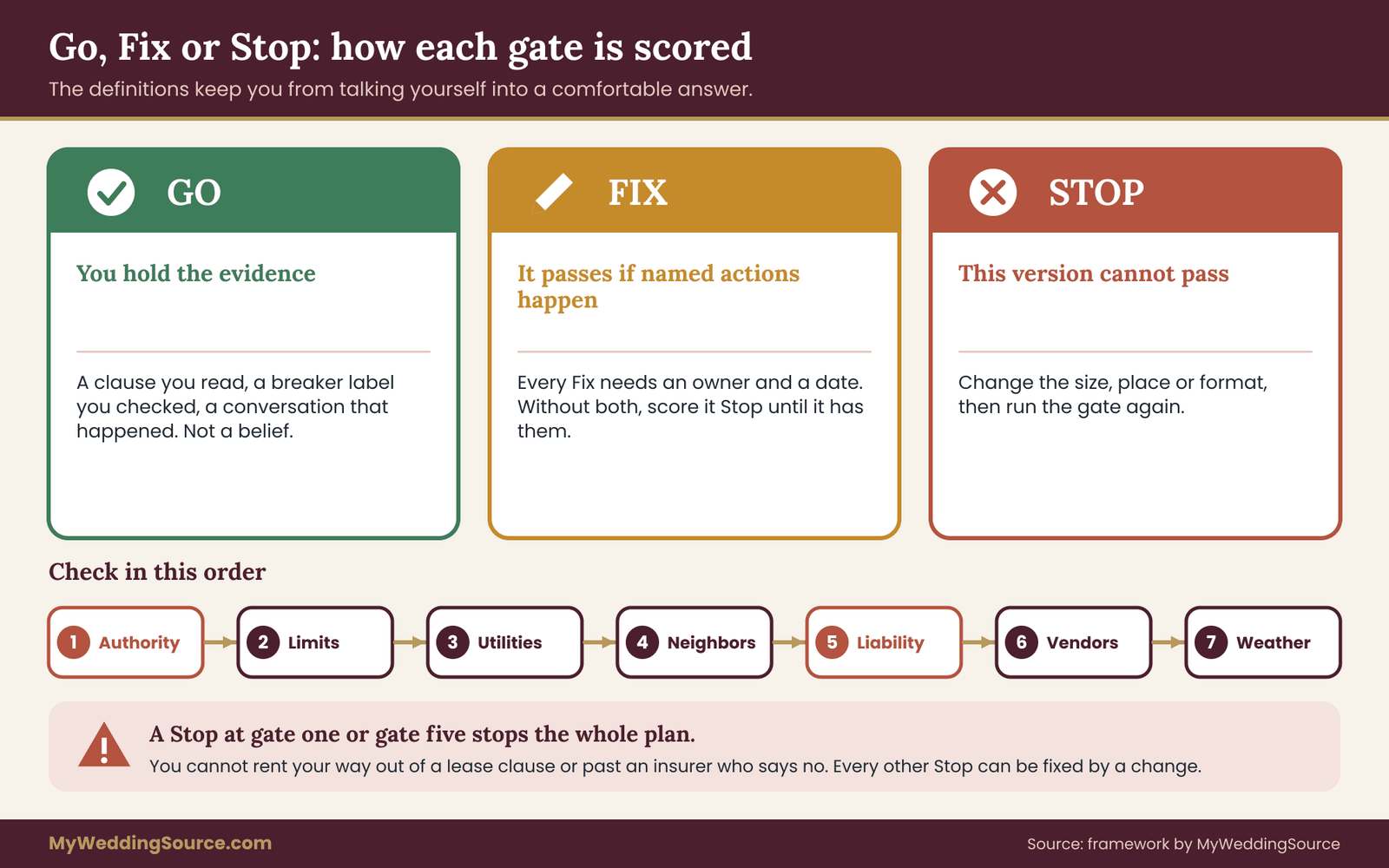
Each gate ends in one of three verdicts, and the definitions matter because they stop you from talking yourself into a comfortable answer.
Go means you have the evidence in hand, not a belief. For a lease, evidence is the clause you read. For a circuit, it is the breaker label and the load you calculated. For a neighbor, it is a conversation that happened.
Fix means the gate can pass if specific, named actions happen by specific dates. A Fix without an owner and a date is not a Fix. It is a hope, and it should be scored Stop until it has both.
Stop means the gate cannot pass under the current plan. A Stop does not necessarily end the wedding. It ends this version of the wedding, and the plan must change in size, location or format before you continue.
The two gates that end plans
Not all gates are equal. Gate one and gate five are different from the rest, because they are not engineering problems. You cannot rent your way out of a lease clause, and you cannot decorate your way past an insurer who says no.
Treat a Stop at gate one or gate five as a full Stop for the whole plan until it is resolved in writing. Every other Stop can be addressed by a change: fewer guests, a rented trailer, a different tent position, a shuttle. This rule is simple, and it protects you from the most common home wedding mistake, which is paying for the visible parts first.
Where the numbers come from
You will notice that this guide gives very few figures for prices or crowd sizes. That is intentional. Costs for tents, generators, restroom trailers, permits and insurance vary widely by region and season, and a number printed here would be out of date or wrong for your address. The audit works with quantities you can measure on your own property, such as breaker ratings, square footage of usable lawn and the number of parking spaces.
It asks you to collect written quotes for anything that has a price. The wedding budget guide shows how to hold those quotes in one place.
The audit workbook: how to keep the answers
An audit that lives in your head is worthless on the day. Keep a single page for each gate, in a shared document both partners and the homeowner can see. Each page has the same five lines.
First, the question the gate asks, in one sentence. Second, the evidence, with a photo or a pasted clause. Third, the verdict. Fourth, the Fix actions, each with an owner and a date. Fifth, the person you will call if the answer changes.
Seven pages is not a lot of paper, and it is far less than what a venue’s operations binder contains. It also gives vendors and officials a clear, consistent answer when they ask the same question you asked yourself. The last section of this guide returns to the workbook and shows a completed example.
Timing the audit
Run the audit as early as you can, ideally before you set a date or send invitations. Gate one and gate five can be checked in an afternoon of reading documents and making two phone calls. If those pass, spend a second weekend walking the property with a tape measure, a phone and a notepad for gates two and three.
Gates four, six and seven need other people, so start them as soon as the first three look promising. A neighbor conversation is better held eight weeks before the event than eight days before. If your date is already fixed and close, compress the sequence but keep the order, and be honest about which gates you are marking Go on belief rather than evidence.
Gate one: who has the right to say yes to a wedding at home
The first gate is about permission for a wedding at home, and it is almost always answered by documents rather than opinions. Collect them before you do anything else. If you own the property outright, the list is short. If anyone else has an interest in it, the list is longer, and each item can end the plan.
Ownership, leases and mortgages
If you rent and want a wedding at home, read the lease for any clause about guests, gatherings, noise, commercial activity, alterations to the yard, tents, stakes in the ground, fires or alcohol. Many leases are silent on a one-day private party, and silence is not permission. Ask the landlord in writing, describe the wedding at home in plain terms (date, hours, approximate guests, tent or no tent, amplified music or not), and keep the reply.
A friendly verbal yes from a landlord about a wedding at home is easy to forget when a neighbor complains.
If the property is owned jointly, or by a parent or relative, confirm that every owner agrees. If it is held in a trust or an estate, the person who lives there may not be the person who can authorize an event, so ask who can.
Mortgages and loan agreements rarely mention a wedding at home, but some contain covenants about use of the property and about maintaining insurance. You are not trying to find a hidden ban. You are confirming that nothing in the loan terms conflicts with hosting a wedding at home of this size, and that the insurance that the lender requires is in force. A call to the lender’s customer line, or a read of the insurance requirements section, is usually enough.
Neighborhood associations and deed restrictions
If the home you picked for a wedding at home sits within a homeowners association, a condominium or a planned community, the governing documents often say more about events than the lease or the loan. Look for rules on tents and temporary structures, noise, guest parking, signs, portable restrooms, outdoor lighting, commercial vehicles and use of common areas. Some require advance notice or a form. Some require a deposit. Some set a maximum number of guests or a limit on how often events are allowed.
Deed restrictions run with the land, and older neighborhoods may have covenants that nobody has read in decades. Your title documents or the county recorder’s office can tell you what applies. If you find a restriction that appears to conflict with a wedding at home, ask the association or an attorney how it is enforced. Do not decide on your own that an old covenant does not count.
Zoning, occupancy and home use rules
Local governments regulate what can happen on a residential lot, including a wedding at home. Zoning rules usually address commercial use, and a private wedding hosted by the owner for family and friends is generally treated differently from a business that rents the property for events. Where the line falls, however, is a local question. Rules about the number of people allowed on a residential property, about temporary structures and about overnight guests also vary.
The practical step is to find your city or county planning, zoning or building department and ask a specific question: “We plan a private family wedding at our home on this date with this many guests, a tent and a caterer. Do any permits or approvals apply?” The federal government’s USA.gov site has a directory for finding local government offices. Ask for the answer in an email, or ask for the name of the person who gave it.
This conversation also protects you from a different problem. If a neighbor reports the wedding at home and an inspector arrives, you can show that you asked in advance. Being able to say “we checked, and here is the reply” is a far better position than “we assumed it was fine.”

Authority gate scoring
Score the gate with a short set of questions, and answer each with yes, no or not yet.
Do you have the lease, mortgage insurance terms, association rules and deed restrictions in front of you? Have all owners agreed in writing? Has the landlord, if any, approved the specific event? Has the local office answered your permit question? Is any approval conditional on something you have not done?
Go means every answer is yes. Fix means some are “not yet” and each has an owner and a date. Stop means a document prohibits the event or an owner has said no. At this gate a Stop also stops the whole audit, because everything after it assumes you may hold the event.
Edge cases at the authority gate
A few situations come up often enough to name. A couple who rent from a family member may feel awkward asking for terms in writing, and that awkwardness is exactly why a short written note is a kindness to both sides. A couple planning a wedding at home in a house that is for sale, in probate or in transition has an extra party to ask, the person who can say yes to the sale conditions.
A property with an accessory dwelling or a tenant on the other side of the wall needs that tenant’s agreement as well, even if the main owner is delighted.
A wedding at home on land that is not formally residential, such as farm land, a vineyard or a property with an agricultural tax status, may trigger different rules, and for some owners an event changes how the land is classified for tax or insurance purposes. Ask the county assessor or an agent before you assume it does not.
Property limits for a wedding at home: footprint, ground and access
If gate one passes, you can measure what you have. Property limits decide the size of a wedding at home more than the guest list does. The mistake is to start with the number of people and then try to fit them. The audit works in the opposite direction, from what the property can safely hold to what the invitation list can be.
Measure the usable footprint
For a wedding at home, walk the property with a tape measure or a measuring wheel and a notepad. Draw a rough plan and mark the areas that are not usable even if they are open grass: the septic tank and drain field if you have them, buried utilities and irrigation lines, steep slopes, wet ground, tree roots, low branches, planting beds, a pool or pond, a fire pit, steps, retaining walls and the area under power lines.
What remains is your usable footprint. A lot that looks large may offer only a small flat, dry, clear rectangle. Be honest about the rectangle, because tents, tables, a dance floor, a bar, a buffet, a catering staging area and an aisle all need to fit inside it, with room to walk between them.
Ask your rental company, not a general chart, how much space each layout needs. Companies that supply tents, tables and chairs have worked out seated dinner layouts, cocktail layouts and ceremony layouts, and they will tell you how many guests a given footprint accommodates for each. This is also the right moment to read the site-visit and rental questions in the wedding rental planning checklist. The rental company usually offers a site visit, and it is worth taking.
Ground, slopes and structures
Ground conditions decide whether a footprint is really usable for a wedding at home. Lawn that looks firm in July may be soft after rain, and heavy items such as a tent, a dance floor, a trailer or a truck can leave ruts that cost far more to repair than any rental.
Slopes matter for tent installation, for chairs and tables, for wheelchairs and walkers, and for guests in formal shoes. A tent crew can often level or compensate for modest slopes with platforms, but they will tell you when a slope is beyond them.
Check what is in the ground. Tent stakes, anchors and posts need to avoid buried lines, septic components and irrigation. Many places have a free service for marking underground utilities before any digging, usually reached through a national number for calling before you dig. Ask your tent company whether they require a utility locate, and if so, who orders it. When stakes are not allowed, weights are an option, with trade-offs in cost and space.
Structures need their own check. Decks, porches, balconies and stairs are designed for specific loads, and a crowd gathered on them is a different load than a family barbecue. If guests will gather on a deck, ask a builder or inspector about its capacity, and consider limiting how many people stand on it at once. Never stage a band, a heavy cake or a buffet on an elevated structure without checking.
Access: driveways, gates and routes
A wedding at home brings large vehicles that need real room. Delivery trucks for tents and rentals, a caterer’s van, a portable restroom truck and a generator trailer all need a route into the property, a place to stop, and a way out. Check the width of gates, the turning radius on the driveway, low branches and wires over the route, the strength of any bridge, culvert or paved surface they will cross, and whether the street itself is wide enough for a truck to park without blocking others.
Equally, check the route on foot from the arrival point to the ceremony, the reception, the restroom and the exit. Is it level, lit, wide enough for two people to pass, free of steps, and clear for a guest using a wheelchair or a walker? The wedding reception guest flow guide covers how guests move through a site, and the same logic applies to a backyard. Even if no guest has a mobility need, an older guest in evening shoes on a dark slope is a risk worth removing.
Parking and drop-off
For a wedding at home, count the legal parking spaces you control: the driveway, any paved pad, and the street frontage in front of your property where public parking is allowed. Do not count the neighbors’ driveways or frontage unless they have agreed. Then divide your expected guests into vehicles. Couples often arrive at an estimate of cars per guest by thinking about who is coming with whom, and a rough count is enough.
If the spaces you control fall well short, you have four options: reduce the guest list, arrange parking at a nearby lot and run a shuttle, ask neighbors for permission to use their driveways, or choose a drop-off arrangement with a driver. Street parking rules, permits, and the effect on neighbors are covered under gate four. At gate two, the question is simpler: are there enough safe, legal places to put vehicles?
Property limits gate scoring
Go means your wedding at home has a measured usable footprint, a layout from the rental company that fits your target guest count, a clear access route for vehicles and for guests, and an identified place for every vehicle. Fix means one or two specific items, such as a slope that needs leveling or a parking shortfall that has a shuttle plan in progress. Stop means the footprint cannot hold the guest count with any layout the rental company will confirm, or the access route cannot take the necessary vehicles.
At this gate, a Stop usually means one thing: the guest count must come down, or part of the event must move elsewhere. The alternatives section later in this guide covers exactly that situation.
Gate three: utilities for a wedding at home
Utilities are where a wedding at home most often surprises people who have already done the hard planning, so a wedding at home needs its own utility budget. A house supports a household. A wedding adds a caterer, a band or a DJ, lighting, refrigeration, heating or cooling, hot water, and many times the usual number of people using plumbing. The audit breaks the gate into four parts: power, water, wastewater and connectivity.
Power: do the arithmetic once
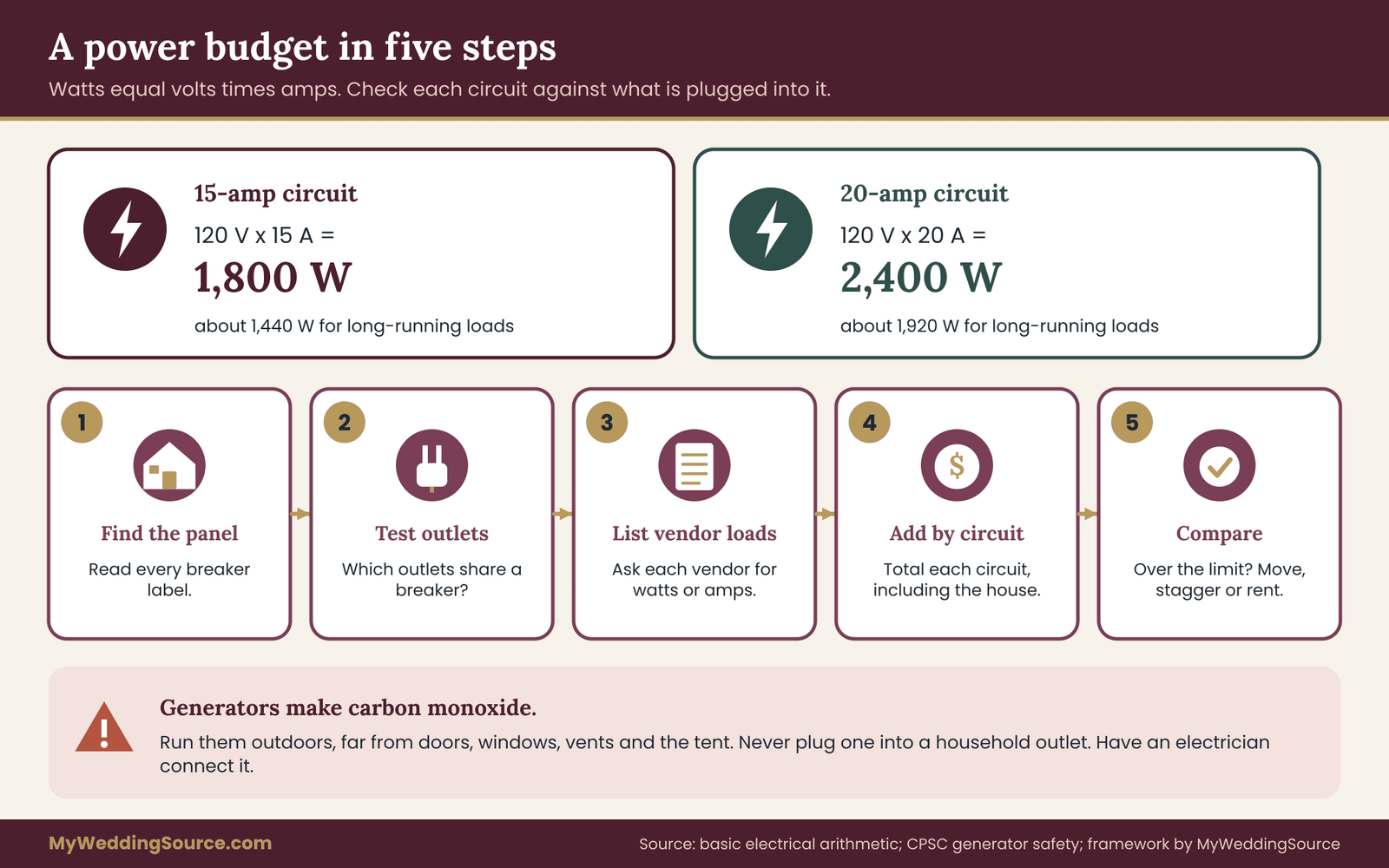
Electricity is a budget with a simple formula. Watts equal volts times amps. A standard household outlet in the United States is 120 volts, and a common circuit breaker is rated for 15 or 20 amps. That means a 15-amp circuit can supply about 1,800 watts, and a 20-amp circuit about 2,400 watts.
Electricians commonly plan for continuous loads to stay near 80 percent of a breaker’s rating, which leaves roughly 1,440 and 1,920 watts for long-running equipment. Treat these as planning figures and let a licensed electrician confirm the details for your home.
The catch is that outlets are rarely on their own circuit. One breaker may serve the kitchen counter, a bathroom, a garage and the outside plugs, and the appliances already running in the house count against the same limit. Find the panel, read the labels, and test which outlets belong to which breaker. A label that says “patio” may feed three rooms.
Now list what the wedding at home will draw. For a wedding at home, ask each vendor for the wattage or amperage of their equipment and whether they bring their own power. A caterer’s warming equipment, a coffee station, a refrigerator, a band’s amplifiers and lights, a DJ’s speakers, decorative lighting, a fan, a heater, a photo booth and a dessert freezer all draw. Add them by circuit, and compare each total against the circuit’s usable watts.
Most people find one of three outcomes. The existing circuits carry everything with a margin, which is Go. A few items need to move to a different circuit or be staggered, which is Fix. The total is far beyond what the house can supply, which means you need a generator or a temporary power service, which is also a Fix with a larger action.
Generators and temporary power
If you rent a generator for a wedding at home, ask the supplier or a licensed electrician to size it for your listed loads and to connect it safely. Generators produce carbon monoxide, which is invisible and deadly, and the Consumer Product Safety Commission warns against running them in garages, basements or anywhere near doors, windows and vents.
Plan the placement before the event, well away from the tent, the guest area and open windows, and follow the manufacturer’s distances. Plan for fuel, refueling away from guests, and quiet: a loud generator beside a ceremony ruins the audio in a recording as well as the moment.
Do not plug a generator into a household outlet or wire it into a panel without a proper transfer arrangement. Backfeeding is dangerous for anyone working on the lines outside. If you want the house itself to run on a generator, hire an electrician.
Extension cords are the other quiet risk. Use cords rated for the load and for outdoor use, keep connections off wet ground, cover or route cords so nobody trips, and never run them under rugs or through doorways that are closed on them. A cord that is warm to the touch is telling you it is overloaded.
Water: supply, pressure and hot water
A caterer may need water for prep, washing and cleanup. A bar may need ice and rinsing. Restrooms inside the home need a supply that keeps up with a crowd, and a sink with hot water if guests will wash hands. Ask your caterer what they need and where they want it, and test your supply by running several taps at once to see what happens to the pressure.
Hot water is a limit that surprises people planning a wedding at home. A residential water heater holds a fixed volume, and a morning of showers for a wedding party followed by a kitchen full of washing can exhaust it before the ceremony. If the wedding party will get ready at the house, set a shower schedule. If the caterer needs hot water, ask whether they bring their own heating.
Drinking water for guests, particularly in hot weather, is a care issue, not a luxury. Plan for plenty of cold water, in dispensers or large coolers with cups, in more than one place.
Wastewater: sewer or septic
If your wedding at home is on a municipal sewer, the question is usually just one of in-house plumbing capacity and the condition of the lines. A blocked or slow drain on the day is a risk, so avoid dumping grease, large amounts of food waste or wipes into drains, and keep a plumber’s number handy.
If your home is on a septic system, the question is more serious. A household septic tank and drain field are sized for the normal number of residents, and a sudden load of many extra people using toilets, sinks and a caterer’s dishwashing can overload them. The Environmental Protection Agency explains how septic systems work and how to protect them, including keeping vehicles and heavy loads off the drain field, which matters for tents, parking and rental trucks.
Ask a licensed septic professional whether your system can handle the event, whether the tank should be pumped beforehand, and whether you should rent portable restrooms to keep load off the system. For the audit, the core answer is that a septic-system property needs a professional opinion, in writing, before you commit to a wedding at home of any size.
Restrooms
Plan restrooms for a wedding at home as a system, not an afterthought. A house may have one or two toilets, and they are also your household’s toilets and may be needed by the wedding party and the vendors. Decide which restrooms guests may use, how guests will find them, how they will be stocked and kept clean during the event, and where vendors will go.
Portable restroom units, restroom trailers with sinks, and hand-washing stations are the usual supplements. The supplier can advise on how many you need for your guest count and event length, and can tell you about the delivery and servicing access they need. Plan accessible options for guests who need them, and place units on firm, level ground away from the tent and the kitchen window. Lighting for the walk to a restroom at night is part of the plan.
Connectivity and cell coverage
A cell signal that works fine in the living room may disappear on the lawn. Walk the property with a phone and note where calls and data work. If you intend to livestream the ceremony, run a music playlist from the internet, use a card reader for a bar, or give vendors a wifi password, test the real conditions. A quiet home internet connection may struggle if forty guests join it.
If any part of the day relies on a connection, have an offline fallback. A downloaded playlist, a printed cue sheet and a vendor who can take payment later cost nothing and remove a whole category of panic. The same applies to lighting: do not rely on a phone flashlight for a dark path.
Lighting, heating and cooling
Evening receptions at a wedding at home need more light than the property has. Porch lights and landscape lights were chosen for ambiance, not for guiding eighty people to a restroom. Walk the property at dusk, and again after dark if the event runs late, and note every step, edge, hose, root and cord. String lights, path lights and battery lanterns are common fixes, and each draws power or needs charging, so add them to the power budget.
Heating and cooling add real load. A rental heater, a fan, a portable air conditioner for a tent or a cooler for a drink station can each use more power than every other vendor combined. Ask the supplier for the draw, and ask whether the equipment is fuel-powered, in which case it needs its own safety plan for ventilation and placement. Never use an outdoor fuel-burning heater inside a closed tent unless the tent company and the manufacturer say it is designed for that.
A small power-budget example
Imagine a simple evening. The caterer brings two warming cabinets and a coffee urn. A DJ brings speakers and lights. A string of decorative lights runs along the tent. A rented refrigerator holds drinks. You do not need real wattages to see the method: write each item and its draw, group the items by the circuit they would use, add the totals, and compare each total with the circuit’s usable watts from the formula above.
If the caterer’s gear alone approaches the limit of a single kitchen circuit, you have found your first Fix before the first guest arrives.
The method matters more than the example. It converts “will the power be okay” into a list you can check line by line with an electrician, which is how you avoid a tripped breaker in the middle of a toast.
Trash, grease and waste
Every wedding at home produces waste, and a home’s weekly trash service is not designed for it. Ask the caterer how they handle food waste and packaging, plan bins at each food and drink area, and decide who empties them. The wedding waste reduction planning guide describes how to estimate and reduce what an event generates. Put a plan on paper for recycling, for compost if available, and for where full bags wait until pickup, away from the guest area and out of reach of animals.
Grease and food scraps down a kitchen drain can clog household pipes and burden a septic system. A caterer should have a plan for grease. If they do not, treat that as a vendor-access question under gate six.
Utilities gate scoring
Go for a wedding at home means you have a power budget calculated against actual circuits, a plan for water and hot water, a written professional opinion for wastewater if you are on septic, a restroom plan with numbers, and a tested connection plan. Fix means a specific item is incomplete but has an owner and a date. Stop means the loads cannot be met by any arrangement you can afford, or a septic professional says the system cannot take the event and no alternative restroom plan solves it.
Most utility Stops turn into Fixes with an additional rental. A generator, a restroom trailer or a hand-washing station can turn a Stop into a Go. The trade-off is cost and space, which loops back to gate two. Keep those numbers on the same page of your workbook.
Gate four: neighbors and local rules around a wedding at home
A venue sits among businesses, or on land far from anyone. A home sits among people who did not choose the event. Gate four is about them, and about the local rules that exist because of them. It is also the gate where small courtesies buy a great deal of goodwill for a wedding at home.
Noise: the rule and the neighbor
Most cities and counties have noise ordinances that apply to a wedding at home. They differ in what they measure, what hours they cover, whether they apply differently to amplified music, and how they are enforced. Some set quiet hours, some set decibel limits at the property line, and some rely on complaints.
Find the ordinance for your address on the city or county website, or ask the office that handles it, and write down the hours and the limits. The question for the audit is practical: until what hour can amplified music play, and at what level?
Then think about the people behind the rule. A rule says what an officer may do about a wedding at home. A neighbor decides whether to call. The calmest way to avoid a call is to make sure no one is surprised, which is the point of the next section.
Plan the sound itself. Direct speakers inward, away from nearby houses. Put the music area on the side of the property that faces the fewest homes. Set a firm end time for amplified sound, and build the schedule so the loudest part of the evening, dancing, happens earlier than the final hour. A live ceremony is much quieter than a reception, and a ceremony in the afternoon rarely causes friction. The wedding reception guest flow guide helps place activities so loud ones are not at the property edge.
Telling the neighbors
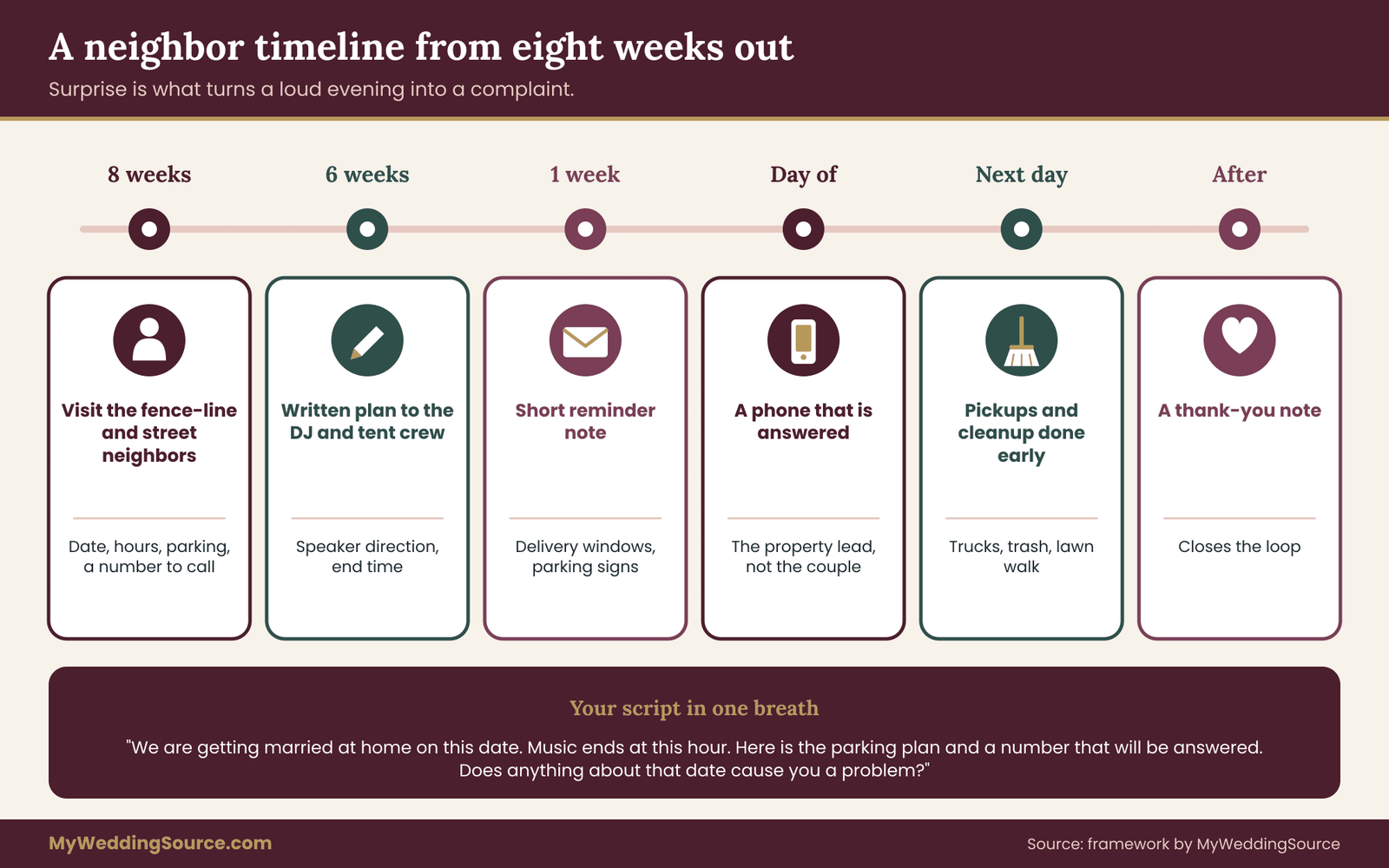
For a wedding at home, talk to your neighbors, in person where you can, before the invitations go out. Neighbors who learn about a large party from a delivery truck feel ignored. Neighbors who hear it from you weeks ahead, with a date, a rough size, the hours, the parking plan and a phone number, usually feel respected, and many will be happy for you.
Visit the households that share a fence line, the ones across the street, and anyone whose driveway or view is affected. A short script works: say that you are getting married at home on a date, give the hours of the main event and of amplified music, describe the parking plan and the delivery windows, offer a contact number that will be answered on the day, and ask whether any date or time causes them a problem.
Then listen. A neighbor with a newborn, a night-shift job, an elderly parent or an anxious dog can tell you something no ordinance does.
Follow up with a short note a week before, and a thank-you afterward. An invitation to the ceremony is a kind gesture and it is not required, and it should be offered only if you mean it. Do not ask neighbors for permission in a way that implies they hold a veto they do not have, and do not promise anything you cannot deliver, such as silence.
Parking, streets and traffic
Public streets near a wedding at home are governed by local parking rules, and some neighborhoods have permit zones, time limits, fire lane restrictions, or limits on parking near driveways, hydrants and corners. Never assume guests may park wherever there is room. Check the rules, and if needed ask the traffic or parking office whether a temporary permit exists for events. Blocking a neighbor’s driveway or a fire lane is the quickest way to turn goodwill into a complaint, and an emergency vehicle that cannot pass is a real danger.
If you need a shuttle or valet, tell the neighbors where vehicles will stop and which way they will travel. Put a person with a hi-visibility vest at the entrance to direct arrivals. The earlier you tell guests where to park, and where not to, the fewer problems on the day.
Tents, fire and temporary structures
Local fire and building codes often regulate tents at a wedding at home, canopies, heaters, open flames, cooking equipment, candles and fireworks. Requirements depend on size, on how many people the structure shelters, and on what is inside it. Many places require a permit or an inspection for tents above a certain size, flame-retardant fabric, clear exits and fire extinguishers.
The National Fire Protection Association publishes the model codes that many jurisdictions adopt, and your local fire marshal or building office applies them. Ask your tent company what permits they usually pull in your area, and who is responsible. A reputable company knows the answer.
Open flames deserve a separate decision. Candles, sparklers, fire pits and lanterns look good in photographs and carry real risk in tents, dry grass and near dresses. If you want them, ask the fire office what is allowed and plan for water or extinguishers nearby, a trained person responsible, and a clear policy on guests and flames.
Alcohol rules
Serving alcohol at a wedding at home may be unrestricted in some places and licensed or limited in others, especially if drinks are sold, if a vendor serves them, or if the event is considered public. Some places require a bartender to hold a certification, some require a permit for catered alcohol, and some set rules for what a vendor may bring.
Ask your state alcohol regulator or local authority, and ask your caterer or bartender what they require. The wedding bar service planning guide covers the options for how a bar can be run. At home, the added question is who is legally and financially responsible if someone is hurt after leaving, which is a liability issue and appears in the next gate.
Gate four scoring
Go means you know the noise hours and limits, you have talked to the neighbors who are most affected, your parking and drop-off plan complies with street rules, the tent and flame plan has been checked with the right office, and the alcohol plan complies with local rules. Fix means one of these is in progress with an owner and a date.
Stop is rare here, but it exists: a local rule that forbids the planned structure, size or sound level, or a neighbor dispute so serious that a complaint is certain and there is no agreement to reduce it, may require changing the plan.
Gate five: liability and insurance for a wedding at home
Liability is the gate that decides who pays when something goes wrong. It is also the gate most couples skip, because the answer is dull until it is urgent. Nothing in this section is legal advice. It is a way to ask the right people the right questions.
What your homeowner’s policy may and may not say
A standard homeowner’s or renter’s policy is written for the ordinary use of a home, not for a wedding at home. It often provides liability coverage if a guest is injured on the property, but the terms, the limits and the exclusions vary. Some policies exclude or limit coverage for events, for business activities, for rented equipment, for alcohol-related claims or for temporary structures. Some treat a large private party differently from a family dinner. Your policy cannot be assumed to say what you hope.
Call your insurance agent or carrier and describe the wedding at home honestly: date, hours, guest count, tent, rented equipment, vendors, whether alcohol will be served and by whom. Ask directly whether your policy covers liability for a guest’s injury during the event, whether it covers damage to your property and to rented property, whether any exclusion or limit applies to events, and whether a one-day event policy or an endorsement is available.
Write down the answer, the date and the name of the person who gave it, and ask for it by email.
The National Association of Insurance Commissioners publishes consumer information about insurance and points to your state’s insurance department, which is the right place to ask about rules and about how to find a licensed agent.
One-day event insurance and other options
If your homeowner’s policy is not enough for a wedding at home, several options exist. A one-day event liability policy is sold by specialist insurers and some agents, and can add liability coverage for the date. Some policies also cover cancellation, vendor failure or damaged rentals. Read what is covered and what is excluded, read the alcohol terms, and compare more than one quote.
The wedding vendor contract guide explains the clauses to look for in vendor agreements, and many of the same questions apply to an insurance contract: scope, exclusions, who is covered and how a claim is made.
Insurance cost is a number only a quote can give. Do not guess it, and put the quote in the budget page of your workbook. If the quote surprises you, compare it with the cost of a venue, which includes its own insurance.
Vendor certificates and who covers what
Professional vendors often carry their own liability insurance, and some venues and homeowners ask for proof. A certificate of insurance is a document that shows a vendor’s coverage. Ask your tent company, your caterer, your bartender, your DJ and your rental company whether they carry liability coverage and whether they will provide a certificate naming you or the property owner as an additional party where appropriate. A vendor who has no insurance is a risk that transfers to you.
Vendor coverage protects the vendor’s work. It does not cover a guest who falls on your uneven path, a fire that started from your candle, or a car damaged on your lawn. Those fall back on your own policy, which is why the earlier call matters.
Alcohol and host liability
Many states have rules about the liability of people who serve alcohol, including hosts at private events. The details vary: who can be held responsible, in what circumstances, and for what harm. Because you are hosting a wedding at home, you may carry that responsibility personally. Ask your insurance agent how your policy treats alcohol, and ask a local attorney if you are unsure.
Practical steps reduce the exposure whatever the law says: use a professional bartender who is trained and insured, close the bar before the end of the event, serve food, offer water and non-alcoholic drinks, and arrange safe rides home for guests, which the wedding bar service planning guide also covers.
Guest safety and accessibility
Liability is not only about money. Liability also covers the fact that a wedding at home asks guests to walk on surfaces that were not designed for a crowd, in clothes and shoes that were not designed for lawns. Remove or mark hazards, light the paths, cover cords, put a first-aid kit and a phone with the address in a known place, and decide who will call for help and how an ambulance will find the house. Tell the vendors where the first-aid kit is.
Private homes are generally not subject to the same accessibility rules as public venues, but your guests’ needs are real. The Americans with Disabilities Act website explains accessibility principles, and a rental company can supply ramps, mats and accessible restrooms. Ask guests privately what they need, and plan it.
Gate five scoring
Go means your wedding at home has a written answer from your insurer about event coverage, a policy or endorsement in place where needed, certificates from vendors, an alcohol plan, and a safety plan. Fix means one item is in progress with an owner and a date, such as a quote you are waiting for.
Stop means the insurer refuses coverage and you have no alternative, a vendor refuses to carry insurance and cannot be replaced, or the alcohol plan creates exposure you are unwilling to accept. As noted, a Stop here ends the plan until it is resolved in writing.
Gates six and seven: vendor access, weather and recovery
The last two gates of a wedding at home are about operations. By now you know you may host, how many the land can hold, what the utilities can carry, how the neighbors feel and who is covered. These gates ask whether the professionals can work in a house that was never built for them, and whether the day and the property survive contact with the weather.
Gate six: can the vendors do their jobs here?
A wedding at home is the most vendor-dependent version of a wedding, not the least. Without a venue’s staff, kitchen, loading dock and storage, each vendor has to improvise on your property, and the plan has to say how. The wedding vendor contract guide explains what to put in writing, and the vendor gate adds a short set of site questions to each agreement.
The caterer. For a wedding at home, ask whether the caterer has worked in private homes and what they need. Some bring a full mobile kitchen. Others expect to use yours, and a household kitchen has limited oven space, refrigeration, counter area and electrical capacity. Ask for their equipment list, their power and water needs, how they hold hot and cold food safely, where they plate, where they wash, and how they handle waste.
The U.S. government’s food safety resources explain the basic rule that perishable food should not sit out for more than two hours, or one hour when the temperature is above ninety degrees Fahrenheit. A caterer should know this and plan for it.
If you intend to cook the food yourselves or through family, the audit asks harder questions: how many people, what menu, where is the refrigeration, who is responsible for food safety, and what happens if a guest becomes ill. For a larger wedding at home, a licensed caterer is the safer path, and many local health departments have rules about food served at events.
The tent and rental company. Ask for the delivery window, the route, the setup time, the crew size, the ground and stake requirements, the permit responsibility, the weather policy and the pickup window. Ask what condition they require for the surface and what happens if rain softens it. Rental equipment on a lawn is heavy, and the pickup truck is heavier.
The band or DJ. Ask for their power needs, their load-in time, how much space they need, their sound level, and whether they can follow your end time for amplified sound. A good performer in a residential neighborhood has dealt with a curfew before.
Photographers, florists and others. They need a place to stage, a place to put bags, power for a charger, and a clear schedule. A florist installing arrangements before the ceremony needs a route that does not cross the area where the tent crew is working.
Staging, schedule and the load-in plan
Make a simple load-in schedule that lists, hour by hour, who arrives, where they park, where they unload, where they stage and where they go when they finish. Each vendor’s arrival window should not overlap another vendor’s in the same place unless you have checked that it works. The earliest vehicles are usually the tent and rental trucks, and everything else must fit around them.
Mark the areas of the property that are off limits to vendors, such as the septic field or a garden bed, with stakes or tape, and tell every vendor. Put a named person on site as the point of contact for vendors on the day, who is not the couple. The wedding vendor timeline guide covers the schedule logic in general. At home, the extra element is that every vendor needs to know where the property rules live: where to park, which door to use, and which areas are private.
Staff needs
Vendors are people. They need a restroom, drinking water, a place to eat, shade and sometimes a place to rest. Plan one restroom for vendors, separate from the guests’ if possible, and a staff area out of sight of the guests, with a table and chairs. A caterer working all day in a tent without access to water or a bathroom will not do their best work, and the ones who have done home events will ask for these things in advance.
Gate six scoring
Go means every vendor has confirmed in writing that a wedding at home on this property works for them, that they can work with the property as described, you have a load-in and staging plan, the kitchen or catering arrangement meets food safety needs, and staff facilities are provided. Fix means a vendor has questions you are still resolving. Stop means a vendor has told you the property cannot support their work and no substitute exists, such as a caterer who needs a kitchen you cannot provide.
Gate seven: weather and recovery
Weather is a risk at every outdoor event, and at a wedding at home it also threatens the property, with no venue staff to absorb the damage. The gate asks two questions: what do we do if the weather turns, and how does the place get back to normal?
A shelter plan. If the ceremony or reception is outdoors, decide in advance what the rain plan is. A tent with sidewalls covers many conditions. An indoor alternative needs a capacity check, because a house that is comfortable for a family will not seat eighty. Decide who makes the call, what time it must be made, and what each choice does to the vendors’ setup. The decision rule should be written and agreed before the day, with a time and a named decider.
Lightning is a hard limit. The National Weather Service advises moving people indoors or into a sturdy shelter when thunder is heard, and waiting thirty minutes after the last thunder before returning outside. A pop-up tent or an open canopy is not a safe shelter from lightning. Wind is the other tent risk: ask the tent company what wind speeds they take the structure down for, and make sure a person on site has authority to act on that.
Heat and cold need a plan too. Shade, water and fans in warm weather, heat and blankets in cold, and a place for older guests, small children and anyone vulnerable to sit comfortably.
Alerts. Check the forecast in the days before, and sign up for local alerts for the date. Know who on your team monitors the weather on the day.
Recovery and restoration
An event leaves marks. Grass is flattened, beds are trampled, the driveway holds oil and trash, and the house needs cleaning. Plan recovery as part of the wedding at home, not an afterthought.
Decide who is responsible for cleanup and when. Rental pickup usually happens the day after or the next morning, and those trucks drive on your lawn again. Arrange for trash and recycling removal, for a restoration plan for the lawn if tents and dance floors covered it, for a walk of the property for dropped items, glass and cords, and for returning any borrowed furniture to its place. Schedule at least one person who is not the couple to handle early-morning pickups, because the couple will not want to.
Document the condition of the property before the event with dated photos, and again after. If anything is damaged, the photos support a claim to a vendor or to an insurer. They also help you decide whether a repair is cosmetic or needs a professional.
Gate seven scoring
Go means you have a written rain and wind plan with a decider and a time, a heat or cold plan, a lightning plan, a cleanup and pickup schedule with named people, and before-photos of the property. Fix means any item is pending with an owner and a date. Stop means the only shelter that exists cannot hold your guest count and no tent or alternative is feasible, which usually means reducing the guest count or moving the event.
The day-of chain of decisions
A wedding at home has no venue manager, so someone has to fill the role. Pick one person, ideally a friend or relative who is not in the wedding party and is not a vendor, to act as the property lead for the day. Give that person the workbook, the vendor list with phone numbers, the neighbor contact list, the weather decision rule and the authority to make small calls without asking the couple.
The property lead handles the questions that otherwise find their way to the couple at the worst moment. Where does the florist park? The generator is loud, can it move? A guest’s car is blocking the driveway. The caterer needs more ice. The neighbor has called to say the music is carrying. Each of those is a thirty-second problem for a prepared person and a ten-minute crisis for a bride in a dress.
Brief the property lead a day or two before, on site, walking the route that vendors and guests will take. Hand over a one-page contact sheet and a copy of the rain plan. Agree what the lead may decide alone, such as moving a vehicle, and what needs a call to the couple or the homeowner, such as canceling the outdoor ceremony.
Why these two gates sit last
Gates six and seven depend on everything before them. Vendors cannot answer whether they can work on the property until the footprint, utilities and rules are known. A weather plan cannot be built until you know how many people must fit under a roof. That is why the audit puts them last, and why a Stop here usually points back to an earlier gate: the footprint was too small, the utilities too thin, or the guest count too high for the site.
When a late gate fails, trace it back and adjust the earlier answer instead of forcing the late one.
A word on the household
Do not forget the people who live there. Children, older relatives, pets and housemates will experience the wedding at home from the inside. Plan a quiet room that is off limits to guests, a plan for pets, and a place for personal items. If the wedding party is getting ready in the house, set expectations for how the rooms will be used. Residents who feel ignored become unhappy hosts, and a calm household is part of a calm event.
A worked case: one wedding at home, seven gates
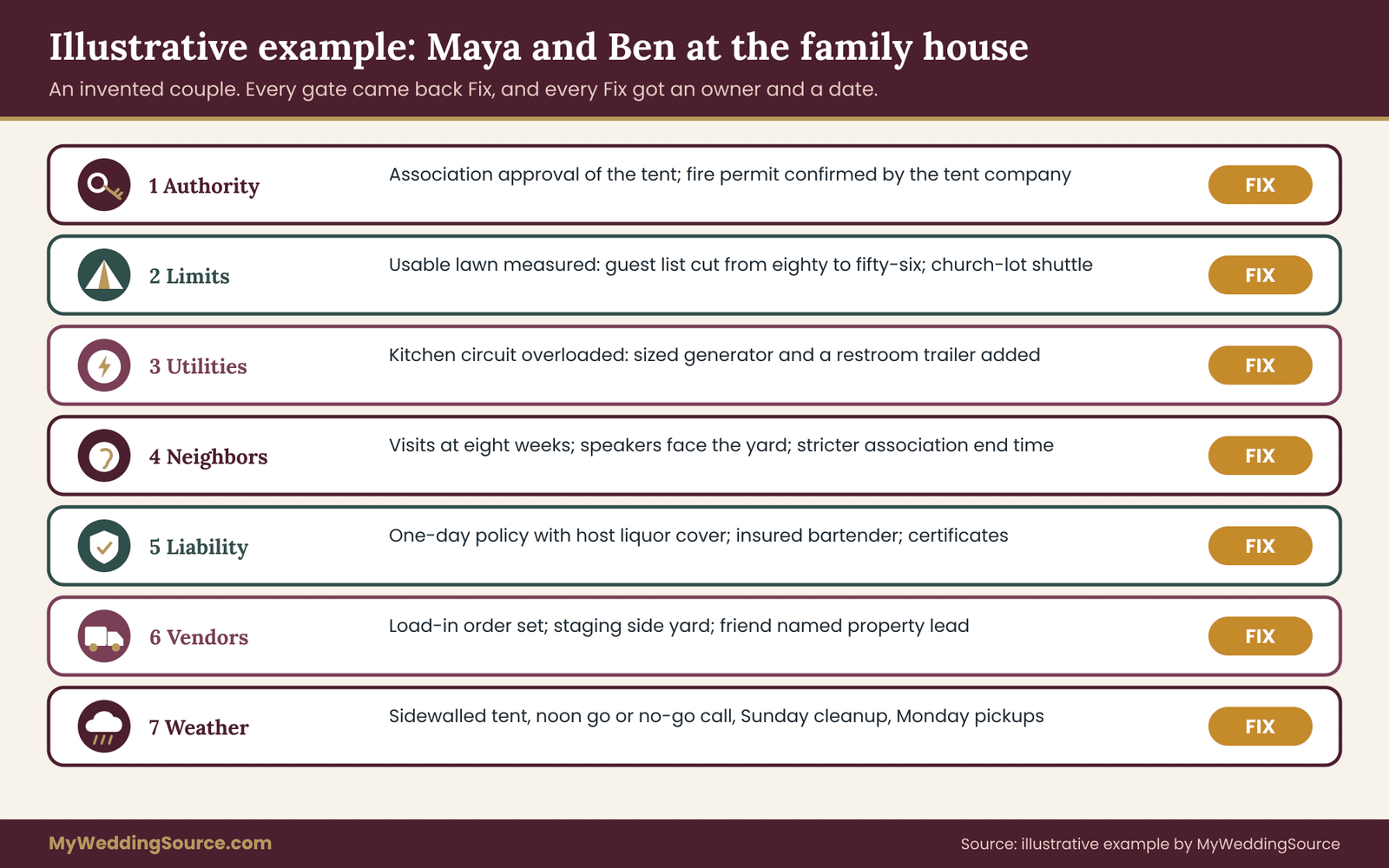
The following wedding at home is an invented example for teaching. The couple, the numbers and the findings are illustrative, not a report of a real wedding, and your property will give different answers. What matters is the sequence: the way each gate produces a verdict and an action, and how the plan changes in response.
Maya and Ben want to marry in late September at the house where Maya grew up, which belongs to her mother, Rosa. The house sits on a suburban lot within a homeowners association, connected to the municipal sewer, with a neighbor on each side and a street with parking on one side only. For their wedding at home they start with an invitation list of eighty and a plan for a tented dinner, a DJ and dancing.
Gate one: Fix for the wedding at home
Rosa owns the house outright, so there is no lease or mortgage question beyond confirming her insurance is in force. The association’s rules, which Maya finds in her mother’s closing paperwork, require written notice and approval for temporary structures and set an earlier end time for amplified sound than the city does. A call to the city’s planning office produces an emailed answer: a private family wedding needs no event permit, but the fire office has its own tent rule above a certain size.
Verdict: Fix. Actions: Rosa submits the association’s notice and gets written approval (owner: Rosa, due ten weeks out), and the tent company confirms in writing whether it will pull the fire permit (owner: Ben, due ten weeks out).
Gate two: Fix, and the guest count changes
Maya and Ben measure the lawn. After subtracting the slope at the back, the irrigation heads, a planting bed and the area near the sewer cleanout, the usable flat rectangle is smaller than anyone expected. The rental company runs layouts for a seated dinner with a dance floor and a bar, and tells them the footprint seats far fewer than eighty.
The couple settles on fifty-six seated guests for the wedding at home. The driveway holds four cars and the legal street frontage holds a few more, so parking is short even for fifty-six.
Verdict: Fix. Actions: the guest list is cut to fifty-six, with a casual open house planned for other friends the following weekend (owner: both, due twelve weeks out); a shuttle from a nearby church lot, with the church’s written permission, covers the parking gap (owner: Ben, due eight weeks out).
Gate three: Fix
The panel shows that the kitchen outlets share one breaker with the dining room. The caterer’s equipment list, added up against that circuit with the formula from the utilities section, exceeds what it can carry safely. The band and tent lights make the total worse. An electrician sizes a generator for the caterer, the DJ and the lights, and specifies where it goes.
Two bathrooms in a house with fifty-six guests, six vendors and a wedding party is not enough, so the couple add a restroom trailer, placed on the firm side yard. Cell coverage on the lawn is weak, so they print the cue sheet and download the playlist.
Verdict: Fix. Actions: book and confirm the generator and trailer with delivery access (owner: Ben, due eight weeks out); electrician visit (owner: Rosa, due ten weeks out).
Gate four: Fix
The city’s ordinance allows amplified sound later than the association does, so the couple adopt the stricter end time. Maya and Ben visit both adjacent neighbors and the two homes across the street eight weeks ahead. One neighbor has a baby, and asks that the loudest music not start until after the baby’s bedtime window passes and that speakers face away from the nursery wall.
The couple agree to put the dance floor on the far side of the tent, aim the speakers into the yard and end amplified sound at the association’s time. They give everyone a number that will be answered on the day, and plan a thank-you note afterward.
Verdict: Fix. Actions: neighbor visits done at eight weeks (owner: both); written plan to the DJ about speaker direction and end time (owner: Maya, due six weeks out); parking signs and a person in a vest at the corner (owner: property lead).
Gate five: Fix
Rosa calls her agent. The policy covers guest injury liability, but the agent says that event and alcohol-related claims need to be discussed, and that a one-day policy can be added. The couple get a quote, compare it with a second one, and buy the policy that includes host liquor liability. They hire a bartender who is trained and insured, and the caterer, tent company and DJ send certificates. They agree to close the bar an hour before the end, serve food throughout and arrange rides.
Verdict: Fix. Actions: policy in force with written confirmation (owner: Rosa, due six weeks out); certificates collected (owner: Ben, due four weeks out).
Gates six and seven: Fix
The caterer is a licensed mobile operation that has worked in backyards. They need water access at the side of the house, a staging area out of guest view, power from the generator and a hand-washing setup. The load-in plan puts the tent crew first, then rentals and the caterer, then the band. A friend, Priya, agrees to serve as property lead.
For weather, the tent has sidewalls, the tent company gives its wind threshold, and the couple agree that a named person will make a go or no-go call by noon on the day. Photos of the lawn and garden are taken a week before. A cleanup crew is booked for Sunday morning, and rental pickups are scheduled for Monday.
The outcome
After the audit, the plan is a Go with changes. The wedding at home is smaller, it has a shuttle, a generator, a restroom trailer, a one-day policy, written approvals and an informed set of neighbors. Every Fix has an owner and a date. The audit did not make the wedding cheaper or easier, and it may well have made it more expensive in places.
It made it feasible, and it let the couple choose the trade-offs with their eyes open. If any of the Fixes had failed, for example if the association had refused the tent, the next step would have been to look at the alternatives below.
Alternatives to a full wedding at home
Sometimes the audit of a wedding at home says Stop. Sometimes it says Go, and the couple look at the Fix list and decide the effort is not what they want. Either is a legitimate result. Before you give up on the home setting entirely, consider the range between “everything at home” and “everything at a venue”.
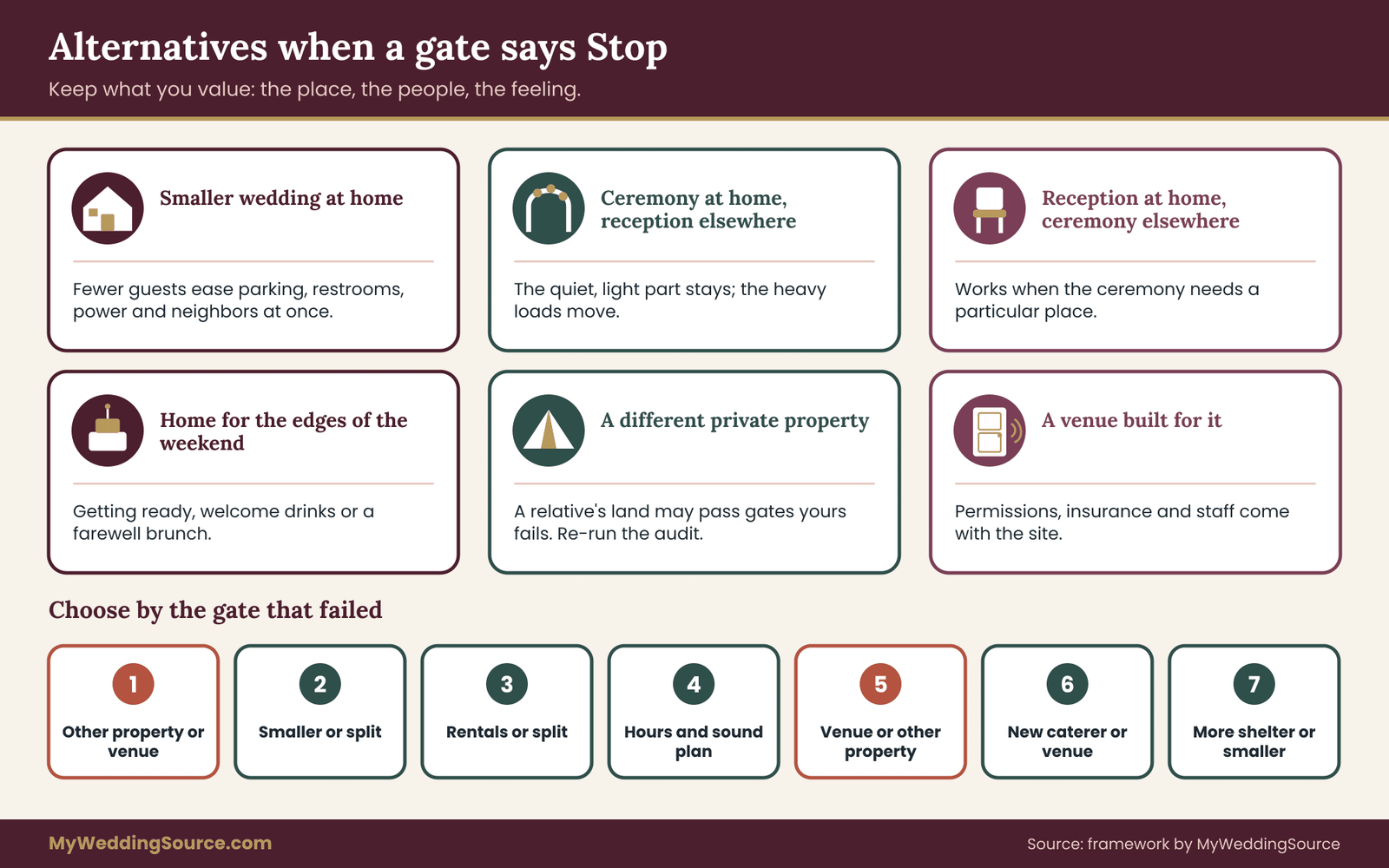
A smaller wedding at home. If gate two is the problem for your wedding at home, reduce the guest count. Plenty of couples marry at home with a ceremony and a dinner for a small group, and celebrate with a larger group later. This often resolves parking, restrooms, power and neighbor load all at once.
Ceremony at home, reception elsewhere. A ceremony is quieter, shorter and lighter on equipment than a reception. Holding the ceremony at home and the dinner and dancing at a restaurant or hall keeps the meaningful setting and moves the heavy loads to a place built for them.
Reception at home after a ceremony elsewhere. The reverse works when the ceremony needs a specific place, such as a place of worship, and the home reception is a smaller dinner.
Home for the edges of the weekend. Getting ready, a welcome drink, a rehearsal dinner or a farewell brunch are lighter events than a wedding, and many fit at home even when the main event does not.
A different private property. A relative’s farm or a friend’s larger lot may pass gates that yours fails. Run the whole audit again, because gate one in particular starts over with a different owner.
A venue built for it. If gates one and five are the obstacles, a venue solves them by design: it has the permissions and the insurance. The wedding venues guide and the guide to barn wedding venues cover places that offer a similar rustic or residential feeling with the operations handled.
Choosing by the gate that failed
Use the failed gate to choose the alternative. A Stop at gate one points to a different property or a venue. A Stop at gate two points to a smaller guest count or a split event. A Stop at gate three is often a matter of rentals, but if the cost is too high, a split event moves the heavy load.
A Stop at gate four usually calls for a changed schedule, a smaller sound plan or a different date. A Stop at gate five points to a venue or a different property. A Stop at gate six points to a different caterer or a venue. A Stop at gate seven points to more shelter, a smaller group or a different location.
The point of matching the alternative to the failed gate is that you keep what you value. Many couples who start from “we want a wedding at home” are really asking for a feeling, a place with meaning and room for the people they love, and there is more than one way to deliver it.
Failure conditions and the readiness workbook for a wedding at home
A plan for a wedding at home is only honest if it says what would make it fail. Write the failure conditions down at the start, and agree with your partner and the homeowner that if one occurs, you will change the plan instead of arguing about it. This is the part of the audit that protects relationships as much as budgets.
Conditions that should stop a wedding at home
Some findings are final until resolved. A written prohibition from a lease, a lender, an association or a local authority is one. A refusal by an insurer to cover the event, with no alternative policy available, is another. A septic professional’s written opinion that the system cannot take the load, combined with no workable restroom alternative, is another. So is a measured footprint that cannot hold the minimum guest count you will accept, or a vendor list in which the essential vendors cannot work on the property.
Other findings do not end the plan but signal that the cost of continuing may exceed the benefit. If the Fix list has grown to the point that rentals, insurance, power, restrooms, shuttles and permits together cost about what a venue would, the main reason to host at home has gone, and it is fair to compare honestly. If a close neighbor is opposed and there is no way to reduce the effect, a complaint is likely and you should decide whether you are willing to live with that.
Late failures happen as well. The forecast might show severe weather with no shelter that can hold the guests. A key vendor might cancel with no replacement. The homeowner might become ill or change their mind. A written fallback, with a trigger and a named decider, converts each of these from a catastrophe into a decision.
Soft failures that are easy to miss
Not every failure is a Stop. Some are slow. A guest list that grows by a few people at a time until the tent is full. A Fix list with no owners that nobody reads. A neighbor conversation that keeps being postponed. A vendor who has not confirmed in writing. A budget that carries the quotes in someone’s head. These are the failures that appear only when the audit is not being used, which is why the workbook has dates and names.
Review the workbook on a schedule, and mark any Fix whose date has passed as Stop until someone updates it. The rule is blunt on purpose. A late Fix is a risk, and a risk with a name beside it gets handled.
Decision checkpoints
Set four checkpoints on the calendar, adjusted to your timeline. The first, as early as possible, is after gates one and five: do you have written permission and an insurer’s answer? Until then, spend nothing that cannot be refunded. The second is after gates two and three, when the guest count is fixed by the footprint and the power and restroom plans are costed.
The third is a few weeks before the event, when neighbors, vendors, permits and the weather plan are confirmed. The fourth is the week of the event, with a walkthrough of the property, the forecast, the load-in schedule and the property lead’s briefing.
At each checkpoint, ask the same question: if we stopped here, what would we lose? The answer should shrink early and grow late, and if it grows faster than your confidence, pause. The wedding cash-flow planning guide explains how to time payments so that commitments follow certainty.
Cost logic without invented prices
The audit gives you a way to think about cost that does not depend on guessing. First, sort expenses by reversibility. Spending that can be refunded or cancelled, such as a tent hold with a refundable deposit, can come early. Spending that cannot, such as printed invitations, should wait until gates one and five pass.
Second, compare the Fix list with the venue alternative using real quotes. Add the quotes for tent, power, restrooms, shuttle, insurance, permits, extra staffing, cleanup and restoration. Add the value of your own time, which is real even if it is not on an invoice. Place that total beside the all-in quote from a venue, including its own food and service. Neither number is the right one in general. The comparison is what lets you decide on purpose.
Third, keep a contingency line. A wedding at home has more unknowns than a venue wedding, and the unknowns are often things that must be rented on short notice. How much to set aside depends on your situation and is covered in the wedding budget guide.
The readiness workbook, page by page
The workbook is seven pages and a cover. The cover holds the event summary: date, hours, target guest count, address, the homeowner of record, the event host, the property lead and the final decision-maker. It also holds the four checkpoint dates and the current verdict at each gate, in a line, so anyone can see where things stand in ten seconds.
Each gate page repeats the five lines described earlier: the question, the evidence, the verdict, the Fix actions with owners and dates, and the person to call. Add a “last reviewed” date at the top of each page. Attach the evidence directly: the lease clause, the photograph of the panel, the email from the planning office, the rental layout, the insurer’s reply, the vendor’s confirmation.
Keep it in one shared place where the couple, the homeowner and the property lead can all read it. Print the cover, the contact sheet, the load-in schedule and the weather decision rule for the day, because a phone may be dead or out of signal.
What to hand a vendor
Vendors at a wedding at home do better with a one-page site sheet drawn from the workbook. It lists the address, the access route, the parking location, the load-in window, the power and water available, the restroom for staff, the areas that are off limits, the end time for amplified sound, the property lead’s name and number, and the weather decision time. Sending it with the contract saves questions and shows that the property has been thought through.
After the event
Close the workbook for the wedding at home. Record what happened at each gate against what you expected, note any complaints or damage, file the vendor certificates, the insurance policy and the permits with your other records, and write down anything you would change. If the house will host another celebration, such as an anniversary, the next audit starts with this one. The wedding records after the event guide explains how to keep the paperwork in order.
Your next steps
Start with the two gates that can end the plan. This week, gather the lease or loan terms, the association rules and any deed restrictions, and write to the owner, landlord or association with a plain description of the event. Call your insurance agent and ask the five questions in the liability section, and ask for the answers by email.
Then spend a weekend on the property with a tape measure, a notepad and a phone. Measure the usable footprint, read the panel, test the cell coverage, count the parking and note the slopes. Fill in the workbook as you go, give each gate a verdict, and attach an owner and a date to each Fix. Set the four checkpoints on the calendar.
If the verdicts hold, keep going and talk to your neighbors before the invitations go out. If a gate says Stop, use the alternatives section to choose a version of the plan that keeps what you care about, and run the audit again for the new version. A wedding at home done this way is not a leap of faith. It is a plan that has been checked at the places where plans like it usually break.
FAQ
Do we need a permit for a wedding at home?
It depends on where you live and what you plan. A private wedding hosted by the owner is often treated differently from a commercial event, but tents above a certain size, amplified sound, street closures, open flames and alcohol service can each trigger local rules. Ask your city or county planning, building and fire offices a specific question and get the reply in writing. USA.gov can help you find the right local office.
Does homeowner’s insurance cover a wedding at home?
Often it covers some liability for a guest’s injury, but terms and exclusions vary, and events, alcohol and rented property are common limits. Call your agent, describe the event honestly, and ask what is covered and excluded. Ask about a one-day event policy or an endorsement if the answer is not enough. Request the response by email and keep it with your workbook.
How many guests can a home hold?
The answer comes from your usable footprint, not from the guest list. Measure the flat, dry, clear area, subtract septic, utilities, slopes and beds, and ask the rental company what layouts fit. Also check parking, restrooms, power and the rain shelter, because any of them can set a lower limit. The smallest number from all those checks is your real capacity.
How do we handle neighbors and noise?
Check your local noise rules, then talk to the nearby neighbors weeks before the event. Share the date, hours, parking plan and a phone number that will be answered, and listen to what they say. Face speakers away from houses, set a firm end time for amplified sound, and thank neighbors afterward. A complaint is less likely when no one is surprised.
What if our home is on a septic system?
Ask a licensed septic professional in writing whether the system can handle the added load, and whether the tank should be pumped beforehand. The Environmental Protection Agency advises keeping vehicles and heavy loads off the drain field, which affects tent, parking and truck placement. Portable restrooms can reduce the load, and many couples add them for a larger guest count.
Can we cook the food ourselves?
For a small gathering, some couples do, but food safety then becomes your responsibility. Perishable food should not sit out for more than two hours, or one hour in hot weather, according to U.S. food safety guidance. A larger wedding at home usually goes better with a licensed caterer who has worked in private homes. Check local health department rules before deciding.
Is a wedding at home cheaper than a venue?
Not automatically. You save a site fee, but you may add a tent, power, restrooms, shuttles, insurance, permits, staff and restoration. Compare real quotes for the full Fix list with an all-in venue quote, and include your own time. For some couples the home wins on meaning, not price, and that is a fair reason.
What should we do if the audit says Stop?
Do not push through a wedding at home that fails a gate. Identify which gate failed and choose an alternative that fits it: a smaller guest count, a ceremony at home with a reception elsewhere, a different private property or a venue. Run the audit again for the new plan. A Stop in the first or fifth gate means pausing every deposit until the issue is resolved in writing.
Sources
- Find local government offices and services, USAGov
- Septic systems, U.S. Environmental Protection Agency
- Codes and standards, National Fire Protection Association
- Carbon monoxide safety and portable generators, U.S. Consumer Product Safety Commission
- Lightning safety, National Weather Service
- Keep food safe: the two-hour rule, FoodSafety.gov
- Consumer insurance information, National Association of Insurance Commissioners
- Americans with Disabilities Act information, U.S. Department of Justice
- Workplace and equipment safety, Occupational Safety and Health Administration
- Severe weather preparedness, Ready.gov