
Flower girl dresses are chosen by adults and worn by a small person who will grow, fidget, get hungry, and walk on her own schedule, so the dress that wins is rarely the most elaborate one: it is the one that fits on the wedding date, stays comfortable for hours, is paid for by an agreed person, and passes a few basic safety checks.
Quick answer
Settle three things before you look at styles of flower girl dresses: how old the child is, who has the final say, and who pays. Then buy later than you would for adult attire. The Knot and David’s Bridal both suggest roughly two to three months before the wedding, because children grow quickly, and a published average of about 2.5 inches a year in height (KidsHealth) is a good reason not to order a year ahead. Choose a hem length she can walk in, fabrics that suit the season, and shoes she has already worn. Traditionally the child’s parents pay for the dress, though the couple may choose to cover it, especially for a pricier or custom choice. Ask the seller about drawstrings and care labels, and keep the fitting buffer.
This guide is for the couple or family member choosing flower girl dresses, and for parents who have just been asked to dress a child for a wedding and want to know what a reasonable process looks like. It stays with the garment: age, sizing, weather, comfort, schedule, cost and safety. For the wider question of how flower girl dresses fit with the rest of the wedding party, our wedding party attire guide covers the group, and our bridesmaid dresses guide covers the adults. We do not repeat that material here.
A note on how to read the numbers. Where a figure comes from a magazine or survey-style article, we name the publisher and the date of the article. Where it comes from a retailer’s own advice, we say so, because a seller’s advice reflects the seller’s products. Where we did the arithmetic ourselves, we label it an estimate or an illustration. We did not find a current, methodologically disclosed survey that reports an average price for flower girl dresses specifically, so every dollar range below is a published planning range from an article, not a measured average. Prices change, and nothing here is a quote from a particular shop.
One more boundary. This article gives general education only. It is not medical, legal or product-safety advice. Where we mention federal children’s clothing rules, we describe what the agency’s own pages say and tell you to verify the details with the seller or the agency.
Settle the age, the decision-maker, and who pays for flower girl dresses
Most of the friction around flower girl dresses has nothing to do with fabric. It comes from three unspoken assumptions: that everyone means the same age by “flower girl,” that the couple will choose, and that someone else will pay. Saying each one out loud, early, makes every later decision easier.
Define the age range before you search for flower girl dresses
Shopping filters, size charts and the phrase flower girl dresses itself all carry assumptions about age. If you start with the wrong range, you will compare dresses designed for a different body and a different level of patience.
See where the sources place the age
The published ranges differ, and it helps to see how much. David’s Bridal says flower girls are typically two to eight years old, though some couples choose older girls. Anthropologie’s flower girl guide says they are usually four to seven, with no strict rule, and notes that a very young child may not walk as composed as an older one. The Knot, in its guide to junior bridesmaids, describes junior bridesmaids as usually about nine to sixteen, older than a flower girl and younger than the adult bridesmaids, without giving its own flower girl range.
Put together, the sources overlap most around ages four through seven, with real variation on either side. That is our reading of three differing sources, not a rule. The practical point is that flower girl dresses are sold to families whose children range from a toddler who may need to be carried to an eight-year-old who can manage a longer skirt, and the same word covers a toddler who may need to be carried and an eight-year-old who can manage a longer skirt.
Choose between flower girl and junior bridesmaid sizing
Retailers draw the line in their size charts, not in etiquette. Azazie says its junior styles are made for girls roughly eight to twelve who have not developed an adult figure, with junior proportions and no padding or boning, and that adult styles are designed for ages thirteen and up. The Knot’s junior bridesmaid article lists Revelry’s kids’ sizes as 2T to 5T and junior sizes as J6 to J18, and Azazie and David’s Bridal junior ranges as roughly J6 to J16 or J18. That article is dated February 2023, so confirm current ranges on the retailers’ own pages.
What this means for you: a seven-year-old may be at the edge between a children’s chart and a junior chart. Measure her, read the chart of the brand you are actually buying from, and decide which chart fits her body rather than her birthday. If she is a flower girl in a junior-cut dress, check that the neckline and hem still suit her age and the venue, because junior cuts are proportioned for older girls.
Decide who chooses and who pays for flower girl dresses
Two separate questions hide inside “who handles the dress”: who picks it, and who pays for it. They often have different answers, and confusing them is where awkwardness starts.
Understand the traditional split on payment
The sources we reviewed agree on the default. According to The Knot’s article on who pays for child attendants’ attire, updated in September 2024, the flower girl’s parents usually pay for the dress, and it is a nice gesture, but not an expected one, for the couple to cover it. The same article says couples often cover custom dresses, which cost significantly more. Zola’s article, last updated in February 2024, says the parents traditionally pay, and lists alternatives: the couple pays, the two sides split the cost, or a relative who sews makes the dress with the couple supplying the fabric. David’s Bridal says the same about parents paying and the couple being free to gift the dress.
The Knot’s article assigns other items to different people as well. Accessories and shoes usually fall to the parents; alterations usually fall to the parents; flowers and the basket are usually covered by the couple as part of the florals budget; and hair and makeup for an older flower girl vary, with the bride often covering them according to an event producer quoted there. Zola adds that the thank-you gift is typically the couple’s and that out-of-town parents usually pay for their own lodging, though the couple may offer one night.
Ask the parents before you pick flower girl dresses with a price
A rule that appears in several sources and holds up in practice: talk to the parents before you fall in love with any of the flower girl dresses you see. Zola advises asking the parents’ permission before discussing who will pay for the dress. The Knot advises getting input from the parents or guardians, and says that if the couple wants a pricier dress than the parents planned on, the couple is expected to cover it. Anthropologie’s guide suggests offering the parents a few options so they can choose one they are comfortable with.
Our suggestion, which is ours and not a source’s rule: send the parents a short message with a price ceiling and a choice. For example, “We would love her in a pale green tea-length dress, and we will cover up to a set amount, or you are welcome to choose within that color and budget.” That keeps the decision where it belongs, avoids surprising anyone with an invoice, and makes the child’s parents partners instead of recipients. If your family has a different tradition, or if the parents have limited means, the sources note the arrangement can change, and the couple can cover everything without making it a favor.
For the wider conversation about how couples treat their attendants and how to handle family expectations, our wedding etiquette guide covers the social side.
Start with fit and function before aesthetics for flower girl dresses
A small photograph of a tulle skirt is persuasive and tells you almost nothing about whether a four-year-old can sit through a ceremony in it. The more reliable order is the reverse: what must the dress do, what must it fit, and only then what should it look like. Choosing flower girl dresses this way removes most of the expensive second-guessing.
Translate body proportions and movement needs into design choices in the flower girl dresses decision
A child is not a small adult, and the features that make a dress work are different. She needs to walk without lifting her skirt, raise her arms, sit on a pew or a lap, and perhaps be picked up. Translating those needs into design features is how the dress stays out of the way of the day.
Explain which measurements matter for flower girl dresses
Retailers who sell flower girl dresses tend to ask for a small set of measurements. Pegeen, a retailer that makes flower girl dresses to order, asks for three: full standing height, waist and chest. Its instructions are practical and worth copying whoever you buy from. For height, have the child stand against a wall with her heels touching it, mark the top of her head with a flat pencil, and measure from the mark to the floor. For waist, measure at the belly button line with the tape parallel to the floor; for chest, measure at the nipple line, also parallel to the floor. Keep the tape snug but not tight, have her take a breath and let it out, and keep her chatting so she relaxes.
Pegeen also says not to add your own allowance for growth, because its process already builds one in, and extra room would make the dress too big. That is one retailer’s advice about its own made-to-order system, and other brands work differently, so read the instructions for the brand you are buying from. David’s Bridal’s general measuring page, as we read it, addresses adult sizing and does not give guidance for measuring girls.
Our recommendation: take the three measurements once when you start shopping, write the date next to them, and take them again right before you order. The change between the two sets tells you more about how she is growing than any chart can.
Identify where sample sizing distorts expectations for flower girl dresses
Two things distort expectations. The first is the label. Children’s formal sizes are not standardized across brands, and Pegeen notes that each manufacturer has its own chart, so a “size 5” from one brand may not match a “size 5” from another. Use the brand’s chart and her measurements, not the number on a dress she wore last year, and compare flower girl dresses by measurements before you compare them by price.
The second is age labels. Several brands print an age range next to a size, but those ranges describe an average child, and the sources show how much the notion of “age” varies: one retailer’s junior chart starts at what another treats as a flower girl size. The Knot advises choosing a size with a little room to grow but not one that is oversized, which is sensible and also vague. We turn that vagueness into a concrete rule in the next section: compare the growth you can expect between ordering and the wedding to the room the dress gives you.
The third, less obvious distortion is the photograph itself. Online photos of children’s dresses are usually shot on a sample, and we could not find a published source quantifying how closely the sample matches the delivered dress. Treat that as an editorial observation: judge fabric and construction from the photo, but judge fit from measurements and, once the real dress arrives, from a trial.
Plan for growth between ordering and the wedding in the flower girl dresses decision
Growth is the one variable that adult attire does not have. It is also the easiest to turn into arithmetic, as long as you remember that the arithmetic uses an average and your child is not an average.
Convert an average growth rate into inches of hem
KidsHealth, in an article medically reviewed in June 2022, says that starting around age two, children grow in height about two and a half inches (six centimeters) a year until adolescence. Dividing that by twelve gives about a fifth of an inch a month. This is our arithmetic, labeled as an estimate: over three months, an average child gains roughly six tenths of an inch; over six months, about an inch and a quarter; over a full year, about two and a half inches. Ten weeks, the remeasure window Pegeen uses before a wedding, is a little under half an inch.
Those numbers are why the retailers we reviewed suggest ordering flower girl dresses late. The Knot says to aim for about two to three months before the wedding and to plan for a size change if you buy earlier. David’s Bridal suggests about three months and sizing up because children grow quickly. WeddingWire, in a 2017 article, says to buy as close to the date as possible because a dress bought months ahead may not fit on the day. Put the average growth next to those windows and the logic is visible: buying three months out risks about six tenths of an inch in height, while buying a year out risks about two and a half.

Account for spurts, seasons and the limits of the average
An average hides the fact that growth is uneven. KidsHealth says growth alternates between slower periods lasting weeks or months and brief spurts, that children tend to grow a bit faster in spring, and that kids differ widely, with some naturally taller or shorter and late bloomers catching up. Pegeen says growth spurts tend to happen during summer, and that children in colder climates may grow faster in warmer months while children in warmer climates tend to grow more steadily.
Those two sources disagree about which season is the fast one, and we do not have a way to settle it. That is the real lesson: do not try to predict the spurt. For flower girl dresses, choose a forgiving cut, such as an A-line or full skirt with an elastic or adjustable back, buy it as late as the seller’s schedule allows, and measure again when it arrives. A dress that can be taken in or let out by a tailor, or that has a ribbon or hook-and-eye closure that adjusts, tolerates growth better than a fitted bodice.
Match fabric and construction to season and venue in the flower girl dresses decision
Fabric decides whether the child is comfortable, whether the dress survives the day, and how much work a tailor will face. Children also tolerate discomfort less patiently than adults, and a child who is itchy or hot is a child who will tell you.
Connect weight, lining, sleeves, hem and ventilation for flower girl dresses
The Knot’s guide, updated in May 2024, gives a few concrete pointers. Satin is wrinkle- and rip-resistant. Silk is expensive and damages easily, so the article suggests avoiding it. Tulle works for a princess or ballerina look. For summer or warm spring weddings, it recommends short sleeves and open-toed shoes; for fall or winter, long sleeves with a cardigan and tights. WeddingWire’s 2017 article adds that a wrinkle-free fabric, or one that hides wrinkles well, such as chiffon, helps the dress look good after hours of sitting and moving.
Length is the other big construction choice for flower girl dresses. The Knot says tea length, a few inches below the knee, suits younger girls and reduces tripping, while floor length can work for older girls who can learn to manage the skirt. WeddingWire’s 2017 article quotes a vendor who calls a long hem a risk not worth taking, even if the look is charming. Our synthesis: for children under about six, choose tea length or shorter; for older girls, a floor-length hem is workable only after she has practiced walking and turning in it while wearing the actual shoes.
Lining deserves more attention than it usually gets. A tulle skirt without a soft lining at the waist and neckline can scratch, and a lined bodice that is stiff or has a seam running across the ribs can bother a child for hours. We could not find a published test of how itchy specific fabrics are for children, so this is practical experience from the people we cited and from common sense: ask whether the lining is smooth, whether the waist has a soft backing, and whether tags or trims touch the skin.
Flag heat, snag, transparency and mobility risks for flower girl dresses
Heat is the risk most often underestimated with flower girl dresses, because the adults are not wearing the dress. The American Academy of Pediatrics’ HealthyChildren site says light-colored, loose-fitting clothing helps children stay cooler, and that a single layer of absorbent fabric lets sweat evaporate. It also says children have lower sweat rates than adults, which reduces their natural cooling, and that young children often cannot tell when they are becoming dehydrated. A multi-layer tulle skirt over a lined satin bodice is close to the opposite of that advice, so for an outdoor summer wedding, choose a lighter fabric, fewer layers and short sleeves, and plan water and shade. This is general information, not medical advice; for any concern about heat illness, follow the pediatric guidance and contact a clinician.
The other risks are practical. Sequined sleeves and appliqué can itch, as The Knot notes. Delicate beading and long ribbons can snag on pews, chairs and playground equipment at the reception. Thin fabric can turn transparent in bright sun or under flash photography, so look at the dress against a window and under a phone flashlight. And rigid bodices or heavy skirts limit the one thing a child is supposed to do: move. The table below turns these factors into decisions. It is our synthesis of the sources, and it describes tendencies, not guarantees.
| Factor | What it suggests | Alteration risk | What to ask the seller |
|---|---|---|---|
| Child under about six, walking on her own | Tea length or shorter, light skirt, elastic or adjustable back | Low: hems are quick to shorten | How much can the hem be shortened without cutting a decorative border? |
| Child between seven and ten, near junior sizing | Floor length possible after practice; check junior versus children’s chart | Moderate: length and bodice may both need work | Which chart does this style use, and what does the age label mean? |
| Hot outdoor venue | Short sleeves, one or two light layers, breathable lining | Low to moderate | Is the lining breathable, and does the skirt have several layers? |
| Cold or winter venue | Long sleeves or a cardigan, tights, closed shoes | Moderate: sleeves are harder to lengthen | Is there extra sleeve length in the seam allowance? |
| Beaded, sequined or lace detail | Statement look, but itch and snag risk | Highest: details are worked around | Are the trims sewn flat, and is the inside smooth? |
| Sheer or tulle skirt | Needs a lining or layers for opacity | Moderate: lining adds hem work | Can I see it against a window, with and without lining? |
| Growth expected before the wedding | Forgiving cut, adjustable closure, late purchase | Low if the cut forgives | What is the policy if she grows before the wedding? |
| Stairs, grass or uneven floors | Shorter hem, shoes with grip, no long trailing ties | Low | Will the hem be finished with the shoes I plan to use? |
If your venue is outdoors, our garden wedding venues guide and beach wedding dresses guide discuss how setting changes fabric choices for adults, and the same reasoning applies to a child’s dress, with extra attention to heat and ground conditions.
Build the shopping timeline around alteration reality for flower girl dresses
Adult dress timelines are built around production and tailors. A child’s timeline is built around the opposite pressure: you want to buy as late as possible so the dress fits, which squeezes the time left for delivery, corrections and a spare. The art is finding the narrow window between “too early to fit” and “too late to fix.”
Work backward from fittings and delivery in the flower girl dresses decision
Start at the wedding date and subtract. The published windows are short and fairly consistent, and the gaps between them are where problems hide.
Show when custom, rush or off-the-rack changes the schedule for flower girl dresses
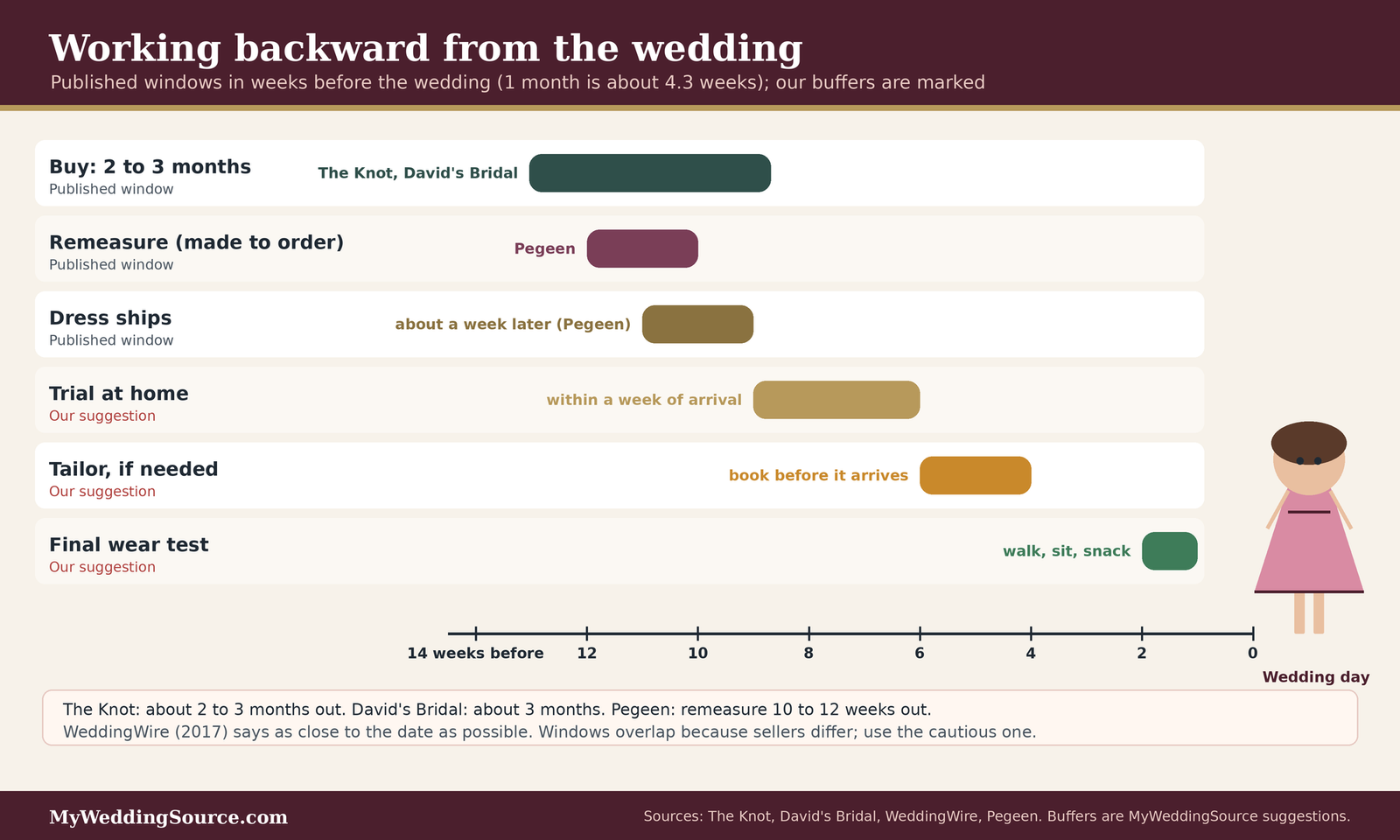
The sources we reviewed do not give a single schedule for flower girl dresses, so here is what each says. The Knot recommends buying about two to three months before the wedding. David’s Bridal says about three months and suggests sizing up. WeddingWire’s 2017 article says as close to the date as possible. Pegeen, which makes dresses to order, sets a remeasure date ten to twelve weeks before the wedding when the wedding is more than four months away, and says the dress is made and shipped about a week after that remeasure date. Zola’s advice is to buy early enough for alterations but not so early that she outgrows the dress.
Read together, these windows describe a purchase or final measurement somewhere between roughly nine and thirteen weeks out. That is our arithmetic converting two to three months at about 4.3 weeks a month. What changes by type of dress:
- Off the rack or ready to ship: You can buy near the later end of the window, because the dress is in hand within days. That protects fit, but gives you fewer styles and sizes to choose from, so confirm the return or exchange policy before you buy.
- Made to order: The seller’s production time sets the floor, not your preference. Pegeen’s own process, with a remeasure about ten to twelve weeks out, shows how a maker can build growth into the schedule. Ask any maker for the production time, the last day to change the size, and what happens if the child grows after the last size date.
- Custom or heavily altered: Custom dresses also cost more, which The Knot says is why couples often cover them. They also leave less room for error, so they need an earlier decision, and the growth risk is shared between you and the maker.
- Resale or hand-me-down: Zola notes that resale shops can offer savings on gently used children’s dresses. These are the fastest option and the least predictable on condition, so inspect seams, closures and stains before you pay.
Ask whichever seller you choose for the delivery estimate in writing, and treat it as a range, not a promise.
Add buffer for correction, steaming and accessories in the flower girl dresses plan
A schedule for flower girl dresses that ends on delivery day has no margin. Our recommendation, which is editorial and not from a source, is to add three buffers after the dress arrives:
- A trial week. When the dress arrives, have her try it on with the real tights or socks, the real shoes and the real hair accessory, and check the closure, the neckline and the hem. If it does not fit, you need time for an exchange.
- A correction window. If a hem or strap needs to be shortened, you need a tailor appointment and a pickup date. The Knot says that perfect alterations are not necessary for a flower girl dress, and that her alterations usually cost less than adult ones because the dresses are smaller, but a hem that sits on the floor is a trip risk and worth fixing.
- A steaming and storage window. Check the care label for how to remove creases. Dresses that arrive folded in a box may be creased, so plan a day to steam or hang the dress before the wedding.
The accessories are a separate list, but they follow the same rule. The Knot says accessories such as baskets, crowns or Mary Janes are usually quicker to buy than the dress, so they can wait until after the dress is in hand, which lets you match color and check comfort. The table below turns the published windows and our buffers into a working schedule. It is our synthesis, and the ranges overlap because the sources differ. When two conflict, use the more cautious one for any step that cannot be undone.
| Stage | When (before the wedding) | What happens | Where the timing comes from |
|---|---|---|---|
| Ask the flower girl and her parents | Around the time you ask bridesmaids | Give the family time to budget and plan | David’s Bridal |
| Agree on age, budget and who pays | Early, before shopping | Send the parents a ceiling and a choice | Zola and The Knot (conversation advice); wording is ours |
| First measurements | When you start shopping | Record height, waist, chest and the date | Pegeen (what to measure); the date note is ours |
| Buy or make the final size decision | About 2 to 3 months (roughly 9 to 13 weeks) | Order in the size she needs now | The Knot about 2 to 3 months; David’s Bridal about 3 months; Pegeen remeasure 10 to 12 weeks |
| Delivery or ship date | About a week after the final size date for made-to-order | Confirm the date in writing | Pegeen (its own process); other sellers vary |
| Trial at home | Within a week of arrival | Try with tights, shoes and accessories; check hem and closure | Editorial |
| Tailor, if needed | 4 to 6 weeks out | Book the appointment before the dress arrives | Editorial; confirm lead time with your tailor |
| Final wear test | 1 to 2 weeks out | Walk, sit and eat a snack in the dress | Editorial |
| Wedding day | Day of | Dress her last | WeddingWire |
For a wider plan that puts this schedule next to everything else on your list, our wedding planning timeline and wedding planning checklist can hold the dates together, and our wedding dress alterations guide explains how tailors schedule and price work.
Budget for the finished outfit, not the rack price in the flower girl dresses decision
A price tag tells you what the dress costs. It does not tell you what the outfit costs. For a child, the extras are often as large as the dress itself, and they are where the families who pay find surprises.
Separate purchase, alteration, shoes, accessories and styling costs for flower girl dresses
The figures below are the published ranges we found for flower girl dresses and the items that go with them. They come from two articles, so treat them as planning ranges. We could not find a survey with a disclosed method that reports averages for these items.
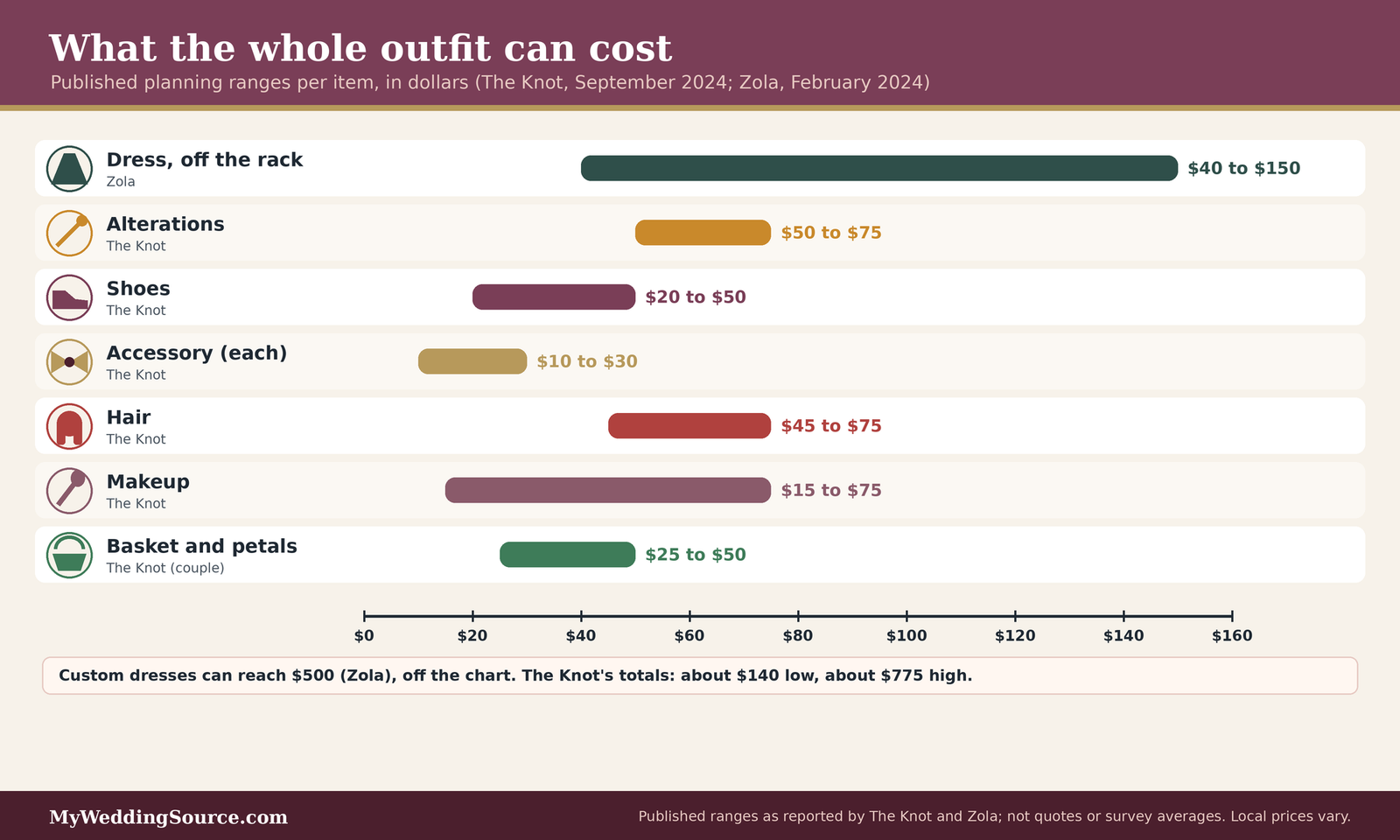
- Dress: Zola, in an article last updated February 2024, says off-the-rack dresses start around $40 and go up to about $150 for intricate designs, and custom dresses can cost up to $500. The Knot, in an article updated September 2024, says simple traditional dresses are under $100, gives Azazie at about $50 to $70 and Anthropologie at about $150 to $250 as retailer examples, and names a designer example near $500. Those are named retailers’ prices as reported in the article, not current quotes.
- Alterations: The Knot suggests budgeting about $50 to $75 and says they are cheaper than bridesmaid alterations because the dresses are smaller.
- Shoes: About $20 to $50 in children’s sizes, more for larger sizes, according to The Knot.
- Accessories: About $10 to $30 each (jewelry, tights, belts, headbands) according to The Knot. Zola lists a flower crown, purse, bracelet, tiara, hat, gloves, headband and bouquet among the possibilities.
- Flowers and basket: The Knot says petals run about $25, or about $50 for a basket with petals, usually covered by the couple.
- Hair and makeup, if used: About $45 to $75 for hair and $15 to $75 for makeup, with payment varying, according to The Knot.
The Knot’s own totals are a low end of about $140 (a dress and a couple of accessories) and a high end of about $775 (including hair and makeup if the couple does not cover them), with most families in between.
Cost reality check
Estimate, using only the published ranges above. For a simple off-the-rack outfit, a $40 dress plus $20 shoes and one $10 accessory comes to about $70, assuming no alterations. For a mid-priced outfit, a dress at $50 to $70, alterations of $50 to $75, shoes of $20 to $50 and one accessory of $10 to $30 add up to about $130 to $225. For a higher-end outfit, a $250 dress plus $75 alterations, $50 shoes, a $30 accessory and $75 each for hair and makeup reach about $555, and a custom dress at $500 with the same alterations, shoes and accessory comes to about $655 before hair and makeup. These are our sums from other people’s figures, not quotes. Your local prices will differ, and the dress is only the start of the outfit.
Our wedding budget calculator can hold these line items, and our guide to who pays for what in a wedding budget goes through how couples divide the larger costs.
Compare quotes by finished cost, not dress price
If you are comparing two or three flower girl dresses, or one new dress and one resale dress, put them on the same footing. Here is a simple method, which is ours. For each option, write down:
- The dress price, including tax and shipping.
- Any alteration the dress will probably need, using a local tailor quote if you have one, or The Knot’s $50 to $75 range if you do not.
- Shoes and tights or socks she does not already own.
- Any accessory you plan to buy.
- A return or exchange fee, if the seller charges one, and who pays the return shipping.
- Subtract the resale value only if you honestly plan to resell it. We could not find a source on typical resale values for flower girl dresses, so do not count on a number.
The total is the finished cost. Two dresses with a $30 gap on the tag can end up with a $5 gap, or a $60 gap, once alteration and returns are counted, and the cheaper tag does not always win. Compare totals, then choose the one you would buy if the totals were equal.
Show which design details drive alteration complexity for flower girl dresses
A child’s dress has fewer seams than an adult’s, so flower girl dresses are usually quick to alter, but a few details drive the work and the cost. Hems are the simplest change, unless the hem has lace, a decorative border or multiple tulle layers that must each be shortened. Straps and sleeves are harder, because there is rarely extra length. Bodice construction matters too. Azazie notes that its junior styles have no padding or boning, that adult styles are designed for ages thirteen and up, and that a custom adult style for a junior may need extra alterations, for which it says it offers reimbursement. Azazie also says custom-sized orders cannot be returned for any reason, which is exactly the kind of policy to read before you pay.
Our rule of thumb, which is ours: the more layers, trims or structure a dress has, the more a tailor will charge to change it, so choose a simpler construction if you expect adjustments. And if you do not need to alter the dress, the best alteration is the one you do not pay for.
Use the fitting room to test the wedding day for flower girl dresses
Flower girl dresses that look right on a hanger can fail in the first ten minutes of real use. A fitting for a child is less a measurement exercise than a rehearsal: you are checking whether she can do the things she will be asked to do, in the clothes she will be wearing, for longer than she wants to.
Move, sit, eat and walk the aisle in the flower girl dresses outfit
The most useful test is also the least formal: put her in the complete outfit and let her act like herself. The Knot’s advice is the right starting point: have her walk around and sit in the outfit before you commit.
Test the actual shoes, tights and hair accessory
The Knot says to prioritize comfortable shoes and to watch for shoes that slip off. Zola suggests ballet slippers, cushioned flats or sneakers, and says parents can help pick a pair that fits well. For very young children, The Knot says shoes are optional if the parents and couple agree, and that if she goes barefoot, you might carry her or use a wagon to avoid hazards underfoot.
Our test, which is editorial: have her walk the length of a hallway or a driveway at least twice, climb a few stairs, and turn around in the full outfit, including tights and shoes. Then have her stand still for two minutes, which is about how long a ceremony photo can last. If a heel slips, if a strap falls, or if she hitches her skirt, fix it now. Wear the shoes around the house for a few days beforehand so any blisters show up before the wedding, not during it.
For the aisle itself, look at the floor. A smooth, polished floor and a smooth-soled shoe is a slip risk, and a lawn is a heel-sinking and hem-wetting risk. If your ceremony is outdoors, visit the site with the shoes on, if you can.
Check neckline, sleeves and comfort under photography movement
Children move more than adults, and the dress has to survive being picked up, hugged and spun. Try it on and ask her to raise both arms, bend to pick something up, and sit on the floor. If the neckline gapes, the armholes pinch or the skirt rides up, you will see it in the photographs.
The Knot advises watching for itchy details such as sequin sleeves, and says that a comfortable child is less likely to be distracted or fussy during the ceremony and photos. Ask her, in plain words, whether anything scratches, pinches or feels hot. WeddingWire’s article adds that the dress should accommodate any planned hairstyle or accessory without clashing, so try the hair accessory in the fitting, too, and check that the neckline does not catch on a crown or a headband.
If photographs of her with the bride are on your list, as WeddingWire suggests, put the outfit through the same test: hold her, hug her, kneel beside her. Our wedding photographer shot list and wedding photography guide cover how to ask for those pictures.
Document what must change before the next fitting in the flower girl dresses plan
A trial is only useful if what you learn survives until the next one. With a busy wedding calendar and a child who will not stand still for a second look, notes beat memory.
Photograph the problem spots and write the notes down
Take a quick photo from the front, back and side, and one close-up of anything that looks off: a gaping neckline, a hem that touches the floor, a strap that slips. Add the date to the file name, and write two or three sentences about what bothered her. If you plan to use a tailor, the photos save an explanation, and if you plan to return the dress, they document the condition at the time.
Get alteration scope, deadlines and policies in writing
Before any work begins, ask the tailor or the seller to confirm what will change, how much it will cost, and the date it will be ready. Ask who is responsible if the dress is damaged, and what the return or exchange policy is for the dress, particularly if it is custom-sized. Azazie’s page says custom-sized orders cannot be returned for any reason, which is a good reminder to read the policy before the first measurement. Keep receipts and confirmations in one place, such as an email folder, and put the pickup date on the calendar as a task, not just a note.
Questions to ask before you order or alter
- What size chart does this dress use, and is the age label an average or a rule?
- What is the production and delivery time for this dress, and is the date in writing?
- What is the last day to change the size, and what happens if she grows after that?
- Which closures does the back use, and can it be adjusted by an inch or two?
- Is the lining smooth against the skin, and are any trims or tags scratchy?
- Does the dress have any drawstrings, ties or long ribbons, and are they removable?
- What does the care label say, and can the dress be steamed or pressed?
- What is the return or exchange policy, and are custom sizes returnable?
- Can the seller tell me how the dress is certified as a children’s product, and share the certificate if it has one?
Check the children’s clothing safety basics that apply to flower girl dresses
Most wedding sites skip this topic, and most flower girl dresses raise no issue. But children’s clothing is regulated differently from adult clothing in a few specific ways, and a few minutes of reading the federal agency’s own pages gives you good questions to ask. This section describes what the U.S. Consumer Product Safety Commission (CPSC) says on its pages. It is general information, not legal or safety advice, and it does not tell you whether a particular dress complies. We could not find a CPSC page that addresses formal dresses or flower girl dresses specifically, so where a page does not say, we say so.
Read the label and ask about drawstrings and ties in the flower girl dresses you consider
Cords and ties are the best-documented children’s clothing hazard on the CPSC’s pages, and decorative ties are common on dresses.
Know what the drawstring rule says and does not say
The CPSC’s business guidance on drawstrings in children’s upper outerwear says that hood and neck drawstrings are prohibited on garments in sizes 2T to 12 (or equivalent), because the agency considers them a strangulation hazard and a substantial product hazard. For waist and bottom drawstrings in sizes 2T to 16, it says they are allowed only under conditions: the drawstring can extend no more than three inches beyond the drawstring channel when the garment is laid flat at full width, the free ends cannot have toggles, knots or other attachments, and a single continuous loop must be bar tacked so it cannot be pulled out of its channel.
What the page does not say, in the text we reviewed, is which garment types count as “upper outerwear,” and it does not mention dresses or formal wear. Its linked FAQ lists questions about what upper outerwear includes and whether belts count as drawstrings, but we could not read the answers. So we will not tell you that a dress sash or a back tie is or is not covered. What we can say is that these are reasonable things to ask a seller about, and that any cardigan, jacket or hooded layer that comes with the outfit deserves the same question.
Treat long ties and ribbons as a trip and snag risk anyway
Apart from any rule, a long loose ribbon is a practical hazard for a child who runs, climbs stairs and sits on the floor. This is our observation, not a source’s finding. If a dress has a sash that ties in a bow at the back, check that it is sewn to the dress at the sides, that the ends are short, and that the bow is secure enough not to come undone and trail on the floor. If a cardigan or jacket has a drawstring at the neck or hood, ask the seller about it before the wedding, and consider removing it, if the seller agrees that is safe.
Ask about flammability, labeling and certification for flower girl dresses
Flammability and certification are two areas where the CPSC’s pages give a few clear facts, and a few things we could not confirm.
Understand what the clothing flammability standard covers
The CPSC’s standard for the flammability of clothing textiles, 16 CFR part 1610, is the standard for general wearing apparel. As we read the regulation, it applies to clothing and textiles intended for clothing, in a form ready for use, including finished garments and costumes. It sorts fabrics into three classes. Class 1 is normal flammability and acceptable for clothing; Class 2 is intermediate flammability that applies only to raised-surface fabrics such as those with pile or nap, and may still be used; Class 3 is rapid and intense burning, considered dangerously flammable and not allowed in clothing. The regulation also lists fabrics that are exempt from the testing otherwise needed to support a guaranty, including plain-surface fabrics weighing 2.6 ounces per square yard or more and fabrics of any weight made entirely from acrylic, modacrylic, nylon, olefin, polyester or wool, or a combination of these fibers.
What that means for a shopper is modest. The standard is the general rule for clothing, and fabrics made entirely of polyester or nylon appear on its exemption list. It does not mean that a fabric will not burn, and it is not a substitute for ordinary caution around candles, sparklers and open flames at a wedding. If your ceremony includes candles or a fire feature, keep a child’s tulle skirt away from them, and ask your venue about its rules. We did not find a CPSC source that ranks tulle or other formal fabrics for flammability, so we make no claim about specific fabrics.
Treat robes and sleepwear differently from dresses
Many families buy a matching robe for the getting-ready photographs. The CPSC’s page on children’s sleepwear says the children’s sleepwear flammability standards protect young children from burns when sleepwear catches fire from small open flames, with the standard for sizes 0 through 6X in 16 CFR part 1615 and the standard for sizes 7 through 14 in part 1616. It says that sleepwear fabrics and garments must pass specified tests, and that garments meeting the infant or tight-fitting garment rules are exempt from those tests but must still meet the general clothing standard. The page does not say whether robes are included, so we cannot tell you how a particular robe is classified.
The practical question is simple: if the robe is labeled as children’s sleepwear or a robe, ask the seller how it meets the standard, and look at the care label and any flame-related labeling. If the seller cannot answer, choose a different robe.
Ask whether the product is certified as a children’s product
The CPSC’s example of a Children’s Product Certificate for clothing explains that a certificate records how a children’s product complies with the safety rules that apply, and that the domestic manufacturer or importer issues it. The example cites total lead content, paint and similar surface coatings, and the flammability standard for clothing textiles, and says sleepwear falls under different flammability rules. It also notes that a finished product needs its own certificate even if a supplier tested the components. The page does not say what age range counts as a children’s product, and it does not say whether a shopper can ask a retailer for a certificate, so we cannot promise one will be produced.
What you can do is ask: “Is this a children’s product, and can you tell me how it is certified?” A well-run seller should be able to answer. If the dress is custom-made by a relative or a local seamstress, a certificate is not something a family is likely to hold, and this guide does not cover what the rules require of someone who makes children’s clothing for sale. The next step is ordinary good sense: avoid small detachable pieces that could come off and be swallowed, and look closely at trims and closures.
Plan the wedding day around the flower girl dresses
The wedding day tests the dress in ways no fitting can. She will be asked to stand still, walk calmly, stay clean and stay happy, usually while an unfamiliar crowd looks at her. A few practical choices make that more likely.
Protect the dress and the child on the day itself in the flower girl dresses plan
The day-of plan is about two things the dress cannot do for itself: stay clean and stay comfortable.
Dress her last and manage food and drink
WeddingWire’s 2017 article advises dressing the flower girl last to protect the outfit from spills, offering snacks beforehand, then water or milk through a straw and colorless foods such as crackers or cheese, and keeping her busy with games while the bridal party gets ready. A robe or a button-front shirt for the getting-ready photographs lets you put the dress on at the last moment without pulling it over her hair. Keep a small kit with a stain remover pen, a few safety pins, a lint roller and a spare pair of tights, and assign it to one person, such as a bridesmaid or her parent, so it is never anyone’s second thought.
Plan for heat, cold and a bad day
If the day is hot, the pediatric guidance quoted earlier applies: lighter clothes, water offered often, and regular breaks indoors or in cool places. HealthyChildren lists warning signs that need prompt attention if they do not improve quickly in a cool place, including unusual tiredness, confusion, severe headache, fever and vomiting. That is general information and not medical advice, and heat stroke is described there as a medical emergency. If the day is cold, The Knot’s pointers, a cardigan and tights, are a start; bring a coat that goes over the dress without crushing it.
Plan for the day she does not cooperate, because even the best flower girl dresses cannot guarantee a calm child. Zola notes that the flower girl may carry a bouquet or another item, instead of petals, if the venue bans petal tossing, and David’s Bridal lists alternatives such as a sign, bubbles or a ribbon wand. A toddler who will not walk can ride in a wagon, as The Knot suggests, or be carried by a parent. Tell her parents in advance that either outcome is fine, so no one is embarrassed if she freezes halfway down the aisle. Our wedding ceremony guide covers processional order and how children fit into it.
Think about the dress after the wedding in the flower girl dresses plan
Most flower girl dresses are worn once, and a few decisions after the day are worth making in advance, ideally before you buy.
Decide who keeps the dress and how to clean it
Ask the parents whether they want to keep it as a keepsake, pass it on, or resell it. Zola notes that resale shops can offer savings on gently used children’s dresses, which is a reason to keep the tags and the care label and to clean it soon after the wedding. We could not find a source on typical resale values, so do not count on getting money back. If the dress is a keepsake, check the care label before sending it to a cleaner, and ask the cleaner what they would do with beading or tulle.
Choose a thank-you that fits the child
Zola says the thank-you gift is typically the couple’s and suggests items such as a personalized robe, a gift box, a tote, jewelry, slippers or a water bottle. David’s Bridal lists a jean jacket, a necklace or a shirt, and says the gift is optional. If the gift is a robe, see the sleepwear note above. Whatever you choose, a note of thanks to the parents, who did the work of getting her there, is the part they will remember.
Work through three scenarios for flower girl dresses
The scenarios below are illustrations we built to show the trade-offs, not case studies of real families. Dates, ages and prices are assumptions, and the dollar figures use only the published ranges earlier in this guide.
Match the dress to the child and the venue in the flower girl dresses scenarios
Each scenario for flower girl dresses starts with a child, a season and a place, then runs through the decisions in the order this guide suggests.
A four-year-old at a June garden wedding
The wedding is on a Saturday in mid-June, outdoors, with afternoon temperatures expected to be warm. The flower girl is four and a half. Following the guidance above, the couple asks her parents in January, sends a price ceiling, and agrees the parents will buy a tea-length chiffon dress in the bridesmaids’ sage color, with the couple covering the basket and petals. They measure her in February and again in late March, which is about ten to twelve weeks out. The dress is short-sleeved and has a soft cotton lining, and she tries it with her own flat sandals. A hem is taken up half an inch after the dress arrives. On the day, she is dressed last, carries a small bouquet instead of petals because the garden venue bans them, and has water at hand. Using the published ranges: a dress at $50 to $70, alterations of about $50 to $75, sandals at $20 to $50, and one accessory at $10 to $30, the parents’ share is roughly $130 to $225 by our arithmetic, plus the couple’s basket and petals at about $50.
A seven-year-old at a January ballroom wedding
The wedding is in January, indoors, in a hotel ballroom with a long carpeted aisle. The flower girl is seven and wants a dress that looks like the bride’s, with a full tulle skirt. She is at the edge between a children’s chart and a junior chart, so the family checks both and picks the one that matches her measurements. Because she is older, a floor-length hem is workable, but only after she has practiced the walk twice in the shoes she will wear. Long sleeves and tights suit the season, and the family adds a cardigan for the photographs. The couple, who prefer a more elaborate dress than the parents had planned, offer to cover the cost, as The Knot says couples are expected to do in that case. The finished cost depends heavily on the dress: using the published ranges, a dress at $150 to $250 plus $50 to $75 alterations, $20 to $50 shoes and $10 to $30 for tights or an accessory comes to roughly $230 to $405 by our arithmetic, which is why the conversation about who pays happens before the dress is chosen.
A two-year-old and a nine-year-old in the same wedding
Two girls of different ages need different dresses that still look like they belong together. The Knot says multiple flower girls do not need identical outfits, but their styles and colors should complement each other. The couple chooses one color and one fabric family, then lets the older girl pick her own shape and the toddler’s parents pick the shape that works for a child who may be carried. The two-year-old goes shoeless or in soft shoes, as the parents prefer, and rides in a wagon, as The Knot suggests as an option. The nine-year-old is close to the junior bridesmaid range, so the couple looks at junior sizes and decides whether she is a flower girl or a junior bridesmaid. The decision is not about the dress at all; it is about what each child will be asked to do, and whether each of them is happy with the answer.
Turn the scenarios into a decision rule in the flower girl dresses plan
The scenarios share a pattern, and the pattern is more useful than any one of them.
Choose the dress for the longest task, not the shortest
The aisle walk takes less than a minute. The wedding takes most of a day. Choose flower girl dresses for the longest thing she will do in them, which is sitting, eating, being photographed and being a child. If the dress works for that, it will work for the walk.
Spend on comfort first when choosing flower girl dresses
A child cannot always tell the difference between a $60 dress and a $200 dress, but she can tell if shoes pinch, a lining itches or a skirt makes her hot. If the budget is limited, spend on comfort and fit, and save on embellishment. That is our opinion, not a source’s finding, and it is the one we would stand behind.
Frequently asked questions about flower girl dresses
Age, sizing and timing
What age is a flower girl?
The sources we reviewed on flower girl dresses overlap around four to seven. David’s Bridal says typically two to eight, and Anthropologie says usually four to seven with no strict rule. The Knot places junior bridesmaids at about nine to sixteen. Choose by what the child can do comfortably, not by a number.
When should I buy flower girl dresses?
The Knot suggests about two to three months before the wedding, and David’s Bridal suggests about three months, because children grow quickly. WeddingWire says as close to the date as possible. With made-to-order dresses, ask the seller for the last day to change the size and the delivery date in writing.
How do I measure a flower girl for a dress?
Pegeen, a children’s formal wear retailer, asks for height, waist and chest. Measure height against a wall with heels touching it, and waist and chest with the tape snug and parallel to the floor. Take them again right before you order, and use the brand’s own chart, because children’s sizes vary between makers.
Comfort, weather and safety
What should a flower girl wear in hot or cold weather?
The Knot suggests short sleeves and open-toed shoes for warm weddings, and long sleeves with a cardigan and tights for fall or winter. For heat, the American Academy of Pediatrics says light, loose clothing in a single absorbent layer helps. Choose fewer layers in summer and always have water available.
What makes flower girl dresses comfortable?
A smooth lining, a soft waist, no scratchy trims, and shoes that stay on. The Knot says to watch for itchy details such as sequin sleeves and to have her walk and sit in the outfit first. Ask her directly what pinches or scratches, and test the hair accessory too.
Are there safety rules for children’s dresses?
Yes, in part. The CPSC has rules on drawstrings in children’s upper outerwear and a flammability standard for clothing, but its pages we reviewed do not say how they apply to formal dresses. Ask the seller about cords, ties and certification, and check the care label. This is general information, not legal advice.
Who pays
Who pays for the flower girl dress?
According to The Knot, Zola and David’s Bridal, the child’s parents traditionally pay for the dress, and the couple may choose to cover it. The Knot says couples often cover custom dresses and are expected to cover a pricier dress they prefer. Settle it with the parents before choosing a dress.
How much do flower girl dresses cost?
Published ranges vary. Zola says off-the-rack dresses start around $40 and reach about $150, with custom up to $500, and The Knot adds $50 to $75 for alterations and $20 to $50 for shoes. We found no survey average, so use these as planning ranges and get real quotes.
Your next steps
Settle the basics
Write down age, budget and who decides
Send the child’s parents a short message with the date, the color palette, a price ceiling and a clear choice. Our wedding party attire guide shows how the flower girl’s outfit fits with everyone else’s, and our bridesmaid dresses guide helps you coordinate color and fabric.
Put the dates on the calendar
Mark the date to remeasure, the last day to change a size, the delivery date, the tailor visit and the final wear test. Use our wedding planning guide and wedding planning checklist to keep these next to your other deadlines.
Test before the wedding
Rehearse the outfit
Have her try the full outfit, including tights, shoes and hair accessory, at least twice before the wedding, once when it arrives and once a week or two before. Photograph anything that needs fixing and write down what you learn.
Keep one rule in mind
Choose the dress for the longest thing she will do in it, which is sitting, eating and being photographed, not the walk down the aisle. If a feature makes that harder, a simpler dress is the better choice.
Sources & methodology
How we built this guide
What we relied on
This guide combines advice from wedding publishers and retailers about children’s attire, a pediatric health site’s guidance on heat and a children’s health site’s figure for average growth, and the federal Consumer Product Safety Commission’s pages on drawstrings, clothing flammability, children’s sleepwear and children’s product certificates. Where a statement comes from a retailer, we say so, because retailer advice reflects the seller’s products and habits. The growth arithmetic, the finished-cost sums, the timeline buffers and the scenarios are our own work from those published figures, and they are estimates or illustrations.
What we did not do
We did not test dresses, measure children, or verify current retailer prices, and we found no survey with a disclosed method reporting average flower girl dress prices. Several CPSC pages we reviewed did not state how their rules apply to formal dresses, and we did not read the answers on the agency’s linked FAQ, so we make no claim about how a particular dress is classified. We do not give legal, safety or medical advice. Verify details with the seller, the CPSC and your child’s clinician.
Source list
Government, regulatory and health sources
- U.S. Consumer Product Safety Commission, Drawstrings in Children’s Upper Outerwear (business guidance): https://www.cpsc.gov/Business–Manufacturing/Business-Education/Business-Guidance/Drawstrings-in-Childrens-Upper-Outerwear
- U.S. Consumer Product Safety Commission, Drawstrings in Children’s Upper Outerwear FAQ: https://www.cpsc.gov/FAQ/Drawstrings-in-Children%E2%80%99s-Upper-Outerwear
- U.S. Consumer Product Safety Commission, Flammability of Clothing Textiles (rulemaking summary): https://www.cpsc.gov/Regulations-Laws–Standards/Rulemaking/Final-and-Proposed-Rules/Flammability-of-Clothing-Textiles
- U.S. Consumer Product Safety Commission, Clothing FAQ (flammability of general wearing apparel): https://www.cpsc.gov/FAQ/Clothing
- Standard for the Flammability of Clothing Textiles, 16 CFR Part 1610 (Code of Federal Regulations, 2016 edition): https://www.govinfo.gov/content/pkg/CFR-2016-title16-vol2/pdf/CFR-2016-title16-vol2-part1610.pdf
- U.S. Consumer Product Safety Commission, Children’s Sleepwear Regulations (business guidance): https://www.cpsc.gov/Business–Manufacturing/Business-Education/Business-Guidance/Childrens-Sleepwear-Regulations
- U.S. Consumer Product Safety Commission, Children’s Product Certificate example for clothing: https://www.cpsc.gov/Business–Manufacturing/Testing-Certification/Childrens-Product-Certificate/CPC-Example-Clothing
- American Academy of Pediatrics, HealthyChildren.org, Protecting Children from Extreme Heat: https://healthychildren.org/English/safety-prevention/at-home/Pages/Protecting-Children-from-Extreme-Heat-Information-for-Parents.aspx
- KidsHealth (Nemours), Your Child’s Growth (medically reviewed June 2022): https://kidshealth.org/en/parents/childs-growth.html
Wedding publishers and retailers
- The Knot, Who Pays for the Flower Girl Dress? All Expenses to Consider (updated September 2024): https://www.theknot.com/content/who-pays-for-child-attendants-attire
- The Knot, How to Buy a Flower Girl Dress That Matches the Wedding Vibe (updated May 2024): https://theknot.com/content/flower-girls-attire
- The Knot, What Should a Junior Bridesmaid Wear? (February 2023): https://www.theknot.com/content/what-should-a-junior-bridesmaid-wear
- Zola, Who Pays for the Flower Girl Dress? (updated February 2024): https://www.zola.com/expert-advice/who-pays-for-the-flower-girl-dress
- WeddingWire, 9 Things You Must Know Before Picking a Flower Girl Dress (August 2017): https://www.weddingwire.com/wedding-ideas/things-you-must-know-before-picking-a-flower-girl-dress
- David’s Bridal, What Is a Flower Girl?: https://apps.davidsbridal.com/blog/wedding-planning/what-is-a-flower-girl/
- Anthropologie, Flower Girl Guide (retailer): https://www.anthropologie.com/stories-flower-girl-guide
- Azazie, Junior Bridesmaid Sizing Guide (retailer): https://support.azazie.com/hc/en-us/articles/43547539441307-Junior-Bridesmaid-Sizing-Guide
- Pegeen, How do you properly measure for your Flower Girl Dress? (retailer): https://pegeen.com/blog/post/measuring-flower-girl-dress
- David’s Bridal, How to measure guide (retailer): https://davidsbridal.com/inspiration/dress-sizes-measurement