
International wedding guests are the relatives and friends who will cross a border to attend a wedding in the United States, and they face three separate problems: getting permission to enter, surviving the clock change, and physically arriving rested and on time. This guide gives you a five-gate arrival readiness card, a backward calendar, a worked case and the official sources to check before you promise anyone anything.
Give every one of your international wedding guests a short arrival readiness card with five gates: entry path, documents, timing, time zone and journey. The entry path depends on the guest’s passport and is decided by U.S. authorities, not by you, so point each guest to the State Department and Customs and Border Protection pages and ask only for a yes, no or “still working on it” by a fixed date. Send save-the-dates early, write the time zone on everything, plan arrival days before the wedding, and decide in advance what you will do if a guest cannot come.
Inviting someone from another country feels like a normal invitation until the first practical question arrives. A cousin asks whether she needs a letter from you. An uncle wants to know if he can stay on after the wedding to visit friends. A college friend wonders whether his connecting flight will land in time for a four o’clock ceremony. None of these questions is hard on its own, but together they can swallow months of a couple’s attention if there is no system.
The good news is that most of the work is predictable. Entry rules differ by passport, yet the questions you need to ask are the same for every guest. Time zones are fixed facts you can look up. Travel days can be scheduled backward from the wedding.
What you cannot control is the decision of a consular officer or a border officer, so the plan has to include a fallback for a guest who is delayed or refused. That is the part most couples skip, and it is the part that protects the wedding day.
A scope note. This guide is general planning information and not legal advice, and entry rules, fees and processing times change, so confirm every requirement with the issuing agency before you rely on it. Where a rule matters, the guide names the agency that publishes it.
What international wedding guests need from you, and what they do not
Start by separating what you can do from what you cannot. Couples who mix these up either overpromise (“don’t worry, we will sort out your visa”) or underhelp (“we are not sure what you need, good luck”).
Here is what you can do for your international wedding guests. You can tell them the date, place and time early. You can give them an accurate address for the ceremony and the lodging. You can write a plain letter confirming that you invited them and where they will be. You can explain how the days around the wedding will run. You can help with practical logistics: hotel blocks, airport transfers, a welcome note in the language they read best, and a contact person who is awake in their time zone.
Here is what you cannot do. You cannot make a visa appear, shorten an interview queue, or guarantee how a border officer will treat a traveler. You cannot decide which documents a guest’s passport country requires. You should also avoid acting as an unofficial immigration adviser, even with the best intentions. A couple who says “you will definitely get in on that passport” has taken on a promise they have no power to keep.
A useful rule of thumb: you own the invitation, the information about the event and the schedule; the guest owns the passport, the application and the decision to travel; the authorities own the answer. Keep that split in your head and in your messages, and conversations with international wedding guests become calmer for everyone.
The three problems hiding inside one invitation
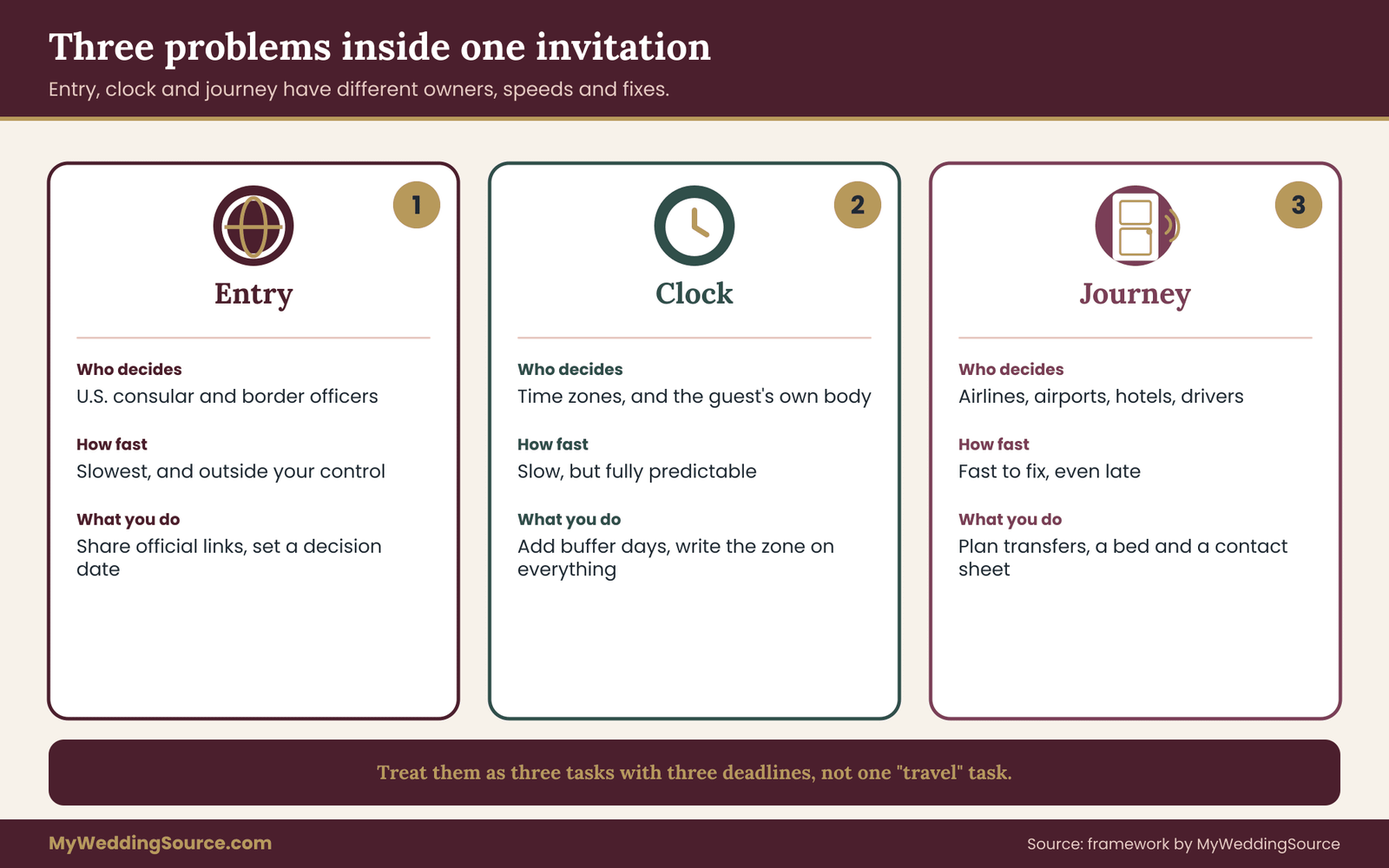
Entry, clock and journey are different problems with different deadlines, and treating them as one “travel” task is how things slip.
Entry is slow and outside your control. Some international wedding guests can apply online in a few minutes and some must book a consular interview that may have a long wait. Either way, the guest has to start early, and you have to give them a firm date to plan against.
The clock is slow in a different way. A guest who flies across many time zones and goes straight to a long ceremony and dinner may be awake for a very long stretch and then struggle to function the next day. That is a schedule problem you can solve with a day or two of buffer.
The journey is the logistics layer: flights, connections, baggage, ground transport, a bed, money, a working phone. It is the part everybody pictures when they think of travel, and it is the part that is easiest to fix last-minute, which is exactly why it belongs third.
Why a card beats a group chat
Group chats are good for warmth and bad for tracking. Within a month you will not remember which uncle said he had applied for what. A one-page card for each guest or household, with five fields, makes status visible at a glance and makes your own follow-ups short. The rest of this guide builds that card gate by gate.
Who is responsible for what with international wedding guests
Before the framework, settle the division of labor with your partner, because international guest lists often come from one side of a family and the planning burden quietly lands on one person.
Name one owner for the international guest tracker. This should be someone who is comfortable sending polite reminders and who will not take a delayed visa personally. If the international wedding guests are mostly from one partner’s family, that partner is usually the owner, but the other can take the venue and schedule questions so the load is shared. A third person, such as a sibling in a convenient time zone, can be the overseas contact who talks to the older relatives in their own language and hours.
Then decide the boundaries in writing, even if only in a note to each other. Will you pay for any part of anyone’s travel? If yes, which part, and does it depend on the guest’s entry decision? Will you put people up in your own home or in a hotel block?
Will you write letters of invitation, and will you include details such as the guest’s relationship to you? If you are unsure how to talk about money without causing offense, travel help belongs in your wedding budget as a line item, not as a favor you improvise.
What guests are responsible for
Guests are responsible for reading the official instructions for their own passport, applying in time, paying the fees, and carrying valid documents. Say this kindly in the first message, for example: “Entry rules depend on your passport, so please check the U.S. government pages we have linked. Tell us if anything is unclear and we will help with the event side of it.” It sets the expectation without sounding cold.
Guests are also responsible for their own health, insurance and travel protection decisions. The U.S. does not provide health coverage to visitors in the way many countries do, and a visit to a hospital can be costly for someone who is not insured, so it is reasonable to encourage visitors to check their coverage before they fly. Phrase it as encouragement and avoid giving specifics that you cannot verify.
What the authorities decide
Two U.S. bodies matter most for visitors. The Department of State, through its Bureau of Consular Affairs and the embassies and consulates abroad, handles visas. Customs and Border Protection, part of the Department of Homeland Security, handles the Electronic System for Travel Authorization, known as ESTA, and the inspection at the airport or border.
A visa or an ESTA approval is permission to travel to a port of entry and request admission. The final decision on admission is made by a CBP officer when the traveler arrives. That is a structural fact, and every honest conversation about international wedding guests should include it once, calmly, without drama.
The five-gate arrival readiness card
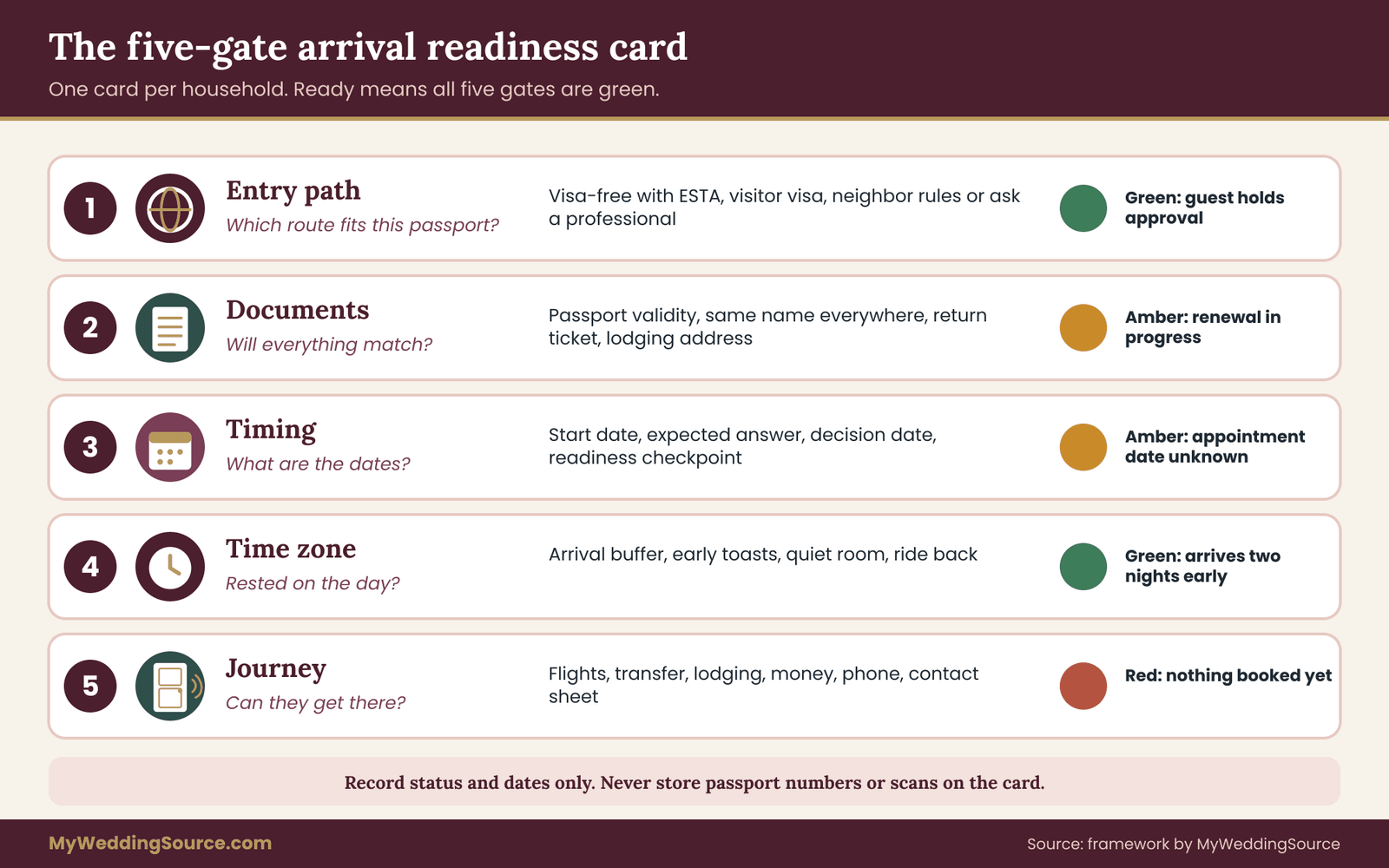
The card is the original tool in this guide. It is a single sheet per guest or household that records where each person stands on five gates. A guest is “ready” only when all five are green. The gates run in the order in which delays hurt most.
Gate one: entry path. Which route applies to this passport? The answer is one of a few categories, covered in the next section: travel without a visa under the Visa Waiver Program with an approved ESTA, a visitor visa from a U.S. embassy or consulate, a special arrangement for neighbors such as Canada and Mexico, or something unusual that needs a professional. You do not decide the answer. You record it.
Gate two: documents. A valid passport, the visa or ESTA that matches it, the same name on every document, a return or onward ticket where relevant, and the lodging address. This gate also covers what you will provide, such as a confirmation of the event, so that the guest can show a clear purpose of travel.
Gate three: timing. The date the guest will apply, the date they expect an answer, and the date by which you both need to know. This gate is where the backward calendar lives.
Gate four: time zone. The arrival date, the number of buffer days before the wedding, and any adjustments to the wedding-day schedule for international wedding guests who will be tired.
Gate five: journey. Flights, connections, ground transport, lodging, money and phone. This is the longest list but the easiest to repair.
How to use the colors
Mark each gate green, amber or red for each guest. Green means confirmed with evidence, such as an ESTA approval the guest has seen on screen or a visa the guest holds. Amber means in progress with a date. Red means blocked or unknown past its deadline. Do not mark green on someone’s word alone if the stakes are high, such as a parent of the couple.
Ask for a confirmation in a form that shows the status, but never ask for a photo of a passport or a visa to be sent in a group chat or by ordinary email. International wedding guests can simply say “approved” and, if you need extra confidence, confirm it on a video call.
A card with five green gates is a quiet success. A card with one red gate and a calendar date next to it is a decision waiting to be made, which is far better than a surprise at the airport.
What this guide does not cover
This guide is about guests who are traveling to attend a wedding and then returning home. It is not about marrying a non-citizen partner, a fiancé visa, a change of status or a green card, which are immigration matters for the couple themselves and need an immigration attorney or the official agencies. It is also not about international wedding guests who plan to work, perform or be paid at the event; a paid role changes the legal category of the trip, so anyone in that position should get advice before they travel. ## Gate one: the entry path for each of your international wedding guests
The entry path is set by the guest’s passport, not by where they live or how close they are to you. A British citizen living in Dubai follows the rules for a British passport holder. A Brazilian citizen living in Lisbon follows the rules for a Brazilian passport. This single fact clears up a surprising number of misunderstandings, so state it early in your first message to each household.
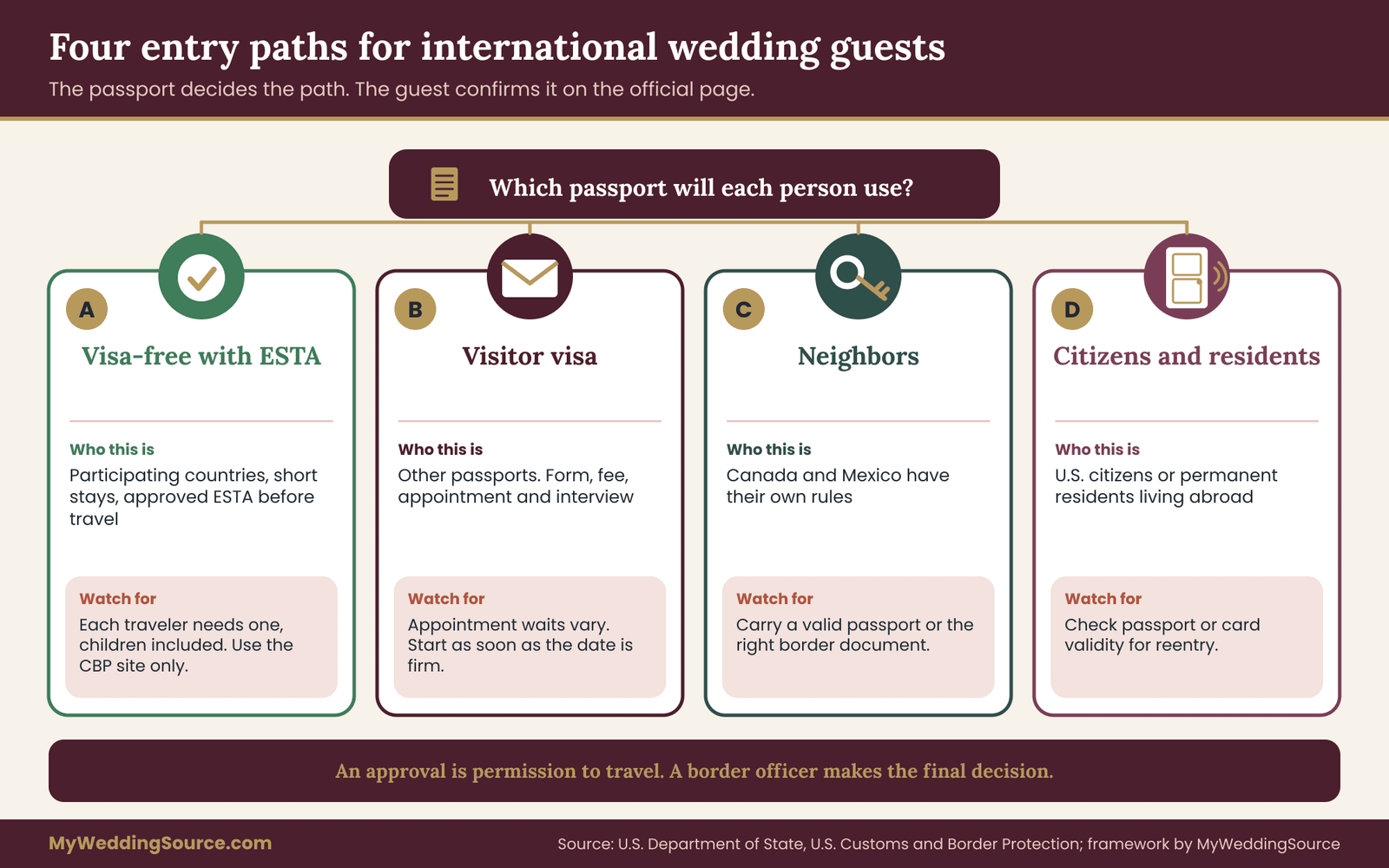
For planning purposes, think of four common paths. Which one applies is for the guest to confirm on official pages, and the list of countries and conditions is published and updated by the government, so do not try to memorize it or copy it into your wedding website.
Path A: travel without a visa, with an approved ESTA
The Visa Waiver Program lets citizens of participating countries visit the United States for tourism or business for a short stay without first getting a visa, provided they hold an approved travel authorization through ESTA and meet the other conditions. A wedding visit is ordinarily a tourism-type trip, which is why most international wedding guests on this path only need the online application.
The stay limit under the program is short and fixed, and the program does not allow a traveler to extend the stay or change to another status while in the United States. Tell international wedding guests who want to turn the wedding into a longer holiday to read the limit on the CBP page and plan their dates inside it with room to spare.
The application is done online at the official ESTA site run by CBP. Some imitation websites copy the look of the official page and charge extra fees for the same form, so tell your international wedding guests to start from the CBP page and not from a search advertisement. The ESTA fee and the validity period are set by CBP and can change, so send people to the site rather than quoting a number.
Three practical details matter for international wedding guests on this path. Each traveler needs their own ESTA, including children and infants, even if a family files together. The ESTA is tied to the passport it was issued for, so a guest who renews a passport after applying needs to check whether to apply again. And an ESTA approval is a travel authorization, not a promise of admission; the officer at the airport decides.
Path B: a visitor visa from a U.S. embassy or consulate
Citizens of countries that are not in the Visa Waiver Program, and some travelers from countries that are, need a visa to visit. The usual category for a wedding visit is the visitor visa, B-2 for tourism, often issued as a combined B-1/B-2. The process generally involves an online application form, a fee, a scheduled appointment at an embassy or consulate, and an interview, though some applicants are eligible for interview waivers, and the rules on that change.
The two things that vary most are the wait for an appointment and how long processing takes afterward. The State Department publishes appointment wait-time information by location, and the wait can differ from one consulate to another and from one season to another.
For the purposes of your calendar, the lesson is simple: a guest on this path should start before you have fully finalized your guest list. If your wedding is in the spring and a relative needs a visa, the practical time to ask them to begin is as soon as the date is firm, which means your save-the-date message is the trigger.
The consular officer’s central question for a visitor visa is whether the applicant plans a temporary visit and has real ties that bring them home. That is why a letter from you does not decide anything on its own, and why the applicant should answer questions about their own job, family and travel plans truthfully. You cannot do that part for them, and you should not try to coach them on what to say.
Path C: neighbors and special cases
Canadian citizens generally do not need a visa to visit the United States and are not subject to the ESTA requirement, but they should carry a valid passport when flying in, and they should confirm the current document rules on the CBP site. Mexican citizens typically need a visitor visa or a Border Crossing Card, which is a specific document for short visits near the border; if a guest holds one, they should confirm on official pages whether it covers the area of your wedding.
Other cases fall outside the neat paths. A guest who holds two passports should check which nationality they will use to travel, and enter and exit consistently with it.
A guest who has been refused entry or a visa in the past, who has an immigration history in the United States, or whose records include arrests or past overstays should get advice from an immigration attorney before applying, because the form asks about these things and incorrect answers can cause long-lasting problems. You can offer to help the guest find that advice and leave it there.
Path D: guests who are not international in this sense
Some guests live abroad but travel as U.S. citizens or lawful permanent residents. A U.S. citizen needs a valid U.S. passport to return to the United States by air, even if they have lived overseas for years. A lawful permanent resident has their own rules for reentry and should check the validity of their card and any time spent outside the country. These international wedding guests belong on your international list for scheduling and time-zone reasons, but their entry gate is a different check, mostly about document validity.
Questions to ask each household, and in what order
Short, repeatable questions make the card easy to fill. Use the same four with every household and write the answer in the card.
First: “Which passport will each person use to travel?” This gets the nationality right and surfaces dual citizens and children early.
Second: “Have you checked whether you need a visa or an ESTA for that passport?” This does not ask for details, and it lets people say “yes, we need a visa” or “I did not know that” without embarrassment.
Third: “Do you have a valid passport, and when does it expire?” Many countries and entry processes expect the passport to be valid beyond the planned trip, so a passport that expires soon should be renewed now. Some passport countries are covered by an arrangement that lowers the validity requirement, and the State Department publishes the list, so international wedding guests should read it rather than guessing.
Fourth: “What date will you apply, and can you tell us when you hear back?” This turns an abstract worry into a date, which is what your calendar needs.
Why you should not ask for copies of documents
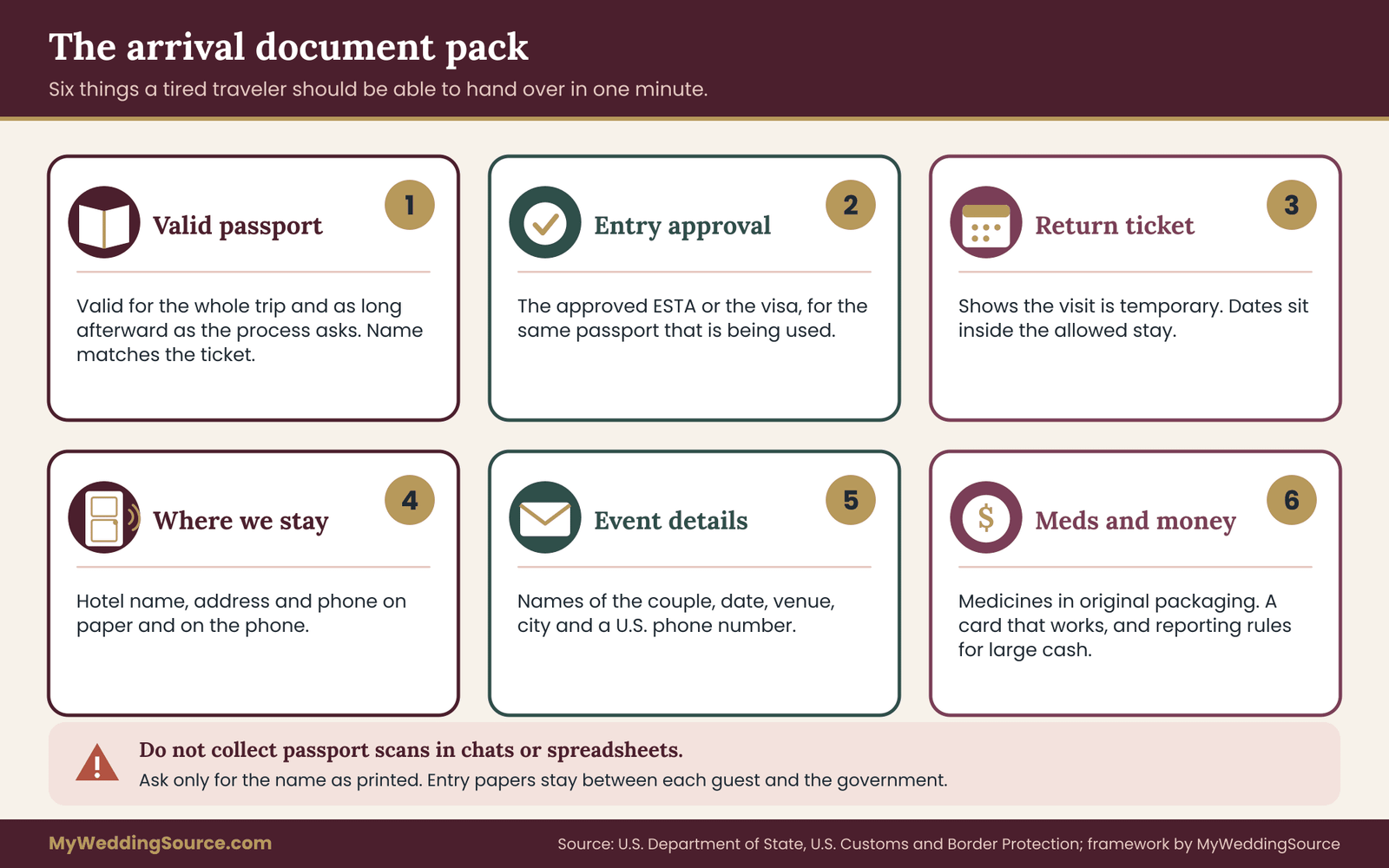
It is tempting to collect passport scans so that you can book flights or hotel rooms for people. Resist it. A passport scan is the kind of document that is damaging if it leaks, and a shared spreadsheet or a group chat is a poor place for it to live.
If you are booking anything on a guest’s behalf, ask for exactly the details the booking needs, such as the name as printed in the passport, and nothing else. If a guest offers a scan, thank them and say you do not need it. The more you can keep entry documents between each guest and the government, the cleaner your own records stay.
A note on visa-free does not mean easy
Guests from visa-waiver countries sometimes assume nothing can go wrong. Two things can. The ESTA application can be denied or require a visa, usually because the guest answered a question in a way that makes them ineligible for the program, and the guest should know that this is possible.
And at the airport a CBP officer asks about the purpose of the visit and the length of stay, so the guest should have the wedding details, the lodging address and a return ticket ready. None of this is a reason to worry; it is a reason to apply early and to carry the documents on the card.
Rules of thumb for the entry gate
Because the specifics change, build the gate around stable principles.
- The guest checks the official source for their own passport, and you give them the link, not a summary.
- Anything with a fee goes through the official site only.
- Each traveler, including children, has their own entry document.
- A guest who has a complicated history gets professional advice before applying.
- You record status and dates, not documents.
- You treat “not yet” as normal until the deadline, and “no” as a prompt for the fallback plan, not as a failure.
If you set the entry gate up this way, you protect yourself from the two biggest mistakes: giving wrong information with confidence, and learning too late that a guest never started. ## Gate two: documents, names and the invitation letter for international wedding guests
Gate two is about the paper and the screen. It answers one question for every traveler: when this person stands in front of an officer, will everything match? Most document trouble is not dramatic. It is a passport that expires too soon, a name spelled one way on the ticket and another way on the passport, or an approval that was issued for an old passport number.
The core documents
For almost every guest the core set is the same. A passport that is valid for the whole trip and, depending on the passport country and the process, for some time afterward. The entry authorization that matches that exact passport, either an approved ESTA or a visa in the passport. A return or onward ticket, because officers commonly want to see that the visit is temporary. The address and phone number of the place where the guest will stay. And the details of the event, kept simple and in hand.
The wedding details are worth stressing. A guest who can say “I am here for my cousin’s wedding on this date at this venue, and I am staying at this hotel until this date” gives a short, clear answer.
Print the key facts on a card or a short letter that the guest can keep with their passport: names of the couple, date, venue name and city, hotel name and address, and a phone number of someone in the United States. This is not a legal document. It is a memory aid for a tired traveler at a counter.
Names must match, even when your wedding materials use something else
Names cause more trouble than people expect. International wedding guests may have several given names, a single name, two surnames, a name written in a different alphabet in daily life, or a transliteration that differs between documents. For travel purposes, the name that matters is the one printed in the machine-readable zone of the passport. Flight tickets, hotel bookings tied to a visit and any transfer reservations that need a name should use that form.
Your invitations and place cards can use the name the guest actually goes by, as long as you keep a private mapping to the passport name for anything involving travel. If you are planning a block of rooms, the lodging section below covers room blocks; for international wedding guests, add one column to your own private list for “name as in passport” and ask the guest to type it themselves.
The invitation letter question
Couples hear a lot about invitation letters, so it is worth being precise. An invitation letter is a personal letter from the host to a visitor. It describes who is inviting whom, why, where and for how long. International wedding guests sometimes include one with a visa application or carry one when they travel.
What it is not: a requirement of the visa process in general, a substitute for any official document, or a promise that a visa will be granted. The consular officer decides the visa on the applicant’s own situation and on the law, and the State Department’s visitor visa pages should be your guide on what to submit.
If a guest asks for a letter, write one; it is a courtesy and costs you a few minutes. If a guest tells you a letter is “required,” ask them to check the instructions of their own consulate, because requirements are set locally and change.
A plain letter, written in your own words, usually works. Include the date of the letter, your full names and address, the guest’s full name as in the passport and your relationship, the event, the date and place of the wedding, the expected arrival and departure dates, where the guest will stay, and how to reach you. Sign it. Keep it to a page.
What not to promise in the letter
Be careful with money language. If you write that you will pay for the guest’s flights, lodging or expenses, you are making a statement that someone may read as a commitment, and officers may ask the guest about it. Say only what you really intend.
If you plan to pay for the hotel room, say so; if you are not paying for anything, you do not need to mention finances at all, and the guest can speak for their own means. Do not use language from forms meant for immigrants, such as sponsorship or support obligations, because those are different legal tools for a different purpose.
Also avoid writing anything that reads like you are vouching for the guest’s character or telling the officer what the decision should be. A letter that says “please approve” sounds worried. A letter that sets out the facts sounds ordinary.
Children, older relatives and special situations
Each traveler needs their own documents, including infants. Children traveling with only one parent, with grandparents or without either parent sometimes need extra consent paperwork under the rules of the departure country or the airline, and requirements vary, so the family should ask the airline and the relevant authorities well ahead of departure. The couple can help by giving the family the clearest possible adult contact details in the United States.
For older relatives and guests with health needs, think about two practical items. Medications are usually best carried in their original packaging with the prescription label, in hand luggage, and travelers should check the rules for specific medicines with the CDC and CBP before leaving.
And if a guest uses a wheelchair or other mobility aid, airlines and airports provide assistance that is arranged in advance through the airline, so the guest should tell the carrier when booking and not at the check-in desk. The hotel guidance for guests with different mobility needs, linked in the lodging section below, pairs with this.
A shared system that respects privacy
Your tracker will hold names, relationships, flight numbers and arrival times. That is enough information to be useful to a stranger, so treat it carefully. Keep it in one document with limited sharing, not in a group chat that eight cousins can forward. Do not store passport numbers, visa numbers, dates of birth, or ESTA application numbers in it.
If a family member asks you to hold a copy of their documents “just in case,” politely suggest that they keep their own copy in a secure place of their own and give a trusted person at home a copy, which is a safer arrangement than giving it to a host abroad.
Delete or archive the tracker when the trip is over. The wedding guest list guide covers how to keep a guest list tidy; for international wedding guests the same discipline applies with a little more care about what you hold.
Document day: a calm checkpoint before departure
Set a checkpoint about two weeks before the wedding, when the plans are real but fixes are still possible. Ask each household to confirm four things in a short message: the passport is in hand and valid, the entry authorization is in hand and matches, the flights are booked with the passport name, and the printed event details and lodging address are packed. If any of them is “no,” you have two weeks to react. If you wait until the week of the wedding, you have days.
At this checkpoint you can also gently ask about phones and payments. A phone that works in the United States, or a plan for a local SIM or eSIM, makes a very big difference to a person who has just landed and needs to find a driver. A card that works in the United States, plus a small amount of local cash, is enough for most international wedding guests. Do not give money advice beyond that, and never pressure anyone about what to bring.
When a document problem shows up
If a guest tells you their passport expires soon, their ESTA was denied, or a name on the ticket is wrong, do three things. Thank them for telling you early. Ask what the official next step is and by when. And put a date on your own card next to the red gate. Many document problems can be repaired if they are found two months out, and very few can be repaired the week of the wedding.
A final point on tone. Guests do not like to bring bad news to hosts. They worry they are letting you down. If you make a habit of saying “this is normal, tell us early and we will adjust the plan,” you will hear problems sooner, and sooner is the only thing that makes them fixable. ## Gate three: a backward calendar for international wedding guests
Gate three is the calendar, and it has one governing idea: work backward from the wedding date, and put a decision date in front of each step that you cannot control. The calendar below does not use official processing times, because those change and differ by place. It uses stages. You fill in the dates yourself from the State Department and CBP pages, then add margin.
Start with the three anchor dates
Every international wedding guest has three dates on the card. The first is the date the guest begins the entry process. The second is the date they expect an answer. The third is the date by which you both need the answer in order to book flights and rooms at sensible prices. The gap between the second and third dates is your margin, and it should be large for a guest on a visa path and smaller for a guest on a visa-free path.
Consider how the wedding date itself affects these. If your date lands on a holiday weekend in the United States, flights and rooms are more expensive and more crowded. If it lands near a major holiday in your international wedding guests’ home countries, some will have a hard time traveling at all. The date-choosing guide on choosing a wedding date deals with the general version of this problem, and it is worth reading before you commit if your international list is large.
The stages, from far to near
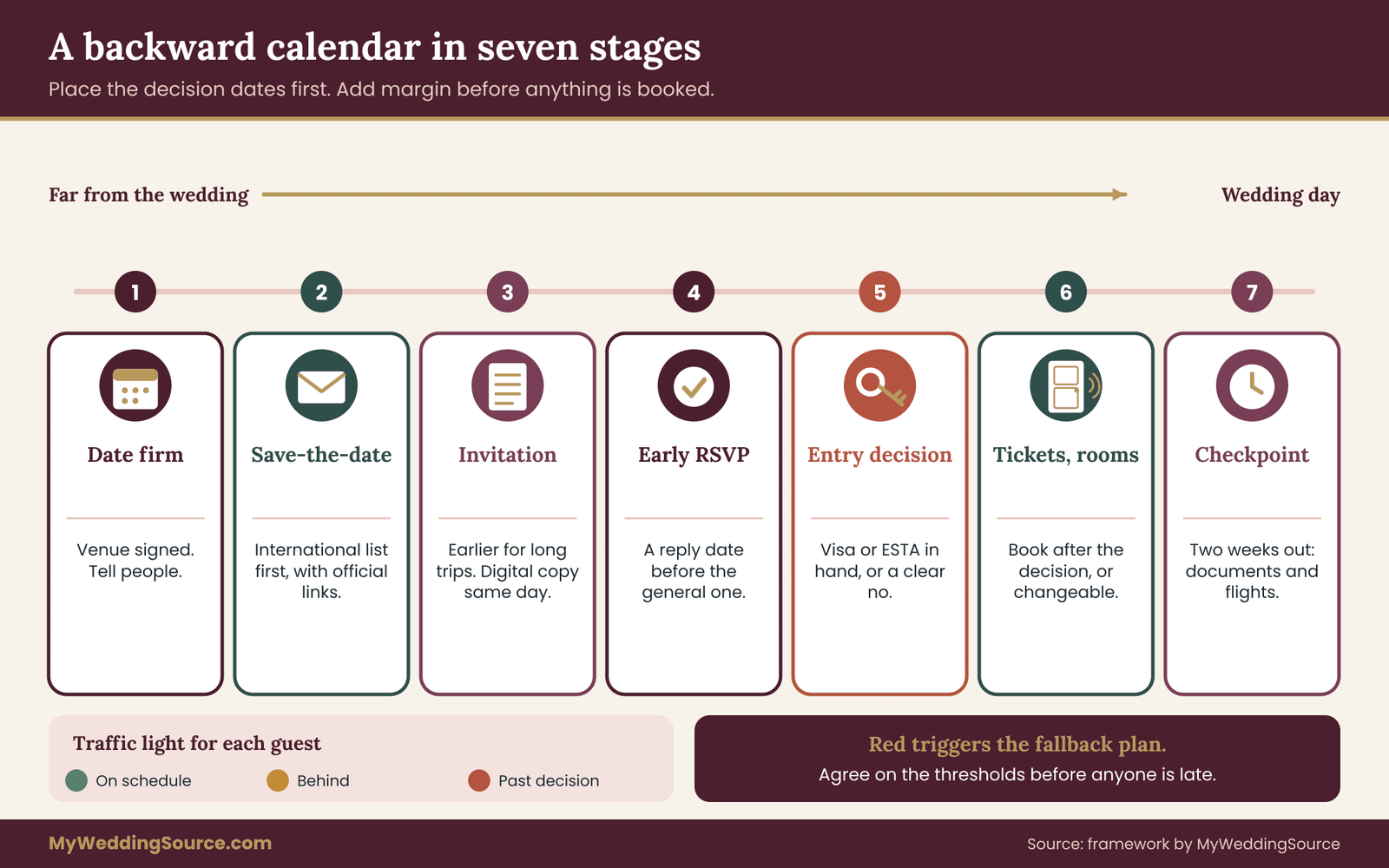
Think in seven stages and attach your own dates.
Stage one: the date is firm. As soon as the date and city are fixed and your venue contract is signed, you can tell people. This is the earliest point at which a guest on a visa path can begin planning, and the earlier the better, because the appointment queue is the longest delay in the whole process.
Stage two: the save-the-date. Send it to all international wedding guests first, before the domestic list, with a short line that says entry rules depend on the passport and that you will share official links. A save-the-date is not an invitation to apply for a visa on its own; some consulates want to see actual travel plans, so international wedding guests should read the instructions for their own location. If you need help with wording and timing, the wedding invitation etiquette guide is the right companion.
Stage three: the invitation. For international wedding guests who must travel far, send the formal invitation earlier than you would for local guests. The printing and mailing side, including international postage and proofing, is covered in the invitation printing guide, and a digital copy sent the same day avoids the weeks a letter can spend in transit.
Stage four: the answer to “can you come?” Set an RSVP date for international wedding guests that is earlier than the general one. The reason is practical: you need to know who is traveling to plan blocks, transfers and seating, and the international wedding guests need to know where they stand to buy tickets. The RSVP etiquette guide has wording for an early reply date that does not sound pushy.
Stage five: the entry decision. This is the date by which each guest holds the visa or the approved ESTA, or has told you they cannot come. It is the most important date on the card.
Stage six: tickets and rooms. Book after the entry decision wherever you can. If the guest is booking before the decision, suggest a changeable or refundable fare, and read the fare rules carefully, since conditions vary and a cheap fare may not be changeable at all.
Stage seven: the readiness checkpoint. About two weeks before the wedding, run the document-day check from the previous section.
How to place the stages on your own calendar
Do it in order, with a pencil. Write the wedding date at the right. Mark the readiness checkpoint two weeks before it. Mark the arrival day, which for most long-haul international wedding guests should be at least a day or two before the wedding, a decision explained in the next section.
Then place the entry decision date, and be generous: the further the guest is from a fast and simple process, the earlier this date should be. Next, place the date international wedding guests on the longest paths should start. Put the save-the-date before that.
If the resulting calendar says a guest should have started last month, do not hide that from yourself. It is information. It may mean that this guest is on the amber list from day one, and that your fallback plan, described later, matters.
Use a three-level traffic light for the calendar
Instead of treating every delay equally, define three levels for each guest and agree on them with your partner in advance.
Green: the guest is on schedule against their own anchor dates. Nothing to do except thank them.
Amber: the guest is behind by a few weeks, or has not told you the date of their appointment. Send a friendly check-in and offer to help with the event side, such as a letter or hotel confirmation.
Red: the entry decision date has passed without an approval, or the guest has reported a refusal or a missing document that cannot be fixed in time. Move to the fallback plan, which is described in the section on alternatives and failure conditions.
Deciding the thresholds before anyone is behind lets you act calmly. When the calendar is vague, couples tend to wait too long, then find themselves emailing a guest about a visa in the week of the wedding.
Time costs on the couple’s side
The couple’s own work also takes time, and it is worth putting it on the calendar. Collecting passport names and arrival details, sending a letter, answering the same question from different relatives, and keeping the tracker up to date add up to hours across the months. Estimates for that depend on how many international wedding guests are traveling, so do not try to apply a formula. Instead, make the task small and regular: one short session every two weeks to review the cards, send two or three check-in messages and update dates.
If the international list is large, consider handing the follow-up to a trusted relative or a planner. A relative who speaks the language of your international wedding guests and can call at the right hour can be more helpful than any app. The broader timeline logic in the twelve-month wedding checklist can host these tasks alongside the rest of your planning.
Money and timing: what to commit and when
Entry processes involve fees paid by the guest to the government, and these are not refundable in some cases if the application is denied. That is a reason to avoid pushing a guest to start before they are sure, and a reason for you to be clear about who pays what. If you intend to cover any fees, say so early and in writing. If you do not, say nothing about it, since many international wedding guests would be offended by the offer or the omission.
On the couple’s side, avoid committing money to travel for international wedding guests whose entry is unresolved. Hotel blocks are normally managed with cut-off dates and attrition terms, so it is sensible to arrange block sizes with some flexibility; your budget can help you decide where a buffer belongs.
A note on school terms, harvests and festivals
Guests are not all free on the same dates, and calendars abroad differ from yours. Exam periods, religious observances, seasonal work and national holidays may affect whether a relative can leave. Ask early, ask kindly, and listen to the answer.
You may find that moving the date by one week is easier than convincing six people to take extra leave. When you cannot move the date, it is reasonable to accept that some international wedding guests will not be able to come and to plan a way for them to take part from afar, which is covered later. ## Gate four: time zones, jet lag and the wedding-day schedule for international wedding guests
The fourth gate has nothing to do with paperwork. It is about how a human body and a day plan meet. A guest can have every document in order and still have a miserable wedding if they land at noon, go straight to a four o’clock ceremony and are asked to dance at midnight, which is the middle of the following morning according to their own body.
The time zones you are actually dealing with
The contiguous United States spans four time zones, called Eastern, Central, Mountain and Pacific, and the country as a whole has two more, Alaska and Hawaii-Aleutian. A flight from a European or Asian city often lands in one zone and ends in another, so a guest whose wedding is in Denver may arrive via an airport in New York, Chicago or Dallas and make a connection into a different clock. Write down the zone of the wedding venue, not the zone of the arrival airport.
Daylight saving time adds a second layer. Most of the United States moves its clocks forward in March and back in November, on dates set by law; Hawaii and most of Arizona do not change. Many other countries change on different dates, or not at all. The result is that for some weeks each year the hour gap between your wedding city and a guest’s home city is different from what it is the rest of the year.
If your wedding falls near a clock-change date in either place, check the conversion on an official or well-known time source rather than relying on a number a relative gave you. The official U.S. time is published at time.gov, which is a helpful reference when you are checking a start time.
Write the time zone on everything
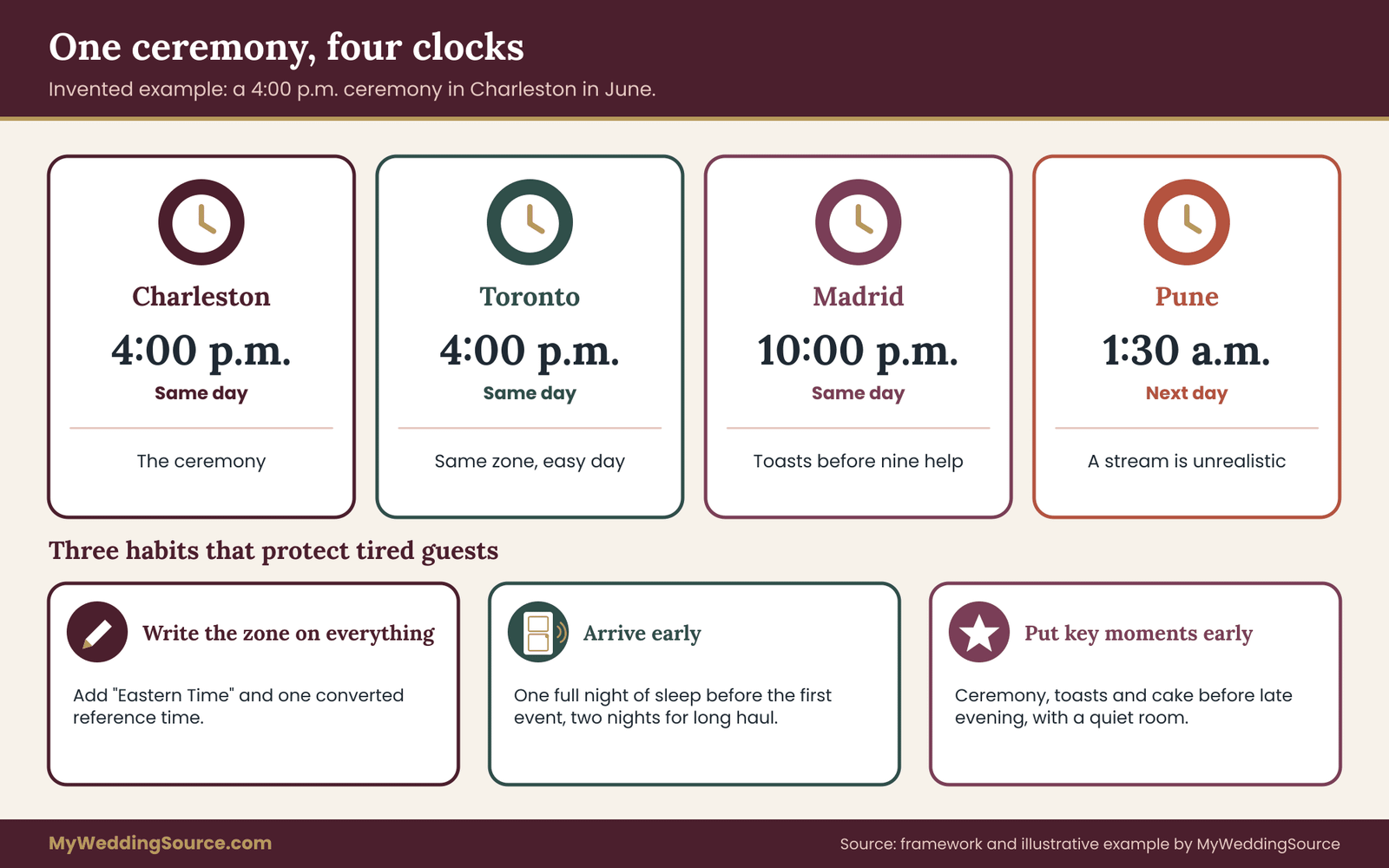
Add the time zone to every invitation, website page, schedule and message that gives a clock time. “Ceremony at four o’clock, Central Time” takes a few extra words and prevents a surprising number of mistakes. For international wedding guests, it is also useful to give one converted reference time on the website or a printed schedule, such as the ceremony time in the one or two zones where most of your overseas family lives. Do the conversion carefully and mark it as a convenience.
For example, with both places on standard time, four in the afternoon in New York is nine in the evening in London and six the next morning in Tokyo. That one line tells a Tokyo relative they would be watching a live stream at dawn, which is a very different proposition from what they imagined. It also tells you whether a live stream makes sense for that family or whether a recording and a call at a better hour would serve them better.
Say dates and units the way every guest reads them
International wedding guests read dates in different orders. The string 06/12 means June twelfth to an American and the sixth of December to many readers elsewhere. Write dates with the month spelled out, such as “Saturday, June 12,” and include the year on anything that will be printed or saved. Use the same approach for time: “4:00 p.m.” or “16:00” are both clear, but pick one style and use it everywhere, or show both.
The same courtesy applies to temperature and distance. Americans use degrees Fahrenheit and miles. When you tell international wedding guests the outdoor ceremony will be around eighty degrees, a visitor from a Celsius country may not know what to pack. Give both, or simply describe the weather in words: warm, hot, cool, likely rain. A line about the dress code with the weather in both units is the kind of detail that makes an international guest feel considered, and it costs you one extra sentence.
The arrival rule
Our planning rule, and it is a planning rule and not medical advice, is that every long-haul guest should arrive early enough to sleep at least one full night before the first event they are expected to attend, and ideally two nights before the wedding itself. The more time zones they cross, and the more fragile the guest, the more this matters. A young relative flying a short distance may need less. A grandparent flying across the globe should have more.
The reasoning is simple. Most travelers find that crossing many time zones disrupts sleep for a few days, and that eastward travel is commonly harder to adjust to than westward travel. The Centers for Disease Control and Prevention publishes travel health information that covers jet lag and the usual ways to reduce it, such as shifting sleep times, getting daylight at the right hours, and staying hydrated. Refer international wedding guests who ask medical questions to that guidance or to their doctor, and do not offer your own remedies.
What the rule means for you: do not schedule anything required on the day most international wedding guests land. A welcome event can be offered on the evening before the wedding, with an easy exit, and with no assumption that everyone will attend. People who arrive that day may need a hot meal and a bed, not a party.
Shape the wedding day around tired guests
There are small decisions in the wedding schedule that help international wedding guests without costing the rest of the party anything. Put the most important moments earlier in the evening: the ceremony, the toasts, the first dance, the cake. A guest whose body says it is three in the morning can usually manage an hour of toasts, and will be grateful to have seen the important parts before fading.
Offer a quiet place at the venue where a guest can sit or lie down for fifteen minutes, with water and a light snack nearby. Keep the transport back to the hotel running earlier than the final song, so that someone who wants to leave at nine does not have to wait until midnight for a ride.
Make sure the venue and the lodging both have a place for older relatives to rest. For more on this, the guide to wedding guest care planning covers babies, children and older relatives in detail, and many of its ideas help a jet-lagged adult too.
Food is another factor. A guest’s hunger rhythm moves with their body clock. Pairing the cocktail hour with substantial food, rather than only light bites, can be kind to people who feel they are eating breakfast at dinner. Think too about early-morning wake-ups; a hotel that offers a simple breakfast at six helps the guest who is awake anyway.
The day after
Plan the morning after as carefully as the day before. International wedding guests often want to see you again before leaving, and they often have the earliest flights. A farewell brunch that ends by noon, a clear plan for airport rides, and a note with each guest’s departure date on the card are useful.
If a guest wants to extend the trip for sightseeing, they should check the length of stay they are allowed under their entry authorization, and not rely on the reasons they originally gave. Your part is to share information about the area and then step back.
Time zones and the people who stay home
For guests who cannot attend, a live stream or a recorded message is a way to include them, and time zones decide what is realistic. Ask the household you want to include what hour works. If the ceremony is at an impossible hour for them, offer a short recorded greeting from you to them, and ask them to record one for you in return.
The digital side of this, including links and backups, belongs in the plan for wedding day digital operations, and a short guest video message gives remote relatives a role that is easy to fulfill from anywhere. Whatever you pick, decide it in advance so you are not scrambling on the day.
A short sequence for the arrival day
When a long-haul guest lands, the sequence matters more than anything else. Passport control and customs first, then baggage, then a ride to the lodging. A driver who knows the flight number and watches for delays is a gift.
A hotel that can offer an early check-in, or at least a place to store luggage until the room is ready, removes the worst part of arrival, which is standing in a lobby at eight in the morning with no bed. A written reminder in the welcome note of where to find breakfast, water and a pharmacy is enough. Then the guest sleeps.
That sequence sounds obvious, but it is exactly what gets skipped when the couple is thinking about the wedding and not about the person who has been traveling for a day. Writing it on the card turns courtesy into process, and process is what survives a busy week. ## Gate five: the journey, lodging and money for international wedding guests
The last gate is the one everyone pictures first and the one that is easiest to fix late, which is why it comes last. It covers how a guest gets from their front door to the venue and back, where they sleep, how they pay for things and how they stay reachable. The goal is not to plan every minute for them. It is to remove the few failure points that turn a long trip into a bad one.
Routing and connections
Most international wedding guests will land at a major airport and then either connect on a domestic flight or travel by road. The first airport in the United States where a traveler arrives is usually where inspection by CBP takes place, which means passport control, baggage collection and customs happen there, even if the final destination is elsewhere.
A few airports abroad offer U.S. preclearance, in which the inspection is done before departure; CBP publishes where these are. For everyone else, the first U.S. stop is where the clock for the next flight starts to matter.
Two choices lower the risk. First, book the whole trip as one itinerary where possible, so that a delay on the first flight is the airline’s problem and not the traveler’s. Separate tickets are sometimes cheaper, but if the first flight is late and the second airline is not responsible for the connection, the guest may be stuck.
Second, leave generous time between flights when the first stop includes immigration, a bag recheck and a security screening, because lines vary a great deal. A guest can ask the airline for its minimum connection time and then add a comfortable margin.
Think about the airport nearest your venue and the airport with the best flights, which are often different. A slightly longer drive from a larger hub may suit an international traveler better than a small regional airport with a tight connection. Ask your venue and your hotel for their view on realistic travel times, and add time for traffic and for the fact that arrivals are tired.
Ground transport
Plan the leg from airport to lodging for each guest or household, not for the group. A shuttle with a fixed schedule works well when many international wedding guests arrive on the same day, and it is a poor fit when flights land at random hours.
A named driver with the flight number, who watches for delays, is a simple, calm option for the most important international wedding guests. Rideshare apps work in most U.S. cities but require a working phone and a payment card, so check that your guest has both before relying on them.
Be careful about rental cars. Many travelers are keen to drive on their own after a long flight, but a jet-lagged driver in an unfamiliar country, on the right side of the road, is a safety risk. Encourage international wedding guests to rest first, and consider keeping a ride plan for the first day. If a guest does plan to drive, they should check the rental company’s and the relevant state’s rules about foreign driver’s licenses and the need for an international driving permit, which differ by state.
Lodging
Arrange lodging so that international wedding guests are near the venue or near the transport that serves it, and so they are not isolated from each other. A cluster of international wedding guests in one hotel makes it easier to pair a returning relative with a new friend, and the hotel block can often include breakfast. If you do not already have a plan for room blocks and varied budgets, the guide on coordinating wedding guest hotels shows how to keep prices and accessibility needs in view together.
For international wedding guests, ask the hotel three things. Can it hold luggage for international wedding guests who arrive before the room is ready, or offer an early check-in for a fee or at no cost? Does it accept a foreign card and what identification does it need at check-in? And can it receive a package or a garment bag a day or two ahead? Many hotels ask to see a passport at the desk, which is normal; international wedding guests should keep it in hand luggage on arrival.
Money, phone and power
Most guests can manage with one credit or debit card that works internationally and a small amount of cash for tips and small purchases. Encourage them to tell their bank about the trip so that a first-day purchase is not blocked, and to know the fees their card charges abroad. Do not recommend a particular card or app, and do not quote exchange rates.
If your international wedding guests come from cash-gift cultures, be aware that some will want to bring cash for you. The United States requires travelers to report currency and monetary instruments above a threshold when they enter, and the CBP website explains the rule.
The honest approach is to mention that there are reporting rules for large amounts of cash and point them to the CBP page, and to suggest that a transfer or a check is simpler. Do this gently, since you are protecting them from trouble and not questioning their generosity.
Phones need a plan. Options include an international roaming plan from the home carrier, a local SIM, or an eSIM purchased before departure. Any of them is fine; the point is that the guest has a way to call the driver and a way to reach you. Power is the last detail.
Electrical outlets in the United States supply a lower voltage than much of the world and use flat-pin plugs. Many phone and laptop chargers accept a wide range of voltages and need only a plug adapter, but hair dryers, irons and some other tools may not, and the label on the device will say. A guest who brings a steamer for a wedding dress should check it first.
Items in the suitcase
Guests may want to bring gifts, food from home or traditional items for the ceremony. Plants, fruit, meat and some other food items can be restricted or prohibited at the border, and travelers have to declare what they carry on the customs form. CBP publishes plain guidance on this.
The safe suggestion is that guests who plan to bring food or plant gifts check the CBP page before they pack, and when in doubt, leave the item at home or declare it. A confiscated gift is a sad moment on a day that should be happy.
Formalwear belongs in carry-on luggage when possible. Checked bags can be delayed, and a delayed suit is a larger problem than a delayed toothbrush. Medications should travel in carry-on luggage in their original packaging, as covered earlier.
Health and insurance
Most visitors are not covered by a U.S. health plan, and medical care can be expensive for someone without U.S. coverage. It is reasonable to suggest that each guest check whether their own health or travel insurance applies abroad, and to read the policy for the exclusions. Frame it as a kindness, and avoid recommending a product. The CDC also lists health information for travelers, including vaccination and general health guidance, and international wedding guests with chronic conditions should talk to their own doctor before they fly.
Travel insurance has another role: it can reimburse some costs when a trip is canceled or interrupted, within the policy’s own terms and exclusions. Whether it fits a given guest is their decision, and the terms vary widely, so nobody should assume it covers a visa denial or a change of mind. That belongs in the policy wording, not in your wedding website.
When flights are disrupted
Delays and cancellations happen. The Department of Transportation publishes information on airline passenger protections that applies to flights to and from the United States, and the details depend on the airline, the route and the cause of the disruption.
If a guest’s flight is canceled, the first step is to contact the airline, and the second is to message you with the new arrival time. Keep your own plan flexible enough to absorb a late arrival: a driver who can wait, a hotel that holds the room, a seat at the wedding that can be released if the guest is delayed beyond the ceremony.
For the highest-stakes guests, such as parents of the couple, build a day of slack into their arrival, and consider a quiet backup arrival route. A grandmother whose flight is canceled on Thursday and rebooked for Friday is a story you tell at the reception. The same grandmother canceled on Saturday morning is a heartbreak. Slack costs one hotel night and is the best money you can spend on the whole gate.

The contact sheet
Create one page that every international guest has in hand and in their phone. It lists your emergency contact, the coordinator who is awake in their time zone, the hotel phone and address, the driver’s phone, the venue address and the schedule for the weekend. It should be short enough to read in a minute and clear enough for a tired person at a luggage carousel. When something goes wrong at an airport, this is what gets used. ## A worked case: three guests, three paths
This example is invented to show how the card works. The couple, the international wedding guests and the dates are made up, and the example does not describe real people or real processing times. It is only a way to see the gates in motion.
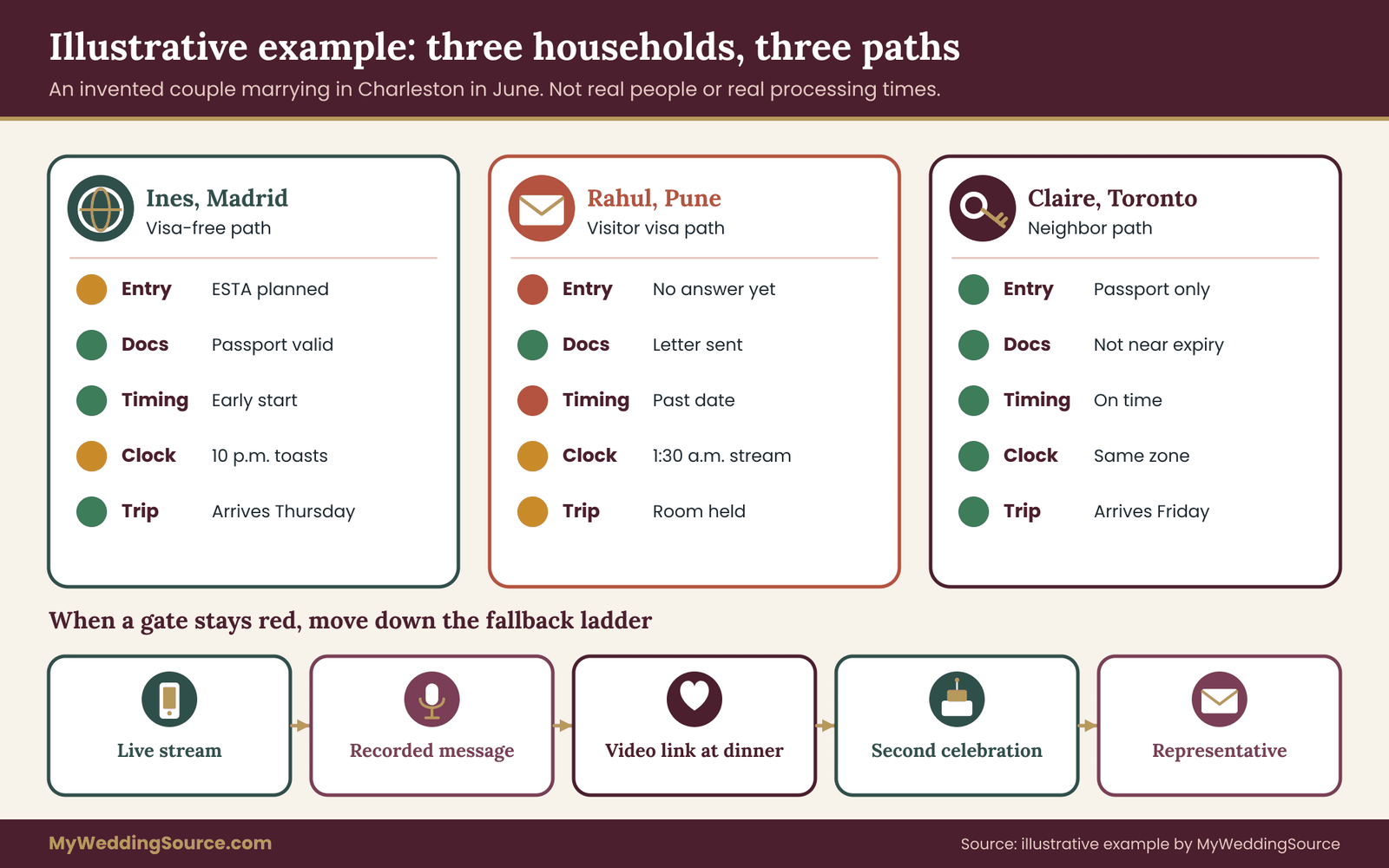
Priya and Jonah are marrying on a Saturday in June in Charleston, South Carolina, so the wedding runs on Eastern Daylight Time. They have three households that will cross a border. Priya’s friend Inés lives in Madrid and holds a Spanish passport. Priya’s uncle Rahul lives in Pune and holds an Indian passport. Jonah’s cousin Claire lives in Toronto and holds a Canadian passport. The couple’s international tracker owner is Priya’s sister, who works in the same time zone as the wedding and has the evenings free.
The cards at the start
When the date becomes firm, Priya’s sister creates a card for each household and sends the save-the-date to the three of them before the general list, with the same short note: entry rules depend on the passport, here are the official links, please tell us the date you plan to start.
Inés is on the visa-free path. She reads the CBP page, sees that Spain participates in the Visa Waiver Program and that she needs an approved ESTA, and says she will apply a few months out. Her entry gate is amber with a date, and her documents gate is green once she confirms her passport is valid.
Claire is on the neighbor path. Canadians generally do not need a visa or an ESTA, and she needs a valid passport to fly. Her entry gate is green after a quick check; her main task is to confirm her passport is not close to expiry.
Rahul is on the visa path. His entry gate is amber from the first day, and the calendar matters most for him. He decides to look up the appointment wait time at the nearest U.S. consulate, and reports that the wait is long. That finding goes on the card as a date: his entry decision date is set several months before the wedding, well before flights are priced.
Gate by gate
Time zone. At four in the afternoon in Charleston, it is ten at night in Madrid and about half past one the next morning in Pune. Toronto is in the same time zone as Charleston. This shows at once that a live stream is realistic for Inés and Claire, if either could not attend, and unrealistic for Rahul. The sister therefore sets the ceremony at four in the afternoon, keeps the toasts before nine, and plans a quiet room at the venue.
Arrival. The couple puts Inés and Rahul on the long-haul rule: arrive two nights before the wedding if possible. Claire is traveling a short distance and arrives the day before. The hotel block holds rooms for the Thursday night, and a driver is booked with the flight numbers once known.
Documents. Priya writes a one-page letter for Rahul that names her and Jonah, says who the uncle is, gives the date and place of the wedding, and the hotel he will stay in. The letter says nothing about money, and nothing about the decision. Rahul decides whether to include it with his application. Priya does not ask him for a copy of his passport; she asks only for the name as printed.
What goes right and what does not
Inés gets her ESTA and reports it approved. Her card turns green. Claire books her flights and sends her arrival time. Rahul’s appointment is scheduled, and his interview takes place. At the decision date on the card, he has not yet received an answer. That is the moment the calendar was built for. His entry gate turns red, which, under the rule the couple set in advance, activates the fallback.
The fallback has two parts. First, the sister calls Rahul at a good time for him and tells him the plan: his hotel night is held for another week, there is no pressure, and the family will keep the live stream ready. Second, she asks Priya whether she wants to arrange a small celebration with him after the honeymoon in case he cannot travel. Rahul’s passport and ticket plans are his own, so the couple’s role is to keep options open and keep their tone warm.
In this invented case, the passport is returned in time, and Rahul arrives on the Thursday. In another version of the story, the answer would have come too late, and the family would have turned to the live stream and the second celebration. Both versions are acceptable outcomes, because the plan treated each as possible.
What the example shows
Three households produced three different timelines from one set of questions. The card did not change the rules for any of them. It simply revealed that one of the three was on a long path, told the couple that early, and gave them a date to act on. That is the whole value of the system: it replaces vague worry with a date.
Failure conditions and alternatives for international wedding guests
A plan for international wedding guests that has no failure conditions is a wish. Decide now what counts as failure and what you will do. Failure here does not mean someone is to blame. It means the guest cannot be there on the day under the current plan.
The conditions that trigger the fallback
Define them in writing with your partner. Typical conditions are: the entry decision date has passed with no approval; the guest reports a visa refusal or an ESTA that requires a visa; a document problem that cannot be corrected before the checkpoint; a flight cancellation that cannot be repaired within a day of the wedding; a health issue that makes travel unwise; or a refusal of admission at the port of entry.
That last one is rare, and it is worth saying plainly. An officer at the border can refuse admission even to a traveler who holds a visa or an approved ESTA. If it happens, the guest will normally be returned on a flight, and there is little you can do except stay in touch and be kind. Do not argue with officials on the guest’s behalf, and do not promise outcomes. Give the guest a number to reach you, and ask the airline for help with rebooking.
What to do, in order
When a condition is met, move through the same steps each time. Acknowledge the news and thank the guest for telling you. Ask the guest what they want: some will want to try again, some will want to be done. Release any resources you were holding for them, such as a hotel room or a seat, in line with your contracts, which is where the cut-off dates in your hotel block matter.
Choose an alternative from the list below. Update the card and the schedule, and let the people who were relying on that guest know, such as the driver, the seating chart and the family member who was going to sit with them.
The alternatives
You have more options than “come” or “do not come”. The right one depends on how close the guest is to you, how they feel and what fits the day.
A live stream of the ceremony is the first choice for international wedding guests whose time zone makes it workable. It needs a person to run it, a stable connection and a plan for what happens if the connection fails; the digital operations guide already linked covers the backup side.
A recorded message, in either direction, is a good option when the time difference is extreme or the guest is not comfortable on camera. A short video that you play at the reception, and a message from you to them afterward, can mean a great deal.
A call or video link during dinner works for close relatives, but it should be tested and have a person who looks after it, so it does not interrupt the toasts.
A second celebration, held weeks or months later in the guest’s country or in a place both sides can reach, is the warmest alternative for a very close family member. It does not have to be a large event. A dinner can do the job.
A representative is a person who carries a letter, a gift or a message on the guest’s behalf. It suits cultures and families where such gestures are meaningful.
Changing the date is the last resort, since it affects every vendor, every other guest and every contract. Consider it only if the missing guest is central to the wedding, such as a parent, and the cost and the effects on other international wedding guests are acceptable. The earlier section on choosing the date discusses the trade-offs when a date moves.
What not to do
Do not pressure a guest to reapply, travel against medical advice or take risks with their documents. Do not suggest that they use a different category of entry to make the trip easier, since misstatements on a travel authorization can have long-lasting effects. Do not tell the other guests the reason in detail, since entry decisions are private. Say that the guest is unable to travel, and let them share more if they wish.
Hosting international wedding guests once they arrive
Everything above gets people to the door. Once they are in the building, the host’s job changes from logistics to welcome. A few habits help.
Greet each long-haul guest personally or arrange for a family member to do it, and point to a place they can rest. Introduce them to one or two people who can help them feel at home, which matters most for international wedding guests who do not know the other families. Keep a short list of the languages guests speak and match volunteers, so a relative who is more comfortable in another language is not left standing alone during the cocktail hour.
Explain, lightly and without condescension, anything that might be unfamiliar. A card on each seat or a line in the program can describe the order of events, whether there is a receiving line, when the meal is served and whether guests are expected to tip anyone. A note about tipping is useful, because customs differ and visitors worry about it; if gratuities are included in the vendor contracts, say so. Do not turn the day into a lecture on American customs, which belongs in its own guide, and keep it practical.
Finally, thank them in a way that fits the trip. A hand-written note at the hotel desk, a welcome bag with water and a snack, and a short toast that names the international wedding guests who traveled far can say a great deal. The guest who flew through the night to be there does not need a gift as much as they need to feel that the effort was seen.
Your next steps
Start this week with three actions. First, list every guest who holds a passport from another country, and write down the passport country next to each name. Second, create the five-gate card, with the gates and a space for dates, and send each household the same short message with the official links from the State Department and CBP. Third, put four dates on your calendar: the save-the-date to international wedding guests, the entry decision date, the readiness checkpoint two weeks before the wedding, and the fallback trigger date.
Then check in every two weeks. Update the cards, send two or three friendly messages and keep your fallback plan where you can find it. If your list of international wedding guests is long, hand the follow-up to a trusted person who is awake in the right time zone. The calmest weddings with international wedding guests are not the ones where nothing goes wrong. They are the ones where the couple knew early which gates were open, and what to do about the ones that were not.
FAQ
Do we need to write an invitation letter for our international wedding guests?
You do not need to for the wedding, but guests sometimes ask for one and it is polite to provide it. A letter is not a requirement of the visa process in general, and it does not guarantee an outcome. Keep it factual: your names, the guest’s name, the date and place, where they will stay and how to reach you. International wedding guests should follow their own consulate’s instructions for what to submit.
Can we promise our guests that they will get a visa?
No. Visa decisions are made by consular officers at U.S. embassies and consulates under U.S. law, and admission at the border is decided by a CBP officer. Neither depends on the wedding or on your wishes. You can help by giving accurate event details, by encouraging international wedding guests to apply early and by planning a fallback, but you cannot promise a result.
Which guests need an ESTA and which need a visa?
It depends on the guest’s passport. Citizens of countries in the Visa Waiver Program can generally travel for a short visit with an approved ESTA, while citizens of other countries generally need a visitor visa. Canadians have separate rules. Because the lists and conditions change, each guest should check the CBP and State Department pages for their own passport.
How far ahead should international wedding guests start applying?
As early as the wedding date is firm, for anyone who needs a visa, since appointment wait times can be long and vary by consulate. ESTA is faster, but CBP advises applying well before travel. Send the save-the-date to international wedding guests first, give them the official links, and set an entry decision date that leaves margin before tickets are booked.
How many days before the wedding should long-haul international wedding guests arrive?
As a planning rule, aim for at least one full night of sleep before the first event, and ideally two nights before the wedding for international wedding guests who cross many time zones or who are older or in poor health. Recovery varies by person, so ask your international wedding guests, and keep the arrival day free of required events.
Should we buy plane tickets for guests who are waiting on a visa?
It is safer to wait until the guest has the visa or has told you they cannot come. If a guest must book earlier, a changeable or refundable fare lowers the risk, though conditions vary by airline and fare. Be clear in advance about who pays if a ticket is lost, and do not commit money for a guest whose entry decision is still open.
What if an international guest is refused entry at the airport?
It is uncommon, but officers can refuse admission even to a traveler holding a visa or an approved ESTA. The guest will normally be returned on a flight, and you cannot change the decision. Stay in touch, make sure they have your phone number, help with rebooking if asked, and switch to the fallback, such as a video link or a later celebration.
Can international wedding guests extend their trip after the wedding?
Possibly, but rules depend on the type of entry. Visa Waiver Program travelers cannot extend their stay or change status, and visa holders have their own conditions, so international wedding guests who want to stay on should read the CBP and State Department pages and plan inside the limit. Share local suggestions if they ask, and let them handle the legal side.
Sources
- Bureau of Consular Affairs, U.S. Department of State
- Visitor visa, U.S. Department of State
- Electronic System for Travel Authorization (ESTA), U.S. Customs and Border Protection
- Visa Waiver Program, U.S. Customs and Border Protection
- Information for international visitors, U.S. Customs and Border Protection
- Know before you go, U.S. Customs and Border Protection
- Find a U.S. embassy or consulate, U.S. Department of State
- Travelers’ health, Centers for Disease Control and Prevention
- Official U.S. time, National Institute of Standards and Technology and U.S. Naval Observatory
- Aviation consumer protection, U.S. Department of Transportation