
A wedding story display is the board, slideshow, timeline or printed spread that tells guests how the two of you came to be. This guide shows how to build one that feels personal and honest without exposing the private family history that belongs to someone else: a consent checklist, a three-lane sorting method and a line-by-line edit routine.
Treat every fact on a wedding story display as a separate item and run it through three questions: Whose is it, who will see it, and how long will it last? Facts that are only yours can go up. Facts that involve a parent, sibling, former partner, child or someone who has died need that person’s yes, or a gentler rewrite. Facts that carry health, money, legal, immigration or family-conflict weight stay off the wedding story display, however moving they are. Then edit captions, dates and names before anything is printed.
Most couples start a wedding story display with an easy instinct: gather the best photos, add a few lines about how you met, and let the guests wander past it during cocktail hour. The trouble starts in the details. A caption that says “the year Dad lost the business” is a family secret on a three-foot board.
A photo of a grandmother in a hospital bed, posted because she looks radiant, is a medical record the whole room can read. A line about your first marriage might be old news to you and new news to your fiancé’s grandparents.
None of this means the wedding story display has to be bland. The most affecting displays tend to be specific, and specific is not the same as exposing. This article gives you a method for building a wedding story display for keeping the specifics that make your story yours while removing the facts that make someone else uncomfortable, unsafe or unready. It sits alongside the broader guidance on wedding etiquette and goes narrower: one object, one set of choices, one edit checklist.
A note on scope. This is general planning information, not legal, tax or financial advice. Privacy expectations, image rights and copyright rules differ by place and by situation, so where a rule matters, the sources at the end point you to the issuing agency to confirm the current version.
What a wedding story display is and where it goes wrong
A wedding story display is any visual or written presentation of your relationship and background that guests can read or watch at your wedding. It comes in several shapes, and each shape leaks information in its own way.
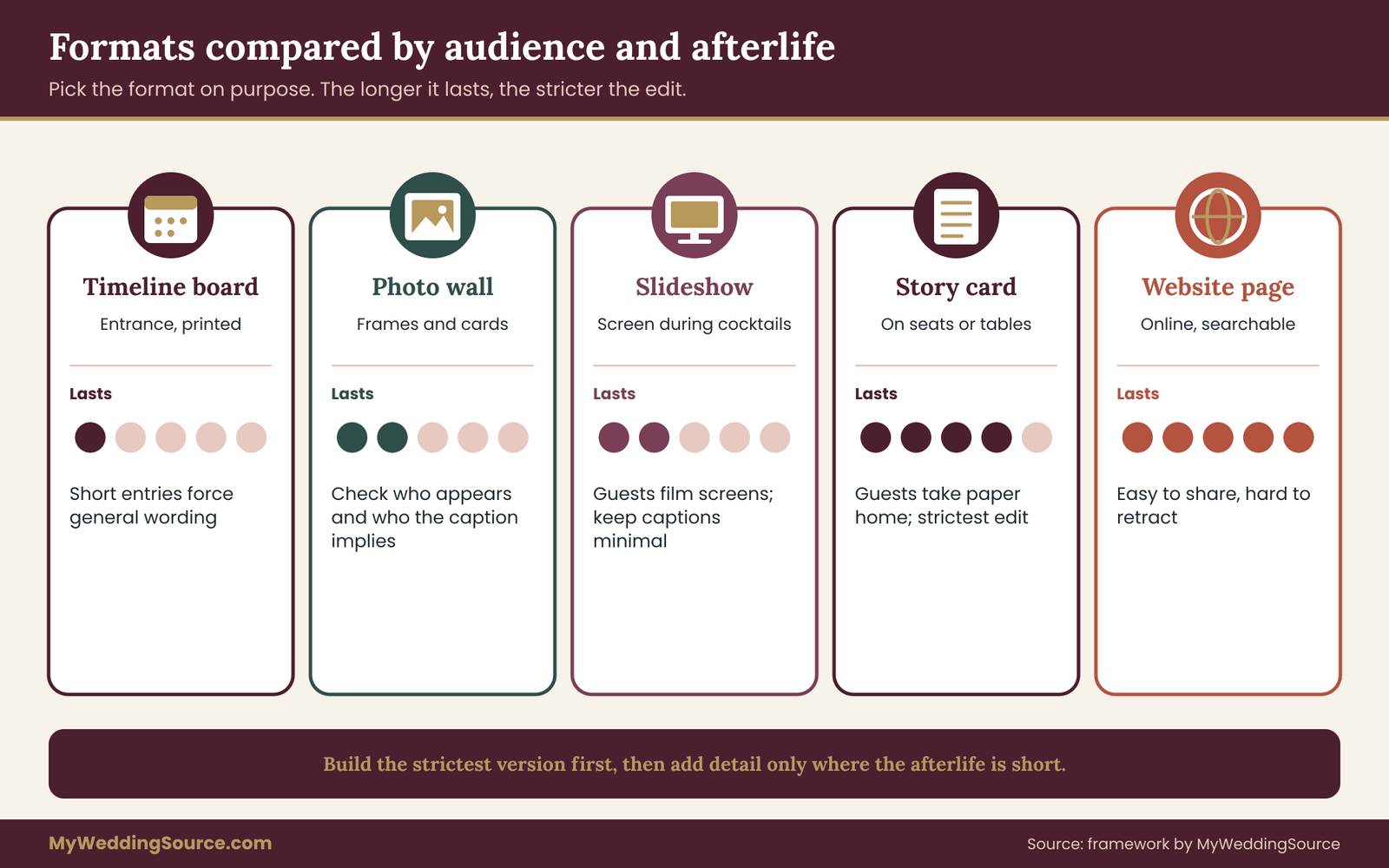
A timeline board lists dates and events along a line: where you met, first trip, engagement, the move. A photo wall pairs images with short captions. A looping slideshow on a screen shows photos and text in sequence, sometimes with music. A printed story card or program page puts a short narrative on each seat or table. A website page can echo any of the above, and it lasts far longer than the evening.
Whatever the format, the wedding story display does three things that private conversation does not. It fixes a version of events in writing. It puts that version in front of everyone at once, including people who would never have heard it otherwise. And it creates a record: guests photograph it, post it, and sometimes keep the printed card.
That combination is why a wedding story display deserves more care than a toast. A spoken line fades. A printed or filmed line stays. The guide to wedding photography consent covers how images travel after the day; the same logic applies here, only the content is words and archive photos instead of live portraits.
The usual leaks
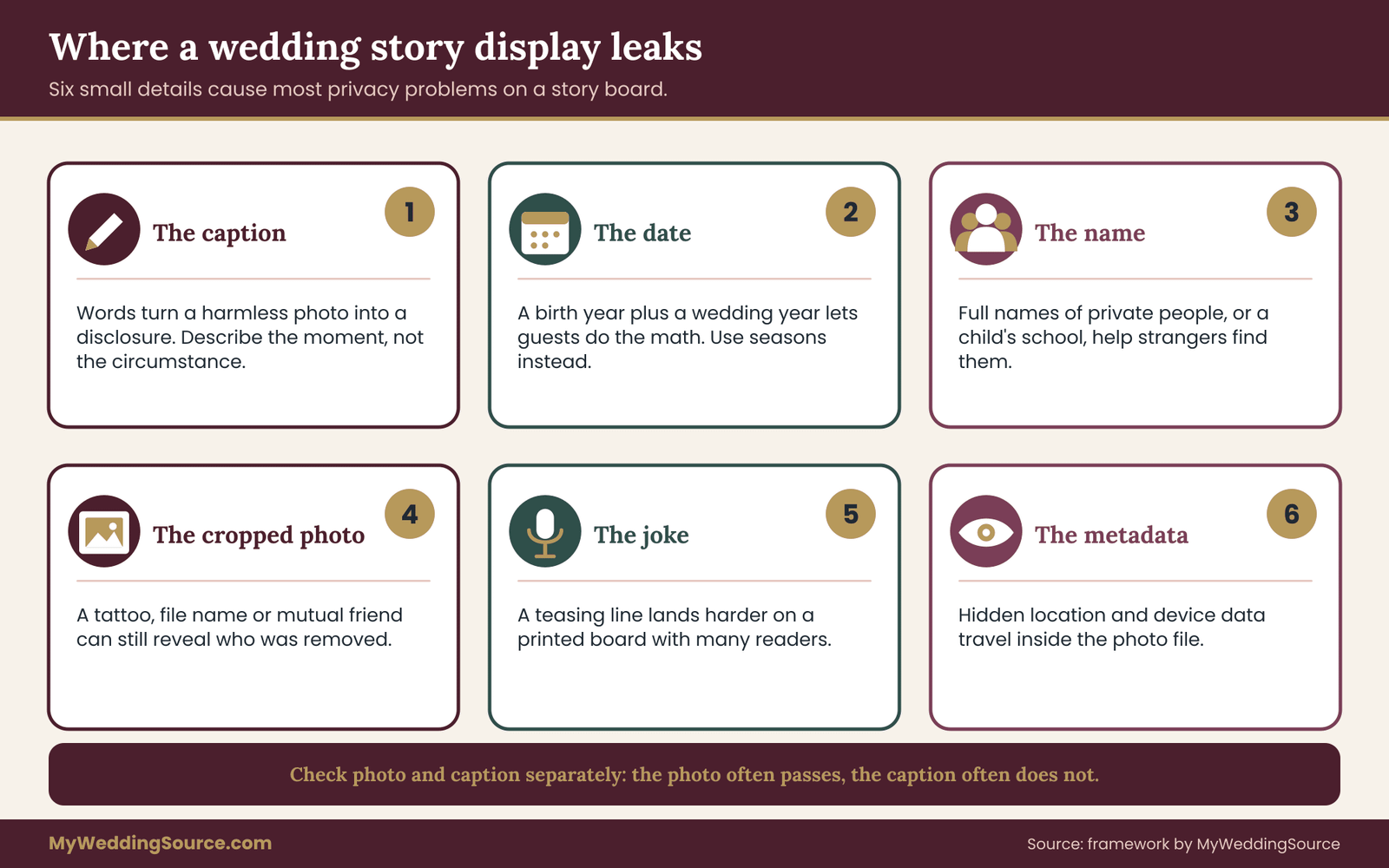
When a wedding story display goes wrong, it is rarely because anyone meant harm. It goes wrong in a handful of predictable ways.
The caption that says too much. Photos are often fine. The caption turns them into disclosures: “Mom’s second year of treatment,” “the summer before the divorce,” “right after Grandpa came to this country.”
The date that does the math. A timeline with a birth year, a wedding year and a parent’s remarriage year lets any guest work out things nobody announced. Dates are small, and they add up.
The name that was never cleared. A former partner appears in the background of a favorite photo. A friend who has since fallen out of touch is credited. A sibling’s child is named in a caption without asking the child’s parents.
The cut that does not cut. Someone crops an ex out of a photo, but the file name, a visible tattoo or a mutual friend’s caption still gives it away.
The humor that lands badly. A teasing line about a mother-in-law’s cooking or an uncle’s past is fine in the family group chat and sharper on a printed board with a hundred and fifty readers.
What this guide does not cover
This guide does not tell you what your family history is worth or whether to be open about it. Plenty of couples choose to share hard stories on purpose, and that is their right when the story is theirs. The target here is narrower: stories and facts that belong partly or wholly to other people, shown on a wedding story display without those people having a say. If you also plan a memorial element, the same principles carry over, with extra care for relatives who are still grieving.
Whose story is it? Separating your story from your family’s
The first useful move has nothing to do with design. It is a sorting exercise on paper: what is your story, and what is the story of the people around you?
Your story is the set of events you were part of as an adult participant, or events about you that you are free to tell. How you met, what you did on the first trip, the apartment with the broken radiator, the proposal. Even here your partner shares ownership of the shared events, so both of you approve.
A family’s story is the set of events that happened to parents, grandparents, siblings, former partners or children, even when you were in the room. A parent’s job loss, a sibling’s diagnosis, a grandparent’s journey to this country, a relative’s time in prison, a family estrangement, a parent’s earlier marriage.
You may feel entitled to tell these because they shaped you, and in a sense they did. But the person at the center of the story may not have agreed to a public telling, and the fact that they are your parent does not make the telling yours.
The overlap problem
Most real stories sit in the overlap. You are not telling your father’s bankruptcy; you are telling that you moved back home at twenty-four, and that your father’s situation was part of why. The overlap is where the editing happens. In the overlap, ask whether the part you need is your experience or their event. “I moved home and learned to cook with my mother” is your experience. “My father’s business failed” is his event.
Writers who work with personal stories often use a simple rule of thumb: you can tell what you felt and did, and you should be careful about telling what someone else did, felt or went through. It will not settle every case, but it settles many.
A two-column worksheet
Before gathering photos, sit down together with two blank lists. Label the left column “Mine or ours” and the right column “Someone else’s.” Brainstorm every moment, fact and photo you might use and put each in a column. Do not judge yet. Items in the left column move to the next stage. Items in the right column are not banned; they are flagged for the consent step later in this guide.
You will usually find the right column is longer than you expected. That is normal. Childhood photos include parents. A first apartment includes a former roommate. A graduation includes a proud grandparent. Photos with other people are not the issue by themselves. Captions and context are.
Who counts as an affected person
For the purposes of this guide, an affected person is anyone who is named, shown in a recognizable way, or described closely enough to be identified, and whose life includes something they have not chosen to make public. That can include:
- Parents, stepparents, grandparents and in-laws.
- Siblings and their partners or children.
- Former partners, including a former spouse of either of you.
- Children from a prior relationship, including children whose parentage or custody is sensitive.
- People who have died, whose close relatives may still react strongly.
- Friends, roommates and colleagues who appear in photos or stories.
- Anyone whose immigration, health, legal or financial circumstances are part of the story.
You do not need to ask all of them about everything. The point of the next sections is to avoid asking everyone by giving you a way to decide who truly needs to be consulted. For ideas on how to share decisions across families more generally, the guide on wedding decision-making is worth a read before you begin collecting opinions.
A short example of the overlap
Suppose one partner grew up mostly with a grandmother after a parent’s long hospitalization. The story is real, and it explains why the grandmother sits at the center of the couple’s world. A draft caption reads: “Grandma raised me while Mom was in the hospital.” The grandmother’s role is the partner’s own memory. The mother’s hospitalization is the mother’s medical history. A safe rewrite keeps the love and drops the diagnosis: “Grandma’s kitchen was home.” The grandmother is honored, the mother is not announced, and nothing the partner holds dear is lost.
That one edit is the whole method in miniature. The remaining sections turn it into a repeatable process.
The Own, Audience, Afterlife test for every fact
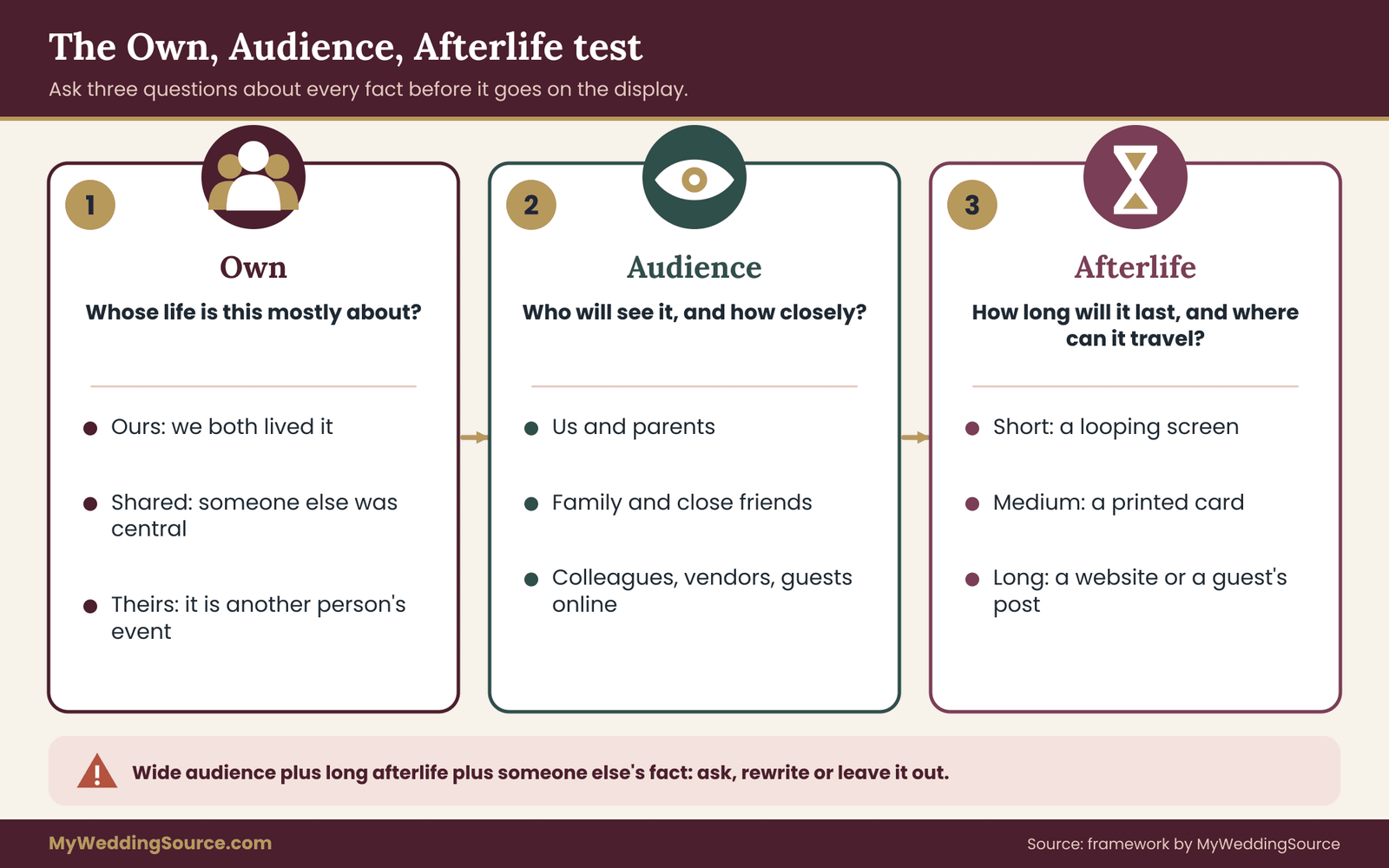
Sorting by “mine or someone else’s” is a good start, but it is too blunt on its own. Some facts about other people are harmless and warm. Some facts about you are risky for reasons that have nothing to do with ownership. A better filter asks three questions of each fact on the wedding story display, one at a time. This guide calls it the Own, Audience, Afterlife test, and it is the original decision tool at the center of your wedding story display edit.
Question one: Own
Who owns this fact? Not legally, in the ordinary sense: whose life is it mostly about?
- Fully ours. We both lived it and we both approve. The first date, the shared car breakdown, the dog we adopted.
- Mostly ours, partly theirs. We were there, but someone else was central. A parent’s retirement party, a sibling’s wedding where we met.
- Mostly theirs. The fact is about another person’s life and we are just close to it. A relative’s illness, a parent’s earlier marriage, a grandparent’s wartime history.
Score each fact as ours, shared or theirs. “Theirs” facts need the person’s consent, a rewrite that removes the identifying detail, or a decision to leave them out.
Question two: Audience
Who will see this, and how closely will they read? Audience matters because the same fact lands differently with different readers. A cousin who already knows about a family estrangement will shrug at a vague reference. A new coworker of your partner’s and a great-aunt who was never told will each read it a different way.
Think in rings:
- The two of you.
- Parents and siblings.
- Extended family, including those who live far away.
- Close friends.
- Colleagues, neighbors, and plus-ones who know very little.
- Vendors and venue staff who see the wedding story display during setup.
- Anyone online, if guests photograph it and post it.
A fact comfortable for ring two may be wrong for ring five. Ask which ring is the widest one that will realistically see the item, and test against that ring, not the cozy one.
Question three: Afterlife
How long will this last, and where can it travel? An afterlife score depends on format.
- Spoken or live-only. A line that scrolls past on a looping screen and is gone. Shortest afterlife.
- Printed and left on a table. Guests may take it home. Medium.
- A board that you later keep. Lives in your home, maybe in a photo album.
- A photo or video posted online by a guest. Long and uncontrolled.
- A page on your wedding website. Long, searchable, and sometimes indexed by search engines.
A sensitive fact in a loop that runs for a few seconds is not the same exposure as the same words on a printed card. The more durable the format, the stricter the test.
Putting the three together
Give each fact a quick mark for each question: Own as 1, 2 or 3 (ours, shared, theirs), Audience as the widest ring it reaches, and Afterlife as short, medium or long. You do not need numbers beyond that. The pattern tells you what to do.
A fact that is ours, seen mostly by close rings, short afterlife goes straight onto the wedding story display.
A fact that is shared or theirs, with a wide audience or a long afterlife needs consent or a rewrite.
A fact that is theirs, widely seen, long-lived, and sensitive in nature stays off.
Notice that this is a decision method, not a rule list. It forces you to say out loud why something is in or out, which is useful when a relative asks later.
How to run it in an evening
Print your two-column list from the earlier worksheet, or open it on a laptop. For each fact, write three short marks in the margin. Do it together, because the two of you will often disagree about the audience ring. One partner may think “everyone knows” while the other knows that half the guests have never heard it. That disagreement is the point of doing the test jointly. It is far cheaper to find the gap at your kitchen table than when a guest reads it aloud.
Keep the marks. For a wedding story display, they become the backbone of the wedding story display edit checklist later, and they let you explain a decision in one sentence: “It is about Dad’s health, the room is wide, and it would be printed, so we left it out.”
A note on photos versus text
The test applies to photos and to captions separately. A photo of a family dinner may be perfectly fine on its own. The caption “last dinner before the court date” turns it into something else. Score the photo and the words as two items. Often the photo passes and the caption fails, and the fix is simply a different caption.
Another case on a wedding story display: an image where a person is recognizable but the story around them is not. A wedding story display that shows your uncle at a cookout is not telling his private history. The risk comes from what you add to it. When in doubt, describe the moment, not the person’s circumstances.
Sorting facts into three lanes: Show, Ask, Keep
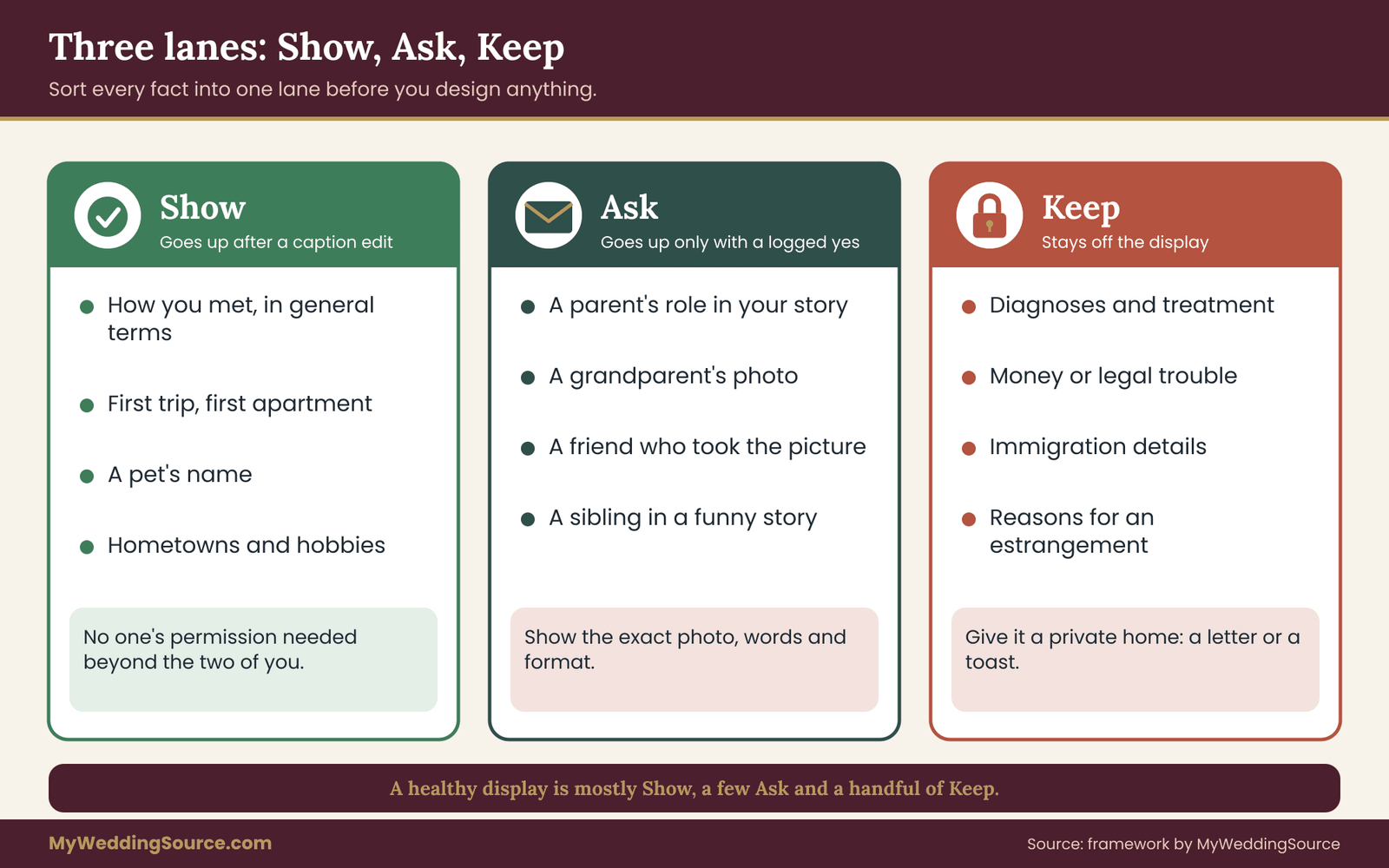
The test gives you marks. Now turn the marks into lanes. Three lanes are enough: Show, Ask and Keep. Each fact goes in one lane, and the lane determines what you do next.
Lane one: Show
These are facts that pass without conditions. They are yours or shared with your partner, they carry no health, legal, financial or immigration weight, and they would not surprise the people named in them.
Typical examples are how you met in general terms, the city you each grew up in, the hobby you both took up, the trip where you realized things were serious, a pet’s name, the first apartment, the engagement location, and a favorite family recipe credited with the family’s blessing.
Showing does not mean careless. Even a Show fact gets a caption edit in the checklist: remove exact addresses, full names of private people, and anything that identifies a child’s school or routine. But Show facts do not need anyone’s permission beyond the two of you.
Lane two: Ask
These are facts that involve another person’s life but could go up with that person’s yes. They are not secrets. They are the kind of thing a person might happily see on a wedding board if asked, and might feel stung by if surprised.
Typical examples are a parent’s role in your story (a mother who drove you to every audition), a grandparent’s photograph with a caption of their own wording, a sibling’s name in a funny story, a friend who introduced you, a former classmate in a group photo, or a childhood home.
For Ask items, do not just message “is this okay?” Show the exact words and the exact photo, say where it will appear and for how long, and offer a way to say no without a reason. The consent section later in this guide gives scripts.
Lane three: Keep
These facts do not go on the wedding story display. Keep does not mean shameful; it means that the wedding story display is the wrong place, however true or meaningful the fact is.
Typical Keep items are medical diagnoses and treatment of anyone other than you (and sometimes you), money trouble, legal trouble, immigration status or the details of a journey someone has not chosen to share, adoption or parentage details, circumstances around a death, reasons for an estrangement, details of a former marriage that involve the other person, and anything that would let a guest identify a child’s custody situation.
If an item in the Keep lane matters to you, give it a better home. A letter to a parent. A private toast. A conversation with the officiant. A quiet moment before the ceremony. The ceremony step-by-step guide shows where quiet, private moments fit in the day, and a short exchange between the right people there serves a Keep fact better than a poster does.
Edge: when a Keep fact is also your own
Sometimes a Keep fact is truly yours: your own illness, your own past marriage, your own earlier name. You can choose to share these. The extra care is about your partner, your family and any other person involved. If you decide to share your own hard story, do it on purpose, tell the closest affected people first, and keep the wording factual and short. Shock is not a gift to your guests, and a display is a poor way to inform your mother of something she has not been told.
Lane tally
When you finish, count how many items are in each lane. A healthy ratio is mostly Show with a handful of Ask and a few Keep. If the Ask lane is large, you may be overreaching on other people’s stories; trim to the items that truly matter. If the Keep lane is empty, look again. Nearly every family has at least one thing that should not be on a wedding story display.
The tally also helps you size the wedding story display. A wedding story display with twelve Show items and two Ask items is manageable. One with five Show items and fifteen Ask items is really a project in family diplomacy, and it may be easier to trim to the ones that tell your story rather than theirs.
Five edit moves that protect a wedding story display
Once a fact is sorted, you rarely have to choose between showing it whole and deleting it. Five edit moves sit between those extremes. They keep the feeling and remove the exposure. Use them in order when you edit the wedding story display: try the lightest move first, and escalate only when it does not solve the problem.
Move one: Generalize
Replace a specific detail with a broader one that is still true. “The summer Dad was between jobs” becomes “the summer we spent at the lake.” “My sister’s wedding in Tampa” becomes “a family wedding in Florida.” “The apartment on Fenwick Street” becomes “our first apartment.”
Generalizing is the workhorse of any wedding story display edit. It keeps a recognizable human moment while stripping the part that points at an address, a person’s circumstance or a date that does the math. It also reads more smoothly, because personal stories on a display tend to be best when they are short.
Move two: Reframe from event to feeling
Shift the caption from what happened to someone else toward what it meant to you. “After Mom’s surgery” becomes “The year we learned how much we needed each other.” Be honest with yourself here: a reframe should not hide a lie. If the feeling is real, it will read as real without the medical detail. If the reframe is a euphemism that would confuse the people who lived through the event, simplify further instead.
Move three: Swap the person for the place or object
Instead of “Grandpa’s last Christmas,” use a photo of the Christmas tree or the table, with a caption like “Christmas at the house.” The recipient of the memory is clear to the family, and a stranger sees a warm holiday scene. This also works for photos of people in sensitive situations: use the one taken before the sensitive moment, or one that shows an object or a place rather than a face.
Move four: Move it to a private format
Some stories are too meaningful to cut and too sensitive to display. Put them in a format that has a controlled audience: a handwritten letter to a parent, a one-page note slipped into a keepsake box, a private toast at the rehearsal dinner, or a conversation with an officiant who can weave a sentence into the ceremony with the family’s agreement. The wedding story display stays light, and the weight goes where it belongs.
The guide to ceremony cue sheets shows where a short, quieter personal moment can sit in a program.
Move five: Cut
When nothing else works, cut. This is not failure; it is editing. A wedding story display gains focus when it drops a detail that was drawing attention away from the main story. If you find yourself writing four paragraphs of explanation to justify a photo, the photo is not working for this format.

A quick drill
Take a caption you think is fine and run the moves on it. Draft: “Mom, Dad and me, the Christmas after the divorce, still smiling.” Generalize: “Mom, Dad and me, Christmas 2009.” Reframe: “A Christmas with both of them.” Swap: a photo of the tree. Move: save for a card to your mother. Cut: leave out. Each version gives a different result, and often the second or third move is the sweet spot.
Editing names and relationships
Names on a wedding story display carry as much exposure as stories. Three habits help.
Use first names or roles only where needed. “Grandma Rose” is warm and specific. “Rose Ellen Marlowe Kessler, born in 1938 in Lviv” is a profile that any guest could search.
Avoid labeling relationships that are not settled. “My stepdad” may be fine. “My father’s girlfriend” is a status that might change before the wedding. If a relationship has a history, describe the person by what they did for you, not by their label.
Do not credit a minor by full name. A child can appear in a group photo, but a full name and school or sports team in the caption helps strangers find them. Use a first name with parental approval, or none at all.
Editing dates
Dates are quiet identifiers. Think about what a guest can compute. A birth year plus a wedding year gives an age. A marriage year plus a child’s birth year can reveal the timing of a pregnancy. A parent’s remarriage year, a move abroad and a death year let someone map a family’s life. Where you do not need the year, drop it. A timeline that reads “Spring, our first trip” says enough.
Editing photos themselves
A few photo habits reduce risk without losing charm. Choose photos where people are looking at each other or at the camera and are plainly happy, because candid photos mid-conversation can capture moments people would not choose to show. Avoid medical settings, funeral settings, courthouse steps, and photos with visible documents, mail, license plates or house numbers. Check the background for screens, lists and anything handwritten. Crop with care, and re-export so that the original is not recoverable from the file.
Choosing the format for your wedding story display
The same story reads differently depending on where it lives. Pick the format on purpose, because format controls both the audience and the afterlife in the test above.
Timeline board
A wedding story display built as a printed board with five to eight points along a line. It suits couples with a clear arc: met, first trip, moved, engaged. It works at the entrance or near the guest book. Because it is compact, it forces you to generalize, which is usually good for privacy. The risk is dates stacking up, so use seasons or “year one” and “year two” rather than calendar years where you can.
Photo wall with captions
As a wedding story display, a cluster of framed or mounted photos, each with a short card. This is the format most likely to include relatives, since family photos fill it naturally. Give every photo a quick check for who appears in it and who the caption implies. A photo wall is also a sturdy place for the Ask lane, because each item can be approved separately.
Looping slideshow on a screen
A slideshow version of the wedding story display can hold many photos with very short on-screen time. It suits larger weddings and rooms with a screen already. Its afterlife is short in the room, but guests often film screens with their phones, and a video of the screen has a long life. Keep captions minimal, use no sensitive dates, and ask the venue about the screen’s size and legibility. For anything with audio, see the music notes in the next sections.
Printed story card or program page
A paragraph on each seat or at each table. This is the most durable and portable format, because guests keep paper. Hold it to the strictest standard of the test. Three or four sentences, written in the first person plural, with no health, legal or financial references and no named private people, usually work best.
Wedding website page
A web page lasts as long as the site does and can be indexed by search engines unless you take steps. If you want an online wedding story display, make it shorter than the physical display and lighter on names. The related guide on wedding signage systems explains how readable, well-placed printed signs work in the room; the website page is the opposite end of the spectrum, an item that is easy to share and hard to retract.
Mixing formats
Many couples combine formats: a printed timeline at the entrance, a slideshow during cocktail hour, and a short story card at each table. If you do, treat each as a separate edit. The facts that pass for the slideshow may not pass for the card. A sensible approach is to build the strictest version first, then add detail only to the formats with the shortest afterlife.
Photos, captions, credits and copyright
A wedding story display is made of borrowed material more often than couples realize. The photos were taken by relatives and friends. The caption quotes a song lyric. The timeline uses a map screenshot. The slideshow plays a favorite track. Each of these has a rights question attached, and each is simple to handle if you ask early.
Who owns a photo
In the United States, the person who presses the shutter generally owns the copyright in the photograph, not the person who appears in it. That is the starting point described by the U.S. Copyright Office. If your cousin took the engagement-party photo, your cousin holds the rights unless they transferred them. If a professional photographer shot your engagement session, the contract controls what you may print, and many contracts give you a personal-use license that may or may not cover a large enlargement or a slideshow shared online.
None of that makes your wedding story display illegal. Using a friend’s snapshot with their obvious blessing is normal. It is worth being intentional, though: a short message such as “We would like to print your photo from the lake trip on a board at our wedding; is that all right?” settles it.
For professional work, read the license, or ask the photographer whether display enlargements are covered. The guide to wedding photography consent lists the questions worth asking a photographer before the day, and the same questions apply to an engagement session you want to use.
Photos of people versus rights in the photo
There is a second layer apart from copyright: the people in the picture. Appearing in a photo does not give someone control over its copyright, but you still owe them ordinary courtesy and, in some cases, caution. Children deserve extra care. A photo of a niece at a cookout is typically fine in a family context, but a caption naming her school, a sensitive family arrangement or her full name is not necessary and may not be wanted by her parents.
Ask the parents. The Federal Trade Commission’s consumer guidance on children’s online privacy is a reasonable starting point if you plan an online version.
Caption credits
A credit line that says “Photo: Aunt Lena” is a gesture of respect and tells people the photo was shared with permission. It also shifts attention from the person in the frame to the photographer, which can be a subtle privacy help. Keep credits short and optional. If someone prefers not to be credited, leave it off.
Music in a slideshow
If your slideshow plays music, the music is another rights question. A commercial recording involves rights in the recording and in the underlying song. Venues and event spaces often hold blanket licenses for background music in public rooms, but a slideshow with synchronized music is something else, and the terms vary. The practical route is simple: ask the venue and the person who will run the screen what is covered, or use music that is clearly licensed for this kind of use, or run the slideshow silent and let your regular reception music play.
For the wider sequencing of music across the evening, see the reception music planning guide.
Quotes, poems and borrowed words
Short quotes from readings and songs are common on a wedding story display. A short quotation with credit is a common practice, but copyright law does not give a fixed word count that makes a quote safe. The U.S. Copyright Office explains fair use as a case-by-case judgment, not a rule of thumb.
A reliable approach is to keep borrowed text very short, credit the source, and prefer public-domain works or your own wording. If a poem is central to your story, ask the publisher or rights holder; many are generous with a small, non-commercial wedding use.
Maps, screenshots and stock images
A screenshot from a mapping service, a ticket stub, or an icon from an image library each has terms of use. Mapping services generally publish their attribution rules. If you use a screenshot of a map, check that service’s current terms or redraw the map yourself. For stock illustrations, read the license, because many free licenses require credit or limit printed enlargements.
Metadata and hidden details
Digital photos carry hidden data, such as the time, device and sometimes the location where they were taken. Before you send images to a printer or post them on a website, strip location data or export a copy without it. The Cybersecurity and Infrastructure Security Agency publishes general guidance on protecting personal information online, and its advice about limiting what you share applies here. A location tag on a childhood home photo is a real risk that nobody sees on the board but a determined person can read in the file.
Resolution and print quality
Last, a practical point for any wedding story display that affects the privacy edit too: low-resolution phone screenshots print badly, and blurry text invites squinting and close reading. Ask relatives for the original file, not a messaging-app copy. Check that every photo is sharp enough at print size, because a poor print draws guests closer and slower, which means they read the captions more closely than you intended.
Asking for consent without making it awkward
The Ask lane of your wedding story display means you will have conversations. Most couples fear them more than they need to. Done well, a consent request is a small act of respect that people appreciate, and it usually takes less than a minute.
Principles that make the request easy
Ask early. Do it weeks before the print deadline, not days. A person who has time can say yes with ease, say no without pressure, and suggest a better wording.
Show the real thing. Share the exact photo, the exact caption, and a mock-up of where it will sit. “We might mention your illness” is vague and alarming. “Here is the line and the photo” is concrete.
State the format and the lifetime. Tell them whether it will be printed, on a screen or online, and whether you plan to keep it.
Make no easy. Offer a plain way to decline that does not require a reason. A person should not have to explain a private reason to a relative’s fiancé.
Offer a rewrite. Ask whether they would like to change a word, choose another photo, or supply their own caption.
Accept the answer. If the answer is no, or silence, the item goes in the Keep lane. Silence is not consent.
A script for a parent
“We are putting together a small story board for the wedding. We would love to include the photo of you and Dad at the lake, with the caption ‘Where we learned to swim.’ It would be printed and on display for the evening, and we may keep it afterward. Would that be okay? If you would rather skip it, or change the words, we are completely fine with that.”
A script for a grandparent
Keep the language warm and plain, and ask by phone or in person if you can, because a grandparent may not be comfortable with a text. Offer to bring a printed mock-up. Ask whether they would like to choose the photo themselves.
A script for a former partner or a sensitive person
Usually the best choice is to leave them out and spare everyone the conversation. If someone is part of a family photo you value, such as a sibling’s former spouse in a group shot, crop or choose a different frame. If you must ask, a short and neutral note is enough, and you should accept any answer.
A script for a friend
“I love the photo you took of us at the trailhead. We would like to print it for a board at our wedding with a credit to you. Is that all right, and would you like your name on it?”
A script for a sibling’s child
Always go through the parents. Name the child only if the parents are comfortable, and consider using only a first name or none at all.
What to do about a silence or a maybe
If someone has not answered, do not treat it as a yes. Follow up once, kindly. If the print deadline arrives and the answer is still unclear, move the item to Keep or swap in a safer photo. A display that is a little plainer is much better than one that triggers a conversation at the reception.
Recording the consent
For the wedding story display, keep a short log: the item, who you asked, the date, the answer and the exact wording you showed. A saved text message works. This takes two minutes and protects you if someone later remembers the conversation differently. It also feeds the final checklist, because every Ask item must have a logged yes before it goes to print.
When a relative objects after the fact
Sometimes a relative objects at the wedding. The best response is calm and quick: thank them, remove the item if it is practical to do so, and ask later what they would have preferred. A wedding is not the moment to argue about a caption. If the wedding story display is printed, a trusted person can quietly turn the card face down or slide it out of a frame.
Having a plan for this in advance, even a one-line plan, reduces the stress. The guide on handling family decisions offers a way to set expectations early so objections come before the day, not during it.
Vendor and venue questions for a wedding story display
Even a modest wedding story display passes through other people’s hands: a print shop, a venue coordinator, a screen operator, perhaps a photographer or a florist who frames the board. Each of them sees the content before your guests do, and each has terms that affect what you can show and what happens to your files afterward. A short set of questions about the wedding story display, asked once, saves trouble.
Questions for the print shop
What happens to my files after the job? Many print services keep uploaded files for a period, and some reserve the right to use customer images in samples. Ask for the retention period and whether you can request deletion. A board that includes family photos and captions is not material you want sitting in a shop’s archive indefinitely.
Do you proof content? Some shops flag sensitive or copyrighted material and may decline a job. Ask what their policy is, and ask who sees the proof. A printed proof with a caption on it is a copy of your wedding story display, so treat it that way.
What resolution do you need, and will you check it? Use their stated minimum. A blurry enlargement is a cost and a delay.
Can you provide a digital proof showing the exact caption text? Typos in names or dates are common, and a misspelled name on a display of private history is a poor way to meet a great-aunt.
What is the turnaround, and what is the rush fee? Print shops get busy in peak wedding months, and a rush job leaves no time for the consent steps. Work backward from the last logged yes.
Questions for the venue
Where can a display stand, and what can it be attached to? Many venues limit tape, nails and easels. Ask whether they supply easels and whether anything may lean against a wall. The practical side of placement overlaps with the principles in the guide to wedding signage systems: sightlines, lighting, readability and permissions apply to a story board as much as to a welcome sign.
Who sees it during setup and teardown? Venue staff, the cleaning crew and any other event using the space may pass it. Ask who clears the room and what happens to leftover items. A display of family photos should not end up in a general lost-and-found bin.
Is there a screen, and who operates it? If you plan a slideshow, ask about screen size, file formats, the player and whether someone will be there to start and stop it. Ask also whether anyone can record the screen or whether the venue has a policy about it.
Is there a policy on guests photographing displays? Most venues do not mind. But you should know what to expect, especially if your wedding story display includes children or private people.
Questions for the photographer or videographer
Will you photograph the wedding story display? Many photographers capture details such as signs and boards as part of coverage. If yours does, ask whether detail photos may be used in their portfolio or marketing. If the wedding story display includes anything sensitive, that is a good reason to say no, or to keep the wedding story display’s captions simple. Wedding photographers typically have contract language about use of images; read it.
Can the wedding story display be left out of portfolio use? This is an ordinary request. A phrase such as “No close-up of display captions, please” is easy to add to a shot list.
Questions for the person running the screen
If a friend or a staff member runs the slideshow, ask them to check the slides for private details before the doors open. Provide a one-page sheet: the order, the timing, which slides are optional, and the instruction to skip any slide if a guest or relative seems uncomfortable. Hand over the file on a drive and keep a backup, because venue screens and files fail at the worst time.
Questions for a planner or coordinator
A planner or coordinator can be a calm buffer. Ask them to field any questions about the wedding story display, so you are not the person explaining a caption in a receiving line. Give them a short script: “The family chose these photos and captions together. If anyone has a concern, please let us know after the evening.” This keeps a minor concern from becoming a scene.
A short vendor brief
Many vendors appreciate a one-page brief. For a wedding story display, include the wedding story display’s format and size, where it will be placed, who sets it up, who takes it down, whether the photographer may feature it, a clear note that no one should add captions or notes, and a contact person on the day. The same habit of writing things down is central to the guide on vendor due diligence, and the brief is a small-scale version.
Delivery and handling
Parts of a wedding story display, such as boards and framed photos, can be damaged or lost in transit. Pack them face to face with protective sheets, label the back with a contact, and decide who carries them. A forgotten display is a nuisance. A lost one that includes family photos is a real loss, especially if the originals are not backed up. Keep digital copies of everything, and keep originals of any irreplaceable photos at home; print copies for the wedding story display.
Worked example: the Hale and Mensah story board
The following example is invented, to show the method in practice. Nothing here is a real couple or a real family.
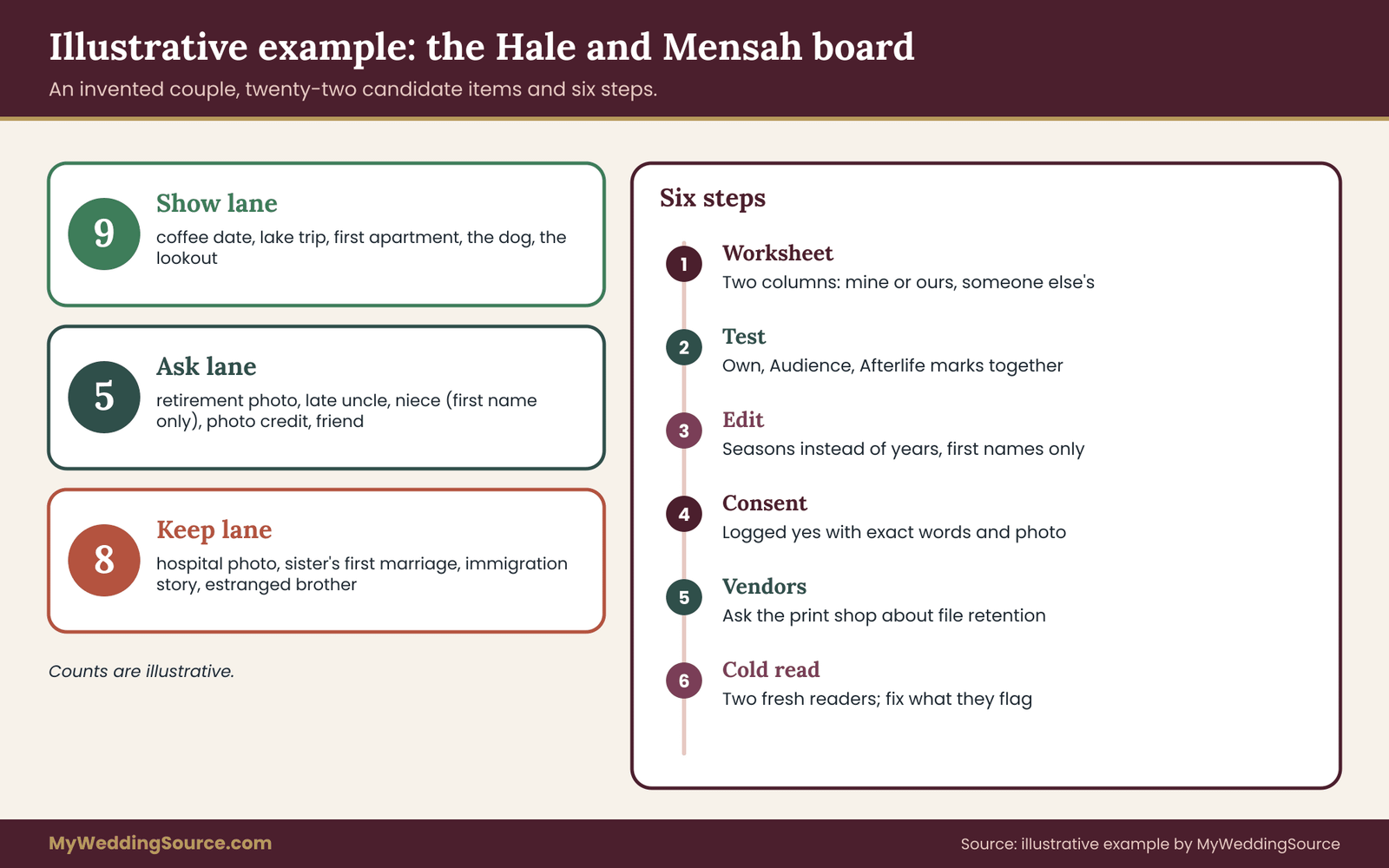
Priya Hale and Daniel Mensah are planning a wedding for about ninety guests, and their wedding story display is the project. They want a wedding story display that has a timeline board at the entrance and a short slideshow during cocktail hour. They begin with the two-column worksheet and quickly collect twenty-two candidate items.
Step one: the worksheet
Of the twenty-two items, nine are Mine or ours: the first coffee date, a rainy walk, the apartment move, a weekend trip to a lake, a ski weekend where Daniel fell, the dog’s adoption, the engagement at the lookout, a shared birthday and a favorite diner. Thirteen are Someone else’s: Priya’s father’s retirement party, a photo of Daniel’s grandmother in the hospital, a story about Priya’s sister’s first marriage, a photo of Daniel’s late uncle, Priya’s parents’ immigration journey, a family reunion shot that includes Daniel’s estranged brother, a photo of Priya’s niece at a swim meet with her school name on the caption, and so on.
Step two: the test
They run each item through Own, Audience, Afterlife. The nine of their own pass quickly, though the ski weekend photo includes a stranger in the background, which they crop. For the rest, the results look like this.
The retirement party is shared and light. Audience is wide but the event was celebratory. It goes to Ask, because they want Priya’s father to choose the photo.
The grandmother’s hospital photo is theirs-not-ours, health-related, with a wide audience. It goes to Keep. Daniel does, however, love his grandmother. He swaps in a photo of her kitchen with the caption “Grandma’s kitchen.”
The story about Priya’s sister’s first marriage is a Keep. It is her sister’s history, and it would be on a printed board.
The photo of Daniel’s late uncle goes to Ask. Daniel’s cousins are the closest relatives; he checks with his aunt, who says she would be glad, and asks for the caption “Uncle Ray, always first on the dance floor.”
Priya’s parents’ immigration journey goes to Keep for the board, and moves to a private format: Priya writes a letter to be read to her parents at the rehearsal dinner. They like the idea.
The reunion shot with the estranged brother is a Keep for the wedding story display. Daniel chooses a different photo from the same event.
The niece’s swim meet photo is Ask, via her parents, with an edit: first name only, no school.
Step three: the edit moves
They draft captions. The timeline reads: “Spring: coffee that ran long.” “Summer: the lake.” “Autumn: our first apartment.” “Winter: the dog.” “The next spring: the lookout.” No calendar years. For the slideshow, they use no captions except a few first names with permission.
Step four: consent log
They create a short log: father (retirement photo, yes with a different crop), Aunt Mavis (uncle’s photo, yes with her caption), niece’s parents (yes, first name only), and the friend who took the lookout photo (yes, credit requested). Every Ask item has a date and a saved message.
Step five: vendor questions
They ask the print shop how long files are kept, and request deletion after delivery. They ask the venue whether easels are provided and who runs the screen. They tell the photographer that detail photos of the board are fine but captions should not be featured close up.
Step six: final check
A week before printing the wedding story display, a trusted friend who has never seen the board reads it cold and answers four questions: Can you work out anyone’s age, illness or family conflict? Do you know any private person’s full name? Is any caption about someone’s circumstance rather than a feeling or a place? Would anyone named here be surprised? The friend flags one date and one line about the dog’s previous owner, and both are fixed.
What the example shows
The finished wedding story display is warm and specific. It tells the couple’s story in seasons and places. It includes people in family photos, with their consent. It leaves out hospital rooms, sibling histories and a brother’s absence. And nothing about it feels thin: the couple’s story is whole without those items. The remaining sections turn the same steps into checks you can measure.
Edge cases that need a different answer
The method above handles most wedding story display projects. A few situations bend it. None has a single right answer, so each entry below gives the reasoning rather than a rule.
Blended families and stepparents
A blended family can include several parents, several sets of grandparents and a history that is not always smooth. The risk is not just privacy but fairness: a display that features one set of parents prominently can quietly wound another. Decide the principle first, such as “every parent appears once, in the same size photo,” and apply it. Avoid captions that rank relationships. If a relationship is recent or delicate, use a photo of the whole group at the wedding-related event rather than a before-and-after story.
A parent or grandparent who has died
A memorial presence on a wedding story display is common and often welcome. Ask the closest surviving relatives, usually the person’s spouse or children, before you include a photo or a line. Keep the wording simple: a name, a place, a feeling. Leave out the circumstances of the death. If a relative says no, accept that and find a private way to honor the person, such as a reserved seat, a candle, or a mention by the officiant with the family’s agreement.
If you want a dedicated element, the principles here carry over, but a memorial usually calls for a separate conversation with those most affected.
Estranged or absent relatives
On a wedding story display, if a parent or sibling is not coming, or is not speaking to you, their absence is already heavy for you. A display that avoids them can still be honest. Do not write captions that explain, accuse or hint. Choose photos that do not feature them, and avoid cropping that leaves an obvious gap. Do not add a symbolic empty frame unless you have thought hard about the effect on others who are present. A calm, simple display is kinder to everyone, including you.
Previous marriages and children from earlier relationships
A previous marriage is a legitimate part of someone’s life, and a wedding story display does not have to hide it. But the former partner has a stake in how the history is told, and children have a stake in how their family is described. A fair approach is to tell the story from your own side, with no characterization of the former partner, and to include children only if the other parent and the children themselves, if old enough, are comfortable. Use first names. Avoid dates that reveal custody timelines.
Immigration and family journeys
Family stories of migration are often among the most meaningful and the most sensitive. Some relatives are proud and open about them. Others carry fear, loss or legal risk. A caption that names a country of origin may be fine. A caption that mentions how someone entered a country, a status, a dispute with authorities or a separated family can create real danger.
When in doubt, tell the story in person, in a private moment, with the person’s consent, and put only a warm, general line on the board, such as “Where our family’s story began.”
Illness and disability
A person’s health is theirs. A photo of someone with a visible condition may be fine if they chose it and are proud of it. Beyond that, do not name diagnoses. Be careful with photos taken in hospitals, rehab centers or care homes, and with captions that frame a person primarily through their condition. If you are the person with a condition and you want to share it, you can, and the people closest to you should hear it from you first.
The Department of Health and Human Services explains that the federal health privacy rule covers certain health providers and plans, not family or couples, so the protection in this setting is mostly courtesy and judgment rather than law.
Religion, culture and differing beliefs
Couples from different faiths or cultures often want a display that honors both. A story that touches conversion, a family’s disapproval or a ritual with deep meaning may be received very differently by different guests. Ask the elders concerned, and describe rituals by what they are rather than by what they replace. The general principle from the wedding etiquette guide applies: be generous in how you describe each tradition, and do not turn a difference into a headline.
Money, work and status
Captions about promotions, a family business, a house purchase or the cost of the wedding itself can read as boasting or as a private statement of family finances. Leave them out unless they are plainly light, such as “the apartment above the bakery.” Avoid job titles that identify an employer if either of you works somewhere sensitive.
Safety-related privacy
Some people have a reason to keep their location, workplace or family connections quiet: those who have left an abusive relationship, who work in security, law enforcement or public service, who are in witness programs or who face harassment. If anyone close to the wedding has such a concern, remove geographic and workplace details, avoid tagging locations, and ask the venue about guest photography. This is not an exotic case; many families have one such person.
Social media and the display
For your wedding story display, decide in advance whether guests may post photos of the wedding story display. A line on a small sign, “We are sharing the story board with you in person; please ask before posting captions or photos of other guests,” sets an expectation without a lecture. For a broader approach to guest photos, the wedding photography consent guide gives wording options. Keep the tone friendly. You are asking for care, not issuing rules.
Last-minute changes
A relative asks to be removed the week before. A photo arrives that is better than the one you chose. A rift opens. Build in a final edit window: stop adding items one week before printing, and keep a spare, generic version of each element that can replace a pulled item. A plain “Our story” card with no names can fill a gap. If a change arrives on the day, pull the item and move on.
Final checks for a wedding story display
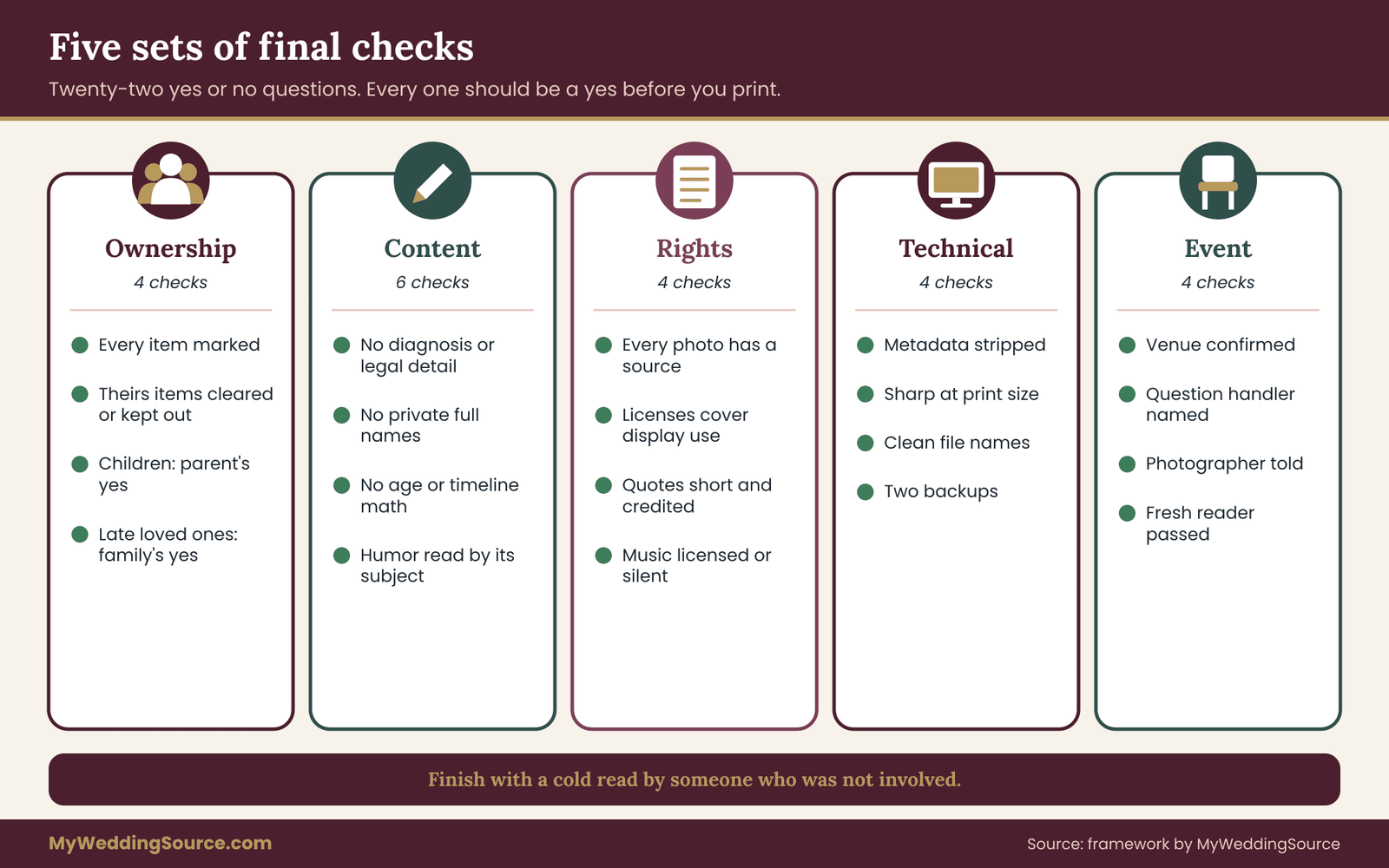
Good intentions are not a test. Before you print or load anything for the wedding story display, run these checks. They are written so that each can be answered yes or no, which makes them measurable and easy to hand to a friend.
The display edit checklist
Ownership checks
- Every item has a mark for Own, Audience and Afterlife.
- Every “theirs” item is in Keep, or has a logged yes with the exact wording shown.
- Every item involving a child has a parent’s yes.
- Every item involving someone who has died has a yes from a close surviving relative.
Content checks
- No caption names a diagnosis, a legal matter, a financial difficulty, an immigration detail or the cause of a death.
- No caption identifies a private person by full name.
- No timeline lets a reader calculate an age, a pregnancy or a custody timeline.
- No caption describes someone else’s feelings or motives.
- No photo shows documents, screens, license plates, house numbers or mail.
- Humor has been read by someone who is the subject of it, or has been cut.
Rights checks
- Every photo has a source: you, a friend with a yes, or a licensed photographer.
- Any professional photo is covered by the license for display enlargement and slideshow use.
- Any borrowed text is short, credited and either public domain or cleared.
- Any music in a slideshow is licensed or run silent.
Technical checks
- Location and device metadata are stripped from exported files.
- Photos are sharp at print size.
- File names do not contain private names or details.
- Backups of the final files and of original photos exist in two places.
Event checks
- The venue has confirmed placement, setup and cleanup.
- A person is named to handle questions and quietly remove an item if asked.
- The photographer has been told whether caption close-ups are allowed.
- A fresh reader has read the final proof and passed it.
If you can tick all twenty-two, you have done what a careful couple can do.
Measurable thresholds
Some couples like numbers. These are working rules for your own use, not official standards, so adjust them to your situation.
- Cold-read test. Ask two people who were not involved to read the proof. If either can state a private fact about someone that you did not intend to share, edit and test again with a different pair.
- Surprise test. For every named person, ask whether they have seen the item. If the answer is no for any Ask item, it is not ready.
- Ratio check. Aim for most of your final items to be from the Show lane. If more than a third come from Ask, simplify.
- Caption length. Keep captions short enough to read in a few seconds. Long captions tend to carry explanation, and explanation tends to carry exposure.
- Lead time. Close the Ask lane one week before the print deadline and the print deadline two weeks before the wedding.
Who should do the final read
A good final reader is a friend who is kind but not close to the family, who will read as a guest would. Give them the question list above and ask for notes only about surprises and discomforts, not design. Thank them, and make the fixes.
After the wedding
When the day is over, decide what to do with the wedding story display. Printed boards can be kept, recycled or archived. Slideshow files can be stored with your photo archive; the guide on wedding records after the event explains how to organize and back up what you keep. Remove online versions when they are no longer needed. If a relative asked you not to keep something, honor it. A wedding story display is meant for an evening, and nothing obliges you to preserve every part of it forever.
Your next steps
Do these in order. Each step toward a finished wedding story display takes a short sitting, and together they carry you from a loose pile of photos to a display you can stand beside.
- Block one evening for the worksheet. Make the two columns, Mine or ours and Someone else’s, and list every candidate photo and fact.
- Run Own, Audience, Afterlife on each item. Write the three marks together, and note every disagreement between the two of you.
- Sort into Show, Ask and Keep. Give each Keep item a better home, such as a letter or a private toast.
- Draft the lightest captions you can. Apply the five edit moves, and strip dates and full names.
- Send consent requests with the exact photo and wording. Log each answer, and treat silence as no.
- Choose the formats. Build the strictest version first, then add detail only where the afterlife is short.
- Brief the print shop, venue and photographer. Ask about file retention, placement, screens and detail photos.
- Run the twenty-two-point checklist and a cold read. Fix what the reader flags, then print.
- Back up the final files and originals. Store them in two places, and decide what to keep afterward.
If you only have time for three steps on the wedding story display, do the worksheet, the Keep lane and the cold read. Those catch most of what goes wrong. For the larger picture of how the ceremony and reception fit together, the ceremony step-by-step guide is a useful companion.
FAQ
Do we need permission from every person in a photo on a wedding story display?
Not always. Copyright in a photo generally belongs to whoever took it, and appearing in it does not give someone control. But courtesy and context matter. Ask anyone who is central, anyone who is sensitive about their image, every parent of a child, and anyone whose caption touches private matters. For a casual group shot with a neutral caption, a quick heads-up is usually enough.
Can we mention a relative’s illness if it is part of our story?
It is safer not to. A health condition belongs to the person who has it, and a printed or filmed mention puts it in front of guests who may not know. If the relative is open about it and gives a clear yes to the exact words, you can include it. Otherwise express the feeling instead: “The year we learned how much family matters.”
What if a parent insists on including something we want to leave out?
Listen first, then separate the item from the relationship. You can offer another home for it, such as a toast or a printed card for family only, or a photo they choose from a short list you approve. If the item would expose a third person, you can say that you cannot include it without that person’s yes. The decision-making guide on the site offers language for shared control.
Is a looping slideshow less risky than a printed wedding story display?
In the room, usually yes, because each slide passes quickly. But guests often film screens, and a video of the screen lasts. Slides also tend to include more photos, which raises the chance of an unplanned detail. Use the same edit rules for both, and keep captions minimal on the screen.
Can we use a song or a poem on the display?
Often yes, with care. Short quotes with credit are common, but copyright law does not give a safe word count, and fair use is judged case by case. Public-domain works and your own words are the easiest choices. For a slideshow with music, ask the venue about licensing, use cleared music or run the slideshow silent.
How do we handle photos of children?
Ask the parents first, use first names only or no names, and leave out schools, teams and routines. Avoid photos in bathing suits, hospital settings or sensitive moments. Check the background for details that identify a home. If a parent says no, use another photo or crop the child out. A display that is slightly plainer is a fair trade.
What if we have already printed something and a relative objects?
Stay calm and respond quickly. Thank them for telling you, remove or cover the item if you can, and ask later what they would have preferred. A short note later saying you are sorry it was a surprise goes a long way. Next time, move the consent step earlier and keep a log of every yes.
Should a wedding story display include our own difficult history?
That is your choice. If you want to, decide on purpose, tell the people most affected first, and use short, factual wording. Avoid shock, and avoid describing other people’s roles. If sharing feels uncertain, keep it for a private moment, a letter or a conversation. The wedding story display can be warm and complete without it.
Sources
These are the official or primary pages the article draws on. Check each one for the current version before you rely on it.
- U.S. Copyright Office: general information on copyright ownership and registration.
- U.S. Copyright Office, Fair Use: explanation of fair use as a case-by-case judgment.
- Federal Trade Commission: consumer protection and children’s privacy information.
- FTC Consumer Advice: practical guidance on protecting personal information.
- Cybersecurity and Infrastructure Security Agency: guidance on limiting personal information shared online.
- NIST Privacy Framework: a standards-body framework for thinking about privacy risk.
- Library of Congress, Preservation: guidance on caring for personal photographs and digital files.
- U.S. Department of Health and Human Services, HIPAA: explanation of who the federal health privacy rule covers.
- USA.gov: government directory for finding the right agency for rules and forms.