
Wedding fatigue is what happens when a day built for stamina meets a body, or a nervous system, that runs out of energy before the schedule does. This guide gives you a method for pacing the wedding day itself: where to put buffer time, which moments can be done seated, and how to decide in advance when the plan should bend.
Start by listing every block of the day and rating how much each one costs you: heavy, medium or light. Never schedule two heavy blocks back to back. After each heavy block, add a recovery block that you protect like a vendor booking. Give every moment a seated version, and name two or three warning signs that trigger a fallback. Test the timeline once before the day. A plan for wedding fatigue works because the decisions are made while you are rested, not at hour seven.
Most wedding timelines are written by working backward from the venue contract. The ceremony starts at four, dinner service takes ninety minutes, the band has a four-hour slot, and the photographer wants an hour of portraits. Nobody asks how the couple will feel at the end of that chain. For many couples this is fine.
For a couple where one or both partners live with fatigue, pain, a heart or lung condition, a recovering body, or simply a limit on how long they can stay upright and social, the usual chain is where wedding fatigue takes over and the day falls apart.
This article is about one narrow job: building a wedding day that a tired person can actually get through and enjoy. It does not cover how to budget energy across the months of planning, and it does not tell you what condition you have or how to treat it. It covers the day itself, in order, with a worked example and a list of moments where the plan for wedding fatigue should change.
A note on scope. This is general planning information, not medical, legal or accessibility-compliance advice, and it cannot replace the guidance of your own treating professionals. Where a rule or a legal duty matters, the article points you to the agency or the contract, so you can confirm the current version yourself.
What wedding fatigue means for a wedding day
The phrase “wedding fatigue” is used loosely, so it helps to pin it down. In this guide it means any limit on energy, strength, concentration or tolerance that makes a long, busy, social day harder for the couple than it is for a typical guest. The cause does not matter for planning purposes. It might be a chronic illness, a treatment schedule, a medication that makes the afternoon heavy, pregnancy, postpartum recovery, chronic pain, anxiety, a sensory sensitivity, or a body that tires fast in heat.
You do not need to explain it to a vendor or justify it to a relative for it to be a valid planning input.
What matters is how wedding fatigue behaves. It usually does not arrive as one clean event. Wedding fatigue builds across the day, and it builds faster when several costs stack: heat, standing, noise, travel, being watched, making small decisions, and talking to many people in a row. It also tends to hit after a delay.
A couple can feel fine through a long photo session and then be unable to eat dinner an hour later. A good plan for wedding fatigue treats the cost of an activity as spread across the minutes that follow it, not only the minutes it takes.
Three ideas hold the rest of this guide together.
First, a wedding day is a sequence of blocks, not a single event. Each block has a cost, a recovery need and a seated version.
Second, buffer time is not slack. Slack is unplanned time that vendors and relatives will fill. Buffer time is planned, named, protected time with a purpose and a person assigned to guard it.
Third, a timeline with no failure conditions for wedding fatigue is only a hope. The plan has to say, in advance, what you will cut or move if energy drops faster than expected.
How this wedding fatigue guide differs from planning for limited energy in general
If you are earlier in the process and still deciding how to divide months of planning tasks between partners, a broader guide on planning when one partner has limited energy or mobility is the right starting place. The accessible-venue questions in accessible wedding venue red flags also come first when you are still choosing where to marry, because a venue with no step-free route or no quiet room limits every option below.
This guide starts later. It assumes the date, the venue and the main vendors are mostly chosen, and it asks how to arrange the twelve or so hours of the day so the couple has something left at the end. Think of it as the day-of layer that sits on top of a normal wedding vendor timeline.
Who this method is for
The wedding fatigue method is built for couples, but it works for a single partner too. It suits anyone whose wedding fatigue calls for more than the standard allowance of rest, and it also helps couples who have no condition at all but expect a very long day, such as a ceremony in one town and a reception in another.
It is not a diagnosis tool. If you do not know your own pattern yet, the next section shows how to read it from ordinary days, and your treating professional can help you interpret what you see. If a plan you draft conflicts with medical advice you have been given, the medical advice wins.
Reading your own wedding fatigue pattern first
A pacing plan for wedding fatigue is only as good as the numbers it rests on. Before you draw any timeline, spend two or three weeks collecting plain observations from ordinary days. You are not studying yourself like a lab subject. You are noticing a few specific things that a wedding will test.
Start with the clock. At what time of day are you strongest, and at what time does the drop usually come? Many people find that a morning ceremony is easier than a late afternoon one, and that a seven o’clock dinner arrives well after their best hours. If you have a treatment or medication schedule, note when its effects are strongest and weakest. Share that note with your clinician and ask whether anything about timing should change on the wedding day. Do not adjust anything on your own.
Next, notice what costs you most. Write down the activities that leave you drained for hours rather than minutes. For some people it is standing in one spot. For others it is conversation in a loud room, heat, a long drive, a heavy meal or a day with no quiet minute. The costs on your list are where wedding fatigue will hit hardest, so they are the ones that deserve a buffer or a seated option on the wedding day.
Then notice how you recover. Does twenty minutes lying down help? Does a quiet room with the lights low work better than a walk? Do you need food, water, salt, a cool room or a dark one? Recovery needs are personal, and the recovery block in your timeline should contain exactly the things that work for you.
A one-page pattern note
Put your wedding fatigue observations on one page that you can hand to a coordinator, a bridesmaid or a family member who will help on the day. It should answer five questions in plain sentences. When is my best window? What drains me fastest? What helps me recover, and how long does it take? What are my early warning signs, the ones that show up before I am in trouble? What should a helper do, and not do, when they see them?
The last two questions matter most. Early warning signs differ widely: slower speech, a shift in color, shakiness, irritability, a glazed look, losing the thread of a conversation, a headache, a flare of pain. Name yours. When helpers know the signs, they can offer a chair or a glass of water before you have to ask, and asking is itself a cost many tired people try to avoid.
Setting a realistic day length for wedding fatigue
Here is the first hard decision. Ask how many hours of the day you can plan to be “on” with reasonable comfort, and how many more you could stretch to with real recovery. Count from the moment hair and makeup start, not the ceremony. A typical wedding day asks for ten to fourteen hours of presence. If your honest number is shorter, the plan should shorten the day instead of squeezing the same program into fewer rest stops.
Couples often feel guilty about adjusting for wedding fatigue at this step, as if shortening the day means shrinking the wedding. It usually means the opposite. A smaller number of well-chosen hours, with real rest between them, leaves you present for the moments you care about. The later sections give several formats, from a trimmed single day to a split day, so you can match the shape to your limits.
One caution. Your day-length number is an estimate made on ordinary days. Excitement, adrenaline and an audience can mask fatigue for a while, and then the cost arrives late. Build the plan on the cautious number, and let any extra energy on the day be a bonus you spend at the party.
The Spend, Seat, Recover method for wedding fatigue
The method for managing wedding fatigue has three moves, applied to every block of the day in order. You can do it on paper in an evening. It replaces the usual question, “What time does each thing happen?” with a better one: “What does each thing cost, what is the seated version, and what has to happen afterward?”
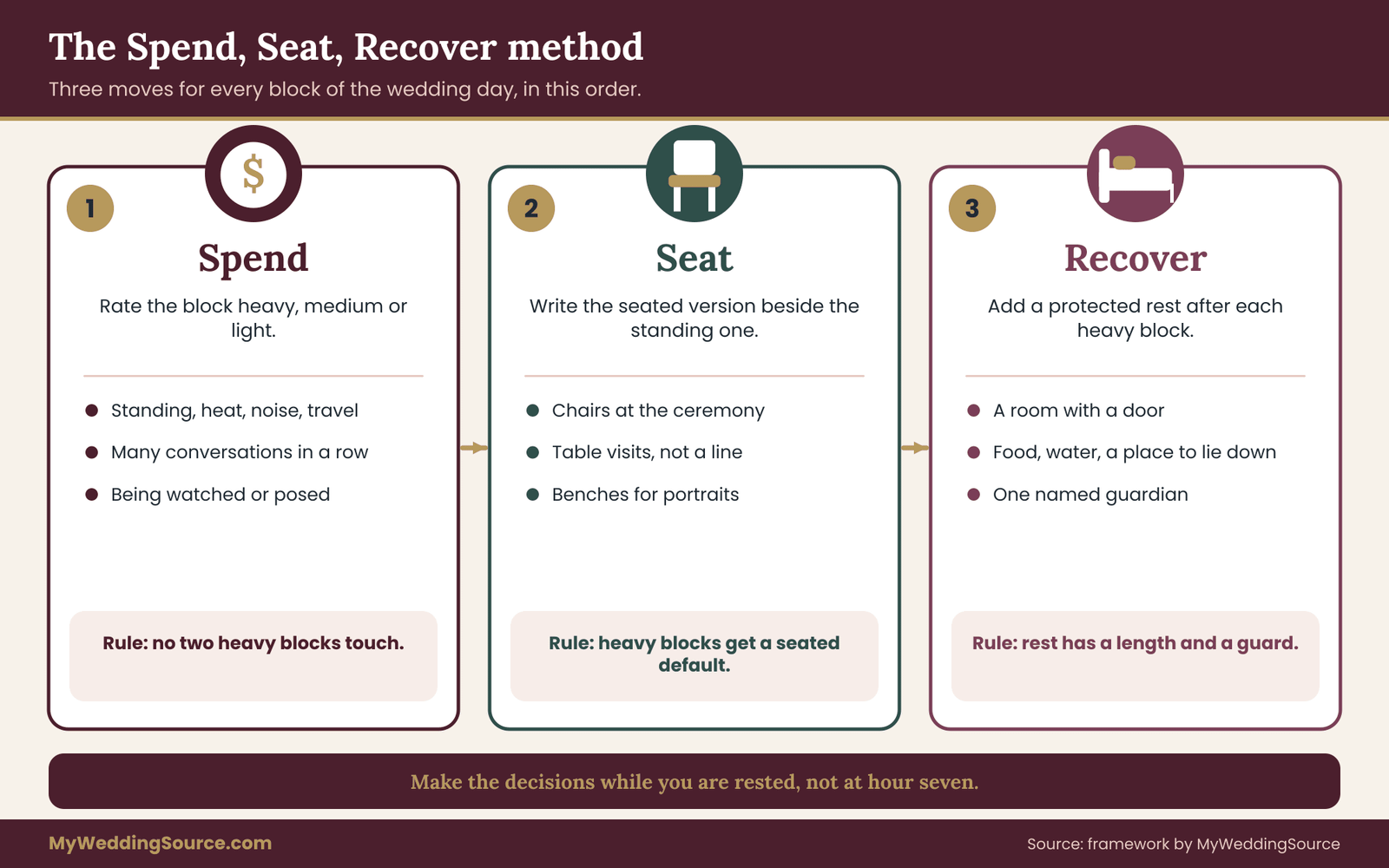
Spend. Give each block a cost tier. Use three tiers and keep them rough. A heavy block combines several drains: standing, heat, noise, performing, many conversations, or travel. A medium block has one or two. A light block is seated, quiet or private. The tiers are your judgment of how wedding fatigue shows up for you, drawn from the pattern note in the previous section, not a scientific scale. If you disagree with a rating a week later, change it.
Seat. For every block, write the seated version next to the standing one. This is not a fallback for emergencies. It is the default for any block you rated heavy. Many seated versions look no different to guests: a ceremony with chairs for the couple, a receiving line replaced by table visits, portraits taken on a bench. The next part of this guide gives options for each moment.
Recover. After each heavy block, add a recovery block, and after each medium block add a shorter one if two mediums fall in a row. The recovery block has a length, a place, a content list and a guardian. Without all four it will be eaten by the next obligation, and wedding fatigue rarely forgives a rest that stayed a good intention.
Rating the blocks of a typical wedding day
Here is how a rating pass for wedding fatigue might go for a mid-afternoon ceremony. Your ratings will differ, which is the point.
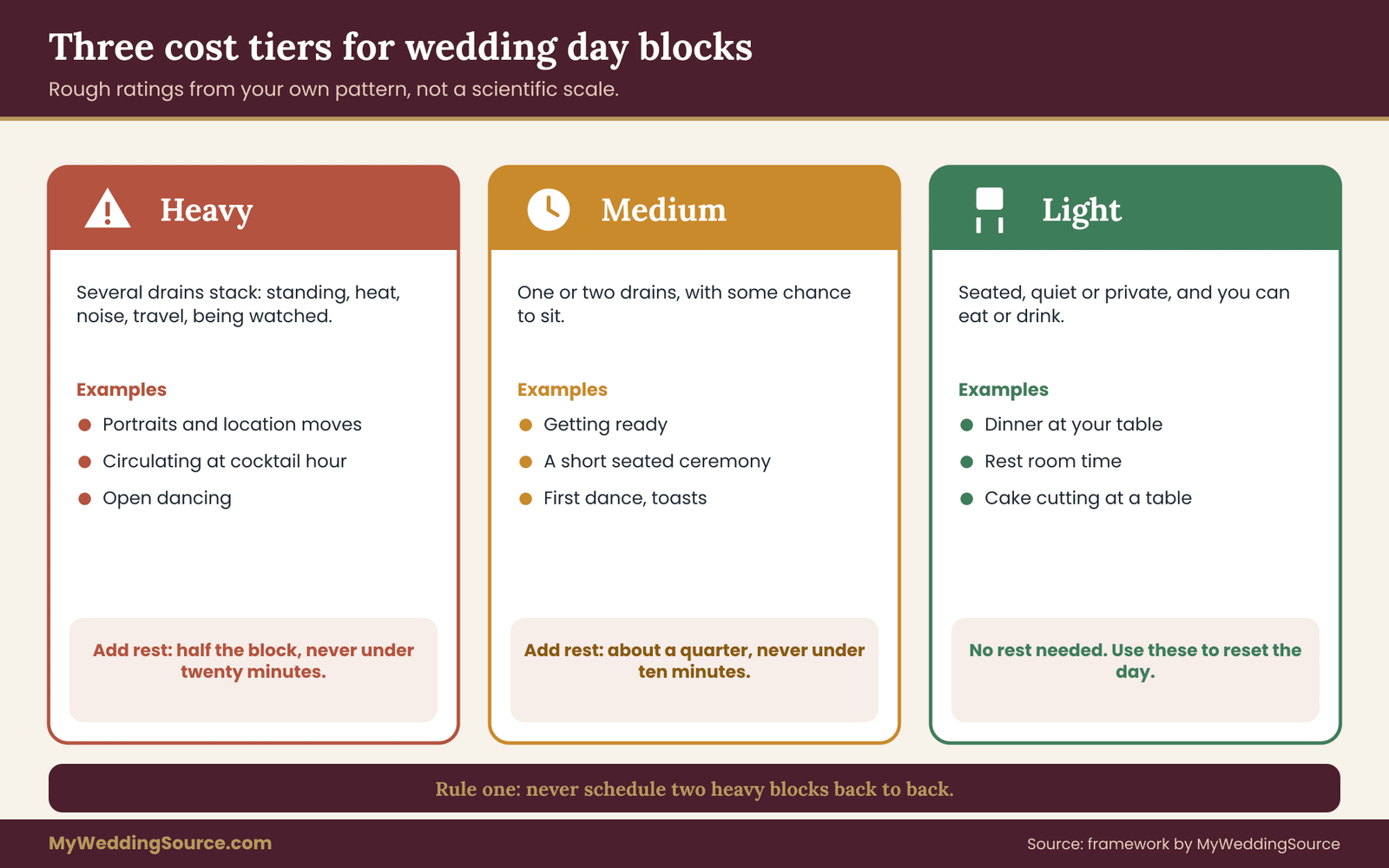
Getting ready is usually medium. It is seated for hair and makeup, but it holds a lot of conversation, photography, a tight clock and often skipped meals. It becomes heavy if the room is crowded or hot.
The first look and couple portraits are heavy for many people, because they combine standing, posing, moving between locations and being watched. They become medium if they happen in one spot with benches nearby and a break scheduled in the middle.
The ceremony itself varies. A short, seated ceremony in a cool room can be light to medium. A long outdoor ceremony with standing guests, a long walk and sun is heavy.
Family photographs are medium to heavy, since they involve a long run of names, standing, and other people’s needs. The cocktail hour is heavy for a couple who feel obliged to circulate. Dinner is usually light if you remain seated and eat. Toasts are light to medium. The first dance and any choreographed moment are medium, and open dancing is a choice that can be heavy.
Departure and the last half hour are easy to forget, and wedding fatigue often peaks there. Saying goodbye to many people, carrying things, and traveling to a hotel are all costs, and they come when you have the least left.
Three rules that keep wedding fatigue in check
A set of simple rules keeps the method from collapsing into a pile of preferences.
Rule one: no two heavy blocks touch. If the timeline puts them side by side, move one, shorten one or insert a recovery block between them.
Rule two: protect the meal. Eating on a schedule is a basic energy input, and the couple’s own meal is the first thing a busy day cancels. Mark the couple’s meal as a fixed point, with food that suits you, delivered to you.
Rule three: the day has a spending limit. Decide how many heavy blocks you can afford in total. For some couples it is two. For others it is one. Once the limit is reached, everything else on the list is either light or optional. Honest limits on wedding fatigue make the guest-facing parts of the day better, because you are not rationing the best moments to whatever is left.
What goes in the recovery block
A recovery block has four parts that must be named before the day: where, what, how long and who guards it.
Where means a real room with a door, not “somewhere quiet.” A bridal suite, a green room, a spare office, a vehicle with air conditioning, or a hotel room close by can all work. The room should be reachable without crossing the main party and without stairs. Photograph the route when you visit the venue.
What means the specific items that help you. Food and drink you can tolerate, any medication you have been told to take at a set time, a place to lie flat or to put your feet up, a change of shoes, a cooling or warming item, low light, earplugs, a phone charger. Pack these in one labeled bag that travels with the helper, not with you.
How long means a number. Twenty minutes, thirty, forty-five. A common starting point is to make recovery after a heavy block about half as long as the block itself, with a floor of around twenty minutes, then adjust after a rehearsal. Treat that as a place to begin, not a rule. Your own experience and your clinician’s guidance override it.
Who guards it means one named person with permission to say no. The guardian turns away the cousin who wants a photo, tells the DJ you are not ready, and stops the photographer from “just one more.” Without a guardian, the couple has to say no themselves, which is exactly the effort the block exists to save.
Building buffer time against wedding fatigue
Buffer time is the most common thing to cut and the most damaging thing to lose when you are managing wedding fatigue. Vendors schedule to the minute, relatives arrive late, and a late start pushes everything back. When the schedule is tight, the couple’s rest is the first slice to go because it has no vendor behind it. The way to protect it is to attach it to something that cannot be cut.
Three kinds of buffer
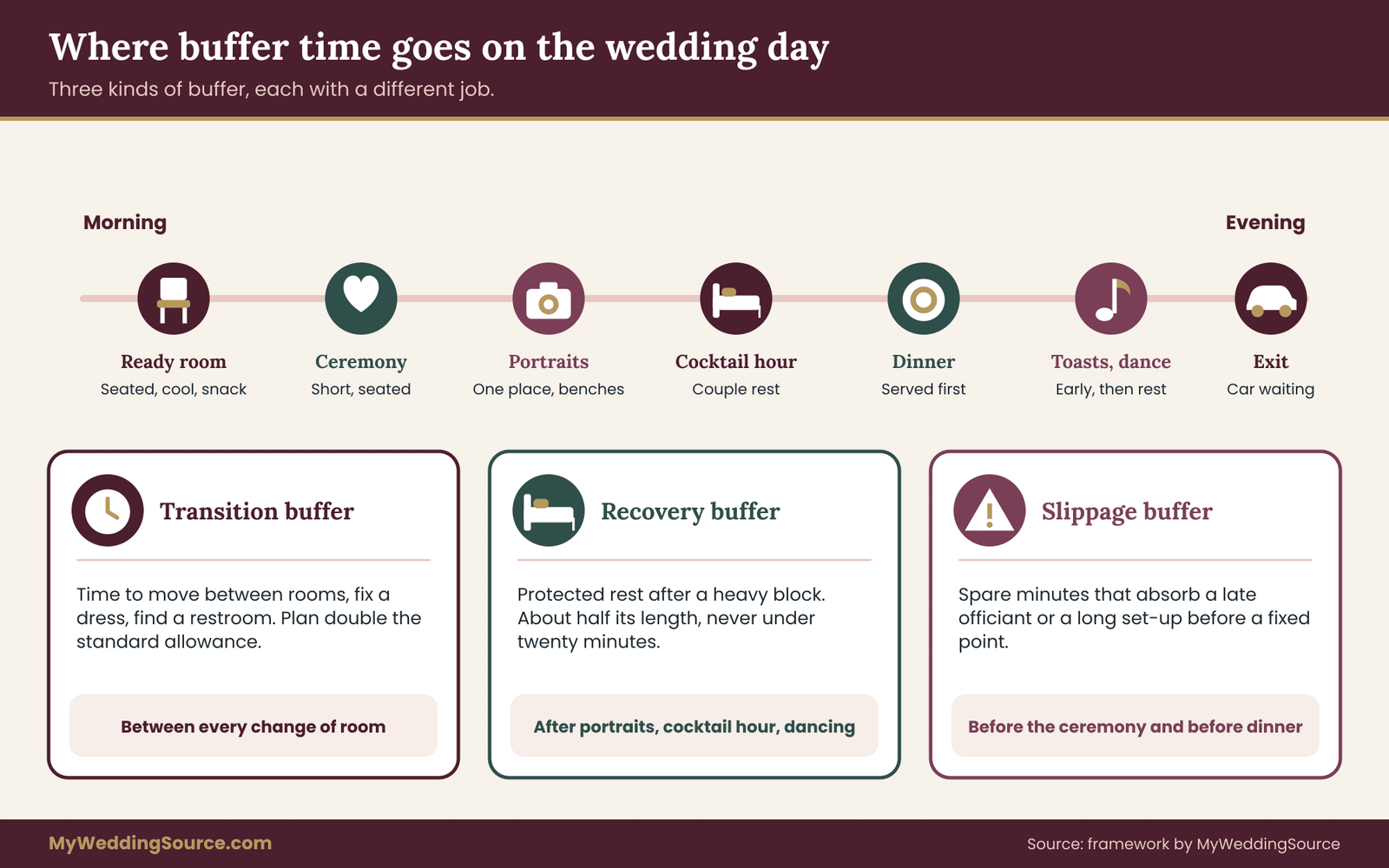
Not all buffer works the same way against wedding fatigue, and a good timeline uses all three.
Transition buffer covers movement. It is the time between leaving one place and being ready in the next: walking from the getting-ready room, loading a vehicle, finding the restroom, fixing a dress. Wedding fatigue makes transitions slower and less predictable, so give each one more time than a standard timeline does. If the standard allowance is ten minutes, consider twenty.
Recovery buffer is the protected rest after a heavy block, as described above. It has a purpose and a guardian.
Slippage buffer is spare time near the end of a stretch that absorbs late arrivals and overruns so they do not push into your recovery. A thirty-minute gap before the ceremony is slippage buffer. If the officiant is late, you lose the gap rather than your rest.
Where buffer matters most
Four places on the timeline deserve extra attention.
The first is the gap between getting ready and the ceremony. Many couples are dressed and ready an hour early and then stand around. That is a good place for a seated, air-conditioned recovery block, with a drink and a snack, not a waiting period spent on your feet greeting early guests. Ask your coordinator to hold the ready room until a set minute.
The second is between the ceremony and the portraits. Guests enjoy a cocktail hour while the couple works, so the couple gets no rest unless it is scheduled. A twenty-minute recovery right after the ceremony, before any photographs, often changes how the next two hours feel. It also lets the photographer reset and gives you a moment to take in what just happened.
The third is between the end of the formal photographs and dinner. If dinner service begins the minute portraits end, you eat without a break and may not eat at all. A short buffer, and an arrival at the table with food already waiting, protects the meal.
The fourth is the stretch between dinner and the evening program. Toasts, cake, first dance and open dancing follow each other with little room. If the couple plans any dancing, the buffer before it should be longer than the buffer between any other two blocks.
Writing buffer into contracts and run sheets
A buffer that exists only in your head will be lost. Turn it into something other people can read. On the run sheet, label the block “Couple rest, private” with a start time, an end time, a room and a guardian name. Give the document to the coordinator, photographer, caterer, DJ or band lead, and venue contact. Many vendor timeline templates leave no row for this, so add one.
Then check that vendor contracts do not contradict the buffer. A photographer’s package that includes a set number of hours of coverage may be consumed if rest eats the clock, so ask now what happens to the schedule if portraits are split into two shorter sessions. A band booked for a fixed slot may play through your recovery unless the plan says otherwise. If you have to pay a little more for flexible hours, decide that before the day, when you can weigh it calmly.
A worked rule for sizing a buffer
Since a number is easier to use than advice, here is a decision rule you can adapt. Take the cost tier of the block that just ended. After a heavy block, plan recovery equal to half the block’s length, with a floor of twenty minutes. After a medium block, plan about a quarter of its length, with a floor of ten. After a light block, no recovery is required. Add a transition buffer on top whenever the next block is in a different room or building.
Apply it to a ninety-minute portrait session rated heavy. That yields forty-five minutes of recovery before the next heavy block, which is more than most timelines allow. If you cannot afford it, the rule points to the right trade: shorten the portrait session, split it into two shorter ones with a break between, or change the next block to a light one. The rule tells you what the plan is spending. You then decide what to cut.
Treat every number here as a starting point for the wedding fatigue rehearsal described later, and let your own results replace them.
What buffer costs and what it saves
Buffer feels expensive because it is visible. A forty-five-minute rest appears on the run sheet as forty-five minutes in which nothing is happening, and a vendor on an hourly rate may see it as paid time with no output. The savings are invisible, which is why they are underrated. A couple who rests is more likely to finish the portraits in the time planned, eat the dinner they paid for, and stay through the toasts.
Wedding fatigue that goes unmanaged shows up later as an early exit, a skipped course, a rushed second half of the photographs and a flat evening.
Count the cost in the units that matter. If a rest block adds an hour to the photographer’s coverage, that is a price you can ask for. If it moves dinner earlier, it may cost nothing. If it makes the band start later, it may cost a little in overtime. Put each of those into a short list and look at the total beside the cost of losing the evening.
Most couples find that a modest, planned cost for protecting energy beats the unplanned cost of falling apart at the reception, which can include a lost vendor window, a late-night hotel scramble or the memory of a day they could not enjoy.
There is also a quieter saving. When rest is on the run sheet, helpers stop treating it as a favor and start treating it as part of the work. The guardian has something to point to when a guest asks for a minute. And you stop spending effort defending your own pause, which is the effort wedding fatigue makes hardest to find.
Seated options for every moment of a wedding fatigue plan
A seated option is any version of a moment that lets you sit, lean or lie down without removing the meaning of the moment. The goal is not to hide that you are sitting. The goal is to make sitting look like a design choice, so nobody, including you, feels you are failing a standard version. Seated options are the most direct tool against wedding fatigue, and they cost very little.
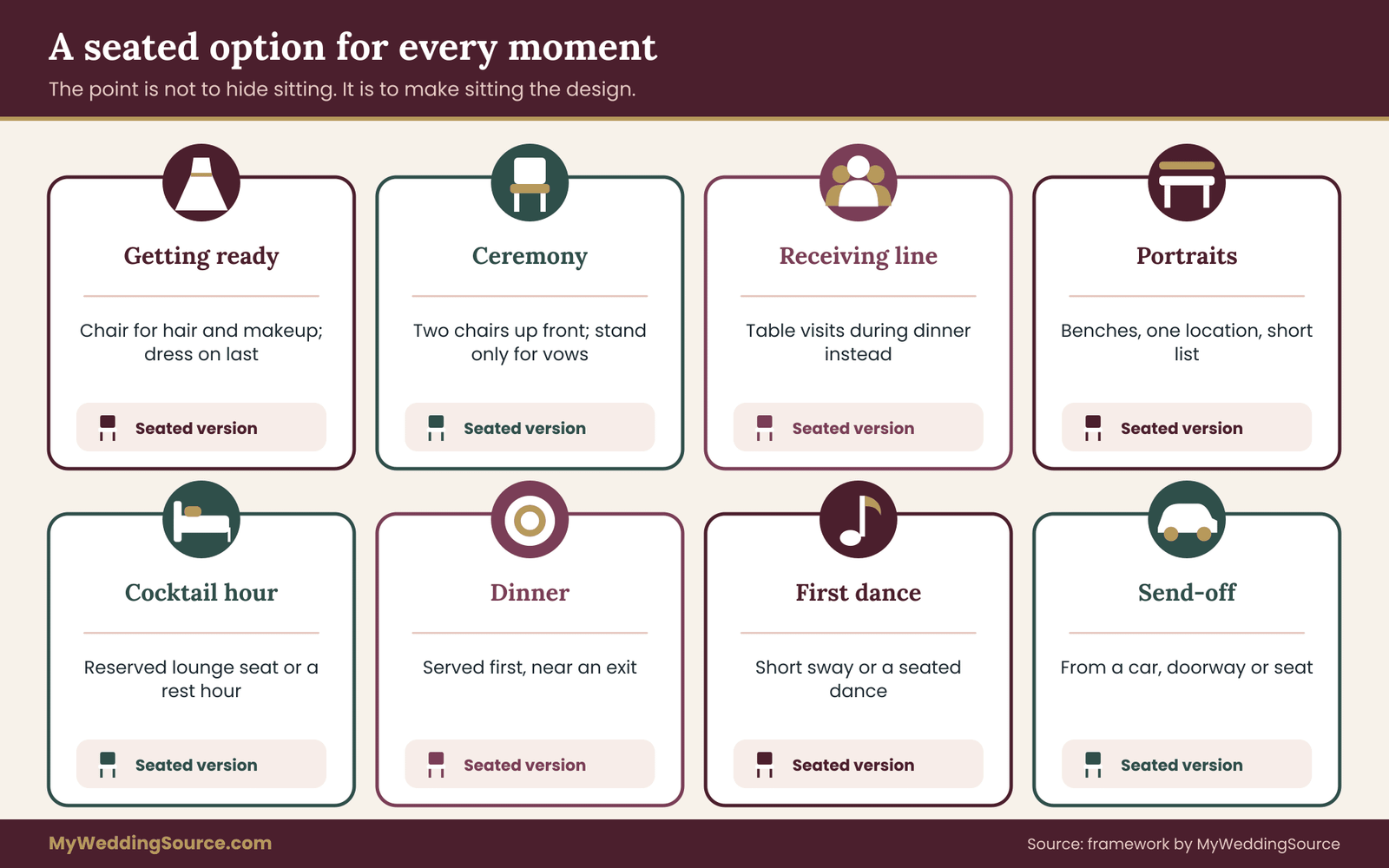
A useful habit is to write the seated version first. Ask what the moment is for, then ask whether standing is part of that purpose or only a habit. A ceremony exists to marry two people, and the couple standing for twenty minutes is a convention. A receiving line exists to greet guests, and greeting can happen at tables. Once the purpose is clear, a seated form usually appears.
Seated options by moment
Getting ready. Choose a room with a real chair and a surface for food. Ask hair and makeup artists to work with you seated at all times, including for finishing touches. Keep the dress for the last possible minute, since formal garments add weight, heat and restriction. If photographs of getting ready are planned, ask for them to be taken while you are sitting.
Processional and ceremony. Several formats avoid long standing. The couple can enter together and sit in two chairs at the front, with the officiant standing or sitting beside them. They can stand only for vows and the ring exchange, which are short. A ceremony held at a table, in a circle or around a low platform feels intimate and suits sitting.
For couples whose processional walk is the hard part, a short route, a cart, a wheelchair or mobility aid decorated for the day, or an arrival already at the front are all workable. Confirm that the route is step-free and firm underfoot, and use the ceremony cue sheet guide to put the seated cues in writing for the officiant and musicians.
Receiving line. Skip it. Replace it with table visits during dinner, or with a seated spot near the entrance where guests come to you in groups. Table visits let you control the pace and eat first.
Photographs. Ask the photographer for a seated portrait list. Benches, steps with cushions, a chair in a garden, a car door, a sofa in a lounge area and the ceremony chairs all work. Seated portraits can be made lovely, because photographers often prefer simple poses where the couple is relaxed. Move any long walks or location changes to a golf cart or to a plan where the photographer travels and the couple does not.
Group photographs of families can be brought to you in small sets rather than the couple standing while forty relatives rotate. A well-written family photo list helps cut the standing time.
Cocktail hour. The couple can sit at a reserved cocktail table or lounge seating, with guests rotating in. Alternatively the couple can use this hour as the main recovery block, and join the party for the last fifteen minutes. Both are honest choices.
Dinner. Dinner is already a seated block. The pacing work is to protect it: seat the couple early, serve them first, put the table near the restroom and away from the speaker or the kitchen door, and give them food that suits their needs.
Toasts. Speakers can toast from their tables or from a mic at the couple’s table. The couple can respond from their seats.
First dance and dancing. A first dance can be a slow sway, a short one-minute version, a seated dance with hands and arms, a song shared with a parent while seated, or a dance in two parts with a break between. Open dancing is optional. Offer other seated ways to join the party, such as a lounge, games or a photo area with chairs.
Cake cutting and send-off. Cut the cake at a table, with guests gathering around, and do the send-off from a vehicle, a doorway or a seat.
Making seated options for wedding fatigue look natural
Guests read comfort from the couple’s body language, and a visible plan for wedding fatigue looks like confidence. If you sit with ease, they will not question it. A few tricks help. Put chairs in the same style as the rest of the decor, not a folding chair among velvet ones. Place chairs at several points through the venue so that sitting is an everyday option for everyone, not a sign that someone is struggling. Give both partners a seat even if only one needs it, so neither seems singled out.
You can also add a short line in the program, such as “The couple will be seated for most of the evening and would love to come and see you at your table.” It shapes guest expectation and spares you explaining at every handshake. The guest wording is yours to choose, and no health detail needs to be shared.
Matching seats to your own wedding fatigue
Seated does not mean the same thing for every body. For some people the right seat has arms to push up from, a firm cushion and a back. For others it needs a footrest, or a recline, or room for a mobility aid. Test chairs at the venue visit and write the specification into the vendor requests: height, arms, cushioning, and number of chairs.
If the venue’s chairs are poor, a rental company can supply better ones, and the cost is usually small compared with what a day on a bad chair does to you.
Surfaces matter too. A grass ceremony is difficult for wheels and canes, gravel can be worse, and a steep ramp may be a trap. Ask the venue for the actual route and surface, then walk it, rather than relying on a general statement that the site is accessible. The accessible wedding venue red flags checklist covers the questions to put to a venue about routes, restrooms and quiet space.
Pacing the ceremony and portrait hours with wedding fatigue in mind
The ceremony and the portraits form the first heavy stretch of the day, and they come when excitement is highest and the clock is tightest. They also contain the decisions that cause the most regret, since photographs cannot be redone.
Choosing a ceremony time that fits wedding fatigue
If you have a choice of time, match it to your best window from the pattern note. For many people with afternoon drops, a late-morning or early-afternoon ceremony leaves the evening for a slower party. For people who feel strongest late in the day, an early evening ceremony makes sense. Think about the sun, too. A ceremony at midday in summer heat can be dangerous for anyone sensitive to heat, and cool, shaded or indoor settings reduce a major drain.
Do not choose the time based on the photographer’s favorite light alone. Soft golden light is lovely, but it is not worth a couple who cannot enjoy the evening. If light matters to you, ask the photographer how to get good results in the time you can manage, including shaded and indoor options.
Shortening what the ceremony asks of you
Ceremony length is under your control, which makes it a strong lever against wedding fatigue. A ten- to twenty-minute ceremony is common and can include everything that matters. Cut long readings, extra rituals that need movement, and unity ceremonies that require the couple to stand and work with materials. Keep the vows, the ring exchange, the declaration and one or two personal touches.
Ask the officiant to keep the pace calm and to avoid long pauses where you stand waiting. Ask whether they can adjust their position so you sit with the officiant close enough to be heard, which saves your voice and strength. If you plan a recessional, make it short, and have a driver, cart or chair waiting at the exit to carry you to the recovery room.
Portrait sessions that respect wedding fatigue
The pairing of heavy photographs and wedding fatigue is the most common trouble spot. A few changes make a large difference.
Cut the shot list. Pick the portraits that matter and drop the long tail. Photographers often propose a full list by habit, and they are used to trimming it when asked. Aim for fewer set-ups, and ask for the couple portraits you value most first, when you are freshest.
Split the session. Two shorter sessions with a recovery between them are better than one long one. A first-look session before the ceremony and a short second session after the ceremony can cover everything, with less standing in either.
Choose one location, or two close together. Moving between sites costs more than the photographs themselves. If the venue has one pretty spot with benches and shade, use it.
Consider doing family portraits before the ceremony, or in a short block right after, with a prepared list and a family member who gathers the people. Keep the list short. A long list of names is also long standing time.
Finally, agree on a stop signal. A word or a gesture that means “pause now” should be understood by the photographer, the coordinator and your partner. Tell the photographer at the planning meeting that you may use it, and that it is not a sign of trouble with them.
Pacing the reception when wedding fatigue peaks
The reception is where wedding fatigue tends to win. The ceremony is short and focused, but the reception runs for hours, it is loud, and it asks the couple to be the center of attention. By this point the day has already spent most of the budget. The way to protect what remains is to decide what the reception is for, then arrange the order of events around the couple’s real limit.
Start with an honest question: which parts of the reception matter most to you? Many couples say dinner with their closest people, a toast or two, and one dance. Few say three hours of open dancing. If your list is short, the reception can be short as well, and you can leave a lively party behind you, which many couples find the best way to end.
The reception order that spends the least on wedding fatigue
A standard order is arrival, cocktail hour, grand entrance, dinner, toasts, cake, first dance, open dancing, send-off. Reordering a few items can save a great deal of energy without touching what guests experience.
Move the first dance and the toasts earlier. Doing them before dinner, when you are fresh, means the highest-attention moments come while you have the most to give. Guests can eat while the music plays. It also removes the long wait between dinner and dancing, which is the stretch many tired couples dread.
Put the cake cutting right after dinner or even during the cocktail hour, if the caterer agrees. It is a short moment that can be done seated at a table.
Hold open dancing last, and make it optional for you. If you want a dance block, schedule it directly after a rest, and set a clear exit time. Some couples plan an early formal exit around the end of dinner, and let the party continue without them. That is a legitimate and common choice, and the wedding reception guest flow guide explains how entry, seating, food and exit connect, which helps when you are rearranging the order.
Making the reception room work against wedding fatigue
Room layout is a hidden energy cost, and it feeds wedding fatigue without anyone noticing. Where the couple sits, how far they must walk to reach the restroom, how loud the speakers are at their table, and whether a quiet corner exists all affect how long they can stay.
Choose a table position away from the speakers, and close to an exit that leads to the recovery room. A head table facing the room is traditional, but a sweetheart table or a round table with a few friends is easier to leave and easier to serve. Check the chairs, again. Ask for a footstool or a low table if you want to elevate your legs.
Think about the sound. Loud music is draining for many people, even when they like it. Ask the DJ or band to keep the volume lower during dinner and in the first part of the evening, and to set a hard end time. If noise is a particular problem, a quiet room next to the party lets you rejoin without leaving. Earplugs designed for music can reduce volume while preserving clarity.
Consider temperature. Reception halls are often warm once guests arrive. A fan, a seat near an air-conditioning vent or a cooling item can help. Cold rooms can be as tiring as hot ones for people sensitive to cold, so bring a wrap.
Food, drink and the couple’s meal
Eating well matters more than it seems, because hunger makes wedding fatigue worse. A wedding day is full of events where the couple is too busy to eat, and then dinner arrives when they are past hunger and cannot manage a full plate. Fix this with three habits.
Eat early. Have a real meal, not just a pastry, before hair and makeup start, and again during the recovery block before the ceremony. Keep snacks in the helper’s bag.
Order the couple’s plates ahead. Ask the caterer to serve you first, in a smaller portion if that helps, and to hold a second plate you can eat later. If you follow a specific eating pattern for health reasons, put it in writing with the caterer well before the day, using the same process you would for any guest with dietary needs.
Keep drinks simple. Water is the default. Alcohol affects many people more strongly when they are tired, dehydrated or on medication, so ask your clinician whether it fits your plan. Having something festive to hold, such as a sparkling nonalcoholic drink, lets you join toasts without the effect.
Who reads the room for you
During the reception, the couple is surrounded by people who want a moment with them. Delegate the job of watching for wedding fatigue. Your coordinator or day-of helper should be the one who decides when a conversation ends, who brings food, who tells the DJ when to shift and who notices the early warning signs from your pattern note. A good helper protects the plan without making you feel monitored.
A worked example of wedding fatigue pacing: an invented couple
To show how the pieces fit, here is a worked case of planning around wedding fatigue. The couple, Maya and Daniel, are invented for this guide, and the details are illustrative, not drawn from a real wedding. Maya’s wedding fatigue sets in sharply after about three hours of standing and socializing, and she is at her best before noon. Daniel is fine physically but wants to protect Maya’s day and has his own anxiety in crowds.
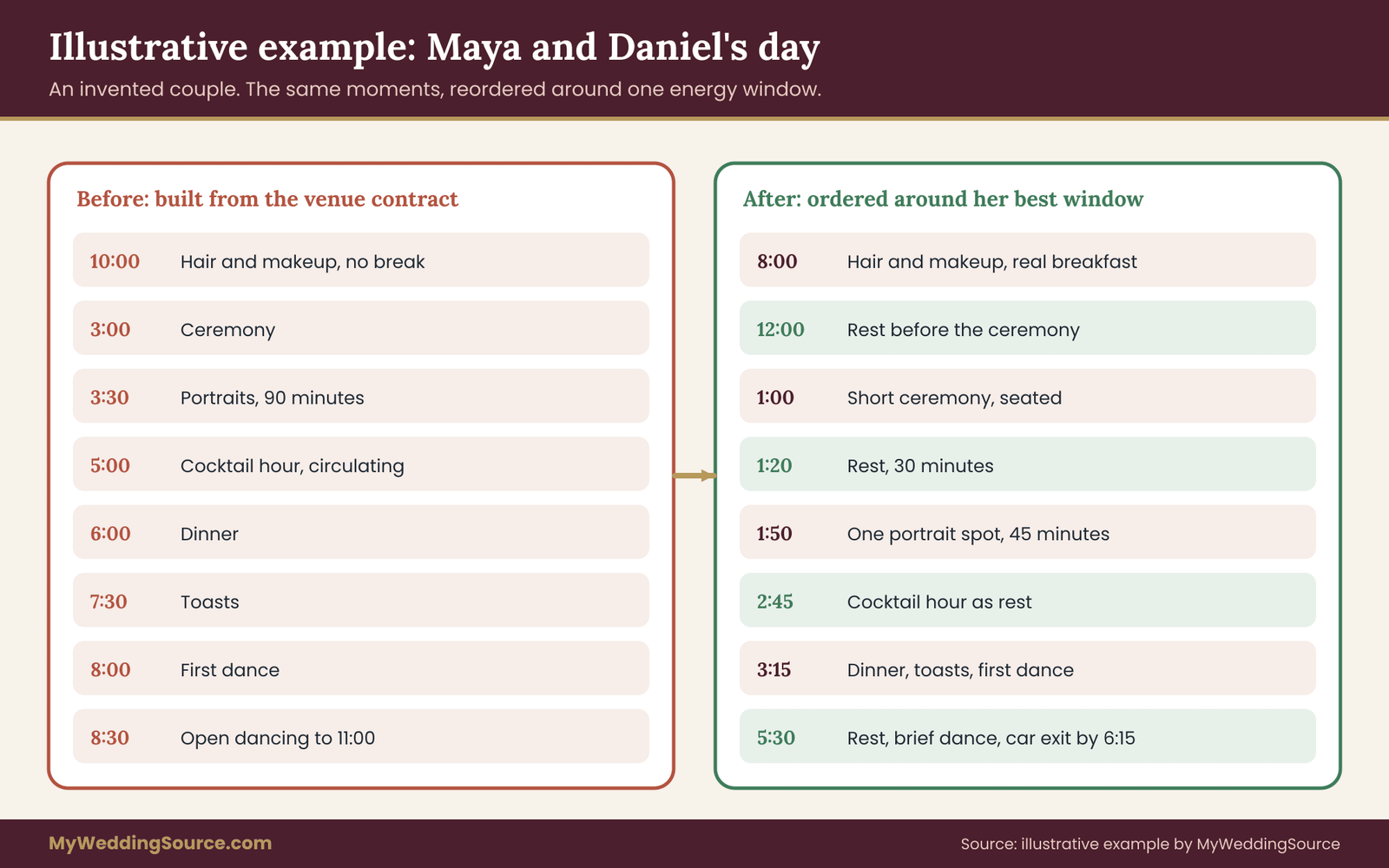
Their original plan, built from the venue contract, looked like this. Hair and makeup from ten to one. A ceremony at three. Portraits from three-thirty to five. Cocktail hour five to six, dinner at six, toasts at seven-thirty, first dance at eight, dancing until eleven.
Step one: rate the blocks
They wrote down each block with a tier. Hair and makeup became medium. The ceremony was medium, since the venue was cool and short. Portraits were heavy. Cocktail hour was heavy if they circulated, which they felt obliged to do. Dinner was light. Toasts were light to medium. First dance was medium. Open dancing was heavy.
By the rules, they had three heavy blocks and a back-to-back pair, portraits followed by cocktail hour, with no recovery. They also found that the ceremony came after a medium block with no break, and that the meal was set at six when Maya’s energy was already low.
Step two: apply the limit and rearrange
They set a wedding fatigue limit of two heavy blocks: portraits and one hour of dancing. They changed the rest.
The ceremony moved to one o’clock, so it fell in Maya’s best window. Hair and makeup shifted to start at eight, with a real breakfast at nine. A recovery block from twelve to twelve-forty, in a room with air-conditioning, came before the ceremony, with Daniel’s sister as guardian.
After a twenty-minute ceremony, they took a thirty-minute recovery. Then a single portrait session of forty-five minutes ran at one location with benches, with a seated bench pose and a short break at the midpoint. Family portraits were cut to six groups, handled by a cousin who gathered people. Cocktail hour became a rest hour for the couple, who joined the last ten minutes at a lounge table.
Dinner moved to three-fifteen. Toasts and the first dance came right after dinner, at four-thirty, while Maya had energy. They ended the formal program at five-thirty, danced for forty minutes after a thirty-minute rest, and left in a decorated car at six-fifteen, while guests kept dancing.
Step three: write the wedding fatigue failure conditions
They added three tripwires. If Maya showed the early signs on her note, such as slowed speech and a gray look, the helper would call a ten-minute pause. If the ceremony started more than thirty minutes late, the first portrait session would shrink to twenty minutes. If the couple needed to leave before dinner ended, a pre-agreed phrase to the coordinator would trigger the early exit and the caterer would send a to-go plate to the hotel.
What changed and what did not
The revised day, built around Maya’s wedding fatigue, was shorter by about three hours and contained all the moments they cared about: the ceremony, a few portraits, dinner with family, toasts, a first dance and an exit with friends cheering. It lost long portraits, a receiving line, a grand entrance and four hours of dancing. It added a rest before the ceremony, one after, and a long one during cocktail hour.
Notice that the changes were mostly reordering and relocating, not removing. The couple got back time and kept their day. Notice, too, the cost of the plan: a different vendor schedule, a request to the photographer to cover fewer hours, and a conversation with the caterer about an earlier dinner. Those conversations are the work of the next section.
What to ask vendors and the venue about wedding fatigue
A pacing plan for wedding fatigue only works if the people running the day agree to it. Vendors are used to a standard order and a fixed clock, and most are glad to adjust when they know early and when the change is specific. The key is to ask for concrete things, in writing, with enough lead time that they can price and staff for them.
Hold one planning meeting, or a short video call, with the coordinator or venue manager, photographer, caterer and music lead together if you can. Walk through the revised timeline and ask each person one question: what does this change for you? Hearing the answer in front of the others prevents the later surprise where the caterer learns that dinner moved three hours.
The coordinator or day-of lead
The coordinator is the most valuable person for a couple facing wedding fatigue, because they hold the clock. If you do not have one, a trusted friend or relative can take the role for the day, though a professional brings more experience with vendors. Ask the coordinator to own the run sheet, guard the rest blocks, run the tripwire plan, and speak for you to anyone who wants your time.
Give them your pattern note and the list of warning signs. Agree on the stop signal. Confirm they know where the recovery room is and who carries the bag. If your plan involves a nonstandard order of events, make sure every vendor receives the same printed version, so no one works from an old one.
The venue
Ask venue questions that match your recovery needs and your wedding fatigue pattern. Is there a private room with a door and a place to lie down, available at the times you need it, with air-conditioning or heat? How far is it from the ceremony and reception spaces, and is the route step-free and firm? Where are the nearest accessible restrooms? Can a vehicle or cart reach the ceremony space? Can the load-in schedule include a quiet period for rest? Is there a reserved parking or drop-off spot near the entrance?
On legal duties, remember that rules for public places and the businesses that host events are set by law and vary with the type of venue. The Americans with Disabilities Act and its guidance are published by the Department of Justice at ADA.gov, and the ADA National Network offers plain-language help.
A venue manager who is unsure of an accessibility feature can often explain what exists and what can be arranged. If a specific legal question arises, ask a qualified professional. For choosing a venue in the first place, the accessibility red flags for venues article lists what to look for.
Also ask about the end time, because wedding fatigue extends past the party. Is there a hard curfew, how early can you leave, and what happens to your gifts, flowers and items when you do? An early exit is far easier when someone else handles the cleanup and your belongings.
The photographer
Ask the photographer about the revised shot list, the split session, the seated portrait approach and what it does to the hours in your contract. If rest breaks use up paid hours, ask whether you can shift coverage to the times that matter most. Ask for a second shooter or an assistant who can scout locations while you rest, since setup time is also a cost that can be moved away from you.
Ask, too, whether the photographer will work around the stop signal without stopping the whole session, and whether they will let you see a few images during a break, which many people find reassuring and which can save retakes.
The caterer and bar
Ask whether dinner can move earlier or later, whether the couple can be served first, whether a smaller or special plate is available, and whether a boxed meal can be sent to the hotel. Ask how they handle special dietary needs, and give details in writing. If a cocktail hour is part of the plan, ask whether the couple can have a protected table and a server who will bring food to them.
The wedding cocktail hour guide covers how the cocktail hour is usually staffed and served, which helps you decide how much of it to attend.
The music lead
DJs and bands are used to adjusting the order of toasts and dances. Ask them to place the first dance and parent dances early, to keep volume lower during dinner, to cue music for a decorated exit, and to follow the coordinator’s signals on timing. Ask them not to make announcements that pull the couple back to the floor without the coordinator’s say.
Putting wedding fatigue agreements in writing
Handshake agreements fade by the wedding day. After the meeting, send a short written summary of every wedding fatigue change to each vendor and ask for a reply that confirms it. Keep it factual: the new time, the room, the person responsible, the signal. If a change affects price, hours or staffing, ask for an updated contract or an addendum. This is ordinary good practice, and it protects the vendor as much as you.
Scripts for the planning conversation
Many couples find the conversation harder than the plan, so here are phrasings you can use or change. They name the need, give a reason and make a specific ask. None of them requires a medical explanation.
To the photographer: “We want to keep the portraits to forty-five minutes in one location, with seated poses, and a twenty-minute break right after the ceremony. Can you work that way, and does it change our coverage hours?”
To the caterer: “The two of us need to eat early and sit down for the whole meal. Can you serve our table first and hold a second plate for later?”
To the venue: “We need a private room with air-conditioning and a flat route to it from the ceremony and the reception. Can you show us the route and hold the room from noon?”
To the music lead: “Please place the first dance right after dinner, keep the volume down until the toasts end, and take timing cues only from the coordinator.”
To a relative who wants a long receiving line or a long list of photographs: “We’re keeping the day shorter so we can enjoy it. We’ll visit every table, and we’ll take a few group photos. Thank you for understanding.”
A calm, specific request usually gets a calm, specific answer. If a vendor responds as though wedding fatigue is an unreasonable demand, that tells you something about how they will behave on the day, and it is worth knowing before the deposit.
Tripwires: when wedding fatigue beats the plan
Even a good plan for wedding fatigue fails sometimes. The day may start late, a flare may arrive early, a storm may force a move, or adrenaline may fade faster than expected. What turns a bad hour into a ruined day is trying to push through. The fix is to decide in advance what you will do, so that deciding in the moment costs nothing.
Choose your warning signs and your trigger levels
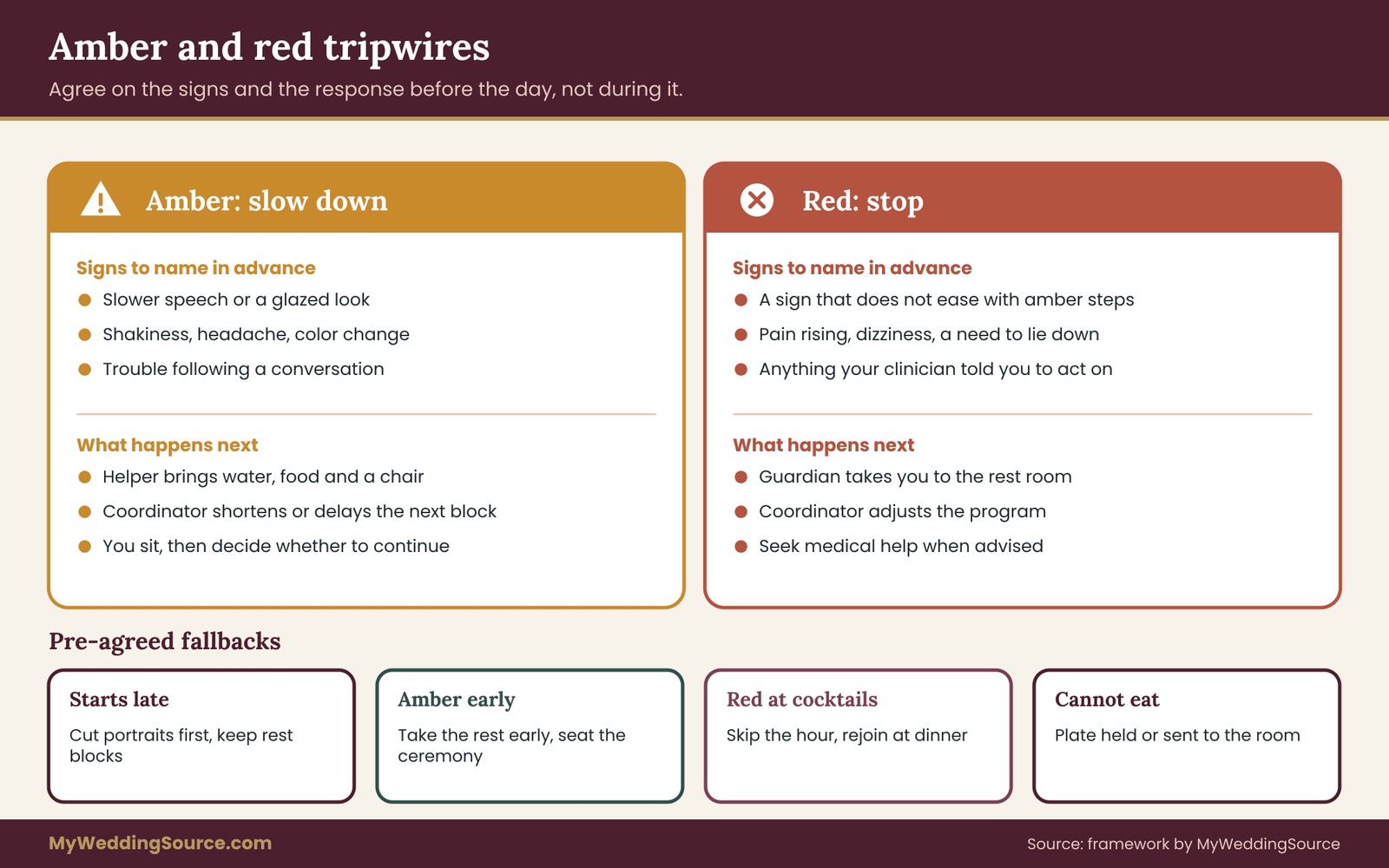
Use two levels. Amber means the early signs of wedding fatigue are showing and a short intervention is needed. Red means you should stop what you are doing and go to the recovery room.
Amber signs come from your pattern note: slower speech, a glazed look, shakiness, a headache, a change in color, trouble following a conversation. The response is small and quick. A helper brings water, a snack and a chair. The coordinator shortens the current block or moves the next one back by ten minutes. You sit, drink and eat, and you decide whether to continue.
Red signs are stronger or last more than a short time: pain rising, dizziness, a symptom that has not responded to the amber steps, a need to lie down, trouble breathing or chest symptoms. Red means you stop. The guardian takes you to the recovery room, everyone else carries on, and the coordinator adjusts the plan.
If you have a condition with risks, ask your clinician in advance for the symptoms that mean seek medical help right away and tell your helper. Do not try to manage a medical emergency through a wedding timeline. Call emergency services when a situation warrants it.
Pre-agreed fallbacks
For each tripwire, write the fallback. Here are examples to adapt.
If the day starts late by more than thirty minutes, cut the portraits first, since they are the easiest block to shorten, and keep the rest blocks intact.
If you hit amber before the ceremony, take the recovery block early and run the ceremony as a seated version.
If you hit red during the cocktail hour, skip the rest of it and go to the recovery room. The coordinator can announce that the couple will join the party at dinner.
If you cannot manage dinner, ask the caterer to hold your plate for later or send it to your room. The toasts can happen with you seated or even with only one partner present.
If you need to leave early, the coordinator tells the DJ, and the exit moves up. Your friends can carry on a party with or without you.
Who decides
The hardest part is that the person in trouble often judges worst. Excitement masks signs, and many people hate to cancel. Decide beforehand that either partner, the coordinator or the helper can call an amber pause, and that the couple agree not to argue with the call in the moment. The rule is for the benefit of the whole day. A single paused fifteen minutes is cheaper than a lost evening.
After a tripwire fires
Afterward, reassure the guests lightly if wedding fatigue was visible, and move on. A line such as “We took a short rest and we’re back” is enough. No explanation of a health condition is owed. If guests ask later, you can decide how much to say. The point is that a fallback is a normal feature of a thoughtful day, not a failure.
A guide on wedding guest care planning offers ideas on how to look after guests with their own needs, which also helps the couple in a pinch, since the helpers are the same people.
Alternative formats when wedding fatigue rules out the standard day
Sometimes careful pacing is not enough, because the standard shape of a wedding day is too long for the couple’s limit. In that case the answer is not to push harder. It is to pick a different shape. The formats below keep what couples usually want, which is a marriage, the people they love and a celebration, while changing how the hours are arranged.
Trimmed single day
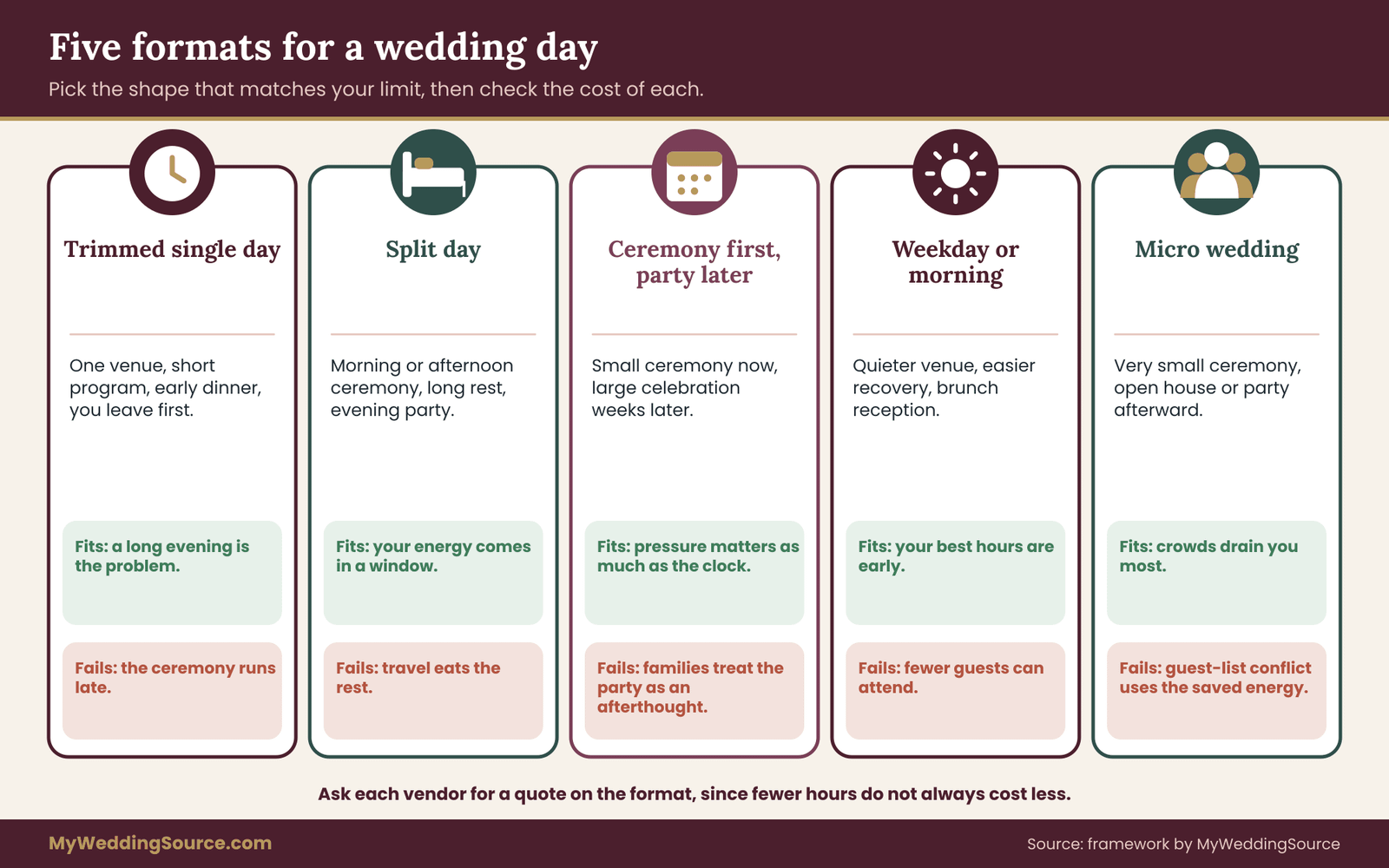
The simplest alternative for wedding fatigue is to keep one day and cut it down. The ceremony and reception share a venue, the program is short, there is no receiving line, the portraits are limited, and dinner is early. The couple leaves while the party continues. This works well when the main problem is the length of the evening, not the ceremony. Its weakness is that all heavy blocks still fall within the same ten hours, so the rest blocks have to be strictly protected.
Split day
A split day divides the wedding into two parts with a long rest in between. For example, a late-morning ceremony and light lunch with close family and friends, a long afternoon break, and an early-evening party for everyone. Or the reverse: a private ceremony the day before and a larger reception on the day. Splitting suits couples whose energy comes in a clear window and who need a real nap, treatment session or quiet stretch.
Its cost is logistical. Guests may need two outfits, two travel plans or two sets of timings, and vendors may charge for two sessions. Ask the venue whether a split booking is possible and how it prices it.
Ceremony first, celebration later
Some couples marry in a small, calm ceremony, then hold a larger celebration weeks or months afterward, when they are rested and the pressure is gone. The legal marriage is done, the photographs are taken in a relaxed way, and the party has no clock. The tradeoff is a second round of planning and a gap between the two events that some families dislike. It can still be the lowest-cost way to protect your health and give guests a good party.
Weekday or morning wedding
A weekday or morning wedding often costs less and brings a quieter venue, fewer crowds and easier recovery. If your best hours are early, a morning ceremony with a brunch reception can fit your pattern better than any evening. The tradeoff is that fewer guests can attend. Weigh that against the benefit of a day you can enjoy, and consider whether livestreaming or a later gathering helps those who cannot come.
Micro wedding or elopement with a party later
A very small ceremony, with a handful of guests or none, removes most of the crowd-related drains. The couple can rest in the same place, and a longer rest schedule is invisible. A party or open house later gives everyone else a chance to celebrate. A small wedding is not a lesser wedding. It is a different shape, and for couples with serious limits it can be the one in which they are most present.
How to choose a format for wedding fatigue
Use a short decision rule. Count the heavy blocks your plan requires, using the Spend, Seat, Recover ratings. If you can fit them under your limit with the trimmed single day, choose it. If heavy blocks still crowd each other, because the problem is the length of the whole day, consider a split day. If the problem is the pressure and the audience as much as the clock, consider ceremony first and celebration later.
If travel for guests is the main concern, consider a weekday or morning event. If more than two of these problems apply at once, a micro wedding with a later party may be the honest answer.
Then check the cost. Cutting hours does not always reduce the price. Many venues have minimums, and some vendors charge a fixed fee regardless of time. Ask for quotes on each format, and compare them with the rest blocks you would still need.
Failure conditions for each format
Every format has a point where it stops working, and it helps to name it. A trimmed day fails when the ceremony runs late and portraits cannot be cut further. A split day fails when travel between the halves eats the rest. A later party fails when relatives treat the small ceremony as the real event and the party as an afterthought. A micro wedding fails when family conflict over the guest list consumes the energy you saved. If your plan fits one of those descriptions, adjust early, before deposits are paid.
Helpers, guests and the days around the wedding
A wedding fatigue plan does not stop at the edges of the wedding day. The day before and the day after both affect how much you have to spend, and the people around you decide whether the plan holds.
The day before
The rehearsal and the evening before can be as draining as the wedding itself. Travel, greeting arriving guests, the rehearsal dinner, decorating and last-minute errands all draw from the same account. Treat the day before as a light day, because wedding fatigue carries over. Keep the rehearsal short, hold the dinner small or early, and hand the setup to others.
Sleep and a regular meal are the main goals. If you are traveling to a destination, arrive at least a day or two early, if you can, so that the trip does not eat the wedding.
Do a short run-through of the day’s timeline with the helpers. Walk to the recovery room, test the route, check the chairs, and put the bag in place. Confirm medication, food and any equipment you need. If your treating professional gave you guidance for the event, read it again.
Choosing and briefing helpers for wedding fatigue
Pick two or three helpers, not ten. A helper should be calm, willing to be firm and not so emotionally involved that they cannot make a call. Close friends and siblings often make good choices, but parents can find it hard to be the person who says no to guests. Give each helper a clear job: one guards the rest blocks, one carries the bag and food, one speaks to vendors. Give them the pattern note and a printed run sheet.
Brief them on the wedding fatigue failure conditions and the rule that they can call a pause. Tell them what not to do: do not hover, do not ask repeatedly how you feel, do not apologize to guests on your behalf. The best help is quiet and specific.
Telling guests without over-explaining
Guests do not need your medical details. They need to know the shape of the day and what to expect from you. A line on the website or program can do this: the couple will be seated for much of the day, will take rest breaks, and may leave early. Say it warmly and briefly. Tell close family in person, so they are not offended when the receiving line disappears or when you head to a rest room after the ceremony.
Prepare two or three short phrases for the day. “Thank you, we’re going to sit for a moment” and “We’ll come by your table after dinner” are enough. Most guests respond kindly, and a few will push. Your helpers can handle those.
Think about guests with their own needs as well. Older relatives, small children and anyone with limited mobility will also benefit from seats, shade, water and a quiet place. Making those provisions part of the day means yours do not stand out.
The day after
Leave the day after the wedding empty. If you have a brunch with family, make it optional or short, and consider skipping it. If you are traveling for a honeymoon, build in a rest day first, or delay the trip. Many couples find the wedding fatigue after the event as large as the day itself. Sleep, food and quiet are the priorities, and thank-you messages can wait.
Check in with your clinician if your condition flared. Share what you learned about the day with each other: what worked, what you would change, which signs you missed. That reflection helps with future events, such as a family gathering or a holiday, and it records what your body told you.
Running a wedding fatigue rehearsal day
One test before the wedding is worth more than any amount of planning. Pick a Saturday a few weeks ahead and run a compressed version of the day. Dress in the shoes you will wear. Sit in the chairs. Stay in the order of blocks for the first three hours at the real times. Take the recovery blocks and time how long they actually take to work. Eat the meals you plan to eat. Note when amber signs appear and what helped.
Afterward, change the numbers. If you needed fifty minutes of recovery and the plan allowed thirty, the plan was wrong, not you. Adjust the buffer, move a block, or cut one. The result is a timeline based on your results, and that is the one that holds on the day.
Your next steps
Do these in order, over about three weeks, and your wedding fatigue timeline will have a real foundation.
First, spend two weeks noting your best window, your costliest activities, your recovery needs and your early warning signs. Write them on one page. Share the page with your treating professional and ask whether anything about timing, medication, food or heat should change for the wedding day.
Second, list every block of your current timeline and rate each as heavy, medium or light. Apply the three rules: no two heavy blocks touch, the couple’s meal is fixed, and the day has a spending limit. Write the seated version beside every block, and add recovery blocks with a place, contents, length and guardian.
Third, hold the vendor meeting. Send the written summary, collect the confirmations and update contracts where hours or prices change. Name your helpers and brief them. Write the amber and red signs, and the fallbacks.
Fourth, run the rehearsal day, adjust the numbers and finalize the run sheet. Then protect the day before and the day after.
If the timeline still does not fit your limits, choose one of the alternative formats before you pay more deposits. A shorter or differently shaped wedding is a good wedding. The point of a plan for wedding fatigue is that you arrive at the end of the day still able to enjoy the people who came for you.
FAQ
How much buffer time does wedding fatigue require in a timeline?
There is no universal number. A reasonable starting point is a recovery block of about half the length of each heavy block, with a floor of around twenty minutes, plus extra transition time between rooms. Test it in a rehearsal and adjust. Your own experience and your clinician’s guidance matter more than any rule of thumb, and a plan that works for another couple may not suit you.
Can the couple sit for the whole ceremony?
Yes. Many ceremonies are designed with two chairs at the front, and some couples stand only for the vows and rings. A circle or table format also suits sitting. Tell the officiant, the musicians and the photographer ahead of time, and put it in the written cue sheet. Guests usually take their cue from the couple’s ease.
Should we skip the receiving line?
Often, yes. A receiving line asks the couple to stand and greet every guest in sequence, which is a heavy block. Greeting guests at their tables during dinner, or at a seated spot near the entrance, achieves the same purpose with more control over pace, and you can eat first. Mention the plan in the program so guests expect it.
Do venues have to provide a rest room or accessible routes?
It depends on the venue, the law that applies and the details of the space. The Department of Justice publishes Americans with Disabilities Act information at ADA.gov, and the ADA National Network offers plain-language guidance. For a specific question, ask the venue directly and, if needed, a qualified professional. Ask for any rest room, route or seating you rely on to be written into the contract.
What if wedding fatigue hits harder than expected on the day?
Use the tripwires you wrote beforehand. At the first amber signs, a helper brings water, food and a chair, and the coordinator shortens or delays the next block. At red signs, you stop and go to the recovery room. If you have a medical concern, follow the advice of your clinician and call emergency services when the situation calls for it.
Is a shorter wedding day worth it for wedding fatigue?
For many couples with limited energy, yes. A shorter or split day lets you be present for the parts that matter and avoids the crash that can follow a very long day. Compare formats by counting heavy blocks and checking vendor minimums. Cutting hours does not always cut costs, so ask for quotes before choosing.
How do we explain our needs to guests without sharing health details?
You do not have to share any. A line on the website or in the program that says the couple will take rest breaks, sit for much of the day and may leave early is enough. Prepare two short phrases for the day, such as “We’re going to sit for a moment,” and let helpers handle persistent questions.
Should we tell our vendors about our condition?
Share what they need to do their job, not more. “We need seated portraits, a protected rest after the ceremony and dinner served early” is a useful instruction. Details of a diagnosis are your choice, and vendors do not need them to change a schedule. Put every change in writing, with times, rooms and the person responsible.
Sources
- Americans with Disabilities Act information and guidance, U.S. Department of Justice
- ADA National Network, information, guidance and training on the Americans with Disabilities Act
- U.S. Access Board, accessibility guidelines and standards
- Sleep and sleep disorders, Centers for Disease Control and Prevention
- Heat safety, National Weather Service
- Heat and your health, Centers for Disease Control and Prevention
- National Institute on Aging, health information for older adults
- Food safety information, U.S. Department of Health and Human Services
- Job Accommodation Network, workplace accommodation guidance
- U.S. Department of Health and Human Services